Trump administration sued to disclose funding for controversial Gaza aid group
Press TV – August 21, 2025
An American legal advocacy organization has filed a lawsuit to seek the source of funding for the controversial US and Israeli-backed group delivering aid in the Gaza Strip.
The US-run Gaza Humanitarian Foundation (GHF), a so-called humanitarian group set up to cater to the needs of the Palestinian people, has cost the lives of hundreds of Gazans, already ravaged by famine and genocide.
International aid experts have described GHF’s distribution points as “death traps, criticizing the relief group’s work model as “an insult to the humanitarian enterprise and standards.”
GHF spokesperson Chapin Fay told Channel 4 of the UK last week that Western European countries funded GHF, but that he would not reveal which countries did it.
On Wednesday, the New York-based Center for Constitutional Rights (CCR) filed a lawsuit to seek the source of GHF’s funding and its initial tens of millions of dollars paid as salaries and the travel expenses to its aid workers, who have been described as “mercenaries.”
The CCR was investigating the legality of GHF’s charter and demanding that its financial records be revealed under the Freedom of Information Act.
In its lawsuit, the CCR requested that Delaware’s Attorney General Kathy Jennings “investigate GHF and revoke its charter on grounds that it is illegally abusing its privileges with its complicity in war crimes, crimes against humanity, and genocide.”
The New York-based firm said it filed its lawsuit against the Donald Trump administration for its failure to comply with its request.
The CCR said it aims to follow the money to find who is funding the failed aid operation.
“Today’s lawsuit seeks records that could shed light on not only the decision-making process… but also on the creation of GHF, its funding and how it plans to use” a US government grant, the CCR said.
“The Center for Constitutional Rights is particularly interested in information that could reveal whether the administration’s distribution of funds has any link to President Trump’s ‘Gaza Riviera’ plan, which would cleanse the area of Palestinians and redevelop it for investors,” the statement said.
Since GHF began its relief operations in southern Gaza in May, which have left over 1,000 Palestinians seeking food aid dead at its four distribution points across Gaza, its funding sources have been a secret.
US military contractors who staff GHF have also been seen in videos shooting at aid seekers – something former US special forces soldier Anthony Aguilar confirmed after leaving the organization.
“GHF, far from alleviating suffering in Gaza, is contributing to the forced displacement, killing and furtherance of genocide of Palestinians,” the CCR said.
GHF food aid distribution points “have become synonymous with scenes of chaos and carnage,” it added.
Meanwhile, human rights experts familiar with the matter say the word “humanitarian” in the title of the organization only serves to “add to Israel’s humanitarian camouflage.”
“Without clear accountability, the very idea of humanitarian relief may ultimately become a casualty of modern hybrid warfare,” they warned.
Analysts say the United States and the Israeli regime created GHF to bypass the United Nations’ central role in aid distribution in Gaza.
The UN has refused to cooperate with the US-Israeli program, calling it a militarized aid model that would result in the displacement of the Gaza people.
Since the Israeli regime launched its genocidal war in Gaza in October 2023, most of the population has been forced to relocate, some of them several times.
More than 62,122 people in Gaza, most of them women and children, have been killed during this time, according to Gaza’s Health Ministry.
London closing in on $2.7bn contract with Israeli firm to train 60,000 British troops per year
The Cradle | August 21, 2025
The British Ministry of Defence (MoD) is preparing to sign a $2.7-billion contract with Elbit Systems – Israel’s largest arms manufacturer – that would see the company train 60,000 British troops each year and be designated a “strategic partner,” according to a report by Private Eye.
The British branch of Elbit is competing against US firm Raytheon for the Army Collective Training Service contract. In February, the MoD reduced the shortlist to the two bidders.
If the contract is granted, Elbit would oversee a sweeping overhaul of British army instruction “through digitalisation, simulation, a different relationship with industry, and by changing how and where the military trains.”
This prospective contract follows revelations earlier this month that Elbit signed a $1.64-billion arms deal with Serbia to supply long-range precision rockets and other military systems.
Last month, Francesca Albanese, the UN special rapporteur for Palestine, said that “for Israeli companies such as Elbit Systems … the ongoing genocide has been a profitable venture.”
Elbit supplies around 85 percent of Israel’s drones and ground-based hardware, directly fueling its war on Gaza.
Since 2023, Elbit’s British arm has managed the MoD’s Project Vulcan, a £57-million (around $74.1 million) program providing simulation-based training for tank crews. The new $2.7-billion agreement would mark a major escalation of that relationship.
In September, the government suspended 30 of 350 arms export licences to Israel after a review found a clear risk of British-made components being used in violations of humanitarian law.
However, export permits for F-35 parts, which are deployed directly in Gaza, were exempt from the freeze.
Private Eye said it asked the MoD whether it considered it appropriate to hand such a contract to a company so deeply involved in the Gaza war, but the ministry did not reply.
Elbit subsidiaries in the UK have been the main target of Palestine Action, which the government banned last month as a terrorist group.
US expands sanctions against ICC
RT | August 21, 2025
The US has imposed sanctions on two judges and two prosecutors of the International Criminal Court (ICC) for their role in pursuing cases against American soldiers and Israeli officials.
According to a State Department statement on Wednesday, Judge Kimberly Prost was blacklisted for approving The Hague-based court’s investigation into the conduct of US troops in Afghanistan.
Judge Nicolas Yann Guillou was sanctioned for issuing arrest warrants for Israeli Prime Minister Benjamin Netanyahu and former Defense Minister Yoav Gallant on charges of war crimes in Gaza. In addition, deputy prosecutors Nazhat Shameem Khan and Mame Mandiaye Niang were blacklisted for upholding the warrants. Neither the US nor Israel is a party to the ICC.
The ICC rejected the designations as “a flagrant attack against the independence of an impartial judicial institution, which operates under a mandate from 125 States Parties from all regions.”
US President Donald Trump imposed his first sanctions on the ICC in February, accusing the court of “illegitimate and baseless actions targeting America and our close ally Israel.” Netanyahu similarly denounced the arrest warrants, calling the ruling “anti-Semitic.”
In 2024, the ICC placed Netanyahu and Gallant on its wanted list after finding “reasonable grounds” that Israel had denied humanitarian aid into Gaza, where more than 60,000 people have been killed since 2023.
Netanyahu rejects Gaza deal, reviews plans to occupy Gaza City instead
Al Mayadeen | August 20, 2025
Israeli Prime Minister Benjamin Netanyahu has decided not to respond to the proposal recently approved by Hamas, despite efforts by mediators to push forward a deal.
US envoy to the Middle East, Steve Witkoff, has also distanced himself from the formula he initially supported, with reports noting that he no longer trusts the mediators.
Despite endless Israeli claims that Hamas was being unreasonable and not flexible throughout previous negotiation rounds, the Palestinian Resistance in Gaza had already agreed to the new proposal, which is nearly identical to the Witkoff paper previously proposed.
On Monday, Hamas and other Palestinian factions announced their approval of the proposal put forward by mediators from Egypt and Qatar.
Netanyahu to review new genocide phase
Instead of adhering to the demands of his people, who have been protesting against the resumption of the war in Gaza, Netanyahu is expected to arrive at the Southern Command on Thursday to approve military plans to occupy Gaza City.
“Negotiations will be held under heavy fire, and everything depends on reaching an agreement,” Israeli media said.
Meanwhile, the Israeli military spokesperson for the occupation army confirmed on Wednesday evening the launch of the second phase of “Operation Gideon’s Chariots (B)” aimed at occupying Gaza City.
According to the military spokesperson, the 162nd Division has begun operations from Jabalia in the northwest as part of a broader plan to tighten the siege on the city. The statement said the campaign may take an extended period, but could also be halted depending on political directives. It added that the maneuvers are being carried out by conscript units supported by 133,000 reserve soldiers.
At the same time, occupation authorities issued a statement to the settlers of the Gaza Envelope warning of the possibility of hearing heavy explosions and artillery fire “from now on.”
The operation is widely viewed as part of the broader ethnic cleansing plan against Gaza’s population, aiming to depopulate the city through siege, destruction, and forced displacement under the guise of military maneuvers.
The Israeli flag just became the only national flag illegal to burn in the United States
When Criticizing Israel Becomes a Hate Crime: How One Ruling Betrayed the First Amendment
By Shaun King | The North Star | August 16, 2025
The Flag America Protects
This week in Washington, D.C., a federal judge made a ruling so shocking, so unprecedented, that it flips the First Amendment on its head. Judge Trevor N. McFadden declared that the Israeli flag — with the Star of David at its center — is not a political symbol at all, but a racial one.
He ruled that tearing it, grabbing it, desecrating it, even in the heat of protest, is not free expression but racial discrimination.
Think about that. In the United States, you can burn the American flag — the Supreme Court has said so for decades. But now, according to this ruling, burning or tearing the Israeli flag could make you guilty of racial hatred. The one national flag protected in American law today isn’t our own. It’s Israel’s.
You can burn the flags of all 50 states. You can torch the American flag all you want. You can burn the flags of the UK or France or Brazil or China.
But not Israel.
The Supreme Court’s Bedrock Principle
The highest court in the land has spoken clearly: you cannot criminalize burning the American flag. In Texas v. Johnson(1989), Justice William Brennan wrote:
“If there is a bedrock principle underlying the First Amendment, it is that the government may not prohibit the expression of an idea simply because society finds the idea offensive or disagreeable.”
The following year, in United States v. Eichman (1990), the Court struck down another attempt to ban flag burning, reminding the country that:
“Punishing desecration of the flag dilutes the very freedom that makes this emblem so revered, and worth revering.”
In America, even the Stars and Stripes — the nation’s own sacred symbol — cannot be placed above criticism or protest. That is what freedom means. And yet in 2025, a federal judge just carved out an exception — for a foreign flag.
How the Israeli Flag Was Elevated
The case came from dueling protests in D.C. last fall. Kimmara Sumrall, a pro-Israel activist, draped the Israeli flag around her shoulders as a cape. A pro-Palestinian demonstrator yanked it. A police officer saw it and arrested the woman.
The criminal court acquitted her. But Sumrall filed a civil rights lawsuit, backed by the National Jewish Advocacy Center, arguing that this wasn’t just an assault — it was racial discrimination.
Judge McFadden agreed. In his ruling, he wrote:
“Purposefully yanking on an Israeli flag tied around a Jewish person’s neck… is direct evidence of racial discrimination. The Star of David — emblazoned upon the Israeli flag — symbolizes the Jewish race.”
With that, he collapsed the line between a political symbol and a people’s identity. He went so far as to compare attacking the Israeli flag to using the N-word against a Black person.
No other flag in the world has been granted this kind of protection in an American courtroom. Not Britain’s. Not Canada’s. Not Mexico’s. Not even our own. Only Israel’s.
Civil Rights Law Twisted
To reach this conclusion, McFadden invoked the Civil Rights Act of 1866, written to protect newly freed Black Americans. Later, in 1987, the Supreme Court held that Jews and Arabs were covered as “races” under this law.
But McFadden went further than any court before him. He declared that the flag of Israel itself is a racial symbol — and therefore protected. And in doing so, he turned what was supposed to be a shield for the oppressed into a shield for an oppressive foreign government.
The Global Contrast
Everywhere else in the democratic world, flag burning is understood as a political expression. The European Court of Human Rights has ruled again and again: desecrating a flag, however offensive, is free speech.
It is only authoritarian regimes that conflate their flags with their people, criminalizing dissent in the name of “unity.” Now, America has imported that same authoritarian logic — not to protect our own flag, but to protect Israel’s. It’s wild to see.
The Stakes for Protest
The implications are chilling. If this ruling stands, tearing down or burning an Israeli flag at a protest could be treated as a federal hate crime. Shouting against Zionism near someone draped in the flag could be called racial harassment.
This isn’t about protecting Jewish people from violence. It’s about shielding Israel from protest while it bombs and starves children in Gaza.
One Flag Above All
Let’s be brutally clear. The Israeli flag is now the only national flag that American courts have declared effectively immune from desecration. The Stars and Stripes itself can be burned in the name of protest. Israel’s flag cannot.
That is not constitutional law. That is political favoritism dressed up as civil rights. And it represents a betrayal of the First Amendment.
Shaun King is an American writer & activist.
Israel’s man inside the CIA betrayed the US, new files show
By Kit Klarenberg, Wyatt Reed | The Grayzone | August 15, 2025
Veteran CIA counterintelligence chief James Angleton secretly oversaw a top-level spy ring involving Jewish émigrés and Israeli operatives without “any clearances” from Congress or Langley itself, according to recently declassified documents published as part of the Trump administration’s pledge to disclose all available information on the assassination of President John F. Kennedy.
The files provide a fresh and often disturbing look at a spy described by historian Jefferson Morley as “a leading architect of America’s strategic relationship with Israel,” detailing Angleton’s role in transforming the Mossad into a fearsome agency with global reach, while assisting Israel’s theft of US nuclear material and protecting Zionist terrorists.
Angleton established the Jewish emigre spying network in the aftermath of WWII, with the apparent goal of infiltrating the Soviet Union. But as the files show, the spymaster considered his “most important” task to be maintaining the supply of Jewish immigrants flowing from the Soviet Union towards the burgeoning Israeli state.
According to Angelton, his Jewish assets were responsible for 22,000 reports on the USSR, generating several intelligence masterstrokes. Chief among them was the publication of Soviet Prime Minister Nikita Kruschev’s famous 1956 secret speech denouncing Stalin, which the spymaster boasted “practically created revolutions in Hungary and Poland.” Elsewhere, Angleton bragged that his arrangement with Israel had produced “500 Polish intelligence officers who were Jewish” who “knew more about Polish intelligence than the Poles.”
Other passages appear to show Angleton taking credit for securing the “release” of several Zionist terrorists affiliated with the Irgun militia before they could be convicted for bombing the British embassy in Rome. Though the group had been captured by Italian authorities, the newly-disclosed files indicate the terror cell was freed on the orders of the CIA.
The information was originally divulged in 1975 to senators serving on the Church Committee, which probed widespread abuses by US intelligence in the decades prior. Congress was particularly interested in claims by New York Times foreign correspondent Tad Szulc, who testified under oath that Angleton had personally informed him that the US provided technical information on nuclear devices to Israel in the late 1950s. The new documents show that Angleton was deceptive under questioning, and evaded questions on Israel’s nuclear espionage efforts on the record.
Additional unsealed FBI documents, which refer to Israel’s Mossad as Angleton’s “primary source” of information, confirm that the CIA’s head of counterintelligence relied heavily on Tel Aviv to solidify his position within the Agency – and also add to the growing body of evidence that Angleton may not have been operating with US interests in mind throughout his 21-year tenure.
Other newly declassified files from the FBI have shown that Angleton maintained a wildly lopsided relationship with the Bureau, which saw federal agents deferring to the CIA counterintelligence chief after they caught him surveilling the correspondence of huge numbers of Americans. The files show Angleton openly admitting he would have been fired if Langley caught wind of his leaks to the Bureau.
A side-by-side analysis of the now-unredacted Church Committee files compared with their previously-released versions from 2018 demonstrates that even after 70 years, Washington felt compelled to conceal details of its real relationship with Israel’s founders. Over a dozen references to “Israel,” “Tel Aviv,” or descriptions of figures as “Jewish,” which were scrubbed from the 2018 release, can now be viewed on the National Archives site.
The documents reveal that Angleton repeatedly lied to multiple Congressional bodies, including the Church Committee, which investigated CIA abuses, and the House Select Committee on Assassinations, which probed the murders of John F. Kennedy and Martin Luther King, Jr. Angleton was similarly evasive when interrogated over Israel’s nuclear weapons program, and about CIA knowledge or complicity in the scheme.
Those documents also reveal that Angleton’s CIA counterintelligence staff ordered Lee Harvey Oswald’s removal from federal watchlists six weeks before Kennedy’s assassination, despite his classification as a high security risk. The surveillance of Oswald was personally overseen by a member of Angleton’s intelligence network of Jewish emigres, Reuben Efron, a CIA spy from Lithuania. Angleton had placed Efron in charge of an Agency program called HT/Lingual which intercepted and read correspondences between Oswald and his family.
Numerous historians have questioned why the CIA counterintelligence chief insisted for decades on personally overseeing what he described as the “Israeli account.” Though several off-the-record interactions remain impossible to parse, the documents show that when grilled about his “unusually close” connections to the Israeli Mossad, Angleton acknowledged forming an “arrangement” in which, “in most simplistic terms, [the Israelis] were informed that we would not work with them against the Arabs, [but] that we would work with them on Soviet bloc Intelligence and communism.”
Freeing Zionist terrorists
One of the earliest instances of Angleton’s cooperation with Zionist elements came as Zionist militants embarked on a terrorist campaign to pressure the British colonial authorities to leave Mandate Palestine.
In October 1946, three months after they bombed the British administrative headquarters at the King David Hotel in Jerusalem, members of the right-wing Irgun militia planted explosives in the British embassy in Rome in a failed bid to assassinate the UK’s ambassador to Italy.
According to Angleton, after the Irgun “blew up the British embassy in Rome” in 1946, the CIA intervened to ensure they escaped Italy without prosecution.
“We had the members of the group, and then we had the dilemma again as to whether we turned them over to the British authorities,” noted Angleton, who had served as counterintelligence chief for the Italian branch of the Office of Strategic Services, the CIA’s predecessor. “And we were in a position to make the decision one way or the other. And eventually we came down on the side of releasing them.”
A secret deal with the Mossad
As Washington sought to manage the political ruptures caused by the creation of Israel, and monitor the wave of Soviet migrants pouring into the self-proclaimed Jewish state, Angleton framed his takeover of “the Israeli account” as a convenient way for US intelligence to kill two birds with one stone.
“The other side of the Israeli problem was that you had thousands coming from the Soviet Union and you had the Soviets making use of the immigration for the purpose of sending illegal agents into the West and breaking down all the travel control, identifications and so on. And so there was both a security problem and a political problem.”
To manage these “problems,” the US and Israelis brokered a deal involving the secret exchange of “papers and signals, communications intelligence, [and] the other products of intelligence action,” Angleton stated. The spy chief claimed the only records of the 1951 arrangement held by the US side would be in the possession of the Agency, and admitted US Congress had been left in the dark, telling senators, “I don’t think there were any clearances obtained from the Hill.”
Asked by one legislator how it was “possible for succeeding directors of the intelligence agency to understand what the agreements were between” US and Israeli intelligence, Angleton responded: “Very simple. They saw the production to begin with. And they met with directors or the head of Israeli intelligence. And they met with Ambassadors and prime ministers. And they were very much involved.”
Grooming Zionist spies “outside the structure” of the CIA
Angleton was especially protective of what he called “the fiduciary relationship” with Tel Aviv, assembling a close-knit clique of Jewish Americans with dubious loyalties to manage it as World War Two drew to a close. “I started from the south side with two Jewish men who worked with me during the war,” he explained. Having “sent them over as ordinary people under cover” to get their bearings in newly-formed Israel, Angleton “brought over six others and put them through some months of training, outside of the structure” of the CIA.
“To break down the fiduciary relationship – which is after all a personal business – all the men I have had, were men who stayed in it and came back to headquarters and went back to Tel Aviv, they went to the National Security Council, and went back to Tel Aviv, et cetera.”
“It was probably the most economical operation that has ever been devised in the U.S. Government,” Angleton crowed. “I don’t think there was [sic] more than 10 people that were hired in the same process.”
Having trained these spies “outside of the structure” of the CIA, it’s unclear how Angleton ensured they remained faithful to US national security objectives, or whether he ever intended to.
Enabling Israeli theft of US nuclear material, spying on America
Angleton’s role in enabling Israel’s wanton theft of nuclear material from an American facility is one of the more shocking episodes in the US-Israeli relationship. The scene of the crime was the Nuclear Materials and Equipment Corporation, or NUMEC, a uranium processing facility in Apollo, Pennsylvania owned by a Zionist financier named David Lowenthal. In 1965, Zalman Shapiro, a fellow Zionist hired by Lowenthal to run the plant, illegally diverted hundreds of kilograms of nuclear fissile material to Israel. Posing as a scientist, the notorious Mossad spy Rafi Eitan visited NUMEC three years later to continue the heist.
As Jefferson Morley documented in his biography of Angleton, “The Ghost,” the late CIA counterintelligence chief made sure the CIA looked the other way as Israel constructed its first nuclear weapon out of the stolen fissile material. According to Morley, “Angleton, it is fair to say, thought collaboration with Israel was more important than U.S. non-proliferation policy.”
A 1977 investigation by the US Government Accountability Office found that the CIA withheld information about the NUMEC nuclear theft from the FBI and Department of Energy, and “found that certain key individuals had not been contacted by the FBI almost 2 years into the FBI’s current investigation.”
The latest batch of Church Committee files add new detail about Angleton’s compromising of US national security to benefit Israel, and his attempts to cover up his betrayal.
During his testimony before the Committee, Angleton was pressed about media reports alleging that he and his counterintelligence unit provided Israel with technical support for constructing nuclear weapons. He strenuously denied the charges, insisting the CIA had never played any role in providing Tel Aviv with nuclear materials. However, when questioned about whether “Israeli intelligence efforts” were ever conducted in the US “aimed at acquiring… nuclear technology,” Angleton equivocated.
First, he blustered, “there have been many efforts by many countries to acquire technical knowledge in this country, and that doesn’t exclude the Israelis.” Asked if CIA counterintelligence had “certain knowledge” of Israeli agents “trying to acquire nuclear secrets in the US,” Angleton pleaded, “Do I have to respond to that?”
The Committee then went “off record” at the senators’ request, making Angleton’s responses impossible to scrutinize.
In a secret 1975 memorandum to the FBI, the ousted CIA counterintelligence chief disclosed that he had “avoided any direct answers” during his Senate testimony on Israel’s spies carrying out “intelligence collection” to gather “nuclear information” in the United States.
Just days later, a Bureau report on “Israeli intelligence collection capabilities” revealed Angleton entertained “frequent personal liaison contacts” with Mossad representatives at Israel’s Washington DC embassy between February 1969 and October 1972. This “special relationship” involved “the exchange of extremely sensitive information.”
Further, the 1975 FBI memo on Angleton disclosed the Israeli embassy’s establishment of a “technical intelligence network” seven years earlier which was directed by an Israel scientist who worked on Tel Aviv’s nuclear program. This may explain why Angleton was so cagey under Senate questioning.
“Israeli matters” trigger Angleton’s downfall
The Church Committee files show Angleton bristled at then-CIA Director William Colby’s efforts to apply a modicum of transparency to the Agency’s activities, especially as they related to Israel. The spymaster warned that if the USSR ever caught wind of Langley’s use of the self-proclaimed Jewish state as a de facto halfway house for communist turncoats, they would almost certainly end their policy of encouraging Eastern European Jews to migrate to Israel:
“This idea of opening the doors and letting the light in, and breaking down compartmentation, and breaking down the need to know, would inevitably put in jeopardy the immigration, if the Soviets should learn the extent of the activities,” Angleton stated.
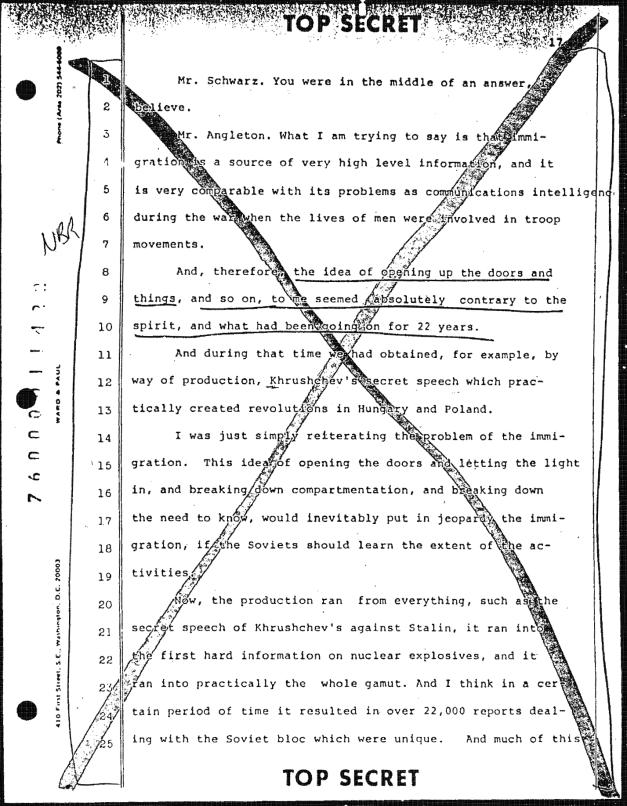
Colby fired Angleton in 1974 after the New York Times revealed that he devised an illegal program of domestic spying targeting antiwar American dissidents. In his testimony, Angleton framed their clash as an interpersonal conflict, describing Colby as “not my cup of tea professionally or in any other way.”
Yet Angleton also acknowledged to Senate that a “dispute in connection with these Israeli matters” between himself and Colby contributed to his departure from the Agency. Was this a reference to the former spook’s involvement in Israeli theft of US nuclear secrets, enabling Israel to acquire the bomb?
Whatever the case, it was clear why Angleton would be remembered more fondly in Israel than inside the country he ostensibly served.
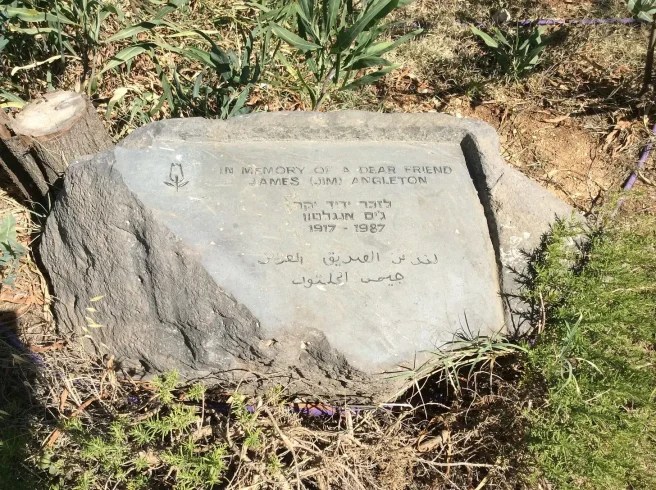
On December 4, 1987, the director of Israel’s Mossad and Shin Bet intelligence services gathered in secret on a hillside in Jerusalem to plant a tree in honor of Angleton. They were joined there by five former Israeli spy chiefs and three former military intelligence officers.
Despite attempts to keep the ceremony under wraps, two local reporters managed to evade the cordon to record the ceremony for the former CIA counter-intelligence director, who had died seven months prior. Together, the Israeli spooks laid a memorial stone that read, “In memory of a dear friend, James (Jim) Angleton.”
Armed Settler Militia Terrorizes Ibziq, Assaults ISM Volunteers
International Solidarity Movement | August 18, 2025
On the night of August 11th, two ISM volunteers were assaulted, beaten, and robbed by a mob of at least eight armed settlers dressed in full military-style uniforms in the rural shepherding village of Ibziq. The volunteers were engaged in protective presence, which includes documenting illegal intrusions into Palestinian communities and recording and opposing intimidation, threats, and attacks led by Zionist militias against Palestinians across the Jordan Valley.
The settler militia entered the remote village around 7PM in dune buggy-style military vehicles, wearing helmets and balaclavas, and carrying assault rifles. The militia canvassed the village for over an hour, trespassing into community school grounds and upon critical water infrastructure before moving on to block Palestinian traffic and terrorize local residents with threats of arson and theft.
When the settler militia directly entered a Palestinian family’s home, the ISM volunteers—both U.S. citizens, one residing in Jerusalem and the other in Liverpool, UK—intervened by approaching the settlers and stating the militia were illegally encroaching upon Palestinian lands, violating the human rights of Palestinians, and contravening international law.
Although the volunteers had their hands up to indicate that they were unarmed and nonviolent, the militia members pinned one ISM volunteer to the ground and he was repeatedly beaten. Amidst the thrashing, settlers also kicked sand and dirt into the volunteer’s face and eyes multiple times. When the second volunteer began filming, several members of the settler militia turned their rifles on him.
The ISM volunteer recording was held at gunpoint, ordered to his knees, and told he would be shot if he did not obey commands. The militia deliberately aimed laser targeting sights at the volunteer’s genitals, before physically forcing him to the ground and wrenching his arm wrenched behind his back. While held at gunpoint, he was elbowed in the back of the head after his phone was stolen.
Before leaving, the settler militia issued a final direct threat to the Palestinian family, shouting that the village would be attacked and burned down if they did not leave. According to one member of the family, the settlers “threatened to burn us alive.” Both volunteers were evacuated by a Red Crescent ambulance and treated at a nearby hospital in Tubas. Each were later released in stable condition and subsequently returned to Ibziq to resume on-the-ground protective presence with ISM.
According to the local community, the attack was perpetrated by a settler militia rather than active-duty military. However, these settler militias operate alongside and as part of the army, particularly when settlers are in uniform wielding the power and mandate of the state. In Ibziq, the active duty military has also collaborated with settlers on a number of attacks over the last month.
Notably, this assault is part of a broader wave of settler colonial violence and militia aggression sweeping across the occupied West Bank. At present, Palestinian and Bedouin communities are being systematically harassed, attacked, arrested, displaced, and murdered. Settler militia operatives are operating with the full knowledge—and support and protection—of the Israeli Occupation Forces (IOF) and Zionist apartheid regime. In many cases, including this one, settler militia are both afforded impunity and indistinguishable from official IOF soldiers and army units. They are given military vehicles, surveillance equipment, and weapons to collectively intimidate, terrorize, and dispossess Palestinian communities.
Markedly, this is neither an isolated case nor a recent phenomena. The occupied West Bank is however seeing a sharp escalation in racialized hostilities and frontier violence, where armed settlers, emboldened by Israeli policy and army support, are carrying out coordinated attacks on Palestinian life and land. Bedouin communities in particular face systemic racism, militarized demolitions, nighttime raids, and arson attacks, which are all part of a settler colonial project aimed at annexation and the elimination of Palestinian heritage, history, and presence.
ISM calls on international media, human rights organizations, and members of civil society to publicly denounce and take concrete action against the violence and crimes against humanity being committed by the Israeli apartheid regime. The settler militia attack in Ibziq is but one of countless examples of how Palestinian civilians and entire villages continue to be subjected to an illegal occupation, systemic terror, compounding trauma, and an intensifying colonial war that is being waged by the Zionist movement.
Britain: From arms supplier to accomplice in war crimes
By Adnan Hmidan | MEMO | August 18, 2025
When we speak of the devastation in Gaza, the blame does not rest solely on the generals and politicians of the occupying power. The tragedy is sustained by the international system that arms, trains and protects it. And Britain, far from being a neutral observer, is among the most significant enablers of this machinery of destruction.
For more than 22 months, the Gaza Strip has been subjected not to war, but to genocide. Entire families have been wiped out, refugee camps turned into mass graves, and civilian infrastructure systematically destroyed. The International Court of Justice has already confirmed that there is a “plausible risk of genocide” — yet Western governments continue to provide weapons, surveillance systems and diplomatic cover.
Britain’s historic and present responsibility
Britain’s complicity is not new. From the Balfour Declaration in 1917, which laid the foundations for the settler-colonial project, to today’s arms shipments and political protection, the United Kingdom has been central to the dispossession of Palestinians. The government in London cannot claim ignorance: under international law, providing material support to a state committing war crimes or genocide makes the supplier complicit in those crimes.
This is not about maintaining a “strategic ally.” It is about directly enabling bombardment, mass displacement and collective punishment of two million besieged Palestinians.
Evidence of involvement
The evidence is clear and overwhelming:
- Data from the Stockholm International Peace Research Institute (SIPRI) shows that the UK exported key components for F-35 fighter jets — including radar and targeting systems — worth over £17 million in 2023 alone.
- Campaign Against Arms Trade (CAAT) estimates that British-made parts account for around 15 per cent of every F-35 jet currently bombing Gaza.
- Even after the UK government announced in September 2024 that it was suspending 30 export licenses, human rights groups documented new shipments, including more than 8,600 rounds of ammunition and 150,000 bullets in the following months.
- Palestinian and international human rights organisations brought a case before the UK High Court, arguing that such exports breach international law. Yet in June 2025, the court dismissed the case, claiming that arms licensing falls outside judicial review — effectively granting the government a free hand in supplying a military accused of genocide.
Such facts leave little room for ambiguity. Britain is not merely arming a strategic partner; it is aiding and abetting grave breaches of international humanitarian law.
Silencing solidarity
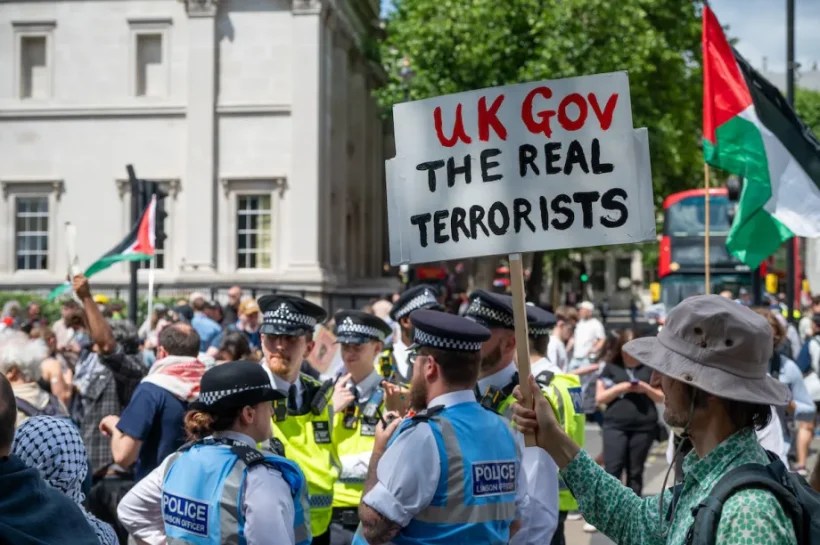
The British government has also moved to suppress those who expose this complicity. Campaign groups such as “Pal Action” have been targeted with bans, activists have been arrested, and even banners confiscated. But repression cannot erase reality. The blood of civilians testifies to the fact that this is not a conflict between equals, but a massacre sustained by Western capitals.
A moral and legal imperative
As Palestinians living in the UK, we speak not only with the voice of memory and history, but also with the authority of law and morality. International law is explicit: states that knowingly provide weapons used in the commission of genocide share responsibility for that crime. Silence, therefore, is not neutrality. It is complicity.
Britain’s record will be judged harshly. Just as the Balfour Declaration is remembered as a colonial betrayal, today’s arms exports will be recorded as enabling one of the most documented genocides of the modern era.
The call to conscience
Yet Britain is also home to countless free voices: campaigners, lawyers, journalists and politicians who understand that what is unfolding in Gaza is not distant, but deeply tied to Britain’s own decisions. They know that complicity today will stain this country for decades to come.
The choice before Britain is stark: continue to arm and shield a regime accused of genocide, or align with international law and the universal values it claims to uphold.
Until justice prevails
Our struggle is not simply to lift a siege, but to end decades of settler-colonialism and military occupation. Freedom will not be gifted; it will be won. And as Palestinians, in Gaza, across the diaspora, and here in Britain, we carry the same message passed down from one generation to the next: never accept injustice, and never let the flag of freedom fall.
READ ALSO: US-based contractor hired by UK to continue spy flights over Gaza
Israel dangles aid for South Sudan amid reports of Gaza expulsion talks
The Cradle | August 18, 2025
Israel’s Foreign Ministry announced on 18 August that it plans to provide “urgent” humanitarian assistance to South Sudan, following recent reports that Tel Aviv was engaged in efforts to expel Palestinians from Gaza to the east African nation.
Israel’s Agency for International Development Coordination “will provide urgent humanitarian assistance to vulnerable populations in the country” due to “the severe humanitarian crisis in South Sudan,” the Foreign Ministry said.
The aid will include medical supplies, water purification supplies, gloves and face masks, special hygiene kits, and food packages.
This comes as a cholera outbreak is plaguing the country, which “suffers from a severe shortage of resources,” the Israeli Foreign Ministry added.
IsraAID, an Israeli NGO operating in South Sudan, will also assist in the aid plan, the Foreign Ministry went on to say.
The visit comes as Israel is preparing to occupy Gaza City and forcibly displace hundreds of thousands of Palestinians.
Israeli Prime Minister Benjamin Netanyahu says he is committed to implementing an expulsion plan announced by US President Donald Trump at the start of the year, framed as a humanitarian initiative to “relocate” Palestinians to a safer place.
Trump said he would make Gaza the “Riviera of the Middle East.”
Israel and the US have reportedly been in contact with several countries as part of the effort to expel Gaza’s population.
Last week, several sources cited by AP said Israel is in talks with South Sudan about the potential relocation of Palestinians from Gaza to the East African country.
The sources said it is unclear how far the negotiations have advanced.
Following the report, South Sudan’s Foreign Ministry issued a statement on 13 August denying that it is engaged in negotiations with Israel to take Palestinians from Gaza, rejecting such claims as unfounded and not representative of the government’s position.
In February, Hebrew news outlet Channel 12 reported that Morocco, the Puntland State of Somalia, and the Republic of Somaliland are being considered as places to relocate Palestinians as part of Trump’s controversial plan.
Somalia and Somaliland denied these reports earlier this year – saying they received no such proposals.
According to a Wall Street Journal report, Israel has identified six countries to negotiate with regarding relocating Gaza residents, including Syria, Libya, Somaliland, and South Sudan. The report says the efforts are not going well, and that previous talks on the matter “didn’t make much progress.”
Syria and Libya have not responded to requests for comment.
Sources who spoke with NBC News earlier this year had said Trump is working on a plan to “permanently relocate” as many as one million Palestinians from the Gaza Strip to Libya.
Hamas agrees to Gaza ceasefire proposal presented by mediators
Palestinian Information Center – August 18, 2025
GAZA – An official Hamas source said on Monday that the Movement delivered a positive response to an Egyptian-Qatari proposal for a 60-day ceasefire in the Gaza Strip.
An informed Palestinian official also said, on condition of anonymity, that the proposal forms a framework for indirect negotiations over a permanent ceasefire between Hamas and Israel.
The response came after internal consultations held by Hamas with major Palestinian factions.
The source did not reveal details of the proposal, but other informed Palestinian sources reported that the proposal stipulates a prisoner exchange deal that includes the release of 10 living Israeli captives and 18 bodies in exchange for the release of 140 Palestinian prisoners serving life sentences and 60 others serving sentences of more than 15 years, as well as 1,500 from Gaza.
The sources explained that the new Egyptian-Qatari proposal includes a modification to the Israeli withdrawal lines from the Gaza Strip during the 60-day truce period, limiting them to a distance of 800 meters along the eastern, northern, and southern borders of the coastal enclave.
According to the proposal, discussions on a comprehensive agreement or permanent ceasefire will begin immediately once this truce takes effect
The proposal also includes the entry of urgent humanitarian aid into the Gaza Strip immediately after the agreement enters into force, including fuel and water, and stipulates the rehabilitation of hospitals and bakeries, and the provision of rescue teams with rubble removal equipment.
The UN and its agencies, along with the Red Crescent and international organizations operating in the Gaza Strip, should be responsible for aid distribution.
Over the past two years, the Hamas leadership has accepted proposals for a ceasefire and the release of Israeli captives and Palestinian prisoners only for Israel to reject them and insist on continuing the war.
The major sticking point has been the duration of the ceasefire. Hamas wants a permanent end to the war, but Israel has been seeking a temporary truce that would allow it to resume its genocide and its destruction and displacement campaign in Gaza after its captives in the territory are released.
Serbia exposed as EU nation behind $1.64bln ‘Israel’ arms deal
Al Mayadeen | August 17, 2025
Israeli media reported that Serbia was the European country behind a $1.64 billion deal signed with Israeli defense company Elbit Systems.
Last week, Elbit announced a deal for the supply of its long-range precision strike artillery-rocket systems and unmanned aerial vehicles, though it did not disclose the identity of the customer, The Times of Israel reported. Under the five-year defense contract, Elbit was set to supply a suite of AI-powered unmanned aerial combat systems, which included personally operated drones for tactical and operational missions.
The contract covered the supply of Elbit’s long-range precision artillery rockets and defense systems equipped with advanced intelligence, surveillance, target acquisition, and reconnaissance (ISTAR) capabilities, along with communications and signal intelligence systems, as well as the delivery of advanced electro-optical and night-vision equipment.
Investments in Elbit Systems soar despite genocide
Elbit Systems is an Israeli arms firm and the main supplier for “Israel’s” land-based equipment and UAVs used in its wars.
According to a May 31 report by Novara Media, a UK government-backed pension scheme tasked with managing retirement funds for British workers had been investing in the major Israeli arms manufacturer Elbit Systems.
UK workers who contributed to Nest’s Retirement Date Fund starting in December 2024 were indirectly financing Elbit Systems, described as “Israel’s” largest defense company, which marketed its weapons as battle-tested by the Israeli military during operations in the Palestinian territories.
In February 2025, Morocco signed a defense contract with Israeli arms manufacturer Elbit Systems, further solidifying its military cooperation with the Israeli occupation.
According to French newspaper La Tribune, the deal involved the purchase of 36 ATMOS 2000 self-propelled artillery systems, while the Stockholm International Peace Research Institute (SIPRI) found that this would make Israel Morocco’s third-largest weapons supplier, representing up to 11% of its total arms imports.
American Nun: Hamas is a resistance movement, and Christians suffer under occupation

Palestinian Information Center – August 17, 2025
WEST BANK – An American nun said that Israeli policies have made the lives of both Palestinian Christians and Muslims “extremely difficult,” due to restrictions on movement, land confiscation, and settlement construction. She also stressed that the Islamic Resistance Movement (Hamas) is a resistance movement that defends its people and land.
Mother Agapia Stephanopoulos, who has lived since 1996 in the Palestinian town of Bethany in the occupied West Bank, appeared in an interview with American journalist Tucker Carlson on a popular US television program, sparking wide controversy after she spoke about her two-decade-long experience in the occupied Palestinian territories.
She affirmed that Christians there face suffering similar to that experienced by Muslims under Israeli occupation.
She added that the number of Palestinian Christians has significantly declined since the Nakba in 1948 due to restrictions and displacement, emphasizing that “the problem is not religious but national,” as Christians face the same discrimination because of their Palestinian identity.
The nun criticized what she described as the “blind support” of some Christian Zionists in the United States for Israel, saying they ignore the suffering of Palestinian Christians and justify settlement expansion and land confiscation.
Mother Agapia Stephanopoulos also pointed out that churches and Christian institutions in the West Bank and Gaza have been bombed and destroyed, considering this part of a systematic targeting of Palestinians.
She explained that Palestinian Christians live in natural cohesion with Muslims, citing the example of Christian schools in Bethlehem and Jerusalem where the majority of students are Muslims, stressing that coexistence is the prevailing feature of Palestinian society.
The interview, titled “This is How Christians Live in the Holy Land,” received over 12 million views and was considered one of the most prominent episodes shedding light on the conditions of both Palestinian Christians and Muslims under occupation, and the violence and restrictions they face from settlers and Israeli authorities.
Featured Video

Bombing Hitler’s Hometown
or go to
Aletho News Archives – Video-Images
From the Archives
‘Conspiracy Theory’ Now Fact: Greater Israel Has Arrived
By Kit Klarenberg | Mint Press News | January 28, 2025
Ever since Tel Aviv’s 1948 creation, much has been said and written about ‘Greater Israel’ – the notion Zionism’s ultimate end goal is the forcible annexation and ethnic cleansing of vast swaths of Arab and Muslim lands for Jewish settlement, based on Biblical claims this territory was promised to Jews by God. The mainstream media typically dismisses this concept as antisemitic conspiracy theory, or at most the fringe fantasy of a minuscule handful of extremist Israelis.
In reality … continue
Blog Roll
 Aletho News
- Failing to Defeat Hezbollah, Israel & US Pressure Syria’s Ahmed al-Sharaa to Join War
- US-Israeli war on Iran drives global fertilizer prices up 40%
- Hezbollah’s Surprise Weapons Redefine Ground Battle with Israel
- Yemen joins fight against US, Israel by firing missiles at occupied territories
- Seizing the Kharg: Washington’s path to defeat in the Persian Gulf
- Iran reports 500 US casualties in strikes on covert US military sites
- Pro-Israel terrorist arrested before assassination of pro-Palestinian activist
- Bombing Hitler’s Hometown
- German journalist threatened with homelessness as German court upholds EU sanctions in landmark free speech case
- US Tells Allies That Ukraine-Bound Arms Could be Sent to Middle East
- If Americans Knew
- Researchers at Human Rights Watch Resign Over Blocked Report on Palestinian Refugee Return
- Jewish Groups Are Backing a War Americans Don’t Want
- Eric Fingerhut Thinks He’s the President of the Jews
- Top Jewish Philanthropists, Rabbis Urge Israeli President to Take Action Against ‘Jewish Extremists’
- Don’t Be Fooled. Zionist Leaders Have Always Wanted to Control Southern Lebanon
- Israel’s widespread use of torture is a core element of its genocide against the Palestinian people
- In Israel’s War on Iran, Many Middle East US Bases Rendered “All But Uninhabitable”
- ‘Burn the lawn’: Israel pursues ‘Rafah model’ in southern Lebanon
- A genocide here, an amputation there
- Reports: Iran mobilizing 1M fighters, Israel-US run low on ammo, Israeli army faces shortage – Not a ceasefire Day 168
- No Tricks Zone
- Devastating Assessment Of Comirnaty Vaccine By Former Senior Pfizer Europe Toxicologist
- New Study: CO2 Is ‘Effectively Negligible’ As An Explanatory Climate Change Factor Since 2000
- Former Pfizer Toxicologist Dr. Helmut Sterz Tells Bundestag Hearing Pfizer Vaccine Should Have Never Been Approved
- Energy Expert: Germany’s Nuclear Phaseout Was A “500 Billion Euro Mistake”
- New Research: South Australia’s Mid-Holocene Sea Surface Temperatures Were 4°C Warmer Than Today
- Storing Green Energy To Last Germany 10 Days Would Require A 60-Million Tonne Battery
- New Studies: UK Sea Levels Were 4 Meters Higher Than Today During The Mid-Holocene
- Destructive Green New Deal: German Energy And Metal Group Warns Of Drastic Crisis
- New Study Documents A 20-Year Pause In Arctic Sea Ice Decline – Driven By Internal Variability
- Wake-up Call: Survey Shows Majority Of Germans Now Favor Postponing Climate Targets!
 Aletho News