Romania Strong-Armed Into Buying $2.3 Billion Israeli Anti-Aircraft Systems
By Tyler Durden | Zero Hedge | July 23, 2025
Having managed to derail populist, NATO-skeptical presidential candidates through a variety of extraordinary means, Romania — bowing to pressure from NATO and President Trump — announced it will spend $2.3 billion on Israeli anti-aircraft systems to fend off the supposed Russian menace.
The big-ticket, Israel-benefitting purchase comes even as Romania is poised to impose dramatic austerity measures to address its deteriorating financial condition. Romania’s 2025 deficit will be the largest in the country’s history. At roughly 9% of GDP, its deficit is also the EU’s highest by that measure. The alarming numbers have triggered reprimands from the European Commission, which asked Romania to bring its deficit down to 2.8% of GDP by 2030. At last month’s NATO summit, the organization’s members bent to Trump’s long-running demands, agreeing to more than double their targeted military spending — from 2% of GDP to 5% — by 2035.
Working hard to rationalize the outlay, Reuters’ report on the Israeli deal notes that Romania “has had Russian drone fragments fall in its territory repeatedly over the past two years.” The Times of Israel bolstered the narrative with a headline claiming “Romania [is] on edge over Russia.”
Last year, Romania seemed poised to elect the deeply NATO-skeptical populist Calin Georgescu, who won the first round of Romania’s two-round presidential election. Citing supposed Russian interference, the country’s Constitutional Court threw out the election and ordered it to be started anew. In a May triumph for the EU establishment, centrist Bucharest mayor Nicusor Dan prevailed.
Romania’s pending redistribution of $2.3 billion of its wealth to Israel’s booming arms industry comes as the government is poised to unleash drastic austerity measures that are certain to stoke resentments. Potential moves include firing 20% of the country’s civil service workers, increasing value-added taxes, and increasing taxes on profits and dividends from 10% to 16%. “This correction is so extensive, so far-reaching, that pain cannot be avoided,” former finance minister and current head of the Romanian Fiscal Council Daniel Daianu told Politico.
Meanwhile, Romania will shower $2.3 billion on an Israeli arms industry already enjoying record revenues. Hitting a new high for the fourth consecutive year, Israeli weapon sales totaled just under $14.8 billion in 2024. European customers accounted for 54% of exports, the Times of Israel reports.
Under the new arms agreement, Romania will buy short-range and very-short-range anti-aircraft systems from Israel’s Rafael Advanced Defense Systems, with contracts encompassing training, logistical support and ammunition. The first two V/SHORAD systems will be delivered within three years of the contract’s signing, which is expected this fall. The Defense Post reports that Rafael submitted its SPYDER missile systems in the bidding competition. Rafael defeated South Korea’s LIG Nex1, European multinational MBDA and Germany’s Diehl Defence.
Too many conservative Americans clap like seals when Trump demands that European countries spend more money on “defense” — seemingly oblivious to the fact that higher defense spending by European governments is not geared to achieving lower defense spending by the US government. Indeed, in a matter of several weeks during his new term, Trump went from oratorically aspiring to partner with Russia and China to cut the three countries’ military budgets in half, to enthusiastically announcing his approval of a Pentagon request to lift spending to a record $1 trillion.
Fittingly, Trump did so in an Oval Office session with Israeli Prime Minister Benjamin Netanyahu at his side. Turning to the man who would soon drag Trump into a war on Iran launched on false claims about Iran’s nuclear program, Trump said, “You’ll like to hear of this.”
What Explains Washington’s and Israel’s Opposition to Questioning Ghislaine Maxwell?
By Paul Craig Roberts | Institute for Political Economy | July 24, 2025
Attorney Alan Dershowitz allegedly is on the Epstein client list, but he calls for the release of the Epstein files and for the release of Ghislaine Maxwell under “use immunity,” which compels her to testify. In other words Dershowitz wants to clear his name by getting to the bottom of the Epstein Saga.
The saga is that Epstein was a Mossad spy financed by Israel out of the billions of dollars that Israel extracts from American pocketbooks each year. Epstein’s job was to implicate the American ruling establishment in sex crimes that enabled Israel to blackmail Washington into conforming US Middle East policy with Israel’s policy.
That done, Washington destroyed at the expense of American lives, money and reputation five counties for Israel.
Now Netanyahu wants Americans to destroy Iran for Israel. Can Washington refuse when Netanyahu has the blackmail information accumulated by Epstein for Mossad?
The problem is that neither Washington nor Netanyahu want Ghislaine to testify.
How long will it be before we hear that Ghislaine has committed suicide in her suicide proof prison cell?
Palestinian factions reject Israeli vote on West Bank sovereignty
Al Mayadeen | July 23, 2025
Palestinian resistance factions strongly condemned the Israeli Knesset’s vote on Wednesday in favor of a bill to impose “Israeli sovereignty” over the occupied West Bank and Jordan Valley, calling it a dangerous escalation and a blatant violation of international law.
The Islamic Resistance Movement, Hamas, described the Knesset’s approval of the bill as “null and void,” stressing that the decision had no legitimacy and constituted a direct challenge to international resolutions. In a statement, Hamas urged Palestinians in the West Bank to unite and escalate resistance “in all its forms” to thwart the occupation’s plans to annex the territory.
Formalization of control expands settler-colonialism
The Popular Front for the Liberation of Palestine (PFLP) warned that while the occupation already exerts de facto control over the territory, the formalization of this through legislation strengthens its colonial grip, expands the settler-colonial and Judaization project, and advances a policy of ghettoization and forced displacement.
The PFLP emphasized that unity and resistance remain the only path to confront what it described as a “dangerous scheme,” equating its severity to the genocidal campaign waged by the Israeli occupation in Gaza.
The Palestinian Resistance Committees said the Knesset vote further exposes the colonial nature of the Israeli entity, adding that “the enemy’s ambitions extend beyond Palestine and target the entire region.” The committees called on Palestinians in the occupied West Bank, al-Quds, and the territories occupied in 1948 to “take the initiative, launch a popular revolution, and ignite a widespread intifada to thwart Zionist schemes.”
‘Legally and morally void’
Fatah also rejected the bill “categorically,” calling it legally and morally void. In its statement, the movement reaffirmed that the West Bank, including East al-Quds, is occupied Palestinian land, and the Israeli occupation has no legal authority to impose sovereignty over it under any pretext.
Fatah urged the international community, particularly the United Nations and the European Union, to support a Palestinian legal campaign before the International Court of Justice and other international legal bodies. The movement also called for full recognition of a Palestinian state on the 1967 borders with East al-Quds as its capital, as a clear political response to annexation efforts.
PA condemns Knesset decision
Palestinian Authority official and Deputy President Hussein al-Sheikh also condemned the Knesset’s move, calling it “a direct assault on the rights of the Palestinian people and a serious escalation that undermines peace prospects and the two-state solution.”
Al-Sheikh described the unilateral Israeli measures as flagrant violations of international law and global consensus, urging states worldwide to recognize the State of Palestine and denounce the Knesset’s decision.
The bill passed with 71 votes in favor and 13 opposed. While it carries no binding legal effect, the legislation asserts that the West Bank and Jordan Valley are “an inseparable part of the historic homeland of the Jewish people” and calls for “strategic steps” to solidify this so-called historical right in pursuit of Israeli “national security.”
Red states back Israeli annexation of West Bank
Several Republican-led states in the US have moved forward with legislation compelling the official use of the term “Judea and Samaria” instead of the West Bank, following a bill passed in Arkansas last month.
The legislative push is part of a broader effort to support the annexation of occupied Palestinian territories. Spearheaded by Yossi Dagan, head of a regional council representing Israeli settlements in the occupied West Bank, the initiative aims to influence US policy in favor of extending Israeli control over the area.
Dagan has framed the ethnic cleansing campaign as one of “historic justice,” seeking to persuade US leaders, including President Donald Trump, to support the annexation of what he described as “the land of the bible.” According to Dagan, using the term “Judea and Samaria” in official US documents is part of reinforcing that narrative.
The decision by Republican states to consider adopting the terminology followed meetings with Dagan during the annual conference of the American Legislative Exchange Council (ALEC). After Dagan’s address, ALEC unanimously endorsed the initiative, giving the proposal broader momentum across GOP-controlled legislatures.
Federal-level support grows
In addition to state-level initiatives, a similar move is underway at the federal level. Brian Mast, chairman of the House Foreign Affairs Committee, announced that the committee intends to adopt the historical terms promoted by Dagan. Mast’s support signals growing alignment between certain US political circles and Israeli settlement interests.
States reportedly considering the bill include Utah, Tennessee, Alabama, Louisiana, Idaho, Iowa, and Oklahoma. These bills also include language declaring the West Bank as the biblical cradle of the Jewish people, arguing it should not be considered occupied territory.
The adoption of such terminology by US lawmakers carries significant political implications. By aligning with Israeli settlement narratives and rejecting the international consensus that views the West Bank as occupied territory, this legislation risks legitimizing ongoing ethnic cleansing and violations of international law.
This comes as settler attacks escalate across the occupied West Bank as part of the Israeli occupation’s ongoing efforts to annex Palestinian territory. These incursions are taking place under direct military protection and with full political backing from the Israeli government, according to rights groups and local sources.
Historic First: Brussels Court Judge Orders Halt to Arms Transit to Israel
By Marc Vandepitte | Global Research | July 23, 2025
In a landmark ruling, the Brussels Court of First Instance has ordered the Flemish government not only to block a specific container of military equipment bound for Israel, but also to ban any further transit of military material to the country.
The judge ruled that Flanders — a region in the north of Belgium — is systematically failing to meet its obligations under arms legislation and international treaties, and even imposed a penalty for each shipment that goes through despite the ruling.
The four Flemish NGOs that filed the case were granted full victory on all points.
The container at the center of the case is located in the port of Antwerp. It contains so-called tapered roller bearings, produced by Timken via a French branch, and destined for Ashot Ashkelon Industries, an Israeli defense company that supplies components for Merkava tanks and Namer armored vehicles.
According to the organizations, these systems are used daily in the genocide in Gaza.
In its ruling, the court immediately prohibits the Flemish government from authorizing any new arms transit to Israel. Since 2009, there has been an agreement not to export weapons to Israel that could reinforce its armed forces — a policy that has been seriously eroded in practice.
To enforce this, the court has imposed a penalty of 50,000 euros for each shipment that still leaves for Israel.
Containers may only be shipped to Israel if the Flemish government has written proof that the goods are intended for civilian use. According to lawyer Lies Michielsen of Progress Lawyers Network, who pleaded the case, the ruling implies that the government must actively verify the final destination of goods exported to Israel.
Significance
This ruling is highly significant because the court has confirmed that facilitating the delivery of weapons to a state committing war crimes or possible genocide is illegal.
“The court is stating what politics refuses to acknowledge,” says Fien De Meyer from the League for Human Rights.
This means an end to impunity: governments can no longer look away while their weapons are used for atrocities.
The ruling sets a legal precedent that forces European and other governments to take responsibility. Similar lawsuits in other countries are expected to follow.
In any case, it is a victory for peace and solidarity movements, showing that resistance works.
Follow-Up
Around the same time, another lawsuit was filed in Belgium — this time against the federal government. A group of Palestinian claimants and Belgian organizations sent a formal notice to the federal government, accusing Belgium of passive complicity in the genocide in Gaza.
If no satisfactory response is received, they will proceed to court — which would also be a global first.
The action is led by a Palestinian citizen, several Belgian NGOs, and a legal expert. They demand that Belgium halt all military deliveries to Israel, confiscate imports from occupied Palestinian territories, block investments in those areas, and suspend the EU-Israel association agreement.
According to them, Belgium’s passivity is both morally and legally unacceptable. The action is supported by a group of artists and intellectuals who are raising funds for legal costs.
There is also movement at the European level. The legal NGO JURDI is taking both the European Commission and the Council of the European Union to the Court of Justice for their “negligence” regarding the violence in Gaza. For the first time in history, these two powerful institutions are being sued for failing to uphold their own treaty obligations.
JURDI cites Article 265 of the EU Treaty, which makes institutional inaction punishable. According to them, EU institutions are applying double standards: Russia was heavily sanctioned, while Israel remains untouched despite clear human rights violations.
JURDI is demanding, among other things, the suspension of the EU-Israel Association Agreement, the termination of subsidies, and sanctions against Israeli officials. The complaint argues that the EU is both legally and morally obligated to act and warns that even European leaders could be prosecuted for complicity in genocide.
Complicity
At the heart of these cases lies the question: does a country — or by extension, the European Commission — have a legal obligation, as a third party, to prevent genocide elsewhere? According to the Genocide Convention, it does. That treaty obliges every country not only to punish genocide but also to actively prevent it.
In January, the International Court of Justice already called on Israel to take all necessary measures to prevent genocide. But does that obligation also apply to countries like Belgium, which are not directly involved?
According to eighteen top Belgian jurists, the answer is yes. In a letter, they warn that a country like Belgium risks being brought before the International Court of Justice itself if it continues to remain silent about the situation in Gaza. Passivity can be legally interpreted as complicity.
The jurists are demanding sanctions against Israel and consider suspension of the EU-Israel Association Agreement as an absolute minimum. Countries too often hide behind diplomatic caution, but according to them, that attitude is legally and morally untenable. Only concrete actions — not words — can save the credibility of Belgium and the EU.
No Pause
The court victory in Flanders and other ongoing legal proceedings represent a qualitative leap in the fight against genocide. But that fight is far from over. Genocide does not pause. While politicians delay, people in Gaza suffer end die.
Now is the time to maintain and intensify pressure. Legal actions must be brought in other countries as well. Key demands include the immediate enforcement of the ban on arms deliveries, full transparency about the export of military equipment, and prosecution of those complicit in these crimes.
Lawsuits like this are very important, but certainly not sufficient to stop the killing in Gaza. Political leaders worldwide must be pressured through mass protests and acts of solidarity.
That is why the Palestinian resistance movements in Gaza have jointly issued a call for global mobilization starting on 20 July 2025 to save the population in Gaza from genocide, hunger, and thirst caused by the Israeli occupation.
They denounce the international silence and call on countries and citizens around the world to take to the streets and act to halt the genocide.
Marc Vandepitte is a member of the Network of Intellectuals and Artists in Defense of Humanity and was an observer during the presidential elections in Venezuela.
West Bank: Army Abducts Many Palestinians, Shoots Child, Young Man

Mosab Shawer – ActiveStills
IMEMC | July 23, 2025
On Tuesday afternoon and evening, Israeli forces abducted several Palestinians and shot both a child and a young man during military invasions across multiple areas of the occupied West Bank.
One Palestinian youth was violently assaulted and detained at the Hizma military roadblock, northeast of occupied Jerusalem in the West Bank.
According to eyewitnesses, soldiers stopped the vehicle he was traveling in, forced him out, and beat him with batons and fists, leaving him with multiple injuries.
He was then restrained and transported to an unknown location in a military vehicle. The roadblock was temporarily closed, and civilians were prevented from passing or documenting the incident.
Israeli forces routinely escalate restrictive and punitive measures at military roadblocks surrounding Jerusalem, including field abductions and physical assault, as part of what observers describe as a systematic policy aimed at obstructing Palestinian movement and instilling fear.
In a separate incident, three Palestinians, former political prisoners from Nablus, were detained at a temporary roadblock near the Qaber Hilwa bridge, east of Bethlehem.
The detainees were identified as Emad Abdul-Halim Abu Mosallam, Ala’ Mohammad Jom’a, and Samer Nidal Issa.
They were taken to the Ush Ghorab military base east of Beit Sahour, interrogated, and later released. Their vehicle remains confiscated. Hours earlier, Israeli forces at the same site reportedly abducted another unidentified youth.
In the towns of Beit Fajjar and Al-Khader, south of Bethlehem, forces sealed off main streets and concentrated their invasions in central areas.
Israeli troops also surrounded Rafidia Hospital and the Arab Specialized Hospital in Nablus, in the northern West Bank, targeting the vicinity of emergency departments and firing concussion grenades.
The soldiers parked their military vehicles in front of the gates of the Emergency Department, blocking patients from entering.
The soldiers also stopped Palestinians’ ambulances heading to the two hospitals and searched them, in addition to surrounding a residential building.
In Jenin, in the northern West Bank, a youth identified as Mohammed Jihad Zaid was abducted from his home in Nazlet Zaid village.
Soldiers also invaded the residence of Saleh Zaid, seizing gold jewelry estimated at 29,000 shekels and an additional 1,500 shekels in cash.
 In Qabatia, in northern West Bank, the soldiers shot a 15-year-old child in the chest [killing him] and a young man in the leg during a military invasion involving multiple military vehicles.
Both were transported to hospital for treatment. The shootings occurred after soldiers closed intersections, ransacked homes, and clashed with protesting residents.
The military offensive across the Jenin governorate have intensified since the launch of an Israeli offensive targeting Jenin city and its refugee camp on January 21.
These invasions are marked by mass abductions, violent home searches, and widespread infrastructural damage.
In addition, Israeli forces raided Al-Am’ari refugee camp in Al-Bireh, in the central West Bank, particularly the Sateh Marhaba neighborhood, where they fired tear gas canisters at residential homes, causing several cases of suffocation.
Earlier Tuesday, the army abducted many Palestinians across the West Bank, especially in Hebron, Bethlehem and Nablus, in addition to Ramallah.
Since the beginning of this year, Israel has killed 181 Palestinians in the occupied West Bank; 63 in Jenin, 32 in Nablus, 27 in Tubas, 17 in Tulkarem, 12 in Hebron, 11 in Ramallah, 6 in Bethlehem, 4 in Qalqilia, 5 in Jerusalem, 3 in Salfit and 1 in Jericho.
Israel has now killed 1,016 Palestinians in the occupied West Bank since October 7, 2023; 270 were killed in Jenin, 124 in Nablus, 94 in Tubas, 213 in Tulkarem, 89 in Hebron, 70 in Ramallah, 27 in Bethlehem, 37 in Qalqilia, 23 in Jerusalem, 32 in Jerusalem suburbs, 7 in Salfit and 13 in Jericho and Northern Plains.
‘Peacemaker’ Trump beats Biden’s bombing record since return to office: Report
The Cradle | July 23, 2025
US President Donald Trump has ordered hundreds of airstrikes across West Asia and Africa since his return to office, carrying out more attacks in the first five months of his second term than former president Joe Biden did during his entire presidency, according to the Armed Conflict Location & Event Data (ACLED).
“In just five months, Trump has overseen nearly as many US airstrikes (529) as were recorded across the entire four years of the previous administration (555),” said ACLED President Clionadh Raleigh.
Among the countries bombed by Trump are Iran, Iraq, Syria, Somalia, and Yemen. The majority of strikes were carried out against Yemen.
“The US military is moving faster, hitting harder, and doing so with fewer constraints. Syria, Iraq, Afghanistan, Yemen, Somalia, and now Iran are all familiar terrain, but this isn’t about geography – it’s about frequency,” Raleigh added.
The surge in attacks contradicts Trump’s campaign promises, which framed him as “anti-war.”
In March this year, Trump renewed the Biden government’s campaign against Yemen with much greater intensity.
Months of brutal and deadly attacks struck the country in response to the Yemeni Armed Forces’ (YAF) naval operations against Israeli interests and its missile and drone strikes in support of Palestine.
Yemeni forces consistently responded to US attacks by targeting US warships in the Red Sea, during both Biden and Trump’s terms.
A ceasefire between Sanaa and Washington was reached in May, after the US campaign burned through munitions and failed to impact Yemeni military capabilities significantly.
However, the campaign took a heavy toll on civilians and compounded the humanitarian crisis the country has faced due to over a decade of war.
An investigation released by Airwars last month revealed that Trump’s war on Yemen killed almost as many civilians in less than two months as in the last 23 years of Washington’s military action in the country combined.
“In the period between the first recorded US strike in Yemen to the beginning of Trump’s campaign in March, at least 258 civilians were allegedly killed by US actions. In less than two months of Operation Rough Rider … at least 224 civilians in Yemen [were] killed by US airstrikes – nearly doubling the civilian casualty toll in Yemen by US actions since 2002,” it said.
In Iraq, Syria, and Somalia, Trump has also continued to strike what Washington says are ISIS and Al-Shabab targets.
Despite vowing to end “forever wars,” Trump has recently threatened to expand them.
On 22 July, the US president threatened to launch new attacks on Iran, after late June bunker-buster strikes on Iranian nuclear facilities which were carried out on behalf of Israel.
AOC Tries to Defend Vote Against Amendment to Cut $500 Million in Israeli Military Aid

By James Rushmore | The Libertarian Institute | July 22, 2025
U.S. Congresswoman Alexandria Ocasio-Cortez (D-NY) is trying to explain away her “no” vote on an amendment to the 2026 National Defense Authorization Act (NDAA). The amendment, introduced by Congresswoman Marjorie Taylor Greene (R-GA), would have cut $500 million in U.S. funding for nuclear-armed Israel’s missile defense programs.
“People exploding this false messaging that I voted for a bill [and] funding that I quite literally voted NO on. The threat environment this morning is scary,” the progressive lawmaker wrote on Bluesky Monday afternoon. “Doesn’t help anyone. Drag me for the position if you disagree but don’t lie. It’s out of control. Saying I voted for this funding is false.”
“If you believe neo-nazis [sic] are welcome and operating in good faith, you can have them!” she added on X.
Earlier in the day, NBC 4 New York reported that Ocasio-Cortez’s Bronx congressional office was doused with red paint overnight. A sign was posted outside that read “AOC FUNDS GENOCIDE IN GAZA.”
Ocasio-Cortez joined 421 of her colleagues in the House of Representatives in voting against the Greene Amendment, which only received six votes. The amendment would have prevented the Department of Defense from strengthening Israel’s air and missile defense systems, including the Iron Dome. It would also have prevented Congress from effectively abrogating the Symington Amendment to the International Security Assistance and Arms Exports Control Act of 1976, which bans the provision of U.S. military aid to any country that develops nuclear weapons technology in contravention of safeguards imposed by the International Atomic Energy Agency (IAEA).
Ocasio-Cortez’s latest comments come days after she initially tried to head off concerns about her vote. “Marjorie Taylor Greene’s amendment does nothing to cut off offensive aid to Israel nor end the flow of US munitions being used in Gaza. Of course I voted against it,” she wrote on X Saturday morning. “What it does do is cut off defensive Iron Dome capacities while allowing the actual bombs killing Palestinians to continue. I have long stated that I do not believe that adding to the death count of innocent victims to this war is constructive to its end.”
“I remain focused on cutting the flow of US munitions that are being used to perpetuate the genocide in Gaza,” she added.
Ocasio-Cortez’s “no” vote earned her a rebuke from the Democratic Socialists of America. “An arms embargo means keeping all arms out of the hands of a genocidal military, no exceptions. This is why we oppose Representative Alexandria Ocasio-Cortez’ [sic] vote against an amendment that would have blocked $500 million in funding for the Israeli military’s Iron Dome program,” the DSA wrote on Saturday.
Israel Attacks UN Agency’s Buildings in Gaza
By Kyle Anzalone | The Libertarian Institute | July 22, 2025
Israeli forces attacked two facilities used by a UN aid agency in Gaza.
A safe house used by the World Health Organization was struck by Israeli forces three times on Monday. According to Tedros Adhanom Ghebreyesus, the head of the WHO, said after the strikes, “Israeli military entered the premises, forcing women and children to evacuate on foot toward Al-Mawasi amid active conflict.”
“Male staff and family members were handcuffed, stripped, interrogated on the spot and screened at gunpoint.” He continued, “Two WHO staff and two family members were detained. Three were later released, while one staff remains in detention.”
It is frequently reported that when Israel raids an area, they split the men from the women and children. Those released are instructed to go to the Mawasi tent city. Men are stripped and humiliated by Israeli soldiers before being released or detained.
Additionally, an Israeli strike hit the main WHO warehouse. The attack caused a fire. The WHO described the attack as “part of a pattern of systematic destruction of health facilities.” Following the attack, the warehouse was looted.
The WHO safe house and warehouse were located in Deir al Balah. Last week, Israel ordered Palestinians out of the city. The WHO said before the attack, the locations of the buildings were shared with the IDF.
The agency says the attack and Israeli blockade have significantly limited its operations in Gaza. “With the main warehouse nonfunctional and the majority of medical supplies in Gaza depleted, WHO is severely constrained in adequately supporting hospitals, emergency medical teams and health partners, already critically short on medicines, fuel, and equipment,” a WHO statement explained.
Anti-genocide protesters block hundreds of Israeli tourists from disembarking in Greek port
The Cradle | July 22, 2025
Israeli passengers on a cruise ship arriving in Greece on 22 July were unable to disembark the vessel due to a large crowd of pro-Palestine protesters demonstrating against the Israeli genocide of Palestinians in the Gaza Strip.
The MS Crown Iris, owned by Israeli cruise line Mano Maritime, arrived on Tuesday at the Greek island of Syros in the Aegean Sea. The passengers were supposed to disembark for six hours.
However, they were forced to remain on board due to the protests in support of Palestine.
“The demonstrators posed no danger to us,” an Israeli on board the ship told Hebrew news site Walla.
Between 120 and 300 protesters waved Palestinian flags and held banners reading “stop the genocide” as the ship arrived.
Israeli Foreign Minister Gideon Saar spoke with his Greek counterpart, Giorgos Gerapetritis, to request intervention to resolve the issue.
Yet the cruise ship ended up being redirected to Limassol, Cyprus. Around 1,600 Israelis were traveling on the MS Crown Iris, according to Israel’s Channel 12.
A group of the Greek island’s residents organized the protest and posted on social media that they “raise their fists in solidarity with the Palestinians in Gaza,” adding that “it is unacceptable that tourists from Israel continue to be welcomed here while the Palestinians are suffering in the Strip.”
Israel’s genocidal war has resulted in a significant decline in Tel Aviv’s popularity worldwide.
Israeli soldiers responsible for war crimes, including the destruction of civilian infrastructure in Gaza, are regularly pursued and targeted with criminal complaints issued by pro-Palestine organizations in courts around the world.
Two Israeli soldiers were detained at the Tomorrowland festival in Belgium last week. Belgian police released them after conducting an interview.
The legal complaint was filed by the Hind Rajab Foundation (HRF), which has been leading a global campaign against Israeli soldiers involved in war crimes.
In January, the Israeli army issued restrictions against media coverage of active-duty soldiers due to legal risks they face over war crimes in Gaza while traveling abroad.
This came after an Israeli army reservist’s vacation in Brazil ended abruptly after HRF convinced a federal judge in Brazil to open a war crimes investigation into his participation in the demolition of civilian homes in Gaza.
How close was Jeffrey Epstein to Israel’s Mossad?
The Grayzone | July 18, 2025
The Grayzone’s Anya Parampil and Max Blumenthal discuss allegations that late financier and trafficker Jeffrey Epstein was an Israeli intelligence asset.
Al-Tanf and the Yinon Plan for Syria: Israel’s Fortress of Fragmentation
21st Century Wire | July 21, 2025
Oded Yinon, author of the 1982 paper “A Strategy for Israel in the 1980s,” is often cited regarding Israel’s aim to divide neighboring Arab and Muslim areas into ethnic mini-states. Yinon was a former advisor to Ariel Sharon, a former senior official with the Israeli Foreign Ministry, and a journalist for The Jerusalem Post. Although Yinon downplays the paper’s direct relevance to current geopolitics, its ideas have arguably become foundational to Zionist policy; balkanization was crucial for Israel’s establishment and continues to be a strategy for its military dominance in the Middle East, especially in Syria. His paper is commonly known as the “Yinon Plan.” Within it, you can read:
“The dissolution of Syria and Iraq later on into ethnically or religiously unqiue areas such as in Lebanon, is Israel’s primary target on the Eastern front in the long run, while the dissolution of the military power of those states serves as the primary short term target. Syria will fall apart, in accordance with its ethnic and religious structure, into several states such as in present day Lebanon, so that there will be a Shi’ite Alawi state along its coast, a Sunni state in the Aleppo area, another Sunni state in Damascus hostile to its northern neighbor, and the Druzes who will set up a state, maybe even in our Golan, and certainly in the Hauran and in northern Jordan. This state of affairs will be the guarantee for peace and security in the area in the long run, and that aim is already within our reach today.”
The fragmentation of Syria was always an integral part of the Yinon plan, with its operational headquarters not in Tel Aviv but at the US Al-Tanf base, located at the tri-border area between Syria, Jordan, and Iraq, and along one of the main highways between Baghdad and Damascus.
Syrian journalist and TV presenter, Haidar Mustafa, wrote for The Cradle on December 2, 2024, about the importance of the Al-Tanf base, one of the most strategic military garrisons for the US occupation in Syria, which acted as a launching platform for countless Israeli overt and covert operations:
“The US coalition’s mission against the Islamic State quickly evolved into a broader strategy of occupying parts of Syria, with the Al-Tanf base crucial to securing its influence and supporting Israeli interests amid growing local resistance.”
In a recent post on X, Lebanese analyst Ibrahim Majed articulated several points about the Al-Tanf base and the immense role the American base has played in advancing Israel’s Yinon Plan, describing it as a “Strategic Outpost for Greater Israel and Israel’s Fortress of Fragmentation.” His post inspired the title of our post today.
Recently, we covered the “David’s Corridor”, a land route in Israel that extends from the occupied Golan Heights through southern Syria to the Euphrates. This route represents Israel’s most crucial foothold in the centre of West Asia, which ultimately benefits from the protection provided by the Al-Tanf base. Should Israel manage to gain control over the southern provinces of Syria, it will be considerably closer to connecting with the territories held by the U.S.-backed Syrian Democratic Forces (SDF) in the east, through the American Al-Tanf base located near the Iraqi border, achieving several goals including the non-negligible control of the corridor, the fragementation of Syria and in time the replacement of the “Shiite Crescent” by an “Israeli Crescent”. Israel aims to establish a secure route that begins in the Golan Heights, traverses through the Suwayda province, continues across the eastern Syrian desert where the US base at Al-Tanf is situated, and extends to the Kurdish-controlled area of Hasakah, ultimately reaching Iraqi Kurdistan along the Iranian border. This explains the continued US military presence in north-east Syria and why last week, on two occasions, a large CIA delegation found itself at the Qasrak base in Al-Hasakah. This is how Israel intends to permanently cut off the Tehran-Beirut road.
Regarding the Druze community in Syria, Israel uses them primarily as a geographic instrument, a human “Maginot Line” of some sort, where the demographic acts as a human shield that, on one hand, hinders Sunnis’ expansion, while simultaneously stopping the Shiites from consolidating on the other. Local groups like Druze, Kurds and Bedouin tribes are all supported directly or indirectly with Western and Israeli logistics and intelligence, and it will remain so, as long as their presence helps Israel fill the vacuum.
The situation in Syria is no longer up for debate—it is laid bare, with each chapter shedding light on the Greater Israel Plan, or the so-called Yinon Plan. This plan provides neither peace nor solutions, nor does it reflect any sense of humanity; instead, it ensures chaos for geopolitical and financial profit, leading to the downfall of a nation we once recognised as Syria. Lebanon is undoubtedly next on Israel’s fragmentation map, and it is with great concern that one must anticipate Israel’s next move…
Darrin Waller writes Fountainbridge Substack…
Understanding the Yinon Plan: Syria is Gone — Is Lebanon Next?
The fall of Syria marks the beginning of a new era of Levantine chaos.
As I wrote when Assad fell, Syria ceased to exist. Fourteen years of sectarian carnage — unleashed by a Salafist proxy terrorist militia, trained by the US, UK, Israel, and Turkey in camps across Jordan and Turkey, and funded by Persian Gulf petrodollar monarchies to the tune of three trillion dollars — extinguished the last secular Levantine nation in December 2024.
As Hassan Nasrallah warned:
“If Syria were to fall into the hands of these groups, its present and future would spiral into chaos… a scene of endless infighting among factions devoid of reason or culture, drowning in extremism, bloodshed, sectarian rivalries…”
It is done. Sold to us as a revolution. A popular uprising.
Another regime change operation — brutally executed over 14 years — culminated in the installation of a mercenary leader: the Saudi-born takfiri Jolani, now styling himself as President Ahmed al-Sharaa.
What we are seeing is the prosecution of the Yinon Plan — a 1982 geopolitical blueprint calling for Israeli regional dominance through the fragmentation of Iraq, Syria, Lebanon, and Egypt along ethnic, sectarian, and tribal lines.
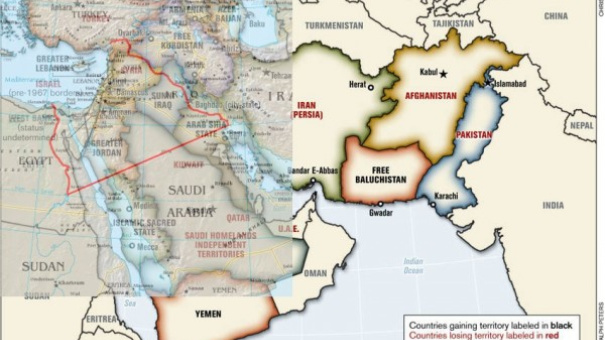
IMAGE: Project Balkanisation: Oded Yinon and an Enduring Plank of Israeli Foreign Policy (Source: Katehon)
It argues that Israel’s long-term survival hinges on one core premise: “The dissolution of all existing Arab states into small units.”
On the surface, the geopolitical win by the US-UK-Israel military-intelligence trifecta — backed by Turkey and the Persian Gulf monarchies — appears seismic. A Shīʿī-led country now falls under Sunni Salafism, severing the contiguous Shīʿī-controlled corridor linking Tehran to Hezbollah in Lebanon.
Another barrier to China’s Silk Road ambitions into the Mediterranean has been firmly set in place. Any revival of the ancient Via Maris — a trade corridor that once ran the Levantine coast, linking Asia to Europe and North Africa — remains a pipe dream.
Severed by the establishment of Israel and now buried beneath the rubble of Syria’s destruction, it ensures that any vision of unity from the Maghreb to the Arabian Peninsula remains just that — a vision.
But perhaps of greater immediate import — Israel’s ethno-supremacists and their vision of a ‘Greater Israel’ have just taken a giant leap forward. Southern Syria — and crucially, Mount Hermon, which overlooks Damascus and the Bekaa Valley in Lebanon, granting strategic military dominance over both — is now firmly under Israeli control. As is the tri-border area between Syria, Jordan, and Iraq — Al Tanf.
Yet there’s more. Israel now moves to establish its self-styled ‘David’s Corridor’ — a contiguous land route stretching from the occupied Golan Heights through southern Syria to the Euphrates. It cuts through the governorates of Deraa, Suwayda, Al-Tanf, and Deir Ezzor, reaching the Iraqi-Syrian border at Albu Kamal — granting Israel a strategic foothold deep in the heart of West Asia.
The corridor was already partially activated during the 12-day war with Iran, enabling standoff air strikes deep into Iranian territory.
With a direct land route to Iraq now viable, expect covert destabilisation efforts within the Shīʿī heartlands of Karbalāʾ and Najaf, alongside renewed backing for Kurdish separatists in both Iraq and Syria. Further vicious sectarian conflict across the region is now being baked in.
Whilst Israel’s bombing of the Defence Ministry and the Presidential Palace in Damascus was supposedly to protect the Druze community from Jolani’s Salafist mercenaries, no such protection was afforded to the Alawites, Armenians, Assyrians, or any of Syria’s other religious or ethnic minorities, who were left to be slaughtered.
The strikes on the Defence Ministry and Presidential Palace were telegraphed well in advance — and were thus performative. A warning to Jolani — Southern Syria is now firmly under Israel’s purview. No Syrian military forces will be allowed.
Meaning: Jolani and his hired guns are expendable, especially now that they’ve completed their task — extinguishing Syria’s sovereignty. As Hadi Nasrallah ruefully put it:
“You mean to tell me the very ones armed by Israel, treated in Israeli hospitals, coordinating with the IOF, shaking Netanyahu’s hand and thanking him for bombing Lebanon — are now being bombed by Israel after serving their purpose? Who would’ve thought?”
And yet, it remains far from clear if Jolani has outlived his usefulness, or if he still has his uses, at least from a US perspective.
Only days ago, whilst Jolani was in Baku, Syrian and Israeli officials were reportedly in talks. Rumours even swirled of a deal wherein Syria would launch attacks against Lebanon’s Shiʿī communities — either independently or in coordination with Israel.
Little wonder, then, that US envoy Tom Barrack warned Lebanon to ‘disarm Hezbollah or risk Syrian occupation’ — signalling that Lebanon, too, is likely slated for division and balkanisation.
The port of Tripoli and the Bekaʿa Valley, Lebanon’s agricultural heartland and a Shīʿī stronghold, are now in play. The only question is whether Ankara or West Jerusalem will seize them first, come to blows over Lebanon’s spoils, or quietly divide them, with Turkey taking the port and Israel the Bekaʿa.
But full control may yet require the chaos of full-on civil war. Syria and Lebanon edge closer — division and balkanisation becoming ever easier to enforce, until little remains but manageable fragments. The Yinon Plan made manifest.
“The attack on Lebanon is going to happen without a doubt… the question is when, and the other question is how. Is Israel going to do a ground invasion at the same time or just attack from the air?” (Ibrahim Majed)
Doubtless, the architects of today’s chaos are already patting themselves on the back, expecting handsome dividends to roll in. More division. More balkanisation. A weaker, fractured Arab world — and a stronger, more dominant Israel.
This is what Netanyahu means when he talks about “redrawing the Middle East”.
Yet the US and Israel are unravelling at an accelerating pace. Their seeming victory over the Levant is no triumph of providence — it courts the abyss and beckons the judgment to come.
US envoy says Hezbollah weapons ‘an internal matter’ during Beirut visit
The Cradle | July 21, 2025
US envoy Tom Barrack said while visiting Lebanon on 21 July that the issue of disarming Hezbollah is an “internal matter,” after months of pressure by Washington on the Lebanese state to secure a surrender of the resistance’s weapons.
“Disarming Hezbollah is an internal matter,” he said, adding that “ideas and assistance” are being offered to the Lebanese state.
“We are not forcing anyone to do anything … we are trying to help,” he added.
He stressed that Hezbollah “is a terrorist organization” in the eyes of the US, and that Washington does not engage in dialogue with it. “We have no skin in the game,” Barrack said.
He claimed Lebanon faces no “consequences” or “threat” if Hezbollah does not disarm, but that it will be “disappointing.”
When asked by a reporter about guarantees that Israel will withdraw its forces from Lebanon and end its attacks on the country, Barrack said, “We cannot compel Israel to do anything, can we?”
Barrack is in Lebanon to discuss with officials Beirut’s response to a US proposal for disarming Hezbollah.
Sources cited by Reuters in early July said that Barrack warned that Hezbollah must be disarmed by November or the end of this year at the latest – in exchange for a withdrawal of Israeli troops from the five points they occupied in south Lebanon after the ceasefire, in violation of the deal. Earlier this month, the US envoy warned that Lebanon risked being occupied by Syria’s extremist-dominated military if Beirut did not move quickly to disarm Hezbollah.
Barrack said during his last trip to Lebanon that he was “satisfied” with Lebanon’s response to the US roadmap, which is expected to be finalized and handed over soon.
Beirut has reportedly demanded that no timeframe for disarmament be set until Israel withdraws and ends attacks.
The resistance group has repeatedly rejected surrendering its weapons. As the government vows to achieve a monopoly over all weapons across Lebanon, Hezbollah says it is ready for internal discussions on the formation of a Lebanese defensive strategy, through which the group’s arms would be incorporated into the state for use in deterring Israel.
The Lebanese resistance group has refused any discussion on the matter until Israeli troops withdraw from Lebanon and end their attacks.
Israeli attacks on Lebanon have continued unabated. Tel Aviv has violated the ceasefire over 3,000 times. More than 200 people have been killed since the deal was signed in November 2024.
Twelve people were killed in an Israeli airstrike in the eastern Bekaa region of Lebanon last week.
Israel has threatened to continue escalating against Lebanon if Hezbollah is not disarmed.
Hezbollah MP Hussein Jachi said on Monday that Hezbollah “will not abandon its weapons for empty US promises.”
“We will not abandon our faith or our strength. We are ready for confrontation. There will be no surrender or submission to Israel, and Israel will not receive our weapons,” Hezbollah chief Naim Qassem said on Friday.
“We know that confrontation is very costly, but surrender leaves us with nothing,” he added, noting that if the “threat is removed, we are ready to discuss the defense strategy and the national security strategy.”
Featured Video

Bombing Hitler’s Hometown
or go to
Aletho News Archives – Video-Images
From the Archives
‘Conspiracy Theory’ Now Fact: Greater Israel Has Arrived
By Kit Klarenberg | Mint Press News | January 28, 2025
Ever since Tel Aviv’s 1948 creation, much has been said and written about ‘Greater Israel’ – the notion Zionism’s ultimate end goal is the forcible annexation and ethnic cleansing of vast swaths of Arab and Muslim lands for Jewish settlement, based on Biblical claims this territory was promised to Jews by God. The mainstream media typically dismisses this concept as antisemitic conspiracy theory, or at most the fringe fantasy of a minuscule handful of extremist Israelis.
In reality … continue
Blog Roll
 Aletho News
- Trump admits Iran hit USS Ford carrier: ‘We ran for our lives’
- Battle for Hungary: EU attacks on Orban are a sign of worse things to come
- Iraqi resistance conducts drone strike on US-run base in Syria
- Failing to Defeat Hezbollah, Israel & US Pressure Syria’s Ahmed al-Sharaa to Join War
- US-Israeli war on Iran drives global fertilizer prices up 40%
- Hezbollah’s Surprise Weapons Redefine Ground Battle with Israel
- Yemen joins fight against US, Israel by firing missiles at occupied territories
- Seizing the Kharg: Washington’s path to defeat in the Persian Gulf
- Iran reports 500 US casualties in strikes on covert US military sites
- Pro-Israel terrorist arrested before assassination of pro-Palestinian activist
- If Americans Knew
- Over 300 US service members wounded, majority have brain injuries – Not a ceasefire Day 169
- Researchers at Human Rights Watch Resign Over Blocked Report on Palestinian Refugee Return
- Jewish Groups Are Backing a War Americans Don’t Want
- Eric Fingerhut Thinks He’s the President of the Jews
- Top Jewish Philanthropists, Rabbis Urge Israeli President to Take Action Against ‘Jewish Extremists’
- Don’t Be Fooled. Zionist Leaders Have Always Wanted to Control Southern Lebanon
- Israel’s widespread use of torture is a core element of its genocide against the Palestinian people
- In Israel’s War on Iran, Many Middle East US Bases Rendered “All But Uninhabitable”
- ‘Burn the lawn’: Israel pursues ‘Rafah model’ in southern Lebanon
- A genocide here, an amputation there
- No Tricks Zone
- Devastating Assessment Of Comirnaty Vaccine By Former Senior Pfizer Europe Toxicologist
- New Study: CO2 Is ‘Effectively Negligible’ As An Explanatory Climate Change Factor Since 2000
- Former Pfizer Toxicologist Dr. Helmut Sterz Tells Bundestag Hearing Pfizer Vaccine Should Have Never Been Approved
- Energy Expert: Germany’s Nuclear Phaseout Was A “500 Billion Euro Mistake”
- New Research: South Australia’s Mid-Holocene Sea Surface Temperatures Were 4°C Warmer Than Today
- Storing Green Energy To Last Germany 10 Days Would Require A 60-Million Tonne Battery
- New Studies: UK Sea Levels Were 4 Meters Higher Than Today During The Mid-Holocene
- Destructive Green New Deal: German Energy And Metal Group Warns Of Drastic Crisis
- New Study Documents A 20-Year Pause In Arctic Sea Ice Decline – Driven By Internal Variability
- Wake-up Call: Survey Shows Majority Of Germans Now Favor Postponing Climate Targets!
 Aletho News