Agent of Chaos: Lindsey Graham’s Power Depends on War
By Ekaterina Blinova – Sputnik – 30.06.2025
Hawkish Senator Lindsey Graham got President Donald Trump to strike Iran, according to the Wall Street Journal. What’s he gaining from the Middle East war?
Darling of Jewish Lobby
- The Republican Jewish Coalition was Graham’s top donor in his 2020 re-election, giving $111,000 (OpenSecrets).
- Over $1 million more came via RJC, according to RJC’s executive director Matt Brooks.
- Brooks: “There is nobody more important in the US Senate” for the US-Israel partnership.
- He raised $109 million in total.
RJC: Longtime Supporter of Graham
- RJC leaders Larry Mizel and Sam Fox backed Graham’s 2014 re-election.
- Fox gave $50,000 and Mizel $100,000 to his super PAC, West Main Street Values.
- RJC board member Sheldon Adelson co-hosted a fundraiser for Graham’s 2016 presidential bid.
AIPAC is Another Backer
- Graham major backer, billionaire Mizel, also sits on AIPAC’s board — the top pro-Israel lobby in the US.
- Haaretz calls Mizel a key booster of pro-Israel Republicans who opens doors in Israel’s power circles for GOP politicians.
More Wars – More Defense Contractors Backing
- Lockheed Martin gave Graham $102,000 in 2020, according to OpenSecrets
- Boeing added $80,700 in 2024.
- The Intercept notes most cash comes from defense-linked individual donors — like Humvee mogul Ron Perelman, who gave $500,000 to Graham’s 2016 run.
Graham’s 2026 Senate Bid at Stake
- Graham’s hawkish Iran stance apparently ties to his 2026 ambitions – he needs big donor cash.
- RJC backs him as “one of the strongest advocates for the US Jewish community.”
- Defense firms will pay too—if he keeps the bombs dropping.
Can international institutions be reformed?
By Raphael Machado | Strategic Culture Foundation | June 30, 2025
It appears that Israel and Iran have postponed World War III and, for now, seem to adhere to the ceasefire negotiated by Donald Trump (likely with the help of other countries). But even if the “12-Day War” has stopped and missiles are no longer flying back and forth, doubts remain about the fate of Iran’s nuclear program.
The U.S. government insists that Iran’s nuclear program no longer exists, while Iran maintains that its nuclear program is still operational. All signs indicate that the Iranians are correct and that the U.S. is once again constructing a purely simulated parallel reality for the sake of narrative power projection.
But the main issue is not this—it is, in fact, something few have mentioned, as recently noted by Sergey Lavrov: the role of Rafael Grossi and the International Atomic Energy Agency (IAEA).
The IAEA was founded in 1957 as an “autonomous” agency—though linked to the UN—with the goal of monitoring nations’ use of nuclear energy to promote peaceful applications and prevent the construction of nuclear weapons. In this capacity, IAEA teams visit nuclear power plants, research centers, and other facilities related to national nuclear programs to conduct safety checks and oversee enrichment levels.
However, it is important to note that despite its claims of “autonomy,” the IAEA was established at the insistence of the U.S., shortly after the abandonment of the post-WWII “utopian” idea of keeping nuclear weapons under the exclusive control of the UN. The institution has always been closer to the interests of the Western Bloc than to those of the Eastern Bloc or the Non-Aligned Movement.
That said, in the past, the IAEA did challenge U.S. claims about weapons of mass destruction in Iraq, under the leadership of Hans Blix and Mohamed ElBaradei.
But even during ElBaradei’s tenure, there were signs of a shift toward Western alignment. In writings from that period, ElBaradei advocated for a revival of the utopian, globalist vision of nuclear energy monopolized by a “multinational” agency—much like the various Western agencies controlled or influenced by the U.S. ElBaradei himself became a collaborator with the U.S. after his term ended, participating in the color revolution orchestrated in Egypt against Hosni Mubarak.
It was only during Yukiya Amano’s leadership that the IAEA’s collaboration with the U.S. became evident, thanks to WikiLeaks revelations. According to documents obtained by Julian Assange, in a meeting between Amano and U.S. diplomats, Amano explicitly stated that he was aligned with the U.S. regarding staffing decisions and the stance to be taken on Iran’s nuclear program. This, of course, meant that Amano filled the IAEA with U.S. collaborators. He was later accused by IAEA staff themselves of having a pro-Western bias.
This context helps explain the behavior of Rafael Grossi, Amano’s successor.
Fast-forward to June: Grossi prepared a report accusing Iran of failing to meet its obligations to the IAEA and scheduled a board meeting for the same day Trump’s 60-day ultimatum on negotiations with Iran expired. According to CNN, the U.S. contacted several board members to persuade them to vote in favor of Grossi’s resolution. The purpose was to lend an institutional veneer of legitimacy to Israel’s attacks against Iran.
Grossi’s report was entirely based on information provided by Mossad, which alleged the existence of previously unknown nuclear facilities containing traces of enriched uranium.
All evidence suggests that Grossi was aware of the imminent attack and collaborated in creating a pretext to justify Israel’s actions. This is further corroborated by the fact that Grossi has never once turned his attention to Israel’s nuclear program, which remains entirely opaque, free from any international inspections.
In light of these revelations, it is alarming that, as Grossi told the Financial Times earlier this year, he intends to run for UN Secretary-General. Given his track record, it is plausible that he will have U.S. backing, which would greatly aid his candidacy.
Cases like this are not isolated. We have seen how the International Criminal Court (ICC) moved to accuse Vladimir Putin and Russia of “kidnapping” Ukrainian children. The World Health Organization (WHO), meanwhile, attempted to override national sovereignty during the pandemic. The IMF is routinely used to deindustrialize Third World countries.
The list could go on.
The key issue, however, is this: Given the current state of international institutions, can they be reformed?
Or will we need to abandon them—as Iran did with the IAEA—and build new ones from scratch?
Iran asks UN Security Council to recognize Israel, US as ‘initiators’ of aggression

Iranian Foreign Minister Abbas Araghchi
Press TV – June 29, 2025
Iranian Foreign Minister Abbas Araghchi has called on the United Nations Security Council to recognize the Israeli regime and the United States as the “initiators” of the recent 12-day aggression against the Islamic Republic.
“We solemnly request that the Security Council recognize the Israeli regime and the United States as the initiators of the act of aggression and their subsequent responsibility, therefore including compensation and reparation,” Araghchi said in a letter to UN Secretary General Antonio Guterres on Sunday.
“The Security Council should also hold the aggressors accountable and prevent the recurrence of such heinous and serious crimes to enable it to maintain international peace and security,” he added.
He emphasized that political and military leaders, who order an act of aggression, “are also individually liable for the international crime of aggression under customary international law.”
The top Iranian diplomat described the act of aggression as a “brazen assault” on the very foundations of international law, warning that tolerating it and its legal consequences seriously undermines the credibility of the United Nations system.
It also “poses a real threat to the rule of law at the international level and engenders lawlessness in the future of international relations in our region as well as the international community at large,” Araghchi pointed out.
In the early hours of June 13, the Israeli regime launched an all-out aggression on Iranian soil by targeting various military and nuclear sites, claiming the lives of dozens of top military commanders and nuclear scientists as well as ordinary civilians.
On June 22, the United States joined the Israeli regime in the assault and bombed three Iranian nuclear sites in a grave violation of the United Nations Charter, international law, and the Nuclear Non-Proliferation Treaty (NPT).
A day later, Iran launched a wave of missiles at al-Udeid air base in Qatar—the largest American military base in West Asia—in retaliation for the aggression.
As the Iranian armed forces pounded Israel and its military and industrial infrastructure, using many new-generation missiles that precisely hit the designated targets, the embattled regime was forced to unilaterally declare a truce deal on June 24.
In a letter to the United Nations secretary general and president of the Security Council on June 13, Araghchi said the Israeli regime’s act of aggression against the country amounts to a “declaration of war.”
“These oppressive acts are not only constitute a severe violation of sovereignty and territorial integrity of Iran as an independent member of the United Nations, but as per international law and international humanitarian law, including the Geneva Conventions, are among acts of aggression and war crimes,” he said back then.
Strategic Misfire: Iran Torches Israel’s Attack
By Svetlana Ekimenko – Sputnik – 29.06.2025
Israel’s attack on Iran failed to achieve any of its objectives, said Iranian government spokeswoman Fatemeh Mohajerani in remarks to Al Mayadeen.
Israel’s operation Rising Lion to target Iran’s military and nuclear facilities amounted to a “strategic miscalculation” that only reinforced Iran’s resolve, stated Fatemeh Mohajerani.
Military Response
Claims that Israel weakened Iran’s defense capabilities are “for domestic consumption,” underscored the spokeswoman.
Iran’s defense system remains strong, self-sufficient, and built for both symmetrical and asymmetrical threats, she noted, adding:
“Our response was measured, legal, and effective – and it sent the message we intended.”
Nuclear Program Moving Forward
Iran remains committed to advancing its peaceful nuclear program via advanced tech development.
Mohajerani deplored the fact that the IAEA and its director general, Rafael Grossi, failed to “denounce the cowardly strikes.”
Iran’s parliament, she confirmed, has backed a bill to scale down cooperation with the nuclear watchdog.
Message to the West
Western silence or passive approval of Israel’s actions makes it “complicit in war crimes,” according to the Iranian government spokeswoman.
This conflict proves that “militarism and reckless policies do not bring security. They only deepen instability,” concluded Fatemeh Mohajerani.
Prof. Ted Postol on Why No Bomb on Earth Can Destroy Iran’s Nuclear Program!
Dialogue Works | June 28, 2025
UK arrests 4 in crackdown on Palestine Action over RAF incursion
Al Mayadeen | June 28, 2025
UK counterterrorism authorities have arrested four individuals in connection with a break-in at RAF Brize Norton, reportedly carried out by members of Palestine Action. The incident, which took place last Friday, involved activists entering the Royal Air Force base in Oxfordshire and spray painting on two military aircraft in protest against Britain’s support for “Israel” and its ongoing genocide in Gaza.
South East Counter Terrorism Police confirmed the arrests, stating that a 29-year-old woman without a fixed address, along with two men aged 36 and 24, were detained on “terrorism-related grounds”. A fourth suspect, a 41-year-old woman, was arrested on suspicion of “assisting an offender.”
Authorities said the three were being held under suspicion of committing, preparing, or instigating acts of terrorism, as defined under Section 41 of the Terrorism Act 2000.
Government crackdown on pro-Palestine activism
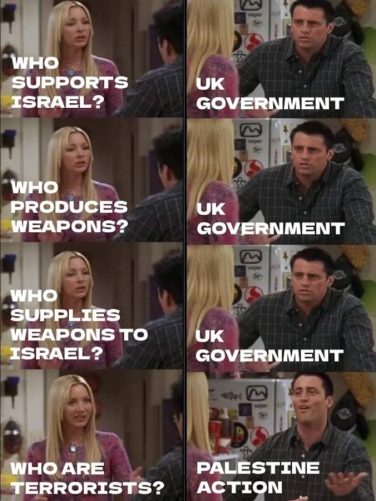 Following the arrests, Home Secretary Yvette Cooper announced her intention to designate Palestine Action as a proscribed organization under the UK’s Terrorism Act. If implemented, the designation would make it illegal to support, join, or promote the group, an escalation that has drawn concern from human rights advocates and civil liberties organizations.
On the same day, hundreds gathered in Trafalgar Square to express solidarity with the group, warning against the criminalization of activism aimed at opposing the UK’s complicity in supplying weapons to “Israel”.
In response, Palestine Action issued a statement via X, condemning the government’s treatment of the protest. “Despite us not being proscribed, the state is treating red paint on warplanes as an act of terrorism,” the group stated. It further revealed that the arrested activists were being held in solitary confinement without charge for several days.
Authorities moved quickly to suppress related demonstrations, dispersing planned rallies outside Parliament and pushing protesters into Trafalgar Square. Several arrests were made, with the Metropolitan Police citing public order risks. Meanwhile, counter-terrorism police have launched a broader security review across UK military installations.
Wider context
Palestine Action, founded in 2020 by British-Palestinian activist Huda Ammori and co-founder Richard Barnard, is known for its confrontational yet non-lethal tactics aimed at arms companies tied to “Israel’s” military-industrial complex. Previous campaigns have led to the temporary shutdown of Elbit Systems-linked factories in Oldham and Tamworth, as well as disrupted contracts with Israeli weapons suppliers.
Legal experts have raised doubts about whether Palestine Action meets the statutory requirements for proscription under the Terrorism Act 2000, which include posing a real threat to national security or British citizens. Critics argue that the group’s actions, while disruptive, remain rooted in civil disobedience rather than terrorism.
The proposed ban has renewed scrutiny of UK-“Israel” cooperation, with campaigners pointing to past evidence of coordination between British counterterrorism units and the Israeli embassy. Concerns are growing that this measure could set a precedent for further repression of pro-Palestine activism.
Families of detained activists face deepening uncertainty, as support efforts, ranging from legal aid to court appearances, could be criminalized. Foreign nationals involved in the group may also face deportation or visa revocation if the ban is enacted.
Zarif accuses IAEA’s Grossi of aiding war crimes, calls for removal
Al Mayadeen | June 27, 2025
Former Iranian Foreign Minister and ex-Vice President for Strategic Affairs, Mohammad Javad Zarif, issued a scathing condemnation of International Atomic Energy Agency (IAEA) Secretary-General Rafael Grossi on Friday, accusing him of facilitating war crimes through politically charged actions and rhetoric.
In a statement posted on his official X account, Zarif said Grossi had “abetted the slaughter of innocents” by issuing what he described as a fictitious IAEA report, and warned that the director-general is now laying the groundwork for further crimes against Iran.
Grossi accused of promoting false narratives
Zarif sharply criticized Grossi’s recent suggestion that Iran might be concealing uranium at World Heritage Sites in Isfahan, calling the claim “reckless musing” and part of a broader campaign to provoke further military escalation. “@rafaelmgrossi is now conspiring to abet more war crimes,” Zarif wrote.
The former top diplomat added that the IAEA should remove Grossi from his post, calling him a “disgrace” to the agency and launching the hashtag “#Fire_Grossi” to amplify the demand.
Mounting criticism over IAEA’s politicization
The remarks add to a growing number of Iranians accusing the IAEA of losing its impartiality and enabling acts of aggression by the Israeli occupation and the United States.
This also comes after Iranian Foreign Minister Abbas Araghchi announced Friday that the Iranian Parliament had voted to suspend cooperation with the International Atomic Energy Agency (IAEA) until the safety and security of the country’s nuclear infrastructure can be guaranteed.
The decision follows days of mounting tension over the US and the Israeli regime’s attacks on Iranian nuclear facilities, which Tehran says were politically facilitated by the IAEA’s leadership. Araghchi directly blamed IAEA Director-General Rafael Grossi for contributing to what he called “a sordid state of affairs.”
In a statement published on X, Araghchi accused Grossi of playing a “regrettable role in obfuscating” the fact that the IAEA had closed all past issues with Iran’s nuclear program a decade ago. Instead of upholding that record, Grossi, according to Araghchi, enabled the IAEA Board of Governors to adopt a “politically-motivated resolution” against Iran.
That resolution, Araghchi said, directly set the stage for recent bombings of Iranian nuclear sites by the US and the Israeli occupation.
Iran to defend its sovereignty
Araghchi condemned Grossi’s silence in the face of these attacks, calling it a “betrayal” of his statutory responsibilities. “In an astounding betrayal of his duties, Grossi has failed to explicitly condemn such blatant violations of IAEA safeguards and its Statute,” Araghchi said.
He further criticized Grossi’s insistence on visiting bombed sites under the pretext of inspections, calling such efforts “meaningless” and “possibly even malign in intent.”
Iran, Araghchi emphasized, reserves the right to take any measures necessary to defend its sovereignty, people, and national interests. He reiterated that cooperation with the IAEA would not resume until credible guarantees are in place to protect Iran’s nuclear facilities from further attacks.
“The IAEA and its Director-General bear full responsibility for what has transpired,” Araghchi stated, underscoring Iran’s growing distrust of the agency’s impartiality amid a broader climate of Western pressure and aggression.
Most Americans Believe Israel Has Too Much Influence on US Policy – Poll
Sputnik – 27.06.2025
More than half of Americans believe Israel wields too much influence on US policy, a survey conducted by US research firm Tyson Group showed on Friday.
Specifically, 54% of respondents said that Israel’s influence is excessive, while 27% disagreed with this position, according to the survey.
Among Democrats, 62% agreed with the position, compared to 43% of Republicans and 44% of senior Americans aged 65 and over.
The majority of Americans, 54%, also believe recent US airstrikes significantly set back the development of Iran’s nuclear progam, including 19% who state that it was “completely obliterated,” the survey showed.
Meanwhile, 75% of respondents are concerned that the conflict could escalate into a larger war, while 67% believe that the US could launch new military action against Iran, according to the survey.
The survey was conducted from June 25-26 among 1,027 US adults, with a margin of error of 3.1 percentage points.
Ceasefire without terms: Iran’s strategic deterrence in shadow of 9,379 kg
By Amro Allan | Al Mayadeen | June 27, 2025
12 days of war between Iran and the Israeli-US alliance have ended, not with an agreement, treaty, or even mutual understanding, but with silence. US President Donald Trump announced a unilateral ceasefire following an Israeli request, and after consultation with Prime Minister Benjamin Netanyahu’s cabinet. Qatar, acting as an intermediary, passed on the message to Tehran, which acknowledged the mediation without committing to any terms. No documents were signed, no concessions were made, and no conditions agreed. What has emerged is a calm devoid of consensus, a tactical pause, not an end to the war.
Yet for all its fragility, this ceasefire reveals something critical: Iran endured, Iran responded, and most significantly, Iran preserved what it considers the cornerstone of its strategic deterrence, its nuclear capability and its sovereignty in the face of overwhelming pressure. And for a nation that has lived through decades of sanctions, threats, and assassinations, survival on its own terms is not defeat, it is a form of victory.
Victory without capitulation
From Tel Aviv and Washington, the war was framed as a swift punitive campaign meant to decapitate Iran’s nuclear programme and reassert Israeli regional dominance. Netanyahu boasted of air superiority, missile interception, and the assassination of key Iranian generals and nuclear scientists. He claimed “Israel” had “dismantled” Iran’s missile programme and brought its nuclear efforts to a halt.
But such triumphalism proved premature, and ultimately misleading. The final missiles fired before the ceasefire originated from Iranian launchers, employing a strategic class of weaponry deployed for the first time in this conflict. Strikes on Tel Aviv, Haifa, and strategic military targets pierced “Israel’s” multi-layered air defence systems and killed seven. These were not symbolic responses; they were calibrated strikes executed under pressure, revealing Tehran’s ability to absorb an attack and immediately retaliate.
From Iran’s perspective, the war did not end in surrender, nor even in compromise. Iranian officials confirmed that while key facilities at Fordow, Natanz, and Esfahan were targeted, critical material, including an estimated 9,379 kilograms of enriched uranium, was relocated to fortified and undisclosed sites before the first missiles struck. Iran suffered damage, but not disarmament. Its ability to resume nuclear enrichment, or even accelerate it, remains fully intact.
The untouched core: 9,379 kilograms
The most recent IAEA report from May 2025 offers the most telling figures: Iran holds 9,379 kilograms of enriched uranium at various purities. Of these, 8,840 kilograms are enriched to 5% or less, usable for civilian reactors and medical isotopes. A further 130 kilograms of uranium exists in intermediate purity levels, mostly in scrap form.
The strategic concern, and Tehran’s most potent leverage, lies in the 408.6 kilograms enriched to 60%, a step away from weapons-grade 90% enrichment. According to nuclear experts, this stockpile could provide material for up to nine nuclear warheads if further refined. Iranian officials assert that none of this material was compromised during the bombing campaign and that their pre-emptive relocations prevented a nuclear or environmental catastrophe.
The IAEA has acknowledged that it detected no abnormal radiation levels post-strikes, suggesting no containment breach occurred. However, the Agency has not been granted access to the new locations, a move Tehran justifies as a response to what it sees as an illegitimate and unprovoked military assault on safeguarded civilian nuclear infrastructure.
In this light, Iran’s refusal to disclose further details is not simply about secrecy: it is an assertion of sovereignty. It underscores a consistent Iranian position that nuclear development, so long as it remains within NPT guidelines, is a right, not a bargaining chip.
Strategic deterrence and battlefield lessons
Iran’s response went beyond merely absorbing damage. It turned the battlefield into a proving ground for its missile, drone, and cyber capabilities. Iranian forces launched hypersonic missiles that bypassed Israeli defences entirely, signalling not just tactical innovation but strategic maturity. It demonstrated that its command-and-control structures remain functional under attack, and that its military doctrine has evolved to anticipate multi-domain warfare.
Equally important is the shift in psychological warfare. For the first time, Iran shattered the long-standing regional norm against directly striking Israeli territory with sustained, high-precision attacks. It was a message: the Islamic Republic is prepared to escalate if pushed, and escalation no longer means allies in Lebanon or Iraq—it means Tehran itself.
“Israel’s” sense of impunity has been challenged. Its air defense failures in intercepting Iranian salvos have exposed critical vulnerabilities, undermining Netanyahu’s claims of “total superiority.” What once was an asymmetric confrontation tilted in “Israel’s” favour has now grown more balanced. Iran may not match “Israel’s” military hardware or American support, but it has altered the rules of engagement and redefined the costs of war.
A Ceasefire or a Countdown?
Like most previous regional confrontations, this ceasefire was not a culmination, it was an intermission. There is no written document, no internationally recognised monitoring framework, and no agreed roadmap for de-escalation. From Tehran’s point of view, this suits “Israel” and the US, both of which sought a pause, not a solution.
US President Trump’s ceasefire announcement was timed more for electoral optics than for strategic clarity. It postponed a war that risked spiralling out of control, particularly if the United States was drawn deeper into an open-ended campaign. But in doing so, it handed Iran space: space to harden its facilities, mobilise internally, and potentially accelerate a shift from nuclear ambiguity to overt deterrence.
And while Washington may consider this a temporary win, in Tehran, it’s viewed as proof that Iran’s endurance forced a nuclear superpower to back down.
Tehran has since filed a complaint with the United Nations, accusing the US and “Israel” of violating international law by targeting nuclear facilities under IAEA safeguards. Article II of the UN Charter prohibits the use of force against the territorial integrity of sovereign states outside of self-defence or Security Council approval. Moreover, under the Convention on the Physical Protection of Nuclear Material, attacks on safeguarded nuclear sites are explicitly prohibited due to the danger of radiological release and nuclear proliferation.
By failing to condemn the assault, Iran argues, the IAEA and its Director General, Rafael Grossi, risk setting a precedent that undermines the entire non-proliferation regime. The silence from international bodies has also eroded confidence in future cooperation and inspections. Why, Iranian officials ask, should Tehran continue to allow oversight if that oversight brings no protection?
The Unravelling of the JCPOA framework
With the Joint Comprehensive Plan of Action (JCPOA) already hanging by a thread since the US withdrawal in 2018, this latest episode may have finally sealed its fate. While Europe and Russia have called for renewed diplomacy, the military strikes have made a return to the previous deal politically toxic in Iran.
For many in Tehran, the JCPOA is now seen as a trap, one that offered transparency in exchange for economic relief that never came, and which left Iran’s strategic sites vulnerable to airstrikes and sabotage. In this view, returning to negotiations without structural guarantees would be naïve.
Indeed, many voices in Iran’s political establishment are calling for full withdrawal from the Non-Proliferation Treaty (NPT) itself, a move that would legally unbind Iran from its current commitments and allow for open pursuit of a nuclear deterrent.
A shift toward strategic ambiguity
The consequences of the ceasefire extend far beyond Iran’s borders. In Arab capitals, there is quiet recognition that Iran has emerged more resilient and emboldened. In Tel Aviv, there is growing unease over the efficacy of existing defences. And in Washington, there is a dangerous temptation to view ambiguity as strategy.
But ambiguity, in this case, cuts both ways. Iran has preserved its right to develop nuclear technology while refusing to confirm its future intentions. Should it now cross the weaponisation threshold, it may do so without warning, rendering international diplomacy too slow to stop it. The 9,379 kilograms of enriched uranium now sit in the shadows, untouched, uninspected, and more symbolically potent than ever.
If the goal of the Israeli-American air campaign was to slow down Iran’s march toward nuclear capacity, it may have done the opposite. Tehran now has every justification to argue that deterrence, not diplomacy, is its only protection against existential threats.
The reality is stark: this ceasefire has changed nothing. It has only delayed the inevitable confrontation, whether on the battlefield or in the nuclear sphere. “Israel” will continue to press for economic isolation and sabotage operations. Iran will deepen its alliances, harden its defences, and invest in further nuclear and missile development.
In truth, both parties are positioning themselves for the next phase of confrontation.
The international community, meanwhile, remains largely paralysed. With diplomacy broken, legal frameworks ignored, and verification mechanisms sidelined, the world is flying blind. The stakes are no longer theoretical. A single miscalculation could trigger a chain reaction that extends far beyond the Middle East.
The rendezvous has only been postponed
What began as an undeclared war has concluded with an undeclared pause. Yet make no mistake, this is merely the beginning of a countdown.
Iran, having absorbed an extensive assault on its territory, has emerged defiant, intact, and strategically alert. “Israel”, despite its claims, has discovered its limits. And the US, though instrumental in halting the war, has revealed the fragility of its credibility as an honest broker.
The next act may begin with an enrichment announcement, a nuclear test, or another missile barrage. For now, Tehran waits in silence, but it waits on its own terms. The world, meanwhile, must decide whether to engage that silence diplomatically, or face its consequences militarily.
Either way, the rendezvous is coming.
Did US Really ‘Obliterate’ Fordow?
Sputnik – 27.06.2025
Pentagon and White House claims and intelligence and media reports about the US’s June 22 attack on Iran are turning into a confusing jumble of contradictory information. Sputnik asked veteran former Swedish Armed Forces officer Mikael Valtersson to sort through the falsehoods.
The Pentagon’s Claim: The DoD and White House say Fordow, Iran’s main, fortress-like mountain nuclear site, was obliterated based on evidence of concrete dust rising through its ventilation shafts after the US attack.
Expert Opinion: Valtersson points out that the concrete dust could be expected even with superficial damage, as the shafts themselves are made of concrete. “Even if you just hit the top of it, there will be concrete dust,” he explained.
“The ventilation shaft is made in such a way that it’s not just a hole down to it that you can drop a bomb into it. Exactly how they have built it, I don’t know. But it will not be possible just to drop it down to the facility if you hit it. [Otherwise] the Israelis could have done it.”
GBU-57 Bomb Details: Valtersson noted that the GBU-57 bomb is designed to penetrate up to 60 meters before exploding. But Fordow is built in rock, and buried under a mountain. The observer speculates that even if individual bombs hit the ventilation shafts, they would only penetrate 20 to 30 meters of rock before the blast occurred.
Built Fordow Tough: Valtersson assumes the Iranians likely designed Fordow to withstand a US attack, with shafts potentially built with caverns to divert blasts. He compared this to his experience with underground Swedish military facilities, constructed in a zigzag pattern for similar protection.
Seismic Considerations: Furthermore, Valtersson noted that Iran, mindful of potential attacks and earthquake risks, likely built Fordow on springs to absorb heavy shockwaves, ensuring its structural integrity. “They’re probably not just standing on the ground in a cavern,” he emphasized.
Attacking Iran is How You Get a Nuclear Iran
The debate over just how much damage US strikes did to Iran’s nuclear sites can only really be resolved on the ground, “big shovel” in hand, as frustrated DoD chief Pete Hegseth admitted to media after the leak of a preliminary intel assessment indicating that the attacks did not destroy the sites.
But “it’s not about whether they did or did not do damage,” says retired Russian Army colonel and military analyst Viktor Litovkin. “It’s about Trump bragging that the US had finally ‘closed’ the issue of Iran producing nuclear material. And leaks to press show that they did not conclusively do so.”
For one thing, “we don’t know whether Iran took its enriched uranium out of [Fordow] or not, and where this enriched uranium is now. Maybe it’s in Pakistan,” Litovkin quipped.
“One thing is clear. After what the US has done, Iran, which did not want to have the bomb before, will have it now. If not today, tomorrow. They understand that the only guarantee against such bombings is an atomic bomb,” the analyst said, citing the example of North Korea, who “no one touches” thanks to its nuclear capabilities.
Araghchi outlines post-war nuclear diplomacy, warns against sanctions
Al Mayadeen | June 27, 2025
In a televised interview with Iranian broadcaster SNN TV, Iranian Foreign Minister Abbas Araghchi asserted that both the United States and “Israel” had mobilized their nuclear capabilities and coercive strategies to force Iran into submission, but ultimately failed.
Araghchi praised the Iranian people’s steadfastness, describing it as a “historic symbol of resistance” during a critical national moment, emphasizing that despite years of sanctions, threats, and failed negotiations, the Iranian nation remained united in defense of its nuclear rights.
“Neither pressure nor diplomacy deprived us of our legitimate rights,” Araghchi declared.
The minister criticized US President Donald Trump’s “maximum pressure” campaign, describing it as marked by mixed messages, threats coupled with calls for dialogue.
While Iran rejected direct talks with Washington, Araghchi noted that Tehran was considering indirect negotiations under new conditions. After diplomatic efforts failed to impose US terms, Araghchi accused Washington of unleashing “the Zionist enemy to commit hostile acts,” which he described as a betrayal of diplomacy.
Addressing Iran’s retaliatory actions, he stated that Tehran’s missile attacks on US bases were a direct response to American threats and aggression, clarifying that no agreement had been reached to initiate new talks and that the outbreak of war had undermined Iran’s readiness to propose a balanced negotiation framework.
He revealed that this framework rested on three pillars: the continuation of uranium enrichment within Iran, the complete removal of sanctions, and a firm commitment not to pursue nuclear weapons.
“If these three conditions are met, an agreement is possible,” he said.
Iran’s response to military strikes and diplomatic breakdown
In his interview, Araghchi stressed that diplomacy following the recent war would differ sharply from previous efforts, warning that “Future international relations will reflect how each country behaved during the crisis.”
He noted that the Atomic Energy Organization of Iran (AEOI) is currently conducting technical assessments of damage caused by the strikes, describing them as “serious and extensive.” Meanwhile, Iran’s Foreign Ministry has tasked its international affairs division with identifying the aggressors and seeking compensation through the United Nations.
“Reparations are now a key component of Iranian diplomacy,” he added.
The minister urged European countries, particularly Germany and France, to uphold their stated commitment to international law, issuing a stark warning to France and the UK, both permanent members of the UN Security Council, against triggering the snapback mechanism that would reinstate UN sanctions on Iran.
He labeled such a move as “the most dangerous strategic error Europe could make,” warning that it would exclude them from any meaningful role in Iran’s nuclear dossier.
“Military strikes and snapback sanctions won’t weaken Iran—they will eliminate Europe’s place at the table,” he asserted.
No plans to host IAEA chief amid inspection concerns
The Foreign Minister confirmed that Iran currently has no plans to host IAEA Director Rafael Grossi, noting that the issue of inspector access is under careful legal and political review.
“With some facilities damaged, inspections could inadvertently reveal sensitive details about the extent of destruction,” he said, emphasizing that all decisions must comply with recent legislation passed by Iran’s Parliament.
Ian Proud: Was the Iran War a Strategic Blunder?
Glenn Diesen | June 25, 2025
Ian Proud was a member of His Majesty’s Diplomatic Service from 1999 to 2023. Ian was a senior officer at the British Embassy in Moscow from July 2014 to February 2019, at a time when UK-Russia relations were particularly tense. He performed a number of roles in Moscow, including as Head of Chancery, Economic Counsellor – in charge of advising UK Ministers on economic sanctions – Chair of the Crisis Committee, Director of the Diplomatic Academy for Eastern Europe and Central Asia and Vice Chair of the Board at the Anglo-American School.
Ian Proud’s Substack: https://thepeacemonger.substack.com/
Follow Prof. Glenn Diesen: Substack: https://glenndiesen.substack.com/
Featured Video
It’s the Occupation, Stupid
or go to
Aletho News Archives – Video-Images
From the Archives
A superpower and “the world’s sickest warrior state”
By Paul J. Balles | March 8, 2010
Living through five or six major wars has hardened me to what I thought were the extremes of inhuman cruelty and brutality.
Two things made those extremes almost bearable: the brutality always revealed – at least according to the media coverage – the viciousness of the enemy. It was therefore quite understandable when our “brave men and women” pulverized the enemy.
Films of Japanese torturing captive Americans somehow justified holding Japanese Americans in internment camps during World War II; and only a small percentage of Americans found the bombing of Hiroshima and Nagasaki unreasonably vengeful at best, at worst, depraved.
The media giants in America portrayed the North Koreans as barbaric beasts with their captives, quite unlike their southern counterpoints – our allies during the Korean War. No one ever felt the need to explain how the South Koreans were a civilized breed while the North Koreans were absolute savages, at least according to the official line.
In Vietnam, our warriors justifiably (or so the media made us believe) dropped napalm on the North Vietnamese who had the gall to hide in villages and tunnels to ravage our invaders. At least it was accepted practice until some rogue photojournalist filmed a young girl screaming down a Vietnamese road in flames. … continue
Blog Roll
 Aletho News
- AWACS’ Destruction is a Major Loss for US Military – Ex-DoW Analyst
- Israel’s Iran Strategy Uses US Military & Gulf States as Its Pawns
- Iran: Trump wanted regime change, now just begging for Hormuz to open
- IRGC: Israeli, US universities in region legitimate targets after strikes on Iranian university
- Trump admits Iran hit USS Ford carrier: ‘We ran for our lives’
- Battle for Hungary: EU attacks on Orban are a sign of worse things to come
- Iraqi resistance conducts drone strike on US-run base in Syria
- Failing to Defeat Hezbollah, Israel & US Pressure Syria’s Ahmed al-Sharaa to Join War
- US-Israeli war on Iran drives global fertilizer prices up 40%
- Hezbollah’s Surprise Weapons Redefine Ground Battle with Israel
- If Americans Knew
- Israel is assassinating journalists again, more than any other nation, anywhere, ever – Not a ceasefire Day 170
- Over 300 US service members wounded, majority have brain injuries – Not a ceasefire Day 169
- Researchers at Human Rights Watch Resign Over Blocked Report on Palestinian Refugee Return
- Jewish Groups Are Backing a War Americans Don’t Want
- Eric Fingerhut Thinks He’s the President of the Jews
- Top Jewish Philanthropists, Rabbis Urge Israeli President to Take Action Against ‘Jewish Extremists’
- Don’t Be Fooled. Zionist Leaders Have Always Wanted to Control Southern Lebanon
- Israel’s widespread use of torture is a core element of its genocide against the Palestinian people
- In Israel’s War on Iran, Many Middle East US Bases Rendered “All But Uninhabitable”
- ‘Burn the lawn’: Israel pursues ‘Rafah model’ in southern Lebanon
- No Tricks Zone
- German Science Blog Accuses PIK Climate Institute Of Hallucinating Climate Tipping Points
- Devastating Assessment Of Comirnaty Vaccine By Former Senior Pfizer Europe Toxicologist
- New Study: CO2 Is ‘Effectively Negligible’ As An Explanatory Climate Change Factor Since 2000
- Former Pfizer Toxicologist Dr. Helmut Sterz Tells Bundestag Hearing Pfizer Vaccine Should Have Never Been Approved
- Energy Expert: Germany’s Nuclear Phaseout Was A “500 Billion Euro Mistake”
- New Research: South Australia’s Mid-Holocene Sea Surface Temperatures Were 4°C Warmer Than Today
- Storing Green Energy To Last Germany 10 Days Would Require A 60-Million Tonne Battery
- New Studies: UK Sea Levels Were 4 Meters Higher Than Today During The Mid-Holocene
- Destructive Green New Deal: German Energy And Metal Group Warns Of Drastic Crisis
- New Study Documents A 20-Year Pause In Arctic Sea Ice Decline – Driven By Internal Variability
 Aletho News