Israeli Navy Chases Fishermen, Confiscates Fishing Equipment in Gaza Waters
Palestinian Center for Human Rights – December 19, 2013
Israeli Naval Forces stationed off Beit Lahi shore, in the northern Gaza Strip, opened fire at Palestinian fishing boats in 4 separate incidents, while sailing between 600 meters and 3 nautical miles. Israeli naval forces also confiscated 24 fishing nets.
The Palestinian Center for Human Rights (PCHR) expresses concern over the continued targeting of fishermen and their livelihoods.
Economic and social rights of fishermen have been violated by the illegal naval blockade imposed by Israeli authorities on the Gaza waters since June 2007.
According to investigations conducted by PCHR, at approximately 10:40 on Wednesday, December 18, Israeli gunboats opened fire at a Palestinian fishing boat that was sailing about 600 meters off al-Wahah shore in Beit Lahia, in the northern Gaza Strip.
Two gunboats surrounded the fishing boat which was boarded by 3 fishermen: Mahmoud ‘Ali ‘Arouq (16); his brother Mohammed (22); and Jom’aah Amin ‘Arouq (24).
Israeli naval forces then ordered the men to stop fishing and give themselves up, but they refused and fled.
The naval forces confiscated 14 fishing nets, a total length of 840 meters.
Mahmoud ‘Ali ‘Arouq (28) said that they left the waters, to the shore, and watched the gunboats, hoping that they would regain their fishing nets.
However, the gunboats confiscated the nets and left the place.
In another incident, at approximately 12:30 yesterday, December 18, Israeli gunboats opened fire at a fishing boat belonging to Khalid ‘Awad al-Kafranah, from Beit Hanoun, in the northern Gaza Strip, while sailing at approximately 1.5 nautical miles off al-Wahah shore in Beit Lahia, also in the northern Gaza Strip. Israeli naval forces then confiscated 10 fishing nets.
In a third incident, at approximately 06:00 on Tuesday, December 17, Israeli gunboats stationed off al-Wahah shore in Beit Lahia, in the northern Gaza Strip, opened fire in the vicinity of Palestinian fishing boats that were sailing approximately 3 nautical miles offshore.
The shooting continued for about 10 minutes, so the fishermen were forced to flee, for fear of being attacked.
In a fourth incident, at approximately 14:10 on Monday, December 16, Israeli gunboats stationed off al-Wahah shore in Beit Lahia, in the northern Gaza Strip, opened fire in the vicinity of Palestinian fishing boats that were sailing at approximately 3 nautical miles offshore.
The shooting continued for about 15 minutes, so the fishermen were also forced to flee, for fear of being attacked.
PCHR condemns the continued Israeli attacks against Palestinian fishermen in the Gaza Strip, and:
1. Calls for the immediate halt of the policy of chasing and arresting Palestinian fishermen, and allowing them to sail and fish freely;
2. Demands compensation for the fishermen, for the physical and material damage caused to them and their property as a result of these violations;
3. Calls upon the international community, including the High Contracting Parties to the Fourth Geneva Convention of 1949, Relative to the Protection of Civilian Persons in Time of War, to immediately intervene and stop the Israeli violations against the Palestinian fishermen and to allow them to sail and fish freely in the Gaza Sea.
**************************************
For more information please e-mail: pchr@pchrgaza.org
Related articles
- Army Kidnaps Two Palestinian Fishermen In Northern Gaza (imemc.org)
- Under Israeli fire, Gaza fishermen plan protest tent to “free the Holy Land sea” (palsolidarity.org)
- Palestinian fisherman injured and his finger amputated as Israeli naval troops fire at fishing boat in Gaza sea (palsolidarity.org)
- Israeli forces attack, detain Gaza fishermen near Beit Lahiya (gazasolidarity.blogspot.com)
Israeli navy captures two Gaza fishermen, including one injured by gunfire
By Rosa Schiano | International Solidarity Movement | November 13, 2013
Gaza, Occupied Palestine – On the morning of Sunday, 10th November, brothers Saddam Abu Warda (age 23) and Mahmoud Abu Warda (age 18) were captured by the Israeli navy in Palestinian waters off the Gaza Strip. They were released later in the evening and their boat was confiscated. Mahmoud was injured by a bullet in the right side of his abdomen.
We went to visit the two young fishermen in their home in the town of Jabaliya, in the northern Gaza Strip.
In the absence of electricity, the house was dark like most homes in Gaza Strip, which is stifled by the siege and a severe fuel crisis. Without electricity, water could not reach the house’s plumbing system.
“We cast our nets into the sea at a distance of about 500 meters from the forbidden fishing area,” Saddam told us. “We were far away from the Israeli gunboats.” The two fishermen were on a small boat, or hasaka, without an engine.
Saddam told us that an Israeli gunboat approached their boat. The soldiers shouted for them to leave in less than five minutes. “We had to cut our nets in order to flee,” Saddam said. “The soldiers came closer to us and started shooting at our boat.”
Without a motor, the two fishermen could not escape. The Israeli soldiers ordered the two fishermen to undress and jump into the water. Meanwhile, they continued to open the fire. “I was shocked,” Saddam said. “I could not move. They were shooting, and I thought I would be killed.”
As we listened to Saddam, F-16 fighter jets rumbled overhead at low altitudes, a constant threat in the darkness.
“I shouted, asking the soldiers to stop shooting and save our lives,” Saddam said. According to him, another Israeli gunboat reached them and attacked the fishermen using water cannons. The two fishermen jumped into the water. “Three Israeli gunboats surrounded us, our boat was now far away, and the water was cold,” he added. The soldiers told them to swim to the forbidden maritime area. “I was scared. My brother was away from me, and the soldiers kept firing. He was wounded. He could not swim. I reached him to save him. His blood was everywhere in the sea. Two Israeli dinghies reached us. The soldiers took my brother Mahmoud and closed his wound to stop the bleeding. They didn’t take me, too. They left me in the water. They told me to swim to the marker that delimits the maritime area allowed by Israel, then took me. They covered my head. I could not see anything. They pointed a gun at my head and cuffed my hands and feet. They hit me, kicking me on the back. Then I fainted for about an hour. I don’t remember anything more.”

Mahmoud (left) and Saddam Abu Warda. (Photo by Rosa Schiano)
The two fishermen were transported to a medical center in the port of Ashdod. “When I woke up, I saw my brother beside me,” Saddam said. “Two soldiers then took me to a special room and interrogated me. They asked me why we were fishing in the forbidden area. I told them that we were 500 meters away from the limit, and that the soldiers forced us to swim until we reached it. An investigator asked me how my brother was wounded, since it was not by the Israeli soldiers. I told him my brother was wounded by Israeli gunfire. The investigator tried to convince me that Mahmoud was not wounded by the soldiers. Then I told him that three Israeli gunboats were shooting over our heads and my brother’s blood was everywhere in the sea”.
The investigators then showed Saddam a map on a laptop, placing their boat in the forbidden maritime area. Investigators interrogated the two fishermen individually. Afterwards, the two brothers were detained in another room, and at the end of the day, were transferred to Erez, where they received another interrogation. “They asked me about my family, my neighbors, fishermen, and every detail of my life,” said Saddam. “Then they showed me a map and asked me about every house around my home. They also asked me how many boats I had.”
The Israeli port of Ashdod now holds three boats belonging to Saddam’s family. In the past, in fact, other members of the Abu Warda family had been arrested and seen their boats confiscated. Now they have none left.
After interrogation, the fishermen were detained in a cell for two hours before being released through the Erez checkpoint later in the evening.
Saddam’s family has 15 members. Fishing is their only source of livelihood. The other eight brothers are also fishermen. They don’t have any other source of income, and they don’t believe they will get their boats back.
Mahmoud showed us the wound on the right side of his abdomen. The bullet did not enter his body, but brushed it. Doctors in the Ashdod medical center closed his wound with two stitches. Mahmoud also told us of the physical and verbal abuse he received from Israeli soldiers. We asked him if he will return to fishing. “Of course,” he said. “We have no choice. We have to face the danger.”
What its fishermen earn only allows the Abu Warda family to survive. Sometimes, they return home without anything. Other times, what they earn only covers the cost of fuel.
The fishermen told us that they would like more support from international associations, especially when they are in the north of the Gaza strip. There, attacks are more frequent and the majority of confiscated boats have been lost.
We continue to hope that one day the international community will break its silence and force Israel to stop attacking Gaza fishermen, and to release all their boats it has confiscated.
Background
Israel has progressively imposed restrictions on Palestinian fishermen’s access to the sea. The 20 nautical miles established under the Jericho agreements, between Israel and the Palestine Liberation Organization (PLO) in 1994, were reduced to 12 miles in the Bertini Agreement of 2002. In 2006, the area Israel allowed for fishing was reduced to six nautical miles from the coast. After its military offensive “Operation Cast Lead” (December 2008 – January 2009) Israel imposed a limit of three nautical miles from the coast, preventing Palestinians from accessing 85% of the water to which they are entitled under the Jericho agreements of 1994.
Under the ceasefire agreement reached by Israel and the Palestinian resistance after the Israeli military offensive “Operation Pillar of Defense” (November 2012), Israel agreed that Palestinian fishermen could again sail six nautical miles from the coast. Despite these agreements, the Israeli navy has not stopped its attacks on fishermen, even within this limit. In March 2013, Israel once again imposed a limit of three nautical miles from the coast. On 22 May, Israeli military authorities announced a decision to extend the limit to six nautical miles again.
Related article
- Army Invades Southern Gaza (imemc.org)
Sailing From Gaza to Break the Blockade
By ALESSANDRA BAJEC | August 19, 2013
 A new mission vows to challenge the blockade of Gaza by sea following Freedom Flotilla efforts since 2010, and Free Gaza missions preceding Cast-Lead in 2008. Not a Gaza-bound aid convoy this time.
With a crew of Palestinians and international activists on board, Gaza’s Ark will sail from the port of Gaza, carrying Palestinian products to buyers around the world, to defy Israel’s illegal and inhuman blockade.
Gaza’s Ark is rebuilding a cargo vessel that will attempt to open the sea to Palestinian exports to show to the outside world that Palestine is a productive land, while drawing public attention on the 7-year blockade.
Because nearly all previous attempts to reach Gaza were blocked by the Israeli navy, and given Israel-imposed three mile limit from the Gazan coast, campaigners are well aware that Israeli forces will hardly let any boat leave Gaza port.
David Heap, French-language and linguistics associate professor at the University of Western Ontario, is a spokesperson for Gaza’s Ark. He talked about the new solidarity initiative.
How did the idea of Gaza’s Ark come about?
D.H: After the last flotilla sailing I was involved in with other members, we realised we obviously need to carry on our work, trying to think of ways to continue direct action. Not just talking about the siege, but acting directly against the siege to change the premises of it.
Gaza’s Ark is the continuation of the Freedom Flotilla movement, but it’s different in significant ways due to the direction, the non-humanitarian connotation, and because fundraising efforts are being spent primarily in Gaza.
Why is this initiative important?
DH: Freedom of movement is a fundamental human rights issue that has been systematically denied to all Palestinians, in particular most severely to Palestinians of Gaza. I feel it’s an obligation to try, even in a small, symbolic way, to demand some kind of hope for these people, especially the young ones. When I visited Gaza last autumn, I was struck by the youth and their thirst for contact with the outside world.
What makes Gaza’s Ark different from previous attempts to break the siege?
D.H: Gaza’s Ark has a broader focus. We don’t just talk about the sea blockade but the whole blockade imposed on Palestine. What we’re addressing is freedom of movement –both commercial goods and people- national sovereignty and territorial integrity. We will have goods on board from all over Palestine, as Palestinians themselves have told us they should be exporting goods from not only Gaza but also the West Bank and Jerusalem.
Could you discuss how trade rather than aid may help Gaza more effectively?
D.H: Working with the Palestinian civil society in Gaza, what we at Freedom Flotilla Coalition hear is they’re sick of being recipients of international humanitarian aid. Palestinians tell us they don’t want more humanitarian aid, they want to live on their own economy as they’re very capable of doing. They claim the same freedom of movement rights that everybody enjoys.
Gaza, in particular, had a very prosperous economy in the past. But the infrastructure was systematically destroyed by Israel, and the only factories that are surviving can’t function due to the Israeli blockade.
What potential do you think the project has in comparison with the flotillas that have so far tried to sail to Gaza?
DH: If we take the Flotilla Movement as a whole, it has almost had as many successful arrivals to Gaza as attacks. This is something that goes easily forgotten in the mainstream media.
The choice of allowing us to sail safely to other destinations in the Mediterranean is something the occupier decides, not us. We can only control what we do. When the Israeli navy assaulted prior flotillas, the rhetoric used was that the boats posed a threat to Israel’s security. Which is absolutely false, none of the inbound voyages created a security risk for anyone, nobody ever found dangerous items on the flotillas that could possibly threaten the security of Israel.
Given that Gaza’s Ark is outbound, it will be interesting to see what the response from the Israeli military will be. They won’t be able to use the security argument since, even if we carried anything dangerous –which is to exclude- Israel shouldn’t care about a boat sailing out. However, I’m sure they will come up with a pretext, but It will be even harder to defend in international public opinion.
How open are international consumers to Palestinian products from Gaza?
D.H: We’ve been conditioned to think of Palestinians, Gazans in particular, as being dependant on aid. We don’t think of them as capable of having a productive economy. Part of our work is to educate the world that Palestinians can and do produce goods, and they have goods that they could export. Most people don’t know what products are available in Gaza, for example.
There’s a small selection of products that can be viewed on our website, including dugga, za’atar, dates, olive oil to name a few. Our campaign partners based in a number of countries are putting together group purchases of products from interested businesses, individuals and community groups to have their goods exported onboard Gaza’s Ark. Whichever goods potential buyers are more appealed to, whether agricultural or handicraft products, we will match them with producer organizations in Gaza.
Whatever happens to the boat, there will be a connection established between purchaser and producer in the end. Even in the event the goods don’t reach the port of destination, commercial partners in other countries will be connected to Palestinian produce organizations, they will know they bought goods and who sent them. That puts a human face to Palestinians as people who produce, and has the longer term function of building relationships which will ultimately help challenge the power of the occupier as well as the complicity of our governments in the West.
How doable is it for Palestinian producers of Gaza to secure trade deals with purchasers when there’s a real risk that goods will be confiscated by the Israeli military?
D.H: Although there’s commercial deal, it’s a special kind of commercial deal. We work with civil society partners, businesses and organizations. Purchasers in Europe, North America, Australia or South Africa have to be prepared to secure full payment before the boat sails. Palestinian producers are assured they will be paid the full purchase price of the goods before anything travels.
The risk is borne outside of Gaza by supporters of Palestinian businesses who believe that Palestinians should have their own economy. Then if something happens during the sailing, the risk is being shared by many people keeping in mind the human and commercial interest involved in this mission.
Only a small number of people can board a small boat in the east Mediterranean. But hundreds or thousands of people from different countries can potentially get on board with the campaign by buying parts of the cargo.
You intend to raise awareness and mobilize to action. How do you hope Gaza’s Ark will help put pressure on national governments and international organizations?
DH: There are bilateral trade agreements between Israel and the EU stipulating that there must not be obstacles to trading with occupied Palestinian territories. When we sail, and European buyers have purchased goods stocked on Gaza’s Ark, if the Israeli navy interferes with that sailing that’s an obstacle to trade. European commercial businesses will then have a very strong case to go to their governments and claim that, despite that they have commercial relations -with documentation proving the purchase of those goods- their imports have been confiscated.
We usually address human rights parliamentary commissions in Europe, now we may also appeal to commerce commissions. People have so far protested about human rights in reference to flotillas, but this initiative opens up another avenue, the commercial one, to bring up the blockade issue. Why is there free trade with Israel while there isn’t free trade for Palestinians? Why can’t Palestinians use their only port in Gaza?
Israel has used violence to stop other boats from leaving or entering the port of Gaza. What do you expect Gaza’s Ark will achieve?
DH: Again, the choice to use violence lies with the occupier, it’s not our choice. Everybody that sails with us is committed to non-violence, and we are very transparent about it. Whoever goes will make the choice to sail knowing the implications and possible consequences. Unfortunately we are dealing with a state that attacks unarmed civilians with impunity, as our governments in the West don’t hold it accountable.
When I went on the Gaza relief boat earlier in 2011, I was very aware of the risks. I and two dozen other activists were kidnapped, beaten and illegally arrested after Israeli naval forces seized the Canadian vessel we were on. The Canadian government did nothing. Canadians don’t overall support the blockade of Gaza, this government is in discordance with Canadian public opinion. So how can we make pressure? By putting Canadians and other internationals on the frontline. When I embark on a boat to break the blockade, I don’t just sail against the occupier, I sail against my own government.
What will be the next step if Gaza’s Ark will not reach its destination?
D.H: There’s always an after campaign. People are still following up actions from past flotilla sailings with regards to Gaza relief boats that have been seized in the last few years. With Gaza’s Ark, there will be more people involved because there are also purchasers on board. So we’ll be also bringing commercial actions against whoever happens to steal goods on the ship. We will also continue to stand in solidarity with the fishing fleet of Gaza, which is daily subject to violent constraints from the Israeli navy.
When do you anticipate Gaza’s Ark will be ready to sail?
D.H: We’re set to depart sometime this year hopefully. It depends on a lot of factors that we don’t control. The process of rebuilding the vessel has been difficult, especially this past month, raising funds internationally has not gone as fast as we would like.
But the date of sailing is for us less important than the lead up to it. The lesson we’ve learned from 2012 flotilla is a long campaign is an advantage because it allows you to develop more support in more countries. As long as we’re developing support for Palestinians of Gaza, spending most of the donated money in Gaza, we’re achieving the goal of affirming our support for a Palestinian economy. So if we don’t sail in 2013, we will sail after. The important thing is we keep opposing the blockade.
Alessandra Bajec lived in Palestine between June 2010 and May 2011 starting to work as a freelance journalist. Her articles have appeared in various Palestinian newswires, the European Journalism Centre’s magazine, The Majalla, among others.
The Most Contaminated Land in the Middle East
By Gilad Atzmon | June 17, 2013
Ynet reported today that Haifa District Court judge rules that there is no causal link between Kishon River’s pollution and the illness of more than 70 Israeli Navy seal divers, despite expert claims that ‘exposure to one molecule’ could lead to illness.
For more than 25 years, the Israeli elite Navy seals used to dive and train in the Kishon River in the Haifa Bay, apparently, the most polluted river in Israel. Authorities were warned about the lethal concentrations of cancerous substances in the river for years.
The Haifa District Court ruled Monday that there is no causal link between the pollution in the Kishon River and the illness of 70 former Navy commandos.
The divers’ suit was filed against the Haifa Municipality, Haifa Chemicals, oil refineries, and the Haifa Region Association of Towns, claiming they are responsible for the pollution and toxic waste in the river, including arsenic, nickel, chromium, cadmium, lead and benzene.
Seemingly it took 2000 years for the Jews to come back to their so-called ‘promised land’ but just a few years to pollute the rivers and contaminate the land.
Refusing to Acquiesce in Gaza
By JOSHUA BROLLIER | CounterPunch | November 30, 2012
Gaza City – The past few days have been harrowing, yet still deeply inspiring in Gaza as people in the strip must carry on with their lives after the Israeli army’s deadly 8 day offensive operation “Pillar of Cloud” which killed at least 160 Palestinians and left over 1000 wounded, many of them severely. To “carry on” in Gaza does not mean returning to predictable routines or a reasonable set of expectations of calmness in what amounts to everyday life in most parts of the world. This is exceptionally true for Palestinian fishermen who return to the daily struggle with the Israeli Navy to fish in waters that are rightfully theirs.
There has been no ceasefire for these men who bravely attempt to exercise not only their legal rights, but perhaps more urgently, the human right to fulfil the most basic of needs, such as feeding their families and paying rent. Since November 26th, 2012, 15 fishermen have been arrested and 6 boats destroyed. As participants in an emergency delegation to Gaza, we have had the opportunity to speak to several of the fishermen arrested, members of their families, and a Palestinian activist, Maher Alaa, who was documenting the situation while aboard one of the adjacent boats, which also received heavy gunfire. We spoke with concerned relatives in the afternoon after the attacks, but we did not get the full story until Maher returned in the evening.

Israeli gunboat off coast of Gaza.
The scene Maher described was chaotic, but not uncommon. Only one boat sailed the full length of six nautical miles, the distance supposedly conceded by Israel as a term of the ceasefire, before it was attacked. Israeli Navy and helicopters assaulted the others boats, most far inwards of six miles, with live fire periodically from the early morning until evening. (It’s also essential to keep in mind that Gazans were guaranteed 20 nautical miles for fishing in the Olso Accords.) The boat of Jamal Baker (20) was completely destroyed. Others had engines destroyed from bullets. Five men from the al-Hessi family were ordered to take off their clothes and jump into the water, which is a common humiliation tactic deployed by the Israeli Navy. They were then forcefully arrested at gunpoint and their boat impounded for the second time in one year. The al-Hessi’s boat alone was the main source of income for the twenty-five person crew and the families depending on them.
Another brave Gazan fisherman, Mohammed Morad Baker (40), was fired upon and ordered to strip his clothes and leave his boat. According to Maher, he looked directly at the Israeli gunboat captain and responded loudly “You can put a bullet in my head before I will jump into the water.” He then draped his body over the engine to protect it. This brave act apparently caught the Israeli soldiers off guard as he was then able to navigate another course and avoid being detained.
In the aftermath of an eight day war and what Dr. Khalil Abu-Foul of the Palestine Red Crescent describes as a “chronic, acute and protracted state of emergency” in Gaza, the heroic acts of fishermen like Mohamed Baker are often left out of the broader mainstream media’s discussion of military and diplomatic victory or defeat.
It has often been said that “existence is resistance” in Palestine. From what I have seen here, Gazans are doing far more than just existing. They are standing up with dignity and ingenuity to a slow and inhuman process of destabilization and colonization that many feel is intended to gradually force Gaza to become uninhabitable for Palestinians. Mohamed Baker and the other fishermen’s refusal to acquiesce to the destruction of their livelihoods is a victory over the cowardly conscience of Israeli soldiers who make sport of shooting at unarmed men, most of whom are very poor and supporting families with over ten children.
It’s also heartening to witness that after such a traumatic eight days where many people did not leave their houses for fear of their lives, Gaza’s streets are alive. Just across from our apartment at Al-Bakri Tower, families are filling a wedding hall. Dozens of youth pile into the back of trucks, enthusiastically beating on drums. Adults and children alike laugh and hold hands as they perform Debke, a traditional wedding dance. Though Khalil Shahin, director of the Palestinian Centre for Human Rights, has spent long nights taking only as little as two hours of sleep while documenting and double checking the casualties and injuries from the conflict to avoid duplication, he still smiles brightly as he tells of reviving plans for his daughter’s upcoming wedding, which had been postponed due to the fighting.
In the afternoons, children pour out of the schools, many of which were used to shelter thousands during the recent bombings. They kick cans and soccer balls while approaching our delegation with openness, curiosity and playfulness. The shock they have just endured will likely remain with them in some ways for the rest of their lives, but the strong sense of community and family is evident. I cannot help but wonder how children and families from the United States would cope given such conditions, especially with the breakdown of the communal structure and obsessive focus on individualism in our culture.
Perhaps one of the most beautiful things I have seen throughout our short time here is that, despite the very legitimate anger, mourning and failure of the political process to provide scarcely any justice to Palestinians, the Gazans I have met know better than to waste their lives on hate. The suffering they have seen all around them is too great to wish upon others. Just today we sat with Dr. Anton Shuhaibar, a Palestinian physician and also one of Gaza’s 3,000 Christians, who described at length his hope for a solution that includes psychological healing for all parties involved, especially the youth, so that both Israel and Palestine’s children can live as neighbours. His sentiment was not without critique of long needed political changes that would have to be implemented for this vision to be a possibility. However, the intention I sensed from his words reminded me of what Mamie Till uttered so profoundly in response to the brutal and racist lynching of her son in Mississippi in the fall of 1955: “I have not a minute to hate. I’ll pursue justice for the rest of my life.”

Palestinian farmer in Johr Al-Deek.
Gaza’s farmers continue to pursue justice on the issue of land rights. Yesterday, November 29th at approximately 9:30 AM, members of our delegation accompanied other international solidarity activists and Palestinians from the Ministry of Agriculture to the farm of Ahmad Hassan Badawi who lives and farms along the border with Israel in an area called Johr Al-Deek. Mr. Badawi has remained on his land despite multiple incursions and direct attacks from the Israeli Occupation Forces, including attacks during the recent Israeli offensive which killed many of his sheep and chickens.
Much of Ahmad’s farmland has now been rendered useless by Israel’s arbitrarily declared buffer zone, which has confiscated around twenty -per cent of Gaza’s arable land. After the November 21st ceasefire, negotiations were supposedly in place that Hassan would now be able to farm within 300 meters of the fence. The allowed distance has often changed and has nothing to do with international law or any understandable pattern. After we heard from Hassan and other farmers about their situation, we approached the barb wire fence, which also separates residents of Johr al-Deek from their former water source. In a manner of minutes, multiple shots were fired in our direction by Israeli soldiers. Moments later, tear gas canisters were launched within a few feet of where we were standing. This treatment was mild compared to many other instances, including the killing of a young Palestinian named Anwar Abdul Hadi Musallam Qudaih (20) in Khan Yunis on November 23rd and the injury of 14 others.
One does not need to travel far in any direction to witness the destruction wreaked by the Israeli offensive. Yesterday in Tal al-Hawa we met with Ahmed Suleman Ateya. His entire house and a small olive grove were destroyed when Israel targeted an empty house across the street ostensibly used by militants. His was not the only other house flattened nearby by Israel’s “precision guided” missile strikes. A former farmer, Ahmed is sixty-six years old and has no money to rebuild and no permanent place to house his family who are staying with relatives in Al-Tufah while he searches for scrap metal from the rubble of his home to sell for a few shekels. As we talked with Ahmed, an Islamic relief agency arrived to provide him with a heavy blanket for the winter and a few other items. Mr. Ateya received them gratefully and with a dignity which escapes those who have not suffered such loss.
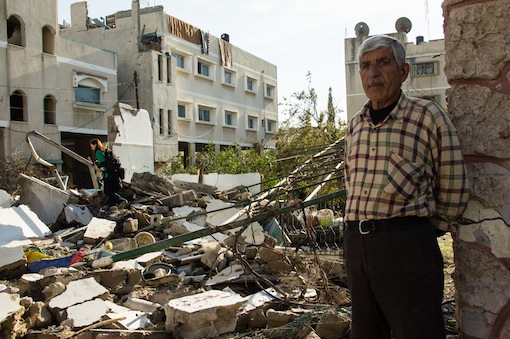
Ahmad Hassan Badawi amid ruins in Gaza City.
The wounds from operation “Pillar of Cloud” are obvious and the stories we have heard are tragic, but a spirit of resilience and determination is equally visible in the eyes of the families we have visited. Last night, Gazans were in the streets celebrating the UN General Assembly’s decision to upgrade Palestine’s status to a non-member observer state. The United States was one of only nine UN countries, including Israel and Canada, to vote against the resolution. Even so, Palestinians continue to extend hospitality to the members of our delegation as relentlessly as the fishermen who refuse to be pushed from their waters. It is my hope that residents of the United States will learn such strength based in friendship and resistance to inhumane policies, demanding that our government recognize the aspirations and political rights of Palestinians that have been ignored now for decades.
Joshua Brollier (joshua@vcnv.org) co-coordinates Voices for Creative Nonviolence (vcnv.org).
Related articles
- PCHR Statement On Ongoing Attacks Against Palestinian Fishermen In Gaza (imemc.org)
- Palestine: More land taken in WB, two succumb to serious injuries, 70 year old farmer assaulted, & Gaza’s fishermen taken (realisticbird.wordpress.com)
- PCHR Statement On Ongoing Attacks Against Palestinian Fishermen In Gaza (occupiedpalestine.wordpress.com)
Four fishermen arrested in the Gaza Sea, fishing boat confiscated
PCHR | October 22, 2012
The Palestinian Centre for Human Rights (PCHR) condemns continued Israeli violations against Palestinian fishermen in the Gaza Strip, and expresses concern about the escalation of these violations, which have resulted in the arrest of four fishermen and the confiscation of a fishing boat belonging to a fisherman from the Gaza Strip.
According to the findings of investigations conducted by PCHR, at approximately 10:00 on Monday, 22 October 2012, Israeli naval forces positioned off Al-Waha resort northwest of Beit Lahia, in the northern Gaza Strip, opened fire on a group of fishermen and arrested four fishermen while they were fishing 2 nautical miles offshore. The arrested men were identified as: Ramez Izat Baker (41), Khamis Sobhi Baker (43), Arafat Mohammad Najib Baker (20), Bayan Khamis Baker (17). In his testimony to a PCHR fieldworker, ‘Eid Mohssen ‘Eid Baker (23) from the northern Rimal neighborhood in Gaza City, who was near the scene at the time of the attack, reported the following:
“At approximately 10:00 on Monday, 22 October 2012, I was fishing with my brothers on my father’s boat near al-Soudanya area, in the north of Gaza, nearly 2 nautical miles off the shore, while my cousins’ boat was fishing approximately 200 meters away from us, when I saw an Israeli gunboat approaching us. One of the soldiers used a speakerphone and told us to sail towards the north, however, we went south and continued fishing. 15 minutes later, the gunboat came again at great speed and suddenly they started shooting randomly at us. One of the soldiers ordered us to stop, but we kept sailing south in escape of the open fire. My cousin Ramez Baker’s boat suddenly stopped after a bullet hit the boat engine, and the Israeli gunboat approached it, to a distance of nearly 30 meters. I saw the four fishermen, Ramez, Arafat, Khamis and his son Bayan, take off their clothes, jump in the water amidst the continuous shooting, and swim towards the Israeli gunboat. The soldiers confiscated the fishermen’s boat and transported it towards the northern side.”
It should be noted that Israeli forces have recently imposed more restrictions on the work of fishermen in the Gaza Strip. Since 2000, fishermen have been denied their right to sail and fish freely. Israeli forces reduced the area of fishing from 20 nautical miles, which was established upon in the agreements signed between Palestinians and Israel, to 6 nautical miles in 2008. However, Israeli forces have continued to prevent fishermen from going beyond 3 nautical miles since 2009. As a result, fishermen are prevented from reaching areas beyond that distance where fish is abundant. Sometimes, Israeli forces also chase fishermen within the 3 nautical mile area. Consequently, Palestinian fishermen have lost 85% of their source of income, because they are denied access to Palestinian waters.
PCHR condemns the recurrence of violations committed by the Israeli naval forces against Palestinian fishermen. PCHR believes that these violations are committed in the context of a policy of collective punishment against civilians, and that they are aimed at preventing civilians from meeting their subsistence needs. Such actions are prohibited under international humanitarian and international human rights law.
PCHR holds that the closure imposed by Israel on the Gaza Strip is illegal and constitutes a form of collective punishment, prohibited under Article 33 of the 1949 Fourth Geneva Convention Relative to the Protection of Civilian Persons in Time of War. It is also a war crime, the recurrence of which must be prevented by all parties, including the High Contracting Parties to the Fourth Geneva Convention. This view is maintained in legal opinions issued by many international legal experts and UN bodies concerned with human right and international humanitarian law.
In light of the above, PCHR:
- Calls upon Israel to immediately release the arrested fishermen, return the confiscated boat to its owners, and compensate the victims for any material or psychological damages caused by the attack;
- Calls upon Israel to respect the right to freedom of movement of fishermen in the Gaza Strip, to immediately put an end to its policy of chasing and arresting Palestinian fishermen, to allow them to sail and fish freely in the Gaza Sea;
- Calls upon Israel to put an end to the illegal closure of the Gaza Strip, which constitutes a form of collective punishment, prohibited under Article 33 of the 1949 Fourth Geneva Convention Relative to the Protection of Civilian Persons in Time of War; and
- Calls upon the international community and the High Contacting Parties to the Fourth Geneva Convention to fulfil their legal and moral obligations, apply the rules of international law, and put a just end to the suffering of the Palestinian people.
Related articles
- Israeli Navy Chases Fishing Boats, Tries To Sink Them (alethonews.wordpress.com)
- Army Opens Fire At Fishermen In Gaza (imemc.org)
- 13 Israeli attacks on Palestinian fishermen in past two months (alethonews.wordpress.com)
13 Israeli attacks on Palestinian fishermen in past two months
Palestine Information Center – 03/09/2012

GAZA — The Palestinian Centre for Human Rights (PCHR) documented thirteen violations against Palestinian fishermen in the Gaza Strip perpetrated by the Israeli navy forces, during the past two months.
PCHR documented the Israeli violations against Palestinian fishermen during the reporting period 26 July to 01 August 2012 including 10 incidents in which the IOF fired at fishermen.
The center also confirmed the arrest of two fishermen by the Israeli forces while fishing at a distance of 300 meters from Gaza port.
The center considered the Israeli attacks against Palestinian fishermen in the Gaza Strip as a flagrant violation of international humanitarian and human rights law, especially the right to life and security of the person, in accordance with Article 3 of the Universal Declaration of Human Rights and Article 6 of the International Covenant on Civil and Political Rights, to which the State of Israel is a party.
The IOF perpetrated violations against Palestinian fishermen in the sea, when these fishermen did not pose any threat to Israeli naval troops. The fishermen were practicing their right to work and seek their livelihood within the territorial waters of the Gaza Strip when the IOF indiscriminately fired at them.
During the reporting period, PCHR documented 11 cases in which the IOF fired at Palestinian fishermen in the sea off the Gaza shore, and the arrest of 2 Palestinian fishermen, including a 16-year-old boy
These attacks took place within the 3 nautical miles allowed for fishermen to sail and fish in. PCHR also noticed that these firing incidents against fishermen and their boats took place in the context of seeking their livelihood, and the imposition of more restrictions to terrify and prevent the fishermen from practicing their work freely.
The report pointed out that Israeli gunboats fired on August 28 Palestinian fishing boats in front of the coast of northern Gaza Strip, causing damage to Palestinian boat, an issue that pushed the fishermen to go back to the shore.
Despite the fact that the fishermen were trying to steer their boats back to the shore, the Navy boats continued to target them.
Related articles
- Israeli Navy Chases Fishing Boats, Tries To Sink Them (alethonews.wordpress.com)
- IOF gunfire targets fishermen and farmers in Gaza (altahrir.wordpress.com)
Israeli Navy Chases Fishing Boats, Tries To Sink Them
By Saed Bannoura | IMEMC & Agencies | August 30, 2012
A Palestinian cameraman from the Gaza Strip managed to capture on tape, an attack carried out by Israeli Navi boats, on Wednesday, against small Palestinian fishing boats. The video shows the Israeli Navy boats encircling the boats flooding them with water, and even blocking their way as they tried to sail back to the shore.
The video was captured by Mohammad Al-Mash-harawy, of the Media Town News Agency in Gaza, during a field report documenting the ongoing Israeli assaults against Palestinian fishermen in the coastal region.
The Navy boats were sailing at fast speeds, and encircling the Palestinian fishing boats, and flooding them with water, an issue that pushed the fishermen to go back to the shore.
Despite the fact that the fishermen were trying to steer their boats back to the shore, the Navy boats continue to encircle them.
In related news, the Palestinian Center for Human Rights (PCHR) reported that, on Tuesday morning, 28 August 2012, two Palestinian fishermen were kidnapped and a Palestinian fishing boat was heavily damaged in two separate attacks carried out by the Israeli Navy in the northern part of the Gaza Strip.
Since 2000, fishermen have been denied their right to sail and fish and have been subject to frequent attacks that led to excessive damage and dozens of casualties.
Israel reduced the area of fishing from 20 nautical miles, which was established upon in the agreements signed between Palestinian and Israel, to 6 nautical miles in 2008.
“However, Israeli forces have continued to prevent fishermen from going beyond 3 nautical miles since 2009. As a result, fishermen are prevented from reaching areas beyond that distance where fish are abundant. Sometimes, Israeli forces also chased fishermen within the 3 nautical mile area. Consequently, Palestinian fishermen have lost 85% of their income, because of limiting the fishing area”, the PCHR reported.
Related articles
- New Videos: Vancouver Delegation to Gaza Reportback + Palestinian Fishers Under Attack in Gaza (windowintopalestine.blogspot.com)
- IOF gunfire targets fishermen and farmers in Gaza (altahrir.wordpress.com)
Israeli navy detains five Palestinian fishermen of one family
Palestine Information Center – 29/04/2012
GAZA — Israeli occupation forces (IOF) detained five Palestinian fishermen to the west of Gaza harbor on Sunday morning, fishermen syndicate chairman said.
Nizar Ayash told the PIC that Israeli navy boats intercepted the fishing boat of the Shurafi family less than two nautical miles off the Gaza coast, which is a permissible area according to the Oslo accords.
He said that the fishermen are three brothers and two of their cousins, charging the Israeli occupation authority with fighting the Palestinian fishermen in their sustenance.
Ayash noted that the Israeli navy more often than not detains the fishermen for a while then returns them without their fishing kit with the sole goal of humiliating those fishermen and breaking their will.
The chairman said that his syndicate addressed messages to various world powers and institutions to check the Israeli violations against the Palestinian fishermen but to no avail.
He said that the Oslo accords allow fishing at a distance of 20 nautical miles but the Israeli navy does not implement that article.
Related articles
- Israeli gunboats fire at Palestinian fishing boats, destroy one – Video by @rosa_schiano (occupiedpalestine.wordpress.com)
- PCHR Weekly: Israel’s Army Carries Out 81 Invasions In W. Bank, 1 in Gaza (occupiedpalestine.wordpress.com)
Featured Video

Pentagon insider says high US official Douglas Feith reported to Netanyahu
or go to
Aletho News Archives – Video-Images
Frlom the Archives
Who’s to blame for the Iraq war?
A not-so-trivial quiz
By Maidhc Ó Cathail | 14 March 2010
Maidhc Ó Cathail names and shames the top 19 politicians, academics and policy makers – all con men and all Zionist Jews – who lied and conspired to steer the US toward aggression against the Iraqi people. … continue
Blog Roll
 Aletho News
- Even The Neo-Cons Admit The Iran War Is Failing
- Inside the Caucasus Drone Corridor Fueling Tensions With Iran
- ‘Not our war’: Trump’s naval coalition to reopen Strait of Hormuz dead in the water
- Iran declares support centers for USS Gerald R. Ford legitimate targets
- Moscow issues warning over Trump’s Golden Dome plan
- Brussels wants ‘our sons to die for Ukraine’ – Orban
- Where in the World Is Benjamin Netanyahu? On the Move or Out of Sight?
- Pentagon insider says high US official Douglas Feith reported to Netanyahu
- The Sludging of Rural America
- Lawyers’ groups demand end to British military bases in Cyprus
- If Americans Knew
- Predictions of another 9/11, amid Israel-US killing spree – Not a ceasefire Day 157
- As US-Israel war on Iran rages, Gaza faces massive dust storm – Not a ceasefire Day 156
- No let-up in attacks on Gaza as Israel takes on Iran, Lebanon – Not a ceasefire Day 155
- ‘Of Course’: IDF Drops Case Against Soldiers Accused of Raping Palestinian Prisoner
- Don’t Fall for the Regime Change Talk. Israel Is ‘Mowing the Lawn’ in Iran
- Will Israel and the US wreck the Gulf States along with Iran?
- US so far burned through ‘years’ of munitions in Iran war: Report
- How the Israeli Tail Wags the American Dog
- Outdated intel likely led to deadly U.S. strike on Iranian elementary school, sources say
- Pentagon insider says high U.S official Douglas Feith reported to Netanyahu
- No Tricks Zone
- Storing Green Energy To Last Germany 10 Days Would Require A 60-Million Tonne Battery
- New Studies: UK Sea Levels Were 4 Meters Higher Than Today During The Mid-Holocene
- Destructive Green New Deal: German Energy And Metal Group Warns Of Drastic Crisis
- New Study Documents A 20-Year Pause In Arctic Sea Ice Decline – Driven By Internal Variability
- Wake-up Call: Survey Shows Majority Of Germans Now Favor Postponing Climate Targets!
- Televised! Leading German Political Candidate Tells Schoolchildren CO2 Makes Sun Hotter!
- New Study: A Century Warming Of 1.1°C Is ‘Commonplace’ And ‘Not Unusual’ During This Interglacial
- New Study: ‘Internal Noise’ And Volcanic Forcing Can Trigger 10-15°C Warming Within Decades
- Glaciers Worldwide Are Suddendly Surging, Experts Blame Warming!
- Surprising Discovery: Sahara Is Greening…Billions Of Trees Where Once Thought To Be Barren
 Aletho News