Palestinian family displaced after settlers violently attack them in Humsa, Jordan Valley
International Solidarity Movement | March 13, 2026
On Friday, March 13, at 1:20am, around 30 masked Israeli settlers invaded a Palestinian property in Humsa, north of Jordan Valley, where a family of 12 people live. The family decided to leave their land after this latest attack.
The settlers first stormed a tent where one of the Palestinian men was asleep and Portuguese and US international activists were staying. The settlers attacked and blindfolded the man and activists and took them into another tent where they brought three other men and five children from the family. The settlers tied the hands and ankles of the Palestinian men and the activists, dragged them by the hair and ankles, beat them with sticks and kicked their faces. The settlers exerted extreme violence toward the Palestinian men and beat the eldest man with rocks.
The settlers told the family and activists to leave, stating: “We are Jewish, this is our land”. When asked by an activist what they wanted, they responded: “We want to kill you”. The settlers also took rings from the activists, asking them if they wanted their fingers cut off.
As the family’s children were crying while forced to witness the violence, the settlers told them to shut up.
The settlers opened the family’s sheep pen and let loose around 350 sheep. They stole the activists’ passports, phones, money, as well as one of their backpacks, and cut one of their jackets. They then cut the men and activists’ ties, rolled one of the activists on top of a Palestinian man, and left.
The Palestinian men and the activists were taken in ambulances to receive medical treatment.
Israeli settler attacks in the north Jordan Valley have increased sharply in the past few weeks as the Israeli government begins building a 500km apartheid wall and military road in the region. At the end of February, Israeli forces have also issued demolition orders for 10 farms and a vegetable store in the area.
These coordinated efforts are accelerating the ethnic cleansing of communities in the Jordan Valley at alarming rates. Families have left the villages of Hammamat Al Maleh, Al Miteh and Al Burj, Khirbet Yarza, and Humsa during the last month alone. Hammamat Al Burj is now completely empty, while the two remaining families in Hammamat al Maleh were badly attacked yesterday.
Since Israel-USA attack on Iran, settlers have also killed six Palestinians in the West Bank.
World’s largest shipping firm facilitates US trade with illegal Israeli settlements
The Cradle | February 9, 2026
The world’s largest shipping firm, Mediterranean Shipping Company (MSC), has been transporting goods from the illegal Israeli settlements in the occupied West Bank to the US, including via European ports.
According to a joint investigation by Al-Jazeera and the Palestinian Youth Movement (PYM) published on 9 February, commercial documents obtained through US import databases show that between 1 January and 22 November 2025, MSC facilitated at least 957 shipments of goods from Israeli settlements to the US.
Of these shipments, more than half transited through European ports, including 390 in Spain, 115 in Portugal, 22 in the Netherlands, and two in Belgium.
MSC is privately owned by Italian billionaire Gianluigi Aponte and his Italian-Israeli wife, Rafaela Aponte-Diamant.
“Israeli settlements are widely considered illegal under international law, because they are built on occupied territory, in violation of the Fourth Geneva Convention,” noted Nicola Perugini, senior lecturer in international relations at the University of Edinburgh.
“Commercialising products from these settlements effectively supports the illegal settlements,” she affirmed.
A wide range of products are produced in the settlements, from food items and textiles to skin care and natural stones, Al-Jazeera noted.
Israel conquered the West Bank and Gaza during the Six-Day War in 1967 and has sought to oust the native Palestinian Muslims and Christians and replace them with Jewish Israelis in an effort to create “Greater Israel.”
Professor Perugini called on states to ban trade with illegal settlements entirely. “You cannot normalize the profits of an illegal occupation,” he said.
The US and EU allow imports of products from Israeli settlements, despite policies formally acknowledging the settlements are illegal.
MSC also facilitates shipments from the US and Europe to the Israeli settlements.
In 2025, MSC facilitated at least 14 shipments from the Italian port of Ravenna, listing the names and zip codes of Israeli settlements as recipients.
MSC also holds cooperation and vessel-sharing agreements with Israel’s publicly held cargo shipping company, ZIM.
Such shipments may be illegal under international law following a 2024 opinion by the International Court of Justice (ICJ) advising that third states are obliged to “prevent trade or investment relations that assist in the maintenance of the illegal situation created by Israel in the Occupied Palestinian Territory.”
The ICJ opinion does not directly address the responsibility of private corporations like MSC.
PYM, a grassroots, international pro-Palestinian movement, found last year that Danish shipping firm Maersk, the world’s second largest, also ships products to and from Israeli settlements.
According to UN estimates, businesses located in illegal settlements in the West Bank and East Jerusalem contribute about $30 billion to the Israeli economy each year.
Settlement businesses are often unusually profitable as they are established on stolen Palestinian land that the company has not paid for.
Israel has recently accelerated efforts to expand the E1 settlement project, designed sever the West Bank into two parts, isolate it from East Jerusalem, and ensure a two-state solution becomes impossible.
The plan calls for constructing 3,500 apartments next to the existing settlement of Maale Adumim.
On Sunday, the Israeli government approved sweeping changes to land registration and civil control in the occupied West Bank, which will dramatically expand settlement construction, Middle East Eye (MEE) reported on Monday.
Israeli Finance Minister Bezalel Smotrich and Defense Minister Israel Katz said the policy changes are intended to pave the way for expanded settlements and land seizures.
Under the new measures, the military will be allowed to demolish Palestinian buildings and homes for which Israel refused to issue a building permit in areas A and B of the West Bank
The changes would also open West Bank land registries to the Israeli public, enabling settlers to identify Palestinian landowners and pressure them to sell their land.
Making ownership records public could also make it easier for settlers to forge claims over Palestinian land, and thereby seize Palestinian land through Israeli courts, MEE added.
The measures also loosen restrictions on the sale of Palestinian land to Israelis, overturning a Jordanian-era law prohibiting transfers to non-Palestinians.
Spain Opens Probe Into Israeli Tourism Firms
IMEMC | January 26, 2026
Spain’s Ministry of Social Rights, Consumer Affairs, and Agenda 2030 has opened a formal investigation into Israeli tourism companies suspected of promoting goods or services linked to Israeli colonies built on occupied Palestinian land.
In a statement issued Sunday, the ministry said the inquiry aims to determine whether companies operating in Spain have advertised or sold tourism‑related services connected to Israeli colonies in the occupied West Bank, in violation of Spanish law.
The investigation is based on Royal Decree‑Law 10/2025, which prohibits the advertising of goods or services originating from occupied territories.
The decree was adopted in September 2025 as part of Spain’s emergency measures responding to the genocide in Gaza and to ensure that companies operating in Spain do not profit from activities tied to Israel’s occupation.
According to the ministry, the probe focuses on allegations that certain Israeli tourism firms promoted services linked to colonies illegally constructed on Palestinian land under military occupation.
Spanish officials emphasized that such activity would constitute illegal advertising under the decree, given the internationally recognized status of the West Bank as occupied territory and the illegality of Israeli colonial activity under international law.
The ministry stated that the purpose of the inquiry is to identify all companies involved and determine whether their conduct violates Spanish consumer and advertising regulations. If breaches are confirmed, authorities may impose sanctions or restrict the companies’ ability to operate commercially in Spain.
Spanish officials underscored that the investigation reflects the government’s commitment to ensuring that businesses in Spain do not contribute to or profit from Israel’s ongoing occupation of Palestinian land.
All of Israel’s colonies in the occupied West Bank, including those in and around occupied East Jerusalem, are illegal under International Law, the Fourth Geneva Convention, in addition to various United Nations and Security Council resolutions. They also constitute war crimes under International Law.
Article 33 of the Fourth Geneva Convention prohibits collective punishment and acts of terror against civilian populations.
Article 49 of the Fourth Geneva Convention states: “The Occupying Power shall not deport or transfer parts of its own civilian population into the territory it occupies.” It also prohibits the “individual or mass forcible transfers, as well as deportations of protected persons from occupied territory”.
Articles 53 and 147 prohibit the destruction of civilian property and classify pillage as a war crime.
Report warns that ‘Jewish terrorism is out of control’ and could lead to major security escalation
MEMO | January 22, 2026
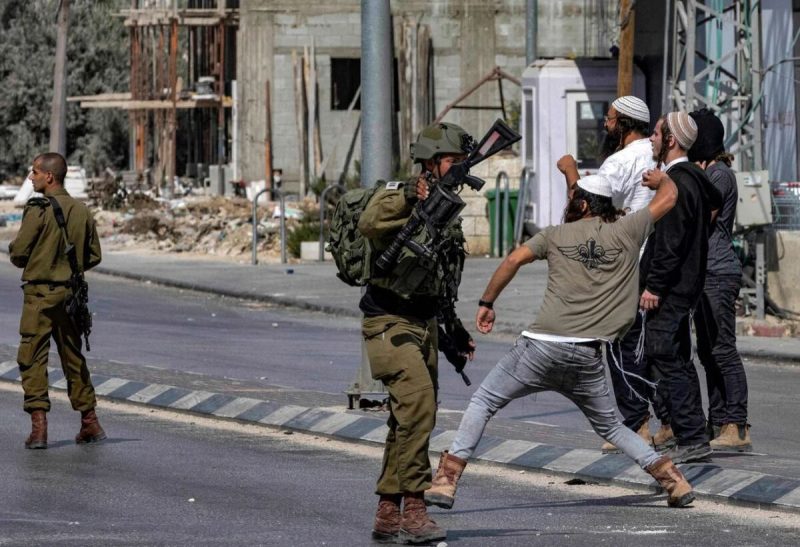
An Israeli report warns of a rapid rise in Jewish terrorism against Palestinians in the West Bank, saying it has become a widespread phenomenon with serious security and strategic implications. The report cautions that this trend aims to undermine the Palestinian presence and could trigger large waves of violence, while also causing growing damage to Israel’s international standing.
The report, issued on Tuesday by the Institute for National Security Studies at Tel Aviv University (INSS), says recent years—especially since 7 October 2023—have seen a sharp increase in both the scale and severity of attacks carried out by Jews against Palestinians. It describes these acts as part of a “struggle over control of land” and “growing attempts to weaken the Palestinian presence”, particularly in areas classified as Area C.
According to the report, data from Israeli military and international sources point to a steep rise in such attacks. Figures from the Israeli army’s Central Command show that in 2025 there was an increase of about 27 per cent in incidents classified by the security establishment as “nationalist crime”. Around 870 offences were recorded, including 120 described as serious, compared with 83 serious offences in 2024.
United Nations data, however, present an even darker picture. In 2024, about 1,420 attacks against Palestinians were documented, a 16 per cent rise compared with 2023 and the highest level since systematic monitoring began in 2006. The report says these attacks led to the killing of five Palestinians and injuries to around 350 others. More than 300 Palestinian families — nearly 1,700 people — were also displaced from their homes.
The report adds that the upward trend has continued, noting that the number of attacks in 2025 has “exceeded 1,770 incidents”, surpassing the peak recorded the previous year.
Zionism on the Upper East Side
By Patrick Lawrence | Consortium News | December 3, 2025
We watch in horror from afar as the Zionist terror state continues its genocide against the people of Gaza and escalates its slower-motion, lower-technology genocide against the 3 million Palestinians who reside in East Jerusalem and the West Bank, otherwise known as the Occupied Territories — illegally occupied, of course.
As a few Israeli commentators have pointed out — those few who guard their integrity— the operative principle here is the limitless impunity the Western powers have long granted “the Jewish state.”
This is the outcome, they say, when a people given to a culture of vengeance are told they will never suffer consequences however barbaric their conduct toward others, however many laws they break, however many their assassinations, however many their torture victims, however many exploding telephones they plant among civilian populations, etc.
Maybe we need no reminders, maybe we do, that this presumption of impunity is not bound by sovereign borders and is not limited to the cowardly, condemnable savagery of apartheid Israel in Gaza and the West Bank. But we had one last week, and it is well we consider it carefully.
Zohran Mamdani, the principled social democrat who is New York’s mayor-elect, is now under attack from Zionist Americans who insist Zionist Americans are above the law — American law and international law. You may look well on Mamdani and you may not, but as he is besieged by these objectionable people, so are we all.
This story begins on Wednesday, Nov. 19, at Park East Synagogue, a grand edifice that sits on East 67th Street between Third and Lexington Avenues in the Lenox Hill section of Manhattan.
Park East has been serving Modern Orthodox Jews since 1890. Its congregation, to be noted, is comprised of the great and good of the Upper East Side. These are observant but assimilated Jews, thoroughly plugged into, let’s say, secular public space.
Except.
Two Wednesdays back Park East hosted an organization dedicated to encouraging Jews to “make Aliyah,” the Hebrew term for emigrating to “the Promised Land.” O.K., you cannot find anything legally wrong in this, although it is unambiguously a moral wrong in that it expresses support for a genocidal state.
But let us set aside the moral question for now. The organization Park East sponsored, Nefesh B’Nefesh, also assists American Jews who wish to emigrate to Israeli settlements in the Occupied Territories. This is a legal matter and as such not inconsequential.
American Settlers
Statistics on the settler population in the West Bank and East Jerusalem are hard to nail down (and I can easily imagine why). The Times of Israel reported eight years ago that some 60,000 Americans were among the Jewish settlers in the West Bank.
That was roughly 15 percent of the settler population then — not counting the considerable number residing in East Jerusalem. We have no precise figures now, but these populations — settlers and Americans among the settlers — are both higher.
As has been well-reported, and well-recorded in several documentaries, the Americans among the West Bank settlers are frequently the most violent in their incessant attacks on Palestinians. They have also been at times the most readily inclined to murder.
There is the infamous case of Baruch Goldstein, a freakshow Zionist from Brooklyn who killed 29 Palestinians when he attacked the Ibrahimi Mosque (tomb of Abraham and other patriarchs) in Hebron in 1994. Goldstein was not singular: He was and remains exemplary — and a hero among some Zionists. National Security Minister Ben Givr had a picture of Goldstein on his living room wall until 2020.
I cannot name the precise statutes applicable here, but they must be several. Open and shut, just the facts, Ma’am, Nefesh B’Nefesh is an accomplice to the settler movement.
Most immediately significant in the Park East case, Nefesh B’Nefesh — this translates as “soul to soul,” and who knows what that is all about — is directly implicated in the settlers’ breach of international law given that all the settlements in the West Bank and East Jerusalem are illegal according to said law.
There was no claiming surprise that blustery Nov. 19th when a group of roughly 200 vociferous demonstrators gathered in front of Park East to protest the promotional seminar Nefesh B’Nefesh was running that day.
“Death to the IDF” was among the tamer of various chants; others encouraged violence against settlers. “It is our duty,” one leader of the demonstration said measuredly to those assembled, “to make them think twice before holding these events.”
Inside the Park East building, people indirectly but unmistakably promoting violence against Palestinians, land theft and all the rest. And on East 67th Street, righteous indignation, anger in behalf of a persecuted people, some violent rhetoric, but no violence.
It was obvious the mayor-elect would have to intervene. The event itself warranted this, and various Zionist constituencies, as well-reported before and since Mamdani’s election, have been attacking him as a radical jihadist, an anti–Semite and who knows what else, so attempting to poison his relations with New York’s Jewish community.
Here is the ever-poised Mamdani’s day-after statement, his first on the incident:
“The mayor-elect has discouraged the use of language used at last night’s protest and will continue to do so. He believes every New Yorker should be free to enter a house of worship without intimidation and that these sacred spaces should not be used to promote activities in violation of international law.”
A few days later, storms of protest from Zionist quarters having instantly erupted, Mamdani sent this statement to The New York Times:
“We will protect New Yorkers’ First Amendment rights while making clear that nothing can justify language calling for ‘death to’ anyone. It is unacceptable, full stop.”
I find these statements a little in the way of Solomon in their discernment, in Mamdani’s determination not to tilt his hand and to articulate the core truth of the matter:
The more extreme language out on East 67th Street was wrong so far as it intimidated synagogue goers, but the principle of free speech is nonetheless to be honored; those encouraging breaches of international law are wrong, and a synagogue should not be used to promote illegalities.
‘A Hateful Mob’
Maybe what has come back at Mamdani in the course of all this was predictable, more-of-the-same babble. “Mob” was the de rigueur term among those responding to the mayor-elect’s response.
The demonstrators were “a hateful mob of anti–Israel protesters,” the New York Post reported, and it got worse from there. Mamdani sided with “an anti–Semitic mob,” eJP, or eJewishphilanthropy.com, declared. “Last week,” this outfit continued, “Mayor-elect Zohran Mamdani failed the first test of his promise to protect all New Yorkers.”
And from William Daroff, the chief exec of the Conference of Presidents of Major American Jewish Organizations: “We are still judging him, and I’d say that at the moment he’s got a failing grade.”
They sitteth in judgment, you see.
O.K., we have heard all this before in one or another context, so has Mamdani. He is surely in for more of same once he assumes office Jan. 1. But we ought not miss the very much larger matters raised by the Park East incident.
There is the First Amendment question, as Mamdani correctly noted, and there are the legal questions as pencil-sketched above. These are related at the not-too-distant horizon.
People speaking for Nefesh B’Nefesh now deny they promote emigration to West Bank settlements — which, as the group’s website attests, is simply not true. It advertises Gush Etzion, an expanding sprawl of 22–and-counting settlements south of Jerusalem, Ma`ale Adumim, whose location makes it key to the Israelis final takeover of the West Bank, and various others.
“Teaching about Aliyah and Zionism belongs in that space”: This is the aforementioned William Daroff. And from eJP again: “Mamdani condemned the synagogue’s choice of programming.”
Choice of programming.
You see what is going on here. Park East and Nefesh B’Nefesh are encouraging Americans to breach international law. And absolutely to a one, those defending the synagogue and the event-organizer do so by pretending this is not what is most pithily at issue.
“We are deeply concerned by, and firmly condemn, the violent rhetoric and aggressive behavior that took place outside of the Park East Synagogue,” Nefesh B’Nefesh now declares on its website. Violent rhetoric and aggressive behavior on East 67th Street but not in the West Bank or in East Jerusalem.
To go straight to the point, this is another assertion of Zionist impunity. And we should understand what has lately transpired in New York as a very, very direct extension of the impunity that encourages and also protects the Israeli terror machine in Gaza and the West Bank. Impunity: It is a blight under which Palestinians suffer, and none of us is immune to it.
To put this another way, we witness an especially insidious case of chutzpah, the dangers of which I have considered elsewhere. You have your laws, the world has its, and we will ignore them before your eyes (and ostracize you as an anti–Semite if you object). This, in a sentence, is what Zionists now insist we must accept.
Four foreign activists injured by illegal Israeli settlers’ attack in occupied West Bank
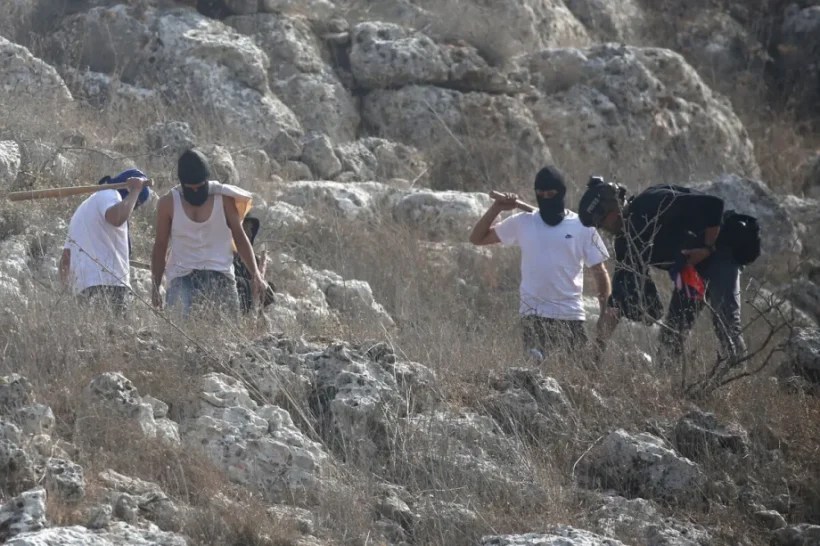
Illegal settlers attack Palestinian farmers, journalists and foreign activists in Beita town of Nablus, West Bank on November 8, 2025. [Nedal Eshtayah – Anadolu Agency]
MEMO | November 30, 2025
The Israeli army launched a large-scale arrest campaign in the occupied West Bank as illegal settlers attacked foreign activists and Palestinians on Sunday, according to local sources, Anadolu reports.
Three Italian and one Canadian activists were injured by illegal Israeli settlers in Ein ad-Duyuk village of Jericho in the central West Bank, local sources told Anadolu.
The activists were hospitalized, as three of them sustained moderate injuries and the fourth was critically wounded.
Illegal settlers stormed a house in a Bedouin community where the foreign activists have been residing in solidarity with Palestinian residents for a few days, and assaulted them.
The attackers also attempted to steal the activists’ passports, phones, and belongings, in addition to property from the house, the sources said.
According to the official news agency Wafa, illegal Israeli settlers destroyed four vehicles belonging to Palestinians in eastern Salfit in the central West Bank.
A group of illegal Israeli settlers also raided the al-Masoudieh area in Nablus, vandalizing Palestinians’ properties.
According to the Colonization and Wall Resistance Commission, an official body, illegal Israeli settlers have carried out 766 attacks against Palestinians and their property in the occupied West Bank in October only.
Meanwhile, Israeli army forces detained four people in two Nablus villages on Sunday. One of the detainees was injured, the official news agency Wafa said, without providing more details on his condition.
Israeli army forces fired tear gas canisters towards locals in the al-Lubban al-Sharqiya town of Nablus, causing several people to suffer from suffocation.
Three people were detained in Ramallah during an Israeli army raid, while a young Palestinian was detained after being beaten by the soldiers in the Sheikh Jarrah neighborhood of the occupied East Jerusalem.
Five others, including two ex-prisoners, were arrested in Bethlehem, in the southern West Bank, after their houses were searched by the Israeli forces. According to Palestinian figures, at least 55 Palestinians were detained by Israeli forces in military raids in the West Bank since Saturday.
In a landmark opinion last July, the International Court of Justice declared Israel’s occupation of Palestinian territory illegal and called for the evacuation of all settlements in the West Bank and East Jerusalem.
Settler attacks intensify as Palestinians face systematic displacement
Al Mayadeen | November 24, 2025
Abdullah Awad, speaking to the Financial Times, describes a reality Palestinians across the occupied West Bank know too well: armed Israeli settlers storming their land with the aim of driving them out. The attack on his family farm near Turmus Ayya, carried out by about 15 masked settlers, left his children screaming as the group smashed their home and equipment.
“The settlers had axelike sticks with nails attached. So, they intended to injure us badly or kill us. Thank God we were awake when they came, so we could move away a bit,” he said. The assault followed years of harassment, but Awad says the violence has intensified since the war on Gaza began: “There were many assaults. This was not the first, and won’t be the last . . . but since the start of the war [in Gaza], they have become more violent. The situation has changed.”
Escalating campaign of settler aggression
Across the West Bank, Palestinians are facing an orchestrated campaign to terrorize communities and seize land. Settlers have attacked farmers, burned property, and raided villages from the northern hills to the southern plains. Videos of settlers beating Palestinians, including one incident in which a masked settler clubbed a woman unconscious, reflect a growing sense of impunity.
Political analyst Ibrahim Dalalsha told FT the pattern is unmistakable, “The settlers are totally emboldened, and the attacks are spreading, in the north, centre and south [of the West Bank]… This time they are really going deep inside.”
Targeting the olive harvest, the backbone of Palestinian rural life
The olive harvest, which sustains thousands of Palestinian families, has become an annual target for settler groups seeking to disrupt livelihoods and claim new territory. This season, attacks have soared. Settlers have torched a mosque in Deir Istiya, burned cars and homes near Beit Lahm, and even stormed an industrial area close to Beit Lid.
According to UN OCHA figures, more than 260 settler assaults resulting in injuries or property destruction were recorded in October, the highest monthly total since monitoring began nearly two decades ago.
Israeli condemnations ring hollow as impunity deepens
Israeli leaders have issued belated statements condemning settler actions, but on the ground, Palestinians say nothing has changed. The army dismantled a single illegal outpost, an exception so rare it drew international attention, while settlers continue attacking communities without consequence.
The settlers who burned the Deir Istiya mosque left graffiti stating: “We’re not afraid of Avi Bluth.”
Their message was aimed at the Israeli general responsible for West Bank operations, a taunt conveying how little fear violent settlers have of the regime’s security forces.
Rights group Yesh Din reports that 94% of settler violence cases were closed without charges in the 18 years before the war on Gaza. Palestinian officials say the situation has only worsened, with the military frequently standing aside, or acting in coordination with settlers during attacks.
Dalalsha said, “In the past, when there were attacks, there were investigations. Palestinians viewed these as a sham. But at least there was a process. These days, we do not hear of anything.”
Forced displacement as policy
Settlement expansion, illegal under international law, has accelerated at a pace Palestinian rights groups describe as intentional and strategic. Reports indicate that since the start of the war on Gaza in 2023, 44 Palestinian communities have been forcibly pushed from their lands through settler assaults combined with military restrictions.
Yair Dvir of B’Tselem put it bluntly, “When you look at what is happening, there is an order to [the attacks] . . . It’s not just individuals and settlers. They are backed by the Israeli system. There is a very clear goal, which is to forcibly displace the Palestinians and force them into the big cities.”
Daily terror in towns under siege
In Sinjil, a town outside Ramallah, a newly built settler outpost has triggered relentless harassment for Palestinians. Mayor Moataz Tawafsha told the FT: “There is no day without an attack. They steal tractors, burn stuff that belongs to the farmers, prevent farmers from reaching their land. Every day. They never stop.”
Near Turmus Ayya, settlers have placed a metal cabin and tent on a Palestinian building left half-finished and raised an Israeli flag above it, a symbolic claim over land that locals have farmed for generations. The new presence has cut Palestinians off from hundreds of hectares of farmland, including thousands of olive trees.
The mayor, Lafi Adeeb Shalabi, says the aim is clear, “They are trying to destroy the history of Palestine . . . This land belonged to our families, to our great great-grandfathers,” he said. “And when we try to defend it, they say we are terrorists.”
A systematic drive to empty Palestinian land
Testimonies from across the West Bank point to a coordinated effort to dispossess Palestinian communities: settlers advancing deeper into Palestinian areas, soldiers restricting movement, homes and farms burned, and entire communities uprooted.
What was once seasonal harassment has evolved into a sustained campaign of displacement.
Airbnb sued in France for rentals in occupied West Bank
MEMO | November 4, 2025
The Association of Jurists for the Respect of International Law (JURDI) has sued Airbnb in France for listing properties in Palestinian territories occupied by Israel in the West Bank, the BFMTV broadcaster said Tuesday, Anadolu reports.
JURDI, a non-profit group in France that advocates for international law regarding the Israeli-Palestine conflict, accuses Airbnb of supporting war crimes by listing the properties in occupied territories in the West Bank. It is asking the court to order the company to remove listings in Israeli settlements.
“By offering these accommodations, Airbnb contributes to the normalization and perpetuation of the colonial regime, by providing financial resources to settlers and legitimizing their presence,” JURDI said in its lawsuit, excerpts of which were seen by BFMTV.
Attorney Helene Massin-Trachez, who is leading the case, said French law prohibits offering contracts that violate public order, arguing that Airbnb was doing exactly that by promoting unlawful rental agreements to clients based in France.
A preliminary hearing has been scheduled for Jan. 13, and if the court rules in JURDI’s favor, Airbnb will have eight days to comply before facing a €5,000 ($5,740) fine for each day of delay.
The company defended its actions when contacted by BFMTV, denying it profits from the international situation and vowed to remain committed to addressing each of the situations “with the greatest care.”
The French Human Rights League (LDH) filed a complaint against Airbnb and Booking.com last month for listing properties in Israeli settlements in Palestinian territories.
The complaint accuses those companies of complicity and aggravated concealment of war crimes, underlining that the platforms promote “occupation tourism” by offering listings in Israeli settlements.
Israel Issues Demolition Orders to Clear Path for Colonial Road
IMEMC | October 24, 2025
Israeli occupation authorities issued demolition orders on Thursday targeting large industrial structures at the entrance of Anata, northeast of occupied Jerusalem in the West Bank.
According to Jerusalem Governorate advisor Marouf Al-Refa’ey, Israeli forces stormed the town’s entrance and distributed demolition notices affecting metal workshops, furniture factories, and storage units.
He stated that the move is part of a long-standing plan to construct a road, traffic circle, and bridge connecting the Anata junction to the Hizma military roadblock.
This infrastructure is linked to the so-called “Greater Jerusalem” scheme and the colonial E1 plan.
Al-Refa’ey emphasized that Israeli authorities are systematically eliminating Palestinian presence along the path of this project. Demolitions in the area have been repeatedly carried out under various pretexts, including lack of permits or proximity to the illegal separation wall.
He warned that the developments at Anata’s entrance and along Az-Za’ayyem Road are part of a broader plan to establish a segregated road system. The goal is to bar Palestinians from using Abu George Road, which leads to the Jerusalem–Jericho highway and is reserved exclusively for illegal paramilitary Israeli colonizers.
In contrast, the Anata/Az-Za’ayyem entrance would be restricted to Palestinian traffic only, connecting Anata, Az-Za’ayyem, and the Hizma checkpoint roundabout.
Soldiers, Settlers Injure 20 Palestinians in Beita

International Solidarity Movement | October 11, 2025
October 10 was the opening of the Zaytoun2025 olive harvest campaign. Here’s a wrap-up of the events:
Beita, South Nablus
About one hundred farmers joined by some 60 Palestinian and solidarity activists, were attacked by armed Israeli citizens and soldiers, near a recently established Israeli settlement in the Jabal Qamas area. The soldiers both ignored the attacks on the farmers and used violence themselves to try and repel the harvesters from their lands, and ignored the assault of Palestinians by the Israeli civilians, and therefore enabling them. The soldiers used tear-gas concussion grenades and physical violence, while the Israeli civilians attacked harvesters with baton blows, stone throwing and by shooting live ammunition.
- 20 injuries were recorded. 11 of the injured Palestinians were evacuated to the Rafidia hospital in Nablus. In addition, one solidarity activist was evacuated to the Belinson hospital after Israeli civilians assaulted her with batons and broke her arm.
- One of the Palestinians suffered a gunshot wound after being shot by an Israeli civilian.
- Three of those injured are journalists: Wahaj Bani Mufleh, Saja al-Alami and Jaafar Astaya, whose car is one of those torched.
- Eight cars were torched by the Israeli civilians.
- An ambulance was attacked and flipped over. An attempt to torch it as well was foiled by Palestinians who came to the crew’s rescue.
Jorish and Aqraba, South-East Nablus
Israeli civilians armed with batons prevented farmers from the two villages accompanied by solidarity activists from accessing their lands in the Wad Issa agricultural area.
Duma, Sout-East Nablus
Israeli soldiers prevented farmers from harvesting their olives in the Houma and Khallet al-Hassad areas, asserting access to these lands requires security coordination with Israeli authorities. The Houma area is in Area B.
Yanoun, East Nablus
Israeli civilians expelled farmers and stole their harvested olives.
Deir Istia, North Salfeet
Israeli civilians harassed harvesters in an attempt to prevent them from accessing their lands near the Yaqir settlement.
Kufer Thulth, East Qalqilya
Settlers attacked harvesters and shepherds, killing several goats.
Farata, East Qalqilya
Israeli civilians shot at farmers harvesting olive with live fire in the presence of Israeli soldiers, who did not intervene. Both the soldiers and Israeli civilians then continued to raid the village, stop residents in the street and question them.
Kobar, North Ramallah
Israeli forces arrested harvesters in their lands near the village.
US deploys abortion law against Israel critics who picketed synagogue
RT | October 1, 2025
The US Justice Department has filed a civil lawsuit against several anti-Israeli protesters, using a law historically applied to protect women entering abortion clinics from pro-life demonstrators.
The complaint, filed on Monday by the DOJ’s Civil Rights Division, could mark the first of more cases to come, Assistant Attorney General Harmeet Dhillon said at a press conference. She argued that the 1994 Freedom of Access to Clinic Entrances Act (FACE) was previously “weaponized” against pro-life activists, while those disrupting religious practices were not targeted.
The case stems from a November 2024 incident in West Orange, New Jersey. Congregation Ohr Torah synagogue was hosting a real estate fair promoting the sale of homes in Jewish settlements in the occupied West Bank. The DOJ maintains that it was “a religious event centered on the Jewish obligation to live in the Land of Israel.”
Around 50 pro-Palestinian demonstrators staged a protest outside, which Dhillon characterized as a “mob.” An altercation broke out involving organizer Moshe Glick and his associate, David Silberberg. The complaint claims that one protester blasted a vuvuzela horn inches from Glick’s ear, an action prosecutors say amounted to a “physical attack” due to potential hearing damage.
Local media reported in February that Glick and Silberberg were charged in connection with the brawl after Glick allegedly pepper-sprayed a protester and struck his head with a metal flashlight. The DOJ complaint, however, described these actions as self-defense. One of the named defendants is accused of choking Silberberg and tackling him to the ground.
The fair was one of several US events promoting settlement property sales that drew pro-Palestinian protests as Israel pressed its military operation in Gaza. Jewish settlements in occupied territories are considered illegal under international law and remain a flashpoint in the broader Middle East conflict.
Enforcement of the FACE Act was reportedly scaled back early in US President Donald Trump’s term in office. In June, the House Judiciary Committee considered a bill introduced this year by Representative Chip Roy to repeal the measure entirely.
UN blacklist expands to 158 firms over Israeli settlement ties
Al Mayadeen | September 27, 2025
The United Nations has expanded its blacklist of companies linked to Israeli settlements in the occupied West Bank, adding 68 firms from 11 countries accused of contributing to violations of Palestinian human rights.
The updated “database of companies,” released Friday by the UN human rights office, now includes 158 businesses, most of them Israeli. Others are headquartered in the United States, Canada, China, Britain, France, Germany, Spain, Portugal, the Netherlands, and Luxembourg.
The list highlights firms engaged in activities deemed supportive of settlement expansion, which much of the international community considers illegal under international law. These include suppliers of construction materials, heavy equipment vendors, and providers of financial, security, and travel services.
Among the latest additions are German building materials giant Heidelberg Materials, Portuguese rail systems provider Steconfer, and Spanish engineering firm Ineco. US-based Expedia Group, Booking Holdings Inc., and Airbnb, Inc. also remain on the list.
First update since 2023
While 68 new companies were named, seven were removed following a UN review of 215 enterprises. The delisted firms include French transport company Alstom and online travel agencies eDreams (Spain) and Opodo (Britain).
“Businesses working in contexts of conflict have a due diligence responsibility to ensure their activities do not contribute to human rights abuses,” said Ravina Shamdasani, spokesperson for the UN human rights office. “We call on businesses to take appropriate action to address the adverse human rights impacts of their activities.”
Shamdasani added that governments also bear responsibility for ensuring that corporations under their jurisdiction are not complicit in rights violations.
The newly flagged companies are concentrated in industries such as construction, real estate, mining, and quarrying. Each was notified of its inclusion and granted the right of reply.
This marks the first update to the database since 2023, when 97 companies were listed, down from 112 in the original 2020 publication. Fifteen firms, including US food conglomerate General Mills, were removed during that previous revision.
Featured Video

Seyed M. Marandi: Negotiations Collapsed – Return to War
or go to
Aletho News Archives – Video-Images
From the Archives
Wartime internment camps in Australia
National Archives of Australia
World War I
During World War I, for security reasons the Australian Government pursued a comprehensive internment policy against enemy aliens living in Australia.
Initially only those born in countries at war with Australia were classed as enemy aliens, but later this was expanded to include people of enemy nations who were naturalised British subjects, Australian-born descendants of migrants born in enemy nations and others who were thought to pose a threat to Australia’s security.
Australia interned almost 7,000 people during World War I, of whom about 4,500 were enemy aliens and British nationals of German ancestry already resident in Australia.
Records of World War I internment camps
World War II
During World War II, Australian authorities established internment camps for three reasons – to prevent residents from assisting Australia’s enemies, to appease public opinion and to house overseas internees sent to Australia for the duration of the war.
Unlike World War I, the initial aim of internment during the later conflict was to identify and intern those who posed a particular threat to the safety or defence of the country. As the war progressed, however, this policy changed and Japanese residents were interned en masse. In the later years of the war, Germans and Italians were also interned on the basis of nationality, particularly those living in the north of Australia. In all, just over 20 per cent of all Italians resident in Australia were interned. … continue
Blog Roll
 Aletho News
- Seyed M. Marandi: Negotiations Collapsed – Return to War
- Tomorrow’s naval blockade showdown
- ‘Israel’ attacks civilians to hide its embarrassing military failures & out of pure sadism
- Any Foreign Military Vessel Approaching Hormuz Under Any Pretext ‘Will Be Dealt With Severely’: IRGC
- Diplomats slam US negotiators’ performance in Iran talks
- Trump Refuses Exit Ramp, War with Iran will Continue
- Trump Says US Naval Blockade in Strait of Hormuz Will Begin Shortly
- US, Iran end 21-hour talks without agreement
- US IRAN TALKS: Who Are the Crazy Ones Here? /Lt Col Daniel Davis
- Talks with the US end without a deal over excessive US demands: Iran
- If Americans Knew
- US-Iran ceasefire negotiations make zero progress – Daily Update
- Pro-Israel ‘Thinktanks’ and Individuals who Influence U.S. Foreign Policy
- Mearsheimer reveals how Israel dictates US policies on Iran, Gaza – video
- After killing 350+, Israel still has a “score to settle” with Lebanon before ceasefire – Daily Update
- Military aid to Israel emerges as the latest political litmus test for Democrats
- The only Palestinian children’s rights organization closes following years-long Israeli campaign against it
- ‘I Can’t Forget the Smell’: Lebanese Reel After Israel Kills Over 300 in Single Day
- DNC Shoots Down Resolutions Calling Out AIPAC and Limiting Arms to Israel
- TCN: Is Israel Blackmailing President Trump?
- Israel killed at least 303 Lebanese yesterday – who were they? Daily Update
- No Tricks Zone
- Cave Discovery Reveals Today’s Desert Climates Were Recently Far Warmer, Wetter, Teeming With Life
- German Expert: Heat Dome Led To Record Temps In Western USA…Warmer In 1934, 1936
- New Study: No Linear Warming Or Glacier Retreat Along Northern Antarctic Peninsula Since 1980s
- An Inconvenient Tree: Uncovered In Alps… Europe Much Warmer Than Today 6000 Years Ago
- New Study Reports A 60% Slowdown In Greenland’s Ice Loss Rate In The Last Decade
- Low Intensity Tornado Wrecks Major Solar Farm, Creating A Potential Toxic Dump
- New Study Finds Warming Saves Lives…Cold Temperatures 12 Times More Deadly Than Excess Heat
- German Science Blog Accuses PIK Climate Institute Of Hallucinating Climate Tipping Points
- Devastating Assessment Of Comirnaty Vaccine By Former Senior Pfizer Europe Toxicologist
- New Study: CO2 Is ‘Effectively Negligible’ As An Explanatory Climate Change Factor Since 2000
 Aletho News