Israeli settler attempts to run over Palestinians near Hebron
Ma’an – April 7, 2017
HEBRON – Two Palestinians from the Hebron-area village of Beit Ummar were lightly injured Friday after an Israeli settler attempted to run them over on a main road connecting the southern occupied West Bank city of Hebron to Jerusalem.
Local activist Muhammad Awad told Ma’an that an Israeli settler was driving on the road, located near Beit Ummar, when the settler attempted to to run over Palestinians Muhammad Basem Khader al-Alami, 25, and Saed Samir Hassan al-Salibi, 20.
“The Israeli settler drove very fast with his car towards the two, who noticed the settler’s car rushing towards them at the last moment, causing them to fall on the side of the street, while the Israeli settler escaped,” Awad said, describing the scene to Ma’an.
An Israeli army spokesperson said they were looking into reports.
The incident came a day after Israeli settlers from the illegal settlement of Yitzhar in the northern West Bank closed a Nablus-area road in protest, calling for “revenge” on Palestinians after an alleged car-ramming attack was carried out earlier in the day near the illegal Israeli Ofra settlement in Ramallah, which killed an Israeli soldier and wounded another moderately.
Incidents involving Israeli settlers hitting Palestinians in the occupied Palestinian territory are a relatively regular occurrence, and are usually treated by Israeli security forces as accidents, even in cases when witnesses claim the car rammings were deliberate.
Many Palestinian activists and rights groups have accused Israel of fostering a “culture of impunity” for Israeli settlers and soldiers committing violent acts against Palestinians.
Between 500,000 and 600,000 Israelis live in Jewish-only settlements across occupied East Jerusalem and the West Bank in violation of international law, with announcements of settlement expansion earlier this year sparking condemnation from the international community.
According to the United Nations Office for the Coordination of Humanitarian Affairs (OCHA), there were a total of 107 reported settler attacks against Palestinians and their properties in the West Bank and occupied East Jerusalem in 2016.
Silwan Palestinians receive evacuation orders due to damage caused by Israeli tunnels
Ma’an – April 6, 2017
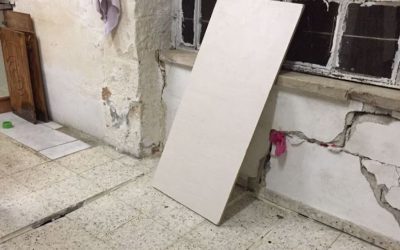
JERUSALEM – The Israeli municipality of Jerusalem issued evacuation orders for three housing apartments in the Wadi Hilweh area of the occupied East Jerusalem neighborhood of Silwan on Wednesday evening, due to fractures and cracks formed at the base of the houses, as Israeli authorities continued work on a tunnel network expected to be used to provide services to Israeli settlers.
According to the Wadi Hilweh Information Center, the houses belong to Hamed Oweida, Abed Oweida, and Suleiman Oweida.
Sixteen family members, including ten children, reside in the houses.
The Oweida family said that Israeli tunnel-digging under their homes has increased over the past three days, adding that loud noises from the digging would last for several hours, while the family could feel their houses shaking during the construction.
They said that the digging had caused severe damage of fractures and cracks in the walls and the bases of the houses.
The family added that they had called the Israeli police, who had then summoned a municipality team to inspect the houses. After taking photographs and inspecting the damage, an architect for the municipality decided to issue an emergency order for the families to evacuate and seal the houses, saying that it was dangerous to remain inside.
Suleiman Oweida had left his house several days ago after fractures in the walls had become more severe.
The information center said that Israeli authorities were creating a tunnel network for Israeli settlers directly under the Oweida family’s house.
Member of the Wadi Hilweh neighborhood committee Ahmad Qarrain said that the Israeli authorities began work under the neighborhood in 2007.
The residents at the time appealed to Israeli courts and were able to halt the construction under their homes for 14 months. However, Israeli courts later issued another order allowing the work to continue on the condition that the digging not endanger the lives of residents.
However, Qarrain said that the digging and work under the houses continued “without any consideration for the safety of residents,” and pointed out that the streets, walls, structures, and houses of the neighborhood have also been fractured and collapsed owing to the tunnel work.
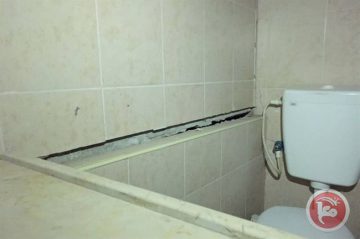
A spokesperson for the Israeli Jerusalem municipality told Ma’an that the municipality had informed the residents that their properties were “unsound and dangerous” out of “concern for their own welfare,” while also being built “without regard for building codes or safety standards.”
The spokesperson added that “claims that the city is attempting to construct underneath this family’s structure are patently false.”
Wadi Qana’s Palestinian farmers endure another mass tree uprooting
International Solidarity Movement | April 5, 2017
Hebron, occupied Palestine – Just days after Palestinians commemorated Land Day, a day which marks the struggle against the Israeli government’s expropriation of Palestinian land, farmers of Wadi Qana endured another mass uprooting and theft of their trees.
Speaking from his home in the Salfit district village of Deir Istiya, Palestinian activist Rezeq Abu Nasser cited the frustrating chronology, “This is the third time they took my trees. They stole them in 2013 and 2015 as well.” He then handed ISM volunteers the Arabic/Hebrew notice that he found posted on a fence he erected at a cost of over 1,000 NIS to protect his trees. Abu Nasser’s fence was also dismantled and seized along with 25 of his trees.
The notice received by four Palestinian farmers demands that they uproot their own trees or face arrest and/or fines to cover the cost of Israeli occupation forces uprooting the trees for them. Soon after, 135 trees were uprooted and stolen during the small hours of morning. Several bulldozers entered the valley, hauled large stones into the road to block the entryway and rammed through part of a 40 meter stone wall to access the trees.
Citing environmental justifications for these aggressive acts of theft, an Israeli government spokesperson for the Coordinator of Government Activities in the Territory was quoted as saying that the trees were uprooted due to their “damaging the natural view and value of the nature resort.” Claiming the act to be one of protection of the view of a lush valley from the sight of trees is even more absurd, given that the Israeli forces left a partially demolished stone wall and broken tree limbs scattered atop a small field of holes where the trees once took root.
While speaking to the Mayor of Deir Istiya, his office produced copies of the issued warrants for the threatened trees and the generations old British land deeds affirming the farmers’ rights to their ancestral land. The Mayor of Deir Istiya described arriving at the Wadi Qana immediately after being alerted to the uprootings in progress, only to find the road blockage Israeli forces left to keep farmers and residents from defending their land. As for the stone wall, he claimed,”This is a new experience for us that they demolished the stones.”
The farmers who lost their trees, tantamount to their livelihood, plan to continue their struggle against these incursions by furthering their cases with the local municipality. As for Abu Nasser, “I’m going to replant them again.”
Top French banks, insurer financing Israeli settlements: NGO
Press TV – March 29, 2017
Several human rights organizations have exposed the complicity of four major French banks and an insurance company in financing Israeli settlements in the occupied Palestinian territories.
The revelation was made in a Wednesday report titled “Dangerous Liaisons: French banks and Israeli settlements” on the website of the Paris-based International Federation for Human Rights (FIDH), an international human rights NGO with 184 member organizations from 112 countries.
The banks of BNP Paribas, Societe Generale, Credit Agricole and Groupe BPCE as well as AXA insurance firm hold shares in or are involved with Israeli banks, which are an “essential political tool in the creation of the settlements (and) finance construction,” the report read.
The five companies are further involved with businesses that help settlement development through the building of “housing, factories, the installation of telephone and internet connections, or surveillance equipment,” it added.
Additionally, the report, which was co-authored by a number of other human rights groups, including the France-Palestine Solidarity Association (AFPS), held France responsible for indirectly supporting the Israeli settlement enterprise by allowing the institutions to finance businesses involved in the construction activities.
“The French government must bring pressure to bear on the banks and insurance companies, demanding that they bring all their support to an end,” the report concluded.
Meanwhile, FIDH Vice President Maryse Artiguelong expressed frustration at the French groups’ involvement “in this illegal activity just to make a bit more money,” adding, “(They) are seeking profit at any cost.”
Moreover, Didier Fagart, an AFPS member, urged the French groups to “withdraw their money from Israeli businesses with a connection to the settlements.”
“French banks cannot say they don’t know what is going on. They must make the right decision,” Fagart said.
Emboldened by the support of US President Donald Trump’s administration, the Tel Aviv regime has given the go-ahead to the construction of many settler units in the occupied territories.
Israel’s settlement expansion defies United Nations Security Council Resolution 2334 adopted in December 2016 that condemned the settlements as a “flagrant violation of international law.
Over half a million Israelis live in over 230 settlements built since the 1967 occupation of the Palestinian territories.
The continued expansion of Israeli settlements is one of the major obstacles to the establishment of peace in the Middle East.
New Israeli settlement projects planned in Jordan Valley
Palestine Information Center – March 24, 2017
JORDAN VALLEY – The Israeli Civil Administration delegation visited the Jordan Valley Regional Council, compromising of 21 illegal settlements, on Friday to discuss ways to establish new development projects in the Jordan Valley settlements, Israeli media sources said.
The delegation included David El Hayani, mayor of the Jordan Valley Regional Council, and Aravot HaYarden, chairman of the council.
The delegation discussed ways to develop agriculture, tourism, and other economic sectors in the settlements.
Nearly one million tourists arrived last year in the Jordan Valley, half of whom came to visit the religious sites in the area, which were recently developed by the Civil Administration, Hayarden said.
For his part, El Hayani revealed plans to establish new tourism projects in the area including restaurants and parking.
The new projects came as part of the Israeli settlement expansion policy which has been notably escalated over the few months.
Earlier on Thursday, Haaretz (Hebrew) newspaper revealed that US President Donald Trump gave a green light for Israeli settlement construction in occupied Jerusalem.
Israel to Bulldoze Palestinian Homes to Build ‘Settlers Only’ Road
Sputnik – 22.02.2017
As Israel begins work on its “American road” project in East Jerusalem’s Jabal al-Mukaber area, hundred of Palestinians are on edge, as their homes lie directly in its path.
Part of the larger al-Touq Highway, the road is ostensibly being constructed to connect Israeli settlements north, south, and east of East Jerusalem, and cuts through sections of Jerusalem, joining the Maale Adumim and Har Homa settlements on the West Bank.
The al-Touq Highway, proposed ten years ago by Israel’s municipality planning and construction committee, will, once completed, be 230-feet wide and over 7-miles long.
Roughly 300 acres, encompassing 12 Palestinian neighborhoods in Jabal al-Mukaber, will be confiscated to build the road, which has alarmed residents of Salaa, where construction has already begun.
Salaa resident Mohammad al-Sawahra told Al Jazeera, “We are living in a state of perpetual fear…It’s as if we are living in [two different worlds]. In Palestinian areas, it is like living in the third world, while those living in settlements built on the land of Jabal al-Mukaber are offered a life of comfort like first world countries.”
Al-Sawahra received a demolition notice for his home last month, adding that, “Now, they want to build a road on the ruins of my home for themselves, as well.”
He will be one of some 500 Palestinians living in 57 homes set to be demolished for the ‘American Road’ project. Raed Basheer, with the Committee of Defence for Jabal al-Mukaber properties, told Al Jazeera, “We were surprised to hear about the project, which will be 32 metres wide, with an additional 32 metres on the sides to allow for the light rail. All of the homes, both old and new, standing in the way of the road, will be demolished.”
“In response to this plan,” Basheer said, “we reached out to the Israeli municipality in Jerusalem and managed, with difficulty, to obtain an extension on the house demolition orders for five years, provided that we submit a request every year to extend the demolition orders. But, still, we do not know whether we will be allowed to remain in our homes over the next five years.”
The project map reportedly shows the disconnection of roads that link Jerusalem’s Palestinian neighborhoods, cutting residents off from health care facilities and schools, leaving a road only to be used by Israelis.
The plan comes on the heels of a recently-passed and hotly-debated bill that retroactively legalizes thousands of Israeli homes on privately-owned Palestinian land. The “regulation” law has been called “theft’ and a “land grab” by the opposition.
About 48,000 Palestinian homes have been demolished since Israel first seized the territories in 1967.
Why Palestinian Children Throw Stones
By Jonathan Cook | Dissident Voice | January 16, 2017
Forget the empty posturing of world leaders in Paris yesterday. This photo tells us what the Israel-Palestine “conflict” is really about.
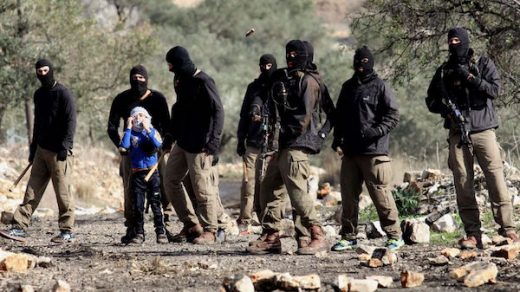
Imagine for a second that the little boy – how old is he, eight, nine? – is your son, trying to adjust his keffiyeh because it keeps falling over his eyes and he can’t see anything. Imagine your small son surrounded by masked Israeli “soldiers”, or what looks more like a Jewish militia than an army. Imagine that the boy is likely soon to be bundled into the back of a military van and taken for interrogation without his parents or a lawyer present, or even knowing where he is. That he could end up beaten and tortured, as human rights groups have regularly documented.
Maybe you can’t imagine any of that because you, a responsible parent living in Europe or the United States, would never let your child out to throw stones.
Then you need to know more about the story behind this picture.
This photo was taken in Kfar Qaddum last month. The boy and his friends aren’t there to bait Israeli soldiers or indulge a bout of anti-semitism. Jews from the violent – and illegal – settlement of Kedumim have taken over their farm lands. Kedumim’s expansion has been further used to justify the army closing the access road in and out of Qaddum. The village is being choked off at the throat. In short, these villagers are being ethnically cleansed.
Parents living in such circumstances do not have the privilege of concealing from their children what is happening. Everyone in the village knows their community and its way of life are being extinguished. Israel is determined that they will leave so that the Jewish settlers next door can grab their land. Israel expects these villagers to join the rest of the aid-dependent Palestinian population in one of the ghettoised towns and cities in the bantustans of the West Bank.
Even little boys understand the stakes. And unlike your child, this one knows that, if he doesn’t resist, he will lose everything he holds dear.
Israeli forces escort Israeli settlers to visit shrine in Palestinian village
Ma’an – January 8, 2017
SALFIT – Israeli forces raided the town of Kifl Haris in the Salfit district of the central occupied West Bank overnight Saturday to provide protection for Israeli settlers visiting a site believed to be a Jewish shrine.
Eyewitness Yousif Yaqoub told Ma’an that he counted about 30 Israeli military vehicles storming the center of the town to escort the settlers, with Israeli soldiers firing stun grenades.
Israeli forces then set up military checkpoints at the entrances to Kifl Haris and imposed curfew, according to Yaqoub.
An Israeli army spokesperson told Ma’an that overnight, “Israeli forces escorted Jewish pilgrims to the tomb of Joshua,” saying that the visit took place “without incident.”
A visit by settlers to the site earlier this month that was not carried out in coordination with the Israeli army sparked clashes with locals youth, prompting Israeli army forces to raid Kifl Haris, when a number of Israeli settlers were reportedly detained and interrogated over “violating Israeli military orders that bans Israelis from entering Palestinian districts.”
Residents of Kifl Haris have been living a continuous tension due to Israeli settlers’ raids to allegedly visit Jewish religious sites.
A number of tombs exist in Kifl Haris, which Palestinians in the area believe to be the graves of Muslim prophet Dhul-Kifl, the Sufi saint Dhul-Nun, and another shrine built by 12-century Sultan Saladin.
However, some Jews believe the tombs belong to the biblical figures Joshua, Caleb, and Nun.
Like many other Palestinian towns across the West Bank with religiously significant sites, Kifl Haris, situated on the main road connecting the illegal Ariel settlement to Jerusalem and Tel Aviv, commonly experiences incursions by Israeli settlers accompanied by armed escorts.
Settlers who visit the tombs to pray often actively disrupt Palestinian residents and damage property.
Meanwhile, Palestinians are restricted from visiting holy sites in Israel without hard-to-obtain permits from Israeli authorities.
Featured Video

Stanislav Krapivnik: Russia-Iran Cooperation & Escalation in Ukraine
or go to
Aletho News Archives – Video-Images
Frlom the Archives
A dark page from the CIA’s history: What was Project Artichoke, launched 74 years ago?
By Erkin Oncan | Strategic Culture Foundation | August 22, 2025
One of the most useful instruments hidden behind the U.S. empire’s rhetoric of “freedom and democracy” was the Central Intelligence Agency, founded on September 18, 1947, as the successor of the Office of Strategic Services (OSS).
Since its creation, the CIA has carried out countless inhumane operations: assassinations, coups, drug trafficking, support for terrorism, conspiracies. The list of its crimes is endless. But among the darkest and most inhumane chapters of its record lie the notorious “mind control” experiments. … continue
Blog Roll
 Aletho News
- Stanislav Krapivnik: Russia-Iran Cooperation & Escalation in Ukraine
- Indonesia suspends participation in Board of Peace following attack on Iran
- ‘Operation Epic Fury’ burns an estimated $5.82 billion in just 100 hours
- Zionism’s grip over the world: From Epstein to Greater Israel
- How Israel and the FBI manipulated assassination plots to goad Trump into Iran war
- Iranian Strikes Dispel the Illusion of US Security Umbrella
- US Boasts of Destroyed Iranian Launchers Lack Credibility – Ex-DoD Official
- Europe not in position to cooperate with US and Israel against Iran
- Iran Has ‘Broken the Myth’ of Israeli Military Power: Former Pakistani Envoy
- How, and why, US data centers in the Gulf became targets of war
- If Americans Knew
- US troops were told war on Iran was ‘all part of God’s divine plan’, watchdog alleges
- Trump wants to run the show in Iran, but doesn’t know what he’s doing – Not a ceasefire Day 147
- ‘Dirty Work’ :The truth about how Israel was founded
- Mass Expulsion in Lebanon as Israel Expands War: “We Don’t Know Where to Go”
- Lies, distortions, and propaganda: how the U.S. mainstream media coverage on Iran hides the truth
- Palestinians in Gaza fear famine returning as Israel cuts off food amid Iran war
- AIPAC, other pro-Israel groups enter midterms with $100 million to spend
- Iranian girls killed by ‘double-tap’ strikes on Minab school
- Bari Weiss Is Going Full ‘Propaganda-Palooza’ With the Iran War
- Inside the Pro-Israel Campaign to Stop ‘The Voice of Hind Rajab’ From Winning an Oscar
- No Tricks Zone
- Televised! Leading German Political Candidate Tells Schoolchildren CO2 Makes Sun Hotter!
- New Study: A Century Warming Of 1.1°C Is ‘Commonplace’ And ‘Not Unusual’ During This Interglacial
- New Study: ‘Internal Noise’ And Volcanic Forcing Can Trigger 10-15°C Warming Within Decades
- Glaciers Worldwide Are Suddendly Surging, Experts Blame Warming!
- Surprising Discovery: Sahara Is Greening…Billions Of Trees Where Once Thought To Be Barren
- New Research Reaffirms Clouds, Aerosols, And Surface Solar Radiation Are ‘Driving The Climate System’
- Germany: Electric Car Catches Fire At Charging Station, Sets Off Local “Inferno”, Widespread Damage
- New Study: Canada’s New Brunswick Was 1°C Warmer Than Today During The Medieval Warm Period
- Coal Power Back In Trend As Globe Tries To Keep Pace With Growing Demand For Power
- New Study: A 4°C Warmer Beaufort Sea Had ‘No Sea Ice’ 11,700 – 8200 Years Ago
 Aletho News