Clashes erupt in Silwan after Israeli settler attacks 8-year-old boy
Ma’an – September 12, 2015
JERUSALEM – An Israeli settler attacked an 8-year-old Palestinian boy late on Friday in the Batn al-Hawa area of Silwan — a neighborhood in occupied East Jerusalem — leading to clashes in the area, a local monitoring group told Ma’an.
The Wadi Hilweh Information Center, located in Silwan, said 8-year-old Zaid Abu Qweidir was attacked by a group of Israeli settlers in the neighborhood.
An Israeli police spokesperson did not immediately respond when asked for comment.
According to the center, a young Palestinian man witnessed the attack and moved to intervene, which quickly escalated into clashes between the two sides.
More than 20 Israeli settlers arrived on the scene, many of whom used pepper spray against Palestinians as young as five-years-old, the information center reported.
Witnesses said the Israeli attackers came out from a building which settlers had recently occupied.
After the attack, security guards of the settlement outpost, as well as Israeli forces, arrived to protect the settlers, witnesses said.
The forces fired tear gas canisters and stun grenades at Palestinians in the area.
The Wadi Hilweh center said at least 15 Palestinians were moderately to severely injured by pepper spray, including 60-year-old Abdullah Abu Nab and 14-year-old Mahdi al-Rajabi. Both were taken to al-Maqasid hospital in East Jerusalem for treatment.
Zaid Abu Qweidir, 8, Adam al-Rajabi, 9, Rahaf Abu Qweidir, 5, Udayy al-Rajabi, 12, Hamza al-Rajabi, 12, Yazan al-Rajabi, 14, Walid al-Shaer, 16, were lightly injured and received treatment at the scene. A pregnant woman, Asmaa al-Rajabi, 29, and 75-year-old Abu Adnan Gheith were also lightly injured.
Furthermore, a tear gas canister was shot into a home housing five children aged 7-months to 13-years-old, the information center said.
Silwan is one of many Palestinian neighborhoods in occupied East Jerusalem that is seeing an influx of Israeli settlers.
According to a statement released by the PLO Negotiations Affairs Department in August, illegal Israeli settlers have taken over 39 homes in Silwan, creating settlement enclaves in which approximately 400 Israeli settlers live.
As Third Victim Dies, Arsonists Get a Pass in Israel (and in The NY Times)
By Barbara Erickson | TimesWarp | September 8, 2015
Riham Dawabsheh, the third victim of an arson attack on her West Bank home, was laid to rest this week in a funeral attended by thousands. The New York Times has duly reported this, but the article is little more than a “color” piece, a detour around the full story of Israeli racism and impunity surrounding this event.
Riham, 27, died Monday, on her birthday, more than a month after the July 31 firebombing of her home in the village of Duma. Her toddler son, Ali, was burned to death in the attack, and her husband, Saad, 32, died a week later. A second son, Ahmad, 4, remains alive in a hospital with burns over 60 percent of his body.
The Times barely mentioned Riham’s death in a brief 135-word story yesterday (placed in the bottom corner of page 6 of the print edition); today it gives us a five-column photo with an article by Diaa Hadid that describes the women at her funeral and very little else.
It is a piece devoid of context, and it includes no official responses to the news of the latest death, with one exception—the statement by Israeli Prime Minister Benjamin Netanyahu, decrying the attack and insisting that security services were “doing their utmost” to find the perpetrators.
Other media outlets in the United States and Israel report the anguished concern of United Nations and Palestinian officials over the lack of progress in the case. Nicholay Mladenov, UN special coordinator for the Middle East peace process, said that he “reiterated and strengthened” his earlier call for justice, and that he was “concerned by the lack of progress in identifying and prosecuting the perpetrators of this outrage.”
Saeb Erekat, secretary-general of the Palestinian Liberation Organization, released a statement saying, “Over a month has passed and the Israeli government has not yet brought the terrorists to justice. In fact, more hate speech and incitement have been coming out from members of the Israeli government, more settler attacks have been carried out, and more Palestinians have been killed, injured or detained.”
The Times story mentions none of this and says only that Israel arrested several extremists who belonged to a “network that had encouraged acts of arson” and that it is “unclear” if any of them were connected to the Duma attack because Israel had imposed a gag order on the investigation.
Missing from this all-too-brief summary are some significant facts: The Israeli authorities arrested several suspects soon after the arson attack but released them, and although villagers reported that four men ran from the house after setting it on fire and entered a nearby settlement, no one from the settlement is in custody.
Other media have noted that Israel has failed to arrest and prosecute those responsible for similar attacks in the past. The Israeli magazine 972 ran a piece titled “No one is put on trial when a Palestinian family is burned alive,” comparing the Duma attack to a taxi firebombing three years ago.
The taxi bombing left six Palestinian family members hospitalized, but all survived. The investigation, however, did not. As 972 writers John Brown and Noah Rotem state, “Despite incontrovertible evidence showing settlers were behind the attack, the case was closed after a two-week investigation.”
None of the Times stories on the Duma bombing have found this news fit to print, and the newspaper has failed to mention other developments that shed light on the tragedy. They include:
- Under Israeli law, the Dawabsheh family is not eligible for compensation, while settlers who suffer similar attacks automatically receive reparations.
- The family struggled to cover medical expenses for the three who were being treated for burns.
- Settlers tried to burn another Duma house not long after the July 31 arson attack.
The newspaper has had several opportunities to include this kind of information in its pages, but it has preferred to emphasize officials’ efforts to control the damage to Israel’s reputation as news of the deadly arson emerged in the media. Thus we have found several stories about the arrests of Jewish extremists and many reports of Israeli outrage over this act of terrorism.
Today’s story was one more opportunity to inform readers of the full context in this disturbing story, but the Times has given us a diversionary slice of local life, omitting any reactions beyond that from the prime minister’s office and obscuring the facts surrounding the investigation.
Even in the most egregious examples of violence against Palestinians, the Times chooses to act as a protector of Israel, placing this goal above its mandate as the newspaper of record.
Israelis Linked to Settler Terrorism were from U.S. Families
By Steve Straehley and Noel Brinkerhoff | AllGov | September 9, 2015
A horrific act of terrorism in the West Bank this summer is suspected to have been perpetrated by Israeli extremists with American roots.
In the village of Duma on July 31, the home of a Palestinian family was firebombed, killing an 18-month-old child, Ali Dawabsheh, who was burned to death, according to media reports. The child’s father, Sa’ed and four-year-old brother Ahmed suffered serious burns, but survived. Ali’s mother, Riham, died Sunday of her burns. Their home was sprayed with graffiti reading “revenge” in Hebrew and featured a Star of David.
“All available evidence suggests that the blaze was a deliberate act of settler terrorism,” Sara Yael Hirschhorn wrote at The New York Times. “More disturbingly, several of the alleged instigators, currently being detained indefinitely, are not native-born Israelis — they have American roots.”
Although not so far charged with the fire that killed the Dawabshehs, four youths believed to be connected to settler terrorism have been incarcerated by Israeli officials. They are Meir Ettinger, 24, grandson of Meir Kahane, a radical American rabbi who served in Israel’s parliament; Mordechai Meyer, 18, the son of American immigrants; American Ephraim Khantsis; and Eviatar Slonim, the child of Australian Jews.
The fire is thought to be a so-called “price tag” attack. Radical Israeli settlers commit such crimes as a response to their government’s efforts to dismantle illegal West Bank Jewish settlements.
To Learn More:
Israeli Terrorists, Born in the U.S.A. (by Sara Yael Hirschhorn, New York Times )
How the Killing of an 18-Month-Old Boy in the West Bank Exposed the Israeli Authorities Failure to Stem Tide of Jewish Extremists (by Ben Lynfield, The Independent )
Israelis Killed more Palestinians Last Year than in any Year since 1967 (by David Wallechinsky and Steve Straehley, AllGov )
U.S. Only Country of 47 to Vote against Investigating Possible Human Rights Violations during Israeli Occupation of Gaza (by Noel Brinkerhoff, AllGov )
Reham Dawabshe’s funeral
International Solidarity Movement |September 8, 2015
Duma, Occupied Palestine – Yesterday, Monday 7th September, at approximately 1pm, thousands of people where waiting for martyr, Reham Dawabshe, to arrive to Duma to attend her funeral.
After struggling for five weeks from severe burns all over her body, Reham Dawabshe died in the hospital. Reham’s home was attacked by illegal Israeli settlers on July 31st, by smashing the windows in the middle of the night, throwing in flammable liquids and molotov bombs and setting the whole house on fire. Her 18-month-old baby, Ali, died in the flames trapped in the house and her husband, Saed, died one week later in the hospital.
 Until this day, only 4-year-old, Ahmad, has survived but is still struggling from severe wounds in the hospital.
Thousands of people mourned the mother’s death in Duma, including hundreds of teachers and dozens of students from the Jurish School for Girls, where Reham worked as a math teacher. Many government representatives were present, including the Governor of Nablus, Akram al-Rujoub, and the Minister of Education, Sabri Seidam.
Soon after the funeral procession was finished, clashes broke out in the entrance of the village of Duma, where Israeli soldiers fired tear gas canisters and sound grenades towards Palestinian youth.
To this day, the perpetrators of the arson attack that killed Ali, Reham and Saed Dawabshe have not been arrested. Israeli authorities only arrested a few random settlers right after the event occurred in order to show in the news media that they were working to make justice, but soon after most of these suspects were released.
It is important to note that the great majority of attacks perpetuated by illegal Israeli settlers towards Palestinian villagers are always ignored by the Israeli authorities, whereas Palestinians are harassed, imprisoned and beaten by Israeli soldiers on a daily basis for no reason.
Israel Slammed Over Plans to Demolish 17,000 Palestinian Buildings
Sputnik – 07.09.2015
Israel has plans to demolish 17,000 Palestinian-owned buildings located on mostly occupied land of the West Bank, a UN report has revealed, with concerns the demolitions will cause poverty and leave many families in a “state of chronic uncertainty”.
A report from the UN Office for the Coordination of Humanitarian Affairs (OCHA) concluded that as a result of new and outstanding demolition orders, up to 17,000 structures, including houses, sheds and animal shelters could be knocked down, despite the fact that 77 percent of the buildings are located on privately owned Palestinian land.
The structures under the threat of demolition are located in Area C, a zone in the occupied Palestinian territory of the West Bank where the state of Israel retains full security and administrative control.
Around 300,000 Palestinians live in Area C, which covers 60 percent of the West Bank, and is also the location of many Israeli settlements with a population of around 360,000 — which are deemed illegal under international law.
Close to 4,500 demolition orders are to affect the land of Palestinian Bedouins, who human rights activists say are under threat of losing their homes in exchange for more Jewish settlements in the West Bank.
The UN report raised concerns about the impacts such proposed demolitions might have on Palestinians living in affected areas.
“These orders heighten the vulnerability of thousands of poor Palestinian households, some of whom are at imminent risk of forcible displacement.”
It also pointed out that the manner in which demolition orders are handled adds to the suffering of locals.
“Structures built without permits are regularly served with demolition orders. While only a minority of the orders issued are executed, these orders do not expire and leave affected households in a state of chronic uncertainty and threat,” the report found.
“Where the orders have been implemented, they have resulted in displacement and disruption of livelihoods, the entrenchment of poverty and increased aid dependency.”
‘Nearly Impossible’ Permits
While Israeli officials claim that the buildings are under threat as a result of not having the correct planning permission, others point out the extreme difficulty many face in trying to secure proper construction permits.
According to data from the governing body in charge of affairs in the West Bank — the Israeli Civil Administration — Palestinians submitted 2,020 applications for building permits in Area C between 2010 and 2014, while only 33 were approved.
The report said that planning and zoning rules made “it is nearly impossible for Palestinians to obtain building permits in most of Area C.”
Israeli officials have been accused of widespread discrimination over their treatment of Palestinians in Area C, with only one percent of the zone legally earmarked for Palestinian development.
This is contrasted to the 235 illegal Jewish settlements and outposts that have been constructed in the area in recent years. Many critics have argued that while authorities are harshly critical of Palestinian constructions, they turn a blind eye to any potential breaches in Jewish settlements.
The report follows international outrage over Israeli plans to demolish the West Bank village of Khirbet Susiya in July, with EU officials specifically asking Israel to stop the “forced transfer of population and demolition of Palestinian housing” in the area.
Labeling Israeli Settlement Products Not Good Enough
By Stephen Lendman | September 6, 2015
Last spring, 16 European foreign ministers urged EU foreign policy chief Federica Mogherini to require labeling of all Israeli settlement products – so consumers can buy or avoid them at their discretion.
Labeling is “an important step in the full implementation of EU longstanding policy,” they said. At best, it’s symbolic. At worst, a weak-kneed gesture with no meaningful effect on Israel’s economy.
By year-end or sooner, the EU is expected to decide up or down on labeling. Mogherini said “(t)he work is close to being finished but it is still ongoing.” If implemented, it’ll only be a guideline, not mandated policy. Individual EU states can do what they please – showing what’s being considered is a sham, an insult to long-suffering Palestinians.
Some EU nations already intend to require labeling – regardless of what the European Commission decides. “We have to make sure that consumers can distinguish products that come from the territories occupied by Israel,” Luxembourg Foreign Minister Jean Asselborn said.
Over 600,000 Israelis live on stolen Palestinian land – in the West Bank and East Jerusalem. Numbers keep increasing exponentially – Palestinians forcibly displaced from their land for exclusive Jewish development.
Palestinian human rights groups justifiably demand a total boycott of all Israeli settlement products. In 2013, Al Haq prepared a report titled “Feasting on the Occupation: Illegality of Settlement Produce and the Responsibility of EU Member States under International Law.”
“Given that trading in settlement goods amounts to a form of recognition and supports the sustainability of entities that violate peremptory norms of international law, a ban on settlement products… is to be considered amongst those actions that Third Party States should undertake to comply with their customary international law obligations,” it states.
Al Haq director Shawan Jabarin said products from settlements “help to sustain their very existence.”
“As things stand, the EU is doing little more than ticking a box by acknowledging that settlements are illegal. Until they support this rhetoric with action and ensure that no assistance or recognition are provided to settlements, even indirectly, any such criticism will continue to be meaningless.”
The EU is Israel’s largest trading partner. Settlement products represent a minuscule percent of Israeli exports. At the same time, they’re important “for the economic viability of many settlements,” the report said.
Economist Shir Hever said “(t)he significance of ending the import of colony products is much larger than the direct financial effect.”
“It (would be) a strong statement reminding Israel of the illegality of the colonization of the West Bank, and a blow to many Israeli and international companies who have turned the occupation into a source of profit.”
It would be a shot across the bow against all Israeli enterprises – a hopeful first step toward greater boycott and divestment from an apartheid state, aiming for total isolation.
Currently, nothing indicates business as usual changing. The 2000 EU/Israel Association Agreement governs relations between the Parties, including strengthening economic cooperation and trade.
Human rights groups blasted the enhanced partnership – showing EU officials say one thing and do another, effectively supporting Israeli high crimes.
After decades of mass slaughter and destruction, ethnic cleansing, illegal occupation and oppression, as well as international complicity with Israeli ruthlessness, mandated boycott, divestment and sanctions more than ever are essential – continued until Israel:
- recognizes Palestinian self-determination unconditionally;
- strictly observes international laws, norms and standards;
- ends its illegal occupation and Gaza blockade unconditionally;
- ends illegal aggression and all other hostile acts;
- dismantles its Separation Wall;
- frees all Palestinian political prisoners unconditionally;
- grants Israeli Arabs equal rights as Jews;
- ends apartheid racism;
- complies with UN resolution 194, affirming the right of diaspora Palestinians to return to their homes and property or be fully compensated for loss or damage if they prefer;
- recognizes East Jerusalem as Palestine’s exclusive capital within June 1967 borders; and
- gives Palestinians control over their land, borders, air space, coastal waters and resources.
Ending Israeli high crimes against defenseless Palestinians is long overdue. Nothing less than its full observance of international law is tolerable.
Israeli settlers pepper spraying Palestinians in Hebron attacks
Ma’an – September 5, 2015
HEBRON – Israeli settlers from the illegal settlement of Beit Hadasa in Hebron on Saturday attacked a young Palestinian man with pepper spray, witnesses said.
A Ma’an reporter identified the Palestinian man as Ayman al-Fakhori, and said that he had been transferred to Hebron hospital for medical treatment.
An activist group, Youth Against Settlement in Hebron, released video footage of the incident that appears to show the Palestinian scuffling with masked men and one Israeli soldier.
The masked men, identified by the activist group as settlers, then beat the Palestinian, before one of them sprays pepper spray directly into his face.
The masked men then run from the scene along with the Israeli soldier.
Earlier on Saturday, the official Palestinian Authority news agency Wafa reported another incident of a Palestinian being attacked and pepper-sprayed by Israeli settlers in Hebron.
Wafa identified the Palestinian as Jadawi Hani Abu Haykal, 21.
Abu Hakyal’s family reportedly told Wafa that he was attacked near the illegal Israeli settlement of Tel Rumeida and that his body was left severely bruised.
He was reportedly taken to hospital following the incident.
Settler attacks are a routine occurrence in Hebron, where 700 settlers live in 80 homes in the city center, surrounded by nearly 200,000 Palestinians.
Veolia sells its shares in the Jerusalem Light Rail and completes withdrawal from the Israeli market
Who Profits | August 2015
More than a decade after winning the tender for the construction and operation of the Jerusalem Light Rail (JLR), Veolia Environnement’s subsidiary, Transdev, has sold all of its holdings in the JLR to a group of Israeli investors.
The approval of the deal by the Israeli authorities and the completion of the ownership transfer, earlier this month, mark an end to Veolia’s operations in the Israeli market in general and to its involvement in the controversial JLR project in particular.
Israeli authorities’ approval and ownership transfer
Until August 2015, Trasndev, a Veolia Environnement subsidiary, held a minority interest (5%) in CityPass, a consortium tendered by the Israeli government to build the JLR, as well as full ownership (100%) of the train’s operator – Connex Jerusalem. The JLR was designed to connect the western part of Jerusalem with the illegal settlements surrounding the city. Operational since December 2011, the JLR crosses the Green Line and passes through the Palestinian neighborhoods of Shuafat and Beit Hanina.
On September 2nd 2014, Transdev (formerly: Veolia Transdev) signed a contract with the CityPass consortium for the sale of Connex Jerusalem and Transdev’s remaining 5% share in CityPass. The buyer, CityPass consortium, consists of three Israeli shareholders: The Ashtrom Group, IIF – Israel Infrastructure Fund and Harel Insurance.
Recent findings by Who Profits Research Center indicate that after almost a year- long negotiations between the companies, the Israeli authorities and the funding banks, the September deal was fulfilled and that the sale of Connex Jerusalem together with the 5% of CityPass shares reached completion.
On August 6th 2015, the Ashtrom Group – one of the buyers and a shareholder in CityPass, reported to the Israeli Stock Exchange that all conditions precedent in the JLR sale agreement with Transdev were fulfilled and that the agreement was completed. Ashtrom’s report also mentioned that on the same date, 1% of CityPass shares’ was passed into Ashtrom’s possession. For further information on the deal and necessary approvals, see Who Profits’ update from February 2014.
Later that month, on August 18th 2015, and according to the Israeli Companies’ Registrar, 100% of Connex Jerusalem shares’ were transferred from Transdev to an Israeli holding company jointly owned by the Ashtrom Group, IIF and Harel Insurance. According to the Registrar however, Transdev 5% share in CityPass still remained.
The Israeli financial newspaper – the Marker – has also confirmed the completion of the deal on August 2015. In an article (available in Hebrew), published on August 20th 2015, it was reported that Transdev received NIS 100 million for Connex Jerusalem. Contrary to Ashtrom’s report to the Israeli Stock Exchange and to the unaltered status of CityPass ownership in the Israeli Companies’ Registrar, The Marker reported that Trandev’s 5% share in CityPass was fully sold to IIF. Who Profits will continue to monitor the publications around the sale in order to determine which company is the current owner of Transdev’s former 5% share in CityPass.
Finally, Who Profits findings and analysis strongly suggest that the sale has been completed and that the formal ownership transfer of CityPass shares will soon show on public record.
The final step in a gradual withdrawal
The sale of the JLR is the final step in Veolia’s gradual withdrawal from the Israeli market and several illegal operations in the occupied Palestinian territory. Through its various Israeli subsidiaries, the company has engaged in multiple sectors of the local economy, including transportation, water, waste management and energy. Since the Israeli private sector, much like the Israeli government, considers the settlements as a legitimate part of Israel, Veolia’s Israeli subsidiaries operated freely beyond the Green Line. Their activities included the provision of public bus services to Israeli settlements in the West Bank, the operation of a landfill in the occupied Jordan Valley, wastewater treatment facility for settlements’ sewage, and finally the construction and operation of the controversial JLR.
In the last few years, Veolia Environnement sold its Israeli subsidiaries piecemeal. In September 2013, the company sold its local bus services subsidiary to Afikim Company and in April 2015, water, waste and energy activities in Israel were also sold to the US-based investment firm Oaktree Capital Management. At the same time, Veolia tried to distance itself from the JLR by decreasing its holdings in Veolia Transportation – the multinational’s transport services division. In 2011, Veolia Transportation was merged with Transdev UK, leaving Veolia with a 50% share in the new company. To further blur Veolia’s involvement in the JLR, the new subsidiary – Veolia Transdev, changed its name to Transdev.
Simultaneously, Veolia negotiated with the Israeli Ministry of Transportation its way out of Jerusalem. In 2010, the Ministry has effectively blocked Veolia’s attempts to sell its holdings in the light rail to the local Egged Company. It did so by demanding previous international experience form the replacing operator. Due to the controversy surrounding the light rail, it appeared that international companies were hesitant to take on Veolia’s role, additionally with an unexperienced local transportation sector, Veolia was unable to sell Connex Jerusalem and its minority share in CityPass for years. Apparently, negotiations have now ended with the removal of the Israeli government’s objection to an unexperienced buyer and the acceptance of the CityPass consortium as capable rail operator.
Aftermath
As of August 2015, Veolia Environnement is no longer active in the Israeli market and in the occupied Palestinian territory. Nevertheless, the company has left behind irreversible facts on the ground. The construction of the railway involved the expropriation of occupied land that was not done for the benefit of the occupied population, and hence contradicts international law and the Fourth Geneva Convention. The JLR continues to serve the Jewish settlement neighborhoods in occupied East Jerusalem and passes daily through the Palestinian neighborhoods of Beit Hanina and Shuafat, by doing so it will play a substantial role in the reinforcement of Israeli sovereignty over occupied East Jerusalem for years to come.
Only after a final determination of the owner of Transdev’s former 5% share in CityPass, Who Profits Research Center will remove the profiles of Veolia Environnement, Transdev and Caisse des Dépôts et Consignations(CDC) from its database.
International Outcry Over Demolitions of Palestinian Homes: Silence in The NY Times
By Barbara Erickson | TimesWarp | August 31, 2015
The United Nations has called for a freeze on Israeli demolitions of Palestinian homes, dozens of aid agencies and the European Union have joined in the protest, and even the U.S. State Department has voiced its dismay. Yet, even as the outcry has become an international issue and reached the highest ranks of our own government, we find a resounding silence at The New York Times.
Times readers are unlikely to know that 31 international organizations recently called on Israel to stop the “wanton destruction of Palestinian property,” including “basic humanitarian necessities,” such as solar panels, animal pens, latrines and tents supplied by the European Union. The groups asked world leaders to take “urgent action,” to hold Israel accountable for “grave breaches” of international law, and to demand reparations for the destruction of their charitable gifts.
The statement came shortly after the United Nations and representatives of the European Union in separate actions called on Israel to freeze demolitions in the West Bank.
The State Department joined both groups with statements made during a press briefing Aug. 19. When spokesman John Kirby was asked about the issue, he had a prepared declaration ready to hand.
The department was “deeply concerned” and “very troubled,” he said, calling the demolitions and evictions “harmful and provocative and indicative of a damaging trend.” He referred to the “destruction of dozens of structures and the displacement of over 150 people in the West Bank and East Jerusalem this month alone.”
His words got the attention of Israeli media, which published his comments at length, but they failed to arouse the interest of the Times.
In fact, Israel’s cruel (and illegal) policy of demolishing Palestinian property has been a constant story in alternative and Palestinian media outlets over the years, and the spate of international protests appearing this past month is not the first. Last February, for instance, some 400 rabbis from around the world urged Israel to halt demolitions in the West Bank.
Israeli forces have destroyed houses, tents, animal shelters, shops and farming structures throughout the West Bank at a steady clip, leaving 486 Palestinians displaced in 2015 as of Aug. 24. The destruction has hit the poorest and most vulnerable populations hardest, as Israel attempts to clear the land for Jewish settlers.
In the midst of this, the Times has seen fit to report on only one official demolition action this summer: the destruction of illegal Jewish settler homes in the West Bank. (This event was accompanied by Prime Minister Benjamin Netanyahu’s announcement of plans for 500 news settlement homes to replace them.)
When the demolitions have made their way into the pages of the Times, the reports have failed to reveal the full extent of the problem. This year, for instance, the paper took notice of the threatened destruction of the West Bank village Susiya, when international media attention made it impossible to ignore, but dozens of other actual demolitions found no mention in the newspaper.
Again, when bureau chief Jodi Rudoren wrote about East Jerusalem demolitions last year, she underreported the extent of the damage by omitting over 46,000 structures that have been destroyed over the years and mentioning only the 675 that took place for “punitive reasons” during the second intifada.
Although demolitions are a constant threat to thousands of Palestinians in the West Bank, the Times prefers to ignore this reality. Palestinian media, however, issue reports almost daily, and monitoring groups such as the United Nations and the Israeli organization B’Tselem struggle to keep tallies.
These groups also note that demolitions fly in the face of international rules. As the UN release states, they contravene “Israel’s obligations as an occupying power under humanitarian law and human rights law.”
Behind the numbers cited by the United Nations and other groups are thousands of individual stories: herders struggling to shelter their flocks as Israeli forces tear up sheds and corrals, children robbed of playgrounds and schools, communities forced to pay for water deliveries after bulldozers crush their pipelines, families pulling prized possessions out of the rubble of their homes.
These stories find little notice in the Times, even as aid organizations and governments from the European Union to the U.S. State Department have spoken out with alarm and dismay. On many levels, Israeli demolitions are eminently newsworthy, but this is not enough for the Times, which prefers to shield Israel above all.
Violent arrest of Palestinian man in al-Khalil (Hebron)
International Solidarity Movement | August 29, 2015
Occupied Palestine – A 52-year old Palestinian man was arrested at Shuhada checkpoint in al-Khalil (Hebron) yesterday, for ‘not obeying soldiers’ orders. Israeli forces painfully handcuffed and blindfolded him.
Around 1:30 pm, Hisham Azzeh walked through Shuhada Checkpoint in order to reach his house that is located up the hill next to the illegal settlement in Tel Rumeida. At this first checkpoint on his way home, Hisham passed through the metal detector without it beeping to indicate he had to go back and pass again. Therefore, he continued on his way, but Israeli soldiers yelled at him to go back and pass through the checkpoint again for no reason.
When he did not immediately comply with the soldiers orders, they arrested him. Israeli soldiers painfully handcuffed him with his hands behind his back with plastic handcuffs, without any regard for a recent operation on his hand. The soldiers also blindfolded him, so he was unable to see what happened to him and where he was brought. On the way up the hill towards the military base, the pain, caused by the plastic handcuffs, was so intense, that Israeli soldiers had to allow Azzeh to sit down on the ground, as he was unable to continue walking.
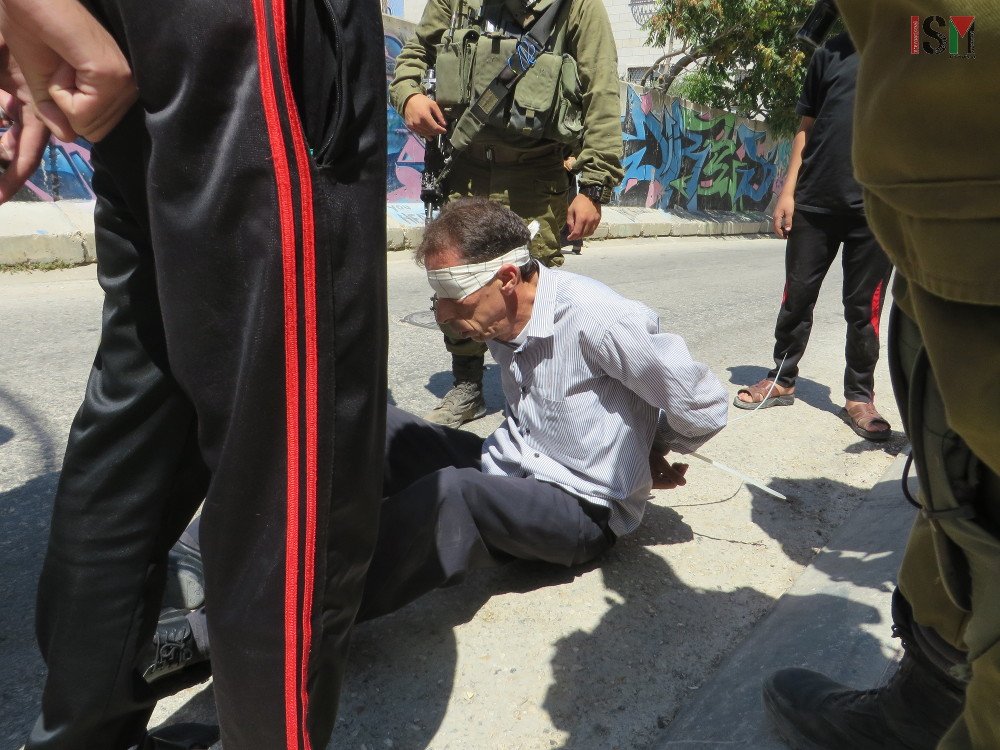
Palestinian man sitting on the ground in pain
Palestinians observing the arrest were continously telling soldiers about Azzeh’s recent operation on his hand and the plate that had to be inserted during this operation. Even though they were explaining the immense pain the plastic handcuffs were causing to Azzeh due to this operation, the Israeli soldiers shouted at them to leave the area and be quiet. Various requests to call an ambulance were denied. Only after Azzeh’s brother, who is a medical professional, arrived and reasoned with the soldiers, they attempted to cut the handcuffs. As the soldiers put the handcuffs too tight, they were struggling to cut the handcuffs without cutting Azzeh’s hands, making the procedure even longer and more painful, with Azzeh suffering immensely and crying out in pain.
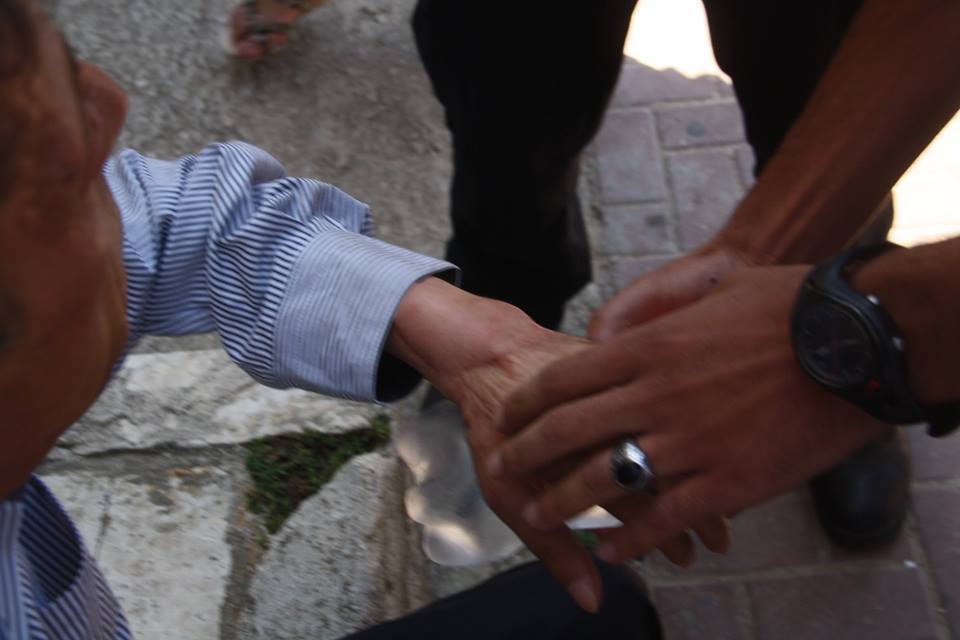
Hisham’s hand showing scars from the operation. Photo credit: Youth against settlement
In the meantime, a civil police car was driving past on a regular patrol and got stopped by the Palestinians in an attempt to alleviate the situation for Hisham. After the handcuffs were finally cut off, by-standers cooled his hand first with a bottle of cold water until an ice-pack was brought for him. The police took Hisham Azzeh to the police station after a long discussion. After about an hour, Azzeh was released. He is now doing okay, but is still suffering from pain in his hands.
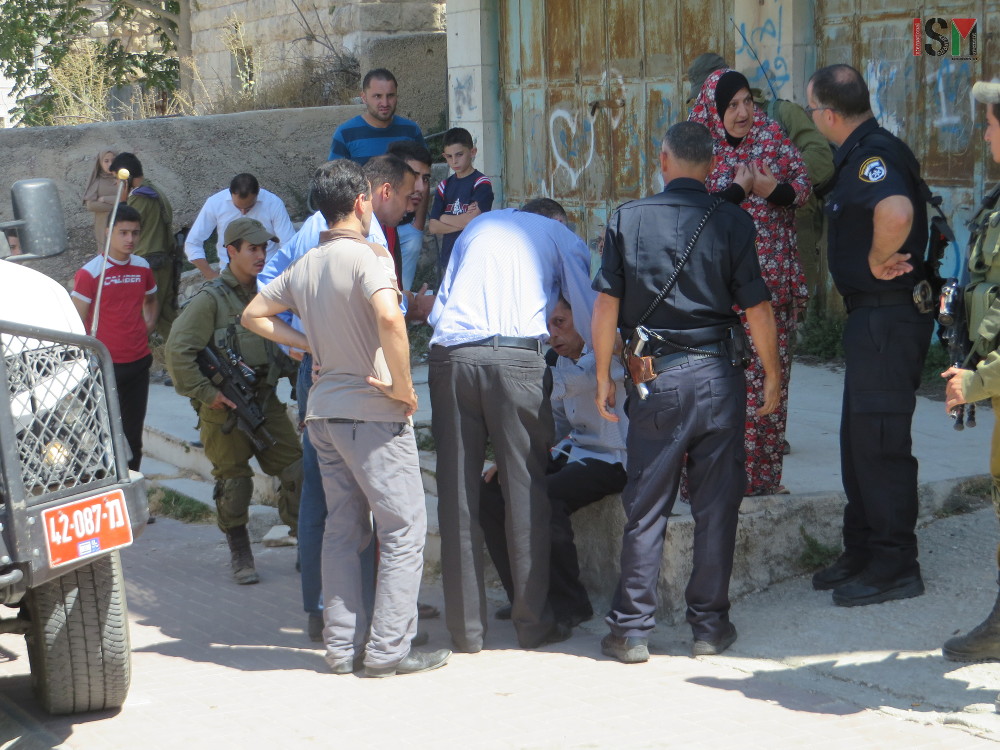
Police, bystanders and the soldiers standing around Hisham
Harassment like this in al-Khalil (Hebron) is not unusual. Palestinians have to pass through various checkpoints on their way home or to work and often get detained for long periods of time.
Continual harrassment, threatening and intimidation of Palestinian family by settlers in Hebron
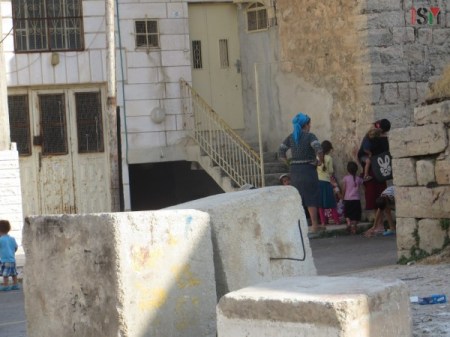
Settler women with their children blocking the stairs to the Abu Rajab house
International Solidarity Movement | August 30, 2015
Occupied Palestine – The Palestinian Abu Rajab family in the occupied West Bank city of al-Khalil (Hebron) is facing continual intimidation by groups of settlers and Israeli forces protecting these settlers in their attempts to take over the Abu Rajab family home.
In the last few weeks, settlers from the nearby illegal Israeli settlements on various occasions have camped outside the home under the protection of the Israeli forces, leaving the family confined to the house not able to leave fearing attacks by settlers as well as settlers taking over the rest of the house.
In March 2012, a group of settlers from illegal settlements within the city broke the gate of the house and occupied the two upper floors of the house at night-time during Passover. Afterwards the settlers claimed to have legally bought the house, a claim that until now could not be proven legit by an Israeli court. Until the final decision of the court, the Abu Rajab extended family is not permitted to use that part of their home. The same year, one of the sons, in his early twenties, was arrested and put in administrative detention (detention without charges or trial) for a year.
When in September 2013 an Israeli soldier was shot in the neighbourhood of the Abu Rajab house, the Israeli Prime Minister Benjamin Netanjahu promised the settler movement that they would be allowed to move back into the house.
Since the beginning of this year, the threats and attacks by settlers on the family have increased. A month ago, during Passover, settlers again tried to move into the house. Instead of protecting the family from these repeated and unlawful attacks, they threatened the family to leave the house. Since then, settlers again and again camp or even sleep outside the families’ home. On Monday and Tuesday, small groups of settler women with their children have been blocking the stairs to the house’s door all afternoon. The children, all under eight years old, were instrumentalised by their mothers as they are too young to understand what was going on. Palestinian children playing nearby the house were forced by soldiers to leave the area.
Featured Video

Stanislav Krapivnik: Russia-Iran Cooperation & Escalation in Ukraine
or go to
Aletho News Archives – Video-Images
Frlom the Archives
Are the Jews indigenous to Palestine?
By David Miller | Al Mayadeen | August 3, 2022
There is a rising tide of claims from apologists for the crimes of Zionism that they have been misunderstood. Palestinians might be indigenous to Palestine, but the Jews definitely are. What is called the ‘Israel-Palestine’ conflict, they say, is competition over the same small piece of land by two rival groups of indigenous people. But are the Jews indigenous to the Levant? And what are the consequences of the argument?
In fact, most of the power structure of the Zionist state is dominated by Ashkenazi Jews who have no ancestral link to Palestine. Overall despite very significant financial and infrastructural contributions from Western European countries (especially the US, UK and France, for example via the Rothschild family), Eastern European Ashkenazim have been at the centre of the Zionist power structure since the early years of the 20th Century. … continue
Blog Roll
 Aletho News
- USA and Israel: Who is the lord and who is the colony?
- Indian journalist reveals severe Israeli censorship after escape from occupied territories
- Majority of Israelis Back War with Iran as Anti-War Minority Faces Stigmatization
- Are the Jews indigenous to Palestine?
- Stanislav Krapivnik: Russia-Iran Cooperation & Escalation in Ukraine
- Indonesia suspends participation in Board of Peace following attack on Iran
- ‘Operation Epic Fury’ burns an estimated $5.82 billion in just 100 hours
- Zionism’s grip over the world: From Epstein to Greater Israel
- How Israel and the FBI manipulated assassination plots to goad Trump into Iran war
- Iranian Strikes Dispel the Illusion of US Security Umbrella
- If Americans Knew
- US troops were told war on Iran was ‘all part of God’s divine plan’, watchdog alleges
- Trump wants to run the show in Iran, but doesn’t know what he’s doing – Not a ceasefire Day 147
- ‘Dirty Work’ :The truth about how Israel was founded
- Mass Expulsion in Lebanon as Israel Expands War: “We Don’t Know Where to Go”
- Lies, distortions, and propaganda: how the U.S. mainstream media coverage on Iran hides the truth
- Palestinians in Gaza fear famine returning as Israel cuts off food amid Iran war
- AIPAC, other pro-Israel groups enter midterms with $100 million to spend
- Iranian girls killed by ‘double-tap’ strikes on Minab school
- Bari Weiss Is Going Full ‘Propaganda-Palooza’ With the Iran War
- Inside the Pro-Israel Campaign to Stop ‘The Voice of Hind Rajab’ From Winning an Oscar
- No Tricks Zone
- Televised! Leading German Political Candidate Tells Schoolchildren CO2 Makes Sun Hotter!
- New Study: A Century Warming Of 1.1°C Is ‘Commonplace’ And ‘Not Unusual’ During This Interglacial
- New Study: ‘Internal Noise’ And Volcanic Forcing Can Trigger 10-15°C Warming Within Decades
- Glaciers Worldwide Are Suddendly Surging, Experts Blame Warming!
- Surprising Discovery: Sahara Is Greening…Billions Of Trees Where Once Thought To Be Barren
- New Research Reaffirms Clouds, Aerosols, And Surface Solar Radiation Are ‘Driving The Climate System’
- Germany: Electric Car Catches Fire At Charging Station, Sets Off Local “Inferno”, Widespread Damage
- New Study: Canada’s New Brunswick Was 1°C Warmer Than Today During The Medieval Warm Period
- Coal Power Back In Trend As Globe Tries To Keep Pace With Growing Demand For Power
- New Study: A 4°C Warmer Beaufort Sea Had ‘No Sea Ice’ 11,700 – 8200 Years Ago
 Aletho News