5 injured, 2 critically as Israeli forces fire on Kafr Qaddum march
Ma’an – June 12, 2015
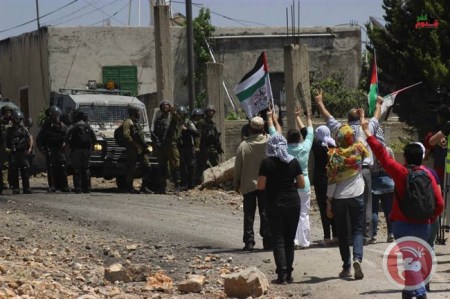
QALQILIYA – Five Palestinians were injured, two critically, when Israelis forces opened live fire on the Kafr Qaddum weekly march Friday.
A coordinator for the village’s popular resistance committee, Murad Shtewi, said that Muhammad Majid, 20, had been shot in the stomach and chest with live rounds and is in critical condition.
Ibrahim Mousa, 35, is also in critical condition after he was shot in the abdomen while in his house.
Shtewi also said that Muhammad Nidal, 20, and Mouiz Khader had been shot in the leg, and Ayman Farouq, 38, in the hand.
Dozens others suffered from excessive tear gas inhalation.
Israeli forces had closed down the village’s entrance since the early morning after they declared it a closed military zone. As a result, those injured had to be evacuated from the village in private cars using dirt roads.
An Israeli army spokeswoman contacted by Ma’an said she would look into it.
Israeli forces routinely suppress weekly marches by violent means.
In Kafr Qaddum, they also regularly declare the village a closed military zone in order to prevent the weekly march from taking place.
The march is carried out to protest the Israeli separation wall and Israeli settlement activity, both illegal under international law.
The internationally recognized Palestinian territories of which the West Bank and East Jerusalem form a part have been occupied by the Israeli military since 1967.
Time is running out for Abu Nowwar
MEMO | June 11, 2015
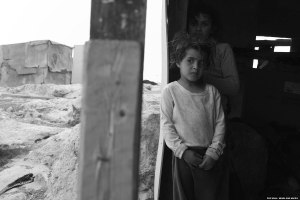
Construction of the new planned townships that will house Palestinians displaced by Israel’s E1 plan is already well underway although the demolition of the current villages has not yet been implemented. The E1 plan will displace thousands of Palestinian Bedouin from the Jerusalem periphery area.
Within this colonial project – that has received significant criticism from across the ‘international community’ – the story of the village of Abu Nowwar is in many ways seen as a test case.
The residents of Abu Nowwar are themselves already refugees, as are the majority of all Bedouin in the West Bank, having been originally displaced in the early 1950’s from their ancestral lands in the Naqab. The more than 100 family homes in the village are all slated for demolition.
In early May, residents were told by the Israeli authorities that they must sign documents by May 31st stating that they agreed to being transferred to one of the planned new townships – a site known as al-Jabal – alongside a large Jerusalem Municipality landfill site. The community was told that anybody who refused to sign would have their houses immediately demolished. Yet the community resisted.
For now a legal challenge in the Israeli Supreme Court has delayed the promised demolitions, but time is short. Many people believe that the case of Abu Nowwar, if won by the State in the Supreme Court, will set a legal precedent that will allow E1 to be quickly implemented. None of the planned demolitions of entire communities in this latest phase of E1 have yet been implemented but this legal precedent, if granted, could set a swift and dangerous ball rolling.
Despite the widespread criticism that the E1 project has received internationally, no action has yet been taken to prevent this major advance within Israel’s settler-colonial project. E1 will link Ma’ale Adumim and other Israeli West Bank settlements in a contiguous ring to and around Jerusalem.
‘Forcible transfer’, which is an inherent aspect of the E1 plan, is a breach of the Geneva Conventions, and is recognised by both the Nuremberg Charter and the International Criminal Court as a ‘war crime’.
Image by MEMO Photographer Rich Wiles.
5 Palestinian children have been arrested by Israel every day for the past 48 years
MEMO | June 10, 2015
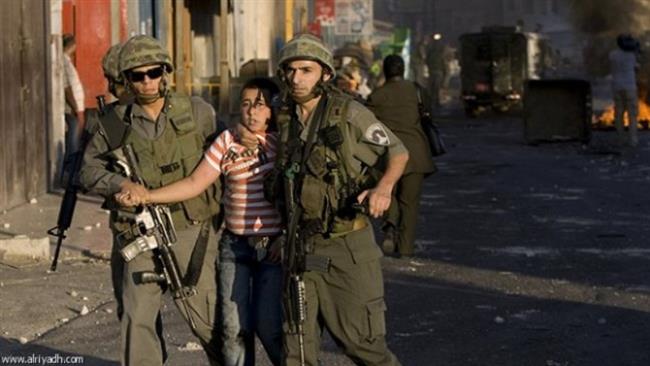
Data provided by the Israeli military and the UN has revealed that since martial law was imposed on the occupied West Bank in 1967, around 95,000 Palestinian children have been arrested by Israel, an average of more than 5 children per day. Almost 60,000 are believed to have been subjected to some form of physical abuse whilst in detention.
The details were revealed this week in a report submitted by rights group Military Court Watch (MCW) to the UN Special Rapporteur on Torture and other Cruel, Inhuman or Degrading Treatment or Punishment. Over 300 pages of evidence relating to the treatment of Palestinian children held in Israeli military detention were included in the report.
MCW pointed out that the evidence included details of 200 minors detained by the Israeli military in the West Bank between January 2013 and May 2015. The submission confirmed an earlier finding by UNICEF that “the ill-treatment of children, who come in contact with the military detention system, appears to be widespread, systematic and institutionalised.”
According to the rights group, this finding is based on recent evidence that shows that intimidation, threats, verbal abuse, physical violence and the denial of basic legal rights are still commonplace within the system. “Based on the evidence, the submission also drew a link between this industrial scale abuse and the maintenance of Israeli settlements in the West Bank,” added MCW. “It concluded that in order to enable 370,000 Israeli settlers to live in the West Bank in violation of international law without serious interference, the military is required to adopt a strategy of mass intimidation and collective punishment.”
A court of non-convictions for Israeli felons
By Yossi Gurvitz | Yesh Din | June 8, 2015
Does everyone get his or her day in court? Not if they are Palestinian.
Every year Yesh Din publishes data about police investigative failures regarding offenses carried out by Israelis towards Palestinians in the West Bank. They are usually quite similar: the police fail to investigate approximately 85 percent of complaints of Palestinians who report being harmed by Israelis. The rate becomes much higher when it comes to the destruction of Palestinian trees by Israeli civilians: then the police failure rate grows to 97.4 percent.
The average Israeli may not be surprised that the police failure rates are so high, but he or she still has some expectations of the courts. After all, we are told time and again that Israel is governed by the rule of law.
Okay, says the average citizen to himself, yes, we seem to have a problem when it comes to investigations, and naturally if the investigation is a mess we are not likely to get to court. But once we step into the halls of justice, everything should be fine.
Or not.
Our latest data sheet, which was released in tandem with an exhaustive report on the failure of law enforcement in the West Bank, examines for the first time what happens to the cases we follow once they leave the limbo of the prosecution and make it to court. The situation, to put it mildly, is not “okay.”
To begin with, the chance that a complaint by a Palestinian victim will bloom into a an indictment against an Israeli felon stands at a mere 7.4 percent. This means that the chances an Israeli felon will appear in court for a crime he is suspected of committing is about 1:14. Most often, cases are closed due to police investigative failures; in a majority of the cases, the specific reason is the inability of the police to find a suspect – what is known as the the unknown perpetrator clause.
The fact that a case makes it to court does not, of course, mean it will end in a conviction. The defendants have the right to representation and have access to attorneys — as a human rights organization we entirely support this. The problem lies elsewhere.
In 10.5 percent of the cases, the defendants are convicted of all charges; in 22.8 percent of the cases, only some of the defendants are convicted, or they are convicted of some of the charges – sometimes reduced charges as part of a plea bargain. The rate of acquittals is high relative to other cases in Israeli courts (8.8 percent). But what is truly high is the rate of “non-conviction” (24.6 percent) and the rate of indictment withdrawal (22.8 percent).
What is a non-conviction? It is a relatively rare practice, in which the court believes there is reason to avoid tarring him/her with a criminal conviction for one reason or another — despite the fact that the felon has been found guilt of the charges. This almost never happens in the Israeli courts: the percentage of defendants in the magistrates courts found guilty without conviction is 5.3 percent; in district courts the number stands at only 1.2% percent. This is true unless the victim is a Palestinian; then the rare of non-conviction jumps to 24.6 percent. That’s four times that of magistrates courts, and almost 20 times that of the district courts. What a coincidence.
In many of the cases in which indictments against Israelis charged with harming Palestinians were withdrawn, the reason was, once again, investigative failure. The prosecution re-examined the evidence, apparently after the response of the defendants’ attorneys, and reached the conclusion that it did not have enough evidence for a conviction. And that, we note, is a perfectly legitimate decision.
But in many of the indictment withdrawal cases, one of the reasons given was that the defendants did not even bother to show up for the hearings. In most of the cases the government took the required steps – a fine, issuing warrants for arrest and subpoenas – but the indictments were frozen until the defendant was found. In one of the cases, the prolonged freezing caused the police prosecution to say that the evidence has been degraded, to the point of cancelling the indictment.
At the end of the day, the chance that a Palestinian who lodged a complaint about being harmed by an Israeli civilian will see a conviction is only 1.9 percent. Again, most of the blame for this lies with the police – but the courts have their share, as seen by the unusual rate of non-conviction.
Rule of law? Rule of the violent.
Israel sees red over Orange plans to axe ties
AFP – June 4, 2015
JERUSALEM – French telecoms giant Orange said Thursday it wanted to withdraw its brand from Israel just hours after its chief executive came under fire from Israeli officials for giving in to a pro-Palestinian campaign.
Orange, which is partly controlled by the French government, insisted its decision to end its brand-licensing agreement with Partner, Israel’s second largest mobile operator, was not politically motivated.
But Israel lashed out at the decision, which appeared to be related to Partner’s operations in the occupied West Bank.
Citing its own “brand development strategy”, Orange said it did not wish to maintain a brand presence in countries “in which is it not an operator”, while distancing itself from the politics.
“In this context, and while strictly adhering to existing agreements, the Group ultimately wishes to end this brand licence agreement,” it said.
“The Orange Group… does not engage in any kind of political debate under any circumstance,” it said.
The storm erupted on Wednesday when Orange chief executive Stephane Richard told reporters in Cairo that the company was planning to withdraw from Israel.
His remarks touched a raw nerve in Israel which is growing increasingly concerned about global boycott efforts and the impact on its image abroad.
It drew a furious response from Israeli officials as well as from Partner, which is not a subsidiary but operates under the Orange brand name.
“The black side of Orange” said the top-selling Yediot Aharonot, while Israel HaYom, a staunch backer of rightwing Prime Minister Benjamin Netanyahu, ran a headline reading: “Orange is no longer a partner.”
Deputy foreign minister Tzipi Hotovely wrote to the Orange boss urging him “to clarify the matter” and warning him not to become party to “the industry of lies which unfairly targets Israel”.
And Isaac Benbenisti, who becomes chairman of Partner on July 1, said he was “very, very angry”, accusing Richard of caving in to “very significant pressure” from pro-Palestinian activists and joining a global campaign to isolate Israel.
End of the affair
Richard’s remarks dominated the headlines in all of Israel’s main media outlets on Thursday where he was immediately cast as a supporter of the boycott movement.
Although the Orange boss did not directly refer to the question of settlements, his remarks in Cairo came after the publication on May 6 of a report accusing the telecoms giant of indirectly supporting settlement activity through its relationship with Partner.
Compiled by five mainly French NGOs and two trade unions, the report accuses Partner of building on confiscated Palestinian land, and urges Orange to cut business ties and publicly declare its desire to avoid contributing to the economic viability of the settlements.
The international community regards all Israeli construction on Palestinian land seized during the 1967 Six-Day War as illegal.
Challenged in Cairo, Richard said: “Our intention is to withdraw from Israel. It will take time” but “for sure we will do it”.
“I am ready to do this tomorrow morning … but without exposing Orange to huge risks.”
Orange says it holds no shares or voting rights in Partner Communications, nor does it have any influence over the firm’s strategy, and that it does not have any other business activity in Israel.
Orange and Partner are linked by a licensing agreement which allows the Israeli firm to use its brand and logo in exchange for a fee. The contract was signed in 1998, two years before the telecoms giant was acquired by France Telecom.
The contract, initially open-ended, was recently amended by Orange and now expires in 2025.
Orange is present in 20 countries and the brand licensing agreement with Partner is the only one with a firm that is not a subsidiary.
Victory for BDS movement
The crisis comes after days of introspection in Israel over its place in the world, with the government railing against what it has denounced as a campaign of delegitimization.
Israel has been struggling to tackle a growing Palestinian-led boycott campaign which has had a number of high-profile successes.
Known as the BDS movement — boycott, divestment and sanctions — it aims to exert political and economic pressure over Israel’s occupation of the Palestinian territories in a bid to repeat the success of the campaign which ended apartheid in South Africa.
This week, Britain’s National Union of Students voted to affiliate itself with the BDS movement, in a move which drew a sharp rebuke from Netanyahu.
Last week, Israel narrowly avoided expulsion from FIFA after the Palestinians withdrew a resolution calling on it to ban its Israeli counterpart over restrictions on Palestinian footballers and the presence of five teams inside Jewish settlements.
The boycott movement was even debated in parliament on Wednesday.
“It’s not politically correct to be anti-Semitic today but it’s super ‘in’ to be anti-Israel,” Justice Minister Ayelet Shaked told MPs.
~
Ma’an staff contributed to this report.
Nablus activists to deploy on hilltops to prevent settlement expansion
Ma’an – June 3, 2015
NABLUS – Palestinian activists in the Nablus area of the northern West Bank are preparing to launch what they describe as the largest campaign against settlement expansion in the area.
Palestinian official Ghassan Daghlas, who monitors settlement related activities in the northern West Bank, told Ma’an Wednesday that the activists plan to install movable houses on hilltops in 35 villages and towns across Nablus district under threat of confiscation by Israeli authorities.
The move comes amid an ongoing takeover of private Palestinian land in the hills surrounding Nablus, where several Jewish-only settlements have been established throughout the area over the years.
After small groups of Israeli settlers claim the land and gradually grow outwards with the protection of the Israeli military, private Palestinian land is confiscated through legal processes, according to Israeli human rights group B’Tselem.
There are currently 12 illegal settlements and 27 settlement outposts in the Nablus area housing around 23,000 of the “most extremist settlers in the Palestinian Territory,” according to Daghlas.
The settlements and outposts surrounding Nablus have gained such reputation largely due to high rates of violent acts by settlement residents against local Palestinians, including uprooting and burning olive trees, vandalism against private property, in addition to violent physical attacks.
Last week, residents from the illegal Yitzhar settlement expanded onto local Palestinian land near the village of Huwwara.
Israeli security forces estimated that the majority of incidents during a 2014 wave of anti-Palestinian hate crimes were carried out by Yitzhar residents, Israeli media reported at the time.
The hilltop campaign, added Daghlas, is a preemptive move to protect Palestinian land from the ongoing settlement expansion especially as the newly-formed rightist Israeli government begins to fulfill promises made to the settler bloc in the run up to the March elections.
The activity was organized by the Nablus district Committee Against Settlements in cooperation with the Fatah movement’s recruitment commission headed by Mahmoud al-Aloul.
NY Times Applauds While Israel Robs Palestine of Water
By Barbara Erickson | TimesWarp | May 30, 2015
The New York Times invites us to gaze with wonder on the miracles of Israeli technology today, with a page 1 photo and story touting the innovations that have saved the country from drought. Because of wise policies and applied science, we learn, “there is plenty of water in Israel.”
The Times never tells us, however, that a significant number of those who reside on the land are seriously deprived of water: Palestinians in some areas of the West Bank are forced to survive on only 20 liters of water a day per person, well below the World Health Organization minimum of 60 liters. In Gaza 90 percent of the water is unfit to drink.
Meanwhile, Israelis in West Bank settlements “generally have access to as much running water as they please,” according to the Israeli human rights group B’Tselem, and Israelis over all use three times as much water as Palestinians. Settlers also confiscate West Bank springs, and Israeli security forces destroy water equipment in Palestinian villages and prevent their residents from building cisterns and wells.
In the Times story, “Aided by the Sea, Israel Overcomes an Old Foe: Drought,” Isabel Kershner writes that Israel is thriving because it has adopted recycling and desalination. She quotes at length from Israeli officials but includes not a single Palestinian voice.
Kershner manages to dismiss Palestinian concerns in two sentences: “Israel, which shares the mountain aquifer with the West Bank, says it provides the Palestinians with more water than it is obliged to under the existing peace accords. Palestinians say it is not enough and too expensive.” She feels no need to address the humanitarian crisis Israeli has created in confiscating Palestinian water for its own use.
In fact, Israel steals the water from under the feet of Palestinians, draining West Bank aquifers, allocating 73 percent of this water to Israel and another 10 percent to settlers. Palestinians are left with 17 percent, and many are forced to buy from the Israeli water company at rates up to three times as high as the tariffs charged Israelis.
Kershner omits any mention of the obvious inequalities between Israeli West Bank settlements and the Palestinian villages nearby. Settlements often have swimming pools and green, watered turf, while villages remain dusty and dry, without enough water for agriculture or even for home gardens.
The Times has also turned its back on news that underscores the outright theft of water in Palestine. It had nothing to report, for instance, when settlers recently surrounded a Palestinian spring with mines and barbed wire. The paper also remained silent when security forces destroyed pipes providing water to an impoverished Jordan Valley herding community earlier this year.
Many organizations, however, have spoken out. The United Nations, the World Bank, Amnesty International, B’Tselem, church groups, If Americans Knew, and others. They have issued reports and press releases noting that Israel violates international law in confiscating Palestinian water resources and highlighting the striking disparities between West Bank villages and Jewish settlements.
Kershner found none of this worth mentioning in her story today. Instead, we find a promotional piece that should benefit Israeli water specialists now peddling their products in California and other drought-stricken areas of the United States.
Editors and reporters are complicit in this effort to tout Israel as an enlightened and technologically advanced country, even in the face of its flagrant theft of Palestinian water. The New York Times has found an Israeli puff piece on water technology to be worth a front page spread, but it deems the criminal confiscation of this basic resource unfit to print.
Private Palestinian land in Jerusalem slated for confiscation
Ma’an – May 28, 2015
JERUSALEM – Israeli authorities on Wednesday morning left posters in the occupied East Jerusalem town of al-Isawiya notifying owners that the property is needed for urgent military purposes for two and a half years.
The confiscation order comes amid increasing incidents of demolition of Palestinian homes throughout occupied East Jerusalem and transfer of property from Palestinian to Jewish Israeli ownership in the area.
A local committee member told Ma’an that Wednesday’s orders were posted by officers of Israel’s Civil Administration who classify the confiscation as “seizure for military purpose.”
The land, measuring 8,200 square meters, is located in the eastern side of the neighborhood Al-Isawiya near an Israeli military base established 10 years ago, Hummus told Ma’an.
The order has been signed by head of the Israeli forces Central Command Nitzan Alon and the land will be used for military purposes until Dec. 31, 2017, according to the order.
High-profile Israeli military officers are expected to arrive Thursday morning to delineate the land slated for confiscation.
Hummus explained that seizure orders such as the one issued Wednesday “temporarily” reclassify private land for military purposes orders, however orders are automatically renewed and such properties are eventually confiscated from their owners.
The land slated for confiscation Wednesday houses a farm owned by heirs of Radi Ahmad Issa Abu Riyala. Riyala passed away four years ago and has been buried in the farm.
In the last two weeks, several buildings have been demolished in the nearby Silwan neighborhood including a large three-story building newly built for Palestinian residents.
Municipal inspectors ordered the building’s demolition because the construction had been carried out without a permit from the municipal council.
In effort to gain and maintain a Jewish majority in the city, government policies make it near impossible for Palestinian residents to obtain building permits, while Jewish residents frequently take over Palestinian buildings with the protection of Israeli security, according to the Israeli rights organization the Association for Civil Rights in Israel.
The majority of Israeli PM Benjamin Netanyahu’s newly built right-wing coalition has vowed to expand settlements in occupied East Jerusalem and West Bank, with many opposing a future independent Palestinian state.
Wednesday’s seizure order move comes shortly after the newly assembled government allocated $25 million for settlement expansion in Jerusalem last week.
Netanyahu allocates $26m for settlement activities in Al-Buraq Wall
MEMO | May 27, 2015
Israel’s Prime Minister Benjamin Netanyahu yesterday passed a decision in favour of allocating 100 million shekels ($25.8 million) towards investment in settlement activities in the vicinity of Al-Buraq Wall (also known as the Western Wall).
During his weekly meeting with his cabinet Netanyahu said that during the last five years there has been a large increase in the numbers of visitors to Al-Buraq Wall, claiming that “the Western Wall belongs to all the people of Israel” and that the decision taken today “reflects our commitment together; my commitment as a son of Jerusalem, and the commitment of ministers to continue with the construction activities in Jerusalem.”
Only yesterday, Netanyahu appointed Zeev Elkin, a Likud member of the Knesset who is known to be close to the prime minister, as minister for Jerusalem affairs.
Netanyahu repeated the statement he made last week about the intention of his new government to continue the construction work in the settlements in East Jerusalem, despite international demands to halt settlement activity, declaring “a united Jerusalem as the undivided capital of the State of Israel.”
Israeli Jewish settlers storm Al-Aqsa Mosque from the Maghribi door at Al-Buraq Wall almost daily. Extremist Jewish NGOs, rabbis and sometimes state officials have repeatedly called on settlers to storm the mosque and urged security officials to protect them.
Israel To Confiscate 820 Dunams For New Settlements’ Dumping Ground
By Saed Bannoura | IMEMC News | May 24, 2015
 The Israeli Authorities have decided to confiscate around 820 Dunams (202 acres) of privately owned Palestinian lands to establish new dumping grounds for its illegal colonies, in the central West Bank, in the Ramallah district.
The dump, according to the Israeli authorities, “would serve the settlements and the Palestinians in the area,” but would be run completely by Israel and Palestinians would have no access to it.
If the Israeli government manages to take control of the 820 Palestinian Dunams, the total impacted area from the new dumping grounds would be around 2,000 Dunams, which would be contaminated by runoff and debris.
These lands contain fertile soil and farmland, in addition to many water wells, Palestine TV has reported.
The residents plant their lands with various crops, mainly wheat, and use parts of this land as grazing grounds for their livestock. Some of the land is slated for development as residential areas, but this would be impossible once Israel takes control of the land and turns it into a dump.
Local villagers told Palestine TV that Israel is trying to push them out of the area to turn their land into a dump – many of these villagers have already lost land in past seizures by the Israeli military for the construction of illegal colonies.
Israeli light rail guards assault young Palestinian woman

Natalie Abed Rabbo
Ma’an – May 9, 2015
JERUSALEM – A young Palestinian woman from occupied East Jerusalem has accused security guards at an Israeli light rail station, along with Israeli police officers, of physically and verbally assaulting her on Thursday.
Natalie Abed Rabbo, 18, told Ma’an that she had bought a light rail ticket and was boarding the tram, when “all of a sudden, a security guard approached me and accused me of boarding the tram without a ticket.”
She said that she showed her ticket to the the guard, but that he ignored it. She added: “I asked him to check the surveillance cameras to make sure that I had bought a ticket, but he refused.”
Abed Rabbo said that she then asked to speak to an officer to submit a complaint, but before she was able to do so, “eight security guards attacked me and pushed me into a corner, grabbing me by the neck.”
She said that a female Israeli police officer tried to take away her handbag, but that she held onto it.
Abed Rabbo said she was able to use her mobile phone to call her family, and that her mother and brother soon arrived on the scene.
However, she said: “Special force officers then arrived and they beat my mother and brother, and they cuffed my hands and my feet.”
The young woman said she was taken to the Russian Compound police station where she said she was again physically assaulted.
The interrogator “accused me of boarding the tram without a ticket, as well as assaulting security officers and police personnel,” she said.
Abbed Rabbo was released several hours later having paid a bail of 3,000 shekels. She said she was also forced to pay a fine of 200 shekels for breaching tram regulations.
On Monday, a Palestinian man was shot in the foot by a security guard at a light rail station near the illegal Israeli French Hill settlement in East Jerusalem.
The security guard alleged that Hatem Salah had been attempting to stab passengers, although police later withdrew the allegations after it became clear that Salah had not been in possession of any sharp objects at the time.
Early investigations showed that Salah had been physically assaulted by two Israeli light rail guards on Sunday, the day before he was shot.
The light rail service began operating in 2011 along a 14-kilometer (nine-mile) route which begins at Mount Herzl and passes through West Jerusalem before heading through the Palestinian east of the city and ending at the illegal settlement of Pisgat Zeev.
Land belonging to Palestinians in Shuafat was confiscated in 2001 by the Jerusalem Municipality for the construction of the light rail, which will eventually link more illegal settlements in occupied East Jerusalem to West Jerusalem upon its expected completion in 2016.
Israeli State threatening immediate demolition of entire Palestinian village
Operation Dove | May 5, 2015
At-Tuwani, Occupied Palestine – The entire Palestinian village of Susya is in danger of demolition and expulsion. By refusing to issue an interim order preventing preemptive demolitions before their case is heard, the Israeli High Court is allowing for the demolition of the entire Palestinian village of Susya and subsequent expulsion of its 340 residents. The refusal of the State to commit to not demolishing before the conclusion of proceedings suggests it has plans to destroy the village in the near future.
On one hand, the High Court of Justice is willing to hear the village’s petition to legitimize its status, but on the other hand, the court allows the village to be destroyed before even deciding on the case.
On May 5 2015, High Court Judge Noam Solberg rejected the request for an interim order by the Palestinian village of Susya, represented by Rabbis for Human Rights, in a petition against the Civil Administration’s decision to reject the master plan prepared by the village and subsequent demolition of the entire village.
The village argued that their plan was rejected for non-professional reasons and that the village should be legalized due to its unique history. The residents sought an interim order to freeze the implementation of the demolitions until the petition is heard, as is standard practice in these sort of cases.It was against this request for an interim order that Justice Solberg, without even conducting a hearing on the request, made the unusual move of granting the state’s request not to freeze the orders. This decision means that the Civil Administration can now destroy Susya at any time. The demolition of the village will lead to hundreds of residents living in the desert with no roof over their heads and may result in their displacement. The state’s refusal to commit to waiting for a conclusion to the court proceedings raises great alarm that it intends to implement the demolition order in the near future; tragically, it seems the villagers are in real danger.
In the petition, Susya’s residents claimed that the army is obliged to legalize their village as it was the one to confiscate their land and their caves in 1986, leaving them without a housing solution and forcing them to move to their adjacent agricultural lands. As evidence to the life in the village prior to the expropriation, various testimonials and photographs of life in caves were presented to the judge. Among other things, there were documented photos of a visit by the US Consulate to the village at the beginning of 1986. The photos and testimony clearly shows that the Palestinian village of Susya is an old village formed prior to the Israeli occupation and the declaration of the area as an archaeological site.
Among the evidence was the opinion of the late governmental legal adviser Plia Albeck (considered to be very pro-settlement and who wrote in her memoirs that she tried to find legal ways to declare Palestinian land as State land), indicating the existence of a Palestinian village in 1982 where today the archaeological site stands.
Despite the evidence presented before him, revealing the many injustices done to the villagers – from the expropriation and dispossession of their lands, to the refusal by the state to recognize the status of the village in its new location – Judge Sohlberg did not agree to hear the case before allowing the demolition of the village and setting the fate of its inhabitants.
Attached to the petition, inter alia, was an expert opinion by Prof. Eyal Benvenisti, a renowned expert in international law, stipulating that the demolition of the village of Susya constitutes a war crime.
This week, a report by radical right-wing NGO “Regavim” (which has close ties to the settlement enterprise) was exposed indicating that in the nearby Jewish settlement, also called Susia, there are 23 illegal homes built on private Palestinian land. We have no indication of any attempt by the state to demolish these illegal structures in the settlement Sussia or in its nearby outposts. We see in this current situation that this Jewish settlement, whose very existence is prohibited by international law, and where some of its homes are sitting on private Palestinian land, is prosperous, while the Palestinian village of Susya, whose inhabitants are on their own private land, is at risk of displacement and loss of their entire village.
Background:
In 1986 the village of Susya was declared an archaeological site, its land expropriated, and its inhabitants, who lived in caves, were deported. While the Palestinians were told that they could not reside in an archeological site, Israeli settlers live in an illegal outpost located inside the archeological site.
After the expulsion, villagers were forced to move to their neighboring agricultural plots. Because there was no willingness to grant a zoning plan, they involuntarily became illegal builders. Dozens of villagers followed procedures in attempts to obtain building permits, but those attempts were rejected. In 2012 the villagers raised funds and submitted a proposed master plan, drawn up by Professor Rassem Khamaiseh, for the Civil Administration for review. The plan would authorize construction in the village according to accepted standards of professional planning.
The plan was rejected in 2013 on very questionable grounds, indicating a double standard in planning, and blatant discrimination against the Palestinian population. For example, it was argued that the number of residents in the village, which is a few hundred people, is not substantial enough to grant it independent planning as its own entity. On the other hand, dozens of unauthorized outposts which are built housing only a handful of residents are approved by the Civil Administration’s planning body. In addition, it was argued that the plan will prevent the population from properly developing and moving out of poverty, and therefore, they should be moved to an adjacent city. It should be noted that the city is, of course, in Area A, and what actually prevents the progress of Susya is the lack of infrastructure which they are prevented from building. Also important to note is that Israelis are permitted to choose their preferred way of life – be it urban or rural, and are not forced by the state into one or the other.
In 2014, Rabbis for Human Rights petitioned the High Court on behalf of the Susya village council and its residents against the decision to reject the village master plan (HCJ 1420/14). As mentioned, on May 5th the court rejected the request for an interim injunction, leaving the whole village vulnerable to imminent demolition.
The big picture:
The danger of demolishing and expropriating the village of Susya reflects the systemic problem of planning for Palestinian villages located in Area C; in these villages, planning is done by military planning committees, without representation of Palestinians, with the intent of preventing residents from building on their own land based on reasonable and professional planning standards. A recent High Court petition, submitted by the village council Dirat, Rabbis for Human Rights, Jerusalem Legal Aid and Human Rights Society, the Israeli Committee Against House Demolitions, and St. Yves – Catholic Human Rights Center, demands planning authority be returned to Palestinian villages for their own communities in order to prevent the tragic demolitions of hundreds of homes every year due to the impossibility of obtaining building permits.
Featured Video

Stanislav Krapivnik: Russia-Iran Cooperation & Escalation in Ukraine
or go to
Aletho News Archives – Video-Images
Frlom the Archives
Are the Jews indigenous to Palestine?
By David Miller | Al Mayadeen | August 3, 2022
There is a rising tide of claims from apologists for the crimes of Zionism that they have been misunderstood. Palestinians might be indigenous to Palestine, but the Jews definitely are. What is called the ‘Israel-Palestine’ conflict, they say, is competition over the same small piece of land by two rival groups of indigenous people. But are the Jews indigenous to the Levant? And what are the consequences of the argument?
In fact, most of the power structure of the Zionist state is dominated by Ashkenazi Jews who have no ancestral link to Palestine. Overall despite very significant financial and infrastructural contributions from Western European countries (especially the US, UK and France, for example via the Rothschild family), Eastern European Ashkenazim have been at the centre of the Zionist power structure since the early years of the 20th Century. … continue
Blog Roll
 Aletho News
- Iran warns of consequences after US strike on water plant
- US Bases in Middle East Fail to Secure Nations & Become Safety Risk – Expert
- Iranian Crisis Becomes Embarrassment for US Military That Can’t Protect Anyone – MidEast Analyst
- IAEA Never Had Reasons to Forgo Talks With Iran — Russian MFA Spox
- Iran pledges to ‘respect sovereignty of neighbors’, declares US-Israel assets ‘primary targets’
- USA and Israel: Who is the lord and who is the colony?
- Indian journalist reveals severe Israeli censorship after escape from occupied territories
- Majority of Israelis Back War with Iran as Anti-War Minority Faces Stigmatization
- Are the Jews indigenous to Palestine?
- Stanislav Krapivnik: Russia-Iran Cooperation & Escalation in Ukraine
- If Americans Knew
- US, Israel ravage Iran and Lebanon; 4 killed in Gaza – Not a ceasefire Day 148
- US troops were told war on Iran was ‘all part of God’s divine plan’, watchdog alleges
- Trump wants to run the show in Iran, but doesn’t know what he’s doing – Not a ceasefire Day 147
- ‘Dirty Work’ :The truth about how Israel was founded
- Mass Expulsion in Lebanon as Israel Expands War: “We Don’t Know Where to Go”
- Lies, distortions, and propaganda: how the U.S. mainstream media coverage on Iran hides the truth
- Palestinians in Gaza fear famine returning as Israel cuts off food amid Iran war
- AIPAC, other pro-Israel groups enter midterms with $100 million to spend
- Iranian girls killed by ‘double-tap’ strikes on Minab school
- Bari Weiss Is Going Full ‘Propaganda-Palooza’ With the Iran War
- No Tricks Zone
- Televised! Leading German Political Candidate Tells Schoolchildren CO2 Makes Sun Hotter!
- New Study: A Century Warming Of 1.1°C Is ‘Commonplace’ And ‘Not Unusual’ During This Interglacial
- New Study: ‘Internal Noise’ And Volcanic Forcing Can Trigger 10-15°C Warming Within Decades
- Glaciers Worldwide Are Suddendly Surging, Experts Blame Warming!
- Surprising Discovery: Sahara Is Greening…Billions Of Trees Where Once Thought To Be Barren
- New Research Reaffirms Clouds, Aerosols, And Surface Solar Radiation Are ‘Driving The Climate System’
- Germany: Electric Car Catches Fire At Charging Station, Sets Off Local “Inferno”, Widespread Damage
- New Study: Canada’s New Brunswick Was 1°C Warmer Than Today During The Medieval Warm Period
- Coal Power Back In Trend As Globe Tries To Keep Pace With Growing Demand For Power
- New Study: A 4°C Warmer Beaufort Sea Had ‘No Sea Ice’ 11,700 – 8200 Years Ago
 Aletho News