Fighting for the history of Tel Rumeida

International Women’s Peace Service | May 17, 2014
Hebron, Occupied Palestine – The Israeli occupation uses many methods to take over land – from settlements and military camps to the nature reserve and political treaties. However, the Abu Haikal family of Tel Rumeida in Al-Khalil (Hebron), faces a much more unexpected enemy: archaeologists. Currently, the family home is completely surrounded by an Israeli archaeological excavation – there is only one gate into the property, which can be shut at any time, leaving the family isolated from the surrounding city.
At first glance, the presence of an archaeological site seems quite positive, or at the very least harmless, however a quick look at the politics surrounding the Tel Rumeida excavation shows that this is far more sinister than a simple historical inquisition.
Under the Oslo Accords, the Israeli Antiquities Authority (IAA) must coordinate all of their work in the West Bank with the Palestinian Ministry of Tourism and Antiquities. In Tel Rumeida, Palestinian officials have been denied entry.
IAA archaeologists – many of whom live in the surrounding illegal settlements – began digging in Tel Rumeida on January 5th, 2014. They claimed they were looking for the graves of Jesse and Ruth, figures from the Hebrew Bible. The IAA has also stated their intent to turn the area into a ‘Biblical Archaeological Park’, depending on what the dig turns up.
While no uniquely Jewish artifacts have been found, Palestinian officials confirmed that the settler-archaeologists have destroyed several Muslim graves that were found on the site. Residents of Tel Rumeida have reported that IAA employees are also in the process of bulldozing an ancient Canaanite retaining wall. For them, the deliberate annihilation of non-Jewish history in Hebron is anything but innocuous.
The Israeli Antiquities Authority has been a tool for settlement expansion and land grabs in the West Bank for a long time, including the East Jerusalem neighbourhood of Silwan, the town of Khirbet Susiya, and other settlements within Hebron. The strategy is simple: Archaeologists enter an area and search for signs of uniquely Jewish history. When a site or artifact is discovered – or possibly fabricated – the area is declared to be an integral part of the ‘Jewish State’. To ‘protect’ the land, a settlement is built on top of the site, driving away the Palestinian owners. – Video interview
Israeli army demolishes three houses and a mosque near Nablus
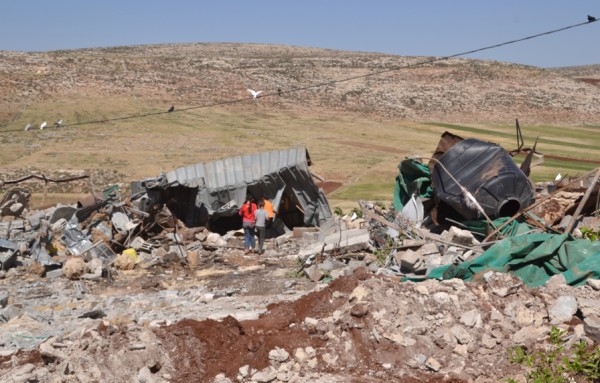
Photo by International Solidarity Movement
MEMO | April 29, 2014
Israeli army forces demolished three houses and a mosque in Khirbet Al-Taweel village near Nablus, North of West Bank, a Palestinian official reported today.
The official responsible for monitoring settlement activity in the northern West Bank, Ghassan Douglas told reporters that “a large force of Israeli army vehicles stormed Khirbet Al-Taweel village and declared the area a closed military zone amid tight security measures.
“The forces prevented residents from entering or leaving the village and students from going to their school then demolished a mosque and three houses belonging to Osama Anas, Anwar Sudqi Hani and Mohammed Sudqi Hani and three agricultural barracks.”
The buildings were destroyed because it was claimed they were built without the correct permits, he said.
According to Douglas, this is not the first time Israeli forces have demolished buildings in the village under the pretext they were built in area C, which lies under Israel’s security and administrative control according to the Oslo accords.
Douglas pointed out that Israeli army forces target the village to displace its residents and annex its land to attach it to nearby settlements or use them for army training.
He said Israeli army had recently handed its residents 18 demolition orders including one to demolish the village electricity grid.
The village’s land is vital for agriculture and constitutes natural pastures for over 30,000 cattle in nearby towns.
Israeli forces raid Kifl Haris overnight for religious visit
Ma’an – 26/04/2014
SALFIT – Israeli forces stormed the village of Kifl Haris on Friday in order to escort a large group of Jewish Israelis to the village as they visited three religious sites in the northern West Bank village.
Israeli forces erected checkpoints throughout the village and blocked major intersections throughout the raid, which began around midnight and lasted until sunrise.
During this time, locals were prevented from moving freely through the streets, and they said that the members of the visiting Jewish group “provoked” locals who did venture out.
The soldiers escorted hundreds of religious Jews, who locals said yelled in the streets of the village and chanted anti-Arab slogans during their visit.
An Israeli army spokesman confirmed the visit, saying that the military has “coordinated the entrance of several hundred Israeli civilians” to Joshua’s tomb.
A number of tombs exist in Kifl Haris that are believed to be the graves of local holy people but which some Jews believe to be the tombs of biblical figures Joshua, Caleb, and Nun.
Palestinians who live in the area, however, consider these shrines to be the graves of the prophet Dhul-Kifl, the Sufi saint Dhul-Nun, and another shrine built by Saladin.
Visits by Israeli Jews to sites in areas under Palestinian control across the West Bank often cause tensions with locals, as these visits are accompanied by large armed escorts.
Palestinians are restricted from visiting holy sites in Israel, meanwhile, without hard-to-obtain permits from government authorities.
Is Israel planning to ethnically cleanse the Negev desert?
presstvlondon
An attempt to ethnically cleanse the Negev desert hasn’t really hit the international headlines — but that’s what Palestinians say is happening.
The so-called Prawer Plan — which envisaged the re-location of up to 70,000 Palestinian bedouins from the Negev — was supposed to have been shelved following protests last year.
But despite that a Palestinian village in the Negev was recently bulldozed — seemingly in direct contravention to the law.
On this week’s show we’ll discuss what Israel’s plans in the Negev really are. Do they really intend to effectively colonize the area? How will this affect the lives of Palestinians already living there? And can anything be done to stop this from happening?
Palestinian girl badly injured by Israeli settler attack
Operation Dove | April 24, 2014
At-Tuwani, Occupied Palestine – On Thursday April 24 at around 12 pm, two Israeli settlers coming with a quad-bike from the illegal outpost of Havat Ma’on attacked with stones four Palestinian children and the mother of three of them, as they were returning from school to their homes in the villages of Tuba and Maghayir Al Abeed. A seven year old girl child was hit by a stone and fell while attempting to run away, badly injuring her head.
Her father, who witnessed the attack as he was harvesting his land situated on top of the Old Havat Ma’on hill, immediately brought her to the nearby village of At Tuwani, where an ambulance came to rescue her and bring her to the hospital.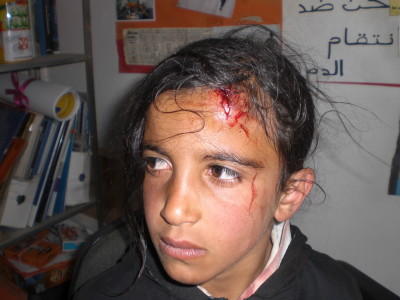 The girl required five stitches and is now resting at home with her family.
The five Palestinians were coming from the village of At Tuwani, where the children attend school, through the only path they can use without the military escort that everyday accompanies the children from Tuba and Maghayir Al Abeed on their way to and from school since 2004. On this path Palestinians cross the hill where the outpost of Havat Ma’on was situated before it was dismantled in 2000 and moved to Hill 833. Through this hill passes a paved road used by Israeli settlers as a hiking trail. The five Palestinians were attacked by two Israeli settlers who were riding with their quad-bike on this trail.
Operation Dove has maintained an international presence in At Tuwani and the South Hebron Hills since 2004.
[Note: According to the Fourth Geneva Convention, the Hague Regulations, the International Court of Justice, and several United Nations resolutions, all Israeli settlements and outposts in the Occupied Palestinian Territories are illegal. Most settlement outposts, including Havat Ma’on (Hill 833), are considered illegal also under Israeli law.]
Jewish settlers move into the Rajabi building in Hebron
Hebron Rehabilitation Committee | April 13, 2014
Hebron, Occupied Palestine – On Sunday 13 April 2014 in the early afternoon, Israeli settlers with assistance from the Israeli occupation forces started moving into the so-called Rajabi building in Hebron. After seven years of litigation, on 11 March 2014, the Israeli Supreme Court handed over the building to the settlers despite previous court rulings that said that the relevant purchase documents and power of attorneys had been forged.
Early this morning, the Israeli Minister of Defence Moshe Ya’alon approved the settlers to move into the building. As a result, three families entered the building later the day and started preparing the building for occupation. The settlers were observed cleaning the house, bringing in pieces of furniture and fixing the windows. The occupation forces provided the settlers with power generators and water tanks to help them in their efforts as the building is not connected to the electricity or water grid. According to Israeli sources, the settlers are to hold a Passover Seder dinner on the site during the upcoming holiday and ten more families are to move into the building after the end of the Passover.
Local Palestinians voiced their fears that the creation of a new settlement will cause further violations of their rights and violence against them. During 2007 and 2008, when settlers were dwelling in the building, the community witnessed multiple attacks by the settlers as well as routine house searches and arbitrary detentions by the occupation forces. Following their eviction by the Israeli police and army in December 2008, the settlers went on a rampage torching Palestinian property and assaulting Palestinians.
Arrests and stolen land in Osarin village
International Solidarity Movement | April 10, 2014
Osarin, Occupied Palestine – In the last month, the Israeli army has arrested 10 boys under the age of 16 from Osarin village. As of today, they all remain in the prison.
This is the latest in a long line of tactics employed by the Israeli military to intimidate the people of Osarin and the surrounding villages. According to a member of the village’s local council, the Israeli army approached the village around six months ago demanding that Osarin and three other neighboring villages sell three dunams (3,000 square meters) of land to the Israeli government. The threat was that if they did not comply the army would simply take the land. Despite this pressure, the people of the village collectively chose to refuse and have had to live with the consequences of this choice ever since.
The land the army asked for originally was intended to build three watchtowers, one of which would be just outside Osarin. The other two would be near the villages of Yatma and Qabalan, who also had demands from the Israeli army to sell their land. In total the army was trying to obtain 320 dunams of important farmland, containing olive trees, other crops and grazing areas from the three villages.
The village’s decision to refuse was met with a new plan by the army to build a wall on either side of the main road (route 505), running adjacent to the village, all the way to Za’tara checkpoint. This would be roughly 10km in length and would unsurprisingly require the confiscation of land on either side of the road, which belongs to the village of Osarin. The reasoning for this intrusion into Palestinian land was allegations that boys from the village had been throwing stones onto the main road, where settlers from the illegal settlements pass by in their cars and sometimes on foot. In fact, the Israeli army used these allegations to call a meeting with four villages, one of which was Osarin, the others being Beita, Beit Furik and Madama. In this meeting the army told the representatives from the villages that unless the alleged stone throwing ceased they would make all four of the villages into closed military zones. In other words, force out the inhabitants of all four villages and make it impossible for them to return.
While the Israeli army demands that children stop throwing stones, they are also at the same time increasing attacks on the civilian population of Osarin. During these periods physical force has been used, including punching individuals with no just cause and firing live ammunition into the air to intimidate the local population. Also during these incursions, the roads are closed around the village even when ambulances need to either enter or leave the village, endangering lives in the process.
The village has attempted to go through the court system to block the Israeli authorities’ plans for the area, but has lost each court battle numerous times. This is despite the fact that the village is located in Area B (Palestine Authority and Israeli control) and therefore any seizure of land, including for the purposes of military building construction, is illegal. The area has long been an area of high activity for the Israeli military, where in November 2013 witnesses report that military training took place involving up to 1,000 Israeli soldiers. During the week-long action villagers were told to stay in at night, creating a curfew, and at times local groups of boys were used to provide training with how to deal with stone throwing.
When a local representative was asked if he felt matters had gotten worse in terms of Israeli military interference and intimidation, his answer was an unequivocal yes. The construction of the wall along either side of Route 505 has yet to begin but will most probably commence in the near future. In the meantime, arrests of children and physical violence towards the villagers continue.
Palestinian schoolchildren attacked by Israeli settlers, in South Hebron Hills
Military escort misconduct exposes Palestinian children to risk on their way to and from school

Tuwani Resiste | April 9, 2014
At Tuwani – On April 9, children from the Palestinian villages of Tuba and Maghayir Al Abeed were attacked by settlers coming from the Israeli illegal outpost of Havat Ma’on. The children were walking to school, accompanied by the Israeli military escort that has the duty to protect them everyday on their way to and from school, as established in 2004 by the Children Rights Committee of the Knesset. During the 2013-2014 school year the misconduct this military escort has exposed the children to dangerous risks in numerous occasions.
In order to reach the school in the village of At Tuwani, the Palestinian children coming from the nearby byvillages of Tuba and Maghayir Al Abeed, aged between 6 and 17 years, usually walk through the shortest route, about 20 minutes walking, that passes between the Israeli settlement of Ma’on and the illegal outpost of Havat Ma’on (Hill 833). This route is the main road linking their villages and At Tuwani.
On the morning of April 9 at 7:40 am, two Israeli children coming from the illegal outpost of Havat Ma’on attacked the Palestinian children by trowing them stones with slingshots. Two Palestinian girls, aged 12 and 14, were hit on their legs by the stones and were injured. At the moment of the attack the Israeli soldiers were not walking with the children as they are supposed to, but were all inside the military vehicle, following behind the group of children.
Everyday international volunteers monitor the regular implementation of the IDF escort for an average number of 16 children, aged between 6 and 17 years old, coming from the villages of Tuba and Maghayir al Abeed. August 25 marked the beginning of the school year 2013-2014 and 132 days of school have been recorded so far. The escort was not present in 5 mornings and 6 afternoons, forcing the children to walk a longer and still dangerous path that takes them about one hour to reach the school. During the current school year international volunteers registered that in 30% of the cases the military escort was late (27% during the previous school year 2012-2013), causing children the loss of about 8 hours of lessons (17 in 2012-2013). In addition, in 50% of the cases (52% in 2012-2013) the military escort arrived late after school, forcing the children to wait in a dangerous place (the gathering one), close to both the settlement and the outpost, for a total time of about 12 hours (19 in 2012-2013). In contravention to the escort’s protective mandate, in 96% of the cases (i.e. 127 out of 132 recorded cases in which the escort was present) the Israeli military failed to fully complete the escort and the soldiers did not accompany the children to the end of the established path (78% in 2012-2013). Furthermore thus far in 2013-2014 school year, in 82% (37% in 2012-2013) of the cases the escort didn’t walk with the children, as established in the agreement between the Israel Civil Administration’s District Coordination Office (DCO) and the mayor of At Tuwani.
For further information on the military escort in the past years, it is available the report “The Dangerous Road to Education. Palestinian Students Suffer Under Settler Violence and Military Negligence” at: http://goo.gl/CXfi9
Operation Dove has maintained an international presence in At Tuwani and the South Hebron Hills since 2004.
For further information:
Operation Dove, 054 99 25 773
[Note: According to the Fourth Geneva Convention, the Hague Regulations, the International Court of Justice, and several United Nations resolutions, all Israeli settlements and outposts in the Occupied Palestinian Territories are illegal. Most settlement outposts, including Havat Ma’on (Hill 833), are considered illegal also under Israeli law.]
Settler shoots Palestinian as he tries to repair his car
International Solidarity Movement | April 8, 2014
Urif, Occupied Palestine – On Sunday 30th March on the road to Madama (near Nablus), 25-year-old Nidal, from the village of Urif, was fixing his car when a settler with a handgun shot him in the leg. 12 years ago, in the same area, Nidal and two friends were kidnapped and held for 17 hours by settlers from a nearby illegal settlement.
At approximately 9:00 pm, Nidal and a friend attempted to drive from their village of Urif to the city of Nablus. Before reaching the Huwarra checkpoint, they discovered that one of the tires on the car had a puncture. While they were fixing the tire, another car arrived on the other side of the road and stopped across from them.Nidal assumed it was a Palestinian stopping to offer his help, as he walked over to the car he realized that it was a settler, carrying a handgun. The settler shot Nidal in the calf and fled the area.
Nidal was losing a lot of blood, so his friend drove to the hospital without fixing the puncture, damaging the car. They arrived at Rafidia hosptial approximately15 minutes after the event. Nidal stayed in hospital for two days and will need to rest for at least three weeks to heal correctly.
This not the first time Nidal has suffered from settler violence. Twelve years ago, Nidal was 13-year-old and was playing outside Urif School with two friends. A group of settlers from what would become the illegal settlement of Yezhar arrived at the school and kidnapped the three children. The families and the Palestinian Authority worked hard to have the children released; while they were illegally detained settlers beat the children.
They were held in the settlement for 17 hours, denied food, water, and access to the bathroom. Eventually the President of the Palestinian Authority made a call for their release, and after 17 hours the Israeli army entered the settlement and finally released the children back to their families.

Israeli Government Approves ‘Archaeology Center’ in Palestinian Neighborhood
By Celine Hagbard | IMEMC News | April 05, 2014
The Israeli Ministry of the Interior approved on Friday a plan to demolish a large section of the historic Palestinian neighborhood of Silwan, in East Jerusalem, to construct an archaeological center proposed by a nationalist right-wing ethno-religous organization which aims to expand Jewish settlement on Palestinian land in east Jerusalem.
The people of Silwan have faced colonization efforts for the last dozen years – from approved Israeli government projects that involve demolitions of residents’ homes, to forced evictions from their ancestral homes by armed Israeli settlers who force their way in to the houses and push the Palestinian families into the street.
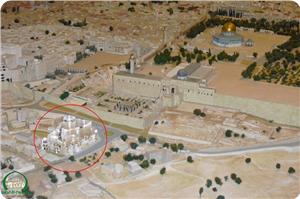 Numerous forced evictions have been documented by the Silwan Information Center but the Israeli police have refused to take any action against the settlers. Instead, they have, on multiple occasions, forcibly removed the tents of residents who camped out on the street in front of their homes after their homes had been taken over by Jewish settlers.
In the project approved on Friday, the right-wing Israeli settlement organization Elad will run the center, which is set to be constructed across from the ‘Dung Gate’ entrance to the Old City of Jerusalem. Elad also runs the controversial ‘City of David’ Israeli national park nearby, which was also constructed over an alarming number of demolished Palestinian homes in Silwan. This is the only instance in which a private organization has been granted control of a national park in Israel.
Elad’s mission statement is to “strengthen the Jewish connection to Jerusalem, and this in the means of tours, guidance, populating, and publishing material.”
According to the Silwan Information Center, “In practice, Elad feverishly worked to gain ownership of houses and lands in the village and particularly in Wadi Hilweh [in Silwan].”
In its approval of the new project, the Israeli Ministry of the Interior said that, “As a tourist attraction, this will contribute to the development of the city of Jerusalem.” When completed, the multi-level building will take up 16,000 square metres (172,160 square feet).
In response to previous archaeological projects by Elad, the Palestinian Authority’s archaeological and cultural heritage expert stated, “The sort of archaeology being carried out in Jerusalem, specifically in East Jerusalem and the Silwan area, is motivated by hidden agendas and has nothing to do with scientific objectives. It is done secretly, without taking into consideration international standards, and casts great doubts on the objectives of these excavations.”
Journalist Emily Hauser, of the Jewish Daily Forward, wrote last month, after the Israeli government handed over control of the southern part of the Western Wall to Elad, “Elad’s mission sits hand in glove with the larger government goal of tightening control over the entirety of 21st century Jerusalem, making the possibility of sharing the city with a future Palestinian state infeasible.
Jerusalem-based archaeological NGO Emek Shaveh has found that Elad’s decisions about where and how to excavate in the area are rooted in political considerations about establishing an Israeli presence and staying one step ahead of the diplomatic process, with the understanding that “’local and international public opinion will not create pressure against them.’”
Related article

Demolitions in Bruqin: “If you really want peace, you wouldn’t take what’s mine”
International Solidarity Movement | April 2, 2014
Bruqin, Occupied Palestine – On the 1st of April, at approximately 5.30 AM, a bulldozer and eight military jeeps arrived in the village of Bruqin close to the city of Nablus. The bulldozer first destroyed a farmers shed, killing the ten rabbits inside. The destruction continued as a caravan belonging to another farmer was also demolished, and finally later the same night, a building belonging to a farmer in the nearby village of Beit Furik was also destroyed.
This is just one of many nights where Palestinian property has been demolished by the Israeli army. Inside the village of Bruqin a girl’s school, recently financed by US Aid, is threatened by a demolition order.
The mayor of Bruqin spoke to an ISM activist after the demolitions:
“I talked to some Israeli settlers one week ago, and told them that we could live in peace, together. But they replied that they want another 700 dunums of land from Bruqin. So, I don’t think that they want peace. If you really want peace, you wouldn’t take what’s mine”.
The resistance in Bruqin against the illegal expansion of settlements continues. The day after the demolitions, men, women and children of the village went out on the hills close to a nearby illegal settlement and planted olive trees.

Related articles
Oxfam’s PR firm helping to greenwash Sodastream
By Tom Anderson | Corporate Watch | April 2, 2014
There has been a lot of negative media attention in the last few months on Sodastream, an Israeli fizzy drinks company with a factory in the illegal Israeli settlement of Mishor Adumim. A partnership between Oxfam and Scarlett Johansson ended recently after an international campaign put pressure on the charity to end its relationship with Johansson because she was undertaking ongoing work for Sodastream.
However, a high profile US public relations (PR) firm, which boasts of its “ethical business practices”, is providing services to both Sodastream and Oxfam America. Fenton Communications states on its site that “We do not take on clients that we do not believe in ourselves” and claims that it works “for companies and foundations advocating social change”. Fenton’s corporate social responsibility rhetoric and greenwash doesn’t bear more than a few minutes of scrutiny. The PR firm has a client list which includes large multinationals such as General Mills and Unilever. General Mills jointly own the General Mills (Pillsbury) plant in the Atarot settlement Industrial zone, while Unilever only pulled out of the Barkan settlement industrial zone after years of pressure from the boycott, divestment and sanctions movement. Both companies are also responsible for selling, marketing and lobbying hard for processed foods globally, which are damaging to people’s health. One of Fenton’s other clients is Oxfam America.
In response to the public campaign about Scarlett Johansson, Oxfam stated: “While Oxfam respects the independence of our ambassadors, Ms. Johansson’s role promoting the company SodaStream is incompatible with her role as an Oxfam Global Ambassador… Oxfam is opposed to all trade from Israeli settlements, which are illegal under international law.” Why then does Oxfam America find it acceptable to work with a PR firm that includes Sodastream on its client list?
It is not surprising that Sodastream feels the need for a PR firm. The company sells consumer products, marketing them as ‘green’. It relies on maintaining a positive public image. The international boycott campaign against the company has been growing apace and is taking its toll. Sodastream has reported a loss in the last three quarters and its share price is suffering.
Why not contact Oxfam encouraging them not to work with a PR firm doing business with a company working in Israel’s settlements:
Oxfam America office
226 Causeway Street 5th Floor
Boston, MA 02114-2206
United States
+1 617 728 2594
+1 617 482 1211 (Toll-free 1-800-77-OXFAM)
Oxfam GB office
Oxfam House
John Smith Drive Cowley
Oxford OX4 2JY
United Kingdom
+44 1865 472 600
+44 1865 473 727
Featured Video

Stanislav Krapivnik: Russia-Iran Cooperation & Escalation in Ukraine
or go to
Aletho News Archives – Video-Images
Frlom the Archives
Are the Jews indigenous to Palestine?
By David Miller | Al Mayadeen | August 3, 2022
There is a rising tide of claims from apologists for the crimes of Zionism that they have been misunderstood. Palestinians might be indigenous to Palestine, but the Jews definitely are. What is called the ‘Israel-Palestine’ conflict, they say, is competition over the same small piece of land by two rival groups of indigenous people. But are the Jews indigenous to the Levant? And what are the consequences of the argument?
In fact, most of the power structure of the Zionist state is dominated by Ashkenazi Jews who have no ancestral link to Palestine. Overall despite very significant financial and infrastructural contributions from Western European countries (especially the US, UK and France, for example via the Rothschild family), Eastern European Ashkenazim have been at the centre of the Zionist power structure since the early years of the 20th Century. … continue
Blog Roll
 Aletho News
- Hezbollah Foils Israeli Landing in Lebanon’s Bekaa
- Iraqi Resistance: Attacks on Beirut suburbs threaten US interests
- US approves $151.8M weapons sale to Israel, waiving congressional review
- “Burnt Bridges”: Why Trump’s Plan to Use Kurds Against Iran Is Doomed to Fail
- Iran Red Crescent says 6,668 civilian sites targeted in US-Israeli attacks
- Maybe Attacking Iran Was Not Such A Good Idea
- UK readies deployment of Prince of Wales carrier amid war on Iran
- Iran warns of consequences after US strike on water plant
- US Bases in Middle East Fail to Secure Nations & Become Safety Risk – Expert
- Iranian Crisis Becomes Embarrassment for US Military That Can’t Protect Anyone – MidEast Analyst
- If Americans Knew
- Israel is using the ‘Gaza doctrine’ in Lebanon and Iran
- Saudi journalist says ‘not all attacks’ on Gulf coming from Iran, fears US-Israel dragging monarchies into war
- Iranian officials say Israel carried out some of the drone strikes on Gulf energy sites
- US, Israel ravage Iran and Lebanon; 4 killed in Gaza – Not a ceasefire Day 148
- US troops were told war on Iran was ‘all part of God’s divine plan’, watchdog alleges
- Trump wants to run the show in Iran, but doesn’t know what he’s doing – Not a ceasefire Day 147
- ‘Dirty Work’ :The truth about how Israel was founded
- Mass Expulsion in Lebanon as Israel Expands War: “We Don’t Know Where to Go”
- Lies, distortions, and propaganda: how the U.S. mainstream media coverage on Iran hides the truth
- Palestinians in Gaza fear famine returning as Israel cuts off food amid Iran war
- No Tricks Zone
- Televised! Leading German Political Candidate Tells Schoolchildren CO2 Makes Sun Hotter!
- New Study: A Century Warming Of 1.1°C Is ‘Commonplace’ And ‘Not Unusual’ During This Interglacial
- New Study: ‘Internal Noise’ And Volcanic Forcing Can Trigger 10-15°C Warming Within Decades
- Glaciers Worldwide Are Suddendly Surging, Experts Blame Warming!
- Surprising Discovery: Sahara Is Greening…Billions Of Trees Where Once Thought To Be Barren
- New Research Reaffirms Clouds, Aerosols, And Surface Solar Radiation Are ‘Driving The Climate System’
- Germany: Electric Car Catches Fire At Charging Station, Sets Off Local “Inferno”, Widespread Damage
- New Study: Canada’s New Brunswick Was 1°C Warmer Than Today During The Medieval Warm Period
- Coal Power Back In Trend As Globe Tries To Keep Pace With Growing Demand For Power
- New Study: A 4°C Warmer Beaufort Sea Had ‘No Sea Ice’ 11,700 – 8200 Years Ago
 Aletho News