Report: 100 Israeli attacks during June
Palestine Information Center – 01/07/2013
RAMALLAH — In its monthly report, the Information Center of the Wall and Settlement documented an escalation in Israeli attacks during June including demolition notices and settlement expansion.
The report issued on Sunday monitored 98 Israeli assaults during June including 23 demolition operations mostly in Jordan alley and Jenin.
The report also pointed out 57 demolition orders in al-Khalil, 11 demolition notifications in Jerusalem, and 6 others in Bethlehem.
During June, the Israeli authorities declared the establishment of 3,341 housing units in West Bank settlements, and approved the construction of a huge building in Wadi al-Hilweh, known as Giv’ati parking, as part of the Israeli Judaization schemes in occupied Jerusalem.
Israel’s Jerusalem District Committee for Planning and Building has prepared an outline to connect the Jewish quarter in the Old Town Square with Al-Buraq Square through building underground elevators and corridors, the report added.
For its part, the Israeli Municipality has established a new road to link between the occupied city of Jerusalem and Ma’aleh Adumim settlement.
The monthly report referred to Israeli settlers’ escalated attacks where 14 Palestinian citizens were assaulted, and 30 cars were burned, in addition to stealing Palestinian monuments in Bethlehem and closing main streets that connect Palestinian villages and cities.
The Information Center also documented several Israeli break-ins into al-Aqsa mosque during June.
Related articles
- Jewish settlers attack buses filled with children in Jerusalem (alethonews.wordpress.com)
- UN statement on Israeli plan to relocate Palestinians to build houses for settlers (alethonews.wordpress.com)
- Maximum Land with Minimum Palestinians: The Annexation of Area C (alethonews.wordpress.com)
- More Israeli settler-terrorism: Settlers attack two Palestinian buses in Jerusalem (altahrir.wordpress.com)
- Report: “1790 Palestinians Kidnapped, 16 Killed, In First Half of 2013” (imemc.org)
- Palestine: Al Aqsa mosque stormed, demolition orders & more lands confiscated (realisticbird.wordpress.com)
Maximum Land with Minimum Palestinians: The Annexation of Area C

In the vast majority of Area C Israel denies Palestinians any opportunity to build or develop.
By Sam Gilbert | Palestine Chronicle | June 29 2013
Early this month Israeli human rights organization B’Tselem published a report on Israel’s policy in Area C and its implications for the population of the West Bank. Less then a week later Economy Minister Naftali Bennett, in the midst of Kerry’s attempts to start the stalled peace talks, reiterated his plan to annex all of Area C to the Israeli state, bringing with it the 350,000 some od settlers as well as 62% of land of the West Bank.
In a conference held by the settler Yesha Council Bennett said “the attempt to establish a Palestinian state in our land has ended … That we need to Annex area C of the West Bank now because the idea of creating a Palestinian state there is over.”
Bennett’s comments were met with international condemnation, the timing of his words seen as purposefully undermining Kerry’s attempt to restart the stalled peace negotiations. These comments, along with others from the Israeli right, have been presented as marginal within the mainstream Israeli political discourse. However the substance of Israeli policy and practice in the West Bank requires that these ideas been taken seriously.
Bennett’s Israel Stability Initiative published in 2012 lays out his plan for annexation, while B’tselem’s Report on Area C outlines the application and effect of Israeli Policy in Area C from 1995 till today. Each report has fundamentally different political objectives yet both provide a window into Israeli politics and practices in the Occupied Palestinian Territories (oPt).
The Israel Stability Initiative
In 2012 Naftali Bennett presented a 7-point plan for managing the Arab-Israeli Conflict in Judea and Samaria, the biblical term for the West Bank. The Israel Stability Initiative outlines a plan whereby Area C, the territory that Israel maintains full security and planning control after the Oslo agreement, would be annexed to Israel and the Palestinian State would be created in the disconnected cannons of areas B and C. Bennett’s plan would naturalize the 50,000 Arab residents (official number at 180,000), along with the 350,000 Israeli settlers. No Palestine refugee would be allowed to return to the west bank or Israel, and Gaza would be left to fend for itself.
The PA would be granted, “Full autonomy in areas A and B” while Israel would maintain a “full security umbrella for all of Judea and Samara.” The IDF would maintain a strong presence and complete security control over all of Judea and Samaria.”
While this proposal might seem especially partial to Israeli interests, B’tselem’s recent report on Area C shows how Bennet’s plan is in essence the institution of permanence for something has already become the de-facto reality in the west bank today.
B’Tselem Report
Earlier this month B’Tselem published a 111 page report titled “Acting the Landlord: Israeli Policy in Area C, the West Bank. The report presents Israel’s policy in Area C and explores its implications for the population of the West Bank as a Whole.
Area C is a product of the Oslo accords, an interim agreement that was supposed to lead to the establishment of a Palestinian state next to Israel. In 1995 the interim agreement went into effect in West Bank and the region was divided into three administrative categories A, B and C. “Area A: Under full control of the Palestinian Authority, comprising 18 percent of west bank including most Palestinians cities and population center. Area B, 22%: Israel retains military control while PA controls civil matters. Area C, 60 percent: Israel controls security and land related matters, including land allocation, planning and construction, and infrastructure.”
These divisions were based on demography not geography, with A and B subdivided into 165 disconnected cantons with no territorial continuity and surrounded by area C. Area C on the other hand is territorially contiguous, and comprises all the settlement and settlers in the west bank (350,000) along with some 180,000 Palestinians.
Area C contains the vast majority of the West Bank’s natural resources (water, agricultural, mineral) and nearly all of the development potential for a future Palestinian state. Area C lands surround all areas of A and B stifling growth in these already built up areas, and disconnecting the regions from one another
Legalizing the Norm
Claim to the greater land of Israel (Eretz Israel), has been a common thread in Israeli politics since the state’s inception and before. Bennet’s proposed plan to annex all of Area C (a modified two state solution) is interesting in that it simply cements the reality on the ground today, extending it to a final solution to the conflict.
B’Tselem’s report underscores how Israel’s policy in area C is anchored in the perception of the area as meant above all to serve Israel’s Own Needs in favor to those of the Palestinians by restricting Palestinian construction and development throughout.
In the vast majority of Area C Israel denies Palestinians any opportunity to build or develop. In fact since 1967 only .6 percent of the entire area C has been allocated to Palestinians by the Civil Administration, while 31 percent has been allocated to pseudo governmental World Zionist Organization (which develops settlement), 8 percent to Settlement Authorities, 12% to government ministries with an additional 30 percent designated as Military Firing Zones.
According to international law, planning and construction policy for Area C should rely on Jordanian planning law, but this has been altered by order of the Israeli military to serve the state’s purposes. One outcome has been the refusal of Civil Administration to plan villages, approving Mandatory Plans for only 16 of 180 villages in Area C. Since all construction in Area C requires approval of Civil Administration, the prospect for receiving a building permit without a master plan is negligible. In fact between 2000-2010 of the 3050 application for permits only 6.5% were approved. Many are forced to build without permits, at constant risk of demolition (660 a year since 2000).
Yet “in contrast to the restrictive planning policy followed for Palestinian communities, the Israeli settlements, also in Area C, enjoy expansive allocation of land, detailed planning, connections to advanced infrastructure and a blind eye regarding illegal construction.”
In 75% of the settlements, building was carried out without the appropriate permits, legalized retroactively by government and military. Between 2000-2007, 91 building permits were issued for Palestinians, same period 17,000 residential units were built in settlements. While Palestinians in area C are isolated from areas A and B, Jewish settlements are connected to one another and to Israel proper by Jewish only bypass roads.
The international community has time and again confirmed the illegality these actions under International Humanitarian Law. Yet insufficient international pressure (particularly from the U.S.) has led to a situation where Israel strengthens it hold on Area C and “preserves a de-facto annexation of area C and creates circumstance that will help perpetuate this state and influence the final status of the Area.”
The Party Line
Bennet’s Ideas about area C reflect a broader hostility within the Knesset about Palestinian statehood and the need to annex all or most of West Bank. In a Times of Israel interview, Deputy minister of Defense Danny Dannon spoke about the sentiment within the coalition government: “there was never a government discussion, resolution or vote about the two-state solution… and nobody will bring it to a vote, it’s not smart to do it — but if you bring it to a vote, you will see the majority of Likud ministers, along with the Jewish Home [party], will be against it.”
Numerous quotes from current cabinet minsters confirm this position:
“The essence of Zionist existence in Israeli settlements across the country.” – Moshe Ya’allon: Defense Minister.
“The real solution is to extend Israeli sovereignty over the settlements in Judea and Samaria.” — Danny Dannon, Deputy Defense Minister.
“We will try to apply sovereignty over as much as we can at any given moment.” — Ze’ev Elkin, Deputy Minister of Foreign Affairs.
“Israel should announce the annexation of Jewish settlements in Judea and Samaria.” — Gilad Erdan, Minister of Communication and Home Front Defense.
“Israel will need to take unilateral steps to extend Israeli sovereignty over the Jewish settlements in Judea and Samaria.” — Yisreal Katz Minister of Transportation.
Annexation: The Final Solution
The vocal support of annexation has been attributed to the right wing shift in the government in Israel, yet its mainstream credentials are exposed with even a cursory glance at policy and practice in the west bank through Israeli history.
Every Israeli president since Menachem Begin in the 70’s has publicly espoused a two state solution based on Bilateral U.S. brokered negotiations, while simultaneously doing everything in their power to undermine its physical viability on the ground.
Netanyahu’s most recent statements, considered “moderate” in comparison to Bennet’s, nonetheless betray the administration’s position to undermine the two state solution, as noted in Peace Now’s report on settlement construction under the current administration. In response to the proposed peace talks Netanyahu said that Israel would continue to build and that “construction in major settlement blocks does not substantially affect Israel’s ability to come to an agreement.” He went on to say that “We will continue to live and build in Jerusalem, which will always remain united under Israeli sovereignty,” as published by the Israeli daily, Isreal Hayom and Haaretz.
Considering East Jerusalem is the internationally recognized future capital for the Palestinian state, and that settlement expansion is the number one obstacle to peace, these comments say much about the prospects for a future agreement. Furthermore, the proposed state Netanyahu supports is one that according to him “would have to be demilitarized and with arrangements that rely fully on the Israel Defense Forces for security.” A state that doesn’t control its borders or security and whose army is the occupying power is not an autonomous state, but the “state” of Palestine today.
Netanyahu’s position toward the Palestinians in consistent with the low ceiling allowed for Palestinian aspirations since the onset of the peace processes. Oslo, the basis of the most current arguments about annexing area C, provides a telling example. As scholar Rashid Khalidi, one of Yassar Arafat’s key advisers during the Oslo negotiations, states, “It (the Oslo agreement) was never designed to achieve independent Palestinian statehood. It was never designed to end the occupation. It was really designed, of all people, by Menachem Begin, to make permanent Israeli control over the occupied territories. And that is what has succeeded until now.” Indeed it has. Since the signing of the Oslo agreement settlement population in West Bank (not including East Jerusalem) has tripled from 110,900 to nearly 350,000, according to B’Tselem.
Palestinian author Naseer Aruri notes the occupation was never designed to be temporary, but has been used to create the illusion of a two-state solution when that option has never been on the real agenda. Madrid, Oslo, Camp David all have been used as diplomatic cover as Israel has consolidated and even extended its illegal occupation.
B’Tselem’s report exposes the fact that Israeli policy gives every indication of permanence. “Israel preserves a de-facto annexation of area C and creates circumstance that will help perpetuate this state and influence the final status of the Area.” If we acknowledge Israeli policy in tandem with territorial usurpation, then comments like Bennet’s need not be viewed as extreme. It is time the International community, the U.S. and those moderates in the Israeli Knesset acknowledge that what Bennett’s is arguing for is not on the margins of Israeli political thought but the ideological underpinning of Zionism as practiced in the oPt. And in area C the Zionist goal of maximum land with minimum Palestinians is on full display.
– Sam Gilbert is a journalist living in Ramallah.
Jewish settlers attack buses filled with children in Jerusalem
Palestine Information Center – 29/06/2013
OCCUPIED JERUSALEM — Palestinian sources in Jerusalem said Jewish settlers on Friday night attacked buses carrying 100 Palestinian children participating in a summer camp organized by Health Work Committees in Silwan in occupied Jerusalem.
Health Work Committees pointed in a press release on Saturday that the camp includes a group of children between 7 and 12 years old, a number of them had been previously arrested in the occupations jails.
The settlers threw stones at the buses, breaking their windows and terrorizing the children.
The committees condemned the attack and called for “providing protection for the Palestinian people and children from settlers’ violence in occupied Palestine, committed under the protection of the occupation army.”
In al-Khalil, another group of Israeli settlers attacked on Thursday evening a Palestinian civilian near Yatta, and fled the scene in the absence of the occupation forces, locals reported.
They added that the citizen sustained wounds as the settlers threw stones at him and was taken to hospital for treatment.
Jewish settlers set on Thursday fire to agricultural lands in the archaeological area of Sebastia near the city of Nablus in the north of the West Bank.
Na’el Shaer, Sebastia’s mayor, said that groups of settlers from the settlement of Shavei Shomron built on the town’s land set fire to agricultural land, damaging large stretches of land, including land planted with olives and almond trees.
He added that the settlers have been continuously targeting the town as it represents an archaeological and historical area, noting that they had previously destroyed crops after pumping wastewater into the cultivated lands.
Related articles
- IOF soldiers round up two boys (ramyabdeljabbar.wordpress.com)
- Jewish settlers injure children in two separate vehicular assaults (alethonews.wordpress.com)
- When Cars Become Weapons: Israeli settler runs over 4 year old Palestinian child in al-Khalil (occupiedpalestine.wordpress.com)
‘They have two roads on our land already, why do they need a third…?’
International Solidarity Movement | June 27, 2013
Hebron, Occupied Palestine – In the Wadi al-Hussein area of Hebron, Israeli occupation forces have started to build a new road ‘for military purposes’. The route of the road is from the illegal settlement of Kiryat Arba towards the city centre, directly across Palestinian-owned land.
A military order has decreed the construction of this road, four metres wide and more than two hundred metres long, cutting through fields of olive and fruit trees owned by the Palestinian families living there. The stipulation on the width of the road has already been broken, with the route that has been cut by bulldozers being six metres wide in places.
In contrast to the military order to build a road, Palestinian landowners have been denied the right to build on their own land. Despite gaining approval from the Palestinian Authority, the Israeli authorities (who have the final say on civil matters in area H2 of Hebron) have refused permission to build a new house. Landowners also point out that there are two existing roads from Kiryat Arba built on Palestinian land for Israeli-use only, and ask why a third is required.
When occupation forces attempted to build this road initially, landowners and others tried to stop construction by sitting down in front of bulldozers, but this non-violent protest was met with arrests, fines and imprisonment, and by the bulldozer dumping a load of earth on top of them.
Landowners complain that Israel insists on applying those aspects of the Hebron accords that benefit settlers, while ignoring those aspects covering the rights of the majority Palestinian population. Using military orders to steal land is a tactic long-used by Israel. Land seized this way then later typically becomes part of the ever-expanding settlement project. All Israeli settlements are illegal under international law, which bans the transfer of the occupier’s population into the land under occupation.
Related articles
- Jewish settlers setting up tent and planning road on Palestinian owned land in Al Khalil (alethonews.wordpress.com)
- Settlers building illegal road on Palestinian land in Hebron (palsolidarity.org)
- Susiya resists mass demolition orders (alethonews.wordpress.com)
- Settlers Attack Palestinians In Hebron (imemc.org)
- New road connects Israeli settlement with the Ibrahimi Mosque (ramyabdeljabbar.wordpress.com)
Susiya resists mass demolition orders
“We will not give up; to give up is to die”
International Solidarity Movement | June 27, 2013
Susiya, Occupied Palestine – Today, June 27, 2013, the Israeli Civil Administration served thirty-four demolition orders in the Susiya village, which is in Area C and surrounded by the Israeli colony of Suseya. Due to previous demolition orders, every existing structure in the village is now threatened with destruction if they do not obtain permits by July 17.
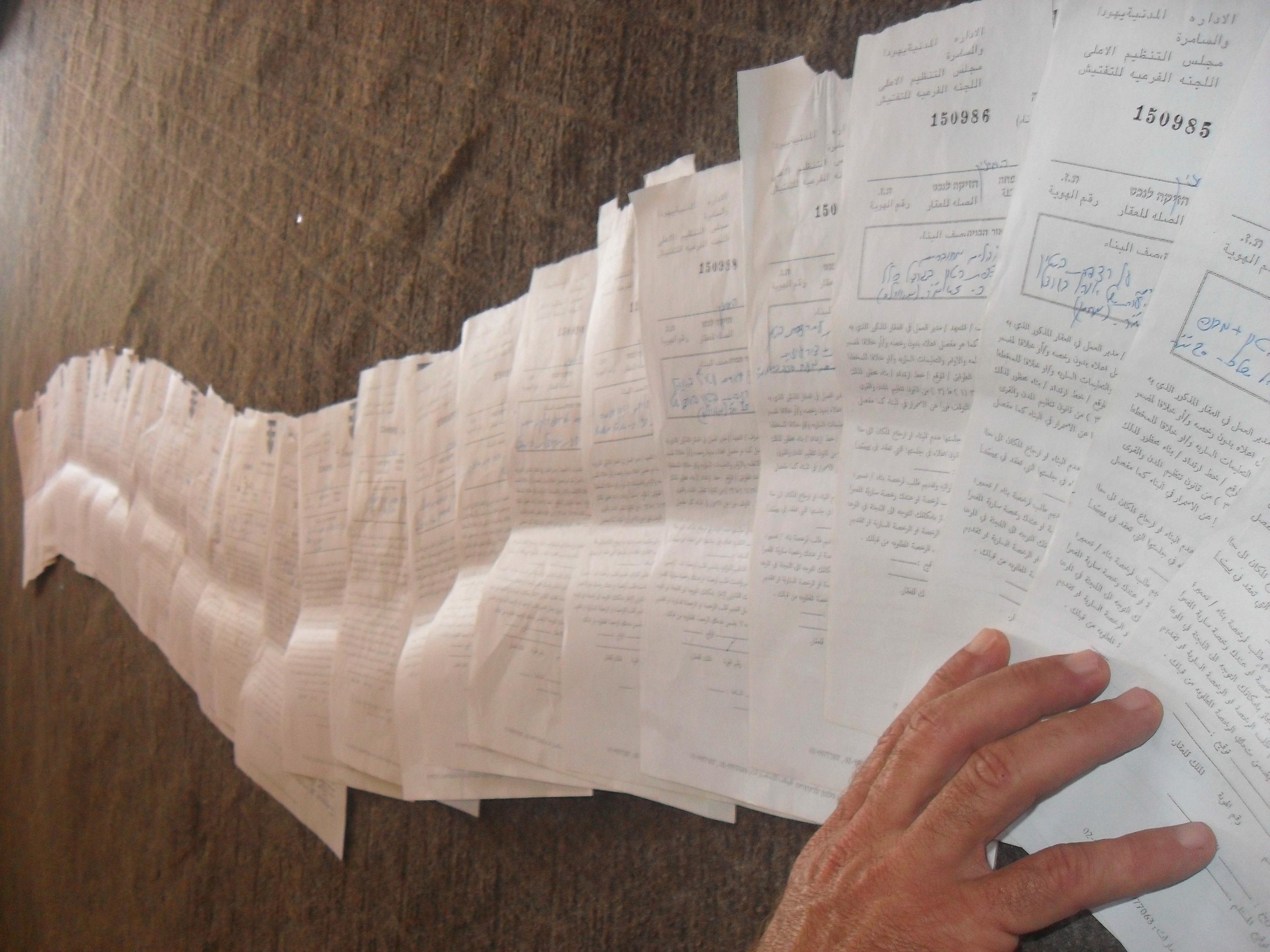
Original copies of all the demolition orders served today (Photo by ISM)
The residents of Susiya include more than thirty families, who were all evacuated from their homes in the old Susiya village and forced to relocate 200 meters to the southeast, in 1986. Susiya residents collaborate with the nearby villages in Masafer Yatta, a closed military “firing zone,” also in Area C and threatened with demolition. On July 15, a hearing will decide whether all the villages in Masafer Yatta can be evacuated by the military. Hafez Huraini, leader of the South Hebron Hills Popular Committee and himself a refugee from 1948, emphasizes that the villagers in Susiya are targeted simply for existing, so everything they do from grazing sheep to visiting family members in the nearby city of Yatta draws violence from the Israeli military and the local settlers.
Susiya has faced six mass demolitions since the establishment of the Israeli Suseya colony in 1983. The last wave of demolitions in 2011 repeatedly displaced 37 people including 20 children [1]. Residents of Susiya, most of whom rely on subsistence agriculture, are subject to some of the worst living conditions in the West Bank. Their houses were destroyed by Israeli forces and they now live in tents and shelters, paying more than five times the price nearby villages pay for water and consuming less than 1/3 of the WHO standard per capita [2]. Settlers have violently denied Susiya residents access to over 300 hectares of their land, including 23 water cisterns. Documented cases of settler violence include beatings, verbal harassment and destruction of property. Settlers then annex parts of the land by exploiting the Palestinian owners’ inability to access their land.
Of over 120 complaints that have been filed based on monitoring from Rabbis for Human Rights, regarding settler attacks and damage to property, around 95 percent have been closed with no action taken. In 2010, when 55 Susiya residents petitioned the High Court to be granted access to their land, the State responded that it intended to map land ownership of the area. Since then they have only closed to settlers 13% of the land Palestinians have been denied access to, reversing only one incursion [3].
Susiya has been the site of creative non-violent resistance for years, resistance that is continually met with brutality. Events have included marches, picnics on land likely to be confiscated, and Palestinian “outposts.” This coming Saturday Susiya will be part of a festival in the South Hebron Hills aimed at raising awareness about the situation of Masafer Yatta residents and stress their right to remain on their land [4]. In the words of Hafez Huraini, coordinator of the South Hebron Hills Popular Committee, “We will not give up.”
Sources:
[1] Strickland, Patrick O. “Palestine’s Front Line: The Struggle for Susiya.” Palestine Note RSS. N.p., n.d. Web. 27 June 2013.
[2] “Susiya: At Imminent Risk of Forced Displacement.” Susiya: At Imminent Risk of Forced Displacement – OCHA Factsheet (30 March 2012). N.p., Mar. 2012. Web. 27 June 2013.
[3] “South Hebron Hills.” Khirbet Susiya. N.p., 01 Jan. 2013. Web. 27 June 2013.
[4] Al Mufaqarah. “Al Mufaqarah R-Exist.” Weblog post. Al Mufaqarah RExist. N.p., 24 June 2013. Web. 27 June 2013.
Related articles
- The occupation plans to expand settlement of Susiya in al-Khalil (occupiedpalestine.wordpress.com)
- Jewish settlers setting up tent and planning road on Palestinian owned land in Al Khalil (alethonews.wordpress.com)
- Settler dogs attack Palestinian villagers near Hebron (occupiedpalestine.wordpress.com)
Related video
- From Al-Araqib to Susiya (palestinefreedomnow.wordpress.com)
UN committee slams Israeli forces’ torture of Palestinian children

A child sits in front of a destroyed home in Rafah. (Photo: European Commission DG ECHO/cc/flickr)
Al-Akhbar | June 20, 2013
A United Nations human rights body accused Israel on Thursday of mistreating Palestinian children, including by torturing those in custody and using others as human shields.
Palestinian children in the Gaza and the West Bank, captured by Israeli forces in the 1967 war, are routinely denied registration of their birth and access to health care, decent schools and clean water, the UN Committee on the Rights of the Child said.
“Palestinian children arrested by (Israeli) military and police are systematically subject to degrading treatment, and often to acts of torture, are interrogated in Hebrew, a language they did not understand, and sign confessions in Hebrew in order to be released,” it said in a report.
The Israeli Foreign Ministry said it had responded to a report by the UN children’s agency UNICEF in March on ill-treatment of Palestinian minors and questioned whether the UN committee’s investigation covered new ground.
“If someone simply wants to magnify their political bias and political bashing of Israel not based on a new report, on work on the ground, but simply recycling old stuff, there is no importance in that,” spokesman Yigal Palmor said.
The report by the UN Committee on the Rights of the Child noted that, while both Israeli and Palestinian children end up killed and wounded, Palestinians constitute a much larger proportion of these casualties.
Most Palestinian children arrested are accused of having thrown stones, an offense which can carry a penalty of up to 20 years in prison, the committee said. Israeli soldiers had testified to the often arbitrary nature of the arrests, it said.
The watchdog’s 18 independent experts examined Israel’s record of compliance with a 1990 treaty as part of its regular review of a pact signed by all nations except Somalia and the United States. An Israeli delegation attended the session.
The UN committee regretted Israel’s “persistent refusal” to respond to requests for information on children in the Palestinian territories and occupied Syrian Golan Heights since the last review in 2002.
“Hundreds of Palestinian children have been killed and thousands injured over the reporting period as a result of the state party military operations, especially in Gaza where the state party proceeded to (conduct) air and naval strikes on densely populated areas with a significant presence of children, thus disregarding the principles of proportionality and distinction,” the report said.
The 10-year period examined by the committee included the second Intifada, which took place between 2000 and 2005.
Israel withdrew its troops and settlers from the Gaza Strip in 2005, but maintains a heavy blockade on the Hamas-run enclave.
During the 10-year period, an estimated 7,000 Palestinian children aged 12 to 17, but some as young as nine, had been arrested, interrogated and detained, the UN report said.
Many are brought in leg chains and shackles before military courts, while youths are held in solitary confinement, sometimes for months, the report said.
It voiced deep concern at the “continuous use of Palestinian children as human shields and informants”, saying 14 such cases had been reported between January 2010 and March 2013 alone.
Israeli soldiers had used Palestinian children to enter potentially dangerous buildings before them and to stand in front of military vehicles to deter stone-throwing, it said.
“Almost all those using children as human shields and informants have remained unpunished and the soldiers convicted for having forced at gunpoint a nine-year-old child to search bags suspected of containing explosives only received a suspended sentence of three months and were demoted,” it said.
Israel’s illegal occupation of Palestinian territory and the Syrian Golan Heights, continued expansion of Jewish settlements, construction of the apartheid wall into the West Bank, land confiscation and destruction of homes and livelihoods “constitute severe and continuous violations of the rights of Palestinian children and their families,” it said.
Israeli settlements in the West Bank are deemed illegal by international law, a charge the Zionist state disputes.
The UNICEF report in March showed that Israel was the only country in the world where children were “systematically tried” in military courts.
Over the past decade, Israeli forces have arrested, interrogated and prosecuted around 7,000 children between between 12 and 17, mostly boys, UNICEF found, noting the rate was equivalent to “an average of two children each day.”
Figures from the end of January show that 233 children are currently being held in custody, 31 of them under the age of 16.
(Reuters, Al-Akhbar)
Related article
New wall construction to surround Azzun Atma
International Solidarity Movement | June 20, 2013
Azzun Atma, Occupied Palestine – On the 18th of June, two bulldozers arrived with Israeli forces in the village of Azzun Atma, southeast of Qalqilya, and began to work on the land behind the village’s school, to what is believed to be the construction of the new wall.
Accompanying the bulldozers to the village was the Israeli army and border police, including the local Israeli army commander who said the action was based on a High Court decision by the Israeli government. He said it was in order to protect their citizens, and if anybody tried to stop the construction, they would then close the gate to the village, the only way in and out.
Two weeks prior to this, the Israeli army put up signs stating that this is where the construction of the new wall would begin. The villagers fear that this new construction is being done in order to replace the current two metre barbed mesh fence that surrounds the village from all sides and separates it from the settlements nearby, with the concrete wall. The wall’s existence and constant deviation from the Green Line is justified by the Israeli authorities by citing security concerns for its citizens, in this case the illegal settler colonisers in the area.
Azzun Atma is located two kilometres east of the Green Line and encompassed on three sides by the current wall, constructed in 2002, which leaves the village within a settlement block and separates it from the rest of the West Bank. The only way in and out of the village is through a military checkpoint with a small gate. The village is thus stranded in the “seam zone” between the Green Line and the wall, surrounded by settlements, placing it under full Israeli military control. Access to the village, therefore, is dictated by the Israeli military and the checkpoint is regularly closed, denying the villagers their right to freedom of movement. The villagers thus live under the constant threat of the gate being closed and work permits for the other side of the Green Line being denied.
Palestinians living in the “seam zone” require permanent resident permits from the Israeli authorities to live in their own homes and work on their land. There are often few health and education services available in the “seam zone”, and those living inside it have to rely on checkpoints being open to reach workplaces and essential services.
The school where the construction is taking place has provided education for 300 children in Azzun Atma and a neighbouring village since 1966. Every day, the current wall and checkpoint restricts the freedom of movement of teachers and students. The school has so far lost one dunum of land to the wall and the septic system faces demolition orders.
When the second wall is constructed, Azzun Atma will be isolated from the rest of the West Bank by the already existing wall (see the red line on the map) and the new wall which will further close off the village from the settlement block and the rest of the West Bank (see the black line on the map).
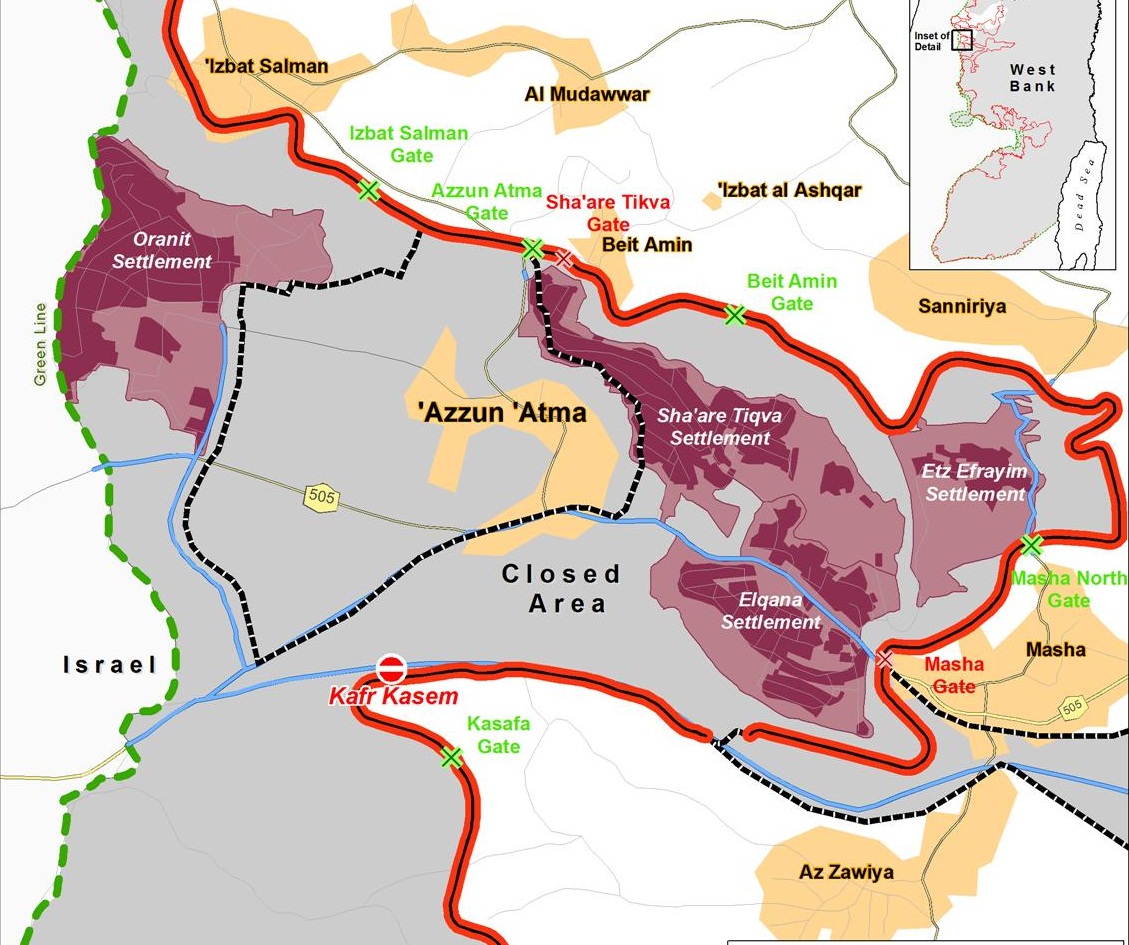
Azzun Atma (Map by OCHA)
In 1982, the Israeli authorities established two illegal settlements: Oranit to the northwest and Sha’are Tiqva to the northeast of Azzun Atma. The settlements have expanded over the years, and more than 2500 dunums of the village’s land have been stolen by them. Sha’are Tiqva now comes within metres of Azzun Atma, and since 2005, villagers have been subject to verbal harassment from settlers. The wall, though purported to be a security measure, is essentially another way for the Israeli government to steal land from their Palestinian owners and isolate villages and cities from each other, turning them into easily controllable cantons.
Isolating people and making daily life as hard as possible under occupation is a tactic used by the Israeli authorities to force villagers to leave their land and homes. However, residents of Azzun Atma remain steadfast in their land and will continue to resist the land theft, isolation and deprivation of their lives by organising protests.
Related articles
- Israeli settlers threaten to occupy Palestinian village of Azzun (occupiedpalestine.wordpress.com)
- West Bank Barrier creates hardship for Palestinian villagers (euronews.com)
UN statement on Israeli plan to relocate Palestinians to build houses for settlers
MEMO | June 17, 2013
A UN organisation has highlighted the plight of small Palestinian farming communities in the hills to the east of Jerusalem which are at risk of forced displacement due to a “relocation” plan advanced by the Israeli authorities. The UN Office for the Coordination of Humanitarian Affairs in Occupied Palestinian Territory (UNOCHA) said that the Israelis try to justify their plan on the grounds that the residents do not “possess title over the land”. Around 80 per cent of the people affected are refugees who were forced from their original lands in the south of the country in the early 1950s.
“A combination of measures adopted by the Israeli authorities has created a coercive environment for the communities,” said OCHA. They have restricted access to grazing land and markets to sell their produce. “These acts have undermined their livelihoods and increased their dependency on humanitarian assistance.”
In addition to demolition and the threat of demolition of homes, schools and animal shelters, as well as corresponding restrictions on obtaining building permits, the authorities have also failed to protect the communities from intimidation and attacks by Israeli settlers, alleges OCHA. “The communities have been told that they have ‘no choice’ but to leave.”
The UN organisation stated that the Israeli authorities have allocated public (state) land in two sites designated for the relocation, and prepared planning schemes, which are at final stages of approval. It added that this step raises cultural concerns as it threatens the traditional way of life for these people.
Israel’s plan includes the construction of thousands of housing units for illegal settlers in the E1 area, which creates a continuous built-up area between the Ma’ale Adumim settlement and Jerusalem. OCHA said that this plan has been frozen since the late 1990s, but the Israel government has recently reactivated it.
“The affected area is also planned to be surrounded by the Barrier [West Bank Separation Wall],” said OCHA. “If implemented, these plans will undermine Palestinian presence in the area, further disconnect East Jerusalem from the rest of the West Bank, and disrupt the territorial contiguity of the occupied territory.”
According to the OCHA report, “The UN Secretary General has stated that the implementation of the proposed ‘relocation’ would amount to individual and mass forcible transfers and forced evictions, prohibited under international humanitarian law and human rights law.”
The Secretary General based his statements on the following grounds:
- As an occupying power, Israel has an obligation to protect the Palestinian civilian population and to administer the territory for the benefit of that population.
- The destruction or confiscation of private property, including homes, as well as the transfer of settlers into occupied territory, is also prohibited.
OCHA pointed out that these residents are “calling for the international community to protect them and assist them in their current location and to afford adequate planning and permits for their homes and livelihood-related properties.”
Related articles
- Israel lawmakers approve plan to displace Negev Bedouins
- Israel threatens to demolish ‘illegal’ Bedouin school
- ISRAEL: Water being used to coerce Bedouin villagers, says NGO
- The Negev’s Hot Wind Blowing
- Palestinian Bedouins threatened with ethnic cleansing
- Israeli cabinet announces plan to forcibly displace tens of thousands of indigenous Bedouins
Israeli army detains a 10-year-old during the weekly demonstration in Kafr Qaddum
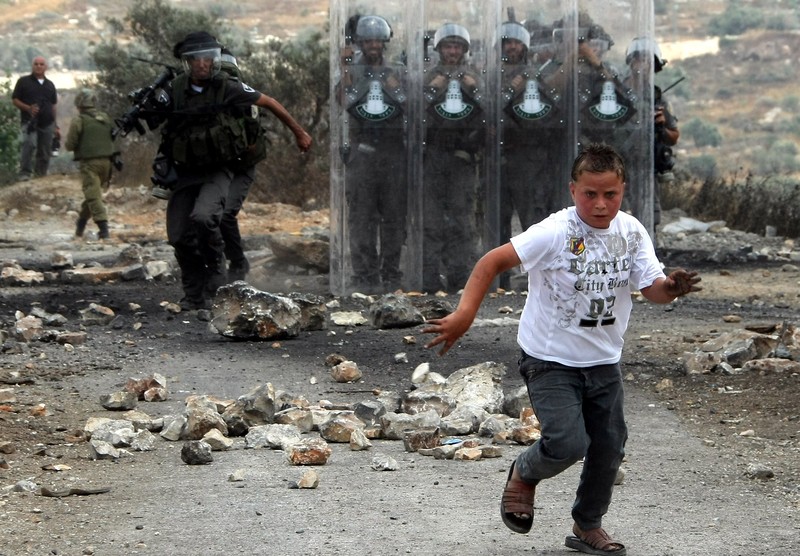
A young Palestinian protester runs away from Israeli soldiers during a demonstration against the expropriation of Palestinian land by Israel in the village of Kafr Qaddum, near the West Bank city of Ramallah on June 22, 2012. – Source
International Women’s Peace Service | June 14, 2013
Kafr Qaddum, Occupied Palestine – On Friday 14 June, the Israeli army arrested a 10-year-old child during the weekly protest in Kafr Qaddum. Israeli soldiers fired tear gas canisters and sound bombs at the villagers; many local residents suffered from tear gas inhalation.
At approximately 12:00, when residents and international solidarity activists started gathering for the demonstration before the Friday prayers, nearly 30 foot soldiers stormed the village from the main road leading toward the illegal Israeli settlement Qedumim. As they entered the village, they fired tear gas canisters directly at the group before the demonstration even began. Local youth resisted the incursion, chasing the soldiers back from the bystanders toward a hill overlooking the village.
Over the next two and a half hours, soldiers shot tear gas and threw sound bombs at demonstrators in the olive groves next to the main road of the village. At approximately 12:30, soldiers detained a 10-year-old boy. While in their custody, soldiers tied his hands, grabbed him by the neck, beat him and threatened to “drop [him] from this rock.”
Nearly one and a half hours later, the boy was released and residents of Kafr Qaddum celebrated his return. Soldiers continued to fire tear gas at local youth protesting at the edge of the village close to the illegal settler colony of Qedumim. No further arrests were made and the demonstration ended at around 15:00.
Kafr Qaddum is a 3,000-year-old agricultural village that sits on 24,000 dunams of land. The village was occupied by the Israeli army in 1967; in 1978, the illegal settler-colony of Qedumim was established nearby on the remains of a former Jordanian army camp, occupying 4,000 dunams of land stolen from Kafr Qaddum.
The villagers are currently unable to access an additional 11,000 dunams of land due to the closure by the Israeli army of the village’s main and only road leading to Nablus in 2003. The road was closed in three stages, ultimately restricting access for farmers to the 11,000 dunams of land that lie along either side to one or two times a year. Since the road closure, the people of Kafr Qaddum have been forced to rely on an animal trail to access this area; the road is narrow and, according to the locals, intended only for animals. In 2004 and 2006, three villagers died when they were unable to reach the hospital in time. The ambulances carrying them were prohibited from using the main road and were forced to take a 13 km detour. These deaths provoked even greater resentment in Kafr Qaddum and, on 1 July 2011, the villagers decided to unite in protest in order to re-open the road and protect the land in danger of settlement expansion along it.
Kafr Qaddum is home to 4,000 people; some 500 residents attend the weekly demonstrations. The villagers’ resilience, determination and organization have been met with extreme repression. More than 120 village residents have been arrested; most spend 3-8 months in prison; collectively they have paid over NIS 100,000 to the Israeli courts. Around 2,000 residents have suffocated from tear-gas inhalation, many in their own homes. Over 100 residents have been shot directly with tear-gas canisters. On 27 April 2012, one man was shot in the head by a tear-gas canister that fractured his skull in three places; the injury cost him his ability to speak. In another incident, on 16 March 2012 an Israeli soldier released his dog into the crowded demonstration, where it attacked a young man, biting him for nearly 15 minutes whilst the army watched. When other residents tried to assist him, some were pushed away while others were pepper-sprayed directly in the face.
The events of the past week are part of a continuous campaign by the Israeli military to harass and intimidate the people of Kafr Qaddum into passively accepting the human rights violations the Israeli occupation, military and the illegal settlers inflict upon them.
Related articles
- Kafr Qaddum – Blocked from life’s basics; pushed back when doing something about it (alethonews.wordpress.com)
- Palestinians demonstrate across West Bank (altahrir.wordpress.com)
- “We are the army…we will catch you or we will come to your house” – Soldiers threaten children of Kafr Qaddum (palsolidarity.org)
- Violent repression continues by the Israeli Army against protesters in Kufr Qaddum (occupiedpalestine.wordpress.com)
Settlers from Bracha attack and harass farmer on his land
International Solidarity Movement | June 13, 2013
Al Rujeib, Occupied Palestine – On Friday 7th June five settlers from the illegal settlement of Bracha attacked a farmer on his land, using sling shots to throw stones at him near Huwwara checkpoint. The same settlers continued to harass the farmer in the following days as he tried to graze his sheep and gather his crops, unprotected by the Israeli authorities.
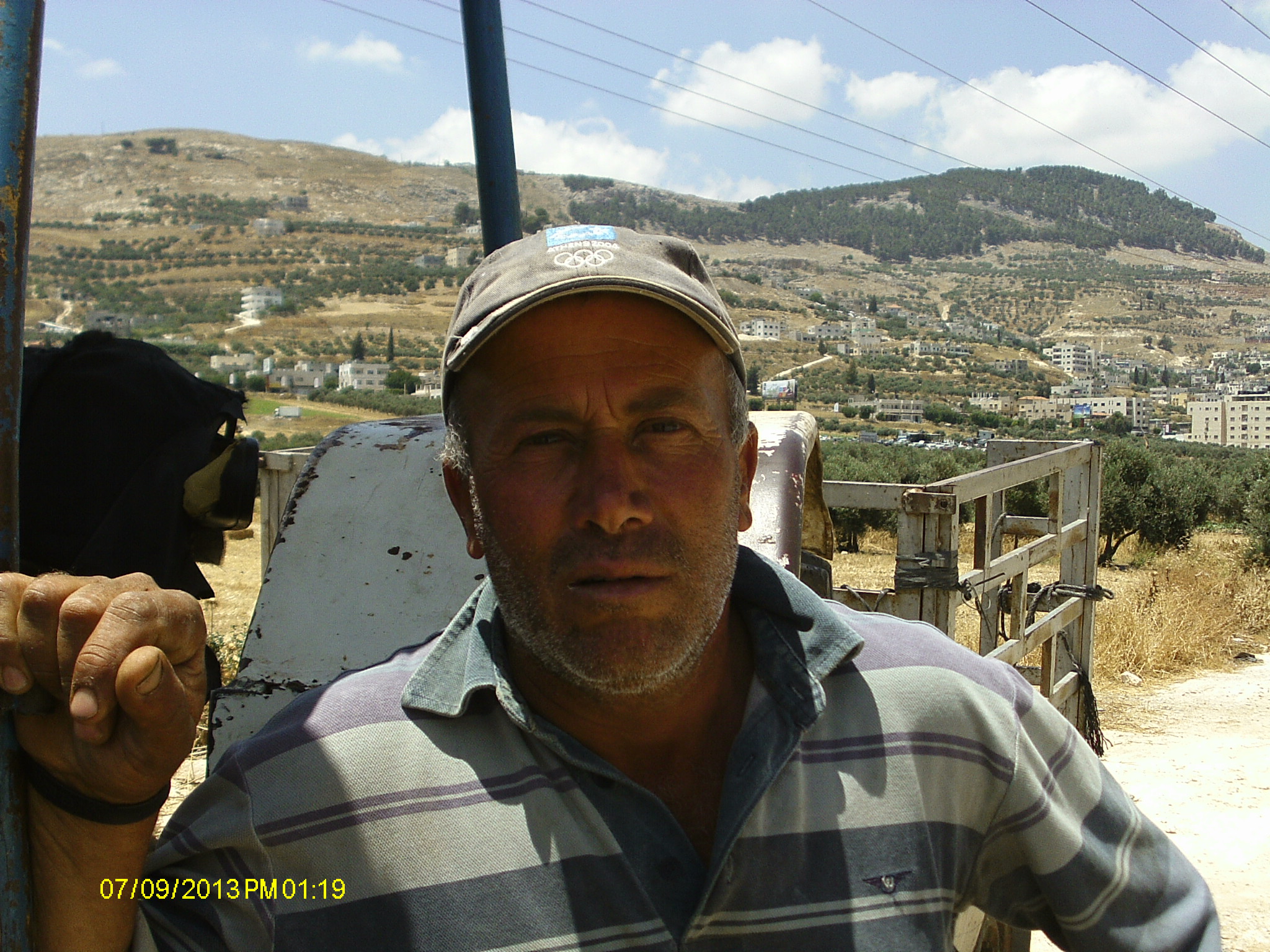
Salah Sukamel Deweket (Photo by ISM)
Salah Sukamel Deweket rents 70 dunums of land between his home in Al Rujeib and the occupation forces’ checkpoint at Huwwara. The land is mainly used to plant crops for his sheep to graze upon.
On Friday 7th June Salah was working hard to enable his sheep to feed when he was surprised by five settlers, thought to be an old man and his four sons who brought their own sheep to eat Salah’s wheat. The settlers threw rocks using slingshots at Salah and his flock. Salah had no one who could help him as he had no number for the District Coordination Office (DCO) – the Palestinian liasion with Israeli authorities or other organisations. Unable to get the number, he returned to his land to find that the settlers had ripped apart his bales of wheat.
The settlers resumed throwing stones at him in full view of soldiers stationed at the Israeli occupation forces checkpoint at Huwwara. The soldiers did nothing but watch as the Palestinian farmer was attacked. As an occupying power the Israeli military are meant to protect all citizens in the territory.
Salah asked the older settler why he had destroyed his wheat. “People who stay in Israeli land have to be good Israeli people”, the settler replied. “If this is Israeli land, where’s Palestinian land?” Salah asked. “There is no Palestinian land” the settler shouted back. The settlers continued to graze their sheep on Salah’s land and then encouraged their sheep to eat the olive trees of another Palestinian farmer who came to protect his land. It was only then that army jeeps came to intervene – asking why the Palestinian farmers were there. Salah tried to explain the problem with the settlers to the army, who told him to take photos and go to DCO. Salah then asked the soldiers if they were going to arrest the settlers, to which they said, ” we don’t know, it’s up to the judge.” When the soldiers were asked why they did not come earlier, they replied that it wasn’t their problem. The next day Salah tried to fix his wheat bales but the settlers kept coming and causing problems. Soldiers eventually came and told both Salah and the settlers to leave but said that the Palestinians must leave first.
Palestinians face many attacks by settlers of varying severity. Religious extremists living in illegal settlements attack Palestinian people, lands and crops. Palestinians have almost no means of legal recourse or protection from settler attacks but are routinely targeted by the army in mass arrests in the alleged defence of the Israeli occupation and settlements. Even when Palestinians can contact the DCO, the coordination office can often not solve issues with settlers who generally are treated with impunity under Israeli law. Settlements are illegal under international law under the fourth Geneva convention.

Salah Sukamel Deweket’s wheat fields (Photo by ISM)
Related articles
- Jewish settlers setting up tent and planning road on Palestinian owned land in Al Khalil (alethonews.wordpress.com)
- After the flames, only determination remains in Burin and Madama (alethonews.wordpress.com)
- VIDEO | 82-year-old Hebron woman Umm Salah challenges Israeli settlers, troops. Alone. (occupiedpalestine.wordpress.com)
- Jewish settler fires at Palestinian workers wounding one of them (occupiedpalestine.wordpress.com)
Featured Video

Israeli Foreign Ministry projects Palestinians as the Zionists, Ashkenazis as indigenous
or go to
Aletho News Archives – Video-Images
Frlom the Archives
Are the Jews indigenous to Palestine?
By David Miller | Al Mayadeen | August 3, 2022
There is a rising tide of claims from apologists for the crimes of Zionism that they have been misunderstood. Palestinians might be indigenous to Palestine, but the Jews definitely are. What is called the ‘Israel-Palestine’ conflict, they say, is competition over the same small piece of land by two rival groups of indigenous people. But are the Jews indigenous to the Levant? And what are the consequences of the argument?
In fact, most of the power structure of the Zionist state is dominated by Ashkenazi Jews who have no ancestral link to Palestine. Overall despite very significant financial and infrastructural contributions from Western European countries (especially the US, UK and France, for example via the Rothschild family), Eastern European Ashkenazim have been at the centre of the Zionist power structure since the early years of the 20th Century. … continue
Blog Roll
 Aletho News
- Hezbollah Foils Israeli Landing in Lebanon’s Bekaa
- Iraqi Resistance: Attacks on Beirut suburbs threaten US interests
- US approves $151.8M weapons sale to Israel, waiving congressional review
- “Burnt Bridges”: Why Trump’s Plan to Use Kurds Against Iran Is Doomed to Fail
- Iran Red Crescent says 6,668 civilian sites targeted in US-Israeli attacks
- Maybe Attacking Iran Was Not Such A Good Idea
- UK readies deployment of Prince of Wales carrier amid war on Iran
- Iran warns of consequences after US strike on water plant
- US Bases in Middle East Fail to Secure Nations & Become Safety Risk – Expert
- Iranian Crisis Becomes Embarrassment for US Military That Can’t Protect Anyone – MidEast Analyst
- If Americans Knew
- Israel is using the ‘Gaza doctrine’ in Lebanon and Iran
- Saudi journalist says ‘not all attacks’ on Gulf coming from Iran, fears US-Israel dragging monarchies into war
- Iranian officials say Israel carried out some of the drone strikes on Gulf energy sites
- US, Israel ravage Iran and Lebanon; 4 killed in Gaza – Not a ceasefire Day 148
- US troops were told war on Iran was ‘all part of God’s divine plan’, watchdog alleges
- Trump wants to run the show in Iran, but doesn’t know what he’s doing – Not a ceasefire Day 147
- ‘Dirty Work’ :The truth about how Israel was founded
- Mass Expulsion in Lebanon as Israel Expands War: “We Don’t Know Where to Go”
- Lies, distortions, and propaganda: how the U.S. mainstream media coverage on Iran hides the truth
- Palestinians in Gaza fear famine returning as Israel cuts off food amid Iran war
- No Tricks Zone
- Televised! Leading German Political Candidate Tells Schoolchildren CO2 Makes Sun Hotter!
- New Study: A Century Warming Of 1.1°C Is ‘Commonplace’ And ‘Not Unusual’ During This Interglacial
- New Study: ‘Internal Noise’ And Volcanic Forcing Can Trigger 10-15°C Warming Within Decades
- Glaciers Worldwide Are Suddendly Surging, Experts Blame Warming!
- Surprising Discovery: Sahara Is Greening…Billions Of Trees Where Once Thought To Be Barren
- New Research Reaffirms Clouds, Aerosols, And Surface Solar Radiation Are ‘Driving The Climate System’
- Germany: Electric Car Catches Fire At Charging Station, Sets Off Local “Inferno”, Widespread Damage
- New Study: Canada’s New Brunswick Was 1°C Warmer Than Today During The Medieval Warm Period
- Coal Power Back In Trend As Globe Tries To Keep Pace With Growing Demand For Power
- New Study: A 4°C Warmer Beaufort Sea Had ‘No Sea Ice’ 11,700 – 8200 Years Ago
 Aletho News