Defending the EU Rather Than One’s Own Country
By Andrew Spannaus | Consortium News | June 24, 2018
Milan – By invoking his power last month to reject a proposed government minister because of the his critique of the EU, Italian President Sergio Mattarella made it clear that his priority is not to defend the Italian state—his job, theoretically—but rather the European Union.
This put into the open something rarely admitted publicly: that Italy—like other European countries—has essentially given up its existence as a sovereign nation-state. The EU treaties adopted by national parliaments now take precedence over the basic principles of each member country’s constitution.
Mattarella had announced on May 27 that Paolo Savona, the minister of the economy proposed by the populist parties that won the March elections, was unacceptable because of his critical position towards the EU. The president said the appointment would spook the markets and threaten the survival of the Euro. When the two populist parties that had joined together to govern, the Five Star Movement (M5S) and the League, insisted on keeping Savona, Mattarella exercised his power to reject their choice and began plans to appoint an IMF technocrat who would guarantee the current budget orthodoxy while taking the country towards new elections.
Luigi di Maio, the 31-year old M5S leader, ultimately got Matteo Salvini, head of the League, to partially relent, shifting Savona to another position in order to avoid the collapse of their newly-formed coalition. Yet the brief firestorm touched off by the clash with Mattarella was revealing, as it risked doing precisely what the president and his EU backers fear most—promote even more opposition to the loss of national sovereignty that has occurred over the past 25 years.
Finance Dominates Government

Mattarella: Serving the EU, not Italy.
The EU’s principle aim is to continue the pro-finance policies launched in the 1980s with wide-scale de-regulation and the emergence of what became known as globalization, i.e. the loss of national sovereignty in favor of a borderless world in which financial interests would become more important than governments. The Union adopted the free market mantra, which it imposed through increasing supra-national bureaucracy. State intervention and regulations were considered the enemies of efficiency and growth, while austerity and so-called structural reforms were launched to break down the successful mixed state/market model that had been in place for decades.
Over the years, as national institutions gradually relinquished their power to make economic policy, European political elites adopted the goal of complete EU integration. They followed this dogma despite numerous contradictions, from the failure of austerity policies to increasing economic divisions, from the lack of democratic debate to sharply different foreign policy goals among member states.
Naturally, some members of national elites recognized the folly of the EU policies, one of whom was Paolo Savona. However, he is by no means “anti-European,” against further political cooperation at the supranational level. Rather, he simply recognizes that the neo-liberal policies of budget balancing and prohibiting state intervention are harmful to Italy (and others). And, given the European institutions’ refusal to re-think these rules, he came up with what some saw as a radical idea: draw up a “Plan B” in which Italy would withdraw from the single currency. The aim was to use this threat to the very survival of the Euro to exact changes such as abandoning austerity policies and allowing for large-scale public investment.
In practical terms, it is very unlikely that Italy or any other large country would today simply “leave” the Euro on its own. A more probable scenario is that the EU architecture would crumble if some of its largest members broke with the Brussels and Frankfurt orthodoxy. So, if Italy were to dig in its heels, for example, resisting calls for further deregulation and insisting on large-scale, targeted public investment, it could potentially find support from other victims of austerity such as Greece, Portugal and Spain, but also factions critical of EU policies in France and Germany.
Most of the Italian population now supports such a scenario and populist parties big and small have used it explicitly to increase their popularity. This gave them a crucial margin of added support, beyond exploiting other hot-button issues such as immigration, which despite having taken on more importance in recent years, by itself would not have been enough to bring the outsiders to power.
Thus when Mattarella stood before the TV cameras on May 27 to declare his veto, he made what was potentially a colossal blunder, both formally and politically. Besides overstepping his authority as President, since the Constitution does not allow him to intervene regarding the political orientation of the government, he sparked a backlash that could have easily strengthened his opponents.
Populists Reject Russophobia
The new government has already shown its willingness to break with establishment policies, specifically regarding relations with Russia. At the G7 meeting in Canada this month, Prime Minister Conte supported Donald Trump’s call to bring Russia back into the fold, providing the U.S. President with support on this issue that he has lacked so far among the leaders of the world’s most industrialized countries. Conte stressed Italy’s position as a loyal ally of the United States and NATO, while still insisting that better relations with Russia are needed. This point is also felt strongly among Italian businesses and institutions, particularly due to economic ties developed over many decades.
While the popularity of M5S is based on its anti-existing-system, anti-corruption platform, the League is best-known for its anti-immigration rhetoric. But over the years, the League has also adopted the most “sovereignist” positions among the large Italian political parties regarding economic policy. It now showcases economists who reject budget constraints outright, suggesting that governments can create currency freely, if need be. Further, the party has run national campaigns to re-regulate the banking sector—which would conflict directly with EU rules; both they and M5S promise to abandon austerity policies and increase both social spending and public investment. Last, they aim to implement a soft version of a “flat tax,” simplifying the tax system with only two brackets so as to inject more liquidity into the coffers of companies and the pockets of families, while raising penalties for tax evasion.
Any of these issues can cause an open clash with the EU, given its strict budget rules. The question is if the new government will attempt to finesse the issue and avoid an open fight, or welcome a political debate over the validity of the neo-liberal policies whose failure brought them to power.
Andrew Spannaus is a journalist and strategic analyst based in Milan, Italy. He was elected Chairman of the Milan Foreign Press Association in March 2018. He has published the books “Perché vince Trump” (Why Trump is Winning – June 2016) and “La rivolta degli elettori” (The Revolt of the Voters – July 2017).
Italy: The Center Cannot Hold
By Diana Johnstone | Consortium News | June 3, 2018
The traditional governing parties, center “left” and center “right” all follow the same neoliberal policies and constitute the self-designated “center.” Mainstream media enforce center right claims to authority on the base of orthodox economic expertise, while the center left derives its authority from its “values,” centered on an identity politics version of human rights. “Center” sounds so reasonable, so safe from dangerous “extremes” and unpredictable populism. Against such threats, the Center presents itself as the champion and safeguard of “democracy.”
How true is this?
World Values Survey results indicate that in Europe and the United States, people who describe themselves as “centrist” on the average have less attachment to democracy (e.g. free and fair elections) that those on the left, and even those on the far right. This is not as surprising as it may seem at first, since “centrists” are by definition attached to the status quo. In European countries, the authoritarian neoliberal “center” is institutionalized in the European Union, which imposes economic policy over the heads of the parliaments of the member countries, dictating measures which conform to the choices of Germany and northern Europe, but are increasingly disastrous for the Southern EU members.
The Centrist fear of democracy was resoundingly confirmed by March 4 legislative elections in Italy. The Center was relegated to the margins and outsiders burst in. The winner, with 32 percent of the votes, was the Five Star Movement (M5S) whose campaign “against corruption” won popular support in the impoverished South. In second place, with 17 percent, was “the League”, formerly the Northern League – that is, a party of rich north Italy chauvinists ready to secede from the “lazy good-for-nothing” south. It took almost three months for this extremely odd couple to agree to a coalition government.
The mystique of the European Union is anti-nationalist, based on the theory that “nations” are bad because they caused the devastating wars of the twentieth century, while European unification is the sole guarantee of “peace.” Convinced of their mission, the Eurocentrists have had no qualms in throwing out the baby of democratic choice along with the nationalist bathwater.
The notion that “peace” depends on “Europe” persists despite the NATO bombing of Serbia and European participation in U.S. wars in Afghanistan, Iraq, Libya and Syria, not to mention EU participation in the current major military buildup in the Baltic States against “the Russian enemy.” Indeed, thanks to NATO, the EU is gearing for a war even worse than the previous ones.
Since the “nation-state” is blamed for evil in the world, the Eurocentrists react with horror at growing demands in Member States for a return to “national sovereignty.” This, however, is a natural reaction to the economic and social disasters resulting from policies dictated by EU institutions in Brussels. The 1992 Maastricht Treaty legally bound member countries to centralized neoliberal monetarist policies; not only “socialism” became illegal – even Keynesianism was ruled out. Promised endless peace and prosperity, citizens of European countries were cajoled into giving up their sovereignty to EU institutions, and many now want it back.
Disillusioned Italy
Italian disillusion is particularly significant. Italy was an exceptionally enthusiastic founding member of the unification begun with the 1957 Treaty of Rome. And yet, Italy’s own history illustrates what can go wrong with such unification, since the 19th century political creation of a unified Italy centered in Turin led to the enrichment of the industrial north at the expense of southern Italy, where the splendor of Naples declined into chronic poverty, crime and corruption. Now Italy itself is “the south” in the periphery of a European Union centered around Germany.
Antagonism between northern and southern Italy has given way to a much stronger antagonism between Italy and Germany – each blaming the other for the crisis.
It is only fair to recall that Germans were very attached to their Deutsche Mark and to their own austere financial policies. Germany could only be lured into the common currency by agreeing to let the euro follow German rules. France eagerly supported this concession based on the notion that the common currency would unify Europe. It is doing quite the opposite.
Germany is a major exporting nation. Its trade with the rest of the EU is secondary. It uses the EU as its hinterland as it competes and trades globally with China, the United States and the rest of the world. The proceeds of Germany’s favorable EU trade balance is less and less invested in those countries but in Germany itself or outside the EU. In the official German view, the main function of the Southern EU members is to pay back their debts to Germany.
Meanwhile, Italy’s once flourishing industrial network has lost its competitive edge due to the euro. It cannot save its exports by devaluation, as it was accustomed to doing. Italy’s debt is now 132 percent of its GNP, whereas the Maastricht Treaty governing the monetary union puts a ceiling of 60 percent on national debt. And to continue paying the debt, public services are cut back, the middle class is impoverished, the domestic market declines and the economy gets even weaker.
This is precisely the situation that has plunged Greece into ever deepening poverty.
But Italy is not Greece. Greece is a small peripheral country, which can be pounded to death by creditors as a warning of what can happen to others. Italy, on the contrary, is too big to fail. Its collapse could bring the whole EU crashing down.
Italy’s Potential Strength Through Weakness
The traditional Italian parties had no solution beyond those that have ruined Greece: cut back social spending, impoverish workers and pensioners, and pay back the foreign banks, with interest.
The odd coalition of the League and the M5S was obliged to try something different: basically, to invest in the economy rather than abandon it to its creditors. Their program combines lower taxes with Keynesian stimulation of investment. Since the leader of the League, Matteo Salvini, and Luigi Di Maio of M5S do not like each other, they selected law professor Giuseppe Conte to be Prime Minister in their coalition cabinet. The interesting choice was that of Paolo Savona for the key post of Minister of Economy and Finance. Savona, whose long career has taken him across the summits of Italian and international finance, was certainly the most qualified choice imaginable. Savona knows everything there is to know about the Italian economy and international currency creation.
And yet, it was the appointment of this 81-year-old expert that created outrage in the Eurocenter.
The uproar was spurred by the fact that in one of his books Savona had described the euro as “a German prison.” Savona had also said it was necessary to prepare a Plan B, to leave the euro if there is no other choice. “The alternative is to end up like Greece.”
This hint of disloyalty to the euro was totally unacceptable to the European establishment.
The Center struck back in the person of the largely figurehead President of Italy, Sergio Mattarella, who used, or misused, his unique constitutional power by refusing to approve the government. On May 28, he designated as prime minister Carlo Cottarelli of the International Monetary Fund – a man who represented everything the Italians had just voted against. Known in Italy as “Mr. Scissors” for his advocacy of drastic government spending cuts, Cottarelli was supposed to run an apolitical “technical” government until new elections could be held in the fall.
This coup against the Italian voters caused momentary rejoicing in the Authoritarian Center. The European Budget Commissioner (a German of course), Günther Oettinger, was reported to be gloating over the prospect that “the markets” (meaning the financial markets) would soon teach Italians how to vote. Italy’s economy “could be so drastically impacted,” he said, as to send a signal to voters “not to vote for populists on the right and left.”
This simply intensified Italian indignation against “German arrogance.”

Savona: Plan B just a negotiating tactic
Meanwhile Savona wrote a letter to President Mattarella which introduced a bit of cold reason into an increasingly hysterical situation. He reminded the president that an important meeting of EU heads of state was to be held at the end of June; without a political government, Italy would be absent from negotiations which could seal the fate of the EU. Italy’s plea for economic change could expect French support. Savona denied having called for leaving the euro; in the spirit of game strategy, he had mentioned the need for Plan B in order to strengthen one’s position before negotiations. He made it clear that his strategy was not to leave the euro but to transform it into a genuine rival to the dollar.
“Germany prevents the euro from becoming ‘an essential part of foreign policy’, as the dollar is for the United States”, wrote Savona. But change becomes necessary, as the dollar is less and less suitable for its role as world currency.
Indeed, the Italian crisis merges with a mounting trans-Atlantic crisis, as the U.S. uses sanctions as a weapon in competition with its European “partners.” The paradox is that Italy could use its very weakness to oblige Germany to reconsider its monetary policy in a moment when the German economy is also facing problems due to U.S. sanctions on deals with Russia and Iran, as well as protectionist measures. Savona’s message was that clever diplomacy could work to Italy’s advantage. In its own interest, Germany may need to accept transformation of the euro into a more proactive currency, able to defend European economies from U.S. manipulation.
It was a matter of hours before Cottarella stepped back and a new M5S-League government was formed, with Savona himself back as Minister of Relations with the European Union.
Italy’s Double Jeopardy
The new Italian cabinet sworn in on June 1 is riven with contradictions. Despite all the released anti-EU sentiment, it is definitely not an “anti-EU” government. Conte is back as prime minister. The new foreign minister, Enzo Moavero Milnesi, is a staunch pro-European. As interior minister, the northern Italy chauvinist Salvini – who doesn’t particularly care for southern Italians – will get tough with migrants. As minister of economic development M5S’ Di Maio will try to find ways to improve conditions in the southern regions that elected him. Since Salvini is the more experienced of the two, the League is likely to profit from the experiment more than the M5S.
Some Italians warn that by leaving the “German prison” Italy would simply find itself even more dependent on the United States.
One should never forget that ever since the end of World War II, Italy is an occupied country, with dozens of U.S. military bases on its territory, including air bases with nuclear weapons poised to strike the Middle East, Africa or even Russia. The Italian Constitution outlaws participation in aggressive war, and yet Italian bases are freely used by the United States to bomb whichever country it pleases, regardless of how Italians feel about it.
Worst of all, the U.S. used its Italian “NATO bases” to destroy Libya, a disaster for Italy which thereby lost a valuable trade partner and found itself inundated with African refugees and migrants. While international financial experts exhort Italy to cut government expenses, the country is obliged by NATO to spend around 13 billion euros to buy 90 U.S. F-35 fighters and to increase its military spending to around 100 million euros per day.
Italy’s economic prospects have also been badly hit by U.S.-enforced sanctions against trade with Russia and Iran, important potential energy sources.
U.S. economic aggression, in particular Trump’s rejection of the Iranian nuclear deal, is the issue with the potential to bring European leaders together at a time when they were drifting apart. But at present, the Europeans are unable to defy U.S. sanctions in punishment for trade with those countries because their international dealings are in dollars.
This has already led to the U.S. exacting billions of dollars in fines from the biggest French and German banks, the BNP and Deutsche Bank, for trading that was perfectly legal under their own laws. The French petroleum giant has been obliged to abandon contracts with Iran because 90% of its trade is in dollars, and thus vulnerable to U.S. sanctions. And that is why the idea is growing of building financial instruments around the euro that can protect European companies from U.S. retaliation.
The Disappearance of the Left
The disappearance of left political forces has been almost total in Italy. There are many reasons for this, but a curable part of the problem has been the inability of what remains of the left to face up to the two main current issues: Europe and immigration.
The left has so thoroughly transformed its traditional internationalism into Europism that it has been unable to recognize EU institutions and regulations as a major source of its problems. The stigmatization of “the nation” as aggressively nationalistic has held back the left’s ability to envisage and advocate progressive policies at the national level, instead putting its hopes forever in a future hypothetical “social Europe.” Such a transformation would require unanimity under EU rules – politically impossible with 28 widely differing Member States.
Without such inhibitions, the far right capitalizes on growing discontent.
Another related handicap of the left is its inability to recognize that mass immigration is indeed “a problem” – especially in a country like Italy, with a flagging economy and 20 percent official unemployment (although this figure is probably too high, considering undeclared labor). There is resentment that prosperous Germany issued a general invitation to refugees, which for geographic reasons pile in Mediterranean countries unable to cope. The mass influx of economic migrants from Africa is not even “taking jobs away from” Italians – the jobs are not there to take. These migrants fled war and misery to come to Europe in order to earn money to send back to their families, but how can they possibly meet these expectations?
It is all very well to extol the glorious hospitality of America entreating the world to “Give me your tired, your poor, Your huddled masses yearning to breathe free, The wretched refuse of your teeming shore. Send these, the homeless, tempest-tossed to me…”. Such generosity was suited to a new nation with huge empty spaces and rapidly growing industry in need of a work force. The situation of a “full” nation in a time of economic downturn is quite different. What is to become of the tens of thousands of vigorous young men arriving on Italian shores where there is nothing for them to do except sell African trinkets on the sidewalks of tourist centers? To make matters worse, the great contemporary thrust of technical innovation aims at replacing more and more workers with robots. Leftist denial of the problem leaves its exploitation and resolution to the extreme right.
Some leftist politicians in Italy, such as Stefano Fassina of the Sinistra Italiana are waking up to this need. A left that dogmatically ignores the real concerns of the people is doomed. A bold, honest, imaginative left is needed to champion Italians’ independence from both German-imposed austerity and the expensive military adventurism demanded by the United States. But the interlaced problems created by unregulated globalization do not lend themselves to easy solutions.
Diana Johnstone is a political writer, focusing primarily on European politics and Western foreign policy. She received a Ph.D. at the University of Minnesota and was active in the movement against the Vietnam War. Johnstone was European editor of the U.S. weekly In These Times from 1979 to 1990, and continues to be a correspondent for the publication. She was press officer of the Green group in the European Parliament from 1990 to 1996. Her books include Queen of Chaos: The Misadventures of Hillary Clinton, CounterPunch Books (2016) and Fools’ Crusade: Yugoslavia, NATO and Western Delusions, Pluto Press (2002).
Euroskeptic coalition in Italy agrees on new government bid
RT | May 31, 2018
Italian anti-establishment parties that won the latest general election have reached an agreement for a new bid to form a coalition government, averting the possibility of new snap election.
Former International Monetary Fund official Carlo Cottarelli, who was appointed by President Mattarella as interim head of the government until a potential to new election, formally gave up his mandate after the success of the talks was announced.
“All the conditions have been fulfilled for a political, 5-Star and League government,” 5-Star chief Luigi Di Maio and League leader Matteo Salvini said in a joint statement on Thursday. The two parties, which lie on the opposite sides of the left-right political spectrum, negotiated the revival of their coalition for several hours.
The new bid for the cabinet keeps Giuseppe Conte, a law professor close to 5-Star, as the proposed prime minister. Paolo Savona, whose candidacy for the position of the economy minister was vetoed by President Sergio Mattarella earlier this week, is no longer proposed for the job. He was replaced in the proposed government by Giovanni Tria, an economy professor at Rome’s Tor Vergata University, according to Reuters. Tria is a Eurosceptic, but he didn’t argue for a possible withdrawal of Italy from the euro zone, which was the reason for Savona getting blocked.
According to the parties, the League’s Salvini will lead interior ministry in the would-be cabinet while Di Maio of the 5-Star will take portfolios of labor and industry under a newly-created ministerial position.
Enzo Moavero, a former EU affairs minister under Prime Minister Mario Monti, is slated ty become foreign minister in the Conte government. Savona was proposed for the consolation prize, the position of EU affairs minister.
“Maybe finally we have made it, after so many obstacles, attacks, threats and lies,” Salvini said on Facebook shortly after the deal was announced.
Lebanon launches search for first oil & gas reserves despite Israeli threats
RT | May 30, 2018
Beirut has announced the start of its oil and gas exploration for offshore energy reserves in the Mediterranean after approving a plan submitted by a consortium of France’s Total, Italy’s Eni and Russia’s Novatek.
Energy and Water Minister Cesar Abi Khalil said Lebanon plans to launch a second offshore licensing round by the end of 2018 or early 2019.
In February, the country signed its first offshore oil and gas exploration and production agreements with the Total-Eni-Novatek consortium for offshore Blocks 4 and 9.
Part of Block 9 contains waters disputed with neighboring Israel but the consortium said it had no plans to drill in that area. Lebanese authorities gave the go-ahead this week for exploration of the two blocks to begin, said Khalil.
The exploration period can last up to three years and the first well is expected to be drilled in 2019, providing all government departments grant necessary licenses and permissions “on time and without delay”, he added.
The minister explained that drilling would determine whether Lebanon had commercial reserves and, if so, their scale. Lebanon shares the Levant Basin in the eastern Mediterranean with Israel, Cyprus, and Syria. A range of big sub-sea gas fields have been discovered in the area since 2009.
However, the country was far behind Israel and Cyprus in exploring and developing its share of resources as a result of political issues over the past few years, and a dispute with Israel over Lebanon’s southern maritime border.
Israel had earlier threatened Lebanon over drilling in areas which it considers to be disputed. It warned Lebanon that it would pay a “full price” if another war breaks out between the two countries.
Three months ago, Lebanese President Michel Aoun appealed to US Secretary of State Rex Tillerson, asking for Washington’s “effective role” in settling the dispute with Israel over offshore oil drilling areas. After the US proposed sharing the offshore blocks, Lebanon rejected its offer to “help.”
The US proposal reportedly specified that the Lebanese would take up 65 percent of the disputed sections of the shelf. Commenting on the proposal Aoun said Lebanon will not give Israel a “millimeter.” He underlined that the offshore energy blocks are located in Lebanon’s waters and thus are within Beirut’s exclusive economic zone.
Lebanon and Israel’s dispute runs over a triangular area of around 860 square kilometers (332 square miles) of waters, which could contain huge reserves of natural gas and maybe even crude oil.
Italy’s anti-euro bloc likely to gain crushing majority in new elections
Asia Times | May 30, 2018
After investors hailed for a brief moment Italian President Sergio Matterella’s stand against a fledging populist coalition, a sense of dread began to set in. Matterella’s move to foil the League party and Five Star Movement’s bid to form a government forestalled the installation of an anti-euro finance minister, but may ultimately make the newly-formed, anti-euro alliance an even more powerful force.
What comes next could be a nightmare scenario for those hoping to blunt the determination of Italy’s populists to enact policies which many fear will prove disastrous for Italy’s debt solvency. The prospect of tax cuts along with a massive increase in entitlements has already triggered a selloff in Italian bonds. If new elections are held, despite the market turmoil the populists have caused, some analysts say they will only be emboldened.
An election simulation conducted by the Bologna-based Cattaneo Institute, as reported by Italy’s Ansa news agency, found that the League-Five Star coalition would sweep elections across most of the country, winning more than 90% of uninominal parliamentary elections. Just over one-third of the seats in both the Senate and the Chamber are awarded based on a direct first-past-the-post basis (uninominal), with voters electing specific candidates.
More than 90% of that uninominal vote will give the League-Five Star juggernaut around 35% of the seats in parliament just to start with. The remaining seats, which are awarded on a proportional basis between parties, would give them a two-thirds majority, according to Cattaneo’s projection. That represents a 15% bonus over what they achieved in the March elections.
The upshot: All the populists have to do is sit back and let the establishment attack them until the election, and clean up.
Italian president appoints ex-IMF official Cottarelli as interim PM, gives him mandate to form govt.
Press TV – May 28, 2018
Italian President Sergio Mattarella has appointed Carlo Cottarelli, a former senior director at the International Monetary Fund (IMF), as interim prime minister, giving him mandate to form a government ahead of snap elections in the country, which has been without a government for two months.
Cottarelli made the announcement after a meeting with Mattarella on Monday, saying he would put together a transitional government “very quickly” and lead the country to fresh elections slated in the fall or early next year.
“I have accepted the task to form a government as the president has asked. As an Italian I am very honored by this task and I will do my best,” Cottarelli said.
The former senior IMF official also told reporters that he would soon return to parliament with a budget program to be put to the vote for approval.
“I will present myself to parliament with a program, which, if it wins the backing of parliament, would include the passage of the 2019 budget, and then parliament would be dissolved with elections at the beginning of 2019,” he said.
“In the absence of a confidence (vote), the government would resign immediately and its main function would be the management of ordinary affairs until elections are held after August 2018,” Cottarelli added.
The appointment came after anti-establishment forces abandoned efforts to form a ruling coalition in the European country and hit a standoff with the president over his refusal to endorse a eurosceptic pick for the post of finance minister.
Mattarella vetoed the nomination of Paolo Savona as economy minister in a coalition of the anti-establishment Five Star Movement and far-right League party.
The 76-year-old president said he would accept every proposed minister except Savona, who had formerly asserted that Italy’s entry into the European Union’s single currency, euro, was a “historic mistake.”
Mattarella stressed that he had done “everything possible” to aid the formation of a government but an openly eurosceptic economy minister ran against the parties’ joint promise to simply “change Europe for the better from an Italian point of view.”
The two populist parties accused Mattarella of betraying voters and later dropped their plan to take power.
Mattarella’s action sparked angry calls for his impeachment and the chaos sent Italian stocks tumbling by as much as two percent at one stage.
Cottarelli, 64, is widely known at home as “Mr. Scissors” for making cuts to public spending. To become prime minister, he is required to gain the approval of parliament with Five Star and the League holding a majority in both houses.
Italy — a founding member of the European Union — has been without a government since an election in early March when Five Star and League emerged as the biggest parties.
The two parties have vowed to battle the EU over its financial and immigration policies. The two have formerly been open to the possibility of Italy holding a referendum on euro.
The prospect of a eurosceptic government in Rome has concerned EU leaders such as French President Emmanuel Macron and German Chancellor Angela Merkel, who are pushing for further political and economic integration.
‘Unprecedented institutional clash’: Italy fails to form govt over anti-EU economic minister
RT | May 27, 2018
Italy’s PM-designate Giuseppe Conte said he’s given up on attempts to form a government after President Sergio Mattarella rejected his candidacy for economy minister. The country may now face a new election by the end of 2018.
“President [Mattarella] has received Prof. Giuseppe Conte …. who returned the mandate given to him on May 23 to form the government. The president has thanked him for his effort in fulfilling this task,” Ugo Zampetti, an official within the presidential administration, told RAI. After the talk, Mattarella said that he was going to make a decision on the new parliamentary vote in the country in the coming hours.
The president had summoned Conte to his office in order to find a way to break the two-months-long deadlock on forming the coalition government after a similar meeting on Friday ended fruitlessly.
The candidacy for economy minister has been the main stumbling block for the creation of the new cabinet in the country. The anti-establishment Five Star Movement (M5S) and its rightist coalition ally Lega Nord, which won the most parliamentary seats in the March vote, insist on having Paolo Savona in the vital role.
M5S was outraged by Mattarella’s decision, with 5-star leader Luigi Di Maio calling it “an institutional clash without precedent” in a Facebook live video.
“What’s the point of going to vote if it’s the ratings agencies that decide?” Di Maio fumed.
Paolo Savona is a distinguished economist who served as the industry minister in 1993-94 and also worked at the Bank of Italy. But Mattarella has been refusing to appoint the 81-year-old due to concerns over his criticism of euro, the EU and Germany’s economic policies. In a book, which Savona co-authored in 2015, he argued that Italy should have a “plan B” to leave the eurozone with minimum damage if the situation calls for it.
Earlier on Sunday, Savona made a public statement to clarify his views, saying that he stands for “a different Europe, stronger, but more equal.” He said that he believes Italy’s debt should be reduced through targeted investment and stimulation of the economy, but not austerity or tax cuts.
Barbarians at the gate? End of democracy? Most hysterical establishment takes on new Italian govt
By Igor Ogorodnev | RT | May 23, 2018
Mainstream political analysts have unleashed their doom-laden predictions about the impact of Italy’s Five Star-Lega coalition, though their hostility is tempered by new-found concern for the “desperate,” misguided electorate.
‘The Weimar Republic’
“It may be too late. The spiral of populism is: unhappy voters; irresponsible promises, bad outcomes; even unhappier voters; still more irresponsible promises; and worse outcomes. The story is not over. It may have just begun,” writes Martin Wolf in the Financial Times.
The FT has been one of the most apprehensive publications since Silvio Berlusconi stepped aside to allow the two upstart parties to form a coalition. An article last week went under the headline “Rome opens gates to modern barbarians” – presumably the majority of the Italian electorate, who voted for the two biggest parties in March – while another FT column on Monday said that the election paved the way “to liberal democracy’s demise,” and invoked the mistakes of the Weimar Republic before the ascent of Adolf Hitler.
For many centrist observers, the two parties are a devilish blend of retrograde baseness and cynical online savvy, a prototype of political activity that won’t just be in charge of Italy until the next election (feasibly just months away), but will somehow poison the well of modern politics.
“These parties are incoherent, angry, unrealistic and often anti-science; they are also clever users of information technology. The Northern League and the Five Star Movement represent every powerful emotion, resentment, suspicion and anxiety that can be mobilized and weaponized by modern political parties. Above all, they reflect the disillusionment with politics — the disillusionment with everything — that inevitably sets in when populism fails,” writes Anne Applebaum in the Washington Post, who connects their rise with supposedly Trump-like failures of Berlusconi’s previous terms.
Applebaum is merely continuing the view expressed by New York Times pundit David Brooks, who suggested back around the time of the election that the decline of established centrist parties will lead to “political groups that are crazier than anything you could have imagined before.”
“Once the norms of acceptable behavior are violated and once the institutions of government are weakened, it is very hard to re-establish them. Instead, you get this cycle of ever more extreme behavior, as politicians compete to be the most radical outsider,” wrote Brooks, notably without asking once why the first-world Italian society would want to be governed en-masse by these supposed lunatics. It would also be curious to detangle the assemblage of loaded terms – what is “acceptable” or “extreme” or “weakened” in Brooks’ understanding?
‘Can’t be trusted to run the country’
As witnessed previously following Brexit and Donald Trump’s election, Italy’s government seems to have turned political analysts, often of a nominally center-left persuasion, into avid market watchers, nay, defenders, with particular concern over the fate of the eurozone (Paul Mason in the New Statesman described the prospect of an EU-Rome stand-off as “bloodcurdling”).
“Brussels is allowed to be concerned, because the populists set to take over the EU’s third-largest economy could rattle the euro zone with irresponsible financial policies,” an opinion piece in Deutsche Welle said. “To bail out an economy as large as Italy’s in a way that is similar to what happened in Greece would be practically impossible.”
“Another reason to beware is the parties’ programmes,” proclaims the Economist, which two sentences earlier said the parties “can’t be trusted” to run Italy. “Their visceral Euroscepticism threatens the integrity of the euro zone. The Five-Star Movement has only recently stepped back from pledging to hold a referendum on leaving the single currency.”
Indeed, why would anyone question, not to mention ask the public, whether the euro has been a success? While a new economic crisis in Europe would have seismic consequences for Italy first of all, this sort of analysis entirely misses the point of the coalition’s manifesto (they were not elected to save the euro!) and turns them, a symptom of the continent’s troubles, into its cause.
The Economist, and other publications, whose offices are located in other countries, have also enjoyed the luxury of lecturing Italy, which has borne the brunt of recent illegal immigration (over 600,000 are still in the country) into Europe on its election of anti-migrant parties.
“The League goes well beyond reasonable concern over refugees, advocating xenophobic and unworkable deportation policies,” on one of the issues where perspective seems to make all the difference – migration was the biggest worry for Italians polled before the vote, and the inability to control it was likely the primary reason for the decimation of the ruling center-left.
Will there be a better time to deploy Game of Thrones parallel?
Of course, other than accusations of fascism, made somewhat difficult by the thoroughly un-Mussolini-like two months of patient coalition-building – it’s hardly been the March on Rome – the other powerful and trump card remains Russia.
“This single-minded dedication to improving ties with Moscow as a panacea for all that ails the world is in line with the close links both parties are known to have cultivated with the Kremlin,” Haaretz insinuates of the new government’s desire to drop sanctions against Moscow.
And undoubtedly, what the Economist calls “excessive Russophilia” is liable to cause deleterious and sinister effects – there is only one step from liking Putin, to actually becoming Putin.
“Populists like Salvini understand that – as Petyr Baelish puts it in Game of Thrones – ‘chaos is a ladder,'” writes Mason in his New Statesman piece. “Salvini is a fan of Putin and Le Pen, and knows that the route to power for authoritarian right-wing nationalists is through the drama of increasingly chaotic situations.”
So to summarize: Italy is on course to destroy the euro, bankrupt itself, but bounce back by turning into a dictatorship, ushering in a new age of authoritarianism across Europe. Not even Italy’s new leaders themselves could conjure up such power fantasies, as they doze off during the fifth hour of a Brussels finance ministers’ meeting.
READ MORE:
Ditching Russia sanctions is part of draft coalition deal with Lega Nord – M5S to RT
New Italian Government to Trigger Crisis in EU
By Alex GORKA | Strategic Culture Foundation | 07.04.2018
The formal consultations on forming a new coalition government in Italy kicked off on April 4. The center-right coalition led by the anti-migrant League won 37% of the vote to control the most parliamentary seats while the populist 5-Star Movement won almost 33% to become the single party with the highest number of votes. Neither of them can govern alone. It does not make great difference who President Sergio Mattarella will entrust with the task to form a coalition government: the leader of the center-right League, Matteo Salvini, or Five Star’s Luigi De Mayo. The outcome will be the same – the EU will face a crisis over its Russia policy. By and large, the two are at one on the issue – they want the Russia sanctions lifted.
The Five Star is not simply Eurosceptic; it’s openly anti-EU. The movement has always been known as “part of a growing club of Kremlin sympathizers in the West”. It shares a pro-Moscow outlook with the League. “STOP absurd Russia sanctions” tweeted Matteo Salvini to make his position known. It coincides with the opinion of Ernesto Ferlenghi, the President of Confindustria Russia, a non-profit association, who asks for government’s support of Italian businesses operating in Russia. Both agree that the sanctions hurt Italian economy. Salvini lambasted his country’s decision to expel Russian diplomats over the so-called spy poisoning case. In March, he signed a cooperation agreement with United Russia party.
It’s almost certain that Italy, the 3rd-largest national economy in the eurozone, the 8th-largest by nominal GDP in the world, and the 12th-largest by GDP (PPP), will question the wisdom of sanctions war. No doubt, it will be backed by a number of countries, including Greece, Austria, Cyprus, Hungary etc. If not for pressure exercised by the EU and German leadership, the sanctions would have been eased, or even lifted, long ago, especially as Great Britain is on the way out of the bloc. The Skripal scandal can delay the discussions but not for a long time. It will die away. If there were a solid proof to bolster the accusations against Moscow, it would have been presented to public without procrastination to fuel the anti-Russia sentiments. It has not been done. The scandal is doomed to fade away gradually.
The expedience of diplomats’ expulsions has been questioned in almost all EU member states, including Germany. Its newly appointed Foreign Minister Heiko Maas insists that Europe needs Russia as an ally to solve regional conflicts. According to him, “We are open to dialogue and are counting on building confidence again bit by bit, if Russia is ready to do so.”
Austria and Greece have refused to join so far but if such a big country as Italy joins them, the EU will be in a tight spot. The sanctions are to be prolonged in early fall but Rome will block their automatic extension. Italy is too big and important to be easily made to kneel. This is an EU founding nation. The bloc is facing serious cracks and adding more bones of contention will put into question its very existence. Under the circumstances, gradual easing of sanctions to ultimately lift them is the best solution for the EU. That will put the US and Europe on a collision course, especially at a time the divisions over the Nord Stream-2 gas project go on deepening.
US Ambassador to the UN, Nikki Haley, has recently stated that Russia is no friend of the US. Moscow is well aware that Washington is not its friend either. It’s not about friendship but rather the need for a dialogue on equal terms to address burning issues of mutual interests.
As one can see, the US hostility toward Russia does not strengthen its standing in the world. Quite to the contrary, it makes the gap wider to alienate European allies. The relationship is complicated enough as it is. The pressure exercised by the US and the UK, its staunch European ally, to involve the EU into the anti-Russia campaign provokes stiff resistance. Its strong alliances, not disagreements with close partners that make great powers stronger.
The CAATSA law that allows punitive measures against European allies, the divisions over the Iran deal being probably decertified by the US in May, the European resistance to the US tariff policy and a lot of other things undermine the West’s alliance the US considers itself the leader of. Adding Russia to the list of European grievances hardly makes the US position in the world stronger. By ratcheting up anti-Moscow sentiments it hurts itself to make the “America First” policy much less effective than it could be, if outright hostility gave place to business-like dialogue.
Looks like those who wish Russia ill have lost an important ally. The more effort is applied to hurt Moscow, the more damage is done to West’s unity.
Samantha Power blames Russia for anti-establishment success in Italy’s elections
RT | March 6, 2018
One of the key people behind the policies that destabilized Libya and Syria, causing a flood of refugees to Europe, accused Russia of influencing the Italian elections after voters gave the cold shoulder to establishment parties.
Russia’s utility as the universal scapegoat cannot be underestimated these days. A historically-separatist region votes for independence? Russia! Somebody on the internet smeared your candidate? Russia! Extreme cold comes from the east? Er… Russia probably still wants “thousands and thousands and thousands” killed by the cold, as one member of the UK cabinet claimed, and sells its gas to freezing Britons as deception.
In the past 2 years, Putin has won elections in the United States, Austria, Czechia & now Italy. He’s also delivered Brexit & performed well in France & Germany. It’s because there are no problems in the west & a large amount of people only vote to make Russia happy. pic.twitter.com/4XATeOSTEO
— Bryan MacDonald (@27khv) March 5, 2018
So it’s no surprise that the outcome of the latest election in Italy, which resulted in a surge of anti-establishment forces, would be blamed on Moscow. For instance, here is Samantha Power, formerly a senior official in the Obama administration, sharing an article in the Spanish newspaper El Pais about how Russia allegedly spun an immigration discourse in Italy.
Italy’s joins long list of elections influenced by Russia. Sputnik will do what Sputnik does. The question is: what are our democracies going to do about it? Will voters repudiate candidates who seek to benefit from Russian interference? https://t.co/JbFe35Sw5n
— Samantha Power (@SamanthaJPower) March 5, 2018
The Spanish article is a hit piece based on social media analysis done by a private firm, claiming the Russian news outlet Sputnik and the almighty Russian bots made the discourse in Italy radicalized on the issue of immigrants. Because Italians, obviously, cannot be genuinely unhappy to be living in a country that also happens to be a primary destination for refugees departing across the Mediterranean Sea from Libya and have no right to feel betrayed by Brussels’ immigration policies.
But the criticism is precious coming from Power, a staunch advocate of America’s “humanitarian interventions” by the military since Yugoslavia and onward. During her tenure as member of the National Security Council and later ambassador to the UN in the Obama administration, this pretext was used to destroy Libya, which had served as a barrier for irregular immigration to Europe under strongman Muammar Gaddafi and has now turned into a hotbed for people smugglers. It was also used to justify the arming of militants in Syria, perpetrating the war that displaced millions of people. Power advocated a direct military intervention, Iraq-style.
The Twitter post has gained plenty of angry responses. People reminded Power of numerous interventions Washington had its fingerprints on, calling her position ‘ludicrous’. But don’t let them shake your convictions – they are all surely just Russian bots doing the Kremlin’s bidding.
Sunday’s election has shaken the political scene in Italy, seeing voters ditch the ruling center-left parties and switch to anti-establishment forces. The Euroskeptic Five-Star Movement came out as the top individual party, winning over 32 percent of the vote, while anti-immigrant Lega Nord party outperformed expectations, garnering over 17 percent.
A center-left bloc led by ex-Prime Minister Matteo Renzi from Italy’s Democratic Party, gained some 23 percent, admitting “a very clear defeat” in the election. Political analyst Daniele De Bernardin believes that people voted for change on Sunday, not for a particular party.
“In the last five years we had a lot of party switching in the country. Five Star Movement is a movement that puts together very different people with different views,” he told RT, adding that the party can be viewed as a “post-ideological movement.”
What’s putting people together is in fact “a sentiment of changing the country,” he concluded.
US should have withdrawn its estimated 200 nukes from Europe long ago – Moscow
RT | December 18, 2017
The US should withdraw the nuclear weapons it has deployed in Europe rather than upgrading them, a senior Russian diplomat has said. Moscow is concerned that the upgrades are making the bombs more suitable for actual combat.
The US stores an estimated 200 of its B61 nuclear bombs in countries like Germany, Belgium, Italy, the Netherlands and Turkey as part of NATO’s nuclear sharing program. Russia has long considered the continued presence of American nuclear weapons in other nations as a hostile gesture after the Cold War.
“Russia has long withdrawn its nuclear weapons to its national territory. We believe that the American side should have done the same a long time ago,” Mikhail Ulyanov, head of the non-proliferation and arms control department in the Russian Foreign Ministry, told RIA Novosti.
“They are actually planning to upgrade them to be, according to some retired American military officials, ‘more suitable for combat use’ thanks to better precision and somewhat reduced power,” the diplomat said, adding that Moscow suspects that the US may have plans to deploy additional nuclear bombs to Europe under the guise of an upgrade.
In August, the US National Nuclear Security Administration announced a second successful test of the B61 – the 12th version of the bomb with no nuclear warhead. The first test was conducted in March. The Mod12 version is meant to replace a number of older designs by refurbishing them, with the process expected to start in 2019.
Moscow criticized the US not only for keeping nuclear weapons in non-nuclear nations, but also for training its NATO allies in their deployment. Such actions, Russia believes, violate the spirit of America’s non-proliferation commitments.
The Trump administration plans to spend over $1 trillion upgrading America’s nuclear arsenal, claiming it is necessary to keep up with Russia.
Featured Video
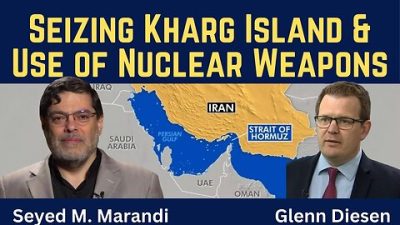
Marandi: Threat of Seizing Kharg Island & the Use of Nuclear Weapons
or go to
Aletho News Archives – Video-Images
Frlom the Archives
Iran War: United States Military Versus Israel Firsters
By James Petras | November 27, 2007
Why must Jewish organizations be and be seen as the loudest drum-beaters of all? Why can we not bring ourselves to say that military intervention is not on the table at all? Why not stash it under the table, out of sight and mount instead a diplomatic assault? – Leonard Fein, Forward
Introduction
As the White House and Congress escalate their economic sanctions and military threats against Iran, top military commanders and Pentagon officials have launched a counter-offensive, opposing a new Middle East War. While some commentators and journalists, like Chris Hedges (Truthdig, November 13, 2007), privy to this high stakes inter-elite conflict, attribute this to a White House cabal led by Vice President Cheney, a more stringent and accurate assessment puts the Zionist Power Configuration (ZPC) in the center of the Iran war debate.
There is a great deal riding in this conflict – the future of the American empire as well as the balance of power in the Middle East. Equally important is the future of the US military and our already heavily constrained democratic freedoms. The outcome of the continuous and deepening confrontation between top US military officials and the Israel Firsters over US foreign policy in the Middle East has raised fundamental questions over self-determination, colonization, civilian primacy and military political intervention, empire or republic. These and related issues are far from being of academic interest only; they concern the future of the United States. … continue
Blog Roll
 Aletho News
- American Military Failure in Afghanistan
- Friendly Skies of Georgia: Are Israeli-Linked Drones Launching False Flags from Georgian Territory?
- The Three Big Lies about Mammography Screening
- Ukrainian Embassy in Beirut sheltering top Mossad agent
- Palestinian family displaced after settlers violently attack them in Humsa, Jordan Valley
- The EU never learns – except for the wrong lessons
- Iran attacks on UAE leaves RSF militia high and dry
- Hosting Washington’s war: Bahrain faces the consequences
- The US fell for its own Iran propaganda
- Seyed M. Marandi: Threat of Seizing Kharg Island & the Use of Nuclear Weapons
- If Americans Knew
- ‘Of Course’: IDF Drops Case Against Soldiers Accused of Raping Palestinian Prisoner
- Don’t Fall for the Regime Change Talk. Israel Is ‘Mowing the Lawn’ in Iran
- Will Israel and the US wreck the Gulf States along with Iran?
- US so far burned through ‘years’ of munitions in Iran war: Report
- How the Israeli Tail Wags the American Dog
- Outdated intel likely led to deadly U.S. strike on Iranian elementary school, sources say
- Pentagon insider says high U.S official Douglas Feith reported to Netanyahu
- In fond memory of Walid Khalidi, the historian of Palestine
- 6 more Americans killed, as Israel ‘mows the lawn’ in Iran – Not a ceasefire Day 154
- Are we on the precipice of World War III?
- No Tricks Zone
- New Studies: UK Sea Levels Were 4 Meters Higher Than Today During The Mid-Holocene
- Destructive Green New Deal: German Energy And Metal Group Warns Of Drastic Crisis
- New Study Documents A 20-Year Pause In Arctic Sea Ice Decline – Driven By Internal Variability
- Wake-up Call: Survey Shows Majority Of Germans Now Favor Postponing Climate Targets!
- Televised! Leading German Political Candidate Tells Schoolchildren CO2 Makes Sun Hotter!
- New Study: A Century Warming Of 1.1°C Is ‘Commonplace’ And ‘Not Unusual’ During This Interglacial
- New Study: ‘Internal Noise’ And Volcanic Forcing Can Trigger 10-15°C Warming Within Decades
- Glaciers Worldwide Are Suddendly Surging, Experts Blame Warming!
- Surprising Discovery: Sahara Is Greening…Billions Of Trees Where Once Thought To Be Barren
- New Research Reaffirms Clouds, Aerosols, And Surface Solar Radiation Are ‘Driving The Climate System’
 Aletho News