Automated License Plate Readers Threaten Our Privacy
By Jennifer Lynch and Peter Bibring | EFF | May 6, 2013
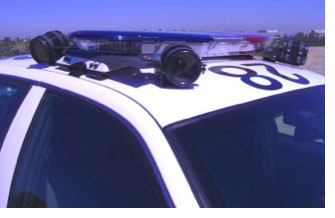 Law enforcement agencies are increasingly using sophisticated cameras, called “automated license plate readers” or ALPR, to scan and record the license plates of millions of cars across the country. These cameras, mounted on top of patrol cars and on city streets, can scan up to 1,800 license plate per minute, day or night, allowing one squad car to record more than 14,000 plates during the course of a single shift.
Photographing a single license plate one time on a public city street may not seem problematic, but when that data is put into a database, combined with other scans of that same plate on other city streets, and stored forever, it can become very revealing. Information about your location over time can show not only where you live and work, but your political and religious beliefs, your social and sexual habits, your visits to the doctor, and your associations with others. And, according to recent research reported in Nature, it’s possible to identify 95% of individuals with as few as four randomly selected geospatial datapoints (location + time), making location data the ultimate biometric identifier.
To better gauge the real threat to privacy posed by ALPR, EFF and the ACLU of Southern California asked LAPD and LASD for information on their systems, including their policies on retaining and sharing information and all the license plate data each department collected over the course of a single week in 2012. After both agencies refused to release most of the records we asked for, we sued. We hope to get access to this data, both to show just how much data the agencies are collecting and how revealing it can be.
ALPRs are often touted as an easy way to find stolen cars — the system checks a scanned plate against a database of stolen or wanted cars and can instantly identify a hit, allowing officers to set up a sting to recover the car and catch the thief. But even when there’s no match in the database and no reason to think a car is stolen or involved in a crime, police keep the data. According to the LA Weekly, LAPD and LASD together already have collected more than 160 million “data points” (license plates plus time, date, and exact location) in the greater LA area—that’s more than 20 hits for each of the more than 7 million vehicles registered in L.A. County. That’s a ton of data, but it’s not all — law enforcement officers also have access to private databases containing hundreds of millions of plates and their coordinates collected by “repo” men.
Law enforcement agencies claim that ALPR systems are no different from an officer recording license plate, time and location information by hand. They also argue the data doesn’t warrant any privacy protections because we drive our cars around in public. However, as five justices of the Supreme Court recognized last year in US v. Jones, a case involving GPS tracking, the ease of data collection and the low cost of data storage make technological surveillance solutions such as GPS or ALPR very different from techniques used in the past.
Police are open about their desire to record the movements of every car in case it might one day prove valuable. In 2008, LAPD Police Chief Charlie Beck (then the agency’s chief of detectives) told GovTech Magazine that ALPRs have “unlimited potential” as an investigative tool. “It’s always going to be great for the black-and-white to be driving down the street and find stolen cars rolling around . . . . But the real value comes from the long-term investigative uses of being able to track vehicles—where they’ve been and what they’ve been doing—and tie that to crimes that have occurred or that will occur.” But amassing data on the movements of law-abiding residents poses a real threat to privacy, while the benefit to public safety is speculative, at best.
In light of privacy concerns, states including Maine, New Jersey, and Virginia have limited the use of ALPRs, and New Hampshire has banned them outright. Even the International Association of Chiefs of Police has issued a report recognizing that “recording driving habits” could raise First Amendment concerns because cameras could record “vehicles parked at addiction-counseling meetings, doctors’ offices, health clinics, or even staging areas for political protests.”
But even if ALPRs are permitted, there are still common-sense limits that can allow the public safety benefits of ALPRs while preventing the wholesale tracking of every resident’s movements. Police can and should treat location information from ALPRs like other sensitive information — they should retain it no longer than necessary to determine if it might be relevant to a crime, and should get a warrant to keep it any longer. They should limit who can access it and who they can share it with. And they should put oversight in place to ensure these limits are followed.
Unfortunately, efforts to impose reasonable limits on ALPR tracking in California have failed so far. Last year, legislation that would have limited private and law enforcement retention of ALPR data to 60 days—a limit currently in effect for the California Highway Patrol — and restricted sharing between law enforcement and private companies failed after vigorous opposition from law enforcement. In California, law enforcement agencies remain free to set their own policies on the use and retention of ALPR data, or to have no policy at all.
Some have asked why we would seek public disclosure of the actual license plate data collected by the police—location-based data that we think is private. But we asked specifically for a narrow slice of data — just a week’s worth — to demonstrate how invasive the technology is. Having the data will allow us to see how frequently some plates have been scanned; where and when, specifically, the cops are scanning plates; and just how many plates can be collected in a large metropolitan area over the course of a single week. Actual data will reveal whether ALPRs are deployed primarily in particular areas of Los Angeles and whether some communities might therefore be much more heavily tracked than others. If this data is too private to give a week’s worth to the public to help inform us how the technology is being used, then isn’t it too private to let the police amass years’ worth of data without a warrant?
After the Boston Marathon bombings, many have argued that the government should take advantage of surveillance technology to collect more data rather than less. But we should not so readily give up the very freedoms that terrorists seek to destroy. We should recognize just how revealing ALPR data is and not be afraid to push our police and legislators for sensible limits to protect our basic right to privacy.
Documents
EFF and ACLU-SC’s legal Complaint
LA Sheriff’s Department ALPR Powerpoint Presentation
LA Sheriff’s Department – Automated License Plate Reader System Information
LAPD – Automated License Plate Reader User Guide
LA Sheriff’s Department – Field Operations Directive
FBI Prepares Billion-Dollar Iris Recognition Database
By Matt Bewig | AllGov | July 08, 2012
With at least 30 million surveillance cameras watching Americans every day, one aspect of the world of George Orwell’s dystopian novel 1984 has already come to pass, and more is on the way. In the next two years, for example, the FBI plans to test a nationwide database for searching iris scans to more quickly identify persons “of interest” to the government. The human iris, which is the doughnut-shaped, colored part of the eye that surrounds the black pupil, exhibits a pattern unique to each individual, just as fingerprints do, and iris recognition has been a staple of science fiction stories and films for years.
Iris scanning is part of the FBI’s Next-Generation Identification system, a multiyear $1 billion program built by Lockheed Martin and already well underway for several years, which will expand the FBI’s server capacity to allow for rapid matching not only of iris scans, but also of additional physical identifiers, such as fingerprints, palm prints and facial images. The FBI intends to test the system in conjunction with prisons, some of which already use iris scans to track prisoners and prevent mistakes of identification. According to the FBI, the time for urgent criminal fingerprint searches will eventually be reduced from 2 hours to 10 minutes, while the use of iris scans and other markers should ensure greater accuracy.
Although privacy advocates have little criticism of the use of iris scanning in correctional settings, the fact that the FBI and state prison officials are using a database owned and maintained by a private corporation, BI2 Technologies, gives many pause. Jennifer Lynch, a staff attorney at the digital rights group Electronic Frontier Foundation, points out that privately-run databases, including well-encrypted ones at banks and other financial businesses, have experienced serious data breaches exposing private customer information, and that leaks of fingerprints or iris scans would be potentially much more serious. “You can change your credit card data. But you can’t change your biometric data.”
And in light of the fact that the New York Police Department, in cahoots with major Wall Street banks and finance firms, used security cameras to identify Occupy Wall Street protesters, suspicions that iris scans might be used to target non-criminals who are disliked by powerful cannot be dismissed out of hand.
Related articles
- Biometric data blows up (salon.com)
- Face to face with online privacy concerns (sfgate.com)
Featured Video

Chinese jet fuel and the myth of energy independence
or go to
Aletho News Archives – Video-Images
Book Review
Former Insiders Criticize Iran Policy as U.S. Hegemony
By GARETH PORTER | CounterPunch | February 27, 2013
“Going to Tehran” arguably represents the most important work on the subject of U.S.-Iran relations to be published thus far.
Flynt Leverett and Hillary Mann Leverett tackle not only U.S. policy toward Iran but the broader context of Middle East policy with a systematic analytical perspective informed by personal experience, as well as very extensive documentation.
More importantly, however, their exposé required a degree of courage that may be unparalleled in the writing of former U.S. national security officials about issues on which they worked. They have chosen not just to criticise U.S. policy toward Iran but to analyse that policy as a problem of U.S. hegemony. … continue
Blog Roll
 Aletho News
- What is fueling unrest across the EU?
- Why no power can undermine Iran’s eternal dominance over the Strait of Hormuz
- Is The War Against Iran Over?
- Iran war will leave long-term ‘scar’ on Wall Street, investors warn
- How Iran decimated US power projection in West Asia: Military lessons of 40-day war
- Iran’s report details US-Israeli war crimes in targeting schools, hospitals, livelihoods
- NATO’s Slow Fracture: How Trump’s Iran War Exposed the Instrument of Hegemony
- Chinese jet fuel and the myth of energy independence
- Ukraine Sea Drone Fired From Libya Hit Russian Tanker in Mediterranean
- IRGC: Iranian forces launched no attacks during ceasefire hours
- If Americans Knew
- Military aid to Israel emerges as the latest political litmus test for Democrats
- The only Palestinian children’s rights organization closes following years-long Israeli campaign against it
- ‘I Can’t Forget the Smell’: Lebanese Reel After Israel Kills Over 300 in Single Day
- DNC Shoots Down Resolutions Calling Out AIPAC and Limiting Arms to Israel
- TCN: Is Israel Blackmailing President Trump?
- Israel killed at least 303 Lebanese yesterday – who were they? Daily Update
- Amnesty: Urgent – Protect Lebanese civilians from brutal escalation in Israeli attacks
- Is The War Against Iran Over?
- Inside the Israeli army’s propaganda wing
- Hundreds of Gaza Amputees Stranded in Legal Limbo
- No Tricks Zone
- New Study: No Linear Warming Or Glacier Retreat Along Northern Antarctic Peninsula Since 1980s
- An Inconvenient Tree: Uncovered In Alps… Europe Much Warmer Than Today 6000 Years Ago
- New Study Reports A 60% Slowdown In Greenland’s Ice Loss Rate In The Last Decade
- Low Intensity Tornado Wrecks Major Solar Farm, Creating A Potential Toxic Dump
- New Study Finds Warming Saves Lives…Cold Temperatures 12 Times More Deadly Than Excess Heat
- German Science Blog Accuses PIK Climate Institute Of Hallucinating Climate Tipping Points
- Devastating Assessment Of Comirnaty Vaccine By Former Senior Pfizer Europe Toxicologist
- New Study: CO2 Is ‘Effectively Negligible’ As An Explanatory Climate Change Factor Since 2000
- Former Pfizer Toxicologist Dr. Helmut Sterz Tells Bundestag Hearing Pfizer Vaccine Should Have Never Been Approved
- Energy Expert: Germany’s Nuclear Phaseout Was A “500 Billion Euro Mistake”
 Aletho News