Haniyeh: ‘Palestine is not for sale’
MEMO | June 27, 2019
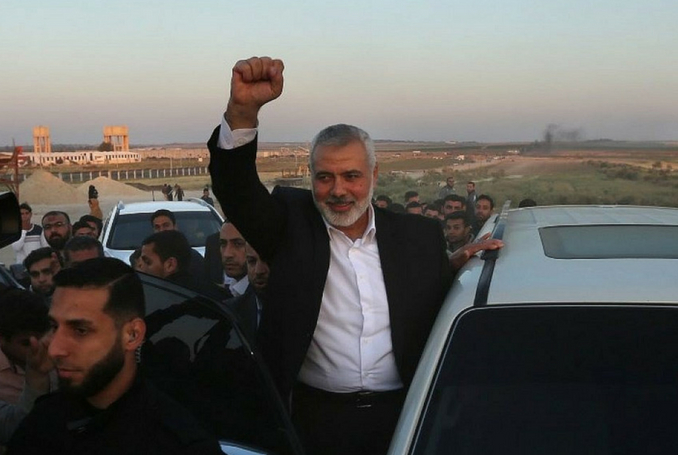
Head of Hamas’ political bureau Ismail Haniyeh has said that the Manama workshop “secures economic cover for a political attempt to liquidate the Palestinian cause.”
Haniyeh’s statement came in a speech during a conference organised by Palestinian factions on Tuesday, entitled the Palestinian National Conference to face the Deal of the Century and Reject the Manama Workshop held in Gaza.
He added: “We are witnessing a crucial historical moment. Our position is clear: Palestine is not for sale. No for deals which consecrate the occupier’s hegemony over our land.”
He continued: “The Palestinian people stand today in the face of the Manama workshop in a renewed uprising and political revolution, as Palestinians have sensed the unprecedented strategic threat facing the Palestinian cause.”
Haniyeh pointed out that the Manama workshop “grants Israel the green light to expand its occupation efforts and control over the entire West Bank, in addition to paving the way for normalisation with Arab countries and the integration of the occupier in the region.”
He stressed that the workshop “was born dead and frustrated. The Palestinian people today stand unified in the face of these deals.”
Haniyeh continued that “all Arab people stand today to emphasise the significance of the Palestinian cause and that Jerusalem is the compass of the nation.”
On Tuesday evening the Manama Peace to Prosperity Workshop began in Bahrain, looking at the economic aspects of the Middle East peace settlement plan, known as the deal of century, according to US media.
Haniyeh demanded all factions “insist on steadfast adherence to the Palestinian cause, primarily Jerusalem, the right of return and a sovereign state with Jerusalem as its capital on the entire national territory.”
Haniyeh said: “We, Hamas, are ready now to meet with Palestinian President Mahmoud Abbas in Gaza, in Cairo or anywhere.”
Haniyeh called for “the formation of a government of national accord to run our affairs, and prepare for the presidential and legislative elections as well as the Palestinian National Council.”
The movement’s leader also called for “the reconstruction of the Palestine Liberation Organisation to include all factions under one single leadership.”
Israeli municipality in Jerusalem names Silwan streets after rabbis
Palestine Information Center | June 21, 2019
OCCUPIED JERUSALEM – The Israeli municipality in Occupied Jerusalem has decided to name some streets in the predominantly Arab Silwan neighborhood after Jewish rabbis.
According to Haaretz, the move was against the recommendation of a professional panel who said “It is inappropriate to give Jewish street names in neighborhoods overwhelmingly populated by Arabs.”
The naming committee in the municipality, headed by Mayor Moshe Leon, named five alleyways and narrow streets in the Baten Al-Hawa neighborhood of Silwan.
The neighborhood, which is currently the home of 12 Jewish families and hundreds of Palestinian families, is targeted by extremist settler groups, including Ateret Cohanim.
Settlers claim there was a small Jewish-Yemenite community in the neighborhood 80 years ago. The newly-approved street names are “Ezrat Nidhim,” after the charitable organization founded by Yisroel Dov Frumkin in the late 19th century which established the Yemenite community.
The other streets are named after Yemenite rabbis. The decision was taken by a majority of eight to two.
The committee made the decision despite the opinion of a professional panel, who warned that the move will “create unnecessary tension. The names will not be used by residents and will therefore be futile.” The committee recommended neutral street names which will benefit all residents.
The two committee members opposing the decision are city coalition members Laura Wharton and Yossi Havilio. Havilio said he firmly opposes as the move, adding that it provokes Arab residents and will inflame the atmosphere in the neighborhood.
Israeli Minister’s Draft Bill: 3 Years In Prison for Supporting PA Activity in Jerusalem
Palestine Chronicle | June 18 2019
Israel’s Public Security Minister Gilad Erdan has “proposed a new bill that would impose a maximum sentence of up to three years in prison for those who sponsor, finance, support or organize activities for the Palestinian Authority (PA)” in occupied East Jerusalem, reported Asharq Al-Awsat.
Currently, Israeli law “prohibits organization of activities in favor of the PA in Jerusalem, but does not penalize those who organize such activities”.
Erdan has thus “proposed a series of penalties amounting to 3 years imprisonment to completely prevent such activities.”
According to the report, Erdan has made the move after being briefed by the Shin Bet that “Palestinian activities in East Jerusalem have increased recently”, including “demonstrations, festivals and political seminars”.
The minister claims that the legislative amendment “will dramatically enhance the deterrence of those cooperating with the PA”, preventing “foothold of the Palestinian Authority in Jerusalem”.
In recent years, Israeli authorities have conducted dozens of campaigns of political repression against supposedly PA-linked activities in occupied East Jerusalem, including the detention of activists, intellectuals and officials.
Three months ago, the report noted, Israel banned a cultural activity in the French Cultural Centre in East Jerusalem, “causing a diplomatic problem with the French Foreign Ministry, which summoned the Israeli ambassador to Paris, Aliza Bin-Noun”.
Palestinian Photojournalist at Risk of Deportation
IMEMC News & Agencies | June 2, 2019
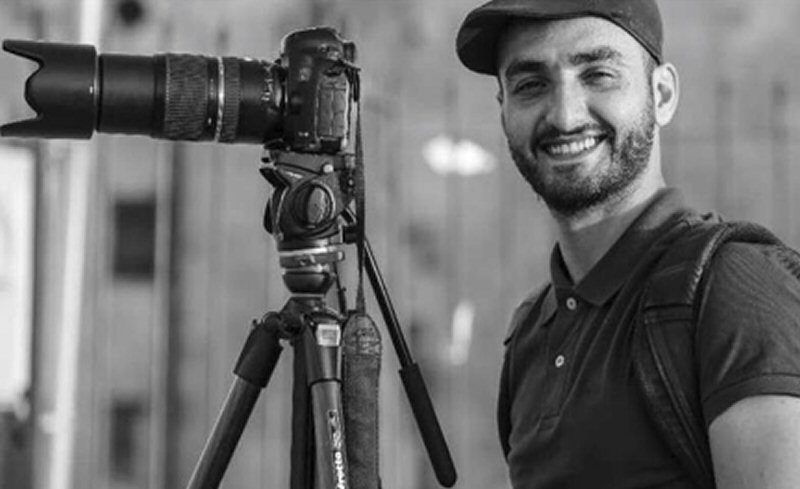
For the past five months, Mustafa al-Kharouf has been languishing inside Israel’s Givon prison, away from his wife Tamam and their one-and-a-half-year-old daughter Asia. But, now, he faces deportation to Jordan.
The 32-year-old photojournalist, son to an Algerian mother and a Palestinian father, has been living in Jerusalem since 1999, when his family returned.
Despite repeated attempts, over the past decade, he has been denied permanent residency status, which he is entitled to, thus rendering him stateless.
By the time Kharouf’s family met the conditions set by the policy, to get residency, Mustafa was 18 years old and his family was not able to submit an application for either reunification or child registration, on his behalf.
In January, Mustafa, who worked with Anadolu Agency, was detained after his lawyer challenged the Israeli interior ministry’s decision to reject his request for legal status.
His fate is now in the hands of an Israeli high court, which will decide if he will be deported to Jordan, a country he has no ties to.
In order to attain their “legal” status as Palestinians in the city, Kharouf’s family applied for family reunification, Al Jazeera/Al Ray further reports.
But, at the core of Israel’s complicated laws for Palestinian residents of Jerusalem – who are granted residency rights but not Israeli citizenship – is the “center of life” policy, which has been described as a legalized ethnic cleansing.
The policy, which requires Palestinians living in occupied East Jerusalem to prove they keep a center of life in the city, to uphold their legal status, has been criticized by rights groups as discriminatory, and as a precursor to forcible transfers – a serious violation of international law.
Legal status rejected by Israeli interior ministry
Adi Lustigman, Kharouf’s lawyer from the Israeli rights organization HaMoked, told Al Jazeera that Kharouf tried to regulate his status in Jerusalem for years, but to no avail.
“He had an interim order during some periods, but, the rest of the times, he has just managed, like many other stateless and status-less Jerusalemites do,” Lustigman said.
“It is, of course, enormously difficult to be a person with no rights, no work permit, and nowhere to go, in order to be legal.”
From October 2014 to 2015, Kharouf was granted an Israeli B/1 work visa, on a “humanitarian basis”. Yet, requests for a visa extension were eventually rejected by the ministry of interior for “security reasons”.
Lustigman believes that the ministry’s rejections are related to his work as a photojournalist documenting human rights abuses committed by the Israeli authorities, in occupied East Jerusalem.
After Kharouf was married, in 2016, to his wife Tamam, a Palestinian Jerusalemite, he filled out another family reunification application, but it was again rejected in December of 2018, by the interior ministry.
According to Lustigman, the decision was based on unfounded accusations that Kharouf was a member of Hamas, which is banned by Israel.
The lawyer appealed the decision on January 21, 2019, but, the next day, Israeli forces raided Kharouf’s home and abducted him, and he has since been placed under administrative detention – indefinite imprisonment without trial or charge.
“My husband is the most optimistic person I know. But, now, he is beyond miserable,” Kharouf’s wife Tamam told Al Jazeera.
Tamam is permitted to visit her husband once a week, for a maximum of 20 minutes, behind a glass window.
“His spirits have deteriorated so much since his arrest,” the 27-year-old school counselor said. “He has lost 10 kilograms, and is very depressed.”
A few months later, in April, the Israeli District Court rejected Kharouf’s appeal and gave an interim order not to deport him, so he is able to take his case to Israel’s High Court, with May 5 given as the deadline. The appeal has already been filed, but the High Court has yet to make a decision. Kharouf remains at imminent risk of being forcibly deported to Jordan.
Deportation order ‘illegal’
Saleh Hijazi, the head of Amnesty International’s Jerusalem office, described the Israeli decision to refuse Kharouf’s residency application and deport him as “cruel and unlawful”.
“[Kharouf] must be released immediately and granted permanent residency in East Jerusalem, so he can resume his normal life with his wife and child,” Hijazi said.
“The arbitrary detention and planned deportation of Mustafa al-Kharouf reflect Israel’s long-term policy to reduce the number of Palestinian residents of East Jerusalem, while denying them their human rights,” he continued.
Following Israel’s illegal annexation of East Jerusalem in 1967, at least 14,600 Palestinians have had their residency permits revoked.
Under the Fourth Geneva Convention, the deportation of protected people from an occupied territory is illegal. The Rome Statute of the International Criminal Court stipulates that “the deportation or transfer [by the occupying power] of all or parts of the population of the occupied territory within or outside this territory” constitutes a war crime.
“A person cannot be left stateless”, Jessica Montell, Executive Director of HaMoked, said in an April press release.” On the practical level, there is no sense holding Mustafa ‘pending deportation’ when there is no country to which Israel can deport him.
“The High Court of Justice has recognized East Jerusalemites as an indigenous population with a unique status. Israel must therefore release Mustafa without delay and give him the legal status to which he is entitled, as a Jerusalemite.”
Tamam has been busy consulting with lawyers, to see what can be done. But, she said that most of them say her husband’s case is too complicated, and refuse to take it on.
“I haven’t thought about an alternative plan for us,” Tamam said. “If Mustafa gets deported to Jordan, he will not receive residency, let alone citizenship.
“In fact he’ll get detained by Jordanian authorities as soon as he crosses the border, for as long as it will take them to review his files and come to a decision on what to do with him,” she continued.
“If he gets deported, it won’t be just one family that will be fragmented. He’ll be ripped away from me and my daughter, from his parents, and from his in-laws.”
Lustigman says that the importance of highlighting Kharouf’s case can make the difference in not uprooting the photojournalist’s life.
“We hope that public opinion, press interests, and NGO actions would have a certain weight and be of help,” the lawyer said.
Jerusalem Cable Car Project Passes Over Objections from Many Quarters
Political interests drive tourism plan that would blight historic city’s skyline and bypass Palestinians
By Jonathan Cook • The National • May 14, 2019
East Jerusalem has received new impetus from the rise of the Israeli far right and Washington’s decision to move its embassy to the city. But if completed, critics say, the long-running proposal would contribute to erasing the visibility of Palestinians in the city they hope to make their capital.
Planning for the $55 million tourism project continues despite unifying archaeologists, architects, Palestinians, and a tiny community of Jews against it – in a sign of Israel’s ever-growing confidence in making unilateral moves in occupied parts of Jerusalem.
Critics say the cable car will help hide the local Palestinian population from the roughly 3 million tourists who visit Jerusalem each year, turning the city into a “Disneyland” focused on promoting Israeli interests.
“The advantage for Israel is that visitors can be prevented from having any dealings with Palestinians,” said Aviv Tartasky, a researcher with Ir Amim, an Israeli organisation that campaigns for equal rights in Jerusalem.
“The local population will be largely erased from the experience of visiting Jerusalem. Tourists will pass over Palestinian residents, via the cable car, and then pass under them via tunnels.”
Israel’s Ministry of Tourism dismissed the criticism. In a statement to The National, the ministry said the cable car project was “a significant milestone in the promotion of Jerusalem and the strengthening of its status as a world tourism capital”.
Settler-run tours
The cable car, the largest project of its type undertaken by Israel, could be completed as early as in two years, its destination the slopes in occupied East Jerusalem just below the Old City, next to Al Aqsa mosque and the Dome of the Rock. Some 72 cabins have the capacity to ferry up to 3,000 visitors an hour above mainly Palestinian homes.
Tourists will be channelled from the cable car into a visitor centre run by Jewish settlers in the heart of the crowded Palestinian neighbourhood of Silwan. They will be led by settler-approved guides underground, through tunnels under Palestinian homes to the foot of the Western Wall.
Blueprints show that visitors will be able to shop in the tunnels, bypassing local Palestinian traders in the Old City market who have long depended on tourism. Israeli officials accelerated the project by bypassing routine planning procedures, even though urban planning specialists warn that it will damage the Jerusalem skyline and archaeological sites revealing the origins of modern civilisation.
Equally important, critics say, the Benjamin Netanyahu government and settler groups view the cable car as helping block any possibility of a Palestinian state emerging with East Jerusalem as its capital. They have been emboldened by President Donald Trump’s 2017 decision to transfer the US embassy from Tel Aviv to Jerusalem.
“It should set off alarm bells that a huge state project like this is being intertwined with a private settler organisation, physically forcing visitors to go through its visitor centre, channelling them into its attractions and activities,” Mr Tartasky said.
He said the cable car was one of the ways Israel was connecting disparate settler compounds in the Palestinian neighbourhoods of occupied Jerusalem.
“It will physically strengthen these settler areas, and mean their organisations have an even greater influence on Israeli authorities.”
Encircling Al-Aqsa
The project has been forcefully promoted by the Israeli tourism ministry, headed by Yariv Levin, an ally of Mr Netanyahu, and Jerusalem’s mayor, Moshe Lion. Tenders will be issued as soon as the National Planning Council approves the project, which is expected to be a formality.
In violation of international law, Israel has treated East Jerusalem as annexed territory since it occupied the city in 1967. More than 200,000 Jewish settlers have moved there over subsequent decades
Hanna Swaid, a Palestinian planning specialist and former member of the Israeli parliament, said the cable car was illegal because international law allows major changes in occupied territory only out of military necessity or for the benefit of the population under occupation.
“Even in its own planning justifications, the Israeli authorities are clear the cable car is designed only for the benefit of tourists, Israeli developers and the settler groups overseeing it, not the local Palestinian population. In fact, it will serve to actively harm Palestinians in Jerusalem,” Mr Swaid said.
“It will parachute tourists to Jewish sites like the Western Wall, and marginalise Muslim and Christian sites,” he added.
Palestinians are concerned that the cable car will serve to tighten Israel’s control over access to the Al Aqsa mosque compound, the highly sensitive holy site in the Old City. For decades Israeli authorities have moved to weaken the control of Islamic religious authorities, the Waqf, on Al Aqsa, contributing to repeated clashes at the site.
Jews believe the mosque is built over the ruins of a major Jewish temple. The Western Wall, which supports the mosque compound, was originally a retaining wall of the long-lost temple.
“The cable car looks suspiciously like another means for encircling Al Aqsa, for laying siege to it,” Mr Swaid said.
Tunnels under Palestinians
According to official plans, dozens of cabins will run hourly along a 1.5-kilometre route from West Jerusalem, inside Israel’s recognised borders, to the occupied Palestinian neighbourhood of Silwan, just outside the Old City walls and in the shadow of Al Aqsa.
Tourists will disembark in Silwan into a large visitor centre, the Kedem compound, to be run by a settler organisation called Elad that has close ties with the Israeli government.
The Kedem centre is the latest venture in the City of David complex, an archaeological site that the settlers of Elad have been using for more than two decades as a base to seize control of the Palestinian neighbourhood.
Visitors will be taken on tours to explore Jerusalem, moving through ancient sewage tunnels that run under Palestinian homes and reach to walls of Al Aqsa.
Additional plans will eventually see the cable car alight at other sites in East Jerusalem. Among them are the Mount of Olives, which includes an ancient Jewish cemetery; the Church of Gethsemane, at the reputed site where Judas betrayed Jesus; and the Pool of Siloam, a bathing area referred to in the Old and New Testaments.
Yonatan Mizrahi, the director of Emek Shaveh, a group of Israeli archaeologists opposed to the misuse of archaeology and tourism by Israel, said: “The purpose is to offer tourists a one-dimensional narrative about Jerusalem and its history. They should see all layers of the city’s rich history. Instead they will hear only the parts that relate to Jewish history.”
Mr Mizrahi has been among those leading the criticism of the project. “No other historic city in the world has built a cable car – and for very good reason,” he said.
Jerusalem ‘not Disneyland’
In March about 30 international architects – some of whom have worked on projects in Jerusalem – wrote to Mr Netanyahu urging him not to pursue what they called short-term interests.
“The project is being promoted by powerful interest groups who put tourism and political agendas above responsibility for safeguarding Jerusalem’s cultural treasures,” the letter said.
The letter followed a statement by 70 Israeli archaeologists, architects and public figures against the cable car in November, when the project was sped up. They said: “Jerusalem is not Disneyland, and its landscape and heritage are not for sale.”
A French firm, Safege, which worked on the initial feasibility study, pulled out in 2015, reportedly under pressure from the French government over concerns that the project violated international law.
In an apparent bid to ensure the project would go through, the previous Netanyahu government changed planning laws to remove the cable car from local and regional oversight. It also ensured the public could not submit objections.
Instead the scheme is being treated as a “national infrastructure” project, similar to a new railway line or gas pipeline. The National Planning Council offered a curtailed period for organisations to lodge reservations that ended on March 31.
Mr Swaid, who is the director of the Arab Centre for Alternative Planning, drew up a list of reservations on behalf of the Supreme Religious Council of Muslims in Israel.
Other critical comments were submitted by lawyers for the Silwan neighbourhood, the archaeologists of Emek Shaveh, the planning group Bimkom, a Palestinian merchant association in the Old City, and a tour guides group.
The Karaites, a small Jewish sect whose ancient cemetery lies in the path of the cable car, in the Biblical Hinnom Valley, said the project showed “contemptuous disregard for the dignity of the deceased and the Karaite community in general”.
Benjamin Kedar, a former chairman of the Israel Antiquities Authority, lodged a protest too.
Loss of all privacy
One of the Silwan homes in the path of the cable car belongs to the Karameh family. The cabins may pass only four metres above the flat roof where toddlers play and the family of 20 hang their washing. Support columns for the cable car may end up being driven into the family’s garden, one of the few green spots in Silwan.
“Nowhere in Israel do cable cars travel over houses, let alone a few metres above,” said Mr Mizrahi. “It seems clear why in this case. Because the houses belong to Palestinians.”
Samer Karameh, a 24-year-old lorry driver, said everyone in Silwan was opposed to the cable car, as it would be helping settler groups like Elad trying to take over their neighbourhood. But he was shocked to learn that it would pass so close to his house.
“We’ll lose all privacy. We won’t be able to open the windows without being seen by thousands of strangers. And it can’t be safe to have these cars travelling just over the heads of our children,” Mr Karameh said.
“We know we won’t be the beneficiaries,” he added. “The authorities won’t give us a permit to build anything here, so all the business will go to the settlers.”
How Israel is Working to Remove Palestinians from Jerusalem
By Jonathan Cook | The National | April 1, 2019
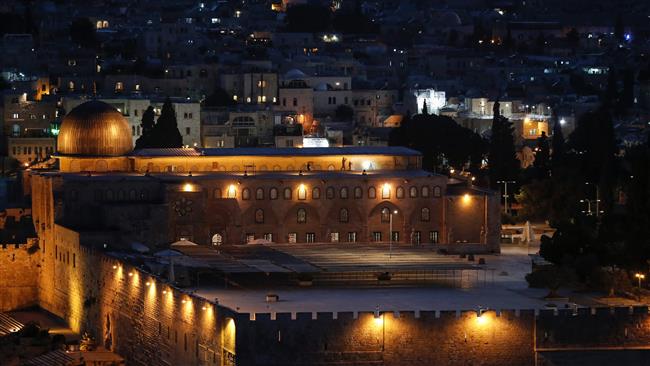
The 350,000 Palestinian inhabitants of occupied East Jerusalem are caught between a rock and hard place, as Israel works ever harder to remove them from the holy city in which they were born, analysts and residents warn.
That process, they say, has only accelerated in the wake of US President Donald Trump’s decision a year ago to relocate the American embassy to Jerusalem, effectively endorsing the city as Israel’s exclusive capital.
“Israel wants Palestinians in Jerusalem to understand that they are trapped, that they are being strangled, in the hope they will conclude that life is better outside the city,” said Amneh Badran, a politics professor at Jerusalem’s Al Quds university.
Since Israel seized the eastern part of Jerusalem in 1967 and then illegally annexed it in 1981, it has intentionally left the status of its Palestinian population unresolved.
Israeli officials have made Palestinians there “permanent residents,” though, in practice, their residency is easily revoked. According to Israel’s own figures, more than 14,500 Palestinians have been expelled from the city of their birth since 1967, often compelling their families to join them in exile.
Further, Israel finished its concrete wall slicing through East Jerusalem three years ago, cutting some 140,000 Palestinian residents off from the rest of the city.
A raft of well-documented policies – including house demolitions, a chronic shortage of classrooms, lack of public services, municipal underfunding, land seizures, home evictions by Jewish settlers, denial of family unification, and police and settler violence – have intensified over the years.
At the same time, Israel has denied the Palestinian Authority, a supposed government-in-waiting in the West Bank, any role in East Jerusalem, leaving the city’s Palestinians even more isolated and weak.
All of these factors are designed to pressure Palestinians to leave, usually to areas outside the wall or to nearby West Bank cities like Ramallah or Bethlehem.
“In Jerusalem, Israel’s overriding aim is at its most transparent: to take control of the land but without its Palestinian inhabitants,” said Daoud Alg’ol, a researcher on Jerusalem.
Like others, Mr Alg’ol noted that Israel had stepped up its ‘Judaisation’ policies in Jerusalem since the US relocated its embassy. “Israel is working more quickly, more confidently and more intensively because it believes Trump has given his blessing,” he said.
Demographic concerns dominated Israel’s thinking from the moment it occupied East Jerusalem in 1967, and subordinated it to the control of Jewish officials in West Jerusalem – in what Israel termed its newly “united capital”.
City boundaries were expanded eastwards to attach additional Palestinian lands to Jerusalem and then fill in the empty spaces with a ring of large Jewish settlements, said Aviv Tartasky, a researcher with Ir Amim, an organisation that campaigns for equal rights in Jerusalem.
The goal, he added, was to shore up a permanent three-quarters Jewish majority – to ensure Palestinians could not stake a claim to the city and to allay Israeli fears that one day the Palestinians might gain control of the municipality through elections.
Israel has nonetheless faced a shrinking Jewish majority because of higher Palestinian birth rates. Today, Palestinians comprise about 40 per cent of the total population of this artificially enlarged Jerusalem.
Israel has therefore been aggressively pursuing a twin-pronged approach, according to analysts.
On one side, wide-ranging discriminatory policies – that harm Palestinians and favour Jewish settlers – have been designed to erode Palestinians’ connection to Jerusalem, encouraging them to leave. And, on the other, revocation of residency rights and the gradual redrawing of municipal boundaries have forcibly placed Palestinians outside the city – in what some experts term a “silent transfer” or administrative ethnic cleansing.
Israel’s efforts to disconnect Palestinians from Jerusalem are most visibly expressed in the change of Arabic script on road signs. The city’s Arabic name, Al Quds (the Holy), has been gradually replaced by the Israeli name, Urshalim, transliterated into Arabic.
The lack of services and municipal funding and high unemployment mean that three-quarters of Palestinians in East Jerusalem live below the poverty line. That compares to only 15 per cent for Israeli Jews nationally.
Despite these abysmal figures, the municipality has provided four social services offices in the city for Palestinians, compared to 19 for Israeli Jews.
Only half of Palestinian residents are provided with access to the water grid. There are similar deficiencies in postal services, road infrastructure, pavements and cultural centres.
Meanwhile, human rights groups have noted that East Jerusalem lacks at least 2,000 classrooms for Palestinian children, and that the condition of 43 per cent of existing rooms is inadequate. A third of pupils fail to complete basic schooling.
But the biggest pressure on Palestinian residents has been inflicted through grossly discriminatory planning rules, said Mr Tartasky.
In the areas outside the wall, Palestinians have been abandoned by the municipality – and receive no services or policing at all.
Israel’s long-term aim, said Mr Tartasky, had been exposed in a leak of private comments made by Israeli Prime Minister Benjamin Netanyahu in 2015. He had proposed revoking the residency of the 140,000 Palestinians outside the wall.
“At the moment, the government is discussing putting these residents under the responsibility of the army,” Mr Tartasky said.
That would make them equivalent to Palestinians living in Israeli-controlled areas of the West Bank and sever their last connections to Jerusalem.
Meanwhile, on the inner side of the wall, Palestinian neighbourhoods have been tightly constrained, with much of the land declared either “scenic areas” or national parks, in which construction is illegal, or reserved for Jewish settlements. The inevitable result has been extreme overcrowding.
In addition, Israel has denied most Palestinian neighbourhoods’ masterplans, making it all but impossible to get building permits.
“The advantage for Israel is that planning regulations don’t look brutal – in fact, they can be presented as simple law enforcement,” said Mr Tartasky. “But if you have no place to live in Jerusalem, in the end you’ll have to move out of the city.”
An estimated 20,000 houses – about 40 per cent of the city’s Palestinian housing stock – are illegal and under threat of demolition. More than 800 homes, some housing several families, have been razed since 2004.
As well as the large purpose-built Jewish settlements located on Palestinian land in East Jerusalem, several thousand extremist settlers have taken over properties inside Palestinian neighbourhoods, often with the backing of the Israeli courts.
Mr Tartasky noted that Israel has been accelerating legal efforts to evict Palestinians from their homes over the past year, with close to 200 families in and around the Old City currently facing court battles.
When settlers move in following such evictions, Ms Badran said, the character of the Palestinian neighbourhoods rapidly changes.
“The settlers arrive, and then so do the police, the army, private security guards and municipal inspectors. The settlers have a machine behind them whose role is to make life as uncomfortable as possible for Palestinians. The message is: ‘You either accept your subjugation or leave’.”
In Silwan, where settler groups have established a touristic archaeological park in the midst of a densely populated Palestinian community just outside the Old City walls, life has been especially tough.
Mr Alg’ol, who lives in Silwan, noted that fortified settler compounds had been established throughout the area, many dozens more Palestinian families were facing evictions, excavations were taking place under Palestinian homes, closed-circuit TV watched residents 24 hours a day, and the security services were a constant presence. Many hundreds of children had been arrested in recent years, usually accused of stone throwing.
Israel’s newest move is the announcement of a cable car to bring tourists from West Jerusalem through Palestinian neighbourhoods like Silwan to the holy sites of the Old City.
Mr Tartasky said touristic initiatives had become another planning weapon against Palestinians. “These projects, from the cable car to a series of promenades, are ways to connect one settlement to the next, bisecting Palestinian space. They strengthen the settlements and break apart Palestinian neighbourhoods.”
Mr Alg’ol’s family was one of many in Silwan that had been told their lands were being confiscated for the cable car and a new police station.
“They want to turn our community into an archaeological Disneyland,” he said. “And we are in the way. They plan to keep going until we are all removed.”
The merger of the US consulate and embassy in Jerusalem completes the humiliation of the Palestinians
By Motasem A Dalloul | MEMO | March 5, 2019
The US State Department announced on Tuesday that it is going to merge the American consulate general in East Jerusalem with the American embassy in West Jerusalem. A statement published on the embassy website in Israel said that, “We will continue to conduct all of the diplomatic and consular functions previously performed by the US Consulate in Jerusalem.”
This move was celebrated by the Israeli occupation authorities, although it has angered the Palestinians The Palestinian Authority suspended its relationship with the US administration when US President Donald Trump recognised Jerusalem as the capital of of Israel in December 2017 and relocated the US embassy from Tel Aviv to the holy city in May last year.
Saeb Erekat, the general secretary of the PLO’s Executive Committee, described the merger as “the final nail in the coffin” of the US administration as a sponsor of the peace process, which has in any case been moribund since 2014. According to a senior member of the PLO’s Central Committee, Hanan Ashrawi, “The Trump administration is intent on leaving no room for doubt about its hostility towards the Palestinian people and their inalienable rights, as well as its abject disregard for international law and its obligations under the law.”
Ashrawi insisted that the merger of the US consulate in Jerusalem with the US embassy to Israel, which is now located illegally in Jerusalem, is not an administrative decision. “It is a political assault on Palestinian rights and identity and a negation of the consulate’s historic status and function, dating back nearly 200 years.” She reiterated that this move “precludes any possible positive role for the current US administration in seeking peace and stability.”
State Department spokesman Robert Palladino, however, claimed that the decision was driven by Washington’s global efforts to increase the efficiency and effectiveness of its diplomatic engagements and operations. “It does not signal a change of US policy on Jerusalem, the West Bank, or the Gaza Strip.”
Speaking to MEMO, Professor of Political Sciences at Al-Najah University in the occupied West Bank Abdul Sattar Qasim described the merger as a “humiliation” for the Palestinians. “The US premise is that the Palestinian Authority did not accept the relocation of the US embassy to Jerusalem so that it decided to oblige the PA and the Palestinians to go to the embassy [for consular services] on their own two feet.”
“After this move, nothing remains hidden about the American intentions regarding the Palestinian cause,” added Dr Hanna Issa, an expert in diplomatic affairs. “The US has been undermining the Palestinians from penetrating any international body through its support for Israel, vetoes and stick. Now, it has cancelled any possible future recognition of a Palestinian state because it has cut its last diplomatic channel with the Palestinians by closing its consulate in East Jerusalem.”
The consulate-general in Jerusalem was established in 1844, Dr Issa pointed out. ”In moving it, the US has declared openly that there is no difference between East and West Jerusalem and both are parts of the same ‘Israeli’ city. In addition, the merger means that there is no need to have two separate representatives for the same country – Israel.”
Although Palladino stressed that Washington “remains fully committed to efforts to achieve a lasting and comprehensive peace that offers a brighter future to Israel and the Palestinians,” Prof. Qasim insists that this is not true. “The merger is not an innocent move. It is a fulfilment of Israeli promises [that Palestine is the Jewish State of Israel] and implementation of Israeli laws.” he said, “It is the prelude to US recognition of the illegal Jewish settlements in the occupied Palestinian territories.”
The US Ambassador to Israel, David Friedman, is a vociferous supporter of Israeli colonial-settlements, Qasim has no doubt that he will carry out this mission. The US consulate used to prepare reports about settlements for the US State Department; this will now be the mission of the embassy which is overseen by Friedman, so we can guess that they will be very favourable.
America’s moves on the ground give the lie to Palladino’s claim that the Trump administration is still committed to peace in the interests of both Israelis and Palestinians. It looks more like a brighter future for Israel and yet more gloom for the Palestinians. Not only has Washington doubled its support for Israel, but it has also cut more than $500 million from donations to the UN Relief and Works Agency for Palestine Refugees (UNRWA) and other aid programmes.
The Americans, explained Qasim, have been working hard to undermine the PA’s status as an autonomous entity which serves Palestinian interests. “The PA will lose its prestigious status after this move,” he said. “The Palestinian people will now see that the PA does not deserve any diplomatic representation from a long-standing ally which was regarded for decades as the country which would fulfil Palestinian dreams.”
In response, he suggested that the Palestinians should begin a popular protest campaign against the US and Israeli measures. Optimistically, Prof. Qasim added that this should not be stopped by the PA, although he does not expect the Ramallah-based authority to allow such a campaign to get off the ground.
Hanna Issa accused the Americans of “racial discrimination” against the Palestinians by closing the consulate. “What else does it mean given that the US has official representation offices for every nation, but the mission which was established 200 years ago in Palestine has been ended?” Nevertheless, he does not expect the PA or any Arab state to raise any complaints, because they have basically given the Israelis and Americans the green light to do what they want. The PA might be a loser in all of this, but it still does what it is told by the occupation authorities and their allies. “We have no hope in the PA or the Arab regimes,” Dr Issa concluded. “If the PA is serious about stopping the unilateral measures on the ground, it should unite the Palestinians, rearrange the Palestinian home and agree on a resistance programme.”
The merger of the US consulate and embassy in Jerusalem really does complete the abject humiliation of the people of Palestine. What will the Palestinian Authority do about it? Nothing whatsoever is my guess. And that is what is truly humiliating.
Palestine: the Middle Eastern Equation with Many Unknowns
By Veniamin Popov – New Eastern Outlook – 03.03.2019
In the middle of February 2019, one of the main Israeli newspapers, Haaretz, published an article, which reported that, according to official Israeli statistics, 6.7 million Jews and 6.7 million Arabs lived in Israeli territories (including the occupied Palestinians lands) at the beginning of 2019.
In the eyes of the opposition forces in Israel, these numbers yet again highlight the intensity of the Arab-Israeli conflict, and underscore the need to resolve this issue as quickly as possible using a two-State solution, described in numerous UN documents. It is worth noting at this point that the nation state of Israel itself was born of the decision made by the United Nations Organization, which over the past 70 years has adopted more than 3,000 resolutions on creating two states, an Arab one and a Jewish one in the former Palestinian territory.
Leftist forces in Israel have consistently supported the idea of demography being a key factor, which should compel the Israeli government to find such means of resolving the conflict that will be acceptable to the Palestinian population. Otherwise Israel will embark on a path towards establishing a system of apartheid to control those who live in the Israeli-occupied territories in Palestine.
Another common argument is that birth rates among Palestinians are higher than those in Israel, hence it will become difficult to maintain a Jewish majority in the state in the future.
The situation in Israel ahead of its upcoming legislative elections is far from simple. For instance, Benjamin Netanyahu was even forced to reschedule his visit to Moscow since his political opponents were making serious efforts to ally together in order to weaken his position. But, at the very beginning of the year it seemed that Netanyahu’s victory was assured.
Accordingly, there has been a lot of talk about the so-called deal of the century, meant to resolve the Middle East situation, that the U.S. President Donald Trump promised to publicize in the next few months.
Based on the already available leaks, Palestinians have already, by and large, rejected this plan, as it does not include any mention of East Jerusalem being the capital of the potential Palestinian state, and it almost completely ignores the refugee problem. According to Palestinian sources, Americans would only like to discuss the issue of approximately 40,000 refugees, who have survived the war in 1948, and do not plan on taking into account the fact that the overall number of refugees has increased to 5 million over these years.
It is common knowledge that Donald Trump’s recognition of Jerusalem as the capital of Israel, and the transfer of the American Embassy to this city have caused outrage in the Muslim world.
In light of these developments, on 14 February 2019, the Jerusalem Post reported that the Al-Aqsa Mosque and the Old City of Jerusalem were “too symbolic, holy and sacred for Muslims to allow their leaders to agree to allow Israel to receive legitimization for their control.”
The world today is becoming more and more interdependent and is widely recognized as multi-focal. Although the United States has a prominent place in the international community, it cannot enforce many of its decisions. Paradoxically, Washington’s allies, even if often not very consistently, yet more and more actively, are attempting to defend their own interests and follow their own policies.
The stance taken by a number of nations towards the UN Relief and Works Agency for Palestine Refugees (UNRWA) is noteworthy in this regard. When Americans refused to make a contribution to support the work of this organization, some Asian and European nations compensated for the lacking funds on request from Palestinians.
However, the USA is still striving to marginalize the Palestinian issue to the sidelines of history, by announcing that the key problem facing the Middle East is the fight against Iran. But, the fact that an attempt to unite Israel and several other Arab nations into an alliance against Tehran at the Middle East conference in Warsaw failed makes it reminiscent of an endeavor to portray wishful thinking as reality as, according to our literary giant, “You cannot hitch a trembling doe and horse up to a single carriage”.
Veniamin Popov, Director of the Center for Partnership of Civilizations at MGIMO (Moscow State Institute of International Relations) of the Russian Ministry of Foreign Affairs, Ambassador Extraordinary and Plenipotentiary.
War on Al-Aqsa: What price for Netanyahu’s victory
By Ramzy Baroud | MEMO | February 26, 2019
On 18 February, members of extremist Jewish groups raided the Al-Aqsa Mosque compound in Occupied Al-Quds (Jerusalem). They clashed with Palestinian worshippers, as the settlers attempted to shut down the gate of Al-Aqsa itself.
The clashes involved the Israeli army and police as well, who opened fire and brutally assaulted Palestinians, leading to scores of injuries.
On February 19, the Israeli army carried out the unusual step of shutting down Al-Rahma Gate, which leads to a section of the Al-Aqsa compound that has, itself, been shut down by the Israeli army since 2003.
The provocative decision to seal the gate was made in advance, and the lock and key have the fingerprints of Israeli Prime Minister, Benjamin Netanyahu.
It is quite typical for Israeli politicians to carry out confrontational measures against Palestinians shortly before general elections are due. The nature of these measures is determined by the kind of political constituency that Israeli leaders aim to appease.
However, a war on Gaza, at least for now, is too risky an option for Netanyahu as it would take place too close to the April 9 elections date. Moreover, a botched Israeli attack on the Strip on November 11 caused Netanyahu a major embarrassment, forcing him to shelve the Gaza option for now.
That said, if the Israeli Prime Minister’s political standing grows too desperate in the coming weeks, a Gaza war may, once again, be placed on the table.
Indeed, the political union between Benny Gantz and Yair Lapid, which was declared on February 21, has certainly upped the ante for Netanyahu who has assumed that his election victory is a foretold conclusion.
Gantz and Lapid merged their two parties into one election list called Kahol Lavan (“Blue and White”), the single most serious electoral challenge for Netanyahu in years.
For the time being, Netanyahu has decided to appeal to the most messianic religious segments of Israeli society to keep his challengers at bay. This should come as no surprise as the religious, ultra-national far right has been the backbone of the Israeli leader’s coalitions for a decade.
Weeks before the Gantz and Lapid union, Netanyahu had taken several measures to show signs of goodwill towards his religious constituency.
One such overture was made on January 28, when Netanyahu ordered the UN unarmed international observers to leave the Occupied Palestinian city of Al-Khalil, where a few hundred armed Jewish settlers have been a constant source of violence. The Jewish settlers of Qiryat Arba’a live under the protection of a massive Israeli army contingent. Both groups have worked together to terrorise the Palestinian inhabitants of the city for many years.

Israeli soldier fires at Palestinian protesters in Hebron, Sept. 2016 [Anadolu]
A joint statement issued by several humanitarian organisations, including Oxfam, Norwegian Refugee Council (NRC) and Save the Children warned of the terrible fate awaiting the Palestinian community as a result of Netanyahu’s decision in Al-Khalil.
“Hundreds of civilians, including children, will see their safety put at risk by the withdrawal of international observers deployed in the city of Hebron,” the statement read.
True to form, attacks by Jewish settlers followed, as media and rights group reports point to a surge of violence against Palestinian civilians in the city.
By unleashing the wrath of Jewish settlers in Al-Khalil, Netanyahu wanted to communicate to his supporters that he remains committed to their settlement project, an unworthy cause that violates international law and comes at the price of protracted human suffering.
Similarly, the Israeli decision to shut down Al-Rahma Gate on February 19 was a pre-calculated move, aimed at uniting the entirety of the Israeli right, including the most extremist of all religious and settler groups behind Netanyahu’s leadership in the coming elections.
A trend began a few weeks earlier. On January 9, the Palestinian Ministry of Endowment documented a sharp increase of Israeli violations, involving the Israeli army and Jewish settlers at holy Palestinian sites throughout December. According to the Organization, over 100 such violations were reported, including 30 different incursions into Al-Aqsa itself.
A raid on Al-Aqsa on January 7 involved more than the usual suspects but was led by Israeli Agriculture Minister and a strong ally of Netanyahu, Uri Ariel.
This type of politically-motivated and highly militarised ‘visits’ to Al-Aqsa are reminiscent of the infamous ‘visit’ by late Israeli right-wing leader, Ariel Sharon in September 2000. At the time, Sharon wanted to increase his chances of becoming Israel’s next prime minister, and to ensure that his arch-rival (then, interestingly enough, the very Benjamin Netanyahu) did not win the Likud Party nomination. The gambit worked. Sharon sparked the Second Palestinian Uprising (2000-05), leading to the deaths of thousands and, of course, securing his seat at the helm of Israeli politics for years.
Netanyahu, ever studious and resourceful, has, indeed, mastered the art of political manipulation as his mentor and, once again, Al-Aqsa is the platform for this sinister Israeli politicking.
Netanyahu’s decision to strike an alliance with Otzma Yehudit (Jewish Power) – the rebranded party of the extremist late Meir Kahane – further demonstrates how the current surge of violence around the holy Palestinian sites is a pre-calculated political move by Netanyahu and his government.
The fact that Netanyahu would bring into his future coalition groups that are the ideological mutation of the Jewish Defense League – which is classified as ‘terrorist organisation’’ by the US Federal Bureau of Investigation (FBI) speaks volumes about the changing relationship between the US and Israel. Thanks to Washington’s blind support of Israel, Netanyahu feels politically triumphant and invincible, even above US’ laws.
However, to achieve his pathetic dream of being Israel’s longest serving Prime Minister, Netanyahu should be wary of the bloody consequences that his reckless action is sure to yield. Indeed, Netanyahu may be provoking the kind of violence that is much bigger than his ability to contain.
Al-Aqsa Mosque has served not only as a religious symbol for Palestinians but a national symbol as well, representing their coveted freedom and serving as a source of hope and unity throughout generations.
While the blood of Palestinians is irrelevant in Netanyahu’s quest for political dominance, the international community should take immediate measures to prevent what could become an Israeli-induced bloodbath in the coming weeks.
How the rule of the rabbis is fuelling a holy war in Israel
By Jonathon Cook | February 13, 2019
In which country did a senior, state-salaried cleric urge his followers last month to become “warriors”, emulating a group of young men who had murdered a woman of another faith?
The cleric did so with impunity. In fact, he was only echoing other highly placed colleagues who have endorsed a book – again without penalty – urging their disciples to murder babies belonging to other religions.
Where can the head of the clergy call black people “monkeys” and urge the expulsion of other religious communities?
Where does a clerical elite wield so much power that they alone decide who can marry or get divorced – and are backed by a law that can jail someone who tries to wed without their approval? They can even shut down the national railway system without notice.
Where are these holy men so feared that women are scrubbed from billboards, college campuses introduce gender segregation to appease them, and women find themselves literally pushed to the back of the bus?
Is the country Saudi Arabia? Or Myanmar? Or perhaps, Iran?
No. It is Israel, the world’s only self-declared Jewish state.
Which ‘shared values’?
There is barely a politician in Washington seeking election who has not at some point declared an “unbreakable bond” between the United States and Israel, or claimed the two uphold “shared values”. Few, it seems, have any idea what values Israel really represents.
There are many grounds for criticising Israel, including its brutal oppression of Palestinians under occupation and its system of institutionalised segregation and discrimination against the fifth of its population who are not Jewish – its Palestinian minority.
But largely ignored by critics have been Israel’s increasing theocratic tendencies.
This hasn’t simply proved regressive for Israel’s Jewish population, especially women, as the rabbis exert ever greater control over the lives of religious and secular Jews alike.
It also has alarming implications for Palestinians, both under occupation and those living in Israel, as a national conflict with familiar colonial origins is gradually transformed into a holy war, fuelled by extremist rabbis with the state’s implicit blessing.
Control of personal status
Despite Israel’s founding fathers being avowedly secular, the separation between church and state in Israel has always been flimsy at best – and it is now breaking down at an ever-accelerating rate.
After Israel’s establishment, David Ben Gurion, Israel’s first prime minister, decided to subordinate important areas of life for Israeli Jews to the jurisdiction of an Orthodox rabbinate, representing the strictest, most traditional and conservative stream of Judaism. Other, more liberal streams have no official standing in Israel to this day.
Ben Gurion’s decision in part reflected a desire to ensure his new state embraced two differing conceptions of Jewishness: both those who identified as Jews in a secular ethnic or cultural sense, and those who maintained the religious traditions of Judaism. He hoped to fuse the two into a new notion of a Jewish “nationality”.
For that reason, the Orthodox rabbis were given exclusive control over important parts of the public sphere – personal status matters, such as conversions, births, deaths and marriages.
Biblical justifications
Bolstering the rabbis’ power was the urgent need of Israel’s secular leaders to obscure the state’s settler-colonial origins. This could be achieved by using education to emphasise Biblical justifications for the usurpation by Jews of the lands of the native Palestinian population.
As the late peace activist Uri Avnery observed, the Zionist claim was “based on the Biblical history of the Exodus, the conquest of Canaan, the kingdoms of Saul, David and Solomon … Israeli schools teach the Bible as real history.”
Such indoctrination, combined with a much higher birth rate among religious Jews, has contributed to an explosion in the numbers identifying as religious. They now comprise half the population.
Today, about a quarter of Israeli Jews belong to the Orthodox stream, which reads the Torah literally, and one in seven belong to the ultra-Orthodox, or Haredim, the most fundamentalist of the Jewish religious streams. Forecasts suggest that in 40 years the latter will comprise a third of the country’s Jewish population.
‘Conquer the government’
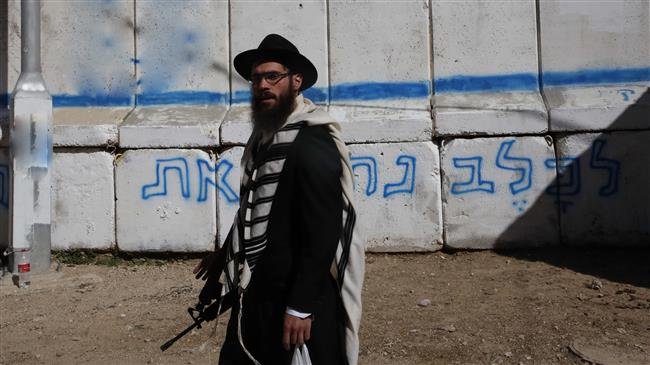
Both the growing power and extremism of the Orthodox in Israel was highlighted in the last week of January when one of their most influential rabbis, Shmuel Eliyahu, publicly came to the defence of five students accused of murdering Aisha Rabi, a Palestinian mother of eight. Back in October they stoned her car near Nablus, in the occupied West Bank, forcing her off the road.
Eliyahu is the son of a former chief rabbi of Israel, Mordechai Eliyahu, and himself sits on the Chief Rabbinical Council, which controls many areas of life for Israelis. He is also the municipal rabbi of Safed, a city that in Judaism has the equivalent status of Medina in Islam or Bethlehem in Christianity, so his words carry a great deal of weight with Orthodox Jews.
Last month, a video came to light of a talk he gave at the seminary where the five accused studied, in the illegal settlement of Rehelim, south of Nablus.
Eliyahu not only praised the five as “warriors” but told fellow students that they needed to overthrow the “rotten” secular court system. He told them it was vital to “conquer the government” too, but without guns or tanks. “You have to take the state’s key positions,” he urged them.
Law-breaking judges
In truth, that process is already well-advanced.
Justice Minister Ayelet Shaked, who should have been the first to denounce Eliyahu’s comments, is closely aligned with religious settlers. Tellingly, she and other government ministers have maintained a studious silence.
That is because the political representatives of Israel’s religious Jewish communities, including the settlers, have now become the lynchpin of Israeli coalition governments. They are the kingmakers and can extract enormous concessions from other parties.
For some time, Shaked has been using her position to bring more openly nationalistic and religious judges into the legal system, including to the highest court in the land, the Supreme Court.
Two of its current 15 judges, Noam Sohlberg and David Mintz, are law-breakers, openly living in West Bank settlements in violation of international law. Several more judges appointed to the bench by Shaked are religious and conservative.
This is a significant victory for the Orthodox religious and the settlers. The court is the last line of defence for the secular against an assault on their religious freedoms and on gender equality.
And the court offers the only recourse for Palestinians seeking to mitigate the worst excesses of the violent and discriminatory policies of the Israeli government, army and settlers.
Chosen people
Shaked’s colleague, Naftali Bennett, another ideologue of the settlement movement, has been education minister in the Netanyahu government for four years. This post has long been a critical one for the Orthodox because it shapes Israel’s next generation.
After decades of concessions to the rabbis, Israel’s school system is already heavily skewed towards religion. A survey in 2016 showed 51 percent of Jewish pupils attended sex-segregated religious schools, which emphasise Biblical dogma – up from 33 percent only 15 years earlier.
This may explain why a recent poll found that 51 percent believe Jews have a divine right to the land of Israel, and slightly more – 56 percent – believe that Jews are a “chosen people”.
Those results are likely to get even worse in the coming years. Bennett has been placing much greater weight in the curriculum on Jewish tribal identity, Bible studies and religious claims to Greater Israel, including to the Palestinian territories – which he wants to annex.
Conversely, science and maths are increasingly downplayed in the education system, and entirely absent from schools for the ultra-Orthodox. Evolution, for example, has been mostly erased from the syllabus, even in secular schools.
‘No mercy’ to Palestinians
Another key sphere of state power being taken over by the religious, and especially the settlers, are the security services. Police Commissioner Roni Alsheikh lived for years in a settlement renowned for its violent attacks on Palestinians, and the force’s current chief rabbi, Rahamim Brachyahu, is also a settler.
Both have actively promoted a programme, Believers in the Police, that recruits more religious Jews into the police force. Nahi Eyal, the programme’s founder, has said his aim is to help the settler community “find our way into the command ranks”.
The trend is even more entrenched in the Israeli military. Figures show that the national-religious community, to which settlers belong – though only 10 percent of the population – make up half of all new officer cadets. Half of Israel’s military academies are now religious.
That has translated into an increasing role for extremist Orthodox rabbis in motivating soldiers on the battlefield. In Israel’s 2008-09 ground invasion of Gaza, soldiers were issued with pamphlets by the army rabbinate using Biblical injunctions to persuade them to “show no mercy” to Palestinians.
Call to kill babies
Meanwhile, the rapidly growing ultra-Orthodox population has been encouraged by the government to move into West Bank settlements purpose-built for them, such as Modi’in Illit and Beitar Illit. That, in turn, is gradually fuelling the emergence of an aggressive nationalism among their youth.
Once the Haredim were openly hostile, or at best ambivalent, towards Israeli state institutions, believing that a Jewish state was sacrilegious until the Messiah arrived to rule over Jews.
Now, for the first time, young Haredim are serving in the Israeli army, adding to the pressure on the military command to accommodate their religious fundamentalist ideology. A new term for these hawkish Haredi soldiers has been coined: they are known as the “Hardal”.
Brachyahu and rabbis for the Hardal are among the senior rabbis who have endorsed a terrifying book, the King’s Torah, written by two settler rabbis, that urges Jews to treat non-Jews, and specifically Palestinians, mercilessly.
It offers God’s blessing for Jewish terror – not only against Palestinians who try to resist their displacement by settlers, but against all Palestinians, even babies, on the principle that “it is clear that they will grow [up] to harm us.”
Gender segregation expands
The dramatic rise in religiosity is creating internal problems for Israeli society too, especially for the shrinking secular population and for women.
Posters for the forthcoming election – as with adverts more generally – are being “cleaned” of women’s faces in parts of the country to avoid causing offence.
Last month, the Supreme Court criticised Israel’s Council for Higher Education for allowing segregation between men and women in college classrooms to spread to the rest of the campus, including libraries and communal areas. Female students and lecturers are facing “modesty” dress codes.
The council has even announced that it intends to expand segregation because it is proving difficult to persuade religious Jews to attend higher education.
Violence of the mob
Israel has always been a society deeply structured to keep Israeli Jews and Palestinians apart, both physically and in terms of rights. That is equally true for Israel’s large Palestinian minority, a fifth of the population, who live almost entirely apart from Jews in segregated communities. Their children are kept away from Jewish children in separate schools.
But the greater emphasis in Israel on a religious definition of Jewishness means that Palestinians now face not only the cold structural violence designed by Israel’s secular founders, but additionally a hot-tempered, Biblically sanctioned hostility from religious extremists.
That is most keenly evident in the rapid rise of physical assaults on Palestinians and their property, as well as their holy places, in Israel and the occupied territories. Among Israelis, this violence is legitimised as “price tag” attacks, as though Palestinians have brought such harm on themselves.
YouTube is now full of videos of gun- or baton-wielding settlers attacking Palestinians, typically as they try to access their olive groves or springs, while Israeli soldiers stand passively by or assist.
Arson attacks have spread from olive groves to Palestinian homes, sometimes with horrifying results, as families are burned alive.
Rabbis such as Eliyahu have stoked this new wave of attacks with their Biblical justifications. State terrorism and mob violence have merged.
Destroying al-Aqsa
The biggest potential flashpoint is in occupied East Jerusalem, where the growing symbolic and political power of these Messianic rabbis risks exploding at the al-Aqsa Mosque compound.
Secular politicians have long played with fire at this Islamic holy site, using archaeological claims to try to convert it into a symbol of historic Jewish entitlement to the land, including the occupied territories.
But their claim that the mosque is built over two Jewish temples, the last of which was destroyed two millennia ago, has been rapidly reconfigured for incendiary, modern political purposes.
The growing influence of religious Jews in parliament, the government, the courts and the security services means that officials grow ever bolder in staking a physical claim to sovereignty over al-Aqsa.
It also entails an ever greater indulgence towards religious extremists who demand more than physical control over the mosque site. They want al-Aqsa destroyed and replaced with a Third Temple.
The gathering holy war
Slowly, Israel is transforming a settler-colonial project against the Palestinians into a battle with the wider Islamic world. It is turning a territorial conflict into a holy war.
The demographic growth of Israel’s religious population, the cultivation by the school system of an ever-more extreme ideology based on the Bible, the takeover of the state’s key power centres by the religious, and the emergence of a class of influential rabbis who preach genocide against Israel’s neighbours has set the stage for a perfect storm in the region.
The question now is at what point will Israel’s allies, in the US and Europe, finally wake up to the catastrophic direction Israel is heading in – and find the will to take the necessary action to stop it.
This is why Al-Quds is being silenced
By Mohammed Ayesh | MEMO | February 19, 2019
If Al-Quds satellite station actually closes its doors and completely stops broadcasting, which is what is currently occurring, albeit gradually, this means that the enemies of the Palestinian national project succeeded in silencing the voice that has long plagued the occupation over the past ten years. Moreover, silencing Al-Quds carries a number of implications, most importantly those associated with the “deal of the century”, which is simmering on a low heat, and the need to silence voices opposed to it.
The collapse of Al-Quds, which broadcasts from Beirut, is occurring shortly after the imminent closure of Al-Aqsa television in Gaza, which almost occurred a few weeks ago. However, this was cancelled at the last minute. It is also occurring a few months after the complete shutdown of Al-Ketab satellite which was broadcast from Gaza. The common reason behind all of these closures and obstacles is a financial crisis.
Al-Quds has been a source of concern for the Israelis over the last ten years and it played an important role during the three wars waged against the Gaza Strip. It has therefore been bombed by the Israeli air force in Gaza and its crews were prohibited from operating in the occupied West Bank, occupied Jerusalem, and the territories inside the Green Line. Some of its journalists and correspondents were arrested and the channel was eventually shut down in those areas.
The only reason for the collapse and closure of Al-Quds channel is the financial crisis, and the reason behind the financial crisis is the siege imposed by the Arabs on the Palestinian resistance and all of its media outlets. This was the siege the Israelis were unsuccessful with, but the Arab regimes succeeded in this regard. It is a carefully planned and systematic siege that aims to silence the voices that are opposed to the “deal of the century”. It has become clear that a number of Arab regimes are involved in the arrangements of this deal and have colluded in passing it, despite the unanimous Palestinian and Jordanian rejection of it.
All the other reasons that some of the employees and those monitoring the situation have referred to are embellishments and are not the truth. Administrative errors, financial waste, or other reasons do not lead to the complete shut down of a television channel and cannot silence its voice. Moreover, a lot of these stories and statements are just figments of the imagination of those uttering them.
Al-Quds and other channels that can be referred to as the resistance’s media outlets are funded by Arab donors who have a love and passion for Palestine and Jerusalem and those who want to support the Palestinian people. Such donors were singled out by the Arab regimes, which spend millions, and even billions of dollars to slander the Palestinian people in order to promote normalisation with Israel.
The Arab regimes that besiege the Palestinians and demonise them and prevent donors from supporting them and supporting their resistance and steadfastness in the face of the occupation, are the same ones that have recently been exposed as being involved in the Judaisation of occupied Jerusalem. They are also the same regimes that are in collusion with Trump and his son-in-law Jared Kushner in preparing the “deal of the century”. They are also the same countries who mobilise electronic armies to post comments online such as, “the Palestinians in Palestine carry an Israeli passport, the Palestinians abroad sold their country, the Palestinian in Gaza are spies for Iran, and the Arabs’ interests i.e. in normalising relations with Israel because Iran is more dangerous than Israel.” Those who believe this foolish and dubious theory are the same people who besieged Al-Quds and silenced its voice in order to continue their project.
The bottom line is that the targeting and silencing of Al-Quds is happening in the context of the siege imposed on the entire Palestinian nation and as part of the systematic campaign targeting Palestinians in order to justify normalisation with Israel. This then leads to justifying the “deal of the century”, which these Arab regimes do not want any one opposing.
READ ALSO:
Featured Video
Pax Judaica Explained | Prof. David Miller
or go to
Aletho News Archives – Video-Images
From the Archives
History and Biblical Scholarship: Al-Quds Is Not Jerusalem
By Dr. Elias Akleh | Global Research | July 3, 2018
The Zionist Israeli state calls on the Old Testament/Torah as a historical document to prove its legality to “re-claim” Palestine; their god’s promised land. To assert this legality and the myth of the promised land Zionist Organization, since its establishment, had recruited the science of archaeology, employing western Christian biblical archaeologists, to provide the required “historic” proof of the right of the Jews; alleged modern Israelites, to Palestine. This became very critical after Julius Wellhausen; the biblical scholar and Professor Ordinarius of Theology and head of the German School of Biblical Criticism, published his 1883 book “Geschichte Israels”, later titled as “Prolegomena zur Geschichte Israels” claiming that the Old Testament/Torah stories were invented during the Babylonian exile to serve certain theological and political purposes.
American biblical scholars and archaeologists, such as William Fox Albright, were recruited to refute Wellhausen’s claims. Albright was endorsed by covertly Zionist financed Biblical Colloquium; a scholarly society devoted to the analysis and discussions of biblical matters, and the preparations, publication, and distribution of biblical literature to brainwash readers and students with a specific theological ideology. Albright, as well as other biblical archaeologists like him, was also honored (bribed) by the American Friends of the Israel Exploration Society. His writings; such as “Why the Near East Needs the Jews”, are flagrant racist Zionist propaganda ignoring the vast archaeological history of the indigenous Palestinians while emphasizing the fake unproven Israelites’ narrative in Palestine. … continue
Blog Roll
 Aletho News
- Your Enslavement Begins in Gaza: The ‘Board of Peace’
- Israeli FOIA Data Reveals Massive Heart Injury Spike in Children Immediately After mRNA Shot Rollout
- What is Zionism? And what is anti-Zionism?
- Hungary’s Blocking of EU Loan to Ukraine May Jeopardize IMF Funding – Reports
- Pax Judaica Explained | Prof. David Miller
- Was MAHA Too Good to Last in the Trump Administration?
- Vermont advances bill letting unelected Health Commissioner decide which vaccines ctizens should receive
- Why the US-Israeli alliance will lose against Iran
- US envoy Huckabee claims Israel has ‘biblical right’ to conquer all West Asia
- Testing the Alliance: Netanyahu’s Washington Visit
- If Americans Knew
- Palestinian church leaders admonish Christian Zionist Mike Huckabee – Not a ceasefire Day 135
- Ominous messaging from Trump’s “Board of Peace” – Not a ceasefire Day 134
- ‘Christians Out’: Jerusalem Church Tagged With Hate Graffiti, Police Investigating
- Israeli Settlers Kill American Teen
- ‘We returned from hell’: Palestinian journalists recount torture in Israeli prisons
- No mercy for Gaza in Ramadan – Not a ceasefire Day 133
- The Israeli Government Installed and Maintained Security System at Epstein Apartment
- Tucker Carlson interrogated in Israel, has passport seized after interviewing US ambassador
- 6,000 Amputees in Gaza Face Impossible Recovery amid Israeli War Ultimatum
- The Lancet: Gaza death toll far higher than reported – Not a ceasefire Day 132
- No Tricks Zone
- Germany: Electric Car Catches Fire At Charging Station, Sets Off Local “Inferno”, Widespread Damage
- New Study: Canada’s New Brunswick Was 1°C Warmer Than Today During The Medieval Warm Period
- Coal Power Back In Trend As Globe Tries To Keep Pace With Growing Demand For Power
- New Study: A 4°C Warmer Beaufort Sea Had ‘No Sea Ice’ 11,700 – 8200 Years Ago
- Unfudging The Data: Dutch Meteorological Institute Reinstates Early 20th Centruy Heat Waves It Had Erased Earlier
- German Gas Crisis…Chancellor Merz Allegedly Bans Gas Debate Ahead of Elections!
- Pollen Reconstructions Show The Last Glacial’s Warming Events Were Global, 10x Greater Than Modern
- Germany’s Natural Gas Storage Level Dwindles To Just 28%… Increasingly Critical
- New Study Rebuts The Assumption That Anthropogenic CO2 Molecules Have ‘Special’ Properties
- Climate Scientist Who Predicted End Of “Heavy Frost And Snow” Now Refuses Media Inquiries
 Aletho News