George Will’s Obtuseness on the JFK Assassination
By Jacob G. Hornberger | FFF | January 5, 2021
 In a small section of his most recent column, Washington Post conservative columnist George Will demonstrates the deference to authority that has come to characterize the mainstream media with respect to the JFK assassination. Will writes:
For many years, some people insisted that a vast conspiracy, not a lone gunman, masterminded the 1963 assassination of President John F. Kennedy near the grassy knoll in Dallas’s Dealey Plaza. To these people, the complete absence of evidence proved the conspiracy’s sophistication. They were demented.
Now, it stands to reason that mainstream journalists at the time of the Kennedy assassination would make that type of statement. That was a time when almost everyone placed undaunted faith in the U.S. national-security establishment and any official narrative it issued. This was especially true for conservative columnists, almost all of whom bought into the extreme anti-communist animus that was used to justify the Cold War and the conversion of the U.S. government to a national-security state. Of course, there was also Operation Mockingbird to consider. That was the CIA’s successful secret operation to acquire assets within the U.S. mainstream press who could be relied upon to publish articles reflecting the views and narratives of the national-security establishment.
Thus, when a mainstream journalist in 1963 or even 1964, immediately after the issuance of the Warren Report, made a statement similar to that made by Will, it was somewhat understandable. At that time, while there were people who suspected that something was amiss in the assassination, most of the evidence pointing to a U.S. national-security regime-change operation was hidden from view because of the shroud of national-security secrecy that was immediately placed over the assassination.
But that was 1963. Today things are entirely different, Over the decades, the national-security state secrecy surrounding the assassination has been pierced, which has brought forth a large body of incriminating evidence pointing to a joint Pentagon-CIA operation to protect “national security” from a president whose policies, they believed, were leading to a communist victory in the Cold War and, ultimately, a communist takeover of the United States.
This is what mainstream journalists like Will just don’t get. Owing to the large amount of evidence that has surfaced pointing toward a domestic regime-change operation, it is no longer sufficient for a mainstream journalist to mouth the standard mantras about the Kennedy assassination that were being mouthed in 1963 or to label people “conspiracy theorists.” Now, it is incumbent on mainstream journalists who wish to maintain the official narrative to confront and deal with the actual evidence that has surfaced since then, especially after the JFK Records Act in 1993, which was enacted in the wake of Oliver Stone’s movie JFK. That law forced the Pentagon, the CIA, and other federal agencies to disclose many, but certainly not all, of their long-secret records relating to the assassination,
Let me give you an example. In the late 1960s, New Orleans District Attorney Jim Garrison brought a criminal prosecution against a man named Clay Shaw. In the trial, Garrison alleged that the JFK assassination was a highly sophisticated domestic regime-change operation carried out by the Pentagon and the CIA, no different in principle from those carried out both before and after the Kennedy assassination — e.g., Iran 1953, Guatemala 1954, Congo 1961, Cuba 1960s, Chile 1973.
The mainstream press criticized and derided Garrison. Their mindset was one of complete deference to the authority of the national-security establishment and its official theory that a lone nut had killed the president.
In the process, the mainstream press failed to note some extremely important aspects of the Shaw trial, especially those relating to the testimony of one of the military pathologists, Lt. Col. Pierre Finck, who had helped carried out the official autopsy on President Kennedy’s body.
Finck testified that he received a call at 8 p.m. on the night of the assassination from one of the other two pathologists for the autopsy, Commander James Humes, asking Finck to come over and help with the autopsy, In that 8 p.m. telephone call, Humes told Finck that they already had x-rays of the president’s head.
A big problem arises though: The president’s body was being carried into the Bethesda morgue at precisely 8 p.m. by a military color guard.
Do you see the problem? How could Humes already have x-rays of the president’s head if the president’s body had not yet been brought into the morgue?
To my knowledge, that testimony didn’t bother any mainstream journalist at the time. They were all so deferential to the national-security establishment that that problem didn’t seem to get their attention. But wouldn’t you think that any self-respecting investigative journalist would say, “I need to get to the bottom of this”?
How about you, George? How do you explain this problem? I would love to hear your explanation.
Another interesting aspect of Finck’s testimony was when he was asked by the prosecutor why the pathologists had failed to “dissect” Kennedy’s neck wound, which would ordinarily have been standard autopsy procedure. At first, Finck repeatedly refused to answer the question. When the judge finally required Finck to answer, he said that he had been ordered by someone in authority to refrain from doing so. Finck then maintained that he couldn’t remember the identity of the person in authority who issued that order to him.
Now, wouldn’t you think that any self-respecting investigative journalist would say, “I need to get to the bottom of this”? After all, the three autopsy pathologists were supposed to be in charge of the autopsy, Finck’s testimony established that there was obviously a secret super-force that had ultimate control over the autopsy and the autopsy physicians.
How about you, George? Aren’t you at least a bit curious as to who composed that force and how, when, and why it came into existence?
After the House Select Committee on Assassinations hearings in the 1970s, a group of enlisted men who were released from vows of secrecy that the military had forced then to sign immediately after the autopsy, began telling a remarkable story. They said that they had secretly carried the president’s body into the Bethesda morgue in a cheap, military-style shipping casket rather than the expensive, ornate casket into which the president’s body had been placed in Dallas, They maintained that they secretly brought the body into the morgue at 6:35 p.m., almost 1 1/2 hours before the official entry time of 8 p.m.
What’s up with that? How about it, George? You can’t say claim that witness statements don’t constitute evidence, can you? What’s your explanation for this phenomenon? I would love to hear it.
In the 1990s, the Assassination Records Review Board secured a written report from a Marine sergeant named Roger Boyajian, which was prepared soon after the November 22, 1963, weekend. In the report, Boyajian stated that his team did in fact carry the president’s body into the morgue at 6:35 p.m.
How about it, George? You can’t really maintain that Boyajian’s statement and his written report don’t constitute evidence, can you? How do you deal with that? What’s your explanation for it? I would love to hear what you have to say about it.
The ARRB also secured the testimony of Saundra Spencer, who worked in the military’s photography lab in Washington, D.C. She told the ARRB a remarkable story. She said that on the weekend of the assassination, she was asked to develop the official autopsy photographs of Kennedy’s body, on a top-secret basis. She had kept her secret for some 30 years. When shown the official photographs of the autopsy in the records today, she said that those weren’t the photographs she developed. The ones she developed showed a massive sized exit wound in the back of Kennedy’s head, which would connote a shot having been fired from the front. The official autopsy photographs show the back of the president’s head to be intact.
How about it, George? How about giving us your take on Spencer’s testimony? You can’t really say that sworn testimony doesn’t constitute evidence, can you? I would love to hear your explanation for Spencer’s sworn testimony.
Spencer’s testimony, of course, matched the statements of the Dallas treating physicians immediately after the assassination, in which they described a massive exit-sized in the back of Kennedy’s head.
How about it, George? How do you deal with the steadfast statements from Dr. Robert McClelland, Dr. Charles Crenshaw, and the other treating physicians immediately after the assassination?
The ARRB discovered that there were two separate examinations of President Kennedy’s brain. At the first examination, the brain was “sectioned” or cut up like a loaf of bread, which is standard procedure in gun shot wounds to the head. At the second brain exam, the brain was damaged but intact — i.e, not sectioned. There is no way that a sectioned brain can reconstitute itself, which means that the brain at the second exam could not possibly have been Kennedy’s,
How about it, George? How do you deal with that one? I would love to know.
Dr. David Mantik, a radiation oncologist in Rancho Mirage, California, has spent nine complete days closely examining the x-rays in the JFK autopsy. He has concluded that they are forgeries.
How about it, George? How do you deal with Mantik’s detailed analysis? You can read it here. I would love to know.
Why is all this autopsy evidence important? Because there is no way to come up with an innocent explanation for a fraudulent autopsy. But George, if you can do so, please let us know what that explanation is. I don’t think you can. Certainly no one else has. And one thing is for sure: It was the national-security establishment that was solely responsible for carrying out the fraudulent autopsy on President Kennedy’s body just a few hours after the assassination.
In fact, George, maybe you wouldn’t mind providing your theory as to why the military, rather than the civilian authorities in Dallas, were even charged with carrying out the autopsy on President Kennedy’s body. After all, while conservatives love national-security states, the United States isn’t a military nation, like the Soviet Union was, or at least it’s not supposed to be.
See also:
“The Mainstream Media’s Deference to Authority in the JFK Assassination” by Jacob G. Hornberger
The Kennedy Autopsy by Jacob Hornberger
JFK’s War with the National Security Establishment: Why Kennedy Was Assassinated by Douglas Horne
Regime Change: The JFK Assassination by Jacob Hornberger
The CIA, Terrorism, and the Cold War: The Evil of the National Security State by Jacob Hornberger
CIA & JFK: The Secret Assassination Files by Jefferson Morley
Morley v. CIA: My Unfinished JFK Investigation by Jefferson Morley
“The National Security State and JFK,” a FFF conference featuring Oliver Stone and ten other speakers
“Altered History: Exposing Deceit and Deception in the JFK Assassination Medical Evidence,” a five-part video by Douglas P. Horne
The Mainstream Press Has Failed America
By Jacob G. Hornberger | FFF | December 1, 2020
While President Trump continues to maintain that the presidential election was marred by massive fraud, the mainstream press continues to maintain that Trump’s charges are “false” and “baseless” and that his allegations are damaging trust in America’s democratic electoral system.
Actually, however, it’s the other way around: It’s the mainstream press, owing to its extreme deferential attitude toward the Washington, D.C., establishment, that has severely damaged trust in America’s democratic system.
Of course, this isn’t the first election in which the losing side has charged that he has been cheated out of his victory. In virtually every election cycle, there is at least one political candidate that charges that he lost because of fraud committed by the other side.
But let’s face it: Sometimes there is fraud. As I have pointed out before (see here and here and here), there is now no doubt that Lyndon Johnson employed fraud to win the 1948 U.S. Senate race in Texas against popular Governor Coke Stevenson. Johnson told a South Texas crony who controlled some South Texas counties to keep his poll results open in case Johnson needed extra votes to win. When the vote-counting was over, Johnson did need a few more votes to win. He called his crony, a man named George Parr, and Parr ordered a local election judge to produce 200 additional votes for LBJ, which then gave Johnson the win. Many years later, the election judge confirmed that he had done this. The 200 signatures on the voter list were all in the same ink, and the names of the 200 voters were in alphabetical order. If Johnson had lost the election, he never would have become vice-president or president, which truly made him a truly illegitimate president in U.S, history, one who ended up sending tens of thousands of American men to their deaths in a senseless war thousands of miles away in Southeast Asia.
The problem with the mainstream press in the Trump-Biden race is the speed by which it concluded that the 2020 presidential election was not marred by fraud. It reached its conclusion before the election was even over.
Now, it’s very possible that Trump’s assertions are, in fact, false and baseless, but how could the mainstream press know that before or immediately after the election without even the semblance of any press investigation into the allegations?
Perhaps the mainstream press believed that the stealing of an election through fraud is simply inconceivable. But how can it be inconceivable when it is undisputed that LBJ won his Senate race through fraud? If it happened once, doesn’t that negate the idea of inconceivability?
It certainly can’t be that the press immediately conducted an investigation and found no evidence of fraud in the Trump-Biden race because the mainstream press reached its conclusions immediately and never conducted any independent investigation.
 And that’s the core of the problem — the mainstream press’s deference to the Washington, D.C., establishment by automatically embracing its official position that the election was honest and above board.
In a free society, the citizenry necessarily depend on an independent press to keep government honest. The citizenry simply lack the resources and time to investigate official misconduct. Thus, they necessarily depend on a vibrant, dynamic independent press to do this job for them.
That’s where the mainstream press has failed America and has severely damaged America’s democratic system. It has essentially become a loyal lapdog of the Washington, D.C., establishment, never daring to challenge it, question, or investigate it at a fundamental level.
That’s why people don’t trust the mainstream press. That’s one big reason why mainstream papers have lost massive numbers of subscribers ever since the Internet came into existence. People know that when it comes to confronting political power with truth, they are going to find it on the Internet rather than in the mainstream press.
In the meantime, the mainstream press cannot figure out why people don’t blindly accept its pronouncements. They cannot figure out why people have been leaving them in droves and going to the Internet for answers. They cannot figure out why people don’t trust them or believe what they say.
Now, I’m not saying that the mainstream press should go out and investigate every charge of fraud that every loser of a political race makes. What I am saying is that when there are extreme anomalies in votes, as there have been in the Trump-Biden race, it is incumbent on an independent press to severely scrutinize them. Extreme anomalies, of course, don’t equate to fraud but they do equate — or should equate — to the need for extremely careful scrutiny to ensure that there is no fraud.
An independent press is in the best position to perform such an investigation. If America were characterized by such a press, it would actually strengthen, not weaken, America’s democratic system because then people would be more assured that elections were not marred by fraud. When you instead have a passive and deferential press that automatically defers to the D.C. establishment, immediately concludes that the election is on the up and up despite extreme anomalies, and just pokes fun of the losing candidate for asserting fraud, that tends to make people suspicious, distrustful, and cynical.
Of course, the passive and deferential nature of the mainstream press has been going on for much longer than the 2020 presidential race. One of the best examples is the Kennedy assassination. From the time Kennedy was declared dead, the mainstream press has always automatically accepted the official version of events of the national-security establishment, never daring to conduct independent investigations into whether that version was false and baseless.
In the 1970s, after the House Select Committee on Assassinations met to reinvestigate the assassination, several enlisted men came forward with a remarkable story. They said that they had secretly carried the president’s body into the morgue almost 1 1/2 hours before the body was officially reintroduced into the morgue. They said that they had been sworn to secrecy on the weekend of the assassination and had been forced to sign secrecy oaths. Their superiors threatened them with extreme punitive action if they ever disclosed what they had seen or done.
Now, wouldn’t you think that that was something that the mainstream press would find worth investigating? Were these enlisted men lying? Were they just making up a story? Why would they do that? Why would the national-security establishment be sneaking the president’s body into the morgue? Why was the military in charge of the autopsy?
Wouldn’t just one mainstream investigative reporter want to investigate such things? Well, if he did, he would be fired by every mainstream paper in the land, owing to the passivity and deferential attitude that the mainstream press have had about the Kennedy assassination since the beginning.
In the 1990s, the Assassination Records Review Board discovered the existence of a Marine Sergeant named Roger Boyajian, who told the ARRB that it was his team that secretly carried the president’s body into the morgue at 6:35 p.m., almost 1 1/2 hours before the official entry time of 8 p.m. Boyajian even produced a copy of his official report that he had submitted to the military immediately after the assassination weekend in November 1963, a report that the military had kept secret. His statement and his report confirmed what those enlisted men has said back in the 1970s.
Did the mainstream press then conduct an investigation? Not on your life. It was still considered verboten for any mainstream news media outlet to investigate any aspect of the Kennedy assassination.
When Congress enacted the law that established the ARRB, someone slipped a provision into the law that prohibited the ARRB from investigating any aspect of the Kennedy assassination. It was a prohibition that was strictly enforced by the ARRB board of trustees. Now, wouldn’t you think that some enterprising, independent-minded mainstream investigative reporter would want to find out why anyone would want to keep the ARRB from investigating things it discovered while securing the release of long secret records of the national-security establishment? Nope. It just didn’t happen.
The ARRB also discovered the existence of a woman named Saundra Spencer. She was a chief petty officer in charge of the Navy’’s lab at its photography center in Washington, D.C. She had a top secret security clearance and worked closely with the White House on both classified and unclassified photographs.
Spencer told the ARRB a remarkable story. She said that on the weekend of the assassination, she had been asked to develop, on a top-secret basis, the photographs of President Kennedy’s autopsy, which had been conducted by the U.S. national-security establishment on the night of the assassination. Spencer had kept her secret for more than 30 years.
Spencer was shown the official autopsy photographs in the record. After closely examining them, she said: No, those are not the autopsy photographs I developed. The ones I developed showed a massive exit-sized wound in the back of the president’s head. The photographs in the official record show the back of the president’s head to be fully intact.
Now, wouldn’t you think that that would be enough to get the mainstream press to send an investigative reporter out to get to the bottom of this, especially given that Spencer’s testimony about the massive exit-sized wound in the back of Kennedy’s head matched the statements of the treating physicians at Parkland Hospital, along with the treating nurses, two FBI agents, a Secret Service agent, and others? Wouldn’t you think that fraudulent autopsy photographs would be enough to generate such an investigation?
Nope. The position of every mainstream paper in the country has always been: “Stay away from the Kennedy assassination. That’s what the national-security establishment wants and that’s the way it’s going to be.”
The ARRB made another remarkable discovery. It discovered that there were two separate brain examinations in the Kennedy autopsy. At the first one, the president’s brain was “sectioned,” which meant cutting it like a loaf of bread to study the trajectory of the bullet that hit the president in the head. At the second brain exam, the brain was fully intact.
There is one big problem: Once a brain is sectioned, it cannot reconstitute itself. That means that the second brain exam had to have involved a brain that wasn’t the same brain at the first exam.
Wouldn’t you think that the mainstream press would find this worth investigating? Nope. And it’s not like they weren’t aware of the two brain exams. The Washington Post and the Associated Press both carried stories on the ARRB’s discovery (see here and here). Unfortunately, as astounding as it is, the discovery of a fraudulent brain exam was not enough to induce the mainstream press to follow up with aggressive investigations to get to the bottom of this.
Many years ago, the American people discovered the existence of Operation Mockingbird, a secret illegal operation of the CIA to convert journalists in the mainstream press into CIA assets and operatives. Mainstream journalists who were asked to serve loved it and considered it a great honor to secretly serve the national-security establishment.
Today, the CIA need not bother because the entire mainstream press has willingly made itself a de facto asset of the national-security state. The American people have been left without an independent mainstream press whose mission is to keep the government honest and instead rely on people on the Internet to perform that service. In the process, the mainstream press has done a tremendous disservice to the American people and to America’s democratic processes by abdicating its responsibility to be a watchdog, not a lapdog, to the Washington, D.C., establishment.
Jacob G. Hornberger is founder and president of The Future of Freedom Foundation. He was born and raised in Laredo, Texas, and received his B.A. in economics from Virginia Military Institute and his law degree from the University of Texas. He was a trial attorney for twelve years in Texas. He also was an adjunct professor at the University of Dallas, where he taught law and economics. In 1987, Mr. Hornberger left the practice of law to become director of programs at the Foundation for Economic Education.
Fifteen Years Before Kennedy, Zionists Murdered Forrestal

By Laurent Guyénot • Unz Review • January 27, 2020
Israel as serial murderer
In the 1990s, a couple of bestsellers brought to the knowledge of a large public the fact that JFK’s assassination in 1963 solved an intense crisis over Israel’s secret nuclear program. In one of his last letters to Kennedy, quoted by Seymour Hersh in The Samson Option (1991), Prime Minister David Ben-Gurion complained: “Mr. President, my people have the right to exist […] and this existence is in danger.”[1] The nuclear option was judged vital for Israel, and JFK opposed it. A Haaretz review of Avner Cohen’s book Israel and the Bomb (1998) puts it this way:
“The murder of American President John F. Kennedy brought to an abrupt end the massive pressure being applied by the US administration on the government of Israel to discontinue the nuclear program. Cohen demonstrates at length the pressures applied by Kennedy on Ben-Gurion. […] The book implied that, had Kennedy remained alive, it is doubtful whether Israel would today have a nuclear option.”[2]
Also openly discussed by Israeli historians today are the close connections between Ben-Gurion’s network in the U.S. and what Tel-Aviv professor Robert Rockaway calls “Gangsters for Zion”, including the infamous “Murder, Incorporated”, run by Bugsy Siegel and then by Mickey Cohen, Jack Ruby’s mentor.
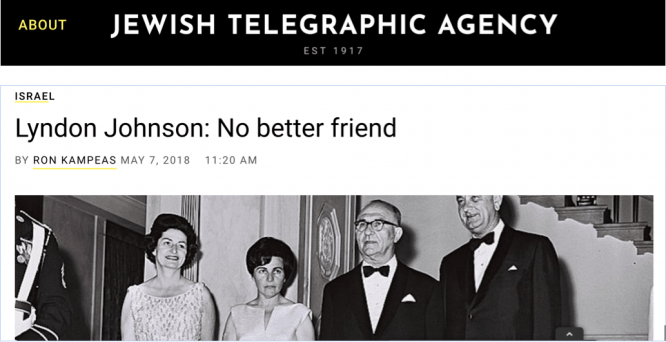
That Israel had the motive and the means of killing JFK does not prove that Israel did it. But I am quite certain that today, most smart Israelis assume and half-approve that Ben-Gurion ordered the elimination of JFK in order to replace him by Lyndon Johnson, whose love for Israel is also now widely celebrated, to the point that some speculate he might have been a secret Jew.

In Ben-Gurion’s mind, making Israel a nuclear state was a matter of life and death, and obliterating any obstacle was an absolute necessity. In Netanyahu’s mind today, preventing Iran—or any other enemy of Israel—from becoming a nuclear state is of the same order of necessity, and would surely justify eliminating another U.S. president in order to replace him by a more supportive Vice President. Most dedicated Zionists understand that. Andrew Adler, owner and editor in chief of The Atlanta Jewish Times, assumes that the idea “has been discussed in Israel’s most inner circle,” and, in his column of January 13, 2012, called on the Israeli Prime Minister to,
“give the go-ahead for U.S.-based Mossad agents to take out a president deemed unfriendly to Israel in order for the current Vice-President to take his place and forcefully dictate that the United States’ policy includes its helping the Jewish State obliterate its enemies. […] Order a hit on a president in order to preserve Israel’s existence.”[3]
Eliminating unsubmissive foreign leaders is part of Israel’s struggle for existence. Besides, it is entirely biblical: foreign kings are supposed to “lick the dust at [Israelis’] feet” (Isaiah 49:23), or perish, with their names “blotted out under heaven” (Deuteronomy 7:24).
On November 6, 1944, members of the Stern Gang, led by future Prime Minister Yitzhak Shamir, assassinated Lord Moyne, the British resident minister in the Middle East, for his anti-Zionist positions. The bodies of his murderers, executed in Egypt, were later exchanged for twenty Arab prisoners and buried at the “Monument of Heroes” in Jerusalem. On September 17, 1948, the same terrorist group murdered in Jerusalem Count Folke Bernadotte, a Swedish diplomat appointed as United Nations mediator in Palestine. He had just submitted his report A/648, which described “large-scale Zionist plundering and destruction of villages,” and called for the “return of the Arab refugees rooted in this land for centuries.” His assassin, Nathan Friedman-Yellin, was arrested, convicted, and then amnestied; in 1960 he was elected to the Knesset.[4]
In 1946, three months after members of the Irgun, led by future Prime Minister Menachem Begin, killed ninety-one people in the headquarter of the British Mandate’s administration (King David Hotel), the same terrorist group attempted to murder British Prime Minister Clement Attlee and Foreign Secretary Ernest Bevin, according to British Intelligence documents declassified in 2006.
These killings and more are documented by Israeli journalist Ronen Bergman in Rise and Kill First: The Secret History of Israel’s Targeted Assassinations (Random House, 2018). Bergman writes:
“At the end of 1947, a report to the British high commissioner tallied the casualties of the previous two years: 176 British Mandate personnel and civilians killed. / ‘Only these actions, these executions, caused the British to leave,’ David Shomron said, decades after he shot Tom Wilkin dead on a Jerusalem street. ‘If [Avraham] Stern had not begun the war, the State of Israel would not have come into being.’”[5]
James Forrestal’s strange death
Absent from Israel’s body count in Bergman’s book is former U.S. Secretary of Defense James Forrestal, assassinated eight months after Count Bernadotte. Forrestal had been Roosevelt’s Secretary of the Navy from April 1944. With consolidation of the armed services under Truman in 1947, he became the first Secretary of Defense. He opposed the United Nations’ vote to partition Palestine, and protested vigorously against U.S. recognition of Israel on May 15, 1948, on the ground that U.S. interests in the Middle East would be seriously jeopardized by American sponsorship of a Jewish state. For this, Forrestal received “an outpouring of slander and calumny that must surely be judged one of the most shameful intervals in American journalism,” in the words of Robert Lovett, then Under Secretary of State. Truman replaced Forrestal on March 28, 1949—shortly after his reelection—by the man who had been his main fundraiser, Louis Johnson. According to the received story, Forrestal, who was psychologically exhausted, fell into depression immediately. On April 2, 1949, he was interned against his will in the military hospital of the Navy in Bethesda, Maryland, a Washington, DC, suburb, where he was forcibly confined for seven weeks. He fell to his death from the 16th floor at 1:50 in the morning of May 22, 1949, landing on the roof of the third floor. He had a dressing-gown sash tied around his neck.
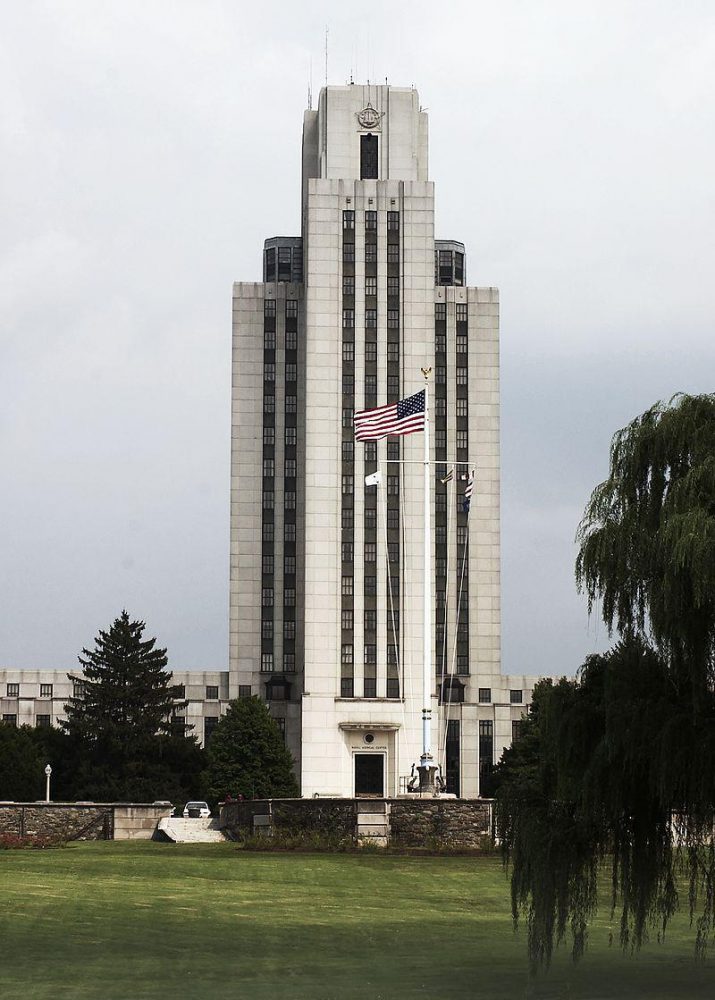
Bethesda Navy Hospital, where Forrestal met his death
National authorities and mainstream media immediately labeled his death a suicide, without any known criminal investigation. A review board was appointed on May 23, headed by Admiral Morton Willcutts, to conduct hearings of members of the hospital staff with the sole purpose of exonerating everyone of responsibility in Forrestal’s assumed suicide. The board completed its work in one week, and published a short press release four months later. But the full report, containing the transcripts of all hearings and crucial exhibits, were kept secret for 55 years, until David Martin obtained it through a Freedom of Information Act request in April 2004 (it is now available on the Princeton University Library website in pdf form, or here in HTML rendition by the anonymous Mark Hunter, who makes useful comments).
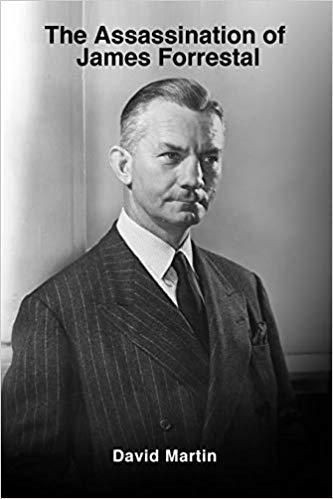
In his book and in his web articles complementing it, David Martin makes a compelling case that Forrestal was murdered, and that his murder was ordered by the Zionists, most probably with the knowledge and approval of Truman, who was then completely hostage to the Zionists. The motive? Forrestal was planning to write a book and to launch a national magazine: he had the money and the connections for it, and he had three thousand pages of personal diary to back his revelations on the corruption of American leadership and the sell-out of American foreign policy to communism under Roosevelt, and to Zionism under Truman.
I will here summarize the evidence accumulated by David Martin, and highlight the significance of this case for our understanding of Israel’s takeover of the heart, soul, and body of the United States. Unless specified otherwise, all information is from Martin’s book or articles.
From James Forrestal to John Kennedy
My own interest for this heartbreaking story stems from my interest for the Kennedy assassinations. (read my article Did Israel Kill the Kennedys?). I found the connection and similarities between the two stories highly illuminating. Everyone knows that Kennedy was assassinated, yet most Americans are still unaware of the evidence incriminating Israel. In the case of Forrestal, it is the opposite: few people suspect a murder, but once the evidence for murder has been presented, it points directly to Israel as the culprit. For this reason, Forrestal’s assassination by the Zionists becomes a precedent that makes JFK’s assassination by the same collective entity more plausible. If Israel can kill a former U.S. Defense Secretary on American soil in 1949 and get away with it with government and media complicity, then why not a sitting President fifteen years later? If the truth on Forrestal had been known by 1963, it is unlikely that Israel could have killed two Kennedys with impunity.
Forrestal was of Irish Catholic origin like the Kennedys, and was close to JFK’s father. Both James Forrestal and Joseph Kennedy are examples of American patriots of Irish stock who were alarmed by Jewish influence over American foreign policy. The entry for 27 December 1945 in Forrestal’s edited diary, says:
“Played golf with Joe Kennedy. I asked him about his conversations with Roosevelt and Neville Chamberlain from 1938 on. […] Chamberlain, he says, stated that America and the world Jews had forced England into the war.”
One major difference between the two men is that Joe Kennedy had resigned from government after Roosevelt’s entry into the war, and had kept a low profile on Israel. Moreover, unlike Forrestal, he was the head of a wealthy clan and had his own men in the press. He was a politician, whereas Forrestal was an uncompromising man. These differences explain why Forrestal was assassinated, whereas Joe had his son elected president. Yet in the end, the Kennedys suffered the Talmudic curse over three generations.
When James Forrestal, hostile to Stalin’s ambitions on Eastern Europe and to Truman’s decision to nuke Japan, was kept away from the official delegation to the Potsdam Conference in the summer 1945, he flew there privately and took with him the then 28-year-old John Kennedy, for a tour of post-war Germany. Later on, John integrated James Forrestal’s son Michael Forrestal as a member of his National Security Council. In May 1963 he made a symbolic public gesture by visiting the grave of James Forrestal on Memorial Day.

JFK visits Forrestal’s grave at Arlington cemetery
James Forrestal’s and John Kennedy’s assassinations bear one sinister thing in common: Bethesda Naval Hospital. As most readers recall, this is where Kennedy’s autopsy was tampered with after his body had been whisked away at gunpoint from Dallas Parkland Hospital, most probably by Secret Service agents on Lyndon Johnson’s order. In 1963, Lyndon Johnson could count on high-level complicity within the Navy.
It happens that Johnson, whom Billy Sole Estes claims ordered nine murders in the course of his political career,[6] makes a special appearance, although brief and poorly documented, in the story of Forrestal’s assassination. LBJ was then a newly elected congressman, on the payroll of Abraham Feinberg, former president of Americans for Haganah Incorporated and financial godfather of Israel’s atomic bomb.[7] According to the testimony of Forrestal’s assistant Marx Leva (more on him later), Johnson paid an unwanted visit to Forrestal at Bethesda Hospital. David Martin asks:
“Could LBJ have been playing something of a foot-soldier role for the orchestrators of Forrestal’s demise? Might he have been there to size up the overall situation, and at the same time contribute to ‘making his bones,’ as it were, by participating in such an important operation?” (Martin p. 20)
The official narrative
It bears repeating that no investigation was conducted into the death of James Forrestal, either by the FBI or the NCIS (Navy Criminal Investigative Service). The very day of his death, the mainstream press announced his suicide as a matter of fact. The New York Times stated in its late May 22 edition that Forrestal “jumped thirteen stories to his death,” and added the next morning:
“There were indications that Mr. Forrestal might also have tried to hang himself. The sash of his dressing-gown was still knotted and wrapped tightly around his neck when he was found, but hospital officials would not speculate as to its possible purpose.”
Later biographers did speculate that he may have tried to hang himself but failed to tie the sash securely to the radiator beneath the window. In The Man Who Kept the Secrets, Pulitzer Price winner Thomas Powers says that Forrestal died trying to hang himself “from his hospital window, but slipped and fell sixteen stories to his death.”
Forrestal left no suicide note, but the New York Times (May 23) informs its readers that:
“A book of poetry beside his bed was opened to a passage from the Greek tragedian, Sophocles, telling of the comfort of death. […] Mr. Forrestal had copied most of the Sophocles poem from the book on hospital memo paper, but he had apparently been interrupted in his efforts. His copying stopped after he had written ‘night’ of the word ‘nightingale’ in the twenty-sixth line of the poem.”
On May 24, the New York Times gave the final word to the psychiatrist in charge, who made suicide sound predictable:
“Captain George M. Raines, the Navy psychiatrist who had been treating Mr. Forrestal, said that the former Secretary ended his life in a sudden fit of despondency. He said this was ‘extremely common’ to the patient’s severe type of mental illness.”
That’s it. Never did the mainstream media hint at the possibility of foul play. The conclusion that Forrestal’s death is an obvious suicide caused by his “mental illness” was taken at face value by the authors of Forrestal’s two main biographies:
- Arnold Rogow, James Forrestal, A Study of Personality, Politics, and Policy (MacMillan Company, 1963);
- Townsend Hoopes and Douglass Brinkley, Driven Patriot, the Life and Times of James Forrestal (Alfred A. Knopf, 2003).
Rogow, whose book has been called a “psychological autopsy,” insists on linking Forrestal’s alleged mental illness to his alleged anti-Semitism, with the implication that anti-Semitism is a form of paranoia that may lead to suicide. Rogow is an expert on the subject of anti-Semitism, on which he wrote the article for The International Encyclopedia of Social Science. He is also the author The Jew in a Gentile World: An Anthology of Writings about Jews by Non-Jews.
 Hoopes and Brinkley borrow heavily from Rogow, but add valuable information based on their own interviews. They give an interesting interpretation of the morbid poem allegedly copied by Forrestal from Mark Van Dorren’s Anthology of World Poetry, titled “The Chorus from Ajax.” Taking their clue from Zionist apologist John Loftus, author of The Belarus Secret (Alfred A. Knopf, 1982), they speculate that, when reaching the word “nightingale” in the poem, Forrestal might have been overwhelmed by a sudden rush of guilt for having authorized a CIA operation with the code name of “Nightingale,” that infiltrated into the Soviet Union Ukrainian spies who had been formerly Nazi collaborators and probably killers of Jews. The word “nightingale,” Hoopes and Brinkley surmise, must have triggered Forrestal’s urge to take the poet’s admonition literally and end his life on the spot.
Was Forrestal mentally ill?
David Martin has uncovered grave inconsistencies and outright lies in the official story. First, it appears that Forrestal’s nervous breakdown has been wildly exaggerated, if not totally invented. As the story goes, Forrestal’s mental health had started deteriorating before Truman replaced him, and collapsed on March 29, just after a brief ceremony in his honor at Capitol Hill. The main source for this story is an Oral history interview of Marx Leva, Forrestal’s special assistant at that time, recorded for the Truman library in 1969. Leva says that, on that day, he found Forrestal in his Pentagon office, “almost in a coma.” He had him driven home and later met him there with Forrestal’s friend Ferdinand Eberstadt, and the two men decided that Forrestal’s state required that he urgently take some vacation. So Leva made immediate arrangement for a Marine plane to fly him to the estate of Robert Lovett in Hobe Sound, Florida that very night. “And on the way out Forrestal said three times, the only thing he said, [Eberstadt] tried to speak to him and he would say, ‘You’re a loyal fellow, Marx.’ ‘You’re a loyal fellow, Marx,’ three times.” Since Leva is Jewish, the implication is that Forrestal was obsessed by the disloyalty he attributed to many Jewish officials. For Leva, “he apparently was beyond being neurotic, I mean it was apparently paranoid”.
David Martin shows in this article (adding a new perspective to his book) that Marx Leva is lying. Forrestal’s vacation had in fact been planned in advance, and his wife was already waiting for him there. This is proven by a Jacksonville Daily Journal article dated March 28 about the ceremony when Truman pinned the Distinguished Service Medal on Forrestal’s chest that very day. The article concludes: “Forrestal is flying tomorrow to Hobe Sound, Fla., for a long rest.” This video clip of Forrestal shows him perfectly healthy and composed on March 28.
News reports and biographies insist that, during his four-day stay at Hobe Sound, Forrestal showed signs of paranoia. One rumor, made up by Daniel Yergin and repeated by Thomas Powers in The Man Who Kept the Secrets, has him running through the streets yelling, “The Russians are coming.” There is no credible source for this claim. Under Secretary of State (and future Defense Secretary) Robert Lovett, who was at Hobe Sound with Forrestal, did say in 1974 that Forrestal appeared to him as “not of sound mind,” because “he was obsessed with the idea that his phone calls were being bugged,” and complained that “they’re really after me.” I find rather strange, though, that Lovett feigns to ignore who Forrestal meant by “they”. There is nothing irrational in Forrestal’s belief that “his telephones were being bugged, [and that] his house was being watched”, as he had earlier complained to Truman’s appointments secretary, Matthew J. Connelly (who said so in a 1968 interview by the Truman Library).
There is also a rumor that Forrestal attempted suicide at Hobe Sound. It is contradicted by the Willcutts report, where Dr. George Raines, the psychiatrist in charge of Forrestal at Bethesda, is recorded stating: “So far as I know he never made a single real attempt at suicide except that one that was successful.” All of Forrestal’s doctors interviewed are unanimous that he had never attempted suicide before his fatal fall.
That is not to say that Forrestal was not psychologically strained in 1949. As Secretary of Defense, he had been subjected not only to slander and calumny by the press, but also to anonymous death threats. Robert Lovett, who shared Forrestal’s views on Israel, testified that he himself received night phone calls with death threats, and that Forrestal was more exposed than him to this kind of treatment. Having lost all protection from the government after March 28, Forrestal had reasons to fear for his life. On May 23, 1949, The Washington Post concluded an article headlined “Delusions of Persecution, Acute Anxiety, Depression Marked Forrestal’s Illness,” with the somewhat paradoxical statement:
“His fear of reprisals from pro-Zionists was said to stem from attacks by some columnists on what they said was his opposition to partition of Palestine under a UN mandate. In his last year as Defense Secretary, he received great numbers of abusive and threatening letters.”
John Loftus and Mark Aarons, the arch-Zionist authors of The Secret War against the Jews, identify Forrestal as “the principal villain, the man who nearly succeeded in preventing Israel’s birth.” They reveal that “The Zionists had tried unsuccessfully to blackmail Forrestal with tape recordings of his own deals with the Nazis” (before the war, Forrestal had been a partner of Clarence Dillon, the Jewish founder of the banking firm Dillon, Read, and Co.), but they believe that Zionist harassment at least succeeded in making him insane: “His paranoia convinced him that his every word was bugged. To his many critics, it seemed that James Forrestal’s anti-Jewish obsession had finally conquered him.”[8]
How convenient to claim that anti-Semitism may lead to suicide. When the Zionist mafia wishes you dead, fearing for your life is not a sign of mental illness, but rather of sound judgment.
We need not doubt Raines’ words to the Willcutts Review Board that, when he first saw Forrestal at Bethesda Hospital, “he was obviously exhausted physically” and showed “high blood pressure.” But here, we also have to take into account that Forrestal had been literally abducted from his vacation center at Hobe Sound. We should not be surprised when Rogow, and Hoopes and Brinkley after him, tell us that, even though he had been sedated, Forrestal “was in a state of extreme agitation during the flight from Florida,” and that:
“Forrestal’s agitation increased during the trip in a private car from the airfield to the hospital. He made several attempts to leave the car while it was in motion, and had to be forcibly restrained. Arriving at Bethesda, he declared that he did not expect to leave the hospital alive.”
As Martin mentions, there is also the very real possibility that Forrestal had been drugged at Hobe Sound, in order to make him appear insane and justify his internment.
Forrestal’s behavior at Bethesda shows nothing abnormal for a man locked up in the psychiatric division of a military hospital, on the 16th floor, for reasons he feared were not strictly medical. It has been reported by medical personnel that Forrestal often seemed restless, walking back and forth in his room late at night. Why wouldn’t he? Forrestal was even denied visits by those dearest to him. His brother Henry had tried several times to visit him, but had been rebuffed by Dr. Raines. The hospital authorities relented only after Henry threatened legal action. Forrestal was also denied the visit of his friend the Catholic priest, Monsignor Maurice Sheehy. Sheehy wrote in The Catholic Digest, January 1951, that, “The day he was admitted to the hospital, Forrestal told Dr. Raines he wish to see me,” but that Dr. Raines told him “that Jim was so confused I should wait some days before seeing him.” Raines turned away Father Sheehy on six occasions.
Despite being kept in virtual imprisonment and under forced medication, Forrestal endured remarkably well. From the hearings conducted by the Willcutts Review Boards, it appears that he was doing fine, in the days preceding his death. Willcutts himself expressed surprise at learning about his death, because he had dinner with him one day earlier (Friday the 20th), and thought he was “getting along splendidly.”
Evidence of cover-up and the fake suicide note
As mentioned earlier, the Willcutts Review Board’s mission was to exonerate every single individual of negligence. Even the brief conclusions released four months after it concluded its hearings, admits so, as reported in the New York Times October 12, 1949:
“Francis P. Matthews, Secretary of the Navy, made public today the report of an investigating board absolving all individuals of blame in the death of James Forrestal last May 22.”
Strangely enough, as Martin discovered, the report states that Forrestal’s fall was the cause of his death, but avoids any statement about the cause of the fall itself.
There is an obvious lack of interest from the Willcutts Board regarding all elements that point to murder rather than to suicide. The nurse who first entered Forrestal’s room after his death testified that there was broken glass on his bed. But the room must have been laundered before the crime scene photographs were taken, because they show the bed with nothing but a bare mattress, while another picture shows broken glass on the carpet at the foot of his bed (photos available on Mark Hunter’s site). The Willcutts Board had no interest in finding the origin of the broken glass, nor the reason it was removed from the bed.
They also failed to ask the personnel or themselves any relevant questions about the gown sash tied around Forrestal’s neck. Hoopes and Brinkley later speculated that Forrestal tied the sash to a radiator beneath the window, but that his knot “gave way.” That is contradicted by hospitalman William Eliades, who found the body of Forrestal with the sash (cord) around his neck, and declared to the Willcutts Review Board: “I looked to see whether he had tried to hang himself and whether a piece of cord had broken off. It was still in one piece except it was tied around his neck.”
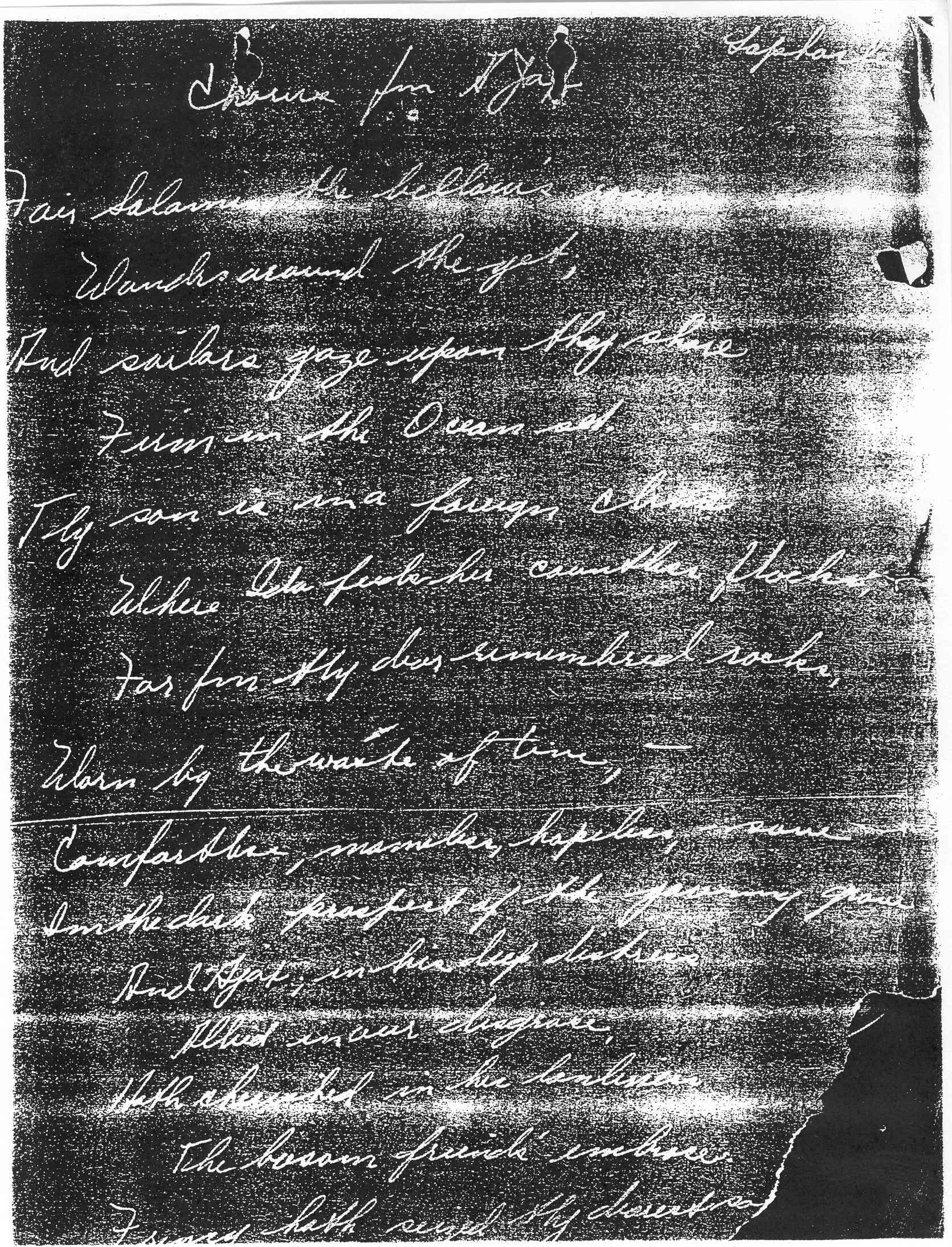
But the most compelling proof that Forrestal’s death has been disguised as a suicide is the poem allegedly copied by Forrestal. Among the exhibits obtained by Martin alongside the Willcutts report is a copy of the memo sheet with the transcription of the poem (here). A comparison with any handwritten note by Forrestal makes it plain that it was not copied by Forrestal (both can be found on Mark Hunter’s webpage).
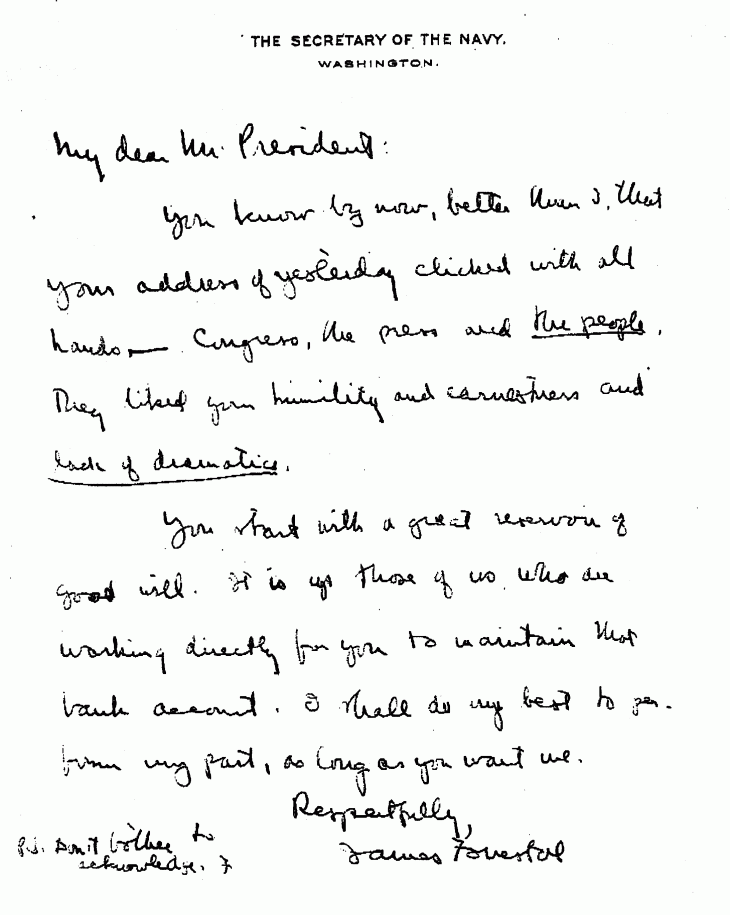

A sample of Forrestal’s handwriting and the note supposedly found in his room
As Martin comments, “One hardly needs an expert to tell him that the person who transcribed the poem is not the same person who wrote the various letters there.” Martin also notes that, from this single page, it is doubtful that the writer, whoever he was, even reached the word “nightingale”, which appears 11 verses below in the poem.
Interestingly, no one is identified in the official report as the discoverer of this handwritten note. It didn’t occur to the members of the Review Board to mention how it came into their possession, and to question about it the person who gave it to them.
In an effort to make the note a convincing proof of suicide, Rogow claims, and Hoopes and Brinkley repeat, that Apprentice Robert Wayne Harrison, Jr., the corpsman on duty to keep watch on Forrestal, checked into his room at 1:45 and saw him copying the poem. But by doing so, they both contradict Harrison’s declaration to the Willcutts Board. He said that, when he checked on him at 1:45, Forrestal was “in his bed, apparently sleeping.” Then he went to fill in the medical chart. Minutes later, a nurse heard the sound of Forrestal’s body striking the third floor roof. Harrison heard nothing but then became aware that Forrestal was missing at 1:50.
 Robert Wayne Harrison, Jr. would certainly have been a prime suspect if any criminal investigation had taken place. He was new to the job, and unknown to Forrestal until that fatal night. He had started his guard at midnight, replacing Edward Prise whose shift had started at 4 pm. Prise was well-known and apparently appreciated by Forrestal; he had been assigned to keep watch on Forrestal from the third day of Forrestal’s arrival at Bethesda. Strangely, his name is not mentioned in any contemporary news report, and it is misspelled “Price” in the report and in all biographies, although he clearly signed “Prise” in the medical chart included among the exhibits with the Willcutts report.
David Martin mentions that he received an e-mail from Prise’s daughter saying:
“We grew up hearing whispers between our parents in reference to this matter but were not allowed to ask for detail. Even up until a year prior to my father’s death in 1991 he had called me and was in fear that he was going to be questioned again about the issue.” (Martin p. 9)
We need not insist on the fact that witnesses are easily intimidated in a military environment, as was Bethesda Hospital. The pressure transpires in the transcripts of the Willcutts interviews: every nurse, corpsman or doctor said what they were expected to say, and understood their obligation never to speak otherwise. An interesting insight into this can be gained from David Martin’s interview of John Spalding, James Forrestal’s Navy Driver, then 27 years-old. When informed of the death of Forrestal by his superior, Spalding was handed a sheet of paper to sign, saying “I could never talk about anything that happened between him and me.”
Was it the communists or the Zionists?
Before David Martin, one author, writing under the pen-name Cornell Simpson, had claimed that Forrestal had been murdered. His book, The Death of James Forrestal, was published in 1966, although he claims to have written it in the mid-1950s. Simpson’s book contains much valuable and credible information. He had for example interviewed James Forrestal’s brother Henry, who was positively certain that his brother had been murdered. Henry Forrestal found the timing of the death very suspicious because he was coming to take his brother out of the hospital a few hours later that very same day. According to Simpson, another person who didn’t believe in Forrestal’s suicide was Father Maurice Sheehy. When he hurried to the hospital several hours after Forrestal’s death, he was approached discreetly by an officer who whispered to him, “Father, you know Mr. Forrestal didn’t kill himself, don’t you?”
Simpson blames the communists for Forrestal’s murder. The claim is not preposterous. Forrestal was definitely anti-communist. He had been alarmed by what he saw as communist infiltration in the Roosevelt administration (the Venona decrypts, giving evidence of 329 Soviet agents inside the U.S. government during World War II, would prove him right). After Roosevelt’s death, he was influential in the transformation of U.S. policy toward the Soviet Union, from accommodation to “containment.” Senator Joseph McCarthy, another Irish Catholic, testifies in his book The Fight for America that it was Forrestal who directly inspired his exposés of communist influence and subversion in the federal government:
“Before meeting Jim Forrestal I thought we were losing to international Communism because of incompetence and stupidity on the part of our planners. I mentioned that to Forrestal. I shall forever remember his answer. He said, ‘McCarthy, consistency has never been a mark of stupidity. If they were merely stupid they would occasionally make a mistake in our favor.’ This phrase stuck me so forcefully that I have often used it since.”
After Forrestal met his violent end, McCarthy moved up to the front line. He himself died on May 2, 1957, at the age of forty-eight, in Bethesda Hospital. Hospital officials listed the cause of death as “acute hepatic failure,” and the death certificate reads “hepatitis, acute, cause unknown.” The doctors declared that the inflammation of the liver was of a “noninfectious type”. Acute hepatitis can be caused either by infection or by poisoning, yet no autopsy was performed. Simpson comments (as quoted at length in Martin’s article James Forrestal and Joe McCarthy):
“Like Jim Forrestal, Joe McCarthy walked into the Bethesda Naval Hospital as its most controversial patient and as the one man in America most hated by the Communists. And, like Forrestal, he left in a hearse, as a man whose valiant fight against Communism was ended forever.”
M. Stanton Evans, who built on his father Medford Evans’ earlier work for his commendable Blacklisted by History: The Untold Story of Senator Joe McCarthy and His Fight Against America’s Enemies (2009), hints at the possibility that McCarthy was murdered, but does not explore the issue.

In 1953, Robert Kennedy worked as an assistant counsel to the Senate committee chaired by Senator Joseph McCarthy
The problem with Cornell Simpson’s theory is that Forrestal’s worst enemies were not the communists, but the Zionists. Although Forrestal’s anti-communism later attracted criticism from left-wing historians, it was not, then, a matter of public condemnation. Forrestal’s anti-communism was shared by most of his contemporaries, especially within the military. As long as you did not mention the high percentage of Jews among communists, being anti-communist did not make you the target of the mainstream media. The same, obviously, cannot be said of anti-Zionism. Neither the Washington Post nor the New York Times can be said to have been pro-communist at any time, but both turned strongly pro-Zionist around 1946. Arthur Hays Sulzberger, the NY Times’ director of publication since 1938, had actually denounced in 1946 the “coercive methods of the Zionists” influencing his editorial line, but eventually gave in and, since 1948, the NY Times has produced singularly unbalanced coverage of Palestine.[9]
It was his opposition to Zionism, not to communism, that attracted death threats to Forrestal. In his diary entry for February 3, 1948, Forrestal writes that he had lunch with Bernard Baruch and mentioned to him his effort at stopping the process of recognition:
“He took the line of advising me not to be active in this particular matter and that I was already identified, to a degree that was not in my own interests, with opposition to the United Nations policy on Palestine.”
Martin comments (p. 86):
“Baruch clearly did not know his man when he attempted to influence him by appealing to Forrestal’s own self-interest. He might have known more than he was telling, though, when he hinted at the danger that Forrestal faced for the courageous position he had taken.”
Jewish gangsters were traditionally anti-communists, but the Zionists could count on them to give a hand whenever needed. From 1945, Ben-Gurion’s Jewish Agency had close links to the Yiddish mafia, also known as the Mishpucka (Hebrew for “the Family”), who contributed greatly to the clandestine arms-purchasing-and-smuggling network that armed the Haganah. Leonard Slater writes in The Pledge that Teddy Kollek, who later became the longtime mayor of Jerusalem, ran the day-to-day operations and was told explicitly by Jewish gangsters from Brooklyn, “If you want anyone killed, just draw up a list and we’ll take care of it.” Yehuda Arazi, a close aide to Ben-Gurion sent by him to the U.S. to purchase heavy armaments, approached Meyer Lansky and met with members of “Murder, Incorporated.” Another Haganah emissary, Reuvin Dafni, who would become Israeli consul in Los Angeles and New York, met with Benjamin Siegelbaum, known as Bugsy Siegel. Some of those “gangsters for Zion”, writes Robert Rockaway, “did so out of ethnic loyalties,” or “saw themselves as defenders of the Jews, almost biblical-like fighters. It was part of their self-image.” Some also helped “because it was a way […] to gain acceptance in the Jewish community.”[10] Mickey Cohen, the successor of Bugsy Siegel, explains in his memoirs that from 1947, “I got so engrossed with Israel that I actually pushed aside a lot of my activities and done nothing but what was involved with this Irgun war.”[11] He was in close contact with Menachem Begin, and met with him when Begin came touring the U.S. in December 1948, a few months before Forrestal was confined to the Bethesda hospital.[12] Had Begin wanted Forrestal dead, he had only to ask.
I think it is quite self-evident that Forrestal had more to fear from the Zionists than from the communists. And so it is strange that Cornell Simpson totally ignores the Zionists as possible culprits. Neither Israel nor Zionism appears in his index. David Martin, who nevertheless recognizes the merit of Simpson’s investigation, finds the explanation for his blackout on Zionism in the fact that his book was published by Western Islands Publishers, the in-house publishing company of the John Birch Society, a Zionist front.
Three years before the Birch Society published Simpson’s book, Rogow had published the first biography of Forrestal, defending the official line about his death, and linking his supposed mental illness directly to his supposed anti-Semitism. It is very unlikely that Rogow’s book eased the suspicions of the skeptics about Forrestal’s suicide. On the contrary, Rogow’s obvious bias as a writer mainly concerned with anti-Semitism must have led many to consider his book as just another layer in the cover-up. Martin therefore speculates that the writing and publishing of Simpson’s book by the Birch Society was a way to give voice to the skepticism over Forrestal’s death, while directing that skepticism away from the most likely suspects. Blaming the communists was the easiest way to deflect suspicions from the Zionists.
It was all the easier that, from the 1930s up to the time of Forrestal’s death, the communists and the Zionists were the same people in many instances, as David Martin points out. Although communism and Zionism may seem incompatible from an ideological viewpoint, it is a matter of record that some of the Jews who acted as communist agents under Roosevelt, turned ardent Zionists under Truman. A case in point is David Niles (Neyhus), one of the few of FDR’s top advisors kept by Truman: he was identified in the Venona decrypts as a communist agent, but then played a key role as a Zionist gatekeeper under Truman. Edwin Wright, in The Great Zionist Cover-Up, names him as “the protocol officer in the White House, [who] saw to it that the State Department influence was negated while the Zionist view was presented.” David Niles’ brother Elliot, a high official of B’nai B’rith, was a Lieutenant Colonel who passed information to the Haganah while working in the Pentagon.
Did the order come from the White House?
Martin considers David Niles “the most likely coordinator of the Forrestal assassination.” He had the motives and the means. He was actually capable of passing orders on behalf of Truman, as he did when orchestrating the campaign of intimidation and corruption that obtained a two-third majority in favor of the Partition Plan at the U.N. General Assembly.[13]
There are reasons to believe that the order to eliminate Forrestal came directly from the White House. According to Truman’s appointments secretary, Matthew J. Connelly, it was Truman himself who suggested arranging for Forrestal a vacation at Hobe Sound. As for the decision to abduct him from there and intern him in Bethesda, Martin makes the following remark:
“Considering the fact that Forrestal, having been officially replaced as Defense Secretary by Johnson on March 28, was a private citizen at this point, it is certainly reasonable to assume that Forrestal’s extra-legal transportation to Florida on a military airplane and confinement and treatment in the Naval Hospital at Bethesda was not done without approval at the highest level.” (Martin p. 29)
Hoopes and Brinkley state explicitly that the decision to take Forrestal to Bethesda came from Truman, and that Forrestal’s wife was convinced by a telephone conversation with Truman.
The decision to put Forrestal on the 16th floor, which seems hardly appropriate for a patient reputed suicidal, also came from the White House. Hoopes and Brinkley quote Dr. Robert P. Nenno, a young assistant to Dr. Raines from 1952 to 1959, who believed that Raines had received instruction to put Forrestal there, and added, “I have always guessed that the order came from the White House.”
Hoopes and Brinkley justify Dr. Raines’ turning Sheehy away on six occasions by the fear that Forrestal might divulge sensitive information during confession. Such concerns obviously came from higher up. It apparently didn’t come from Navy Secretary John L. Sullivan because, as Hoopes and Brinkley tell us, when Sheehy and Henry Forrestal took their complaint to him on May 18, he expressed surprise and had the decision overruled. According to Simpson: “the priest later commented that he received the distinct impression that Dr. Raines was acting under orders.”
There is, of course, no evidence that throwing Forrestal out of the window was also ordered by the White House, but given Truman’s complete control by the Zionists, and by David Niles in particular, it is not unlikely.
Why kill him after he had been dismissed from power?
But, one may ask, why would Truman or anyone need to kill Forrestal? Once out of the Pentagon, he had no more influence on government policy.
The answer is easy. Far from being suicidal, Forrestal was a man with a plan. According to Hoopes and Brinkley,
“he had told powerful Wall Street friends […] that he was interested in starting a newspaper or a magazine modeled after The Economist of Great Britain, and they had demonstrated a willingness to help him raise the start-up funds.”
He also planned to write a book. With no more ties to the government or to the army, he was free to speak his mind on many issues. As a war hero and a very popular figure, he was sure to have a great impact. And he had plenty of embarrassing things to reveal about what he had seen during his nine years in the government.

Time cover, October 29, 1945
As Navy Secretary, he had been the central person for Pacific operations during World War II. He had inside knowledge of Roosevelt’s scheme to provoke the Japanese into attacking Pearl Harbor. According to his diary entry for April 18, 1945, he had even told Truman, that,
“I had got Admiral Hewitt back to pursue the investigation into the Pearl Harbor disaster. […] I felt I had an obligation to Congress to continue the investigation because I was not completely satisfied with the report my own Court had made.”
Forrestal was also very bitter about the way the war ended in the Pacific. Knowing the desperate situation of the Japanese, he had worked behind the scene to achieve a negotiated surrender from the Japanese. He was opposed to the demand of “unconditional surrender”, which he knew was unacceptable to the Japanese military leadership. Simpson writes, as quoted by David Martin here:
“As secretary of the navy, Forrestal had originated a plan to end the war with Japan five and a half months before V-J Day finally dawned. He had mapped this plan on the basis of massive intelligence information obtained on and prior to March 1, 1945, to the effect that the Japanese were already desperately anxious to surrender and the fact that the Japanese emperor had even asked the pope to act as peace mediator. If Roosevelt had acted on Forrestal’s plan, the war would have ground to a halt in a few days. A-bombs would never have incinerated Hiroshima and Nagasaki, thousands of Americans would not have died in the unnecessary battle of Okinawa and later bloody encounters, and the Russians would not have had a chance to muscle into the Pacific war for the last six of its 1,347 days, thus giving Washington the pretext for handing them the key to the conquest of all Asia.”
Forrestal had also much to say about the way the Zionists obtained the Partition Plan at the General Assembly of the United Nations, or about the way Truman was blackmailed and bought into supporting the recognition of Israel. He had written in his diary, February 3, 1948, about his meeting with Franklin D. Roosevelt, Jr., a strong advocate of the Jewish State:
“I thought the methods that had been used by people outside of the Executive branch of the government to bring coercion and duress on other nations in the General Assembly bordered closely onto scandal.”
Forrestal had a pretty good memory. But, in addition, he had accumulated thousands of pages of diary during his public service. According to Simpson,
“During Forrestal’s brief stay at Hobe Sound, his personal diaries, consisting of fifteen loose-leaf binders totaling three thousand pages, were hastily removed from his former office in the Pentagon and locked up in the White House where they remained for a year. […] all during the seven weeks prior to Forrestal’s death, his diaries were out of his hands and in the White House, where someone could have had ample time to study them.”
The White House later claimed that Forrestal had sent word that he wanted President Truman to take custody of these diaries, but that is very unlikely.
A small part of Forrestal’s diaries was ultimately published in a heavily censored form by Walter Millis, FDR apologist and New York Herald Tribune journalist. Simpson estimates that more than 80 percent was left out. Millis frankly admitted that he had deleted unfavorable “references to persons, by name [and] comment reflecting on the honesty or loyalty of an individual.” Millis also said that he deleted everything on the Pearl Harbor investigations. One can only guess how much censorship Millis exerted on Forrestal’s view about American support for Israel.
David Martin’s conclusion makes perfect sense:
“Forrestal’s writing and publishing plans provide the answer to the question, ‘Why would anyone bother to murder him when he had already been driven from office and disgraced by the taint of mental illness?’”
“The compelling reasons for Forrestal to want to continue living were also compelling reasons for his powerful enemies to see to it that he did not.”
“He comes across, in short, not as a prime candidate for suicide, but for assassination.” (Martin, pp. 52, 53, 87)
A parallel with Lord Northcliffe
In his blurb for Martin’s book, James Fetzer puts it this way:
“Dave Martin has established that James Forrestal was targeted for assassination by Zionist zealots who were convinced that his future influence as an editor and publisher represented an unacceptable risk.”
In this article, Martin expands on this idea by comparing Forrestal to Lord Northcliffe (Alfred Harmsworth), an influential newspaper editor whose tragic story is told by Douglas Reed in The Controversy of Zion (pp. 205-208), based on The Official History of The Times (1952). In the 1920s just like today, factual reporting from the press was the greatest obstacle to the Zionist ambitions. Lord Northcliffe owned journals and periodicals, including the two most widely read daily newspapers, and he was the majority proprietor of the most influential newspaper in the world at that time, The Times of London. He took a definite stand against the Zionist plan, and wrote, after a visit to Palestine in 1922: “In my opinion we, without sufficient thought, guaranteed Palestine as a home for the Jews despite the fact that 700,000 Arab Moslems live there and own it.” Northcliffe commissioned a series of articles attacking Balfour’s attitude towards Zionism. His editor, Wickham Steed, refused, and, when Northcliffe asked him to resign, took a series of actions to have Northcliffe declared mentally ill. Although he appeared perfectly normal to most people he met, on June 18, 1922, Northcliffe was declared unfit for the position of editor of The Times on the authority of an unknown “French nerve specialist,” removed from all control of his newspapers, and put under constraint. On July 24, 1922 the Council of the League of Nations met in London, secure from any possibility of loud public protest by Lord Northcliffe, to bestow on Britain a “mandate” to remain in Palestine and to install the Zionists there. On August 14, 1922, Northcliffe died at the age of fifty-seven, officially of “ulcerative endocarditis.” The public was, of course, kept in total ignorance of the way this highly respected public figure was taken off the scene. Douglas Reed, who was then working as a clerk in the office of The Times, and learned the full story much later, remembers that:
“Lord Northcliffe was convinced that his life was in danger and several times said this; specifically, he said he had been poisoned. If this is in itself madness, then he was mad, but in that case many victims of poisoning have died of madness, not of what was fed to them. If by any chance it was true, he was not mad. […] His belief certainly charged him with suspicion of those around him, but if by chance he had reason for it, then again it was not madness.”
Reed sees Northcliffe’s elimination as a turning point:
“After Lord Northcliffe died the possibility of editorials in The Times ‘attacking Balfour’s attitude towards Zionism’ faded. From that time the submission of the press […] grew ever more apparent and in time reached the condition which prevails today, when faithful reporting and impartial comment on this question has long been in suspense.”
The parallel with Forrestal is indeed striking, as David Martin remarks:
“Forrestal’s first love was journalism. In his youth he had worked as a reporter for three newspapers in his native upstate New York, and he had been the editor of the student newspaper at Princeton. As former president of the investment banking firm of Dillon, Read, & Co. he was a rich, powerful and well-connected man. He had plans to run his own news magazine. In short, he could have become an American Lord Northcliffe with the ability to have a great deal of influence on public opinion in the country.”
Notes
[1] Seymour Hersh, The Samson Option: Israel’s Nuclear Arsenal and American Foreign Policy, Random House, 1991, p. 141.
[2] Haaretz, February 5, 1999, quoted in Michael Collins Piper, False Flags: Template for Terror, American Free Press, 2013, pp. 54–55.
[3] Joe Sterling, “Jewish paper’s column catches Secret Service’s eye,” CNN, January 22, 2012.
[4] Alan Hart, Zionism: The Real Enemy of the Jews, vol. 2: David Becomes Goliath, Clarity Press, 2013, p. 90.
[5] Ronen Bergman, Rise and Kill First: The Secret History of Israel’s Targeted Assassinations, Random House, 2018, p. 20.
[6] William Reymond and Billie Sol Estes, JFK Le Dernier Témoin, Flammarion, 2003.
[7] Alan Hart, Zionism: The Real Enemy of the Jews, vol. 2: David Becomes Goliath, Clarity Press, 2013, p. 250.
[8] John Loftus and Mark Aarons, The Secret War against the Jews: How Western Espionage Betrayed The Jewish People, St. Martin’s Griffin, 2017 , p. 212-213.
[9] Alfred Lilienthal, What Price Israel? (1953), Infinity Publishing, 2003, pp. 95, 143.
[10] Robert Rockaway, “Gangsters for Zion. Yom Ha’atzmaut: How Jewish mobsters helped Israel gain its independence”, April 19, 2018, on tabletmag.com
[11] Mickey Cohen, In My Own Words, Prentice-Hall, 1975, pp. 91–92.
[12] Gary Wean, There’s a Fish in the Courthouse, Casitas, 1987, quoted by Michael Collins Piper, Final Judgment: The Missing Link in the JFK Assassination Conspiracy, American Free Press, 6th ed., 2005, pp. 290–297.
[13] Alfred Lilienthal, What Price Israel? (1953), Infinity Publishing, 2003, p. 50.
The Umbrella Man, the Sins of the Father, and the Kennedy Curse
By Laurent Guyénot • Unz Review • November 22, 2019
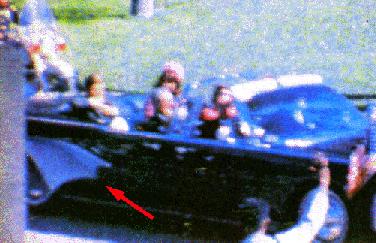
I first heard of the so-called “Umbrella Man” from a commenter to my unz.com article “Did Israel Kill the Kennedys?” (thanks again). It is one of the most puzzling pieces in the JFK assassination file. An intriguing introduction to it is this short interview of Josiah Thompson filmed by Errol Morris for the New York Times, on the 48th anniversary of his death:
Or view on Vimeo.
This film is interesting because, besides presenting the facts accurately, it illustrates the kind of “cognitive dissonance” they can produce, leading reasonable people to believe an implausible but harmless and comforting explanation, rather than a more logical but deeply disturbing one. In that case, it seems that normally programmed brains will reject vigorously, as unspeakable and therefore unthinkable on the conscious level, the notion that John Kennedy’s assassination can possibly have anything to do with his father’s appeasement policy in 1938, despite the fact that that notion has been deeply ingrained in our subconscious mind through the twin Jewish mythemes of “The Sins of the Father” and “The Kennedy Curse”, as illustrated by those two books:
The “sins of the father” is a not-so-subtle reference to Exodus 20:5:
“I, Yahweh, am a jealous God, punishing the children for the sin of the parents to the third and fourth generation of those who hate me.”
Chief among Joe Kennedy’s sins was, of course, that “he was a documented anti-Semite and an appeaser of Adolf Hitler” (publisher’s presentation of Kessler’s book).
The “Kennedy Curse” is a quasi kabalistic attempt to explain how the Kennedys were “on a fatal collision course with reality” because they “made the fatal mistake of thinking of themselves as divine.” By implication, their assassinations are to be blamed on their “self-defeating behavior” (publisher’s presentation of Klein’s book).
Taken together, those twin hasbara refrains evoke a notion of divine punishment. JFK and RFK were punished for the sins of their Jew-hating, Nazi-loving father. Mind you, it was Yahweh who took vengeance, not Israel!
The Umbrella Man fits so perfectly in this mythic narrative! The problem is that myths are not supposed to incarnate themselves so patently in physical reality. The implications are here too disturbing: for no reasonable man can believe that Yahweh supernaturally inspired Louie Steven Witt his “bad joke” (as he called it when interviewed by the special House Select Committee on Assassinations in 1978). Then who inspired it?
Such a question is off-limit for Josiah Thompson’s mind. So he simply decided not to see anything “sinister” in the weird fact that he relates. He not only takes Witt’s explanation at face value (“this is just wacky enough, it has to be true!” in other words, credo quia absurdum), but assumes that the strange behavior of the Umbrella Man and JFK’s assassination are unrelated, and happened precisely at the same time and at the same spot by pure quantum physics coincidence.
By setting his mind on that explanation, Thompson obviously feels relieved not to have to get into “conspiracy theories”, because “everybody else got into the conspiracy theories,” and he is above the crowd. I find it hard to explain that this is the same Josiah Thompson who published in 1967 a book titled Six Seconds in Dallas: a micro-study of the Kennedy assassination proving that three gunmen murdered the President, for which he studied the Zapruder film and interviewed eyewitnesses in order to come up with a plausible line of fire, and the conclusion of a conspiracy and government cover-up. What happened to Josiah in between?
Russ Baker has posted on his website WhoWhatWhy a couple of articles in reaction to Thompson’s NYT interview: here and here. Contrary to Thompson, he finds Witt’s explanation literally unbelievable, and opts for the theory of the “signal man”: the Umbrella Man was “signaling the shooters, perhaps that JFK had been hit, perhaps that he still seemed to be alive, perhaps to keep shooting.” That theory, adopted by film director Oliver Stone for his 1991 movie JFK, is of course far more credible than the theory of the fléchette-shooting umbrella that Thompson chose to mention to his own satisfaction. But I must say I find it not entirely convincing. I cannot conceive that professional snipers would need such a conspicuous accomplice, standing almost in their line of fire (in the case of those shooting from the Grassy Knoll).
I also find no reason to doubt, as Baker does, that Witt was the real Umbrella Man. Witt was identified by neighbors and local newsmen before he came forward to the HSCA, and the photos of him on Dealey Plaza seem to match.
Baker borrows from John Simkin of Spartacus Educational the opinion that the umbrella was never the symbol of Chamberlain anyway, and so that Witt’s explanation makes no sense. Baker is wrong on that point, apparently. The umbrella was so much the iconic trademark of Prime Minister Neville Chamberlain that cartoonist David Low of the London Evening Standard, not only systematically drew him with his umbrella, but even drew him as an umbrella!

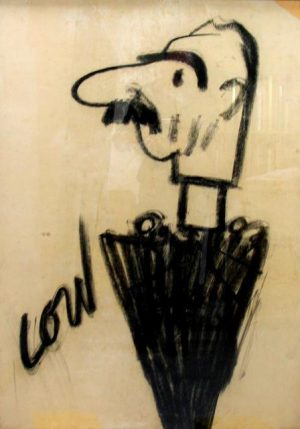
Chamberlain, who became a reviled symbol of appeasement (his biography bears the significant title, More Than Munich: The Forgotten Legacy of Neville Chamberlain) was the archetypal Umbrella Man.
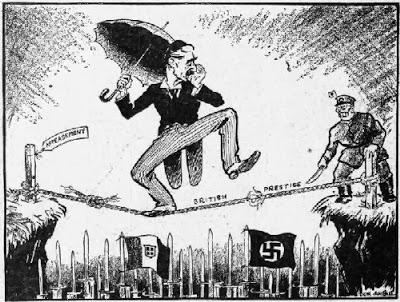
According to Edward Miller,
“Umbrella protests first began in England after Chamberlain arrived home from the [Munich] conference carrying his trademark accessory. Wherever Chamberlain traveled, the opposition party in Britain protested his appeasement at Munich by displaying umbrellas.”[1]
Louie Steven Witt declares in his testimony to the HSCA that he had heard that “some members of the Kennedy family” had once been offended in an airport by people brandishing umbrellas. I haven’t found any confirmation that Joseph Kennedy or any other Kennedy had been heckled by open umbrellas as a “silent protest” against their objectionable lack of love for the Jews, but I find it plausible that “the umbrella was a sore spot to the Kennedys,” as Witt put it in his HSCA testimony. So John Kennedy being heckled with Chamberlain’s umbrella at the same time as being assassinated under Ben-Gurion’s order does strike me as both plausible and significant, as a sort of cryptic signature by the Zionist-Irgun mafia.
In my view, summarized here, John Kennedy was assassinated by Israel for three major reasons:
Dimona: President Kennedy, who had made nuclear disarmament his grand mission on the international level, and was on the way to achieve it with Khrushchev (as shown by James Douglass in JFK and the Unspeakable), was determined to stop Israel developing its own nuclear bomb. According to Colonel Muammar Gaddafi’s interpretation, it was to plunge into the Israeli deep state and supervise Kennedy’s assassination that Ben-Gurion resigned in July 1963 before receiving Kennedy’s ultimatum letter demanding inspections of Dimona.
American Zionist Council: John Kennedy and his Attorney General Bobby Kennedy had infuriated Zionist leaders by supporting an investigation led by Senator William Fulbright (whom Kennedy had been prevented to name as Secretary of State) aimed at registering the American Zionist Council as a “foreign agent” subject to the obligations defined by the Foreign Agents Registration Act of 1938, which would have rendered its lobbying division, the AIPAC, near powerless. On October 11, 1963, the AZC received a formal demand from RFK’s office to register within 72 hours (details here).
Nasser: Kennedy unequivocally supported Arab nationalism in 1957 as a senator,[2] reversed Eisenhower’s foreign polity in a pro-Nasser way (as documented by Philip Muehlenbeck, Betting on the Africans: John F. Kennedy’s Courting of African Nationalist Leaders, Oxford UP, 2012), and committed the U.S. to support U.N. Resolution 194 for the right of return of Palestinian refugees. That was a major threat to Zionist interests, who had bet on making Nasser an enemy of the United States.
To these reasons for assassinating Kennedy, we must add the opposite reasons for putting Johnson instead in the Oval Office, for Johnson buried both the Dimona and the AZC proceedings, and cut U.S. support for Nasser’s in order to boost support to Israel. In 1967, he would commit high treason against his own country by allowing and covering-up Israel’s failed false-flag attack on the USS Liberty. No wonder Israel loved Johnson as much as they hated Kennedy.

In the Zionists’ view, JFK’s anti-Israel policies (discreet or secret) were part of a more general “Kennedy problem” that went back to his father’s attempt to prevent WWII by supporting Chamberlain’s appeasement with Hitler rather than Churchill’s appeasement with Stalin. According to German documents declassified in 1949, the German Ambassador in London, Herbert von Dirksen, after meeting U.S. ambassador Joseph P. Kennedy in 1938, wrote that he “understood our Jewish policy completely,” and was “Germany’s best friend” in London.[3] When Roosevelt entered the war, Joseph Kennedy resigned, and later complained privately that, “the Jews have won the war.”[4] According to biographer David Nasaw, Joseph was not an anti-Semite in the racial sense, but rather someone who believed in a Jewish conspiracy to push the United States into an unnecessary war with Germany (Nasaw insists he was mistaken, because “Jewish influence on American foreign influence was negligible, its influence on the State Department nonexistent”).[5]
Zionists had reasons to fear that Joseph Kennedy did “inject some poisonous drops of anti-Semitism in the minds of his children, including his son John’s” (as printed in September 1960 by the Herut, Menachem Begin’s political party).[6] In 1940, John had published a book titled Why England Slept, adapted from his Harvard thesis which was, as the title alluded, a response to Churchill’s 1938 book While England Slept, and a veiled support for his father’s pro-appeasement views. In his Pulitzer prize-winning book Profiles in Courage (1956), Kennedy had declared his admiration for Senator Robert Taft, who by calling the Nuremberg trials a shameful parody of justice had sacrificed his political career, including his chances for the presidency, rather than build it on hypocrisy. Although Zionists probably didn’t know it until recently, in 1945, JFK had written the following in his diary, as quoted here by Abigail Abrams:
“You can easily understand how that within a few years Hitler will emerge from the hatred that surrounds him now as one of the most significant figures who ever lived. He had boundless ambition for his country which rendered him a menace to the peace of the world, but he had a mystery about him in the way he lived and in the manner of his death that will live and grow after him. He had in him the stuff of which legends are made.”[7]

Joseph Jr., Joseph Sr., and John Kennedy in 1938
The Kennedys were a family of strong traditions and strong convictions. They had to be destroyed, politically as had Charles Lindbergh (1902-1974), and if necessary physically, before they extirpate America from Zionists’ clutches.
Dallas was an Israeli coup, ordered from Tel Aviv with Johnson’s support, and supervised by the local B’nai B’rith under the cover of the Dallas Citizens Council, who was sponsoring Kennedy’s visit, and of whom Abraham Zapruder himself was a member (watch his satisfaction when interviewed two hours after JFK’s assassination in the History Channel documentary JFK – 3 Shots That Changed America , at 43:34).
When trying to make sense of Dallas’ Umbrella Man, we are faced with a dilemma: should we believe Witt’s explanation of his strange behavior (as does Josiah Thompson), or should we consider him an accomplice to the assassination (as does Russ Baker)? Only in the framework of the Israeli theory pioneered by Michael Collins Piper is it possible to surmount the dilemma.
Let’s recap what we know for certain. Fact number 1: on the sunny day of November 22, 1963, one man was standing on the President’s motorcade route with an open umbrella, at the precise moment and place when JFK was shot. To assume that the Umbrella Man’s strange behavior and JFK’s assassination are unrelated is unreasonable. The coincidence is just too improbable.
Fact number 2: In 1978, Louie Steven Witt claimed in front of the HSCA that he was the Umbrella Man and explained that he wanted to heckle JFK about his father’s policy of appeasement of Hitler in 1938.
Although Thompson and Baker disagree about everything else, they agree that there can be no connection between John Kennedy’s assassination and Joseph Kennedy’s appeasement policy. That is where they are both wrong.
Was Louie Steven Witt a Zionist agent, a sayan? Not necessarily. Operations like the JFK assassination are planned on a strict need-to-know basis: no one knows more than he needs to know. Witt declared to the HSCA that he belonged to no organization whatsoever. He summarized his motivation for his “bad joke” in these words:
“In a coffee break conversation someone had mentioned that the umbrella was a sore spot with the Kennedy family. Being a conservative-type fellow, I sort of placed him in the liberal camp and I was just going to kind of do a little heckling.”
What would be interesting to know is: who inspired Witt during his coffee break? Did the coffee break take place in the office of Witt’s Jewish boss, director of the Rio Grande National Life insurance Co. in Dallas? Did Witt have insurmountable debts, like Jacob Rubenstein, aka Jack Ruby? Russ Baker mentions that the company wrote a lot of insurance for the military and was located in the same building that housed the local office of the highly negligent Secret Service.
Mr Witt, would you kindly come forward again and answer a few questions?
Notes
[1] Edward H. Miller, “Umbrella Man”, November 22, 2013, on The Historical Society, on
[2] “Remarks of Senator John F. Kennedy, ‘The New Dimensions of American Foreign Policy’,” University of Pennsylvania, Philadelphia, Pennsylvania, November 1, 1957”; Arthur Schlesinger, A Thousand Days: John Kennedy in the White House (1965), Mariner Books, 2002, p. 554.
[3] Edward Renehan Jr., “Joseph Kennedy and the Jews”, History News Network; Kellen Perry, – “The Dark Side Of Joe Kennedy Sr.” allthatsinteresting.com, April 17, 2017.
[4] Quoted in Herbert Druks, John F. Kennedy and Israel, Praeger Security International, 2005, p. 10
[5] David Nasaw, The Patriarch: The Remarkable Life and Turbulent Times of Joseph P. Kennedy, Penguin, 2015, p. 509.
[6] Alan Hart, Zionism: The Real Enemy of the Jews, vol. 2: David Becomes Goliath, Clarity Press, 2013, p. 252.
[7] Abigail Abrams, “Auction of Rare Diary Highlights What John F. Kennedy Really Thought About Hitler,” Time, March 23, 2017, on
Laurent Guyénot is the author of JFK-9/11: 50 years of Deep State , Progressive Press, 2014, and From Yahweh to Zion: Jealous God, Chosen People, Promised Land … Clash of Civilizations, 2018. (or $30 shipping included from Sifting and Winnowing, POB 221, Lone Rock, WI 53556).
Unspeakable Memories: The Day John Kennedy Died
By Edward Curtin | November 22, 2019
There is a vast literature on the assassination of President John F. Kennedy, who died on a November 22nd Friday like this in 1963. I have contributed my small share to such writing in an effort to tell the truth, honor him, and emphasize its profound importance in understanding the history of the last fifty-six years, but more importantly, what is happening in the U.S.A. today. In other words, to understand it in its most gut-wrenching reality: that the American national security state will obliterate any president that dares to buck its imperial war-making machine. It is a lesson not lost on all presidents since Kennedy.
Unless one is a government disinformation agent or is unaware of the enormous documentary evidence, one knows that it was the CIA that carried out JFK’s murder. Confirmation of this fact keeps arriving in easily accessible forms for anyone interested in the truth. A case in point is James DiEugenio’s recent posting at his website, Kennedys and King, of James Wilcott’s affidavit and interrogation by the House Select Committee on Assassinations, declassified by the Assassinations Record Review Board in 1998. In that document, Wilcott, who worked in the finance department for the CIA and was not questioned by the Warren Commission, discusses how he unwittingly paid Lee Harvey Oswald, the government’s alleged assassin, through a cryptonym and how it was widely known and celebrated at his CIA station in Tokyo that the CIA killed Kennedy and Oswald worked for the Agency, although he did not shoot JFK. I highly recommend reading the document.
I do not here want to go into any further analysis or debate about the case. I think the evidence is overwhelming that the President was murdered by the national security state. Why he was murdered, and the implications for today, are what concern me. And how and why we remember and forget public events whose consequences become unbearable to contemplate, and the fatal repercussions of that refusal. In what I consider the best book ever written on the subject, JFK and the Unspeakable: Why He Died and Why It Matters (2009), James W. Douglass explains this in detail, including the James Wilcott story.
Realizing what I am about to say might be presumptuous and of no interest to anyone but myself, I will nevertheless try to describe my emotional reactions to learning of John Kennedy’s murder so long ago and how that reverberated down through my life. I hope my experiences might help explain why so many people today can’t face the consequences of the tragic history that began that day and have continued to the present, among which are not just the other assassinations of the 1960s but the lies about the attacks of September 11, 2001 and the subsequent endless and murderous “war on terror” with its mind-numbing propaganda and the recent anti-Russia phobia and the blatant celebration of the so-called “deep-state’s” open efforts to overthrow another president, albeit a very different one.
On November 22, 1963 I was a college sophomore. I was going down three steps into the college dining hall for lunch. (Many of my most significant memories and decisions have taken place on steps, either going up or going down; memory is odd in that way, wouldn’t you say?) I remember freezing on the second step as a voice announced through a PA system that the president had been shot in Dallas, Texas. When I finally recovered and went down into the building, another announcement came through saying the president had died. The air seemed to be sucked out of the building as I and the other students with a few professors sat in stunned silence. Soon little groups on this Catholic campus joined together to pray for John Kennedy. I felt as if I were floating in unreality.
Later that day when I left the campus and drove home, I thought back to three years previously and the night of the presidential election. Everyone at my house (parents, grandparents, and the five sisters still at home) had gone to bed, but I stayed up past 1 A.M., watching the television coverage of the vote count. My parents, despite their Irish-Catholicism, were Nixon supporters, but I was for JFK. I couldn’t comprehend why anyone would vote for Nixon, who seemed to me to personify evil. When I finally went up the stairs to bed, I was convinced Kennedy would win and felt very happy.
It wouldn’t be for another tumultuous decade before I would hear Kris Kristofferson sing
Never knowin’ if believin’ is a blessin’ or a curse
Or if the going up is worth to coming down….
From the rockin’ of the cradle to the rollin’ of the hearse
The goin’ up was worth the coming down
and I would ask myself the same question.
In the meantime, the next few years would bring the Bay of Pigs, the Cuban Missile crisis, and the Nuclear Test Ban Treaty, among other significant events, and for a high school student interested in politics and world events it was a heady and frightening few years. It was a country of newspapers back then, and I would read perhaps 3-4 each day and sensed a growing animosity toward Kennedy, especially as expressed in the more conservative NYC papers. I can remember very little talk of politics in my home and felt alone with my thoughts. As far as I can remember, this was also true at the Jesuit high school that I attended. And of course nothing prepared me for the president’s murder and the feeling of despair it engendered in me, a feeling so painful that I couldn’t really acknowledge it. At nineteen, I felt traumatized but couldn’t admit it or tell anyone. After all, I was a scholar and an athlete. Tough.
Then on Sunday morning my family had the TV on and we watched as Jack Ruby shot Lee Harvey Oswald, the guy the government said had killed the president. The unreality was compounded manyfold, and when later it was reported that Oswald had died, I felt I was living in an episode of The Twilight Zone, a popular television show at the time, whose narrator would say we are now entering the weird world between shadow and substance.
The next day a friend and I went to the Fordham University campus to visit a Jesuit priest who was a mentor to us. He had the television on for JFK’s funeral and we sat and watched it for a while with him. After a few hours, it became too painful and the two of us went outside to a football field where we threw a football back and forth. Perhaps subconsciously we were thinking of Kennedy’s love of football; I don’t know. But I remember a feeling of desolation that surrounded us on that empty cold field with not another soul around. It seemed sacrilegious to be playing games at such a time, yet deep trauma contributes to strange behavior.
Then I went on with my college life, studying and playing basketball, until the day after Malcolm X was assassinated on February 21, 1965. Those New York newspapers that didn’t like Kennedy, hated Malcolm even more and were constantly ripping into him. I vividly remember talking to my college basketball teammate the next day. His sense of devastation as a young African American struck me forcefully. As we walked to basketball practice and talked, his sense of isolation and gloom was palpable. Visceral. Unforgettable. It became mine, even though I didn’t at the time grasp its full significance.
In 1968 when Dr. Martin Luther King was assassinated, I was driving to visit a girlfriend and remember hearing the news on the car radio and feeling deeply shocked. I felt immediately oppressed by the first warm spring evening in the New York area. It was as if the beautiful weather, usually so uplifting after winter and so joyously stimulating to a young man’s sexuality, was conspiring with the news of King’s death to bring me down into a deep depression.
Soon the country would awaken on June 5 to the surreal news that Senator Robert Kennedy was shot in Los Angeles the night before. Like so many Americans, when he died not long after, I felt his death was the last straw. But it was far from it. For all the while Lyndon Johnson had lied his way to election in 1964 and escalated the Vietnam war to savage proportions. Death and destruction permeated the air we were breathing. The year 1968 ended with the suspicious death in Thailand of a hero of mine, the anti-war Trappist Monk Thomas Merton. Subsequent research has shown that that too was an assassination. And while all of this was going on and my political consciousness was becoming radicalized, I became a conscientious objector from the Marines. I was 24 years old.
By the late 1970s, having been fired from teaching positions for radical scholarship and anti-war activities, and mentally exhausted by the unspeakable events of the 1960s, I retreated into the country where I found solace in nature and a low-key life of contemplation, writing literary and philosophical essays, a novel, book reviews, and becoming a part-time newspaper columnist. By the 1990s, I gradually returned to teaching and a more active political engagement, primarily through teaching and writing.
Then in 1991 Oliver Stone jolted me back in time with his film JFK. I found powerful emotional memories welling up within me, and growing anger at what had happened to the U.S. in the previous decades. Soon JFK Jr., who was investigating his father’s assassination and was about to enter politics and take up his father’s mantle, was killed in a blatantly rigged “accident.” A month before I had been standing in line behind his wife in the bakery in my little town while he waited outside in a car. Now the third Kennedy was dead. I called my old friend the Jesuit priest from Fordham, but he was speechless. The bodies kept piling up or disappearing.
When the attacks of September 11, 2001 happened, I realized from day one that something was not right; that the official explanation was full of holes. My sociological imagination took fire. All that I had thought and felt, even my literary writing, came together. The larger picture emerged clearly. My teaching took on added urgency, including courses on September 11th and the various assassinations.
Then in 2009 I read and reviewed James Douglass’s masterpiece, JFK and the Unspeakable, and my traumatic memories of 1963 and after came flooding back in full force. I realized that those youthful experiences had been so difficult for me to assimilate and that I therefore had to intellectualize them, for the emotional toll of re-experiencing them and what they meant was profound. The book really opened me to this, but so too did the awareness of how sensitive I was to John Kennedy’s death, how emotional I felt when reading about it or hearing him speak or listening to a song such as “The Day John Kennedy Died” by Lou Reed. It was as though a damn had burst inside me and my heart had become an open house without doors or windows.
I tell you all this to try to convey the ways in which we “forget” the past in order to shield ourselves from powerful and disturbing memories that might force us to disrupt our lives. To change. Certain events, such as the more recent attacks of September 11, have become too disturbing for many to explore, to study, to contemplate, just as I found a way to marginalize my feelings about my own government’s murder of President Kennedy, a man who had given me hope as a youngster, and whose murder had nearly extinguished that hope.
Many people will pretend that they are exposing themselves to such traumatic memories and are investigating the events and sources of their disquietude. It is so often a pretense since they feel most comfortable in the land of make-believe. What is needed is not a dilettantish and superficial nod in the direction of having examined such matters, but a serious in-depth study of the facts and an examination of why doing so might make one uncomfortable. A look outward and a look inward. Just as people distort and repress exclusively personal memories to “save” themselves from harsh truths that would force them to examine their current personal lives, so too do they do the same with political and social ones. When I asked two close relatives of mine, both of whom came close to death on September 11, 2001 at The World Trade Towers, what they have thought about that day, they separately told me that they haven’t really given it much thought. This startled me, especially since it involved mass death and a close encounter with personal death in a controversial public event, two experiences that would seem to elicit deep thought. And these two individuals are smart and caring souls.
What and why we remember and forget is profoundly important. Thoreau, in writing about life without principle, said, “It is so hard to forget what is worse than useless to remember.” This is so true. We are consumed with trivia, mostly by choice.
Perhaps a reason we remember so much trivia is to make sure we forget profound experiences that might shake us to our cores. The cold-blooded public execution of President John Kennedy did that to me on that melancholy Friday when I was 19, and by trying to forget it and not to speak of it, I hoped it would somehow go away, or at least fade to insignificance. But the past has a way of never dying, often to return when we least expect or want it.
So today, on this anniversary Friday, another November 22, I have chosen to try to speak of what it felt like once upon a time on the chance that it might encourage others to do the same with our shared hidden history. Only by speaking out is hope possible. Only by making the hidden manifest.
T. S. Eliot wrote in “Journey of the Magi” words that echo ironically in my mind on this anniversary of the day John Kennedy died:
All this was a long time ago, I remember
And I would do it again, but set down
This set down
This: were we led all that way for
Birth or Death? There was a Birth certainly,
We had evidence and no doubt. I had seen birth and
Death,
But had thought they were different; this Birth was
Hard and bitter agony for us, like Death, our death.
We returned to our places, these Kingdoms,
But no longer at ease here, in the old dispensation,
With an alien people clutching their gods.
I should be glad of another death.
Remembering in all its emotional detail the day John Kennedy died has been a long and cold journey for me. It has allowed me to see and feel the terror of that day, the horror, but also the heroism of the man, the in-your-face warrior for peace whose death should birth in us the courage to carry on his legacy.
Killing a man who says “no” to the endless cycle of war is a risky business, says a priest in the novel Bread and Wine by Ignazio Silone. For “even a corpse can go on whispering ‘No! No! No! with a persistence and obstinacy that only certain corpses are capable of. And how can you silence a corpse.”
John Kennedy was such a man.
Eliot was right: Sometimes death and birth are hard to tell apart.
President Kennedy’s courage in facing a death he knew was coming from forces within his own government who opposed his efforts for peace, nuclear disarmament, and an end to the Cold War – “I know there is a God-and I see a storm coming. I believe that I am ready,” he had written on a slip of paper, and his favorite poem contained the refrain, “I have a rendezvous with death” – should encourage all of us to not turn our faces away from his witness for peace.
We must stop being at ease in a dispensation where we worship the gods of war and clutch the nuclear weapons that our crazed leaders say they will use on a “first-strike” basis. If they ever do, Eliot’s question – “were we led all that way for Birth or Death?” – will be answered.
But no one will hear it.
The Kennedy Autopsy 2
By Jacob G. Hornberger | FFF | November 22, 2019
Fifty-six years ago today, President John F. Kennedy was shot dead on the streets of Dallas, Texas. The official story is that a lone nut named Lee Harvey Oswald, without any motive, committed the assassination. During the past several decades, however, the overwhelming amount of circumstantial evidence, much of which was intentionally kept secret, points to a national-security regime-change operation to oust Kennedy from office and elevate Vice President Lyndon Johnson to the presidency.
 A key to understanding the assassination lies in a critically important event that occurred after the assassination. That event was the official autopsy that was conducted on the president’s body. By understanding the autopsy, one can gain a better understanding of the assassination itself.
That was the purpose of my best-selling book several years ago, The Kennedy Autopsy, which was a synopsis of a watershed five-volume assassination book entitled Inside the Assassination Records Review Board by Douglas P. Horne, who was a staff member of the ARRB in the 1990s.
The ARRB was the agency that Congress called into existence to enforce the President John F. Kennedy Records Collection Act of 1992, the law that required the CIA, the Pentagon, the Secret Service, and other federal agencies to disclose assassination-related records that such agencies had insisted on keeping secret since the day of the assassination. The law was enacted in response to the public outcry produced by Oliver Stone’s movie JFK, which posited that the assassination was a national-security regime-change operation carried out by the U.S. national-security establishment. At the end of the movie was a blurb pointing out the national-security establishment’s continued secrecy with respect to its assassination-related records.
The Future of Freedom Foundation recently published my new book The Kennedy Autopsy 2: Lyndon Johnson’s Role in the Assassination, which builds on the mountain of circumstantial evidence surrounding the president’s autopsy supporting the thesis developed by Oliver Stone in his movie and by Douglas Horne in his five-volume book. Specifically, my new book documents the circumstantial evidence pointing to the role that Lyndon Johnson played in the assassination.
Now, before anyone cries “Conspiracy theory!” which is the term that the CIA promoted early on to its assets in the mainstream press to dissuade people from questioning the official version of the assassination, consider the following:
The purpose of an autopsy is to determine the cause of death, which includes a determination of where the bullets were fired from. Since this was a state murder case, Texas law required that an autopsy be conducted on President Kennedy’s body. That duty fell to the Dallas County Medical Examiner, Dr. Earl Rose, who was one of the most competent pathologists in the country.
As soon as Kennedy was declared dead, however, a Secret Service team had the president’s body placed in an expensive, ornate casket and began taking it out of Parkland Hospital. Rose refused to permit them to do that, standing in their way, and declaring that he was required by state law to conduct an autopsy on the president’s body. In loud, screaming voices, the Secret Service team made it clear to Rose that they were operating under orders to take the body back to Washington without permitting Rose to conduct his autopsy. When Rose continued standing his ground, the Secret Service agents pulled back their suit jackets and brandished their guns. Screaming, yelling, and issuing a stream of profanities, they forced their way out of Parkland Hospital with Kennedy’s body, in direct violation of Texas law.
Waiting at Love Field was Lyndon Johnson, who was having seats removed from the back of Air Force One to make room for the casket. That meant that he knew that the casket was coming, which is virtually conclusive proof that he was the one who issued that order to that Secret Service team before he departed from Parkland Hospital.
Johnson himself was actually the very first conspiracy theorist in the Kennedy assassination. When he was at Parkland Hospital waiting to see if Kennedy would die and then later on the way to Dallas’s Love Field, Johnson raised the notion that the assassination might be the first step in a nuclear attack by the Soviet Union on the United States.
Yet, Johnson’s own actions establish that he knew that his conspiracy theory was bogus. When he arrived at Love Field, he had his personnel transfer everyone’s luggage from his plane — Air Force Two — to Air Force One, so that he could ride on the presidential plane rather than the vice-presidential plane. Yet, both planes were identical. He also took the time to find a federal judge to swear him in, despite the fact that the U.S. attorney general, Robert Kennedy, had advised him that no such swearing in was necessary. Johnson also took the time to wait for the casket to appear and be loaded onto Air Force One.
Does that sound like a man who was concerned that Soviet missiles might possibly be raining in on the United States, including one being aimed at Dallas, Texas? Wouldn’t a president who was genuinely concerned about such a possibility have gotten up into the air immediately in order to conduct America’s defenses to such an attack? Despite his words, Johnson’s actions indicate that he was certain that the Soviets played no role in the assassination. There could only be one reason for such certainty, even while promoting what he knew was a bogus conspiracy theory.
When Air Force One landed in Maryland, Johnson ensured that the president’s body be turned over to the military rather than to civilian authorities. Why? America isn’t a military nation. It’s a civilian nation. The United States wasn’t at war, and Kennedy hadn’t been killed on the field of battle. Why the military instead of a Maryland or Washington, D.C., medical examiner?
The reason is that a fraudulent autopsy was needed to disguise the fact that shots had been fired from the front of Kennedy. The accused killer, Lee Harvey Oswald, was in Kennedy’s rear and, therefore, could not have fired from the front.
Now, before anyone cries “Conspiracy theory!” consider the following:
After the House Select Committee Hearings on the Assassination, which reopened the investigation into the assassination, several enlisted men came forward and told a remarkable story. They said that they had secretly carried the president’s body into the Bethesda morgue in a cheap, military-style shipping casket similar to the ones being used to bring back bodies of U.S. soldiers being killed in Vietnam. They said that they carried the body into the morgue about 6:35 p.m., which was approximately 1 1/2 hours before the body was officially carried into the morgue at 8 pm in the expensive, ornate casket into which the body had been placed in Dallas. They said that military officials had sworn them to secrecy, forced them to sign written secrecy oaths, and threatened them with court martial and criminal prosecution if they ever told anyone what they had seen and done.
In the 1990s, the ARRB uncovered a written document prepared by a Marine sergeant named Roger Boyajean, which had been prepared soon after the autopsy. The document confirmed that the president’s body had in fact been secretly carried into the morgue at 6:35 p.m. Boyayean himself confirmed to the ARRB the authenticity of the document and the event itself.
Now, before anyone cries “Conspiracy theory!” consider the following:
One of the three autopsy physicians, Col. William Finck, later testified that on the evening of the assassination he received a telephone call from Commander James J. Humes, who was one of the other autopsy physicians. The purpose of the call was to request Finck to assist with the autopsy. The call was made at 8 p.m., which was the same time that the president’s body was officially being carried into the morgue in the expensive, ornate Dallas casket.
Finck testified that Humes told him in that call that they already had x-rays of the president’s body. The question naturally arises: How could they already have x-rays at 8 p.m. if the president’s body was first being carried into the morgue at 8 p.m.? Finck inadvertently confirmed the remarkable story that those enlisted men would disclose several years later.
Now, before anyone cries “Conspiracy theory!” consider the following:
The ARRB summoned a woman named Saundra Spencer to testify. On the weekend of the assassination, she was a U.S Navy petty officer working in the U.S. Navy’s photography lab in Washington, D.C. She had a top-secret security clearance. She worked closely with the White House on official photographs, including top-secret ones. No one has ever questioned the veracity, competence, and professionalism of Saundra Spencer. It would be virtually impossible to find a more credible witness.
Under oath, Spencer told the ARRB a remarkable story. On the weekend of the assassination, she was asked to develop photographs of the autopsy carried out by military officials on President Kennedy’s body. She was told that her role was a highly classified operation. For some 30 years, she had kept the secret.
The ARRB showed Spencer the military’s official autopsy photographs. She carefully examined them. She testified directly and unequivocally that the photographs were not the ones she developed on the weekend of the assassination. The ones she developed, she said, showed a massive exit-sized wound in the back of President Kennedy’s head, which implied a shot having been fired from the front.
Now, before anyone cries “Conspiracy theory!” consider the following:
After Kennedy was brought into Trauma Room One in Parkland Hospital, the treating physicians immediately began emergency treatment procedures. However, one of the treating physicians summoned the others to view the back of the president’s head. They saw a huge exit-sized hole in the lower back of President Kennedy head. At that point, they knew that there was no way that they could save his life. The statements of the treating physicians immediately after the assassination confirm what Saundra Spencer would tell the ARRB some 30 years later. See “RIP: Dr. Robert McClelland, the Most Important JFK Witness” by Jefferson Morley.
For much more on the events surrounding the autopsy as well as the events leading up to Lyndon Johnson’s dramatic announcement that he was dropping out of the 1968 presidential race, read my new book The Kennedy Autopsy 2: Lyndon Johnson’s Role in the Assassination.
Featured Video
No Threat Can Force Iran’s Surrender /Trita Parsi & Lt Cl Daniel Davis
or go to
Aletho News Archives – Video-Images
From the Archives
What is the Israeli Lobby in Australia Doing in Interfaith Dialogue?
By Ali Kazak | Dissident Voice | October 11, 2015
For years Israel and its lobby around the world have been trying to normalise their relations with Arabs and Muslims without solving the Palestine Question.
One of the methods they resorted to in the last few years is using human rights and community organizations such as interfaith dialogue and Multiculturalism to achieve this objective and to: isolate the Palestinians, marginalise the Palestine question, end Israel’s isolation, and prevent criticism of Israel, knowing that these organisations will be the first to stand against Israel’s violations, racial and religious discrimination.
The group responsible for this task in Australia is The Australia/Israel & Jewish Affairs Council (AIJAC); its Director of International & Community Affairs, Jeremy Jones is in charge of lobbying religious community organizations, specifically Muslims and Christians. Consequently he convened the Faith Communities for Reconciliation, founding participant in the Australian Partnership of Religious Organisations and the Australian National Dialogue of Christians, Muslims & Jews.
AIJAC is a private political propaganda group. It is recognised as the main Israeli lobby in Australia. It coordinates its activities and works intimately with the Israeli embassy in Canberra and different institutions in Israel. It is privately funded by some Jewish businessmen. It monitors closely Australian politicians, the media, ethnic and religious groups, (especially Arabs and Muslims), unions and academics on their stands towards Israel and the Palestine question. … continue
Blog Roll
 Aletho News
- ‘War Crime’: Iran condemns attacks on Arak, Ardakan nuclear sites
- Two-thirds of Americans want quick end to Iran war even if goals unmet
- Trump to Give “Important Update on Iran” Wednesday in Prime-Time Speech
- Theodore Postol: Iran’s Missiles & Drones Were Underestimated
- Iran To Target Military Industrial-Tech Complex That Facilitated Gaza Genocide
- Collapsing Empire: The Resistance Disarms ‘Israel’
- Suicide Should Not Be a Government Service
- Rethinking America’s greatest threat: Iran vs. Israel-Firsters
- Iran accuses adversaries of false flags to strain Turkey ties
- Poland rules out sending Patriot missiles to US/Israel amid war on Iran
- If Americans Knew
- Ann Coulter Rips Into Fox News for Iran War Coverage, Compares to False Rigged 2020 Election Reporting
- Joe Kent Urges Americans To Call White House and Congress To Object To Sending Troops Into Iran
- DNC Resolution to Reject AIPAC Funding Puts Democratic Leaders in the Hot Seat
- Swedish foundation to build 400 schools as over 650,000 Gaza children remain without education for 2 years
- Israeli army admits photshopping image of slain Lebanese journalist
- This is how Israel is systematically killing health workers under the cover of war in Lebanon
- Carrying life under fire: Israeli invasion of Lebanon leaves pregnant women facing deadly risks
- Champagne all around for the new death penalty (for Palestinians) law – Not a ceasefire Day 172
- Why are Palestinian books struggling to be seen on Amazon?
- The Line Between Affinity and Conspiracy
- No Tricks Zone
- New Study Finds Warming Saves Lives…Cold Temperatures 12 Times More Deadly Than Excess Heat
- German Science Blog Accuses PIK Climate Institute Of Hallucinating Climate Tipping Points
- Devastating Assessment Of Comirnaty Vaccine By Former Senior Pfizer Europe Toxicologist
- New Study: CO2 Is ‘Effectively Negligible’ As An Explanatory Climate Change Factor Since 2000
- Former Pfizer Toxicologist Dr. Helmut Sterz Tells Bundestag Hearing Pfizer Vaccine Should Have Never Been Approved
- Energy Expert: Germany’s Nuclear Phaseout Was A “500 Billion Euro Mistake”
- New Research: South Australia’s Mid-Holocene Sea Surface Temperatures Were 4°C Warmer Than Today
- Storing Green Energy To Last Germany 10 Days Would Require A 60-Million Tonne Battery
- New Studies: UK Sea Levels Were 4 Meters Higher Than Today During The Mid-Holocene
- Destructive Green New Deal: German Energy And Metal Group Warns Of Drastic Crisis
 Aletho News