Debate Debacle: Democrats Need to Find New Candidate ASAP – Wall Street Analyst

By Ekaterina Blinova – Sputnik – 28.06.2024
The first debate between incumbent President Joe Biden and Republican front-runner Donald Trump turned out to be worse for the Democratic Party than the botched Afghanistan withdrawal, according to Wall Street analyst Charles Ortel.
“Debate night was a fiasco for Team Biden and for the conspirators in media and elsewhere who have ceaselessly sold Biden disasters on many fronts as ‘successes’,” Wall Street analyst and investigative journalist Charles Ortel told Sputnik.
With just a few months until Election Day, the Democratic leadership must now “push Biden and Harris both out and try to find a more credible team to fight the already well-funded and fiercely energized Trump juggernaut,” the analyst said.
“This is a very heavy lift as the Democrat bench is light and marginalized by primary cycles of 2020 and 2024 that installed a serial liar and diminished clod into the White House where he fails on all fronts,” Ortel said. “Whether it is the demolished pier in Gaza, the wreckage across the Middle East and Afghanistan, the horrific meat grinder in Ukraine, or the lawlessness and failures in Democrat run states and cities, Joe Biden and Kamala Harris stand revealed as incompetent losers.”
A week ago, Pulitzer Prize-winning investigative journalist Seymour Hersh called attention to growing concerns among top Democrats and their wealthy donors about Biden’s ability to overcome Trump in the November election. After saying that Biden’s debate performance would be “a major touchstone,” Hersh quoted political insiders as suggesting that if the first showdown with Trump goes badly for the incumbent president, the Democratic convention in Chicago would replace Joe with another, more dynamic candidate in August.
That scenario seems likely after the debate, according to Ortel.
“One theoretical approach might be to field an all-female historic ticket, seeking to exploit perceived weaknesses for Republicans over stances on abortion and gender insensitivity. Here, a Michelle Obama ticket with, perhaps, Hillary Clinton might gel. But who gets the top billing and who is second?” the Wall Street analyst remarked.
“Thursday’s nightmare will look even worse on Friday morning for Democrats. The Biden and Harris ‘brands’ are unsaleable,” Ortel concluded.
Hamas slams Biden regime for political, military support of Israel’s Gaza genocide
Press TV – June 25, 2024
Hamas says US President Joe Biden’s administration is responsible for the genocidal campaign in the Gaza Strip.
The Palestinian resistance movement said Washington continues to lend political and military support to Israel to carry out further destruction and carnage in the besieged territory.
In a statement released on Tuesday, the Gaza-based resistance movement also lamented the death of family members of Ismail Haniyeh, the head of the Hamas political bureau, including his sister, in an Israeli airstrike on their home in western Gaza City.
“We in the Hamas movement hold the Biden administration accountable for the unrelenting genocide war against our Palestinian brethren and sisters in the Gaza Strip, as it continues to offer the Zionist regime and its criminal army unconditional political and military support to press ahead with its destruction and genocide in the Strip,” the statement read.
“In light of the continuation and escalation of these horrific massacres, we call on Arab and Muslim nations as well as freedom-loving people of the world to step up their actions, and push for an end to the aggression.”
Hamas urged the international community and the United Nations to assume responsibility for the crimes of Israel in Gaza, protect innocent civilians, and hold the leaders of the terrorist Zionist regime accountable for their crimes.
One of the sisters of Haniyeh was killed in Gaza City’s Shati refugee camp on Tuesday morning.
Palestinian sources say an airstrike on a building belonging to Haniyeh’s extended family claimed the lives of 13 people.
Earlier in April, Israel had targeted and killed three of Haniyeh’s sons, along with four grandchildren — three girls and a boy.
Israel launched the atrocious onslaught on Gaza, targeting hospitals, residences, and houses of worship after Palestinian resistance movements conducted surprise Operation al-Aqsa Storm against the usurping regime on October 7, 2023.
Israel has killed more than 37,650 Palestinians, most of them women and children, and injured nearly 86,240 in Gaza since that October day.
More than 1.7 million people have also been internally displaced.
Here’s Why The US Is Unable To Secure A Gaza Ceasefire
By Robert Inlakesh | Al Mayadeen | June 22, 2024
It’s time to be serious about the reasons behind the US government’s inability to secure a ceasefire in the Gaza Strip. This comes down to unrealistic expectations, a refusal to concede a loss, incompetence and a pro-Israeli Lobby that controls many levers of power.
Weeks have passed since US President, Joe Biden, spoke in favor of a ceasefire and presented an Israeli proposal as “a road map to an enduring ceasefire and the release of all hostages.” Not long after this, the American military provided a supporting role to the Zionist military operation in Gaza’s Nuseirat, which allegedly resulted in 3 Israeli captives being killed and 4 re-captured, but most notably inflicted a civilian massacre that killed at least 274 Palestinians, injuring around 800 others.
The US temporary pier project, which was supposed to deliver humanitarian aid to Gaza, has been removed for a third time from the besieged coastal enclave, following allegations that immediately after its previous re-attachment it was used during the Nuseirat massacre. This project cost the American taxpayer hundreds of millions of dollars and has barely facilitated a trickle of the much needed aid, calling into question its true intended application.
On top of all of this, US Secretary of State, Antony Blinken, traveled once again to West Asia on a trip that was publicly announced to be geared towards concluding the ceasefire proposal that was voted through by the United Nations Security Council (UNSC). Blinken immediately decided to put himself in front of the cameras and tell the media that the Israelis had accepted the proposal and that Hamas was hindering its implementation due to their inability to answer “yes or no”. However, Hamas, unlike the Zionist entity, were the only side to actually issue a legitimate response to the UNSC’s resolution on the ceasefire proposal.
At this point, when the Secretary of State began openly lying and making excuses for the Zionist regime, it was clear that his administration had given up on the proposal and were preparing themselves to continue protecting the Israelis publicly. The Zionist regime never accepted the ceasefire, which was allegedly their own, with not a single one of their leaders issuing a statement uttering an acceptance. In fact, the very opposite has been the case, while Hamas has welcomed the ceasefire push and responded positively, the Zionists have been repeatedly asserting their desire to continue the genocide in Gaza. Israeli Prime Minister, Benjamin Netanyahu, has repeatedly made it clear that his intention is to pursue the destruction of Hamas and only ever issued statements regarding releasing the Israeli captives.
All of this was so predictable, because Netanyahu has no incentive at all to end the war in Gaza, other than the threat of a wider regional war. The US government supports him no matter what he does. So he need only shrug off any pressure coming from a rather weak and pathetic American administration that will unconditionally support the Zionist regime at any cost.
There are, however, layers to this catastrophe from the US government’s side. Starting with the fact that Washington cannot accept the impending strategic defeat it faces and wishes to try to extract a win by any means necessary. The United States is now experiencing the shrinking of its influence in the region, as a new multi-polar order emerges where nations around the world are given other economic partners as alternatives to the tyranny of the American so-called “rules based world order”. This order is rooted in maintaining the cultural and physical supremacy of the collective West, where Washington commands the world as the dominant liberal democracy that seeks to teach everyone else how to behave.
In line with attempting to hang onto the idea that they are still living in a world that resembles the period immediately following the Cold War, they clearly believe that the Palestinian cause will die down in its popular support and that they can return to a similar situation to the one that existed prior to Al-Aqsa Flood. In line with this way of thinking, to which the Arab client regimes still also desperately cling, the US continues to pursue Arab regime normalization with the Zionist entity. This way of thinking is predicated on the idea that Hezbollah, Ansarallah and the Palestinian resistance will suddenly disappear, which is out of touch with reality.
The Palestinian resistance have turned Gaza into a graveyard for its invaders, while Lebanese Hezbollah pummels their military sites and burns the northern settlements, meanwhile, the Yemeni resistance has succeeded in consistently embarrassing the US naval forces and imposing its blockade on the Zionist entity.
While the US could end this war any time it chooses, it is filled with incompetent and money-driven careerists who are incapable of long-term strategic thinking. If the Americans shut this war down earlier on, there was a window of opportunity to save their own power, image, and at least temporarily the future of the Zionist entity. Now, they have undermined both their own future and the existence of the Israeli regime in ways that are irreversible.
Joe Biden is essentially a human vegetable, who is clearly not physically capable of commanding such an important international issue at a time when other major geopolitical challenges are also ongoing. Perhaps if the self-professed Zionist was mentally sound and not simply a shell of his former self, he could have had more of an impact, beyond placing himself in front of cameras to deliver pro-Israeli propaganda.
Then we have Antony Blinken, who is tasked with standing up to Benjamin Netanyahu and is failing abysmally, assuming he is even employing the courage to try at all. The Israeli PM is a man that is well connected in the United States, not only with the billionaire class there, but also with the intelligence services too. Netanyahu is many things, a liar, a war criminal and a certified narcissist, but he isn’t stupid and knows how to operate from his position of power in a way that no other Israeli politician can. Blinken is clearly in no way cut out for the task in front of him and presents himself as a weak, incompetent, Secretary of State.
Although there may be people in the Biden administration who see the predicament they currently find themselves in and seek to maneuver strategically, they are clearly incapable of leading their government to a position that would save its own interests.
If we look at the elected officials, the vast majority of the US Congress and Senate are bought and paid for, whether this is by the military-industrial complex, AIPAC, or both. These officials are therefore useless, serving only their special-interest donors and/or seeking to climb the ladder of political power as the parasitic social climbers they are. Then we have both major Parties, who are heading towards a national election in which they need every billionaire and special-interest group to donate.
What the US’s current state of politics does is ensure that pockets are lined on all sides; however, you can’t run a successful country on the whims of mega-corporations and billionaires with special loyalties. It appears that a combination of weak politicians, incompetency, cognitive decline in the case of the President, the Israeli lobbying efforts, delusional misconceptions about their own capabilities, combined with a racist lack of regard for Palestinian life, has allowed for Washington to bow down to the demands of the Israeli PM.
Unfortunately, the approach that the US government adopted after October 7 of permitting a genocidal assault in order to try and save the image of the defeated US-Israeli regional alliance, continues.
As Israeli Prime Minister Benjamin Netanyahu slowly sinks to the bottom of the ocean, so too does he drag down the Zionist entity, while grabbing onto the hand of the US, pulling both down with him. Washington, meanwhile, holds on and chooses to believe that air bubbles exist at the bottom of the ocean.
Hunter Biden’s Charge of Lying Under Oath
The June 5 criminal referrals are indication enough that the Oversight and Judiciary committees are far from done, spent, or at a dead end.
By Patrick Lawrence | Consortium News | June 19, 2024
This is the fifth in Consortium News’ series on the congressional investigation into President Joe Biden’s allegedly corrupt involvement in the business affairs of his son Hunter. We publish these reports whenever new developments warrant them. Our earlier reports can be read here, here, here and here .
One reads regularly in the mainstream media, when events force them to report on the question, that the U.S. House Oversight Committee has hit a wall as it investigates Hunter Biden’s schemes to leverage his father’s power and Joe Biden’s potentially impeachable role in his son’s unseemly doings.
The House hearings have stalled, or fizzled, or reached a dead end: This has been the standard theme in corporate media for months now.
“Wouldn’t you know it,” Michael Goodwin asked in The New York Post as far back as March, “CNN, The Washington Post, The New York Times, Politico and others on the left all reached exactly the same conclusion at the same time.”
Let us put aside the notion that the above-named media are “left” and consider the implications of what Goodwin, a conservative columnist and relentless critic of the Biden regime, means to imply with this remark. There are three points to consider.
One, U.S. media’s brazen rush to slam shut the door on the House proceedings puts their bias in favor of the president and his family well beyond dispute.
Two, liberal newspapers and broadcasters — repeatedly claiming that the House hearings have produced no proof or indication of wrongdoing on the president’s part — can do so only by ignoring very substantial evidence of criminal and impeachable offenses.
Finally and not least, whatever the final outcome of the House proceedings, the nation’s most powerful media have already sustained considerable self-inflicted damage by way of the negligence that is perfectly legible in their coverage of the investigations and its interim findings.
To be noted in this connection: More than two-thirds of Americans, according to a poll conducted earlier this year, think the House hearings should continue; half of these respondents — 34 percent of those surveyed — “think Joe Biden is guilty of corruption and should be impeached.”
These figures cannot land as a surprise to anyone who has paid careful attention to the House hearings. Among much else, they have already produced substantive evidence establishing in considerable outline the operations of what is called, with justification, the Biden crime family:
— Payments of $5 million each to Joe and Hunter Biden by Mykola Zlochevsky, the founding chairman of Burisma Holdings, the Ukrainian gas company. Zlochevsky sought (and enjoyed) Vice–President Biden’s protection from Ukraine’s chief prosecutor, who was investigating Burisma on charges on suspicion of extensive corruption.
— Gross payments to the Biden family, chiefly Hunter and Joe’s brother James, of more than $20 million during the years (2009–2017) when Joe was vice-president.
— A dense network of 20–odd shell companies the Biden family set up to disguise payments received from influence-peddling schemes Hunter conducted in Ukraine, Russia, China and elsewhere.
— The detailed testimony, so far not credibly refuted, of government investigators — from the F.B.I. and the IRS — providing granular evidence of the Biden family’s illegal financial operations.
— The covert, corrupt efforts of David Weiss, during his tenure as federal attorney for the Delaware District, to protect Hunter Biden from the above-noted investigators and, in addition, to negotiate a plea bargain on gun and tax charges that would immunize Hunter Biden from all subsequent criminal liabilities. This plea deal collapsed a year ago next month.
— Voluminous evidence of Joe Biden’s often intimate involvement in Hunter’s business dealings, many of these illicit, as lodged in the infamous laptop computer Hunter left at a repair shop in Wilmington, the contents of which were obtained by The New York Post.
— A check for $240,000 James Biden wrote his brother shortly after he and Hunter consummated a transaction with a Chinese associate worth many times this figure. James Biden continues to contend that this was repayment of a loan from Joe Biden, but he and the Biden White House refuse to provide documentation substantiating the nature of the transaction.
Consortium News reported on these and other matters earlier in this series. Now there is evidence that Hunter Biden compounded his legal liabilities when he testified at length and under oath to Congress on Feb. 28 — an appearance Biden refused until he was threatened with contempt of Congress.
The House Ways and Means Committee, which also has an investigative function in the Biden case, voted on May 22 to release 100 pages of new evidence showing that Hunter Biden lied three times during that testimony. The evidence of this was provided, once again, by Gary Shapley and Joseph Ziegler, the IRS investigators who had previously presented the Oversight Committee with evidence of the Biden family’s corruption.
The Ways and Means Committee is chaired by Jason Smith, a Missouri Republican. Here is part of Smith’s official statement as he released the new evidence:
“Hunter Biden has shown once again he believes there are two systems of justice in this country — one for his family, and one for everyone else. Not only did Hunter Biden refuse to comply with his initial subpoena until threatened with criminal contempt, but he then came before Congress and lied….
The documents released today are not part of a personal vendetta against Hunter Biden, but are meant to ensure the equal application of the law.
Lying during sworn testimony is a felony offense that the Department of Justice has prosecuted numerous individuals for in recent years…. Hunter Biden’s lies under oath, and obstruction of a congressional investigation into his family’s potential corruption, calls into question other pieces of his testimony.
The newly released evidence affirms, once again, the only witnesses who can be trusted to tell the truth in this investigation are the IRS whistleblowers.”
Ways and Means presents the three instances when Shapley and Zeigler caught Biden lying in a succinct format, the rigorous tone of which suggests the committee’s strong determination to hold the president’s son to the letter of the law.
Each entry is headed, “Lie #1,” #2, or #3, followed by a section headed “Hunter Biden’s Sworn Testimony” and another called simply “The Truth.”
In the first case, Biden is shown to have lied about who he was texting, in a now- famous incident, when he warned a Mr. Zhao that his father was with him as he demanded an immediate wire transfer of $5 million.
Biden, hiding behind his drug and alcohol addictions, claimed in testimony, “I sent the text to the wrong Zhao.” The committee produced What’sApp telephone records showing there was only one “Zhao” in Hunter Biden’s universe, and it was Raymond Zhao, the chairman of CEFC, a Chinese energy company that, shortly after the exchange of texts, wired $5 million to accounts Hunter Biden controlled.
In the second case, Biden claimed to have no beneficial association with or control of the bank accounts of Rosemont Seneca Bohai, a financial entity Biden operated with a business partner named Devon Archer.
The committee revealed evidence that Biden in fact used Rosemont Seneca to receive his monthly stipend from Burisma, where he sat on the board during his father’s vice-presidency, as well as funds from other foreign enterprises and people to whom he was selling influence.
Lie #3 concerned Biden’s intervention to secure a U.S. visa in behalf of Mykola Zlochevsky, the Burisma founder (who is misidentified in the Ways and Means statement as “Nicolay.”) Asked about this during his Feb. 28 testimony, Biden asserted, “I’d never pick up the phone and call anybody for a visa.” The committee produced email traffic demonstrating that Biden “was actively using his name and father’s influence to aid foreign nationals in obtaining visas from the U.S. government.”

Zlochevsky in 2010. (Svetlana Pashko, Wikimedia Commons, CC BY-SA 4.0)
Scant Coverage
It is shocking — or perhaps not in view of the media’s record — to consider how little coverage these revelations received at the time. On June 5, Jason Smith, Jim Jordan, who chairs the House Judiciary Committee, and James Comer, who chairs Oversight, sent criminal referrals to U.S. Attorney General Merrick Garland, recommending the Justice Department charge Biden, and James Biden as well, with making false statements under oath.
David Weiss, who now serves as a special prosecutor, also received the three chairs’ letter. Neither Garland nor Weiss has so far responded publicly. It is difficult to see how either the DoJ, the White House, or the media can ignore, spin, or distort these charges — open-and-shut matters documented on paper and in digital records.
Tangentially related but closely so, after a trial of of seven days, June 4 to June 10, the jury on June 11 found Hunter Biden guilty on all three charges related to his purchase and possession of a gun in 2018, during a time he was drug addicted and lied about this condition on his application to purchase a .38 Colt revolver.
Biden now awaits sentencing by Maryellen Noreika, the district court judge in Delaware who rejected the objectionably lenient plea bargain to which Weiss agreed in July 2023.
Much has been made of the Biden family’s displays of unity and compassion before and during Hunter Biden’s trial. President Biden flew to Wilmington for a late-night visit with Hallie Biden a few days before the trial began.
Even The New York Times suggested this risked leaving the president open to charges of witness tampering, given Hallie Biden was scheduled to testify for the prosecution. Hallie Biden is the widow of Beau Biden, Joe’s oldest son, and, during Hunter Biden’s years as an addict was for a time after Beau’s death Hunter’s paramour.
During testimony, Hunter’s chronic indulgences in cocaine and alcohol were almost ostentatiously played out for the jury and, it seemed, the public. The First Lady, Jill Biden, attended the trial daily but for the days she was at the Normandy beaches to join the president in marking the 80th anniversary of the D–Day landings.
The Biden clan was notably stoic when the verdict was announced. Evidently for the cameras, Hunter Biden took his wife, Melissa Cohen Biden, by the shoulders, leaned to kiss her, and audibly whispered with a faint smile, “Hey.”
It is not possible to interpret these evidently rehearsed-for-the-public family displays with anything like certainty. But questions inevitably arise. They turn, almost inevitably on David Weiss’ role as the prosecutor in the gun case.
Weiss is a highly problematic figure. As earlier noted, he was deeply compromised when, during federal investigations into Hunter Biden’s tax records and the broader matter of his foreign business dealings, he, Weiss, acted covertly on numerous occasions to shield Hunter Biden from the lawful scrutiny of federal investigators.
Many were astonished — and many Republican political figures objected — when, the plea deal of July 2023 having collapsed, Attorney–General Garland promoted Weiss to the rank of special prosecutor.
This was ostensibly to give Weiss broader powers to direct investigations into the corruption allegations Hunter Biden faced — an array that threatened to lead to the White House door.
As many critics immediately charged, the Weiss appointment seemed intended not to extend his powers but to keep in place a federal attorney who had just demonstrated his willingness to protect the president’s son — and by extension the president, let us not miss — as a matter of partisan loyalty.
Hunter Biden’s trial on various charges related to his handling of his federal taxes is to begin on Sept. 5, two months to the day before the presidential elections.
Weiss will again be the prosecutor. This leaves us now with two questions.
One, were Hunter Biden’s attorneys in the gun trial in essence shadow-boxing? Their defense strategies — it could not be proven Hunter was using when he purchased the gun, a guilty verdict would infringe on his Second Amendment rights — were flimsy and unpromising.
Was the guilty verdict, in other words, what is called in intelligence circles a limited hangout?
Has a decision been made at top levels of the Democratic- controlled federal judiciary to find Hunter Biden guilty on the lesser crime of illegal gun possession — on the argument he had to be convicted of something — so as to prepare a skeptical public for an innocent verdict in the much more consequential trial on charges of financial corruption — a trial that could directly threaten the Biden presidency?
Two, where are the House hearings likely to go from here, and what will be the next step? The June 5 criminal referrals are indication enough that the Oversight and Judiciary committees are far from done, spent, or at a dead end.
As previously noted in this series, it seems clear they have enough sound evidence to support a vote to impeach President Biden.
But it remains to be seen whether the House committees will have the political will to press the case they appear to have, just as the outcome in California, where Weiss will prosecute the tax and corruption cases, is for now not at all certain.
Patrick Lawrence, a correspondent abroad for many years, chiefly for The International Herald Tribune, is a columnist, essayist, lecturer and author, most recently of Journalists and Their Shadows, available from Clarity Press or via Amazon. Other books include Time No Longer: Americans After the American Century. His Twitter account, @thefloutist, has been permanently censored.
Joe Biden’s Time Interview Should Set Off Alarms
By Ted Snider | The Libertarian Institute | June 12, 2024
On May 28, U.S. President Joe Biden gave an interview to Time. His delivery and content were concerning for a number of reasons. Biden, at times, seemed misinformed and detached from reality. Sometimes, he seemed off message; other times, he seemed convinced by his own talking points. But four answers he gave were especially alarming and deserve to be highlighted.
The first was Biden’s assertion that America is “the world power.” The truth of that claim can be debated, but making that claim is deaf to the changes taking place in the world. Much of the world is angry at the United States for substituting leadership in the global community of international law with the imposition of an inconsistent and hypocritical rules-based order.
If the United States is still the world power, then a multipolar world that includes a rapidly growing BRICS+ and the Shanghai Cooperation Organization is closer and closer on its heels. Biden seems not to have noticed what his CIA director has: that the world is in one of “those times of transition that come along a couple of times a century. Today the United States still has a better hand to play than any of our rivals, but it is no longer the only big kid on the geopolitical bloc. And our position at the head of the table isn’t guaranteed.”
In a disturbing defense of his claim, Biden said that “the reason why I cleared the intelligence so we can release the information we knew that [Putin] was going to attack, was to let the world know we were still in charge. We still know what’s going on.”
It is disturbing that Biden says that he released the intelligence, not to alert and protect Ukraine or to prevent war, but “to let the world know we were still in charge.” It is also disturbing that the United States had that intelligence, and knew Ukraine was about to be attacked, but did nothing to prevent it. Hawkishly, they could have massively armed Ukraine prior to the invasion. More rationally and responsibly, they could have seriously engaged Vladimir Putin on Russia’s December 2021 proposal on security guarantees and discussed a promise that Ukraine would not be invited into NATO. Sociologist Volodymyr Ishchenko of Freie University in Berlin remarks that the United States failing to act on that intelligence in either of those ways “looks sort of strange, and of course very tragic for Ukraine.” It is disturbing that the U.S. impotently released the intelligence, not to prevent war and protect Ukraine, but to show the world that they are still “the world power.”
The second is Biden’s insistence that Putin has clearly stated his intention not to stop at Ukraine but to “reestablish the Soviet Union.” He pulled out a copy of Putin’s February 21, 2022 speech, repeatedly mocking his interviewers, “You probably haven’t read it.” But as Biden explains it to them, and summarizes it as saying “Ukraine is not a neighboring country” but “an inalienable part” of Russia, it begins to sound like Biden has not read the speech, which is highly critical of the Soviet Union.
Discussing the “critical” stage “the situation in Donbas has reached,” Putin references the closeness of the people of Donbas not to justify integrating or conquering them but to justify protecting them. If Biden has read the speech, it must have been a heavily redacted version. As Nicolai Petro, author of The Tragedy of Ukraine, pointed out to me, Biden selectively quotes from the speech while leaving much of contextual importance out.
Biden quotes that Putin “has just laid out, straight out. He said, he said, ‘I would like to emphasize again, Ukraine is not a neighboring country of us. It is an inalienable part of our own history, culture and spiritual space.’” But he then omits, “These are our comrades, those dearest to us—not only colleagues, friends and people who once served together, but also relatives, people bound by blood, by family ties.” Biden picks up Putin’s speech with “Since time immemorial, the people living in the south-west of what has historically been Russia, Russian land have called themselves Russians and Orthodox Christians,” but omits the qualifier, “This was the case before the 17th century, when a portion of this territory rejoined the Russian state, and after.”
Nowhere in Biden’s edited quotation, nor elsewhere in the speech, does Putin hint at going beyond Ukraine and reestablishing the Soviet Union.
As Petro pointed out to me, when addressing Biden’s accusation about “restor[ing] the Soviet Union,” Putin said, “the page has been turned. We look to the future based on the realities of today. There is no need to invent anything and form an opinion about Russia based on these ideas, there is no need to form an image of an enemy from Russia.” He called the “thought that Russia wanted to attack NATO” “nonsense.”
The third alarming answer that Biden gave came when the interviewer asked him if a Russian proposal to end the war is the best Ukraine can hope for when the United States finds itself “facing a difficult situation in Ukraine,” when “the war is stalled,” and when so many Ukrainians are being killed or wounded. Biden accused the interviewer of “skipping over all that’s happened in the meantime,” insisting that “[t]he Russian military has been decimated. You don’t write about that. It’s been freaking decimated.”
They don’t write about that because it’s not true. Biden’s answer is disconnected from reality. After a poor beginning, Russia has improved its battlefield strategy and its methods of dealing with Western supplied weapons and has fought effectively. The war seems to have decisively turned in Russia’s favor. Russia is gaining some ground, and Ukraine is losing huge numbers of soldiers to injury or death.
Far from being decimated, General Christopher Cavoli, the commander of United States European Command and Supreme Allied Commander Europe has reported to Congress that “the Russian ground force…is bigger today than it was at the beginning of the conflict.” He added, “Much of the Russian military has not been affected negatively by this conflict…despite all of the efforts they’ve undertaken inside Ukraine.” On April 3, Deputy Secretary of State Kurt Campbell said, “We have assessed over the course of the last couple of months that Russia has almost completely reconstituted militarily.”
On April 11, General Cavoli explained the Russian army is reconstituting “far faster” than initially projected and that “[t]he army is actually now larger—by 15 percent—than it was when it invaded Ukraine” and that it is growing by 30,000 soldiers a month. Rather than being decimated, Cavoli reported that Russia is on track to “command the largest military on the continent.”
The fourth answer was, perhaps, the most confused and alarming. When asked what the “endgame” was in Ukraine, Biden seems to have answered that the endgame was a Ukraine that is not in NATO. Biden said peace means making sure Russia never occupies Ukraine. But that, he said, “means we have a relationship with them like we do with other countries, where we supply weapons so they can defend themselves in the future.” But that relationship, he explained, “doesn’t mean NATO.” He then explained that “I was the one when—and you guys did report it at Time—the one that I was saying that I am not prepared to support the NATOization of Ukraine.”
In his confusing and surprising response, Biden seems to say that the American security arrangement with Ukraine will be that of a partner supplying weapons so they can defend themselves and not of an ally in NATO.
That last response was only the most alarming of several alarming responses that either come as a surprise or seem misinformed or disconnected from reality.
Biden and other Western leaders could face war crimes prosecution over Gaza and Ukraine

By Finian Cunningham | Strategic Culture Foundation | June 12, 2024
US President Joe Biden and European leaders are liable for war crimes in Gaza and Ukraine and could face prosecution.
That’s the assessment of internationally renowned legal expert Alfred de Zayas* and a collective of jurists at the Geneva International Research Peace Institute.
In what could be a breakthrough test case, Professor de Zayas and his colleagues have submitted a formal request to the International Criminal Court to investigate European Commission President Ursula von der Leyen for complicity in war crimes in Gaza and Palestinian Territories committed by the state of Israel.
In this interview, de Zayas outlines the case for prosecution against von der Leyen, who as president of the European Commission is Europe’s most senior political representative. Von der Leyen is accused of being in breach of the 1948 Convention on Genocide by aiding and abetting the Israeli state in its military onslaught against Palestinians.
It is not just von der Leyen who is liable for war crimes prosecution. Other senior members of the European Union – Charles Michel and Josep Borrell – and European national leaders such as France’s Emmanuel Macron, Germany’s Olaf Scholz and Britain’s Rishi Sunak are also indictable.
As Prof de Zayas points out, US President Joe Biden is a prime figure for prosecution given that the United States is the biggest political and military supporter of Israel.
All Western leaders have a case to answer for the appalling genocide in Gaza which has resulted in more than 40,000 Palestinian deaths, mainly among women and children. If a case can be made against von der Leyen then others will follow against Western leaders.
What de Zayas says is crucially important is to break the false aura of impunity that “arrogant” Western leaders think they have. These politicians have the misplaced belief that they are “untouchable” and “unaccountable” under international law.
He says the legal process initiated by his collective of jurists at the Geneva International Peace Research Institute of prosecuting Western leaders is gathering worldwide momentum. More international legal experts and concerned citizens are adding their names to the legal petition.
A final note on the conflict in Ukraine. The funneling of weapons into that country by the US and other NATO powers is grounds for prosecution under the war crimes of incitement against peace and instigation of aggression. The NATO powers are guilty of Nuremberg crimes that Nazi leaders were convicted of in 1946.
Professor de Zayas and his colleagues are serving notice on Western leaders that they are not above the law and they will eventually end up the dock to face justice. The groundswell of world public opinion is outraged by the war crimes in Gaza and NATO’s relentless warmongering in Ukraine. The movement of protests across the world against the genocide in Gaza is proof of the huge groundswell. The political challenge to establishment politicians and figures cannot be overstated.
A movement to call out the war criminals in high office and put them in the dock is long overdue but it is underway.
* Alfred de Zayas is a formidable legal authority who writes a regular column for Counterpunch magazine. He is a Professor of International Law at the Geneva School of Diplomacy. Formerly, he served as the United Nations senior expert on international law. He has written 11 books, including Building a Just Global Order (2021, Clarity Press) and Countering Mainstream Narratives (2022, Clarity Press).
Biden claims Israel ‘has not invaded Rafah’ as jets, tanks raze city

The Cradle | June 7, 2024
US President Joe Biden told ABC News on 6 June that the Israeli government has listened to his “concerns” about a major military offensive in Gaza’s southernmost city of Rafah.
“They were going to go into Russia – into Rafah – full bore, invade all of Rafah, go into the city, take it out, move, move with full force. They haven’t done that. And what they’ve done is they’ve agreed to a significant agreement,” the US president said as Israeli warplanes continued their months-long blitz of residential areas and displacement camps in the city.
Residents of Rafah who spoke with Reuters on Friday morning described the latest raids as “one of the worst nights,” adding that “some people were wounded inside their homes before being evacuated this morning.”
Residents also said that Israeli tanks that have taken control along the border with Egypt made several raids towards the west and the center of the southern city.
“I think he’s listening to me,” Biden added when asked by ABC News if Israeli Prime Minister Benjamin Netanyahu heeded his warnings.
Elsewhere in the interview, Biden claimed Netanyahu will stick by his own ceasefire proposal. “He’s publicly said he is. Our European friends are in on it. We have to get a ceasefire.”
“What [Israel has] done is they’ve agreed to a significant agreement that if in fact Hamas accepts it,” the US president said before adding that the offer is backed by much of the Arab world.
“We’ll see. This is a very difficult time,” Biden said.
On Thursday, senior Hamas officials revealed that the Israeli ceasefire proposal “does not mention stopping the aggression or the withdrawal [of troops from Gaza].”
“The Israeli documents speak of open-ended negotiation with no deadline, and it speaks of a stage during which the occupation regains its captives and resumes the war. We had told the mediators that this proposal is unacceptable,” Hamas official Sami Abu Zuhri told Reuters on Thursday.
The Cradle columnist Khalil Harb earlier this week described the proposal presented by Biden as a “repackaging of last month’s Hamas-approved agreement, which he is now repositioning as an Israeli-sanctioned deal.
Biden could cause nuclear war – Trump
RT | June 6, 2024
US President Joe Biden may end up destroying the world in a nuclear conflict, his election rival Donald Trump has claimed.
Speaking to Fox News host Sean Hannity on Wednesday, the former president warned that “we have a chance of going into World War III because of our leader.”
The remark came after Hannity suggested that Biden was in a state of mental decline, showing several clips of the president appearing distracted or fumbling his words during public appearances. Hannity and Trump were discussing a report published in the Wall Street Journal on Tuesday, which said the incumbent was showing “signs of slipping” behind closed doors.
Trump suggested that, unlike the leaders of Russia, China and North Korea, Biden is “not at the top of his game” and “was never the brightest bulb” among American politicians – even when he was younger. It is currently the “most dangerous time in the history of our country,” he warned, citing the destructive potential of nuclear weapons.
In the event of a nuclear exchange, “nothing will matter because practically nothing will be here anymore,” he warned. “This is obliteration. Maybe world obliteration. And we have a man that is incapable of even discussing it.”
Trump pointed to the Ukraine conflict as a major source of danger. Russian President Vladimir Putin “is talking about nuclear weapons,” he said.
The Biden administration has recently granted Kiev permission to strike targets outside of what Washington recognizes as Ukrainian territory with US-donated weapons.
When asked on Wednesday how he would react to possible attacks deep inside Russia using Western arms, Putin said Moscow may “supply our weapons of the same class to parts of the world, where strikes would be delivered against sensitive assets of the nations that act like that against Russia.”
The US and its allies are getting “directly involved in the war against us,” he added, and this path of escalation “leads to very serious problems.”
Asked directly whether Moscow would consider using nuclear weapons, Putin said he’d rather stay clear “not only from the use, but even from the threat of use” of such arms. However, he warned people in the West not to delude themselves that such a scenario was impossible.
DOJ: Americans Can’t Hear The Biden-Hur ‘Memory Interview’ Because of ‘Deepfakes’
By Ian DeMartino – Sputnik – 02.06.2024
The US Department of Justice (DOJ) is attempting to prevent the release of the audio of the infamous “memory interview” between US President Joe Biden and special counsel Robert Hur, arguing that “deepfakes” may appear as a result.
Hur was investigating Biden’s handling of classified documents he obtained as a senator and vice president. While Hur wrote in his report that Biden likely violated the law intentionally, he declined to press charges because he thought Biden would appear to the jury as a “sympathetic, well-meaning, elderly man with a poor memory.” It also noted that Biden had trouble remembering when he was vice president and which year his son Beau died.
The DOJ issued a filing on Friday that argued “The passage of time and advancements in audio, artificial intelligence, and ‘deep fake’ technologies only amplify concerns about malicious manipulation of audio files. If the audio recording is released here, it is easy to foresee that it could be improperly altered, and that the altered file could be passed off as an authentic recording and widely distributed.”
While the DOJ admits that there is plenty of “other raw material to create a deepfake of President Biden’s voice” available to unscrupulous actors, it argues that if the public became aware that the legitimate recording was released, they would be more apt to believe a fake recording is legitimate.
The filing was first obtained by Politico.
It is not known how the court will respond to the strange reasoning. If a legitimate copy of the recording were released, it stands to reason it would become easier –not more difficult– to disprove fake versions.
As the DOJ admits in its filing as part of its argument that the release of the audio recording is unnecessary, the full transcript of the interview has already been released. It would be trivial for someone with AI experience to use the “raw material” already available of Biden to create a deepfake version of the interview and say it was leaked. A legitimate version being released would make that much easier for other internet users and the media to definitively debunk.
The filing also comes after Biden used his executive privilege to stop the release of the tape to House Republicans who had sought to obtain it as part of their investigation into the Biden family. The latest filing was in response to a Freedom of Information Act (FOIA) request.
The DOJ also argues that the release of the audio would be a violation of Biden’s privacy. However, since we already know what he said thanks to the transcript– and we have no reason to believe that the transcript is incorrect, the only thing that would be revealed is everything between those words. How long did Biden pause before answering? How many times did he stumble on his words? Did he sound confused or angry during the interview?
These are the questions that could be revealed through the release of the audio and according to the filing, the DOJ doesn’t think it is in the “public interest” to reveal the answers, so much so that they are willing to resort to absurd fear-mongering over a new technology in hopes that the judge will be cowed into blocking its release.
Hamas: AP news report necessitates US apology to the resistance
Palestinian Information Center – May 23,2024
GAZA – The Hamas Movement said on Wednesday the press reports refuting the Israeli allegations that Palestinian resistance fighters committed sexual violence on October 7 is a new slap in the face of those promoting these baseless allegations.
This came after the Associated Press published a press report on Wednesday in which it confirmed that Israel’s allegations were not true and deliberately fabricated.
Hamas confirmed in a press statement that these allegations were used for the purpose of demonizing the resistance, and to hide the resistance’s humanitarian behavior and good treatment of Israeli prisoners who were detained in Gaza.
The Movement pointed out that the AP report is added to many international media and human rights reports that refute the Israeli allegations, proving they are mere lies and blatant fabrications.
Hamas said that all these reports require US President Biden and other officials in some European countries to apologize and stop repeating false accusations against the resistance and the Palestinian people.
The Movement called on Ms. Pramila Patten, the UN Special Envoy for Sexual Violence in Conflict Areas, to re-evaluate and review her report in which she accused the Palestinian resistance of committing sexual violence, after relying on Israeli narratives proven to be based on no professional investigation into those alleged crimes.
The AP revealed in a report published on Wednesday that many of the stories about sexual assaults on October 7 turned out to be untrue, quoting an Israeli volunteer who claimed that sexual assaults occurred during the October 7 attack as saying that he did not fabricate stories, but rather interpreted what he saw in a wrong way, indicating that he corrected that later.
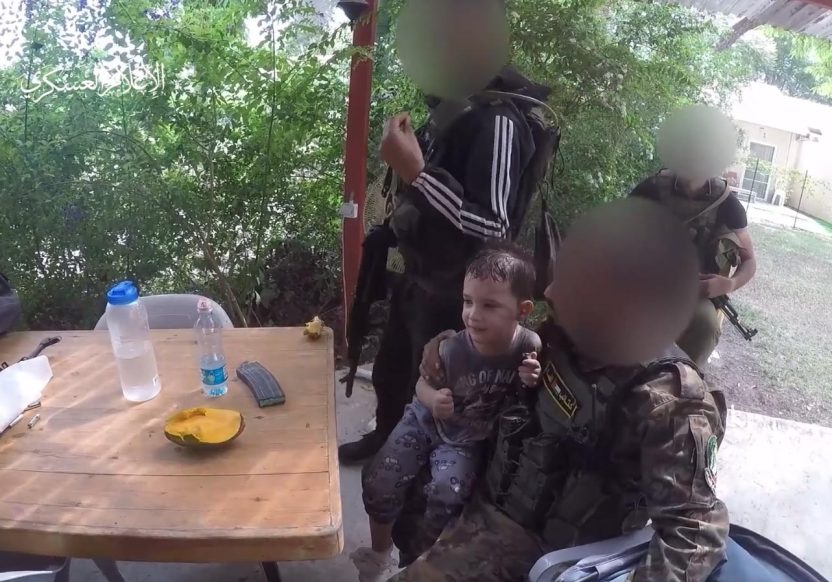
The Israeli government and media claimed that Hamas fighters beheaded children and committed violations such as rape, but Hamas denied the matter and published video clips showing its fighters dealing with children in a friendly manner.
Another video clip showed Al-Qassam Brigades, the armed wing of Hamas, releasing a woman and her two children at the Gaza border.
The AP indicated that the religious non-governmental organization “ZAKA”, which was responsible for collecting bodies following the October 7 attack, admitted several months later that the stories that went viral on Hamas sexual assaults during the attack were incorrect.
A member of the Hamas political bureau, Ezzat Al-Resheq, said in a statement in English, “The world will realize the lies and falsity of the Israeli narrative that spreads misleading information about alleged atrocities committed by the Palestinian resistance.”
Only one power could stop Israel’s Rafah invasion – but it dropped the ball
By Robert Inlakesh | RT | May 13, 2024
Israel has been threatening a full-scale invasion of the Gazan city of Rafah for months, with the US government belatedly warning against the move and calling for a ceasefire. However, the Biden administration has consistently flip-flopped on the issue and refused to take serious measures to pressure Israel into reaching a deal.
On May 6, Hamas publicly announced that it had accepted a ceasefire proposal, triggering celebrations throughout Gaza. The rejoicing was short-lived though, as the Israeli government reiterated its refusal to accept a deal and pledged instead to launch a ground operation in Gaza’s southernmost city, despite US government objections.
Israeli Prime Minister Benjamin Netanyahu even stated that “the day after is the day after Hamas. All of Hamas,” meaning there is no ceasefire deal he will accept.
Despite the Israeli military capturing the Rafah Crossing between Gaza and Egypt, in addition to killing dozens of civilians after bombing 100 targets throughout Rafah, Israel announced that a delegation had been sent to Cairo to “exhaust” all possibilities of reaching a ceasefire. As it would later turn out, the ceasefire proposal that Hamas accepted was almost identical to one drafted by the CIA and Israeli intelligence, and lauded by US Secretary of State Antony Blinken as a “strong proposal”.
Meanwhile, in cities like Haifa and Tel Aviv, Israeli protesters – led by the families of captives held in Gaza – had taken to the streets to demand their government accept the ceasefire terms, which included the release of all Israeli prisoners. Clashing with the police and labeling the Netanyahu government liars, the demonstrators threatened to burn the country if their prisoners were not freed.
The US response the very next day was to gaslight reporters by telling them that the whole world was wrong and that Hamas had not accepted any ceasefire proposal. It was not long before US President Joe Biden was to sit down for an interview with CNN and state that he would not supply Israel with offensive weaponry to be used in a “major invasion” of Rafah. What he refused to do, however, was define what a major invasion means – and where the red line is.
This unclear approach comes after the Israeli military violated the terms of the 1979 Camp David agreement, which normalized ties between Egypt and Israel, by invading what is known as the Philadelphi Corridor in southern Gaza. Not only did the Israeli army send in its Givati Brigades, who published videos of themselves recklessly crushing the border crossing for fun, they also sealed off the key aid route to Gaza’s civilian population, who are on the brink of famine.
A weak and confusing American approach
The Israeli government has been threatening to invade Rafah since the start of the year, with Benjamin Netanyahu repeatedly asserting, since the beginning of February, that Israel will “lose the war” if there is no invasion. it’s a move that the US not only says will mean defeat militarily, but more importantly, threatens the lives of over a million civilians, most of whom have nowhere else to go.
In early March, Biden gave a confusing interview to MSNBC, where he repeatedly contradicted himself when addressing the issue of an Israeli invasion of Rafah.
While claiming that entering Rafah is a “red line,” he then said that “there’s no red line [where] I’m going to cut off all weapons… but there’s red lines that if he crosses them”, before he seemed to lose his train of thought.
The sudden changes in the stance of policymakers in Washington are not limited to Biden’s MSNBC interview. In early February, the US said it would oppose an invasion of Rafah, calling it a “disaster,” to which the Israeli prime minister responded that he was preparing his forces to invade – and ramped up aerial attacks on the area. Yet, in mid-February the US government prepared a $14 billion military aid package for Israel and would go on to say that it could only support a limited invasion of Rafah.
Then there were reports that emerged, citing unnamed US officials, alleging that Biden was growing frustrated with Netanyahu and that he had even sworn at him. There was then the American push towards a “six-week ceasefire” in March, which the US president publicly said he hoped would happen prior to the Muslim Holy month of Ramadan. Even now, the Biden administration is still talking about an alleged “six-week ceasefire”, despite its own proposal to Hamas being a detailed agreement designed to end the war or at least to last for several months.
Silently, the US approved over 100 weapons transfers to assist the war effort against Gaza, in which they used loopholes to avoid Washington’s own new laws on weapons sales. Then, with two weeks left until the end of Ramadan, the US finally abstained in a United Nations Security Council (UNSC) vote, which called on Israel to implement a ceasefire until the end of the Muslim Holy month. In response, Israel immediately canceled the pre-planned visit of a high-level American delegation to Tel Aviv.
However, the very next morning, following the passing of the UN Security Council resolution, the US State Department announced that the resolution was non-binding. This not only meant that Washington was denying the reality of the internationally understood consensus that all UNSC votes are by their nature binding, but also that it would allow Israel to violate the resolution. So, even though Washington technically took a measure to pressure its ally temporarily, the very next day it gave an informal veto of the resolution, signaling to the Israeli government that it would retain American support no matter what.
While admitting that an invasion of Rafah will inevitably lead to the mass killing of Palestinian civilians, and block humanitarian aid transfers during an impending famine, and that it will not lead to the collapse of Hamas or the return of Israeli prisoners, the US government is effectively twiddling its thumbs.
The US has had nearly seven months to formulate a coherent policy when it comes to its goals and red lines in the Gaza-Israel war, yet it cannot articulate what its red lines are – and what ceasefire it even desires – without constantly contradicting itself. Western corporate media are now pointing to the postponing of a singular weapons shipment to Israel by the Biden administration, as if this constitutes pressure. But the US has done nothing to force Israel to allow aid to pass through the Rafah Crossing, which it immediately called upon Israel to do.
At this point, the US government is not helping to achieve Israel’s publicly stated war aims, it is not helping the families of Israeli prisoners, and it has failed to achieve a ceasefire or the sufficient transfer of humanitarian aid into Gaza. Instead, Joe Biden appears to be doing one thing – helping Benjamin Netanyahu prolong the conflict, with no end goal, no exit strategy, and no political solution or even the most basic idea of a post-war situation on the horizon. If anything, the US government has proven itself to be incapable of playing any constructive role to any side’s benefit. In fact, it is detrimental to the situation. If there were any people of conscience left in Washington, they would be urging their colleagues to step aside and hand the issue over to nations with coherent foreign policy platforms and intelligent diplomats.
Robert Inlakesh is a political analyst, journalist and documentary filmmaker currently based in London, UK. He has reported from and lived in the Palestinian territories and currently works with Quds News. Director of ‘Steal of the Century: Trump’s Palestine-Israel Catastrophe’.
Featured Video

Rewriting the risk? Inside the government’s vaccine safety messaging
or go to
Aletho News Archives – Video-Images
Book Review
“Davos Can Really Replace the UN”
Inside the book that maps the architecture behind global governance — from the Epstein files to the Pact for the Future
Lies are Unbekoming | April 1, 2026
On June 13, 2019, the United Nations and the World Economic Forum signed a partnership deal to “accelerate the implementation of the 2030 Agenda for Sustainable Development.” That same evening, WEF president Börge Brende — Norway’s former Foreign Minister — had dinner with Jeffrey Epstein at Epstein’s Manhattan townhouse. The Epstein files, released January 2026, contain an exchange between the two from the previous year. Epstein to Brende: “Davos can really replace the UN. C21, cyber, crypto . genetics… intl coordination.” Brende back to Epstein: “Exactly — we need a new global architecture. World Economic Forum (Davos) is uniquely positioned — public private.”
The next day, the UN General Assembly adopted the framework for restructuring global governance.
That sequence — the partnership signing, the Epstein dinner, the candid admission about replacing the UN with a public-private architecture, and then the formal adoption — opens Jacob Nordangård’s The Digital World Brain. Pages two and three. Footnoted to the UN resolution number, the Epstein files, and the General Assembly record.
I keep coming back to it because it captures what this book does that almost nothing else in the independent research space manages. I’ve followed Jacob’s work for years now and interviewed him about his research. Each book peels back another layer of the same institutional architecture, and each time I think he’s reached the limit of what can be documented, the next one goes further. Nordangård doesn’t speculate. He doesn’t editorialize much. He lays institutional actions next to each other in chronological order and lets the pattern announce itself. … continue
Blog Roll
 Aletho News
- The End of NATO
- 37 days of war on Iran cost US staggering $42bln, tracker shows
- Baghdad tells Asian refiners, traders to begin loading Iraqi crude amid Iranian exemption
- Under fire, Moscow and Tehran close ranks
- Iran, US receive Pakistan-mediated plan for ceasefire then final deal
- Iran submits demands for end to war as mediators scramble ahead of Trump deadline
- Iran Threatens Retaliatory Strike on Stargate AI Project in UAE
- US sent ‘a lot’ of arms to Iranian protesters – Trump
- Barak Ravid Launders Deception To Allow Trump To Back Off Of His Power Plant Threat – Again
- REWRITING THE RISK? INSIDE THE GOVERNMENT’S VACCINE SAFETY MESSAGING
- If Americans Knew
- Trump poised to “blow everything up” (ie. commit war crimes) in Iran – Daily Update
- In Iran, Israel-US take aim at “reason, research, and freedom of thought” – Daily Update
- US loses planes over Iran, Israel downgrades Lebanon war goals – Daily Update
- Israel Is Blocking Palestinians from Easter at Church Where Jesus Resurrected
- Plot to assassinate Palestinian activist follows harassment campaign promoted by Zionist groups and elected officials
- Prominent New York synagogue hosts presentation on why U.S. Jews should support the ethnic cleansing of Gaza
- Tapper vs. Piker: Is the CNN Anchor Auditioning for David Ellison?
- Shouldn’t Democrats Be Able to Condemn Genocide?
- Israel-US kill negotiators, destroy civilian structures, but Iran’s military capabilities still largely intact – Daily Update
- ‘War crime’: Global condemnation as Israeli ministers celebrate death penalty law targeting Palestinian prisoners
- No Tricks Zone
- An Inconvenient Tree: Uncovered In Alps… Europe Much Warmer Than Today 6000 Years Ago
- New Study Reports A 60% Slowdown In Greenland’s Ice Loss Rate In The Last Decade
- Low Intensity Tornado Wrecks Major Solar Farm, Creating A Potential Toxic Dump
- New Study Finds Warming Saves Lives…Cold Temperatures 12 Times More Deadly Than Excess Heat
- German Science Blog Accuses PIK Climate Institute Of Hallucinating Climate Tipping Points
- Devastating Assessment Of Comirnaty Vaccine By Former Senior Pfizer Europe Toxicologist
- New Study: CO2 Is ‘Effectively Negligible’ As An Explanatory Climate Change Factor Since 2000
- Former Pfizer Toxicologist Dr. Helmut Sterz Tells Bundestag Hearing Pfizer Vaccine Should Have Never Been Approved
- Energy Expert: Germany’s Nuclear Phaseout Was A “500 Billion Euro Mistake”
- New Research: South Australia’s Mid-Holocene Sea Surface Temperatures Were 4°C Warmer Than Today
 Aletho News