Lawsuit Filed Against Biden, Blinken, and Austin’s Complicity in Gaza Genocide
Al-Manar | January 27, 2024
The Center for Constitutional Rights in America (CCR) has filed a lawsuit accusing President Joe Biden, Secretary of State Anthony Blinken, and Secretary of Defense Lloyd Austin of being “complicit in the crimes of genocide committed by `Israel` in the Gaza Strip.”
On Friday, a federal court in Oakland, California, held a hearing to consider this lawsuit, which Judge Jeffrey White described as the most challenging case for the court.
Legal representatives for Biden, Blinken, Austin, and the Center for Constitutional Rights were present at the hearing session. Attorneys, activists, and medical professionals from Gaza provided testimonies, elucidating the adversities faced by Palestinians in the Strip.
According to media reports, the plaintiffs emphasized in their pleadings that the current US administration is allegedly contravening the 1948 Genocide Convention by supplying weaponry to the Zionist entity. Conversely, the defense asserted that the court lacks jurisdiction to adjudicate on this matter.
The Center for Constitutional Rights in the United States, focusing on civil liberties, initiated a civil lawsuit against Biden, Blinken, and Austin last November. This legal action was taken on behalf of Palestinian organizations, Palestinians in Gaza, and American citizens with relatives in the Strip.
The plaintiffs allege that Biden and his ministers failed to leverage their substantial influence to set conditions or limits on Zionist aggression against Gaza.
Biden halts new LNG exports
The fuel is seen as a vital lifeline for Western Europe, which has cut itself off from cheaper Russian gas imports
RT | January 26, 2024
US President Joe Biden has ordered a pause on liquefied natural gas (LNG) exports from new projects in the country, citing their potential contribution to climate change. Energy costs in Western Europe have skyrocketed since nations such as Germany switched from Russian gas to American LNG, but Biden insists the continent doesn’t currently need additional supplies.
The pause will allow the US Department of Energy (DOE) to update the economic and environmental guidelines it uses when approving new export licenses, and will last for several months.
“During this period, we will take a hard look at the impacts of LNG exports on energy costs, America’s energy security, and our environment,” Biden said in a statement on Friday. The president added that the pause “sees the climate crisis for what it is: the existential threat of our time.”
According to the White House, roughly half of American LNG exports went to Western Europe last year, and the US has exceeded its annual delivery targets to the EU for each of the last two years. “Today’s announcement will not impact our ability to continue supplying LNG to our allies in the near-term,” Biden claimed in his statement.
Europe remains mired in an energy crisis. The continent’s former industrial powerhouse, Germany, is “in a particularly difficult situation” after abandoning Russian gas supplies, Economy Minister Robert Habeck told lawmakers last week. Prior to the imposition of sanctions on Moscow over the Ukraine conflict, Germany received 40% of its gas imports from Russia. Replacing this fuel with LNG from the US, as well as energy from Norway and the Netherlands, has come at a cost, with the German government forced to roll out massive subsidy packages to prevent its largest industrial firms from leaving the country.
German industrial output fell by 2% last year, while the entire economy shrank by 0.3% in the same time period, the country’s Federal Statistical Office reported last week. The office blamed the decline on high inflation, soaring energy prices, and weak foreign demand.
LNG is transported on large tanker ships to regasification plants, where it is heated to return it to a gaseous state. Germany has rushed to bring three such offshore plants online since early 2022, and plans to open three more over the coming months. The US has also built out its LNG export infrastructure to cope with the demand, including the Calcasieu Pass 2 project in Louisiana, which once certified will be the nation’s largest export terminal.
The Calcasieu Pass 2 facility will likely come before the DOE for approval in the coming weeks, where it will be stalled indefinitely by Biden’s pause. With half of the terminal’s output set to go to Germany, a spokesman for the project’s developer, Venture Global, told Reuters last week that the pause would send a “devastating signal to our allies that they can no longer rely on the United States.”
Senate Looks to Fund Middle East Military Activity as CENTCOM Is ‘Running Out of Funds’
By Kyle Anzalone | The Libertarian Institute | January 24, 2024
The Senate is planning to add money to upcoming legislation to fund President Joe Biden’s military buildup in the Middle East and war in Yemen. Senator Susan Collins says the legation should be a priority as US Central Command is quickly depleting its funds. Senator Jack Reed believes Congress will need to pass multiple rounds of funding to allow Biden to wage war across the Middle East.
Following the Hamas attack on southern Israel, Biden ordered thousands of troops and multiple aircraft carrier strike groups into the region. Politico reports the Department of Defense informed Congress the deployment of additional troops and warships to the Middle East over the past four months has cost $1.6 billion. The Pentagon estimates the cost will be $2.2 billion over the course of the year.
The cost estimates do not include the price of the interceptors and munitions used in fighting the Houthis. Congress has not authorized Biden’s war in Yemen or the military surge in the Middle East. A growing number of American lawmakers, including within Biden’s party, have voiced opposition to the White House waging a war in Yemen without Congressional authorization.
A Pentagon official said at some point, the holes in the Department of Defense budget will have to be filled by Congress. An official told Politico, “It will be, I think, a hole that we would want to be filled. It is a bill that will be due and we will have to pay for it within a limited amount of resources.”
The Senate is now preparing to fund the conflicts in the Middle East, but there are no plans to authorize the war. Politico reports Congress is considering several options for authorizing the war spending. The outlet explains, “Lawmakers are aware of the unplanned cost and are weighing how to pay for it. Options include adding it to the annual spending bill, adding it to the $111 billion emergency supplemental for Ukraine and Israel, or funding it through a stand-alone supplemental for war costs.”
The White House has been pushing Congress to pass a $111 billion bill that provides funding for the wars in Ukraine and Israel, the military buildup in the Asia-Pacific, and border security. The legislation has been delayed for several months over debate on immigration policy.
Sen. Collins, a Republican member of the Senate Appropriations Committee, is urging the body to take action. “[US Central Command] needs [the funding] sooner. They’re fast running out of funds,” she said.
Senator Jack Reed believes Congress will have to pass multiple rounds of funding to fight wars in the Middle East. He said, “I sense, given the unexpected cost, that there will have to be a separate supplemental. These aren’t routine costs. They’re because of our reaction to the Houthi disruption, to Iranian malign behavior, etc. And I think that’s probably where we would go for it.”
Senators Dan Sullivan, Mitch McConnell, and Mark Kelley have all called for adding money to the supplemental war legislation to replace the interceptors and munitions used to fight the Houthis in Yemen.
Corruption, disinformation, warnings about assassinations: What to make of the latest Biden Ukraine links claims

By Tarik Cyril Amar | RT | January 12, 2024
At first it feels like a blast from the past but it’s really about the present and future: Journalist Simona Mangiante Papadopoulos has released a long interview with former Ukrainian MP Andrey Derkach. In which Derkach makes allegations about corruption in the US and Ukraine. In particular about the American President Joe Biden and Secretary of State Antony Blinken.
With regard to graft, while the various allegations (by no means only Derkach’s) and ongoing investigations are complex, in essence several simple questions are at stake: Did the current president’s son, Hunter Biden, sell his services as a Washington influence-peddler by using the “brand” (as one witness, Devon Archer, has put it) of his father’s connections (as then vice-president under Barack Obama)? And, potentially even more disturbingly, did the elder Biden himself profit from such influence-peddling? Finally, most disconcerting of all, did the current president use his leverage as Obama’s point-man on Ukraine to shield his son and, possibly, himself from investigations in Ukraine? Including by bringing down Ukrainian chief prosecutor Viktor Shokin, who got too close to the truth about Hunter Biden’s shady role in the Ukrainian Burisma gas company?
In sum, did the highest-ranking American official, charged with overseeing (among other things) Kiev’s putative “fight against corruption,” make things even worse by injecting a strong dose of US-establishment corruption into Washington’s newest client state? And, if so, could that two-sided entanglement have left a legacy, including of compromising actions, that has been influencing America’s reckless and failing (even on its own misconceived terms) proxy war policy in Ukraine?
Full disclosure: I happen to believe that the answer to all these questions is yes. Which is depressing, since it means that decisions, costing many human lives and making our shared global politics very dangerous, have been influenced by corrupt motives reminiscent of the world of organized crime.
But we do not know, yet. It is certain that Hunter Biden, a textbook failed-son and pampered heir, used his dad’s name to cash in, to the tune of (at the very east) $7.5 million. That much even the pro-Biden Washington Post had to admit (while revealing its bias with the packaging of the story, which accuses Republicans of “hyping” the numbers). As to whether Joe Biden himself also got a share and how all of this affected his policy on Ukraine – compelling proof, as opposed to plausible conjecture, is not available. At least at this point. But the Republicans, for their own selfish yet, politically, perfectly normal reasons, are digging for it through an impeachment inquiry into the current president’s record.
This is the background against which Derkach has now spoken up. Make no mistake: There will be attempts to dismiss all of this as – yes, you guessed it – the beginning of BIG BAD RUSSIAN MEDDLING in the 2024 presidential elections. In fact, they have already started. Frankly, yawn: Let’s not be distracted.
Such attempts will inevitably seek to make use of Mangiante Papadopoulos’ and Derkach’s own records. Mangiante Papadopoulos is a journalist and the wife of the former Trump campaign adviser George Papadopoulos. As such (though, to be precise, still his girlfriend at the time), she was questioned by the FBI in 2017, during the hot phase of the neo-McCarthyite campaign commonly known under the misleading label “Russiagate.”
Misleading because it was not really about Russia, but about the American Democrats’ foul-play attempt to undermine the reality of Donald Trump’s victory in 2016. (which was really down to Trump’s gifts as a populist and the Democrats’ arrogant decision to try and ram down the country’s throat the unelectably unappealing and politically terrifying candidacy of Hillary Clinton.)
“Russiagate” was, in reality, Russia Rage, a mix of Centrist and Liberal conspiracy theory-mongering and mass hysteria. The true scandal was that a sizable part of the US political and media establishment further ruined what was left of any working relationship with Russia, and undermined the American public’s faith in a legitimate election result. (No, Trump was not the first one to do so in 2020/21: The roots of the January 6 riot in Washington are deeply bipartisan.)
Derkach came to international attention a few years later, with respect to Trump’s successor. A Russian-Ukrainian businessman and politician (who is open about receiving elite Russian intelligence training in the early 1990s), American and Ukrainian officials have accused him of playing an important role in “meddling” in the election of 2020, specifically by helping undermine Biden’s reputation. Derkach released recordings of what he claimed were conversations between then-vice-president Biden and then-Ukrainian president Pyotr Poroshenko that, critics argued, pointed to illicit dealings. (Ironically enough, for a while these revelations were welcomed by the team of Poroshenko’s successor Vladimir Zelensky because they embarrassed his opponent.)
Derkach has also been accused of – and in Ukraine formally charged with – working for Russian intelligence and with treason. No wonder he fled the country in 2022 and now lives in exile in Belarus. The 56-year-old is, in sum, a very ambiguous figure whose statements should be treated with caution.
Yet they should not be dismissed wholesale. Simply branding anything inconvenient to the American Democrats and their media clique as “information warfare” or “Russian meddling” is how “Russiagate” has done so much damage. That was, after all, the manner in which the authentic and very relevant news about the compromising data on Hunter Biden’s abandoned laptop was suppressed before his father’s election. If the evidence pointing to corruption (and revolting personal depravity) had been allowed to be subjected to ordinary scrutiny and public debate – as it certainly would have been if it had concerned a member of the Trump family – the chances of Biden senior would have suffered.
Derkach is a complicated source; Mangiante Papadopoulos has also been accused of promoting Russia’s interests. (But then, frankly, who hasn’t?) But the question among adult observers is not who may be interested in a given piece of information seeing the light of day. Because here’s a little secret: As long as the information is of any political relevance at all, there’s always someone interested (as, by the way, Derkach openly admits in the interview, as far as his case is concerned). And here’s another one: That doesn’t mean that a given piece of information is untrue (“disinformation,” as we have been trained to say now). And finally: Remember, interests are involved not only in revealing, but also in hiding facts. Or, indeed, in pooh-poohing inconvenient revelations as nothing but propaganda.
So, what to make of what Derkach has had to say now? In the interview, which is almost an hour long, he makes many detailed statements, involving a large number of specified persons, especially in Ukraine. Let’s try to focus on key aspects and look at three of his most striking allegations one by one.
First, Derkach states that the Ukrainian authorities started going after him in earnest, including by extra-legal and life-threatening means, when (or because?) US Secretary of State Antony Blinken told them to resolve that Derkach problem. The interview is somewhat ambiguous: Is Derkach saying that Blinken himself gave, in essence, an order to use criminal methods or that Blinken – Henry II/Thomas Becket-style – “merely” called for someone to somehow rid his president of that turbulent Ukrainian?
Either way, it would have been a highly incriminating and tawdry act on Blinken’s part. But it would be naive to consider the current Secretary of State incapable of stooping so low. We are, after all, talking about the man who, during Biden’s election campaign, played a devious behind-the-scenes role in organizing the suppression of the Hunter Biden laptop story.
Back then, by mobilizing the American intelligence community to, once again, serve party-political purposes, Blinken helped Biden win and, in the long term, further shredded what’s left of American establishment credibility. (Not to mention that, currently, Blinken is displaying his absolute legal nihilism in stunning fashion by shielding Israel’s genocidal attack on Gaza.)
Secondly, Derkach also maintains that former Ukrainian chief prosecutor Viktor Shokin, who lost his job for going after a Biden (or was it even two of them?), is in danger of assassination and should receive help to leave Ukraine. What makes this claim sound improbable is the fact that Shokin is still alive. What makes it plausible is the fact that there has already been at least one attempt on his life, although that took place years ago when he was still in office: As a matter of fact, for Shokin, losing his job may have made losing his life less likely.
Third, Derkach claims that, inside Ukraine, a large bribe linked to the fallout from the Burisma affair has been turned into funding for the Ukrainian intelligence services, in particular for assassinations in Russia and the attack on the Nord Stream gas pipelines. Can he prove this specific connection, namely that precisely that dirty money was used for this dark purpose? Maybe, maybe not. Yet there is no doubt that Ukraine’s military intelligence service in particular has organized assassinations. Indeed, some Western media have quite openly sung its praises for this, such as The Economist.
As regards Nord Stream, after an initial period of plainly silly Western disinformation absurdly trying to point the finger at Russia (anyone remember that?), it is now fashionable to blame it all on Ukraine, as if the latter could have acted without NATO permission and assistance. So, here as well Derkach gets a grade of ‘at least partly true’; and his allegation about how some of these activities have been financed cannot be dismissed as implausible either.
Let’s return, however, to the biggest issue at stake here: the Bidens. And let’s note a simple but generally overlooked fact: They are amazingly good at lowering expectations. They and their media allies are engaged in an ongoing, largely successful operation of shifting US baselines even farther down: In a normal country, there simply should not be an endless, partisan struggle over whether and how much money exactly went to the current president personally. In a normal country, the fact that, at the very least, Joe Biden has long tolerated, facilitated (to one extent or the other) and, finally, defended and shielded the screamingly unethical behavior of his son, should be more than enough to have forced him to resign.
Tarik Cyril Amar is a historian from Germany working at Koç University, Istanbul, on Russia, Ukraine, and Eastern Europe, the history of World War II, the cultural Cold War, and the politics of memory.
Israel Goes to Court for the Crime of Genocide
BY PHILIP GIRALDI • UNZ REVIEW • JANUARY 12, 2024
A friend of mine who follows international developments closely recently observed that the United States and Israel have “own goaled” themselves to become widely perceived as together the two most evil governments on earth. It is a judgement that is hard to disagree with regarding the Jewish state if one examines the abundant evidence that Israel is systematically committing war crimes against the largely unarmed Palestinian civilian population in an effort to bring about ethnic cleansing or even genocide in Gaza and on the West Bank. The process would include removing the Palestinians physically and/or killing them if they resist, which is what is currently taking place. Something like 10,000 dead Palestinian children attest to the brutality and inhumanity of the effort, together with nearly 400 doctors and nurses who were directly targeted plus more than 100 UN employees trying to bring aid to the civilians. What Israel is doing is monstrous, almost unimaginable. A number of senior Israeli officials have confirmed their government’s view, supported by public opinion, that a land between the Jordan River and the Mediterranean Sea swept clean of Arabs would be the most desirable outcome of current developments.
The United States is at the same time loathed alongside Israel because it is enabling the slaughter by the Israelis while simultaneously spewing the lies that it is somehow restraining or even making more “humanitarian” Israel’s attack. Nothing could be farther from the truth as the White House recently worked hard to defang a major UN-led diplomatic effort that had global support to bring about a ceasefire that would enable emergency relief supplies to be introduced into the battered enclave. Instead, Israel now continues its daily bombardment of Gaza and controls entering supplies, slowing the process down while watching people die of famine and disease, not to mention from artillery shells and bombs. Oh, and the United States both funds the Israeli war effort and supplies the munitions that make it all possible. That makes Washington an accessory to the war crimes and to what most of the world considers to be a genocide being perpetrated openly and with malice.
In spite of all that, and the tons of evidence of atrocities of all kinds which even includes “friendly fire” killing of Jewish hostages, the Joe Biden Administration continues to spout the nonsense that neither war crimes nor a genocide are taking place. Thursday saw the opening of the International Court of Justice hearings on evidence filed by South Africa demonstrating that Israel’s slaughter of the Palestinians amounts to a genocide as defined by the 1948 “UN Convention on the Prevention and Punishment of the Crime of Genocide” which both Israel and the US have signed. On the day before it opened at the Hague, US National Security Council Spokesman John Kirby preemptively stated that the charges were “meritless, counterproductive and completely without any basis in fact whatsoever.” State Department spokesman Matt Miller added that the United States is “not seeing any acts that constitute genocide” in Israel’s bombing and physical destruction of Gaza. Both comments are contrary to the fact that Israel is clearly creating at a minimum “conditions that don’t allow the survival of the population,” which is a definition of genocide. It all means that the United States will be fighting hard on behalf of its favorite son, doing whatever lying, coercing and cheating that it might take to protect Prime Minister Benjamin Netanyahu and the crimes-against-humanity crew that he has surrounded himself with. As it is not a US interest to become a nation that condones the killing of tens of thousands of helpless civilians, one must ask the question “Who owns you Joe and why are your top officials lying about what is taking place?”
As an American, what I find most offensive about the current state of play is that my country has been turned into a war criminal by a group of politicians and staff appointees controlled by a foreign government and its lobby whose ignorance is so profound that they should not be running a hot dog stand. In particular, it is soul-destroying to hear the pathetic squealing coming out of a subservient White House every time Israel kills another hundred or so Palestinian children and women cowering in the ruins of a hospital, church or school. Each squeal in support of more “humane” or “restrained” warfare is followed by an assertion from Netanyahu to the effect that Israel’s war cabinet will make its own decisions about who it will kill and when. One senior official Itamar Ben-Gvir even warned Biden that Israel is “no longer a star on the American flag.” Indeed, but it is not that Israel is ungrateful, as those two-thousand pound bunker buster bombs supplied by Biden can really do a number on them “terrorists.” The Biden Administration has now expedited two shipments of munitions to Israel worth about $253 million, relying on another lying rascal Antony Blinken of the State Department’s claim that the weapons were urgently needed for poor “victim” Israel to “defend itself, allowing circumvention of existing Congressional authority requiring legislative approval of arms sales. There is no step so low when pandering to Israel that the Biden Administration will not take it!
It is all as if Genocide Joe is in a hurry to get the job done on those pesky Palestinians so he can get back to the serious work of fooling the US electorate into voting for him a second time. He is now going around the country trying to sell the product that he is “saving democracy,” which he is claiming would be destroyed by Trump. As Trump is on an apparent revenge tour, Biden might actually be more right than he usually is, but one has to ask what is happening to American democracy with the current open borders and two wars being de facto fought simultaneously without any actual threat to the US having ever been involved and without the consent of the American people. Quite the contrary, opinion polls suggest the wars are very unpopular while Biden weasels his way to support the fighting while pretending that the US is not directly involved. Can one imagine voluntarily putting the survival of one’s nation in the hands of someone like Joe Biden?
Israel continues to play its own hand as the US has given it political cover to bomb and otherwise kill as it sees fit. Civilian deaths from bombing totaled 247 on one night alone in early January, but the Netanyahu government has just announced that it will be shifting from large scale troop movements in Gaza to more “directed” operations that will focus on Hamas concentrations, finding hostages, and destroying the tunnels that connect resistances points. Rear Admiral Daniel Hagari, the chief spokesperson for the Israeli military, described how the new phase of the campaign, hopefully to be completed by the end of the month, will involve fewer soldiers and airstrikes, though Israel has previously lied repeatedly about its actual intentions. Ironically, the US concern appears to be that the war is already expanding apart from Gaza. The violence by armed settlers directed against Palestinians on the West Bank is increasing and foreign targeting by Israel now includes the killing of Hamas and Hezbollah leaders in Lebanon, regular bombing missions directed against targets in Syria which recently killed a dozen senior Iranian officials near the Damascus airport, assassinations in Iraq, as well as the terror bombing in Tehran claimed by ISIS that killed 103. Both Israel and the US are known to have cooperative clandestine relationships with ISIS.
And there are several other issues that are worthy of mention. First, is how a steady stream of mostly Republican hawks have been making the pilgrimage to Israel to express their wholehearted support of Israel’s ongoing genocide of the Palestinians. Most recently, former Vice President Mike Pence made the trip and was photographed near Israel’s border with Lebanon writing messages or possibly signing off on US made artillery shells that were about to be fired against Hezbollah. This pushing for direct US involvement in an impending war that should and could be avoided has had an impact in Washington, where clowns like Senator Lindsey Graham have called on the Biden administration to “… hit Iran. They have oil fields out in the open, they have the Revolutionary Guard headquarters you can see from space. Blow it off the map.” This pressure has prompted Biden to pledge to those in Congress calling for war and also to the Israelis that he will not allow Iran to develop a nuclear weapon and do whatever it takes to stop it. As US intelligence has declared its judgement that Iran has no such weapons program, the alleged intelligence suggesting that Iran has a secret program will inevitably come from Israel and Netanyahu, so guess what? Israel will be working hard to produce fabricated evidence that will drag the US into a first strike against Iran, which will in turn hit back against US bases in Syria, Kuwait, Qatar and Iraq. It is all too reminiscent of the neocon-Israeli plot that dragged a clueless George W. Bush and Condi Rice into initiating the disastrous Iraq War in 2003.
And the other issue that absolutely no one chooses to talk about is the “secret” Israeli nuclear arsenal of 200-400 weapons together with delivery systems, which is definitely a potential game changer no matter what happens in Gaza and on the West Bank. Would Israel use the nukes? They sure would, especially if the war they are deliberately expanding should turn against them somehow. When former Israeli Prime Minister Ariel Sharon was queried about how the rest of the world might respond to Israel using its nukes to effectively wipe out its Arab neighbors, he responded “That depends on who does it and how quickly it happens. We possess several hundred atomic warheads and rockets and can launch them at targets in all directions, perhaps even at Rome. Most European capitals are targets for our air force… We have the capability to take the world down with us. And I can assure you that that will happen before Israel goes under.”
The plan by America’s “best friend” and “closest ally” to nuke the world even has a name: “The Samson Option,” recalling how the Biblical strongman Samson brought down the temple where the Philistines were mocking him, killing thousands of them. So maybe Joe Biden should be thinking long and hard about how, and with whom, he is getting our country set up to go to war. Or just maybe it is already too late!
Philip M. Giraldi, Ph.D., is Executive Director of the Council for the National Interest, a 501(c)3 tax deductible educational foundation (Federal ID Number #52-1739023) that seeks a more interests-based U.S. foreign policy in the Middle East. Website is councilforthenationalinterest.org, address is P.O. Box 2157, Purcellville VA 20134 and its email is inform@cnionline.org.
Former Ukrainian chief prosecutor ‘fired’ for Biden could be assassinated – ex-MP
Viktor Shokin has dirt on the US president’s family and Kiev is using him as a bargaining chip, Andrey Derkach has claimed

Viktor Shokin in February 2015, after his appointment as Prosecutor General. © Vladimir Shtanko / Anadolu Agency / Getty Images
RT | January 11, 2024
The former Prosecutor General of Ukraine, Viktor Shokin, who was famously sacked by then-President Pyotr Poroshenko under pressure from US President Joe Biden, is being used by the current government in Kiev as a bargaining chip with Washington, controversial former MP Andrey Derkach has claimed in an interview.
Biden had Poroshenko sack Shokin in 2016, when he was vice president in the Obama administration, threatening to withhold a $1 billion loan unless his demands were met. The now-incumbent US president claimed that the Ukrainian prosecutor was corrupt, but also bragged about getting rid of the man. Critics of Biden have alleged that he used his office to derail an investigation into the gas firm Burisma, which infamously retained his son Hunter on a well-paid board position during his father’s tenure as Obama’s VP.
Derkach made his explosive claims in an interview recorded in Minsk, Belarus, with Italian-US journalist Simona Mangiante, published on Wednesday on X (formerly Twitter).
“Shokin is now a hostage on Ukrainian territory. As far as I know, he is not allowed to leave Ukraine. He is under the total control of the Security Service of Ukraine (SBU),” he claimed.
President Biden and Secretary of State Antony Blinken on the US side, and President Vladimir Zelensky and his chief-of-staff Andrey Yermak on the Ukrainian side, are interested in information possessed by Shokin, according to Derkach.
He claimed that last October Shokin had contacts with two attorneys “working with the US Congress,” Jake Greenberg and Clark Abourisk. The SBU “recorded those conversations, where Shokin told the Congress about real criminal acts of Blinken and Biden, and about the corruption of the Biden family.”
The former official said he’d been tipped off about the surveillance by sources inside the SBU. Derkach is an intelligence officer by background and served in the Ukrainian agency before being elected to parliament.
He claimed that his sources had told him that “the question of liquidating Mr Shokin on the territory of Ukraine is under consideration.” He urged the US Congress to ensure the man’s safety and extraction from his home country.
Derkach spoke in Russian throughout the hour-long interview and touched on a number of sensitive aspects of US-Ukraine relations, including those he’d been personally involved in.
He was the official that published in 2020 what he claimed to be recordings of conversations that Biden and Poroshenko had in 2015-2016. In the interview this week he claimed that at the time he was acting with the blessing of Zelensky’s office, which was seeking to discredit the former president.
Washington branded Derkach a Russian agent in 2022 and indicted him for allegedly interfering in the 2020 US presidential elections. Last year, Ukraine accused him of treason, also claiming he was working for Moscow. Zelensky stripped him of his Ukrainian citizenship in January 2023.
Derkach has denied the accusations and claims in the interview that the Ukrainian charges against him were brought after Kiev failed to dispose of him by other means, on a direct request from Antony Blinken.
Gaza destroys western divide-and-rule narratives
By Sharmine Narwani | The Cradle | January 4, 2024
It could be a clean sweep. Decades of western-led narratives crafted to exploit differences throughout West Asia, create strife amid the region’s myriad communities, and advance western foreign policy objectives over the heads of bickering natives are now in ruins.
The war in Gaza, it transpires, has blown a mile-wide hole in the falsehoods and fairytales that have kept West Asia distracted with internecine conflicts since at least the 1979 Islamic Revolution in Iran.
Shia versus Sunni, Iran versus Arabs, secular versus Islamist: these are three of the west’s most nefarious narrative ploys that sought to control and redirect the region and its populations, and have even drawn Arab rulers into an ungodly alliance with Israel.
Facts are destroying the fiction
It took a rare conflict – uncooked and uncontrolled by Washington – to liberate West Asian masses from their narrative trance. Israel’s genocidal assault on Gaza also brought instant clarity to the question of which Arabs and Muslims actually support Palestinian liberation – and which do not.
Iran, Hezbollah, Iraqi resistance factions, and Yemen’s Ansarallah – maligned by these western narratives – are now visibly the only regional players prepared to buttress the Gaza frontline, whether through funds, weapons, or armed clashes that aim to dilute and disperse Israeli military resources.
The so-called ‘moderate Arabs,’ a misnomer for the western-centric, authoritarian Arab dictatorships subservient to Washington’s interests, have offered little more than lip service to the carnage in Gaza.
The Saudis called for support by hosting Arab and Islamic summits that were allowed to do and say nothing. The Emiratis and Jordanians trucked supplies to Israel that Ansarallah blockaded by sea. The mighty Egypt hosted delegations when all it needed to have done was to open the Rafah Crossing so Palestinians can eat. Qatar – once a major Hamas donor – now negotiates for the freedom of Israeli captives, while hosting Hamas ‘moderates,’ who are at odds with Gaza’s freedom fighters. And Turkiye’s trade with the Israeli occupation state continues to skyrocket (exports increased 35 percent from November to December 2023).
Palestine, for the pro-west ‘moderate Arabs,’ is a carefully handled flag they occasionally wave publicly, but sabotage privately. So, they watch, transfixed and horrified today, at what social media and tens of millions of protesters have made crystal clear: Palestine remains the essential Arab and Muslim cause; it may ebb and flow, but nothing has the power to inflame the region’s masses like this particular fight between right and wrong.
The shift toward resistance
It is early days yet in the battle unfolding between the region’s Axis of Resistance and Israel’s alliances, but the polls already show a notable shift in public sentiment toward the former.
An Arab barometer poll taken over a six-week period – three weeks before and three weeks after the Al-Aqsa Flood operation – provides the first indication of shifting Arab perceptions. Although the survey was restricted to Tunisia, the pollsters argue that the country is “as close to a bellwether as one could imagine” and that it represents views similar to other Arab countries:
“Analysts and officials can safely assume that people’s views elsewhere in the region have shifted in ways similar to the recent changes that have taken place in Tunisia.”
The survey results should be of paramount concern to meddling western policymakers: “Since October 7, every country in the survey with positive or warming relations with Israel saw its favorability ratings decline among Tunisians.”
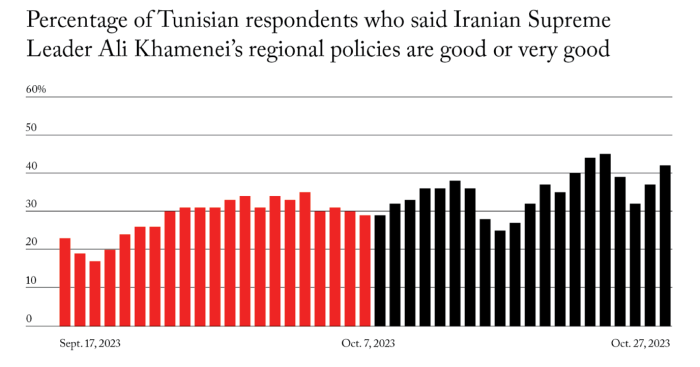
The US saw its favorability numbers plummet the most, followed by West Asian allies that have normalized relations with Israel. Russia and China, both neutral states, experienced little change, but Iran’s leadership saw its favorability figures rise. According to the Arab barometer:
“Three weeks after the attacks, Iranian Supreme Leader Ali Khamenei has approval ratings that matched or even exceeded those of Saudi Crown Prince Mohammed bin Salman and Emirati President Mohammed bin Zayed.”
Before 7 October, just 29 percent of Tunisians held a favorable view of Khamenei’s foreign policies. This figure rose to 41 percent according to the conclusion of the survey, with Tunisian support most notable in the days following the Iranian leader’s 17 October reference to Israel’s actions in Gaza as a “genocide.”

The Saudi shift
Prior to the 7 October operation by the Palestinian resistance to destroy the Israeli army’s Gaza Division and take captives as leverage for a mass prisoner swap, the region’s main geopolitical focus was on the prospects of a groundbreaking Saudi normalization deal with Tel Aviv. The administration of US President Joe Biden flogged this horse at every opportunity; it was seen as a golden ticket for his upcoming presidential election.
But Operation Al-Aqsa Flood ruined any chance for Saudi Arabia – home to Islam’s holiest sites – to seal that political deal. And with Israeli airstrikes raining down daily on Palestinian civilians in Gaza, Riyadh’s options continue to shrink.
A Washington Institute poll conducted between 14 November and 6 December measures the seismic shift in Saudi public sentiment:
A whopping 96 percent agree with the statement that “Arab countries should immediately break all diplomatic, political, economic, and any other contacts with Israel, in protest against its military action in Gaza.”
Meanwhile, 91 percent believe that “despite the destruction and loss of life, this war in Gaza is a win for Palestinians, Arabs, and Muslims.” This is a shockingly unifying statement for a country that has adhered closely to western narratives that seek to divide Palestinians from Arabs, Arabs among themselves, and Muslims along sectarian lines – geographically, culturally, and politically.
Although Saudi Arabia constitutes one of the few Arab states to have designated Hamas as a terrorist organization, favorable views of Hamas have increased by 30 percent, from 10 percent in August to 40 percent in November, while most – 95 percent – do not believe the Palestinian resistance group killed civilians on 7 October.
Meanwhile, 87 percent of Saudis agree with the idea that “recent events show that Israel is so weak and internally divided that it can be defeated some day.” Ironically, this is a long-stated Resistance Axis refrain. Hezbollah Secretary General Hassan Nasrallah was famously quoted as saying “Israel is weaker than a spider’s web,” upon its defeat by the Lebanese resistance on 25 May, 2000.
Prior to 7 October, Saudis had strongly favored economic ties with Israel, but even that number dropped dramatically from 47 percent last year to 17 percent today. And while Saudi attitudes toward the Resistance Axis remain negative – Saudi Arabia, after all, has been the regional epicenter for anti-Iran and anti-Shia propaganda since the 1979 revolution – that may be largely because their media is heavily controlled.
Contrary to the observations of the Arab masses, 81 percent of Saudis still believe that the Axis is “reluctant to help Palestinians.”
The Palestinian shift
Equally important to the discussion of Arab perceptions is the shift seen among Palestinians themselves since 7 October. A poll conducted by the Palestinian Center for Policy and Survey Research (PSR) in both the occupied West Bank and Gaza Strip between 22 November and 2 December mirrors Arab views, but with some nuances.
Gazan respondents, understandably, displayed more skepticism for the ‘correctness’ of Hamas’ Operation Al-Aqsa Flood, which triggered Israel’s genocidal assault on the Strip in which over 22,000 civilians – mostly women and children – have so far been brutally killed. While support for Hamas increased only slightly in the Gaza Strip, it tripled in the West Bank, with both Palestinian territories expressing near equal disdain for the western-backed Palestinian Authority (PA), which governs from Ramallah.
Support for acting PA President Mahmoud Abbas and his Fatah party was hit hard. Demands for his resignation are at nearly 90 percent, while almost 60 percent (the highest number recorded in a PSR poll to date in relation to this matter) of those surveyed want a dissolution of the PA.
Over 60 percent of Palestinians polled (closer to 70 percent in the West Bank) believe armed struggle is the best means to end the occupation, with 72 percent agreeing with the statement that Hamas made a correct decision to launch its 7 October operation, and 70 percent agreeing that Israel will fail to eradicate the Palestinian resistance in Gaza.
Palestinians have strong views about regional and international players, who they largely feel have left Gaza unprotected from Israel’s unprecedented violations of international law.
By far the country most supported by respondents is Yemen, with approval ratings of 80 percent, followed by Qatar (56 percent), Hezbollah (49 percent), Iran (35 percent), Turkiye (34 percent), Jordan (24 percent), Egypt (23 percent), the UAE (8 percent), and Saudi Arabia (5 percent).

In this poll, the region’s Axis of Resistance dominates the favorability ratings, while pro-US Arab and Muslim nations with some degree of relations with Israel, fare poorly. It is notable that of the four most favorable countries and groups for mostly-Sunni Palestinians, three are core members of the “Shia” Axis, while five Sunni-led states rank lowest.
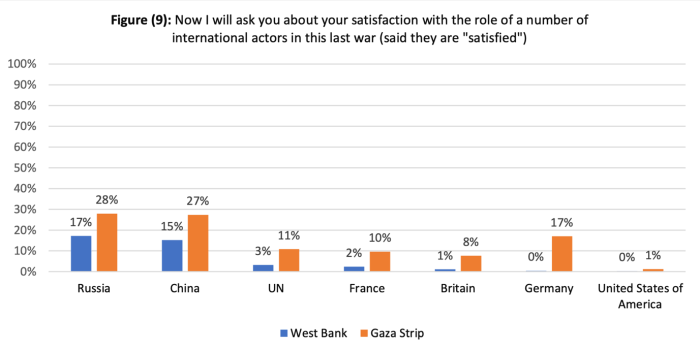
This Palestinian view extends to non-regional international states, with respondents most satisfied with Resistance Axis allies Russia (22 percent) and China (20 percent), while Israeli allies Germany (7 percent), France (5 percent), the UK (4 percent), and the US (1 percent) struggle to maintain traction among Palestinians.
The numbers depend on the war ahead
Three separate polls show that Arab perceptions have shifted dramatically over Israel’s war on Gaza, with popular sentiment gravitating to those states and actors perceived to be actively supporting Palestinian goals, and away from those who are perceived to support Israel.
The new year starts with two major events. The first is the drawdown of Israeli reservists from Gaza, whether because Washington demands it, or due to unsustainable loss of life and injury to occupation troops. The second is the shocking assassination of Hamas leader Saleh al-Arouri and six others in Beirut, Lebanon, on 2 January.
All indications are that Israel’s war will not only continue, but will expand regionally. The new US maritime construct in the Red Sea has drawn other international actors into the mix, and Tel Aviv has provoked Lebanon’s Hezbollah in a major way.
But if the confrontation between the two axes escalates, Arab perceptions will almost certainly continue to tilt away from the old hegemons toward those who are willing to resist this US-Israeli assault on the region.
There will be no relief for Washington and its allies as the war expands. The more they work to defeat Hamas and destroy Gaza, and the more they lob missiles at Yemen, Iraq, and Syria, and besiege the Resistance Axis, the more likely Arab populations are to shrug off the Sunni-versus-Shia, Iran-versus-Arab, and secular-versus-Islamist narratives that have kept the region divided and at odds for decades.
The swell of support that is mobilizing due to a righteous confrontation against the region’s biggest oppressors is unstoppable. Western decline is now a given in the region, but western discourse has been the first casualty of this war.
US sending ‘bloody New Year’s gift to Kiev’ – Moscow
RT | December 28, 2023
The Russian ambassador to the US, Anatoly Antonov, has criticized Washington for its recent arms package to Ukraine, stating that it reflects an intention to fight Russia “to the last Ukrainian.”
The diplomat’s remarks came in response to the $250 million worth of military assistance, including air defense munitions, rockets, artillery shells, and small-arms rounds, approved on Wednesday by the administration of US President Joe Biden.
Antonov called the latest round of military aid a “bloody New Year’s gift to Kiev” in remarks published on social media. The Americans “are pushing the puppet regime to the abyss, dooming thousands of ordinary Ukrainians to certain death,” he warned.
On the other hand, the official emphasized Russia’s recent success in acquiring the town of Maryinka in the Donetsk People’s Republic, a strategic Ukrainian stronghold. According to Antonov, the US tends to ignore such developments and instead focuses on highlighting “Ukrainian fetish ‘victories.’”
The diplomat predicted that any arms provided by NATO nations to Ukraine would be “burned and destroyed” without altering the situation on the ground.
The White House could not appropriate more funding for Ukraine after Republican opposition in Congress blocked its request. The lawmakers have demanded major concessions on immigration reform and southern border security as a precondition for their approval of spending additional billions of taxpayers’ dollars on Ukraine support. US officials have indicated that this latest package would be the last under the current spending allowance.
US President Joe Biden has accused those lawmakers opposed to more Ukraine spending of jeopardizing national security by tying it to domestic policy issues. He suggested that Russian President Vladimir Putin might attack a NATO member after dealing with Ukraine.
Putin dismissed this remark as “absolute nonsense,” saying that Biden was using exacerbated rhetoric to cover up his administration’s foreign policy failures. Moscow maintains that preventing NATO expansion into Ukraine is a key objective in the conflict.
Netanyahu Outsmarted by ‘Wily’ Biden? No, Biden Is the One Being Played
By Alastair Crooke | Strategic Culture Foundation | December 25, 2023
Biden smirked and responded, “I know”, when told by a guest that Netanyahu is drawing the U.S. into a civilisational conflict – and further that Netanyahu blames him (Biden), complaining that the White House wants to block Israel from getting at the root of the problem, by harping on about Gaza and the ‘day after’.
In practice, what Netanyahu is doing is simply mounting a classic flanking manoeuvre – attempting to circumvent Biden by pointing to the ‘broader conflict’ with Iran: ‘Why are you pestering me about Gaza when there’s a monumental conflict raging’, suggests Bibi in exasperation?
“This is not only ‘our war’ but in many ways your war… This is a battle against the Iranian axis… now threatening to close the maritime strait of Bab Al-Mandeb… It is the interest … of the entire civilized community”, Netanyahu has said – not very subtly.
Biden’s reaction is a smug smile, hinting that he thinks he can outplay Netanyahu (‘the fox’). This is Biden’s approach: He aims to disarm Netanyahu’s allegation of an obstructionist U.S. through a parade of top-level visits that reiterates his unstinting support Israel – and to pre-empt Bibi, through insisting that he (Biden) will take care of the non-Gaza issues (Hizbullah, Yemen etc.).
So, the U.S. is assembling a maritime force to confront AnsarAllah in Yemen; the Biden Admin will act to sanction violent settlers in the West Bank; it is warning Baghdad to rein-in the Hashad al Sha’abi; and his envoys in Beirut are trying to forge a ‘diplomatic agreement’ that will include the withdrawal of Hizbullah’s Radwan Forces to the other side of the Litani River in southern Lebanon, and also deal with the unresolved border disputes between Israel and Lebanon.
Biden prides himself on being a hugely experienced foreign policy actor – and thinks himself too wily for Bibi’s tricks. But maybe, Netanyahu – for all his many faults – better understands the Region?
Biden clearly is being played. Even though he fails to recognize it.
Netanyahu knows that ‘no way’ will Hizbullah disarm, and withdraw to north of the Litani. He knows this, and thus can wait out Biden’s diplomatic failure, before saying that the approximately 70,000 Israeli citizens displaced from the northern towns in the wake of 7 October need to ”go home”, and that if the U.S. cannot remove Hizbullah from the border-fence, then Israel will do it.
Netanyahu is using Biden’s diplomatic Lebanese initiative to build European justification for an Israeli operation in a few weeks’ time to push Hizbullah away from the border with Israel. (An Israeli operation against Hizbullah has been in the works from the outset of the Gaza war).
Netanyahu knows too that control over settler violence in the West Bank lies not with him, but is in the hands of his partners: i.e., Ministers Ben Gvir and Smotrich. Neither he, nor Biden can dictate to them – they have been quietly increasing the squeeze on West Bank Palestinians for months.
And finally, Netanyahu knows the Houthis: They will not be deterred by Biden’s maritime flotilla. They will, rather, relish drawing the West into a Red Sea quagmire.
Like it or not, Biden’s tactic of containing and pre-empting regional escalation through the U.S. itself becoming lead actor – in lieu of Israel – is clearly drawing the U.S. deeper into conflict. Does Biden believe that the Houthis will just quietly ‘roll-over’ because the Gerald Ford is anchored off Bab Al-Mandeb, or that Hizbullah will accept instruction from Amos Hochstein?
The second way that Biden is being outplayed is through him seeing the Israeli problem as ‘just Bibi’ – indulging in personal politics. Of course, it is true that the Israeli PM is moulding Israeli politics to his own survival needs; yet pause a moment to consider what President Herzog said on Tuesday during an interview facilitated by the Atlantic Council, a leading Washington-based think tank.
Herzog has long been viewed as distinctly ‘dovish’ and ‘Leftist’ by the Beltway foreign policy establishment – prior to the war – compared to Netanyahu.
In the interview, Herzog said: “We intend to take over the entire Gaza Strip and change the course of history”. He said that the current conflict is a clash of “a set of civilizational values” and he cast Hamas (in pure Manichaean terms) as a “force of evil”, adding that Israel would no longer tolerate Gaza being a “platform for Iran – driving everyone into the abyss of bloodshed and warfare”.
Not much daylight then between him and the PM then.
The convergence between Herzog and Bibi reflects, perhaps, a more substantive change taking place in Israel – a strategic shift that extends far beyond Biden’s personal obsession with Bibi:
Since 7 October, the New York Times and the Jerusalem Post report that 36% of Israelis have moved decidedly to the right on a number of political issues, including support for settlers in the West Bank, endorsements for far-right politicians, and even settlements again inside the Gaza Strip. And while public opinion of Netanyahu himself is faltering, his government is not expected to fall.
And even were that to occur, the more important point to grasp is that support for the policies upheld by Netanyahu’s radical Rightist government is growing, and rapidly.
Israel’s Right generally believes in Israeli control of the West Bank and Gaza, with many right-wing Israelis opposed to the principle of a Palestinian state existing at all alongside Israel. This can be seen in many of the current government’s policies, which have worked toward expanding Israeli settlement of the West Bank and rendering Gaza unlivable for Palestinians.
On the opposite side of the spectrum sits Israel’s Left. The Jerusalem Post notes that the Left largely believe that Israel is ‘occupying’ the West Bank, and that an end to the conflict can only be achieved by ending the occupation and enabling a two-state solution. But no one is explicit on where that second state – a Palestinian state – would be situated. Legally it would be Gaza, the West Bank and part of Jerusalem. But who could enforce that? Who would expel settlers from the West Bank?
For many Israelis, the separation ‘apartheid’ Occupation state of the past 30 years was the workable ‘two-state solution’ – but its pillars (structural separation, military enforcement and deterrence) which had for many Israelis seemed to promise the ‘quiet’ that many hoped for – blew apart on 7 October.
“The trauma of what happened on Oct. 7 shifted Israeli society. It made them question the most basic tenets of whether they were safe in their homes”, said Israeli columnist, Tal Schneider:
“They are calling now for more — more military, more protection, more hard-line policies”.
“Many right-wing people,” Ariella Marsden writes in the Jerusalem Post, “and a minority of left-wingers, saw 7 Oct as proof that peace with the Palestinians is impossible”. Not surprisingly, thinking has turned to population removal which chimes with Netanyahu’s ‘new war of Independence’ theme.
In short, Biden may believe that his ‘long experience’ puts him on the ‘right side’ in judging events. His experience however, is drawn from another era. The political Israel he knew is over: It has reached the end of the road in respect to the old paradigm of its Palestinian modus vivendi. Demography no longer pushes towards ‘giving’ the Palestinians a state, but rather to a clearing of the land of all ‘hostile populations’.
Israelis are rummaging now for their new solution.
And just as Hamas’ resistance has pointed to new ways of conducting warfare, so Biden’s ‘long experience’ exemplified in the sending of 1960s era carriers and vessels to sit offshore, in an age of smart nimble, often untraceable drones and pinpoint missiles, points to something also passé.
The U.S. is directly engaged today in Yemen, Lebanon, the West Bank, Iraq and Syria. And as the war widens, so the U.S. will be held at least partly responsible – You deliberately let Gaza break, and what’s broken, you own. What further gets broke, you own that too.
A destitute 2 million Gazans will be all refugees with no government to provide basic functions and services. Does Netanyahu get it? Of course. Do the vast majority of Israelis care? Nope. But the rest of the world does, and sees a dark stain spreading across the map, and leeching into the West.
And does the U.S. Red Sea flotilla; does the diplomatic effort in Lebanon; do the frantic calls to China to ask for help to rein-in Iran, and the efforts in Baghdad – will this suffice to bring an end to the Axis’ plan?
No – the Resistance must see the U.S. floundering and that Israel – suffused with anger – is positively inviting the next ascent up the escalatory ladder of diffused incremental wider conflict.
US’ ‘Hypocritical’ Reversal on Saudi Arms Ban Won’t Knock Riyadh’s Peace Push Off Course
By Ilya Tsukanov – Sputnik – 22.12.2023
The Biden administration is reportedly preparing to ease restrictions on the sale of offensive weaponry to Saudi Arabia, reversing a decision made in 2021 in a bid to put the Yemeni crisis to bed. The reversal is aimed at pulling Riyadh into Washington’s confrontation with the Houthis, but will surely fail, a Saudi foreign affairs observer says.
Washington is having trouble lining up allies to join its anti-Houthi Red Sea coalition.
The US-led alliance, formed to conduct a military operation dubbed Operation Prosperity Guardian in the Red Sea and the Gulf of Aden against Yemen’s Houthi militia, currently consists of a handful of countries, including the UK, Canada, Denmark, France, Greece, Italy, the Netherlands, and Norway, plus Bahrain and the Seychelles. Some members’ participation seems purely decorative, with Norway reportedly planning to send 10 officers, the Netherlands two, and Denmark just one, to assist in the mission.
Spain has taken by far the most curious position to date, first backing an EU-level mission, but then changing its position and apparently vetoing the decision without explanation.
US AUKUS ally Australia has similarly dismissed requests to join Operation Prosperity Guardian in any major way, limiting its involvement to 11 military personnel.
Washington was pressed into forming its ‘new coalition of the willing’ in the wake of a string of Houthi hijackings and missile attacks on commercial cargo vessels thought [?] to be affiliated with Israel amid Tel Aviv’s ongoing war in Gaza. The attacks have caused multiple major global shipping companies to halt commercial transit through the Red Sea, with over $60 billion in cargoes already diverted to alternative routes, and losses expected to continue mounting.
US preparations for war against the Houthis mark a major reversal of policy for the current administration, which cut off US weapons support for the Saudi-led coalition’s campaign against the Yemeni militia in 2021, and delisted them as a ‘terrorist’ group. This, together with a series of other factors, pushed Riyadh into a major shakeup in its foreign policy, including peace talks with the Houthis, the normalization of ties with long-time regional rival Iran, and, most recently, joining the BRICS bloc.
Washington has accompanied its Houthi-related policy reversal with plans to lift an offensive weapons sales ban targeting Riyadh, presumably in a bid to get on Crown Prince Mohammed bin Salman’s good side and perhaps even rope him into supporting or even joining the US-led Red Sea coalition.
But Riyadh-based political analyst Dr. Ahmed Al Ibrahim doesn’t expect Washington’s sweet talking to have any substantive impact on Saudi Arabia’s stance vis-à-vis escalating regional tensions.
“Saudi Arabia is doing what’s best for Saudi Arabia. It does not matter whether this is for the US administration or for anybody else. As you know, MBS is trying to zero out the whole region from any conflict, and yet we are being challenged periodically with the concerns of the militias in the region like Hamas, Hezbollah and Houthis,” Al Ibrahim told Sputnik.
Characterizing the US deployment of warships to the region as “a kind of hypocrisy” in the wake of the Biden administration’s previous attempts to starve Riyadh of military equipment to fight the Houthis, Al Ibrahim stressed that Saudi Arabia is doing its best to “move forward” instead of getting bogged down in another quagmire thanks to the US.
“Controlling the Houthis is now the US mandate. They need to deal with them,” Al Ibrahim emphasized. “I doubt if the United States will basically pull Saudi Arabia into the Houthi conflict. Saudi Arabia is a sovereign country and it will assess the situation. And I don’t think Saudi Arabia is going to contribute to that. Having Saudi Arabia involved in that, it’s one day [until] you get blamed by actually protecting your border and your security by the Americans. And if you don’t, also, you will get blamed. So I think Saudi Arabia is not going to get dragged into any war. Saudi Arabia has an economic vision that they need to be rich, and they will choose any day, anytime peace.”
If the US fails to play its cards right, the Saudi analyst predicts another power vacuum in the region like those left in Afghanistan and Iraq, and even further loss of support among Muslim countries by Washington.
“As you can see, the tone of the Middle East has risen against the United States because of the whole wrongdoing that the United States is doing to the region. But we are fed up with war,” Al Ibrahim stressed.
“America needs to restructure itself. They need to know what their goals are and who their allies are. And they need to understand the region much better because they’re losing a lot of ground to their competitors, unfortunately,” the observer said, citing China and Russia as two examples.
As far as Saudi Arabia’s cooperation with Russia is concerned, Al Ibrahim doesn’t expect any fledging security ties between the two countries to be frayed by Washington’s reversal on weapons sales. Trust with the Biden administration has been broken, and the bad taste left from the bad blood between the US president and MBS hasn’t gone anywhere, in his estimation.
“Maybe we get delayed spare parts for some of the jets, some of the weapons that Saudi Arabia needs. But we’ll see after the election of 2024,” Al Ibrahim summed up, hinting that a change of power may be necessary in Washington before Riyadh will consider restoring close ties.
US ‘Builds Trap for Itself’ in Red Sea
By Scott Ritter – Sputnik – 22.12.2023
On December 18, following a tour of the Middle East with stops in Kuwait, Bahrain, Qatar and Israel, US Defense Secretary Lloyd Austin announced the establishment of Operation Prosperity Guardian, under the umbrella of Combined Task Force (CTF) 153, which focuses on security in the Red Sea, to protect maritime shipping.
Back on November 19, Yemen’s Houthi rebels, operating in solidarity with the Palestinians of Gaza, took over an Israeli-linked cargo ship, the Galaxy Leader. The Houthis announced that they would block all shipping transiting the Red Sea toward Israel—in effect establishing a blockade of Israel—until Israel allowed humanitarian aid into Gaza.
The Houthis have subsequently attacked numerous vessels passing through the Bab al-Mandeb Strait, a narrow passageway leading into the Red Sea and further on to the Suez Canal, threatening global trade as major oil and shipping giants, including BP, MSC, Evergreen, OOCL, and Maersk, suspended operations through the Red Sea. The damage to the Israeli economy done by the Houthi blockage is estimated to run into the billions of dollars, and Israel’s Prime Minister Benjamin Netanyahu has threatened to use military force against the Houthis if the United States does not intervene on its behalf.
CTF 153, which has operated under both US and Egyptian command, is tasked with international maritime security and capacity-building efforts in the Red Sea, Bab al-Mandeb, and Gulf of Aden. Its compliment of four ships—three US destroyers (the USS Carney, USS Mason, and USS Thomas Hudner) and the UK Royal Navy guided-missile destroyer HMS Diamond) have all been involved in intercepting Houthi missiles and drones fired against either Israel or merchant shipping operating in the Red Sea.
Austin also ordered Carrier Strike Group 2, consisting of aircraft carrier the USS Dwight D. Eisenhower and three escorts (a cruiser and two destroyers), to join up with CTF 153 as part of Operation Prosperity Guardian. Ohio-class submarine the USS Florida, equipped with 154 Tomahawk cruise missiles, is also operating in the region.
Austin announced that the US and UK would be joined by Bahrain, Canada, France, Italy, the Netherlands, Norway, Seychelles, and Spain as part of Operation Prosperity Guardian. Notable absentees include Arab nations like Egypt and Saudi Arabia. Australia was asked to provide a warship, but offered [13] personnel only.
French Navy guided-missile frigate the FS Languedoc is already operating in the Red Sea and, like its US and UK counterparts, has been involved in the shooting down of Houthi drones and missiles. However, France has stated that the Languedoc will operate under French command, complicating its relationship with CTF 153.
Italy’s Defense Ministry has announced that it will deploy naval frigate the Virginio Fasanto the Red Sea. Its command relationship with CTF 153 remains unclear as of the present time.
The military problem facing CTF 153 is threefold. First, there is a need to establish a barrier defense against the Houthi missile and drone attacks. This will require that the guided missile destroyers and frigates establish a picket line along the eastern channel of the Bab al-Mandeb Straight which will screen shipping from any Houthi attack. Second, CTF 153 will need to engage in aggressive patrolling designed to deter and repel any Houthi efforts to repeat their hijacking of the Galaxy Leader. Lastly, CTF 153 will need to provide mine clearance capabilities to deal with any sea mines that the Houthis may place in the narrow waters of the Bab al-Mandeb.
These missions alone will be taxing, and difficult to accomplish. As things stand, while the CTF 153 ships have shot down dozens of Houthi drones and missiles, scores have gotten through, striking targets in Israel and hitting shipping in the Red Sea. Simply put, CTF 153 doesn’t have enough ships to adequately screen either Israel or maritime shipping from Houthi attack. And given the lack of mine warfare ships in the CTF 153 organization, any deployment of sea mines by the Houthis will effectively close the region from commercial shipping, and threaten military deployments in the area, until demining capability can be deployed.
The only way that Operation Prosperity Guardian could possibly keep the Bab al-Mandeb Straight open is to launch strikes against the Houthi capability of launching missiles and drones in hopes of interdicting them before they can be used. Here the plot thickens—the Houthis have made it clear that if attacked, they will expand the conflict to include Saudi and UAE oil production, threatening global energy supplies. Moreover, targeting mobile missile and drone launchers is no simple task—Saudi Arabia, using US intelligence support to assist in targeting, was unable to prevent the Houthis from launching missiles and drones against Saudi targets during the entirety of its ongoing conflict with the Houthis. The US would likely run into similar problems.
In short, by initiating Operation Prosperity Guardian, the US appears to have built a trap for itself, where it is damned if it doesn’t attack the Houthi (since the Red Sea would remain blocked to all Israeli traffic), and damned if it does (since it wouldn’t be able to stop the Houthi attacks, and such action would likely expand the scope and scale of the conflict to the detriment of US interests.)
Keep in mind that all of this could have been solved with a single phone call from US President Joe Biden to Israeli Prime Minister Benjamin Netanyahu directing Israel to accept a ceasefire and allow humanitarian aid to be sent to the Palestinian residents of Gaza. Instead, the United States is destroying its moral standing in the world by openly facilitating the ongoing slaughter of Palestinian civilians at the hands of the Israel Defense Forces, while simultaneously undermining the credibility of US military deterrence by getting itself mired in a tar baby of its own making.
The deployment of the USS Dwight D. Eisenhower into the Sea of Aden comes on the heels of its brief foray into the Persian Gulf, where it was closely monitored by Iran. The US has also deployed a second carrier battlegroup, consisting of the USS Gerald R. Ford and its six escorts, in the eastern Mediterranean Sea. Meanwhile, the USS Carl Vinson and its five escorts operate just over the horizon, in the South China Sea.
Never in the history of the American Navy have so many carrier battlegroups been moved around the globe with so little impact.
The reality of modern warfare is that small nations and non-state actors such as the Houthis can be armed with modern military weaponry which negates the military impact of multibillion-dollar investments such as the carrier battlegroup. It costs the Houthis tens of thousands of dollars to fire its drones and missiles against Israel and maritime shipping; it costs the US Navy millions of dollars to shoot them down. Moreover, it costs the US navy hundreds of millions of dollars just to keep a carrier battle group deployed and operating, while the Houthis can credibly threaten to sink a carrier using weapons that cost hundreds of thousands of dollars.
The final score card regarding Operation Prosperity Guardian has yet to be written. But the reality is that it will most likely not succeed in its mission of preventing Houthi attacks against either Israel or maritime shipping. This failure goes far beyond the issue of security for the Red Sea. The United States has long maintained that it could guarantee that if Iran ever sought to close the strategic Straight of Hormuz, the US Navy would be able to reopen it in a very short period. Operation Prosperity Guardian puts a lie to that claim. The fact is, the world balance of power has changed dramatically, and legacy systems like the carrier battlegroup are no longer the dominant means of power projection they once were. The US has, in effect, put all its eggs in one basket through its over-reliance upon the carrier battlegroup when it comes to force projection.
The looming failure of Operation Prosperity Guardian exposes the impotence of the US when it comes to being able to accomplish its plans for regional dominance in the Persian Gulf, South Pacific, and Taiwan, and signals a new era where the appearance of an American fleet of the shores of a far way land no longer inspires fear and intimidation. For a nation like the United States, which has premised so much of its foreign and national security on the notion of strength-based deterrence, the revelation that its military power projection capabilities are more bark than bite undermines its credibility as an ally and partner in a world largely defined by conflicts created by, or on behalf of, the United States.
Featured Video

Rewriting the risk? Inside the government’s vaccine safety messaging
or go to
Aletho News Archives – Video-Images
Book Review
“Davos Can Really Replace the UN”
Inside the book that maps the architecture behind global governance — from the Epstein files to the Pact for the Future
Lies are Unbekoming | April 1, 2026
On June 13, 2019, the United Nations and the World Economic Forum signed a partnership deal to “accelerate the implementation of the 2030 Agenda for Sustainable Development.” That same evening, WEF president Börge Brende — Norway’s former Foreign Minister — had dinner with Jeffrey Epstein at Epstein’s Manhattan townhouse. The Epstein files, released January 2026, contain an exchange between the two from the previous year. Epstein to Brende: “Davos can really replace the UN. C21, cyber, crypto . genetics… intl coordination.” Brende back to Epstein: “Exactly — we need a new global architecture. World Economic Forum (Davos) is uniquely positioned — public private.”
The next day, the UN General Assembly adopted the framework for restructuring global governance.
That sequence — the partnership signing, the Epstein dinner, the candid admission about replacing the UN with a public-private architecture, and then the formal adoption — opens Jacob Nordangård’s The Digital World Brain. Pages two and three. Footnoted to the UN resolution number, the Epstein files, and the General Assembly record.
I keep coming back to it because it captures what this book does that almost nothing else in the independent research space manages. I’ve followed Jacob’s work for years now and interviewed him about his research. Each book peels back another layer of the same institutional architecture, and each time I think he’s reached the limit of what can be documented, the next one goes further. Nordangård doesn’t speculate. He doesn’t editorialize much. He lays institutional actions next to each other in chronological order and lets the pattern announce itself. … continue
Blog Roll
 Aletho News
- How I fell foul of the BBC thought police
- The End of NATO
- 37 days of war on Iran cost US staggering $42bln, tracker shows
- Baghdad tells Asian refiners, traders to begin loading Iraqi crude amid Iranian exemption
- Under fire, Moscow and Tehran close ranks
- Iran, US receive Pakistan-mediated plan for ceasefire then final deal
- Iran submits demands for end to war as mediators scramble ahead of Trump deadline
- Iran Threatens Retaliatory Strike on Stargate AI Project in UAE
- US sent ‘a lot’ of arms to Iranian protesters – Trump
- Barak Ravid Launders Deception To Allow Trump To Back Off Of His Power Plant Threat – Again
- If Americans Knew
- Israel’s Latest Genocide Is Against the Shias of Lebanon. Why Is the World Silent?
- How Eliot Cohen’s influence over U.S. war-making paved the way for Trump’s war crimes in Iran
- Israelis don’t pay for the weapons we ‘sell’ to them — US taxpayers do
- While Distancing from AIPAC, Most 2028 Democratic Hopefuls Are Still Embracing Israel
- A brief history of the Israeli nuclear program, the open secret at the heart of the Iran war
- Israeli Settlers Killed a Palestinian Farmer on His Own Land, in Front of His Father. Yes, Again
- The US-Israeli War on Science is an Assault on our Future
- 100+ International Law Experts Say US Strikes on Iran Violate UN Charter, Could Be War Crimes
- ‘Vile, Horrifying, Evil’: Trump Threatens to Bomb Nation of 90 Million People ‘Back to the Stone Ages’
- The Axis of Resistance: Islamic Liberation Theology and the Struggle for Freedom
- No Tricks Zone
- An Inconvenient Tree: Uncovered In Alps… Europe Much Warmer Than Today 6000 Years Ago
- New Study Reports A 60% Slowdown In Greenland’s Ice Loss Rate In The Last Decade
- Low Intensity Tornado Wrecks Major Solar Farm, Creating A Potential Toxic Dump
- New Study Finds Warming Saves Lives…Cold Temperatures 12 Times More Deadly Than Excess Heat
- German Science Blog Accuses PIK Climate Institute Of Hallucinating Climate Tipping Points
- Devastating Assessment Of Comirnaty Vaccine By Former Senior Pfizer Europe Toxicologist
- New Study: CO2 Is ‘Effectively Negligible’ As An Explanatory Climate Change Factor Since 2000
- Former Pfizer Toxicologist Dr. Helmut Sterz Tells Bundestag Hearing Pfizer Vaccine Should Have Never Been Approved
- Energy Expert: Germany’s Nuclear Phaseout Was A “500 Billion Euro Mistake”
- New Research: South Australia’s Mid-Holocene Sea Surface Temperatures Were 4°C Warmer Than Today
 Aletho News