US readies ‘Plan B’ to supply heavy weapons to militants: Report
Press TV – April 13, 2016
The United States and its regional allies have prepared plans to supply more-powerful weapons to militants fighting the Syrian government, amid concerns that a landmark ceasefire is threatening to fall apart.
US officials said the so-called Plan B is aimed at providing vetted “moderate” militant units with weapons system that would enable them to launch attacks against Syrian government aircraft and artillery positions, the Wall Street Journal reported on Tuesday.
US-backed militants carried out a series of attacks in central and southern Syria on Monday even as the Damascus government was observing a ceasefire and holding talks with opposition groups to end the years-long conflict.
A ceasefire brokered by the US and Russia went into effect on February 27 across Syria. The truce agreement does not apply to Daesh and al-Qaeda-affiliated al-Nusra Front. A new round of discussions is to resume between the two sides in Geneva this week.
Concern has been growing that the recent uptick in violence is putting intense strain on the fragile truce.
US Secretary of State John Kerry floated the idea of a “Plan B” for the first time late in February, stressing that partitioning of Syria was on the table if the ceasefire collapsed.
The preparations for the “Plan B” were discussed at a secret gathering of intelligence chiefs in the Middle East before the ceasefire went into effect and in exchanges between intelligence services, the Journal said.
During those sessions, the CIA gave assurances to allies that they would be given approval to expand arms shipments to Syria’s “moderate” militants.
Coalition members reportedly agreed to the outlines of the plan, but the White House must approve the list of proposed weapons systems before they can be sent to Syria.
“The agreement is to up the ante, if needed,” a senior US official said.
The plan for introducing more sophisticated weapons into the Syrian battlefield is perceived as being part of a broader behind-the-scenes effort by the US to counter its adversaries in the conflict.
US officials have privately warned their Russian counterparts that the armed opposition will persist in Syria and that a return to full-scale fighting could put further strain on Russian pilots there, according to the Journal.
In addition, Pentagon officials said in recent weeks that the White House was looking to “greatly increase” the number of special forces deployed in Syria. The US military also said that it had resumed training new units of militants operating in the country.
The discussions for a possible escalation of the proxy war in Syria have been fueled to a large extent by a relatively successful Russian campaign in the country.
Kerry Balks at Supplying MH-17 Data
By Robert Parry | Consortium News | March 25, 2016
Secretary of State John Kerry has rebuffed a request from the father of the only American citizen killed aboard Malaysia Airlines Flight 17 for Kerry to disclose the radar and other data that he cited in 2014 in claiming to know the precise location of the missile launch that allegedly downed the airliner over eastern Ukraine killing 298 people.
In a letter to Kerry dated Jan. 5, 2016, Thomas Schansman, the father of American-Dutch citizen Quinn Schansman, asked Kerry to turn over that data to aid the investigation seeking to identify who was responsible for shooting down the plane on July 17, 2014. In a letter dated March 7, 2016, but just delivered to Thomas Schansman on Thursday, Kerry expressed his condolences and repeated his claim to know where the missile launch originated, but did not provide new details.

Quinn Schansman – (Photo from Facebook)
Kerry wrote, “The assessment I provided to the media three days following the shoot down remains unchanged, and is corroborated by the findings of the Dutch Safety Board [DSB]. Flight 17 was shot down by a BUK surface-to-air missile fired from separatist-controlled territory in eastern Ukraine.”
But Kerry’s assertion is not entirely correct. Despite Kerry’s claim on July 20, 2014 – three days after the shoot-down – to know the location of the missile launch, the Dutch Safety Board reported last October that it could only place the likely launch site within a 320-square-kilometer area that included territory under both government and rebel control. (The safety board did not seek to identify which side fired the fateful missile).
Why the U.S. government has dragged its heels about supplying the evidence that Kerry claimed to possess just days after the tragedy has become a secondary mystery to the allegations and counter-allegations about whodunit. That Kerry would not even elaborate on that information in response to the father of the lone American victim is even more striking.
In an email to me with Kerry’s letter attached, Thomas Schansman wrote, “the message is clear: no answer on my request to hand over satellite and/or radar data to DSB or public.”
Plus, Kerry’s credibility has come under a darkening cloud because of recent disclosures undermining his repeated claims on Aug. 30, 2013, that “we know” that Syrian government forces were responsible for the Aug. 21, 2013 sarin gas attack outside Damascus. Despite Kerry’s assertions of certainty in that case, he presented no verifiable evidence and it has since been confirmed that the U.S. intelligence community lacked “slam dunk” proof.
Nearly a year after his “we know” performance regarding the Syria-sarin case, Kerry staged a reprise expressing similar certainty about the MH-17 case – again dumping the blame on the target of an intensive U.S. propaganda campaign, this time Russia, which was backing the rebels in eastern Ukraine. Kerry again failed to supply supporting evidence.
Cracks in the Story
Also, some of Kerry’s MH-17 assertions have shown cracks as more information has become available. For instance, despite Kerry’s putting the blame on the ethnic Russian rebels and their supporters in Moscow, Western intelligence now says the only functioning Buk anti-aircraft missiles in the area were under the control of the Ukrainian military.
According to Dutch intelligence – and implicitly corroborated by U.S. intelligence – Ukraine’s Buk batteries were the only anti-aircraft missiles in the area capable of hitting a commercial airliner flying at 33,000 feet. That information was contained in a little-noticed Dutch intelligence report last October citing information from the Netherlands’ Military Intelligence and Security Service (MIVD).
MIVD made its assessment in the context of explaining why commercial aircraft continued to fly over the eastern Ukrainian battle zone in summer 2014. MIVD said that based on “state secret” information, it was known that Ukraine possessed some older but “powerful anti-aircraft systems” and “a number of these systems were located in the eastern part of the country.”
MIVD added that the rebels lacked that capacity, having only short-range anti-aircraft missiles and a few inoperable Buk missiles that had been captured from a Ukrainian military base. “During the course of July, several reliable sources indicated that the systems that were at the military base were not operational,” MIVD said. “Therefore, they could not be used by the Separatists.”
U.S. intelligence, which had eastern Ukraine under intensive overhead surveillance in summer 2014, implicitly corroborated MIVD’s conclusion in a U.S. “Government Assessment” released by the Director of National Intelligence on July 22, 2014. It listed weapons systems that Russia had provided the rebels but made no mention of a Buk missile battery.
In other words, based on satellite imagery and other intelligence reviewed both before and after the shoot-down, U.S. and other Western intelligence services could find no proof that Russia had ever given a Buk system to the rebels or introduced one into the area. If Russia had provided a Buk battery – four 16-foot-long missiles hauled around by trucks – it would have been hard to miss.
There was also logic to support the notion that a Ukrainian team may have been responsible for the MH-17 shoot-down. At the time, the Ukrainian military was mounting an offensive against the rebels, who had resisted a U.S.-backed coup on Feb. 22, 2014, which ousted elected President Viktor Yanukovych, who had strong support among Ukraine’s ethnic Russian minority in the east.
As the Ukrainian offensive claimed territory that the rebels had held, the Ukrainian military moved several Buk anti-aircraft missile batteries toward the front, presumably out of concern that Russia might directly intervene to save the rebels from annihilation. Plus, on July 16, 2014, a Ukrainian warplane was shot down apparently by an air-to-air missile believed fired by a Russian jet, giving reason for the Ukrainian anti-aircraft batteries to be on edge the next day, looking for Russian aircraft possibly intruding into Ukraine’s airspace.
But this evidence – that the only operational Buk batteries were under control of the Ukrainian military – did not fit the U.S. propaganda needs of blaming Russia and the rebels. Any indication that the post-coup Ukrainian government was responsible would instead put the U.S.-backed Kiev regime in a negative light.
So, it makes sense in a “strategic communications” kind of way for Kerry and other U.S. officials to leave the conventional wisdom – blaming Russian President Vladimir Putin for the 298 deaths – in place for as long as possible. Kerry told Thomas Schansman that he and the other families of victims should expect a long wait before the perpetrators are brought to justice.
Expressing Condolences
In the letter to Thomas Schansman, Secretary Kerry wrote, “As a father myself, I can only begin to imagine the pain and loss you have endured with your son’s tragic passing. My heart goes out to you and your family.”
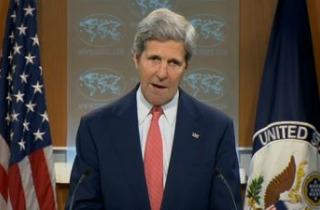
Kerry denounces RT as “propaganda bullhorn”
Kerry then added, “This investigative work is not easy, and bringing those responsible to justice will not be a quick process. However, Quinn, your family, and the families of all the others who died that day deserve such justice, and we will continue to do everything possible to achieve it.”
But the “everything” doesn’t apparently include releasing the data that Kerry claimed to have just days after the crash.
On July 20, 2014, Kerry appeared on NBC’s “Meet the Press” and declared, “we picked up the imagery of this launch. We know the trajectory. We know where it came from. We know the timing. And it was exactly at the time that this aircraft disappeared from the radar.”
In the letter asking Kerry to release that data, Thomas Schansman noted Kerry’s similar comments to a news conference on Aug. 12, 2014, when the Secretary of State said about the Buk anti-aircraft missile suspected of downing the plane: “We saw the take-off. We saw the trajectory. We saw the hit. We saw this aeroplane disappear from the radar screens. So there is really no mystery about where it came from and where these weapons have come from.”
Yet where the missile launch occurred has remained a point of mystery to the Dutch-led investigation. Last October, the Dutch Safety Board put the missile launch in a 320-square-kilometer area. Almaz-Antey, the Russian arms manufacturer of the Buk systems, conducted its own experiments to determine the likely firing location and placed it in a much smaller area near the village of Zaroshchenskoye, about 20 kilometers west of the DSB’s zone and in an area under Ukrainian government control.
Earlier this month, Fred Westerbeke, the head of the Dutch-led Joint Investigation Team, told the families of the victims that the inquiry had yet to pin down the missile launch site, saying “In the second half of the year we expect exact results.” In other words, on the second anniversary of the shoot-down, the investigators looking into the MH-17 shoot-down still might not know what Kerry claimed to know three days afterwards.
[For more on this topic, see Consortiumnews.com’s “Flight 17 Shoot-Down Scenario Shifts”; “The Danger of an MH-17 Cold Case”; and “The Ever-Curiouser MH-17 Case.”]
Investigative reporter Robert Parry broke many of the Iran-Contra stories for The Associated Press and Newsweek in the 1980s. You can buy his latest book, America’s Stolen Narrative, either in print here or as an e-book (from Amazon and barnesandnoble.com.
MH17 Crash: More Questions Arise as US Fails to Provide Promised Info
Sputnik – March 3, 2016
Dutch MPs have held a parliamentary debate on the ongoing investigation into the 2014 downing of Malaysia Airlines Flight MH17 in eastern Ukraine. The discussion focused on radar data and satellite imagery that US Secretary of State John Kerry claimed the United States possessed and which it called strong evidence.
“We picked up the imagery of this launch. We know the trajectory. We know where it came from. We know the timing, and it was exactly at the time that this aircraft disappeared from the radar,” Kerry said in a July 2014 interview.
Question 1. Why did not the US provide this information to the Dutch investigators?
The Dutch MPs and members of the Dutch Safety Board insisted that they had seen no evidence of what John Kerry described as “irrefutable proof.”
Question 2. Why is the investigation taking so long?
The parliamentarians also complained about the investigation into the MH17 disaster taking too long and obvious attempts to keep the public in the dark about its progress.
Question 3. Why haven’t the key documents related to the investigation been made available to the Dutch MPs?
Some important documents related to the probe have been classified indefinitely, which means that they will be kept under wraps for good.
The reason probably being that if these documents were released, they would compromise the method of how this intelligence was collected.
If the US has either secret ground based radar in Ukraine or satellites with unknown capabilities, they will not want to disclose their collection abilities to the public.
Question 4. What is being done to prevent such tragedies ever happening again?
The lawmakers also wanted to know what was being done to rule out such tragedies in future again and make sure that civilian aircraft never fly over war zones.
When asked by representatives of the far-right Dutch Freedom Party whether such incidents could be ruled out in future, Prime Minister Mark Rutte said that such guarantees simply did not exist.
When asked during a daily briefing in Washington whether the US had provided Dutch investigators with the data that Secretary Kerry said the US had, State Department spokesman Mark Toner said: “I believe we have collaborated with the Dutch in their investigation. To what level of detail, I just don’t know.”
RT correspondent Gayane Chichakyan asked whether the Americans had shared vital radar information with the Dutch.
“I know we’ve collaborated with them; I just don’t know to what level we’ve shared information with them. I’d have to look into that,” Mark Toner said.
Citing Terrorism Concerns, John Kerry Supports Saudi Bloodbath in Yemen
Sputnik – 25.01.2016
US Secretary of State John Kerry has expressed his support for Saudi Arabia’s military campaign in Yemen, a conflict that has killed over 2,400 civilians. As justification, the secretary reiterated false claims that Riyadh is battling al-Qaeda.
Over the weekend, the White House stated its concern over the rising civilian death toll in the Yemen conflict.
“We are deeply concerned about recent reports of escalating violence in Yemen and resulting deaths of civilians…” White House National Security Council spokesperson Ned Price said in statement on Saturday.
But while the Obama administration is ostensibly worried about the amount of violence, it also fully supports the Saudi campaign that is creating the chaos. One day after the release of Price’s statement, US Secretary of State John Kerry reiterated his full support for Riyadh’s actions.
“Let me assure everybody that the relationship between the United States and the GCC nations ([Persian] Gulf Cooperation Council) is one that is built on mutual interest, on mutual defense and I think there is no doubt whatsoever in the minds of the countries that make up the GCC that the United States will stand with them against any external threat,” Kerry told reporters.
Kerry claimed that the war was necessary since it is partially aimed at targeting “al-Qaeda operatives.” Those motivations are highly suspect, however, given that Riyadh failed to go after al-Qaeda in the Arabian Peninsula (AQAP) during the first nine months of fighting.
In April, the Saudi government also looked the other way as AQAP seized the port city of al Mukalla. By gaining control of the central bank, the terrorist group gained over $17 billion from the city’s capture.
In addition, Kerry cited the need to combat Iranian “interference.”
“The United States remains concerned about some of the activities that Iran is engaged in other countries,” he told reporters.
Riyadh has provided little evidence to suggest that Tehran is providing any assistance to Houthi rebels in Yemen.
Riyadh’s intervention began last March, and the Saudi naval blockade of Yemen has left approximately 1 million people internally displaced, and as many as 20 million people in need of food, water, and medical supplies.
The United Nations estimates that as many as 2,400 Yemeni civilians have been killed by coalition bombing. Most airstrikes have utilized cluster munitions sold by the United States. Worth an estimated $1.2 billion, this could partially explain Kerry’s support, but it also implicates Washington in Yemen’s civilian deaths.
“We should be culpable for the crime of killing civilians as well, as we produce and sell the weapons when we know the use they will be put to,” retired US Army Major Todd Pierce told Sputnik.
“Our indivisibility with our ‘allies’ inculpates us in their crimes…”
Kerry Pressed for MH-17 Evidence
By Robert Parry | Consortium News | January 21, 2016
The father of Quinn Schansman, the only American citizen to die in the 2014 shoot-down of Malaysia Airlines Flight 17 over eastern Ukraine, has asked Secretary of State John Kerry to release the U.S. data that Kerry cited in claiming precise knowledge of where the suspected anti-aircraft missile was fired.
One of the mysteries of the MH-17 case has become why the United States – after asserting that it possessed information implicating ethnic Russian rebels and the Russian government – has failed to make the data public or apparently even share it with Dutch investigators who are leading the inquiry into how the plane was shot down and who was responsible.

Quinn Schansman (Photo from Facebook)
Quinn Schansman, who had dual U.S.-Dutch citizenship, boarded MH-17 along with 297 other people for a flight from Amsterdam to Kuala Lumpur on July 17, 2014. The 19-year-old was planning to join his family for a vacation in Malaysia.
In a letter to Kerry dated Jan. 5, 2016, Thomas J. Schansman, Quinn’s father, noted Kerry’s remarks at a press conference on Aug. 12, 2014, when the Secretary of State said about the Buk anti-aircraft missile suspected of downing the plane: “We saw the take-off. We saw the trajectory. We saw the hit. We saw this aeroplane disappear from the radar screens. So there is really no mystery about where it came from and where these weapons have come from.”
Yet, where the missile launch occurred has remained a mystery in the MH-17 investigation. Last October, when the Dutch Safety Board issued its final report on the crash, it could only place the launch site within a 320-square-kilometer area in eastern Ukraine, covering territory then controlled by both Ukrainian and rebel forces. (The safety board did not seek to identify which side fired the fateful missile).
Meanwhile, Almaz-Antey, the Russian arms manufacturer of the Buk systems, conducted its own experiments to determine the likely firing location and placed it in a much smaller area near the village of Zaroshchenskoye, about 20 kilometers west of the Dutch Safety Board’s zone and in an area under Ukrainian government control.
In the days immediately after the shoot-down, Kerry and other senior U.S. officials pointed the finger of blame at ethnic Russian rebels who were resisting a military offensive by the U.S.-backed regime in Kiev. The Russian government was faulted for supposedly giving the rebels a powerful Buk anti-aircraft system capable of downing a civilian airliner flying at 33,000 feet.
But – in more than 18 months since the tragedy – the U.S. government has never made public its alleged evidence, while Russia has denied supplying the rebels a Buk system and the rebels have asserted that they did not possess functioning Buk missiles.
An Anguished Father
Thomas Schansman, who lives in The Netherlands, wrote to Kerry, noting that “celebrating Christmas and New Year without my son Quinn Schansman, was difficult for my family and myself” and then pressing the Secretary of State to release U.S. information about the case.
“It is my understanding, that neither the Dutch government nor the Dutch Safety Board [DSB] have officially received the radar information from the US that you referred to. It is not included in the [DSB] report and it is not in the public domain,” Schansman wrote.
“On behalf of the bereaved parents and to assist in the pursuit of justice, I would like to request that the United States provides the DSB with the radar data you referred to at the press conference and all other available and relevant information (like satellite data and infrared satellite data) that is in your government’s possession.
“I would be most grateful if the United States either directly or through NATO would publicly hand over to the Dutch Safety Board radar and satellite data of the minutes before and after the crash. … This would enable the DSB to reopen the investigation and include a chapter with this information, which is essential for a successful criminal prosecution. I count on the support of the government of the United States to find and prosecute those responsible for my son and your citizen’s death.”
Kerry has yet to reply although a U.S. consular official, Pamela J. Hack, sent Schansman a letter dated Jan. 14, expressing condolences for his son’s death and saying “We expect that you will receive a separate response … from Washington.”
A Rush to Judgment
In the days after the shoot-down, Kerry took the lead in accusing the ethnic Russian rebels (and implicitly their supporters in Moscow) of shooting down MH-17. Just three days after the tragedy, Kerry made the rounds of the Sunday talk shows to leave little doubt that the rebels and Russians were at fault.
After mentioning information gleaned from “social media,” Kerry said on NBC’s “Meet the Press”: “But even more importantly, we picked up the imagery of this launch. We know the trajectory. We know where it came from. We know the timing. And it was exactly at the time that this aircraft disappeared from the radar.”
Two days later, on July 22, 2014, the Office of the Director of National Intelligence released a “Government Assessment,” also citing “social media” seeming to implicate the rebels. Then, this white paper listed military equipment allegedly supplied by Russia to the rebels. But the list did not include a Buk missile battery or other high-powered anti-aircraft missiles.
The DNI also had U.S. intelligence analysts brief a few select mainstream reporters, but the analysts conveyed much less conviction than their superiors may have wished, indicating that there was still great uncertainty about who was responsible.
The Los Angeles Times article said: “U.S. intelligence agencies have so far been unable to determine the nationalities or identities of the crew that launched the missile. U.S. officials said it was possible the SA-11 [the designation for a Russian-made anti-aircraft Buk missile] was launched by a defector from the Ukrainian military who was trained to use similar missile systems.”
The analysts’ uncertainty meshed somewhat with what I had been told by a source who had been briefed by U.S. intelligence analysts shortly after the shoot-down about what they had seen in high-resolution satellite photos, which they said showed what looked like Ukrainian military personnel manning the battery believed to have fired the missile.
The source who spoke to me several times after receiving additional briefings about advances in the investigation said that as the U.S. analysts gained more insights into the MH-17 shoot-down from technical and other sources, they came to believe the attack was carried out by a rogue element of the Ukrainian military with ties to a hard-line Ukrainian oligarch. [See, for instance, Consortiumnews.com’s “Flight 17 Shoot-Down Scenario Shifts” and “The Danger of an MH-17 Cold Case.”]
Creating a Pariah
But, officially, the U.S. government never retracted or refined its initial claims. It simply went silent, leaving in place the widespread belief that the ethnic Russian rebels were responsible for the atrocity and that the Russian government had been highly irresponsible in supplying a powerful Buk system to the rebels.
That Western conventional wisdom convinced the European Union to join the U.S. government in imposing economic sanctions on Russia and treating President Vladimir Putin as an international pariah.
As the U.S. government clammed up and hid the evidence that it claimed to possess, it became clear that U.S. intelligence agencies lacked evidence to support Kerry’s initial rush to judgment blaming the rebels and the Russians.
Despite intensive overhead surveillance of eastern Ukraine in summer 2014, U.S. and other Western intelligence services could find no proof that Russia had ever given a Buk system to the rebels or introduced one into the area. Satellite intelligence – reviewed both before and after the shoot-down – only detected Ukrainian miltary Buk missile systems in the conflict zone.
One could infer this finding from the fact that the DNI on July 22, 2014, did not allege that Buks were among the weapons systems that Russia had provided. If Russian-supplied Buks had been spotted – and the batteries of four 16-foot-long missiles hauled around by trucks are hard to miss – their presence surely would have been noted.
But one doesn’t need to infer this lack of evidence. It was spelled out in a little-noticed Dutch intelligence report from last October citing information from the Netherlands’ Military Intelligence and Security Service (MIVD). Dutch intelligence, which as part of NATO would have access to sensitive overhead surveillance and other relevant data, reported that the only anti-aircraft weapons in eastern Ukraine – capable of bringing down MH-17 at 33,000 feet – belonged to the Ukrainian government.
MIVD made that assessment in the context of explaining why commercial aircraft continued to fly over the eastern Ukrainian battle zone in summer 2014. MIVD said that based on “state secret” information, it was known that Ukraine possessed some older but “powerful anti-aircraft systems” and “a number of these systems were located in the eastern part of the country.”
But the intelligence agency added that the rebels lacked that capacity, having only short-range anti-aircraft missiles and a few inoperable Buk missiles that had been captured from a Ukrainian military base. “During the course of July, several reliable sources indicated that the systems that were at the military base were not operational,” MIVD said. “Therefore, they could not be used by the Separatists.”
Ukrainian Motives
In other words, it is fair to say – based on the affirmative comments from the Dutch MIVD and the omissions from the U.S. “Government Assessment” – that the Western powers had no evidence that the ethnic Russian rebels or their Russian allies had operational Buk missiles in eastern Ukraine, but the Ukrainian government did have several batteries of such missiles.
It also would have made sense that Ukraine would be moving additional anti-aircraft systems close to the border because of a feared Russian invasion as the Ukrainian military pressed its “anti-terrorism operation” against ethnic Russians fighters, who were resisting the U.S.-backed coup of Feb. 22, 2014, which had ousted elected President Viktor Yanukovych, whose political base was in the east.
According to the Dutch Safety Board report, a Ukrainian warplane had been shot down by a suspected air-to-air missile (presumably from a Russian fighter) on July 16, 2014, meaning that Ukrainian defenses were probably on high alert. The Russian military also claimed that Ukraine had activated a radar system that is used to guide Buk missiles.
I was told by the intelligence source that U.S. analysts looked seriously at the possibility that the intended target was President Putin’s official plane returning from a state visit to South America. His aircraft and MH-17 had similar red-white-and-blue markings, but Putin took a more northerly route and arrived safely in Moscow.
Other possible scenarios were that a poorly trained and undisciplined Ukrainian squad mistook MH-17 for a Russian plane that had penetrated Ukrainian airspace or that the attack was willful provocation designed to be blamed on the Russians.
Whoever the culprits and whatever their motive, one point that should not have remained in doubt was where the missile launch occurred. Kerry said repeatedly in the days after the tragedy that U.S. intelligence had detected the launch and knew where it came from.
So, why did the Dutch Safety Board have to scratch its head about the missile coming from somewhere in a 320-square-kilometer area, with the Russian manufacturer placing the launch site about 20 kilometers further west? With the firing location a key point in dispute, why would the U.S. government withhold from a NATO ally (and investigators into a major airline disaster) the launch point for the missile?
Presumably, if the Obama administration had solid evidence showing that the launch came from rebel territory, which was Kerry’s insinuation, U.S. officials would have been only too happy to provide the data. That data also could be the only precise radar evidence available. Ukraine claimed that its principal radar systems were down at the time of the attack, and the Russians — while they asserted that their radar screens showed another plane closing on MH-17 — did not save the raw data.
Thomas Schansman noted in his letter to Kerry: “the DSB [Dutch Safety Board] stated that it did not receive the (raw) primary radar data from any State. …. The UN Security Council Resolution 2166 explicit[ly] requested Member States to provide any requested assistance and cooperate fully with the investigation. The (raw) primary radar data is crucial for determining cause, and for identifying and prosecuting those responsible for this heinous act.”
Conventional Wisdom
Despite the strange evidentiary gaps and the U.S. failure to present the proof that it claims to possess, the West’s “conventional wisdom” remains that either the ethnic Russian rebels or the Russians themselves shot down MH-17 and have sought to cover up their guilt. Some of this certainty comes from the simpleminded game of repeating that Buk missiles are “Russian-made,” which is true but irrelevant to the issue of who fired the missiles, since the Ukrainian military possesses Russian-made Buks.
Despite the lack of U.S. cooperation in the investigation – and the failure of Western intelligence to detect Russians or ethnic Russian rebels with a Buk battery in eastern Ukraine – the Dutch criminal prosecutors who are working closely with the Ukrainian government say they are taking seriously allegations by bloggers at a British Web site called Bellingcat who have identified Russian soldiers assigned to a Buk missile battery as prime suspects in the shoot-down.
So, the possibility remains that this Dutch-led investigation – in coordination with the Ukrainian government – will indict some Russian soldiers even as the U.S. government withholds its data that could resolve such key questions as where the fateful missile was fired.
An indictment of Russian soldiers would make for more useful anti-Putin propaganda and would be sure to produce another chorus of denunciations against Moscow from the mainstream Western media. But such a development might do little to resolve the mystery of who really shot down MH-17, killing Quinn Schansman and 297 other people aboard MH-17.
Investigative reporter Robert Parry broke many of the Iran-Contra stories for The Associated Press and Newsweek in the 1980s. You can buy his latest book, America’s Stolen Narrative, either in print here or as an e-book (from Amazon and barnesandnoble.com).
The Washington Post’s world of good and evil
By Danielle Ryan | RT | December 29, 2015
No other country, with the exception of maybe China, gets as much of a look in as Russia does from the Washington Post’s editorial board.
It’s hardly strange that the newspaper would focus some of its attention on Russia, an increasingly influential global player, but it does seem to have a bit of a bee in its bonnet about the old enemy.
Reading the Post’s editorials on matters of global affairs is like an exercise in understanding the very worst imaginable interpretation of American exceptionalism — and the latest dispatch on Syria is a perfect example. The headline reads: “A UN resolution on Syria is shattered – and Russia is to blame.”
The UN resolution referred to by the Post stated that all parties must “immediately cease any attacks against civilians and civilian objects” as well as “any indiscriminate use of weapons, including through shelling and aerial bombardment.” Leaving aside the laughable notion that the US itself would adhere to such a resolution and “immediately cease” anything whatsoever, let’s take a look at what concerned the Post.
Two days after the resolution was passed, the editorial says, Russia carried out strikes in the northern Syrian provincial capital of Idlib “killing scores of civilians”. It is not for this writer to judge the authenticity of that claim or to question the word of the Post’s reporter in Beirut — and it would be ludicrous to claim Russia’s strikes have killed not one civilian, but it is at least worth noting that one of the newspaper’s original sources for the story was The Syrian Observatory for Human Rights, an ‘organization’ run out of a home in Coventry by one man who hasn’t visited Syria in 15 years, has received “small subsidies” from the European Union, and whose reports are at best, unreliable. Nevertheless, SOHR has become one of the single-most important “sources” of information on Syria in the Western press.
Irony lost
The Post continues on, unabashed. Secretary of State John Kerry, they chide, should be embarrassed by “this outrage” which “shattered” the UN resolution. They say this without so much of a hint of irony as the US continues to wage its illegal bombing campaign in the country they purport to care so very deeply about. They always care, you see. The more they care, the more bombs they want to drop.
And in the Post’s world, the UN is important and should be respected. Unless you’re the United States, in which case, go ahead and do whatever you want. Ever the pen-wielding champions for the spreading of good old freedom and democracy, they are always there, on the frontlines, cheering on America’s wars. It’s awfully easy to be in favor of ‘humanitarian’ military interventions when you comfort yourself with the knowledge that it’s okay, because you’re the good guys — always. But still, the board likes to be outraged (!) — and it needs to get its outrage fix from somewhere.
At least they’re consistent
Enter Russia. You have to at least hand it to the Post for its consistency. Russia and Putin continue to be the scapegoats for all seasons. There is nothing Moscow can’t be blamed for and nothing it can do right. If the Kremlin produced a cure for cancer tomorrow, the Post would re-imagine it as a sinister plot devised by Putin to put Western oncologists out of jobs.
In early October, the board warned Obama: Don’t green light Mr. Putin’s Syria project. That piece argued that the “moderate” opposition to Assad — which in the real world includes Al-Qaeda’s Syria affiliate Al Nusra, should be given more US anti-tank missiles and that Putin should be given “red lines”.
In November, after the Paris attacks, sensing that things were moving in Putin’s favor, and that an international anti-ISIS coalition might be in the making, they jumped in to ensure no one thought that was a good idea with a piece headlined: Teaming up with Russia in Syria could be a dangerous.
And of course, when Turkey shot down a Russian jet near the Syrian border after claiming that it had violated Turkish airspace, the Post did its bit to make sure no one was left with the wrong impression about who exactly was responsible for the incident: Russian “provocations” and “dangerous behavior of Vladimir Putin’s regime.” Reading that, you’d be forgiven for thinking that it was Russia recklessly shooting planes out of the sky. One wonders would the Post’s reaction have been the same if an American warplane had been shot down in Syria? It’s certainly unlikely (to say the least) that the Post would be calling the US’s illegal flights over the war-torn country “provocations” and demanding accountability.
Occasionally, the newspaper likes to dabble in wishful thinking. Not the editorial board, but an opinion piece published by the Post in late November asked: Is Syria the beginning of the end of Putinism?
It’s our world. Everyone else just lives in it.
The Post’s penchant for US exceptionalism extends far beyond Syria. Here, they lament, Obama just “doesn’t understand” Putin’s “Eurasian ambitions”. Apparently it’s not worth noting that Russia is in fact a massive Eurasian country, unlike say, the US.
And God forbid any other countries might think they could act independently of Washington in any arena. Obama was “right to order a sail-by” in the South China Sea because “failure to respond” to the “aggression” of other countries is always the greatest sin. Meanwhile, Iran “steps up its aggression” in the Middle East. The list goes on and the Washington Post’s editorial board fails, time and again, to see the irony.
That’s the kind of world the Post’s editors live in: Black and white. Good and evil. We’re always right, you’re always wrong. Do what we say, not as we do. The destruction this kind of thinking leaves in its wake is always someone else’s problem to solve.
Danielle Ryan is an Irish freelance journalist and media analyst. She has lived in the US and Germany and is currently based in Moscow. She previously worked as a digital desk reporter for the Sunday Business Post in Dublin. She studied political reporting at the Washington Center for Politics & Journalism in Washington, DC and also has a degree in business and German. She focuses on US foreign policy, US-Russia relations and media bias.
The Syrian opposition circus comes to town
By Sharmine Narwani | RT | December 22, 2015
In January, the Syrian government will – ostensibly – sit across the negotiating table from ‘the Syrian opposition’ to decide on the structure and make-up of a transitional government that promises to end the 5-year Syrian conflict.
The ‘Syrian opposition,’ we are told by US Secretary of State John Kerry, will be selected by ‘Syrians’ and will therefore be ‘representative.’
“This is not about imposing anything on anyone,” Kerry remarked about the Vienna process, convened to broker a Syrian peace – which was negotiated by 20 countries, but without the involvement of Syrians.
“I want to be clear: the Syrian people will be the validators of this whole effort,” says Kerry again – lest we forget. This is just before he instructs us that Syrian President Bashar al-Assad cannot hold any long-term position in Syria: “Asking the opposition to trust Assad or to accept Assad’s leadership is simply not a reasonable request, and it is literally therefore a non-starter,” explains Kerry from his non-Syrian perspective.
Incidentally, Kerry now also calls any Syrian demand for Assad to leave before the political transition “a non-starting position.” It appears that to be part of this ‘Syrian solution,’ you must first agree with Kerry’s many nuanced positions on Syria.
But back to the ‘Syrian opposition’ – those able negotiators who will represent the ‘Syrian people’ come January.
This is where it gets really confusing. The 20 non-Syrian countries participating in the Vienna process will ultimately decide 1. which Syrians will speak for the opposition at future talks, and 2. which Syrians will instead be labelled ‘terrorists’ to be slaughtered on the battlefield.
To whittle down the ‘Syrian opposition’ to a few dozen individuals that are ‘representative’ of Syrians, several meetings were held to fight it out – mostly in foreign countries.
The Saudis shrewdly tried to grab front-runner advantage for their favorite Syrians by hosting a highly-publicized meeting in Riyadh that cobbled together a 34-member opposition ‘turnkey solution.’
But several countries balked at some of the Riyadh-cooked opposition, which consists of groups or individuals they think should be on the ‘terrorist’ list instead of the negotiating table.
Others on the Saudi shortlist don’t appear to be ‘representative’ of anybody, let alone the ‘Syrian people.’ They include several former heads of the now widely-discredited Syrian National Coalition (SNC), once viewed by Syria’s foes as the country’s ‘legitimate’ government-in-exile.
These Riyadh-backed luminaries include ex-SNC President George Sabra, who gained his Syrian ‘legitimacy’ in 2012 from a whopping 28 votes cast by 41 Syrians – in Qatar.
They also include Khaled Khoja, who squeaked through as president of the now-rebranded ‘National Coalition for Syrian Revolutionary and Opposition Forces’ with 56 votes out of 109 cast – in Turkey.
They also include the likes of Saudi-based Ahmad Jarba, who won his second term at the helm of the National Council in 2014 with 65 votes – also cast in Turkey. Jarba beat his only rival Riad Hijab by 13 whole votes. Hijab turned the tables on Jarba in Riyadh last week, however, when 34 Syrians chose him instead to represent them at peace talks in Vienna.
Hijab, of course, is best known as the highest-ranking official to defect from the Syrian government during this crisis. He was prime minister of the country at the time – and I was in Damascus sitting in a roadside café when the news of his defection first broke. It created quite a stir in the café: Half of the Syrian customers were asking “who is the prime minister?” while the other half were asking “who is Riad Hijab?”
Representative of the Syrian people? Not so much.
The ‘Terrorists’
There are two lists being drawn up per the agreement reached in Vienna: the first list is to decide the ‘Syrian opposition’ negotiators. Since 22 million Syrians will not be voting for their own representatives, this list will basically be ‘manufactured’ by a handful of influential foreign states via some frenzied horse-trading.
The second list created by the Vienna-20 will determine which Syrian opposition militias are to be designated as ‘terrorist’ organizations. It is understood that those who make this list will not be participating in any ceasefires. It is also understood that the groups on this list will be mowed down by the Syrian army, its allies and foreign coalition airstrikes – unless they flee back across the Turkish border, of course.
For years, Washington has insisted there are armed ‘moderate’ groups in Syria, but have gone to great lengths to avoid naming these ‘moderates.’ Why? Because if moderates were named and identified, the US would have to be very, very certain that no past, present or future ‘atrocity video’ would surface to prove otherwise. And the US could not guarantee this with any of the groups they have armed, trained or financed in Syria over the past five years.
The twenty countries involved in Vienna talks have already agreed that ISIS and Jabhat al-Nusra (Al Qaeda’s Syrian franchise) are on this list. The big question now is who else makes the cut. And in everyone’s sights first and foremost is Ahrar al Sham, a Turkish, Qatari and Saudi-funded extremist group whose backbone is a mix of the Syrian Muslim Brotherhood and Al Qaeda.
Earlier last summer, when I queried the US State Department about how they viewed Ahrar, I was told: “The US has neither worked with nor provided any assistance to Ahrar al-Sham. The US supports moderate Syrian opposition groups.”
Put it this way, if Ahrar were ‘moderates,’ they would have already received direct US assistance, so desperate has Washington been to find Syrian fighters to do their bidding. And influential Americans have worked overtime to whitewash Ahrar – to distance it from Al Qaeda and other extremists, even though Ahrar’s closest primary ground force ally is none other than Jabhat al Nusra.
This strange western-Turkish-GCC determination to mainstream radical Salafist militants was seen again in Riyadh in December, when Ahrar reps were invited to join the opposition deliberations. The group is reported to have signed on to the final Riyadh declaration, but this was later hotly disputed by its leadership inside Syria. Either way, Ahrar is never going to be comfortable with Vienna’s terms today – to do so will be to turn its guns on its comrades in Nusra tomorrow, and to renounce many of its core beliefs.
The Ahrar challenge is mirrored by many of the hundreds of militias fighting inside Syria right now. These are mostly Sunni Islamist fighters, who over the course of this conflict have become overtly sectarian, violent and intolerant. Are they terrorists? The Syrian state says yes, and so do its allies Iran and Russia.
And this leads us to why they are right.
Armed and foreign-backed
Whatever this Syrian crisis has been, a ‘revolution’ it is not. No revolution, borne from the heart of a genuinely popular insurrection, is financed, armed and trained by the enemies of a state. What has transpired in Syria for the past five years is a long-planned foreign conspiracy – in coordination with a small sliver of its nationals – to create regime-change on the back of the narratives of the ‘Arab Spring.’
The US military’s ‘unconventional warfare’ manual contains the blueprint for exactly this kind of regime-change operation:

But this is not the first time this trick has been tried in Syria. In the late 1970s and early 1980s, the Syrian branch of the Muslim Brotherhood launched a similar operation from inside Hama and tried to replicate it nationwide. They failed and were wiped out by Bashar al Assad’s father, Hafez, who was not constrained by the threat of today’s foreign “humanitarian intervention” and “Responsibility To Protect” (R2P) doctrines.
The US Defense Intelligence Agency (DIA) in their now-declassified 1982 report on Hama called the Muslim Brotherhood’s actions “terrorism,” and rightly so.
You cannot pick up arms against a central government, impose your will with weapons on population centers, blow up police stations, public transportation, bread factories, pipelines, waterworks, target your national army, human-shield yourself in mosques and schools, assassinate public and private figures – and imagine yourself anything but a terrorist. You are not fighting an occupation, where your right to self-defense is enshrined in law. You are fighting your state, and your state has an internationally-mandated legal duty to protect its nationals – from you.
Furthermore, no state would shelter you from lawful consequence if you were doing all these things at the behest of, and with material support from, an enemy state.
Syria’s largest militant opposition groups are – one and all – financed, armed, trained, supported by the United States, Great Britain, Saudi Arabia, Turkey, Qatar, France and a smattering of other states and nationals.
None of these groups belong at a negotiating table across from the Syrian government – for one, they do not represent ‘Syrians,’ they represent foreign interests.
Can Washington name a single of its own anti-government, US-based, armed militias that it would term “moderate?” If an enemy state was financing and arming a group of American citizens, what would the consequence be if this group burned vehicles, killed police officers, set banks ablaze?
Moderate or extremist, secular or Islamist, why should Syria’s foreign-backed armed groups sit at the table in Vienna? And, for that matter, why should Syria’s foreign-backed unarmed politicos represent ‘Syrians’ at talks either?
Foreign states that spent five years ignoring the many non-violent Syrian dissidents based in Syria who have spent decades in opposition – in order to manufacture a thoroughly unrepresentative, subservient, malleable and repressive ‘Syrian opposition’ that will serve their interests – should not be rewarded for their deeds in Vienna.
None of their hand-picked ‘Syrian opposition’ will do – these mini-tyrants, warlords and militants will just prolong Syria’s tragedy indefinitely.
Think of Vienna as a stage. Right now, several western powers are seeking a political solution in Vienna as an exit from the Syrian theater – because it has become too costly. The extremism of ISIS, terror threats on the home front, a flood of migrants and refugees, and the promise of indefinite chaos in the Middle East has created a new-found bargaining spirit in the west. For the west, Assad, the Russians and Iranians suddenly look like worthy partners today – able, potentially, to help negotiate a face-saving exit from the Syrian quagmire. It is no coincidence that the US pushed through a nuclear deal with Iran this year – or that Kerry and Russian Foreign Minister Sergei Lavrov are co-chairing the Vienna talks.
But in the east – in Saudi Arabia, Turkey and Qatar – Vienna represents potential defeat unless Assad goes. These states either believe they are facing down existential threats, or at best, political humiliations from which they are unlikely to recover.
This brings another level of complexity to the Vienna stage. Allies in east and west find themselves with vastly diverging interests. All are still looking to stack their hands with cards which can improve their fortunes at the table, but their militants in the Syrian field have been losing ground since Russian jets took to Syria’s skies. Their own anti-terror Coalition is being outed and shamed for its complicity with the very terrorists it purports to fight. And they still, five years on, cannot construct a cohesive ‘Syrian opposition.’
Vienna is unlikely to ever see a genuine Syrian political solution. But it could still act as a springboard for some new thinking. Think ‘terror’ first. Disarm militants, halt weapons transfers, shut down borders, besiege them in their strongholds, cut off their financing, sanction their supporters.
Many of these components were in last week’s UN Security Council Resolution 2254, co-sponsored by Syria, in a new twist. An important start.
Cooperate with the Syrian state; coordinate airstrikes, ground battles; share intelligence. This stage may yet arrive.
Finally, acknowledge the reforms that the state tried to implement in the first few months of the Syrian crisis – Syria shut down its military court at the same time that Jordan was establishing a new security court. Why was one derided and the other lauded? Provide the time and space – reconciliation takes time – for Syrians to gear up for new elections under international observation.
If a ‘Syrian opposition’ is the desired outcome, this can only come organically from inside Syria, when Syrians are no longer under the threat of violent conflict.
The alternative, of course, is this Syrian opposition circus that is gearing up for a fall in Vienna. You can pay these clowns through the nose, but you will never get a performance out of them.
Sharmine Narwani is a commentator and analyst of Middle East geopolitics. She is a former senior associate at St. Antony’s College, Oxford University and has a master’s degree in International Relations from Columbia University. Sharmine has written commentary for a wide array of publications, including Al Akhbar English, the New York Times, the Guardian, Asia Times Online, Salon.com, USA Today, the Huffington Post, Al Jazeera English, BRICS Post and others. You can follow her on Twitter at @snarwani
Featured Video
No Threat Can Force Iran’s Surrender /Trita Parsi & Lt Cl Daniel Davis
or go to
Aletho News Archives – Video-Images
From the Archives
An Expert Military Analysis of War with China
Actually, None is Necessary
By Fred Reed • Unz Review • December 13, 2020
The Correlation of Armed Forces: U.S. goods and services trade with China totaled an estimated $634.8 billion in 2019. Exports were $163.0 billion; imports were $471.8 billion. The U.S. goods and services trade deficit with China was $308.8 billion in 2019. Trade in services with China (exports and imports) totaled an estimated $76.7 billion in 2019. Services exports were $56.5 billion; services imports were $20.1 billion. The U.S. services trade surplus with China was $36.4 billion in 2019.
There is talk within the Washingtoniat of a possible war with China. Steve Bannon, who apparently was dropped on his head as a child, actually favors such a war. We hear the usual shoo-the-boobs alarm about how the Chinese are doing something terrible and we must gird our loins and American values and show them what for, bow wow, woof. The danger is that the current game of who-blinks-first in Asian waters might actually provoke a shooting war. You know the kind of thing: One warship refuses to get out of the way of another, a collision ensues, some retard lieutenant who signed up on waivers opens fire, and we’re off and running. It is not a good idea to let children play with matches.
The said war is discussed either in emotional terms by idiots or in purely naval terms by those familiar with such things, so we hear of the First Island Chain and the Second Island Chain and whose missiles against the other’s missiles and so on. This would be appropriate if we were fighting World War Two again. Which we aren’t. Let’s take a quick-and-dirty look at how such a war might go.
To begin the war, America would overestimate itself and underestimate China. This is doctrine in the Pentagon. … continue
Blog Roll
 Aletho News
- Theodore Postol: Iran’s Missiles & Drones Were Underestimated
- Iran To Target Military Industrial-Tech Complex That Facilitated Gaza Genocide
- Collapsing Empire: The Resistance Disarms ‘Israel’
- Suicide Should Not Be a Government Service
- Rethinking America’s greatest threat: Iran vs. Israel-Firsters
- Iran accuses adversaries of false flags to strain Turkey ties
- Poland rules out sending Patriot missiles to US/Israel amid war on Iran
- Tehran approves new Hormuz plan with major restrictions
- No Threat Can Force Iran’s Surrender /Trita Parsi & Lt Cl Daniel Davis
- UK’s New Pandemic Plan Would Turn Big Tech Into a Mass Location Tracking Network
- If Americans Knew
- Ann Coulter Rips Into Fox News for Iran War Coverage, Compares to False Rigged 2020 Election Reporting
- Joe Kent Urges Americans To Call White House and Congress To Object To Sending Troops Into Iran
- DNC Resolution to Reject AIPAC Funding Puts Democratic Leaders in the Hot Seat
- Swedish foundation to build 400 schools as over 650,000 Gaza children remain without education for 2 years
- Israeli army admits photshopping image of slain Lebanese journalist
- This is how Israel is systematically killing health workers under the cover of war in Lebanon
- Carrying life under fire: Israeli invasion of Lebanon leaves pregnant women facing deadly risks
- Champagne all around for the new death penalty (for Palestinians) law – Not a ceasefire Day 172
- Why are Palestinian books struggling to be seen on Amazon?
- The Line Between Affinity and Conspiracy
- No Tricks Zone
- New Study Finds Warming Saves Lives…Cold Temperatures 12 Times More Deadly Than Excess Heat
- German Science Blog Accuses PIK Climate Institute Of Hallucinating Climate Tipping Points
- Devastating Assessment Of Comirnaty Vaccine By Former Senior Pfizer Europe Toxicologist
- New Study: CO2 Is ‘Effectively Negligible’ As An Explanatory Climate Change Factor Since 2000
- Former Pfizer Toxicologist Dr. Helmut Sterz Tells Bundestag Hearing Pfizer Vaccine Should Have Never Been Approved
- Energy Expert: Germany’s Nuclear Phaseout Was A “500 Billion Euro Mistake”
- New Research: South Australia’s Mid-Holocene Sea Surface Temperatures Were 4°C Warmer Than Today
- Storing Green Energy To Last Germany 10 Days Would Require A 60-Million Tonne Battery
- New Studies: UK Sea Levels Were 4 Meters Higher Than Today During The Mid-Holocene
- Destructive Green New Deal: German Energy And Metal Group Warns Of Drastic Crisis
 Aletho News