Crimea vote in line with UN charter: Putin to Ban
BRICS Post | March 15, 2014
Ahead of the upcoming referendum in Crimea, Russian President Vladimir Putin told UN Secretary General Ban Ki-moon in a phone conversation on Friday the move was in line with the UN Charter.
Putin and Ban discussed “the situation in Ukraine, including the referendum to be held on March 16,” said a Kremlin statement.
“Putin emphasized that the decision to hold the referendum is in line with the provisions of international law and with the UN Charter,” says the statement.
International observers have arrived in Crimea on Saturday ahead of the controversial referendum.
The Crimean parliament declared independence Tuesday ahead of a popular vote Sunday on seceding from Ukraine and becoming part of Russia.
Authorities in Kiev and international leaders have condemned the referendum as illegitimate and accused Moscow of fomenting unrest in order to annex Crimea.
Ban told reporters in New York later in the day that the situation in Ukraine continues to deteriorate and there was “a great risk of dangerous, downward spiral.”
He also urged Russia and Ukraine not to take “hasty measures” that “may impact the sovereignty, unity and territorial integrity of Ukraine.” The UN chief said that peaceful solution was still an option.
Russia and the West have reached a standoff over the fate of Crimea, which has refused to recognize the legitimacy of the new central government in Kiev following last month’s revolution.
Russia has no plans of a military action in southeastern Ukraine, Russian Foreign Minister Sergei Lavrov said on Friday after talks with his US counterpart John Kerry in London.
“Russia does not and cannot have any plans to invade southeastern Ukraine. There are no reasons that prevent us from showing transparency [on the Ukrainian issue],” he said.
In spite of extensive talks between Kerry and Lavrov, disagreements between Moscow and Washington persist.
“As far as prospective sanctions are concerned… I assure you that our partners are fully aware that sanctions are a counter-productive measure. They will not benefit our mutual business interests or the development of our partnership in general,” Lavrov said.
Writing for The BRICS Post, Alexander Nekrassov, a former Kremlin and government advisor, said too much is at stake to make drastic changes in Russia-US ties, and “too much money is involved in deals and trade to simply ignore everything and turn back on years of tough negotiating and compromise”.
“Despite what is happening in Ukraine, relations between the US and Russia will continue; Exxon Mobile and others will keep on signing deals with the Russian oil giant Rosneft and trade between the two countries will not suffer,” writes Nekrassov.
TBP and Agencies

America’s Unceasing Contempt for Venezuela
By Jason Hirthler | CounterPunch | March 11, 2014
Some things never change. The petulant and undemocratic Venezuelan opposition is at it again, with the full backing and check-writing support of the U.S. government. Recent protests have inflamed the streets of Caracas, as opposition groups, as they have in the Ukraine, called for the ouster of the sitting president. I suppose it’s needless to note that Nicolás Maduro is Venezuela’s democratically elected president, and that he won by a higher victory margin in a cleaner election than did Barack Obama in 2012. Nor is it worth asking, one supposes, that if the entire country is engulfed by dissent, as The New York Times insidiously suggested by claiming the “The protests are expressing the widespread discontent with the government of President Nicolás Maduro, a socialist…”, then why did Maduro’s party, Partido Socialista Unido de Venezuela (PSUV), claim wide majorities in municipal elections in December? Or why are these “widespread” protests largely confined to middle-class or student areas of Caracas and not rife within much larger poor neighborhoods? Or if a government has the right to arrest opposition leaders (in this case Leopoldo Lopez, the latest rabid ideologue) for inciting violence?
Public Virtue, Private Vice
Secretary of State John Kerry has ratcheted up the drivel stateside, claiming to be “alarmed” by reports that Maduro has “detained scores of anti-government protesters” and that the crackdown would have a “chilling effect” on free expression. A bit rich coming from a man whose own government has been icing free speech since the Snowden revelations. Kerry failed to mention whether the millions of American taxpayer dollars being funneled to the opposition were behind the violence. The Los Angeles Times described Maduro’s administration as an “autocratic government.” Opposition leader Henrique Caprilles, demolished by Maduro in last year’s landslide election, rejected Maduro’s invitation to talks and claimed one of the Latin America’s most popular political parties was a “dying government.”
For its part, Mercosur, the alliance of South America’s southern cone countries, denounced the violence as an attempt to “destabilize” a democratic government. Of course, the behavior of Maduro’s government in response to these street provocations ought to closely watched, as this is the new president’s first real test coping on an international stage with the intrigues of a small but virulent neoliberal opposition.
There’s plenty to suggest that this is, like Ukraine, another external attempt to uproot a democratically elected government through a volatile cocktail of in-country agitation and violence paired with global media defamation of the existing administration. It wouldn’t come as a surprise. Like a frustrated and petulant infant, the United States has repeatedly attempted to derail the Bolivarian Revolution launched by former President Hugo Chavez in the late nineties, as CEPR’s Mark Weisbrot has noted. It backed an anti-democratic coup by business elites in 2002 that actually succeeded for a couple of days and happily dissolved parliament before Chavez regained power. It supported an oil strike in an attempt to destabilize the economy and perhaps bring down the government. It encouraged opposition members of parliament to push for recalls (failed) and boycott National Assembly elections (useless) and clamor incessantly that last year’s national presidential election was rigged (false). Of course, despite being widely held to be a superior electoral process than that of the United States, Kerry was only shamed into recognizing the legitimacy of the election long after the rest of the world had.
The U.S. has poured millions into opposition activities on an annual basis since the failed coup in 2002. (NGOs are convenient destinations for this money since foreign contributions to political parties are illegal in both countries.) Just look at 2013 alone. Washington would hardly stand for interference of this kind from, say, China. Or, better, from Venezuela itself. Imagine if it was discovered that Chavez had been seeding major American metropolises with anti-capitalist pamphleteers. Obama wouldn’t be able to hit the “signature strike” button fast enough. Nevertheless, Kerry, in his role as Secretary of State, has turned out to be a masterful mimic capable of registering a fusty outrage on short notice, especially over claimed violations of civil liberties. Curious, since the ceaseless trampling of civil liberties by his own Democratic party have elicited nothing from this flag-bearer for democratic values.
Dollars & Bolivars
This is not to say that Venezuela does not have protest-worthy problems. Inflation has been chronic since the pre-Chavez days. Now food shortages are trying the patience of the population. And in one sense, these shortages are self-inflicted. According to Gregory Wilpert of VenezuelAnalysis, the government’s currency controls have been undermined by an all-too-predictable black market. While the government has placed strict criteria on the ability of citizens to purchase dollars with bolivars, the black market allows citizens to buy dollars without any criteria whatsoever. The government’s exchange rate is likewise controlled, and has over time begun to distort the real value of the bolivar. The black market exchange rate, by contrast, reflects the external value of the currency. The gap between these exchange rates has grown rapidly, such that there now exist huge incentives for citizens to play currency arbitrage. If they satisfy the federal criteria—such as needing dollars to travel or import goods—Venezuelans can buy dollars cheaply using the government exchange rate. They can then pay those dollars to import goods, then export those goods in exchange for the dollars they just spent on the imports. From there it is a simple step to the black market, where they can sell those dollars for many times what they paid at the government’s official rate, making a tidy profit for themselves. If they happen to be rabid anti-socialists, they can enjoy the companion thrill of generating food shortages that can be blamed on the government. Ah, the timeless magic of import/export.
These are legitimate grievances, however, as are crime figures, which top the regional table. Yet the question is, do they merit the overthrow of a legitimate government backed by a wide majority of the population at the behest of a small but fierce oppositional faction openly funded by an imperial power committed to its overthrow? To do so would risk the absurdity of gratifying the strident demands of a few at the expense of the many. … The fact is, despite the inflation and shortages, the population continues to support the Bolivarian Revolution because of its accomplishments—massive reductions in poverty, extreme poverty, and illiteracy. Significant growth in per capita GDP and other important metrics.
A Doctrine in Decline
We’re seeing in clear images the viciousness with which neoliberal factions resent the loss of power and seek to restore it by any means necessary. Democracy is the least of their concerns. But this has been the Latin American back-story for a couple of centuries. Much of the U.S. activity in Latin America feels like a frantic and desperate last-ditch effort to preserve the Monroe Doctrine, by which we essentially declared Latin America to be our own backyard, off-limits to European empires. What was ostensibly a call to respect independent development in the Southern hemisphere rather predictably evolved into an excuse for self-interested intervention. But now, for the first time in centuries, Latin America has struck out on its own, slipping from beneath the clutch of the eagle’s claw to form organizations like Mercosur and CELEAC, PetroCaribe and Petrosur, the Bank of the South as well as the Bolivarian Alliance for the Americas (ALBA). Aside from Columbia, an implacable outpost of American influence, the region has shunned greater U.S. involvement, and begun to view its proffered trade agreements with far more suspicion, particularly in the long wake of NAFTA, the poster child for lopsided and economically destructive trade treaties.
Whether the U.S. will eventually succeed in a cynical ploy to unseat Maduro remains to be seen. If recent events in the Ukraine are any indication, that may have been a test run for Venezuela, as Peter Lee suggests. It hasn’t helped that, as in practically every country that comes to mind, an elite class of neoliberal ideologues own the mainstream media. The tools of propaganda have rarely been more fiercely deployed than since Chavez launched his socialist revolution. And yet, since then, practically the entire continent has experimented with left-leaning leadership: Rafael Correa in Ecuador, Evo Morales in Bolivia, Nicanor Duarte in Paraguay, Tabare Vazquez in Uruguay, to some degree Luiz Inácio Lula da Silva in Brazil, and Maduro in Venezuela. Nor should exiled Honduran president Manuel Zalaya be forgotten. These figures have collectively stepped back from the brink of dubious integration with North America and sought stronger regional ties and continental autonomy.
The U.S. has replied with a predictable confection of threats, lies, and sacks of cash for ferociously anti-democratic elements. Perhaps it most fears the bad karma it generated for itself with Operation Condor, which on September 11, 1973 overthrew and murdered Chile’s socialist leader Salvador Allende and replaced him with a gutless sadist, Augusto Pinochet. Pinochet—a repressive militarist—happily instituted the untested prescriptions of the Chicago School of Economics’ sermonizing armchair guru Milton Freidman, with predictable results. Now, Maduro, carrying the mantle of Chavez and his Bolivarian manifesto, is arguably the spiritual vanguard of the socialist left in South America. Venezuela’s efforts to continue to forge its own independence in the coming decade will surely influence the mood and courage of other leftists in the region. The stakes are obviously high. Hence the relentless American effort to destabilize and publicly discredit the PSUV. The fate of the global left is in a very real sense being tested in the crucible of Caracas.
Jason Hirthler can be reached at jasonhirthler@gmail.com.
Russia says US proposals on Ukraine crisis ‘not suitable’
Press TV – March 11, 2014
Russia says proposals by the United States on finding a solution to the crisis in Ukraine are “not suitable.”
Russian Foreign Minister Sergei Lavrov said in a televised briefing with President Vladimir Putin on Monday that the proposals made by US Secretary of State John Kerry are inappropriate as they take the “situation created by the coup as a starting point”, in an apparent reference to the ouster of Ukraine president, Viktor Yanukovich by the parliament on February 23.
The Russian foreign minister said the document he received from Kerry on Washington’s recommendations to end the crisis in Ukraine “raises many questions.”
“Everything was stated in terms of allegedly having a conflict between Russia and Ukraine, and in terms of accepting the fait accompli,” Lavrov said.
He also commented on Kerry’s delay in a visit to Moscow for talks on the Ukraine crisis. Lavrov said the Kremlin had decided to draft counter proposals to resolve the situation on the basis of international law.
“We suggested that he (Kerry) come today… And we were prepared to receive him. He gave his preliminary consent. He then called me on Saturday (March 8) and said he would like to postpone it for a while,” the Russian foreign minister stated.
Russia has sent forces to Ukraine’s southern region of Crimea after the Russian parliament authorized President Putin to use armed forces to “protect Russia’s interests in that region.”
Yanukovych refrained from signing an Association Agreement with the European Union in favor of closer ties with Russia in November 2013. The move triggered weeks of anti-government protests in the country.
The local Crimean administration is expected to hold a referendum on March 16 in order to decide whether the Black Sea peninsula should become part of Russia or remain part of Ukraine.
Related article
Washington’s Hysteria Towards Russia Hides US Regime Change
By Finian Cunningham | Strategic Culture Foundation | March 6, 2014
Legally, Washington and its European allies haven’t a leg to stand on. Both can be rightly accused of violating international law from their gross interference in Ukrainian sovereign affairs – from the instigation of violent street protests that led to the sacking of an elected president and government, to the subsequent climate of lawlessness and fear sweeping across Ukraine and felt in particular by the majority Russian ethnic population in the east and south of the country.
The latest revelations that killings in Kiev’s Maidan Square among protesters and police were covertly carried out by snipers working for the Western-backed agitators are further proof that a coup d’état was orchestrated. A leaked phone call between EU foreign affairs chief Catherine Ashton and Estonian foreign minister, Urmas Paet, dated February 25, indicates that snipers were used as provocateurs during the demonstrations, with the intention of heightening violence and blaming it on the government of President Viktor Yanukovych.
In the phone call, reported by Russia Today, Paet is heard to say: «There is now stronger and stronger understanding that behind the snipers, it was not Yanukovych, but it was somebody from the new [Western-backed] coalition».
Ashton replied: «I think we do want to investigate. I mean, I didn’t pick that up, that’s interesting. Gosh».
The evidence for Western-sponsored subversion in Ukraine is so glaring – from the parade of American and European politicians over the past four months whipping up protesters in Kiev, to documented infiltration of civic organizations by the CIA, USAID, National Endowment for Democracy, Freedom House, the Adenauer Foundation, among others, to their own words of admission from the likes of State Department official Victoria Nuland on the desired formation of a new governing administration in Kiev – that in order to distract from this mountain of damning evidence, the Western governments and their servile media are trying to shift the terrain of discourse away from the panoramic obvious.
The latest revelation of snipers used as provocateurs adds a new sinister twist.
However, against all the evidence, it is not the West that is in violation over Ukraine; it is Russia – so they claim.
More than this, the Western leaders and media have gone into hysterical mode, accusing Russia of «brazen aggression» and «bringing the region to the brink of war». Ironically, given the astounding denial of reality by the West, it is now turning around and accusing Russia of peddling propaganda over recent events in Ukraine. One France 24 headline read: «The fanciful claims of Russian propaganda».
Never mind fanciful claims, how about just some hard facts – facts that Western media are in abject denial of?
Apart from the above litany of outrageous Western interference in Ukrainian politics, the fact is that President Viktor Yanukovych was ousted in a violent putsch at the end of last month.
Yanukovych was elected in 2010; and in a constitutional democracy his removal from office requires a vote by the electorate, not the diktats of a bunch of gun-wielding paramilitaries. We may not have liked Yanukovych’s alleged authoritarian style of governance or accusations of cronyism, but the only legal way to correct that would have been for an orderly constitutional process of elections or some other form of due process.
Yanukovych signed a national unity deal with political opponents on February 21, which European Union ministers had been involved in brokering. But his opponents immediately trashed the deal with threats of violence unless Yanukovych stood down.
Russian President Vladimir Putin is therefore correct when he told a press conference this week that what has happened in Kiev is «an unconstitutional coup» and «an armed seizure of power».
Legally speaking, and even under the terms of the EU-brokered national unity accord signed on February 21, Viktor Yanukovych is still the lawful president of Ukraine. When Yanukovych subsequently sent a formal letter to Putin requesting military assistance in the light of unconstitutional and violent upheaval, the Russian Federation had a legal and moral mandate to enter into Ukrainian territory.
The differing responses to the February 21 «event» are instructive. Both Washington and Brussels immediately recognized the new office holders in Kiev as the «legitimate government» of Ukraine with its self-declared president Oleksandr Torchynov and prime minister Arseniy Yatsenyuk. The new cabinet, comprising members of the fascist Svoboda party who had been previously waging street war, was also conferred with official Western recognition. The Western media have since gone on to use euphemisms like Kiev’s «fledgling government».
A more accurate definition of the new administration in Kiev is an unelected, self-imposed junta. But the violent, unconstitutional means of taking political power has not stopped British foreign secretary William Hague coming to Kiev this week, followed by US secretary of state John Kerry, to shake hands with the junta. Brussels also invited the mob rulers in Kiev to a ministerial summit this week.
By contrast, Russia is calling for a return to the national unity deal signed on February 21 – a deal which recognizes Yanukovych as the president in office until mutually agreed constitutional reforms are worked out and mandated by the entire electorate of Ukraine – as the legal starting point for any future political settlement. This is the most reasonable and constitutionally legal way forward. Let the people decide whom they want in government by voting, that is by democracy, which, pointedly, Western leaders do not seem able or willing to countenance. The latter prefer imposing governance by force according to their diktat because the real agenda is the economic pillaging of Ukraine by Western capital, an outcome that the Ukrainian people would not vote for if they truly had a democratic choice in the matter.
Given the self-publicized threats of aggression towards ethnic Russians in Ukraine and other perceived political opponents issued by Svoboda and its Right Sector paramilitaries, together with documented acts of recent violence in Kiev, it is was eminently legal and appropriate that Moscow embarked on defensive security measures in Ukraine. Securing military bases and a majority Russian-speaking population in the autonomous southern republic of Crimea this week – at the written requests of President Yanukovych and the Crimean regional prime minister Sergei Aksyonov, as well as under the legal terms of a long-standing bilateral agreement with Ukraine – all that gives Moscow an irrefutable mandate to do so.
Yet, with frothing hysteria, the Western governments and their media have turned reality upside down. There is not a mention of the unlawful Western interference and subversion in the Ukraine or of its hand-in-fist association with neo-Nazi street mobs in executing a violent putsch in Kiev. US ambassador to the United Nations Samantha Power brazenly denied reality earlier this week when she accused Moscow of citing «imaginary threats» in Ukraine. The bitter irony of that is that Samantha Power is one of the cheerleaders for the so-called «responsibility to protect» which has given her country the fictitious cover to illegally intervene and militarily overthrow governments in former Yugoslavia, Iraq, Libya and anywhere else the US deems desirable for regime change.
In a feat of sheer doublethink, the West has accused Russia of «illegal invasion» in Ukraine and of using «pretexts for acts of aggression». This hysterical rhetoric is being used to cover up the West’s own glaring transgressions in Ukraine and to shift the blame for the turmoil.
Unabashed by its unequivocal involvement in engineering regime change in Ukraine, American and European leaders are demanding that Russia withdraw troops from Crimea or face sanctions. Washington’s top diplomat John Kerry said the US would isolate Russia «economically, politically and diplomatically» if it did not reverse security measures, or as Kerry put it «aggression».
Meanwhile, there is not a scintilla of indication that the Americans and Europeans have any intention of reversing their unlawful interference in Ukraine. Far from it, Kerry on his visit to the junta in Kiev this week said that the US was offering $1 billion in loan guarantees. The New York Times explained: «The purpose of the loan guarantees is to support Ukraine’s efforts to integrate with the West».
European Union ministers this week somehow found reserves of €11 billion for the new «Western friendly» administration in Kiev – against the backdrop of millions of EU citizens suffering from unemployment and deprivation. The International Monetary Fund is also drawing up a lure (loan) of $2 billion.
With pro-Western, pro-capitalist Yatsenyuk now at the helm in Kiev (as Nuland prescribed), Ukraine is being steered inexorably into debt bondage by the West. This bondage, facilitated by an unelected junta, will entail an austerity assault on Ukrainian workers, beginning with swingeing cuts in public spending, wages and subsidies on fuel. It will also lead to privatization of Ukrainian oil and gas industries and the full take over of other prodigious Ukrainian natural resources, such as its wheat agriculture, by Western capital. Yatsenyuk, who talks with pride about being willing to commit political suicide for the sake of pro-Western reforms, that is Western subjugation, is exactly the kind of ideologue the West want and need in Kiev, as Nuland duly recognized.
Interestingly, this week the new Ukrainian ambassador to Belarus, Mykhailo Yeshel, admitted in a media interview that loans (lures) from Washington were being offered on condition of the Ukraine permitting the deployment of American missile systems on its territory – right on the border with Russia.
The emerging picture is clear. Despite all the hysterical nonsense being spouted by Western leaders and their media propaganda machine, demanding Russia to «back off» from Ukraine, the Western regime-change operation in that country is not just being consolidated – it is being ramped up.
US Administration Considering Targeted Sanctions against Members of Venezuelan Government
By Jake Johnston | CEPR Americas Blog | March 4, 2014
Members of Congress and the Obama administration have consistently placed the blame for the violence stemming from protests on the Venezuelan government, while overlooking or ignoring violent incidents by opposition protesters, including the decapitation of motorcycle riders, the burning of government buildings and metro stations, attacks against state media companies, and the killing of individuals seeking to dismantle barricades, including a National Guard officer. Officials have referred instead to “systematic” human rights abuses and government repression, without citing evidence.
Based on these assertions, momentum is building to implement sanctions on members of the Venezuelan government. U.S. Rep. Debbie Wasserman Schultz (D-FL) told the press on Monday that, “There should be sanctions on individuals. … The administration is looking at those.” Wasserman Schultz, the Democratic National Committee chairwoman, cited a “high-level” State Department official that she had recently spoken to.
That the administration is considering sanctions comes on the heels of demands from members of congress that the Obama administration go further in its application of pressure on the Venezuelan government. After introducing legislation “supporting the people of Venezuela as they protest peacefully for democracy,” Rep. Ileana Ros-Lehtinen (R-FL) stated that:
“But this resolution can only be the first step to hold Maduro and his fellow regime thugs accountable for their violent response and their abuses of the Venezuelan people’s liberties and human rights. I have already begun circulating a letter amongst my colleagues in the House, addressed to President Obama, asking him to take immediate actions against Maduro and other Venezuelan officials who are responsible for violations of their people’s human rights. We are calling for the President to enact immediate sanctions against these officials, under authorities granted to him under the International Emergency Economic Powers Act (IEEPA), including denying them visas to enter the United States, blocking their property and freezing their assets in the U.S., as well as prohibiting them from making any financial transactions in the U.S.”
Ros-Lehtinen also plans to introduce a bill that would require the administration to take these steps. The moves from the House of Representatives have been echoed in the Senate, where the Senate Foreign Relations Committee Chairman Bob Menendez (D-NJ) and U.S. Senators Marco Rubio (R-FL), Dick Durbin (D-IL) and Ted Cruz (R-TX) have introduced a resolution calling for sanctions. Menendez stated:
“Now is the time to pursue a course of targeted sanctions by denying and revoking visas, and freezing the assets of Venezuelan officials complicit in the deaths of peaceful protestors. Human rights violators should be held accountable for the crimes they committed and their presence should not be welcome in our nation. Venezuelans today are denied basic rights, freedoms, and the ability to peacefully protest the dire economic circumstances caused by President Maduro and his government. We stand with the Venezuelan people and the brave opposition leaders in their pursuit to build a more hopeful Venezuela that embraces a bright future while discarding a failed past.”
Marco Rubio even made the case for sanctions on NBC News’ “Meet The Press,” telling host David Gregory that, “I would like to see specific U.S. sanctions against individuals in the Maduro government that are systematically participating in the violation of human rights and anti-democratic actions.” Florida Governor Rick Scott has also called for sanctions. Although neither the House nor the Senate have passed these resolutions calling for sanctions, Secretary of State John Kerry told reporters last week that, “with respect to Venezuela, Congress has urged sanctions.”
The call for sanctions has also been trumpeted by the press, with Miami Herald columnist Andres Oppenheimer saying that if Venezuela does not respond to “international diplomatic pressures,” then the Congress “should revoke the U.S. visas of Venezuelan government and military leaders.” Further, Otto Reich, the former U.S. Ambassador to Venezuela and Assistant Secretary of State for Western Hemisphere Affairs at the time of the U.S.-backed coup of 2002, wrote an opinion piece for the National Review titled “It’s Time for Sanctions in Venezuela.”
None of the members of congress nor any of the resolutions mention the fact that of the 18 tragic deaths in Venezuela since the protests began, many were not protestors, but individuals removing barricades and motorcyclists killed by wires strung across streets, or by crashing into barricades. In one case, a member of the Venezuelan National Guard was shot and killed. The Senate resolution makes no call for both sides to refrain from violence nor does it condemn the violent actions of some from the protest movement, however it does deplore “the use of excessive and unlawful force against peaceful demonstrators in Venezuela and the inexcusable use of violence…to intimidate the country’s political opposition.”
While, undoubtedly, excessive force has been used by members of the Venezuelan security forces, over 10 individuals have been arrested for these actions and further investigations are under way. According to the Attorney General (AG) of Venezuela, there are currently 27 investigations into violations of human rights. The AG, Luisa Ortega Diaz, stated that her office “will not tolerate violations of human rights under any circumstance and that any official turns out to be responsible will be sanctioned as established by the laws of Venezuela.” Far from censoring information or trying to hide the extent of the arrests or of those killed in the last few weeks, Diaz has provided regular updates to the press and has kept the public informed about the status of investigations.
Kerry proposes Beit Hanina as future capital of Palestine
MEMO | February 27, 2014
US Secretary of State John Kerry is proposing for the Palestinians to establish the capital of a future Palestinian state in Beit Hanina instead of all of occupied East Jerusalem, which Israel captured in the 1967 war, Palestinian Al-Quds newspaper reported on Wednesday.
Beit Hanina is located to the north of the old city, on the road to Ramallah.
According to the newspaper, Kerry’s proposal for the Palestinian capital to be located in only a small part of East Jerusalem, along with his other suggestions, enraged Palestinian President Mahmoud Abbas, who left his meeting with Kerry last week furious, threatening to torpedo the framework agreement. Kerry is said to have adopted the Israeli positions completely, including demanding that the Palestinians recognise Israel as a Jewish state and retain the ten Israeli settlement blocs in the West Bank as part of a land swap. Kerry also hinted that the Jordan Valley will not be part of a future Palestinian state and refused having any international presence in the Palestinian territories when Israel pulls out.
Meanwhile, the New York Times reported that US President Barack Obama has decided to intervene in the talks and “pressure both sides” to reach a framework agreement within the set deadline. Obama is meeting with Israel’s Prime Minister Benjamin Netanyahu at the White House on Monday and has invited Abbas to visit Washington next month.
Regarding the possibility of extending the negotiations between the Palestinians and Israel after the April deadline, Kerry told reporters that the parties took seven months to reach an understanding on their positions and he did not believe that anyone would feel concerned if it took another nine months to reach a final agreement. “I very much hope we should be able to make both parties take what is necessary to enter the most important stage, that is the final stage. To negotiate the final status based on a clear and specific framework.”
Related article

US: Peace deal will recognize Israel as “Jewish state”
Al-Akhbar | February 21, 2014
The US ambassador to Israel Dan Shapiro asserted that the Israeli-Palestinian peace deal currently being negotiated by US Secretary of State of John Kerry will include recognition of Israel as “the nation state of the Jewish people”,The Times of Israel reported on Friday.
Citing an interview Shapiro conducted with Israel Radio on Friday morning, The Times of Israel quoted him as saying, “It’s too early to know what compromises and concessions both sides will make. But we do believe… that Israel deserves recognition as a Jewish state. That has always been US policy — that Israel is a Jewish state and should remain a Jewish state. That will be one of the elements of the framework we’re working on.”
“I assume that under the framework that we’re currently preparing, that we’ll see that recognition of Israel and a Jewish state, as the nation state of the Jewish people, will appear in the framework,” he added.
“And in the end, we’ll need to know that this is the end of the conflict, and that’s one way of verifying that… that everyone in the region and all of [Israel’s] neighbors will accept that there is a nation state of the Jewish people here, in the Jewish homeland.”
Shapiro’s comments come a day after US Secretary of State John Kerry and Palestinian Authority President Mahmoud Abbas held more than two hours of “constructive” talks on Israeli-Palestinian peace on Thursday, their second session in as many days.
Israeli-Palestinian peace talks resumed on July 29 after a nearly three-year break. At the time, Kerry said, “Our objective will be to achieve a final status agreement over the course of the next nine months.”
As that deadline has approached, US officials appear to have scaled back their ambitions, saying they are trying to forge a “framework for negotiations” as a first step though they still hope to hammer out a full agreement by April 29.
Israel’s demand on recognition of its Jewishness is a recent addition to its list of final-status issues to be resolved with the Palestinians in a negotiated settlement, and the ultra right-wing government has rapidly forced it to the top of agenda, making it all but a precondition for entering talks.
Palestinians have refused to recognize of Israel as a “Jewish state” because it would ultimately signify the end of the right of return for Palestinian refugees who were ethnically cleansed by Zionist forces in 1948, as well as offer legitimacy to the discrimination of the remaining non-Jewish population within the 1948 borders.
Syria’s Chemical Weapons Destruction
Chaos, Corruption, Grand Theft, and an Experiment
By Felicity Arbuthnot | Dissident Voice | February 19, 2014
On September 12, 2013, Syria’s President al-Assad committed to surrender Syria’s chemical weapons, with the caveats that the United States must stop threatening his country and supplying weapons to the terrorists. He has been as good as his word. The same cannot be said for the US and its boot licking allies.
Three days earlier US Secretary of State John Kerry – who had been killing Vietnamese in the US onslaught on Vietnam as American ‘planes rained down 388,000 tons of chemical weapons on the Vietnamese people – had threatened Syria with a military strike if the weapons stocks were not surrendered within a week, stating that President Assad “isn’t about to do it and it can’t be done.”
The ever trigger-happy Kerry was right on the second count. It can’t be done for two reasons — extracting dangerous chemicals from a war zone is, to massively understate, a foolhardy and hazardous business. Additionally, it seems having received Syria’s agreement, the “international community” and the Nobel Peace Prize winning Organisation for the Prohibition of Chemical Weapons (OPCW) had no disposal plan in place and had not a clue what to do with them, whilst at every turn Syria is blamed.
As ever double standards and hypocrisy rule. According to CNN (October 10, 2013): “The United States estimates it will be at least another decade before it completes destruction of the remaining 10% of its chemical weapons, estimated at more than 3,100 tons.” And Syria? “U.S. intelligence and other estimates put its chemical weapons stockpile at about 1,000 tons.” They are believed to be “stored in dozens of sites”, in the circumstances a logistical nightmare and a massive danger to the public and those driving them to be insisting on transporting them anywhere.
CNN also quotes Wade Mathews who had worked on “the U.S. project to destroy its chemical stockpile” who doubted that Syria could meet the deadlines. The US operation, he said, “took billions of dollars, the cooperation of many levels of government – including the military – and a safe environment to make sure the destruction was done safely. We had a coordinated effort, we had a government that insisted that it be done safely and that the community was protected … I don’t think those things are in place in Syria.”
Having received Syria’s compliance, the OPCW started shopping around for a country – any country it seems – to destroy the weapons. Norway, approached by the US, was first choice. They declined, since the country had no experience in dealing with chemical weapons, the Foreign Ministry website stating: “… Norway is not the most suitable location for this destruction.” The second country approached was Albania, a request which the country’s Prime Minister Edi Rama said also came direct from the United States.
According to the Berlin-based Regional Anti-Corruption Initiative, Albania is one of the most corrupt countries in Europe and the most corrupt in the Balkans, plummeting from a woeful 95 out of the 176 countries monitored in 2011, to 113 in 2012 and 116 in 2013, on their Corruption Perception Index.
In their end of year Report, the Initiative quotes Transparency International:
In Albania corruption is registering a new physiognomy in a favorable political environment, with characteristics like a new systems for money laundering, financing of political parties from illegal activities, the capture of the state through the control of procurement and privatization, human and narcotics trafficking and the impunity of high State officials before the justice system and the law.
Protestors against the weapons destruction took to the streets in thousands, some wearing gas masks and protective clothing. Protests also took place in neighbouring Macedonia, with rallying outside the Albanian Embassy.
Albania finally rejected with Rana apologetically grovelling to Washington: “Without the United States, Albanians would never have been free and independent in two countries that they are today”, he said referring to Albania and Kosovo and the massive March 24, 1999 – June 10, 1999 NATO and US assault on the former Yugoslavia with depleted uranium weapons which are, of course, both chemical and radioactive. A Science Applications International Report explains re the residue from the weapons:
Soluble forms present chemical hazards, primarily to the kidneys, while insoluble forms present hazards to the lungs from ionizing radiation … short term effects of high doses can result in death, while long term effects of low doses have been implicated in cancer.
In addition to concerns regarding corruption in Albania – terrorist groups would undoubtedly offer high sums for such weapons – safety might surely have been a consideration. In 2008 an explosion at an ammunition storage depot near Albania’s capitol Tirana, killed 26 people, wounded 300, and damaged or destroyed 5,100 homes. The disaster was said by investigators to be caused by a burning cigarette – in a depository for 1,400 tons of explosives.
Worse, when Albania was pressured to destroy its own chemical weapons stocks, some tons left over from the Cold War.
The U.S. offered to pay for their destruction and later hired some private company which destroyed the weapon capability of the chemicals but otherwise left a horrendous mess.
Hazardous waste was left in containers, on a concrete pad. Inevitably they started to leak.
“In late 2007-early 2008, the US hired an environmental remediation firm, Savant Environmental, who determined the problem was worse than originally thought. Many of the containers were leaking salts of heavy metals, primarily arsenic, lead and mercury.”
Moreover, the conexes – large, steel-reinforced shipping containers – were not waterproof, thus lethally contaminated condensation and water leakage dissolved some of the contaminants which leaked onto the ground.
“Savant Environmental repackaged the waste and placed it in twenty shipping containers. There it sits, visible from space”, on the concrete pad – in the open.
All in all, why was Albania considered?
It is surely coincidence that on October 3, 2013, Tony “dodgy Iraq dossier” Blair, also an enthusiastic backer of Washington and NATO in their Balkans blitz, was appointed as adviser to the Albanian government to advise the impoverished country how to get into the EU. Heaven forbid he might have advised that taking on lethal weapons no one else was prepared to touch, might tick quite a big approval box and made a call to someone somewhere in Washington. This is, of course, entirely speculation.
However, as Pravda TV opined at the time, apart from the sorely needed financial boost: “It will increase the status and prestige of a poor country in Europe, Albania is in Europe’s backyard, in this case it will be going foreground.”
Belgium and France also declined an invitation to dispose of Syria’s weapons, with Ralph Trapp, a consultant in disarming chemical weapons, quoted as saying that “there remain very few candidates” for the task; “the hunt continues” commented The Telegraph (November 18, 2013.)
The trail goes cold as to how many other governments may have been frantically begged to accept cargo loads of poisoned chalices as the US imposed clock ticked, but Italy caved in allowing around sixty containers to be transferred from a Danish cargo ship to a US ship in the Italian port of Giola Tauro, in Calabria, with further consignments also expected to arrive.
The permission caused widespread demonstrations in Southern Italy, the government accused of secrecy and one demonstrator summing up the prevailing mood: “They are telling us that the material carried is not dangerous, but, in fact, nobody knows what is inside those containers.” Not dangerous eh? Does any government, anywhere ever tell the truth?
The Giola Tauro port, which accounts for half the Calabria region’s economy “has been in crisis since 2011”, with 400 workers on temporary redundancies – out of a total workforce of 1300. Not too hard to arm twist, the cynic might think.
The port also suffers from allegations of being a “major hub for cocaine shipments to Europe by the Calabria-based ‘Ndrangheta mafia.” However, Domenico Bagala, head of the Medcenter/Contship terminal where the operation is planned, countered with: “Since Gioia Tauro handles around a third of the containers arriving in Italy, it is normal that it has more containers that are seized”, adding, “We operate in a difficult territory but we have hi-tech security measures in place.”
Calabria is, in fact, plagued by corruption and organized crime. A classfied cable from J. Patrick Truhn, US Consul General in Naples (February 2, 2008) obtained by Wikileaks stated:
If it were not part of Italy, Calabria would be a failed state. The ‘Ndrangheta organized crime syndicate controls vast portions of its territory and economy, and accounts for at least three percent of Italy’s GDP (probably much more) through drug trafficking, extortion and usury.
Further:
During a November 17-20 visit to all five provinces, virtually every interlocutor painted a picture of a region … throttled by the iron grip of Western Europe’s largest and most powerful organized crime syndicate, the ‘Ndrangheta.
Moreover: “The ‘Ndrangheta is the most powerful criminal organization in the world with a revenue that stands at around fifty three billion Euros (seventy two billion U.S. dollars – forty four billion British pounds)” records Wikipedia, noting operations in nine countries, on four continents. Arguably, a less ideal transit point than Calabria for a stockpile of chemical weapons would be hard to find.
Of special concern to Carmelo Cozza of the SUL trade union is the port’s neighbouring village of San Ferdinando which has protested the operation: “The schools are right next door!”
However, when it comes to dodgy dealings, organized crime could seemingly learn a thing or two from the EU. Large amounts of Syria’s financial assets, frozen by the European Union, have simply been spirited from accounts, in what the Syrian Foreign Ministry slams as: “a flagrant violation of law.”
Last week the EU endorsed the raiding of Syria’a financial assets frozen across Europe and the the transfer of funds to “ … the Organization for the Prohibition of Chemical Weapons (OPCW) … a flagrant violation of the international law and the UN Charter and understandings reached by the executive board of the OPCW”, commented a Foreign Ministry source, adding: “the European step violates the resolution of the OPCW executive board adopted on 15th November 2013 which acknowledged Syria’s stance which was conveyed to the Organization, officially stating the inability to shoulder the financial costs of destroying the chemical weapons.”
The theft of Syria’s monies was condemned as a “swindle policy practiced by some influential countries inside the EU at a time when they reject to release frozen assets to fund purchase of food and medicine which is considered the priority of the Syrian state … (meanwhile) the EU allowed its members to arm the terrorist groups which are responsible for bloodshed in Syria … ” the source added.” It is hard to disagree.
The EU/UN/OPCW has apparently learned well from the UN weapons inspectors and other UN benefits from the Iraq embargo, which bled the country dry from “frozen” assets, to which they helped themselves, as the children died at an average of six thousand a month year after year, from “embargo related causes.” As the UN spent Iraq’s monies, Iraq’s water became a biological weapon, the lights went off and medical and educational facilities largely collapsed. Are UN embargoes the UN’s shameful new money spinner?
So, can things get worse in the black farce which is the chaotic, dangerous, disorganised disposal attempts of Syria’s chemical materials? You bet they can. The companies selected to destroy the chemicals are Finland’s Ekokem and the US subsiduary of the French giant Veolia.
“The most dangerous materials are to be neutralized at sea by the Cape Ray, an American naval vessel specially outfitted for that purpose, which departed its Norfolk, Va., home port on Jan. 27 for the Mediterranean.” (New York Times, February 14, 2014.) A method which has never been tried before, an experiment seemingly to take place in the Mediterranean, not in US territorial waters. “It’s Not Just a Job, It’s An Adventure”, was a US Navy recruiting slogan. Doubt the population of the countries bordering the near enclosed Mediterranean feel quite the same, from Europe to Anatolia, North Africa to the Levant.
Additionally, the inclusion of Veolia as a suitable partner in the whole dodgy venture is in a class of its own. The company has long been involved in waste management and vast transport projects in the illegal settlements in Israel.
In November 2012 Professor Richard Falk, wrote, on UN notepaper, to the (UK) North London Waste Authority who were considering awarding £4.7 billion worth of contracts to Veolia. His letter quoted in part below, detailing his concerns regarding the company’s compliance with international legal norms, speaks for itself:
I am writing to you in my capacity as the United Nations Special Rapporteur on the situation of human rights in the Palestinian territories occupied since 1967 to urge you not to select Veolia for public contracts due to its active involvement in Israel’s grave violations of international law.
Due to its deep and ongoing complicity with Israeli violations of international law and the strength of concern of Palestinian, European and Israeli civil society about the role played by Veolia, I decided to select Veolia as one of the case studies to include in my report. I have attached the report for your consideration.
Veolia is a signatory to the UN Global Compact, a set of principles regarding business conduct. Yet its wide ranging and active involvement in Israel’s settlement regime and persistent failure to exercise due diligence show utter disregard for the human rights related principles of the Global Compact.
It is my view that Veolia’s violations of the UN Global Compact principles and its deep and protracted complicity with grave breaches of international law make it an inappropriate partner for any public institution, especially as a provider of public services.
Professor Falk concludes:
I urge you to follow the example set by public authorities and European banks that have chosen to disassociate themselves from Veolia and take the just and principled decision not to award Veolia any public service contracts. Such a measure would contribute to upholding the rule of law and advancing peace based on justice.
So a company in breach of international law is being awarded a contract to a UN body (the OPCW) in spite of being condemned by a distinguished UN legal expert and Special Rapporteur.
The final anomaly, for now, as Bob Rigg – former UN weapons inspector in Iraq, and former senior editor for the OCPW and former Chair of the New Zealand National Consultative Committee on Disarmament – points out:
At present, Israel has a monopoly on nuclear weapons in the middle east. Once the destruction of Syria’s chemical weapons is complete, Israel will enjoy a near regional monopoly over a second weapon of mass destruction -chemical weapons. In addition to Israel, Egypt is the only regional power with a chemical-weapons capability.
At all levels, lawbreakers rule supreme.
The right of return is for individuals to decide, not for Abbas to concede
By Ibrahim Hewitt | MEMO | February 19, 2014
Yet again, we hear that President Mahmoud Abbas has more or less conceded the lawful right for Palestinian refugees to return to their homeland. Last year he told Israelis that although he would like to visit his birthplace in Safed, which is now in Israel, he did not expect to live there. Now he has told a group of Israelis visiting Ramallah that he has no wish to “drown the Jewish character” of Israel with returning refugees. This is an astonishing thing for him to say because its implications are so serious.
For a start, let us make it clear that the right to return is an individual right so it is not within the Palestinian Authority leader’s power to concede it on behalf of anyone other than himself. It may be that he was well aware of that when he signalled his own reluctance to return to Safed but his latest statement is worrying for the millions of refugees festering in squalid UN-run camps around the region.
One journalist said that Abbas’s comments “seemed to signal a significant concession on the so-called right of return – the Palestinian demand that several million descendants of 700,000 refugees expelled during Israel’s 1948 war of independence be allowed to go back to their homes.” For the benefit of the Daily Telegraph’s Robert Tait, it should be remembered that the right to return is not a “Palestinian demand”, it is enshrined in UN General Assembly Resolution 194 dated 11 December 1948: “… refugees wishing to return to their homes and live at peace with their neighbours should be permitted to do so at the earliest practicable date…” Israel’s membership in the UN was conditional inter alia on it implementing this resolution, something which, of course, it has never done.
Israel’s unilateral “Declaration of Independence” of 1948 is clear that it was established as “the Jewish State in Palestine”. Among other things, the founding document insists that Israel “will loyally uphold the principles of the United Nations Charter”, among which is a commitment to implement resolutions; Israel has ignored more UN resolutions than it has ever implemented.
This “Jewish State” was recognised implicitly by the Palestine Liberation Organisation (PLO) in 1993 when the former “terrorist” group came in from the cold and recognised Israel’s “right to exist”. That being the case, it must be asked why Benjamin Netanyahu is insisting on Palestinian recognition of the “Jewish character” of Israel as a pre-condition for a peace agreement.
Experience shows that Israel is an expansionist state; it has never declared its borders and has grown exponentially ever since it was created. Indeed, even by then it had morphed itself from the “national home for the Jewish people” in Palestine mentioned in the infamous Balfour Declaration of 1917 to a “Jewish State” by 1948. The land it occupied by the 1949 armistice was greater in area than the allocation of the UN Partition Plan of 1947; this was increased yet again when Israel launched the Six-Day War in 1967 and occupied all of historic Palestine. While not occupying the Gaza Strip physically since 2005, Israel controls its borders, territorial waters and air space; it is an occupation legally and in all but name. As the “negotiations” (a euphemism for Palestinian concessions) drag on for 20 years and counting, Israel creates more facts on the ground, grabbing ever more land for its illegal settlements, settler-only roads, military zones and “nature reserves”. I think that it is fair to say that Israel’s leaders have no intention whatsoever of giving up any land upon which Jews are now living as they push to create “Eretz Israel”, the Greater Israel that is Zionism’s dream.
Recognition of the “Jewish character” of Israel will give it the green light to complete the ethnic cleansing started in 1948, with the 20 per cent of non-Jewish Israeli citizens being “transferred” to the rump statelet of Palestine that may or may not come into being; ideally, from a Zionist perspective, the transfer won’t end there and life will be made so miserable for Palestinians in the West Bank that they will cross into what many Israelis already call the state of Palestine; the rest of us know this as the Hashemite Kingdom of Jordan. This is the “alternative homeland” scenario dreaded by Palestinians who have no wish to leave their historic homeland.
Israel will cite “security” concerns in order to get its way, though, and willing dupes like US Secretary of State John Kerry, ever-ready to do the pro-Israel Lobby’s bidding, will put pressure on the Palestinian Authority to concede even more than it has already. This includes agreement to a strong Israeli military presence in the Jordan Valley, so that an “independent state of Palestine” will be nothing of the sort; it will have an army of occupation on its territory from Day One.
Once Israel is cleared of the “demographic time-bomb” of its Palestinian citizens it can claim, with hand on heart, that it is indeed both Jewish and democratic in nature. Fear of being an obvious apartheid state with a democratic façade is genuine; Jewish students in America are already being coached about how to defend the case for declaring a Jewish state while basically disenfranchising 1-in-5 of Israel’s citizens and implementing a raft of discriminatory laws.
That is why Mahmoud Abbas needs to wake from his stupor and understand that while he is free to give up his own right of return, he has no right whatsoever to concede that right for all Palestinian refugees. Israel and its Western backers will, of course, continue to ignore the UN resolutions in any case and so won’t mind that the legal niceties are chewed up and spat out as long as what Israel wants, Israel gets. But that will never produce a just and lasting peace in the region. Maybe that doesn’t bother the military-industrial complex upon which Israel is so reliant; it certainly won’t bother the neoconservatives running America. Their plans for the Middle East don’t include a state of Palestine; they want to see US-Israeli hegemony at any cost.
More than anything else, Abbas’s ill-advised statements demonstrate the ridiculous nature of the whole peace process, which is producing neither peace nor much of a process at the moment. The one-state solution is being talked about in all sorts of circles these days, as more and more people realise and accept that two-states are a non-starter. If the message can get through to Mahmoud Abbas and his cronies in Ramallah on board the Palestinian Authority gravy train, maybe peace will have a chance after all.
Related articles
PLO official reveals full details of Kerry’s plan
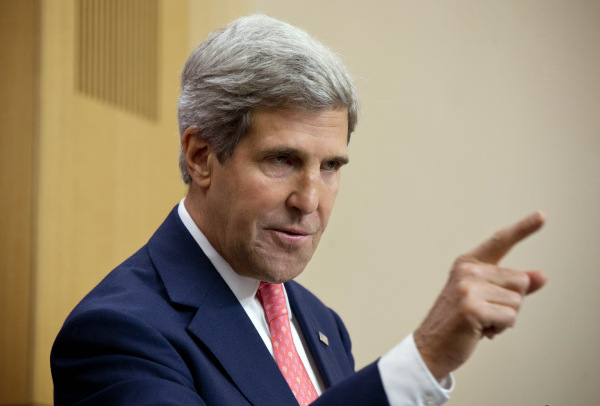
MEMO | January 26, 2014
The secretary of the PLO Executive Committee has revealed the details of John Kerry’s plan for the Israel-Palestine negotiations. Yasser Abed Rabbo spoke to London’s Al-Hayat newspaper.
According to Abed Rabbo, the US Secretary of State’s proposal includes Palestinian recognition of Israel as a Jewish state; establishing part of East Jerusalem as the capital of Palestine; resolving the refugee problem in accordance with the vision of former US President Bill Clinton; maintaining Israeli control of major settlement blocs and leasing the others back to Israel; Israel’s control over border crossings and air space; and the presence of US-Israel-Jordan-Palestinian security forces on the border. “The Israelis would also have the right of ‘hot pursuit’ of fugitives or suspected criminals in the Palestinian state,” he revealed. “Israeli Prime Minister Benjamin Netanyahu rejected these ideas because he wants to carve out the land he wants and refuses to discuss the Jerusalem issue. He also refuses the intervention of any other party in security matters, even America.”
The PLO official pointed out that this way of thinking was essentially unacceptable. “We Palestinians have been more than clear when it comes to this matter. We have stated many times that we reject the concept of a so-called national homeland for Jews in historic Palestine or the concept of a ‘Greater Israel’. Netanyahu has expressed that he not only wants to legitimise the Zionist national narrative and the expulsion of Palestinians in 1948 but also Israel’s ongoing settlement projects, which aim to achieve the Zionist dream of a Greater Israel.”
Security arrangements
As for security arrangements, Abed Rabbo said that there is talk of potential security arrangements and the standards by which these arrangements will be run. “They will last for many years and are supposedly subject to improved Palestinian security performance. However, this will ultimately still be controlled by Israel, which will maintain control even though America has pledged that it will remain involved as these arrangements are made and see to it that Israel withdraws from certain areas including the Jordan Valley.”
Such security arrangements, he claimed, will maintain Israel’s security strongholds on mountain tops and in Palestinian airspace. Israel will maintain the right to fly over Palestinian land should it feel an impending security threat. “At this point, any semblance of Palestinian sovereignty or geographic unity has been completely torn apart”, warned Abed Rabbo.
Settlements, Jerusalem and refugees
He pointed out that there have been numerous discussions about Israel’s vast settlement blocs in the occupied West Bank. Rumours suggest that Israel wants to rent out settlement units to settlers in the event that a Palestinian state is established. What this means, he claims, is that the settlements will remain as they are and settlers will continue to live there as Israeli citizens with special status in the Palestinian state.
“According to Israel, Jerusalem is not up for negotiation and will remain under full Israeli control as its undivided capital,” he explained. “There is rather mysterious general talk about Palestinians establishing their future capital in Jerusalem but, from Israel’s point of view, Jerusalem extends from Ramallah to Bethlehem to the Jordan Valley border. Thus, it could easily be argued that Abu Dis or Kufr Aqab could be named as the future Palestinian capital.”
As far as Palestinian refugees are concerned, said the PLO official, there are four possible outcomes, as envisioned by President Clinton; one of them suggests the return of a limited number of refugees, as stated in Israel law.
The Palestinian Authority’s position
According to Abed Rabbo, the Palestinian Authority cannot accept any of these potential solutions, especially given that Netanyahu is believed to insist on there being no Arab presence in Jerusalem and rejects outright the refugees’ right of return.
“Netanyahu does not want the involvement of any third party, American or non-American, in any of his security arrangements in the Jordan Valley even if it remains under Israeli control. He wants all decisions to be Israeli decisions and judging by our previous attempts in the past, any of our attempts to abide by a plan or time table will be disrupted completely by Israel”, he noted. Israel and America claim that the Palestinian people will be able to get territory equivalent to the West Bank’s 1967 borders through land swaps. “I do not understand how this is possible with settlement blocs, Israeli security zones and the apartheid wall, which divides the eastern and western regions of the West Bank completely. We are supposed to believe that we can gain territory through land swaps? This is impossible.”
Population exchanges
The PLO veteran described those Israelis who suggest “people swaps” to accompany land swaps as “racist”, pointing out that the organisation would not accept any population exchanges.
“Palestinian Arabs living inside Israel are not settlers,” he stressed. “They did [not] come to Israel through an invasion or by migration. They are the owners of that land and no one can uproot them from their homes. Swapping settlers for Israeli-Arabs would mean swapping Israeli citizens for Israeli citizens; how is this possible?” For Abed Rabbo, this shows that the Israeli government does not consider Arabs to be true citizens of the state. “They regard them as second or third class citizens with no rights, which is absolutely racist. They seek to ethnically cleanse that territory more than they want to swap land.”
That is the framework under which most ideas were discussed, said Abed Rabbo. “We do not have any official documentation to prove it but the information gets leaked from Israel in one way or another.”
Reasons for Israeli refusal
He is not surprised that Israel rejects most proposals for the simple reason that it wants to carve out as much land as possible from the occupied West Bank and maintain absolute control, especially in security zones. This would give Israel the “right” to intervene to protect settlements, which would also mean that it has control of the road networks leading to them.
“We are being confronted with an ultimatum,” he added. “We are not standing in front of two different options with various formulas that we can accept or reject. However, any attempt to sweeten the language of these agreements instead of criticising their prejudices will lead us to disaster.”
He ruled out any blame being attached to the Palestinians should Kerry’s plan fail. “The blame game does not concern us and we do not take it in our political consideration. Who will blame us for wanting to have our country based on 1967 borders, and to have East Jerusalem as our capital, and to have a fair and agreeable resolution for the refugee issue?”
Although John Kerry has “done his best” to make proposals acceptable to both sides, argues Abed Rabbo, it seems that he has read the Israeli position at the beginning and accepted the verbal, generic, vague and ambiguous assurances that Netanyahu usually offers to whoever he meets. “He must have interpreted them in some form and when he looked at the fine print realised that there are two different Israeli positions.”
As such, he believes, Netanyahu lured Kerry to discuss the issue of security first and Kerry fell for it, thinking that it will lead to a big breakthrough for the negotiations and will open the way for discussion of other issues. “To his surprise, he discovered that the Israelis want to use security as an excuse to justify their ambitions for expansion,” concluded Abed Rabbo. “This explains how and why we have reached the current impasse.”
Source: Safa
Related articles


Fatah official: Negotiations will fail, it’s time to resume resistance
Ma’an – 26/01/2014
BETHLEHEM – A Palestinian state in the West Bank and the Gaza Strip will not be established within the coming 20 years, a member of the Central Committee of the Palestinian Authority’s ruling party Fatah said on Saturday.
Tawfiq Tirawi told Beirut-based al-Mayadeen satellite channel on Friday that “It is not possible under any circumstances that a Palestinian state will be established in the West Bank and the Gaza Strip 20 years from now.”
“Those who believe a state can be established are misled, as negotiations will bring nothing,” he added.
Tirawi urged the Palestinians to resume resistance in all aspects as a result.
“We have to resume action, as action can change many things. I mean resistance in all its aspects, but under a united Palestinian plan agreed by all factions including PLO factions and factions outside the PLO.”
The Fatah official highlighted that his movement had not dropped resistance as a choice including armed resistance. “That was reiterated in the movement’s sixth congress held in Bethlehem.”
The framework agreement which US secretary of state John Kerry is promoting will be refused by the Palestinians, added Tirawi.
Peace talks between Israelis and Palestinians were relaunched in July under the auspices of the US after nearly three years of impasse.
Israel’s government has announced the construction of thousands of housing units in illegal settlements since peace talks began.
Official: PLO committee agrees on steps for joining UN bodies
Ma’an – 26/01/2014
BETHLEHEM – A political committee of 12 members representing the Palestine Liberation Organization’s various factions convened in Ramallah and agreed on recommendations to take the Palestinian plight to the UN and its various bodies, a PLO official said on Saturday.
Hanna Amirah, a member of the Executive Committee of the PLO, told Ma’an on Saturday that the committee recommended addressing the United Nations regardless of whether the ongoing peace talks make any progress or not, although he added that a date had not been set.
The goal of these recommendations, he said, is to enhance the Palestinian position. However, Palestinian Authority president Mahmoud Abbas and the PLO Executive Committee need to approve them before they can be put into effect.
The Palestinian Authority is currently trying to counter demands made by the United States and Israel, added Amirah.
He asserted that the recent suggestions made by the US Secretary of State John Kerry were completely unacceptable to the Palestinians.
He highlighted that the proposals made related to Jerusalem, to Israeli settlements, and to Palestinian refugees were unacceptable in particular as well as the proposed Israeli military and civilian presence in the Jordan Valley.
Earlier this week, PLO official Wasil Abu Yousif, who is a member of the PLO’s political committee, said the committee agreed on prerequisites the PA needs to fulfill before signing international conventions and joining UN agencies and different bodies.
It is of great importance, he added, that the PA joins the International Criminal Court because that will enable the PA to sue the Israeli occupation over war crimes and crimes against humanity.
Related articles
Featured Video
No Threat Can Force Iran’s Surrender /Trita Parsi & Lt Cl Daniel Davis
or go to
Aletho News Archives – Video-Images
From the Archives
What is the Israeli Lobby in Australia Doing in Interfaith Dialogue?
By Ali Kazak | Dissident Voice | October 11, 2015
For years Israel and its lobby around the world have been trying to normalise their relations with Arabs and Muslims without solving the Palestine Question.
One of the methods they resorted to in the last few years is using human rights and community organizations such as interfaith dialogue and Multiculturalism to achieve this objective and to: isolate the Palestinians, marginalise the Palestine question, end Israel’s isolation, and prevent criticism of Israel, knowing that these organisations will be the first to stand against Israel’s violations, racial and religious discrimination.
The group responsible for this task in Australia is The Australia/Israel & Jewish Affairs Council (AIJAC); its Director of International & Community Affairs, Jeremy Jones is in charge of lobbying religious community organizations, specifically Muslims and Christians. Consequently he convened the Faith Communities for Reconciliation, founding participant in the Australian Partnership of Religious Organisations and the Australian National Dialogue of Christians, Muslims & Jews.
AIJAC is a private political propaganda group. It is recognised as the main Israeli lobby in Australia. It coordinates its activities and works intimately with the Israeli embassy in Canberra and different institutions in Israel. It is privately funded by some Jewish businessmen. It monitors closely Australian politicians, the media, ethnic and religious groups, (especially Arabs and Muslims), unions and academics on their stands towards Israel and the Palestine question. … continue
Blog Roll
 Aletho News
- Envoy warns UN on Trump’s threat to ‘obliterate’ Iran’s civilian infrastructure
- The Larak Corridor: Iran’s Rial Gate With No US, No Israel, and No Way Around
- ‘Economic terrorism’: Steel facilities hit again in US-Israeli strike
- ‘War Crime’: Iran condemns attacks on Arak, Ardakan nuclear sites
- Two-thirds of Americans want quick end to Iran war even if goals unmet
- Trump to Give “Important Update on Iran” Wednesday in Prime-Time Speech
- Theodore Postol: Iran’s Missiles & Drones Were Underestimated
- Iran To Target Military Industrial-Tech Complex That Facilitated Gaza Genocide
- Collapsing Empire: The Resistance Disarms ‘Israel’
- Suicide Should Not Be a Government Service
- If Americans Knew
- Israel wants US to bomb more of Iran’s civilian structures (113,000 is not enough) – Not a ceasefire Day 173
- Ann Coulter Rips Into Fox News for Iran War Coverage
- Joe Kent Urges Americans To Call White House and Congress To Object To Sending Troops Into Iran
- DNC Resolution to Reject AIPAC Funding Puts Democratic Leaders in the Hot Seat
- Swedish foundation to build 400 schools as over 650,000 Gaza children remain without education for 2 years
- Israeli army admits photshopping image of slain Lebanese journalist
- This is how Israel is systematically killing health workers under the cover of war in Lebanon
- Carrying life under fire: Israeli invasion of Lebanon leaves pregnant women facing deadly risks
- Champagne all around for the new death penalty (for Palestinians) law – Not a ceasefire Day 172
- Why are Palestinian books struggling to be seen on Amazon?
- No Tricks Zone
- New Study Finds Warming Saves Lives…Cold Temperatures 12 Times More Deadly Than Excess Heat
- German Science Blog Accuses PIK Climate Institute Of Hallucinating Climate Tipping Points
- Devastating Assessment Of Comirnaty Vaccine By Former Senior Pfizer Europe Toxicologist
- New Study: CO2 Is ‘Effectively Negligible’ As An Explanatory Climate Change Factor Since 2000
- Former Pfizer Toxicologist Dr. Helmut Sterz Tells Bundestag Hearing Pfizer Vaccine Should Have Never Been Approved
- Energy Expert: Germany’s Nuclear Phaseout Was A “500 Billion Euro Mistake”
- New Research: South Australia’s Mid-Holocene Sea Surface Temperatures Were 4°C Warmer Than Today
- Storing Green Energy To Last Germany 10 Days Would Require A 60-Million Tonne Battery
- New Studies: UK Sea Levels Were 4 Meters Higher Than Today During The Mid-Holocene
- Destructive Green New Deal: German Energy And Metal Group Warns Of Drastic Crisis
 Aletho News