U.S. “Dismantling” Rhetoric Ignores Iran’s Nuclear Proposals
By Gareth Porter | IPS | January 25, 2014
Iran’s pushback against statements by Secretary of State John Kerry and the White House that Tehran must “dismantle” some of its nuclear programme, and the resulting political uproar over it, indicates that tough U.S. rhetoric may be adding new obstacles to the search for a comprehensive nuclear agreement.
Iranian Foreign Minister Mohammad Javad Zarif said in an interview with CNN’s Jim Sciutto Wednesday, “We are not dismantling any centrifuges, we’re not dismantling any equipment, we’re simply not producing, not enriching over five percent.”
When CNN’s Fareed Zakaria asked President Hassan Rouhani, “So there would be no destruction of centrifuges?” Rouhani responded, “Not under any circumstances. Not under any circumstances.”
Those statements have been interpreted by U.S. news media, unaware of the basic technical issues in the negotiations, as indicating that Iran is refusing to negotiate seriously. In fact, Zarif has put on the table proposals for resolving the remaining enrichment issues that the Barack Obama administration has recognised as serious and realistic.
The Obama administration evidently views the rhetorical demand for “dismantling” as a minimum necessary response to Israel’s position that the Iranian nuclear programme should be shut down. But such rhetoric represents a serious provocation to a Tehran government facing accusations of surrender by its own domestic critics.
Zarif complained that the White House had been portraying the agreement “as basically a dismantling of Iran’s nuclear programme. That is the word they use time and again.” Zarif observed that the actual agreement said nothing about “dismantling” any equipment.
The White House issued a “Fact Sheet” November 23 with the title, “First Step Understandings Regarding the Islamic Republic of Iran’s Nuclear Program” that asserted that Iran had agreed to “dismantle the technical connections required to enrich above 5%.”
That wording was not merely a slight overstatement of the text of the “Joint Plan of Action”. At the Fordow facility, which had been used exclusively for enrichment above five percent, Iran had operated four centrifuge cascades to enrich at above five percent alongside 12 cascades that had never been operational because they had never been connected after being installed, as the International Atomic Energy Agency (IAEA) had reported.
The text of the agreement was quite precise about what Iran would do: “At Fordow, no further enrichment over 5% at 4 cascades now enriching uranium, and not increase enrichment capacity. Not feed UF6 into the other 12 cascades, which would remain in a non-operative state. No interconnections between cascades.”
So Iran was not required by the interim agreement to “dismantle” anything. What Zarif and Rouhani were even more upset about, however, is the fact that Kerry and Obama administration spokespersons have repeated that Iran will be required to “dismantle” parts of its nuclear programme in the comprehensive agreement to be negotiated beginning next month.
The use of the word “dismantle” in those statements appears to be largely rhetorical and aimed at fending off attacks by pro-Israel political figures characterising the administration’s negotiating posture as soft. But the consequence is almost certain to be a narrowing of diplomatic flexibility in the coming negotiations.
Kerry appears to have concluded that the administration had to use the “dismantle” language after a November 24 encounter with George Stephanopoulos of NBC News.
Stephanopoulos pushed Kerry hard on the Congressional Israeli loyalist criticisms of the interim agreement. “Lindsey Graham says unless the deal requires dismantling centrifuges, we haven’t gained anything,” he said.
When Kerry boasted, “centrifuges will not be able to be installed in places that could otherwise be installed,” Stephanopoulos interjected, “But not dismantled.” Kerry responded, “That’s the next step.”
A moment later, Kerry declared, “And while we go through these next six months, we will be negotiating the dismantling, we will be negotiating the limitations.”
After that, Kerry made “dismantle” the objective in his prepared statement. In testimony before the House Foreign Affairs Committee December 11, Kerry said the U.S. had been imposing sanctions on Iran “because we knew that [the sanctions] would hopefully help Iran dismantle its nuclear programme.”
White House spokesman Jay Carney dismissed Zarif’s comment as “spin” on Iran’s commitments under the Joint Plan of Action “for their domestic political purposes”.
He refused to say whether that agreement involved any “dismantling” by Iran, but confirmed that, “as part of that comprehensive agreement, should it be reached, Iran will be required to agree to strict limits and constraints on all aspects of its nuclear programme to include the dismantlement of significant portions of its nuclear infrastructure in order to prevent Iran from developing a nuclear weapon in the future.”
But the State Department spokesperson, Marie Harf, was much less categorical in a press briefing January 13: “We’ve said that in a comprehensive agreement, there will likely have to be some dismantling of some things.”
That remark suggests that the Kerry and Carney rhetoric of “dismantlement” serves to neutralise the Israel loyalists and secondarily to maximise U.S. leverage in the approaching negotiations.
Kerry and other U.S. officials involved in the negotiations know that Iran does not need to destroy any centrifuges in order to resolve the problem of “breakout” to weapons grade enrichment once the stockpile of 20- percent enriched uranium disappears under the terms of the interim agreement.
Zarif had proposed in his initial power point presentation in October a scheme under which Iran would convert its entire stockpile of 20-percent enriched uranium into an oxide form that could only be used for fuel plates for the Tehran Research Reactor.
U.S. officials who had previously been insistent that Iran would have to ship the stockpile out of the country were apparently convinced that there was another way to render it “unusable” for the higher-level enrichment necessary for nuclear weapons. That Iranian proposal became the central element in the interim agreement.
But there was another part of Zarif’s power point that is relevant to the remaining problem of Iran’s stockpile of low-enriched uranium: Iran’s planned conversion of that stockpile into the same oxide form for fuel rods for nuclear power plants as was used to solve the 20-percent stockpile problem.
And that plan was accepted by the United States as a way of dealing with additional low-enriched uranium that would be produced during the six-month period.
An element included in the Joint Plan of Action which has been ignored thus far states:
Beginning when the line for conversion of UF6 enriched up to 5% to UO2 is ready, Iran has decided to convert to oxide UF6 newly enriched up to 5% during the 6 month period, as provided in the operational schedule of the conversion plant declared to the IAEA.
The same mechanism – the conversion of all enriched uranium to oxide on an agreed time frame — could also be used to ensure that the entire stockpile of low-enriched uranium could no longer be used for “breakout” to weapons-grade enrichment without the need to destroy a single centrifuge. In fact, it would allow Iran to enrich uranium at a low level for a nuclear power programme.
The Obama administration’s rhetoric of “dismantlement”, however, has created a new political reality: the U.S. news media has accepted the idea that Iran must “dismantle” at least some of its nuclear programme to prove that it is not seeking nuclear weapons.
CNN Anchor Chris Cuomo was shocked by the effrontery of Zarif and Rouhani. “That’s supposed to be the whole underpinning of moving forward from the United States perspective,” Cuomo declared, “is that they scale back, they dismantle, all this stuff we’ve been hearing.”
Yet another CNN anchor, Wolf Blitzer, who was an official of the American-Israel Public Affairs Committee before becoming a network journalist, called Zarif’s statements “stunning and truly provocative,” adding that they would “give ammunition” to those in Congress pushing for a new sanctions bill that is clearly aimed at sabotaging the negotiations.
The Obama administration may be planning to exercise more diplomatic flexibility to agree to solutions other than demanding that Iran “dismantle” large parts of its “nuclear infrastructure”.
But using such rhetoric, rather than acknowledging the technical and diplomatic realities surrounding the talks, threatens to create a political dynamic that discourages reaching a reasonable agreement and leaves them unresolved.

Iranian Officials Respond to John Kerry’s “Military Option” Threat
By Nima Shirazi | | Wide Asleep in America | January 24, 2014
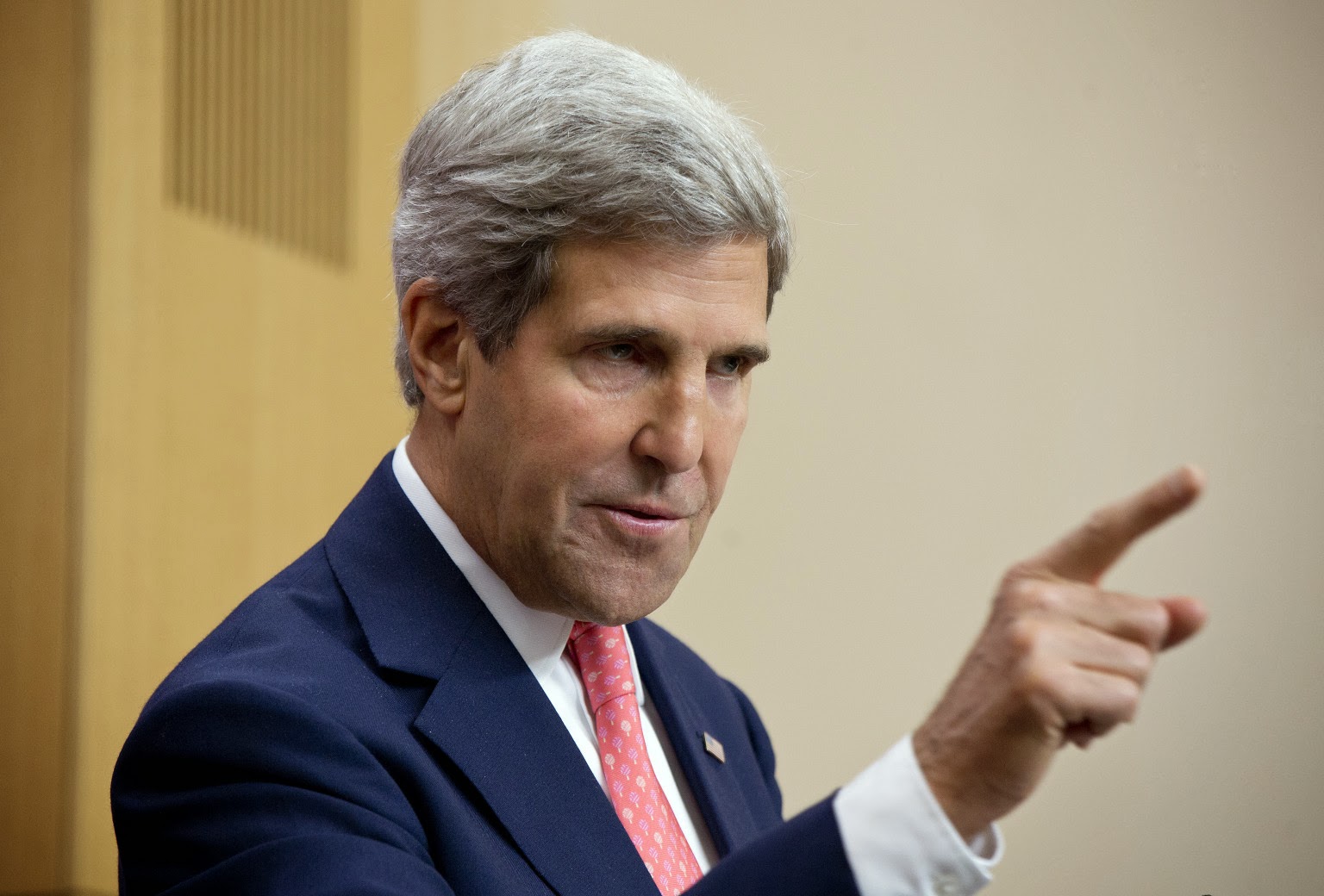
In response to recent comments by U.S. Secretary of State John Kerry regarding a potential military strike on Iran, Brigadier General Seyyed Masoud Jazayeri – Iran’s deputy chief of staff – said in an interview that, in the event of an attack, American interests in the region would be “completely destroyed.”
Speaking to Al Arabiya this week, Kerry defended the interim international deal over Iran’s nuclear program and the alleviating of some sanctions, but declared that if Iran were to back out of its commitments, “the military option of the United States is ready and prepared to do what it would have to do.”
Such rhetoric is par for the course for American officials focused on diplomacy, but still eager to appear bellicose and aggressive to certain influential communities and audiences.
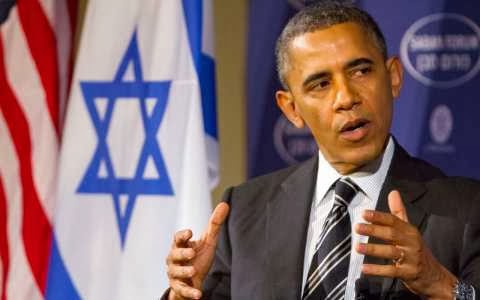 |
| President Barack Obama |
Last month, in a conversation at the Brookings Institution’s Saban Center, a pro-Israel think tank in Washington, DC, President Barack Obama said much of the same. “What I’ve consistently said is even as I don’t take any options off the table,” Obama told Haim Saban, the organization’s Israel-obsessed billionaire benefactor, “what we do have to test is the possibility that we can resolve this issue diplomatically.”
The president repeated this a number of times during the conversation. “The best way for us to prevent Iran from getting a nuclear weapons is for a comprehensive, verifiable, diplomatic resolution, without taking any other options off the table if we fail to achieve that,” he said, adding later that “when the President of the United States says that he doesn’t take any options off the table, that should be taken seriously.”
Following Obama’s own appearance, Secretary Kerry also addressed the Saban conference in December. He assured the attendees that “as we negotiate, we will continue to be perfectly clear that, for Iran, the price of noncompliance, of failing to satisfy international concerns about the nuclear program, will be that we immediately ratchet up new sanctions, along with whatever further steps are needed to prevent Iran from acquiring a nuclear weapon, including – as President Obama just made clear – a military option, if that were necessary.”
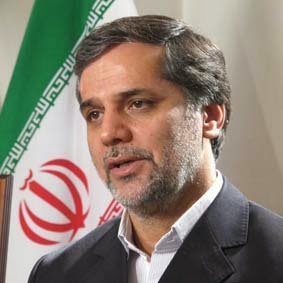 |
| MP Hossein Naqavi Hosseini |
In his own recent comments, General Jazayeri emphasized that the U.S. government is well aware that “the military option against Iran is not practical.”
Hossein Naqavi Hosseini, an Iranian parliamentarian and spokesman for the Majlis’ National Security and Foreign Policy Committee, reacted to Kerry’s new comments by saying, “These statements are indicative of the U.S. double standards and will bring about nothing but tarnishing the US image,” adding, “Definitely, we also announce that if the P5+1 (five permanent members of the UN Security Council plus Germany) commit the least breach of the Geneva agreement, we will also have all the options on our table.”
“Under pressures by the Zionist lobby, the U.S. adopts dual policies; on the one hand, they talk about agreement and positive relations with Iran, but on the other hand, they use an intimidating tone,” Hosseini said.
Related article

The Strange but ‘Stable’ Alliance: US Senate Await Israeli Instructions
By Ramzy Baroud | Palestine Chronicle | January 23, 2014
Israel is often viewed by Washington politicians as the most ‘stable’ ally in the Middle East. But stability from the American perspective can mean many things. Lead amongst them is that the ‘ally’ must be unconditionally loyal to the diktats of the US administration. This rule has proven to be true since the United States claimed a position of ascendency, if not complete hegemony over many regions of the world since World War II. Israel, however, remained an exception.
The rules by which US-Israeli relations are governed are perhaps the most bewildering of all foreign policies of any two countries.
An illustration of this would be to consider these comments by Israeli Defense Minister Moshe Ya’alon quoted in the Israeli news portal Ynetnews. “The American security plan presented to us is not worth the paper it’s written on,” he said, referring to efforts underway since July by American Secretary of State John Kerry, “who turned up here determined and acting out of misplaced obsession and messianic fervor.” Kerry “cannot teach me anything about the conflict with the Palestinians,” said Ya’alon.
So far, Kerry has made ten trips to the Middle East with the intention of hammering out an agreement between Israel and the Palestinian Authority (PA). Based on media reports, it seems that the potential agreement is composed in such a way that it mostly accommodates Israel’s ‘security’ whims and obsessions, including a proposal to keep eastern West Bank regions and the Jordan Valley under Israeli military control. In fact, there is growing interest in the idea of ‘land swaps” which was floated by Israel’s notorious Foreign Minister Avigdor Lieberman ten years ago.
“When Mr. Lieberman first proposed moving Arab-populated Israeli towns near the present border into Palestine in exchange for Jewish settlement blocs in the Palestinians’ West Bank being incorporated into Israel, he was branded a racist firebrand,” wrote the Economist on Jan. 18. “Liberals accused him of promoting the forcible ‘transfer’ plan, akin to ethnic cleansing, proclaimed by a rabbi, Meir Kahane, who vilified Arabs while calling for a pure Jewish state.”
Those days are long gone, as Israeli society drifted rightward. “Even some dovish Israeli left-wingers find such ideas reasonable.” Back then, the Americans themselves were irked, even if just publically, whenever such ideas of ‘population transfers’ and ethnic cleansing were presented by Israel’s ultra-right politicians. Now, the Americans find them malleable and a departure point for discussion. And it’s Kerry himself who is leading the American efforts to accommodate Israel’s endless list of demands – of security and racial exclusiveness even if at the expense of Palestinians. So why is Ya’alon unhappy?
The Defense Minister, who sat immediately next to Prime Minister Benjamin Netanyahu during talks with Kerry, was unapologetic about his reasoning: “Only our continued presence in Judea and Samaria and the River Jordan will endure.” It means unrelenting Israeli military occupation of the West Bank and East Jerusalem.
Netanyahu is hardly an innocent bystander in all of this, although for diplomatic reasons he often entrusts his government minions to deliver such messages. The Prime Minister is busy issuing more orders to populate the occupied West Bank with Jewish settlements, and berating every government that rejects such insidious behavior as being anti-Israel, ‘pro-Palestinian’ or worse, anti-Semitic. This was the case again in recent days following another announcement of settlement expansion.
On Jan. 17, Netanyahu called on Europe to stop its “hypocrisy”. On the same day, Israel’s foreign ministry summoned the ambassadors of Britain, France, Italy and Spain, “accusing their countries of pro-Palestinian bias,” reported the BBC online. According to the ministry, the “perpetual one-sided stance” of these countries is unacceptable.
Yet, considering that Europe has supported Israel’s illegal occupation of Palestinian territories for decades, economically sustained the ‘Jewish state’ and its over 100 illegal Jewish settlements, and continue with its often unconditional military support of Israel, the accusations may appear strange and equally bewildering to that of Ya’alon against John Kerry.
How could a country the size of Israel have so much sway over the world’s greatest powers, where it gets what it wants and more, hurls regular insults against its sustainers, and still asks for more?
European countries found themselves in Israel’s firing line because a day earlier, the four EU countries took the rare step of summoning Israeli ambassadors to object to the Netanyahu government’s latest announcement of illegal settlement expansion (that of an additional 1,400 new homes). EU foreign policy Chief Catherine Ashton even went to the extent of calling the settlements “an obstacle to peace”, although hardly an advanced position considering that Israel’s colonial project in Palestine has been in motion for 46 years.
But even that is too much from the Israeli point of view. “The EU calls our ambassadors in because of the construction of a few houses?” Netanyahu asked as if baffled by a seemingly foreboding act, in a Jan 16 press conference. He even had the audacity to say this: “This imbalance and this bias against Israel doesn’t advance peace,” and also this, “I think it pushes peace further away because it tells the Palestinians: ‘Basically you can do anything you want, say anything you want and you won’t be held accountable.”
There is no sense in arguing with Netanyahu’s strange logic, but the question regarding Israel’s stronghold over the US and EU remains more pressing than ever, especially when one considers the ruckus in US Congress. No, the congress is not revolting because of the unmitigated power of the Zionist lobby, but for something far more interesting.
There seems to be a level of confusion in US Congress because members of the Senate are yet to feel serious pressure by the American Israel Public Affairs Committee (AIPAC) over a bill that proposes more sanctions on Iran.
“The powerful pro-Israel lobby has not engaged in a shoe-leather lobbying campaign to woo wayward senators and push Senate Majority Leader Harry Reid (D-Nev.) to schedule a vote on the bill. While the group supports the bill — authored by Sens. Mark Kirk (R-Ill.) and Robert Menendez (D-N.J.) — it is not yet putting its political muscle behind a push for an immediate vote,” reported Politico, citing key senators and their aides.
To say the least, it is disturbing that the US Senate is completely bewildered that AIPAC, which lobbies for the interest of a foreign power, is yet to provide its guidelines regarding the behavior of America’s supposedly most respected political representatives.
“I don’t know where AIPAC is. I haven’t talked to anybody,” said Senate Armed Services Chairman Carl Levin (D-Mich.). “I don’t know what they’re doing,” said Sen. John McCain (R-Ariz.).
This alone should shed some light on the seemingly bewildering question of the ‘strong bond’ and ‘stable’ alliance of Israel and the US – and to a lesser degree EU countries. This is not to suggest that Israel has complete dominance over US foreign policy in the Middle East, but to ignore Israel’s indispensable role in shaping the outlook of US foreign policy is dishonest and inconsistent with the facts, to put it mildly.
– Ramzy Baroud is an internationally-syndicated columnist, a media consultant and the editor of PalestineChronicle.com. His latest book is “My Father Was a Freedom Fighter: Gaza’s Untold Story” (Pluto Press, London).
For the First Time, Half of Members of Congress are Millionaires… Democrats Worth more than Republicans
By Noel Brinkerhoff | AllGov | January 11, 2014
Members of Congress continued to get richer last year, resulting in more than 50% of lawmakers possessing a net worth of $1 million or more—something that’s never happened before in congressional history.
Of 534 current members of Congress, at least 268 were millionaires, according the Center for Responsive Politics’ review of financial disclosure reports filed last year.
The median net worth for the 530 lawmakers who were in Congress as of the May 2013 filing deadline was $1,008,767—up from $966,000 during the previous year.
The center also found that Democrats overall were a little wealthier than Republicans in Congress, $1.04 million versus $1 million. Both groups saw their collective net worth go up, from $990,000 for Democrats and $907,000 for Republicans in the previous year.
Democrats in the House were richer than their GOP counterparts, $929,000 versus $884,000. House Republicans, however, could boast having the richest member: Darrell Issa of California, who has had this distinction in other years. The Viper car-alarm magnate has a net worth of $464 million.
In the Senate, the GOP caucus was noticeably wealthier than the Democratic caucus, $2.9 million versus $1.7 million.
Senate Democrats experienced a steep drop in their median net worth from $2.4 million in 2011, due in part to the loss of two multimillionaires: John Kerry of Massachusetts (net worth $248 million) and Frank Lautenberg of New Jersey ($87.5 million). Nonetheless, the four richest senators are still Democrats: Mark Warner of Virginia ($257 million), Richard Blumenthal of Connecticut ($104 million), Jay Rockefeller of West Virginia ($101 million) and Diane Feinstein of California ($68 million).
The center noted: “Members of Congress have long been far wealthier than the typical American, but the fact that now a majority of members—albeit just a hair over 50 percent—are millionaires represents a watershed moment at a time when lawmakers are debating issues like unemployment benefits, food stamps and the minimum wage, which affect people with far fewer resources, as well as considering an overhaul of the tax code.”
To Learn More:
Millionaires’ Club: For First Time, Most Lawmakers are Worth $1 Million-Plus (OpenSecrets.org)
Half of Congress Members Are Millionaires, Report Says (by Eric Lipton, New York Times)
2012 Personal Financial Disclosures
The Rich Get Richer…and So Does Congress (by Noel Brinkerhoff, AllGov)
Wealth Gap between Congress and Other Americans Widens to 9 to 1 (by Noel Brinkerhoff and David Wallechinsky, AllGov)
Is Obama Trying to Resolve or Prolong the Conflict in Syria?
By Flynt Leverett and Hillary Mann Leverett | Going to Tehran | January 10, 2014
Suppose a great power declares that it supports a peace process aimed at finding a political solution to a terrible, ongoing conflict. Then suppose that this great power makes such declarations after it has already proclaimed its strong interest in the defeat of one of the main parties to said conflict. And then suppose that this great power insists on preconditions for a peace process—preconditions effectively boiling down to a demand for pre-emptive surrender by the party whose defeat the great power has already identified as its major goal—which render such a process impossible. Is it not reasonable to conclude that the great power in question is (how to put this gently) lying about its purported support for peace?
That, in a nutshell, is the Obama administration’s posture toward the ongoing conflict in Syria.
Earlier this week, United Nations Secretary General Ban Ki-moon began sending out invitations for the Geneva II conference on Syria scheduled for January 22. And, as Ban’s spokesperson acknowledged, the Islamic Republic of Iran was not among the “first round” of nations asked to take part.
According to the spokesperson, invitations to the talks are subject to the approval—or veto—of the two “initiating states,” Russia and the United States. The Islamic Republic has said repeatedly that it is prepared to attend and to contribute constructively to the search for a political settlement. Of course, Russia supports Iran’s participation in Geneva II—as does China, Germany, Turkey, every other state seriously interested in resolving the conflict in Syria, and the United Nations itself. (Ban’s spokesperson publicly stated this week, “The secretary-general is in favor of inviting Iran.”)
It is the United States—whose leader, President Obama has demanded for more than two years that Syrian President Bashar al-Assad relinquish his position—that is blocking Iranian participation in Geneva II. And it is attempting to justify this position by continuing to insist on Assad’s pre-emptive surrender as part of the Geneva II agenda. Moreover, Washington is couching its demand for Assad’s pre-emptive surrender in a shamelessly dishonest reading of the 2012 Geneva I communique, which is supposed to set the terms of reference for Geneva II.
On this last point, Secretary of State John Kerry earlier this week (before Ban started sending out invitations) reiterated the Obama administration’s opposition to Iran’s participation in Geneva II as a “ministerial partner.” In the administration’s view, Iran can’t come to the meeting because it has not signed on to the Geneva I document—in particular, the passage positing that a “transitional governing body” for Syria “shall be formed on the basis of mutual consent” among “the present government and the opposition and other groups.”
Since Iran (at Washington’s insistence) was not invited to Geneva I, it is not clear exactly how or why Tehran should sign up to a communique it had no part in producing. But the most shamelessly dishonest aspect of the Obama administration’s posturing on the matter is its insistence that Iran accept the administration’s warped reading of the passage from Geneva I just cited, which Team Obama (including Kerry) interprets as a requirement that Assad leave office and play no future political role—whether as part of a transitional government or as Syria’s first president elected after a settlement is negotiated.
We suspect that Assad would, in all likelihood, win another national mandate—even in the “free and fair multi-party elections” envisioned in Geneva I. But Washington doesn’t want Syrians to have the chance to make that choice. And so Washington continues to block Iranian participation in Geneva II—save perhaps, as Kerry pompously suggested earlier this week, “from the sidelines” (a proposition that Iran has roundly rejected).
What is so appallingly arrogant about the Obama administration’s position is that it was explicitly rejected at Geneva I. Then-UN envoy Kofi Annan’s draft communique originally contained U.S.-backed language barring figures from the conflict resolution process whose participation would block creation of a national unity government—language that the United States, Britain, and France crafted to exclude Assad. Russia and China insisted that this language be removed from the final communique. But the Obama administration has disingenuously continued asserting that the language in Geneva I bans Assad from any future political role—even though it is as clear as day that Geneva I, as actually adopted, does not do any such thing.
Kerry and Russian Foreign Minister Sergei Lavrov are supposed to discuss the question of Iranian participation in Geneva II on January 13. Let’s see if the Obama administration can actually decide that it wants to resolve the conflict in Syria, rather than prolonging it further.
Who is the Boss and Who is the Servant in this Photo?

By Richard Edmondson | Fig Trees and Vineyards | December 11, 2013
It’s kind of one of those pictures that are “worth a thousand words,” don’t you think? What you’re looking at is Obama onstage with media mogul and Israeli dual national Haim Saban, who has stated previously, “I’m a one issue guy, and my issue is Israel.” The photo was taken last weekend at the Saban Forum, held in Washington. During the event Saban and Obama appeared together for what was billed as a “conversation” on the Middle East, but basically it was a one-on-one press conference—with Saban doing the grilling and Obama doing the answering. Do the facial expressions in the photo, the body language, suggest anything to you—like for instance which of the two figures is dominant and which is submissive?
Saban, of course, has lots of money. In 2002 he provided a $13 million grant which established the Saban Center for Middle East Policy, and which is part of the larger Brookings Institution think tank. Today he is a major funder of political candidates, particularly of the Democratic Party. You can go here and watch a 48-minute video of his “conversation” with Obama, which includes a few questions from the audience towards the end (all of the people selected to ask questions in that closing segment, coincidentally, happen to be Israelis). At one point, Saban jokingly remarks upon how “obedient” Obama is. A little later in the video, Obama states the following:
“The one thing I will say to the people of Israel is that you can be assured, whoever is in the office I currently occupy, Democrat or Republican, that your security will be uppermost on our minds. That will not change.”
Does it not strike you as a curious comment? Why would the security of a foreign nation be “uppermost” in the minds of the leaders of a supposedly sovereign country? But then maybe America is no longer a sovereign nation.
Obama indeed proves his “obedience” by never once bringing up Israel’s nuclear weapons. Much of the conversation is dominated by talk about Iran’s domestic nuclear energy program. The president at one point repeats the standard, stock-in-trade “options-on-the-table” remark—which in essence is nothing more than a threat to attack Iran—yet nowhere, in the entire 48-minute video, does the subject of Israel’s nuclear weapons come up.
A report on the Saban Forum was posted recently at the Mondoweiss blog. While the article mentions the “conversation” between Obama and Saban, much of the piece is devoted to the remarks of John Kerry, who delivered the keynote address for the event. Allison Deger, the author of the report, notes that Kerry expressed the view that Palestinians in the West Bank are deserving of “state institutions” (as opposed to an actual state) of their own, a comment which seems to have prompted Deger to draw the conclusion that “Palestinian statehood is not on the table in the current round of peace talks.” It is a not unreasonable conclusion to draw.
Kerry also referred to Palestinians as a “demographic time bomb” threatening to jeopardize Israel’s “future as a democratic, Jewish state”—apparently the secretary of state’s first public expression of concern over the so-called “demographic threat.” But perhaps most interesting is what Deger reports on comments by Israeli Foreign Minister Avigdor Lieberman, who also attended the event:
Even though Lieberman was amongst a crowd of Washington and Israeli officials familiar with his anti-Arab diatribes, audible gasps could be heard throughout the room when he called to expel Palestinian citizens of Israel. A diplomat from the Russian embassy seated next to me even choked. Another moment of discontent between the plated-dinner audience and Lieberman passed when the foreign minister made a forlorn pun at Sen. Joe Lieberman. Otherwise the foreign minister was amongst allies.
Much has been made of the recent bone of contention between Obama and Netanyahu over the negotiations with Iran, with some suggesting that the US president is beginning to assert himself and to defy the Israeli lobby on some key, important issues. Is it simply wishful thinking on the part of some commentators? I don’t pretend to know the answer to that, but if there was any note of defiance struck at last weekend’s Saban Forum, all I can say is it is extremely difficult to detect.
*
Update-12/11/13:
The following information on Saban comes from Wikipedia:
In March 2008, Saban was among a group of major Jewish donors to sign a letter to Democratic Party house leader Nancy Pelosi warning her to “keep out of the Democratic presidential primaries.” The donors, who “were strong supporters of Sen. Hillary Rodham Clinton presidential campaign”, “were incensed by a March 16 interview in which Pelosi said that party ‘superdelegates’ should heed the will of the majority in selecting a candidate.” The letter to Pelosi stated the donors “have been strong supporters of the DCCC” [Democratic Congressional Campaign Committee] and implied, according to The Jewish Telegraphic Agency, that Pelosi could lose their financial support in important upcoming congressional elections.
And also this:
Regarding Jane Harman AIPAC Controversy, in April 2009, New York Times, quoting anonymous sources, said a caller promised her that Saban would withhold campaign contributions to Representative Nancy Pelosi if she did not select Ms. Harman for the intelligence post.”
And additionally this:
Saban says his greatest concern is to protect Israel. At a conference in Israel, Saban described his formula. His three ways to influence American politics were: make donations to political parties, establish think tanks, and control media outlets.
Related article
- John Kerry Is Israel’s Best Friend – Bloomberg (bloomberg.com)
Kerry Calms Tensions with Bibi: Israel Security “at Top of Agenda” in Iran Talks
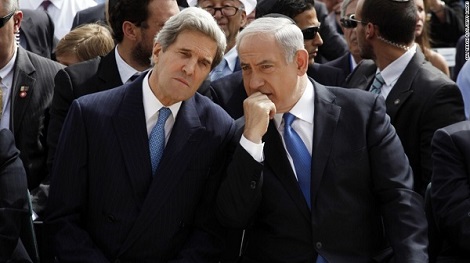
Al-Manar | December 5, 2013
US Secretary of State John Kerry was in the Zionist entity on Thursday for talks aimed at calming tensions with prime minister Benjamin Netanyahu over a nuclear deal sealed between Iran and world powers last month.
“I can’t emphasize enough that Israel’s security in this negotiation is at the top of our agenda,” Kerry told reporters after a meeting with Prime Minister Benjamin Netanyahu in occupied al-Quds (Jerusalem).
“And the United States will do everything in our power to make certain that Iran’s nuclear program of weaponization possibilities is terminated.”
Earlier on November 24, Iran and world powers reached a deal in Geneva on the Islamic Republic’s nuclear program. In which Tehran agree to roll back parts of its nuclear program in return for limited relief from Western sanctions. The deal was roundly condemned by Netanyahu, who called it a “historic mistake”.
“We agreed on what the goal of the final status agreement (with Iran) ought to be, and in the days ahead we will consult very closely and continuously with our Israeli friends in order to bring about a comprehensive agreement that can withstand everybody’s test,” Kerry said.
Kerry landed in the occupied territories late on Wednesday for a trip aimed at giving momentum to Israeli-Palestinian peace talks, which have made little apparent headway since they began under his patronage in late July.
Source: AFP
Probing US intentions in nuclear agreement with Iran
By Kaveh Afrasiabi | Press TV | November 27, 2013
Last Saturday, the ink on the historic “interim agreement” signed in Geneva had not dried yet when the early signs of trouble with the deal and its roadmap for a comprehensive final agreement emerged in the form of US Secretary of State’s explicit denial that the deal had recognized Iran’s right to enrich uranium.
Since then, John Kerry has repeated this claim, flatly contradicted by his Iranian counterpart, Mohammad Javad Zarif, on a half dozen occasions, thus raising questions regarding US’s sincerity.
Not only that, within hours of the late night breakthrough in Geneva, the White House published a “fact sheet” about the content of the agreement, which has now been contested by Iran’s Foreign Ministry as inaccurate, misleading and “one-sided interpretation.” As expected, there is absolutely no reference in this “fact-sheet” to Iran’s nuclear rights, including the right to enrich uranium, an important step in manufacturing fuel for the country’s reactors, which is enshrined in the articles of Non-Proliferation Treaty (NPT).
Indeed, one of the main problems with the US’s approach toward the Iran nuclear issue is, and always has been, its complete obliviousness toward and lack of respect for Iran’s inalienable nuclear rights, which are the centerpieces of Iran’s negotiation strategy.
Little wonder, then, that US President Barack Obama in his post-Geneva outreach to the Israeli Prime Minister Benjamin Netanyahu has reportedly emphasized the “shared goals” vis-à-vis Iran’s nuclear program, namely, the dismantling of Iran’s “nuclear weapons capability” that stems from its uranium enrichment program.
Israel has now dispatched a technical team to Washington to coordinate the US’s effort with respect to the final status agreement with Iran. This will probably mean even less of a “tactical difference” between US and Israel in the coming months with respect to Iran.
There is now even a shared US and Israeli linguistic (and policy) emphasis on “dismantling” the Iranian nuclear program. The word “dismantle” has seeped in the public statements of John Kerry, in contrast to his earlier hints at respecting Iran’s right to enrich uranium, e.g. in Financial Times in 2009.
Case in point, in his interview with ABC network on November 24th, Kerry stated, “While we are negotiating for the dismantling, they will not grow their program.” This echoed Kerry’s earlier admission, on November 10, 2013, that the US “is aiming to get Tehran to halt further nuclear development as a first step toward a complete dismantling of the program.”
By all indications, the US is pursuing this objective through a phased “roll back strategy,” whereby the Iranian nuclear energy program would be targeted for a gradual dismantling, in light of the statement by Tony Blinken, the US Deputy National Security Adviser, that “if we could have gotten an entire freeze of their program right away in one fell swoop, we would have done that.” This recalls Kerry’s other interview, with CBS’s Face the Nation on November 24, when he responded to the question of whether the agreement calls for the dismantling of some of Iran’s programs by saying “Not yet. That’s correct. Not yet. But you don’t get everything at first step. You have to go down the process here.”
The interim agreement is thus viewed by the US as a milestone in achieving the initial objectives of this “roll-back” strategy – by destroying Iran’s 20-percent enriched uranium, halting the completion of Arak heavy water reactor and the installation of new centrifuges, freezing the number of centrifuges and imposing a low-ceiling on enrichment – according to Kerry “3.5 percent,” even though the agreement specifically says 5 percent, and subjecting Iran’s program to unprecedented intrusive inspection, including “a number of facilities we have never been in before,” to paraphrase Kerry.
Since collecting information on Iran’s nuclear energy program is a must for the “roll-back” strategy, the US hopes that the implementation of the interim agreement will prove vital, given the American persistence on keeping the “military option on the table.” Equally important is “reversing key aspects of the Iranian program” via this deal, which Kerry has been fond of repeating since co-signing the deal in Geneva.
As for the agreement’s concluding statements that refer to Iran’s enrichment program in a final agreement, Kerry has put the emphasis on the sentence that subjects this to “mutual agreement.” In other words, Iran’s NPT right is now threatened with a contractual atrophy that subjects this right to the prerogatives of a select few governments and thus shrinks and compromises it.
The full text of that important paragraph is as follows: “Involve a mutually defined enrichment program with mutually agreed parameters consistent with practical needs, with agreed limits on scope and level of enrichment activities, capacity, where it is carried out, and stocks of enriched uranium, for a period to be agreed upon.”
In addition, Kerry has repeatedly turned attention to the agreement’s reference to the UN sanctions resolutions on Iran, which call for the suspension of Iran’s enrichment and reprocessing activities. In other words, as far as the US is concerned, the inclusion of the passage on UN resolutions is yet another stab at Iran’s defense of its right to enrich.
Notwithstanding the above-said, there is very little doubt that the US’s intention of the “first step” interim agreement is to downgrade the Iranian nuclear energy program and move steadily along the path of complete dismantling and dispossession of Iran’s nuclear fuel cycle.
Another point: the agreement places some of Iran’s centrifuges in standby, i.e. spinning without enriching, which can be hazardous to the equipment after a while, causing equipment decay and failure. Both the standby and shut down options have clear consequences for the physical condition of the centrifuges, which is why it is important not to extend this agreement beyond the six months. On this account alone, the US will likely drag its feet on a final deal, hoping that Iranian centrifuge program will increasingly suffer as a result of a lengthy state of ‘limbo.’
Consequently, it is important from Iran’s vantage to correctly tabulate what a “win” for the other side entails, and whether or not the “win-win” is balanced and evenly distributed, rather than triggering a process whereby the other side’s “win” would accumulate over time at Iran’s expense. In that case, it would simply culminate in a “lose-win,” to the detriment of Iran’s interests.
Of course, this is not even to mention the “psychological warfare” behind the White House “fact-sheets” hoopla about allowing the release of measly 4.2 billion of Iran’s oil proceeds in the next six months, while keeping the rest in an escrow. Clearly, the US’s intention is to weaken not only Iran’s resolve but also the spirit of resistance and national dignity, as part and parcel of its nuclear “roll-back.”
Yet, despite all the US’s clever “smart power” maneuvers mentioned above, what is rather remarkable about Iran’s counter-strategy, based on deft, skillful negotiation strategy, is how those maneuvers are neutralized and a broader anti-sanctions, pro-Iran momentum has been generated that is bound to grow stronger and introduce greater fissures between US and its Western partners, who happen to have greater vested economic interests with Iran. And this is precisely why Iran’s “win” in this stage of the nuclear game is irrefutable.
U.S. Officials Hint at Reservations on Final Nuclear Deal
By Gareth Porter | IPS | November 26, 2013
WASHINGTON – The “first step” agreement between Iran and the United States that was sealed in Geneva over the weekend is supposed to lead to the negotiation of a “comprehensive settlement” of the nuclear issue over the next six months, though the latter has gotten little attention.
But within hours of the agreement, there are already indications from senior U.S. officials that the Barack Obama administration is not fully committed to the conclusion of a final pact, under which economic sanctions would be completely lifted.
The administration has apparently developed reservations about such an “end state” agreement despite concessions by the government of President Hassan Rouhani that were more far-reaching than could have been anticipated a few months ago.
In fact the Rouhani government’s moves to reassure the West may have spurred hopes on the part of senior officials of the Obama administration that the United States can achieve its minimum aims in reducing Iran’s breakout capacity without giving up its trump cards—the harsh sanctions on Iran’s oil expert and banking sectors.
The signs of uncertain U.S. commitment to the “end state” agreement came in a background press briefing by unidentified senior U.S. officials in Geneva via teleconference late Saturday night. The officials repeatedly suggested that it was a question of “whether” there could be an “end state” agreement rather than how it could be achieved.
“What we are going to explore with the Iranians and our P5+1 partners over the next six months,” said one of the officials, “is whether there can be an agreed upon comprehensive solution that assures us that the Iranian programme is peaceful.”
The same official prefaced that remark by stating, “In terms of the ‘end state’, we do not recognise a right for Iran to enrich uranium.”
Later in the briefing, a senior official repeated the same point in slightly different words. “What the next six months will determine is whether there can be an agreement that… gives us assurance that the Iranian programme is peaceful.”
Three more times during the briefing the unnamed officials referred to the negotiation of the “comprehensive solution” outlined in the deal agreed to Sunday morning as an open-ended question rather than an objective of U.S. policy.
“We’ll see whether we can achieve an end state that allows for Iran to have peaceful nuclear energy,” said one of the officials.
Those carefully formulated statements in the background briefing do not reflect difficulties in identifying what arrangements would provide the necessary assurances of a peaceful nuclear programme. Secretary of State John Kerry declared at a press appearance in Geneva, “Folks, it is not hard to prove peaceful intention if that’s what you want to do.”
The background briefing suggested that in next six months, Iran would have to “deal with” U.N. Security Council resolutions, which call for Iran to suspend all enrichment activities as well as all work on its heavy reactor in Arak.
Similarly, the unnamed officials said Iran “must come into compliance with its obligations under the NPT and its obligations to the IAEA [International Atomic Energy Agency].”
Those statements appeared to suggest that the administration would be insisting on a complete end to all enrichment, at least temporarily, and an end to all work on Arak.
The actual text of the agreement reached on Sunday states, however, that both the six powers of the P5+1 and Iran “will be responsible for conclusion and implementation of mutual near-term measures,” apparently referring to the measures necessary to bring Security Council consideration of the Iran nuclear issue to a conclusion.
The Obama administration has yet to release an official text of the “first step” agreement, although the official Iran Fars new agency released a text over the weekend.
Iran has demonstrated its determination to achieve such an agreement by effectively freezing and even partially reversing its nuclear programme while giving the IAEA daily access to Iran’s enrichment sites.
The Washington Post story on Sunday cited Western officials in Geneva as saying that the Iranian concessions “not only halt Iran’s nuclear advances but also make it virtually impossible for Tehran to build a nuclear weapon without being detected.”
But since the early secret contacts with Iran in August and September, the Obama administration has been revising its negotiating calculus in light of the apparent Iranian eagerness to get a deal.
In mid-October, Bloomberg’s Jeffrey Goldberg reported that the White House and State and Treasury departments were interested in an idea first proposed in early October by Mark Dubowitz, the executive director of the Foundation for the Defense of Democracies, who had lobbied the Obama administration successfully for the sanctions aimed at cutting Iranian oil export revenues.
The Dubowitz proposal was to allow Iran access to some of its own money that was sitting in frozen accounts abroad in return for “verified concessions” that would reduce Iranian nuclear capabilities.
Meanwhile the United States and other powers would maintain the entire structure of the sanctions regime, at least in the interim period, without any change, Goldberg reported, “barring something like total capitulation” by Iran.
The scheme would give greater rewards for dismantling all but a limited number of safeguards than for lesser concessions, according to Goldberg’s report, based on information from “several officials”.
And if Iran refused, the plan would call for even more punishing sanctions against Iran’s natural gas sector.
That was essentially the policy that the Obama administration adopted in the negotiations in Geneva. In the first step agreement, Iran agreed to stop all enrichment to 20 percent, reduce the existing 20 percent-enriched stockpile to zero, convert all low enriched uranium to a form that cannot be enriched to higher level and allow IAEA inspectors daily access to enrichment sites.
In return for concessions representing many of its key negotiating chips, Iran got no relief from sanctions and less than seven billion dollars in benefits, according to the official U.S. estimate.
But the Iranian concessions will hold only for six months, and Iran has made such far-reaching concessions before in negotiations on a preliminary that anticipated a later comprehensive agreement and then resumed the activities it had suspended.
In the Paris Agreement of Nov. 15, 2004 with the foreign ministers of the UK, Germany, France, Iran agreed “on a voluntary basis, to continue and extend an existing suspension of enrichment to include all enrichment related and reprocessing activities”.
That meant that Iran was giving up all work on the manufacture, assembly, installation and testing of centrifuges or their components. Supreme Leader Ayatollah Ali Khamenei was under the impression it was an open-ended suspension and initially opposed it.
Khamenei relented only after Hassan Rouhani, then the chief nuclear policy coordinator and now president, and other officials, assured him that it was a temporary measure that would endure only until an agreement was reached that legitimised Iran’s enrichment or the determination that the Europeans were not serious, according to Ambassador Hossein Mousavian’s nuclear memoirs.
After the Europeans refused to negotiate on an Iranian proposal for a comprehensive settlement in March 2005 that would have provided assurances against enrichment to weapons grade, Khamenei pulled the plug on the talks, and Iran ended its suspension of enrichment-related activities.
The United States had long depended on its dominant military power to wage “coercive diplomacy” with Tehran, with threat of an attack on Iran as its trump card. But during the George W. Bush administration, that threat begn to lose its credibility as it became clear that the U.S. military was opposed to war with Iran over its nuclear programme.
Obama administration officials are now acting as though they believe the sanctions represent a diplomatic trump card that is far more effective than the “military option” that had been lost.
Some news stories on the “first step” agreement have referred to the possibility that the negotiations on the final settlement could stall, and the status quo might continue. But the remarks by senior U.S. officials suggest the administration may be hoping for precisely such an outcome.
Gareth Porter, an investigative historian and journalist specialising in U.S. national security policy, received the UK-based Gellhorn Prize for journalism for 2011 for articles on the U.S. war in Afghanistan.
Featured Video

No Threat Can Force Iran’s Surrender /Trita Parsi & Lt Cl Daniel Davis
or go to
Aletho News Archives – Video-Images
From the Archives
What is the Israeli Lobby in Australia Doing in Interfaith Dialogue?
By Ali Kazak | Dissident Voice | October 11, 2015
For years Israel and its lobby around the world have been trying to normalise their relations with Arabs and Muslims without solving the Palestine Question.
One of the methods they resorted to in the last few years is using human rights and community organizations such as interfaith dialogue and Multiculturalism to achieve this objective and to: isolate the Palestinians, marginalise the Palestine question, end Israel’s isolation, and prevent criticism of Israel, knowing that these organisations will be the first to stand against Israel’s violations, racial and religious discrimination.
The group responsible for this task in Australia is The Australia/Israel & Jewish Affairs Council (AIJAC); its Director of International & Community Affairs, Jeremy Jones is in charge of lobbying religious community organizations, specifically Muslims and Christians. Consequently he convened the Faith Communities for Reconciliation, founding participant in the Australian Partnership of Religious Organisations and the Australian National Dialogue of Christians, Muslims & Jews.
AIJAC is a private political propaganda group. It is recognised as the main Israeli lobby in Australia. It coordinates its activities and works intimately with the Israeli embassy in Canberra and different institutions in Israel. It is privately funded by some Jewish businessmen. It monitors closely Australian politicians, the media, ethnic and religious groups, (especially Arabs and Muslims), unions and academics on their stands towards Israel and the Palestine question. … continue
Blog Roll
 Aletho News
- The war of liberation of the Arab and Islamic peoples expands across the Gulf
- Envoy warns UN on Trump’s threat to ‘obliterate’ Iran’s civilian infrastructure
- The Larak Corridor: Iran’s Rial Gate With No US, No Israel, and No Way Around
- ‘Economic terrorism’: Steel facilities hit again in US-Israeli strike
- ‘War Crime’: Iran condemns attacks on Arak, Ardakan nuclear sites
- Two-thirds of Americans want quick end to Iran war even if goals unmet
- Trump to Give “Important Update on Iran” Wednesday in Prime-Time Speech
- Theodore Postol: Iran’s Missiles & Drones Were Underestimated
- Iran To Target Military Industrial-Tech Complex That Facilitated Gaza Genocide
- Collapsing Empire: The Resistance Disarms ‘Israel’
- If Americans Knew
- Israel wants US to bomb more of Iran’s civilian structures (113,000 is not enough) – Not a ceasefire Day 173
- Ann Coulter Rips Into Fox News for Iran War Coverage
- Joe Kent Urges Americans To Call White House and Congress To Object To Sending Troops Into Iran
- DNC Resolution to Reject AIPAC Funding Puts Democratic Leaders in the Hot Seat
- Swedish foundation to build 400 schools as over 650,000 Gaza children remain without education for 2 years
- Israeli army admits photshopping image of slain Lebanese journalist
- This is how Israel is systematically killing health workers under the cover of war in Lebanon
- Carrying life under fire: Israeli invasion of Lebanon leaves pregnant women facing deadly risks
- Champagne all around for the new death penalty (for Palestinians) law – Not a ceasefire Day 172
- Why are Palestinian books struggling to be seen on Amazon?
- No Tricks Zone
- New Study Finds Warming Saves Lives…Cold Temperatures 12 Times More Deadly Than Excess Heat
- German Science Blog Accuses PIK Climate Institute Of Hallucinating Climate Tipping Points
- Devastating Assessment Of Comirnaty Vaccine By Former Senior Pfizer Europe Toxicologist
- New Study: CO2 Is ‘Effectively Negligible’ As An Explanatory Climate Change Factor Since 2000
- Former Pfizer Toxicologist Dr. Helmut Sterz Tells Bundestag Hearing Pfizer Vaccine Should Have Never Been Approved
- Energy Expert: Germany’s Nuclear Phaseout Was A “500 Billion Euro Mistake”
- New Research: South Australia’s Mid-Holocene Sea Surface Temperatures Were 4°C Warmer Than Today
- Storing Green Energy To Last Germany 10 Days Would Require A 60-Million Tonne Battery
- New Studies: UK Sea Levels Were 4 Meters Higher Than Today During The Mid-Holocene
- Destructive Green New Deal: German Energy And Metal Group Warns Of Drastic Crisis
 Aletho News