Guardian Watch – Freedland Remembers Yemen is a Thing
By Kit Knightly | OffGuardian | October 20, 2018
Jonathan Freedland has weighed in on the Khashoggi case. He’s outraged, of course. Because they all are. Every single voice in the mainstream world has suddenly realised just how appalled they are that Saudi Arabia does bad things.
They weren’t appalled a few weeks ago, when the Saudis blew up a bus full of school children.
But they are appalled now, because Mike Pompeo was told by the Turkish government, who were told by the Turkish secret service, that a reporter who may or may not be dead, might have been killed by a super-secret Saudi Arabian hit squad (who then died in a car accident). There are video and audio recordings to prove all of this but we’re not allowed to see them yet.
Freedland recounts these alleged gory details with po-faced prurience. Apparently, they might have used a chainsaw. But that’s not really what his article is about – his article is about attempting to claw back some credibility in the face of (perfectly justified) accusations of massive hypocrisy, and deeper questions about the motivations of the media and the agenda of the Deep State.
You see, Yemen is a thing.
It’s the poorest country in the Middle-East and it’s being systematically destroyed by its vastly richer neighbours, with the full backing and cooperation of NATO. In fact, we’re making a fortune out of it. Bombs are expensive, the Saudis need a lot of them, and you can only use them once. Ker-ching.
Domestically, Saudi Arabia is an absolute monarchy with a laughable track-record when it comes to human rights. This has been known for decades, it is talked about a lot. Barely a week goes by without some author, somewhere in the alternate media, writing up a story about the crimes of the House of Saud – either international or domestic. So why are we just now hearing about them in the mainstream?
When he was selling wars in Libya and Syria, did Freedland ever once suggest the “humanitarian bombing” of Riyadh?
Did he object to his paper selling ad space to promote the Muhammed bin Salman, “the great reformer”?
Did he boycott events or protest arms deals or in any way speak out?
Did he devote even a single one his columns to the war in Yemen?
People all over the world are asking: “Why are the Saudis suddenly the bad guys? Why can’t Jamal Khashoggi be brushed under the carpet as if he’s nothing but a burning bus full of children or a napalm-strewn wedding reception?”
It’s a question no one in the media has an answer for. They are aware of the contradiction though, and they are busily trying to get around it.
This is Freedland’s attempt:

I can understand the frustration of campaigners for Yemen that the death of one man has captured a global attention that has so rarely focused on the tens of thousands killed…But sometimes it takes the story of a single individual to break through. So it has proved with Khashoggi.
That’s it. A simple brush-off.
That’s the new narrative – nobody really realised just how bad the Saudis were until now. This is the big reveal. The “oh shit” moment. None of them had been on twitter, or read the alternate news or even looked at the comments BTL on their own articles. Yes, Yemen was there in the background but – through forces beyond everyone’s control – it just never broke through to the public consciousness. Oops.
He’s trying to imply that the news just sort of happens, like it’s an organic process beyond the control of the mere mortals writing the stories or filming the segments or thinking up the headlines.
That is patently absurd. We know how the media works, and it’s not some Jungian expression of the collective will. To suggest as much is insulting and ridiculous.
The news is a system by which a handful of mega-corporations distribute propaganda and manipulate public opinion. It is rigidly controlled. They push some issues to the front page and shovel others down the memory hole. When they need to, they make stuff up. Every headline is picked for a purpose, every omission deliberately made. Cogs turn and push the constantly-evolving agenda forward. There are no accidents, and the process is anything but organic.
It’s mechanical. And like all machines, it lacks a soul. There has been no grand awakening of the media conscience. There is no such thing.
There was a reason Yemen was banished to the far reaches of the press for four years. There was a reason the mainstream media were happy to white-wash the Saudi Arabians as they pummelled school buses and weddings with bombs British and American arms companies probably over-charged them for.
There’s a reason every big newspaper on both sides of the Atlantic was happy to serve as Muhammad bin Salman’s PR agency…. and there’s a reason they stopped. A real reason, that has nothing to do with Jamal Khashoggi.
We just don’t know what it is yet.
Kit Knightly is co-editor of OffGuardian. The Guardian banned him from commenting. Twice. He used to write for fun, but now he’s forced to out of a near-permanent sense of outrage.
Index on Disgrace
By Craig Murray | April 22, 2018
The second half of my life has been a continual process of disillusionment with the institutions I used to respect. I suppose it started with the FCO, where I went from being Britain’s youngest ambassador to being sacked for opposing the use of intelligence from torture, at the same time having an insider view of the knowing lies about Iraqi WMD being used as a pretext for invasion and resource grab.
I still had some residual respect for the BBC, which respect disappeared during the Scottish independence referendum where BBC propaganda and disregard for the truth were truly shameless. My love of the universities was severely tested during my period as Rector of Dundee University, when I saw how far the corporate model had turned them from academic communities developing people and pursuing knowledge, to relentless churners out of unconsidered graduates and financially profitable research, with nearly all sense of community gone. My respect for charities vanished when I discovered Save the Children was paying its chief executive £370,000 and had become a haven for New Labour politicos on huge salaries, which was why it was so involved in pushing a pro-war narrative in Syria. When Justin Forsyth and Brendan Cox – both massively salaried employees who came into Save the Children from the revolving door of Gordon Brown’s office – were outed over sexual predation, that seemed a natural result of “charities” being headed by rich party hacks rather than by simple people trying to do good. As for respect for parliament, well the massive troughing expenses scandal and all those protected paedophiles…
It has become difficult to hang on to respect for any institution, and that is unsettling.
Which brings me to last week’s annual awards from Index on Censorship. The winners of the awards – from Cuba, the Democratic Republic of Congo, Honduras and Egypt – all seem worthy enough, and there is even some departure from the neo-con narrative in recognising a human rights problem in Egypt.
But the Chairman of Index on Censorship is, incredibly, Rupert Murdoch lead hack David Aaronovitch, and he presided over the awards, in the very week in which the newspaper for which he writes produced this appalling attack on freedom of expression:

Inside there was a further two page attack on named academics who have the temerity to ask for evidence of government claims over Syria, including distinguished Professors Tim Hayward, Paul McKeigue and Piers Robinson. The Times also attacked named journalists and bloggers and, to top it off, finished with a column alleging collusion between Scottish nationalists and the Russian state.
That the Chairman of “Index on Censorship” is associated with this kind of attack on freedom of speech, freedom of thought and freedom of research is sadly unsurprising. The guest list of the Index ceremony had a distinct right wing tinge including A C Grayling and Sara Khan, as well as a good smattering of the BBC, which was also represented on the judging panel. The irony of the state broadcaster being part of a panel on freedom of expression is plainly lost.
I realised something was very wrong with Index on Censorship when I contacted them over a decade ago, when Jack Straw attempted to ban the publication of my book Murder in Samarkand, after it had passed successfully through the exhaustive FCO clearance process over a time-consuming year. I tried to interest them again when my second book The Catholic Orangemen of Togo was dropped by my publisher following libel threats from mercenary commander Tim Spicer of Aegis/Executive Outcomes/Sandline. On both occasions I was told that then Chief Executive of Index, John Kampfner, did not regard these attempted book bannings as incidents of censorship. Presumably because they weren’t somewhere like Cuba or Zimbabwe…
The truly appalling Times attack on academics was part of a coordinated and government-led campaign to delegitimise anybody doubting the official narrative on Salisbury and Syria. The BBC weighed in with this horrible effort:
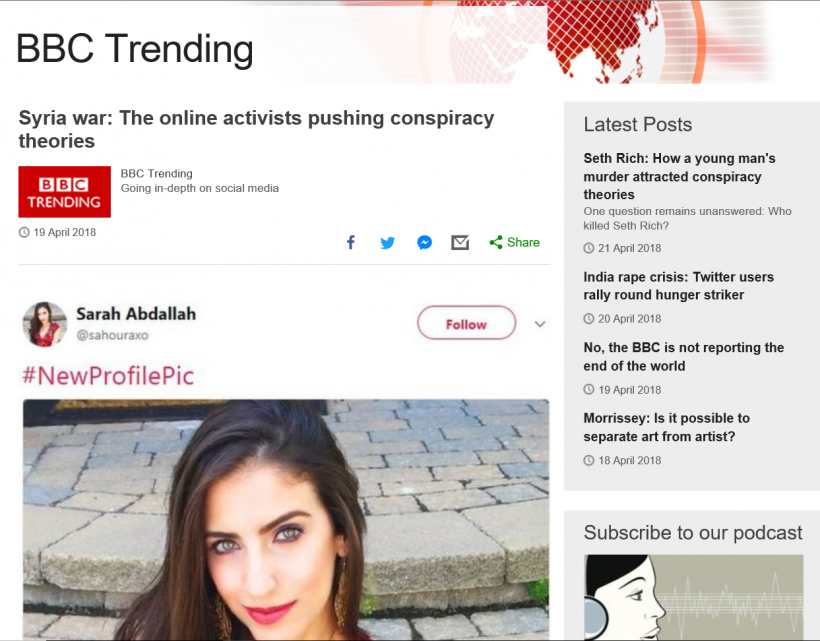
The government then issued a ridiculous press release branding decent people as “Russian bots” just for opposing British policy in Syria. In a piece of McCarthyism so macabre I cannot believe this is really happening, an apparently pleasant and normal man called Ian was grilled live on Murdoch’s Sky News, having been named by his own government as a Russian bot.
The Guardian uncritically published the government’s accusations in full, and astonishingly seemed proud that it had made no attempt to investigate their veracity but had merely published what the government wished them to publish:

The Guardian naturally was just as reliable as the BBC in driving home the message that anybody who doubted the government’s word on Syria was a flat-earth denier of the truth:

Mr Freedland is of course a perfect representation of an interesting fact. Those who are most active in telling us that we must attack Syria, and that anybody who questions the government’s pretexts is insane or evil, are precisely the same individuals who supported the war in Iraq and attacked those who doubted the existence of Iraqi WMD. Indeed these people – Jonathan Freedland, David Aaronovitch, Oliver Kamm, Alan Mendoza, Andrew Rawnsley, John Rentoul, Nick Cohen – are the leaders of the tiny, insignificant number of people who still believe that the invasion of Iraq was both justified and beneficial in its result.
Yet these people of proven terrible judgement, they and others of their media class, are the arbiters who are allowed to dictate the terms of what is and what is not an acceptable public utterance on the situation in Syria.
When Jeremy Corbyn became leader of the opposition, one of two things had to happen. Either the Overton window had to shift to allow for the reflection of views held by the leader of the official opposition and his myriad supporters, or the leader of the opposition had to be castigated and humiliated as an unreasonable lunatic. Corbyn’s rational scepticism on British involvement in the conflict in Syria is a key moment in this process. Despite the fact Corbyn’s scepticism is supported by a wide swathe of diplomatic and military opinion within the UK, it has to be portrayed as fringe, extreme and irrational.
We thus have the extraordinary spectacle of a coordinated government and media onslaught on anybody who doubts their entirely fact free narratives. Those who were demonstrably completely wrong over Iraq are held up as infallible, and given full control of all state and corporate media platforms, where they deride those who were right over Iraq as crackpots and Russian bots.
Meanwhile public trust in the state and corporate media hits new lows, which is the happy part of this story.
Support Craig Murray’s continued writing.
Time to Confront the Media’s Anti-Corbyn Bias
By Jonathan Cook | Dissident Voice | June 1, 2017
Those journalists who should have been behind Corbyn from the start – who could have been among his few allies as he battled the corporate media for nearly two years as Labour leader – are now starting to eat humble pie. Polls suggest that Corbyn may be gradually turning the election around, to the point where the latest poll, published in the Times, indicates that Britain could be heading for a hung parliament.
No one is surprised that the Daily Mail, Telegraph and Times have been relentless in their hatchet jobs on Corbyn. But it has been disconcerting for the left that the Guardian and BBC never gave him a chance either. He was in their gun-sights from day one.
Owen Jones, a Labour stalwart and Guardian columnist, should have been Corbyn’s number one ally in the press. And yet he used the invaluable space in his columns not to challenge the media misrepresentations, but to reinforce them. He engaged in endless and morose navel-gazing, contemplating a Labour rout.
In an Evening Standard interview in February, he imparted the following wisdom: “Things change but only if people will it to be.” But then almost immediately ignored his own advice, saying that if another Labour leadership election were held: “I’d find it hard to vote for Corbyn.”
In early May, Jonathan Freedland, the Guardian’s most senior columnist, wrote a commentary entitled: “No more excuses: Jeremy Corbyn is to blame for this meltdown.” In fact, though he did not mention it, he had been making that very same argument for the previous two years.
But as Corbyn has begun chipping away at Theresa May’s lead – and equally significantly, forced the media to widen the public debate into political territory it has avoided for nearly four decades – Freedland finally admitted this week, very reluctantly, that he and others may have misjudged the Labour leader.
Freedland’s reassessment, however painfully made, was still an evasion. He and Jones continue to avoid facing up to the central problem of British politics – and must do, because they are at its very heart.
The lesson of Corbyn’s much-improved polling, according to Freedland, is this:
If May is returned with a Commons presence far below the expectations of even a month ago, it will suggest that one more bit of conventional wisdom needs to be retired along with all the rest. It will prove that campaigns matter.
But that is not the real lesson. The turnaround in Labour’s fortunes is not chiefly about the party getting its act together, staying on-message and communicating better with the media. Rather, it is that the formal requirements of an election campaign – equal coverage, reporting the speeches of candidates, leaders’ debates – have made it much harder for the media, especially the broadcasters, to entirely obscure Corbyn’s winning qualities. His honesty, warmth and humanity eclipse May’s stiff, evasive and charmless demeanour.
It was precisely those qualities in Corbyn that proved so attractive to voters in the Labour leadership elections. He inspires a rare passion for politics when he is heard. That is why he is the only politician filling stadiums. That is why the Labour party now has hundreds of thousands of members, making it the largest party in Europe. That is why young people have been registering for the election in record numbers.
The demographic breakdown of support for Corbyn and May is largely generational. Corbyn enjoys a huge lead among young people, while May can rely on overwhelming backing from those aged over-65.
It may be comforting to imagine this is simply the natural order of things. Radicalism is the preserve of those starting out in life, while old age encourages caution and conservatism. This may be one factor in explaining the generational divide, but it clearly will not suffice. In much of the post-Thatcher era, the young have proved to be even more conservative than their parents.
The reason for the Corbyn-May split has to be found elsewhere.
The fact is that the young are least likely to trust the traditional, corporate media, and most likely to seek out information from alternative sources and social media, which have been fairer to Corbyn. Youtube clips of Corbyn’s speeches, for example, are one way to bypass the corporate media.
Conversely, elderly voters are mostly still relying on the BBC, Sky and the Daily Mail for the bulk of their information about politics. The over-65s have little sense of who Corbyn is apart from what they are told by a media deeply wedded to the current neoliberal order he is threatening to disrupt.
But neither Freedland nor Jones has been prepared to admit that all of the corporate media – not just their trusted scapegoat of the “rightwing press” – have been to blame for preventing Corbyn getting a fair hearing. It is an admission they cannot make because it would expose their own complicity in a media system designed to advance the interests of corporate power over people power, oligarchy over democracy.
A desire to avoid facing this simple truth has led to some quite preposterously contorted reasoning by Freedland. In a commentary before his recent reappraisal of Corbyn, he dismissed suggestions that the media had played any significant role in the Labour leader’s troubles. Freedland cited two focus groups he had witnessed. It is worth quoting the section at length to understand quite how ridiculous his logic is.
With no steer from the moderator, who remained studiedly neutral, they described Jeremy Corbyn as a “dope”, “living in the past”, “a joke”, as “looking as if he knows less about it than I do”. One woman admired Corbyn’s sincerity; one man thought his intentions were good. But she reckoned he lacked “the qualities to be our leader”; and he believed Corbyn was simply too “soft”. …
Corbyn’s defenders will blame the media, but what was striking about these groups was that few of the participants ever bought a paper and they seldom watched a TV bulletin. Corbynites may try to blame disloyal MPs, but, whatever its impact elsewhere, none of that Westminster stuff had impinged on either of these two groups, who couldn’t name a single politician besides May, Corbyn and Boris Johnson. They had formed their own, perhaps instinctive, view.
Blaming others won’t do.
How do people form an “instinctive view” on political matters, if they never read a paper, never watch TV and never attend a political rally? Through the ethers?
The answer should be obvious. They can do so only through conversations with, or impressions gained from, family, friends, acquaintances and work colleagues who do watch TV and read papers. Given that it is impossible for most voters to see Corbyn in the flesh, most are either getting their information and opinions directly mediated for them by the media, or receiving the mediated information second-hand, from people they know who have been influenced by the media.
Freedland’s assumption that it is possible for voters to form a view instinctively that Corbyn is a “dope” – the view of him that has been uniformly cultivated by the media – is laughable. It is evidence of a profound unwillingness to confront the power of the media, and his own irresponsible complicity in wielding that power.
Corbyn is a “dope” not because that’s the way he’s seen by voters. He is a “dope” because that is the way he has been characterised for two years by all of the media, including the Guardian. The fact that a growing number of voters are starting to question whether Corbyn is quite the dope they assumed is because he has finally had a chance to talk to voters directly, even if in the leaders’ debate Jeremy Paxman did his best to prevent Corbyn from forming a complete sentence.
If we had a fair, pluralistic media driven primarily by the desire to serve the public’s interests rather than those of corporations, who can doubt that Corbyn would be winning hands-down in the polls?
Idlib chemical attack: A sign no change of policy is on the horizon
By Kit | OffGuardian | April 5, 2017
The alleged chemical attack, reported yesterday, is the latest in a series of atrocities notionally carried out by the Syrian government (“The Regime”, in the partisan parlance of the press). There has not been time, as yet, to fully examine and analyse all the evidence – the claims and counter claims, the photographs and videos – but it would be a massive mistake to view it in a vacuum.
First, the situation on the ground needs to be considered. The Syrian government – with assistance from Iran and the Russian Air Force, have been making steady progress for months. Aleppo has fallen. Palmyra was retaken. The rebels are losing. So cui bono? What good does dropping chemical weapons on children do Assad, at this point? It is both strategically pointless, and a crushing blow to his international image. It would serve no purpose, unless he’s a comic-book style villain intent on being cruel for cruelty’s sake – and they don’t exist outside of cinema or the American press. Conversely, it would make all the sense in the world for cornered zealots and mercs to try to disrupt the upcoming talks (from which they are excluded).
Second, the timing. Much like a previous “chemical attack” (and subsequent BBC Panorama documentary) came on the eve of a commons vote on military intervention in Syria, this attack comes at a key moment. In two days there is a meeting in Brussels on the Syria peace process, and the future of the country. This attack will allow Western leaders – especially the European voices, increasingly separate from the US on this issue – to ride an artificial high-horse into those proceedings. Deals can be scuppered and progress refused in the wake of such “atrocities”.
Third, we have seen this all before. There was the chemical attack in Ghouta, initially pinned on the government (and still unquestioningly attributed to them in the MSM), that was revealed to be carried out by rebels. there was also the aforementioned napalm/chemical attack on a school – thoroughly debunked by Robert Stuart. We have seen the same girl rescued three different times by the White Helmets, and seen people in Egypt arrested for faking footage of bombings. The “last hospital in Aleppo” was knocked down everyday for a month, and the last doctors slaughtered bi-weekly. There is no reason, as yet, to think this is not just more of the same.
This is in fine tradition of media manipulation – from filming people on the outside of a fence and pretending they’re inside, to moving bodies for a better photograph, to deliberately removing an image’s context, and lying about it. Events are ignored, twisted, exaggerated and outright fabricated in order to push an agenda. Accordance with reality is immaterial to the process, and coincidental when it occurs.
Real or not, false flag or not – No one can deny convenience of the timing. Given the conflict the UK/EU find themselves in with the new US administration re: Syria. During the campaign Trump, unlike Clinton, totally refused to countenance the idea of no-fly zones or any kind of American/NATO backed military action against Syria and their Russian/Iranian allies. The last few weeks have seen even a softening of America’s “Assad must go” mantra. Rex Tillerson, speaking in Turkey last week, said:
I think the… longer term status of president Assad will be decided by the Syrian people,”
And the American ambassador to the UN added:
You pick and choose your battles and when we’re looking at this, it’s about changing up priorities and our priority is no longer to sit there and focus on getting Assad out.”
Though she did later clarify these remarks, after being named-and-shamed in the media.
John McCain called Tillerson’s words “one of the more unusual statements I have ever heard”, stating it would be ridiculous to let Syrians decide the fate of Syrian government (probably because they would choose wrong).
The press, of course, have not referenced any of this. They continue to cite the partisan White Helmets and completely discredited “Syrian observatory for Human Rights” as if they are reliable sources. They continue to assert gossip and rumor as if it were fact. They continue to lie, but give themselves just enough room to manoeuvre should their lies be exposed.
The Guardian view on…, one of the Guardian’s anonymous editorials (that definitely don’t come straight from GCHQ, you cynics), is a classic example. The headline reads:
The Guardian view on Syria: Assad knows he acts with impunity
A sharp, hard-edged, statement of absolute certitude… and the only sentence of conviction in the whole piece. The rest is littered with uncertain, selective language. Weasel-words and guesses. I have added the emphasis:
Tuesday’s attack in rebel-held Idlib province has forced a reaction: it is one of the worst suspected chemical attacks in the six-year war
the symptoms suggest the use of a nerve agent, probably sarin
ascertaining the agents used, by whom, is always difficult – particularly given the problems experts will face in accessing the site.
The suspicion is that Tuesday’s strike, like another suspected sarin attack which killed 93 people in eastern Hama in December,
Some have already drawn a link between what seems to be the use of a more deadly agent and the US shift on Syria
That’s an awful lot of “seems” and “suspecteds” to cram into 700 words. It’s a suspected attack, that seems like it might be similar to other suspected attacks, which might have happened. As of right now, it appears, we don’t who attacked, how they attacked, what they attacked with or – indeed – if anyone attacked anything at all.
Nevertheless, the nameless and completely non-partisan and objective author reassures us that:
Nonetheless, the evidence so far points in one direction,
… he just neglects to mention exactly what that evidence is, or tell us where we can find it.
Just hours later we are treated to a longer variation on the exact-same theme, this time the author doesn’t feel ashamed to put his name to it… he probably should be. But years of writing about the Guardian teaches you that Jonathan Freedland is never ashamed of putting his name to anything.
Let’s not even condemn these attacks any more – because our condemnations ring so hollow.
… he says, before condemning the attacks – at interminable length and in trite manipulative language. That these condemnations “ring hollow” might be the only honest words in the article. The level of selective blindness, historical dishonesty, and flat-out hypocrisy is astounding. Even for him,
Assad has himself broken international law, indeed broken a set of precious, century-old conventions and agreements that ban chemical weapons.
… he says, as if a) It was a proven fact and b) It was the only example. No mention of American use of depleted Uranium, Agent Orange or napalm is made. No mention of Israeli White Phosphorus or of the cluster bombs we used in Iraq, and sold to Saudi Arabia to be used on Yemeni civilians. The use of any and all of those substances is illegal under International law. America and Israel cannot be charged with a breach of The Geneva Convention, of course, because they have never ratified protocols I and II, outlawing the targeting of civilians and infrastructure and banning certain weapons.
We are all too aware of the costs of action. But the dead of Khan Sheikhoun force us to make another calculation. They force us to see that inaction too can exact a terrible price.
This could be a straight copy-and-paste job from his many articles on Libya. He made the same arguments back then, and must take partial responsibility for post-apocalyptic wasteland that he (and his colleagues in the media) helped to create. Libya is destroyed, he knows this, and if he could excuse or downplay his role in that destruction… he would do so. To ignore it, and employ the same reasoning to encourage the same fate to yet another Middle-Eastern country, displays a callousness and vanity that belies is saccharine concern for “values”.
However, no amount of faux-moral agonising and dishonesty will ever trump this:
For more than a decade, we have rightly weighed the grave consequences of the 2003 invasion of Iraq, counting the toll in human suffering.
The tone mirrors the same tone ever-taken by members of the Western press when it comes to Iraq. “Our consciences are agony”, they scream at us. As if Iraq was all a tragic accident, fuelled by the fervor of our best intentions and naivety of our governments. They will never address the truth of it – that it was a cynical and brutal war of conquest, cheered on a by braying, controlled media, with more regard for their appearance of virtue, and their bank balances, than any idea of objective truth.
Now, the lame self-flagellation is one thing, but that it should appear alongside this:
Assad’s impunity is, at this very moment, being noted and filed away by the world’s most brutal regimes: the precedent is being set. This is what you can get away with.
… is quite another. The world is VERY aware “what you can get away with” in international law…and it’s not 70 dead in what “seems” like a gas attack. What you can “get away with” is walling up millions of people in a giant ghetto, and cutting off their water and power supply. It’s dropping carcinogens on villages, that give babies tumors 50 years later. It’s illegal sanctions that kill 500,000 children but are “worth it”.
“what you can get away with”, as the author so po-facedly admits, is the invasion of Iraq. An illegal war, a million dead, an ancient seat of civilisation reduced to a glass crater. Was anyone fired? Did anyone resign in disgrace? Has anyone faced charges in the Hague. No, the perpetrators walk free. They collect paychecks from the boards of the most powerful companies in the world, and are given column inches in the Guardian when ever they want them.
In terms of making an actual argument, he hits the exact same talking points as The Guardian view, uses the exact same phrases… and produces the exact same amount of evidence:
… we almost certainly know who did it. Every sign points to the regime of Bashar al-Assad.
He doesn’t say what these “signs” are. Or link to where we can see them.
We know that the poison spread after warplanes dropped bombs
We “know” no such thing. That’s just what the White Helmets said. The White Helmets are paid by the governments of several countries… including the US and UK. They are completely discredited as a source. But this article isn’t about making an evidence-based case, it is about harnessing created public outrage in order to further a specific political agenda.
So, what is the agenda? Well, it won’t be full-blown war in Syria. Number 10 was very quick to – shall we say – shoot-down that idea. It won’t be any kind of overt NATO or American backed intervention… if the PTB had wanted that, they would have pushed harder for a Clinton victory. And Freedland’s reference to Anne-Marie Slaughter’s suggestion is laughable:
Anne-Marie Slaughter, formerly of the Obama administration, suggests a single strike that would crater, say, a runway used by Assad’s warplanes – not an invasion, not a full-scale military operation, but some way of punishing Syria for what it has done.
No, the agenda being pushed here is two-fold, firstly an attack on the UN and its apparent impotence, and secondly a pre-emptive defense of the status quo.
To deal with the first point, the article launches a sidelong attack on the UN Security Council, most specifically the veto power:
In February, the UN security council considered imposing sanctions over the use of chemical weapons. Russia vetoed it, of course: it would never want to stay the hand of its murderous chum. But China vetoed it too.
This is not new material for the Guardian, they have been attacking the UN veto for years now – as have other liberal papers and news outlets. You don’t need to be a genius to understand the drive to undermine the only regulatory body that can put a hold on neo-liberal imperialism. But for the UNSC, Iraq would have been so much easier and Syria would have been levelled by now.
The second point is more subtle. For years the CIA et al have been seeking to remove Assad from government, most openly through supplying arms and money to the “moderate opposition” in order to wage a proxy war. Trump’s election, and his public undermining of the intelligence agencies, poses a threat to this on-going plan.
Now that this chemical attack has happened, of course, Trump’s administration can be condemned for being “soft”. Now, we can call on Trump and his cabinet to “act”… and when they refuse to change their policy, rightfully fearful of a conflict with Russia, they will be further derided and undermined in the press as “Russian agents” who are “easy on tyrants”.
All the while, the covert operations carried out by American and European alphabet agencies all over Syria will continue.
When the State Dept., the CIA and all their co-members of America’s (totally imaginary) “deep state” completely disregard the orders of their Commander-in-Chief, and continue to pursue their own agenda – continue to supply arms and funding to their mercenaries and proxies – they will be applauded in the press for their “bravery” and “resolution”.
We will be encouraged to be “thankful” that the mechanics of democracy and freedom cannot be impeded by the election of an autocratic buffoon. We will be told, with a bright smile, that our choice of leadership means literally nothing as it pertains to foreign policy.
It will be thrown in our faces that our elected officials have no real power, and we will be told to applaud the death of democracy… in the name of freedom.
The Guardian Laments Sharon
By Gilad Atzmon | January 4, 2014
In a uniquely dishonest piece, The Guardian’s Jonathan Freedland paid a tribute today to Israel’s veteran PM Ariel Sharon.
According to Freedland, Sharon, “as one of Israel’s founders… had the credibility to give up occupied territory – and even to face the demons of 1948”. Freedland speculates also that “Sharon’s final mission might well have been peace.” This is indeed a big statement, but how does Freedland support his creative historical account?
“Sharon’s final act” says Freedland, “was to dismantle some of the very settlements he had sponsored. In 2005 he ordered Israel’s disengagement from Gaza, seized in the 1967 war in which Sharon had been a crucial, if maverick, commander.”
Let alone the fact that Freedland comes short of reminding his readers about Sharon’s colossal war crimes, he actually completely distorts the political narrative that led Sharon to the 2005 unilateral disengagement.
Did Sharon have a plan to reconcile with the Palestinians and to address their plight or their right to return to their land? Not at all, we do not have any evidence of Sharon’s remorse. The logic behind Sharon’s disengagement is simple on the verge of banal. Sharon knew very well that if Israel insisted to maintain itself as the ‘Jewish State’, it would have to rid itself immediately of Arabs. Late Sharon was becoming aware of the possible implications of the ‘Palestinian demographic bomb’. The Palestinians were becoming a majority in areas controlled by Israel.
Ridding Israel of the highly populated Gaza strip was a perfect start. In a single political and territorial move, Sharon freed Israel of 1.5 million Palestinians and liberated Israel of growing complex security issues. Sharon was a pragmatist politician, he’s always been one and his disengagement wasn’t at all an attempt to “face the demons of 1948” as Freedland suggests: It was a Judeo-centric attempt to maintain the Jewishness of the Jewish State.
Freedland’s biased inclinations continue till the end of today’s piece: “an intriguing habit of Sharon’s was to refer to places in Israel by their original, Arabic names – thereby acknowledging the truth that usually lies buried beneath the soil.” Is this right? Did Sharon really pay tribute to the eradicated Palestinian civilisation by uttering some words in Arabic? Not at all: Sharon was born in the British Mandate of Palestine. He was raised in a country scattered with Palestinian villages and cities. Sharon and Israelis of his generation tended to pepper their Hebrew with a few Arabic words because such an act filled their existence with an authentic sense of belonging and a bond to an imaginary soil. I hope in that context, the laughable Freedland doesn’t also think when Israelis eat Falafel they try to express empathy towards 6 million Palestinian refugees: After all, Falafel also belongs to Palestine.
Freedland probably waited for Ariel Sharon to die in order to spread his laughable reading of history, just to make sure that the ‘immortal Sharon’ would not bounce back and dismiss this gross interpretation as complete nonsense.
The only question that is still left open is why The Guardian, once a respected paper, is publishing such low quality Hasbara drivel? Is it really The Guardian of the truth or has it become The Guardian of Zion?

Featured Video
US IRAN TALKS: Who Are the Crazy Ones Here? /Lt Col Daniel Davis
or go to
Aletho News Archives – Video-Images
From the Archives
Wartime internment camps in Australia
National Archives of Australia
World War I
During World War I, for security reasons the Australian Government pursued a comprehensive internment policy against enemy aliens living in Australia.
Initially only those born in countries at war with Australia were classed as enemy aliens, but later this was expanded to include people of enemy nations who were naturalised British subjects, Australian-born descendants of migrants born in enemy nations and others who were thought to pose a threat to Australia’s security.
Australia interned almost 7,000 people during World War I, of whom about 4,500 were enemy aliens and British nationals of German ancestry already resident in Australia.
Records of World War I internment camps
World War II
During World War II, Australian authorities established internment camps for three reasons – to prevent residents from assisting Australia’s enemies, to appease public opinion and to house overseas internees sent to Australia for the duration of the war.
Unlike World War I, the initial aim of internment during the later conflict was to identify and intern those who posed a particular threat to the safety or defence of the country. As the war progressed, however, this policy changed and Japanese residents were interned en masse. In the later years of the war, Germans and Italians were also interned on the basis of nationality, particularly those living in the north of Australia. In all, just over 20 per cent of all Italians resident in Australia were interned. … continue
Blog Roll
 Aletho News
- Diplomats slam US negotiators’ performance in Iran talks
- Trump Refuses Exit Ramp, War with Iran will Continue
- Trump Says US Naval Blockade in Strait of Hormuz Will Begin Shortly
- US, Iran end 21-hour talks without agreement
- US IRAN TALKS: Who Are the Crazy Ones Here? /Lt Col Daniel Davis
- Talks with the US end without a deal over excessive US demands: Iran
- Feeling Better, Getting Worse: How Psychiatric Drugs Create the Illusion They Cure
- ‘Nobody Told Me’: Former Mental Health Patient Calls Out Dangerous Side Effects of Psychiatric Drugs
- Dr. Abu-Sitta: Beirut ‘felt like a day in Shifa Hospital’
- Iran Has Won the War, It Will Be Up to the US to Secure the Peace: Mohammad Marandi
- If Americans Knew
- US-Iran ceasefire negotiations make zero progress – Daily Update
- Pro-Israel ‘Thinktanks’ and Individuals who Influence U.S. Foreign Policy
- Mearsheimer reveals how Israel dictates US policies on Iran, Gaza – video
- After killing 350+, Israel still has a “score to settle” with Lebanon before ceasefire – Daily Update
- Military aid to Israel emerges as the latest political litmus test for Democrats
- The only Palestinian children’s rights organization closes following years-long Israeli campaign against it
- ‘I Can’t Forget the Smell’: Lebanese Reel After Israel Kills Over 300 in Single Day
- DNC Shoots Down Resolutions Calling Out AIPAC and Limiting Arms to Israel
- TCN: Is Israel Blackmailing President Trump?
- Israel killed at least 303 Lebanese yesterday – who were they? Daily Update
- No Tricks Zone
- German Expert: Heat Dome Led To Record Temps In Western USA…Warmer In 1934, 1936
- New Study: No Linear Warming Or Glacier Retreat Along Northern Antarctic Peninsula Since 1980s
- An Inconvenient Tree: Uncovered In Alps… Europe Much Warmer Than Today 6000 Years Ago
- New Study Reports A 60% Slowdown In Greenland’s Ice Loss Rate In The Last Decade
- Low Intensity Tornado Wrecks Major Solar Farm, Creating A Potential Toxic Dump
- New Study Finds Warming Saves Lives…Cold Temperatures 12 Times More Deadly Than Excess Heat
- German Science Blog Accuses PIK Climate Institute Of Hallucinating Climate Tipping Points
- Devastating Assessment Of Comirnaty Vaccine By Former Senior Pfizer Europe Toxicologist
- New Study: CO2 Is ‘Effectively Negligible’ As An Explanatory Climate Change Factor Since 2000
- Former Pfizer Toxicologist Dr. Helmut Sterz Tells Bundestag Hearing Pfizer Vaccine Should Have Never Been Approved
 Aletho News