All Those Responsible Must Pay a Price for Terrorising and Harming the People They Are Meant to Serve
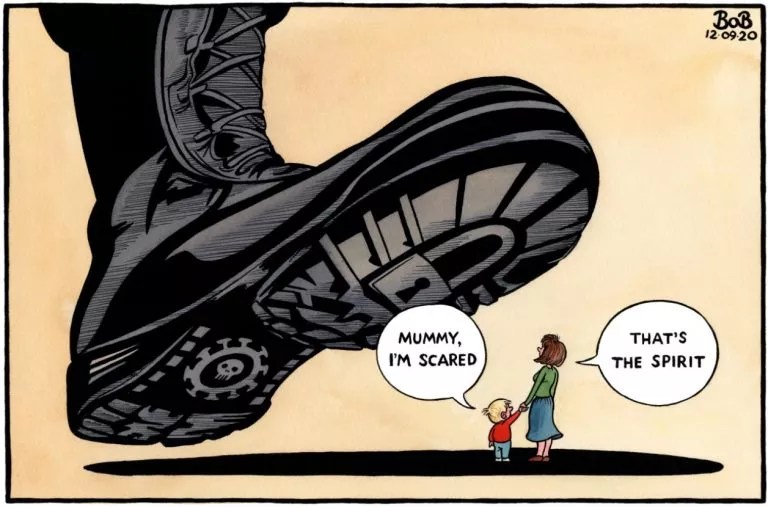
BY DR GARY SIDLEY | THE DAILY SCEPTIC | NOVEMBER 2, 2022
I belong to a privileged generation. Not that I was raised in affluence; far from it. Born in 1958, to a mother who worked all her life as a weaver in the textile industry and a father employed as a maintenance mechanic at the local factory, I lived on a council estate for the first decade of my life. Money was tight, holidays were basic and infrequent, and treats – in the form of confectionary – were rare, usually restricted to a Turkish Delight chocolate bar each Sunday evening. Although I never realised it until I was 62, I was, however, part of a cohort who possessed something sacrosanct, something so very precious and – deplorably – something future generations may never enjoy again: individual freedom.
To be clear, the world I have lived in has been far from perfect. My era has been one incorporating fundamental inequalities and injustices, widespread poverty, discrimination and – particularly in my young-adult years – a recurring risk of physical assault. But despite this context, each of us took for granted a range of basic human rights: to meet with whomever we wished; to leave our homes whenever we chose; to eat whatever we wanted; to express opinions others might not agree with; to take risks, make mistakes and learn sometimes painful lessons; to wear whatever we wanted; to work to improve our career prospects and earn more money to enhance our lives and those of our families; and to decide what drugs and other medical interventions to accept. When cheap flights emerged in the 1970s and 80s, the whole world became wonderfully accessible.
My perception (probably a naïve one) of successive Labour and Conservative Governments was that, although often inept and guilty of policy errors, they broadly sought to improve the lives of their citizens and could at least be relied upon to protect us against external malignant forces. Furthermore, it seemed that the life-spans of our elected politicians were dependent upon keeping us – their constituents – satisfied by acting primarily in the interests of U.K. citizens.
But 30 months ago, this illusion was shattered.
I knew something was awry as early as February 2020. By March the same year my early-warning detector would not rest. While the media, politicians and the science ‘experts’ informed us – incessantly – that a uniquely lethal pathogen was spreading carnage across the world, and unprecedented and draconian restrictions on our day-to-day lives were essential to prevent Armageddon, I wasn’t buying it. I formed the view that a momentous event, unparalleled in my lifetime, was unfolding, but it was not primarily about a virus.
Why, at that point in time, did I recognise that something sinister was underway while almost everyone else I met seemed to be swallowing the dominant narrative? It is a difficult question to answer. Perhaps my time in the early 1980s as a psychiatric charge nurse in an NHS hospital, occasionally interfacing with the ‘infection control’ department, gave me insight into how this professional group operate. Although well-meaning, their advice regarding how to minimise the spread of contagion on a ward often seemed impractical, revealing an apparent inability to see the bigger picture. Or maybe my in-depth knowledge of risk assessment (gleaned in my doctoral thesis during my time as a clinical psychologist) had impressed upon me how woefully inaccurate we are in gauging the relative threat levels posed by various hazards inherent in our environment. What I did know for sure was that Big Pharma – arguably the most corrupt industry in the world – would exploit the emerging ‘crisis’ for its own ends. And how right I was.
The list of state-driven human rights abuses we have endured under the pretence of ‘keeping us safe’ and the (ominous) ‘greater good’ is long: prohibition of travel; confinement in our homes; social isolation; closure of businesses; denial of access to leisure activities; de-humanising mask mandates; directives (scrawled on floors and walls) dictating which way to walk; an arbitrary ‘stay two metres apart’ rule; exclusion from the weddings and funerals of our loved ones; the seclusion and neglect of our elderly; school shutdowns; children’s playgrounds sealed off with yellow and black tape; muzzled children and toddlers; students denied both face-to-face tuition and a ‘rites-of-passage’ social life; and coerced experimental ‘vaccines’ that turned out to be more harmful and less effective than initially claimed. Equally egregious were the strategies deployed to lever compliance with these restrictions, namely psychological manipulation (‘nudging’), pervasive censorship across the media and academic journals and the cancellation and vilification of anyone brave enough to speak out against the dominant Covid narrative. All-in-all, a state-driven assault on the core of our shared humanity.
As the state-orchestrated infringement of our basic human rights continued, I felt compelled to act in ways that were far outside of my comfort zone. The 61-year-old man who had never been on a protest march until summer 2020, and who had innocently assumed that most of society’s leaders were decent people who tried to do what was right, had changed. I found myself walking with tens of thousands of others along Regent Street, London, screaming “Freedom!” I pushed “Back to Normal” leaflets through the letterboxes of hundreds of my neighbours. I stood on the corner of our local shopping street with a placard held aloft stating, “Say No To Vaccine Passports”.
Throughout 2020 and 2021, I struggled to find reasons for the irrational, masochistic Covid restrictions and the ubiquitous infringement of our basic human rights. My explanations evolved. Initially I clung to the ‘panic and incompetence’ rationale, that our governments had been spooked by the images coming out of China – remember the videos of people falling dead in the streets – and the mono-focused, blinkered and catastrophic prophecies of our so-called epidemiological experts. As the atrocities persisted, this explanation was rendered inadequate, and it morphed into an ‘opportunistic agendas’ account where activists – promoting green aspirations, digitalised IDs, social credit systems, a cashless society, universal income, a biosecurity state – had exploited the anxieties associated with the emergence of a novel respiratory virus. By 2021 these conclusions, in turn, seemed insufficient to explain the persistence of the horrors we were enduring and it – belatedly – became clear that globalist and ‘deep state’ powers were at work, striving to realise their inhuman aspirations. My further reading about the activities of World Economic Forum, the United Nations, the European Union, the World Health Organisation, the Bill & Melinda Gates Foundation, the Wellcome Trust, Anthony Fauci and Big Pharma, and others, confirmed this emerging conclusion.
As the Covid event fades from media attention (replaced by a focus on similarly dehumanising and totalitarian responses to environmental threats, the war in Ukraine and the imminent cost-of-living crisis) it is intriguing to reflect upon its residual effects.
I continue to mourn what I have lost, a process associated with a complex mix of fluctuating emotions. For two years, our Government, aided and abetted by state-funded scientists, denied us opportunities for fun and human connection, stymied our freedoms and orchestrated a systematic campaign to coerce us to both accept experimental ‘vaccines’ and to slavishly cover our faces with cloth or plastic. Consequently, I feel anger and disgust towards many of our politicians, epidemiological ‘experts’ and behavioural scientists who were complicit with this shameful period in our history. And I now distrust all sources of information, whether it be the media, the ‘scientific’ world or public health experts. Without an anchor for truth, I float – incredulous – in an ocean of mainstream-generated misinformation.
My 60-plus years of naivety have been shattered. I believe only those few who have shown selfless integrity throughout the Covid debacle. Also, I am now sceptical about much of the green agenda: state-funded scientists lied to us about Covid so why wouldn’t they show the same self-serving dishonesty about the climate?
Closer to home, it is clear my life has changed. I feel disappointment and irritation towards many people who I previously respected and liked, such as friends who colluded with the catastrophically damaging Covid restrictions because of fear, ignorance or a desire to avoid hassle and condemnation. Many relationships are now more distant. On the rare occasions we meet there is often an ‘elephant in the room’, and when the Covid issue is touched upon I typically feel frustrated that many do not want to consider the implications of what has been inflicted upon us.
I feel similarly towards mental health colleagues who, for years, I had stood alongside and respected, collectively fighting the tyranny of biological psychiatry (its human rights infringements, coercion, overuse of drugs and vilification of those who questioned them) but who failed to recognise a much bigger tyranny when it emerged in 2020. While a handful of this anti-psychiatry lobby did soon recognise the totalitarian threat inherent to the Covid response, most bought into the dominant narrative. Heated disagreements ensued with a few, followed by ongoing mutual resentment; for most we just avoid each other.
But the residual effects of the Covid debacle are not all negative. New friendships have emerged with people from across the political spectrum. Based on a mutual respect, enduring bonds have formed with fellow sceptics both locally (through the Community Assembly and the Stand in the Park initiatives) and nationally via joint endeavours in HART, Smile Free, and PANDA. And it was uplifting to recently discover – via a chance meeting in the local pub – that the family I had lived across the road from for the last seven years, yet had rarely spoken to, had always been as sceptical as me about the dominant Covid narrative.
Furthermore, I have noticed that my behaviour has changed in subtle ways. I now make more of an effort to smile and gain eye contact with – unmasked – strangers. Similarly, when greeting acquaintances, I’m more inclined to hug or shake hands as compared to pre-2020 levels of bodily contact. (Non of that fist-bump and elbow-touch nonsense for me.) It’s as if I’m striving to compensate for the human connection deficit that we’ve accrued over the last 30 months. Or perhaps I’m making a defiant metaphorical one-finger salute to any onlookers who still adhere to the risk-averse and dehumanising dominant Covid narrative?
While we continue to drown in a sea of propaganda, censorship and coercion, who knows what the future might hold?
One thing is for sure: We must never forget what the political leaders and public health specialists inflicted upon us. Whether the reason was weakness, groupthink, conflict of interest or unadulterated corruption, the miscreants must all be held to account and pay a price for terrorising the people they are meant to serve. This assertion is not fuelled by a primitive desire for retribution – well, not primarily – but by an expectation that, if the guilty are not named and shamed, the same totalitarian impositions will be repeated again and again.
The conviction sheet is a long one. It includes political leaders at home (Boris Johnson, Keir Starmer, Nicola Sturgeon, Mark Drayford) and abroad (including Justin Trudeau, Emmanuel Macron, Joe Biden and Jacinda Ardern); Bill Gates and his various funding agencies; SAGE scientists who danced to the tune of their academic and political paymasters; the behavioural science ‘nudgers’ at the helm of the worldwide psychological manipulation strategy; the professional organisations that have manifestly colluded with the state-driven tyranny (including the British Medical Association and the British Psychological Society); the conflicted drug regulators (such as the MHRA); the powerful, profit-driven pharmaceutical companies, deploying their financial clout to influence health policy decisions; and the mainstream media, who have slavishly peddled the dominant Covid narrative while dismissing alternative viewpoints.
To successfully expose the wrongdoings of such powerful individuals and institutions is a big ask. Realistically, only bottom-up resistance and protests from millions of ordinary people could achieve this aim, and in this regard there are reasons for optimism. Truth will – eventually – reveal itself. Despite the ongoing censorship and manipulation, public dissent to the attempted imposition of a biosecurity state is becoming increasingly visible. Masking in the community is – at the time of writing – practised only by an eccentric minority. The net harms of Covid restrictions are more widely recognised. Ordinary citizens increasingly claim they will not be locked down and separated from their loved ones ever again. And – perhaps more importantly – the ‘safe and effective’ vaccine narrative is crumbling, as indicated by more and more people rejecting the jabs.
If we do not wish to live in a ‘transhuman’ society devoid of personal freedoms, where our day-to-day decisions – where we go, what we say, what we eat, how we spend our money, what drugs we ingest – are determined by the state’s version of the ‘greater good’, we must all continue to show visible dissent to the globalists’ new world order.
Together, I believe we can defeat the biggest threat to Western values witnessed in my lifetime. And even if we don’t succeed, history will show that at least we tried.
Dr. Gary Sidley is a retired NHS Consultant Clinical Psychologist and co-founder of the Smile Free campaign. He blogs at Coronababble
Trudeau’s West Grey accuser was much younger than first thought

The Buffalo Chronicle | October 19, 2019
Prime Minister Justin Trudeau‘s underage accuser was much younger at the time of their relationship than was first thought, her father tells The Chronicle. Some in the public discourse pegged the accusor at 17 years old. That is inaccurate.
“She was much, much younger than that,” the wealthy Canadian businessman told The Chronicle yesterday. He was not a party to the $2.25 million mutual non-disclosure non-disparagement agreement that she signed, in exchange for her continued silence, on the Wednesday evening of October 9th.
The terms of that agreement prevent both the accuser and Trudeau from acknowledging “any aspect” of that relationship, without triggering a six-to-seven-figure liquidated damages clause. That penalty starts at $500,000 and scales up, depending on the magnitude of the breach.
The accusor’s father shared with The Chronicle a password-protected digital copy of that agreement, giving us limited access to it for several hours on the condition we would make no copies and not distribute. Doing so could have jeopardized the terms of the agreement, which imposes damages on either party in the event they acknowledge or discuss the relationship publicly.
He does not believe his discussion of that agreement’s existence is a violation of its terms since he was not a party to it. He did not acquire the document from his daughter; it was incorrectly CC’d to him on an email between the negotiating parties.
The two engaged in a long and steamy affair on- and off-campus while Trudeau taught drama and French at Vancouver’s prestigious West Point Grey Academy. He was discovered by his accusor’s father at their family home, which prompted private demands to school administrators that he be removed from his position immediately.
 “There was a ‘small settlement’ at the time,” he says, but declined to elaborate.
The relationship was discovered several months after Pierre Trudeau‘s death. He died on September 28th, and was eulogized by his son on October 3rd — an event that made him a rising political star, around whom much of Canada would swoon. His students were particularly fawning, friends say.
At the time, the family was told that the school’s standard employment agreement included confidentiality terms that would be binding on Trudeau after his departure. As a matter of policy, the school does not comment on personnel matters.
Trudeau’s friends at the time say that the typically outgoing and exuberant young man was suffering through a bout of depression following his father’s death in 2000, and his brother’s death in 1997. They postulate that anything improper was likely a result of his fragile emotional state at the time, not because of any nefarious character trait.
“He was lonely and depressed for months,” one friend told The Chronicle.
At the time, Canada’s age of consent was 14 years old.
In 2008, Prime Minister Stephen Harper had that law changed, raising the age to 16, where the law sits today. Still, Canada outlaws sex between adults and people younger than 18 when the adult is in a position of responsibility for the wellbeing of that child.
Trudeau’s behavior would have been illegal at the time.
To date, Trudeau has not offered a public denial of The Buffalo Chronicle’s reporting. Instead, he has instructed his communications staffers to decline to answer those questions and to attack the credibility of this publication.
The Buffalo Chronicle has never — in our entire operating history — been sued for defamation or any other matter. We have never once received a cease and desist letter from the subjects of any article since we began publishing in 2014.
We have not received such a cease and desist letter from Mr. Trudeau.
Trudeau has used his relatively brief time as a teacher to shape his personal narrative when he first got into politics in 2008. He has used the experience to shape his political brand, often claiming to have ‘taught math’.
Canada’s Shameful Hypocrisy on Display!
By Marion Kawas | Canada Palestine Association | May 18, 2018
Six weeks after Israeli snipers started killing and maiming Palestinians, including children, journalists, and medical workers, Canada’s PM Justin Trudeau finally released a carefully worded statement regarding the situation. The statement came only after the wounding of a Canadian doctor on the ground in Gaza, Tarek Loubani.
Activists familiar with the long history of complicity and duplicity of successive Canadian governments cautioned that the statement missed the mark on two main points.
Firstly, it studiously avoided any mention of the culpability of the Israeli government by name, anywhere in the statement.
Secondly, although there was a call for an independent investigation, it was worded this way:
“Canada calls for an immediate independent investigation to thoroughly examine the facts on the ground – including any incitement, violence, and the excessive use of force…We will work closely with our international partners and through international institutions to address this serious situation.”
Calling for investigations is usually diplomatic code for stalling and not taking action. But note also the wording and the ordering of possible facts on the ground, “including any incitement, violence and the excessive use of force”.
However, no-one had to wait long to have the hypocrisy of the Canadian government revealed. Two days after the statement, on May 18, Canada stated it would not support the resolution that was then passed by an overwhelming majority at the UN Human Rights Council. This is what Canada had to say:
“Canada was gravely concerned about the numerous deaths and countless injuries in the Gaza Strip over the past several weeks. However, it could not support the draft resolution because it prejudged the outcome of an international investigation. The resolution was one-sided and did not advance the prospects for a peaceful, negotiated settlement to the Israeli-Palestinian conflict. The resolution singled out Israel, without making reference to other actors.”
So, there we have it. Either the UNHRC is not an “international institution” that the Trudeau government wants to work closely with or the resolution made the serious error of actually naming who was firing the shots and dropping the tear gas on unarmed protestors.
Or the Trudeau government was just playing politics from the beginning, and after realizing that the issue of Israel slaughtering Palestinians was becoming very unpopular and the Liberal Party was losing support for its deafening silence, decided to issue a statement that said little and achieved less.
This way, they (and their supporters) could claim they have indeed responded and stood up to the pro-Israel lobby. Actually, it is a sad tradition in Canada that most of the major political parties play “political football” with the lives and struggles of Palestinians. One eye always on the win/loss column to decide when and how to speak out.
We say enough, over 100 Palestinians have not died in the last 6 weeks just so the Canadian government can shed crocodile tears while still defending Israel. We need to focus less of our resources and time on what politicians have to say and more on developing concrete and grassroots work, like BDS campaigns, that have a long-term benefit to the Palestinian people.
– Marion Kawas is a member of the Canada Palestine Association and co-host of Voice of Palestine.
‘Liberal’ Trudeau joins blood-soaked race for arms deals with Mideast despots
By Finian Cunningham | RT | April 24, 2016
In a remarkable spectacle of money-grubbing over arms deals, this month saw a parade of Western leaders jettisoning any pretense of upholding vaunted “liberal values” to court despotic Mideast regimes.
Justin Trudeau, the Canadian prime minister who sent liberal hearts aflutter when he was elected in November, with his espousal of feminism among other progressive causes, is the latest Western leader to show where real priorities lie. Trudeau signed off on an $11 billion deal with Saudi Arabia to export armored vehicles to the blood-soaked repressive regime.
With astounding cynicism, the 44-year-old Canadian premier said he was duty-bound to fulfill the arms contract drawn up by the previous administration as “a matter of principle” in order to demonstrate that his country’s “word means something in the international community.”
This week also saw US President Barack Obama in Saudi Arabia where he glad-handed King Salman and other Gulf monarchs, lauding them as partners in maintaining regional stability and fighting against terrorism. Conspicuously, Obama made little or no mention of human rights violations in the oil-rich kingdom where mass beheadings are a common method of capital punishment.
Western media talked about “strained relations” between Obama and his Saudi hosts. But underlying the superficial optics it was business as usual. Big business. US military affairs publication Defense One reported that high on Obama’s agenda was securing a $13 billion contract for warships and submarine-hunting helicopters with the House of Saud.
Before Obama touched down in Riyadh, his administration had angered American families by announcing that it would veto a bill going through Congress that could enable relatives of the 9/11 terror attacks to sue the Saudi rulers for their alleged involvement in sponsoring that atrocity. The topic didn’t even arise for discussion during Obama’s visit, indicating the president’s real concerns in meeting the Saudi and other Gulf rulers.
France has also nabbed market share from Western rivals in the Persian Gulf where over the past year Paris has sold billions of dollars’ worth of its Rafale fighter jets to Saudi Arabia, Qatar and the United Arab Emirates.
Similar prevarication over human rights is brazenly shown by the British government of David Cameron in its arms dealing with Saudi Arabia and the wider region. The Saudi-led war in Yemen has been a boon for British sales of bombs and missiles, even though as many as 9,000 Yemenis have been killed over the past year, many of them civilians from aerial bombing by Saudi warplanes.
Britain’s foreign minister, Philip Hammond, has dismissed condemnations by human rights groups in regard to Yemen, claiming that British weapons exports meet tough standards of international law. Britain, like Canada and other Western governments, makes the cynical claim that its military exports are not used for “internal repression” and that if it is proven that weapons are being used to kill civilians in Yemen then trade licenses will be canceled.
So what is Saudi Arabia dropping on Yemen? Cuddly British-made toys?
Duplicity of Western governments doing business with despotic regimes is nothing new. The Middle East’s absolute monarchs have long been a staple of American and other Western so-called “defense industries.” In 2010, the Obama administration signed a $60 billion weapons deal with Saudi Arabia – the biggest in US history.
During the 1980s, Britain under Margaret Thatcher won a comparable mammoth contract with Saudi Arabia known as the Yamamah deal.
Massive arms sales to tyrannical regimes give the real meaning to hackneyed euphemisms spouted by the likes of Obama, Cameron, Hollande and Trudeau, when they cite “regional partners for stability.” What they mean by stability is uninterrupted orders for weapons.
What is new, though, is the lack of discretion in how the West now pursues arms deals in the Mideast.
Western governments are apparently falling over themselves to bid for business. Yet this unseemly rush for arms selling is sharply at odds with not only intensifying repression within Middle Eastern “partner” regimes; it has also become abundantly clear that some of these same regimes are directly responsible for sponsoring terrorism in the region. The case of Saudi Arabia and its sponsorship of Wahhabi terror proxies in Syria, Libya and Iraq is perhaps the most glaring.
Part of the burgeoning Western race for arms business is related to the historical demise of their capitalist economies and the emergence of military industries as key components in whatever remains of gutted manufacturing sectors.
No doubt, critics will point out that Russia is also a major arms supplier to Middle Eastern regimes. According to the Stockholm International Peace Research Institute, Russia is indeed a prominent weapons exporter to the region and globally.
However, there is an important distinction. Western governments never cease to proclaim democracy, human rights and international law as foundational policies. Washington, London, Paris and so on continually invoke such rights as criteria by which they sanction, censure and even invade other countries to ostensibly uphold.
What is therefore more transparent than ever from Western countries soliciting arms deals in the Middle East is their shameless, sordid hypocrisy.
That Canada’s fresh face of “liberal values,” Justin Trudeau, has joined the throng of Western leaders cutting deals with tyrants and dictators just goes to show how cosmetic Western noble pretensions are.
Why should citizens in these countries believe anything that their governments tell them on any issue? Their governments all too evidently do not have a scrap of integrity or principle.
Official Western treachery, duplicity and hypocrisy have become a chronic condition that is no longer veiled by lofty rhetoric, as it once was. So-called liberal values are being stabbed in the back – left, right and center.
Read more:
UK sold Saudis £2.8bn in weapons since outbreak of Yemen war – report
‘Don’t demonize Israel’: Canada passes anti-boycott motion
RT | February 23, 2016
Canada has passed a motion to condemn “any and all attempts” to promote the Boycott, Divestment and Sanctions (BDS) movement against Israel both at home and abroad.
The motion passed on Monday by a 229-51 vote, CIJ News reports. The bill was introduced by members of the Conservative Party and won support from Liberal Party members. The motion calls on the government to condemn attempts by Canadian organizations, groups, and individuals to promote the BDS movement, claiming it “promotes the demonization and delegitimization” of Israel.
BDS is a global grassroots movement that is trying to pressure Israel to “comply with international law and Palestinian rights” through the boycott of products and companies that profit from violating Palestinian rights. It also includes Israeli cultural and academic institutions.
Inspired by the successful BDS movement that aided in ending South African apartheid, its supporters believe the movement is the only way to push for a solution to the Palestinian-Israeli conflict.
Speaking after the vote, the National Council of Canada Arab Relations said, “At its core, the vote on the anti-BDS motion would go against the spirit of Freedom of Speech, a right enshrined in Canada’s Charter of Rights and Freedoms. Democratic governments do not ordinarily attempt to dictate the political views of their citizens. NCCAR Chair, Gabriel Fahel, reminds us that ‘freedom of speech and conscientious objections to buying products from countries that contravene international law are core values of a free and democratic society.’”
The CEO of the Center for Israel and Jewish Affairs, Shimon Fogel, however insisted that the boycott movement “does not contribute to peace and is not pro-Palestinian.”
“It is discrimination based on nationality, and it harms both Israelis and Palestinians alike by driving the two sides further apart. The BDS movement is a fringe movement and is outside genuine peace efforts,” Fogel said, as quoted by The Times of Israel.
Liberal Prime Minister Justin Trudeau is likely to continue former Prime Minister Stephen Harper’s close ties with Israel. He is against the BDS movement, and tweeted his opinion in March of last year.
Students at McGill University in Montreal passed a pro-BDS motion on Tuesday.
In 2014, Trudeau spoke out in favor of Israel’s right to defend itself during Operation Protective Edge, acknowledging the suffering of Israelis, but not that of the Palestinians, 2,200 of whom were killed during the 50 day conflict.
Israel has pushed back against BDS efforts, accusing its promoters of “anti-semitism.” AP recently revealed that the Israeli government had allotted $26 million for a covert cyberattack on the BDS movement, which would include “flooding the internet” with pro-Israel content and monitoring Muslim activists online.
Read more:
Israeli sniper shoots Canadian citizen in West Bank
American Herald Tribune | January 21, 2016
In describing what she calls a lack of symmetry in recent escalations in Israel and the West Bank, Canadian-Palestinian artist and PhD student Rehab Nazzal told The Real News, “You have the Israeli occupation forces armed with all forms of weapons, and you have the youth, mainly the youth in their 20s, mostly they were born during what’s called, between quotations, the peace process.”
Nazzal is describing Palestinians born during the Oslo Accord negotiations of the 1990s, who have been protesting across Israel, the occupied West Bank and Gaza since the summer–and suffering for it.
Since 1 October 2015, 155 Palestinians have been killed by Israeli forces. 24 Israelis have been also been killed, many in stabbing or car ramming attacks.
Nazzal was photographing an Israeli skunk truck in the West Bank–an armored crowd control vehicle that shoots putrid water–when an Israeli sniper shot and wounded her on 11 December, 2015. Medics were prevented from attending to her because rounds of teargas were shot consecutively at them by Israeli forces.
She is recovering still in the West Bank, and plans to continue her Canadian federal government research council-funded research into “non-lethal” and crowd-control weapons.
Nazal contextualizes her shooting among the countless other shootings across the West Bank. “I am one of over 16,000 Palestinians who were injured during the past three months. Among these, over 6,000 with live bullets. Just yesterday, here in my neighborhood where I am now, there were tens of Palestinians who were injured, one seriously with live bullets, and one was killed. He was shot in the chest and was killed yesterday. Today was his funeral. And the city is just buried with tear gas and all forms of aggression,” she said.
She continues to speak about the inequity of aggression between Palestinian youths throwing stones and Israeli forces quelling the demonstrations with live bullets and the inability of nations–even her own nation–to act. “It’s very difficult. And the worst part of it, that the world is silent.”
According to Nazzal’s lawyer Dimitri Lascaris, there is little legal recourse to take because of “something called a State Unity Pact, which effectively bars a lawsuit against the government of Israel or any other government for human rights violations,” Lascaris said, clarifying that he is referring to the Canadian courts. He adds that what is “appalling about this law is that it does not provide immunity for states when they engage in commercial activities. But they could commit crimes against humanity, war crimes, you know, some of the most heinous offenses under international human rights law, and they’re completely immune from suit in the domestic courts of our country.”
Nazzal and Lascaris do intend to painstakingly document the event of Nazzal’s shooting, and in particular the impediment of medics by Israeli forces. And using political power, Lascaris said, “we’re going to call upon the government of Justin Trudeau to fulfill its promise of a more principled foreign policy than the predecessor Harper government, which was absolutely and unequivocally committed to supporting the government of Israel, no matter what atrocities it committed.”
As yet, the new Canadian prime minister Justin Trudeau has not provided a statement of support for the Palestinian struggle and continues to remain a close ally of Israel.
Trudeau is also principally opposed to the Boycott, Divestment and Sanctions movement, a Palestinian civil society-led grassroots movement to call on companies to end their complicity with the Israeli occupation.
Nazzal describes her disappointment with the Canadian government’s lack of response–she is a Canadian citizen–as well as the lack of response from the Canadian ambassador to Israel.
“Not even a condemnation to what happened… If we suppose that the Israeli soldiers don’t know I am a researcher doing work, but I am an unarmed civilian and standing away, far from protesters, even this, we haven’t heard any word… from the Canadian ambassador in Israel or the foreign minister.
Which brings that hypocrisy to our human rights violations in other countries. Why, why Israel is not being questioned. I am, again, a Canadian citizen. I have my career, my children there. I have my life there. Yeah, I am just in disbelief, as well.”
Ill-informed first words on Ukraine by Canada’s new prime minister
New Cold War – November 17, 2015
Canada’s new prime minister is sounding not-so-new when it comes to the civil war that has devastated the lives of millions of people in eastern Ukraine. CBC News reports that Justin Trudeau directed critical and ill-informed words to Russian President Vladimir Putin two days ago during the G20 summit meeting in Antalya, Turkey. Trudeau’s words portend badly for the people of Ukraine if continued.
CBC cites Trudeau speaking of his exchange with Putin: “I pointed out that although Canada has shifted its approach on a broad range of multilateral and international issues, we remain committed to the fact that Russia’s interference in Ukraine must cease; that we stand with the Ukrainian people and expect the president to engage fully in the Minsk peace process.”
The reference to the Minsk ceasefire agreement of Feb 12, 2015 (‘Minsk-2’) is ill-informed or malevolent. Russia was a key international sponsor and negotiator of the agreement, along with Germany and France. Canada and the United States were nowhere to be seen or heard from. The agreement was effectively a refutation of the aggressive egging-on of Kyiv’s civil war in which the U.S., Canada and Britain have engaged ever since Kyiv launched its civil war–‘Anti-Terrorist Operation’–in eastern Ukraine in April 2014.
Minsk-2 sets out 13 very specific clauses which must be met by the governing regime in Kyiv and the rebel, pro-autonomy forces in Donetsk and Lugansk. Kyiv has violated every single one of those clauses. Today, only the first two of the clauses are close to being met by Kyiv–a ceasefire, and a withdrawal of heavy weaponry from the front line of the conflict which runs through the heart of the Donbas region (Donetsk and Lugansk oblasts).
Clause four requires the holding of local elections in Donetsk and Lugansk which would recognize principles of local autonomy. Clauses 11 and 12 require constitutional changes that recognize autonomy for Donbas. None of this has happened. On the contrary, Kyiv has crafted new political measures which block and deny said autonomy.
Clauses five and six require Kyiv to provide amnesty to combatants who resisted its civil war and to conduct a full prisoner exchange with the rebel side. It has failed on the first count, and Kyiv continues to hold many combatants and political prisoners it refuses to exchange.
Clause eight requires Kyiv to end its economic sanctions (cutting of social payments) against the population of the east which it implemented in the summer of 2014 and to end its obstruction and blocking of economic transactions. This has not occurred. Indeed, in the the latest in a string of human rights reports critically examining the situation in Ukraine, Commissioner for Human Rights of the Council of Europe Nils Muižnieks admonishes Kyiv for failing to end its economic blockade of eastern Ukraine. His report was issued on November 3.
Clause ten of Minsk-2 reads, “Pullout of all foreign armed formations, military equipment, and also mercenaries from the territory of Ukraine under OSCE supervision. Disarmament of all illegal groups.” Yet Canada, the U.S. and Britain dispatched soldiers to Ukraine in the months following February 12, under the guise of launching “training missions” of the Ukrainian army. And as for the disarming of “illegal groups” (referring to the extremist paramilitary battalions fighting alongside the Ukrainian army), Kyiv has solved that little problem by incorporating the battalions into its National Guard. This effectively worsens the situation by legitimizing the battalions and giving them more formal access to training and weaponry, including from the aforementioned NATO countries.
So if Ukraine has violated the clauses of Minsk-2 so widely, and if the human rights commissioner of the European Union(!) effectively acknowledges much of this, what is Justin Trudeau talking about when he blames a foreign country, Russia, for violations of the agreement?
Trudeau is either being played by the governing regime in Kyiv, or he and his government have decided to play along.
Last summer, Kyiv began to face up to the fact that it could not longer openly flout Minsk-2 and continue its shelling of Donbas. The military setbacks it suffered during 18 months of civil war cannot be easily fixed. Polls of Ukrainians show very high numbers of people wanting an end to the fighting. Kyiv’s economic and social disaster at home is looming ever larger, including an impending default on its foreign debt. And Berlin and Paris decided last summer that a continued war in Ukraine was not in their interest; they had bigger problems requiring their undivided attention. So as of September 1, Kyiv largely ceased its shelling and it began to match the withdrawals of heavy weaponry already begun by rebel forces. This was and remains a significant political setback to Kyiv’s efforts to crush resistance to its pro-Europe, anti-Russia and pro-austerity program.
The one card that remains for Kyiv to play in order to avoid its obligations under Minsk-2 and obfuscate the real situation is the enduring myth of a Russian invasion and occupation of eastern Ukraine. This is what Trudeau is talking about when he speaks of Russian violations of the agreement. He is parroting the wording to this effect that was begun by Kyiv as it faced its forced climbdown on September 1.
Trudeau can get away with uttering nonsense about Russia violating Minsk-2 because the Canadian population has been deeply misled and misinformed about the situation in Ukraine. Parliamentarians of all parties in Ottawa and the country’s corporate media are 100 per cent united behind a hostile, anti-Russia policy that blames all the ills in Ukraine on its large neighbour to the east. Much of the Canadian population knows of no other story of Ukraine than the one it has been aggressively fed for two years now. But the unfolding disaster of U.S., Canadian and European policy taking place in Syria and the Middle East, and the contrast to that of the apparent, early achievements of Russian diplomacy, have growing numbers of Canadians on full alert against more foreign policy deceptions and misadventures.
Justin Trudeau and his government, not to speak of the people of Ukraine, have nothing to gain and much to lose by a continuation of Stephen Harper’s aggressive and hostile policy towards Ukraine and Russia.
The Toronto Star report on Justin Trudeau’s encounter with Vladimir Putin explained, “Trudeau’s brief chat [with Putin] is in contrast with the lengthy discussion that unfolded here between Putin and U.S. President Barack Obama on the crisis in Syria.”
In politics as in war, advantage is not enough
By Greg Felton | April 28, 2015
Near the outset of the U.S. Civil War, President Abraham Lincoln made Maj.–Gen. George McClellan General-in-Chief of the Union Amy. McClellan was highly popular among his men and a great organizer who built the Army of the Potomac into a formidable force. Unfortunately for Lincoln, McClellan the meticulous organizer lacked the courage and judgment to be a field commander.
On April 5, 1862, Lincoln ordered McClellan to attack a Confederate force in Yorktown, Va. He had at his disposal 121,500 troops, 44 batteries of artillery and prodigious logistical support. The Confederate contingent in Yorktown, meanwhile, comprised something on the order of 10,000 men. The battle was a rout waiting to happen. It never did. McClellan told Lincoln the enemy was 100,000 strong and refused to attack. This delusion was partly due to Gen. John B. Magruder’s crafty parading of his Confederate soldiers in a circuit to give the illusion of greater numbers and his ordering of logs to be painted black to resemble cannons.
McClellan knew that intelligence estimates of Confederate strength were laughable exaggerations yet he acted as if they were true. Instead of attacking, he chose the do-nothing option of laying siege to Yorktown. In early May, Magruder and the Confederates slipped out to fight another day, leaving McClellan to enter an empty town. He declared victory. The last straw for Lincoln was McClellan’s repeated refusal to hasten after Gen. Robert E. Lee’s retreating army after the Battle of Antietam. On Nov. 5, 1862, Lincoln relieved him of command.
McClellan was an administrator who proved to be more of a coward than a commander, notwithstanding the Washington Post’s risible attempt to rehabilitate him. There may be a lesson here for a certain Canadian leader, one who finds himself at the head of a large force in the run up to a political war.
Two years ago this month, Justin Trudeau was anointed leader of the Liberal Party of Canada, a decision that gave hope to Canadians that somebody might finally put the brakes on Stephen Harper’s totalitarianism.
For one thing, Trudeau has a good pedigree. His father, Pierre Elliot Trudeau, was a respected if not wholly popular prime minister, though his reputation has much improved since his death. Trudeau’s Liberal predecessors, Stéphane Dion and Michael Ignatieff, were, respectively, too bland and too aloof to generate any deep support among the party faithful or offer a viable governing alternative. When you add good looks and youth (41), Justin Trudeau appears to be the ideal prime-minister-in-waiting, especially for young voters.
Opinion polls in the month following Trudeau’s election seemed to confirm that a reversion to Liberal rule was highly likely if not inevitable. In May 2013, voter support for the Liberals had more than doubled since the end of the 2011 election, whereas support for the Harperites had fallen by a third. Some of that Liberal growth even came at the expense of the centre-left New Democratic Party, which lost more than 20% support. Had an election been called at this time, the Liberals would have coasted to majority rule. What a difference two years makes.
By April this year, the Liberals had fallen from 38.6% to 27.6%, and Harper, of all people, was the major beneficiary! The NDP, contrary to expectation, not only did not benefit from Trudeau’s slip but lost ground, confirming that its leader, Thomas Mulcair, is not perceived as a serious rival to Trudeau.
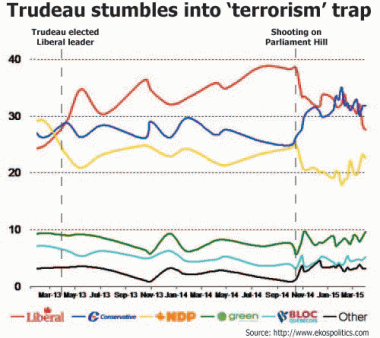 Like McClellan, Trudeau is highly popular. His victory came on the first ballot with 80% of the vote, and Liberal membership grew rapidly almost immediately. Trudeau’s popular appeal really took off in January 2014 and ballooned over the spring and summer.
Then, in mid-October, it all went south. The seminal event was the Oct. 22 shooting of Cpl. Nathan Cirillo, a ceremonial guard on duty on Parliament Hill. It was a bizarre incident, not only because it came out of nowhere, but it received conspicuously comprehensive video coverage. Some of this coverage even managed to catch no fewer than four police cars parked near the site on Parliament Hill with officers standing around as if… waiting for something to happen.
As readers already know, the shooting of Cpl. Cirillo gave Harper the excuse he needed to legislate police-state repression and a host of other unconstitutional measures in the name of “public safety.”
This police-state repression is manifested in Harper’s Protection of Canada from Terrorists Act (Bill C-44) and Security of Canada Information Sharing Act (“Secret Police Act,” Bill C-51) which authorize the state to conduct spying, harassment, arbitrary detention and intimidation and other unconstitutional measures. The main targets are not so much “terrorists” as anyone who criticizes the government, people like environmentalists and Muslim charities. These groups are already subject to malicious audits and have been intimidated into repressing their political activism.
Canada’s McClellan fails test of character
The shooting of Cpl. Cirillo gave Trudeau the perfect opportunity to seize the initiative from Mulcair and the NDP, who represent the Confederacy for analytical purposes: He could condemn the shooting and condemn the Harperites for their conspicuously contrived campaign to demonize the shooter, Michael Zehaf Bibeau, as a terrorist. Moreover, he could call attention to the totalitarian overtones of the shooting and its aftermath.
On the day of the shooting, Trudeau did deliver a speech, but it was stiff and peppered with “values” blathering reminiscent of George W. Bush’s post-Sept. 11 screed. Nevertheless, it had one redeeming virtue—he did not demonize Zehaf Bibeau: “Criminals cannot and will not dictate to us how we act as a nation, how we govern ourselves or how we treat each other. They cannot and will not dictate our values. And they do not get to decide how we use our shared public spaces.”
For his part, Mulcair also steered clear of the terrorism tar pit. On Oct. 29, he also used “criminal” to describe Zehaf Bibeau: “When you look at the history of the individual involved, you see a criminal act, of course. But… I think that we’re not in the presence of a terrorist act in the sense that we would understand it.”
At this point, Mulcair and Trudeau were on the same page regarding the shooting, but Trudeau had a big advantage. His Liberals are far and away richer and more populous than Mulcair’s NDP, and he can tap into overwhelming national hatred for Harper and his anti-terrorism totalitarianism to outmaneuver Mulcair. Since the Bill was announced, Harper’s terrorism smokescreen has lifted and opposition to state totalitarianism tripled in six weeks. Even key business leaders oppose it. All Trudeau had to do was channel this sentiment to become the people’s choice to restore Canada to parliamentary rule.
As expected, Harper and his minions jumped all over Mulcair for daring to be rational, but so did Trudeau! “The RCMP was clear, these were acts of terrorism, [so] these were acts of terrorism,” he said. Instead of lambasting Bill C-51 as unconstitutional and fascist, he tapped into his inner McClellan to adopt the do-nothing approach of proposing amendments that he knew full well would never pass. From a position of strength, Trudeau allowed himself to be outmaneuvered by both Harper and Mulcair thereby placing himself at odds with the electorate and his own party.
Trudeau’s abrupt about-face, and his attack on Mulcair for agreeing with him, makes no sense politically or morally. He does not allow for the possibility that the RCMP might lie, or that it might have abetted the shooting in some way. Currently, Parliament Hill has its own police force, which is loyal to Parliament; Harper wants it replaced by the RCMP, which is loyal to him. The RCMP has even admitted to being party to a smear campaign against former Liberal finance minister Ralph Goodale that helped Harper win his first election. Is it too much of a stretch to suggest that the RCMP came to Harper’s aid again? At any rate, Trudeau had no business taking the RCMP’s judgment on what is or is not “terrorism” at face value.
His uncritical acceptance of the RCMP’s version of events is also disturbing because it raises the possibility that he might have succumbed to political coercion. If so, one of the likely suspects is the Israel Lobby, which has the most to gain from the destruction of Canada’s civil liberties. This view gains credence from Trudeau’s knee-jerk condemnation of the Boycott Divestment and Sanctions campaign, which seeks to isolate Israel politically and economically because of the atrocities it commits in the Middle East. Trudeau claims (wrongly) that the BDS movement, like Israeli Apartheid Week, has no place on Canadian campuses, but this is just standard Lobby propaganda.
Since Trudeau wants to return the Liberals to power, he might have thought it less risky to acquiesce in attacks on Canadians’ constitutional rights than risk offending those who control vast amounts of campaign money and influence. After all, since Harper’s primary loyalty is to Israel, an attack on Harper’s secret-police bill might be construed as an attack on the Lobby. The problem with this scenario, though, is that it is utterly self-defeating—at least half the country and two thirds of Trudeau’s own MPs oppose Bill C-51. Why would Trudeau pick an unnecessary fight with his own party and the voting public unless he lacked the character and confidence to do the right thing?
In the end, Trudeau, like McClellan, succumbed to cowardice. Despite having a decisive advantage over his opponent and Harper set up like a clay pigeon, the expected rout never happened. Instead, Trudeau resorted to timid half-measures and abdicated the role of national saviour-in-waiting to Mulcair. Today, Mulcair and Green Party leader Elizabeth May are the only two national leaders willing to stand up to Harper to defend the Constitution and rule of law. In fact, Green Party support rose by more than 150% over this same period.
Short of a shock caucus revolt, which is distinctly unlikely in an election year, the Liberals are stuck with a McClellan at a time when they need a Ulysses S. Grant.
Featured Video
Laith Marouf: Hezbollah’s position on US-Iran ceasefire
or go to
Aletho News Archives – Video-Images
From the Archives
The Dirty Little Secret behind the “Global Terrorism Index”
The Omission of Israeli Terrorism in the Occupied Palestinian Territories
By Karin Brothers | Global Research | December 6, 2014
… The Israeli settlements — all of which are illegal – have been identified as a major impediment to peace. The refusal of a major “global” terrorism report to name the Israeli settlers as one of the groups most responsible for terrorism not only misrepresents a major source of regional violence but exposes the Global Terrorism Index as a propaganda tool that supports a U.S. agenda.
In recent years, governments have been attempting to thwart terrorism by blocking supportive fund-raising. When it comes to Israeli settlements, however, the US and Canada actually encourage fund-raising by giving organizations (such as Christian Friends of Israeli Communities (CFOIC) and the Jewish National Fund) financial support in the form of donor tax-deductions.
Charities which provide funds for the Israeli settlements should be regarded as terror-financing organizations. They should not only lose their tax-deductible status, but they should be banned because they support the violation of international humanitarian law. The terror-financing laws that are being strictly enforced for Muslim charities should be applied to Christian and Jewish charities as well. … Read full article
Blog Roll
 Aletho News
- Spain orders reopening of Tehran embassy, condemns Israel’s carpet bombing of Lebanon
- Israel faces ‘unsustainable’ strategic crisis following 40-day war against Iran: Analyst
- Iran restricts Hormuz access to 15 vessels per day under ceasefire terms: Report
- The ‘Opposition Party’ Has Done Nothing to Stop the Iran War and Much to Goad Trump Into Continuing It
- Moscow backs Tehran on status of Lebanon in US-Iran deal
- How UK Regulator Ofcom Quietly Bypassed International Law to Police American Speech
- The Black Cube Files: How Former Mossad Operatives Flipped a Nation
- Laith Marouf: Hezbollah’s position on US-Iran ceasefire: What you’re not being told
- Israel’s priority lies in destroying chances of peace between Iran, US: Ex-UN nuclear chief
- Ceasefire for all or for none: Iran shuts Hormuz over Lebanon attacks
- If Americans Knew
- This is ceasefire? Israel’s biggest massacre yet in Lebanon, another journalist killed in Gaza – Daily Update
- Tucker Carlson on Israel: This Is the Behavior of an Ally? Really?
- Gazans face a triple crisis: severe shortages of water and bread, healthcare in tatters
- NY Times reports how Netanyahu took the US into Iran War
- A sigh of relief over Iran, but Gaza and Lebanon in dire straits – Daily Update
- Thousands dead and neighborhoods razed to the ground: Aid agencies fear southern Lebanon is becoming the new Gaza
- The war the US is fighting for Israel could cost trillions
- ‘Cigarette Burns, Nail Wounds’: Toddler Tortured in Gaza to Coerce Father
- Trump Says US Sent ‘a Lot of Guns’ to Protesters in Iran
- Israeli forces destroy 17 UN peacekeeper cameras in south Lebanon
- No Tricks Zone
- An Inconvenient Tree: Uncovered In Alps… Europe Much Warmer Than Today 6000 Years Ago
- New Study Reports A 60% Slowdown In Greenland’s Ice Loss Rate In The Last Decade
- Low Intensity Tornado Wrecks Major Solar Farm, Creating A Potential Toxic Dump
- New Study Finds Warming Saves Lives…Cold Temperatures 12 Times More Deadly Than Excess Heat
- German Science Blog Accuses PIK Climate Institute Of Hallucinating Climate Tipping Points
- Devastating Assessment Of Comirnaty Vaccine By Former Senior Pfizer Europe Toxicologist
- New Study: CO2 Is ‘Effectively Negligible’ As An Explanatory Climate Change Factor Since 2000
- Former Pfizer Toxicologist Dr. Helmut Sterz Tells Bundestag Hearing Pfizer Vaccine Should Have Never Been Approved
- Energy Expert: Germany’s Nuclear Phaseout Was A “500 Billion Euro Mistake”
- New Research: South Australia’s Mid-Holocene Sea Surface Temperatures Were 4°C Warmer Than Today
 Aletho News