The Kagans Are Back; Wars to Follow
By Robert Parry | Consortium News | March 15, 2017
The Kagan family, America’s neoconservative aristocracy, has reemerged having recovered from the letdown over not gaining its expected influence from the election of Hillary Clinton and from its loss of official power at the start of the Trump presidency.
Back pontificating on prominent op-ed pages, the Family Kagan now is pushing for an expanded U.S. military invasion of Syria and baiting Republicans for not joining more enthusiastically in the anti-Russian witch hunt over Moscow’s alleged help in electing Donald Trump.
In a Washington Post op-ed on March 7, Robert Kagan, a co-founder of the Project for the New American Century and a key architect of the Iraq War, jabbed at Republicans for serving as “Russia’s accomplices after the fact” by not investigating more aggressively.
Then, Frederick Kagan, director of the Critical Threats Project at the neocon American Enterprise Institute, and his wife, Kimberly Kagan, president of her own think tank, Institute for the Study of War, touted the idea of a bigger U.S. invasion of Syria in a Wall Street Journal op-ed on March 15.
Yet, as much standing as the Kagans retain in Official Washington’s world of think tanks and op-ed placements, they remain mostly outside the new Trump-era power centers looking in, although they seem to have detected a door being forced open.
Still, a year ago, their prospects looked much brighter. They could pick from a large field of neocon-oriented Republican presidential contenders or – like Robert Kagan – they could support the establishment Democratic candidate, Hillary Clinton, whose “liberal interventionism” matched closely with neoconservatism, differing only slightly in the rationalizations used for justifying wars and more wars.
There was also hope that a President Hillary Clinton would recognize how sympatico the liberal hawks and the neocons were by promoting Robert Kagan’s neocon wife, Victoria Nuland, from Assistant Secretary of State for European Affairs to Secretary of State.
Then, there would have been a powerful momentum for both increasing the U.S. military intervention in Syria and escalating the New Cold War with Russia, putting “regime change” back on the agenda for those two countries. So, early last year, the possibilities seemed endless for the Family Kagan to flex their muscles and make lots of money.
A Family Business
As I noted two years ago in an article entitled “A Family Business of Perpetual War”: “Neoconservative pundit Robert Kagan and his wife, Assistant Secretary of State Victoria Nuland, run a remarkable family business: she has sparked a hot war in Ukraine and helped launch Cold War II with Russia and he steps in to demand that Congress jack up military spending so America can meet these new security threats.
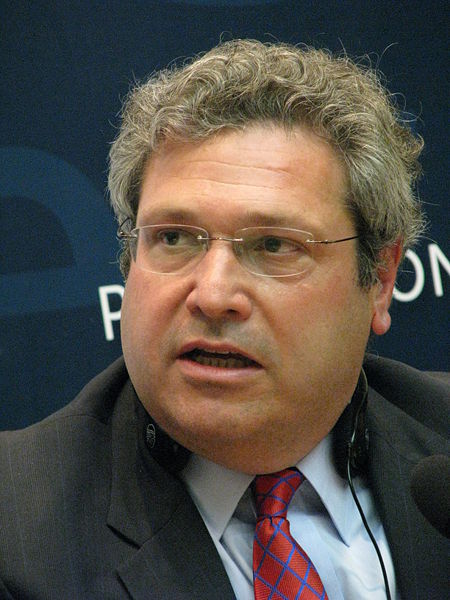
Robert Kagan (Photo credit: Mariusz Kubik)
“This extraordinary husband-and-wife duo makes quite a one-two punch for the Military-Industrial Complex, an inside-outside team that creates the need for more military spending, applies political pressure to ensure higher appropriations, and watches as thankful weapons manufacturers lavish grants on like-minded hawkish Washington think tanks.
“Not only does the broader community of neoconservatives stand to benefit but so do other members of the Kagan clan, including Robert’s brother Frederick at the American Enterprise Institute and his wife Kimberly, who runs her own shop called the Institute for the Study of War.”
But things didn’t quite turn out as the Kagans had drawn them up. The neocon Republicans stumbled through the GOP primaries losing out to Donald Trump and then – after Hillary Clinton muscled aside Sen. Bernie Sanders to claim the Democratic nomination – she fumbled away the general election to Trump.
After his surprising victory, Trump – for all his many shortcomings – recognized that the neocons were not his friends and mostly left them out in the cold. Nuland not only lost her politically appointed job as Assistant Secretary but resigned from the Foreign Service, too.
With Trump in the White House, Official Washington’s neocon-dominated foreign policy establishment was down but far from out. The neocons were tossed a lifeline by Democrats and liberals who detested Trump so much that they were happy to pick up Nuland’s fallen banner of the New Cold War with Russia. As part of a dubious scheme to drive Trump from office, Democrats and liberals hyped evidence-free allegations that Russia had colluded with Trump’s team to rig the U.S. election.
New York Times columnist Thomas L. Friedman spoke for many of this group when he compared Russia’s alleged “meddling” to Japan’s bombing of Pearl Harbor and Al Qaeda’s 9/11 terror attacks.
On MSNBC’s “Morning Joe” show, Friedman demanded that the Russia hacking allegations be treated as a casus belli: “That was a 9/11 scale event. They attacked the core of our democracy. That was a Pearl Harbor scale event.” Both Pearl Harbor and 9/11 led to wars.
So, with many liberals blinded by their hatred of Trump, the path was open for neocons to reassert themselves.
Baiting Republicans
Robert Kagan took to the high-profile op-ed page of The Washington Post to bait key Republicans, such as Rep. Devin Nunes, chairman of the House Intelligence Committee who was pictured above the Post article and its headline, “Running interference for Russia.”
Kagan wrote: “It would have been impossible to imagine a year ago that the Republican Party’s leaders would be effectively serving as enablers of Russian interference in this country’s political system. Yet, astonishingly, that is the role the Republican Party is playing.”
Kagan then reprised Official Washington’s groupthink that accepted without skepticism the claims from President Obama’s outgoing intelligence chiefs that Russia had “hacked” Democratic emails and released them via WikiLeaks to embarrass the Clinton campaign.
Though Obama’s intelligence officials offered no verifiable evidence to support the claims – and WikiLeaks denied getting the two batches of emails from the Russians – the allegations were widely accepted across Official Washington as grounds for discrediting Trump and possibly seeking his removal from office.
Ignoring the political conflict of interest for Obama’s appointees, Kagan judged that “given the significance of this particular finding [about Russian meddling], the evidence must be compelling” and justified “a serious, wide-ranging and open investigation.”
But Kagan also must have recognized the potential for the neocons to claw their way back to power behind the smokescreen of a New Cold War with Russia.
He declared: “The most important question concerns Russia’s ability to manipulate U.S. elections. That is not a political issue. It is a national security issue. If the Russian government did interfere in the United States’ electoral processes last year, then it has the capacity to do so in every election going forward. This is a powerful and dangerous weapon, more than warships or tanks or bombers.
“Neither Russia nor any potential adversary has the power to damage the U.S. political system with weapons of war. But by creating doubts about the validity, integrity and reliability of U.S. elections, it can shake that system to its foundations.”
A Different Reality
As alarmist as Kagan’s op-ed was, the reality was far different. Even if the Russians did hack the Democratic emails and somehow slipped the information to WikiLeaks – an unsubstantiated and disputed contention – those two rounds of email disclosures were not that significant to the election’s outcome.
Hillary Clinton blamed her surprise defeat on FBI Director James Comey briefly reopening the investigation into her use of a private email server while serving as Secretary of State.
Further, by all accounts, the WikiLeaks-released emails were real and revealed wrongdoing by leading Democrats, such as the Democratic National Committee’s tilting of the primaries against Sen. Bernie Sanders and in favor of Clinton. The emails of Clinton campaign chairman John Podesta disclosed the contents of Clinton’s paid speeches to Wall Street, which she was trying to hide from voters, as well as some pay-to-play features of the Clinton Foundation.
In other words, the WikiLeaks’ releases helped inform American voters about abuses to the U.S. democratic process. The emails were not “disinformation” or “fake news.” They were real news.
A similar disclosure occurred both before the election and this week when someone leaked details about Trump’s tax returns, which are protected by law. However, except for the Trump camp, almost no one thought that this illegal act of releasing a citizen’s tax returns was somehow a threat to American democracy.
The general feeling was that Americans have a right to know such details about someone seeking the White House. I agree, but doesn’t it equally follow that we had a right to know about the DNC abusing its power to grease the skids for Clinton’s nomination, about the contents of Clinton’s speeches to Wall Street bankers, and about foreign governments seeking pay-to-play influence by contributing to the Clinton Foundation?
Yet, because Obama’s political appointees in the U.S. intelligence community “assess” that Russia was the source of the WikiLeaks emails, the assault on U.S. democracy is a reason for World War III.
More Loose Talk
But Kagan was not satisfied with unsubstantiated accusations regarding Russia undermining U.S. democracy. He asserted as “fact” – although again without presenting evidence – that Russia is “interfering in the coming elections in France and Germany, and it has already interfered in Italy’s recent referendum and in numerous other elections across Europe. Russia is deploying this weapon against as many democracies as it can to sap public confidence in democratic institutions.”
There’s been a lot of handwringing in Official Washington and across the Mainstream Media about the “post-truth” era, but these supposed avatars for truth are as guilty as anyone, acting as if constantly repeating a fact-free claim is the same as proving it.
But it’s clear what Kagan and other neocons have in mind, an escalation of hostilities with Russia and a substantial increase in spending on U.S. military hardware and on Western propaganda to “counter” what is deemed “Russian propaganda.”
Kagan recognizes that he already has many key Democrats and liberals on his side. So he is taking aim at Republicans to force them to join in the full-throated Russia-bashing, writing:
“But it is the Republicans who are covering up. The party’s current leader, the president, questions the intelligence community’s findings, motives and integrity. Republican leaders in Congress have opposed the creation of any special investigating committee, either inside or outside Congress. They have insisted that inquiries be conducted by the two intelligence committees.
“Yet the Republican chairman of the committee in the House has indicated that he sees no great urgency to the investigation and has even questioned the seriousness and validity of the accusations. The Republican chairman of the committee in the Senate has approached the task grudgingly.
“The result is that the investigations seem destined to move slowly, produce little information and provide even less to the public. It is hard not to conclude that this is precisely the intent of the Republican Party’s leadership, both in the White House and Congress. …
“When Republicans stand in the way of thorough, open and immediate investigations, they become Russia’s accomplices after the fact.”
Lying with the Neocons
Many Democrats and liberals may find it encouraging that a leading neocon who helped pave the road to war in Iraq is now by their side in running down Republicans for not enthusiastically joining the latest Russian witch hunt. But they also might pause to ask themselves how they let their hatred of Trump get them into an alliance with the neocons.
On Wednesday in The Wall Street Journal, Robert Kagan’s brother Frederick and his wife Kimberly dropped the other shoe, laying out the neocons’ long-held dream of a full-scale U.S. invasion of Syria, a project that was put on hold in 2004 because of U.S. military reversals in Iraq.
But the neocons have long lusted for “regime change” in Syria and were not satisfied with Obama’s arming of anti-government rebels and the limited infiltration of U.S. Special Forces into northern Syria to assist in the retaking of the Islamic State’s “capital” of Raqqa.
In the Journal op-ed, Frederick and Kimberly Kagan call for opening a new military front in southeastern Syria:
“American military forces will be necessary. But the U.S. can recruit new Sunni Arab partners by fighting alongside them in their land. The goal in the beginning must be against ISIS because it controls the last areas in Syria where the U.S. can reasonably hope to find Sunni allies not yet under the influence of al Qaeda. But the aim after evicting ISIS must be to raise a Sunni Arab army that can ultimately defeat al Qaeda and help negotiate a settlement of the war.
“The U.S. will have to pressure the Assad regime, Iran and Russia to end the conflict on terms that the Sunni Arabs will accept. That will be easier to do with the independence and leverage of a secure base inside Syria. … President Trump should break through the flawed logic and poor planning that he inherited from his predecessor. He can transform this struggle, but only by transforming America’s approach to it.”
A New Scheme on Syria
In other words, the neocons are back to their clever word games and their strategic maneuverings to entice the U.S. military into a “regime change” project in Syria.
The neocons thought they had almost pulled off that goal by pinning a mysterious sarin gas attack outside Damascus on Aug. 21, 2013, on the Syrian government and mousetrapping Obama into launching a major U.S. air assault on the Syrian military.
But Russian President Vladimir Putin stepped in to arrange for Syrian President Bashar al-Assad to surrender all his chemical weapons even as Assad continued to deny any role in the sarin attack.
Putin’s interference in thwarting the neocons’ dream of a Syrian “regime war” moved Putin to the top of their enemies’ list. Soon key neocons, such as National Endowment for Democracy president Carl Gershman, were taking aim at Ukraine, which Gershman deemed “the biggest prize” and a steppingstone toward eventually ousting Putin in Moscow.
It fell to Assistant Secretary Victoria “Toria” Nuland to oversee the “regime change” in Ukraine. She was caught on an unsecured phone line in late January or early February 2014 discussing with U.S. Ambassador to Ukraine Geoffrey Pyatt how “to glue” or “to midwife” a change in Ukraine’s elected government of President Viktor Yanukovych.
Several weeks later, neo-Nazi and ultranationalist street fighters spearheaded a violent assault on government buildings forcing Yanukovych and other officials to flee for their lives, with the U.S. government quickly hailing the coup regime as “legitimate.”
But the Ukraine putsch led to the secession of Crimea and a bloody civil war in eastern Ukraine with ethnic Russians, events that the State Department and the mainstream Western media deemed “Russian aggression” or a “Russian invasion.”
So, by the last years of the Obama administration, the stage was set for the neocons and the Family Kagan to lead the next stage of the strategy of cornering Russia and instituting a “regime change” in Syria.
All that was needed was for Hillary Clinton to be elected president. But these best-laid plans surprisingly went astray. Despite his overall unfitness for the presidency, Trump defeated Clinton, a bitter disappointment for the neocons and their liberal interventionist sidekicks.
Yet, the so-called “#Resistance” to Trump’s presidency and President Obama’s unprecedented use of his intelligence agencies to paint Trump as a Russian “Manchurian candidate” gave new hope to the neocons and their agenda.
It has taken them a few months to reorganize and regroup but they now see hope in pressuring Trump so hard regarding Russia that he will have little choice but to buy into their belligerent schemes.
As often is the case, the Family Kagan has charted the course of action – batter Republicans into joining the all-out Russia-bashing and then persuade a softened Trump to launch a full-scale invasion of Syria. In this endeavor, the Kagans have Democrats and liberals as the foot soldiers.
Investigative reporter Robert Parry broke many of the Iran-Contra stories for The Associated Press and Newsweek in the 1980s.
A Family Business of Perpetual War
By Robert Parry | Consortium News | March 20, 2015
Neoconservative pundit Robert Kagan and his wife, Assistant Secretary of State Victoria Nuland, run a remarkable family business: she has sparked a hot war in Ukraine and helped launch Cold War II with Russia – and he steps in to demand that Congress jack up military spending so America can meet these new security threats.
This extraordinary husband-and-wife duo makes quite a one-two punch for the Military-Industrial Complex, an inside-outside team that creates the need for more military spending, applies political pressure to ensure higher appropriations, and watches as thankful weapons manufacturers lavish grants on like-minded hawkish Washington think tanks.
Not only does the broader community of neoconservatives stand to benefit but so do other members of the Kagan clan, including Robert’s brother Frederick at the American Enterprise Institute and his wife Kimberly, who runs her own shop called the Institute for the Study of War.
Robert Kagan, a senior fellow at the Brookings Institution (which doesn’t disclose details on its funders), used his prized perch on the Washington Post’s op-ed page on Friday to bait Republicans into abandoning the sequester caps limiting the Pentagon’s budget, which he calculated at about $523 billion (apparently not counting extra war spending). Kagan called on the GOP legislators to add at least $38 billion and preferably more like $54 billion to $117 billion:
“The fact that [advocates for more spending] face a steep uphill battle to get even that lower number passed by a Republican-controlled Congress says a lot — about Republican hypocrisy. Republicans may be full-throated in denouncing [President Barack] Obama for weakening the nation’s security, yet when it comes to paying for the foreign policy that all their tough rhetoric implies, too many of them are nowhere to be found. …
“The editorial writers and columnists who have been beating up Obama and cheering the Republicans need to tell those Republicans, and their own readers, that national security costs money and that letters and speeches are worse than meaningless without it. …
“It will annoy the part of the Republican base that wants to see the government shrink, loves the sequester and doesn’t care what it does to defense. But leadership occasionally means telling people what they don’t want to hear. Those who propose to lead the United States in the coming years, Republicans and Democrats, need to show what kind of political courage they have, right now, when the crucial budget decisions are being made.”
So, the way to show “courage” – in Kagan’s view – is to ladle ever more billions into the Military-Industrial Complex, thus putting money where the Republican mouths are regarding the need to “defend Ukraine” and resist “a bad nuclear deal with Iran.”
Yet, if it weren’t for Nuland’s efforts as Assistant Secretary of State for European Affairs, the Ukraine crisis might not exist. A neocon holdover who advised Vice President Dick Cheney, Nuland gained promotions under former Secretary of State Hillary Clinton and received backing, too, from current Secretary of State John Kerry.
Confirmed to her present job in September 2013, Nuland soon undertook an extraordinary effort to promote “regime change” in Ukraine. She personally urged on business leaders and political activists to challenge elected President Viktor Yanukovych. She reminded corporate executives that the United States had invested $5 billion in their “European aspirations,” and she literally passed out cookies to anti-government protesters in Kiev’s Maidan square.
Working with other key neocons, including National Endowment for Democracy President Carl Gershman and Sen. John McCain, Nuland made clear that the United States would back a “regime change” against Yanukovych, which grew more likely as neo-Nazi and other right-wing militias poured into Kiev from western Ukraine.
In early February 2014, Nuland discussed U.S.-desired changes with U.S. Ambassador to Ukraine Geoffrey Pyatt (himself a veteran of a “regime change” operation at the International Atomic Energy Agency, helping to install U.S. yes man Yukiya Amano as the director-general in 2009).
Nuland treated her proposed new line-up of Ukrainian officials as if she were trading baseball cards, casting aside some while valuing others. “Yats is the guy,” she said of her favorite Arseniy Yatsenyuk.
Disparaging the less aggressive European Union, she uttered “Fuck the EU” – and brainstormed how she would “glue this thing” as Pyatt pondered how to “mid-wife this thing.” Their unsecure phone call was intercepted and leaked.
Ukraine’s ‘Regime Change’
The coup against Yanukovych played out on Feb. 22, 2014, as the neo-Nazi militias and other violent extremists overran government buildings forcing the president and other officials to flee for their lives. Nuland’s State Department quickly declared the new regime “legitimate” and Yatsenyuk took over as prime minister.
Russian President Vladimir Putin, who had been presiding over the Winter Olympics at Sochi, was caught off-guard by the coup next door and held a crisis session to determine how to protect ethnic Russians and a Russian naval base in Crimea, leading to Crimea’s secession from Ukraine and annexation by Russia a year ago.
Though there was no evidence that Putin had instigated the Ukraine crisis – and indeed all the evidence indicated the opposite – the State Department peddled a propaganda theme to the credulous mainstream U.S. news media about Putin having somehow orchestrated the situation in Ukraine so he could begin invading Europe. Former Secretary of State Clinton compared Putin to Adolf Hitler.
As the new Kiev government launched a brutal “anti-terrorism operation” to subdue an uprising among the large ethnic Russian populations of eastern and southern Ukraine, Nuland and other American neocons pushed for economic sanctions against Russia and demanded arms for the coup regime. [See Consortiumnews.com’s “What Neocons Want from Ukraine Crisis.”]
Amid the barrage of “information warfare” aimed at both the U.S. and world publics, a new Cold War took shape. Prominent neocons, including Nuland’s husband Robert Kagan, a co-founder of the Project for the New American Century which masterminded the Iraq War, hammered home the domestic theme that Obama had shown himself to be “weak,” thus inviting Putin’s “aggression.”
In May 2014, Kagan published a lengthy essay in The New Republic entitled “Superpowers Don’t Get to Retire,” in which Kagan castigated Obama for failing to sustain American dominance in the world and demanding a more muscular U.S. posture toward adversaries.
According to a New York Times article about how the essay took shape and its aftermath, writer Jason Horowitz reported that Kagan and Nuland shared a common world view as well as professional ambitions, with Nuland editing Kagan’s articles, including the one tearing down her ostensible boss.
Though Nuland wouldn’t comment specifically on her husband’s attack on Obama, she indicated that she held similar views. “But suffice to say,” Nuland said, “that nothing goes out of the house that I don’t think is worthy of his talents. Let’s put it that way.”
Horowitz reported that Obama was so concerned about Kagan’s assault that the President revised his commencement speech at West Point to deflect some of the criticism and invited Kagan to lunch at the White House, where one source told me that it was like “a meeting of equals.” [See Consortiumnews.com’s “Obama’s True Foreign Policy ‘Weakness.’”]
Sinking a Peace Deal
And, whenever peace threatens to break out in Ukraine, Nuland jumps in to make sure that the interests of war are protected. Last month, German Chancellor Angela Merkel and French President Francois Hollande hammered out a plan for a cease-fire and a political settlement, known as Minsk-2, prompting Nuland to engage in more behind-the-scenes maneuvering to sabotage the deal.
In another overheard conversation — in Munich, Germany — Nuland mocked the peace agreement as “Merkel’s Moscow thing,” according to the German newspaper Bild, citing unnamed sources, likely from the German government which may have bugged the conference room in the luxurious Bayerischer Hof hotel and then leaked the details.
Picking up on Nuland’s contempt for Merkel, another U.S. official called the Minsk-2 deal the Europeans’ “Moscow bullshit.”
Nuland suggested that Merkel and Hollande cared only about the practical impact of the Ukraine war on Europe: “They’re afraid of damage to their economy, counter-sanctions from Russia.” According to the Bild story, Nuland also laid out a strategy for countering Merkel’s diplomacy by using strident language to frame the Ukraine crisis.
“We can fight against the Europeans, we can fight with rhetoric against them,” Nuland reportedly said.
NATO Commander Air Force Gen. Philip Breedlove was quoted as saying that sending more weapons to the Ukrainian government would “raise the battlefield cost for Putin.” Nuland interjected to the U.S. politicians present that “I’d strongly urge you to use the phrase ‘defensive systems’ that we would deliver to oppose Putin’s ‘offensive systems.’”
Nuland sounded determined to sink the Merkel-Hollande peace initiative even though it was arranged by two major U.S. allies and was blessed by President Obama. And, this week, the deal seems indeed to have been blown apart by Nuland’s hand-picked Prime Minister Yatsenyuk, who inserted a poison pill into the legislation to implement the Minsk-2 political settlement.
The Ukrainian parliament in Kiev added a clause that, in effect, requires the rebels to first surrender and let the Ukrainian government organize elections before a federalized structure is determined. Minsk-2 had called for dialogue with the representatives of these rebellious eastern territories en route to elections and establishment of broad autonomy for the region.
Instead, reflecting Nuland’s hard-line position, Kiev refused to talk with rebel leaders and insisted on establishing control over these territories before the process can move forward. If the legislation stands, the result will almost surely be a resumption of war between military forces backed by nuclear-armed Russia and the United States, a very dangerous development for the world. [See Consortiumnews.com’s “Ukraine’s Poison Pill for Peace Talks.”]
Not only will the Ukrainian civil war resume but so will the Cold War between Washington and Moscow with lots of money to be made by the Military-Industrial Complex. On Friday, Nuland’s husband, Robert Kagan, drove home that latter point in the neocon Washington Post.
The Payoff
But don’t think that this unlocking of the U.S. taxpayers’ wallets is just about this one couple. There will be plenty of money to be made by other neocon think-tankers all around Washington, including Frederick Kagan, who works for the right-wing American Enterprise Institute, and his wife, Kimberly, who runs her own think tank, the Institute for the Study of War [ISW].
According to ISW’s annual reports, its original supporters were mostly right-wing foundations, such as the Smith-Richardson Foundation and the Lynde and Harry Bradley Foundation, but it was later backed by a host of national security contractors, including major ones like General Dynamics, Northrop Grumman and CACI, as well as lesser-known firms such as DynCorp International, which provided training for Afghan police, and Palantir, a technology company founded with the backing of the CIA’s venture-capital arm, In-Q-Tel. Palantir supplied software to U.S. military intelligence in Afghanistan.
Since its founding in 2007, ISW has focused mostly on wars in the Middle East, especially Iraq and Afghanistan, including closely cooperating with Gen. David Petraeus when he commanded U.S. forces in those countries. However, more recently, ISW has begun reporting extensively on the civil war in Ukraine. [See Consortiumnews.com’s “Neocons Guided Petraeus on Afghan War.”]
In other words, the Family Kagan has almost a self-perpetuating, circular business model – working the inside-corridors of government power to stimulate wars while simultaneously influencing the public debate through think-tank reports and op-ed columns in favor of more military spending – and then collecting grants and other funding from thankful military contractors.
To be fair, the Nuland-Kagan mom-and-pop shop is really only a microcosm of how the Military-Industrial Complex has worked for decades: think-tank analysts generate the reasons for military spending, the government bureaucrats implement the necessary war policies, and the military contractors make lots of money before kicking back some to the think tanks — so the bloody but profitable cycle can spin again.
The only thing that makes the Nuland-Kagan operation special perhaps is that the whole process is all in the family.
~
Investigative reporter Robert Parry broke many of the Iran-Contra stories for The Associated Press and Newsweek in the 1980s. You can buy his latest book, America’s Stolen Narrative, either in print here or as an e-book (from Amazon and barnesandnoble.com).
Neocons Guided Petraeus on Afghan War
By Robert Parry | Consortium News | December 19, 2012
Even after the Iraq War disaster and Barack Obama’s election in 2008, neoconservatives retained their influence over U.S. war policies in Afghanistan through their close ties to George W. Bush’s national security holdovers, such as Gen. David Petraeus who partnered with neocon war hawks in escalating the Afghan War.
How tight Petraeus’s relationship was with two neocons in particular, Frederick and Kimberly Kagan, was explored in a Washington Post article by war correspondent Rajiv Chandrasekaran who described how Petraeus installed the husband-and-wife team in U.S. offices in Kabul, granted them top-secret clearances and let them berate military officers about war strategy.
Though the Kagans received no pay from the U.S. government, they drew salaries from their respective think tanks which are supported by large corporations, including military contractors with interests in extending the Afghan War. Frederick Kagan works for the American Enterprise Institute, and Kimberly Kagan founded the Institute for the Study of War [ISW] in 2007 and is its current president.
According to ISW’s 2011 annual report, its original supporters were mostly right-wing foundations, such as the Smith-Richardson Foundation and the Lynde and Harry Bradley Foundation, but it was later backed by national security contractors, including major ones like General Dynamics, Northrop Grumman and CACI, as well as lesser-known firms such as DynCorp International, which provides training for Afghan police, and Palantir, a technology company founded with the backing of the CIA’s venture-capital arm, In-Q-Tel. Palantir supplies software to U.S. military intelligence in Afghanistan.
In her official bio at the ISW’s Web site, Kimberly Kagan touts her work “in Kabul for fifteen months in 2010 and 2011 as a ‘directed telescope’ to General David H. Petraeus and subsequently General John Allen, working on special projects for these commanders of the International Security Assistance Force.”
 In the ISW’s 2011 annual report, Petraeus praises Kagan as “a barracuda at some times,” hails her leadership and poses with her for several photographs, including one in his dress uniform with the U.S. Capitol in the background.
The Post article noted that “For Kim Kagan, spending so many months away from research and advocacy work in Washington could have annoyed many donors to the Institute for the Study of War. But her major backers appear to have been pleased that she cultivated such close ties with Petraeus, who went from Kabul to head the CIA before resigning this fall over his affair with [biographer Paula] Broadwell. …
“On Aug. 8, 2011, a month after he relinquished command in Afghanistan to take over at the CIA, Petraeus spoke at the institute’s first ‘President’s Circle’ dinner, where he accepted an award from Kim Kagan. … ‘What the Kagans do is they grade my work on a daily basis,’ Petraeus said, prompting chortles from the audience. ‘There’s some suspicion that there’s a hand up my back, and it makes my lips talk, and it’s operated by one of the Doctors Kagan.’ …
“At the August 2011 dinner honoring Petraeus, Kagan thanked executives from two defense contractors who sit on her institute’s corporate council, DynCorp International and CACI International. The event was sponsored by General Dynamics. All three firms have business interests in the Afghan war.
“Kagan told the audience that their funding allowed her to assist Petraeus. ‘The ability to have a 15-month deployment essentially in the service of those who needed some help — and the ability to go at a moment’s notice — that’s something you all have sponsored,’ she said.”
Earlier Warning Signs
Though the Post article provides new details about Petraeus’s coziness to Washington’s neocons, there have been warning signs about this relationship for several years. In 2010, I wrote articles describing how Petraeus and other holdovers from George W. Bush’s administration, such as Defense Secretary Robert Gates, had trapped the inexperienced Obama into expanding the Afghan War.
On Sept. 27, 2010, I noted that “after his solid victory in November 2008, Obama rebuffed recommendations from some national security experts that he clean house by installing a team more in line with his campaign pledge of ‘change you can believe in.’ He accepted instead the counsel of Establishment Democrats who warned against any disruption to the war-fighting hierarchy and who were especially supportive of keeping Gates. …
“Before Obama’s decision to dispatch [an additional] 30,000 troops [in an Afghan War ‘surge’ in 2009], the Bush holdovers … sought to hem in the President’s choices by working with allies in the Washington news media and in think tanks. …
“For instance, early in 2009, Petraeus personally arranged for Max Boot [a neocon on the Council on Foreign Relations], Frederick Kagan and Kimberly Kagan to get extraordinary access during a trip to Afghanistan. … Their access paid dividends for Petraeus when they penned a glowing report in the Weekly Standard about the prospects for success in Afghanistan – if only President Obama sent more troops and committed the United States to stay in the war for the long haul. …
“‘Fears of impending disaster are hard to sustain, … if you actually spend some time in Afghanistan, as we did recently at the invitation of General David Petraeus, chief of U.S. Central Command,’ they wrote upon their return.
“‘Using helicopters, fixed-wing aircraft, and bone-jarring armored vehicles, we spent eight days traveling from the snow-capped peaks of Kunar province near the border with Pakistan in the east to the wind-blown deserts of Farah province in the west near the border with Iran. Along the way we talked with countless coalition soldiers, ranging from privates to a four-star general,’ the trio said.”
Update 2015: (Frederick Kagan is the brother of Robert Kagan, a co-founder of the neoconservative Project for the New American Century, which began the drive in 1998 for invading Iraq. Robert Kagan, now with the Brookings Institution and a columnist for the Washington Post, is married to Assistant Secretary of State for European Affairs Victoria Nuland, who oversaw last year’s coup in Ukraine. For more on the outsized influence of the Kagans, see Consortiumnews.com’s “Obama’s True Foreign Policy ‘Weakness.’”)
Trapping the President
How Obama was manipulated by Bush’s holdovers – with the help of the neocons – was chronicled, too, in Bob Woodward’s 2010 book, Obama’s Wars, which revealed that Bush’s old team made sure Obama was given no option other than to escalate troop levels in Afghanistan. The Bush holdovers also lobbied for the troop increase behind Obama’s back.
Woodward’s book notes that “in September 2009, Petraeus called a Washington Post columnist to say that the war would be unsuccessful if the president held back on troops. Later that month, [Joint Chiefs of Staff Chairman, Adm. Mike] Mullen repeated much the same sentiment in Senate testimony, and in October, [Gen. Stanley] McChrystal asserted in a speech in London that a scaled-back effort against Afghan terrorists would not work.”
This back-door campaign infuriated Obama’s aides, including White House chief of staff Rahm Emanuel, Woodward reported. “Filling his rant with expletives, Emanuel said, ‘Between the chairman [Mullen] and Petraeus, everyone’s come out and publicly endorsed the notion of more troops. The president hasn’t even had a chance!’” Woodward reported.
According to Woodward’s book, Gates, Petraeus and Mullen refused to even prepare an early-exit option that Obama had requested. Instead, they offered up only plans for their desired escalation of about 40,000 troops.
Woodward wrote: “For two exhausting months, [Obama] had been asking military advisers to give him a range of options for the war in Afghanistan. Instead, he felt that they were steering him toward one outcome and thwarting his search for an exit plan. He would later tell his White House aides that military leaders were ‘really cooking this thing in the direction they wanted.’”
Woodward identified Gates, Petraeus and Mullen as “unrelenting advocates for 40,000 more troops and an expanded mission that seemed to have no clear end.”
The Bush holdovers even resisted passing along a “hybrid” plan that came from outside their group, from Vice President Joe Biden who had worked with JCS vice chairman, Gen. James Cartwright. The plan envisioned a 20,000 troop increase and a more limited mission of hunting Taliban insurgents and training Afghan government forces.
Woodward reported, “When Mullen learned of the hybrid option, he didn’t want to take it to Obama. ‘We’re not providing that,’ he told Cartwright, a Marine known around the White House as Obama’s favorite general. Cartwright objected. ‘I’m just not in the business of withholding options,’ he told Mullen. ‘I have an oath, and when asked for advice I’m going to provide it.’”
Rigged War Game
Later, Obama told Gates and Mullen to present the hybrid option as one possibility, but instead the Bush holdovers sabotaged the idea by organizing a classified war game, code-named Poignant Vision, that some military insiders felt was rigged to discredit the hybrid option, Woodward reported.
According to Woodward’s book, Petraeus cited the results of the war game to Obama at the Nov. 11, 2009, meeting as proof the hybrid option would fail, prompting a plaintive question from a disappointed President, “so, 20,000 is not really a viable option?” Without telling Obama about the limits of the war game, Mullen, Petraeus, Gates and then-field commander McChrystal asserted that the hybrid option would lead to mission failure.
“Okay,” Obama said, “if you tell me that we can’t do that, and you war-gamed it, I’ll accept that,” according to Woodward’s book.
Faced with this resistance from the Bush holdovers – and unaware that their war game may have been fixed – Obama finally devised his own option that gave Gates, Petraeus and Mullen most of what they wanted – 30,000 additional troops on top of the 21,000 that Obama had dispatched shortly after taking office.
Obama did try to bind the Pentagon to a more limited commitment to Afghanistan, including setting a date of July 2011 for the beginning of a U.S. drawdown. Though Obama required all the key participants to sign off on his compromise, it soon became clear that the Bush holdovers had no intention to comply, Woodward reported.
Backstabbing
The incoming Obama administration was warned of this possibility of backstabbing by Gates, Petraeus and other Bush appointees when it was lining up personnel for national security jobs.
As I wrote in November 2008, “if Obama does keep Gates on, the new President will be employing someone who embodies many of the worst elements of U.S. national security policy over the past three decades, including responsibility for what Obama himself has fingered as a chief concern, ‘politicized intelligence.’ … It was Gates – as a senior CIA official in the 1980s – who broke the back of the CIA analytical division’s commitment to objective intelligence.”
More than any CIA official, Gates was responsible for the agency’s failure to detect the collapse of the Soviet Union, in large part because Gates had ridden roughshod over the CIA analysts on behalf of the Reagan administration’s desire to justify a massive military buildup by stressing Soviet ascendance and ignoring evidence of its disintegration.
As chief of the CIA’s analytical division and then deputy CIA director, Gates promoted pliable CIA careerists to top positions, while analysts with an independent streak were sidelined or pushed out of the agency.
“In the mid-1980s, the three senior [Soviet division] office managers who actually anticipated the decline of the Soviet Union and Moscow’s interest in closer relations with the United States were demoted,” wrote longtime CIA analyst Melvin A. Goodman in his book, Failure of Intelligence: The Decline and Fall of the CIA.
Instead of heeding these warnings, Obama’s team listened to Establishment Democrats like former Rep. Lee Hamilton and former Sen. David Boren, who were big fans of Gates. [For more on Gates’s role, see Robert Parry’s America’s Stolen Narrative.]
Petraeus was much the same story. A favorite of Official Washington and especially the influential neocons, he was credited with supposedly winning the war in Iraq by implementing the “surge” in 2007, which was advocated strongly by Frederick Kagan and other key neocons.
However, in reality, all Petraeus did was extend that misguided war for another few years – at the cost of nearly 1,000 more U.S. dead and countless more dead Iraqis – thus giving President Bush and Vice President Dick Cheney time to get out of Washington before the ultimate failure of the mission became obvious. The last U.S. troops were forced to leave Iraq at the end of 2011.
Begging Boot
Petraeus had such close ties to the neocons that he relied on them to pull him out of difficult political spots. In one embarrassing example in 2010, e-mails surfaced showing the four-star general groveling before Max Boot, seeking the neocon pundit’s help heading off a controversy over Petraeus’s prepared testimony to Congress which contained a mild criticism of Israel.
The e-mails from Petraeus to Boot revealed Petraeus renouncing his own congressional testimony in March 2010 because it included the observation that “the enduring hostilities between Israel and some of its neighbors present distinct challenges to our ability to advance our interests” in the Middle East.
Petraeus’s testimony continued, “Israeli-Palestinian tensions often flare into violence and large-scale armed confrontations. The conflict foments anti-American sentiment, due to a perception of U.S. favoritism for Israel. … Meanwhile, al-Qaeda and other militant groups exploit that anger to mobilize support.”
Though the testimony was obviously true, many neocons regard any suggestion that Israeli intransigence on Palestinian peace talks contributed to the dangers faced by American soldiers in Iraq and Afghanistan – or by the U.S. public from acts of terrorism at home – as a “blood libel” against Israel.
So, when Petraeus’s testimony began getting traction on the Internet, the general turned to Boot at the high-powered Council on Foreign Relations, and began backtracking on the testimony. “As you know, I didn’t say that,” Petraeus said, according to one e-mail to Boot timed off at 2:27 p.m., March 18. “It’s in a written submission for the record.”
In other words, Petraeus was saying the comments were only in his formal testimony submitted to the Senate Armed Services Committee and were not repeated by him in his brief oral opening statement. However, written testimony is treated as part of the official record at congressional hearings with no meaningful distinction from oral testimony.
In another e-mail, as Petraeus solicited Boot’s help in tamping down any controversy over the Israeli remarks, the general ended the message with a military “Roger” and a sideways happy face, made from a colon, a dash and a closed parenthesis, “:-)”.
The e-mails were made public by James Morris, who runs a Web site called Neocon Zionist Threat to America. He said he apparently got them by accident when he sent a March 19 e-mail congratulating Petraeus for his testimony and Petraeus responded by forwarding one of Boot’s blog posts that knocked down the story of the general’s implicit criticism of Israel.
Petraeus forwarded Boot’s blog item, entitled “A Lie: David Petraeus, Anti-Israel,” which had been posted at the Commentary magazine site at 3:11 p.m. on March 18. However, Petraeus apparently forgot to delete some of the other exchanges between him and Boot at the bottom of the e-mail.
~
Investigative reporter Robert Parry broke many of the Iran-Contra stories for The Associated Press and Newsweek in the 1980s. You can buy his latest book, America’s Stolen Narrative, either in print here or as an e-book (from Amazon and barnesandnoble.com).
Featured Video
Bombing Iran Back Into the Stone Age /Lt Col Daniel Davis & Jim Jatras
or go to
Aletho News Archives – Video-Images
From the Archives
The Occupied Mentality Syndrome
Saudi Arabia on the American chessboard – Part 2
By B. J. Sabri | American Herald Tribune | April 19, 2016
Since the Korean War, but particularly since the Iranian Revolution of 1979 until today, the United States has been steadily escalating its military presence in the Persian Gulf. Taking advantage of many colossal events of the past 36 years, [1] the hyper-empire has institutionalized its massive presence on land and sea, and expanded its objectives to include the unambiguous physical control of the area, as well as the clear understanding that local Arab governments should abide by them. The pretext is always the same: in “defense” of the national interests and security of the United States. From observing how the United States has been interacting with the governments of the region, and by judging from the size of its expeditionary force, we could reach a basic conclusion. The United States is occupying, de facto, the entire Arabian Peninsula. (Yemen, devastated by Saudi and American jets is yet to be conquered. Oman? Britain returned not as colonial ruler but as a soft occupying power.)
Under this articulation, Saudi Arabia, Qatar, Kuwait, and the United Arab Emirates are virtually occupied countries. If we compare this type of occupation to the mandate and protectorate regimes of the past, the results might be identical—the nations affected by it lose sovereignty. When Arab governments comply with the objectives of a foreign power that station military forces on their national milieu, then that power controls them in multiple ways including how they react to policy deliberations and what decisions they intend to take on specific issues. A good method to verify the concept of effective occupation is this: take notice of what the United States says and wants, and then compare it to what the gulf rulers do in response. (I shall discuss this detail at some point in the upcoming parts.)
If the presence of US forces or other means of political pressure are a factor in Saudi Arabia’s interventionist Arab wars, then we need to debate this issue. However, from the history of resistance to colonialism, we learnt: if a powerful state imposes its order on a nation by military means or other forms of coercion, and if this nation does not resist that imposition, then a mental subordination to the powerful state will ensue. This is especially true in the case of Saudi Arabia. One single event, 9/11, has transformed it from a US “ally” into an instant political hostage of the American Empire. … continue
Blog Roll
 Aletho News
- BREAKING: US JET SHOT DOWN OVER IRAN /Lt Col Daniel Davis & Nima Alkhorshid
- Now everyone is dumping US government bonds
- Brazilian Congressman seeks to bar Israeli military personnel from entering Brazil
- Official reveals evidence of Arab states’ involvement in US-Israeli war on Iran
- His Majesty’s head-chopper: Syria’s MI6-backed president bows to King Charles
- Forced to backtrack: ‘Israel’ drops Hezbollah disarmament goal
- Britain’s Lebanon surveillance network: A digital map for war
- Bahrain faces scrutiny for opposition crackdown after detainee killed
- Hegseth’s Pentagon Purge Designed to Prevent a Mutiny: Karen Kwiatkowski
- Greek shipping firms secretly transporting oil, weapons to Israel
- If Americans Knew
- Israel Is Blocking Palestinians from Easter at Church Where Jesus Resurrected
- Plot to assassinate Palestinian activist follows harassment campaign promoted by Zionist groups and elected officials
- Prominent New York synagogue hosts presentation on why U.S. Jews should support the ethnic cleansing of Gaza
- Tapper vs. Piker: Is the CNN Anchor Auditioning for David Ellison?
- Shouldn’t Democrats Be Able to Condemn Genocide?
- Israel-US kill negotiators, destroy civilian structures, but Iran’s military capabilities still largely intact – Daily Update
- ‘War crime’: Global condemnation as Israeli ministers celebrate death penalty law targeting Palestinian prisoners
- 7 Ways Israel Is Turning Lebanon Into Gaza
- World’s Leading Football Bodies Under Fire Over Israel Policies
- Experts warn of possible use of nukes against Iran
- No Tricks Zone
- Low Intensity Tornado Wrecks Major Solar Farm, Creating A Potential Toxic Dump
- New Study Finds Warming Saves Lives…Cold Temperatures 12 Times More Deadly Than Excess Heat
- German Science Blog Accuses PIK Climate Institute Of Hallucinating Climate Tipping Points
- Devastating Assessment Of Comirnaty Vaccine By Former Senior Pfizer Europe Toxicologist
- New Study: CO2 Is ‘Effectively Negligible’ As An Explanatory Climate Change Factor Since 2000
- Former Pfizer Toxicologist Dr. Helmut Sterz Tells Bundestag Hearing Pfizer Vaccine Should Have Never Been Approved
- Energy Expert: Germany’s Nuclear Phaseout Was A “500 Billion Euro Mistake”
- New Research: South Australia’s Mid-Holocene Sea Surface Temperatures Were 4°C Warmer Than Today
- Storing Green Energy To Last Germany 10 Days Would Require A 60-Million Tonne Battery
- New Studies: UK Sea Levels Were 4 Meters Higher Than Today During The Mid-Holocene
 Aletho News