‘External forces hampering truce in Syria’ – Lavrov
RT | April 17, 2012
The truce in Syria is still very fragile and all the influential parties on either side of the conflict should be guided by the interests of the Syrian people rather than their own ambitions, says Russian Foreign Minister Sergey Lavrov.
“Indeed, there are forces which are interested in the failure of the Kofi Annan plan, they were saying that even before the plan was released,” Lavrov stated on Tuesday. “And they are doing their best to make their wish come true through arms deliveries to opposition forces and by encouraging militants’ activities.”
This leads to retaliation measures from the government Lavrov added, “so that things are not going smoothly” for now.
Kofi Annan’s peace plan implies a ceasefire under the control of the United Nations, providing humanitarian aid to the victims of the conflict and starting dialogue between the conflicting sides. The proposal was unanimously adopted by the Security Council on March 21.
The Russian Foreign Minister also said that “some countries, some external forces are not interested in the success of the current peaceful efforts of the Security Council.”
These forces he went on to say are trying to substitute the Security Council with various unofficial formats and are using all tools to convince the Syrian opposition no to cooperate with the government.
Lavrov called this stance “counterproductive” and “regrettable”.
Related articles
- Syria and the Annan Plan: The Devil in the Details (alethonews.wordpress.com)
UN Delegation Arrives in Syria Wednesday
Al-Manar | April 3, 2012
Syrian Foreign Ministry Spokesman Jihad Maqdissi confirmed Tuesday that a United Nations delegation will arrive to Syria tomorrow to discuss the mechanisms for implementing International Envoy Kofi Annan’s peace plan.
As he reiterated Syria’s commitment and concern to implement Annan’s plan successfully, he criticized some Gulf countries’ decision to arm the so-called opposition, considering that this “targets Syria’s national security on one hand, and obstructs Annan’s mission on another hand”.
In parallel, international envoy Kofi Annan’s spokesman announced Tuesday that an advance UN team is expected in Damascus within the next two days.
“We expect the UN advance team on the deployment of monitors to arrive in Syria in the next 48 hours. They are there to work on the modalities of the deployment of monitors,” the spokesman told AFP.
Related articles
- UN – Arab League envoy hails Syria’s plan acceptance (alethonews.wordpress.com)
Kofi Annan: black skin, white masks
By Thierry Meyssan | Voltaire Network | March 30, 2012
Although Kofi Annan’s track record at the UN is an indisputable success in terms of management and efficiency, he has been sharply criticized for his political shortcomings. As Secretary General, he aspired to bring the Organization into line with the unipolar world and the globalization of U.S. hegemony. He called into question the ideological foundations of the UN and undermined its ability to prevent conflicts. Notwithstanding, he is today in charge of resolving the Syrian crisis.

© SANA
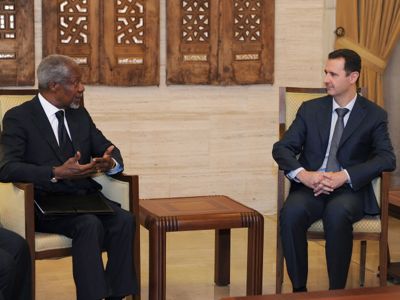
Former UN Secretary General and Nobel Peace Prize, Kofi Annan, has been designated by Ban Ki-moon and Nabil El Arabi as joint special envoy to negotiate a peaceful solution to the Syrian crisis. With Annan’s extraordinary experience and shiny brand image, his appointment was welcomed by all.
What does this top international official really represent? Who propelled him to the highest-ranking positions? What were his political choices, and what are his current commitments? These questions are met with a discreet silence, as if his previous functions were in themselves a guarantee of neutrality.
Handpicked and trained by the Ford Foundation and the CIA
His former colleagues praise him for his thoughtfulness, his intelligence and subtlety. A very charismatic personality, Kofi Annan left a strong imprint behind him because he did not behave simply as the “secretary” of the UN, but more like its “general,” by taking initiatives that revivified an organization that was mired in bureaucracy. All that is known and has been repeated ad nauseam. His exceptional professional qualities earned him the Nobel Peace Prize, although this honor in theory should have been bestowed for personal political commitment, not a management career.
Kofi and his twin sister Efua Atta were born on 8 April 1938, into an aristocratic family of the British colony of the Gold Coast. His father was the tribal chief of the Fante people and the elected governor of Asante province. Although he opposed British rule, he was a faithful servant of the Crown. With other notables, he took part in the first decolonization movement, but looked upon the revolutionary fervor of Kwame Nkrumah with suspicion and anxiety.
In any event, Nkrumah’s efforts led to the independence of the country in 1957 under the name of Ghana. Kofi was then 19 years old. Though not involved in the revolution, he became vice-president of the new National Student Association. It was then that he was spotted by a headhunter from the Ford Foundation who incorporated him into a program for “young leaders.” From there, he was invited to follow a summer course at Harvard University. Having noticed his enthusiasm for the United States, the Ford Foundation offered to sponsor his complete studies, first in economics at Macalester College in Minnesota, followed by international relations at the Graduate Institute of International Studies in Geneva.
After the Second World War, the Ford Foundation, created by famous industrialist Henry Ford, became an unofficial instrument of U.S. foreign policy, providing a respectable facade for the activities of the CIA [1].
Kofi Annan’s overseas study period (1959-1961) coincided with the most difficult years of the African-American civil rights movement (the start of Martin Luther King’s Birmingham campaign). He saw it as an extension of the decolonization he had witnessed in Ghana, but once again did not get involved.
Impressed with Annan’s academic achievements and political discretion, his U.S. mentors opened for him the doors of the World Health Organization, where he landed his first job. After three years at WHO headquarters in Geneva, he was appointed to the Economic Commission for Africa based in Addis Ababa. However, not sufficiently qualified to pursue a career at the UN, he returned to the United States to take up management studies at the Massachusetts Institute of Technology (MIT) (1971-1972). He then attempted a comeback in his home country as director of tourism development, but found himself perpetually at odds with the military government of General Acheampong; he gave up and returned to the United Nations in 1976.
A successful career despite tragic failures
There, he held various positions, initially within UNEF II (the peacekeeping emergency force established to supervise the cease fire between Egypt and Israel at the end of the October 1973 war), then as Director of personnel at the Office of the UN High Commissioner for Refugees (UNHCR). It was at this time that he met and married Nane Lagergren Master, his second wife. The Swedish lawyer is the niece of Raoul Wallenberg, Sweden’s special envoy in Budapest during World War II. Wallenberg is famous for having saved hundreds of persecuted Jews by issuing them protective passports. He also worked for the OSS (forerunner of today’s CIA) as a liaison with the Hungarian resistance. He disappeared at the end of the war, when the Soviets allegedly captured him to stem US influence in the country. In any event, Kofi Annan’s successful marriage opened the doors that he could not have passed through on his own, especially those of Jewish organizations.
Secretary-General Javier Perez de Cuellar chose Kofi Annan as Assistant Secretary-General in charge of human resources management and staff safety and security (1987-90). With the annexation of Kuwait by Iraq, 900 UN employees remained stranded in that country. Kofi Annan was able to negotiate their release with Saddam Hussein, a feat that boosted his prestige within the Organization. He was then successively put in charge of the budget (1990-92) and peacekeeping operations under Secretary-General Boutros Boutros-Ghali (1993-96), with a brief interlude as a special envoy for Yugoslavia.
According to Canadian General Romeo Dallaire, commander of the UN peacekeeping force in Rwanda, Kofi Annan failed to respond to his many appeals and carries the primary responsibility for UN inaction during the genocide (800,000 dead, mainly Tutsis, but also Hutu opponents) [2].
A similar scenario was repeated in Bosnia, where 400 peacekeepers were taken hostage by Bosnian Serb forces. Kofi Annan remained deaf to the calls of General Bernard Janvier and allowed the perpetration of predictable massacres.
In late 1996, the United States vetoed the reappointment of the Egyptian Boutros Boutros-Ghali as Secretary General, regarded as dangerously Francophile. They succeeded in imposing their candidate: a senior official from within the international organization itself, Kofi Annan. Far from playing against him, his failures in Rwanda and Bosnia blossomed into assets after he candidly confessed to them and promised to reform the system so that they wouldn’t recur. He was elected on this basis and took office on 1 January 1997.

Pocantino Conference Center

United Nations Secretary General
Kofi Annan immediately set up an annual two-day seminar behind closed doors for fifteen UN ambassadors. This “retreat” (sic) was generously hosted by the Rockefeller Brothers Fund at the Pocantico Conference Center (upstate New York). There, outside the official framework of the United Nations, the Secretary General discussed the reform of the Organization with the representatives of the States whose support he knew he could count on.
In this context, he reallocated the expenditures of the UN in line with political priorities and significantly reduced the budget of the General Secretariat. He reorganized the administrative functioning around four objectives (peace and security, development, economic and social affairs, humanitarian affairs). He created a post of deputy secretary-general to stand in for him and endowed himself with a real cabinet capable of acting promptly on the decisions of the Security Council and General Assembly.
Kofi Annan’s landmark initiative was the Global Compact, the mobilization of civil society for a better world. On the basis of a voluntary dialogue, businesses, unions and NGOs were brought together to discuss and commit to respect human rights, labor standards and the environment.
In practice, the Global Compact did not yield the desired effect on the ground. On the contrary, it deeply distorted the nature of the UN by playing down the power of nation-states and emphasizing that of transnational corporations and of associations which are “non-governmental” only in name and which are covertly funded by the great powers. By promoting lobbies as partners of the United Nations, Kofi Annan buried the spirit of the San Francisco Charter. It is no longer a question of saving mankind from the scourge of war by recognizing the legal equality of nations large and small, but of improving the human condition by supporting the convergence between private interests.
The Global Compact is a deviation from the nearly universally accepted logic that international law serves the common good, to a logic embraced only by the Anglo-Americans for whom the common good is a chimera and good governance consists in bringing together the largest number of special interests. Ultimately, the Global Compact has had the same effect as the charity galas in the U.S.: to give oneself a good conscience by launching high-profile initiatives while condoning structural injustices.
In that sense, the terms of Kofi Annan (1997-2006) reflect the reality of the historical period, that of a unipolar world subjected to the globalization of U.S. hegemony at the expense of nation-states and the peoples that they represent.
This strategy is in line with the device set up by Washington in the 1980’s involving the National Endowment for Democracy, an agency that, contrary to its title, aims to carry forward the subversive action of the CIA by manipulating the democratic process [3]. The NED subsidizes, legally or not, employers’ organizations, labor unions and associations of all kinds. In return, the beneficiaries participate in the Global Compact, thereby bending the positions of the Nation-States which lack the means to fund their own lobbies. Peace has stopped being a concern for the UN since the unipolar world has its own policeman, the U.S.; thus the organization can concentrate instead on absorbing all forms of protest to better corroborate the global disorder and justify the progressive global expansion of U.S. hegemony.
The soothing rhetoric of Kofi Annan reached its zenith at the Millennium Summit. 147 heads of state and government pledged to eradicate poverty and solve major health problems worldwide, including AIDS, in fifteen years. Universal happiness can dispense with political reform, provided everyone makes an effort and chips in. Why didn’t anyone think of this earlier? But alas, the Millennium remained wishful thinking; injustice was not eradicated and continues to nurture war and misery.
In the same vein, Secretary-General Kofi Annan’s 20 September 1999 speech to the General Assembly outlined what has been termed the “Annan doctrine.” Using his own impotence in Rwanda and Bosnia as an excuse, he argued that in both cases the States had failed in their duty to protect their own people. He therefore concluded that the sovereignty of States, guiding principle of the UN Charter, constitutes an obstacle to human rights protection. The African Union adopted this view under the name of “Responsibility to Protect;” the UN followed suit in 2005 during the World Summit responsible for the follow-up of the Millennium Summit. The Annan doctrine is nothing more than the reincarnation of the right to intervene invoked by the British to wage war against the Ottoman Empire and, more recently, updated by Bernard Kouchner. The new concept will be used explicitly for the first time in 2011 to legalize the colonial operation against Libya [4].
In addition, Kofi Annan’s terms as UN Secretary-General were marked by the “Oil-for-Food” programme which was devised by the Security Council in 1991, but was effective only from 1996 to 2003. It was originally intended to ensure that Iraq’s oil revenues would be used exclusively to meet the needs of the Iraqi people and not to finance new military adventures. However, in the context of the international embargo and under the personal supervision of Kofi Annan, this program became an instrument in the hands of the U.S. and the UK to bleed Iraq while they occupied the “no-fly zone” (which corresponds roughly to the current autonomous Kurdistan region) until the outbreak of the aggression against and destruction of the country [5]. For years, the population was undernourished and deprived of life-saving medicines. Several international officials who were in charge of that program qualified it as a “war crime” and even resigned after refusing to apply it. Among them, the UN Assistant Secretary-General Hans von Sponeck and UN Humanitarian Coordinator Denis Halliday considered that this program brought about the genocide of 1, 5 million Iraqis, including at least 500,000 children [6].
It was not until the invasion and destruction of Iraq that Kofi Annan finally rebelled and denounced those who had paid for his education, propelled his rise to Secretary-General of the UN, and awarded him the Nobel Peace Prize. He described the attack on Iraq as illegal and voiced public concern that this precedent would eviscerate International Law [7] Washington responded brutally with a spying operation against Kofi Annan, his cabinet, his family and even against his friends. The Secretary-General’s son, Kojo Annan, was accused of embezzling “oil for food” program funds with his father’s blessing. The prosecution did not manage to convince UN member states and, on the contrary, consolidated the authority of the Secretary-General [8] However, during the last two years of his mandate, Kofi Annan was paralyzed and forced to toe the line.
Back to square one
After 10 years as Secretary-General, Kofi Annan continued his career in several more or less private foundations.
In December 2007, elections in Kenya degenerated into conflict. President Mwai Kibaki appeared to have defeated the candidate backed by Washington, Raila Odinga, reportedly a cousin of then-Senator Barack Obama. U.S. Senator John McCain challenged the election results and called for revolution as waves of anonymous SMS exacerbated inter-ethnic differences. Within days, riots left more than 1,000 dead and 300,000 displaced. Madeleine Albright proposed the mediation of the Oslo Center for Peace and Human Rights. The institute sent two mediators: former Norwegian Prime Minister Kjell Magne Bondevik and former UN Secretary-General Kofi Annan, both members of the Board of Administration.
As a result of that “mediation,” President Kibaki was forced to bow to U.S. wishes. He was able to stay in office, but first had to accept a constitutional reform that stripped him of his powers in favor of the Prime Minister and to agree to the choice of Odinga as Prime Minister. In his role as wise old African, Kofi Annan helped to give a veneer of legitimacy to a regime change imposed by Washington [9].
Kofi Annan currently exercises two key responsibilities. First, he chairs the Africa Progress Panel, an organization created by Tony Blair after the G8 summit held in Gleeneagles for the purpose of ensuring media coverage of the actions of the British Ministry of Cooperation (DFID). Unfortunately, like the Millennium Summit, the G8 promises were not fulfilled and the activity of the Africa Progress Panel is negligible.
He also serves as chair of the Alliance for a Green Revolution in Africa (AGRA), which aims to solve the food problems of the black continent through biotechnology. In fact, AGRA is a lobby funded by the Bill Gates and Rockefeller Foundations to promote the dissemination of GMO’s produced by Monsanto, DuPont, Dow, Syngenta and others. Most independent experts agree that, beyond the issue of their environmental impact, the use of non-reproductible GMO crops keeps farmers under the thumb of their suppliers and introduces a new form of human exploitation.
Kofi Annan in Syria
So what has this former high-ranking international official come to Syria for? In the first place, his appointment suggests that the current UN Secretary-General Ban Ki Moon, whose image has been tarnished by his kowtowing to the United States and by a string of corruption scandals [10] was not up to the task, while Kofi Annan, despite his balance sheet, still enjoys a positive image.
Secondly, a mediator can succeed only to the extent that he has been selected by the parts in the conflict. But this is not the case. Kofi Annan represents the Secretary-General of the UN and his Arab League counterpart. He defends the honor and reputation of both institutions in the absence of clear political instructions.
If the appointment of Mr Annan was approved de facto by the members of the Security Council and those of the Arab League, it is because it satisfies conflicting expectations. For some, the joint special envoy is not intended to broker peace, but to clad a peace that has already been negotiated between the great powers so that everyone can stand tall. Others expect him to repeat the Kenyan script and bring about regime change without further violence.
Over the past three weeks, the action of Kofi Annan has been to present his own plan, an amended version of the one developed by Russian Foreign Minister Sergey Lavrov. In doing so, he has rendered the plan palatable for Washington and its allies. In addition, Mr. Annan has intentionally introduced an element of confusion by suggesting that he had convinced President al-Assad to appoint one of his vice presidents, Farouk al-Shara, to negotiate with the opposition. This is portrayed as a concession made by Syria to the Gulf Cooperation Council. In fact, Vice President al-Shara has been in charge of these negotiations for a year and the demand made by Saudi Arabia and Qatar is totally different: that President al-Assad should step down because he is an Alawite and that power be transferred to the Vice President for being a Sunni. It would thus seem that the joint special envoy is engineering a way out for those states that have attacked Syria and invented the fable of a democratic revolution crushed in blood.
However, the doublespeak of Kofi Annan, who when in Damascus was satisfied with his meeting with President al-Assad but expressed disappointed once back in Geneva, has not raised any questions about his true intentions.
Related articles
- UN – Arab League envoy hails Syria’s plan acceptance (alethonews.wordpress.com)
Syria and the Annan Plan: The Devil in the Details
By Nicolas Nassif | Al Akhbar | March 27, 2012
While the Syrian regime was pleased with last week’s UN Security Council Presidential Statement on Syria, the Syrian National Council (SNC) was not. It registered its objections, and saw it as providing another chance to President Bashar Assad. Damascus welcomed both the statement and the plan which the UN and Arab envoy to Syria, Kofi Annan, devised after gaining the approval of the international community.
Sources who got to meet high-ranking Syrian officials over the weekend sensed the extent to which the presidential statement was welcomed by Damascus. They also provided some insight into the level of cooperation between Damascus and Moscow on the substance of Annan’s initiative, and their commitment to making a success of it.
While the Syrian leadership supports the general principles of Annan’s plan, it has taken a cautious view of the mechanisms and measures which will need to be taken to implement it.
This stems from a conviction that the devil will lie in details if they are left vague, especially when the time comes for a ceasefire and political dialogue. Accordingly, while Annan completes his talks in Russia and China and prepares to begin implementing his plan, Damascus’ approach will be based on a number of considerations:
1. The initiative must be implemented through the “Syrian state” at all stages: starting with the proposed ceasefire and restoration of calm, extending to the delivery of humanitarian aid, and culminating in a national political dialogue. None of this will occur unless the process for implementing this initiative is approved by the regime and conforms with what it is describes as the “principles of sovereignty.”
Damascus’ position is that it is waiting to see how this initiative will be implemented, while affirming its endorsement of the plan. But the regime insists that any political dialogue about the future of Syria – the end-goal of the initiative – must be held under the auspices of the “Syrian state.”
2. Damascus is greatly satisfied and encouraged by the fact that the presidential statement did not reiterate the demand that the Arab League, France, the US, and Turkey had been insisting on. Namely, that the Syrian president step down and immediately transfer power so a political settlement can be concluded in isolation from him. The regime sees this tacit re-acknowledgement of its authority as a chance to open up dialogue again.
The high-ranking officials insisted to their visitors, however, that Syrian leaders had at no stage been fixated on or alarmed by this demand. They were never under any illusion that, in current international conditions, it was within the capacity of any party, domestic or foreign, to force Assad to step down.
This applies equally to the Syrian opposition, to the many declarations made by US Secretary of State Hillary Clinton and her French counterpart Alain Juppe, the Arab League in its second initiative on January 2, and Qatari, Saudi, and Turkish leaders. Damascus never commented on any of their statements. It declined to get into an argument with them about whether Assad should leave office.
The view put forward by Damascus in defense of its position is that the new Syrian constitution furnishes a mechanism for the transfer or rotation of power. But decapitating the regime – the argument Moscow has also been stressing – would be a recipe for chaos. As the regime sees it, the president stands for the integrity and cohesion of the army and the unity of the country. This position was matched by the similar stand taken by Russia and China against any external foreign military intervention to compel Assad to step down or depose him by force. Also this is why they opposed arming the opposition.
As a result, the international picture has changed significantly since the two countries blocked the attempt to issue a Security Council resolution on Syria on February 4. The threat to force Assad out has been practically dropped – though Arab and Western states may still speak of not just the president’s days, but the regime’s, being numbered – and everybody has opted for a political settlement to be brought about under him.
This approach was reinforced at Russian Foreign Minister Sergei Lavrov’s March 10 meeting with the committee of Arab foreign ministers dealing with Syria. It was confirmed in the appointment of Annan as envoy, and again in the proposals he has put forward, and the Security Council’s endorsement of it last Wednesday.
3. Damascus believes that the real gain it made from the presidential statement was the UN’s acknowledgement that there are two sides to the violence in the Syrian crisis.
This dispensed with the pretext with which the Arabs and the West had armed themselves until Lavrov’s visit to Cairo – namely, that the violence was one-sided, indiscriminate, and practised exclusively by the regime. The existence of armed anti-regime groups was either denied outright, or justified as self-defense.
But the presidential statement, by calling for a ceasefire and end to fighting, conceded that there is another party engaged in violence, and that an armed confrontation is underway. While it did not identify that other party – composed of a combination of Salafis, Muslim Brothers, and deserters – it recognized its existence. This reinforced the regime’s rationale for using decisive military force to try to eliminate members of the armed opposition in Homs, Idlib, and Deir al-Zour, so as to pre-empt any attempt to create buffer zones or similar enclaves in border areas.
Damascus is indebted to Russia and China for supporting its viewpoint and steering the Security Council in the opposite direction to which the Arab League had intended. It had insisted, without hesitation, that the violence was from one side only. The Arab League ignored the report by the chief of its own observer mission, General Mohammed Ahmed Mustafa al-Dabi, and transferred the Syria dossier to the Security Council.
But once there, it did not take long for Moscow’s view to converge with Washington’s over the issue of arming the Syrian opposition. The Americans are wary of Al-Qaeda infiltration of Syrian rebel groups, and fear their weapons could end up reaching the terrorist organization.
4. Damascus believes Annan fully understands the many difficulties involved in his task of bringing about a political settlement. Two sets of these stand out in particular: those connected to convening the proposed national dialogue, and those related to halting the violence on the streets.
Defining the party that will sit opposite the regime at the national dialogue table will be an early obstacle. It is not just that the political opposition, both at home and in exile, is deeply divided. So is the armed component of the opposition, which includes Salafi organizations, the Free Syrian Army (FSA), and the Muslim Brotherhood. The latter are part of the SNC, which has set up its own military bureau and is at odds with the FSA. That in turn is divided between followers of Colonel Riyadh al-Asaad and Brigadier Mustafa Ahmad al-Sheikh.
The political dialogue cannot include the non-SNC armed opposition when it has not yet said who speaks for it. Annan does not know who to talk to in this regard, at least not yet. In the meantime, the political dialogue stands to be between a known actor, the regime, and an undetermined interlocutor, half of which is clandestine, and the other half of which is at odds with itself.
A second obstacle lies in the measures to be taken on the ground to bring about an end to fighting, the withdrawal of gunmen and the army, and the delivery of humanitarian aid to residents of affected areas. Syrian leaders see potential problems in the plans that Annan and his aides devised for arranging these measures and deploying international observers to monitor them.
The Syrian authorities are not simply waiting to see what Annan comes up with in this regard. They have been stressing an issue of extreme sensitivity, which the Syrian leadership considers an absolute necessity for the restoration of normal life to the country: there must be no consolidation of dividing lines between army- and rebel-controlled areas, either in towns or the countryside. Also they have stressed that there must be no deployment of international observers on such lines, which would effectively enforce a fait accompli ahead of political talks.
Damascus has informed all concerned parties that it will not agree to measures which recreate the kind of “confrontation lines” that were established during the Lebanese Civil War, which entrenched the positions of the opposing parties and fuelled the conflict.
It has stressed that a ceasefire must not entail the drawing of such lines inside Syria. Rather, it should result in the disappearance of gunmen and their weapons from the streets, an end to all illegal armed activity, and the reconnection of different parts of the country with each other. Only that would justify ordering the army back to barracks.
Similarly, the task of international observers must not be to monitor a ceasefire, police ceasefire lines, or separate two warring parties, but to monitor the restoration of normalcy in the country. Damascus sees this is as a key point in the Annan initiative which all sides must respect.
Nicolas Nassif is a political analyst at Al-Akhbar.
Related articles
- UN – Arab League envoy hails Syria’s plan acceptance (alethonews.wordpress.com)
- Syrian govt accepts Annan’s 6-point peace plan (rt.com)
UN – Arab League envoy hails Syria’s plan acceptance
Press TV – March 27, 2012
UN-Arab League envoy Kofi Annan has praised the Syrian government for accepting his six-point plan to end the unrest in the country.
“I indicated that I had received a response from the Syrian government and will be making it public today, which is positive, and we hope to work with them to translate it into action,” Annan told reporters after meeting Chinese Premier Wen Jiabao.
In a Tuesday statement, Annan’s spokesman Ahmad Fawzi confirmed that Damascus has written to the Joint Special Envoy Kofi Annan accepting his six-point plan, endorsed by the United Nations Security Council.
Fawzi added that Annan views this as an important initial step that could create an environment conducive to a political dialogue that would fulfill the legitimate aspirations of the Syrian people.
Annan’s proposal includes a ceasefire, access for humanitarian aid agencies as well as political dialog between Damascus and the opposition.
Earlier, the Chinese premier expressed his support for Annan’s efforts for a peaceful end to the crisis.
Meanwhile, Russian President Dmitry Medvedev has said Western calls on President Bashar al-Assad to step down are short-sighted, adding that Assad’s departure will not end the conflict in Syria.
Syria has been experiencing unrest since mid-March 2011.
Related articles
- Syrian govt accepts Annan’s 6-point peace plan (rt.com)
- Syria’s future ‘matter for Syrians’ – Annan (laaska.wordpress.com)
Featured Video

Rewriting the risk? Inside the government’s vaccine safety messaging
or go to
Aletho News Archives – Video-Images
Book Review
“Davos Can Really Replace the UN”
Inside the book that maps the architecture behind global governance — from the Epstein files to the Pact for the Future
Lies are Unbekoming | April 1, 2026
On June 13, 2019, the United Nations and the World Economic Forum signed a partnership deal to “accelerate the implementation of the 2030 Agenda for Sustainable Development.” That same evening, WEF president Börge Brende — Norway’s former Foreign Minister — had dinner with Jeffrey Epstein at Epstein’s Manhattan townhouse. The Epstein files, released January 2026, contain an exchange between the two from the previous year. Epstein to Brende: “Davos can really replace the UN. C21, cyber, crypto . genetics… intl coordination.” Brende back to Epstein: “Exactly — we need a new global architecture. World Economic Forum (Davos) is uniquely positioned — public private.”
The next day, the UN General Assembly adopted the framework for restructuring global governance.
That sequence — the partnership signing, the Epstein dinner, the candid admission about replacing the UN with a public-private architecture, and then the formal adoption — opens Jacob Nordangård’s The Digital World Brain. Pages two and three. Footnoted to the UN resolution number, the Epstein files, and the General Assembly record.
I keep coming back to it because it captures what this book does that almost nothing else in the independent research space manages. I’ve followed Jacob’s work for years now and interviewed him about his research. Each book peels back another layer of the same institutional architecture, and each time I think he’s reached the limit of what can be documented, the next one goes further. Nordangård doesn’t speculate. He doesn’t editorialize much. He lays institutional actions next to each other in chronological order and lets the pattern announce itself. … continue
Blog Roll
 Aletho News
- How I fell foul of the BBC thought police
- The End of NATO
- 37 days of war on Iran cost US staggering $42bln, tracker shows
- Baghdad tells Asian refiners, traders to begin loading Iraqi crude amid Iranian exemption
- Under fire, Moscow and Tehran close ranks
- Iran, US receive Pakistan-mediated plan for ceasefire then final deal
- Iran submits demands for end to war as mediators scramble ahead of Trump deadline
- Iran Threatens Retaliatory Strike on Stargate AI Project in UAE
- US sent ‘a lot’ of arms to Iranian protesters – Trump
- Barak Ravid Launders Deception To Allow Trump To Back Off Of His Power Plant Threat – Again
- If Americans Knew
- Israel’s Latest Genocide Is Against the Shias of Lebanon. Why Is the World Silent?
- How Eliot Cohen’s influence over U.S. war-making paved the way for Trump’s war crimes in Iran
- Israelis don’t pay for the weapons we ‘sell’ to them — US taxpayers do
- While Distancing from AIPAC, Most 2028 Democratic Hopefuls Are Still Embracing Israel
- A brief history of the Israeli nuclear program, the open secret at the heart of the Iran war
- Israeli Settlers Killed a Palestinian Farmer on His Own Land, in Front of His Father. Yes, Again
- The US-Israeli War on Science is an Assault on our Future
- 100+ International Law Experts Say US Strikes on Iran Violate UN Charter, Could Be War Crimes
- ‘Vile, Horrifying, Evil’: Trump Threatens to Bomb Nation of 90 Million People ‘Back to the Stone Ages’
- The Axis of Resistance: Islamic Liberation Theology and the Struggle for Freedom
- No Tricks Zone
- An Inconvenient Tree: Uncovered In Alps… Europe Much Warmer Than Today 6000 Years Ago
- New Study Reports A 60% Slowdown In Greenland’s Ice Loss Rate In The Last Decade
- Low Intensity Tornado Wrecks Major Solar Farm, Creating A Potential Toxic Dump
- New Study Finds Warming Saves Lives…Cold Temperatures 12 Times More Deadly Than Excess Heat
- German Science Blog Accuses PIK Climate Institute Of Hallucinating Climate Tipping Points
- Devastating Assessment Of Comirnaty Vaccine By Former Senior Pfizer Europe Toxicologist
- New Study: CO2 Is ‘Effectively Negligible’ As An Explanatory Climate Change Factor Since 2000
- Former Pfizer Toxicologist Dr. Helmut Sterz Tells Bundestag Hearing Pfizer Vaccine Should Have Never Been Approved
- Energy Expert: Germany’s Nuclear Phaseout Was A “500 Billion Euro Mistake”
- New Research: South Australia’s Mid-Holocene Sea Surface Temperatures Were 4°C Warmer Than Today
 Aletho News