Responding to American criticism of its recent missile launch, North Korea has accused Washington of denying its right to self-defense, even as the US holds war games at the country’s doorstep and tests advanced weaponry.
“It’s a gangster-like logic that it is allowable for the US to ship the strategic nuclear assets into the Korean peninsula and launch ICBMs any time it wants but not allowable for the DPRK, its belligerent party, to conduct even a test of a tactical weapon,” senior North Korean official Ri Pyong-chol said in statement on Saturday.
The comments came after US President Joe Biden condemned a series of missile launches by Pyongyang, which test-fired several newly developed “tactical guided missiles” on Thursday, with the US leader vowing to “respond accordingly” if North Korea opted to “escalate.”
Defending the launches, Ri argued that the guided missile test was merely an “exercise of the full-fledged right of a sovereign state to self-defense,” given that the US and its allies routinely flex their military muscles in the region with “dangerous war exercises” and are happy to arm themselves with advanced weapons.
Ri appeared to reject speculation that the rocket launches, all conducted within a span of a week in the run-up to Biden’s much-anticipated first solo press conference on Thursday, were meant to send a signal to the new administration.
“We are by no means developing weapons to draw someone’s attention or influence his policy,” the official said. Ri, who according to North Korea’s state media, oversaw the latest launch, went on to denounce Biden’s vow of retaliation as “an undisguised encroachment” on North Korea’s right to self-defense and “provocation,” warning that the US “may be faced with something that is not good” if it continued such rhetoric.
The missiles test-fired on Thursday were described by the Japanese and South Korean militaries as ballistic missiles. While North Korea is banned from testing ballistic missiles under UN Security Council resolutions, Washington is not bound by such constraints. Last month, the US military fired an unarmed LGM-30G Minuteman III intercontinental ballistic missile (ICBM) from a California base, with the US Air Force saying that the launch showed that Washington’s “strategic deterrent is safe, secure and effective.”
“Our nation’s ICBM fleet stands ready 24/7,” Lieutenant General Anthony Cotton, deputy commander of the Air Force’s Global Strike Command, said at the time.
Earlier this month, the US and South Korea held a nine-day joint military exercise that was scaled back this year due to the Covid-19 pandemic. The scope of the annual computer-simulated drills has been limited since the previous US administration attempted to strike a denuclearization agreement with Pyongyang, though the effort ultimately failed after Washington refused to provide any sanctions relief until North Korea carried out “complete and irreversible” denuclearization.
March 27, 2021
Posted by aletho |
Militarism, Progressive Hypocrite | Joe Biden, Korea |
Leave a comment
US hostility toward North Korea is all about its freedom from imperial control.
It’s unrelated to alleged threats from its ruling authorities that don’t exist.
Since the Korean peninsula was divided post-WW II, the DPRK never attacked another nation.
It threatens none now — except in self-defense against aggression, its legitimate UN Charter right.
North Korea is an invented US enemy, not a real one.
Its nuclear weapons and ballistic missile capabilities are solely for defense.
They’re deterrents against possible US aggression.
DPRK ruling authorities know that what happened in the early 1950s can repeat because of US imperial rage to dominate other countries, including by brute force.
On Thursday, Japanese Prime Minister Yoshihide Suga said Pyongyang launched two ballistic missiles that landed outside Japan’s exclusive economic zone.
Claiming the test launches threaten regional security defy reality.
Yet the Kyodo news agency reported that Japan is holding an emergency National Security Council meeting in response to the tests.
They were the first North Korean ballistic missiles launched since March 2020.
An unnamed Biden regime official confirmed the launch, saying the Pentagon and US intelligence are analyzing the tests.
It’s unclear if short, intermediate or long-range missiles were launched.
According to South Korea’s Yonhap news agency, the country’s military confirmed “at least one unidentified projectile” launched by North Korea.
In response to provocative US/South Korean military exercises near its territory, Pyongyang condemned them and launched several short-range missiles last weekend.
North Korean leader Kim Jong-un’s sister Kim Yo-jong slammed ongoing US/South Korean military drills, saying:
If Seoul “resort(s) to more provocative acts, we may take a special measure of resolutely abrogating even the north-south military agreement,” adding:
“Perhaps they are expecting ‘flexible judgment’ and ‘understanding’ from us but it is, indeed, ridiculous, impudent and stupid.”
“War drills and hostility can never go with dialogue and cooperation.”
Weeks earlier in a joint Biden regime/South Korea press release, their foreign ministers agreed on pushing for denuclearization of North Korea, calling it a matter of urgency.
Ignored was nuclear armed and dangerous USA and its key imperial partners.
They pose an unprecedented threat to world peace — in sharp contrast to North Korea threatening no one.
Its KCNA news agency earlier slammed Biden, calling him a “rabid dog (in) the final stage of dementia.”
As part of its propaganda drumbeat against nations free from US control, the NYT called North Korea’s missile tests “a show of force, raising tensions to gain leverage as the Biden (regime) finalizes its review of Washington’s North Korea policy,” adding:
“It was a warning to Washington that North Korea will follow up with more provocative tests (sic), involving longer-range missiles, depending on whether Biden decides to adopt more sanctions, engage in dialogue or a mix of both in dealing with the country’s growing nuclear and missile threats (sic).”
Weeks earlier, North Korea’s leadership announced plans to upgrade its nuclear capabilities.
It’s developing miniaturized nuclear warheads, tactical nuclear weapons, multiple independently-targetable reentry vehicles (MIRVs), solid-fuel ballistic missiles of varying ranges, nuclear propulsion systems for submarines, and hypersonic weapons.
Kim Jong-un stressed the importance of strengthening the country’s ability to deter aggressors from launching attacks.
If the above capabilities are developed, they’ll be powerful deterrents against possible US aggression.
March 27, 2021
Posted by aletho |
Militarism | Korea, United States |
Leave a comment
I’m not sure what good it did for the Cold War to end, given that the U.S. government has done everything it could since then to gin up hostilities, tension, and conflict with the communist and former communist world.
When Russia expressed a desire to have friendly relations at the start of the Trump administration, the Pentagon and the CIA went ballistic over that “attack” on their financial well-being. That’s when the big brouhaha over Trump supposedly being a covert Russian agent got launched, which played a major role in derailing his presidency.
Don’t forget also how NATO, under U.S. orders, began gobbling up former Warsaw Pact countries with the ultimate aim of absorbing Ukraine, which would have put U.S. nuclear missiles on Russia’s border and also would have put Crimea under the control of the U.S. military-intelligence establishment.
When China expressed a desire to have friendly relations with the U.S., President Trump launched his vicious trade war against the country, with the aim of preventing China from becoming more prosperous and more powerful. That’s what empires have done throughout history — launch preemptive strikes against rising nations, which are viewed as “adversaries,” “rivals,” “opponents,” “enemies,”or some other such imperialist nonsense.
And then there is North Korea, where the U.S. government intervened in the 1950s as part of its much-vaunted Cold War racket, in which the Pentagon and the CIA convinced Americans that the Reds were coming to get us. If the U.S. didn’t sacrifice tens of thousands of American men in the Korean civil war, U.S. officials maintained, it wouldn’t be long before the commies were running America’s public schools and our Interstate Highway System.
Today, the mainstream media is announcing that North Korea is “challenging” the Biden administration with the firing of what appear to be ballistic missiles. Question: Why aren’t the military exercises that the Pentagon conducts with South Korea considered to be “challenging” North Korea? Isn’t it possible that North Korea is simply responding to the “challenge” that the U.S. is posing to North Korea with its provocative military exercises?
Moreover, what about those cruel and brutal sanctions that U.S. officials continue to enforce against North Korea? They continue to target the North Korean people with death and economic impoverishment. Why aren’t those economic sanctions considered to be “challenging” North Korea? After all, given that their aim is to bring death to innocent people in the hope of achieving a political goal, how are they different from acts of terrorism?
It is the U.S. government — and specifically the U.S. national-security establishment — that is at the heart of the never-ending crisis in Korea, just as it is at the heart of the crises with China and Russia. The U.S. national-security establishment has never wanted to let go of its Cold War communist enemies, which enabled the Pentagon, the CIA, and the NSA to wallow in ever-increasing budgets, powers, and influence.
Crisis is the name of the game in the national-security state racket. The more crises, the better. If the communists won’t fit the Bill, there is always the war on terrorism … or Muslims … or Syria … or Venezuela … or whatever.
There is one reason for North Korea possessing nuclear weapons — to deter U.S. attacks on North Korea or, in the event the Korean War resumes, to defend against U.S. attacks on North Korea. Why should anyone be surprised when a Third World country wants to acquire nuclear weapons to defend itself from the Pentagon and the CIA and their policy of violent regime change?
Just ask the Iraqi people about that. They never attacked the United States. Nonetheless, the Pentagon attacked them, viciously, killing, torturing, and destroying hundreds of thousands of innocent people. It was nothing less than a “war of aggression,” a type of war declared a war crime by the Nuremberg War Crimes Tribunal.
There is something important to note about the U.S. war on Iraq: That Third World country didn’t have nuclear weapons. U.S. officials had nothing to fear from Iraq defending itself against the U.S. war of aggression.
Or ask the Cubans, another Cold War boogieman that U.S. officials claimed for 45 years posed a grave threat to “national security.” That was how the CIA justified its state-sponsored murder schemes against Cuban officials. It’s also how they justified an economic embargo aimed at killing innocent Cuban people as a way to achieve regime change on the island. It’s also what the Pentagon used as a justification to present its fraudulent Operation Northwoods plan to President Kennedy in the hopes that he would use it as an excuse to invade Cuba.
When Cuba brought in Soviet nuclear missiles, Kennedy agreed that there would be no invasion of the island in return for a Soviet withdrawal of the missiles. How could North Korea and every other Third World nation not see that?
It’s probably worth mentioning that although the Cold War ended decades ago, the U.S. government continues to target the Cuban populace with its vicious and brutal economic embargo. Hey, don’t forget: those Cuban Reds are only 90 miles away from American shores!
There is something else to note about U.S. troops in Korea. The war they are fighting is illegal under our form of government, given that Congress has never declared war on North Korea, as our Constitution requires. Don’t the troops take an oath to support and defend the Constitution?
The only thing that surprises me in this entire national-security state racket is that the Pentagon, the CIA, and the NSA aren’t stirring up trouble in Vietnam. Hey, those dominoes could still start falling any day now!
March 26, 2021
Posted by aletho |
Militarism, Timeless or most popular | CIA, Cuba, Korea, NSA, United States |
Leave a comment
In a Washington Post opinion piece, U.S. Secretary of State Antony Blinken and Defense Secretary Lloyd Austin spelled out their objectives in visiting Japan, South Korea, and India. “The United States is now making a big push to revitalize our ties with friends and partners,” they wrote. The nature of those relationships, as perceived by Washington, is the subordination of Asian nations as junior partners in an anti-China coalition. “Our alliances are what our military calls ‘force multipliers,’ Blinken and Austin explain. “Our combined power makes us stronger when we must push back against China’s aggression and threats.” [1]
That approach found a receptive audience in meetings with Japanese officials, who recognize it as offering a path to remilitarization. Results in South Korea were more ambiguous. By a substantial margin, China is South Korea’s primary trading partner, and relations between the two nations are generally solid. South Korea has no rational reason to join Washington’s fanatical anti-China campaign, no matter how much pressure the United States applies. A difference of opinion between Washington’s envoys and South Korean officials can be inferred by comparing the joint U.S.-Japan statement with South Korea’s, as only the latter lacked China-bashing verbiage.
Blinken and Austin appear to have been more successful in reminding South Korean officials that no independent action should be taken to improve inter-Korean relations and in making it understood that Washington calls the shots. The two sides agreed to establish a “working-level diplomatic dialogue” process to align policy regarding North Korea and other matters. [2]In their joint statement, Korean and American officials affirmed that their two nations “are closely coordinating on all issues related to the Korean Peninsula” and that “these issues should be addressed through a fully-coordinated strategy toward North Korea.” [3]
Not that Blinken and Austin found their position on North Korea a hard sell. Although peace and improved inter-Korean relations matter deeply to South Korean President Moon Jae-in, he attaches more importance to the military alliance with the United States. In an article published at the end of 2019, Moon argued, “No matter how desperately peace is desired, Korea cannot afford to race ahead on its own. It has counterparts and must move within the international order.” Support from the “international community” is needed, Moon claims, while using the standard term signifying the several thousand people at the top rungs of power in the United States and excluding the nearly eight billion people in the rest of the world’s population. [4] Moon’s statement is consistent with other comments he has made, such as in his New Year’s address, where he stated, “If we can draw support from the international community in the process,” then the door to peace will “open wide.” [5] No role there for South Korea, other than as supplicant.
Joint U.S.-South Korean military exercises were well underway during Bliken’s and Austin’s time in Seoul. Due to COVID-19 restrictions, war games were conducted via computer simulation. Concurrently, the U.S. deployed F-22 Raptor stealth fighters to participate in joint exercises with the Japanese military. [6] According to a South Korean military official, “The deployment is significant as an alert to North Korea as well as deterrence to China, given F-22s’ operational radius and performance.” [7]
None of this went unnoticed in Pyongyang. Kim Yo Jong, Vice Department Director of the Central Committee of the Workers’ Party of Korea, dismissed South Korean claims that the military exercises are defensive. While no details of the drilled scenarios have been publicly released, past war games customarily practiced the bombing and invasion of North Korea as well as sending commando teams into the north to assassinate government officials. There is no reason to suppose that the latest exercises pose a unique exception. Kim called the “launching of a war game against” her nation “a serious challenge” and pointed out that the “essence and nature of the drills” never changes, regardless of what form they take. [8]
It was not the first time that Pyongyang has expressed frustration over the discrepancy between Moon’s rhetoric on inter-Korean relations and his actions. Similar complaints were raised last June. By hitching its wagon to the U.S. military, the Moon administration is seriously straining ties with the north. “War drill and hostility can never go with dialogue and cooperation,” Kim stated. If South Korean authorities “persist in hostile acts” that deny dialogue and “destroy the foundation of trust through ceaseless war games,” then Pyongyang may abrogate some of the inter-Korean agreements it had signed. [9]
Some aspects of the Panmunjom Declaration, signed on April 27, 2018 by Moon Jae-in and Kim Jong Un, are already a dead letter. Certainly, the affirmation of “the principle of determining the destiny of the Korean nation on their own accord” has never been put into practice, as the Moon administration is unwilling to act without U.S. permission. Nor have any “practical steps” been adopted to connect and modernize rail and road connections or steps been taken to “actively implement” inter-Korean economic agreements signed in 2004. [10] After all, Washington would not approve.
“Pyongyang is pressing Seoul not to talk nonsense in the upcoming meeting with Blinken and Austin,” observed Kim Il-gi, a senior researcher at South Korea’s Institute for National Security Strategy. “And the message goes to the U.S., as well.” [11] A message, one cannot help noting, that inevitably fell on deaf ears.
The United States, too, is hoping for a change in South Korea’s approach, albeit in a decidedly different direction than that sought by North Korea. A recent report by the Atlantic Council’s Scowcroft Center for Strategy and Security is typical of the recommendations being churned out by Washington think tanks. “The Republic of Korea and the United States should broaden their military alliance into a national security alliance in order to more effectively deal with the challenges and opportunities of this new era,” it states. Predictably, the Center lists China as the top challenge and argues that the U.S.-South Korea alliance “must be prepared to continue to deter and dissuade” China from “considering any further aggression.” South Korea ought to “prioritize security cooperation” with Southeast Asian nations “on behalf of the alliance,” the Center argues. Furthermore, “as NATO goes global in its approach in response to the challenges posed by China…NATO’s partnership with the Republic of Korea will increase in importance.” [12]
The Scowcroft Center recognizes that reliance on Chinese trade presents a roadblock in persuading South Korea to join Washington’s anti-China campaign. What South Koreans may happen to want is not a question the Center ever troubles itself with, other than to bemoan that it is necessary to “avoid forcing the Republic of Korea to make explicit, public choices in disputes between the United States and China.”
But less overtly, South Korea can be slowly moved into that position. The Center expects South Korea to join U.S. “efforts to reform international rules and institutions,” a euphemism for American plans to cut China off from much of its international trade. Several measures are recommended that South Korea “should” adopt to align its economy with U.S. regional goals. In addition, to chip away at Chinese-Korean trade, “The Republic of Korea should join the US efforts to diversify its supply chains” and avoid “over-reliance on a single country.” [13] The essential task for South Korea, the Center insists, is that “much more must be done to reduce dependence on Chinese supply chains and protect key industries from” what it laughably calls “predatory Chinese practices.” Washington expects nations it regards as subordinates, such as South Korea, to act as pawns in maintaining American hegemony against challengers such as China.
Despite North Korea’s concerns, it appears that a resumption of full-scale military exercises on the Korean Peninsula may be on the horizon. Currently, the United States holds operational control (OPCON) over South Korean military forces in wartime. The Moon administration hopes to regain OPCON before the expiration of its term in office. Still, the key condition for doing so is completing full-scale live-action military drills to evaluate the concept. [14] According to a South Korean military source, Seoul wants to test Full Operational Capability (FOC) with a full-scale exercise in the second half of this year. [15] A successful assessment would leave only one official step, Full Mission Capability (FMC), to be completed before OPCON transfer could proceed.
Transfer of OPCON is long overdue, but predicating progress toward that decision on a resumption of live-action drills can be counted on to place a further strain on inter-Korean relations, which no doubt Washington regards as a bonus. Indeed, roiling inter-Korean waters may be the only result produced by full-scale military exercises. Robert Abrams, U.S. Forces Korea (USFK) commander, maintains that it is not enough for Seoul to pass the three official assessment stages; it would have to meet an additional 26 requirements. [16] It is a formula perfectly calculated to compel South Korea to resume live military drills while imposing endless conditions that will continually postpone OPCON transfer so that it may never take place.
Currently, relations between South Korea and Japan are at a low point over the unresolved issue of Imperial Japan’s “comfort women” system of sexual slavery, as well as Japanese trade restrictions on South Korea. The rift in relations is problematic for Washington, as it wishes to assign both nations the key role among junior partners in confronting China. As a U.S. State Department fact sheet explains, in “working to strengthen America’s relationships with our allies…[n]o relationship is more important than that between Japan and the Republic of Korea.” [17] Moon promised Blinken he would continue to reach out and try to resolve disputes with Japan. [18] However, previous conciliatory messages sent from South Korea to Japan since the Yoshihide Suga administration’s inauguration have gone unanswered. [19]
The Biden administration is currently undertaking a review to determine details of its North Korea policy, and it has attempted to contact North Korean officials through various channels. The content of the messages is not publicly known, but the Biden administration has indicated in general an intention to add other demands along with that of denuclearization. Piling on demands is not a promising approach for initiating dialogue.
North Korea chose not to respond to the Biden administration’s attempts at contact. In a statement issued during Blinken’s and Austin’s stay in Seoul, North Korean Vice Minister of Foreign Affairs Choe Son Hui explained that no communication or dialogue “of any kind can be possible unless the U.S. rolls back its hostile policy.” She took due note of the Biden administration’s harsh rhetoric and military activities aimed against North Korea. What North Korea is asking for is a change of tone, one that would be conducive for establishing dialogue “on an equal basis.” [20]
A more diplomatic attitude would seem not to be a tall order, but it is constitutionally foreign to the Washington establishment’s nature. It can be anticipated that President Moon may urge Biden to soften the administration’s public comments to encourage a resumption of dialogue. Whether anyone in Washington will be listening is another matter. When U.S. policymakers talk about South Korea and the United States needing to closely coordinate North Korea policy, what they have in mind is a one-way process in which the U.S. decides, and South Korea follows. On China, Seoul can expect to be subjected to mounting pressure to reduce trade, thereby providing Washington with more leverage in attempting to bully it into joining the belligerent U.S.-led anti-China alliance. The one certainty is that respect for South Korean sovereignty is not in the cards.
Notes.
[1] Antony J. Blinken and Lloyd J. Austin III, “America’s Partnerships Are ‘Force Multipliers’ in the World,” Washington Post, March 14, 2021.
[2] “S. Korea, U.S. to Launch New Working-level Policy Dialogue Aimed at Cementing Alliance,” Yonhap, March 18, 2021.
[3] “Full Text of Joint Statement of 2021 S. Korea-U.S. foreign and Defense Ministerial Meeting,” Yonhap, March 18, 2021.
[4] https://english1.president.go.kr/Media/Interviews/541
[5] https://english1.president.go.kr/BriefingSpeeches/Speeches/931
[6] Nick Wilson, “Hawaii-based F-22s Land at MCAS Iwakuni to Support DFE Concept,” Pacific Air Forces, March 16, 2021.
[7] Sang-ho Yun, “U.S. Deploys F-21 [sic] Raptors in Japan,” Dong-A Ilbo, March 18, 2021.
[8] “It Will be Hard to See Again Spring Days Three Years Ago,” KCNA, March 16, 2021.
[9] “It Will be Hard to See Again Spring Days Three Years Ago,” KCNA, March 16, 2021.
[10] Panmunjom Declaration for Peace, Prosperity and Unification of the Korean Peninsula, April 27, 2018.
[11] Won-gi Jung, “South Korea Defends Military Exercises After Kim Yo Jong Threatens Retaliation,” NK News, March 16, 2021.
[12] https://www.atlanticcouncil.org/in-depth-research-reports/report/the-future-of-the-us-rok-security-alliance/
[13] https://www.atlanticcouncil.org/in-depth-research-reports/report/the-future-of-the-us-rok-security-alliance/
[14] Mitch Shin, “South Korea, US to Prepare to Conduct Joint Military Exercise,” The Diplomat, March 2, 2021.
[15] Elizabeth Shim, “Reports: U.S., South Korea to Commence Scaled-down Military Exercises,” UPI, March 4, 2021.
[16] Lee Chul-jae, Kim Sang-jin, Shim Kyu-seok, “Opcon Timing Dashes Moon’s Hope for Transfer,” JoongAng Ilbo, January 24, 2021.
[17] https://www.state.gov/reaffirming-the-unbreakable-u-s-japan-alliance/
[18] Lee4 Chi-dong, “Moon Vows Efforts to Improve Japan Ties in Talks with Biden Aides,” Yonhap, March 18, 2021.
[19] Sarah Kim, “U.S. Working as Middleman to Help Korea-Japan Relations,” JoongAng Ilbo, March 15, 2021.
[20] “Statement of First Vice Foreign Minister of DPRK,” KCNA, March 18, 2021.
March 25, 2021
Posted by aletho |
Economics, Militarism | Korea, United States |
Leave a comment
On February 21, 2021, South Korean media outlets reported that four North Korean defectors plan to sue Unification Minister Lee In-young for defamation over his recent remarks casting doubt over what defectors say about the North’s human rights situation. The matter is that on February 3, Lee said during a press conference with foreign media reporters that human rights-related testimonies of North Korean defectors “lack a process of checking and verifying” their validity.
The four defectors affirmed that Lee deemed their testimonies as “untrustworthy lies”, while their stories represented just the tip of the iceberg of the horrible plight happening in North Korea. “Speaking to the foreign press as if their testimonies are lies is an act threatening the defectors who fled (to the South) for freedom”.
In addition, the complainants believe that Lee was unable, or is unwilling, to protect North Korean defectors and improve the human rights situation in North Korea, although this is a key responsibility borne by the Ministry of Unification. The fact is that South Korea for two consecutive years opted out of co-sponsoring a North Korean human rights resolution at the UN. Seoul sponsored the bill from 2008 to 2018, but decided not to do so in 2019 or 2020, drawing heavy backlash from the country’s conservative lawmakers as well as professional “fighters against the North Korean regime”.
At a February 22 press conference, a spokesperson for the Ministry of Unification “sweetened the pill” just in case, declaring that the testimony given by North Korean refugees was “valuable material” to help shed light on the human rights situation in that closed country. He added that their words are constantly being heeded in Seoul to create an “accurate picture” of the situation occurring in the North. In addition, it was reported that while the complainants assert that Lee In-young considered their testimony to be “untrustworthy lies,” in fact the minister simply stated that their statements could not be verified. That is no wonder, because according to South Korean law, libel can be punishable by up to two years in prison, or a fine of up to 5 million won (4,520 USD). Moreover, the laws do not speak about libel, but about defamation of character, when a person can be incarcerated for the truth if that causes reputational or moral damage.
But for the author, the fuss over the lawsuit raises the issue about to what extent the testimony given by the DPRK defectors represents a valid source, especially when it comes to heartbreaking stories of human rights violations.
The problems with defectors’ testimony can be broken down into two groups. The first has to do with the testimony of witnesses in general, and these difficulties are well comprehended by specialists.
First, not a single witness can remember a situation with complete accuracy. When people remember an event after a long time has passed, they deliberately or unwittingly distort the details involved. Second, the witness may misunderstand what is perceived. The most striking example is the statement made by one Russian journalist that there is no central heating in the DPRK because he did not see any radiators anywhere. However, in both the North and South of Korea, the traditional heating system is a “warm floor”, where the space heating system runs underneath it. Third, knowing the consequences of their actions, witnesses often engage in self-justification, or position themselves as having guessed everything from the very beginning, which makes the events in their recitals look more predictable and “orderly” than they are in reality. Fourth, people who have experienced traumatic experiences have a need to speak out and try to purge themselves of certain experiences.
That is why reconstructing events according to testimony that is given is usually done by comparing the testimony from several people. If the story told by one person may be inaccurate or biased, then describing an event from the hearsay given by numerous witnesses makes that picture more complete.
However, in regard to defectors, the issue of counterchecking their testimony runs up against certain difficulties: these people fled during different periods of time, from different places, and therefore it could be difficult to find two opinions about the same event.
And this is important, because while stories that buck against a certain trend usually elicit a desire to cross-check them (with the hope of refuting them), when a person who is a personal witness to something says things that fit well into the procrustean bed of underlying expectations, nobody counterchecks something “that is common knowledge”. Everyone already knows the recipe for the main course, and a specific story will only differ in the proportion of spices used, or where the side dish is located on the plate.
Now let’s focus on the idiosyncrasies that directly have to do with defectors from the DPRK, for whom storytelling is often an important way to improve their social status and financial situation.
First, it is important who is interviewing the defector. Son Ji-young, who has interviewed refugees for over 20 years, notes how much everything depends on how well the researcher is acquainted with a person’s context: it is easier to “pull the wool over white foreigners’ eyes”, since they do not understand the context in the same way that a Korean does.
Second, people interviewing defectors often perceive them as victims rather than witnesses. Generally speaking, they arouse sympathy in the interviewers, by virtue of which interviewers are less critical of what they hear, and therefore they do not have the desire to expose the narrator stating lies, or look for inconsistencies in the testimony.
Third, defectors try to make sure that interviews are held with them regularly and constantly, since for most defectors the fees they charge are a major increase in their income. This means that the defector can adapt to their interlocutors, and tell them things that they would like to hear. And if a fairly inexperienced interviewer gives tips about desirable responses with questions, such as “have you witnessed mass rapes at the stadium?” then the other party in the conversation may take this question as a cue to talk about that, regardless of whether he or she even saw it, heard some rumors about it, or simply thought it all up.
Some defectors embellish, exaggerate or trade their stories for money, she and other defectors said. Finally, it must be understood that the life of defectors in the South is closely controlled by the National Intelligence Service, which closely monitors the activity of defectors, and if something like “singing the praises of North Korea” is observed then they could face penalties under the National Security Act, and then the reputation of being a North Korean spy. Someone that has escaped from a totalitarian hell must expose the regime, not defend it.
These factors lead to the fact that within a set of defectors a subset of those forms that can be called “career defectors”. The most typical example is Shin Dong-hyuk. Back in 2014, his testimony was considered valid, and the basis of that the well-known UN Report on Human Rights in North Korea was drafted, drawing a direct comparison between the DPRK and Nazi Germany. However, already by early 2015 even its official co-author Blaine Harden “was forced to make an announcement that Shin admitted to making up most of his heartbreaking stories, which he fabricated to heighten their dramatic quality, and he needs to be pronounced an unreliable storyteller.
Nonetheless, in this kind of environment lying about the DPRK is not only allowed, it is something that is desirable. Kim Seong-min, the founder of Free North Korea Radio, in one of his interviews directly responded to a question about his attitude toward the most fantastic rumors that sometimes spread about what is happening in the North: “Any stories – whether they are truthful or not – are good, as long as they do not put the DPRK in a favorable light”.
However, a slew of widespread errors can be encountered in the stories told by this kind of community. They can be used to identify an “unreliable storyteller” whose testimony should be counterchecked at a minimum. The most obvious one is when the stories begin to resemble a “soap opera”, and narrators drastically overdo it with “heartbreaking details” that are aimed at evoking emotions.
A typical example of this is one quote from the stories by the famous defector Lee Soon-ok:
“… they use a kiln to bake bricks. When the newly fired bricks are removed, they push a person into this furnace. In a matter of seconds, the victim suffocates and loses consciousness… I resisted the best that I could, and burned by palms… Then they put me barefoot in the snow. As a result, I lost my toes…”
All that is left for the author to add is that the temperature in that furnace at that particular time was about 800 degrees.
As a result, while the testimony by defectors on other topics could be credible (especially when it comes to the body of testimony or conversations with ordinary, rather than career, defectors), the topic of human rights really does require additional verification. Otherwise, we get “boiled babies”, and one important problem gets its ears chewed off by fictitious stories. The more heartbreaking a story is, the more caution a scientist or journalist needs to take.
But unfortunately, given the power anti-Pyongyang propaganda has, attempts to cast doubt on this testimony provokes a reaction: “Those who have gone through such horrors cannot lie, and if you dare to doubt their words, then you yourself are no better than their executioners”. And these kinds of lawsuits are one consequence of that.
Konstantin Asmolov, PhD in History, is a leading research fellow at the Center for Korean Studies of the Institute of the Far East at the Russian Academy of Sciences.
March 10, 2021
Posted by aletho |
Deception, Fake News, Mainstream Media, Warmongering, Timeless or most popular | Korea |
Leave a comment
On February 25, 2021, the United States District Court for the District of Columbia ordered North Korea to pay 2.3 billion USD in compensation for damages to the crew of the USS Pueblo, which was hijacked in 1968. The American side claims that a marine research vessel was seized that was in international waters at the time of the incident. One of the 83 crew members was killed, and the rest were released after 11 months while “incessantly subjected to mental and physical abuse during their captivity”.
This process became possible after the US Congress passed the Justice Against Sponsors of Terrorism Act in 2016, which allows lawsuits in these kinds of high-profile cases to be heard in federal courts. For the lawsuit to be accepted, the country must be on the appropriate list, and the DPRK wound up there after Pyongyang was accused of murdering Kim Jong-nam, and the story with Otto Warmbier occurred.
Back in 2018, 49 crew members that are currently alive, and the families of the rest, demanded compensation for damages related to how they were held hostage. According to the opinion delivered by the court, “this case arises from the kidnapping, imprisonment, and torture of United States servicemen aboard the USS Pueblo by agents of the government of the Democratic People’s Republic of Korea”. “In granting the plaintiffs’ motion for default judgment on liability, the Court concluded that North Korea was liable to the plaintiffs under this provision and its incorporated theories of assault, battery, false imprisonment, intentional infliction of emotional distress, solatium, and wrongful death”.
Each of the living crew members was awarded compensation in an amount ranging from 22 to 48 million dollars, and the family members of the crew member that was killed, and those that were deceased, received compensation in smaller amounts. In total, the court ruling obliges North Korea to pay out about 2.3 billion dollars: 1.15 billion dollars is the amount of compensation, and about that same amount represents a “fine”.
The South Korean media compared this decision to a 2019 verdict, when that same district court ordered North Korea to pay 500 million USD in damages to the parents of American student Otto Warmbier. It is worth reiterating that he died in 2017, six days after he returned home from being released from captivity in North Korea. In both cases there was allegedly unlawful imprisonment involved, effectively meaning hostage taking, torture, etc., although the author is once again forced reiterate that American doctors and coroners could not find any traces of torture or ill treatment on the student’s body.
Mark Bravin, lead attorney for the plaintiffs, told USNI News today that the damages awarded are among the largest ever awarded in a state-sponsored terrorism case.
Chief Cryptologic Technician Don Peppard, a surviving crew member and president of the USS Pueblo Veterans’ Association, said in a press release, “even though we didn’t expect anything, it is a relief to be recognized for what we went through. Maybe now it is finally settled, and we can move forward.”
The ruling, however, will remain symbolic, since Pyongyang does not respond to verdicts delivered by foreign courts. Therefore, compensation will be paid out, but in 2022, and from a special U.S. Victims of State-Sponsored Terrorism Fund created by the US Congress. The money for the fund comes from the fines and penalties imposed on individuals and corporations in these countries.
In this light, the American sailors look like unfortunate victims – almost like deceased students, only in uniform. But just like in the Warmbier case, there is the official version put forth by the United States, and then there is reality.
The USS Pueblo “was converted into an environmental research ship”, and in late 1967 set out on its maiden voyage to gather intelligence in Asian waters. As photographs show, it was chock full of the most cutting-edge intelligence-gathering equipment for that time, with both encryption and data collection devices.
The story of the capture of the USS Pueblo on January 23, 1968, and the subsequent crisis, is described well in the article by V.P. Tkachenko (Lessons from the Korean Crisis of 1968. // Problems of the Far East – 2008. – No 1. – pp. 82-102.), And, if you believe the North Korean version, the USS Pueblo invaded the territorial waters of the DPRK 17 times, and that one time it plunged deeper that 7.5 miles in them. The vessel tried to escape into neutral waters and shoot back, but North Korean patrol boats caught up and surrounded it. The battle could have lasted for a very long time (later on, dozens of small arms, anti-aircraft machine guns, tens of thousands of cartridges and grenades, etc. were seized on the vessel), but one of the first hits by a North Korean heavy machine gun struck the ammunition depot, and killed one of the crew members. A chain of explosions began. The Americans decided that the ship was seriously damaged, and Captain Lloyd Bucher decided to surrender.
On January 26, 1968, at a press conference in Pyongyang, the captain of the USS Pueblo admitted that the ship’s crew was engaged in espionage in North Korean waters, although American propaganda asserts that the ship’s captain made the confession under torture – and threats to execute the entire crew in front of him. However, the outcome of an investigation revealed that the ship belonged to the US Pacific Fleet, and its crew was doing work according to plans from the Central Intelligence Agency, conducting reconnaissance on the military facilities and coastal waters along the Soviet Union’s Far East, the coastline of North Korea, and China. As can be seen from published maps, extracts from the ship’s log, and secret documents that they did not manage to destroy after the vessel was detained, the USS Pueblo repeatedly violated the territorial waters around not only the DPRK, but also the USSR.
The incident resulted in one dead and nine injured American crew members and, in response to such a “direct attack on the United States”, on January 24, 1968, the American representative to the Military Armistice Commission in Korea demanded the immediate return of the ship and its crew, as well as an apology for interning them in neutral waters. In response, the North Korean side demanded an apology from the United States, and it turned out that none of the conflicting parties considered their actions to be unlawful. The Americans insisted that the seizure of the ship took place outside the accepted 12-mile border demarcating territorial waters, and therefore it was an arbitrary act. The North Korean side justified its actions by the fact that this case had nothing to do with the issue of the width taken up by territorial waters, since the vessel entered the country’s bay, which is considered domestic waters according to international law. In addition, it cited its own government decree dated March 5, 1955, in which (along with establishing the width of its territorial waters) a significant part of the East Korea Bay, where the USS Pueblo was detained, was declared to be DPRK domestic waters. On top of that, at the time the vessel was seized the North did not think to accurately fix the point where the process ended for detaining a vessel that was heading out to open sea – leaving the issue open-ended – unlike the fact established that the ship was captured on its way out of the North’s territorial waters, and the fact that an incursion had taken place.
On January 25, 1968, President L. Johnson announced the urgent mobilization of a total of 14,600 personnel in the US air force and naval reserves. American and South Korean troops were put on extreme alert. Responding to this, the DPRK declared that they were ready for war, and the situation began to rapidly escalate.
On January 30, 1968, the DPRK officially petitioned Moscow with a proposal to immediately provide the DPRK with military and other assistance, using all the means at the disposal of the USSR, if Korea were to go to war. And although Soviet diplomats found the opportunity to explain that the USSR would not automatically be included in the conflict, tensions remained high throughout the crisis.
Actually, because of this, the seizure of the Pueblo is sometimes interpreted as a cunning plan on the part of North Korea to enter into direct negotiations with the Americans, bringing them up to the government level – and this would have meant de facto recognition of the DPRK. According to proponents of this version, the threat to destroy prisoners in the event of an armed invasion was supposed to further push the United States to negotiations. However, there is no direct evidence that such a plan existed.
And the fate of the ship and its crew was decided during negotiations within the framework of the Military Armistice Commission in Korea. On February 15, 1968, the Americans promised to think about making an apology if the returning sailors corroborated the fact that the ship had been detained in the North’s territorial waters, and a day later the United States would order its ships to adhere to a 12-mile zone off the coast of the DPRK. In response, on February 20 the Korean side announced its intention to put the American sailors on trial, but did not do this, taking into account their active repentance.
On May 8, 1968, a DPRK representative proposed his own version of the final document, which read: “The government of the United States of America, confirming the validity of the confessions made by the crew of the American vessel USS Pueblo, and of the documentary evidence presented by a representative of the government of the Democratic People’s Republic of Korea regarding the fact that the ship, which was hijacked in self-defense measures taken by the warships of the Korean People’s Army in territorial waters of the Democratic People’s Republic of Korea on January 23, 1968, repeatedly invaded the territorial waters of the DPRK, and was engaged in reconnaissance work on important DPRK military and state secrets, takes full responsibility for this, and formally apologizes for the fact that the American ship invaded the territorial waters of the DPRK, and committed significant intelligence-gathering activities against the DPRK, and gives an unwavering guarantee that American ships will no longer invade the territorial waters of the DPRK. However, the US government, taking into account the fact that the members of the former crew for the American ship USS Pueblo, detained by the DPRK side, openly confessed to their crimes, and made appeals to the DPRK government, urges the DPRK government to show leniency towards the crew members”.
An American representative had to sign the specified document on behalf of the US government, which was done on December 23, 1968, exactly eleven months after the crew was interred. After this formality, the American general gave a spoken statement that the United States did not recognize this document, but the 82 crew members, and the body of the one killed sailor, were returned home. North Korea added that there was information in the American media that either the entire crew, or all the officers, had been executed. After that, on the one hand, the crew itself decided that they were being sold out, and on the other hand the North Koreans published an open letter on behalf of the crew, and began to threaten a public trial at which evidence of their espionage activities would be presented to the whole world. As a result, the incident with the USS Pueblo is positioned as the only case when the United States not only admitted to spying, but also officially apologized.
They do not report how after the ship was released Captain Bucher went on trial – he and some of the officers were accused of a) surrendering the most valuable ship with little or no resistance, and b) giving up information that forced Washington to apologize after it was divulged. It was also asserted that one of the prosecution’s arguments was the absence of any obvious signs of torture.
The ship itself was docked for a long time in the port of Wŏnsan, and attracted tourists, and in 2002 North Korea was even going to give it to the US government as a gesture of goodwill, but right then the second round of the nuclear crisis happened. After that, the ship was transported to Pyongyang and made into the main exhibit at the North Korean Museum of Victory in the “Patriotic War”. There is a legend that, since it was impossible to ship it by railway transport, it was sent in a roundabout way by water, disguised as a fishing trawler, and the person who organized this received the title of Hero of the Republic. Some also say that the Americans wanted to intercept this ship, but could not.
So the verdict delivered by the American court is actually not a triumph of justice, but a very unpleasant memory – at least for anyone who bothers to study the issue in a little more depth.
Konstantin Asmolov, PhD in History, is a leading research fellow at the Center for Korean Studies of the Institute of the Far East at the Russian Academy of Sciences.
March 7, 2021
Posted by aletho |
Deception, Illegal Occupation, Timeless or most popular | Korea, United States |
Leave a comment
In the United States, participants in the presidential election that will be held on November 3, have been determined. The Republican nominee is the White House’s current head, Donald Trump, and the Democratic nominee is former Vice President Joe Biden. In this context, the Ministry of Foreign Affairs of the Republic of Korea has launched a working group to forecast election results and analyze the promises and political positions of the two candidates as well as their possible impact on diplomacy, security, and the economy.
A reasonable step, since there are less than two months left until November 3, 2020, and, according to American experts, it is difficult to determine the clear winner. Still, this text will be about how the election results will affect the Korean Peninsula situation. To a lesser extent, the region as a whole.
Donald Trump intends to continue his current policy, the main principles of which are strengthening protectionism and creating new jobs. In his opinion, to be a global hegemon, the United States must first focus on internal problems and not waste forces and resources outside.
In this context, Trump intends to stop the endless and unprofitable from his point of view wars that the United States is waging: note that, despite the hostile rhetoric and aggressive Twitter, Trump so far, has turned out to be one of the few US presidents under whom the US military did not find another enemy.
On the other hand, Joe Biden intends to preserve the traditional model of US leadership in foreign policy, updating diplomatic ties and relations from which Trump pulled out as unprofitable. Biden wants to rejoin the world health organization and join the Paris Climate Agreement (UNFCCC), believing that Trump’s steps have led to a weakening of the US position in the world.
In terms of relationships, Trump is a more difficult partner for Seoul (South Korea) than Biden. If re-elected, he will further strengthen his “America first” policy, including the desire to “make allies pay their fair share.” According to experts of the Republic of Korea, having untied his hands for a second term, he will try to recall foreign military contingents to their homeland and force the allies to increase their share in joint defense spending with the United States.
While Washington and Seoul are still at an impasse over how much more burden South Korea should shoulder, Seoul offers a maximum of +13% of the previous amount. At the same time, Washington wants at least 50%. If re-elected, Trump will continue the pressure. Also, it is not known what Trump’s policy will be on maintaining the American contingent in the Republic of Korea in its current form. They may try to reduce it.
A similar situation applies to the Korea-US bilateral free trade agreement (FTA), which, according to Trump, created jobs only for South Korea: “We made a terrible deal with South Korea, remember? A particular case with Hillary Clinton. She said it would give 250,000 jobs, and she was right, except that, unfortunately, the jobs went to South Korea, not to us”.
Under Biden, such demands are likely to be curtailed, but one must remember that in general, Seoul’s economic and value dependence on Washington will not go anywhere.
The North Korean agenda of the two candidates differ more clearly. Donald Trump relies on friendly relations with Kim Jong-un (Supreme Leader of North Korea). He constantly gives reminders that another President would have brought the matter to war, which would have cost the United States “Very Dearly.” While the process “is paused,” each participant receives a minor victory: from Trump, the sanctions are working, and North Korean intercontinental Ballistic missiles (ICBMs) don’t fly; from the perspective of Kim, it is time to shift all their focus for a country’s economic development, overcoming the consequences of the pandemic and adjusting it to the next round of sanctions, that will allow him to continue to improve the standard of living of the population and to lead by carrot, not just by stick.
Nobody wants to make deals with a “lame duck”, but if Trump triumphs for a second term, we can expect a formal continuation of the dialogue, more precisely, a series of demonstration events designed to show that the discussion continues and there is no deadlock in it. Yes, significant counter steps will be expected from America. Still, for the sake of four years of calm in this direction, Trump may take a couple of steps towards it if his domestic political positions strengthen. So far, Trump has promised a “quick deal” if re-elected, but details remain in the shadows. The author expects a statement about ending the Korean war as a symbolic gesture, yet crucial for both sides.
From Biden & Co’s point of view, Trump is flirting with a tyrant without any result. The fact that North Korea does not launch intercontinental ballistic missiles (ICBM) or conducts nuclear tests does not mean that the North’s nuclear missile program has stalled. No, it continues, which means that the problem is not solved. Also, if for the Republicans, the number 1 problem related to North Korea is the Nuclear Programm for the Korean Peninsula, for the Democrats – it is an oppressive regime that violates human rights. Let’s not forget that the US Democratic party’s agenda mainly revolves around protecting specific oppressed categories and from the standpoint of human rights violations, “digging up the North” is very convenient.
Biden himself was a scathing critic of Trump’s policies and his meetings with Kim Jong-un, which led North Korean media to call him a rabid dog that should be beaten to death for insulting the country’s “highest dignity.”
Therefore, in the event of his victory, everything that Trump and Kim have achieved will be reset to zero. Reuters openly say that if Biden wins, “there will be no more exchange of love letters or a spectacular summit”. There will be an attempt at “coordinated efforts” to build a coalition against North Korea, strengthen its diplomatic isolation, and “draw attention to human rights violations in the country in a way that has been lacking in current US policy.” In doing so, he will rely on hawks like Victor Cha or Evans Revere, and to a greater extent, take into account the requirements of Japan. For example, start making a big fuss over its citizens abducted by North Korea.
Revere admits that “the American arms control community is likely to have a strong voice in the Biden administration and will argue it is time to accept that North Korea is now a nuclear power“. But the conclusion from this will be made not “With the new nuclear power, we must conduct dialogue as an equal” but “Crush it at any cost.”
Of course, action will generate opposition, and experts suggest that a Biden victory could push North Korea into hostile action. At the very least, new demonstrations of North Korean military power “within acceptable limits,” such as Submarine-Launched Ballistic Missile tests, and as a maximum, a break in the gentleman’s agreement on Intercontinental ballistic missiles or nuclear tests, which North Korea continues to observe, despite words that there is no longer a moratorium. However, according to Revere and his colleagues, such actions will only help to highlight the threat posed by the Kim regime, gaining more understanding from allies and justifying retaliatory measures.
Now about what will NOT change regardless of who takes the White House.
President Trump’s confrontation between Beijing and Washington continues, without prejudice of the President and his entourage, but with many complex reasons, both technical and ideological. China becomes a challenge in terms of having a successful alternative system of values, extremely dangerous for the US hegemony supported by a) the leading position it has held on the market of meanings and b) the idea that the liberal democracy the US embodies may have flaws, but by the sum of the factors it is still the best model.
Another thing is that if in the confrontation with China, Trump was more focused on direct pressure or methods of economic war, the Democrats will use more subtle ways. They are primarily attempting to brand Beijing as trampling on universal values. We may see increased support within Chinese dissidents and separatists, as well as a more effective fanning of hysteria around the fact that human rights are violated in China (up to the possible fabrication of witnesses or taking on faith outright fakes from the repertoire of the Falun Gong sect).
The sanctions loop will not weaken but strengthen. Although Trump criticized Obama’s policies, he continued Obama’s course of “strategic patience,” which consisted of refraining from risky and dangerous areas, gently rocking the boat, and waiting for North Korea to break in the ring of increasing sanctions. Moreover, he supplemented this with the concept of a secondary boycott, and most likely, Biden will continue this line.
But back to South Korea. Experts contacted by the Korea Times believe that the two candidates show both their good and bad sides for South Korean diplomacy and national security. On the one hand, the current problems with the Free Trade Agreement or the distribution of military spending, which make Trump the worse candidate. On the other hand, Moon Jae-In desires to promote the agenda of inter-Korean reconciliation, and here Biden is worse.
For North Korea, Trump is more acceptable: a bad peace is better than a good quarrel, and in the case of Biden, the probability of the latter increases. The author traditionally hopes for the best but is preparing to consider all options.
Konstantin Asmolov is a Candidate of Historical Sciences, leading science associate of the Center for Korean Studies of the Institute of the Far East of the RAS.
September 13, 2020
Posted by aletho |
Militarism | Korea, United States |
Leave a comment
On more than one occasion recently, New Eastern Outlook has featured, as have other media outlet publications, what kind of “love” US ambassadors have merited in many countries owing to their behavior and genuinely aggressive countenance, which no diplomatic status can conceal.
The publications in media outlets are more frequently expressing the scandals linked to US ambassadors and all the new protests erupting against them in various countries.
Starting in December on a regular basis, protests against Ambassador Harry Harris – who is insulted by saying that he “resembles a Japanese colonial governor” – take place in front of the US embassy building in South Korea.
This is not the first month that authorities and society in Germany have openly expressed their dissatisfaction with the actions taken by Richard Grenell, the US ambassador to their country, right up until the time he recently left Germany.
In December, the US government was forced to recall its ambassador to Zambia, Daniel Foote, after authorities in this African country had stopped expressing their desire to work with him.
The US ambassador in Warsaw, Georgette Mosbacher, uses Poland like a club by threatening other nations with it, the Polish Kresy even writes, trying to drive home the point to the Poles that she virtually treats Poland like her own possession, and demonstrating that her main priority is merely the income American business owners make in Poland.
In Moldovan society and media outlets, intense criticism is leveled at the actions by American ambassador Dereck Hogan for how he gives the center-right and liberal parties instructions on what to do, and how to do it, in current Moldovan day-to-day realities.
And even today, media outlets in Lebanon wrote that the Lebanese Ministry of Foreign Affairs will demand that Dorothy Shea, the head of the American diplomatic mission there, comply with the Vienna Convention on Diplomatic Relations. We should recall that pursuant to the Vienna Convention the ambassador of any foreign nation does not have the right to interfere in the host country’s domestic affairs, or make speeches that goad some in the country to speak out against others in the country, or against the government.
Another scandal with the US ambassador to Lebanon flared up with particular force after Dorothy Shea, during an interview on June 25 broadcast on the Al Hadath TV channel in Dubai, rained down criticism on the Shiite Hezbollah party – which is represented in both the parliament and the government – accusing it of not allowing decisions to be made that would let Lebanon get out of its economic crisis, and of depriving the country of billions of dollars. The diplomat affirmed that Hezbollah has become “a state within a state and bled Lebanon dry”, hindering the cabinet of ministers from making decisions that would “help Lebanon get out of a deep-rooted economic and financial crisis”.
Previously, the US ambassador D. Shea publicly announced that Lebanese politicians from various regions and communities that support close ties with the pro-Iranian Hezbollah and Syria could be subject to impact from new American sanctions. On top of that, to back up her threats Shea reminded people that the “United States is the largest donor country for the Lebanese economy.”
In response to that proclamation, Judge Mohamed Mazeh in the city of Tyre delivered a ruling on June 27 that prohibited local journalists from interviewing the US ambassador to Lebanon for one year, and said that all people who violate that directive will face both losing their licenses and a pecuniary fine of 200,000 USD. When explaining his ruling, the judge underscored that the words spoken by the American diplomat were geared toward undermining stability in Lebanon. “The voice of any ambassador that inflicts damage on civil peace should not be heard in the media,” stated Mazeh.
Mario Aoun, a Lebanese deputy from the Strong Lebanon parliamentary bloc, called it “absolutely unacceptable, unforgivable interference by American diplomats in Lebanese politics.”
On June 29, Nassif Hitti, the Lebanese Minister of Foreign Affairs, called Ambassador Dorothy Shea to a meeting at the ministry to deliver an official protest from Lebanese authorities elicited due to her interference in the domestic affairs in her country of accreditation, and the impermissibility of stoking the country’s domestic political situation.
Lebanese media on June 29 reported that the country’s Ministry of Foreign Affairs building, where the American diplomat was summoned after several scandalous announcements made on local television channels, was where the Lebanese public held a campaign involving many thousands to protest against US ambassador Dorothy Shea for meddling in the country’s domestic affairs. Protestors proclaimed during the action that Lebanon does not need to take lessons in democracy from the American ambassador. “An economic boycott on Syria and Lebanon will not break the resistance to US and Israeli plans!” chanted activists.
On May 17, Michael Pompeo, the US Secretary of State, stated that Washington is imposing new sanctions on Damascus as part of the so-called “Caesar Act”, or the Caesar Syria Civilian Protection Act, which not only Syrian citizens and companies can fall under, but organizations from other countries, including Lebanon. The “Caesar Act”, which was signed by President Donald Trump on December 20, 2018 was incorporated into the US military budget for the 2020 financial year. It gives the US administration the right to impose sanctions on organizations and individuals that provide direct and indirect assistance to the Syrian government, and to various armed groups that are active inside the country’s borders and that – according to the version of events put forth by the United States – receive support from the authorities of Syria, Russia, and Iran. According to a statement made by Gebran Bassil, the leader of the Free Patriotic Movement and Lebanon’s parliamentary majority, the new round of American sanctions “specifically affects Lebanon’s interests and its ties with the Arab world”. He is convinced that sealing off the border with Syria will “squeeze the life out of” the Lebanese economy, and cause famine.
The reaction to the aggressive actions and behavior on the part of US ambassadors shows that instead of searching for ways to develop relations between the US and other countries, they only reinforce the anti-American sentiment in other countries.
Owing to this, the maxim by Lucius Cassius Longinus Ravilla, a Roman consul in 127 BC, involuntarily springs to mind: Cui prodest? (Latin for “Who benefits?”).
July 4, 2020
Posted by aletho |
Wars for Israel | Korea, Lebanon, United States |
Leave a comment
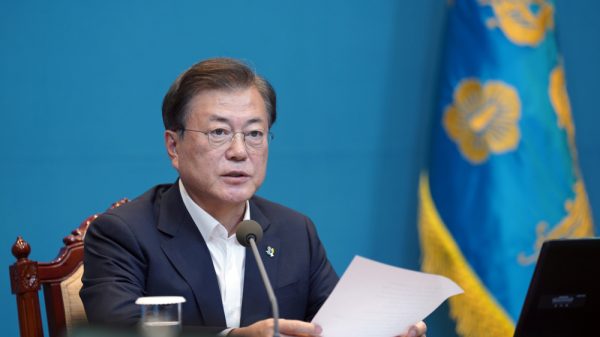
South Korea’s President Moon Jae-in has appointed officials, all known as supporters of inter-Korean détente, as his new top national security advisors in an effort to revive stalled negotiations with North Korea.
The officials were appointed on Friday to replace the chiefs of national security, intelligence and unification policy.
Lee In-young, a four-term lawmaker, who was nominated to oversee inter-Korean ties as unification minister said, “Reviving inter-Korean dialogue is a top priority.”
He said that he would “look at the issue of restarting humanitarian exchanges and cooperation which can be done immediately.”
The current minister resigned over worsening relations with the North.
Moon appointed Suh Hoon, as his national security adviser and Park Jie-won, to succeed Suh as NIS head.
The president has so far held three summits with North Korean Leader, Kim Jong-un, with whom he signed an agreement in 2018 to take a step closer to peace by turning the Korean Peninsula into a “land of peace without nuclear weapons and nuclear threats.”The two Koreas were on a path of rapprochement beginning in January 2018 before US intransigence to relieve any of the sanctions on the North effectively killed diplomacy.
Earlier this year, Moon said he was making efforts to arrange a visit by Kim to Seoul, saying that both sides are in “desperate need” to improve relations.
The South’s president, who has also been trying to mediate between the North and the United States, urged President Donald Trump and Kim to meet once again before the US presidential election in November.
Trump and Kim have already met three times, mainly on Moon’s auspices.
Citing the coronavirus pandemic, the US’s deputy secretary of state and lead negotiator with North Korea, Steve Biegun, said on Monday that another summit was “probably unlikely between now and the US election.”
Biegun, however, said Washington would “continue to leave the door open to diplomacy.”
He is due to visit South Korea next week for meetings with his South Korean counterparts.
July 3, 2020
Posted by aletho |
Aletho News | Korea, United States |
Leave a comment
North Korea is in the news again. As always, that means that it is time for mainstream journalists and establishment figures to reach for the handy cliché and to recycle received opinion as a substitute for thought. Terms like “provocation,” “threat,” and “aggression” abound. Not surprisingly, powerful political and military actors in the United States are seizing the opportunity offered by strained inter-Korean relations to try and kill any prospect of reengagement with the Democratic People’s Republic of Korea (DPRK – the official name for North Korea).
In the eyes of nearly all U.S. politicians, military contractors, think tank analysts, and mainstream journalists, the release of former National Security Advisor John Bolton’s memoir could not have arrived at a better time. Bolton played a key role in torpedoing the Hanoi Summit by demanding that North Korea relinquish its biological and chemical weapons, despite the lack of evidence that the DPRK even has such programs. That was coupled with his insistence that North Korea adopt the Libya model of denuclearization, in which the DPRK would give up everything and receive nothing in return other than vague assurances. For Bolton, sinking the Hanoi Summit was a job half-done. With his memoir, he hopes to complete the task and smother the very concept of reengagement, a message that is predictably finding a receptive ear among so many in Washington.
President Trump’s willingness to meet with Chairman Kim Jong Un had suggested the potential for progress on the Korean Peninsula. For a time, Trump was open to dialogue but he remained wedded to the standard establishment line that the sole purpose of talks should be to negotiate the terms of North Korea’s surrender. In essence, it now appears that there was more continuity than change in Trump’s policy. Both former President Obama and Trump waged economic warfare on the North Korean people through sanctions, and both sought unilateral concessions. Where they differed was in whether issuing demands in face-to-face meetings needed to be added to the mix.
At one point, U.S. Special Representative for North Korea Stephen Biegun responded to criticisms of American intransigence by suggesting that the United States might consider offering compensation to North Korea in exchange for denuclearization. The possibilities he mentioned included agreeing to the two nations opening liaison offices in each other’s capital, permitting a few people-to-people talks, and humanitarian aid. There was also the thought that the United States might be willing to sign a declaration acknowledging that the Korean War came to an end in 1953. What is notable about all of these proposals is that they would provide nothing that North Korea truly needs. Sanctions would remain in place. Nor would there be a security guarantee to the DPRK that would allow it to feel safe enough to dismantle its nuclear deterrent. Also missing was normalization of relations.
Undoubtedly, there is ample reason to question Bolton’s veracity in his self-justifying memoir. But there is at least one passage that has the ring of plausibility. Bolton claims that he began to suspect that the end-of-war declaration was Moon’s idea. That impression was confirmed in talks with the North Koreans, who “had told us they didn’t care about it, seeing it as something Moon wanted,” and they also “worried about Moon’s pitching Trump on these bad ideas.” [1]
Kim Myong Gil, North Korea’s chief negotiator in denuclearization talks, firmly rejected Biegun’s offer of purely symbolic measures. “If the U.S. believes that it can lure us to the table with secondary issues, such as an end-of-war declaration – which can instantly end up as garbage depending on the political situation – and the establishment of a liaison office, instead of presenting fundamental solutions to withdraw its hostile policy against North Korea, which interferes with our right to survival and development, there will never be any hope for a solution.” [2]
However, reciprocity is not a word in the Washington lexicon, so talks remained stymied. Trump is currently distracted as the electoral campaign ramps up and in his criminal mismanagement of the COVID-19 virus. The mood on Capitol Hill and in the media is unremittingly hostile to the resumption of talks, and it is difficult to envision a reelected Trump being open to reengagement in a more even-handed manner. Nor can hope for an improved U.S.-DPRK relationship be placed in a Joe Biden presidency. In a campaign video, Biden declared, “The first thing we have to do is start to demonstrate to the American public that we’re no longer embracing the Kim Jong Uns and the thugs of the world…We are the United States of America. We lead by our example. We’re back. That’s the most critical thing that is going to have to be done.” [3]
The writing, then, is clearly on the wall. North Korean Minister of Foreign Affairs Ri Son Gwon issued a statement on June 12, in which he pointed out that “the hope for improved DPRK-U.S. relations…has now been shifted into despair,” and “even a slim ray of optimism for peace and prosperity… has faded away.” [4]
Trump’s inability or unwillingness to think beyond the ossified constraints of the Washington Establishment’s mindset ensured that talks could only end in failure. The North Koreans have taken due note of the Trump administration’s rigidity and have essentially given up hope for better relations.
Instead, the North Koreans focused their attention where there seemed more potential for improvement, and that was with inter-Korean relations. They hoped for measures such as establishing economic projects of mutual benefit and the cessation of military exercises aimed at each other. But here, too, the DPRK met with disappointment, as progress with South Korea remained stalled.
Mainstream media tell us that by severing communication links with the south and setting off an explosion at the Joint Liaison Office in Kaesong, North Korea is ‘lashing out’ and ‘raising tensions,’ due to economic problems or as a message to encourage Trump to resume negotiations.
In reality, these gestures are intended as a wake-up call to the Moon administration to prod him into returning to the commitments he signed in the Panmunjom Declaration. North-south relations have been in the doldrums for quite some time now, and the DPRK’s repeated requests for cooperation in advancing inter-Korean relations have invariably failed to move Moon into action.
South Korean President Moon Jae-in recognizes the need for warmer relations between the two Koreas, and some of Moon’s ideas for bringing the two Koreas closer together, such as his proposal for a Northeast Asian Railway Initiative, [5] have considerable merit. Yet, all of his plans remain undisturbed on the shelf, collecting dust.
The problem is that, as much as Moon may care about inter-Korean relations, the U.S.-South Korean alliance is more important to him. Moon insists that the UN economic sanctions on North Korea, which the U.S. devised, prevent him from implementing many of his plans. On every matter concerning cooperation with North Korea, whether large or small, Moon feels compelled to first ask for permission from the United States, and the answer is always no. It is due to Moon’s timidity that inter-Korean relations have failed to progress beyond initial steps.
Moon’s pronouncements are indicative of his frame of mind. In a meeting with senior secretaries on April 27, he said, “The fact that the Panmunjom Declaration’s implementation could not be sped up was never for lack of determination. It was because we could not step beyond the international restrictions that are part of reality.” There it is again, that inability to be an independent actor, and the compulsion to seek permission. Moon went on to say that “we should continue to find what is doable,” [6] by which he meant any small thing that the United States would permit him to do.
In the same meeting, Moon stated that “in regard to connecting inter-Korean railroads, we will start with what is possible first.” He added that he looks forward to working with the DPRK to “attain a vision for reconnecting the Donghae and Gyeongui lines, as agreed upon by the two leaders” [of North and South Korea]. Since U.S. opposition had already dissuaded Moon from moving ahead on reconnecting the rail lines, all that’s left is for the two Koreas to work on agreeing on what that “vision” would look like without ever actually attempting to translate that vision into reality.
The United States and South Korea established a working group to coordinate the latter’s policy towards the DPRK. For the Trump administration, the group’s mission is to put the brakes on all attempts at cooperation with the north. It is widely thought in South Korea that it was the working group that prevented business representatives from checking on their factories at the closed Kaesong Industrial Complex. It was also the working group that refused to allow South Korea to ship 200,000 doses of Tamiflu last year to the DPRK. [7] No cracks can be permitted in the Trump administration’s maximum pressure campaign against North Korea, not even when it comes to the provision of humanitarian aid.
With their only remaining hopes focused on closer cooperation with South Korea, the North Koreans have reached the point of total exasperation with Moon for his prioritizing the demands of U.S. imperialism over the needs of the Korean people.
From the North Korean perspective, Moon’s follow through on implementing the terms of the Panmunjom Declaration for Peace, Prosperity and Unification of the Korean Peninsula has been lacking. The clause that “affirmed the principle of determining the destiny of the Korean nation on their own accord” should have been the overarching philosophy.
The Panmunjom Declaration’s call to “actively implement” economic projects agreed to in 2007 at the summit between Roh Moo-hyun and Kim Jong Il had no chance, given punishing UN sanctions. Yet, there could have been some progress on implementing “practical steps towards the connection and modernization of the railways and roads on the eastern transportation corridor as well as between Seoul and Sinuiju for their utilization.” [8]
The immediate trigger for North Korea’s recent actions is the ongoing psychological warfare campaign waged by South Korean right-wing evangelical groups against the DPRK through the launch of propaganda balloons. The Panmunjom Declaration obligated both sides to cease all hostile acts against each other, including “distribution of leaflets” across the border. Given the frequency of right-wing balloon launches, the DPRK felt that South Korea was lackadaisical at best in restraining such efforts. An unnamed former South Korean official comments: “What the North Koreans are saying is that if the South can’t even keep its promise to ban the propaganda balloons, a matter that’s unrelated to sanctions and that the leaders of South and North Korea already reached an agreement about, there isn’t anything the two sides can work on together.” [9]
In a study published in 2014, based partly on interviews with defector groups, Jin-Heon Jung estimated the cost of a single balloon at around $100. Given the volume of balloons sent aloft, it is clear that, as Jung puts it, “fundraising matters the most.” In addition to individual donations, Jung reports: “Some of my interlocutors told me that financial support from international organizations such as the Defense Forum Foundation and overseas churches account for a significant portion of the sponsorship.” [10]
Responding to North Korea’s complaints about South Korean inaction on inter-Korean relations, on June 15, Moon delivered a speech in which he expressed “frustration and regret” for not being able to talk about progress made since the South-North Joint Declaration of twenty years before. Demonstrating a gift for understatement, Moon went on to say: “We’ve always been using cautious approaches to take just one step forward – as if walking on ice – but now it seems that was insufficient.” [11]
A bit later in the speech, Moon explained: “The Korean Peninsula is not yet in a situation where both Koreas can charge ahead as much as we desire at our own discretion. We must move forward, though slowly, with the international community’s consent.” [12] Here, Moon used the term ‘international community’ in its standard usage, as referring solely to the few thousand people in the Washington Establishment, and excluding the rest of the world’s nearly eight billion people.
Moon followed with the suggestion “that there are projects where both Koreas can pursue independently,” and “we have to start with small, achievable tasks.” The problem is that the United States is never going to give its consent for any task, no matter how minor and unrelated to sanctions, and it is not in Moon’s character to even inch along without Washington’s approval.
The North Koreans find Moon’s inaction and penchant for expressing beautiful but empty words annoying. In a scathing reaction to Moon’s speech, Kim Yo Jong, First Vice Department Director of the Workers Party of Korea Central Committee, issued a statement that was filled with language that was undiplomatic, even quite harsh – but which was not inaccurate in its assessment of Moon. “As acknowledged by everyone, the reason that the north-south agreements which were so wonderful did not see any light of even a single step of implementation was due to the noose of the pro-U.S. flunkeyism into which he put his neck.” Kim added that Moon accepted the U.S.-South Korea working group “under the coercion of his master and presented all issues related to the north-south ties to [the] White House. This has all boomeranged.” [13]
It is not only what Kim terms Moon’s “servile” attitude that perturbs the North Koreans. Even though joint U.S.-South Korean military exercises, which practice the bombing and invasion of the DPRK, have been downscaled, the North Koreans still regard these smaller exercises as a violation of the spirit of the Comprehensive Military Agreement signed between the two Koreas. [14]
The same can be said of South Korea’s military buildup. Spending on the military rose 7.4% this year, and Moon’s plans call for an average increase of 7.5% each year through 2023. Already, South Korea ranks tenth worldwide in defense spending [15], and the nation is the fourth-largest buyer of U.S. weaponry. [16] In what strikes the DPRK as a provocative move, South Korea is allocating $3.3 billion to purchase twenty additional F-35 stealth fighter jets over the next five years. [17]
The direction that inter-Korean relations take in the future depends primarily on whether Moon, master of the empty phrase, decides to add action to his repertoire and behave as if he regards South Korea as a sovereign nation. As a recent report in the North Korean press put it, the only option for improvement is “by joining hands with the fellow countrymen, not with foreign forces.” [18] The time has come for Moon to choose between serving the Korean people and serving Washington.
Cheong Seong-chang, director of the Center for North Korean Studies at South Korea’s Sejong Institute, observes, “It has been just words. For the North, the South Korean government’s words and actions are different… There is a need for actions to match words, and it is also necessary for actions to move ahead of words. At the least, the two need to move at the same pace.” [19]
[1] Sarah Kim, “Trump Didn’t Want Moon in DMZ, Writes Bolton,” JoongAng Ilbo, June 22, 2020.
[2] Jeong Je-hyug, “NK Kim Myong-gil, ‘Biegun Conveyed Wish to Meet for Talks in December. Willing to Sit with the U.S.,” November 15, 2019.
[3] https://youtu.be/3TFqeMSsTx0?t=2585
[4] “Our Message to U.S. is Clear: Ri Son Gwon, Minister of Foreign Affairs of DPRK,” KCNA, June 12, 2020.
[5] Kim Ji-eun and Seong Yeon-cheol, “President Moon Proposes Northeast Asian Railway Community Initiative,” Hankyoreh, August 16, 2018.
[6] https://english1.president.go.kr/BriefingSpeeches/Speeches/813
[7] Kang Seung-woo, “South Korea-US Working Group’s Role in Question Amid Growing Inter-Korean Tensions, Korea Times, June 18, 2020.
[8] “Panmunjom Declaration for Peace, Prosperity and Unification of the Korean Peninsula,” Reuters, April 27, 2018.
[9] Lee Je-hun, “Kim Yo Jong Becomes the Face of N. Korea Regarding Propaganda Balloons,” Hankyoreh, June 8, 2020.
[10] Jin-Heon Jung, “Ballooning Evangelism: Psychological Warfare and Christianity in the Divided Korea,” Max Planck Institute for the Study of Religious and Ethnic Diversity,” 2014.
[11] https://english1.president.go.kr/BriefingSpeeches/Speeches/839
[12] https://english1.president.go.kr/BriefingSpeeches/Speeches/839
[13] “Honeyed Words of Impudent Man are Disgusting: First Vice Department Director Kim Yo Jong of WPK Central Committee,” KCNA, June 17, 2020.
[14] “U.S. and S. Korean Authorities Condemned for Exacerbating Situation on Korean Peninsula,” KCNA, June 18, 2020.
Noh Ji-won, “N. Korea’s Grievances with S. Korea as Expressed by Kim Yo-jong,” Hankyoreh, June 18, 2020.
[15] Koharo Ito, “What to Make of South Korea’s Growing Defense Spending,” The Sasakawa Peace Foundation, March 12, 2020.
[16] Elizabeth Shim, “South Korea a Top Buyer of U.S. Weapons, Annual Report Says,” UPI, December 16, 2019.
[17] Jeff Jeong, “South Korea to Buy 20 More F-35 Jets,” Defense News, October 10, 2019.
Franz-Stefan Gady, “F-35A Stealth Fighter Formally Enters Service in South Korea,” The Diplomat, December 19, 2019.
[18] “S. Korean Authorities’ Inveterate Sycophancy Brings North-South Relations to Catastrophe: Rodong Sinmun,” KCNA, June 22, 2020.
[19] Choi He-suk, “Moon’s Progress on NK at Risk of Being Undone,” Korea Herald, June 10, 2020.
June 30, 2020
Posted by aletho |
Militarism | Korea, United States |
Leave a comment
Seoul has accused Japan of brazen behavior after Tokyo objected to Trump’s idea of inviting South Korea into the G7 as a standing member. The proposal may weaken Japan’s political clout within the group, Japanese media claims.
A South Korean parliament official has accused Japan of constantly “harming” its neighboring country, in reaction to a news report published by Japanese news agency Kyodo last week. The report claimed that Tokyo’s administration had opposed US President Donald Trump’s idea of inviting Seoul to participate in the envisioned Group Seven gathering.
“There’s nothing to be surprised anymore by Japan’s consistent attitude not to admit or atone for its wrongdoings,” the official said. “The level of Japan’s shameless (position) is something of the world’s top.”
Kyodo reported that Japan has conveyed its objection to the US with claims that Seoul is not in “lockstep” with G7 – in particular, it does not share the group’s views on Chinese and North Korean issues.
The outlet suggested that Japan’s objection was expected to aggravate its already tense relationship with South Korea, amid ongoing historical and diplomatic disagreements. The two countries have long been locked in a dispute over World War 2 reparations aimed at resolving wartime labor issues. But the bill had heavily influenced controversies within the economic and defense areas in both countries.
The news agency pointed out that South Korea’s participation would mean ending Japan’s status as the lone Asian member within the group, which also includes the United States, United Kingdom, Canada, France, Germany, and Italy. Earlier this month, Japan expressed its hope to take the lead among G7 nations on issuing a statement about the situation in Hong Kong.
At the end of May, Trump suggested inviting Russia, South Korea, Australia, and India to participate at the G7 summit hosted by the US. The president has criticized the group as “very outdated” and pointed out that it no longer represents “what’s going on in the world.” The meeting was initially scheduled for June but had to be postponed until at least September, due to the coronavirus pandemic.
At a media briefing on Monday, Japan’s government spokesman Yoshihide Suga refrained from publicly expressing its opposition to South Korea’s participation. Still, he stressed that it is crucial to maintain the current G7 framework for coordination in tackling global challenges.
June 29, 2020
Posted by aletho |
Aletho News | Japan, Korea |
Leave a comment
North Korea says Washington has left Pyongyang with no choice but to “counter nuclear with nuclear” in a bid to confront hostile US policies against the Asian country.
“In order to eliminate the nuclear threats from the US, the DPRK government made all possible efforts either through dialogue or in resort to the international law, but all ended in vain,” North Korean state news wrote in an essay, using an abbreviation for the country’s official name.
“The option left was only one, and that was to counter nuclear with nuclear,” it added.
The 5,000-word article documented the history of North Korea’s grievances with the US, South Korea and its allies and came a day after all of these countries marked the 70th anniversary of the beginning of the Korean War.
It also came just days after the North said it was suspending “military action plans” against the South after it had blown up a liaison office used for talks between the two countries in a North Korean border city.
The two Koreas were on a path of rapprochement beginning in January 2018 before US intransigence to relieve any of the sanctions on the North effectively killed diplomacy.
North Korea has been under harsh US sanctions for years over its nuclear and ballistic missile programs.
US President Donald Trump has attempted to court Pyongyang, and although he has met with North Korean leader Kim Jong-un three times, he has refused to relieve any of the sanctions on the North. That has in turn hampered efforts to demilitarize the Korean Peninsula.
Kim outlined last month a plan to further boost his country’s nuclear deterrence capabilities.
The Washington-Pyongyang nuclear talks have made little progress since late last year, particularly after the global fight to curb the pandemic, which has so far infected nearly 10 million people and killed over 496,000 others around the world.
North Korea’s hardening of stance comes amid reports that the US is preparing to conduct its first full-fledged nuclear test since 1992.
Last December, Kim ended a moratorium on the country’s missile tests and said North Korea would soon develop a “new strategic weapon.”
June 27, 2020
Posted by aletho |
Aletho News | Korea, United States |
Leave a comment


 Aletho News