A Stumble at Hanoi, but Negotiations Remain on the Agenda
By Gregory Elich | Zoom in Korea | March 4, 2019
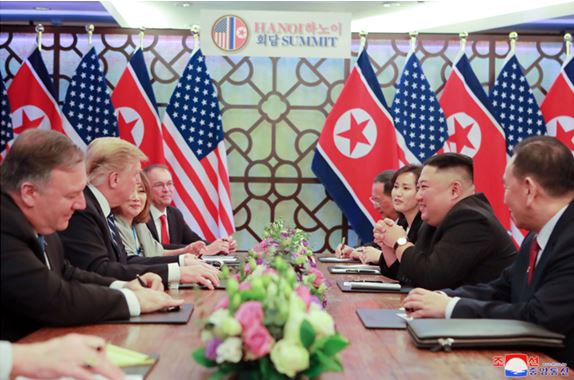
President Trump’s hasty decision to pull the plug on the Hanoi Summit ahead of schedule came as a stunning surprise. The feeling of disappointment in those who were hoping for success contrasted with the sense of relief in the U.S. foreign policy establishment, which remains steadfastly opposed to any improvement in relations.
The widespread assumption going into the summit was that the Trump administration would be able to buy off North Korea with diplomatic trinkets. It was thought that among these would be limited sanctions exemptions, such as allowing humanitarian organizations greater latitude to operate in North Korea. It was also anticipated that a document would be signed which would recognize that the Korean War had ended in 1953. While a peace declaration would have a symbolic “feel good” value, it would change no facts on the ground, and leave the North Koreans essentially empty-handed.
By all accounts, the North Koreans have been more clear-eyed about what they need in talks with U.S. negotiators than they had been given credit. Symbolic measures will not suffice. The North Koreans have serious and well-founded security concerns, given the various wars and military interventions the United States has launched around the world and its decades-long hostility to North Korea.
The Trump administration’s current campaign to destabilize Venezuela and substitute its handpicked lackey as that country’s president can only have further clarified thinking on security matters for the North Koreans.
A more immediate concern for North Korea is the impact of economic sanctions, which have as their aim the collective punishment of the entire population. According to a senior U.S. State Department official, during discussions on sanctions relief with their North Korean counterparts, U.S. negotiators “did our own calculations, and [the damage] tallies up to the tune of many, many billions of dollars.” North Korea’s GDP may be difficult to assess with precision, but it is estimated at around $30 billion. That places it below Vermont, which ranks dead last among U.S. states in terms of GDP. Given the economic damage/GDP ratio, it is obvious that the sanctions war is inflicting enormous hardship on the North Korean people.
According to North Korean Foreign Minister Ri Yong-ho, “Our proposal was that, if the U.S. lifts some of the UN sanctions, or in other words those aspects of the sanctions that impede the civilian economy and the people’s livelihood, we will completely and permanently dismantle the production facilities of all nuclear materials, including plutonium and uranium, in the Yongbyon complex, through a joint project by technicians from our two countries, in the presence of American experts”
“They were willing to give everything, including all the facilities at Yongbyon,” revealed an unnamed source. “Not just one physical reactor, but the whole complex. They were also willing to present their willingness to fully dismantle in the form of an official document. They were getting down to business pretty seriously. And then Mr. Trump and the American side turned down the proposal and left,” to the dismay of the North Koreans.
U.S. Secretary of State Mike Pompeo urged the president to reject the North Koreans’ proposal, as facilities outside of Yongbyon were not included, and nuclear weapons and missiles would remain untouched. National Security Advisor John Bolton may have added objections as well, given his well-known aversion to anything other than unilateral disarmament by North Korea.
“The President in his discussions challenged the North Koreans to go bigger,” a State Department official announced. “The President encouraged Kim to go all in, and we were… prepared to go all in as well.” Trump wanted the North Koreans to put their entire program on the table in exchange for relief on economic sanctions.
From the North Korean standpoint, complete dismantlement of its nuclear program cannot come without a security guarantee. According to Foreign Minister Ri, that guarantee is “even more important” than lifting sanctions. After all, it was for security reasons that North Korea developed its nuclear program, and its security will need to be assured through other means if it denuclearizes. “Given the current level of trust between our two countries,” Ri explained, the dismantlement of the Yongbyon facility is “the biggest step toward denuclearization that we can take at the present moment.” Trump’s proposed grand bargain failed to provide a secure basis for the North Koreans to abandon their nuclear program. Also unaddressed is the concept of denuclearization of the Korean Peninsula, which is habitually interpreted in a one-sided manner in the West as applying solely to North Korea. The meaning of that term needs to be clarified through further negotiations.
The U.S. side, however, remains wedded to the idea of maximum punishment as a negotiating tool and is unwilling to grant relief on economic sanctions without North Korea’s complete denuclearization. That is the essence of the current impasse between the two sides. In an interview broadcast on Fox News, Trump said, “The sanctions are there, and I didn’t want to give up the sanctions unless we had a real program.”
It seems clear that if both parties can agree on timing and sequencing, the possibilities for progress are there, starting with a partial lifting of economic sanctions in exchange for partial denuclearization.
Although the Hanoi Summit failed to produce a concrete result, it would be incorrect to say that it failed. Diplomacy is a process, not a single event. The summit did not end in rancor, and both sides have pledged to continue negotiations. KCNA, the North Korean news agency, reported that the summit “offered an important occasion for deepening mutual respect and trust,” and it noted that President Trump and Chairman Kim Jong Un “agreed to keep in close touch” and “continue productive dialogues for settling the issues discussed at the Hanoi Summit.”
“They were constructive discussions,” points out a State Department official. “There’s room to continue talking.” In Mike Pompeo’s assessment, “There have been lots of things that we’ve moved forward on, and I think we have a set of shared common understandings. I’ve seen enough congruence between what the two sides are trying to accomplish. I saw the goodwill between the two leaders.”
Despite the lack of agreement, Kim reiterated his commitment to maintain a freeze on nuclear and ballistic missile testing, while the U.S. is renaming and reducing the scope of its annual Foal Eagle and Key Resolve military exercises.
The main impediment to progress is U.S. bi-partisan opposition to dialogue and any reduction of tensions in East Asia. An often-repeated charge is that last year’s Singapore Summit produced no tangible result. However, the Singapore Summit was a short meeting meant to establish an agreement on intent, in which not only did North Korea promise to work toward denuclearization, but both sides committed to improve relations and build a peace regime on the Korean Peninsula. After decades of hostility and confrontation, the summit redirected the relationship to one of dialogue. That is no small thing. Critics who argue that detailed steps should have been drawn up in that initial meeting are, of course, intentionally distorting the nature of the meeting in an attempt to discredit the concept of U.S.-North Korea negotiations.
Similarly, those who wish to block progress can be expected to argue that the lack of an agreement at Hanoi proves that it is a mistake to meet with the North Koreans and talks must come to a halt. Nevertheless, U.S. and North Korean leaders remain invested in the process, and the less influence opponents have on U.S. negotiating strategy, the more chance of success. Moreover, although there is internal opposition from conservative forces in South Korea, the detente process between the two Koreas has developed its own momentum, which can be expected to exert a positive influence on the U.S. position. For now, there is certainly more reason for hope than despair.
Gregory Elich is a Korea Policy Institute associate and on the Board of Directors of the Jasenovac Research Institute. He is a member of the Solidarity Committee for Democracy and Peace in Korea, a columnist for Voice of the People, and one of the co-authors of Killing Democracy: CIA and Pentagon Operations in the Post-Soviet Period, published in the Russian language. He is also a member of the Task Force to Stop THAAD in Korea and Militarism in Asia and the Pacific.
His website is https://gregoryelich.org
Follow him on Twitter at @GregoryElich
US & South Korea agree to scrap major military drills to foster denuclearization – Seoul
RT | March 3, 2019
Washington and Seoul will no longer be conducting large-scale Foal Eagle and Key Resolve war games, the South Korean defense ministry said Sunday. It comes several days after US President Trump complained about the drills’ cost.
The cancellation of the annual wargames, initially scheduled to kick off in spring, was announced by the South Korean military, as it made public the details of a call between Acting US defense chief Patrick Shanahan and his South Korean counterpart, Jeong Kyeong-doo, Yonhap reported.
Seoul said that the move to call off the exercises was in support of the diplomatic efforts to pursue a nuclear-free Korean peninsula. The drills have been paired since 2001 and traditionally take place in February-March. North Korea saw the allies’ annual saber-rattling as preparation for invasion.
“The minister and secretary made clear that the alliance’s decision regarding the adjustment of the exercise and drills reflects both countries’ expectation to back diplomatic efforts to reduce tensions and achieve the complete denuclearization of the Korean Peninsula through a final, full verified method,” the ministry said in a statement.
By ditching the costly wargames the US and South Korea are not eliminating joint exercises completely, though: they are planning new command post drills and will continue to carry out field maneuvers. However, these are expected to be conducted on a significantly lower scale. In the run-up to the announcement, unnamed officials told CNN that Washington and Seoul might instead carry out drills “at a small unit level” that would feature “virtual training.” NBC News reported, also citing officials, that the large-scale war games would be replaced by “mission-specific training.”
The scaling-down was widely expected, since Trump has repeatedly bemoaned the drills’ hefty price tag the US has to cover. Following the first Trump-Kim summit in June 2018, Trump said that the US would halt joint drills with South Korea, while calling them “quite provocative,” stirring unease among his own military.
Shortly after that, Washington and Seoul suspended large-scale Ulchi Freedom Guardian exercises scheduled for August.
In November, then Pentagon chief James Mattis stated that the Foal Eagle drills were “being reorganized a bit to keep it at a level that will not be harmful to diplomacy.”
Speaking in the wake of his Hanoi summit with North Korean leader Kim Jong-un this week, Trump said the drills with South Korea were “fun and nice” but a “very, very expensive thing,” and that he “gave that up quite a while ago.”
Foal Eagle typically sees some 11,500 US troops taking part alongside 290,000 South Korean military forces in the drills that include air, ground and naval field operations. Key Resolve is a computer-simulated exercise that also used to draw in a large number of troops from both sides, including about 12,200 Americans and 10,000 South Koran servicemen.
N. Korea offered to halt nuclear, long-range rocket testing for partial relief of sanctions – FM
RT | February 28, 2019
North Korea offered a “realistic proposal” to halt nuclear and missile tests in exchange for partial sanctions relief, Foreign Minister Ri Yong-ho told reporters in Hanoi after the failed Trump-Kim summit.
North Korea demanded the partial lifting of sanctions that “that hamper the civilian economy and the livelihood of our people.”
In exchange for partial lifting of sanctions by the US, North Korea would permanently remove plutonium and uranium processing facilities and Yongbyon, in the presence of US experts, Ri said, adding that the “US was not ready to accept our proposal.”
The North Korean official said Washington demanded “one more” measure beyond dismantling Yongbyon, which went too far for Pyongyang.
“Our proposal will never change although US proposes negotiations again in the future,” said Ri, who then left without taking questions from the press.
Wednesday’s summit in Hanoi began on a high note but ended early and without a deal.
“It was about the sanctions basically,” US President Donald Trump told reporters after parting ways with Kim Jong-un. “They wanted the sanctions lifted in their entirety and we couldn’t do that. Sometimes you have to walk, and this was just one of those times.”
No deal, but Kim Jong-un promised no missile tests – Trump
RT | February 28, 2019
Despite no formal deal being reached, North Korean leader Kim Jong-un said that he wouldn’t test weapons or anything nuclear-related, US President Donald Trump told reporters after the aborted Hanoi summit.
Pressed by reporters about potential fallout over the failure to reach a denuclearization agreement with the North Korean leader, Trump stated that he had received assurances that Pyongyang will continue to halt weapons development.
“He said the testing will not start,” Trump said of Kim. “He said he’s not going to do testing of rockets or missiles or anything having to do with nuclear. And all I can tell is that’s what he said, and we’ll see.”
Trump and Kim’s Hanoi, Vietnam summit came to an abrupt end on Thursday after the two sides failed to reach a consensus on appropriate steps Pyongyang must take in order for US sanctions to be lifted. Kim reportedly promised to dismantle a nuclear facility at Yongbyon in exchange for the lifting of all sanctions – but Washington wanted more concessions, including the destruction of a purported uranium enrichment plant.
The US president said that while the talks were constructive, “Sometimes you have to walk and this was one of those times.”
‘Exercising is fun but very expensive’: Trump explains freeze on US military drills in Korea
RT | February 28, 2019
Donald Trump cited exorbitant costs as the reason for halting “fun and nice” US military drills on the Korean Peninsula – exercises which Pyongyang viewed as a serious provocation.
Speaking at a press conference after his Hanoi summit with North Korean leader Kim Jong-un, the US president told journalists that US military drills in the region would not resume for now.
“I gave that up quite a while ago because it costs us $100 million every time we do it. We fly these massive bombers in from Guam,” Trump said.
“Exercising is fun and it’s nice they play their war games – and I’m not saying it’s not necessary, because on some levels it is – but on other levels it’s not. But it’s a very, very expensive thing.”
The US president added that he “hated to see” how “hundreds of millions of dollars” were spent on the drills.
“I thought it was unfair, and frankly I was of the opinion that South Korea should help us with that. We’re protecting South Korea.”
Trump then claimed that Seoul was just one of many nations which were taking advantage of Washington’s generosity.
“We’re spending a tremendous amount of money on many countries, protecting countries that are very rich – that can certainly afford to pay us and then some. And those countries know it’s not right but nobody’s ever asked them before, but I’ve asked them, and we’re gaining a lot of money.”
The Pentagon announced that a number of joint drills with South Korea were put on hold after landmark talks between Trump and Kim in Singapore last June. However, the Pentagon said that routine joint exercises would continue, but not on such a large scale.
The drills have been seen as a major barrier to brokering a denuclearized, peaceful Korean Peninsula. Moscow and Beijing have suggested that Pyongyang suspend its nuclear weapon and missile tests in exchange for Washington giving up joint exercises with South Korea. However, Washington flatly rejected the proposal.
Trump said on Thursday that Kim told him North Korea will continue to halt missile testing, even though no formal deal was signed after their Vietnam summit.
Trump announces 2nd meeting with Kim, takes credit for avoiding ‘major war’ with North Korea
RT | February 6, 2019
Donald Trump plans to hold a second meeting with North Korea’s leader Kim Jong-un in Vietnam on February 27-28, the US president announced during his State of the Union address, claiming full credit for avoiding a devastating war.
“My relationship with Kim Jong-un is a good one…. Our hostages have come home. Nuclear testing has stopped. And there has not been a missile launch in more than 15 months,” Trump stated in his speech, claiming full credit for the progress of the peace process on the Korean peninsula.
If I had not been elected the president of the United States, we would right now, in my opinion, be in a major war with North Korea
Trump and Kim held a historic meeting in Singapore last June, at which North Korea agreed to dismantle its nuclear program in exchange for the lifting of sanctions that have crippled its economy. Despite the breakthrough, the process has somewhat stalled since, after Washington refused to lift any restrictions before Pyongyang fulfills its part of the deal.
In the meantime, the North stayed true to its pledge and hasn’t tested a missile since 2017. Pyongyang also dismantled one of its test sites and made a significant effort to improve its relations with South Korea, despite the continued presence of 30,000 US troops there.
Ahead of the much-anticipated US-North Korean rendezvous, Kim traveled to China to discuss denuclearization of the Peninsula with President Xi Jinping. Following the meeting, Beijing expressed hope that Pyongyang and Washington can meet each other “halfway” to reach an agreement that will bring a long-lasting peace and stability to the region.
Second-Round Stakes Higher for Trump and Kim
By Patrick Lawrence | Consortium News | January 24, 2019
President Donald Trump’s announcement late last week that he will meet North Korea’s Kim Jong-un next month promises a significant result whether the encounter succeeds or fails. In the intervening weeks, we have two questions to ponder.
No. 1: what will this second summit accomplish? The first Trump–Kim meeting last June in Singapore was about establishing rapport and can by this measure be counted a success. Something of substance, however modest, needs to get done this time.
No. 2, and just as important, will Trump’s foreign policy minders undermine this encounter before it takes place? The record suggests this is a serious possibility.
A month ago, Trump announced the withdrawal of U.S. special forces from Syria. The howls of protest, Capitol Hill Democrats often the shrillest, have not ceased. And troops have not started to pack their duffel bags.
But the Syria decision may prove a turning point, given that Trump directly confronted the policy clique — segments of the Pentagon and State Department bureaucracies, as well as members of the National Security Council —who have been sabotaging his objectives since his first day in office two years ago.
Steve Bannon, once and briefly Trumps’ strategic adviser, put it this way after the withdrawal announcement: “The apparatus slow-rolled him until he just said enough and did it himself. Not pretty, but at least done.”
Will the second Trump–Kim summit prompt another such showdown with “the apparatus” around Trump?
It could. John Bolton, Trump’s national security adviser, is a hyper-hawk on North Korea. Behind him, the Pentagon finds the prospect of lasting peace on the Korean Peninsula a threat to its immense presence in Northeast Asia. Be wary in coming weeks of vaguely sourced press reports citing newly discovered North Korean treachery, betrayals, and deceits.
More For, Than Against
On balance, however, Trump and Kim appear to have more going for them than against them this time.
Now that the policy cliques and the press have run out of playground epithets for Kim—monster, merciless murderer, and so on—it is generally acknowledged that however autocratic, he is a young but capable statesman. In his new year’s message, he confirmed that national policy has now shifted decisively toward economic development as the North’s top priority.
While Washington and its clerks in the corporate press give Kim no credit, he has already made numerous gestures intended to appease American hawks such as Bolton, build confidence, and signal his desire to be, in effect, a modernizing dictator somewhat in the mold of China’s former leader, the late Deng Xiaoping.
Kim has halted all nuclear and missile testing, destroyed a nuclear-testing site, offered to pull back artillery from the 38th parallel, which now divides North and South Korea, and returned the remains of some American soldiers killed in the 1950–53 war. North and South have also demilitarized a “truce town.”
Kim wants a deal—there are no serious grounds to question this—and is surely smart enough to know he has to bring something impressive to the table next month. Just what this will be is not clear. It is easier to anticipate what he will not concede: the reciprocal diplomatic process that Moon Jae-in, South Korea’s president, calls “action for action.” It is the only rational, workable way to go forward after almost seven decades of mutual distrust and animosity.
Development Planning
Moon has remained remarkably energetic in behalf of a North–South settlement. His country, along with Russia and China, have drawn up development plans to connect the North and its neighbors — rails, roads, airports, seaports, power plants, refineries, and so on — that has something for everybody: The North acquires the foundation for a modern economy, South Korea gains land routes to Chinese, Russian, and European markets, Russia develops its Far East, and China can do more business with both North and South. A map of this plan shows three development belts: Two are to run down the Korean Peninsula’s western and eastern coastlines from the Chinese and Russian borders respectively. The third will run west to east across the 38th parallel. Moon wants these links eventually to connect South Korea to the Trans-Siberian Railway.
The numbers bandied about are extraordinary. While Seoul has allocated a modest $260 million to improve cross-border rail links this year, that is merely the beginning. The Korea Rail Network Authority, a government agency, estimates that upgrading the North’s roads and rails alone will cost roughly $38 billion before it is done. At the time of the first Trump–Kim summit, Citicorp put the cost of rebuilding all of the North’s infrastructure at $63 billion.
These plans have advanced steadily since the first Trump–Kim meeting. But coverage in the mainstream American press is far from abundant.
By all appearances, the U.S. is simply not interested in a constructive settlement in Northeast Asia, even as other nations proceed to develop one. This is a perfect illustration of what happens when a nation is intent only on the projection of its power.
It is anyone’s guess what Trump will bring to his summit with Kim. But it is clear what would produce a breakthrough if Trump truly wants one. First, he can exempt some of Moon’s cross-border development plans from sanctions that now inhibit them. Second, he can relax the ridiculous demand that the North completes its denuclearization before Washington concedes anything. “Give us all we want and then we negotiate” is not a position from which to expect any gains.
Given Kim’s aspirations and the diplomatic efforts of Seoul, Moscow, and Beijing, the opportunity for a settlement of the Korean question has not been this promising since the 1953 armistice. At the same time, Washington has rarely been so uncertain of its power—and hence so eager to display it—and we have a president surrounded by advisors given to neutralizing his better policy objectives.
If Trump and Kim get something done a month from now, we could be on the way to peace in Northeast Asia after 66 years of high tension. If they fail, or if Trump gets the Syria treatment, many years are likely to pass before a moment this propitious comes again.
Patrick Lawrence, a correspondent abroad for many years, chiefly for the International Herald Tribune, is a columnist, essayist, author and lecturer. His most recent book is “Time No Longer: Americans After the American Century” (Yale). Follow him @thefloutist. His web site is www.patricklawrence.us. Support his work via www.patreon.com/thefloutist.
Trump-Kim summit to show real progress
By M. K. BHADRAKUMAR | Indian Punchline | January 23, 2019
The White House disclosed in Washington on January 19 that President Trump’s second summit with the North Korean leader Kim Jong-un “will take place near the end of February”. One month is a very long time in politics but the White House disclosure came at the conclusion of three-day working level talks between senior officials of the US, North Korea and South Korea at a secret location near Stockholm, Sweden.
In particular, the visit to Washington last week by North Korea’s chief nuclear negotiator Kim Yong-chul’s and his meeting with Trump, has raised expectations. (Kim’s visit to the US opened the door for the working level negotiations in Sweden.)
The US Secretary of State Mike Pompeo later said in Davos that progress has been made at these talks and he anticipated that they provided a “good marker” for the upcoming summit. As Pompeo put it, “There’s an awful lot of things to be done but some good things have happened already.” He added that there are “many steps along the way to achieve” the goal of North Korea’s denuclearization, while expressing optimism that the next summit will be productive.
The US-North Korea negotiations after the Singapore summit last June had stalled since Pyongyang remained reluctant to “denuclearize” and on its part the US was averse to a step-by-step approach to dismantle the sanctions regime. North Korea has warned that denuclearization could be at risk unless the US eases sanctions, while the US has demanded so far that Pyongyang must first demonstrate its commitment to abandoning the nuclear weapons.
The big question is how this deadlock could be ending. Pompeo’s remarks articulating denuclearization concerns in the same breath as “security and stability and peace on the Peninsula” suggest that the US is gradually shifting its position and is open to embracing the approach of step-by-step concessions. Trump’s upbeat remarks after meeting the North Korean envoy last week lends credence to such a reading.
In the period since the June summit in Singapore between Trump and Kim Jong-un, the latter has consolidated his position. Most importantly, Kim has mended his equations with Chinese President Xi Jinping, whom he visited earlier in January (Kim’s fourth visit to China in the past year), and the relations between the two countries have remarkably improved.
According to Chinese media reports, Kim assured Xi that he is committed to “achieving results” at the second summit with Trump and will “continue sticking to the stance of denuclearization” and “make efforts… to achieve results.” Equally, Xinhua news agency quoted Xi as saying that Pyongyang and Washington would “meet each other half way.”
Equally, the relations between the two Koreas are also proceeding smoothly. It was a measure of Kim’s confidence that in his annual New Year’s speech, the emphasis was heavily placed on his economic programme rather than on threat perceptions.
But the problem lies on the American side. A big campaign is already unfolding with a view to deny Trump the legacy of a successful summit with Kim and a foreign-policy achievement in defusing the North Korea tensions (here and here.) Simply put, North Korea problem has got intertwined with the US domestic politics – like Russia, Syria or Afghanistan. In an editorial comment, Washington Post wrote,
“The North Koreans no doubt hope they can manipulate Mr. Trump into new giveaways at a second summit, such as a relaxation of sanctions, a declaration ending the Korean War, or even the withdrawal of U.S. troops from South Korea… We’d like to hope that Mr. Trump’s advisers, such as Mr. Pompeo, would dissuade him from reckless action; but then, as the president’s recent decision to order U.S. troops out of Syria showed, he’s not inclined to listen. All of which means that a resumption of U.S.-North Korean negotiations should be welcomed — but warily.”
The fact of the matter is that Kim, who has consolidated his position thanks to the backing of Beijing and the prospect of a beneficial economic partnership with South Korea, may well be in a mood to compromise by offering a road map for denuclearization. And if that happens, Trump being highly unpredictable, especially if he is called upon to reciprocate, all bets are off. Indeed, what if Trump reciprocates with the mother of all concessions like withdrawing US troops from South Korea?
Coincidence or not, with just about several weeks left for the Trump-Kim summit, the talks between the US and South Korea regarding the cost-sharing of American military presence in South Korea have reached a deadlock after 10 rounds of intense negotiations since last November. Trump has complained more than once that the US was “subsidizing” the militaries of South Korea. According to Trump, US paid for “about 60 percent” of South Korea’s military costs.
At any rate, through a diplomatic channel, the US demanded in late December that South Korea pay $1.2 billion for costs related to the presence of the 28,500 US soldiers, under a contract valid for one year. The proposal has been framed as an ultimatum from Trump, who stipulated that no offer less than $1 billion would be entertained. Whereas, the South Korean negotiators insist that the amount should not exceed 1 trillion won ($887 million), calling that number “psychologically significant” for the Korean public, and that there should be a five-year contract.
All in all, even if the negotiations over North Korea’s nuclear programme have been exasperatingly slow during the period since the Trump-Kim summit last June in Singapore, it is still better than a hostile standoff or a military confrontation. Without doubt, the Trump-Kim summit created an ambience in which inter-Korean rapprochement could commence, which has since gained traction.
As 2018 ended, the world witnessed the astounding sight of a groundbreaking ceremony for the construction of a new inter-Korean railroad. At the recent talks in Sweden, South Korea actually played a mediatory role between the US and North Korea. If the summit in Singapore was a historic one, real progress can be expected in the upcoming round 2. The South Korean Foreign Minister Kang Kyung-wha said last week that the corresponding measures the US may offer in response to North Korean progress toward denuclearization could include “an end-of-war declaration, humanitarian aid, and a permanent channel for dialogue between the US and North Korea.”
Pyongyang Urges End of Foreign Military Exercises on Korean Peninsula – Envoy
Sputnik – 15.01.2019
Pyongyang calls for abandoning military exercises involving foreign forces on the Korean Peninsula, North Korean Ambassador to Russia Kim Hyun Joong said Tuesday.
“In order to eliminate military hostility between North and South Koreas in a fundamental way and turn the Korean Peninsula into a lasting and eternal peace zone, it is necessary to abandon conducting military exercises with foreign forces because North and South Korea agreed to follow the path of peace and prosperity,” Joong said at a dinner marking the occasion of the New Year at the Embassy of the Democratic People’s Republic of Korea in Moscow.
Joong went on saying that it was also necessary to abandon foreign strategic weapons on its territory.
The ambassador stressed that multilateral negotiations should be conducted with the aim to establish a system of peace on the Korean Peninsula through close cooperation with the countries that had signed an armistice agreement.
Pyongyang was ready to establish new relations with the United States in accordance with the spirit of the era and wishes of the people, the diplomat noted.
He further added that North Korean leader Kim Jong Un in his New Year’s speech declared his readiness to meet with US President Donald Trump once again.
The situation on the Korean Peninsula has improved since the beginning of this year. During this time, North Korean leader Kim Jon Un and South Korean President Moon Jae-in have held several meetings, while Kim even had a historic summit with US President Donald Trump. This summit yielded an agreement stipulating that North Korea would make efforts to promote the complete denuclearization of the peninsula in exchange for the United States and South Korea freezing their military drills as well as the potential removal of US sanctions.
READ MORE:
Trump Sends Letter to North Korean Leader Amid Preparations for Summit — Reports
Is there an Upside to the US Military Presence in the Southeast Asia?

By Jean Perier – New Eastern Outlook – 30.12.2018
As of today the Southeast Asian and Asia-Pacific region have found themselves at the center of a complex international process of establishing a new regional architecture. As states carry on fighting for control over strategic sea routes that run across the region, numerous security and transitional threats would appear seemingly out of the blue.
Unsurprisingly, the United States is trying to exercise as much influence over the region as it possibly can, even in spite of the fact that over the past decades the influence that Washington exercises in Southeast Asia has significantly diminished. Speaking about the evolution of the US approach to Southeast Asia in the post-bipolar period of global composition, it should be noted that the initial goal of containing the spread of communism that Washington used to pursue has evolved into attempts of ensuring American military and economic dominance in this part of the world. These days the US couldn’t care less about communism, as it’s dead set on opposing the rise of China and Russia and their regional allies. Washington’s new approach to its global strategy became evident after the release of America’s National Defense Strategy and the Nuclear Posture Review, in which China and Russia were designated as primary geopolitical opponents of the US.
To achieve these goals, the Trump administration would concentrate its efforts on creating a 400,000 man strong force in the Asia-Pacific region to ensure that at least 50 large military bases across the region remain fully operational at all times. It goes without saying that the absolute majority of those are located in Japan.
Among the tools that allow Washington to advance its agenda in the Asia-Pacific region are large carrier strike groups. For the first time since the days of WWII, the Pentagon keeps a total of two carrier groups stationed in the Western Pacific. Additionally, the US Air Force would use strategic bombers on patrol duty over the Pacific, as Washington believes this practice to be a good demonstration of force.
The Pentagon is also actively deploying its anti-air capabilities in the Asia-Pacific region, thus provoking an arms race across the region. At present, it has 20 ships capable of bringing down both missiles and aircraft, two THAAD batteries, three PAC-3 missile battalions along with five mobile radars stationed in the region.
To ensure its primacy in the region, Washington would place a particular emphasis on expanding its cooperation with Japan and South Korea. This results in those states holding an ever increasing number of joint military exercises, with their total exceeding 30 large military games over the last 18 months.
However, as inter-Korean relations begin reaping results of goodwill shown by both Pyongyang and Seoul, along with the progress that Russia and Japan have made in resolving their territorial disputes, Southeast Asian political analysts have begun discussing the issue of Washington maintaining such a leviathanian scale of American military presence in the region and the rationale behind it.
As for the prospects of a continuous US military presence on the Korean peninsula, it’s being addressed by China that which recently began insisting on the complete withdrawal of US armed forces from South Korea as a precondition for the complete denuclearization of the DPRK. Chinese authorities are persistent in convincing Pyongyang that this should be the first demand made, since there will be no way to force Washington into leaving once a peace treaty is signed. In turn, Washington is pursuing the goal of maintaining as many troops in South Korea as possible, as those remain an important element of its China containment plan.
As for the US military presence in Japan, the public pressure applied by various civil activist groups on Japanese authorities is almost palpable. Although Tokyo hasn’t faced a massive public uproar demanding the complete withdrawal of all American servicemen from the country, the number of civil protests demanding this course of action is increasing annually. In addition, the advances that Japan and Russia made in resolving their differences on questions over the Kuril Islands may vanish overnight, should it be announced that American servicemen are here to stay in Japan. As a matter of fact, this presence contradicts the terms of the 1956 agreement between the USSR and Japan, and ever since the day it was signed any further progress has been derailed by the presence of foreign servicemen in Japanese territory. Back in the day, this fact resulted in the USSR abandoning any discussions with Tokyo over the possibility of transferring a part of the Kuril Islands to Japan, as Tokyo signed the Treaty of Mutual Cooperation and Security with Washington back in 1960. After all, in accordance with this treaty, the Pentagon is allowed to build its naval bases all across the territory of Japan. Should it decide to build one on the Kuril Islands once they are handed over to Japan, it will trap the Russian navy in its harbors. It is quite understandable that Moscow will never allow this scenario to occur.
To get a better understanding of this deadlock, it is enough to recall the Caribbean crisis of 1962 and the deployment of Soviet ballistic missiles in Cuba. Back then, Washington reacted vigorously to Moscow’s attempt to create a direct military threat to the United States in the immediate vicinity of its borders, which brought the world toward the brink of WWIII. So what reaction should we expect from Moscow should Washington build a naval base on the Kuril Islands? Therefore, without Tokyo demanding the Pentagon to pack up and leave, no further progress in the disputes that exist between Russia and Japan can be achieved.
Of course, both Moscow and Beijing in their approach to the question of the lingering US military presence in the immediate vicinity of their shores are driven by their strategic interests. This means that Beijing is going to use any leverage it has to persuade North Korea to abandon its nuclear program in exchange for a US withdrawal, while Russia would never go as far as to consider handing over the Kuril Islands without Japan sending American servicemen home.
As for the position of today’s political elite of South Korea and Japan on this issue, it is clear that they follow the instruction of their overseas masters in addressing these issues, as both of these states have launched massive media campaigns to persuade their population that the presence of US forces is somehow not a bad thing. Washington has even given them cues as to what their media should advertise. In particular, they try to convince the world that:
- a certain part of the population of South Korea and Japan is still supporting the strengthening of military cooperation with the United States.
- the withdrawal of American troops will be accompanied by a substantial increase in defense spending. In particular, it is said that in South Korea in order to prevent the weakening of its combat potential, Seoul will be bound to spend no less than 30-35 billion dollars.
- both Japan and South Korea will lose jobs should they decide to close US military bases. It’s stated that South Korea will lose more than 10,000 jobs that were created by the fact that American soldiers needed services that the Pentagon was willing to pay for. It’s estimated that Washington would spend 800 million dollars on those and thus the withdrawal of American troops is going to somehow affect the overall economic growth rates of South Korea. Should those media sources be believed, Japan with its massive industrial potential is going to suffer even greater financial losses due to the withdrawal of US forces from Japan.
Under these circumstances, the ruling political circles of South Korea and Japan have to decide whether the costs and the lost income associated with persistent tensions those two states have with their neighbors are worth the pay Washington is providing them with. It goes without saying that neither nation can hope to secure full political independence without sending American troops home. Moreover, the signing of peace treaties with their neighbors will eliminate the need to carry on the arms race that Washington initiated, as both Japan and South Korea are bound to buy expensive outdated weapons produced by the United States to the detriment of their national interests. For sure, the final word on this matter should not be left to the political elites of South Korea and Japan who are closely tied to Washington, but to the population of these countries, since they are being described as democracies by the Western media.
DPRK Is Still Being Persecuted For “Violating Human Rights”
By Konstantin Asmolov – New Eastern Outlook – 20.12.2018
The ties between South and North Koreas are becoming closer and there are fewer tensions in the relationship between DPRK and the USA. That often makes us forget that, though it was rather the Democrats’ strategy to pick on North Korea for violating human rights, the pressure on Pyongyang for this reason has merely become less blatant.
For example, on 23 October 2018, the UN Special Rapporteur on the situation of human rights in DPRK, Tomás Ojea Quintana, announced that over the past year many changes had taken place on the Korean Peninsula, but the situation with human rights in DPRK remained the same. He referred to testimonies, made by defectors from North Korea, when he said that ordinary North Korean inhabitants were starving and had no access to medical services due to lack of money. During his speech he even showed a padlock, which had been given to him as a gift by a teenage defector from North Korea, and said that specifically the United Nations had the key to improving the human rights situation in DPRK.
On 15 November, the UN General Assembly Third Committee on human rights, humanitarian affairs and social matters unanimously (without a vote) approved yet another resolution, put forward by Japan and the European Union, condemning DPRK for violating human rights. The UN has been adopting such resolutions since 2005, and the latest resolution happens to be the 14th one. And just as the resolutions approved earlier, it condemns DPRK for constant, systematic, widespread and grave violations of human rights in the north of the Korean Peninsula. It demands, among other things, that all labor camps be immediately closed, all prisoners freed, and all parties, responsible for violating human rights, be held responsible. The authors of the document urge for the situation in DPRK to be resolved in the International Criminal Court; for the North Korean leader Kim Jong-un to be brought to justice, and for concrete measures to be taken on this issue, with due consideration to be given to the conclusions reached by the UN Commission of Inquiry (COI) to investigate violations of human rights in DPRK (as it turns out the notorious 2014 report was, for the most part, based on false testimonies).
In reality, no serious changes were made to the document, which, according to South Korean media sources, lends evidence to the idea that no progress has been made to resolve human rights issues in North Korea, and does not illustrate the fact that such resolutions are produced regardless of the reality on the ground in North Korea. Still, the UN Committee on humanitarian affairs “has welcomed” Pyongyang’s attempts to normalize diplomatic relations with the international community and to abide by the inter-Korean agreements on families split up by the conflict.
In response, North Korea’s Ambassador to the United Nations, Kim Song, stated that discussions about human rights violations in DPRK were out of the question, and that the international community was meddling in internal affairs of a sovereign nation. China, Russia, Syria, Myanmar and other countries also did not support the resolution, but they did not demand for its approval to be put to a vote. They did not do so because the international community cannot demand that Pyongyang abide by its conditions, and the pressure applied by the resolution on North Korea is not great enough to start a confrontation over it. DPRK media outlets also called the resolution a thinly veiled campaign to tarnish North Korea’s reputation, and stated that the step taken by the UN was aimed at halting the current trend towards better dialogue and peace.
In November 2018, Moon Jong In, a special advisor to the South Korean President on issues connected with diplomacy and unification, advised the DPRK leader to start focusing on human rights issues, and to better still close labor camps. In his opinion, any rhetoric voiced by Kim Jong-un on human rights issues can substantially help Pyongyang gain more trust from the international community. Quoting the statement made by Moon Jong In, Amnesty International estimated (it would be interesting to know how) that there are more than 130,000 political prisoners in North Korea. And on 31 October 2018, experts from the international organization Human Rights Watch published an 86-page report, entitled “You Cry at Night but Don’t Know Why: Sexual Violence against Women in North Korea”, which stated that North Korean officials used the lawless rape of women as a mechanism of repression. We will dedicate a separate article to the analysis of this report, as it is a good example of how broad interpretations of the meaning of the word “rape”, and inaccurate information selection help transform DPRK into an analogue of those African nations where mass rape is actually part of repression means, used by authorities.
On 26 November, the main DPRK newspaper commented on the Human Rights Watch report and the repeated allusions to this issue, by noting that the USA had been using these mind games in order to gain concessions from DPRK in negotiations and to destabilize the North Korean regime. The paper also reported that, currently in the US, it is being asserted that the stumbling block in the relationship between the USA and DPRK is the nuclear issue. But once this issue is resolved to the benefit of Washington, the US will use the human rights violation issue or another reason to apply pressure on DPRK to change its regime.
On 27 November, the international news agency France-Presse announced that Washington approached the UN Security Council with a request to hold a meeting on the human rights issues in North Korea on 10 December. Such meetings have taken place since 2014, and despite objections from Beijing, the request has already received support from 9 nation-participants, which is essential for its approval.
DPRK’s Ambassador to the United Nations once again expressed regret at the fact that the UN Security Council followed orders from Washington blindly, and highlighted that the decision would not have a favorable effect on the outcomes of diplomatic negotiations between the international community and Pyongyang.
Along with international sanctions, imposed in response to the violations, unilateral ones are also being used. Hence, on 29 November, in order to reinforce the fight against human trafficking, Donald Trump signed an executive order to ban provision of non-humanitarian and non-trade financial assistance to a number of countries in year 2019. Eighteen countries were placed in this banned list, which includes DPRK, China, Iran, South Sudan, Eritrea, Venezuela and even the Russian Federation. They were included, because their local authorities failed to make enough effort to combat human trafficking, and these restrictions will remain in place until the nations take decisive action. Trump appealed to the International Monetary Fund and development banks to not offer credit lines to the previously mentioned nations.
Every year, the USA publishes a report on human trafficking, and every time DPRK, for 16 years in a row now, is listed as a nation which actively engages in human trafficking. Since 2003, the country has received the lowest rating, which means that it is actively involved in human trafficking within its borders, and that local authorities take no measures to resolve this issue. In the case of DPRK, “slave trade” usually refers to the fate of North Korean defectors to China, who end up in inhumane conditions on account of the efforts made by the so-called “brokers” that are often protected by South Korean NGOs.
As the UN Special Rapporteur on the situation of human rights in DPRK, Tomás Ojea Quintana, stated, the United Nations would embrace closer ties between the two Koreas, but human rights violations were impossible to ignore. The author urges the readers to remember this statement and also recall it when answering the question “Will DPRK be left alone after it (let us say this is possible) fulfills the denuclearization requirements?” After all, in one possible scenario any mistake on North Korea’s part is presented as deplorable, but in another, as an unfortunate incident, which is easily forgotten. It is probably not worth explaining what the reaction of the international community would have been if the diplomatic mission where a dissident was dismembered had been a North Korean and not a Saudi one.
Konstantin Asmolov, PhD in History, Leading Research Fellow at the Center for Korean Studies of the Institute of Far Eastern Studies of the Russian Academy of Sciences.
Featured Video

Deception – Submarines against Olof Palme
or go to
Aletho News Archives – Video-Images
From the Archives
Woolsey Fire started at Santa Susana Field Lab — where “radioactive materials released were never accurately measured”
By John Laforge | CounterPunch | November 30, 2018
In my Nov. 16 column, I reported on potential radiation risks posed by California’s Woolsey wildfire having burned over parts or all of the Santa Susana Field Laboratory—south of Simi Valley, Calif., 30 miles outside Los Angeles—site of at least four partial or total nuclear reactor meltdowns.
The field laboratory operated 10 experimental reactors and conducted rocket engine tests. In his 2014 book Atomic Accidents, researcher James Mahaffey writes, “The cores in four experimental reactors on site … melted.” Reactor core melts always result in the release of large amounts of radioactive gases and particles. Clean up of the deeply contaminated site has not been conducted in spite of a 2010 agreement.
Los Angeles’s KABC-7 TV reported Nov. 13 that the Santa Susana lab site “appears to be the origin of the Woolsey Fire” which has torched over 96,000 acres. Southern Calif. Public Radio said, “According to Cal Fire, the Woolsey Fire started on the afternoon of Thursday, Nov. 8 … on the Santa Susana site.” … continue
Blog Roll
 Aletho News
- What is fueling unrest across the EU?
- Why no power can undermine Iran’s eternal dominance over the Strait of Hormuz
- Is The War Against Iran Over?
- Iran war will leave long-term ‘scar’ on Wall Street, investors warn
- How Iran decimated US power projection in West Asia: Military lessons of 40-day war
- Iran’s report details US-Israeli war crimes in targeting schools, hospitals, livelihoods
- NATO’s Slow Fracture: How Trump’s Iran War Exposed the Instrument of Hegemony
- Chinese jet fuel and the myth of energy independence
- Ukraine Sea Drone Fired From Libya Hit Russian Tanker in Mediterranean
- IRGC: Iranian forces launched no attacks during ceasefire hours
- If Americans Knew
- Military aid to Israel emerges as the latest political litmus test for Democrats
- The only Palestinian children’s rights organization closes following years-long Israeli campaign against it
- ‘I Can’t Forget the Smell’: Lebanese Reel After Israel Kills Over 300 in Single Day
- DNC Shoots Down Resolutions Calling Out AIPAC and Limiting Arms to Israel
- TCN: Is Israel Blackmailing President Trump?
- Israel killed at least 303 Lebanese yesterday – who were they? Daily Update
- Amnesty: Urgent – Protect Lebanese civilians from brutal escalation in Israeli attacks
- Is The War Against Iran Over?
- Inside the Israeli army’s propaganda wing
- Hundreds of Gaza Amputees Stranded in Legal Limbo
- No Tricks Zone
- New Study: No Linear Warming Or Glacier Retreat Along Northern Antarctic Peninsula Since 1980s
- An Inconvenient Tree: Uncovered In Alps… Europe Much Warmer Than Today 6000 Years Ago
- New Study Reports A 60% Slowdown In Greenland’s Ice Loss Rate In The Last Decade
- Low Intensity Tornado Wrecks Major Solar Farm, Creating A Potential Toxic Dump
- New Study Finds Warming Saves Lives…Cold Temperatures 12 Times More Deadly Than Excess Heat
- German Science Blog Accuses PIK Climate Institute Of Hallucinating Climate Tipping Points
- Devastating Assessment Of Comirnaty Vaccine By Former Senior Pfizer Europe Toxicologist
- New Study: CO2 Is ‘Effectively Negligible’ As An Explanatory Climate Change Factor Since 2000
- Former Pfizer Toxicologist Dr. Helmut Sterz Tells Bundestag Hearing Pfizer Vaccine Should Have Never Been Approved
- Energy Expert: Germany’s Nuclear Phaseout Was A “500 Billion Euro Mistake”
 Aletho News