North Korea Nuclear Freeze? Finally, a Realistic Proposal
By Thomas L. Knapp – Garrison Center – July 2, 2019
As President Donald Trump met with Supreme Leader Kim Jong-un for the third time at the end of June — becoming the first sitting US president to visit North Korea — the New York Times ran a piece suggesting the appearance of a new option on the proverbial table: A negotiated “nuclear freeze” rather than just another cycle of fruitless US demands for “de-nuclearization.”
The response from National Security Advisor John Bolton came swiftly via Twitter: “Neither the NSC staff nor I have discussed or heard of any desire to ‘settle for a nuclear freeze by NK.’ This was a reprehensible attempt by someone to box in the President.”
If Bolton and the National Security Council HAVEN’T discussed the possibility, they haven’t been doing their jobs. And if anyone’s being “boxed in” by having the idea called to public attention, it’s not Trump, it’s Bolton, who prefers saber-rattling theatrics for his hawkish friends on Capitol Hill to actually safeguarding the US.
There are really only two viable paths forward for improved US-North Korea relations.
One is for the US to start minding its own business: Withdraw US troops from and end all defense guarantees to South Korea, unilaterally lift sanctions on the North, and let the region work out its own problems without further American interference. Highly unlikely, at least for the moment.
The other is a “nuclear freeze” under which Kim keeps his existing nuclear arsenal but refrains from building more weapons, in return for sanctions relief and the US getting, and staying, out of the way of improving relations and closer ties between Pyongyang and Seoul.
That second option is eminently doable. It would cost the US nothing of real value. In fact, rightly handled, it would immediately reduce US “defense” outlays — a peace dividend, if we can keep the Military-Industrial Complex’s grubby hands off it.
Any US policy toward North Korea must account for two facts:
First, nuclear powers don’t give up their nukes. Only one, South Africa, has ever done so, and that regime didn’t face external foes on any large scale. North Korea has effectively been at war since the late 19th century, first against Japanese occupation, then against the South and the US from 1950 until now. Expecting Kim Jong-un to give up the ultimate deterrent to future invasions — by the US, by the South, by Japan, or even by current allies like China and Russia — is simply unrealistic. It’s not negotiable. The US knows it’s not negotiable. The only reason to even make the demand is to intentionally keep relations hostile.
Secondly, in the case of the United States, Kim has historical evidence as to what giving up his nukes might portend. He saw Iraq’s Saddam Hussein and Libya’s Muammar Gaddafi deposed and killed after they gave up their (never successful) nuclear weapons efforts. Kim would presumably prefer to remain alive and in charge.
A nuclear freeze agreement would not, in and of itself, produce peace. But it would be a giant step in that direction.
Thomas L. Knapp (Twitter: @thomaslknapp) is director and senior news analyst at the William Lloyd Garrison Center for Libertarian Advocacy Journalism (thegarrisoncenter.org).
Hope for a Breakthrough in Korea
By Ray McGovern – Consortium News – July 1, 2019
There is hope for some real progress in U.S.-North Korean relations after Sunday morning’s unscheduled meeting between President Donald Trump and North Korean leader Kim Jong-Un, largely because Russia and China seem more determined than ever to facilitate forward movement.
Sitting down before the talks began, Kim underlined the importance of the meeting.“I hope it can be the foundation for better things that people will not be expecting,” he said. “Our great relationship will provide the magical power with which to overcome hardships and obstacles in the tasks that needs to be done from now on.”
Trump was equally positive speaking of Kim:
“We’ve developed a very good relationship and we understand each other very well. I do believe he understands me, and I think I maybe understand him, and sometimes that can lead to very good things.”
Trump said the two sides would designate teams, with the U.S. team headed by special envoy Stephen Biegun under the auspices of Secretary of State Mike Pompeo, to start work in the next two to three weeks. “They’ll start a process, and we’ll see what happens,” he said.
New Impetus
Russian President Vladimir Putin and Chinese President Xi Jinping, who met individually with President Trump at the G20 in Osaka, have been singing from the same sheet of Korea music — particularly in the wake of Xi’s visit to North Korea on June 20-21. Putin’s remarks are the most illuminating.
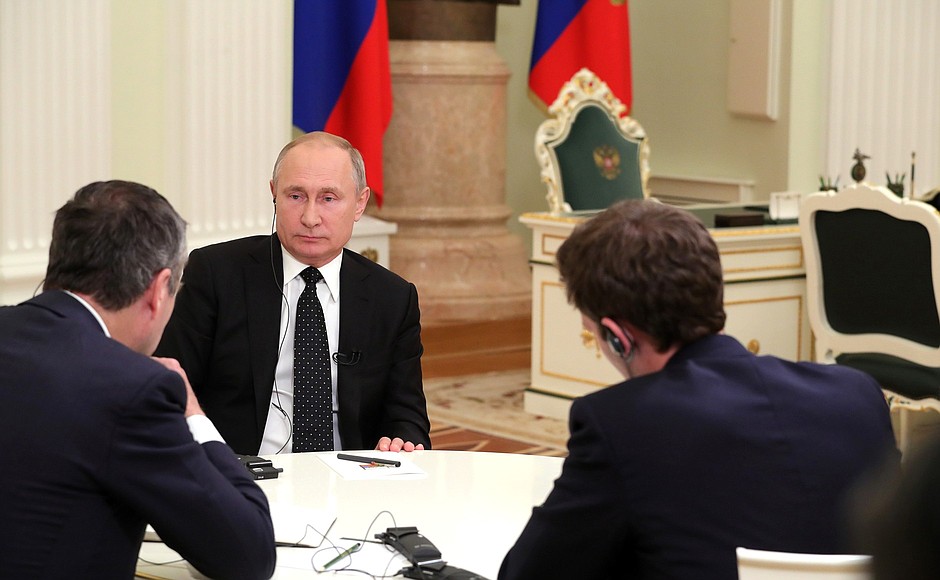
Putin at FT interview. (Kremlin photo)
In an interview with The Financial Times, Putin pointed to “the tragedies of Libya and Iraq” — meaning, of course, what happened to each of them as they lacked a nuclear deterrent. Applying that lesson to North Korea, Putin said,
“What we should be talking about is not how to make North Korea disarm, but how to ensure the unconditional security of North Korea and how to make any country, including North Korea, feel safe and protected by international law. …”
“We should think about guarantees, which we should use as the basis for talks with North Korea. We must take into account the dangers arising from … the presence of nuclear weapons,” he said, adding that if a way can be found to satisfy North Korea’s understandable determination to protect its security, “the situation may take a turn nobody can imagine today.”
“Whether we recognize North Korea as a nuclear power or not, the number of nuclear charges it has will not decrease. We must proceed from modern realities …” And those realities include fundamental, immediate security concerns for both Russia and China. Putin put it this way:
”[W]e have a common border, even if a short one, with North Korea, therefore, this problem has a direct bearing on us. The United States is located across the ocean … while we are right here, in this region, and the North Korean nuclear range is not far away from our border. This is why this concerns us directly, and we never stop thinking about it.”
Xi’s ‘Reasonable Expectations’
Last week in Pyongyang, Chinese President Xi Jinping said China is waiting for a desired response in stalled nuclear talks with the United States.
“North Korea would like to remain patient, but it hopes the relevant party will meet halfway with North Korea to explore resolution plans that accommodate each other’s reasonable concerns,” he said.
A commentary in China’s official Xinhua news agency said China could play a unique role in breaking the cycle of mistrust between North Korea and the U.S, but that both sides “need to have reasonable expectations and refrain from imposing unilateral and unrealistic demands.”
There is little doubt that the Russians and Chinese have been comparing notes on what they see as a potentially explosive (literally) problem in their respective backyards, the more so inasmuch as the two countries have become allies in all but name.
On a three-day visit to Moscow earlier this month, President Xi spoke of his “deep personal friendship” with Putin, with whom he has “met nearly 30 times in the past six years.” For his part, Putin claimed “Russian-Chinese relations have reached an unprecedented level. It is a global partnership and strategic cooperation.”
A Fundamental Strategic Change
Whether they are “best friends” or not, the claim of unprecedented strategic cooperation happens to be true — and is the most fundamental change in the world strategic equation in decades. Given the fear they share that things could get out of hand in Korea with the mercurial Trump and his hawkish advisers calling the shots, it is a safe bet that Putin and Xi have been coordinating closely on North Korea.
The next step could be stepped-up efforts to persuade Trump that China and Russia can somehow guarantee continued nuclear restraint on Pyongyang’s part, in return for U.S. agreement to move step by step — rather than full bore — toward at least partial North Korean denuclearization — and perhaps some relaxation in U.S. economic sanctions. Xi and Putin may have broached that kind of deal to Trump in Osaka.
There is also a salutary sign that President Trump has learned more about the effects of a military conflict with North Korea, and that he has come to realize that Pyongyang already has not only a nuclear, but also a formidable conventional deterrent: massed artillery.
“There are 35 million people in Seoul, 25 miles away,” Trump said on Sunday. “All accessible by what they already have in the mountains. There’s nothing like that anywhere in terms of danger.”
Obstacles Still Formidable
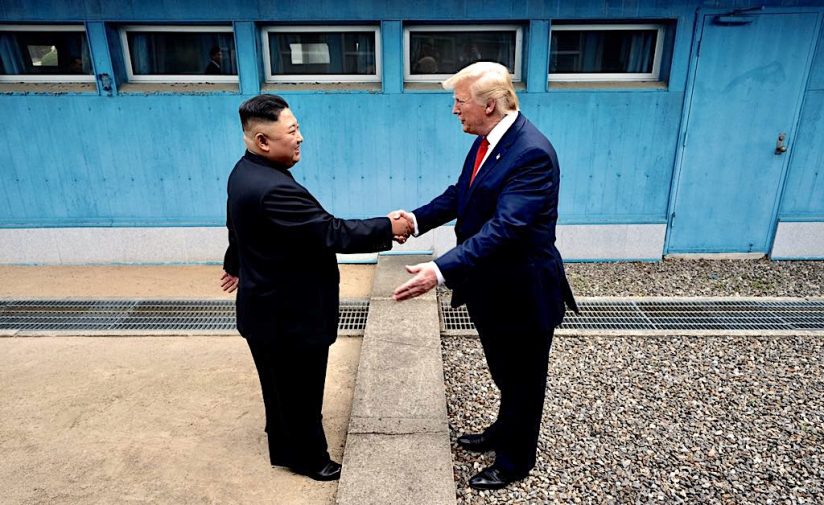
Trump and Kim meet Sunday before Trump became first US president to step on North Korean territory. (White House photo)
Trump will have to remind his national security adviser, John Bolton, and Secretary of State Mike Pompeo, that he is the president and that he intends to take a firmer grip on reins regarding Korean policy. Given their maladroit performance on both Iran and Venezuela, it would, at first blush, seem easy to jettison the two super-hawks.
But this would mean running afoul of the Military-Industrial-Congressional-Intelligence-Media-Academe-Think-Tank (MICIMATT) complex, in which the corporate-controlled media play the sine-qua-non role today.
In a harbinger of things to come, The Washington Post’s initial report on the outcome of the Trump-Kim talks contained two distortions: “Trump … misrepresented what had been achieved, claiming that North Korea had ceased ballistic missile tests and was continuing to send back remains of U.S. servicemen killed in the Korean War.”
The Trump administration could reasonably call that “fake news.” True, North Korea tested short-range ballistic missiles last spring, but Kim’s promise to Trump was to stop testing strategic not tactical missiles, and North Korea has adhered to that promise. As for the return of the remains of U.S. servicemen: True, such remains that remain are no longer being sent back to the U.S., but it was the U.S. that put a stop to that after the summit in Hanoi failed.
We can surely expect more disingenuous “reporting” of that kind.
Whether Trump can stand up to the MICIMATT on Korea remains to be seen. There is a huge amount of arms-maker-arms-dealer profiteering going on in the Far East, as long as tensions there can be stoked and kept at a sufficiently high level.
Ray McGovern works with Tell the Word, a publishing arm of the ecumenical Church of the Saviour in inner-city Washington. His first portfolio at CIA was referent-analyst for Soviet policy toward China, Korea, Vietnam, and Japan. In retirement he co-founded Veteran Intelligence Professionals for Sanity (VIPS).
Bolton is ‘war fanatic’ working to destroy peace – Pyongyang
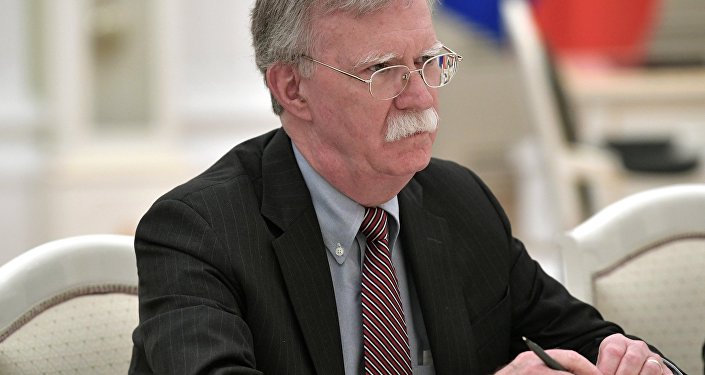
RT | May 27, 2019
US National Security Advisor John Bolton is a “war fanatic” and “defective human product” who works to destroy peace rather than maintain it, North Korea’s Foreign Ministry has said.
The tough assessment, cited by state news agency KCNA, comes after Donald Trump’s adviser lambasted Pyongyang for recently carrying out short-range missile tests. Bolton described the drills as “no doubt” violating UN resolutions.
Hitting back, North Korea’s Foreign Ministry argued that scrapping missile tests completely would hamper the country’s national security.
“Banning launches using ballistic technology is equal to telling us to give up our right to self defence.”
The ministry official added that even in the US Bolton is well-known as a “war fanatic” and that such a “human defect must go away as soon as possible.”
Earlier in May, the North Korean military test-fired a number of rockets and missiles. Washington’s war hawks were quick to cite it as another reason to mount pressure on Pyongyang.
Trump for his part wrote on his favorite social media platform, Twitter, that the tests of “small weapons” did bother some of his people, but not him.
The tests have been viewed as a way to put pressure on Washington to roll back sanctions imposed on North Korea, while Bolton is a staunch opponent of easing the restrictions.
Calling the hawkish American’s comment “more than ignorant,” the North Korean official added that Bolton was working to “destroy peace and security.”
John Bolton has been lambasted before for his “warmongering” position not only in relation to North Korea, but also for “looking for a fight” with Iran. Former congressman Ron Paul recently told RT that such a position is “very dangerous,” lamenting Trump for appointing neocons to his team.
North Korea warns no more talks until US backs off ‘impossible demands’
RT | May 24, 2019
Negotiations between the United States and North Korea over the latter’s nuclear program will not resume until the US administration backs off from what Pyongyang has characterized as a unilateral demand that it disarm.
US President Donald Trump and North Korean Supreme Leader Kim Jong-un held summits in Singapore in June 2018 and in Hanoi in February of this year, but talks broke off after the two sides were unable to bridge an impasse between their respective positions.
On Friday, North Korea’s state-run Central News Agency published comments by an unnamed Foreign Ministry official who said that the talks have broke down due to “impossible” US demands.
“The underlying cause of setback of the DPRK-US summit talks in Hanoi is the arbitrary and dishonest position taken by the United States, insisting on a method which is totally impossible to get through,” the statement read, accusing the US of having “deliberately pushed the talks to a rupture by merely claiming the unilateral disarmament.”
If it sticks to its current demands, “the United States would not be able to move us even an inch,” the Korean official stressed, barring any future more flexible approaches from US officials, “the prospect for resolving the nuclear issue will be much gloomy.”
The North Korean remarks contrast with statements by Trump, who framed the dissolution of talks between the two nations as resulting from unreasonable Korean demands for significant sanctions reduction, in exchange for only a partial nuclear disarmament on its part.
In April, the North Korean leader gave Trump a deadline until the end of the 2019 calendar year to formulate a deal which would be acceptable to both sides.
When North Korea’s Air Force Fought Israel
The Beginnings of Pyongyang’s Military Involvement in the Middle East and its Evolution Over Half a Century
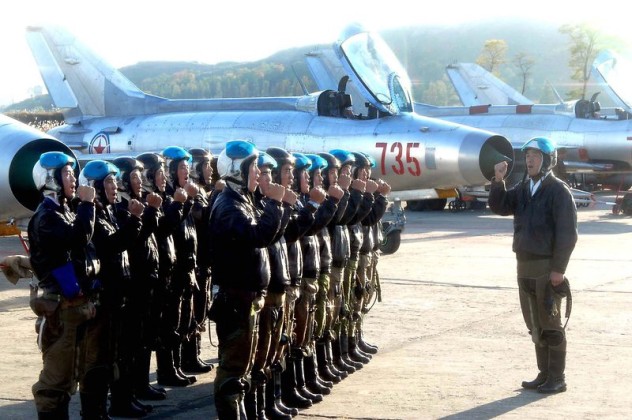
Military Watch Magazine | October 7, 2018
While the Yom Kippur War is a well known Cold War engagement between Soviet and Western aligned forces which took place in the midst of the Vietnam War, pitting the forces of a number of Arab states including Egypt, Syria, Iraq and Algeria against their longstanding adversary Israel, the role played by personnel deployed from external powers remains less well known. One party which played a significant role in the conflict, the beginnings of its extensive involvement in the Middle East to undermine the Western Bloc’s regional interests which continues to this day, was the Korean People’s Army (KPA) – the armed forces of North Korea. Having waged an intensive and brutal war with the Untied States and its allies in the 1950s, where an estimated 20-30% of its population was lost primarily due to the American bombing campaign, North Korea well understood the importance of air superiority and set about rebuilding its air and air defence forces with the most capable Soviet made weapons systems available. North Korean pilots and air defence crews were tasked not only with guarding the country’s airspace in the event of a future war with the Untied States, but also of contributing to the war efforts of a number of friendly countries – which they continue to do to this day. North Korean pilots played a considerable role in the Vietnam War, and according to Korean sources downed several U.S. fighter jets over the country. As the air war over Vietnam neared its end in the early 1970s, the KPA Air Force dispatched pilots to Egypt to aid the Soviet aligned country’s own war effort.
North Korean pilots had been stationed to aid Egyptian forces in defending their airspace months before the outbreak of the Yom Kippur War, and according to the Egyptian Military’s Chief of Staff Saad Al Shazly, Korean assistance provided critical assistance at a time of great need. Recalling that personnel from the USSR had been flying approximately 30% of the Egyptian MiG-21 fleet and operating about 20% of the country’s surface to air missile batteries, he noted that following the departure of Soviet forces under the decree of Egyptian President Anwar Sadat the Egyptian Air Force had struggled with a significant shortage of trained MiG pilots. Regarding North Korea’s role in solving this issue, the General stated in his memoirs:
“The solution occurred to me in March 1973, during the visit to Egypt of the Vice President of the Democratic (People’s) Republic of Korea (official name of North Korea.) On March 6, while escorting their Vice Minister of War, General Zang Song, on a tour of the Suez front, I asked if they could support us – and give their pilots useful combat training – but sending even a squadron of men. I knew at that time that his country flew MiG-21s. After much political discussion, in April I went on an official visit to president Kim Il Sung to finalise the plan. My fascinating ten day tour of that extraordinary republic, an inspiring an example of what a small nation of the so called Third World can achieve with its own resources is, alas, rather outside the scope of this memoir, as is my stopover in Peking (former English name for Beijing.)
Korean pilots – all highly experienced, many with more than 2,000 hours, arrived in Egypt in June and were operating by July. Israel or her ally ( the United States) soon monitored their communications, of course, and on August 15 announced their presence. To my regret, our leadership would never confirm it. The Korean s were probably the smallest international military reinforcement in history: only 20 pilots, eight controllers, give interpreters, three administrative men, a political advisor, a doctor and a cook. Bu their effect was disproportionate. They had two or three encounters with the Israelis in August and September and about the same number in the war. Their arrival was a heartwarming gesture. I mention the story here mainly to pay tribute to them and to apologise for the churlishness of our leadership in not also doing so.”
While Egyptian forces had long claimed that the MiG-21 was poorly suited to engage the F-4E, Israel’s prime air superiority fighter, and that the Soviet jet lacked the necessary survivability against the heavier American made platform, they were proven wrong not only by the successes of North Vietnamese pilots against the United States – but also by North Korean pilots operating against Israeli Phantoms over Egyptian airspace itself. According to Israeli sources, reporting on an engagement between North Korean piloted MiGs and their own Phantoms, the Korean pilots demonstrated considerable skill and were effectively untouchable in close range engagements – taking full advantage of the MiG-21’s superior manoeuvrability to evade multiple Israeli strikes with impunity. Whether North Korean pilots downed any Israeli fighters remains unknown, though reports indicate that no Koreans were shot down by Israeli jets. A number of reports do indicate however that the poorly trained Egyptian surface to air missile (SAM) crews mistook returning Korean MIG-21 fighters for Israeli jets, and proceeded to fire upon them. This was a common error made by Egyptian SAM crews, one which cost the country a number of fighter jets.
North Korean pilots’ participation in the Yom Kippur War represented only the beginning of the country’s military involvement in the Middle East, nor the last time the country would aid Arab states at war with Israel. While Egypt pivoted towards the Western Bloc in the war’s aftermath, abandoning the Soviet Union and its Arab allies, the country would pursue a number of joint weapons projects with North Korea and continues to import significant quantities of arms from the country. The Egyptian ballistic missile arsenal has North Korean origins, and the Korean Rodong-1 remains the country’s most capable platform in service today. North Korean assistance was also commissioned to construct a war museum in Egypt commemorating the Yom Kippur War, which was based heavily on the larger Fatherland Liberation War Museum in Pyongyang commemorating the Korean War. North Korean forces have since the Yom Kippur War also formed close ties to Syria and Yemen, and the KPA is involved in wars against Western aligned forces in both countries.
Korean assistance has been key to upgrading Syria’s surface to air missile network, while special forces have reportedly been deployed for ground operations. KPA personnel were also reportedly involved in the Lebanon War in alongside their Syrian allies, and were later responsible for aiding the Lebanese militia Hezbollah to construct underground fortifications key to its military success against Israel in 2006. A number of key figures in Hezbollah’s leadership, including its leader Hassan Nasraallah, reportedly travelled to Korea for military training in the 1980s. Korean assistance has been key to strengthening the missile capabilities of Libya, Syria and Yemen, as well as Iran and Hezbollah, with all these parties relying heavily on a wide variety of the country’s missile designs until today. The East Asian state has since the Yom Kippur War played a considerable role in supporting regional forces against the Western Bloc and their allies, and is set to continue to do so for the foreseeable future.
‘Anything is possible’: Trump talks North Korea peace after phone call with Putin
RT | May 4, 2019
President Trump took to Twitter to declare his support for peace on the Korean Peninsula, after discussing the issue with Russian President Vladimir Putin. North Korea, meanwhile, test-fired short-range missiles.
“Anything in this very interesting world is possible,” Trump tweeted on Saturday. “But I believe that Kim Jong Un fully realizes the great economic potential of North Korea, & will do nothing to interfere or end it. He also knows that I am with him & does not want to break his promise to me. Deal will happen!”
Trump’s tweet came after he spoke with Putin by phone on Friday. The two leaders discussed a range of geopolitical issues, including nuclear arms control and the Korean peace process.
The president touted the success of the call on Saturday, heralding the “tremendous potential for a good/great relationship with Russia, despite what you read and see in the Fake News Media.” After the phone call, certain media outlets chided Trump for not pressing Putin on supposed Russian election meddling.
Despite Trump’s insistence that a “deal will happen” with North Korea, results thus far have been lacking. A much-anticipated summit between Trump and North Korean leader Kim Jong-un in Singapore last year ended with a vague promise from Kim to work towards denuclearization, while a follow-up summit in Hanoi, Vietnam this year collapsed with no agreement when Trump found Kim’s demands untenable.
Kim has since broadened his horizons, meeting with Putin in Vladivostok last month. Japanese Prime Minister Shinzo Abe is also reportedly considering a meeting with Kim, according to a Friday report in the Shankei newspaper.
Diplomacy aside, Pyongyang has reportedly reversed its dismantling of missile and rocket test sites in the wake of the failed Hanoi summit, and on Saturday morning fired a salvo of short-range projectiles out to sea from the city of Wonsan, on its east coast.
N. Korea warns of ‘corresponding response’ as Washington & Seoul stage joint war games
RT | April 25, 2019
North Korea has warned of a “corresponding response” as it vented anger at the ongoing military drills between the US and South Korea. Pyongyang says such steps simply hamper the reconciliation process.
In a strongly-worded statement issued by the North’s Committee for the Peaceful Reunification of the Country on Thursday, Pyongyang blasted the joint air force exercises as “acts of perfidy.”
It added that the maneuvers go against the “trend toward the reconciliation on the peninsula” and threatened the “valuable spark of peace, reconciliation and cooperation” between the two Koreas.
The committee, which oversees inter-Korean affairs, also warned the South Korean authorities “to behave with discretion,” and said the exercises risked north-south bilateral ties.
It finished by saying that such a “military provocation” would garner a “corresponding response,” noting that authorities in Seoul “can never make a complaint” over whatever actions Pyongyang eventually undertakes.
The two-week joint air force exercises, which kicked off on Monday, had been organized as a more low-key alternative to the annual Max Thunder drills usually conducted by the US and South Korea.
It follows a call made by Trump following his first summit with Kim Jong-un last June to suspend the “very provocative” war games after an agreement was reached by both parties to back “complete denuclearization” of the Korean peninsula.
Since then, several military exercises have been either canceled or scaled-back.
However, the negotiations floundered following a second meeting between the two leaders in Vietnam in late February. Back then, both heads of state walked away without securing a deal amid disagreements over the lifting of sanctions on Pyongyang.
North Korea pitched state-of-the-art submarine system to Taiwan military: report
By Sophia Yang -Taiwan News – 2019/04/05
TAIPEI — As Taiwan’s first indigenous submarine project is underway, media reported the North Korean government years ago reached out to Taiwan’s military in an attempt to sell its advanced marine propulsion technology – Air Independent Propulsion (AIP) – for the project.
People familiar with the matter told UPmedia that a number of submarine builders and software providers from the United States, Europe among 16 other countries showed their interest in participating in the country’s indigenous submarine project. To the military department’s surprise, the North Korean military was among the bidders, reportedly pitching their products through a Taiwanese trading company.
The name of the trading company was not disclosed in the news story.
The report indicated that the company was pitching on behalf of the isolated nation, which has been enduring severe financial stress under the sanctions imposed by international bodies and a number of countries. The products on the list included North Korea’s miniature Yono-class submarine, Yugo-class submarine, Sang-O-class submarine, as well as the North Korean self-made AIP system.
The system is believed to enable the submarine to remain submerged for up to four weeks to better extend its underwater endurance, compared to an underwater endurance of only a few days in traditional diesel-electric submarines.
A submarine expert working for Taiwan’s military reportedly made a fact-checking trip years ago to the China-DPRK border city of Dandong to meet the North Korean military officials, from whom the expert verified the authenticity of the bid and its capability to carry out the task. However, Taiwan’s military eventually didn’t consider the technologies out of concern that it would violate UN sanctions against North Korea.
Also, recently at a press event, a military official told media that Taiwan’s first indigenous submarine would not be equipped with the advanced and expensive AIP system, but will consider it for the other indigenous submarines in the future.
Kim Jong-un May be The World’s Most Strategic Head of State
By Adam Garrie | EurasiaFuture | April 18, 2019
Last night it was confirmed that the DPRK tested a new tactical guided weapon. While this particular weapon does not violate the agreement by Pyongyang to refrain from testing ICMBs and nuclear warheads during the course of the peace process, it would be impossible to argue that the test is unrelated to the public disappointment that Kim Jong-un has voiced at the lack of progress on sanctions relief in the aftermath of the largely uneventful Hanoi summit between himself and Donald Trump.
Thus, the DPRK was able to show that it continues to develop its domestic defence industry while remaining committed to the letter of the no-ICMB/no-nuclear testing agreements which have thus far provided a foundation for the ongoing peace process. At the same time, the test is an indication that Kim Jong-un was not bluffing when he gave until the end of 2019 as a deadline for progress in the ongoing peace process before his country would examine alternative paths forward.
But most importantly was the timing. On the morning of the 18th (Washington D.C. time) it was known that the full contents of the Robert Mueller report would be made public (minus certain redactions). Because US Attorney General Barr’s previous summery of the report made it clear that the US President has been exonerated by Mueller, Kim would have known that Donald Trump’s spirits would likely be up as the entire world will now get to read first hand that the man many thought would destroy Trump has ended up vindicating much of what Trump has said over the last three years.
This is crucial for two reasons. First of all, in his recent speech, Kim indicated that while the last few months have seen a downturn in DPRK-US relations, his personal relationship with Donald Trump remains strong. Later, Trump agreed that he has a highly friendly relationship with Kim Jong-un and that he takes an optimistic view on the overall prospects of a successful peace process.
As such, Kim made it clear that yesterday’s new missile test was not intended to embarrass Trump personally. Because Kim and his colleagues (like the rest of the world) will have known that the public release of the Mueller report was coming within hours, Kim could have and self-evidently did use deductive reasoning to assume that short of a world war breaking out, all of US media would be totally fixated on reading and analysing the Mueller report throughout the 18th of April. On a slower news day, the DPRK’s missile test would have otherwise been headline news.
In this sense, Kim was able to make his point but do so in a matter made subtle due to the fact that the weapons test was going to necessarily be obscured by what for Americans is a bigger news story. The DPRK also used this opportunity to reiterate that far from having a problem with Trump, it is Secretary of State Mike Pompeo who Pyongyang views as the main obstacle to progress in the peace talks.
When taken as a whole, the events of the last 24 hours have revealed Kim to be not only a master of grace under pressure but more importantly, a master of combining important messages with a subtle delivery that avoids inflaming the situation.
The stagnation within the peace process since the Hanoi summit may well have made the DPRK’s new missile test inevitable but Kim Jong-un’s understanding of America’s internal political situation has helped to minimise any potentially negative fall out from Washington within the framework of a delicate and extremely important ongoing peace process.
Trump & the Bolton-Pompeo Axis
By Patrick Lawrence | Consortium News | April 16, 2019
Moon Jae-in’s Oval Office meeting with President Donald Trump last Thursday marked an important step forward for both leaders. The South Korean president appears to have drawn Trump away from the all-or-nothing “big deal” he proposed when he last met Kim Jong-un — an offer we now know was intended to precipitate the North Korean leader’s rejection. Trump won, too: The encounter with Moon has effectively put the Dealmaker back on his feet after the calamitous collapse of the second Trump–Kim summit in Hanoi two months ago. A top-down agreement on the North’s denuclearization is once again within reach.
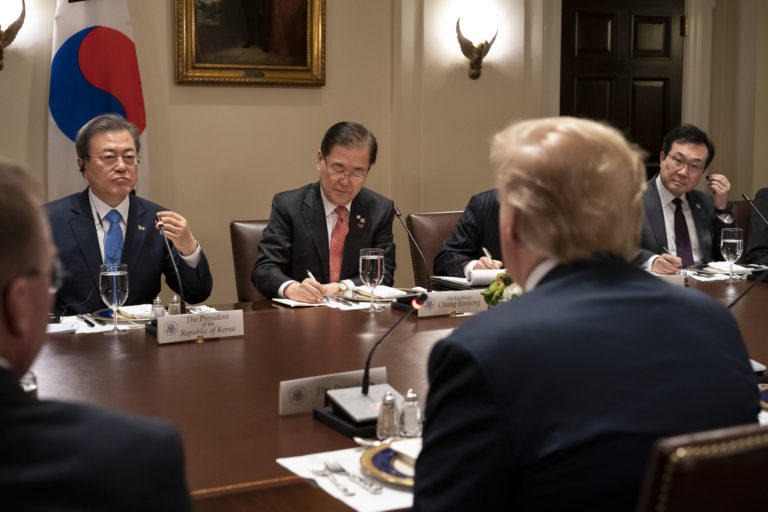
Moon facing Trump in DC, April 11, 2019. (White House/ Shealah Craighead via Flickr)
The importance of the Moon–Trump summit, while eclipsed by news of Julian Assange’s arrest in London the same day, is not be underestimated. Even before receiving Moon, Trump announced for the first time that he is willing to summit with Kim for a third time. While still stressing the North’s complete denuclearization as the U.S. objective, Trump also said he is open to the incremental diplomacy he precluded with his everything-at-once offer in Hanoi.
“There are various smaller deals that maybe could happen,” Trump said before he and Moon withdrew to the Oval Office. “Things could happen. You can work out step-by-step pieces, but at this moment we are still talking about the big deal.”
New Stance
This new stance is a big deal in itself. Moon and Kim — with Chinese and Russian support — have advocated talks based on gradualist reciprocity from the first. “Action for action,” Moon calls it. This strategy is widely accepted at the other end of the Pacific as the only plausible path to a sustainable denuclearization agreement. The U.S. has been the only nation engaged on the Korean question to argue otherwise.
In addition, Trump appeared to signal that Moon may get something he dearly wanted when he arrived in Washington: dispensation to proceed with inter–Korean economic projects — including transport links, an industrial park, and a joint-venture resort in the North — that are now blocked by a plethora of U.S. and UN–imposed sanctions. Moon views these as essential confidence-builders and the first steps toward integrating the North into a Northeast Asian economic hub that will also include South Korea, China, and the Russian Far East.
In Pyongyang, Kim responded to the events in Washington when he addressed the Supreme People’s Assembly last Friday. The speech was carefully balanced between optimism and caution, the latter reflecting Kim’s view that he was betrayed in Hanoi when Trump marshaled an offer he could not possibly embrace. “I am willing to accept if the United States proposes a third North Korea — United States summit,” Kim told North’s legislative body, “on condition that it has a right attitude and seeks a solution that we can share.”
Kim had other things to add. “We don’t like — and we are not interested in — the United States’ way of dialogue, in which it tries to unilaterally push through its demands,” he said. “We don’t welcome — and we have no intention of repeating—the kind of summit meetings like the one held in Hanoi.” The North Korean leader went on to set a year-end deadline “for the United States to make a bold decision.”
While Washington and Pyongyang had sharply conflicting versions of what transpired in Hanoi — each blaming the other for the summit’s failure — there is now little question that the U.S. side was at fault. A post–Hanoi Reuters exclusive reports that, prior to their famously canceled lunch, Trump handed Kim a sheet of paper listing, in English and Korean, extensive U.S. conditions that began with “a blunt call for the transfer of Pyongyang’s nuclear weapons and bomb fuel to the United States,” according to the piece filed by Leslie Broughton and David Brunnstrom.
The English-language version of the letter, the Reuters team reports, went on to demand “fully dismantling North Korea’s nuclear infrastructure, chemical and biological warfare program and related dual-use capabilities; and ballistic missiles, launchers, and associated facilities.”
The Libya Model
In simple terms, this was a kitchen-sink proposition — effectively a demand for unilateral disarmament — that was intended to prompt Kim to walk away. The Reuters reporters suggest that the fatal gambit was the work of John Bolton, Trump’s hyper-hawkish national security advisor. They quote North Korean officials as also implicating Secretary of State Mike Pompeo, another administration hawk, in what amounts to an act of diplomatic sabotage. The device used was Bolton’s “Libya model,” a laden reference if ever there was one. When Muammar Gaddafi gave up his chemical and nuclear weapons programs in 2003, he did so by sending Libya’s nuclear materials and equipment to the U.S. Eight years later, of course, he was assassinated in the wake of a NATO bombing campaign led by the U.S.
“The document appeared to represent Bolton’s long-held and hardline ‘Libya model’ of denuclearization that North Korea has rejected repeatedly,” Broughton and Brunnstrom report. “It probably would have been seen by Kim as insulting and provocative, analysts said.” One of those analysts was Jenny Town, a North Korea specialist at the Stimson Center in Washington. “‘This is what Bolton wanted from the beginning and it clearly wasn’t going to work,’” Reuters quotes Town as observing. “‘If the U.S. was really serious about negotiations, they would have learned already that this wasn’t an approach they could take.’”
Formidable Challenges
As this record of the Hanoi proceedings makes plain, Trump and Moon will assume formidable challenges to the extent they agree to work together toward a resolution of the Korea question on new terms. It is not clear why Trump — who went to Hanoi eager to cut his “big deal” with Kim — accepted the Bolton-inspired design and handed it on to the North Korean leader. But he has now set himself up for another in what appears to be a long line of conflicts with his foreign policy minders, Bolton and Pompeo chief among them.
The outlook in this connection is mixed at best. Trump was able to overrule new sanctions against North Korea that were announced several weeks after the Hanoi debacle. It is a matter of interpretation, but he effectively lost a battle with the Bolton–Pompeo axis when the administration designated the Iran Revolutionary Guard Corps a terrorist organization earlier this month. That move is understood widely to have pushed renewed negotiations with Tehran, for which Trump had been hoping, well beyond the point of no return.
For Moon, the challenges ahead are two. Most immediately, he must keep both Trump and Kim seated at the chess table between now and the end of the year. If no third summit is set by then, Kim has already signaled, he will consider this chapter in the long history of U.S.–North Korean negotiations closed — another story of failure. In such a case, the question facing Moon could hardly be more daunting: Can a South Korean leader determined to end nearly seven decades of enmity between the Koreas decisively wrest control of the diplomatic process from the U.S.?
That would amount to an unprecedented showdown between Seoul and Washington. Despite Moon’s admirable dedication, this is unlikely to materialize — not in the near term, in any case. Moon has formidable allies in Beijing and Moscow; Kim is plainly eager to break North Korea out of its isolation. But the U.S., perfectly satisfied to act as “spoiler” in Northeast Asia (as elsewhere), remains too powerful an obstacle despite the many signs that it is in the sunset phase of its global preeminence.
Patrick Lawrence, a correspondent abroad for many years, chiefly for the International Herald Tribune, is a columnist, essayist, author, and lecturer. His most recent book is “Time No Longer: Americans After the American Century” (Yale).
Gradually Re-establishing Historical Truth about Jeju Uprising
By Konstantin Asmolov – New Eastern Outlook – 14.04.2019
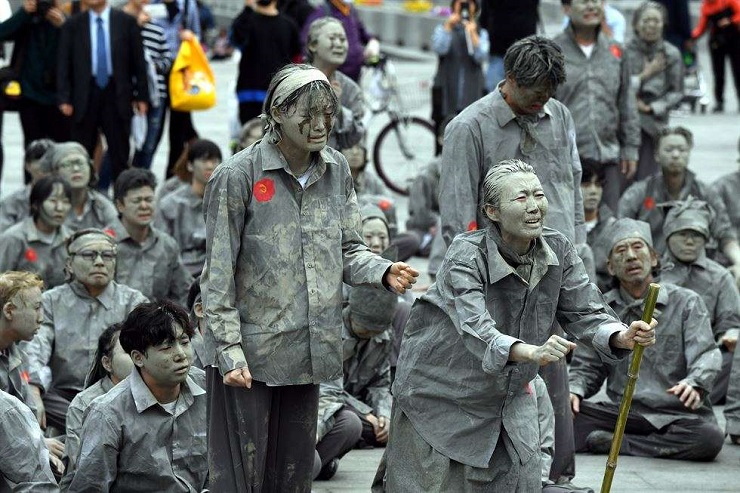
On 3 April, 2019 a commemoration ceremony to honor victims of a bloody suppression by government forces of the people’s uprising in 1948-1954 was held on the island of Jeju. More than 10,000 people, including representatives of the government and the National Assembly, revolt participants and offspring of the victims of its clampdown, took part in the memorial. South Korea’s Prime Minister, Lee Nak-yeon, gave a speech at the ceremony. He proposed to honor the memory of all those lost and expressed his deepest condolences to their families. The minister also referred to the incident in Jeju as the worst event in South Korea’s modern history. Lee Nak-yeon emphasized that Moon Jae-in’s administration has undertaken the monumental task of uncovering the truth behind the Jeju massacre, and of restoring the victims’ dignity.
The head of South Korea’s National Police Agency, Min Gap-Ryong, participated in a commemoration ceremony in Seoul. He wrote the following words in the visitor’s book: “I humbly share my condolences before the spirits of all those innocent people who were killed during Jeju April 3, and I respectfully share my wishes that they rest in peace.” Vice Minister of National Defense Seo Joo-seok, who made the aforementioned statement, was also in attendance. He highlighted that the army was fully committed “to the government investigation efforts going forward” and would “take part in healing the wounds and suffering of the family members while restoring the honor of those who were slain”. This was the first comment about the incident made by a South Korean military agency.
Officially, at least 10,000 Jeju residents were killed and almost 3,600 went missing, as a result of the tragedy that stemmed from Korea’s ideological split following its emancipation from Japanese colonial rule, which lasted from 1910 to 1945. In reality, the situation was even more complex. Propaganda from both North and South Koreas portray the uprising as a communist revolt against elections, which were to take place in the South on dividing the peninsula. However, in reality, the uprising was instigated by actions of the police and agitators from so-called “youth groups”, who used racketeering and violence to bring the region, with a powerful left-wing movement, under control.
South Korea’s current strategic policy has its origins at the start of the rebellion, 1 March 1947, when a child who suffered a blow from a police horse’s hoof died during a street protest in celebration of May Day. This led to a confrontation with the police and the crowd was fired on. In response, the Workers’ Party of South Korea declared a general strike. Instead of calming people down, the government made a decision to destroy the left-wing forces once and for all, which led to an even tougher response from the people.
On 3 April 1948, more than 350 armed civilians simultaneously attacked 12 police precincts and homes of representatives of legislative bodies, in order to free detained relatives and force the government to reconsider its policy. The leadership reacted even more violently in turn. Death squads mercilessly dealt with protesters and local residents who helped them. On 17 October 1948, a ban on movement in inner and mountainous regions of the island, with the exception of its 5-km coast line, was introduced. All the villages outside this perimeter were completely destroyed and so were their residents if they refused to leave these territories. 2,500 islanders were imprisoned although there were no charges against them or any written verdicts.
The bloodshed continued during the Korean War too. The truth is, however, in 1953 armed units had only approximately 60 people in them, and by the beginning of 1954, this number decreased to 5. 21 September 1954 is viewed as the last day of the uprising, when the ban on movement was finally lifted. The last guerrilla member was arrested on 2 April 1957.
Since a substantial portion of the population was massacred, and their bodies were often submerged or burned, the number of estimated victims ranges from 14,000 to 30,000 people. And if those who were indirectly affected by the government’s crackdown (i.e. victims of hunger or subsequent social cleansing) are added to the total, the number is even higher. Incidentally, only 14% of protesters were killed.
For decades after the uprising, memories of this event and the atrocities committed during the rule of Syngman Rhee were hidden from the public by means of censorship and repression. And only on 12 January 2000, a Special Act was decreed, in accordance with which a truth committee was established to investigate the Jeju massacre and to exonerate its victims. Approximately 14,000 people applied to have the status of a victim of those events. On 28 August of the same year, the special committee for investigating causes of death of the residents and their exoneration began their work.
In 2006, Roh Moo-hyun’s government issued an official apology for its role in the massacre. The leadership also promised reparations for the victims, but by the end of 2018 nothing had been done to this end.
On the plus side, a lot of work is being done to clear the good name of people, who, during the uprising, were preemptively jailed and tortured, without a single charge brought against them. Those who were released had to live under the umbrella of suspicion. And, finally, in January 2019, the Jeju District Court dismissed military court’s rulings with regard to the 18 plaintiffs, who survived, and recognized them as victims instead. The accusations levelled against them were deemed unsubstantiated since the military court did not follow prescribed legal procedures. This conclusion, in the opinion of those who issued the verdict, is supported by the fact that the plaintiffs were not aware of the criminal charges against them. Also the sheer number of people brought before the military courts-martial within a short period of time indicated relevant investigations were unlikely to have been carried out.
The plaintiffs demanded that their cases be reviewed as far back as 2017, as they claimed to have been arrested and jailed for a period of up to 20 years without as much as a fair trial. Since that time not a single court record has been found to indicate why the plaintiffs received such harsh sentences. Even after researchers had travelled to the peninsula and accessed central archives, they were unable to find any existing records about the investigation at that time. It turns out that people were detained and tortured without being charged for any crimes , which is consistent with the practice of preemptive arrests.
The court decided to retry the case in September 2018 due to renewed interest in the incident following the commemoration of its 70th anniversary and the official apology issued by President Moon Jae-in.
A few months later, on 17 January 2019, the Jeju court exonerated all the participants of the people’s uprising on 3 April 1948, who had served the sentences handed down to them by the military courts-martial.
This policy, exercised by Moon Jae-in’s government towards residents of Jeju, is part of a common trend. As part of this new shift, “a former police investigation building in Namyeong-dong, Seoul”, where intelligence agents “tortured hundreds of pro-democracy” and anti-government “activists in the 1970s and 1980s, has been turned into a memorial hall for human rights and democracy.” The Ministry of the Interior and Safety plans to outsource the building’s “operation to the Korea Democracy Foundation”. Prime Minister Lee Nak-yon participated in the transfer ceremony, along with Minister of the Interior and Safety Kim Boo-kyum; Seoul Mayor Park Won-soon; Commissioner General of the Korean National Police Agency Min Gap-Ryong, and victims of torture and their family members.
In 1976, the anti-communism investigation division office was located where the current facility stands now. During both the Park Chung-hee and Chun Doo-hwan administrations, the building was used to detain, interrogate and torture anti-government activists. Over a period of approximately 30 years, a combined total of 391 activists were tortured there. Their ranks included Seoul National University student Park Jong-chul, whose death resulted in mass protests that led to the fall of the Fifth Republic of South Korea.
In response to criticism, in 2005 the National Police Agency closed the Namyeong-dong division and transformed it into a human rights police center. However, civic groups demanded that the police stop operating this facility. This process began in earnest in June 2018, when Moon Jae-in promised to convert the building into a memorial for human rights and democracy.
In his speech, Prime Minister Lee Nak-yon said that Namyeong-dong “will forever contribute to the people and history as a place to warn against the state’s abuse of power”.
A similar policy is being used with respect to persecuted members of the Bodo League. This political organization was comprised of “re-educated” left-wing activists. But once the Korean War began, most of its members were subject to repression (as a preventative measure), and the majority were executed by firing squads. Groups, such as the Korean War Bereaved Family Members’ Association, claim that after this war 200,000 members of the League were killed throughout the country.
Numerous testimonies from family members of victims paint a grim picture: activists were gathered together under the pretense of going on an excursion to the mountains or to a ceremony. They were then transported out of town or city, executed by a firing squad and buried in unmarked graves.
Only in June 2014, did a number of residents gather enough courage to corroborate evidence of a civilian massacre, which local witnesses remembered. They carried out an excavation and unearthed burial sites, but there have not been any official exhumations so far.
On 22 June 2016, a testimony by prosecutor Song Jung-won (1918-2014), who is viewed as the founder of the Bodo League, became public knowledge. On 18 October 2007, he testified in front of the Truth and Reconciliation Commission and said that many members of the League were not partisans and, in fact, did not even know what a communist party was. As a rule, these were simple peasants or intellectuals, who wished to expunge the “Red Menace” label from their family name.
Civilian activists think this testimony may be viewed as proof of the fact that the government massacred countless numbers of innocent people knowing full well that they were not members of the Communist Party.
In addition, as far back as 2009, the Truth and Reconciliation Commission confirmed mass killings of at least 3,400 civilians and inmates held in prisons in Busan, Masan and Jinju from July to September 1950. Jail employees, police officers and members of counterintelligence services took part in these reprisals. Victims were either killed inside prisons or taken to the mountains, executed, and their bodies were disposed of in the sea. Only in a few cases were executions carried out after an official sentence was handed down by a military tribunal. Incidentally, most of these victims were prisoners sentenced to less than three years in jail, and they were killed only because of concerns that they would collaborate with DPRC.
Most investigations of this nature were conducted in the course of the work performed by the Truth and Reconciliation Commission. It was established in December 2005 and tasked with researching information connected with the anti-Japanese independence movement; mass killings of civilians during the Korean War, and violation of human rights by government forces during the military dictatorship. During a fairly short 5-year period, the commission uncovered the truth about 8,468 cases by concluding that extrajudicial massacres had taken place during the Korean War and earlier. In addition, the commission ascertained that evidence in a number of espionage cases from the 1980s was either distorted or completely fabricated.
However, during Lee Myung-bak’s presidency the work conducted by the Truth and Reconciliation Commission was discontinued. The final report highlighted the fact that both sides were responsible for atrocities, but failed to mention the fact that there were twice as many victims of the “White Terror”, and many culprits were absolved of responsibility. “As a result, true reconciliation and reckoning with the past ended up being put off until another day.”
And now, possibly, this day has arrived. Although old political myths often have a tendency to transform into new ones during Moon Jae-in’s presidency, hope remains that the final picture will be an accurate reflection of the historical truth.
Konstantin Asmolov, Ph.D. in History, is a leading research fellow at the Center for Korean Studies of the Institute of the Far East at the Russian Academy of Sciences.
Featured Video

Trita Parsi: Israel Set a Trap for Total War in the Region
or go to
Aletho News Archives – Video-Images
From the Archive
Zionism’s Violent Legacy
By Donald Neff | Washington Report On Middle East Affairs | January 1996
On January 4, 1948, Jewish terrorists drove a truck loaded with explosives into the center of the all Arab city of Jaffa and detonated it, killing 26 and wounding around 100 Palestinian men, women and children.[1] The attack was the work of the Irgun Zvai Leumi – the “National Military Organization,” also known by the Hebrew letters Etzel – the largest Jewish terrorist group in Palestine. The Irgun was headed by Revisionist Zionist Menachem Begin and had been killing and maiming Arabs, Britons and even Jews for the previous ten years in its efforts to establish a Jewish state.
This terror campaign meant that at the core of Revisionist Zionism there existed a philosophical embrace of violence. … continue
Blog Roll
 Aletho News
- Trita Parsi: Israel Set a Trap for Total War in the Region
- Trump’s Iran war is on an Israeli leash
- Saudi oil boss issues global supply warning
- Riyadh Says Its Oil System Is Intact. The Numbers Say Otherwise.
- Trump and Netanyahu Want to “Finish the Job” on Iran
- US ‘one-sided dictation’ not Iran’s beliefs makes rational talks impossible: Baghaei
- Iran’s Next Strike May Not Explode. It Could Shut You Down /Col Doug Macgregor
- Iran: US political targets legitimate if assassinations return
- Iraq shuts key border crossing with Iran under US pressure: Report
- Undersea Internet cables could be targeted in retaliation for attacks on Iran: IRGC deputy chief
- If Americans Knew
- The Israel Lobby’s Changing Fortunes
- AIPAC has become such a political liability that it’s shifting to a more “nimble” approach to buying politicians
- At least 160 Israeli settler attacks in 2 weeks
- Will Gaza’s Ancient Christian Community Disappear Forever?
- Israel’s vision of regional security rests on keeping Arab states weak
- Heidi Levine recounts how Palestinian youths helped save her in settler attack
- DAILY UPDATE: Latest essential news on Palestine, Israel, & region
- Trump’s Intensifying Sabotage of the ICC, for Israel’s Sake
- Israeli military detain US and UK volunteers in West Bank including Democratic NY politician Brad Lander
- Americans at National Conservatism Conference held in Israel this year criticize Israel
- No Tricks Zone
- E-Cars Reduce CO2 Emissions By Only 41% Compared To Internal Combustion Engine Vehicles
- Predictions Made By Renowned Climate Professor Over Past Decades Have Been Proven To Be Poor
- New Study Suggests Large Regions Of The Pacific Ocean Have Been Cooling For The Last 80 Years
- Germany’s Green Energy Debacle: High Energy Costs Force Kahla Porzellan to Close After 182 Years!
- New Study: 50 Years Of The Most Aggressive ‘Net Zero’ Policies Can Only Affect The Global Climate By 0.03°C
- US September “Heat” Was No Record…Many Records Set Decades Ago
- Latest European Green Energy Debacle; Portugal’s Largest Flagship Solar Park Insolvent!
- Green Energy Debacle: German Expert Professor Fritz Vahrenholt Warns Of Severe Economic And Social Consequences
- Two More Paleo Reconstructions Affirm Meters-Higher Sea Levels Across Ireland, Brazil 7000-6000 Years Ago
- New Study: Earth And Venus Surface Warmth Largely Explained By Convection And Lapse Rate, Not CO2 Or Radiation

