North Korea’s Kim says US must stop ‘way of calculation’, gives deadline
Press TV – April 13, 2019
North Korean leader Kim Jong-un says the United States has raised the risk of returning to past tensions after the collapse of his second summit with President Donald Trump, stressing that yet another meeting between the two leaders is only possible if Washington comes with the right attitude.
The North’s official KCNA news agency on Saturday quoted Kim as making the remarks, two days after Trump floated the idea of holding a potential third nuclear summit with the North’s leader.
“What is needed is for the US to stop its current way of calculation, and come to us with a new calculation,” Kim was quoted as saying in a speech to the Supreme People’s Assembly on Friday.
He also said that he would wait “until the end of this year” for Washington to decide.
Back in late February, Trump and Kim reached an impasse at their second face-to-face denuclearization talks in the Vietnamese capital Hanoi, with Washington demanding full disarmament and Pyongyang demanding economic incentives through partial lifting harsh sanctions.
The second summit in fact did collapse when the American president abruptly walked away from the talks without reaching a deal or even issuing a final statement.
Trump claimed that he quit the talks because Kim demanded to lift all economic sanctions as a prerequisite to denuclearization.
However, Pyongyang quickly responded that it had never asked for the removal of all sanctions, but only the partial removal of them.
In June last year, the two leaders met at a historic summit for the first time in Singapore, where they agreed to work toward denuclearization of the Korean Peninsula. Subsequent diplomacy between the two sides, however, made little progress, mainly because Washington refused to lift its crippling sanctions.
“The second DPRK-US summit in Hanoi in February raised strong questions about whether the steps we took under our strategic decision were right, and gave us a sense of caution about whether the US is even really trying to improve the DPRK-US relationship,” Kim added, using the initials of North Korea’s full name, the Democratic People’s Republic of Korea.
The North’s leader also said that Washington came with “completely unrealizable plans” to Hanoi and that the US was “not really ready to sit with us face-to-face and solve the problem.”
“By that sort of thinking, the US will not be able to move us one iota even if they sat with us a hundred, thousand times, and will not be able to get what it wants at all,” Kim stressed.
The North Korean leader further blamed the US for continuing “to ignore the basic way of the new DPRK-US relations, including withdrawing hostile policies.”
Kim also warned that the White House mistakenly believes that “if they pressure us to the maximum, they can subdue us”, stressing that he had no interest in a third summit if it is a repeat of Hanoi.
The North’s leader also noted that his relations with Trump remained excellent.
So far, Pyongyang has taken several steps toward the goal by suspending missile and nuclear testing, demolishing at least one nuclear test site, and agreeing to allow international inspectors into a missile engine test facility.
The US, however, has insisted that sanctions on the North must remain in place until it completely and irreversibly dismantles its nuclear program.
The collapse of the Hanoi summit also disappointed US-ally South Korea, which has been improving relations with the North since early 2018.
Moon, who acts as a go-between in diplomacy involving Washington and Pyongyang, flew to Washington earlier this week in his third official visit to the US with the objective of helping put denuclearization talks with North Korea back on track after the Hanoi failed summit.
Despite the fact that that the situation on the Korean Peninsula had significantly improved following a number of high-level talks last year between Pyongyang and Seoul, as well as Washington, the North is still subject to harsh international sanctions over its nuclear and ballistic missile programs.
What Monroe Doctrine?
By Philip M. GIRALDI | Strategic Culture Foundation | 04.04.2019
Because there is a presidential election coming up next year, the Donald Trump Administration appears to be looking for a country that it can attack and destroy in order to prove its toughness and willingness to go all the way in support of alleged American interests. It is a version of the old neocon doctrine attributed to Michael Ledeen, the belief that every once in a while, it is necessary to pick out some crappy little country and throw it against the wall just to demonstrate that the United States means business.
“Meaning business” is a tactic whereby the adversary surrenders immediately in fear of the possible consequences, but there are a couple of problems with that thinking. The first is that an opponent who can resist will sometimes balk and create a continuing problem for the United States, which has a demonstrated inability to start and end wars in any coherent fashion.
This tendency to get caught in a quagmire in a situation that might have been resolved through diplomacy has been exacerbated by the current White House’s negotiating style, which is to both demand and expect submission on all points even before discussions begin. That was clearly the perception with North Korea, where National Security Advisor John Bolton insisted that Pyongyang had agreed to American demands over its nuclear program even though it hadn’t and would have been foolish to do so for fear of being treated down the road like Libya, which denuclearized but then was attacked and destroyed seven years later. The Bolton mis-perception, which was apparently bought into by Trump, led to a complete unraveling of what might actually have been accomplished if the negotiations had been serious and open to reasonable compromise right from the beginning.
Trump’s written demand that Kim Jong Un immediately hand over his nuclear weapons and all bomb making material was a non-starter based on White House misunderstandings rooted in its disdain for compromise. The summit meeting with Trump, held in Hanoi at the end of February, was abruptly canceled by Kim and Pyongyang subsequently accused Bolton and Secretary of State Mike Pompeo of making “gangster-like” demands.
The second problem is that there are only a few actual casus belli situations under international law that permit a country to attack another preemptively, and they are usually limited to actual imminent threats. The current situation with Venezuela is similar to that with North Korea in that Washington is operating on the presumption that it has a right to intervene and bring about regime change, using military force if necessary, because of its presumed leadership role in global security, not because Caracas or even Pyongyang necessarily is threatening anyone. That presumption that American “exceptionalism” provides authorization to intervene in other countries using economic weapons backed up by a military option that is “on the table” is a viewpoint that is not accepted by the rest of the world.
In the case of Venezuela, where Trump has dangerously demanded that Russia withdraw the hundred or so advisors that it sent to help stabilize the country, the supposition that the United States has exclusive extra-territorial rights is largely based on nineteenth and early twentieth century unilaterally declared “doctrines.” The Monroe Doctrine of 1823 and the Roosevelt Corollary of 1904 de facto established the United States as the hegemon-presumptive for the entire Western Hemisphere, stretching from the Arctic Circle in the north to Patagonia in the south.
John Bolton has been the leader in promoting the Monroe Doctrine as justification for Washington’s interference in Venezuela’s politics, apparently only dimly aware that the Doctrine, which opposed any attempts by European powers to establish new colonies in the Western Hemisphere, was only in effect for twenty-two years when the United States itself annexed Texas and then went to war with Mexico in the following year. The Mexican war led to the annexation of territory that subsequently became the states of California, New Mexico, Nevada, Utah, Arizona and Colorado. In the same year, the United States threatened war with Britain over the Oregon Territory, eventually accepting a border settlement running along the 49th parallel.
Meanwhile the march westward across the plains continued, forcing the Indian tribes back into ever smaller spaces of open land. The US government in the nineteenth century recognized some Indian tribes as “nations” but it apparently did not believe that they enjoyed any explicit “Monroe Doctrine” rights to continue to exist outside reservations when confronted by the “manifest destiny” proponents who were hell bent on creating a United States that would run from the Atlantic to the Pacific Ocean.
The Roosevelt Corollary of 1904 amended the Monroe Doctrine, making it clear that the United States believed it had a right to interfere in any country in the western Hemisphere to maintain good order, which inevitably led to exploitation of Latin American nations by US business conglomerates that could count on a little help from US Marines if their trade agreements were threatened. In 1898, Washington became explicitly imperialist when it defeated Spain and acquired effective control over Cuba, a number of Caribbean Islands and the Philippines. This led to a series of more than thirty interventions by the US military in the Caribbean and Central America between 1898 and 1934. Other states in the region that were not directly controlled by Washington were frequently managed through arrangements with local autocrats, who were often themselves generals.
Make no mistake, citing the Monroe Doctrine is little more than a plausible excuse to get rid of the Venezuelan government, which is legitimate, like it or not. The recent electrical blackouts in the country are only the visible signs of an aggressive campaign to destroy the Venezuelan economy. The United States is engaging in economic warfare against Caracas, just as it is doing against Tehran, and it is past time that it should be challenged by the international community over its behavior. Guns may not be firing but covert cyberwarfare is total warfare nevertheless, intended to starve people and increase their suffering in order to bring about economic collapse and take down a government to change it into something more amenable to American interests.
Trump Tells the Truth: Sanctions Cause People to Suffer
By Ron Paul | April 1, 2019
This week President Trump admitted what the Washington policy establishment of both parties would rather be kept quiet. Asked why he intervened to block a new round of sanctions on North Korea, he told the media that he believes the people of North Korea have suffered enough. “They are suffering greatly in North Korea… And I just didn’t think additional sanctions at this time were necessary,” he said.
The foreign policy establishment in Washington, whether they are neocons, “humanitarian interventionists,” so-called “realists,” or even progressives have long embraced sanctions as a way to pressure governments into doing what Washington wants without having to resort to war.
During my time in Congress I saw many of my antiwar colleagues on the Left vote for sanctions because they believed sanctions are more “humane” than war. Neocons and other interventionists endorse sanctions because they know that sooner or later they will lead to war, their preferred foreign policy.
With his characteristic bluntness, President Trump has exposed this big lie. Sanctions are not a more humane alternative to war. They are just another form of war. In fact they are perhaps the cruelest form of war because they do not target the military of an adversary, but rather the innocent civilian population. As President Trump said, they make people suffer.
Sanctions are meant to make life so miserable for the civilian population that it rises up and overthrows a leader out of favor in Washington. In Iraq in the 1990s, those sanctions cost the lives of a half a million children, but then-Secretary of State Madeleine Albright infamously said she thought the price was worth it. But still the people didn’t rise up and overthrow Saddam even as their lives became more and more miserable. So the neocons had to concoct some lies about WMDs and Iraq was invaded anyway. An estimated million more people were killed in that war. So much for the “humanitarianism” of sanctions.
Sanctions often target water supplies, sewage treatment, medicine, food supply and other essentials for civilian life. After the people suffer under the “soft” war of sanctions, though, they most often are forced to suffer again as the US attacks anyway. That was the case in Iraq, Libya, Syria, and elsewhere. And it may soon be the case for Venezuela and perhaps even North Korea.
In Yemen, sanctions have contributed to the death of some 80,000 children from starvation. Millions more are facing starvation, yet they continue to resist Saudi and US demands that they overthrow their government.
Sanctions do not inspire people to rise up and overthrow their governments. Most civilians suffering under sanctions couldn’t throw out their rulers even if they wanted to – after being impoverished and malnourished for years they are really expected to take on their own government’s military?
I am glad to hear President Trump tell the truth about sanctions. They hurt the powerless in the false hope that the powerful will change their behavior. No new sanctions on North Korea is a good start. Now how about dismantling the inhumane and counterproductive sanctions from Caracas to Damascus and from Moscow to Beirut. Let’s return to a foreign policy of peace and engagement, backed by a strong military for our defense alone.
‘Grave terrorist attack’: North Korea seeks probe into mysterious raid on its mission in Spain
RT | March 31, 2019
North Korea called on Spain to conduct a thorough investigation into a raid on its mission in Madrid, which was said to be done by FBI-linked dissidents, now hiding in the US.
Pyongyang asked Spain to investigate the “grave terrorist attack” and “flagrant violation of international law,” state-run KCNA news agency reported. “This kind of act should never be tolerated,” the statement read.
It was the first time North Korean officials have commented on the mysterious break-in at its mission in Madrid on February 22. A group of intruders subdued and tied up the staff before stealing a number of electronic devices and a trove of documents from the building. They also reportedly tried to persuade a North Korean attaché to defect. A video, allegedly filmed during the break-in, shows men taking down portraits of North Korean leaders and smashing them on the ground.
Spanish media say that 10 suspects fled to the US and a court in Madrid issued arrest warrants against them. The leader of the group was named as veteran dissident and anti-Pyongyang activist Adrian Hong Chang, who is a Mexican national and a US citizen. Two of the other suspects were named as US nationals.
An unexpected twist came several weeks later when the Spanish paper El Pais cited court documents and police sources as saying that the suspects tried to obtain information on the North Korean nuclear program and contacted the FBI after arriving in the US.
The details were partially confirmed by dissident group ‘Cheollima Civil Defense / Free Joseon’, which claimed responsibility for the raid. Its members shared “certain information of enormous potential value” with the FBI, on the Bureau’s request, the group claimed on its website.
The US has denied any involvement with the break-in, and the FBI has refused to comment on the incident.
Trump Reportedly Takes Helm in US-DPRK Negotiations as MSM Cries Foul
Sputnik – 21.03.2019
In the aftermath of the failed Hanoi summit between the US and North Korea, US President Donald Trump has reportedly taken the helm in denuclearization negotiations with Pyongyang. Meanwhile, Seoul now sees the ball as having landed in its court to convince its neighbor to give up its weapons and rocket programs.
According to Trump administration officials who spoke with Time for a Monday article, the US president is “sidelining” his special envoy to North Korea, Stephen Biegun, and “dismissing the warnings of top intelligence and foreign policy advisers” who dissent from his continued policy of negotiation with North Korean leader Kim Jong Un.
Time reports that Trump has shut down attempts by Biegun to establish a back channel to Pyongyang via the socialist country’s United Nations mission in New York, citing US and South Korean officials, and is focusing on attempts to negotiate a deal with Kim instead of bowing to the advice of his advisers to press North Korea harder with sanctions — or to abandon negotiations altogether.
Trump and Kim met late last month in Hanoi, Vietnam, for a second round of denuclearization talks to follow up on a June 2018 summit that laid the groundwork for peace on the Korean Peninsula. While Pyongyang has made considerable progress with the South toward that end, negotiations with Washington have stalled, as the two sides reached a point where neither was willing to budge any further until the other side gave something first.
The Democratic People’s Republic of Korea (DPRK) has made several good faith moves toward reducing tensions, including the halting of weapons tests and the destruction of key missile and nuclear program sites. However, Kim was unwilling to make further concessions before Washington lowered at least some of its economic sanctions blocking international trade in many items with his country. The US has refused to lower any of those sanctions until Kim produces “verified denuclearization.” The Hanoi summit failed to surmount this impasse.
Trump administration officials such as Secretary of State Mike Pompeo and National Security Adviser John Bolton have used Pyongyang’s red line to argue that Kim is intransigent and not cooperative. The mainstream media has also largely adopted this position, as the articles by Time, CNN and The Hill on these developments show.
Indeed, ever since Trump agreed to meet with Kim last spring, the mainstream media has been devoted to producing stories that undermined Trump’s attempts at peace, and hawkish foreign policy think tanks have produced report after report claiming Kim has violated the terms of the negotiations. Their reports are often based on outdated or undated evidence, supposition or otherwise unverifiable claims, Sputnik has reported.
One example, from Time’s Tuesday article, tries to juxtapose Trump’s supposedly delusional belief that “Kim is his ‘friend,'” according to an administration official, with the “unanimous assessment by multiple agencies that Kim remains wedded to his nuclear program,” and thus is incapable of responding to a carrot, understanding only the stick.
Indeed, such has been the common refrain by US state officials for decades, going back to George F. Kennan’s eponymous telegram about how the US should handle the Soviet Union during the Cold War, and even further to the suppression of the Boxer Rebellion in imperial China at the turn of the last century.
Meanwhile, South Korean President Moon Jae In has continued his rapprochement with Kim, despite US-DPRK failures.
“We’re in a deep agony over how to take advantage of this baton that has been handed over to us,” said a Moon administration figure earlier this week, according to South China Morning Post.
“We agree with the view that no deal is better than a bad deal… However, in reality, it is difficult to achieve complete denuclearization at one stroke. I think we need to reconsider the so-called all or nothing strategy,” the official said.
Seoul aims to get Pyongyang to “agree with a broad road map aimed to achieve the overarching goal of denuclearization,” the official said, noting that “we should make further efforts to turn a small deal into a deal that is good enough. In order to achieve meaningful progress, we need one or two early harvests for mutual trust-building to move on toward the final goal.”
Still, in the aftermath of Hanoi, Moon’s popularity fell in his country from a high of 70 percent last summer to a measly 45 percent earlier this month, Sputnik reported.
The metaphor of the “harvest” presents a timely parallel as North Korean officials have pressed the UN to step up its food and medical aid to DPRK in the coming year due to bad harvests last year and projected shortages in 2019, Sputnik has reported.
“Although Security Council sanctions clearly exempt humanitarian activities, life-saving programs continue to face serious challenges and delays,” Tapan Mishra, the UN’s resident coordinator in the DPRK lamented earlier this month. “While unintended consequences of sanctions persist, these delays have a real and tangible impact on the aid that we are able to provide to people who desperately need it.
US and other international sanctions bar many useful medical items from being imported by DPRK, too. For example, a paper published last December by the Middlebury Institute of International Studies at Monterey looked at scientific projects in which North Korean scientists had partnered with scholars from other countries, noting that roughly 100 of the 1,300 they examined had “identifiable significance for dual-use technology, weapons of mass destruction (WMD) or other military purposes.”
That means that even though DPRK doctors might be studying epidemiology, their work could be subject to weapons sanctions. “When you study infectious diseases, which are a big burden in North Korea, you have to grow bacteria,” Harvard Medical School neurosurgeon Kee Park, director of DPRK Programs for the Korean American Medical Association, told NPR at the time. “That’s the kind of technology that goes into creating biological weapons.”
The problem is that “virtually all technology you can possibly think of is dual use,” professor and author Tim Beal told Sputnik.
Time reports that Trump administration officials fear the US president might try and strike a deal with Pyongyang and lift some sanctions in exchange for a pledge to continue their freeze on weapons development and testing, which Trump has said he considers to be more important to maintain than the total removal of nuclear weapons and delivery systems from North Korean possession. However at the same time, it seems to be the consensus among administration officials that any such deal wouldn’t actually make progress at all, only “remove much of the leverage” on the DPRK that they believe compels the country to negotiate in the first place.
CIA May Be Behind February Attack on North Korean Embassy in Madrid – Reports
Sputnik – 13.03.2019
Spanish police and intelligence officers, who are investigating the attack on the North Korean embassy in Madrid in February, believe that US Central Intelligence Agency (CIA) may be behind the incident, El Pais newspaper reported on Wednesday.
According to El Pais, at least two out of 10 attackers were identified to have connections with US intelligence services. Spanish investigators have already requested the CIA about their involvement in the incident.
According to the publication, the CIA denied their guilt, but the response to the request was “unconvincing.”
This incident may eventually lead to diplomatic friction between Madrid and Washington, the newspaper said. Sources in the Spanish government believe that if the CIA’s involvement in the attack is confirmed, it will be regarded as “unacceptable” actions by the ally. According to the publication, this would mean that US intelligence services acted in Spain without permission and violated international agreements protecting diplomatic missions.
The reports come after in February, El Confidencial newspaper reported, citing sources in the Spanish Interior Ministry, that a group of unidentified men broke into the North Korean embassy in Madrid, restrained the diplomatic staff for several hours and stole computers. According to the newspaper, the incident occurred on February 22. One of the employees managed to escape and report to the police.
Intelligence Contractors Make New Attempt To Provoke Tensions With North Korea
By William Craddick | Disobedient Media | March 8, 2019
It’s the second, but no less ludicrous, attempt in one week to sway the opinion of the public and President Donald Trump against the concept of denuclearization and peaceful dialogue with North Korea.
A March 8, 2019 report from National Public Radio (NPR) follows another by NBC News with sensational and misleading claims that satellite imagery released by private corporations with contractual ties to government defense and intelligence agencies show imminent preparations by the Democratic People’s Republic of Korea (DPRK) to engage in missile testing or the launch of a satellite from their facilities in Sanumdong, North Korea. An examination of the photos provided shows absolutely no indication of such activity.
I. Satellite Footage Of Sanumdong Facility Shows No Sign Of Imminent Launch
Images provided to NPR by private contractor DigitalGlobe consist of two low resolution images, one of a building in the Sanumdong complex and the other of a train sitting along a rail line. In neither photo is there any discernible amount of unusual activity.

Credit: Image ©2019 DigitalGlobe, Inc. Graphic: Alyson Hurt/NPR
The first image of a “production hall” bears a striking resemblance to a similar photo run by the Washington Post in July 2018 where unnamed intelligence officials claimed that North Korea was building one or possibly two liquid fueled ICBMs which appear to have never materialized or been used in any launch. The claims came one month after President Trump met with Chairman Kim Jong Un in Singapore for a historic summit between the United States and the DPRK.
NPR claims that the imagery shows “vehicle activity” occurring around the facility. Yet close inspection shows that the “activity” consists of a few inert vehicles, which appear to be a white pickup and white dump truck or flatbed parked in a permanent position next to piles of metal. The scene does not appear to be different from any number of sleepy yards of businesses that can be examined by members of the public on Google Maps.

Credit: Image ©2019 DigitalGlobe, Inc. Graphic: Koko Nakajima/NPR
The second image, according to NPR, shows rail cars sitting “in a nearby rail yard, where two cranes are also erected.” The photo simply shows a train car sitting inert with empty flatbed cars and hopper cars that are either filled with coal or empty. A second rail line similarly holds a number of hoppers and flatbed cars. Hopper cars in particular are totally unsuitable for the transportation of military technology such as missiles.
The tracks in the lower left corner are covered in snow, meaning that the train sat for many months through the winter or was backed into its position. Considering that US and international sanctions have caused an extreme scarcity of fuel in the DPRK it is likely that the trains have not moved for quite some time, unless their diesel engines were converted to burn coal or wood.
In short, there is absolutely no indication that several low resolution photos of a facility in North Korea have any activity in them outside of a few rusting vehicles that have sat without moving for some time.
II. NPR’s Sources Of Satellite Imagery Are Contractors For The CIA And Pentagon
The report by NPR lists two sources of satellite imagery – DigitalGlobe, Inc. and Planet Labs, Inc. As Disobedient Media has previously reported, DigitalGlobe is an American vendor of satellite imagery founded by a scientist who worked on the US military’s Star Wars ICBM defense program under President Ronald Reagan. DigitalGlobe began its existence in Oakland, CA and was seeded with money from Silicon Valley sources and corporations in North America, Europe and Japan. Headquartered in Westminster CO, DigitalGlobe works extensively with defense and intelligence programs. In 2016, it was revealed that DigitalGlobe was working with CIA chipmaker NVIDIA and Amazon Web Services to create an AI-run satellite surveillance network known as Spacenet.
Planet Labs is a private satellite imaging corporation based in San Francisco, CA that allows customers with the money to pay for an opportunity to gain access to next generation surveillance capabilities. In February 2016, Federal technology news source Nextgov noted a statement from former CIA Information Operations Center director and senior cyber adviser Sue Gordon that Planet Labs, DigitalGlobe and Google subsidiary Skybox Imaging were all working with the Pentagon’s National Geospatial-Intelligence Agency (NGA) to provide location intelligence. Planet Labs’ own website also lists press releases detailing past contracts for subscription access to high resolution imagery with the NGA.
The pervasive involvement of intelligence agencies and defense contractors in attempts to undermine negotiations with North Korea does not create confidence in the already shaky claims made by NPR regarding alleged preparations by the DPRK to participate in a missile launch. These contentions are not supported in substance by any tangible facts. As claims and pressure continue to build on President Donald Trump to abandon the peace process, there are multiple factions of the United States government who are running a real risk of behaving in manners which could be interpreted as open sedition or refusal to carry out the stated goals and policies of the President.
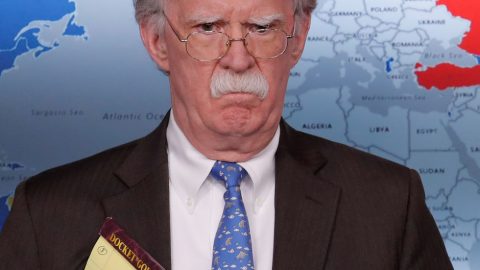
Bolton’s Act of Sabotage
By David Macilwain | American Herald Tribune | March 8, 2019
Across the Western world, there has been discussion and argument and consternation over the apparent failure to make progress on disarmament at the recent talks in Hanoi. Examination of the reasons for that failure has been replaced by speculation about the DPRK’s next move and suspicions about its motives, without any similar skepticism or doubts about the US intent and strategy. But such speculation is entirely misguided, and only possible because of ignorance of one key detail in the discussions in Hanoi.
Thanks mostly to the efforts of Australia’s former ambassador to South Korea and Vietnam, Richard Broinowski, whose diplomatic contacts in Canberra relayed inside information about the discussions, the alarming truth on why the talks suddenly fell apart was revealed to the SBS TV network, and to its listeners in the evening news broadcast on March 1st.
While media around the world, apparently including those not allied to the US, broadcast the press briefing by Donald Trump and Mike Pompeo laying the blame on North Korea for demanding all the sanctions be lifted, only SBS listeners got to hear what really happened, and thenceforth to see things in an entirely different light. As Richard Broinowski explained several days later writing on John Menadue’s influential blog Pearls and Irritations :
… “a well-informed senior Asian diplomatic source in Canberra has added another reason for the Summit’s breakdown: that Trump’s national security adviser, John Bolton, persuaded Trump to add another demand, without notice, that led to North Korean refusal and a premature end to the summit even before negotiations had begun.”
“The Asian diplomat recalled that John Bolton had been scheduled to visit Canberra at the end of February. But the visit was cancelled when he suddenly went to Hanoi instead, whether at Trump’s directive or on his own initiative being unclear. The diplomat’s understanding is that Bolton suggested to Trump that as well as demanding a complete inventory of North Korea’s nuclear weapons and delivery systems, Trump should also request details of the country’s chemical and biological arsenal, a demand Kim found unexpected, and for which he was unprepared, and refused. Trump then broke off the meeting before substantive negotiations had even begun.”
We may all too easily forget the anticipation before these crucial talks between Trump and Kim Jong Un, where it at least looked possible that Trump might “do a deal” on a basis that the North Koreans could accept. The early signs were more than promising, with Kim Jong Un assuring that he would not have been there had he not sought progress on denuclearisation, and Trump prepared to take him at his word. While “substantive negotiations” had not begun, the North Koreans had already suggested they would make very significant concessions in return for the lifting of some sanctions and some other commitments by the US to reduce tensions – “security guarantees” in other words.
It’s worth noting in this context that Sergei Lavrov, speaking at a parallel meeting of the Valdai Club in Ho Chi Minh city had stated quite clearly that the US must make significant concessions, rather than demanding that the DPRK completely denuclearise before lifting sanctions. As always it’s worth reading Lavrov’s wide-ranging and straightforward remarks on the poor state of the world and the destabilizing and destructive role being played by the US.
The necessity for lifting some sanctions on the DPRK is further emphasized by the news that their food production this year is severely restricted by the worst climatic conditions for a decade, making food imports and relief urgent. Their demands for sanctions relief in Hanoi concerned this issue rather than anything connected with the nuclear program.
The truth of the story of Bolton’s demands, which look very much like a planned act of sabotage, is beyond doubt and endorsed in statements from South Korea’s former unification minister Chong Se-Hyun published in Korean newspapers and reported elsewhere. The Sydney Morning Herald and the Australian also covered the story on the following Monday, but this was a temporary blip on their normally unchallenging sympathy for the official US viewpoint. Australia’s other State broadcaster the ABC, however, made no mention of it, simply repeating Trump’s cover-up claim on the sanctions removal.
These media along with their Western partners in officially approved disinformation are now once again adding to the rumor mill on “North Korea’s ongoing nuclear threat” with suspect stories about the renewal of a missile launching site. Satellite photos taken only hours after the failure of the talks claim to show such activity. The Australian Strategic Policy Institute, which has close links to government, has meanwhile warned that moves to scale down the annual war games proposed belatedly as a “goodwill gesture” by the US, are “dangerous and will embolden the North”.
Putting things into a wider perspective, former Australian ambassador to the UN and nuclear disarmament negotiator Richard Butler added his weight to the subject the following day with this footnote on Broinowski’s article:
“This report has now been confirmed by a report published in the March 4th edition of The Bulletin of the Atomic Scientists, which cites a statement by the DPRK Foreign Minister, Ri Yong-Ho, in Hanoi, that “John Bolton disrupted the talks by demanding that North Korea disclose its chemical and biological arsenal as well as its nuclear arsenals”. This would seem to answer the question I posed in my article on whether or not a spanner had been thrown into the works and if so, by whom? Not unusually, there seems to have been no report of this highly salient fact by western mainstream media.”
What matters here however is not simply to expose the misinformed and fraudulent claims made about the failure of the Hanoi talks. Bolton and his allies – whoever they are – evidently sought to sabotage the talks and the possibility of agreement and détente, against the intention of Donald Trump. The last thing they want is to lose the pretext for maintaining and expanding missile systems in the region aimed at threatening or “countering” China. An informative report from the East Asia Forum think-tank also makes this suggestion:
For many in the US security community the ‘no deal’ comes as a relief. There were concerns that Trump would be eager to rush into a deal, no matter what the costs of the concessions, to claim the diplomatic achievement for his administration. This seemed an over-urgent goal due to the impending report by FBI special prosecutor Robert Mueller on the Trump campaign’s ties to Russia and possible obstruction of justice, as well as the heat on Trump from his former fixer Michael Cohen’s damning testimony last week to Congress.
So far from returning to the US with an extra feather in his golden cap, Donald Trump came home to face the music, and not just from the Russia-gate witch-hunt. Even though he had called off the talks with Kim Jong Un, he had already engaged in friendly exchanges and pleasantries that some found offensive, inviting media to repeat the tired nonsense about his dealings with President Putin – that “Trump takes the advice of “dictators” over that of his own intelligence community”. (perhaps not an unwise move under the circumstances!)
The story of his brief meeting with Kim then immediately focussed on how Trump had “taken Kim’s word” over the case of Otto Warmbier, the detained American student allegedly killed by mistreatment in a North Korean hospital. The grotesque demand of the DPRK for $500 million compensation for his death from a US court illustrates the problem that many in the US seem to have in relating to those with a different viewpoint and different attitude. If similar suits were brought against the US government by relatives of the millions of North Koreans who have died over the last sixty-five years as a direct or indirect result of US aggression and sanctions, the US would be bankrupted.
It’s hard not to conclude that the man who was considered “too extreme” to join the regime of George W Bush because of his preference for armed attacks and even nuclear strikes over diplomacy has now launched a soft coup against his own President. Immediately following the Vietnam venture, Bolton was making threats of military action against Venezuela’s President Maduro which had a strange resonance. The demand that Venezuela’s democratically elected President be replaced by an unknown and unelected puppet selected and launched like a missile into Caracas by the US and its European allies is now being copied by the self-selected “Interim President of the United States”, John Bolton.
And a world under this new de facto President with his choice of puppet might just make us look back on the Golden Age of Trump if we are lucky enough to survive it.
A Stumble at Hanoi, but Negotiations Remain on the Agenda
By Gregory Elich | Zoom in Korea | March 4, 2019
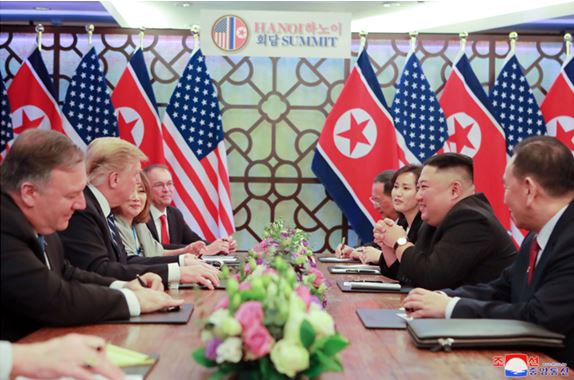
President Trump’s hasty decision to pull the plug on the Hanoi Summit ahead of schedule came as a stunning surprise. The feeling of disappointment in those who were hoping for success contrasted with the sense of relief in the U.S. foreign policy establishment, which remains steadfastly opposed to any improvement in relations.
The widespread assumption going into the summit was that the Trump administration would be able to buy off North Korea with diplomatic trinkets. It was thought that among these would be limited sanctions exemptions, such as allowing humanitarian organizations greater latitude to operate in North Korea. It was also anticipated that a document would be signed which would recognize that the Korean War had ended in 1953. While a peace declaration would have a symbolic “feel good” value, it would change no facts on the ground, and leave the North Koreans essentially empty-handed.
By all accounts, the North Koreans have been more clear-eyed about what they need in talks with U.S. negotiators than they had been given credit. Symbolic measures will not suffice. The North Koreans have serious and well-founded security concerns, given the various wars and military interventions the United States has launched around the world and its decades-long hostility to North Korea.
The Trump administration’s current campaign to destabilize Venezuela and substitute its handpicked lackey as that country’s president can only have further clarified thinking on security matters for the North Koreans.
A more immediate concern for North Korea is the impact of economic sanctions, which have as their aim the collective punishment of the entire population. According to a senior U.S. State Department official, during discussions on sanctions relief with their North Korean counterparts, U.S. negotiators “did our own calculations, and [the damage] tallies up to the tune of many, many billions of dollars.” North Korea’s GDP may be difficult to assess with precision, but it is estimated at around $30 billion. That places it below Vermont, which ranks dead last among U.S. states in terms of GDP. Given the economic damage/GDP ratio, it is obvious that the sanctions war is inflicting enormous hardship on the North Korean people.
According to North Korean Foreign Minister Ri Yong-ho, “Our proposal was that, if the U.S. lifts some of the UN sanctions, or in other words those aspects of the sanctions that impede the civilian economy and the people’s livelihood, we will completely and permanently dismantle the production facilities of all nuclear materials, including plutonium and uranium, in the Yongbyon complex, through a joint project by technicians from our two countries, in the presence of American experts”
“They were willing to give everything, including all the facilities at Yongbyon,” revealed an unnamed source. “Not just one physical reactor, but the whole complex. They were also willing to present their willingness to fully dismantle in the form of an official document. They were getting down to business pretty seriously. And then Mr. Trump and the American side turned down the proposal and left,” to the dismay of the North Koreans.
U.S. Secretary of State Mike Pompeo urged the president to reject the North Koreans’ proposal, as facilities outside of Yongbyon were not included, and nuclear weapons and missiles would remain untouched. National Security Advisor John Bolton may have added objections as well, given his well-known aversion to anything other than unilateral disarmament by North Korea.
“The President in his discussions challenged the North Koreans to go bigger,” a State Department official announced. “The President encouraged Kim to go all in, and we were… prepared to go all in as well.” Trump wanted the North Koreans to put their entire program on the table in exchange for relief on economic sanctions.
From the North Korean standpoint, complete dismantlement of its nuclear program cannot come without a security guarantee. According to Foreign Minister Ri, that guarantee is “even more important” than lifting sanctions. After all, it was for security reasons that North Korea developed its nuclear program, and its security will need to be assured through other means if it denuclearizes. “Given the current level of trust between our two countries,” Ri explained, the dismantlement of the Yongbyon facility is “the biggest step toward denuclearization that we can take at the present moment.” Trump’s proposed grand bargain failed to provide a secure basis for the North Koreans to abandon their nuclear program. Also unaddressed is the concept of denuclearization of the Korean Peninsula, which is habitually interpreted in a one-sided manner in the West as applying solely to North Korea. The meaning of that term needs to be clarified through further negotiations.
The U.S. side, however, remains wedded to the idea of maximum punishment as a negotiating tool and is unwilling to grant relief on economic sanctions without North Korea’s complete denuclearization. That is the essence of the current impasse between the two sides. In an interview broadcast on Fox News, Trump said, “The sanctions are there, and I didn’t want to give up the sanctions unless we had a real program.”
It seems clear that if both parties can agree on timing and sequencing, the possibilities for progress are there, starting with a partial lifting of economic sanctions in exchange for partial denuclearization.
Although the Hanoi Summit failed to produce a concrete result, it would be incorrect to say that it failed. Diplomacy is a process, not a single event. The summit did not end in rancor, and both sides have pledged to continue negotiations. KCNA, the North Korean news agency, reported that the summit “offered an important occasion for deepening mutual respect and trust,” and it noted that President Trump and Chairman Kim Jong Un “agreed to keep in close touch” and “continue productive dialogues for settling the issues discussed at the Hanoi Summit.”
“They were constructive discussions,” points out a State Department official. “There’s room to continue talking.” In Mike Pompeo’s assessment, “There have been lots of things that we’ve moved forward on, and I think we have a set of shared common understandings. I’ve seen enough congruence between what the two sides are trying to accomplish. I saw the goodwill between the two leaders.”
Despite the lack of agreement, Kim reiterated his commitment to maintain a freeze on nuclear and ballistic missile testing, while the U.S. is renaming and reducing the scope of its annual Foal Eagle and Key Resolve military exercises.
The main impediment to progress is U.S. bi-partisan opposition to dialogue and any reduction of tensions in East Asia. An often-repeated charge is that last year’s Singapore Summit produced no tangible result. However, the Singapore Summit was a short meeting meant to establish an agreement on intent, in which not only did North Korea promise to work toward denuclearization, but both sides committed to improve relations and build a peace regime on the Korean Peninsula. After decades of hostility and confrontation, the summit redirected the relationship to one of dialogue. That is no small thing. Critics who argue that detailed steps should have been drawn up in that initial meeting are, of course, intentionally distorting the nature of the meeting in an attempt to discredit the concept of U.S.-North Korea negotiations.
Similarly, those who wish to block progress can be expected to argue that the lack of an agreement at Hanoi proves that it is a mistake to meet with the North Koreans and talks must come to a halt. Nevertheless, U.S. and North Korean leaders remain invested in the process, and the less influence opponents have on U.S. negotiating strategy, the more chance of success. Moreover, although there is internal opposition from conservative forces in South Korea, the detente process between the two Koreas has developed its own momentum, which can be expected to exert a positive influence on the U.S. position. For now, there is certainly more reason for hope than despair.
Gregory Elich is a Korea Policy Institute associate and on the Board of Directors of the Jasenovac Research Institute. He is a member of the Solidarity Committee for Democracy and Peace in Korea, a columnist for Voice of the People, and one of the co-authors of Killing Democracy: CIA and Pentagon Operations in the Post-Soviet Period, published in the Russian language. He is also a member of the Task Force to Stop THAAD in Korea and Militarism in Asia and the Pacific.
His website is https://gregoryelich.org
Follow him on Twitter at @GregoryElich
US & South Korea agree to scrap major military drills to foster denuclearization – Seoul
RT | March 3, 2019
Washington and Seoul will no longer be conducting large-scale Foal Eagle and Key Resolve war games, the South Korean defense ministry said Sunday. It comes several days after US President Trump complained about the drills’ cost.
The cancellation of the annual wargames, initially scheduled to kick off in spring, was announced by the South Korean military, as it made public the details of a call between Acting US defense chief Patrick Shanahan and his South Korean counterpart, Jeong Kyeong-doo, Yonhap reported.
Seoul said that the move to call off the exercises was in support of the diplomatic efforts to pursue a nuclear-free Korean peninsula. The drills have been paired since 2001 and traditionally take place in February-March. North Korea saw the allies’ annual saber-rattling as preparation for invasion.
“The minister and secretary made clear that the alliance’s decision regarding the adjustment of the exercise and drills reflects both countries’ expectation to back diplomatic efforts to reduce tensions and achieve the complete denuclearization of the Korean Peninsula through a final, full verified method,” the ministry said in a statement.
By ditching the costly wargames the US and South Korea are not eliminating joint exercises completely, though: they are planning new command post drills and will continue to carry out field maneuvers. However, these are expected to be conducted on a significantly lower scale. In the run-up to the announcement, unnamed officials told CNN that Washington and Seoul might instead carry out drills “at a small unit level” that would feature “virtual training.” NBC News reported, also citing officials, that the large-scale war games would be replaced by “mission-specific training.”
The scaling-down was widely expected, since Trump has repeatedly bemoaned the drills’ hefty price tag the US has to cover. Following the first Trump-Kim summit in June 2018, Trump said that the US would halt joint drills with South Korea, while calling them “quite provocative,” stirring unease among his own military.
Shortly after that, Washington and Seoul suspended large-scale Ulchi Freedom Guardian exercises scheduled for August.
In November, then Pentagon chief James Mattis stated that the Foal Eagle drills were “being reorganized a bit to keep it at a level that will not be harmful to diplomacy.”
Speaking in the wake of his Hanoi summit with North Korean leader Kim Jong-un this week, Trump said the drills with South Korea were “fun and nice” but a “very, very expensive thing,” and that he “gave that up quite a while ago.”
Foal Eagle typically sees some 11,500 US troops taking part alongside 290,000 South Korean military forces in the drills that include air, ground and naval field operations. Key Resolve is a computer-simulated exercise that also used to draw in a large number of troops from both sides, including about 12,200 Americans and 10,000 South Koran servicemen.
Featured Video

Trita Parsi: Israel Set a Trap for Total War in the Region
or go to
Aletho News Archives – Video-Images
From the Archive
Zionism’s Violent Legacy
By Donald Neff | Washington Report On Middle East Affairs | January 1996
On January 4, 1948, Jewish terrorists drove a truck loaded with explosives into the center of the all Arab city of Jaffa and detonated it, killing 26 and wounding around 100 Palestinian men, women and children.[1] The attack was the work of the Irgun Zvai Leumi – the “National Military Organization,” also known by the Hebrew letters Etzel – the largest Jewish terrorist group in Palestine. The Irgun was headed by Revisionist Zionist Menachem Begin and had been killing and maiming Arabs, Britons and even Jews for the previous ten years in its efforts to establish a Jewish state.
This terror campaign meant that at the core of Revisionist Zionism there existed a philosophical embrace of violence. … continue
Blog Roll
 Aletho News
- Trita Parsi: Israel Set a Trap for Total War in the Region
- Trump’s Iran war is on an Israeli leash
- Saudi oil boss issues global supply warning
- Riyadh Says Its Oil System Is Intact. The Numbers Say Otherwise.
- Trump and Netanyahu Want to “Finish the Job” on Iran
- US ‘one-sided dictation’ not Iran’s beliefs makes rational talks impossible: Baghaei
- Iran’s Next Strike May Not Explode. It Could Shut You Down /Col Doug Macgregor
- Iran: US political targets legitimate if assassinations return
- Iraq shuts key border crossing with Iran under US pressure: Report
- Undersea Internet cables could be targeted in retaliation for attacks on Iran: IRGC deputy chief
- If Americans Knew
- The Israel Lobby’s Changing Fortunes
- AIPAC has become such a political liability that it’s shifting to a more “nimble” approach to buying politicians
- At least 160 Israeli settler attacks in 2 weeks
- Will Gaza’s Ancient Christian Community Disappear Forever?
- Israel’s vision of regional security rests on keeping Arab states weak
- Heidi Levine recounts how Palestinian youths helped save her in settler attack
- DAILY UPDATE: Latest essential news on Palestine, Israel, & region
- Trump’s Intensifying Sabotage of the ICC, for Israel’s Sake
- Israeli military detain US and UK volunteers in West Bank including Democratic NY politician Brad Lander
- Americans at National Conservatism Conference held in Israel this year criticize Israel
- No Tricks Zone
- E-Cars Reduce CO2 Emissions By Only 41% Compared To Internal Combustion Engine Vehicles
- Predictions Made By Renowned Climate Professor Over Past Decades Have Been Proven To Be Poor
- New Study Suggests Large Regions Of The Pacific Ocean Have Been Cooling For The Last 80 Years
- Germany’s Green Energy Debacle: High Energy Costs Force Kahla Porzellan to Close After 182 Years!
- New Study: 50 Years Of The Most Aggressive ‘Net Zero’ Policies Can Only Affect The Global Climate By 0.03°C
- US September “Heat” Was No Record…Many Records Set Decades Ago
- Latest European Green Energy Debacle; Portugal’s Largest Flagship Solar Park Insolvent!
- Green Energy Debacle: German Expert Professor Fritz Vahrenholt Warns Of Severe Economic And Social Consequences
- Two More Paleo Reconstructions Affirm Meters-Higher Sea Levels Across Ireland, Brazil 7000-6000 Years Ago
- New Study: Earth And Venus Surface Warmth Largely Explained By Convection And Lapse Rate, Not CO2 Or Radiation

