US, South Korea could scale back joint drills: Esper
Press TV – November 14, 2019
US military exercises with South Korea could be scaled back to aid diplomacy with the nuclear-armed North, Defense Secretary Mark Esper signaled on his way to Seoul, as Pyongyang said it was running out of patience.
The North has long protested joint military drills, which it condemns as preparations for invasion, and has set Washington an end-of-year deadline to come up with a new offer in deadlocked negotiations on its weapons programs.
The US and South Korea last year cancelled several joint drills in the wake of the Singapore summit between President Donald Trump and the North’s leader Kim Jong Un, but are due to carry out a combined air exercise next month.
“We will adjust our exercise posture either more or less depending on what diplomacy may require,” Esper told reporters on board his plane to Seoul, where he starts an Asian tour Thursday.
The possible downsizing of the joint drills should not be seen as a “concession” to Pyongyang, he said, “but as a means to keep the door open to diplomacy”.
“I’m all for diplomacy first,” he added.
His comments came after Pyongyang reiterated its demands for the combined exercise to be scrapped.
“The US is not accepting with due consideration the year-end time limit that we set out of great patience and magnanimity,” a spokesman for the State Affairs Commission (SAC) said in a statement carried by the official KCNA news agency.
The SAC is the North’s top governing body and it is unusual for it to issue such declarations.
Holding the drills would be an “undisguised breach” of the Singapore summit declaration, it said, adding: “Betrayal is only what we feel from the US side.”
“We no longer feel the need to exercise any more patience,” it went on, but gave no details of the “new way” it was threatening to pursue if Washington did not meet its demands.
Negotiations have been gridlocked since the Hanoi summit between leader Kim Jong Un and Trump broke up in February disagreement over sanctions relief and what the North would be willing to give up in return.
Working-level talks restarted in Sweden in October only to break down quickly, with the North blaming the US for not giving up its “old attitude”.
Pyongyang has carried out a series of missile tests in recent weeks and months, including one launched at sea, which it said was fired from a submarine — a potential strategic game-changer.
The tests would improve the North’s capabilities, Esper acknowledged.
“Anytime you test, you learn something,” he said. “We take them very seriously and we watch them very closely, but we’re also not going to overreact and do something that, for example, could close the door to diplomacy.”
Seoul police ramp up security after protesters break into US ambassador’s residence
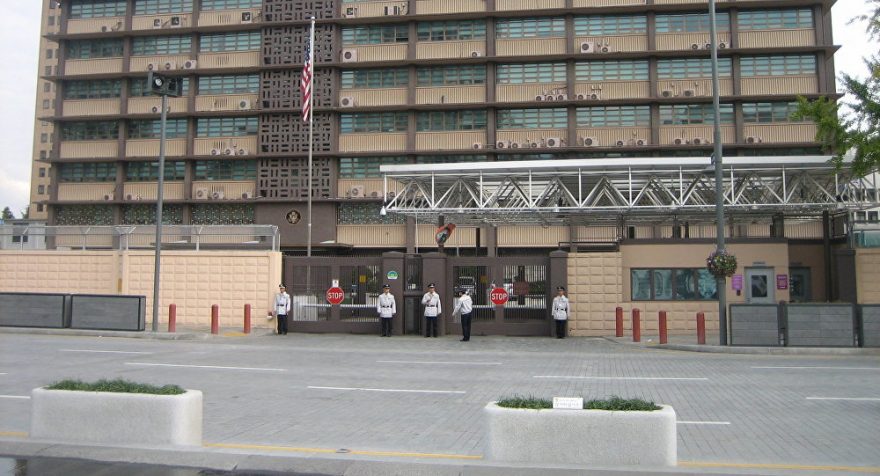
RT | October 19, 2019
South Korean police have increased security at the US ambassador’s residence in Seoul after a group of students demonstrating against American troops in the country were able to infiltrate the diplomatic compound.
The Seoul Metropolitan Police agency said Saturday that the number of officers guarding the estate was more than tripled to 110. The beefed-up security comes a day after a group of protesters used ladders to gain entry to the walled-off grounds around Ambassador Harry Harris’ residence. Nineteen students were detained after unfurling banners saying “Leave this soil, Harris.”
“Stop interfering with our domestic affairs,” they shouted, followed by other chants – “Get out,” and “We don’t need US troops” – before being escorted off the property by police.
The group said they were motivated by Washington’s insistence that Seoul should pay [more] to keep US troops on its soil.
A spokesman for the US Embassy in Seoul said that the diplomatic mission was “seriously concerned about the illegal breach” and urged Korean authorities to do more to protect the compound.
American diplomatic and military outposts in the region are regularly targeted by protesters.
Last year, tens of thousands of protesters in Okinawa, Japan marched to stop the planned relocation of a US military base, demanding that the facility be removed from the island entirely.
North Korea sets deadline for US to end hostilities or forgo talks
Press TV – October 6, 2019
North Korea says it has “no desire” to continue negotiations with the United States until Washington takes “practical” steps to end hostilities, a day after working-level talks between the two countries broke down in Sweden.
In a statement carried by the official Korean Central News Agency, a spokesman for the North’s Foreign Ministry said on Sunday that Pyongyang had “no desire to hold such nauseating negotiations such as this one unless the US takes practical measures to end hostile policies.”
“The fate of the US-North Korea dialog is in Washington’s hands and the deadline is until the end of this year,” the spokesman said.
The spokesman also noted that there was no way the US would bring alternative plans for their stalled nuclear talks to a meeting proposed by Stockholm in two weeks after this weekend’s talks in Sweden broke down.
“The U.S. is spreading a completely unfounded story that both sides are open to meet after two weeks…. It is not likely at all that it can produce a proposal commensurate to the expectations of the DPRK and to the concerns of the world in just fortnight,” the North Korean official said.
The U.S. State Department has announced that it has accepted Sweden’s invitation to return for more discussions with Pyongyang in two weeks.
The talks in Sweden followed months of a stalemate in dialog. In February, US President Donald Trump had walked away from a summit with the North’s leader Kim Jong-un, causing the impasse.
The negotiations in Sweden collapsed when the US once again refused to reciprocate unilateral goodwill gestures by North Korea.
In Stockholm, the North’s leading negotiator, Kim Myong-gil, who spent much of Saturday in the talks, blamed the US for not giving up its “old attitude.” He said the US officials had “disappointed us greatly and dampened our enthusiasm for negotiation by bringing nothing to the negotiation table.”
The US likewise blamed Pyongyang.
There was no immediate reaction by the US to the Sunday statement by the North Korean spokesman.
The Stockholm meeting was the first formal working-level talks since the US president and the North Korean leader met at the Demilitarized Zone (DMZ) on the Korean Peninsula in June and agreed to restart negotiations after their failed summit in Vietnam in February.
Trump’s firing of his national security adviser John Bolton — who espoused a standoffish view toward Pyongyang — last month also seemed to soften the atmosphere between the US and North Korea and raised hopes for a breakthrough in the talks, until they broke down on Saturday.
North Korea, currently under multiple rounds of harsh sanctions by the UN and the US over its nuclear and missile programs, put a unilateral halt to its missile and nuclear tests shortly before a diplomatic thaw began between Pyongyang and Seoul in early 2018 and later between the North and the US.
What the Aggravation of the US-Iranian Relations Means for South Korea
By Konstantin Asmolov – New Eastern Outlook – 06.09.2019
Continuing to monitor the confrontation between Washington and Tehran, the author of this article can see how it affects the South Korean interests. The sanctions badly hit South Korea’s economy and, since the summer of 2019, there have been attempts to involve Seoul in a possible military coalition.
Let us remind the reader that the Joint Comprehensive Action Plan was signed by Iran, Russia, the United States, Germany, France, the United Kingdom and China in 2015, limiting Iran’s nuclear program in return for lifting the sanctions imposed by the European Union and the United Nations.
The removal of most of the international sanctions from Iran stimulated a great interest in its economy, as the country has huge gas and oil reserves, and Seoul took advantage of the opportunity to enter the Iranian market. After all, the South Korean exports to Iran exceeded $6 billion in 2012, however, after the imposition of sanctions by the Obama Administration, it fell to $4.5 billion. In 2016, it fell even more and, only in 2017 did export volume begin to recover.
On August 24, 2017 the South Korean Export-Import Bank and the Central Bank of Iran signed an agreement on a $9,380 million loan to the Iranian Government. In addition, South Korean companies were given the opportunity to participate in construction and resource projects in Iran, as the loan was aimed at providing financial support to those who would receive orders from the Iranian Government.
It should be noted that the arrangement to start negotiations on the loan agreement was made during the visit of the former South Korean President Park Geun-hye to Iran, but the final decision was delayed since the parties could not agree on the terms of repaying the loan in case of the resumption of sanctions should Iran fail to fulfil its obligations in the nuclear technology area.
But after Donald Trump came to power, the White House began to criticize the terms of the nuclear deal and later withdrew from it; in May 2018, the US resumed its sanctions against individuals and legal entities that carry out export transactions in gold, precious metals, graphite, coal, automotive and other industries with Iran. However, for some countries, there was a delay of 90 and 180 days depending on the type of sanctions.
The South Korean government wasted no time and convened an ad-hoc expert working group assigned to reduce the damage to the domestic companies caused by the US sanctions against Iran. The complications came from the fact that more than 80% of South Korean enterprises working with Iran were small and medium-sized businesses. However, with the reinstatement of sanctions, exports from South Korea to Iran decreased yet again. From January to June 2019, they fell by 15.4%, and by 19.4% in July.
The South Korean government also negotiated with the US calling on it to exempt crude oil from the sanctions, as it accounts for most of the imports from Iran. Under the Barack Obama Administration, South Korea received the status of an exception country entitled to buy Iranian crude oil under the sanctions with reducing its purchases by 20%. The importance of Iranian oil imports to South Korea lies in the fact that it has a direct impact on the exports to Iran. Settlements with Iran are made using the Korean won bank account from which goods exported to Iran are also paid for. Therefore, a reduction in the Iranian oil imports will inevitably lead to a reduction in the exports.
Moreover, Seoul remains one of the largest importers of Iranian oil and gas condensate in Asia. As noted by Reuters, the supply of Iranian resources is critical to the South Korean petrochemical industry. South Korea greatly relies on the supply of condensate from Iran, which has a high content of naphtha being the basic raw material for the manufacturing of petroleum products. Besides, the Iranian prices are the lowest. The difference can reach six dollars per barrel, so 50% of the condensate imported into South Korea comes from Iran.
According to an opinion, South Korea is the third largest buyer of Iranian oil. On the other hand, Iran accounts for 8.6% of the oil imported into South Korea and it is the fifth largest oil supplier to South Korea after Saudi Arabia, Kuwait, the United States and Iraq.
On October 29, 2018 US Secretary of State Mike Pompeo and South Korean Foreign Minister Kang Kyung-wha exchanged their views of the issue of US sanctions against Iran during a telephone conversation. Kang Kyung-wha called on the American party to show flexibility in granting South Korea the status of an exception nation in the implementation of sanctions against Iran in order to minimize the damage to South Korean companies. She mentioned the repeated negotiations between the parties on this topic. Pompeo said the US was heeding the position of South Korea and would continue the dialogue.
On November 5, 2018 the second stage of sanctions aimed at stopping foreign currency inflows to Iran thanks to oil exports entered into force. This affects the interests of South Korea, Turkey and India, which actively cooperate with Iran in the oil sector.
While the May sanctions were mainly aimed at a secondary boycott, the second stage included direct sanctions on transactions related to oil, natural gas, petrochemical products, ports, energy facilities and shipbuilding. The sanctions apply to approximately 700 individuals and legal entities, aircraft, ships and other facilities.
However, for eight countries (South Korea, China, India, Italy, Greece, Japan, Taiwan and Turkey) the US made a temporary exemption of 180 days, as each of them had demonstrated a significant reduction in Iranian oil purchases over the previous six months. The US sanctions are aimed at reducing the profit that Iran receives from trade, so permits to carry out trade are issued in exchange for the promise to reduce the purchase of Iranian raw materials. Thus, it will be possible to avoid an increase in oil prices. However, the US Special Representative for Iran Brian H. Hook confirmed that the 180-day exemption would not be extended.
As a result of this decision, South Korea managed to avoid the worst possible scenario, but experts immediately noted that the impact on the economy would not be averted altogether. As a result, the authorities recommended that businesses pay attention to the exports of pharmaceutical products, household appliances and other goods that were not subject to sanctions.
Immediately after the introduction of sanctions, representatives of the South Korean government visited Iran to discuss mutual trade issues. It is pointed out that the parties touched upon the situation with the resumption of the US sanctions and the withdrawal of a number of countries from the ban on the import of Iranian oil. The Iranian party thanked South Korea for consulting it on the current situation.
On April 29, before the end of the exemption period, Deputy Prime Minister for Economy and Minister of Planning and Finance Hong Nam-ki said that the South Korean government would make every effort to stabilize the domestic prices of petroleum products, which may increase due to the ban on the purchase of Iranian oil imposed by the US.
The exemption period for the eight countries expired on May 2, 2019. Now, all of them had to look for other suppliers, given the threat of US sanctions, but the Turkish government reported that it was impossible to stop Iranian oil imports immediately and Beijing said it would not support the unilateral US sanctions considering the significant losses associated with the need to change the suppliers. The South Korean government, through various channels, tried to bring South Korea out of the Iranian sanctions regime, but it failed. Iraq, which was importing natural gas from Iran, asked the US to provide more time to find another supplier, but the request was denied. This situation, among other things, destabilized world oil prices.
On June 20, 2019 the South Korean delegation held talks with the US party on the trade with Iran. The South Koreans called on the US to assist in eliminating possible difficulties in the oil issue and to resolve the problems of South Korean companies working with Iran in humanitarian areas using the Korean currency accounts only. However, the request was de facto ignored.
On the other hand, as from the summer of 2019, South Korea has been increasingly involved in the US-led security coalition in the Strait of Hormuz, which is the only waterway connecting the Persian Gulf and the Indian Ocean between the Arabian Peninsula and Iran and serves as the key transport corridor for large oil-producing countries.
Washington has called on Seoul to participate in this coalition citing the importance of the Strait for South Korea as the main oil transportation corridor. On the other hand, South Korea closely cooperates with Iran in the economic sphere. In this regard, Iranian response measures cannot be ruled out.
On July 24, 2019 during his meeting with the national security advisor to the President of South Korea, Chung Eui-yong, John Bolton demanded not only an increase in the share of South Korea in maintenance costs of US troops, but also the deployment of South Korean naval forces in the Strait of Hormuz.
On July 28, a representative of the South Korean Ministry of Defense noted that the country was considering various options for joining the coalition to ensure security in the Strait of Hormuz, but, at the moment, no specific decisions on this topic had been taken and no official proposals from the US had been received either. However, given the issue of the security of South Korean vessels passing through the Strait of Hormuz, various options for sending a military contingent to the region are being considered, including the possibility of sending the Cheongye unit currently patrolling the Gulf of Aden.
On August 9, Seoul hosted a meeting of the heads of the defense ministries of South Korea and the United States, Jeong Kyeong-doo and Mark T. Esper. Korea Times notes that Mark Esper officially asked Korea to participate in the coalition, but, almost immediately after that, Iranian Foreign Ministry spokesman Seyyed Abbas Mousavi called on South Korea to remain neutral. Mousavi noted that Seoul was an economic partner and asked it to take into account the sensitivity of the issue. “Korea’s possible joining the coalition is not a very good signal for us, and it will complicate things.”
South Korean experts, however, immediately wrote that the government should take the US side. As Meiji University Professor of Political Science Sing Yeoul said, “Diplomacy is not about being praised by all countries. You often have to choose one country over another, even if it means that you have broken ties with the latter.”
On August 13, the 30th outfit of the Cheongye special unit of the South Korean Navy left the South Korean port of Busan for the Gulf of Aden for a 6-month patrolling. It was headed by the destroyer Gang Gam-chan. The 300-strong army unit consists of a special force, including a submarine bomber team, a Navy Seal team, Marines and Navy pilots, who will protect South Korean vessels off the coast of Somalia and support ships of other countries in the nearby waters.
The experts began to discuss the possibility of this detachment joining the security coalition in the Strait of Hormuz, but agreed that the approval of the National Assembly was required for the redeployment of Cheongye to the Strait of Hormuz. It is said that this topic also emerged at the meeting of the defense ministers, and Jeong told Esper that South Korea was well aware of the importance of water area defense and was considering various options to protect its nationals and oil tankers in the region.
However, the destroyer should continue the unit’s mission in the Gulf of Aden and its possible role in the Strait of Hormuz was not considered during its preparation. However, the Gulf of Aden is four-day sail away from the Strait of Hormuz.
On August 21, the US Special Representative for Iran Brian H. Hook told KBS that joining the coalition would not necessarily mean sending troops and that dispatching naval and aviation equipment with the necessary personnel could be a solution. Furthermore, countries joining the coalition will be able to obtain information from the US on certain threats to merchant ship security.
The problem got another dimension in the context of the Japan-South Korean trade war. Mark Esper invited not only South Korea to join the US-led coalition, but also Japan, and it is a good question how the servicemen of the two countries are going to work together.
Thus, there is a possibility that, if a war with Iran is indeed going to happen, then, same as in Vietnam or Iraq, the South Korean military will also be involved. After all, it was not some conservative and pro-American puppet who sent troops to Iraq, but the democratic Roh Moo-hyun.
Konstantin Asmolov, PhD in History, Leading Research Fellow at the Centre for Korean Studies of the Institute of Far Eastern Studies of the Russian Academy of Sciences.
S Korean lawmakers voice opposition to Hormuz deployment
By Frank Smith | Press TV | August 14, 2019
South Korea’s National Assembly hosted a press briefing Wednesday outlining intense opposition to the potential deployment of naval forces to the Strait of Hormuz, off the coast of Iran. Civic leaders argue that participation of South Korea in the US venture violates the country’s constitution.
South Korea on Tuesday sent a destroyer carrying 300 troops to the Gulf of Aden, off the coast of Somalia, to continue the country’s anti-piracy mission there. Legal experts say the potential redeployment to the Strait of Hormuz requires parliamentary oversight. The Justice Party’s Kim Jong-dae believes in freedom of navigation but argues against joining the provocative US mission in the vital energy and shipping corridor.
The Strait of Hormuz has been a flashpoint in recent months following the increase of American naval forces in the region. The US is seeking to create a coalition there. Some voices in South Korea argue Seoul must participate due to its alliance with Washington.
South Korea and Iran have had warm relations for decades, establishing official diplomatic ties in 1962. Recently trade between the two states has been hampered by on again – off again US led sanctions. Tehran’s foreign ministry has said it hopes South Korea can remain neutral – and not participate in the US coalition.
The Chronicle of Yet Another North Korean Short Range Missile Launch
By Konstantin Asmolov – New Eastern Outlook – 13.08.2019
In late July – early August 2019, North Korea conducted a series of short range missile launches and large-caliber multiple rocket launcher firings. It caused a certain stir, but, before analyzing the international reaction, let us review the chronicle of the events.
Let us first note that all the launches took place against the backdrop of a decrease in the US-North Korean dialogue (the working groups agreed on at “the 2.5 summit” have not begun the work yet) and the coming military exercises of the US and South Korea. Certainly, their scale is significantly lower than earlier, but in terms of “violating the spirit of the agreement,” it is identical to the similar action of North Korea.
Besides, the US delivered two more fifth generation F-35A jet fighters to South Korea. These invisible planes are theoretically invincible for the present level of the North Korean missile defense.
On July 25, early in the morning, North Korea launched two short-range missiles in the direction of the Sea of Japan. The first missile covered a distance of 430 kilometers, the second one 690 km. Both missiles flew at an altitude of about 50 km and fell in the Sea of Japan.
What is important though is that the South Korean military regularly lost sight of the second North Korean missile and, judging by what was shown by the surveillance systems, it carried out complex maneuvers of evasion in the horizontal and vertical plane. It did not fall at a certain destination after flying along a parabola trajectory, but flew for much longer keeping at low altitudes in a rectilinear trajectory. Besides, a flight altitude of 50 km is in the blind zone of the South Korean military Patriot PAC-3 SAM systems and the THAAD missile defense systems. At this altitude, North Korean missiles had been already able to cover a distance of up to 500 km. But the mark of 600 km was reached this time: such a weapon can strike any point on the Korean peninsula and at the same time avoid the missile defense systems.
It means that North Korea has a short prestart cycle missile with a complicated trajectory capable of both striking facilities protected by the existing missile defense systems and destroying these very systems.
The military believe that the launches were made by means of a mobile launcher at a low angle and the missiles were of the same type as those launched in May – the North Korean version of the Russian Iskander missile which flies along a complicated trajectory as well, unlike usual ballistic missiles, and therefore has great ability to avoid interception.
However, it should be noted that when South Korean military equate KN-23 to Iskander, they are not being frank. With a comparable degree of verisimilitude, one could say that the North Korean missile is equivalent to the South Korean Hyunmoo-2B or the Ukrainian Hrim-2. In any case, Hyunmoo-2B was made with the assistance of Russian engineers and practically on the basis of Iskander, which, however, this did not prevent military PR staff from describing it as their own design. The US experts Melissa Hanham and Jeffrey Lewis also note that there are several types of short-range missiles which bear a strong similarity to new North Korean complexes and that, in fact, all missiles of this class are similar.
The media coverage of the launch was no less important: the Korean Central News Agency provided a detailed report about the way Kim Jong-un “organized and guided the fire of the new-type tactical guided weapon as part of the power demonstration to send a solemn warning to the south Korean military warmongers who are running high fever in their moves to introduce the ultra-modern offensive weapons into south Korea and hold military exercises in defiance of the repeated warnings from the DPRK.”
The North Korean leader openly explained the purpose of the launch, stating that “the ultra-modern weapons and equipment which the bellicose forces of the South Korean military are introducing with desperate efforts are definitely offensive weapons and their purpose is absolutely clear.” Thus, “the South Korean authorities are revealing such strange double-dealing behavior as producing a “handshake of peace” and fingering joint declaration and agreement and the like before the world people and, behind the scene, shipping ultra-modern offensive weapons and holding joint military exercises.” Therefore, “we cannot but dynamically develop super powerful weapons systems to remove the potential and direct threats to the security of our country that exist in the south.”
Thus, a very clear message (or piece of advice) was conveyed to Seoul, namely that “the South Korean chief executive [must] understand in time the danger the developments will possibly bring, stop such suicidal act as the introduction of ultra-modern weapons and military exercises and come back to the proper stand as in April and September last year […] The South Korean chief executive should not make a mistake of ignoring the warning from Pyongyang, however offending it may be.”
The South Korean press immediately noted that the term “power demonstration” had not been used for a long time. On the other hand, the word “missile” was replaced with the expression “new-type tactical guided weapon,” and all the warnings were addressed to Seoul, rather than Washington, which Pyongyang intends to continue the dialogue with.
The second act took place on July 31, early in the morning. Two more ballistic missiles were launched in the direction of the Sea of Japan from mobile launchers in the district of Wonsan again. Both missiles covered a distance of about 250 km, reaching the altitude of 30 km. The South Korean military believe that, since the missiles flew at lower altitudes and covered a short distance, a near target strike with bypassing the enemy antimissile systems was rehearsed.
The Korean Central News Agency again, though in less detail this time, reported how highly Kim had appreciated the launch performance. After that, South Korean media started using the term “short range projectiles” instead of the word “missile,” emphasizing that, judging by the modification and flying range, the launch of July 31 was aimed at South Korea regardless of whether it is a multiple rocket launcher or a ballistic missile unit.
The third launch of two unidentified short range projectiles in the direction of the Sea of Japan took place on the night of August 2, 2019. The projectiles covered a distance of about 220 km with the maximum speed of 6.9 Mach at an altitude of 25 km.
This time, the Korean Central News Agency even showed a photo of the device more similar to a large caliber multiple rocket launcher than to a missile unit, though many important details were blurred. The weapon was dubbed a “newly-developed large-caliber multiple launch guided rocket system,” and the launch was carried out for the purpose of checking the flight characteristics of mastering altitude, orbit control and target hit accuracy.
Kim Jong-un again “guided the test launch from an observation post.”
However, let us proceed with the conclusions:
- Despite the sanctions, North Korean military production is continuing and provides quite modern weapons.
- The launches are, certainly, a way to whip up Washington and to warn Seoul, as they represent an explicit real threat for South Korea due to the helplessness of its missile defense against this type of weapon.
- However, the launches must be considered in the general context: against the backdrop of the development of the South Korean missile defense, it is no wonder that the opposite party reacted by designing missiles capable of bypassing this missile defense.
- As the missiles operate within short range, the recent tests cannot be considered a violation of the Pyongyang’s self-proclaimed moratorium on ICBM launches and nuclear tests which North Korea first introduced at the end of 2017 and then confirmed officially in early 2018.
- Certainly, the launches do not help reduce the tension, but North Korea is responding to the US and South Korean exercises and the import of new weapons to South Korea to the best of its ability.
Konstantin Asmolov, PhD in History, Leading Research Fellow at the Centre for Korean Studies of the Institute of Far Eastern Studies of the Russian Academy of Sciences.
Japan is a barrier to Korean Peninsula peace process, Blue House says
Tokyo has continually sought to widen the rift between Seoul and Pyongyang
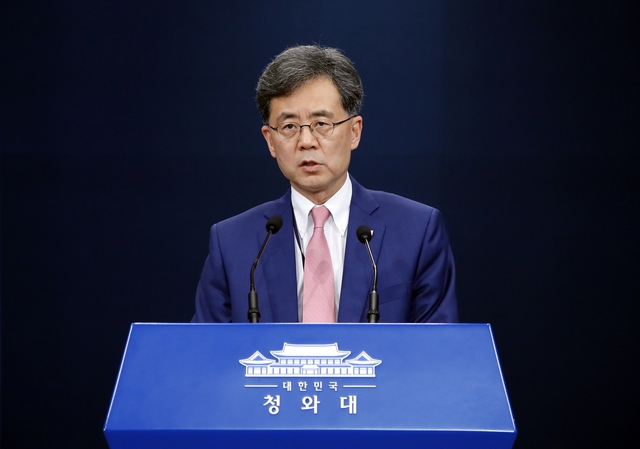
Kim Hyun-chong, second deputy director of the Blue House National Security Office, during a briefing at the Blue House on Aug. 2. (Yonhap News )
By Lee Wan | HANKYOREH | August 3, 2019
The Blue House recounted in detail how Japan has become an obstacle to setting the stage for peace on the Korean Peninsula and how it has rebuffed the US’ attempts to mediate in its dispute with South Korea. “Considering that our two countries have shared the values of liberal democracy and market economy for decades, Japan’s removal of South Korea from its white list on the pretext of security can be regarded as a public slap in the face,” said Kim Hyun-chong, second deputy director of the Blue House National Security Office.
“Rather than assisting South Korea in its efforts to get the peace process underway, Japan has thrown up roadblocks to that process. Japan opposed delaying the South Korea-US joint military exercises around the Pyeongchang Winter Olympics and maintained that sanctions and pressure were the only solution even while dialogue and cooperation with South Korea was underway. It also tried to raise tensions by calling for Japanese citizens residing in South Korea to rehearse a wartime evacuation,” Kim said during a briefing on the afternoon of Aug. 2.
It’s unusual for a figure at the Blue House to openly state that Japan presents an obstacle to the creation of peace on the Korean Peninsula. Such remarks indicate that Blue House officials are fuming over Japan’s removal of South Korea from its white list of countries who enjoy expedited export procedures. “We ought to give some serious thought to the meaning of the peace and prosperity of the ‘normal country’ that Japan seeks to become,” Kim added.
A senior official from the Blue House also went into the details of Japan’s rejection of the US’ attempted mediation. “On July 29, the US expressed its concerns [to us] about the ongoing dispute and suggested that we and Japan put a temporary freeze on the status quo while holding negotiations in an attempt to reach a diplomatic agreement. My understanding is that the same proposal was communicated to the Japanese on the same day. Based on the American proposal, therefore, we proposed high-level bilateral deliberations on the afternoon of July 30, but Japan rejected our proposal a few hours later,” the official said.
This official went on to speak of the need to seriously question the effectiveness of American mediation. “We need to carefully consider Japan’s rationale and motivations behind its removal of South Korea from the white list — are they economic, political, or both at the same time?”
“Given such considerations, we need to give some serious thought to the potential effectiveness of the US attempting to bring Japan around.”
In effect, this official said, South Korea still needs to figure out whether Prime Minister Shinzo Abe’s sudden export controls represent an attempt to contain South Korea’s growing economy, a request to give Japan a seat at the table in peace talks on the Korean Peninsula, or a call for a fundamental realignment of the cooperative relationship between South Korea, Japan, and the US that has been in place since South Korea and Japan settled their outstanding claims in 1965.
What if North Korea and Iran move in tandem
By M. K. BHADRAKUMAR | Indian Punchline | August 3, 2019
The sensational New Yorker story on August 2 by Robin Wright on the unpublicised meeting between Iran’s Foreign Minister Javad Zarif and the American senator Rand Paul (who is a member of the senate’s Foreign Relations Committee) in New York a few days ago details for the first time what transpired between the two leaders. Robin Wright is highly reliable, having good contacts with Iranian officials, and this account can be trusted as authentic.
What emerges is that Zarif and Paul had a substantive conversation, exchanging opinions on a confidential basis the broad contours of a negotiated end to the US-Iran standoff. Some of these details are already known — especially, Iran’s willingness to provide legal guarantee that it will not have a nuclear weapon programme, which comes as no surprise.
Paul is known to be close to President Trump and they both subscribe to the school of thought that the US should not get into any new Middle Eastern war. Paul is also supportive of Trump’s campaign against America’s ‘endless wars’. Evidently, his meeting with Zarif (at the Iranian ambassador’s residence in New York) took place with the prior knowledge and consent of Trump. Reports had appeared previously that Trump gave the go-ahead to Paul to negotiate with Iran.
Therefore, the surprising part in the New Yorker report is the invitation to Zarif, transmitted by Paul, to make a visit to the White House to meet Trump. Of course, Zarif parried, not rejecting the invite offhand but explaining that he needed instructions from Tehran.
The events since then — US imposing sanctions on Zarif — assume an added dimension now. Can it be that Trump felt insulted — and hit out? Or, more plausibly, he pulled back under pressure from within his camp, fearing media leaks and ensuing embarrassment? Either way, the US policy on Iran looks bizarre, lacking coherence, swinging wildly from one end to the other, completely unpredictable.
Tehran will think twice before engaging with Trump.
Meanwhile, Trump’s overture to Zarif and the ensuing snub comes at an awkward time for POTUS, who is lately facing taunts from North Korean leader Kim Jong-Un. North Korea’s multiple ballistic missile tests (with range up to 450 kms and altitude of 50 kms) are highly damaging for Trump’s reputation who has been claiming that his personal diplomacy with Kim has persuaded the latter to end all missile (and nuclear) tests. (By the way, in the South Korean assessment, the newly-developed North Korean ballistic missiles are a “version” of Russia’s famous Iskander-M missile, which is a formidable road-mobile, surface-to-surface short-range ballistic missile capable of carrying both nuclear and conventional warheads and reputed to be highly manoeuvrable at the final stretch of their trajectory, thus allowing them to bypass the enemy’s air defences.)
Without doubt, Kim has signalled to Trump that Pyongyang’s patience has limits and Washington had better get back to the negotiating table and also get used to the reality that Pyongyang is not going to agree to full disarmament.
Trump, of course, has no choice but to downplay the latest series of North Korean missile launches, although he knows his claim of success with Kim as a singular foreign policy trophy of his presidency is in tatters. In a 3-part tweet, Trump said,
“There may be a United Nations violation, but Chairman Kim does not want to disappoint me with a violation of trust. There is far too much for North Korea to gain – the potential as a Country, under Kim Jong Un’s leadership, is unlimited.”
Trump then went on to praise Kim, saying he has a “great and beautiful vision for his country” and that, importantly, that vision can be realised only if Trump remains president. Trump concluded, “He (Kim) will do the right thing because he is far too smart not to, and he does not want to disappoint his friend, President Trump!”
Clearly, Trump’s reaction reflects that his approach to North Korea still emphasises personal diplomacy. Trump thinks Kim will fall for his flattery and for his offer to help out the North Korean economy.
The Trump administration’s approach to North Korea and Iran respectively has nothing in common. Trump is far more cautious about Pyongyang and shows much greater latitude. Of course, the critical difference is that North Korea is a nuclear weapon state which is capable of staging an attack on the US west coast and endangering the US bases in the Pacific and the Far East where over hundred thousand American military personnel are deployed. Besides, what makes the North Korea problem explosive is that the country is in reality having a stockpile of nuclear weapons whereas, in comparison, the US-Iran standoff is not really about nuclear non-proliferation but about the rise of Iran as a regional power.
To be sure, the US diplomacy will have a hard time coping with the North Korean front becoming kinetic at a juncture when the US’s standoff with Iran is also entering a dangerous phase. North Korea’s missile launch today was reportedly supervised by Kim in person. It implies that Trumps flattery had no effect on Kim, who has his own game plan worked out.
What happens if North Korea piles up pressure in the coming months even as Trump’s campaign for re-election shifts gear? The crunch time comes later this month. Pyongyang maintains that if the US goes ahead with its planned military exercise with South Korea in August, Washington will be violating an agreement between Kim and Trump. Indeed, if the exercises go ahead, all bets are off. Pyongyang may retaliate by ending its suspension of nuclear and ICBM tests.
Both North Korea and Iran are astute observers of the vicissitudes of regional and world politics. Therefore, while it seems improbable that North Korea and Iran would move in tandem in tackling Trump, such a likelihood cannot be brushed off, either. To be sure, the US-Iran standoff has created more space for Pyongyang to manoeuvre — just as the US-China tensions already have. And Kim must be aware of that.
On the other hand, so long as all was quiet on the North Korean front, the Trump administration had a relatively free hand to focus on the Iran front. But if both fronts come alive simultaneously, it becomes a new ball game. By pure coincidence, in August, one such situation may arise with Iran planning to make its third move to distance itself from the JCPOA and North Korea challenging the holding of the annual US-ROK military exercises.
Trump Downplays North Korea’s Recent Missile Launches: ‘We’ve Been Doing Very Well’
Sputnik – July 26, 2019
US President Donald Trump in an interview with Fox News has downplayed the recent missile launches by North Korea, saying Washington and Pyongyang have been “doing very well”.
The US president was asked if he would “devastate” Iran and North Korea if they “force him to”, in the wake of recently reported missile launches by the two countries.
“In the case of North Korea, I am actually getting along very well with [Kim]. But we’ll see what happens. The sanctions are on. The hostages are back. We’re getting the remains back. They haven’t done nuclear testing. They really haven’t tested missiles other than, you know, smaller ones, which is something that lots test. But I think with North Korea, we’ve been doing very well”, Trump stated.
On Thursday, North Korea fired two projectiles from an area close to the eastern coastal city of Wonsan. The South Korean Joint Chiefs of Staff subsequently said that the launches were two short-range missiles that flew around 267 miles at an altitude of 31 miles before falling into the Sea of Japan. On Friday, North Korean state-run media reported that the launches were tests of a new tactical guided weapon, observed by chief Kim Jong-un.
According to them, Pyongyang carried out the launches on Thursday as a warning to South Korea against boosting its military.
The incident took place less than a month after a meeting between Kim and Trump at the Demilitarised Zone (DMZ) between the two Koreas. During the meeting, the two heads of state agreed to energize their deadlocked denuclearisation talks by engaging in working-level contacts.
North Korea tests ‘super-powerful’ missile in response to Seoul stockpiling US arms & holding drills
RT | July 26, 2019
Pyongyang says it has no other choice but to continue developing and testing new types of deterrence weapons as long as ‘warmongers’ in the South keep buying modern arms and holding joint military drills with the US.
The test launch of the “new-type tactical guided weapon” on Thursday morning was personally supervised by the country’s leader Kim Jong-un, KCNA reported, noting that the weapons test was carried out “as part of the power demonstration” to warn “South Korean military warmongers” against introducing “ultramodern offensive weapons” and holding joint military exercises with American forces.
“We cannot but develop nonstop super-powerful weapon systems to remove the potential and direct threats to the security of our country that exist in the south.”
Accusing Seoul of “double-dealing,” North Korea lashed out at its neighbor for talking peace while stockpiling American weapons. Besides opting to purchase Terminal High Altitude Area Defense systems (THAAD), Seoul has recently received two more F-35A Lightning II fifth-generation stealth fighters from the US. And despite North Korea’s relative rapprochement with both the US and the South, the allies plan to hold their annual military drills in August.
North Korea resumed its short range missile testing activity earlier this year after the Hanoi Summit between President Donald Trump and Chairman Kim Jong-un in Vietnam failed to produce any clear roadmap to peace. The latest tests were conducted despite the impromptu meeting Trump had with Kim at the Korean Demilitarized Zone last month, where they agreed to revive stalled denuclearization talks.
Pyongyang’s leadership has long maintained that the US should provide some credible guarantees, relieve its sanctions and stop military drills with the South for any viable peace to take hold on the Peninsula. Washington in its turn insists on full denuclearization before any concessions are made.
How Real is the Trump Administration’s New Flexibility with North Korea?
By Gregory Elich | CounterPunch | July 12, 2019
Although widely derided by the Washington Establishment as an empty photo opportunity, the recent meeting between President Trump and Chairman Kim Jong Un at Panmunjom produced an agreement to resume working-level talks in the near future. According to the North Korean news agency KCNA, the two leaders discussed stumbling blocks in improving relations and easing tensions, and agreed to work towards a “breakthrough in the denuclearization of the Korean Peninsula and in the bilateral relations.”
The resumption of working-level talks comes as welcome relief after months of stalled progress since Trump pulled the plug on the Hanoi Summit due to North Korea’s failure to accede to the demand that it unilaterally disarm. At Hanoi, U.S. negotiators presented a plan that called for North Korea to denuclearize, while promising nothing in exchange. Nothing, that is, other than punishment in the form of “maximum pressure” sanctions. All that was on offer to the Democratic People’s Republic of Korea (DPRK, the official name for North Korea) was the vague mention of unspecified economic benefits after it had fully denuclearized.
In addition to denuclearization, the U.S. side widened the scope of talks at Hanoi by delivering a document to the North Koreans that demanded the dismantlement of chemical and biological warfare programs, as well as ballistic missiles and facilities. U.S. negotiators also wanted a detailed accounting of nuclear facilities, subject to intrusive U.S. inspections. For the North Koreans, to implement such a proposal would allow inspectors to map the bombing coordinates of its nuclear facilities, an obvious non-starter when the U.S. has yet to provide any semblance of a security guarantee.
In essence, what the U.S. offered at Hanoi was the Libya Model of denuclearization, in which obligations are loaded solely on its negotiating partner. That is not an approach that is going to work with North Korea, as among other reasons, its nuclear program is far more advanced than was the case with Libya’s. The DPRK has something substantial to trade, and it is not going to relinquish it for free.
The sanctions against the DPRK are designed to strangle its economy. The North Koreans regard sanctions relief as an essential element in the trade-off for denuclearization. The fate of small nations that the United States has attacked, such as Yugoslavia, Iraq, and Libya, did not go unnoticed in the DPRK. Those object lessons led the North Koreans to draw the logical conclusion that the only way for a small targeted nation to ensure its survival would be to develop a nuclear deterrent.
There has been much talk in the U.S. media about the Trump administration’s apparent intent to adopt a more flexible approach to negotiations. This has resulted in much hand-wringing among the Washington Establishment, panicked over a potential reduction in tensions, which it fears could have knock-on effects in sales of military hardware to Asian allies like South Korea and Japan. New pretexts would need to be developed to explain the military buildup in the Asia-Pacific that is aimed at China.
How real is this new flexibility? In a widely misread report in the New York Times, it is suggested that Trump may “settle” for a nuclear freeze, leaving the DPRK as a nuclear power. A careful reading of the article indicates, however, that the Trump administration does not envision a nuclear freeze as an end state, but rather as a “foundation for a new round of negotiations.” Talks “would begin with a significant – but limited – first step.” From there, U.S. negotiators would seek to persuade Kim to expand the range of nuclear facilities that would be dismantled.
On Trump’s return flight from South Korea, U.S. Special Representative for North Korea Stephen Biegun talked about U.S. plans for the next summit between Trump and Kim. Biegun said that the U.S. wanted a complete freeze on the DPRK’s weapons of mass destruction (WMD) programs while negotiations are underway. This is not different than what was stated in the New York Times report, leaving aside the misleading use of the word “settle” and the fretful comments the Times quoted from Establishment analysts.
Biegun’s choice of words is significant: ‘WMD,’ rather than ‘nuclear.’ John Bolton’s insistence on including chemical and biological weapons programs in any negotiated settlement remains very much to the fore. North Korea denies having any such operations and U.S. belief in their existence is predicated primarily on supposition, backed by weak and inconclusive indications. If the DPRK does not have a chemical or biological weapons program, then it cannot freeze what it does not have, and it cannot provide details on programs that remain a fantasy in the minds of Washington. It requires little imagination to anticipate how hawks in the Trump administration would seize upon North Korean denials as a means of sabotaging negotiations.
Whether North Korea has chemical and biological programs or not, it is likely to have misgivings about the United States adding demands while at the same time offering no concessions. When Libya denuclearized, it too faced an ever-expanding array of conditions, including visits by John Bolton and other U.S. officials, telling it how to vote at the United Nations and ordering it to cut military ties with Syria, Iran, and North Korea.
It is notable that at no time has any U.S. official mentioned what kind of security guarantee it could offer to the DPRK. Given the record of U.S. militarism in recent decades, it is difficult to conceive of any assurance the U.S. would provide that could be trusted. Whatever the U.S. may offer will need to be supplemented, and protection will have to come from elsewhere. Chinese President Xi Jinping alluded to the same during his recent visit to Pyongyang, when he stated, “China will take an active role in resolving North Korea’s security concerns.” In May, Russian Foreign Minister Sergey Lavrov announced that security guarantees are an “absolutely mandatory” component of any negotiated agreement with the DPRK. “Russia and China are prepared to work on such guarantees,” he added.
In his meeting with U.S. Secretary of State Mike Pompeo on May 14, Lavrov stressed the importance of providing security guarantees to the DPRK, but all Pompeo wanted to talk about was hitting North Korea as hard as possible with sanctions, without letup.
Much has been made of Stephen Biegun’s claim that the United States plans on a more flexible “simultaneous and parallel” approach to negotiations. When examined, there is less change than many suppose. Biegun is in line with the rest of the Trump administration, emphasizing that “in the abstract, we have no interest in sanctions relief before denuclearization.”
Since sanctions relief and security guarantees are off the negotiating table as far as U.S. officials are concerned, what are they ready to offer? According to Biegun, flexibility means the U.S. would consider agreeing to the two nations opening liaison offices in each other’s capitals, permitting some people-to-people talks, and humanitarian aid. That last point may mean that the United States would consider stopping its efforts to block humanitarian assistance. Or it could indicate a willingness by the U.S. to directly provide a token amount of aid while continuing to shut down independent aid operations in the DPRK.
To the North Koreans, this “flexibility” is a distinction without a difference. It remains the Libya Model. As such, it is a recipe for failure if the U.S. rigidly adheres to this strategy.
Complicating matters further is the rider the U.S. Senate attached to the National Defense Authorization Act for Fiscal Year 2020. If the rider makes it into the House version, then once the defense budget is signed into law, it would mandate secondary sanctions on any financial institution that does business with the DPRK. Current sanctions leave it to the discretion of the Treasury Department as to which firms to sanction. The Senate bill aims to cut off the North Korean economy from what little international trade it still has after sanctions, so as to inflict further harm on the population. Certainly, this also signals the Senate’s opposition to any negotiated settlement.
The North Koreans need two things in exchange for denuclearization: the lifting of sanctions and a security guarantee. What that security guarantee would look like is difficult to discern. A piece of paper is not going to do it. The DPRK needs a reliable means of assuring its security if it is going to denuclearize.
Across the entire U.S. Establishment, both within and outside the Trump administration, there is an unwavering belief that every action the DPRK takes towards denuclearization should be rewarded with “maximum pressure” sanctions.
It is a curious notion, this expectation that nothing need be offered to North Korea in exchange for meeting U.S. demands. Odder still is the conviction that the DPRK ought to be satisfied with being tormented by crippling sanctions for each concession it makes. But then, imperialism and arrogance go hand-in-hand. There is no reason, however, to expect the North Koreans to be servile. “North Korea wants actions, not words,” observes Christopher Green of the International Crisis Group. “I’m not sure the U.S. is mentally ready for it, even now.”
Whether or not North Korea denuclearizes depends entirely on the United States. If the Trump administration believes it can bully the DPRK into unilateral disarmament, then it is sadly mistaken. If on the other hand, it eventually comes to recognize that the only way to achieve its objective is to offer some measure of reciprocity, then denuclearization becomes an achievable goal. At this point, there is little indication that the U.S. is prepared to move beyond the former position.
Gregory Elich is a Korea Policy Institute associate and on the Board of Directors of the Jasenovac Research Institute. He is a member of the Solidarity Committee for Democracy and Peace in Korea, a columnist for Voice of the People, and one of the co-authors of Killing Democracy: CIA and Pentagon Operations in the Post-Soviet Period, published in the Russian language. He is also a member of the Task Force to Stop THAAD in Korea and Militarism in Asia and the Pacific. His website is https://gregoryelich.org
The DPRK’s News Report on The Recent Kim-Trump Meeting is Not Only Accurate But Highly Instructive
By Adam Garrie | Eurasia Future | 2019-07-04
After being conditioned to think of both South Korea and the United States as the “imperial savage aggressors”, it would clearly be a challenge for DPRK media directors to shift this narrative in order to prepare the people for the eventuality of peace and partnership with Seoul and Washington. Beyond this, if the DPRK leadership was apprehensive about the realistic chances of securing a comprehensive peace with the South and the United States, the news and propaganda output of the country would not have dramatically shifted in terms of how Americans and South Koreans are portrayed.
Last year, it was observed by frequent visitors to Pyongyang that old anti-American and anti-South posters and art displays had been replaced by public art emphasising a shared North-South Korean fraternity. This was a good indication that the DPRK was preparing its people for a shift in an otherwise semi-unilateral public mentality that has been carefully crafted since the days of Kim il-Sung.
Thus, in a country in which social developments tend to be stable and centrally managed, a change in official government narratives is vastly more indicative of actual policy than it would be in more open countries.
This trend was confirmed exponentially in the DPRK’s official television news report on the Kim-Trump summit on the DMZ. Contrary to what one might expect, the news broadcast is fully accurate in terms of its factual content and its failure to omit crucial details. The report speaks about the warm personal bonds between the DPRK’s Supreme Leader and the US President whilst also offering constructive realism about a would-be timeline for a final peace deal.
The DPRK report acknowledges that an extended peace process will be a gradual and time consuming phenomenon and that there are bound to be some reasonable disagreements along the way. However, the report remains optimistic that the sincere willingness of Kim and Trump to open up a new era of peace and enlightenment remains a goal that is both realistic and mutually advantageous.
In this sense, the tone of the DPRK’s report was more dignified and more accurate than what came out of western liberal media in the aftermath of the historic meeting during which time Donald Trump became the first sitting US president to enter the DPRK. Beyond this, the DPRK revealed previously unseen photos of Ivanka Trump shaking hands with Kim Jong-un. This contrasted sharply with liberal media’s mockery of Ivanka’s presence in Korea and in Japan for the G20 summit. Assuming that Donald Trump sees this footage, he will be all too aware that whilst American and European liberal media heaped scorn on his daughter, DPRK media portrayed her interaction with Kim in a stately and respectful manner.
The DPRK also showed footage of Kim shaking hands with US Treasury Secretary Steve Mnuchin. As Mnuchin is best known for announcing new sanctions on multiple countries, the fact that he was personally introduced to Kim could be an indication that the US might become more wiling to lessen sanctions during rather than after the de-nuclearisation process.
Whilst scepticism might get otherwise non-entities onto television, the genuine spirit of optimism shared by Moon Jae-in, Kim Jong-un and Donald Trump is palpable. The fact that this optimism is now being conveyed by the once stridently anti-American and anti-South DPRK media means that Pyongyang is conditioning its population for an irreversible shift in relations with the wider world.
Featured Video
Trita Parsi: Israel Set a Trap for Total War in the Region
or go to
Aletho News Archives – Video-Images
From the Archive
Zionism’s Violent Legacy
By Donald Neff | Washington Report On Middle East Affairs | January 1996
On January 4, 1948, Jewish terrorists drove a truck loaded with explosives into the center of the all Arab city of Jaffa and detonated it, killing 26 and wounding around 100 Palestinian men, women and children.[1] The attack was the work of the Irgun Zvai Leumi – the “National Military Organization,” also known by the Hebrew letters Etzel – the largest Jewish terrorist group in Palestine. The Irgun was headed by Revisionist Zionist Menachem Begin and had been killing and maiming Arabs, Britons and even Jews for the previous ten years in its efforts to establish a Jewish state.
This terror campaign meant that at the core of Revisionist Zionism there existed a philosophical embrace of violence. … continue
Blog Roll
 Aletho News
- Trita Parsi: Israel Set a Trap for Total War in the Region
- Trump’s Iran war is on an Israeli leash
- Saudi oil boss issues global supply warning
- Riyadh Says Its Oil System Is Intact. The Numbers Say Otherwise.
- Trump and Netanyahu Want to “Finish the Job” on Iran
- US ‘one-sided dictation’ not Iran’s beliefs makes rational talks impossible: Baghaei
- Iran’s Next Strike May Not Explode. It Could Shut You Down /Col Doug Macgregor
- Iran: US political targets legitimate if assassinations return
- Iraq shuts key border crossing with Iran under US pressure: Report
- Undersea Internet cables could be targeted in retaliation for attacks on Iran: IRGC deputy chief
- If Americans Knew
- The Israel Lobby’s Changing Fortunes
- AIPAC has become such a political liability that it’s shifting to a more “nimble” approach to buying politicians
- At least 160 Israeli settler attacks in 2 weeks
- Will Gaza’s Ancient Christian Community Disappear Forever?
- Israel’s vision of regional security rests on keeping Arab states weak
- Heidi Levine recounts how Palestinian youths helped save her in settler attack
- DAILY UPDATE: Latest essential news on Palestine, Israel, & region
- Trump’s Intensifying Sabotage of the ICC, for Israel’s Sake
- Israeli military detain US and UK volunteers in West Bank including Democratic NY politician Brad Lander
- Americans at National Conservatism Conference held in Israel this year criticize Israel
- No Tricks Zone
- E-Cars Reduce CO2 Emissions By Only 41% Compared To Internal Combustion Engine Vehicles
- Predictions Made By Renowned Climate Professor Over Past Decades Have Been Proven To Be Poor
- New Study Suggests Large Regions Of The Pacific Ocean Have Been Cooling For The Last 80 Years
- Germany’s Green Energy Debacle: High Energy Costs Force Kahla Porzellan to Close After 182 Years!
- New Study: 50 Years Of The Most Aggressive ‘Net Zero’ Policies Can Only Affect The Global Climate By 0.03°C
- US September “Heat” Was No Record…Many Records Set Decades Ago
- Latest European Green Energy Debacle; Portugal’s Largest Flagship Solar Park Insolvent!
- Green Energy Debacle: German Expert Professor Fritz Vahrenholt Warns Of Severe Economic And Social Consequences
- Two More Paleo Reconstructions Affirm Meters-Higher Sea Levels Across Ireland, Brazil 7000-6000 Years Ago
- New Study: Earth And Venus Surface Warmth Largely Explained By Convection And Lapse Rate, Not CO2 Or Radiation

