North Korea slams Blinken’s recent China visit as ‘begging trip’
Press TV – June 21, 2023
 North Korea has ridiculed US Secretary of State Antony Blinken’s recent visit to China as a “disgraceful begging trip,” further slamming it as a failure of policy aimed at exerting pressure on Beijing.
The rare visit was aimed at begging for the relaxation of tensions as the “attempt to press and restrain China may become a boomerang striking a fatal blow to the US economy,” said North Korean international affairs analyst Jong Yong in a column published by the official Korean Central News Agency (KCNA) on Wednesday.
“In a word, the US state secretary’s recent junket can never be judged otherwise than a disgraceful begging trip of the provoker admitting the failure of the policy of putting pressure on China,” he then added.
The analyst further blamed Washington for escalating regional tensions with “anti-China complexes” such as the so-called Quad strategic security group, which includes Japan, Australia, India, and the United States, as well as the Australia-UK-US security deal known as AUKUS.
“It is the height of the double-dealing and impudence peculiar to the US to provoke first and then talk about the so-called ‘responsible control over divergence of opinion,'” he said.
Blinken arrived in Beijing on Sunday on a high-stakes diplomatic mission in a bid to ease deteriorating tensions between the world’s two largest economies amid little hope for much progress in the talks.
During his two-day visit, Blinken met with Chinese President Xi Jinping, saying they had agreed to stabilize their intense rivalry so it did not veer into conflict.
Biden calls China’s Xi ‘dictator’
However, a day after the top American diplomat visited China to purportedly ease tensions, US President Joe Biden likened his Chinese counterpart Xi Jinping with “dictators.”
Speaking at a Democratic Party fundraiser in northern California, Biden claimed Xi had been angered over an incident in February when a Chinese balloon flew over the United States and eventually shot down with Washington claiming – despite Beijing’s denials – that it was used for spying.
“The reason why Xi Jinping got very upset in terms of when I shot that balloon down with two box cars full of spy equipment is he didn’t know it was there,” Biden proclaimed.
“That’s a great embarrassment for dictators,” he then emphasized. “When they didn’t know what happened. That wasn’t supposed to be going where it was. It was blown off course.”
Blinken also stated at the conclusion of his visit that he had called on China to urge North Korea to stop launching missiles as Beijing holds a “unique position” to press Pyongyang to engage in dialogue.
North Korea is reeling under harsh US-led sanctions over its nuclear and ballistic missile programs, which have not prevented it from developing its military capabilities as a deterrent against persisting war games near its waters by US and South Korean military forces that Pyongyang regards as rehearsals for invading the country.
The North has further underlined that it will continue responding to joint military maneuvers of its adversaries by holding its own drills as well as developing all sorts of weaponry, including long-range missiles.
Prior to his visit to Beijing, Blinken had said the trip aims to establish communication channels to avoid the ongoing rivalry between the two nations to spiral into a military conflict.
He said to avoid a conflict with China they should start with “communicating.”
Blinken was the highest-ranking US official to visit China since Joe Biden became president in 2021.
US imposes fresh sanctions on North Korea despite Treasury warning
Press TV – June 15, 2023
The United States has imposed fresh punitive measures on North Korea, targeting the country’s missile program despite a recent warning from the Treasury that sanctions are pushing many countries to seek alternatives to the dollar for settlements.
The US Treasury Department issued the punitive action on Thursday after South Korea earlier said its neighbor fired two short-range missiles, Reuters reported.
The South Korean military said North Korea fired two short-range missiles off its east coast on Thursday after Pyongyang warned of an “inevitable” response to the military drills staged by several thousand South Korean and US troops on the Korean Peninsula.
The Treasury in a statement said it imposed sanctions on two North Korean nationals, accusing them of being involved in the procurement of equipment and materials for the country’s ballistic missile program.
“The United States is committed to targeting the regime’s illicit procurement networks that feed its weapons programs,” said the Treasury’s Under Secretary for Terrorism and Financial Intelligence, Brian Nelson.
The sanctions also targeted a Beijing-based representative for the Second Academy of Natural Sciences, which the US claimed is responsible for research and development for North Korea’s advanced weapons systems. His wife was hit with sanctions as well.
The Treasury in the statement said North Korea continues to use a network of representatives abroad to import components necessary for its nuclear and ballistic missile programs.
Earlier in the day, South Korean and US troops held joint live-fire exercises in the region. A total of 2,500 troops took part in the maneuvers in Pocheon, northeast of Seoul.
President Yoon Suk Yeol of South Korea personally watched the live-fire exercises. He said the drills were the largest of their kind ever held with the United States.
North Korea released a statement on Thursday, with a defense ministry spokesperson saying the exercises were “targeting the DPRK (North Korea) by massively mobilizing various types of offensive weapons and equipment.”
“Our response to this is inevitable,” said the statement, carried by the official Korean Central News Agency.
It said the drills were “escalating the military tension in the region.”
North Korea has been under harsh sanctions by the United States and the United Nations Security Council for years over its nuclear and ballistic-missile programs.
US Treasury Secretary Janet Yellen admitted during her annual appearance on Tuesday before the House Financial Services Committee that US sanctions were pushing many countries to seek alternatives to the dollar for settlements.
Asked about the risk of de-dollarization, Yellen acknowledged that the use of the dollar in the global economy is diminishing.
“It’s not surprising that countries that are fearing they can be affected by our sanctions are looking for alternatives to the dollar. It’s something that we simply have to expect,” she stated.
Asia-Pacific is where China-Russia “no limits” partnership will be put to test
BY M. K. BHADRAKUMAR | INDIAN PUNCHLINE | JUNE 11, 2023
The power dynamic in Northeast Asia is undergoing a dramatic change against the backdrop of the “no limits” strategic partnership between China and Russia. Ukraine’s defeat in the war with Russia may compel the Biden administration to put “boots on the ground” triggering a global confrontation and, equally, the US-China relations are at their lowest point since their normalisation in the 1970s, while Taiwan issue may potentially turn into a casus belli of war. To be sure, the Northeast Asian theatre is going to be a crucial arena in the brewing big power confrontation.
Symptomatic of the cascading tensions, Russian foreign ministry summoned the Japanese ambassador on Friday and a protest was lodged in extraordinarily harsh language, as it came to be known that the 100 vehicles that Tokyo innocuously promised last week to Ukraine would in reality be armoured vehicles and all-terrain vehicles. Apparently, Tokyo was dissimulating, since Japan’s export rules ban its companies from selling lethal items overseas!
Tokyo is crossing a “red line” and Moscow is not amused. The foreign ministry statement on Friday “stressed that the administration of Prime Minister Fumio Kishida should be ready to share responsibility for the deaths of civilians, including those in Russia’s border regions… (and) driving bilateral relations even deeper into a dangerous impasse. Such actions cannot remain without serious consequences.”
Significantly, on Friday, in a video conference with General Liu Zhenli, Chief of Staff of the Joint Staff Department of China’s Central Military Commission, the Chief of the General Staff of Russian Armed Forces and First Deputy Minister of Defence General Valery Gerasimov expressed confidence in the expansion of military cooperation between the two countries and noted, “Coordination between Russia and the People’s Republic of China in the international arena has a stabilising effect on the world situation.”
The Chinese media later reported that the two generals agreed that Russia will participate (for the second time) in the Northern/Interaction-2023 exercise organised by China, signalling a new framework of China-Russia joint strategic exercises alongside the joint air patrol over the Sea of Japan and the East China Sea by their strategic bombers. By the way, the sixth such joint air petrol was conducted on Tuesday since the practice began in 2019.
The big picture is that the shift in Japanese policies through the past year — close alignment with the US regarding Ukraine; copying the West’s sanctions against Russia; supply of lethal weaponry to Ukraine, etc. — has seriously damaged the Russo-Japanese relationship. On top of it, Japan’s re-militarisation with American support and its growing ties with the NATO (which is lurching toward the Asia-Pacific) makes Tokyo a common adversary of both Moscow and Beijing.
The imperative to push back this resurgent US client is strongly felt in Moscow and Beijing, which also has a global dimension since Russia and China are convinced that Japan is acting like a surrogate of American dominance in Asia and is subserving western interests. On its part, in a turnaround, Washington now actively encourages Japan to be an assertive regional power by jettisoning its constitutional limits to rearmament. It pleases Washington that Japan pledged a long-term increase of over 60 percent in defence spending.
What worries Moscow and Beijing is also the ascendance of revanchist elements — vestiges of Japan’s imperial era — in the top echelons of power in the recent period. Of course, Japan continues to be in denial mode as regards its atrocities during the period of its brutal colonisation of China and Korea and the horrific war crimes during World War 2.
This trend bears striking similarity to what is happening in Germany, where too the pro-Nazi elements are reclaiming habitation and a name. Curiously, a German-Japanese axis is present at the core of Washington’s strategies against Russia and China in Eurasia and Northeast Asia.
The German Bundeswehr is expanding its combat exercises in the Indian and Pacific Oceans and will deploy more naval and air force units to the Asia-Pacific region next year. A recent German report noted, “The intensification of German participation in Asian-Pacific regional manoeuvres is taking place at a time when the United States is carrying out record-breaking manoeuvres in Southeast Asia, in its attempts to intensify its control over the region and displace China as much as possible.”
Japan’s motivations are easy to fathom. Apart from Japanese revanchism which fuels the nationalist sentiments, Tokyo is convinced that a settlement with Russia over Kuril Islands is not to be expected now, or possibly ever, which means that a peace treaty will not be possible to bring the World War 2 hostilities to an end formally. Second, Japan no longer visualises Russia to be a “balancer” in its troubled relationship with China.
Third, most important, as Japan sees the rise of China as a political and economic threat, it is rapidly militarising, which in turn creates its own dynamic in terms of both upending its power position in Asia as also integrating itself with the West (“globalising”). Inevitably, this translates as promoting NATO in the Asian power dynamic, something that cuts deep into Russia’s core national security and defence strategies. Consequently, whatever hopes the strategists in Moscow had nurtured in the past that Japan could be weaned away from the US orbit and encouraged to exercise its strategic autonomy have evaporated into thin air.
Arguably, in his zest to integrate Japan into the US-led “collective West”, Prime Minister Kishida overreached himself. He behaves as if he is obliged to be more loyal than the king himself. Thus, on the same day that President Xi Jinping visited Moscow in March, Kishida landed in Kiev from where he went to attend a NATO Summit and openly began lobbying for establishment of a NATO office in Tokyo.
Kishida followed up by hosting NATO Secretary-General Jens Stoltenberg in Tokyo and giving him a platform to berate China publicly from its doorstep. There is no easy explanation for such excessive behaviour. Is it a matter of impetuous behaviour alone or is it a calculated strategy to gain legitimacy for the ascendance of revanchist elements whom Kishida represents in the Japanese power structure?
To be sure, Northeast Asia is a priority now for China and Russia, given their overlapping interests in the region. NATO expansion to Asia and the sharp rise in the US force projection bring home to the defence strategists in Beijing and Moscow that the Sea of Japan is a “communal backyard” for the two countries where their “no limits” strategic partnership ought to be optimal. The Chinese commentators no longer downplay that the Russian-Chinese military ties “serve as a powerful counterbalance to the US’ hegemonic actions.”
It is entirely conceivable that at some point in a near future, China and Russia may begin to view North Korea as a protagonist in their regional alignment. They may no longer feel committed to observe the US-led sanctions against North Korea. Indeed, if that were to happen, a host of possibilities will arise. The Russian-Iranian military ties set the precedent.
North Korea rejects US criticism of failed satellite launch
RT | June 1, 2023
The US is in no position to condemn North Korea for trying to launch a satellite, having sent thousands into orbit itself, the influential sister of leader Kim Jong-un said on Thursday. Pyongyang will soon launch its first-ever reconnaissance spacecraft, Kim Yo-jong promised.
On Wednesday, North Korea confirmed that its rocket carrying military satellite Malligyong-1 crashed into the Yellow Sea due to a malfunction of the second-stage engine.
The development was criticized by Washington and its allies in South Korea and Japan. US National Security Council spokesperson John Kirby said the attempted launch by Pyongyang was a reason for “major concern,” even if it failed. “Kim Jong-un and his scientists and engineers, they work and they improve and they adapt. And they continue to develop military capabilities that are a threat not only on the peninsula but to the region,” he explained.
Kirby’s colleague Adam Hodge suggested that “the door has not closed on diplomacy but Pyongyang must immediately cease its provocative actions and instead choose engagement.”
In her statement, cited by the Korean Central News Agency (KCNA), Kim Yo-jong argued that “if the DPRK’s (Democratic People’s Republic of Korea) satellite launch should be particularly censured, the US and all other countries, which have already launched thousands of satellites, should be denounced. This is nothing, but sophism of self-contradiction.”
“The far-fetched logic that only the DPRK should not be allowed to do so… though other countries are doing so, is clearly a gangster-like and wrong one of seriously violating the DPRK’s right to use space and illegally oppressing it,” she said.
A UN Security Council resolution forbids Pyongyang from using ballistic missile technology for any purposes, including space launches.
Kim’s sister, who is a senior figure in North Korea’s ruling Workers’ Party, insisted that “it is certain that the DPRK’s military reconnaissance satellite will be correctly put in space orbit in the near future and start its mission.”
As for the US calls for negotiations, she said the authorities in Pyongyang “do not feel the necessity of dialogue with the US.” North Korea will continue its “counteraction in a more offensive attitude so that they should not but realize that they will have nothing to benefit from the extension of the hostile policy toward the DPRK,” Kim Yo-jong added.
The Hidden History of the Korean War: New Edition
By I. F. Stone and introduction by Tim Beal and Gregory Elich
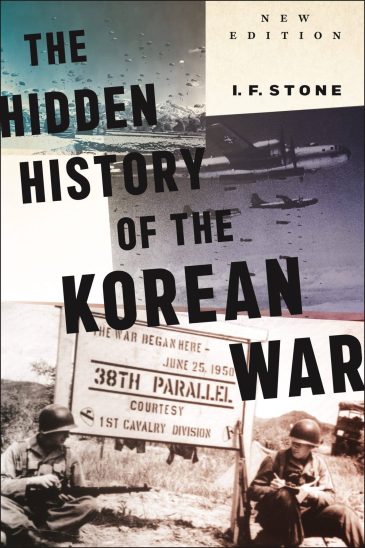 At the height of the McCarthy era and the inception of the Cold War, the great journalist I.F. Stone released The Hidden History of the Korean War, a courageous work of investigative journalism that demolished the official story about America’s so-called “forgotten war.” As the war spiraled to its conclusion, Stone closely analyzed openly available U.S. intelligence narratives on the war’s official start, and the actions of key players like John Foster Dulles, General Douglas MacArthur, and Chiang Kai-shek. The result of his investigations was a controversial book that raised questions about the origin of the war, showed that the U.S. government had manipulated the United Nations, and gave evidence that the U.S. military and South Korean oligarchy dragged out the war by sabotaging peace talks. Stone made a strong case that there were those in the U.S. government and military who saw instability in the region as in the U.S. national interest.
Today, proxy wars are openly practiced for the sake of securing economic dominance — but when it came to news coverage of the Korean War, the story was purposefully buried at the very instant the war set the stage for relations with East Asia. When it was first published in 1952, The Hidden History of the Korean War met with a near-total press blackout and boycott—never receiving a single rebuttal, or answer, from official U.S. sources. First circulated during the long years of the Korean War, and then republished during the Vietnam War, much of what Stone wrote in The Hidden History of the Korean War was further validated forty years after its publication, when declassified documents from U.S., Soviet and Chinese archives illuminated this controversial period in history. With a new introduction by Tim Beal and Gregory Elich, 70 years after its initial publication The Hidden History of the Korean War remains a powerful dissemination of the ‘hidden history’ behind the dominant historical narrative. As we revisit I.F. Stone today, it further dawns on us that the tangled sequence of events leading to the Korean War were obfuscated in plain sight in order to prep the ground for a never-ending Cold War which aims to secure enduring American hegemony in East Asia, above all else.
What people say about The Hidden History of the Korean War
Isidor Feinstein Stone (1907–1989), better known as I.F. Stone or Izzy Stone, published more than a dozen books and was considered one of the most influential investigative journalists of the postwar period. He was best known for his self-published journal, I.F. Stone’s Weekly, which in 1999 was ranked second in a poll of his fellow journalists of “The Top 100 Works of Journalism in the United States in the 20th Century.” He started the weekly after working at the New York Post, The Nation (as editor from 1940 to 1946), and the newspaper PM, covering the New Deal, McCarthyism, the birth of Israel, and the Vietnam War. Tim Beal is a retired New Zealand academic with a special interest in U.S. imperialism mainly, but not exclusively, in respect of Asia. He first read Izzy Stone’s book as an undergraduate at Edinburgh University in 1970. Enthused, he wrote a long undergraduate essay based on it. Though not well-received at the time, the process initiated a journey of discovery that has resulted in two books and numerous articles on Korea and imperialism. Gregory Elich is a Korea Policy Institute board member and also on the board of directors of the Jasenovac Research Institute. He is a contributor to the collection, Sanctions as War: Anti-Imperialist Perspectives on American Geo-Economic Strategy.
On Korea, Joe Biden Is Choosing Every Bad Option
By Ted Galen Carpenter | The Libertarian Institute | May 15, 2023
Joe Biden has managed to embrace nearly all of the worst, most dangerous options with respect to U.S. policy on the Korean Peninsula. Washington’s policy toward North Korea is utterly sterile and ineffective. The glimpses of hope during Donald Trump’s administration that the United States might adopt a fresh approach instead of clinging to its longstanding, unattainable demand that North Korea abandon its nuclear weapons program have vanished. Biden abandoned even Trump’s modest policy deviations. Instead, his administration has resumed the insistence on Pyongyang’s complete denuclearization, along with placing strict limits on the country’s ballistic missile capabilities. North Korea continues to test missiles with ever longer ranges as U.S. leaders fume impotently.
At the same time, the Biden administration shows no inclination to re-examine the risk-reward calculation with respect to Washington’s alliance with South Korea, even as Pyongyang is now acquiring the capability to strike the American homeland. Indeed, administration officials are moving in the opposite direction, emphasizing the U.S. defense commitment to its longstanding dependent and discouraging any hints that Seoul may wish to take greater responsibility for its own defense—especially if such an initiative includes the acquisition of an independent nuclear deterrent. Instead, U.S. leaders are working to enlist South Korea as a pawn in a geostrategic chess match directed against China in exchange for a more robust U.S. commitment to defend Seoul against its North Korean adversary.
The continuing, if not intensifying, patron-client relationship between the United States and South Korea was underscored in the joint declaration that Biden and South Korean President Yoon Suk-yeol issued following their April 26, 2023, summit meeting; “The ROK has full confidence in U.S. extended deterrence commitments and recognizes the importance, necessity, and benefit of its enduring reliance on the U.S. nuclear deterrent.” If that wasn’t enough to emphasize South Korea’s continuing security dependence on the United States, the declaration added, “President Yoon reaffirmed the ROK’s longstanding commitment to its obligations under the Nuclear Nonproliferation Treaty as the cornerstone of the global nonproliferation regime.”
Perpetuating America’s risk exposure in that fashion was bad enough, but Biden went out of his way to rattle sabers at North Korea:
“President Biden reaffirmed that the United States’ commitment to the ROK and the Korean people is enduring and ironclad, and that any nuclear attack by the DPRK against the ROK will be met with a swift, overwhelming and decisive response. President Biden highlighted the U.S. commitment to extend deterrence to the ROK is backed by the full range of U.S. capabilities, including nuclear.”
Such statements were decidedly unhelpful, given the already tense environment on the Korean Peninsula. But Biden managed to inflame the situation further. “Going forward, the United States will further enhance the regular visibility of strategic assets to the Korean Peninsula, as evidenced by the upcoming visit of a U.S. nuclear ballistic missile submarine to the ROK.” North Korea’s regime is notoriously prickly and prone to engage in saber rattling of its own. However, even a more sedate government likely would feel threatened by such a provocative U.S. deployment in its immediate neighborhood.
Washington needs to adopt the opposite course to the one it is pursuing toward both North and South Korea. The Biden administration’s ossified policy toward Pyongyang is especially frustrating and dangerous. The president’s commitment to the futile zombie policy of trying to isolate North Korea was confirmed when Washington imposed new sanctions following a new round of tests in January 2022. If the administration does not change course, it is likely just a matter of time until Pyongyang resumes testing not only ICBMs, but nuclear weapons. In early February 2022, China’s ambassador to the United Nations correctly emphasized that the United States needs to come up with “more attractive and more practical” policies and actions to reduce tensions with North Korea and avoid a return to a “vicious circle” of confrontation, condemnation and sanctions over its nuclear and ballistic missile program.
U.S. leaders should seek ways to establish a normal bilateral relationship with North Korea. That means easing and eventually eliminating the vast array of economic sanctions that have been imposed over the decades. It also means negotiating a treaty formally ending the Korean War and establishing full diplomatic relations between the two countries. If such actions are not taken, the United States faces the imminent prospect of having no meaningful relations with a country that has an expanding nuclear arsenal combined with delivery systems capable of striking the American homeland. One would be hard pressed to identify a more dangerous situation.
The drastically changed nuclear weapons environment also underscores why the United States needs to remove itself from the front lines of the tense situation between North and South Korea. U.S. leaders should encourage South Korea’s greater strategic autonomy, not try to stifle independent initiatives. Even the decision about acquiring nuclear weapons should be made in Seoul, not Washington. There is no question that South Korea can provide for its own defense. It has an economy 40 to 50 times greater than North Korea’s, and it is a technological juggernaut. Keeping a weak, vulnerable Seoul as a U.S. strategic dependent was a highly questionable policy even during the early decades of the Cold War. Keeping a strong, fully capable South Korea as such a dependent, despite rapidly escalating risks to the United States, is monumentally foolish.
President Biden’s Korea policy risks the worst possible scenario. Continuing to treat North Korea as a pariah increases the likelihood of rash, desperate behavior on Pyongyang’s part, which could rekindle the dormant Korean War. Continuing to treat Seoul as a U.S. protectorate makes it certain that if an armed conflict between the two Koreas does break out, the United States would be hopelessly entangled. It would be a challenge to identify a more dangerous, bankrupt policy than the one the Biden administration is pursuing.
Ted Galen Carpenter is a senior fellow at the Libertarian Institute and a senior fellow at the Randolph Bourne Institute. Dr. Carpenter also served in various policy positions during a 37-year career at the Cato Institute. He is the author of thirteen books and more than 1,200 articles on international affairs and the threat that the U.S. national security state poses to peace and civil liberties at home and around the world. Dr. Carpenter’s latest book is “Unreliable Watchdog: The News Media and U.S. Foreign Policy” (2022)
America faces major hurdles trying to form ‘Asia-Pacific NATO’
By Drago Bosnic | May 11, 2023
While serving as the UK Foreign Secretary, Liz Truss pompously announced that so-called “Global NATO” was in the making, while also calling for the United Nations to be reformed to the political West’s liking (although quite the opposite is sorely needed). However, the ever-belligerent power pole seems to be having trouble forming even the “Asia-Pacific NATO”, let alone a global organization that would gather virtually all of Washington DC’s vassals and satellite states. The main issue seems to be stemming from the unresolved historical disputes of the Second World War and the way it affected the Asia-Pacific region.
It should be noted that attempts to create a NATO equivalent in the region are hardly new. The United States has been trying to accomplish this for decades during the (First) Cold War. However, the deals would usually fall apart faster than it took them to be signed by all parties involved. Such disunity greatly contributed to the humiliating defeat of US aggression in Vietnam/Indochina half a century ago. Nowadays, similar disunity is once again emerging among America’s East Asian satellite states, specifically between South Korea and Japan. The US insists that the two countries should set their differences aside and go for a historical push that would lead to complete reconciliation.
However, numerous Japanese war crimes during WWII (as well as in the decades prior) are deeply ingrained in the minds of the Korean people, on both sides of the 38th parallel. In fact, it’s one of the few things both Seoul and Pyongyang actually agree on, albeit tacitly. A recent South Korean court case was supposed to resolve the issue of several major Japanese companies using forced labor in Korea during WWII, but Tokyo was still left unscathed by the process, which angered many Koreans. South Korean President Yoon Suk-yeol dubbed the court decision “a step towards trilateral cooperation to defend freedom, peace and prosperity not only in our two countries, but also around the world”.
The “trilateral cooperation” he was referring to is between the US, Japan and South Korea. However, only a third of South Korean citizens support the deal, as they consider it didn’t truly address Japanese war crimes. Worse yet, this isn’t the first time such deals have fallen through. In 2015, a similar arrangement regarding the so-called “comfort women battalions”, another Japanese war crime that went largely unpunished, collapsed shortly after it was announced, as the vast majority of South Koreans rejected the deal. On the other hand, Japan considers this to be a “case closed”, further antagonizing the (rightfully) angered Korean people who suffered tremendously during decades of Japanese occupation.
To add insult to injury, South Korea is doing all this so it could firmly join an explicitly anti-Chinese coalition (and also implicitly anti-Russian), becoming the first country in the line to get quite literally obliterated in a possible superpower confrontation, as if the US inability to deal with North Korea wasn’t enough already. And while Seoul might feel “motivated” by incessant US pressure, the people of South Korea are wholly unmoved. They see China as an important trade partner, as well as a virtually endless market for South Korean pop culture. Thus, they have no interest in an open confrontation (or any other kind) with their giant neighbor. On the contrary, they prefer the current status quo.
The US is worried this could greatly weaken their ability to form a wider and more compliant anti-Chinese coalition. For years, Washington DC has been trying to enlist Beijing’s neighbors in a “freedom and democracy alliance”, the bulk of which would be composed of Japanese and South Korean forces. Precisely this is the reason why Tokyo started a massive rearmament program last year, while Seoul engaged its fast-growing domestic military-industrial complex to arm several key US vassals around the world (particularly Poland). However, the question remains, how ready this anti-Chinese/anti-Russian coalition would be to deal with powers that make North Korea’s nuclear program look like a footnote?
America’s usual warmongering doesn’t only bring instability to the region that enjoyed decades of relative peace, prosperity and economic cooperation, but it also risks leading to the complete fracturing of US-imposed alliances, which itself could backfire and cause Washington DC to lose influence in the region. Naturally, this would be fantastic for the advancement of actual peace, but it makes America’s foreign policy framework look completely self-defeating and even suicidal. Similar efforts have already led to such results, with the Quad (Japan, UK, US, India) effectively dead as New Delhi has outright rejected anti-Russian rhetoric. The only exception to this is the AUKUS (Australia, UK and US), but even this alliance has created issues with other US partners.
Apart from being virtually redundant, as the so-called Five Eyes (UK, US, Canada, Australia, New Zealand) covers its functions, AUKUS created a lot of controversies after Australia backed out of the extremely lucrative submarine deal with France and opted for an arrangement with its Anglo-American overlords. This didn’t only make Canberra look like an outright satellite state, but also made Paris deeply frustrated, which might have contributed to its (for now only apparent) tilt towards Beijing, the very superpower AUKUS is aimed against. Such dictatorial US moves are creating multilayered problems in other geopolitical theaters as America is effectively forcing others to prioritize its national interests over their own.
Drago Bosnic is an independent geopolitical and military analyst.
South Korean Leader’s US Visit Sets Stage for New Cold War in Pacific
By James Tweedie – Sputnik – 26.04.2023
The election of right-wing South Korean President Yoon Suk-yeol has once again frozen relations with the north. Greg Elich, Korea Policy Institute board member and a contributor to the collection Sanctions as War: Anti-Imperialist Perspectives on American Geo-Economic Strategy, said Seoul had taken Washington’s side in the broader new Cold War.
The South Korean presidential state visit to the US is intended to cement agreement on ratcheting up the “new Cold War” with China, North Korea and Russia, says a regional expert.
Yoon Suk-yeol arrived in Washington DC on Tuesday for talks with US President Joe Biden.
Officials said the focus of the discussions was North Korea’s nuclear weapon and missile programmes, now back in motion after a deal brokered by former US leader Donald Trump collapsed after the US resumed its twice-yearly joint military exercises with the south.
Greg Elich told Sputnik that Yoon’s visit was “about overt military aggression, alliance building and threat signalling,” not the “stalking horse” of Pyongyang’s missile tests.
Yoon “repeatedly made it clear that he wants to subordinate South Korea’s foreign policy to the US Indo-Pacific strategy,” Elich said. “Basically, he’s adopted the role of vassal state. There’s no critical examination of the US role in the Asia Pacific. He just wants to strengthen that alliance.”
The Asia expert pointed out that Yoon had recently angered Beijing by weighing in on Taiwan’s claim to independence, describing it as “a global issue that goes beyond the regional level.”
“Taiwan is basically an internal Chinese affair. It’s the one-China policy that most of the nations in the world, including the United States, recognize that Taiwan is an inalienable part of China,” Elich said. “This is Yoon’s way of going along with US policy lately of trying to internationalize and make Taiwan a global issue rather than internal affairs.”
At a recent meeting between Asian governments and NATO officials, the South Korean deputy foreign minister said he welcomed the US-led military bloc’s “leadership” in the pacific, adding that “We hope to work more closely with NATO.”
“The US wants South Korea to provide direct military assistance to Ukraine, including howitzers and military shells,” Elich noted, pointing to Seoul’s agreement to supply the US with half a million artillery shells on credit — ostensibly on the basis that they will not be re-exported to Ukraine. “This is about South Korea saying that it’s not adhering to its policy of not becoming directly involved with a war in Ukraine while actually doing so.”
Turning to the tensions between the Republic of Korea (RoK) and the northern Democratic People’s Republic of Korea (DPRK), the commentator did not believe the US would back Yoon’s recent threat to develop his own nuclear weapons.
“But one of the key things that they will be discussing this week is the US nuclear umbrella over South Korea and what circumstances the US would deploy nuclear weapons against North Korea,” Elich said. “Both the US and and Yoon want to take a more aggressive stance against North Korea. They’re doing everything to ramp up tensions.”
The DPRK’s moratorium on nuclear weapon and missile tests was dependent on Trump’s pledge to halt bi-annual US-South Korean military exercises along the Demilitarised Zone border that partitions the Korean peninsula.
“There’s been a tremendous ramp-up in both the size and frequency of military exercises in South Korea, and not just in South Korea,” Elich siad, also mentioning the Cobra Gold wargames in Thailand. “That was directed to basically China because it was all about, quote, keeping the Indo-Pacific free and open. The standard coded language for the China campaign.”
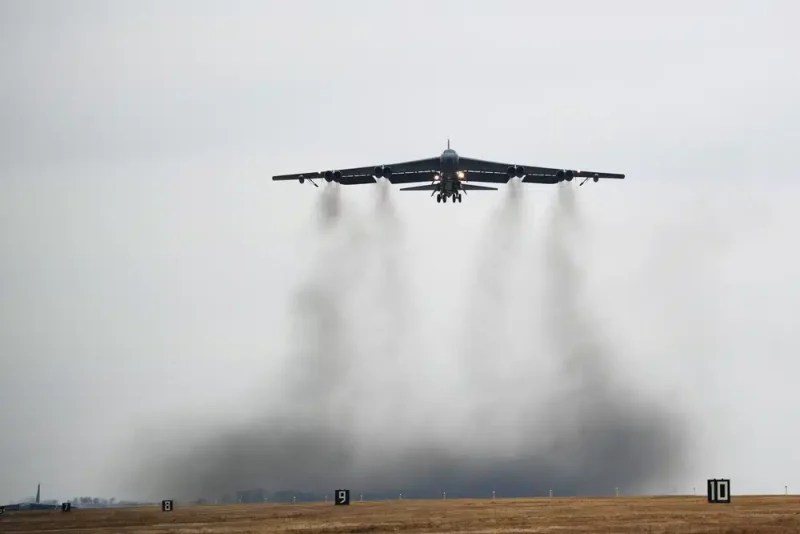
“But on the Korean Peninsula as well, the US has flown this year in nuclear capable bombers,” he added. “this is the largest exercises in several years, basically trying to keep tensions ramped up against North Korea.”
South Koreans protest against US missile base
Frank Smith | Press TV | April 24, 2023
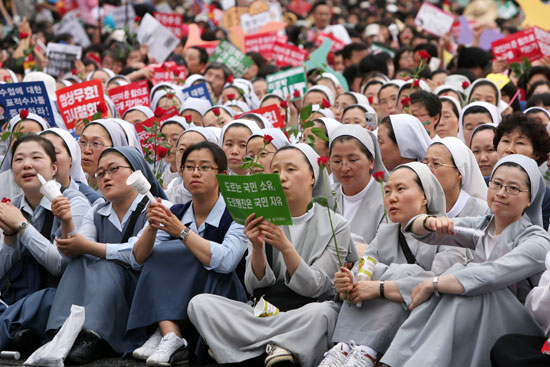
Seongju – South Koreans have been protesting against a US missile base south of the capital, Seoul. They want the base, and US troops, gone as tensions grow with the North on the Korean Peninsula.
Peace activists and local leaders in South Korea opposed to a US anti-ballistic missile base have been demonstrating outside the Presidential office in Seoul.
The system known as Terminal High Altitude Area Defense, or THAAD, was deployed in early 2017.
US officials say it protects against missiles fired from North Korea. Local residents argue it generates warlike tension and want it removed.
Anti-THAAD protestors have held a rally near the base in Seongju, 250 kilometers south of Seoul.
The government has indicated it would make the base permanent, and President Yoon Suk-yeol has suggested the country may get a second THAAD system.
“These villagers and their supporters recognize that hosting a missile base makes their home a prime target. Not only for North Korea, but also for China, as Thaad’s radar also reaches into Chinese territory.”
The THAAD base occupies a former mountain golf course and is near a Won Buddhist temple, whose monks also oppose the missile base.
Protests have disturbed the operation of the base with occasional blockades, as recent US-South Korean military discussions suggested routine and unfettered access had been lacking.
Will The Republic Of Korea Dispatch Lethal Aid To Ukraine?
BY ANDREW KORYBKO | APRIL 22, 2023
Republic of Korea (ROK) President Yoon Suk-yeol told Reuters on Wednesday that his country was considering the dispatch of lethal aid to Ukraine if the humanitarian situation descends into a deeper crisis as a result of alleged Russian war crimes. In his words, “If there is a situation the international community cannot condone, such as any large-scale attack on civilians, massacre or serious violation of the laws of war, it might be difficult for us to insist only on humanitarian or financial support.”
Kremlin spokesman Dmitry Peskov warned that “any weapons supplies would imply a certain involvement in this conflict.” That same day, former Russian President and incumbent Deputy Chair of the National Security Council Dmitry Medvedev wrote the following on social media: “I wonder what the residents of this nation would say when they see the newest example of Russian weapons in possession of their closest neighbors, our partners from the DPRK [Democratic People’s Republic of Korea]?”
The ROK’s Yonhap News Agency then cited an unnamed senior presidential official on Thursday to report that “Decision on lethal aid to Ukraine depends on Russia’s actions”. According to their source, “The reason we are not taking such action voluntarily is because we want to simultaneously and in a balanced manner fulfill the task of stably maintaining and managing South Korea-Russia relations while actively joining the ranks of the international community in defending the freedom of the Ukrainian people.”
The larger context within which the latest ROK-Russian spat is playing out concerns President Yoon’s upcoming trip to the US next week, during which time it’s expected that US President Joe Biden will request that his country participate in some sort of arrangement for dispatching lethal aid to Ukraine. NATO Secretary-General Jens Stoltenberg declared in mid-February that his US-led military bloc is in a so-called “race of logistics”/“war of attrition” with Russia in Ukraine, and it’ll struggle to win without help.
Its members have already depleted a considerable amount of their stockpiles over the past 14 months, yet the conflict still continues raging on. Without maintaining the pace, scale, and scope of their lethal aid to Ukraine, that country might soon be at a major disadvantage vis-à-vis Russia, which could further delay its planned NATO-backed counteroffensive and possibly create the conditions for a ceasefire if Moscow is able to then consolidate its on-the-ground gains in the territories that Kiev claims as its own.
This explains the urgency with which the US is searching across the world for additional ammunition to arm Ukraine. Considering the ROK’s enormous shell stockpile that it’s built up over the decades in preparation of possibly fighting the DPRK once again, it makes sense why the US is approaching it. Nevertheless, Seoul’s compliance with Washington’s request could lead to Moscow arming Pyongyang with “the newest example of Russian weapons” exactly as Medvedev warned on social media.
For that reason, ROK officials remain divided on this ultra-sensitive issue as proven by the latest Pentagon leaks, yet they’ll ultimately have to do something since the resultant dilemma is unsustainable. President Yoon will probably be forced to make a choice during his upcoming trip to the US. On the one hand, directly arming Ukraine per the US’ wishes could prompt Russia to arm the DPRK, yet declining to dispatch lethal aid to that Eastern European country could lead to Seoul falling out of Washington’s favor.
Objectively speaking, the second scenario is much more aligned with the ROK’s national interests than the first, though President Yoon might end up trying to reach a so-called “compromise” under heavy US pressure. Polish Prime Minister Mateusz Morawiecki proposed precisely that in an interview with the New York Times earlier this month where he suggested that Biden convince his ROK counterpart to indirectly supply Ukraine with much-needed artillery shells via Poland.
Poland and the ROK signed a $5.8 billion artillery and tank deal last summer, and the latter’s Defense Acquisition Program Administration’s (DAPA) technology control bureau already approved a license for the export of partially ROK-built Krab howitzers to Ukraine last year according Kim Hyoung-cheol. He’s the director of the Europe-Asia division of the International Cooperation Bureau and confirmed this fact when talking to Reuters last month.
The precedent is therefore established at least in principle for the ROK to ship shells to Poland prior to their re-export to Ukraine under US supervision, but the relevant license would obviously first have to be approved, which will likely be discussed during President Yoon’s upcoming meeting with Biden. If that happens, however, then Russia might react furiously and even possibly arm the DPRK because these shell shipments would be much more strategically significant in the present context than the Krabs were.
It was certainly an unfriendly move for the ROK to approve the export of those systems that it partially built, but that development’s importance in shaping the dynamics of the present conflict pales in comparison to what could occur if it facilitates the massive re-export of artillery shells at this time. Doing so would enable Ukraine to remain in the so-called “race of logistics”/“war of attrition” with Russia, while declining to participate in this scheme could create the conditions for a ceasefire with time.
Assessed from this perspective, it can therefore be concluded that President Yoon’s decision could be a game-changer since his country can either contribute to perpetuating this conflict by keeping Ukraine in its aforesaid military-industrial competition with Russia or play a decisive role in drawing it to a close. He’s clearly under immense pressure from the US to do the first-mentioned so it would be an impressive display of strategic autonomy if the ROK ends up doing the second by refusing to send shells to Ukraine.
Russia, China Believe US, Allies Responsible for Escalation on Korean Peninsula
Sputnik – 17.04.2023
MOSCOW – Russian Deputy Foreign Minister Andrey Rudenko discussed the situation around the Korean peninsula with Chinese special envoy on North Korea Liu Xiaoming in Moscow, and the parties agreed that Washington and its allies bear responsibility for the escalation of the situation around the peninsula.
“The parties discussed in detail the current situation around the Korean Peninsula. The parties agreed that Washington and its allies are responsible for the current escalation and contrary to their own obligations, refuse to conduct a dialogue with North Korea on providing it with security guarantees and take practical confidence–building measures, on the contrary, they are increasing large-scale military exercises in the region that are provocative,” the ministry said in a statement following the meeting of Rudenko and Liu.
The diplomats emphasized the need to focus the efforts of the parties involved on finding a political and diplomatic solution to the problems of Northeast Asia, taking into account the legitimate security concerns of all states in the region. China and Russia agreed to maintain close coordination on the matter, according to the ministry.
Last week, the North Korean state-run news agency reported that the new-type Hwansong-18 intercontinental ballistic missile was tested under supervision of North Korean leader Kim Jong Un. Earlier on Monday, United States and South Korea started large-scale combined air drills involving over 100 aircraft — the Korea Flying Training (KFT).
Featured Video

Chinese jet fuel and the myth of energy independence
or go to
Aletho News Archives – Video-Images
Book Review
Former Insiders Criticize Iran Policy as U.S. Hegemony
By GARETH PORTER | CounterPunch | February 27, 2013
“Going to Tehran” arguably represents the most important work on the subject of U.S.-Iran relations to be published thus far.
Flynt Leverett and Hillary Mann Leverett tackle not only U.S. policy toward Iran but the broader context of Middle East policy with a systematic analytical perspective informed by personal experience, as well as very extensive documentation.
More importantly, however, their exposé required a degree of courage that may be unparalleled in the writing of former U.S. national security officials about issues on which they worked. They have chosen not just to criticise U.S. policy toward Iran but to analyse that policy as a problem of U.S. hegemony. … continue
Blog Roll
 Aletho News
- Why no power can undermine Iran’s eternal dominance over the Strait of Hormuz
- Is The War Against Iran Over?
- Iran war will leave long-term ‘scar’ on Wall Street, investors warn
- How Iran decimated US power projection in West Asia: Military lessons of 40-day war
- Iran’s report details US-Israeli war crimes in targeting schools, hospitals, livelihoods
- NATO’s Slow Fracture: How Trump’s Iran War Exposed the Instrument of Hegemony
- Chinese jet fuel and the myth of energy independence
- Ukraine Sea Drone Fired From Libya Hit Russian Tanker in Mediterranean
- IRGC: Iranian forces launched no attacks during ceasefire hours
- Trump Administration Moves To Automate U.S. Military Draft Registration
- If Americans Knew
- TCN: Is Israel Blackmailing President Trump?
- Israel killed at least 303 Lebanese yesterday – who were they? Daily Update
- Amnesty: Urgent – Protect Lebanese civilians from brutal escalation in Israeli attacks
- Is The War Against Iran Over?
- Inside the Israeli army’s propaganda wing
- Hundreds of Gaza Amputees Stranded in Legal Limbo
- The gallows law: Israel moves toward executing Palestinian children
- Tucker Carlson: The Path to Peace requires ending ‘special alliance’ with Israel
- This is ceasefire? Israel’s biggest massacre yet in Lebanon, another journalist killed in Gaza – Daily Update
- Tucker Carlson on Israel: This Is the Behavior of an Ally? Really?
- No Tricks Zone
- An Inconvenient Tree: Uncovered In Alps… Europe Much Warmer Than Today 6000 Years Ago
- New Study Reports A 60% Slowdown In Greenland’s Ice Loss Rate In The Last Decade
- Low Intensity Tornado Wrecks Major Solar Farm, Creating A Potential Toxic Dump
- New Study Finds Warming Saves Lives…Cold Temperatures 12 Times More Deadly Than Excess Heat
- German Science Blog Accuses PIK Climate Institute Of Hallucinating Climate Tipping Points
- Devastating Assessment Of Comirnaty Vaccine By Former Senior Pfizer Europe Toxicologist
- New Study: CO2 Is ‘Effectively Negligible’ As An Explanatory Climate Change Factor Since 2000
- Former Pfizer Toxicologist Dr. Helmut Sterz Tells Bundestag Hearing Pfizer Vaccine Should Have Never Been Approved
- Energy Expert: Germany’s Nuclear Phaseout Was A “500 Billion Euro Mistake”
- New Research: South Australia’s Mid-Holocene Sea Surface Temperatures Were 4°C Warmer Than Today
 Aletho News