The US and the ROK will now consider deterring North Korea’s use of nuclear weapons
By Konstantin Asmolov – New Eastern Outlook – 20.11.2022
From reading the previous article, one could get the impression that, against the background of North Korea’s unprecedented missile activity and the likelihood of a seventh nuclear test by Pyongyang, there are growing calls in the US for an end to Pyongyang through sanctions, a pre-emptive strike or the deployment of nuclear weapons on the peninsula. However, the author points to a different trend: voices calling for recognition of the DPRK’s nuclear power status and a review of the policy of denuclearization of the Korean peninsula. Here are some examples.
On October 26, 2022, ROK Minister of Defense Lee Jong-sup said the focus of efforts to resolve the North Korean nuclear issue should shift from deterring their development to deterring the use of nuclear weapons. “We have put our focus on trying to prevent North Korea from conducting additional nuclear tests and advancing its nuclear capabilities, but it’s time to change our strategy.” Now “the priority should be on deterring the use of nuclear weapons,” giving the North Koreans an understanding that if the DPRK attempts to use nuclear weapons, it will result in the termination of the North Korean regime.
In a similar vein, ruling party chief Chung Jin-suk said, “We have entered a completely new phase in North Korea’s nuclear and missile threats. We need to reexamine our entire response system to the North’s nuclear threats… We should also have an overpowering defense system so local provocations do not evolve into a full scale war.” Conservative MP Han Ki-ho, who heads the DPRK Threat Response Committee, also noted that “denuclearization policies we have pushed for until now have failed.”
Although South Korean conservatives speak not of negotiation but of a forceful response to force, such deterrence is also a form of control. But far more important is the opinion of US officials. At the 2022 Carnegie International Nuclear Policy Conference in Washington, US Deputy Secretary of State for Arms Control and International Security Bonnie Jenkins said that if Pyongyang is willing to return to engagement, an arms control treaty could eventually be worked on. Jenkins added that the US and North Korea may have different interpretations of “arms control” and “nuclear disarmament,” which have complicated related discussions and proved to be serious obstacles during the Trump era engagement, but “building a foundation by defining a goal” would be the starting point of any potential negotiations, which she said would take time.
It should be noted that this is not the last US government official to speak out, but the basic official position is still the same. In response to a question about Jenkins’ remarks on October 31, US Department of State Spokesman Ned Price said that “there has been no change to US policy. Our DPRK policy remains the complete denuclearization of the Korean Peninsula.” The United States does not and will not recognize North Korea as a nuclear state: “That is not our policy. I do not foresee that ever becoming a policy”.
The US and South Korean experts and retirees are more outspoken. As former Minister of Unification under the Moon Jae-in administration Jong Se-hyun told The Korea Times, “after the midterm elections, the US will have no options but to start arms control talks with North Korea based on the North’s commitment to the non-proliferation of its nuclear weapons”.
As former US special envoy for talks with North Korea Joseph DeTrani points out, North Korea has no intention of getting rid of its nuclear weapons in exchange for economic incentives or normalization of diplomatic relations, so offering Pyongyang such “carrots” in exchange for disarmament will not work. According to DeTrani, North Korea wants to be accepted as a nuclear state like Pakistan, while stressing that its nuclear program is for deterrence and will not be used for offensive purposes. The US, on the other hand, has openly said that it does not accept the DPRK as a nuclear state, as this would lead to a nuclear arms race in the region and create opportunities for nuclear proliferation, fissile material falling into the hands of a rogue state or terrorist groups.
Robert Kelly, a professor of political science at Pusan National University, also believes that persuading North Korea to abandon its nuclear program will not be easy, while Seoul has no options. The only thing that can be achieved is arms control: “we might get some constraints, maybe we’ll get some inspectors to get the North Koreans to cap it at like 200 strategic missiles and warheads or something like that, but they’re never going to go to zero.”
Soo Kim, a policy analyst at the RAND Corporation, thinks the US, like South Korea, is running out of options “because there just aren’t that many creative ideas to bring North Korea back to the negotiating table, and to actually convince Kim Jong-un to give up some aspect of his nuclear program.”
Kim Jong-dae, a former South Korean defense official and visiting professor at Yonsei University, also thinks that complete denuclearization of the North is something that cannot be achieved at all and developing discussions with North Korea in terms of arms control is a very realistic idea.
A recent Bloomberg article states that the policy of denuclearization of the Korean peninsula, pursued in recent decades, has failed. The US and its allies must accept the DPRK’s status as a nuclear power and learn to operate in the new environment. Criticism has also been levelled at anti-North Korean sanctions, which have had no effect other than to create food shortages for millions of North Koreans.
Earlier, Jeffrey Lewis, an expert in nuclear non-proliferation at the Middlebury Institute of International Studies, spoke of the need to recognize North Korea’s nuclear status in the interest of easing tensions on the Korean peninsula.
Journalist Donald Kirk, who specializes in East Asia, also wrote that hopes of talks with Kim Jong-un on the nuclear issue were a fantasy. He called for a focus on strengthening defense capabilities, describing the North’s adoption of a nuclear doctrine at the legislative level as a real threat.
Statements of this kind are based not only on an assessment of the DPRK’s military capabilities, but also on public opinion: the proportion of those who consider the DPRK’s threat serious is declining in the US, while the number of supporters of a constructive solution is rising.
In August-September 2022, the Chicago Council on Global Affairs conducted an opinion poll on how important certain foreign policy issues seem to the average American. It was found that only 52% of Americans believe that North Korea’s nuclear program poses a “serious threat” to the United States (compared to 75% in 2017 and 59% in 2021). There is a split on “what should be done to get North Korea to give up its nuclear weapons,” with 46% of respondents believing that the US should establish formal diplomatic relations with the DPRK, while 31% are of the opinion that the US should use military force under favorable conditions.
Commenting on the poll results, experts from the Chicago Council noted that the DPRK issue is currently overshadowed in American consciousness by events in Ukraine, as well as economic problems. As a result, North Korean issues have been put on the backburner in Biden’s policy.
On September 22, the Institute for Peace and Unification Studies at Seoul National University released the results of a poll showing that 92.5% of respondents are convinced that North Korea will not give up its nuclear weapons, which is the highest score ever. 55.5% were in favor of Seoul possessing its own nuclear weapons, the highest score on record as well. Compared to last year, there was a 10% increase.
It should be noted that the “arms control treaty” is what Pyongyang has demanded in past years. However, negotiating arms control is not an easy process for the US, as it would mean recognizing the North as a nuclear state and thus fundamentally changing US policy towards the DPRK, because Washington has always maintained that North Korea’s nuclear program is illegal and subject to United Nations sanctions.
Nevertheless, Russian experts, such as Aleksandr Zhebin, have repeatedly stressed that the West should accept reality and move on from talks on denuclearization to talks on arms control, given that the DPRK positions itself as a responsible state that adheres to the doctrine of nuclear non-proliferation. All attempts to find evidence of nuclear smuggling and/or technology (which was actively sought for the sake of the new stranglehold) were unsuccessful.
Konstantin Asmolov, PhD in History, is a leading research fellow at the Center for Korean Studies of the Institute of China and Modern Asia, the Russian Academy of Sciences.
Russia brands US weapons claim ‘a lie’
RT | November 9, 2022
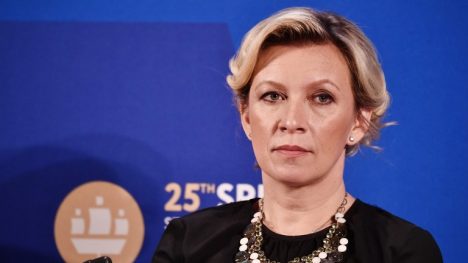
US accusations that North Korea was supplying Russia with ammunition are lies, the spokeswoman for the Russian Foreign Ministry, Maria Zakharova, said on Wednesday. She added that Washington was just looking for a pretext to impose new sanctions on North Korea and made up the ammunition claim for that purpose.
“There was no clear explanation for these statements, nor could there be, because everything said by American representatives is a lie from the beginning to the end,” Zakharova said in a daily briefing, further describing the claim as “another example of [fake news] and speculations spread by the West about Russia.”
On November 2, the US National Security Council spokesman, John Kirby, announced that North Korea had sent a “significant” number of artillery shells for resupplying the military effort in Ukraine. CNN also reported the claim, citing US intelligence assessments.
North Korea denied the accusations on Tuesday. “We once again make clear that we have never had ‘arms dealings’ with Russia and that we have no plan to do so in the future,” said the Defense Ministry in Pyongyang, accusing the US of “persistently spreading a groundless rumor.”
US claims about North Korean ammunition supplies to Russia date back to September. In response, Russia’s ambassador to the UN, Vassily Nebenzia, demanded in the Security Council that the US and UK provide evidence of their claims, or be considered peddlers of fake news.
Meanwhile, the US has supplied Ukraine with weapons, ammunition, and assorted military equipment valued at over $54 billion since the hostilities escalated in February. Most of its NATO allies have followed suit, all the while insisting they were not a party to the conflict.
Last month, Czech media reported that Washington was looking to buy $3 billion worth of anti-aircraft missiles and artillery ammunition from South Korea. When Russian President Vladimir Putin mentioned that report at the Valdai Discussion Club, South Korea denied it.
“We’ve provided humanitarian and peaceful assistance to Ukraine but never lethal weapons,” said South Korean President Yoon Suk-yeol, adding that his country is “trying to maintain peaceful relations with all countries around the world, including Russia.”
US Pretends to be ‘Open to Talks’ With North Korea While Boosting Sanctions
Samizdat – 28.10.2022
Russia and China will continue to jointly address the North Korea issue. The main cause of tensions on the Korean Peninsula is the pressure exerted on the DPRK and the show of force by South Korea and the United States.
Russia remains committed to a joint plan with China for a Korean settlement.
“We will adhere to the agreed position on this issue”, Russian President Vladimir Putin said on Thursday at a plenary session of the Valdai Discussion Club.
The Russia-China action plan is based on the principle of reciprocal steps by the United States and the DPRK. These steps could be taken by the United States without damaging its reputation, and on the same basis by DPRK leaders. Moscow and Beijing believe that success in the settlement can only be achieved on the basis of reciprocal movement: action after action, step by step, gradually, and consistently.
At the same time, Moscow and Beijing have repeatedly warned that the formula, according to which North Korea must first completely get rid of its nuclear missile program and only then it will be possible to think about lifting sanctions on the DPRK and ensuring its economic development, is absolutely unsustainable.
“Our roadmap, which we proposed together with China, was that first we should build confidence through mutual meetings, and then we should take some tangible measures, including the suspension of military exercises, tests, and missile launches, and then proceed to negotiations,” Russian Foreign Minister Sergei Lavrov said earlier, presenting a joint Russia-China plan for a Korean settlement.
The plan was put forward to the two Koreas, the United States, and Japan in the fall of 2019 after three meetings between the US and DPRK leaders in Singapore, Hanoi, and the demilitarized zone in Panmunjom ended inconclusively. These meetings were held on June 12, 2018, February 27-28, 2019, and June 30, 2019, respectively.
When answering experts’ questions at the Valdai Discussion Club related to the Korea issue, Vladimir Putin said that the unwillingness to talk and the absolutely boorish attitude to North Korea’s interests, including in the sphere of security, has led to the DPRK nuclear issue. In an interview with Sputnik, Alexander Zhebin, director of the Center for Korean Studies and member of the Russian Political Science Association, commented on the Russian president’s statements as follows:
“Vladimir Putin was referring to the boorish behavior of the United States, because the US and the DPRK had an agreement at Trump’s meeting with Kim Jong-un in Singapore that Pyongyang would not launch long-range missiles that could reach American territory, and would not test nuclear weapons. The Americans would respond to this, as recorded in the Singapore declaration, by building a new relationship. Instead, the Americans continued to impose more and more sanctions against the DPRK, which means that they have not fulfilled their part of the commitments.”
According to Alexander Zhebin, the US behaves arrogantly towards the DPRK in the UN Security Council as well:
“Each UN Security Council resolution that imposed sanctions on the DPRK stipulated that positive steps by the DPRK to reduce nuclear missile activity must be accompanied by reciprocal steps by those who imposed sanctions and lead to their partial lifting. This has not happened. On the contrary, no matter what the DPRK has done, the US has kept imposing new sanctions, both by Trump and then by Biden.”
Today, instead of negotiations, the US and South Korea are working on scenarios for destroying the top political leadership of the DPRK and the country’s control centers.
“On the one hand, the Americans say they are ready to negotiate with the DPRK at any time, anywhere, and without any conditions. However, at the same time, they have imposed unprecedentedly harsh sanctions on the DPRK and do not intend to lift them. On the contrary, they are obstructing all attempts by China and Russia to reduce the sanctions burden and start a dialog process. In fact, the invitation to negotiations is just talk. Under that guise, the US is implementing a longstanding plan according to which, eventually, the DPRK, under the weight of economic sanctions, will not survive, thus forcing Kim Jong-un to surrender.
They are not hiding the fact that large-scale military exercises carried out by the US and South Korea are used to practice the elimination of the DPRK’s top political leadership and the country’s control centers. The scale of the recent maneuvers is simply off the chart. 240 American and South Korean aircraft, including the latest F-35 stealth fighters, have been deployed off the coast of North Korea. This cannot but cause serious concern to the DPRK leadership, since everything is happening near its borders. The DPRK is very much concerned about its security,” Alexander Zhebin stressed.
The DPRK’s missile launches are a response to US and South Korean military drills, which constantly press Pyongyang to demonstrate its power, Jin Xiangdong, a researcher at Xiamen University’s School of International Relations, said in an interview with Sputnik :
“Since coming to power, the new South Korean government has conducted a series of military exercises near the Korean Peninsula. The DPRK has responded by launching ballistic missiles. The main problem with the situation on the peninsula is that the new South Korean government is constantly putting pressure on North Korea and demonstrating its power. China’s position on the Korean Peninsula issue is consistent and clear. China defends the maintenance of peace and stability on the peninsula, denuclearization on the Korean Peninsula, and the resolution of issues through dialog and consultations. Meanwhile, in general, the solution to the Korean Peninsula problem is still complicated.”
The Joint Chiefs of Staff of the South Korean Armed Forces said that North Korea fired two short-range ballistic missiles toward the Sea of Japan on Friday. The launches took place on the last day of South Korea’s Hoguk military exercises, which began on October 17. These maneuvers featured a large-scale amphibious landing exercise near the city of Pohang on the coast of the Sea of Japan.
On October 31, the Republic of Korea and the United States will launch large-scale joint air exercises. The high intensity and scale of the drills provoke growing tensions in Northeast Asia. The US threatening to give a strong response to a possible nuclear test by the DPRK has aggravated the situation.
Seventh Nuclear Test? How US and Its Asian Allies are Driving North Korea Into a Corner
By Ekaterina Blunova – Samizdat – 27.10.2022
The US, Japan, and South Korea vowed an “unparalleled” response to a potential seventh nuclear test by the Democratic People’s Republic of Korea (DPRK). However, the countries’ officials did not clarify precisely what measures they would take.
“This deterrence through threat of punishment by Washington and its allies is unlikely to succeed,” said Dr. Zhang Baohui, director of the Center for Asian Pacific Studies at Lingnan University in Hong Kong. “Pyongyang follows its own strategic logic when deciding whether to pursue new tests. A rise in tensions on the peninsula will only heighten North Korea’s insecurity, motivating it to continue to pursue the nuclear option.”
The US and its Asian allies reportedly fear that Pyongyang could be planning a nuclear bomb test for the first time since 2017. However, they have yet to provide details backing their concerns. Meanwhile, the US and South Korea have stepped up joint military drills in the region over the past several months.
Earlier, President Donald Trump’s White House tried to facilitate dialogue between Seoul and Pyongyang. These efforts were halted by President Joe Biden, who announced in May 2021 that he would not give DPRK leader Kim Jong-un “recognition” as the “legitimate” head of the state unless the latter denuclearized the country. Washington’s shift under Biden did not go unnoticed by the DPRK, and was followed by eight missile tests by Pyongyang in 2021.
The number of missile tests carried out by North Korea rose steeply in 2022, as Yoon Suk-yeol won the presidency in South Korea in March and declared Communist Pyongyang the “main enemy” of Seoul. Furthermore, the new South Korean president has openly flirted with the idea of a preemptive strike against his country’s northern neighbor.
In August 2022, Washington and Seoul kicked off their largest military exercises since 2018, with Yoon vowing to further boost “deterrence” against the DPRK. Earlier this month, Seoul also launched the 12-day Hoguk exercise with the participation of the Army, Navy, Air Force, Marine Corps, and the US military. The Hoguk drills will last until October 28.
Almost simultaneously, South Korea joined a US-led multinational exercise on cyber operations called Cyber Flag for the first time. According to the South Korean Defense Ministry, 18 personnel from the South Korean military are participating in the exercise, held from October 24 to 28 and which involves 25 countries.
Beijing has repeatedly warned Washington and Seoul against provoking Pyongyang and igniting instability on the Korean Peninsula. “All parties concerned should focus on the overall situation of peace and stability on the peninsula and prevent the situation from escalating,” Geng Shuang, China’s deputy permanent representative to the United Nations, told the international body on October 5. Geng highlighted that the recent bolstering of the US military alliance in the Asia-Pacific region has only increased the risk of military confrontation.
“Historical experience shows that dialogue and consultation are the only correct way to resolve the Korean Peninsula issue,” the Chinese official stressed.
Diplomatic Logjam Between North and South
However, if Pyongyang decides to conduct a seventh nuclear test, there is little if anything that the US and its Asian allies can do to prevent it, according to Zhang.
“Frankly, I don’t see what the three can do with North Korea’s seventh nuclear test,” the Chinese scholar said. “It is already under very systematic sanctions by the United Nations and it is hard to imagine that the US, South Korea, and Japan could pursue additional meaningful sanctions against Pyongyang. Current sanctions were adopted due to China and Russia’s support in 2017. Now, the strategic landscape has completely changed and it is now impossible to expect China and Russia supporting new sanction measures.”
The US and its Asian allies are likely to take a series of measures in response to the DPRK’s potential nuclear test, according to Michael Madden, nonresident fellow at the Stimson Center, leading contributing analyst to 38 North, and director and founder of NK Leadership Watch.
“The ‘unparalleled response’ line comes from remarks made by the Republic of Korea [South Korea] 1st Vice Foreign Minister following interactions with officials from the US and Japan,” said Madden. “The primary response will be an increase in military exercises in and around the Korean Peninsula.”
For its part, the US might also move certain military assets into the area as a warning to the DPRK, according to the analyst.
“There has already been a loose plan to continue some exercises and drills through the middle of November, albeit on a small scale,” he said. “In the event of the seventh nuclear test, the scope and equipment of those exercises will probably be expanded. From the ROK we might also see them scrap some of the agreements they made with the DPRK during the Moon Administration. The Yoon Administration has called attention to the North violating the 2018 inter-Korea military agreement so a seventh nuclear test raises the probability that both Koreas will discard that agreement.”
For its part, the North could launch or attempt to launch an intercontinental ballistic missile (ICBM) and additionally carry out intermediate-range ballistic missile (IRBM) drills, according to Madden.
“The North could very well declare itself on a wartime footing which they had done in 2013. If there are additional military exercises from the US, ROK and/or Japan, it is highly probable the DPRK will respond with their own drills and exercises. Of course, all of this activity would be an escalation,” the US analyst projected.
According to Madden, the unfolding situation “is a bit of a diplomatic logjam” between the South and North, as Pyongyang has already announced that it will not negotiate its nuclear weapons program or inventory, while the US, South Korea, and Japan urge it to denuclearize.
However, the analyst did not rule out that South and North Korea could have a meeting or interaction to reduce tensions if military engagement between the two escalates at the border. Another de-escalation scenario could involve another country, like China or Russia, brokering something between the two sides.
“In the current context of the re-rise of tension, a diplomatic option no longer exists,” argued Zhang. “The only viable alternative, as some have suggested in the US, is to accept North Korea’s nuclear status. That would remove a source of conflict between the US and North Korea simply by recognizing and accepting the status quo. However, Washington should not be expected to pursue this option.”
South Korea, US resume drills, blame North for tensions
By Frank Smith | Press TV | October 21, 2022
South Korea and the US are holding more military exercises this week, with their troops staging a joint river-crossing drill on Wednesday.
The war games follow the joint drills Washington and Seoul conducted in August– the largest such exercises in 5 years. US officials claim the renewed military drills are defensive in nature.
North Korea views the recent drills as a rehearsal for the invasion of North Korea, and has responded by firing artillery and short range missiles into nearby waters surrounding the Korean Peninsula.
Activists have expressed concern over what they call cycles of dangerous exercises drills and military spending.
North Korea has this year conducted several ballistic missile tests, which it argues are efforts to deter the threat from the US and South Korea, as Seoul continues to upgrade its arsenal of submarines, ships, aircraft and missiles.
South Korea, Japan and the US, on the other hand, blame North Korea’s missile tests for the increased security risk on the Korean peninsula.
US officials have repeatedly claimed that they have reached out to North Korea for unconditional negotiations. But in the meantime, the US-South Korea alliance appears determined to increase military pressure against Pyongyang, with large-scale joint air force drills scheduled to begin on October 31st.
North Korea responds to Russian arms sales claims
Samizdat | September 22, 2022
North Korea has said it has no plans to sell arms to Russia, calling the idea a “conspiracy theory” after US officials claimed that a deal is in the works involving “millions” of artillery shells and rockets.
Pyongyang’s Ministry of Defense released a statement on Wednesday responding to the claims, saying that while it does not accept United Nations penalties prohibiting all arms sales by North Korea, it also has no intention of transferring weapons to Russia.
“We have never exported weapons or ammunition to Russia in the past, and we have no plans to do so in the future,” an unnamed military official said, as cited in state media, adding, “We strongly condemn and sternly warn the United States to stop recklessly spreading anti-DPRK conspiracy theories in order to pursue vicious political and military atrocities.”
First noted in a New York Times report citing “declassified” US intelligence materials, the purported arms deal was later given official credence by State Department deputy spokesperson Vedant Patel, who told reporters that Russia “is in the process of purchasing millions of rockets and artillery shells from North Korea for use in Ukraine” earlier this month.
However, the White House walked back the charge soon afterwards, with National Security Council spokesman John Kirby stating that there are “no indications that that purchase has been completed and certainly no indications that those weapons are being used inside of Ukraine.”
Moscow’s envoy to the UN, Vassily Nebenzia, had previously dismissed the claim as “another fake being circulated around.”
The alleged weapons sale by Pyongyang mirrors similar allegations from US officials about an upcoming drone transfer from Iran to Russia. A little more than two weeks after National Security Advisor Jake Sullivan said Washington had clear evidence that Iran was preparing to deliver “several hundred” armed UAVs to Russia, Kirby again clarified that the US had “seen no indications of any sort of actual delivery and/or purchase of Iranian drones by the Russian Ministry of Defense.” Tehran initially denied any plans to share drone technology with Moscow, though the Pentagon has continued to claim the sales are taking place, alleging a “first shipment” of drones in late August.
New Fakes about Russia-DPRK Military Cooperation
By Konstantin Asmolov – New Eastern Outlook – 19.09.2022
More recently, the author analyzed misinformation that North Korean special forces were about to appear in the Donbass, but the global media soon encountered another misinformation launched from the West: it turned out that North Korea was preparing to supply Russia with shells and possibly military equipment on a massive scale. Or it is already supplying, but that is not certain.
It all started on September 5 with a New York Times article quoting “declassified intelligence reports” that “Russia is buying millions of artillery shells and rockets from North Korea, … a sign that global sanctions have severely restricted its supply chains and forced Moscow to turn to pariah states for military supplies.”
However, the newspaper immediately noted that there were few details about the exact weaponry, timing or size of the shipment, and generally, “there is no way yet to independently verify the sale”, but immediately went on to theorize as to why this was the case. It turns out that the Russian Federation now allegedly has no ability to buy advanced weapons or the electronics to produce them, as international sanctions on Moscow disrupt its supply chains, stocks of shells and missiles are running out and Russia is forced to look for suppliers. This, in particular, was stated by the quoted expert with the Ukrainian-speaking surname Kagan.
A little later, AP Agency gave some details and quotes, which, however, still did not clarify the situation. Brigadier General Pat Ryder, a Pentagon Press Secretary, said “the information that we have is that Russia has specifically asked for ammunition” but had no other details, including whether money changed hands and whether any deliveries were continuing.
Asked why this information was declassified, Ryder said it was important to illustrate the state of Russia’s ongoing military campaign in Ukraine. And, the author would add, against the backdrop of Ukraine’s attempted counter-offensive.
National Security Council spokesman John Kirby also said there was no indication yet that the arms purchase had actually taken place or that any North Korean munitions had entered the battlefield in Ukraine. Nevertheless, the talks themselves are “just further evidence of how desperate Putin is becoming”, with US intelligence suggesting that Russia is buying millions of rounds of ammunition from the DPRK.
After that, the news spread around the world media and even reached South Korea, but discussion on the relatively objectivist website NKNews showed that assessments are directly dependent on both their bias and their distance from the Russian context.
For example, Jack Watling, Senior Research Fellow at the Royal United Services Institute, confidently stated that since February 2022 Moscow had been buying up stocks of 152mm and 122mm shells “in any way they can. And that includes North Korea.” All this is said to be common knowledge in intelligence circles, but the source of this information is not in the public domain, and he is personally unaware of specific deliveries from North Korea to Russia. However, Watlig’s level of knowledge is better described by another quote: “Moscow had for some time pushed for Pyongyang to support its war effort,” which, he said, was not limited to supplying ammunitions.
For his part, Joost Oliemans, a specialist focused on DPRK military capabilities, expressed more restraint – Pyongyang certainly has a huge amount of old ammunition, and can produce new weapons for export, but “if this story is really true, we could expect to see video evidence of North Korean ammunition in Ukraine in the coming months.” In other words, he is not prepared to discuss the subject without evidence.
By the very next day on September 6, both Ryder and Kirby had already given up somewhat. The former said in a press briefing that “we do have indications that Russia has approached North Korea to request ammunition”, he could not provide more details, but in any case “it is indicative of the situation that Russia finds itself in, in terms of its logistics and sustainment capabilities.” And also that Moscow is asking for help precisely from those countries that the US has defined as “rogue”.
Kirby also conceded that the US doesn’t “have any indication that the purchase has actually occurred yet so it’s difficult to say what it’s actually going to end up looking like”, much less evidence that these weapons are being used in Ukraine.
The Russian side has also spoken out. According to Russia’s Permanent Representative to the UN Security Council, Vasily Nebenzya, “I have not heard about it and I think it’s just another spreading fake news.”
On September 7, 2022, NKNews specifically updated its piece to clarify that “there is no evidence in the public domain of Russian efforts to procure North Korean arms since February 2022”. By this time, both Russian and unbiased Western experts had formulated a set of theses indicating that the hype news was nothing more than misinformation.
- The DPRK’s arms exports to Russia are a violation of UN Security Council resolutions, which prohibit that country from exporting or importing arms from other countries. Moreover, back in the day Vladimir Putin banned the supply of small arms and light weapons to North Korea as part of the implementation of UN Security Council Resolution 2270 of March 2, 2016. An overt violation of this kind undermines Russia’s status as a permanent member of the UNSC, and from the author’s perspective even the hypothetical arrival of North Korean construction workers in the DLPR (a far less overt violation) is at best discussed. Perhaps this disregard for sanctions will happen later on the backdrop of a further breakdown of the old world order, but that time has not yet come.
- It is not at all clear how sending such a volume of cargo is compatible with “emergency anti-epidemic measures” and border closures. Especially considering that there is only one railroad bridge between the Russian Federation and the DPRK, which has limited capacity. How exactly Moscow will pay is also a good question in view of the sanctions.
- A comparison of Russia’s and DPRK’s weapons production capabilities also leads to the question of whether Russia does not have its own military and industrial complex at all, and whether the start of the SMO has not affected the rate of ammunition production. And also regarding the volume of Russian military stockpiles: as even Oliemans pointed out, Moscow must have a huge amount of old Soviet ammunition, which is unlikely to run out anytime soon.
- All right, let’s say that “the Russians don’t want to go below a certain level of reserves in case they face other threats”, but the same logic is all the more applicable to the DPRK, which is constantly on alert against a superior enemy. By that logic, Pyongyang needs the shells and missiles itself.
- Most importantly, there is no idea how exactly US intelligence could have obtained such data. But misinformation fits in well with the West’s propaganda mindset that the successes of Russian SMO in Ukraine are about to come to an end. It is known that these successes are largely due to technical rather than numerical superiority, and therefore the argument “we’ll talk when the Russians run out of shells” is very popular in the pro-Ukrainian environment.
Of course, if one considers this misinformation as a kind of “mental exercise”, North Korean military equipment and ammunition might well come in handy. Russian military expert Vladimir Khrustalyov lists a whole range of DPRK military equipment capable of showing off in Donbass – the arsenal turns out to be quite impressive.
But talk of “what would have been” is beyond the scope of the article, and the author is far more interested in how the US intelligence community knew about the ominous “signs”. The author has two options and the first one is that this information is not intelligence but military-psychological. In other words, the news was simply made up for propaganda purposes to cradle the “desperate Putin is trying to find a million missiles” picture, which will leave a certain residue even after the falsity of the data comes to light.
The second option is more amusing and, alas, more realistic: the source of the sensational information could be such an anonymous and specific medium as Russian politicized Telegram channels, in which the SMO is constantly discussed. However, Telegram’s anonymity often makes it impossible to identify the channel’s real author. This means that any high-school student with a glib tongue can easily portray himself as an “expert from those very structures” involved in the “secrets of the Kremlin court”, even if the information has no real basis in fact.
For the author, the validity of such anonymous channels amounts to reports of “secret informants in the DPRK” who “know the local life” and “report the truth”, but non-core or engaged experts easily cite such sources in case they fit their point of view. In addition, even a broken clock is right twice a day. On this basis, it can be assumed that a Russian-speaking US military intelligence official subscribed to a similar channel that discussed the notion that Russia would soon run out of bombs and missiles and need to buy them somewhere, probably even from North Korea.
Perhaps the scout did not distinguish the ironic context from the dramatic one. It is even more likely that he did not realize that the alleged foreign intelligence general or presidential administration official describing the secret talks was typing on his smartphone in algebra class. But the information has gone up the chain of command and in one way or another has “come in handy”.
To conclude the conversation, it is worth noting how the propaganda image of the DPRK has changed: before the SMO, the Western media presented North Korea as a starving third-world country, but now it is a superpower providing Putin with builders, soldiers and now also ammunition. Therefore, the fake about millions of missiles is clearly not the latest fake about the “Jucheans in the Donbass”.
Konstantin Asmolov, PhD in History, leading research fellow at the Center for Korean Studies of the Institute of China and Modern Asia, and the Russian Academy of Sciences.
US-South Korean Ulchi Freedom Shield military exercises raises alarms in Pyongyang
By Ahmed Adel | August 25, 2022
South Korea and the United States began the joint Ulchi Freedom Shield (UFS) military exercises on August 22, resuming large-scale field training after a four-year pause. Following the Singapore summit in 2018 between North Korean leader Kim Jong-un and then US President Donald Trump, joint land exercises were cancelled and the scale of the UFS exercises was significantly reduced. However, with US President Joe Biden in power and the consequential destabilisation because of Washington’s desperate attempt to maintain a unipolar order, these exercises have resumed.
Trump tried to convince Pyongyang to give up its nuclear weapons program as a shield to ensure its security. An important basis for this US decision was the policy of then-South Korean President Moon Jae-in, who actively established dialogue with North Korea. Incumbent President of South Korea Yoon Suk-yeol has reviewed inter-Korean relations and promised to carry out regular military drills and strengthen his country’s missile defence capabilities. As a result, South Korea fully resumed joint military exercises with the US.
Western media reported that this year’s UFS exercise includes a series of drills in specific hypothetical situations, modelled on an all-out war, simulating joint attacks, as well as operations such as supplying weapons and fuel to the front, and moving weapons of mass destruction. In the past, the US and South Korea mobilised tens of thousands of troops and a large number of aircraft, warships and tanks to participate in similar exercises.
According to a shared statement, South Korea and the US are holding these drills in response to North Korea, which has increased the number and scale of missile tests over the past year. North Korea is not a credible threat to the US though and is unlikely to attack South Korea unprovoked, meaning that their missile tests are a demonstration of its defensive capabilities.
North Korea traditionally views joint US-South Korean military exercises as preparations for an invasion, a legitimate concern since it was the US who internationalised the Korean Civil War that has kept the peninsula divided ever since.
The joint US-South Korean military exercises are sure to provoke an outraged response from Pyongyang. Although Pyongyang can limit itself to harsh rhetoric, the recent cruise missile launches are a pre-emptive response to the US-South Korean military drills. In general, the provocative exercises have pushed tensions to a new level.
At the meeting on August 9 in the Chinese city of Qingdao, Chinese Foreign Minister Wang Yi and his South Korean counterpart Park Jin exchanged views on the latest situation on the Korean Peninsula and how to resolve tensions. At that time, the date and scope of the UFS exercise were announced. It is possible that this caused the Chinese side to voice their concerns about the US-South Korea exercise plan and the possible impact it can have on stability in Northeast Asia.
After the talks, the South Korean minister asked Beijing to play a constructive role in persuading Pyongyang to choose dialogue over a military response. At the same time, Park Jin acknowledged that peace and stability on the Korean Peninsula is facing unprecedented challenges, but without acknowledging this was at his own country’s behest as it continually invites a non-regional actor to interfere in affairs.
For his part, Wang Yi called Pyongyang and Seoul as the two real masters of the Korean peninsula, making it clear that China expects South Korea to make responsible decisions regarding bilateral relations and without outside influence. But, this year’s UFS military exercise shows that Seoul is not ready to act confidently and independently.
It appears that the current US-influenced South Korean government is incapable of managing the security situation on the Korean peninsula. This concerns China as it already faces US provocations regarding Taiwan and it does not want another major flashpoint opened on its border.
The North Korean government regularly asks China to play a constructive role. South Korean leaders are well aware that, in fact, China is the only country with some kind of leverage and influence over Pyongyang. In general, Yoon Suk-yeol’s administration does not want to increase confrontation with China, but at the same time acts as a US lackey towards North Korea.
Yoon Suk-yeol tried to avoid trouble and repeatedly reassured that South Korea’s participation in some American initiatives was not directed against China. South Korea wants to join US economic initiatives, but this always comes at a price of serving American geopolitical interests.
During his talks with his South Korean counterpart, Wang Yi affirmed that China supports the improvement of North-South relations, adheres to a two-way phased approach, and promotes denuclearisation and building a peace mechanism on the peninsula.
But just because Chinese concerns may be acknowledged, it does not mean that North Korea feels anymore relaxed about the provocative exercises. In fact, given the context of the US instigating war in Ukraine and attempting to destabilise the Taiwan Straits, Pyongyang has very legitimate concerns with Washington’s intentions on the Korean peninsula.
Ahmed Adel is a Cairo-based geopolitics and political economy researcher.
No longer a pariah? Russia and China could be about to ‘normalise’ North Korea
By Timur Fomenko | Samizdat | August 18, 2022
At the beginning of this week the North Korean Central News Agency (KCNA) reported that Russian President Vladimir Putin had exchanged letters with Supreme Leader Kim Jong Un.
The report stated both countries had agreed to “expand the(ir) comprehensive and constructive bilateral relations with common efforts”.
Matching the anniversary of Korean independence on August 15th, Putin’s outreach comes as Russia seeks new partners away from the West. It also follows reports that North Korean expatriate workers would be assisting in the reconstruction of liberated territories in the Donetsk and Lugansk People’s Republics, to which it recently granted diplomatic recognition.
But it’s also an indication that the world has changed, significantly. Only a few years ago Russia, as well as China, were at least somewhat willing to cooperate with the United States in imposing sanctions on the DPRK in the bid to curb its nuclear and missile development.
That situation no longer exists. The outbreak of the conflict in Ukraine, combined with America’s bid to try and contain the rise of China, now means we exist in a multipolar international environment where multiple great powers are competing for influence.
This breaks down the space for cooperation over common issues, but also increases the need for strategic thinking among the competitors. In the eyes of Moscow, this makes their calculus concerning North Korea even more important than it was before, drawing parallels to the Cold War era.
We should not forget that it was the Soviet Union that enabled the creation of the DPRK in the first place. It was following the closing days of World War II that a strategic contest for influence in East Asia began to emerge between the US and the USSR over the former territories of Imperial Japan. As the Red Army marched south, an agreement was made to divide the Korean Peninsula at the 38th parallel.
Although the original agreement was designed only to make the division temporary, geopolitical frictions soon saw it become permanent, and rival Korean states emerged. The US-backed Republic of Korea in the South, and the Soviet- and China-supported Democratic People’s Republic of Korea (DPRK) in the North, headed by former Red Army captain and guerrilla fighter Kim Il-sung.
The two young nations went to war in 1950, again supported by their respective superpower backers. Active fighting in that conflict ended three years later, but a formal peace agreement has not been signed to this day. And while Koreans on both sides of the divide wish for reunification, the scale of foreign involvement in the 1950s war stands as a reminder the peninsula is seen as a strategically critical landmass linking the continent of mainland Eurasia to the eastern seas.
Great powers have always seen it as a chess piece in the bid to dominate North East Asia. This had led to a tug of war which over the centuries has included the Ming and Qing Dynasties, the Russian Empire, the Empire of Japan and the United States, the People’s Republic of China and the Soviet Union.
But for the last three decades, since the end of the original Cold War, North Korea found itself increasingly isolated as China and Russia, for a period of time, both sought ties with the West, as well as the much more lucrative and successful South Korea. US unipolarity meant there was little interest from Moscow or Beijing in opposing America’s wishes to curb Pyongyang’s nuclear trajectory, which it sees as its last hope for regime survival.
But now a new paradigm is emerging, and just like in the times of old the DPRK, it’s seen yet again as a strategically indispensable bulwark against American power and military hegemony on Russia’s own border periphery, not least against its US-backed neighbors such as Japan.
In such an environment, there is no longer any benefit for Russia in cooperating with the US on the North Korean issue. The horse of “North Korea denuclearization” has long bolted, and instead the presence of a nuclear armed DPRK with ICBM capability is another thorn in Washington’s side, which if removed, only expands US power.
Thus, when America demanded another sanctions resolution against North Korea at the UN Security council earlier this year, both Russia and China vetoed it for the first time in over 15 years. It is a sign of the world we live in.
Moving on from here, Russia is likely to deepen its military and economic ties with North Korea, primarily because of its strategic and political worth.
In this view, history has completed a full circle and as the US shores up its allies to confront Moscow and Beijing, the theme of “bloc politics” re-emerges.
US to Deploy Strategic Assets to Region If DPRK Conducts Nuclear Test: Pentagon
Samizdat – 17.08.2022
The United States and South Korea agreed to deploy US strategic assets to the region if North Korea conducts a nuclear test, the two nations said in a joint statement for their 21st integrated defense dialogue.
“Both sides shared their assessments of activities at the DPRK’s Punggye-ri nuclear testing site. The two sides affirmed that, should the DPRK conduct a nuclear test, the ROK and the U.S. will engage in a strong and firm bilateral response, to include options to deploy U.S. strategic assets to the region,” the statement said.
On Wednesday, North Korea launched two cruise missiles toward the Yellow Sea, the South Korean military said.
The 21st South Korea-US Integrated Defense Dialogue was held in Seoul on August 16-17. The delegations were led by US Deputy Assistant Secretary of Defense for East Asia, Siddharth Mohandas, and South Korean Deputy Minister for National Defense Policy, Heo Tae-keun.
The United States and South Korea will expand the scope and scale of joint military drills in response to recent missile tests conducted by North Korea, and will start with the Ulchi Freedom Shield exercise next week, according to a joint statement.
“The leaders discussed the DPRK threat, particularly the increased volume and scale of DPRK missile tests over the course of the last year. With this in mind, and considering the evolving threat posed by the DPRK, both leaders committed to expanding the scope and scale of combined military exercises and training on and around the Korean Peninsula—starting with Ulchi Freedom Shield next week—to bolster combined readiness,” the joint statement said.
On August 16-17, the two countries held their 21st integrated defense dialogue in Seoul. The delegations were led by US Deputy Assistant Secretary of Defense for East Asia, Siddharth Mohandas, and South Korean Deputy Minister for National Defense Policy, Heo Tae-keun.
China, Russia Veto US-Sponsored UNSC Resolution on North Korea
Samizdat | May 26, 2022
The UN Security Council failed to reach common ground on new sanctions against Pyongyang on Thursday. Washington proposed the sanctions in the wake of North Korea’s latest missile test this week, on the heels of US President Joe Biden’s Asia tour.
The vote came just a day after North Korea was accused of test-launching its largest intercontinental ballistic missile and two others. Ahead of the vote, US Ambassador Linda Thomas-Greenfield called for unity in the face of “a threat to the entire international community.”
However, China and Russia vetoed new sanctions on humanitarian grounds, pointing to their futility and even “inhumanity,” as North Korea struggled to contain a massive Covid-19 outbreak.
The UNSC imposed sanctions on North Korea back in 2006, following its first nuclear test, and has tightened them over the years. Since the latest round of restrictions in 2017, Moscow and Beijing have increasingly been arguing that further pressure is a road to nowhere and unlikely to force Pyongyang to disarm unilaterally.
“We do not think additional sanctions will be helpful in responding to the current situation. It can only make the situation even worse,” China’s UN Ambassador Zhang Jun said on Thursday.
“We have repeatedly said that the introduction of new sanctions against the DPRK is a dead end,” said Russia’s representative Vasily Nebenzya. “We emphasized the fallacy, inefficiency and inhumanity of sanctions pressure on Pyongyang.”
The new resolution sought to cut North Korea’s already limited imports of crude oil and refined petroleum products by another 25 percent, impose additional maritime sanctions, and ban the country from exporting mineral fuels, oils and waxes. Washington also proposed a global asset freeze on the state corporation that supervises North Korean laborers overseas, as well as the Lazarus hacking group, accused of “cyberespionage, data theft, monetary heists” on behalf of the Pyongyang government.
Pyongyang has for years accused Washington and Seoul of “hostile policy” towards the North, and vowed to maintain a sufficient level of deterrence. Regional tensions somewhat improved during the presidency of Donald Trump, with Pyongyang temporarily halting its missile tests. However, the two much-hyped summits between the US and DPRK leaders in 2018 and 2019 reached no lasting agreement on the subject of sanctions or denuclearization.
Biden has returned to the more hostile posture of his predecessors, while North Korea’s Kim Jong-Un has responded in kind, by firing off over a dozen of ballistic missiles this year alone and warning that the DPRK not only has a “firm will” to continue with its “nuclear deterrent” program but will use such weapons “preemptively,” if forced to.
New South Korean President Yoon Suk-yeol similarly ran on a more hawkish platform than his predecessor Moon Jae-in.
Featured Video
Stanislav Krapivnik: Russia-Iran Cooperation & Escalation in Ukraine
or go to
Aletho News Archives – Video-Images
Frlom the Archives
A dark page from the CIA’s history: What was Project Artichoke, launched 74 years ago?
By Erkin Oncan | Strategic Culture Foundation | August 22, 2025
One of the most useful instruments hidden behind the U.S. empire’s rhetoric of “freedom and democracy” was the Central Intelligence Agency, founded on September 18, 1947, as the successor of the Office of Strategic Services (OSS).
Since its creation, the CIA has carried out countless inhumane operations: assassinations, coups, drug trafficking, support for terrorism, conspiracies. The list of its crimes is endless. But among the darkest and most inhumane chapters of its record lie the notorious “mind control” experiments. … continue
Blog Roll
 Aletho News
- Stanislav Krapivnik: Russia-Iran Cooperation & Escalation in Ukraine
- Indonesia suspends participation in Board of Peace following attack on Iran
- ‘Operation Epic Fury’ burns an estimated $5.82 billion in just 100 hours
- Zionism’s grip over the world: From Epstein to Greater Israel
- How Israel and the FBI manipulated assassination plots to goad Trump into Iran war
- Iranian Strikes Dispel the Illusion of US Security Umbrella
- US Boasts of Destroyed Iranian Launchers Lack Credibility – Ex-DoD Official
- Europe not in position to cooperate with US and Israel against Iran
- Iran Has ‘Broken the Myth’ of Israeli Military Power: Former Pakistani Envoy
- How, and why, US data centers in the Gulf became targets of war
- If Americans Knew
- US troops were told war on Iran was ‘all part of God’s divine plan’, watchdog alleges
- Trump wants to run the show in Iran, but doesn’t know what he’s doing – Not a ceasefire Day 147
- ‘Dirty Work’ :The truth about how Israel was founded
- Mass Expulsion in Lebanon as Israel Expands War: “We Don’t Know Where to Go”
- Lies, distortions, and propaganda: how the U.S. mainstream media coverage on Iran hides the truth
- Palestinians in Gaza fear famine returning as Israel cuts off food amid Iran war
- AIPAC, other pro-Israel groups enter midterms with $100 million to spend
- Iranian girls killed by ‘double-tap’ strikes on Minab school
- Bari Weiss Is Going Full ‘Propaganda-Palooza’ With the Iran War
- Inside the Pro-Israel Campaign to Stop ‘The Voice of Hind Rajab’ From Winning an Oscar
- No Tricks Zone
- Televised! Leading German Political Candidate Tells Schoolchildren CO2 Makes Sun Hotter!
- New Study: A Century Warming Of 1.1°C Is ‘Commonplace’ And ‘Not Unusual’ During This Interglacial
- New Study: ‘Internal Noise’ And Volcanic Forcing Can Trigger 10-15°C Warming Within Decades
- Glaciers Worldwide Are Suddendly Surging, Experts Blame Warming!
- Surprising Discovery: Sahara Is Greening…Billions Of Trees Where Once Thought To Be Barren
- New Research Reaffirms Clouds, Aerosols, And Surface Solar Radiation Are ‘Driving The Climate System’
- Germany: Electric Car Catches Fire At Charging Station, Sets Off Local “Inferno”, Widespread Damage
- New Study: Canada’s New Brunswick Was 1°C Warmer Than Today During The Medieval Warm Period
- Coal Power Back In Trend As Globe Tries To Keep Pace With Growing Demand For Power
- New Study: A 4°C Warmer Beaufort Sea Had ‘No Sea Ice’ 11,700 – 8200 Years Ago
 Aletho News