How Big Water Projects Helped Trigger Africa’s Migrant Crisis
By Paul Homewood | Not A Lot Of People Know That | April 1, 2018
Following up the Lake Chad post, this is a highly relevant contribution by science writer, Fred Pearce, in Yale 360 last October:

The Hadejia-Nguru wetland was once a large green smudge on the edge of the Sahara in northeast Nigeria. More than 1.5 million people lived by fishing its waters, grazing their cattle on its wet pastures, and irrigating their crops from its complex network of natural channels and lakes. Then, in the 1990s, the Nigerian government completed two dams that together captured 80 percent of the water that flowed into the wetland.
The aim was to provide water for Kano, the biggest city in northern Nigeria. But the two dams dried up four-fifths of the wetland, destroying its natural bounty and the way of life that went with it. Today, many of the people who lost their livelihoods have either headed for Kano, joined the Islamic terrorist group Boko Haram that is terrorizing northeast Nigeria – or paid human-smugglers to take them to Europe.
For the past three years, Europe has been convulsed by a crisis of migrants, some from Syria and the war-torn Middle East, but also hundreds of thousands coming from the arid Sahel region of Africa, including Nigeria, Mali, and Senegal. They are fleeing poverty and social breakdown caused by insurgent groups such as Boko Haram. But environmentalists and others in the region say that behind this social chaos lies serious water mismanagement in the drought-prone region.
Big dams intended to bring economic development to the Sahel are having the opposite effect. By blocking rivers, they are drying out lakes, river floodplains, and wetlands on which many of the poorest in the region depend. The end result has been to push more and more young people to risk their lives to leave the region.
The Manantali Dam is estimated to have caused the loss of 90 percent of fisheries and up to 618,000 acres previously covered by water.
Last year, I traveled with Wetlands International, a Dutch-based environmental NGO, along the valley of the River Senegal, which forms the border between Senegal and Mauritania. Farmers, herders, and fishermen told of their battles against the ecological breakdown that has followed the building of the Manantali Dam, which is located upstream in Mali and was completed in 1987. The dam holds back a large part of the river’s seasonal flood flow to generate hydroelectricity for cities and provide irrigation water for some farmers. But there have been more losers than winners.
Seydou Ibrahima Ly, a teacher in the bankside village of Donaye Taredji in Podor district, said that when he was young, “the river had a flood that watered wetlands where fish grew.” But “now there is no flood because of the dam… Compared to the past, there aren’t many fish. Our grandparents did a lot of fishing, but we don’t.” With their livelihoods gone, more than 100 people had left his village, he said. “In some villages, they are almost all gone.”
“The migrants know the boats [traveling to Europe] are dangerous, but they have a determination to go and find a better life,” said Oumar Cire Ly, deputy chief of neighbouring Donaye village, which has also seen an exodus of its young people.
Farmers once planted their crops in the wet soils as the waters receded. Pastoralists grazed their animals where forests and wildlife flourished. But the dam and its related projects are estimated to have resulted in the loss of 90 percent of the fisheries and up to 618,000 acres of fields that were previously covered by water from the rising river during the wet season, a system of natural irrigation known as flood-recession agriculture.
The Senegal River Basin Development Organization – the intergovernmental agency that is responsible for the dam project and is known by its French acronym, OMVS – conceded in 2014 that eliminating the river’s annual flood “has made flood-recession crops and fishing on the floodplain more precarious, which makes the rural production systems of the middle valley less diversified, and therefore more vulnerable.”
This is clearly at odds with the organization’s mandate to “ensure food security for all people within the river basin and region.” But Amadou Lamine Ndiaye, the OMVS’s director of environment and sustainable development, told me his agency regarded wetlands such as river floodplains primarily as a source of revenue for tourists, rather than as a lifeline for rural communities.
As many as a million Nigerians have lost livelihoods because of dams that once fed a wetland that flowed into Lake Chad.
Worse still is the crisis affecting the region around Lake Chad, which until half a century ago was Africa’s fourth largest lake, straddling the border between Nigeria, Niger, Chad, and Cameroon. The lake has lost more than 90 percent of its surface area since then. Initially, this was largely due to persistent droughts in the Sahel that often dried up the rivers supplying it with water. Since 2002, rainfall has improved markedly, but Lake Chad has not recovered.
That is because of dams on the rivers flowing into the lake from the wetter south, mainly in Cameroon and Nigeria. The Maga Dam in Cameroon has diverted 70 percent of the flow of the Logone river to rice farms. This has both dried up part of the floodplain pastures that once supported 130,000 people, and dramatically reduced inflow to Lake Chad.
In northern Nigeria, up to 1 million people have lost livelihoods because of dams on the River Yobe that once fed the Hadejia-Nguru wetland and flowed on into Lake Chad. In both cases, says Edward Barbier, an environmental economist at Colorado State University, the dams have had an overall negative effect on local economies, as losses to fishermen, pastoralists, and others exceeded gains from irrigation agriculture.
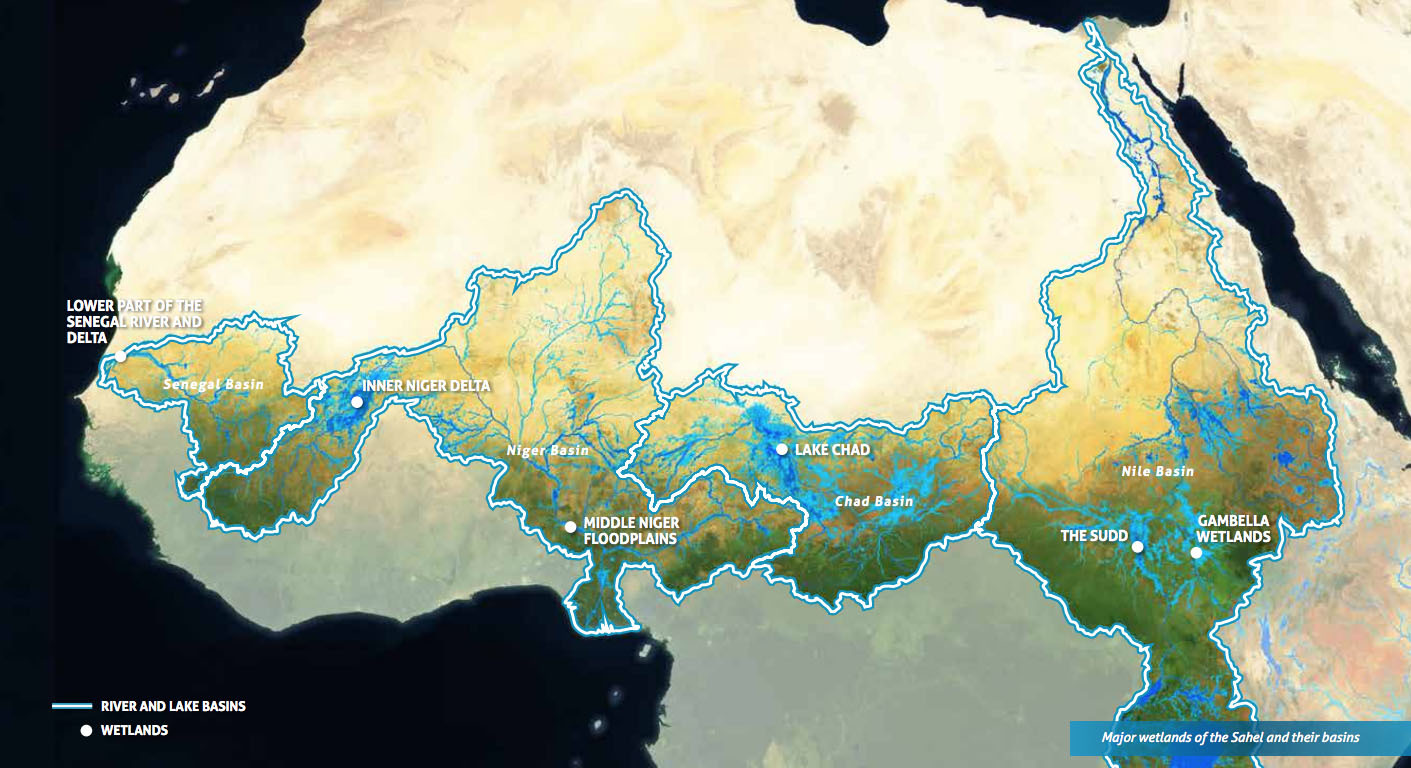
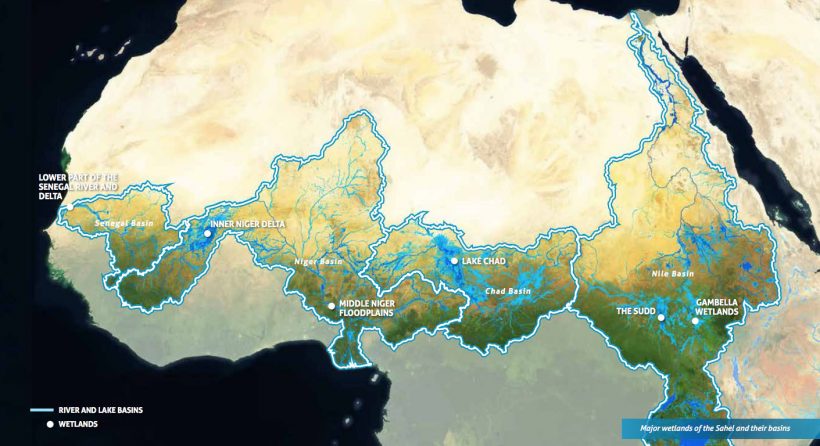
The major wetlands and water basins of the Sahel region in Africa. Wetlands International
https://e360.yale.edu/assets/site/SahelWetlands_WetlandsInternational.jpg
The poverty is driving social breakdown and conflict all around the lake. Mana Boukary, an official of the Lake Chad Basin Commission, an intergovernmental body, told Duetsche Welle two years ago: “Youths in the Lake Chad Basin are joining Boko Haram because of lack of jobs and difficult economic conditions resulting from the drying up of the lake.”
The UN humanitarian coordinator for the Sahel region, Toby Lanzer, told a European Union-Africa summit that it was also fueling migration: “Asylum seeking, the refugee crisis, the environmental crisis, the instability that extremists sow — all of those issues converge in the Lake Chad basin.”
A Nigerian government audit of the lake basin in 2015 agreed. It concluded that “uncoordinated upstream water impounding and withdrawal” were among factors that had “created high competition for scarce water, resulting into [sic] conflicts and forced migration.” More than 2.6 million people have left the Lake Chad region since mid-2013, according to the International Organization for Migration.
At their greatest extent, wetlands cover one-tenth of the Sahel, the arid region stretching for 3,400 miles across northern Africa, immediately south of the Sahara desert. They are wildlife havens, especially notable for their birdlife. The Inner Niger Delta in Mali, for instance, is one of the world’s most important seasonal stops for migrating birds, hosting about 4 million waterbirds from Europe each winter. In addition, these wetlands are a source of sustenance for the region’s poor and the main sources of the region’s economic productivity outside the short wet season from June to September.
Dried-up wetlands are often blamed on climate change when the real cause often is more human interference in river flows.
Yet the decline of the wetlands and the resulting social and economic consequences remains a largely untold story. That is partly because dried-up wetlands are routinely, and often incorrectly, blamed on climate change, when the real cause is often more direct human interference in river flows. It is also partly because many development agencies still mostly think of dams as infrastructure development that furthers economic activity and wealth – and partly because many environmental groups concentrate on the ecological impacts of dried wetlands, while ignoring the human consequences.
In this climate of ignorance, more wetlands are under threat. The next victim is likely to be the Inner Niger Delta, a wetland in northern Mali that covers an area the size of Belgium. The delta forms where West Africa’s largest river, the Niger, spreads out across flat desert near the ancient city of Timbuktu.
The delta is a magnet for migrating European waterbirds. It is also currently one of the most productive areas in one of the world’s poorest countries. It provides 80 percent of Mali’s fish and pasture for 60 percent of the country’s cattle, and it delivers 8 percent of Mali’s GDP and sustains 2 million people, 14 percent of the population, says Dutch hydrologist Leo Zwarts. Its fish are exported across West Africa from Mopti, a market town on the shores of the delta.
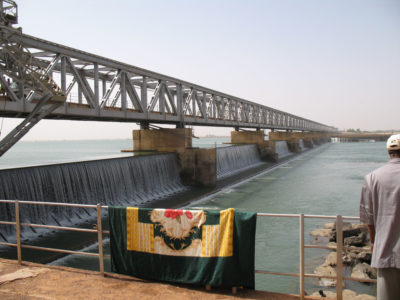
In recent years the Mali government has been diverting water from the River Niger at the Markala barrage just upstream of the delta, to irrigate desert fields of thirsty crops such as rice and cotton. These diversions have cut the area of delta flooded annually by up to 7 percent, says Zwarts, causing declines in forests, fisheries, and grazing grasses. Some people have left the delta as a result, though it is unclear whether they have been among the Malians regularly reported to be in migrant boats heading from Libya to Italy.
The Markala Barrage in Mali, which diverts water from the River Niger for irrigating crops such as rice and cotton. Fred Pearce/Yale e360
But this trickle of people from the delta could soon become a flood. In July this year, Mali’s upstream neighbour, Guinea, announced the go-ahead for Chinese firms to build a giant new hydroelectric dam, the Fomi Dam, in the river’s headwaters. Construction could begin as soon as December.
The Fomi Dam’s operation will replace the annual flood pulse that sustains the wetland’s fecundity with a more regular flow that the Mali government intends to tap for a long-planned tripling of its irrigation along the river. Wetlands International estimates that the combined impact of the dam and irrigation schemes could cut fish catches and pastures in the delta by 30 percent.
“Less water flowing into the delta means a lower flood level and a smaller flood extent”, says Karounga Keïta of Wetlands International in Mali. “This will have a direct impact on food production, including fish, livestock, and floating rice.” He fears that the inevitable outcome will be further human migrations from the wetland.
The links in the chain from water management through wetland health to social breakdown and international migration are complex. Wetland loss is certainly not the only reason for the human exodus from the Sahel. And migration is a long-standing coping strategy for people living in a region of extreme climate variability.
But the parlous state of the wetlands of the Sahel is changing the region. In the past, wetlands were refuges in times of drought or conflict. They were safe, and the water persisted even in the worst droughts. But today, with their waters diminished, these wetlands have become sources of outmigration. Now, migrations that were once temporary and local are becoming permanent and intercontinental.
https://e360.yale.edu/features/how-africas-big-water-projects-helped-trigger-the-migrant-crisis
Note his comment that “dried-up wetlands are often blamed on climate change when the real cause often is more human interference in river flows. “.
And that “since 2002, rainfall has improved markedly, but Lake Chad has not recovered.”
I have every sympathy for countries like Nigeria and Cameroon. They are between the proverbial rock and hard place,
They have growing populations, with ever growing expectations. For this they need, among other things, food and water supplies. On the other hand, these very things impact on the environment which ultimately sustains them.
There are no easy answers.
But blaming it all on climate change does nobody any favours.
Featured Video

Prof. Ted Postol: Iran Already Achieved Nuclear Deterrence Against Israel
or go to
Aletho News Archives – Video-Images
From the Archives
How the occupied mentality syndrome works
Saudi Arabia on the American chessboard – Part 3
By B. J. Sabri | American Herald Tribune | June 27, 2016
Read part 2: “The occupied mentality Syndrome“
Previously I argued whether Saudi Arabia’s repeated involvements in U.S. interventions and wars stem from free national will or in response to a specific condition. For starters, in Saudi Arabia there is no national will. In Saudi Arabia, the national will is the will of the Al Saud clan. Still, when a major Arab state allies itself with a superpower that committed unspeakable crimes against humanity in almost every Arab country, then something is wrong. This fact alone should compel us to examine the U.S.-Saudi relation for one exceptional reason. As a result of the U.S.-Saudi wars, hundreds of thousands of people in Afghanistan, Iraq, Iran, Libya, Syria, Yemen, and Somalia have lost their lives. Millions became displaced in their own homelands. And millions more rendered refugees.
Attributing the Saudi policies to the bonds of “partnership” with the U.S. is frivolous. There are no bonds between these two thugs except those of business, military deals, secret plots, and wars. Proving this point, bonds such as these have no space for the American and Saudi peoples to share significant cultural or societal exchanges. If partnership is not the reason for the Saudi contribution to the U.S. strategy of empire and imperialism, then another reason must exist.
This leads to three possibilities. … continue
Blog Roll
 Aletho News
- Russia Warns of Retaliation as UK Authorizes Seizure of Vessels
- Serbia thwarts plot to bomb Russia-Hungary gas pipeline – Vucic
- Al Mayadeen voices solidarity with Dr. Marandi amid death threats
- US dismantling international law in its war against Iran while claiming ‘false’ victory: Legal scholar
- One martyr, 5 injuries in US attack on Iraqi border crossing with Iran
- ‘This war is Israel’s war’: World facing ‘security breakdown’, says Qalibaf
- IRGC decries attack on US embassy in Riyadh, says executed by ‘Israel’
- Iran blasts EU hypocrisy as EU invokes international law over Hormuz
- There is no military solution to Strait of Hormuz
- NATO’s structural collapse – the outcome of deviation from reality
- If Americans Knew
- US loses planes over Iran, Israel downgrades Lebanon war goals – Daily Update
- Israel Is Blocking Palestinians from Easter at Church Where Jesus Resurrected
- Plot to assassinate Palestinian activist follows harassment campaign promoted by Zionist groups and elected officials
- Prominent New York synagogue hosts presentation on why U.S. Jews should support the ethnic cleansing of Gaza
- Tapper vs. Piker: Is the CNN Anchor Auditioning for David Ellison?
- Shouldn’t Democrats Be Able to Condemn Genocide?
- Israel-US kill negotiators, destroy civilian structures, but Iran’s military capabilities still largely intact – Daily Update
- ‘War crime’: Global condemnation as Israeli ministers celebrate death penalty law targeting Palestinian prisoners
- 7 Ways Israel Is Turning Lebanon Into Gaza
- World’s Leading Football Bodies Under Fire Over Israel Policies
- No Tricks Zone
- An Inconvenient Tree: Uncovered In Alps… Europe Much Warmer Than Today 6000 Years Ago
- New Study Reports A 60% Slowdown In Greenland’s Ice Loss Rate In The Last Decade
- Low Intensity Tornado Wrecks Major Solar Farm, Creating A Potential Toxic Dump
- New Study Finds Warming Saves Lives…Cold Temperatures 12 Times More Deadly Than Excess Heat
- German Science Blog Accuses PIK Climate Institute Of Hallucinating Climate Tipping Points
- Devastating Assessment Of Comirnaty Vaccine By Former Senior Pfizer Europe Toxicologist
- New Study: CO2 Is ‘Effectively Negligible’ As An Explanatory Climate Change Factor Since 2000
- Former Pfizer Toxicologist Dr. Helmut Sterz Tells Bundestag Hearing Pfizer Vaccine Should Have Never Been Approved
- Energy Expert: Germany’s Nuclear Phaseout Was A “500 Billion Euro Mistake”
- New Research: South Australia’s Mid-Holocene Sea Surface Temperatures Were 4°C Warmer Than Today
 Aletho News