Iran won’t deploy forces to Lebanon to help Hezbollah – foreign ministry
RT | September 30, 2024
Iran will not send troops to Lebanon or Gaza to confront Israel, the Foreign Ministry in Tehran announced on Monday. The statement comes amid Israel’s intensified attacks against the Lebanon-based militant group Hezbollah and the Houthis in Yemen.
Tehran does not seek war but is not afraid of it and stands for a safe and stable Middle East, the ministry stressed.
“There is no need to send extra or volunteer forces of the Islamic Republic of Iran,” Foreign Ministry spokesperson Nasser Kanaani told a weekly news conference. Lebanon and fighters in the Palestinian territories “have the capability and strength to defend themselves against the aggression,” he added.
In the past several weeks, Israel has been conducting heavy airstrikes targeting Hezbollah in Lebanon and other militant groups in the region, including in Syria, Yemen, and Iraq, raising fears the conflict could engulf the entire Middle East and draw in Iran and the US, Israel’s main ally.
“We have not received any request in this regard from any side, on the contrary, we are informed and are sure that they do not need the help of our forces,” Kanaani told reporters.
He nonetheless pledged that Israel “will not remain without reprimand and punishment for the crimes it has committed against the Iranian people, military personnel and the resistance forces.”
During the past week alone, the Israel Defense Forces (IDF) significantly ramped up airstrikes on Lebanon, killing more than 1,000 people and wounding over 6,000 according to local health officials. The escalation also triggered a mass exodus from the areas most affected by the Israeli bombing.
The Israeli military also conducted a series of strikes against senior Hezbollah commanders, killing most of them, including the group’s leader Hassan Nasrallah.
Iranian President Masoud Pezeshkian visited Hezbollah’s office in Tehran on Monday to pay tribute to Nasrallah, according to the government’s website.
Lebanon: Israeli forces’ airstrikes kill 14 medics in 2 days
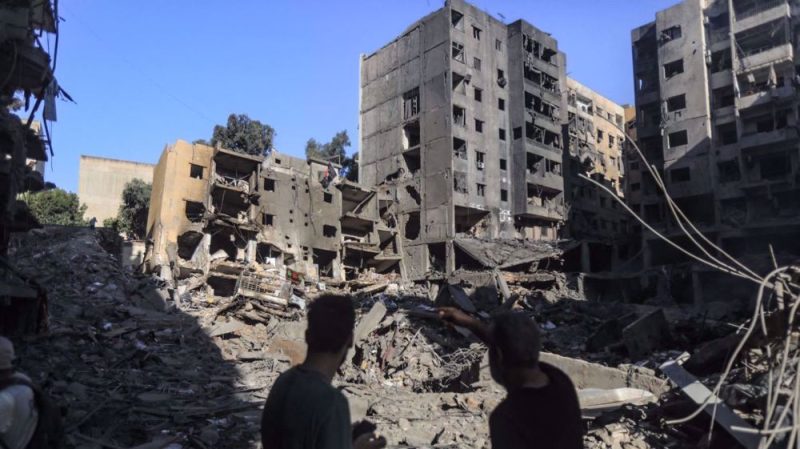
People check the leveled area bombarded on September 27, 2024 by US-made bunker-buster bombs in the Haret Hreik neighborhood of Beirut’s southern suburbs. (Photo by AFP)
Press TV – September 29, 2024
More than a dozen paramedics have been killed in recent Israeli attacks, Lebanon’s health ministry announced.
The Lebanese health ministry announced on Sunday that 14 paramedics had been killed in two days of intense Israeli bombardment in Lebanon’s east and south and in Beirut where it had killed Hezbollah’s leader, Sayyed Hassan Nasrallah.
The ministry said in its statement that it “condemns in the strongest terms the Israeli enemy’s repeated attacks on medical centers” and that “paramedics do not participate in hostilities.”
“The Israeli occupation forces have accumulated their attacks on paramedics and health centers in recent days. This series of attacks led to the martyrdom of fourteen paramedics in two days,” it said in the statement.
“The repeated attacks by the Israeli enemy on health centers flout international laws and norms, especially the Geneva Convention which highlights the neutrality of health centers and health workers in combat zones to allow them to carry out their humanitarian duty.”
“Does Israel want the blood to flow without stopping? Where is the international community and its responsibility to put an end to this escalating genocide?” it added.
The Lebanese Government Emergency Committee announced that the Israeli war machine launched 216 air attacks in the past 24 hours across Lebanon.
The Israeli airstrikes are due to the Lebanese Hezbollah resistance group showing solidarity with and giving support to Palestinians since the Tel Aviv leaders unleashed a genocidal war against the besieged Gaza Strip in October 2023.
Since then, Israeli attacks on Lebanese targets have left 1,640 people dead.
Hezbollah leader Sayyed Hassan Nasrallah, who led the resistance movement for over three decades, was himself martyred after Israeli regime forces bombarded a Beirut suburb using US-made jet fighters and bunker-buster bombs.
Of Cool Heads and Hot Heads

By Philip Kraske • Unz Review • September 29, 2024
Ever more desperate, Israel is working hard to start a world war with the United States on its side. The elimination of Hassan Nasrallah won’t make much difference to Hezbollah’s fight; the new leader will soon step up. But Israel might regret the absence of the cool-headed Nasrallah.
Cool-headedness has actually been the norm this past year, and is among the few hopeful notes on the international scene. Lots of leaders are keeping calm, holding back the factions in their governments that would love to take a crack at the folks thumbing their military noses at them.
China merely tut-tuts about foreign navy ships traversing the Strait of Taiwan, Hezbollah keeps its big missiles in their silos, Iran responds to Israeli attacks with a few half-hearted firecrackers, and Vladimir Putin frowns and issues warning after warning when Ukraine, with Nato help, hits Russian refineries and radar installations. Meanwhile Egypt, Jordan, Iran, Syria, and Turkey — and I’ve probably missed a few — itch to put holes in Israeli runways.
But restraint is the watchword. Unlike before World War One, when governments decided to declare war from one day to the next, countries are looking before they leap. Why? To what do the world’s citizens owe this clear shift to reluctance among national leaders to jump into conflict? It’s often been observed that nuclear weapons have kept the peace among the great powers. Nowadays, however, other elements keep the peace just as well. Here are the three most important ones.
The first is economic. It’s true that capitalist consumerism has atomized the citizenry, but it also keeps people quiet. National leaders figure that the only way to keep everybody fed and employed and hypnotized by Netflix series is to keep the economy running. Take tourism, for example — a labor-intensive industry that absorbs a lot of workers with little formal education. Israel’s has been hammered. Who wants to retrace the steps of Christ in the Holy Land amidst the squall of sirens announcing incoming missiles from Hezbollah? Israel now has to rotate its forces in and out of the military just to keep the economy going. But they’re finally going to throw the Palestinians out, and figure it’s worth the tradeoff.
Other touristy countries have much less to gain. In Turkey, tourism makes up more than ten percent of the economy, and is still growing. In Egypt, it’s 24 percent. Take that away, and the ensuing unrest will topple governments. But their leaders have less to gain from tackling Israel.
The second element is strategic. Just over the last several years, war has turned into a video game of missiles and missile-defenses and drones of all different kinds. As the commentator Alistair Crooke has observed, American aircraft carriers parked in the eastern Mediterranean look like something out of the 1950s. A couple of missiles sent from Crimea would send them to the bottom of the sea in a question of minutes.
Conventional war has all but disappeared. Imagine what would happen to American troop and supply ships traversing the Atlantic. If German U-boats sank nearly three thousand, Russians would sink every one of them, and not from a dank submarine but from a cosy office in Moscow. And crossing the Pacific to attack China would be a suicide mission.
National governments see the destruction wrought by Russian missiles — not its army shelling villages, but the attacks from afar on major cities and infrastructure — and they quickly figure that restraint is the better part of valor.
The third element that makes governments hesitate to get into a fight is that societies are far more fragile than before. Imagine what would happen if the Chinese got mad at the Americans and dropped a few missiles on highway overpasses, which then collapsed highways, between San Diego and San Francisco. Of course, hackers could wreak havoc on just about everything, but if software defenses proved troublesome to them, a couple of missiles — or just bombs placed by hired thugs — on data centers would quickly affect the internet in all kinds of random ways. Well-paid jokers could send drones flying around Atlanta and Chicago airports — or Istanbul’s or Frankfurt’s or Tokyo’s — closing them down. And if some leader were in a bloody frame of mind, he could order the downing of just two commercial airliners, one taking off in Paris and the other in Miami — and watch every flight reservation in the the western hemisphere get canceled in an hour. Citizens of the world’s poorest countries would finally have the last laugh.
In fact, there is a never-declared Mutually Assured Destruction that restrains governments, or quasi-governments like Hezbollah. All to the good, except that conventional war seems to be morphing into terrorism. Now that Israel has opened the Pandora’s box of booby-trapping consumer items, how long will it be before desk lamps — or shoes or avocados — begin to explode in Tel Aviv? Will Kurds need to take apart their Turkish-made earphones? As readers of Unz.com know, attacking China is far more cost-effective through untraceable biological attacks against its people and livestock, and invites no revenge — at least for the moment.
Israel’s attack with pagers and radios, Ukraine’s worthless drone strikes on Moscow apartment buildings, America’s aimless pecking at “terrorists” in Syria and Iraq — these are harbingers of the terrorist world to come.
And as defeat approaches, the losers are bound to raise the ante — especially the Israelis and Ukrainians. As in World War Two, the years of war have corroded their last vestige of ethics, and they know that the Washington elite will ultimately excuse their tactics. The western media would give nothing but dashing accounts of how Zelensky and Netanyahu — harried, exhausted, yet persevering — listened to their advisers, rubbed their necks, and gave the green lights to “limited” chemical or nuclear attacks against advancing enemies. For an excellent example of how flexible, how downright protean, mainstream journalists can be, read New York Times columnist Amanda Taub’s article on the legality of Israel bombing of the Iranian consulate in Damascus: “Israel Bombed an Iranian Embassy Complex. Is That Allowed?” She concludes that it was.
In short, if Hezbollah’s next leader, not so restrained as Nesrallah, unleashes missile hell down the whole length of Israel, Netanyahu and his hard-eyed friends may come to regret finishing him off. Doesn’t history tell the best jokes?
Israel’s new quagmire: a ground invasion of Lebanon
By Mohamad Hasan Sweidan | The Cradle | September 28, 2024
On 26 September, the Israeli army announced the conclusion of a brigade exercise simulating a ground operation in Lebanon, several kilometers from the shared border. In the past two days, several Israeli military officials, including Chief of Staff Herzi Halevy and Northern Commander Uri Gordin, have spoken about the occupation army’s readiness to execute ground operations in Lebanon.
But how can Tel Aviv realistically conceive of launching ground troops into a country that has not once, but twice, managed to expel occupation forces, to engage in combat against an adversary – Lebanese resistance group Hezbollah – that is far better armed and organized than in years past?
Features of the Israeli strategy so far
Since the start of its recent escalation with Lebanon, Israel appears to be executing its war on five simultaneous tracks. First, it seeks to strike Hezbollah’s command and control system, mainly through targeted assassinations against key resistance military leaders, the most recent target being drone unit commander Abu Saleh Sorour.
Second is to directly strike Hezbollah’s military capabilities based on an existing bank of targets established by Tel Aviv: Last Monday, the Israelis announced that they had successfully struck 1,600 resistance military targets, including weapons depots, missile stores, and launching pads. Notably, they claimed the same kinds of successful strikes in the July 2006 war, which turned out to be grossly inaccurate.
Third, Israel aims to apply internal Lebanese pressure on Hezbollah by harming its constituents, supporters, and even detractors. Tel Aviv has intensified its bloody targeting of civilian populations and areas in the past two weeks, killing over 728 civilians, injuring thousands, and displacing nearly 390,000 people, according to official Lebanese government data.
Fourth, is an attempt to influence the broad, general Lebanese environment to turn against the resistance through systematic media campaigns – in cooperation with Lebanese media outlets and personalities who parrot Israel’s intimidation narratives in order to tame and curb Hezbollah’s actions. The fifth and final track, so far, is the growing threat and preparation for an Israeli ground invasion of Lebanon – albeit a limited one – with a goal to confirm Israeli field superiority by controlling Lebanese areas, even for short periods.
Hezbollah’s reactions?
Naturally, the resistance intends to thwart Israel’s strategies through a set of interconnected steps. After each assassination, Hezbollah confirms that its command and control system remains unaffected, then launches a controlled escalation to confirm its readiness in the face of enemy shocks. This was evident on 24 September, when Hezbollah launched a 300+ missile strike the day after Israel’s air campaign, essentially to confirm that its missile capabilities were locked and loaded, ready to go.
As in past Israeli confrontations with Hezbollah, the latter’s support base remains largely consistent and supportive of the resistance’s escalatory plans. Separating Hezbollah from its incubating environment is an Israeli strategy that has repeatedly failed, mainly because the resistance’s rank and file originate from this very society.
Finally, Israel’s goal of turning Lebanese public opinion against the resistance has not advanced, to date. Rather, Israeli aggressions have increased national cohesion, particularly after the occupation state’s pager terror attack, except in some limited cases.
The fifth track: ground invasion of Lebanon
In recent days, discussions about the possibility of an Israeli ground incursion into Lebanon have increased markedly. Israeli Prime Minister Benjamin Netanyahu has boasted that military operations against Lebanon will continue “at full strength to ensure Hezbollah is “significantly weakened,” and has rejected international calls for an immediate ceasefire.
The army’s chief of staff also instructed Israeli forces to prepare for a possible ground attack for the purpose of establishing an Israeli buffer zone in southern Lebanon. Operationally, the occupation army is preparing for this possibility by running training drills and summoning two reserve brigades to the northern front.
According to Western and Israeli sources, there are several scenarios for a possible Israeli ground invasion of Lebanon, with each scenario offering different strategic objectives and risks:
First, is a limited ground action inside Lebanese territory with the aim of striking specific Hezbollah targets near the border, such as missile launch sites, or clearing an area to prevent the resistance from carrying out attacks on Israel. This would be a short-term action used to pressure the party in ceasefire negotiations. At this point, if Tel Aviv chooses the option of ground action, this will be the most likely scenario.
Second, is a limited ground incursion to push resistance forces to retreat from the border, specifically to reduce the range of anti-tank guided missiles that Hezbollah possesses. Israeli military commanders have indicated this option would serve to create a “security zone” extending 8 to 10 kilometers inside Lebanese territory. Notably, this scenario increases the likelihood of prolonged fighting and higher Israeli human and military losses.
Third, is a complete ground invasion of Lebanon – the most extreme scenario – with the goal of destroying Hezbollah’s capabilities. Currently, this scenario remains highly unlikely due to its extremely high-risk profile – and given that Tel Aviv’s near-term goal is not to destroy Hezbollah but rather to alter the security challenges on its border with Lebanon.
Attack where?
An Israeli ground attack – limited or expansive – is expected to focus on specific geographic areas in Lebanon, mainly the south, where Tel Aviv wants its Hezbollah-free buffer zone, or the Bekaa region that flanks the Syrian border. Israel envisages a scenario similar to the status quo in southern Lebanon in the 1990s, in which it maintained a security zone to limit Hezbollah’s access to the border – before being purged by resistance commandos in 2000.
Conversely, a limited Israeli ground action in the Bekaa would be to impact and tighten Hezbollah’s logistical and weapons supply routes from Syria, either by cutting off land routes between Lebanon and Syria or by cutting supply lines between the Bekaa and the south. The groundwork there will be a continuation of Israeli air strikes in the Bekaa, which targeted four main border crossings with Syria – Al-Arrayedh, Mutariba, Saleh, and Qabsh.
Most western analysts are not optimistic about the Israeli army succeeding in executing ground operations in Lebanon, given Hezbollah’s enhanced and sophisticated capabilities to confront such an action. In a Washington Post article, writer Max Boot says this wild option “would be another quagmire for Israel.” From Tel Aviv’s perspective, the best-case scenario would be that its air campaign succeeds in halting the Lebanese support front for Gaza and allows displaced Israeli settlers to return to their homes in northern Israel.
But with no imminent resolution of its conflict with Lebanon likely – given Netanyahu’s refusal to entertain a northern ceasefire, let alone a Gaza one – the possibility of an Israeli ground action in Lebanon increases, despite the extraordinary risks for the occupation army. From its recent battle history with Lebanon’s resistance, in which Israel has lost face, Tel Aviv knows well that its air superiority is matched only by Hezbollah’s ground advantage.
Collective West supporting Israel ‘to wipe out the Palestinian population’: Prof. Marandi
Press TV – September 28, 2024
Professor Mohammad Marandi says all the Western countries are supporting the Israeli regime “to wipe out the Palestinian population.”
Marandi, a professor at the University of Tehran and a political analyst, made the remarks in an interview with Press TV on Friday from Beirut, Lebanon, where he is based these days.
“All the Western countries are supporting the regime in every way possible, through aid, through political cover, through weapons, through ammunition, and… through intelligence gatherings,” Marandi said.
“So this is a collaboration of tens of Western regimes to wipe out the Palestinian population,” he stated.
The Iranian academic added that “when it comes to seeking a ceasefire they are doing everything possible to help the regime carrying out both a holocaust in the south of Palestine and ongoing genocidal attacks in the north of Palestine.”
Commenting on Israel’s recent aggressions against Lebanon, Marandi said, “Hezbollah and the people of Lebanon are paying the price for defending the people of Gaza, against the genocide.”
“For over 11 months now, the resistance in Lebanon with the support of the overwhelming majority of the Lebanese population, have been engaging in battles or in strikes across the border in the north of Palestine in order to draw troops away from Gaza, and to support the people of Gaza to lessen the intensity of the ongoing holocaust in Gaza,” he stated.
The Islamic resistance movement Hezbollah has been conducting numerous operations against Israeli targets since October last year when the Israeli regime waged a genocidal war in the Gaza Strip.
At least 41,534 Palestinians, most of them women and children, have been killed in the brutal Israeli military onslaught so far.
On Friday, Israeli warplanes launched massive airstrikes on the southern suburb of Dahiyeh in Beirut, killing at least eight people and wounding around 80 others.
Hours after a new wave of Israeli airstrikes hit the Dahiyeh area.
The Palestinian resistance movement Hamas called on “Arab and Islamic nations” to act and “reject this brutal aggression” by Israel against the brotherly people of Lebanon.
Hamas condemned the “Zionist escalation and aggression” against the people of Lebanon.
Speaking about the hypocrisy of the Western media, Marandi said, “Whenever they bomb towns and villages across the country, the Western media calls it Hezbollah strongholds.”
He added that many ordinary people get killed in Israeli attacks the Western media call targeted strikes against Hezbollah leaders.
“In general it is fair to say that Hezbollah and the people of Lebanon have played the most courageous role in this almost one-year-long genocide in Gaza because they voluntarily chose to draw Israeli forces away from the battlefield in the south of Palestine,” he noted.
Hezbollah confirms Hassan Nasrallah assassinated by Israel
The Cradle | September 28, 2024
Lebanese resistance movement Hezbollah confirmed on 28 September the assassination of its Secretary-General Hassan Nasrallah during intense Israeli airstrikes that hit Beirut’s southern suburbs on Friday.
“His Eminence Sayyed Hassan Nasrallah, Secretary General of Hezbollah, has joined his great and immortal martyred comrades, whose path he led for nearly thirty years, during which he led them from victory to victory, succeeding the Master of the Martyrs of the Islamic Resistance in 1992 until the liberation of Lebanon in 2000 and to the glorious divine victory in 2006 and all the battles of honor and sacrifice, arriving at the battle of support and heroism in support of Palestine, Gaza, and the oppressed Palestinian people,” the statement released by the Lebanese resistance reads.
“The leadership of Hezbollah pledges to the highest, most sacred, and most precious martyr in our journey full of sacrifices and martyrs that it will continue its jihad in confronting the enemy, in support of Gaza and Palestine, and in defense of Lebanon and its steadfast and honorable people,” the statement adds.
Hezbollah also stressed that its leader “is still among us with his thought, spirit, line, and sacred approach, and you are committed to the pledge of loyalty and commitment to resistance and sacrifice until victory.”
Nasrallah was killed during an Israeli carpet bombing campaign on the Lebanese capital that destroyed several residential buildings and displaced tens of thousands of civilians. The attack reportedly targeted the main headquarters of the Lebanese resistance movement.
Earlier on Saturday the Israeli army confirmed Nasrallah’s assassination alongside other top resistance leaders. Israeli authorities told the New York Times (NYT) that they had been tracking Nasrallah “for months,” adding that “more than 80 bombs were dropped over a period of several minutes to kill him.”
Born in 1960 to a Shia Muslim family in a poor area of east Beirut, Nasrallah briefly joined the Amal Movement as a young man, inspired by its leader Sayyed Musa Sadr.
In late 1976 Nasrallah left for Najaf in Iraq to study at the city’s religious seminary, where he met Lebanese scholar Abbas Mussawi. After the 1978 Baathist crackdown on Shia Muslims Nasrallah and Mussawi returned to Lebanon where he continued his studies.
Nasrallah became head of Hezbollah’s executive council and a member of its shura council in 1985. Seven years later, Mussawi, serving as Hezbollah’s secretary general, was assassinated along with his wife and child in an Israeli airstrike.
Speaking at his funeral, Nasrallah said, “By murdering … Sayyed Abbas Mussawi, they sought to kill our spirit of resistance and destroy our will for jihad. But his blood will continue to simmer in our veins, only strengthening our determination to move forward and intensifying our enthusiasm to pursue the path.”
“America will remain the primary enemy of this nation and the greatest Satan of all. Israel will forever be, in our eyes, a cancerous growth that must be eradicated, an artificial entity that should be removed, even if all the rulers of the world recognize it. Palestine—all of Palestine—will remain part of this nation, and we shall not relinquish a single grain of its sand.”
According to Iranian General Hossein Hamedani, following the assassination of Quds Force commander Qassem Soleimani by the US in 2020, Tehran tasked Nasrallah with uniting its armed allies in Iraq. He also supervised the overall policy for the Resistance Axis during the US-backed Syrian war.
One day after the start of Operation Al-Aqsa Flood the Israeli genocide of Palestinians in Gaza, Nasrallah declared the opening of a “front in southern Lebanon to support Palestinian resistance,” vowing over the past year that the effort would remain active until the war in Gaza ends.
“Our commanders, fighters, women, and children will be martyred; we are united in sacrifice – this is the reality of resistance, and this is our path until the day of judgment,” Nasrallah said during a televised speech earlier this year following the Israeli assassination of Hezbollah senior commander Fuad Shukr.
At the UN, Netanyahu blames Israel’s isolation on ‘anti-Semitism’
The Cradle | September 27, 2024
Speaking at the UN General Assembly on 27 September, Israeli Prime Minister Benjamin Netanyahu blamed the condemnation of Israel at the UN and International Criminal Court (ICC) on anti-Semitism, saying allegations of war crimes have nothing to do with Israel’s actions, including its slaughter and starvation of Palestinians in Gaza.
“It’s not about Gaza,” he claimed. “It’s about Israel” and its very existence.
“[U]ntil this anti-Semitic swamp is drained, the UN will be viewed by fair-minded people everywhere as nothing more than a contemptuous farce,” Netanyahu claimed.
“What hypocrisy. What a double standard. What a joke,” he said to applause from Israel supporters.
The assembly hall was otherwise almost empty after several delegations walked out as Netanyahu reached the podium.
On 27 September, the UN member states voted overwhelmingly in the General Assembly to adopt a resolution calling on Israel to comply with international law, withdraw its military forces, immediately cease all new settlement activity, evacuate all settlers from occupied land, and dismantle parts of the separation wall it constructed inside the occupied West Bank.
In May, ICC Chief Prosecutor Karim Khan applied for arrest warrants for Netanyahu and Defense Minister Yoav Gallant, accusing them of war crimes and crimes against humanity, including using starvation of civilians as a method of warfare and intentionally directing attacks against a civilian population.
However, four months later, ICC judges have still not approved or denied the applications. There is no deadline for judges to come to a decision.
In his UN speech, Netanyahu signaled there would be no immediate end to the Israeli army’s ongoing assault on Lebanon, which has killed over 700 people in less than a week, despite calls from US President Joe Biden and French President Emmanuel Macron for a ceasefire.
Netanyahu said his military would keep striking Hezbollah in Lebanon with “all our might.”
‘We’re at war with Hezbollah,’ he said. ‘As long as Hezbollah chooses the path of war, Israel has no choice. And Israel has every right to remove this threat and return our citizens to their homes safely.”
His speech comes as Israeli officials said they were preparing for a potential ground invasion of Lebanon.
We need to call out the hypocrisy of the humanitarian paradigm
By Ramona Wadi | MEMO | September 26, 2024
Israeli Prime Minister Benjamin Netanyahu’s address to the Lebanese people before bombing their country was eerily similar to the rhetoric usually associated with Gaza. Hezbollah, he told the Lebanese, are using them as human shields and hiding weapons in their homes; the latter was made to sound more familiar by mentioning specific family rooms: “Rockets in your living rooms and missiles in your garage.” To seal Israel’s impunity in Lebanon after telling the Lebanese population to flee from his army’s bombs, Netanyahu added, “Don’t let Hezbollah endanger your lives.” As Israel’s kill toll rises in Lebanon, almost 500,000 Lebanese have been forcibly displaced from their homes in a matter of two days. This can be added to the 1.9 million Palestinian civilians who have been forcibly displaced from their homes in Gaza by Israel.
Meanwhile, the US reached for its playbook on Gaza and endorsed Israel’s right to defend itself, this time allegedly from Hezbollah. “No nation should have to live with these threats right across their border, right next door,” said US White House National Security Spokesperson John Kirby.
How about people not having to live with Israel’s threats at their border or in their homes, Mr Kirby?
Israel has invaded Lebanon on at least five occasions since the late seventies, remember, not including numerous air strikes.
Now diplomats are revealing that the genocide in Gaza is only the beginning of the chaos in the Middle East and the humanitarian paradigm is the only way for them to feign political concern. So blatantly is the world supporting Israel’s actions, that it has come to the point where a failed humanitarian paradigm remains at the forefront of the international agenda, and the discrepancy is rarely called out.
The international community sustains this discrepancy between colonial violence, war, genocide and humanitarian aid. The former reigns supreme and yields profits. Humanitarian aid, on the other hand, works like a defunct charity to make sure that the displaced remain too busy trying to survive to do anything untoward against those responsible for their situation. They face a daily struggle to survive Israeli aggression, bombs and the international community’s collaboration allowing Israel to eliminate who it chooses for territorial gain. “Greater Israel” is the Zionist objective.
We now see that speaking out against breaches of international law is being criminalised, and being taught not to speak out is normalised; in turn, the normalisation of complicity in genocide and forced displacement completes the cycle. World leaders, we are told, must be allowed to talk and lead uninterrupted, and they will decide which nation is to be massacred, displaced, forced to live in temporary shelters while foraging for food, waiting for a temporary pause in the slaughter to receive polio vaccines and be killed later; letting Israel control the lives and deaths of civilians, and all because the international community offers humanitarian aid in return for silence. For the victims, the humanitarian paradigm is a failure on so many levels, a licence to silence criticism and an open invitation to perpetual displacement and premeditated murder.
What do we make out of humanitarian aid as a political paradigm? How is a bare minimum of shelter against biting cold an acceptable measure, when tents provide no shelter against bombs and bullets? Why is it acceptable that countries bolstering Israel’s genocide in Gaza and its war in Lebanon get to dictate who gets humanitarian aid, and when?
The Norwegian Refugee Council-led Shelter Cluster has estimated that it would take aid agencies more than two years to deliver 25,000 sealing kits to Gaza at the current rate of two truckloads per week. In the face of humanitarian aid being weaponised — US Secretary of State Antony Blinken misled Congress about Israel blocking aid to Gaza, for example — leading to the slow death of its intended recipients, why is the world keeping silent? We need to call out the hypocrisy of the humanitarian paradigm.
Hezbollah bombs Israeli arms factory, forces fighter jets to withdraw
Al Mayadeen | September 25, 2024
The Islamic Resistance in Lebanon – Hezbollah announced Wednesday that its fighters launched rockets targeting a bomb material factory in Zikhron, occupied southern Haifa, using a barrage of Fadi-3 rockets.
For the second time on Wednesday, Hezbollah struck the settlement of Kiryat Motzkin with volleys of Fadi-1 rockets. Concurrently, Hezbollah’s air defense units engaged two hostile fighter jets near the Lebanese towns of Houla and Mays al-Jabal to force them out of Lebanese airspace.
In its statements, Hezbollah emphasized that these operations were carried out in support of the Palestinian people in the Gaza Strip and their Resistance, while also defending Lebanon and its citizens.
The Lebanese Resistance has expanded its strikes toward Israeli occupation military bases in northern occupied Palestine, landing precise and direct hits despite an unprecedented Israeli assault on various regions in the Bekaa Valley and southern Lebanon.
Israeli media reported that air raid sirens sounded in the settlements of Gonen, Lahavot Habashan, and Kiryat Shmona in the Houla Valley.
‘No region in Israel outside combat zone’
Israeli settlers in areas stretching from Katzrin in the North to Rosh Pina, Safed, and Mount Meron were advised to stay near bomb shelters.
“There is no region in Israel that is outside the combat zone in the past 24 hours, from Mount Hermon to the Arava Valley,” a correspondent for the Israeli Army Radio said.
These operations add to previous attacks carried out earlier in the day, including Hezbollah’s targeting of the Mossad headquarters in the outskirts of Tel Aviv with a Qader-1 ballistic missile. This facility was responsible for orchestrating assassinations and detonating pagers and handheld radio receivers in Lebanon.
Hezbollah had inflicted significant losses on the Israeli occupation through the expansion of its operations, with Israeli media saying “Isreal” has lost an estimated $1.07 billion over the past two days alone.
The Israeli Broadcasting Corporation (KAN) reported that “Israel’s” strikes on Lebanon on Monday cost the entity some 650 million shekels ($173 million). Officials have underlined that if the airstrikes campaign on Lebanon protracts beyond 10 days, it would require the approval of an additional budget breach.
Israeli media quoted a former official from the Shin Bet security service as saying, “The capability of Hezbollah to launch rockets towards central Israel should not be underestimated.”
The former official added, “What [Hezbollah leader Sayyed Hassan] Nasrallah did today is just a small preview of what he has in store.”
In an interview with the Israeli Channel 12, retired Israeli brigadier general and former financial advisor to the military’s chief of staff, Reem Aminoach, said the escalating use of missile interceptors is a major factor contributing to the significant increase in daily operational costs.
US deploying more troops to West Asia amid Israeli escalation of violence
Press TV – September 23, 2024
The US Department of Defense has decided to deploy more boots to West Asia amid the Israeli escalation of war in the region.
Additional US troops will be deployed to the Middle East in response to a sharp spike in violence between Israel and Hezbollah forces in Lebanon that has raised the risk of a greater regional war, the Pentagon spokesperson said on Monday.
Gen. Pat Ryder announced the new deployment without providing details on how many additional forces would be needed or what they would be tasked to do.
“In light of increased tension in the Middle East and out of an abundance of caution, we are sending a small number of additional US military personnel forward to augment our forces that are already in the region. But for operational security reasons, I’m not going to comment on or provide specifics.”
The United Nations has sounded the alarm, warning that the escalating violence between the Israeli regime forces and the Hezbollah resistance movement in Lebanon was catapulting the Middle East conflict “to another level”.
Prior to the latest escalation of violence, the Pentagon had announced that the approximately 40,000 US troops deployed in the region were “enough to protect Israel.”
In addition to tens of thousands of troops in the Middle East region, the Pentagon has warships, fighter jets, and air defense systems deployed to protect both its forces and the Israeli regime.
Ryder warned of the potential for the Israel-Hezbollah violence to escalate, calling for a diplomatic solution.
“Clearly there is the potential for these tit-for-tat operations between Israel and Hezbollah to escalate and to potentially spiral out of control into a wider regional war, which is why it’s so important that we resolve… the situation through diplomacy,” Ryder said.
Middle East tensions rose sharply after the Israeli assassination of Hamas leader Ismail Haniyeh in Tehran and Hezbollah commander Fuad Shakr in Beirut at the end of July, prompting the Pentagon to begin sending additional US troops to the region. The US military claimed the additional American troops would not be engaged by the Israeli forces for “offensive” operations against Hezbollah.
Pentagon’s announcement comes as fears of a broader regional war grow, with Israel striking hundreds of targets in Lebanon following Israel’s communication devices terror attacks which targeted Hezbollah cadre and civilians with exploding pagers earlier this week. The attacks killed 37 Lebanese and injured thousands more.
World powers have called on the Israeli regime and Hezbollah to pull back from the brink of an all-out war, with the focus of violence shifting sharply in recent days from Israel’s southern front with Gaza to its northern border with Lebanon.
Hezbollah, a powerful political and military force in Lebanon, has exchanged near-daily fire with the Israeli regime forces in support of the defenseless Palestinians in the besieged Gaza Strip.
The Islamic Resistance in Iraq (IRI) and the Ansarallah-led government of Yemen stand alongside Hamas and Hezbollah, targeting US and Israeli positions in the region in an effort to oppose Israel’s genocide of Palestinians in Gaza.
The occupying zionist regime forces launched the genocidal war on helpless Palestinians trapped in Gaza almost a year ago in early October, which has claimed the lives of more than 41,400 people, most of them innocent women and children.
Will Israel “recklessly” seize the day? “Have the doors to a war without limits been opened?”
By Alastair Crooke | Strategic Culture Foundation | September 23, 2024
“After today [the day of the pager simultaneous explosions], there can be no talk about settlement and solutions”, writes Ibrahim Amine, Editor of Al-Akhbar, known for his close contacts with the Hizbullah leadership:
“In just one minute, the enemy succeeded in delivering its harshest blows to the body of the Islamic Resistance … [Furthermore] through yesterday’s operation, the enemy confirmed that it doesn’t want to abide by the rules of engagement. Have the doors to a war [then] been opened: a war without any limits, ceilings, or borders”?
“After today, it [i.e. the Israeli enemy] will make no distinction between a fighter operating on the front and an individual working in some distant office”, Amine noted.
For the last year, both Israel and Hizbullah have avoided major escalation by observing unwritten rules of engagement or ‘equations’ between the parties, such as not targeting civilians. That is now over.
In his first speech since the devices blew up on Tuesday and Wednesday, Sayed Nasrallah, the Hizbullah leader, conceded that his group had “endured a severe and cruel blow”. He accused Israel of breaking “all conventions and laws” and said that it would “face just retribution and a bitter reckoning”. But he did not describe how Hezbollah might retaliate; “nor did he discuss the time, nor manner, nor place” of it ocurring.
Nasrallah warned:
“The enemy declares as its official goal to return the settlers to the North. We accept the challenge: You will not be able to return to the North. In fact, we will displace more Israelis from their homes. We hope Israel enters Lebanon, we are waiting for their tanks day and night: We say, ‘welcome!’”.
There is some point to this remark. From the outset, Hizbullah was configured militarily more for all-out war with Israel, than the limited tit-for-tat, calibrated war – which never played best to Hizbullah’s strengths.
Clearly, a new phase of war has begun, and to underline this point, Israel began one of its heaviest strikes on Israel after Nasrallah’s speech on Thursday night. U.S. Secretary of Defence Lloyd Austin reportedly informed leaders of Congress that evening about his fear of an imminent Israeli offensive into Lebanon.
Nasrallah’s assessment of coming war is fully shared by at least some senior Israeli military commanders, albeit by no means all. Several profess the belief that war with Hizbullah could extend into a regional war – and lead to the collapse of Israel.
However … “You don’t do something like that, hit thousands of people, and think war is not coming”, said retired Brig. Gen. Amir Avivi, who leads the Israel Defence and Security Forum, a group of hawkish former military commanders. “Why didn’t we do it for 11 months? Because we were not willing to go to war yet. What’s happening now? Israel is ready for war”.
“There’s a lot of pressure from the society to go to war and win”, said Avivi, the retired general. “Unless Hezbollah tomorrow morning says, ‘OK, we got the message. We’re pulling out of south Lebanon’ – war is imminent”.
A poll in late August by the Israel Democracy Institute, a Jerusalem think tank, found that 67% of Jewish respondents thought Israel should intensify its response to Hizbullah. That includes 46% who believed that Israel should launch a deep offensive striking Lebanese infrastructure, and 21% who seek an intensified response that only strikes on Hezbollah’s infrastructure.
General Avivi’s remarks likely reflect an underlying reality that had become only too clear: Amos Hochstein, the U.S. Envoy, has failed to achieve any ‘diplomatic’ progress towards a Hizbullah withdrawal from the south of Lebanon. In parallel, U.S. officials, (according to the WSJ ) now concede that a Gaza ceasefire is ‘out of reach’ for Biden; and that, equally, Israel’s military attrition on southern Lebanon that had resulted in the displacement of 80% of its inhabitants had achieved nothing. Israel’s northern residents also remain displaced.
It seems, therefore, that Israel is set on a path to wider conflict. A taster has already been given: On 17 September, the Houthis fired a missile at a target close to Ben Gurion airport. The missile covered 1,300 miles in less than 12 min, which is to say, it flew at hypersonic speed, approaching Mach 9 – untouchable by air defences – and struck its target.
It is probable that we shall see more such hypersonic missiles flying – immune to air defences – should this war escalate, and Iran intervene.
What is paradoxical (as so often in conflict) is that the exploding pager operation seemingly was entirely fortuitous in terms of the timing. It was not planned specifically to move Israel to a new phase in the Lebanese conflict:
“High-level regional intelligence sources told Al-Monitor that the decision to carry out the operation was “forced” on Israel following an intelligence lapse … The Israeli military’s original plan was to explode the devices in the event of a full-blown war with Hezbollah in order to gain a strategic edge – but not to detonate them on Tuesday”, the sources added.
“However suspicions from at least two Hezbollah members caused the Israeli security establishment to agree to a premature execution of the plan. After a Hezbollah member in Lebanon suspected foul play with the pagers several days ago – that person was killed, the sources said … [and the plan was] ultimately executed. The subsequent decision to trigger the radios to explode was said to be driven by the expectation that after the pager detonations the radios would fall under suspicion”.
With the weather due to change within a few weeks, curtailing – or even halting – air operations, Israel was faced with having to choose between two alternative courses: Military action within weeks, or to wait until next Spring to exert more pressure on Hizbullah to shift its stance. The political future in Israel going into next year however, is extremely opaque. (Netayahu’s court appearances are due to resume in December).
The Hizbullah member’s unforeseen suspicions about the pagers ‘cast the die’ – taking us to a new level of war.
Unsurprisingly, the chatter in Israel is that the pager operation has resulted in a major blow to Hizbullah’s communication system that will cripple the movement’s military capability, offering Israel the ‘window’ to press home an invasion to establish a ‘buffer zone’ in southern Lebanon – one that might facilitate the return of Israeli residents to the north. Nasrallah promises the opposite: More Israelis will be displaced from their homes in northern Israel.
The notion that Hizbullah’s communications are crippled is wishful thinking that fails to distinguish between what may be called civil-society Hizbullah, and its military arm.
Hizbullah is a civil movement, as well as a military power. It is the Authority over a significant slice of Beirut and a country – a responsibility that requires the Movement to provide civil order and security. The pagers and radios were used primarily by its civil security forces (effectively a civil police managing security and order in Hizbullah-controlled parts of Lebanon), as well as used by its logistics and support branches. Since these personnel are not combat forces, they were not seen to require truly secure communications.
Even before the 2006 war, Hizbullah ended all cellphone and landline communications in favour of their own dedicated optic cable system and hand-courier messaging for the military cadres. In short, Hizbullah’s communications at the civil level took a major hit, but this will not unduly impact upon its military forces. For years, the Movement has operated on the basis that units could continue with combat, even in the event of a complete rupture of optic communications, or the loss of a HQ.
What comes next? Several scenarios are possible: The key is that Netanyahu is now back in “his comfort zone”. The talk about hostages has subsided, and the plans for the stealth, calibrated expulsion of the Palestinian population are unfolding under the supervision of ministers Ben Gvir, Smotrich and others on the Right. Defence Minister Gallant has even declared military ‘victory’ in Gaza.
And it seems that Gallant too, has bowed to the inevitable: Netanyahu, it would seem, has got his way – bypassing Gallant and senior IDF officers’ objections to escalation versus Hizbullah, without having to sack the popular Gallant as defence minister, and without having to take in the troublesome Gideon Saar into his government!
Defence Minister Gallant, IDF chief Halevi and other IDF officials all issued statements on Wednesday evening which appeared to suggest a full-on war with Hizbullah was brewing, hours after the wave of explosions of communications devices across Lebanon.
From Netanyahu’s perspective, the U.S. – however grudgingly – is committed to supporting Israel in this war, and in a wider war, should Iran enter the fray. The U.S. hints its support is not open-ended, but Netanyahu probably counts on its engagement inexorably ratchetting up as events unfold, pulling the U.S. further in. (The Israel-supporting power-structures would never countenance any abandonment of an Israel in danger, in any case).
Judging by the statements out of Israel, the consensus is that Hizbullah will retaliate, but in a way that is different from the way it has responded until now. Will it make do with a limited response? That is unclear. But anything it does do could lead to an exchange of blows that, in turn, will precipitate a large-scale war.
Senior officials in the IDF and in other parts of the security establishment warn openly against ‘reckless steps being planned by their government in the north’. On the one hand, these steps carry a very tangible danger of flaring up a general state of war, not only on the border with Lebanon, but in the entire region; and on the other hand, they do not promise a solution that will allow the residents of the north to return to their homes, or that the Gaza hostages will ever be released.
What does Putin have to do with Israel’s attacks on Lebanon?
By Tarik Cyril Amar | RT | September 23, 2024
On September 17, Israel launched one of the largest and cruelest terrorist attacks in modern history. For Lebanon and Syria, the victim countries, 9/17 will now have a meaning akin to that of 9/11 in the US. That date will be remembered for a very long time, and beyond those two states, as the start of two waves of explosions, mostly affecting pagers on the first day and walkie-talkies the following day. There have been reports of other everyday objects, such as laptops and tablets as well as solar energy systems blowing up as well.
While some details are still murky, we already know that the attacks were devastating: According to an Amnesty International summary from September 20, more than 2,931 victims were injured and at least 37 were killed. Amnesty International tends to be cautious and conservative with its figures, and it is still too early for a full assessment of casualties and damage. It is certain that the final count will be worse.
Events are moving fast. The onslaught seems to have served to either provoke or start a larger war; UN General Secretary António Guterres quickly – and plausibly – suspected that 9/17 was meant as a preventive strike and prelude to a larger escalation. It has been followed by more and increasingly brutal bombings and massacres, in the manner that we know so well from the rogue state Israel. For now, it is already clear that after a horrific scene of mass terror in shops, streets, and homes, many of the victims of 9/17 have been injured severely, often leaving them with “life-changing injuries.”
An ophthalmologist at Mount Lebanon University Hospital in Beirut told us 60 to 70 percent of his patients “had to have at least one eye removed. [For] some of the patients, we had to remove both eyes. It kills me. In my past 25 years of practice, I’ve never removed as many eyes.”
Israel, the perpetrator regime, has done what it always does, namely release a barrage of lies. The first step, as so often, has been to boast of its crime without, however, officially admitting it. Israeli Defense Minister Yoav Gallant, a chief genocidaire in the Gaza slaughter, has spoken of a “new era” of war with Lebanon and extolled the “excellent achievements” of the Israeli intelligence services. Nudge, nudge, wink, wink. Get it, get it? By the way, that is a technique that Western propagandists just love to ascribe to Russia. Yet it’s as Israeli as (stolen) shakshuka and (authentically Zionist) ethnic cleansing. But that’s okay in the West. Because – Israel.
Israeli politicians, propagandists, and many cut-outs and useful idiots in the West claim that this was a legitimate intelligence operation to strike at Hezbollah, the resistance organization and political party based in Lebanon with which Israel is, in effect, at war. In reality, things are as clear as can be: Using civilian devices in this manner is a war crime.
Legally, two points are decisive as well as incontrovertible: First, Hezbollah is both a military and a civilian organization. Under International Humanitarian Law (IHL), which applies here without a doubt, only those Hezbollah members serving in a military capacity are combatants. All others are and remain civilians, who have and retain a right to protection – obviously also during armed conflict because (duh…) armed conflict is what IHL is all about. Amnesty International has found evidence that the exploding devices of 9/17 had indeed been distributed to members of Hezbollah’s civilian offices, too, as was perfectly expectable for the Israeli perpetrators.
Second, 9/17 was, in any case, fundamentally criminal because, as Amnesty International has explained, it was “indiscriminate […] according to” IHL as “those who planned and carried out these attacks could not verify who would be harmed when the devices exploded, or even if only fighters had been given them.” Indeed, booby-traps spread throughout a civilian population – yes, even while perhaps in immediate possession of a Hezbollah member – are “inherently indiscriminate,” as one expert has put it. That is also why booby-trapping things that are generally associated with civilian use – such as pagers, which are not, obviously, tanks or trenches – is explicitly forbidden by the 1996 Protocol on Prohibitions or Restrictions on the Use of Mines, Booby-Traps, and Other Devices, a United Nations treaty.
Against this background, Western Israel apologists have bent over backwards to spin 9/17. Indeed, this time they are doing overtime, not only downplaying and justifying brazen Israeli criminality as usual but also celebrating it as exemplary and clever (Ironically, dwelling on the stereotypical “cleverness” of Jews is a classic anti-Semitic prejudice, but let’s not dwell on that.) The Wall Street Journal editorial board has framed 9/17 as an example of Israel’s “remarkable” abilities. As if being bankrolled and protected by the US is a skill set. For the reliably warmongering British outlet The Telegraph, the attack was “audacious.” Interesting: how? Did the perpetrators show their face for an open fight? The Bild, a powerful, ultra-Zionist German yellow press outlet from the right-wing Springer group, admired the “almost movie-like spy thriller” behind the operation, that is, the criminal infiltration of civilian supply chains to plant explosives.
If you think that such comments are ever appropriate for a terror attack, try using them for the 9/11 assault on the US in 2001 instead of the 9/17 one on Lebanon and Syria now. See? Not funny, right?
Then there’s the more sophisticated and yet still completely misguided take. Writing for the Daily Mail, Mark Almond, not a stupid man, also felt he had to acknowledge how “spectacular” the “operation was on its own merits” and dwell on Israel’s “excelling” at this kind of “warfare.” That kind of “warfare” is criminal, and if Hezbollah had used it against Israel, Mark Almond would have found the correct word for it: terrorism. It is a principally wrong step to avoid facing or naming the true legal and ethical nature of an act of violence by focusing on how well it was executed, or, in Almond’s words, its “brutal ingeniousness.”
It’s also, frankly, immature. It’s what young bro’ish boys do, when they admire a war criminal such as Nazi Otto Skorzeny because his glider landing on Gran Sasso mountain to snatch washed-out Mussolini must have looked just so damn commando cool. But a world of Israeli genocide and mass murder forbids such infantilism. In a sadly fitting manner, and quite perversely, Almond has not one word for civilians, except Israeli ones.
Almond, however, does see a real downside to Israel’s “sophisticated” attack nevertheless: He fears that its perpetrators may have miscalculated this time and, in essence, bitten off more than they can chew, inviting a backlash he compares with what happened to Japan after its – by the way, non-terrorist – attack on Pearl Harbor. Again, not a thought about Israel’s victims.
What’s the worst that could happen, according to Almond’s unfortunately typical Western mind? That the Israeli terrorists get some pain in return for the suffering of their victims which he has painstakingly made sure not to even mention. Not a word, either, about Lebanon’s or Syria’s right not to be attacked by a terrorist rogue regime next door. Not a word about their sovereignty or their governments’ right and duty to protect their citizens. If this isn’t a racist bias, I don’t know what is.
And then, finally, it’s time for – you must see this coming by now – RUSSIA! Yes, Russia. Not that Almond has any factual reason to bring it up in this context. None at all. Strictly zero. But you see, when we talk about a horrific crime committed by, actually, Israel, but we can’t actually say that, then we talk about Russia. To be on the safe side, let’s add China, too. “How long before Vladimir Putin or Xi Jinping,” Almond dramatically asks, “works out how to make millions of iPhones around the world burst into flames in the pockets of their foes?”
Holy Sigmund Freud! Displacement is a powerful force indeed. Yet here’s the thing: If Moscow or Beijing wanted to do the same horrible things Israel routinely does, they easily could. There’s no issue of “working out” here. What Almond can’t face is that they simply are not like that. Israel is like that, criminal to the core, completely spoiled by decades of US-sponsored impunity, and addicted to underhanded violence and lying. It’s Israel that he supports with the absurd propaganda trick of talking about Russia and China instead of the state that has actually committed the crime and set the precedent he wants to warn about. The West is delusional. Clinically speaking.
Tarik Cyril Amar is a historian from Germany working at Koç University, Istanbul, on Russia, Ukraine, and Eastern Europe, the history of World War II, the cultural Cold War, and the politics of memory.
Featured Video
Laith Marouf: Hezbollah’s position on US-Iran ceasefire
or go to
Aletho News Archives – Video-Images
From the Archives
The Dirty Little Secret behind the “Global Terrorism Index”
The Omission of Israeli Terrorism in the Occupied Palestinian Territories
By Karin Brothers | Global Research | December 6, 2014
… The Israeli settlements — all of which are illegal – have been identified as a major impediment to peace. The refusal of a major “global” terrorism report to name the Israeli settlers as one of the groups most responsible for terrorism not only misrepresents a major source of regional violence but exposes the Global Terrorism Index as a propaganda tool that supports a U.S. agenda.
In recent years, governments have been attempting to thwart terrorism by blocking supportive fund-raising. When it comes to Israeli settlements, however, the US and Canada actually encourage fund-raising by giving organizations (such as Christian Friends of Israeli Communities (CFOIC) and the Jewish National Fund) financial support in the form of donor tax-deductions.
Charities which provide funds for the Israeli settlements should be regarded as terror-financing organizations. They should not only lose their tax-deductible status, but they should be banned because they support the violation of international humanitarian law. The terror-financing laws that are being strictly enforced for Muslim charities should be applied to Christian and Jewish charities as well. … Read full article
Blog Roll
 Aletho News
- The Black Cube Files: How Former Mossad Operatives Flipped a Nation
- Laith Marouf: Hezbollah’s position on US-Iran ceasefire: What you’re not being told
- Israel’s priority lies in destroying chances of peace between Iran, US: Ex-UN nuclear chief
- Ceasefire for all or for none: Iran shuts Hormuz over Lebanon attacks
- Strait of Hormuz is Iran’s ‘nuclear weapon’ that forced US retreat: Medvedev
- Energy crisis will last for months – Kremlin envoy
- Europe’s quiet role in the war on Iran
- Forty days that shook the Empire: How Iran turned the tables on US and prevailed
- Netanyahu unilaterally declares Lebanon outside of ceasefire deal
- Israeli leaders: ‘Not a single goal’ achieved in war with Iran
- If Americans Knew
- Gazans face a triple crisis: severe shortages of water and bread, healthcare in tatters
- NY Times reports how Netanyahu took the US into Iran War
- A sigh of relief over Iran, but Gaza and Lebanon in dire straits – Daily Update
- Thousands dead and neighborhoods razed to the ground: Aid agencies fear southern Lebanon is becoming the new Gaza
- The war the US is fighting for Israel could cost trillions
- ‘Cigarette Burns, Nail Wounds’: Toddler Tortured in Gaza to Coerce Father
- Trump Says US Sent ‘a Lot of Guns’ to Protesters in Iran
- Israeli forces destroy 17 UN peacekeeper cameras in south Lebanon
- US-Israeli strikes ‘completely destroy’ synagogue in Tehran
- Archbishop for US Military Says Iran War Is Unjust Under Catholic Teaching
- No Tricks Zone
- An Inconvenient Tree: Uncovered In Alps… Europe Much Warmer Than Today 6000 Years Ago
- New Study Reports A 60% Slowdown In Greenland’s Ice Loss Rate In The Last Decade
- Low Intensity Tornado Wrecks Major Solar Farm, Creating A Potential Toxic Dump
- New Study Finds Warming Saves Lives…Cold Temperatures 12 Times More Deadly Than Excess Heat
- German Science Blog Accuses PIK Climate Institute Of Hallucinating Climate Tipping Points
- Devastating Assessment Of Comirnaty Vaccine By Former Senior Pfizer Europe Toxicologist
- New Study: CO2 Is ‘Effectively Negligible’ As An Explanatory Climate Change Factor Since 2000
- Former Pfizer Toxicologist Dr. Helmut Sterz Tells Bundestag Hearing Pfizer Vaccine Should Have Never Been Approved
- Energy Expert: Germany’s Nuclear Phaseout Was A “500 Billion Euro Mistake”
- New Research: South Australia’s Mid-Holocene Sea Surface Temperatures Were 4°C Warmer Than Today
 Aletho News