On 11 September 2001, while smoke still rose from the Twin Towers and the Pentagon, two meetings – one in Tel Aviv and the other in Washington – put Iraq in the crosshairs. Then-Israeli prime minister Ariel Sharon convened an emergency meeting of his National Security cabinet and resolved to exploit the attacks to push for war against Saddam Hussein’s Iraq.
Embedded Israeli agents in the hawkish Bush administration were tasked with advancing this agenda. Meanwhile, former US defense secretary Donald Rumsfeld and his deputy, Paul Wolfowitz, initiated internal discussions on targeting Iraq.
According to then-secretary of state Colin Powell’s testimony to the 9/11 Commission, “Wolfowitz – not Rumsfeld – argued that Iraq was ultimately the source of the terrorist problem and should therefore be attacked.” It was he who insisted that Iraq was the root of the terror problem. Inside the Pentagon, “Wolfowitz continued to press the case for dealing with Iraq.”
On 11 September, the very same day of the terror attacks – and despite the fact that Washington immediately identified Afghanistan-based Al-Qaeda leaders as the culprits – CIA director George Tenet authorized the creation of the Iraq Operations Group (IOG), led by covert ops veterans Luis Rueda and John Maguire.
Within 24 hours, the two were drafting a blueprint for the destabilization of Iraq. Codenamed DB/ANABASIS (“DB” being the CIA’s cryptonym for Iraq), the plan was activated long before any formal declaration of war, and well before the American public was groomed to support the spurious allegation of WMDs in Iraq.
Rueda and Maguire brought deep experience in black ops from Latin America and Afghanistan. Both had failed in earlier efforts to topple Saddam – most notably with DB/ACHILLES in 1995. But now, the stage was set, the funding secured, and the political climate ripe.
The key takeaway: While the world focused on Al-Qaeda and Afghanistan, Iraq had already been chosen as the first target.
Operation DB/ANABASIS
Approved by US president George W. Bush in February 2002 and backed by $400 million, DB/ANABASIS was a playbook of sabotage, disinformation, psychological warfare, armed uprisings, and assassinations of Iraqi officials. Though the CIA is barred by law from conducting assassinations, euphemisms like “direct action operations” cloaked the intent.
The first objective was to deepen Saddam Hussein’s paranoia. By sowing chaos through subterfuge, the CIA hoped he would lash out – arresting, torturing, and executing his own personnel in a desperate attempt to root out traitors.
Maguire’s team entered Iraqi Kurdistan in April 2002, securing the cooperation of Kurdish leaders Masoud Barzani and Jalal Talabani in exchange for US guarantees. By fall, DB/ANABASIS was in full effect.
Iraq, already weakened by wars, sanctions, and a decade of no-fly zones, was being “softened up” before the invasion. The plan was not meant to replace war but to ensure a fragmented, broken state that could not resist one.
Target shift: From Iraq to Iran
In January 2002, president Bush delivered his infamous “Axis of Evil” speech, lumping Iran and Iraq together. The speech, written by neoconservative David Frum, who, like Oded Yinon – author of the “Yinon Plan” – was a disciple of Ariel Sharon.
It followed the strategic logic of the Israeli-authored “A Clean Break” report prepared in 1996 for Benjamin Netanyahu by Richard Perle, Doug Feith, and David Wurmser, among others. The original plan targeted Iraq, Iran, and Syria. To disguise Israeli fingerprints, North Korea was inserted as a decoy.
The strategy was straightforward: Take down Iraq first, then Iran. Once those fell, Syria and Hezbollah would be easy pickings.
Iraq fell in 2003. Syria has been shattered. Now, Iran remains the last domino. And the tools once used against Iraq are being dusted off and re-targeted. This is the CIA’s revised ANABASIS – but this time, it is for Iran.
Remaking ANABASIS for Iran
The principles of DB/ANABASIS are being applied in Iran today: sanctions to weaken the economy, sabotage and assassinations to create confusion and fear, and psychological operations to fracture public trust.
Iranian opposition groups are central to this new campaign. In 2012, former US president Obama removed the Mujahideen-e-Khalq (MEK) from the US State Department’s terrorism list. MEK was relocated to Albania, where it now operates from Camp Ashraf, launching cyber and terror attacks against the Islamic Republic.
The CIA also leverages Kurdish and Baluch separatists in its operations. Mossad, often in collaboration with the CIA, is suspected of orchestrating assassinations of scientists like Mohsen Fakhrizadeh, and terror attacks in Tehran (2017), Ahvaz (2018), Chahbahar (2019), and Shah Cheragh (2022, 2023). The recent Kerman (2024) attack fits the same mold.
Protests after Mahsa Amini’s death were swiftly hijacked by CIA – or Mossad-aligned operatives, armed with Molotov cocktails and firearms – a stark contrast to earlier demonstrations.
Fires in Bandar Abbas, Karaj, and Mashhad also fall within the scope of ANABASIS. These are not accidents – they are acts of economic and psychological sabotage.
The hidden war: Psychological and strategic impact
“Mr Bond, they have a saying in Chicago: ‘Once is happenstance. Twice is coincidence. The third time it’s enemy action’” – Goldfinger (1959).
A respected Iranian analyst described the sabotage in Bandar Abbas, Karaj, and Mashhad as “crude counter-value” strikes. That judgment understates the military and psychological impact: As in Lebanon, these acts damage infrastructure, kill civilians, and provoke panic.
Sabotage works best when it appears random yet coincides with political moments. When former speaker of parliament Ali Larijani appeared on television during the Karaj blackout, the message was clear: Your leaders cannot protect you.
Such operations trigger internal suspicion. Iranian security agencies must investigate colleagues, family members, and even friends. As they chase ghosts, trust breaks down. Counterintelligence will target security staff at affected sites, breeding paranoia. Tehran becomes obsessed with foreign infiltrators and moles.
During the Cold War, the KGB was adept at making the CIA suspect its own staff of betrayal. The resulting “mole hunts,” led by CIA counterintelligence chief James Angleton, devastated morale. The same dynamic is now being replicated in Iran.
The endgame: Collapse from within
The CIA’s strategy aims to destroy unity and morale as precursors to outright war. Washington and Tel Aviv hope that Iran, like Iraq before it, collapses from within under pressure from a disillusioned population.
Maguire once said that DB/ANABASIS was about “settling scores” with Saddam. This attitude – reducing foreign policy to vendettas – still dominates US strategic circles. Inside the Pentagon and CIA, figures view Iran through the lens of the 1979 hostage crisis and Tehran’s support for the Iraqi insurgency and Taliban.
American troops, particularly the US occupation army – which absorbed the brunt of IED attacks in Iraq – hold deep animosity toward Iran’s Islamic Revolutionary Guard Corps (IRGC). One especially deadly IED variant, the explosively formed penetrator (EFP), was attributed to Iranian design, with Israeli intelligence helpfully pointing fingers.
This animus, combined with pro-Israel sentiment and a black-and-white worldview, leads many in the Trump administration to align with Netanyahu – such as Mike Waltz, a leading advocate for confrontation with Iran. According to Foreign Policy :
[We are witnessing the] “ideological struggle between proponents of an America First ‘realist’ foreign policy, particularly regarding Iran, and an entrenched neoconservative faction that is pushing for regime change within yet another Middle Eastern country.”
Trump complains about the “Deep State,” but fails to see its true nature – a network not interested in jailing him, but in bypassing the presidency itself to advance long-standing agendas. For the Deep State and Israel alike, Iran has been the ultimate prize for decades.
May 13, 2025
Posted by aletho |
Ethnic Cleansing, Racism, Zionism, Timeless or most popular, Wars for Israel | CIA, Iran, Iraq, Israel, Lebanon, Middle East, Palestine, Sanctions against Iran, Syria, United States, Zionism |
Leave a comment

Al Mayadeen’s correspondent in southern Lebanon reported that an Israeli drone strike targeted a civilian vehicle in the university district of Kfar Rumman, located in Nabatieh Governorate. The attack resulted in the martyrdom of one individual.
The assassination occurred against a backdrop of intensifying Israeli aggression across Lebanon and Syria. Last night, Israeli warplanes conducted coordinated strikes targeting displacement shelters in Tayr Harfa, residential areas in Srifa, and border regions near Syria’s Serghaya.
These attacks follow Saturday’s disturbing incidents where Israeli drones dropped grenades near Marjayoun while others broadcast threats to farmers working in Wadi Khansa’s agricultural lands.
Local monitoring groups note an alarming trend in “Israel’s” violation patterns since the November 2025 ceasefire. Their latest data shows over 3,000 breaches, with a particular focus on southern Lebanon, where vehicle-targeted strikes have increased by 73%.
The cumulative toll now stands at 149 martyrs and 346 wounded, predominantly civilians caught in what human rights organizations describe as “a campaign of collective punishment.”
May 6, 2025
Posted by aletho |
Ethnic Cleansing, Racism, Zionism, War Crimes | Human rights, Israel, Lebanon, Zionism |
Leave a comment
In its relentless campaign to weaken the Lebanese resistance, Washington has launched a comprehensive financial and economic offensive against Hezbollah, aimed at isolating the group and eroding its post-war influence.
This effort is part of a wider US regional agenda to neutralize Israel’s enemies and ensure that Hezbollah plays no role in Lebanon’s recovery, in order to weaken its standing among both supporters and the broader population.
The US playbook draws from its standard regime-change toolkit – blockades, sanctions, institutional sabotage – but now with furious intensity, bolstered by the regional fallout of Syria’s unraveling and Washington’s increasing grip on Lebanese institutions.
A major component of this pressure campaign is the US’s direct and increased involvement in the day-to-day operations of Lebanese state agencies, particularly around ports, airports, and financial networks.
Despite this, Hezbollah has managed to mobilize close to $1 billion in aid since the ineffective ceasefire agreement five months ago – supporting displaced civilians and initiating early-phase reconstruction in the country’s south, Bekaa region, and southern suburbs of Beirut.
Sealing off Lebanon: Borders, skies, and ports
The late, martyred Hezbollah secretary-general Hassan Nasrallah never shied away from publicly acknowledging Iran as the group’s primary financial backer. In response, the US and Israel have worked aggressively to sever that link – most notably by targeting direct flights between Beirut and Tehran.
Following direct Israeli threats against Beirut-Rafic Hariri International Airport and intense US diplomatic and security pressure, Lebanon’s government under western-backed President Joseph Aoun moved to block Iranian aircraft from landing or taking off in Beirut. The goal: severing physical currency flows and cutting off high-value transfers via air.
These measures were followed by a sweeping overhaul of airport security. Electronic surveillance initiated under the Najib Mikati government and Transportation Minister Ali Hamieh – viewed as close to Hezbollah – was expanded.
Inspections were tightened, and dozens of staff were removed or reassigned based on religious, familial, or political affiliations. Control over airport security was consolidated under Brigadier General Kfoury, with American officials closely monitoring implementation.
The aim is clear: Eliminate cash transfers through travelers. In one case back in February, authorities seized $2.5 million from a passenger arriving from Turkiye, which the Higher Islamic Shia Council claimed as its own – though opponents alleged the funds belonged to Hezbollah.
Surveillance now targets passengers arriving from Turkiye, the UAE, Iraq, and African states, especially frequent fliers with little or no luggage, suspected of being couriers.
The US has also ramped up pressure on Turkiye, Iraq, and Qatar to monitor Lebanon-bound financial flows, leveraging their ties with the Islamic Republic. Border inspections across West Asian airports have intensified dramatically.
At Beirut Port, similar efforts are underway. Inspection protocols have been revamped, and staff purged to prevent Hezbollah from using shipping containers for cash smuggling. Israeli officials and Lebanese political adversaries have spotlighted the port – still reeling from the devastating 2020 blast – as a supposed smuggling hub, pushing for stricter measures.
On Lebanon’s eastern border with Syria, pressure is being reinforced militarily. Syrian army operations near the Qusayr region – adjacent to Lebanon’s Hermel – appear coordinated with US and Israeli demands to close off land routes Hezbollah once used to move funds and arms.
Syria’s President and former Al-Qaeda leader, Ahmad al-Sharaa, has reportedly informed US and European interlocutors that his government is actively disrupting Hezbollah supply channels. Meanwhile, Israeli drones conduct routine surveillance of the border, striking suspected transfers at will.
Financial asphyxiation through the banks
With smuggling routes under siege, Washington is escalating efforts to choke Hezbollah via the banking and commercial sectors. All financial activity – from remittances to basic commerce – is now under microscopic scrutiny to ensure the group is cut off at every node.
The recent appointment of Lebanon’s Central Bank Governor Karim Saeed has further solidified US influence over Lebanon’s financial system. While his predecessor Wassim Mansouri (aligned with the Amal Movement) took initial steps that constrained Hezbollah’s financial networks, Saeed has expanded on this approach further, taking an increasingly hostile stance toward Hezbollah – helping enforce Washington’s dictates within Lebanon’s banking institutions.
Measures include arbitrary account closures, frozen transfers, and heightened scrutiny of routine transactions suspected of even peripheral links to Hezbollah. While designed to stifle the group, these policies have ensnared countless ordinary Lebanese – especially Shia populations and those from opposition-aligned backgrounds – trapping them in a banking system that now functions as a US-enforced surveillance and punishment mechanism.
Currency exchange offices are also under fire. Hefty fines have been levied under both Mansouri and Saeed for dealing with individuals flagged by Washington – often baselessly – as Hezbollah affiliates. Ostensibly part of a campaign to dry up Lebanon’s cash-based economy, the deeper objective is political: Make Hezbollah’s support base pay the price of resistance, and sow dissent among Shia communities.
Even cryptocurrency has not escaped notice. Though harder to track inside blockchain systems, US authorities are targeting the fiat-to-crypto entry point, focusing on how individuals acquire digital currency before it moves beyond the reach of formal oversight.
The assault on Al-Qard al-Hassan
In addition to economic warfare, Israel has militarily targeted Hezbollah-linked institutions – chief among them, the Al-Qard al-Hassan Association. During the war, several of the loan institution’s branches were bombed. But the campaign against this financial cooperative extends far beyond airstrikes.
Washington and Tel Aviv are determined to dismantle Al-Qard al-Hassan, viewing it as a pillar of Hezbollah’s socioeconomic infrastructure and a symbol of grassroots resistance. The US is pressuring Lebanon’s central bank to shut the institution down altogether. Although Governor Saeed has publicly denied plans to do so, political insiders widely believe dismantling the cooperative is one of his key tasks.
Unlike traditional banks, Al-Qard al-Hassan operates as a solidarity-based financial institution. Its mission is to provide accessible services to underserved communities – many of whom have lost trust in Lebanon’s scandal-ridden private banking sector. This alternative model undermines the profit-driven logic of western financial institutions, making it a strategic target for elimination.
The campaign to vilify the cooperative has gained momentum in recent years. Claims have surfaced of a past hacking incident that allegedly exposed highly sensitive client data – names, transactions, and account details.
If true, it would hand Washington a sanctions hit list and serve as a deterrent to anyone considering using the institution. The goal is to isolate Al-Qard al-Hassan, destroy public trust in it, and neutralize its utility to the resistance.
Strategic sabotage by another name
Washington is banking on these combined tactics – air, land, financial, and digital – to bear fruit ahead of Lebanon’s next parliamentary elections.
The underlying calculation is blunt: Cut off Hezbollah’s resources, weaken its institutions, and its base will either abstain or swing toward rival factions. Such an outcome could shift the balance of power in the Lebanese parliament, eroding both Hezbollah’s share and that of its primary ally, the Amal Movement.
It is a strategy not of persuasion, but of attrition – waged not on the battlefield, but through bureaucracies, banks, and surveillance networks. The US hopes that a starved resistance will become a subdued resistance – and, eventually, no resistance at all.
May 2, 2025
Posted by aletho |
Full Spectrum Dominance, Wars for Israel | Hezbollah, Iran, Israel, Lebanon, United States, Zionism |
Leave a comment
Egyptian sources told Al Arabiya on 2 May that Israel has backed down from terms for a truce in Gaza agreed upon in recent days, insists on expanding the military operation in the strip, and wants its forces to remain there until the end of the year.
The news comes as the Israeli military claimed it sees the return of the 59 captives still held by Hamas in the Gaza Strip as the most important goal of the war, contrary to the position of Israeli Prime Minister Benjamin Netanyahu, who said on Thursday that “victory” over the Palestinian resistance movement, not the return of the captives, was the supreme objective.
“The supreme mission that the IDF is dealing with is our moral duty to return the hostages. The second mission is defeating Hamas. We are working to advance both goals, with the return of the hostages being at the top [of the list of priorities],” said a military official who briefed reporters earlier this week.
The occupation forces have been gearing up for an intensified offensive that would see the call-up of a large number of reservists and troops operating in new areas of Gaza, according to the military.
Netanyahu’s remarks on Thursday came as families of the captives held in Gaza accused the premier of sabotaging a potential truce deal and withholding information about the remaining 59 captives.
“There are another up to 24 alive, 59 total, and we want to return the living and the dead,” said Netanyahu, whose wife on Monday said the number of living captives was lower than the official figure cited by her husband.
“It’s a very important goal,” Netanyahu continued, but then added, “The war has a supreme goal, and the supreme goal is victory over our enemies, and this we will achieve.”
The deal’s 42-day first phase expired on 2 March amid Netanyahu’s refusal to negotiate the potential second phase, which would have required a full Israeli withdrawal from Gaza.
Israel imposed a new blockade on the strip on 2 March and renewed its attacks on it on 18 March.
The deal’s second phase would have seen Hamas release 24 captives still thought to be alive – all of them current or former Israeli soldiers abducted by Hamas on 7 October 2023.
On 29 April, Israeli Finance Minister Bezalel Smotrich declared that Israel would only stop fighting following the partition of Syria and the forced displacement of “hundreds of thousands” of Palestinians from Gaza.
“With God’s help and the valor of your comrades-in-arms who continue to fight even now, we will end this campaign when Syria is dismantled, Hezbollah is severely beaten, Iran is stripped of its nuclear threat, Gaza is cleansed of Hamas and hundreds of thousands of Gazans are on their way out of it to other countries, our hostages are returned, some to their homes and some to the graves of Israel, and the State of Israel is stronger and more prosperous,” the far-right minister told a gathering at the Eli Yeshiva.
Al Jazeera reported that, according to medical sources, at least 22 people have been killed in Israeli strikes on the strip on Friday alone, with one strike on Bureij in central Gaza killing nine members of the same family.
Also on Friday, humanitarian coordinator Amjad Shawa in Gaza warned that more children are likely to die from malnutrition as “the whole strip is starving” due to Israel’s blockade of aid, which began 60 days ago.
Israel’s war on Gaza has killed at least 52,418 Palestinians and wounded 118,091, according to the enclave’s Health Ministry. The Gaza Government Media Office updated the death toll to more than 61,700, saying thousands of people missing under the rubble are presumed dead.
May 2, 2025
Posted by aletho |
Ethnic Cleansing, Racism, Zionism | Gaza, Hezbollah, Israel, Lebanon, Palestine, Syria, Zionism |
Leave a comment
Head of Yemen’s Ansarullah Movement Sayyed Abdul Malik Badreddine Al-Houthi stressed on Thursday that Hezbollah power is still the deterrence that prevents the Israeli enemy from invading and controlling Lebanon.
In a televised speech, Sayyed Houthi indicated that the feeble stance of the Lebanese authorities necessitates the only guarantor of Lebanon’s security is the Resistance.
Sayyed Houthi affirmed that the enemy’s move of constructing new posts in South Lebanon consecrates its occupation, highlighting the Zionist attacks and violations of Lebanon’s sovereignty.
The Yemeni leader extended greetings to Hezbollah and its command, praising the latest speech of Secretary General Sheikh Naim Qassem. “We will fight along with Hezbollah against any Israeli comprehensive escalation and aggression on Lebanon,” Sayyed Houthi affrimed.
On Gaza, Ansarullah leader hailed the latest military operations of the Palestinian resistance, expecting more Zionist losses if the enemy invades the residential neighborhoods of the Strip.
Sayyed Houthi emphasized that Palestinian resistance has surprised the enemy which is persisting in its crimes of killing, starving and displacing the Palestinians in Gaza and the West Bank.
Finally, Sayyed Houthi warned of the consequences of the US-Israeli conspiracies against the entire Umma, noting that the Israeli enemy is seizing lands in Syria in order to use it to attack the civilians there.
May 1, 2025
Posted by aletho |
Ethnic Cleansing, Racism, Zionism, Solidarity and Activism | Hamas, Hezbollah, Israel, Lebanon, Palestine, Yemen, Zionism |
Leave a comment
The United Nations High Commissioner for Human Rights announced Tuesday that Israeli airstrikes have killed at least 71 civilians in Lebanon since the November 27 ceasefire came into effect, in what it described as an ongoing Israeli assault on Lebanese territory.
Among the victims were 14 women and 9 children, according to the UN rights office, which added that fear continues to grip the population, and over 92,000 people remain displaced from their homes.
UN human rights spokesperson Thameen al-Kheetan told reporters in Geneva that the southern suburb of Beirut was bombed in two separate incidents since the ceasefire was struck. He noted that both strikes targeted areas near schools.
On the morning of April 1, an Israeli airstrike hit a residential building in the area, killing two civilians and causing serious damage to nearby buildings, he said.
Just two days later, on April 3, Israeli airstrikes destroyed a newly constructed medical center operated by the Islamic Medical Association in the southern town of Naqoura. The strike also damaged two ambulances.
Deadly Israeli strikes
Between April 4 and 8, Israeli airstrikes reportedly killed at least six more people in various towns across southern Lebanon.
Al-Kheetan said Israeli strikes have repeatedly hit civilian infrastructure since the ceasefire was declared, including residential buildings, medical facilities, roads, and even a café in the town of Aita al-Shaab.
The latest report comes amid continued Israeli violations of the ceasefire agreement, with repeated attacks on southern Lebanon, the Bekaa region, and Beirut’s southern suburb, alongside the ongoing Israeli occupation of five disputed points along the border.
Targeting of civilians
Earlier today, one person was killed and three others, including a child, were injured in an Israeli airstrike targeting a vehicle in the town of Aitaroun, in the Bint Jbeil district of southern Lebanon.
On a related note, MP Hassan Fadlallah of the Loyalty to the Resistance bloc emphasized in parliament last week that expelling the Israeli occupation from Lebanese territory, liberating Lebanese prisoners, halting “Israel’s” aggression and violations of sovereignty, and rebuilding what it has destroyed are responsibilities that fall on all loyal Lebanese citizens, as well as on the state and its institutions.
He emphasized that the defensive strategy is a purely internal Lebanese matter to be agreed upon by those who believe in these principles and who recognize “Israel” as Lebanon’s enemy.
“As for those who do not view Israel as an enemy of Lebanon, who incite internal division, and who promote, justify, and market for the enemy — such individuals are unfit to take part in any internal dialogue focused on building the components of national strength to protect sovereignty,” Fadlallah indicated.
April 15, 2025
Posted by aletho |
Ethnic Cleansing, Racism, Zionism, Illegal Occupation, War Crimes | Israel, Lebanon, Zionism |
Leave a comment
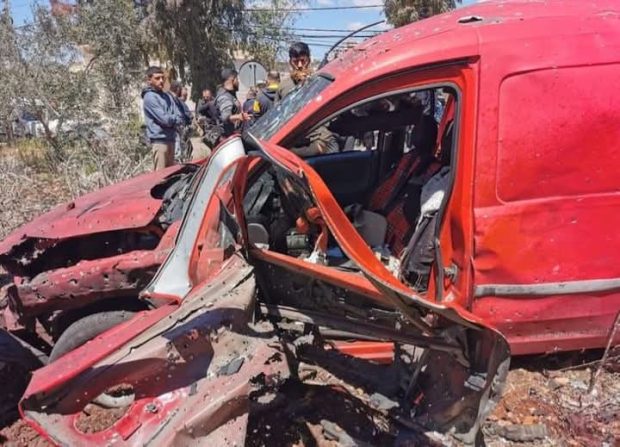
Al Mayadeen’s correspondent in southern Lebanon reported on Tuesday that an Israeli occupation drone targeted a car in the town of Aitaroun in the Bint Jbeil district of southern Lebanon, near the border with occupied Palestine.
The Lebanese National News Agency reported that the Israeli aggression was carried out with three guided missiles, while Lebanon’s Ministry of Health reported one martyr and three wounded, including a child.
Also, according to the National News Agency, the Israeli occupation forces opened fire with machine guns on the eastern neighborhood of Mays al-Jabal.
The occupation continues to breach the ceasefire agreement with Lebanon through repeated assaults on the South, the Bekaa, and Beirut’s southern suburbs, as well as by maintaining control over the five disputed points.
On a related note, MP Hassan Fadlallah of the Loyalty to the Resistance bloc emphasized in parliament last week that expelling the Israeli occupation from Lebanese territory, liberating Lebanese prisoners, halting “Israel’s” aggression and violations of sovereignty, and rebuilding what it has destroyed are responsibilities that fall on all loyal Lebanese citizens, as well as on the state and its institutions.
He emphasized that the defensive strategy is a purely internal Lebanese matter to be agreed upon by those who believe in these principles and who recognize “Israel” as Lebanon’s enemy.
“As for those who do not view Israel as an enemy of Lebanon, who incite internal division, and who promote, justify, and market for the enemy — such individuals are unfit to take part in any internal dialogue focused on building the components of national strength to protect sovereignty,” Fadlallah indicated.
April 15, 2025
Posted by aletho |
Ethnic Cleansing, Racism, Zionism, War Crimes | Israel, Lebanon, Zionism |
Leave a comment
The Israeli war on Lebanon is far from over. Southern Lebanon, the Beqaa Valley, and Beirut’s southern suburbs remain open territory for Tel Aviv’s assassination operations targeting Hezbollah cadres. Barely a day goes by without an Israeli drone carrying out a targeted killing or detonation.
Israeli drones rarely leave the skies over the south or the Beqaa – whether engaged in intelligence gathering or circling for a kill. Alongside this, western diplomats warn the Lebanese government that Israel is preparing for another round of violence to pressure Hezbollah into disarmament – unless a specific timetable is set for handing its weapons to the Lebanese Armed Forces (LAF).
Disarmament by drone
As Tel Aviv’s key supporter on the global stage, Washington calculates that reigniting war will force Hezbollah’s support base to turn against it, pushing for disarmament once its weapons are seen as ineffective in deterring Israeli aggression.
This narrative is promoted through media outlets and social media influencers seeking to normalize this outcome. Even some Lebanese politicians have begun echoing these talking points in interviews.
In contrast, a counter-reading among security officials suggests the occupation state stands to gain little more than what it already has in the war. It can assassinate Hezbollah personnel at will, without prompting retaliation on settlements, given Hezbollah’s declared commitment to the ceasefire and its alignment with the Lebanese state.
Why, then, would Israel risk disrupting the truce and endangering its own population – especially when its stated goal of Hezbollah’s disarmament is far from guaranteed and the cost remains unknown?
A strategy without teeth
Two scenarios are being floated for the handover of arms. The first sees Hezbollah voluntarily relinquishing its weapons – something party officials call impossible. In fact, Hezbollah’s base has become even more entrenched in its support for the resistance’s weapons, particularly after the massacres they saw in Syria’s Alawite coastal villages.
There, extremist factions tied to Hayat Tahrir al-Sham (HTS) and the new Syrian intelligence forces slaughtered thousands of civilians based solely on their sectarian identity. Many now see existential threats emanating both from Israel and the extremist Islamist government in Syria.
The second scenario hinges on adopting a national defense strategy under Lebanese army leadership. This is a concept Lebanese President Joseph Aoun often brings up, with talk of Hezbollah transferring its arsenal to the army and integrating its fighters into the military institution to form a unified national defense force.
Yet here, a critical fact is omitted: the Lebanese army consistently destroys all missiles it seizes from Hezbollah positions south of the Litani River – particularly Almas and Kornet systems. Sources speaking to The Cradle reveal that international observers attend and sometimes film these destruction processes.
Ceasefire in name only
According to the sources, the army follows explicit US directives in destroying these capabilities. The aim is clear: keep Lebanon’s army weak and incapable of forming any real deterrent against its aggressive southern neighbor.
Washington has no intention of allowing Hezbollah’s military assets to be transferred to the national army. Lebanon’s compliance with this plan spells the death of any genuine defense strategy – and the country’s new US-backed president, fresh from his post as commander of the LAF, well knows this.
US dictates go further than just weapons destruction. Beirut also refuses to condemn Israel’s repeated breaches of the ceasefire. Since the truce was signed on 27 November 2024, Israel has racked up over a thousand violations and killed more than 100 Lebanese civilians and soldiers.
Diplomacy has failed to halt these aggressions or compel Tel Aviv to withdraw from five occupied sites inside Lebanese territory, nor has Israel complied with UN Secretary-General Antonio Guterres’s request to halt the use of warplanes and drones over Lebanon.
In response to these thousand-plus violations, only three incidents of rocket or missile fire have been recorded from Lebanese territory into Israel – yet Tel Aviv’s retaliation has been ferocious.
Following the latest rocket fire, Israel bombed Beirut’s southern suburbs. Israeli Prime Minister Benjamin Netanyahu is keen to impose a clear, new military equation on its northern neighbor: any rocket launched toward Israel will carry an exorbitant cost for Lebanon. Tel Aviv is using disproportionate violence to deter further attacks.
The US, meanwhile, has pinned responsibility on Lebanon for preventing rocket launches from its territory. In response, Lebanese security services carried out a series of arrests. Ten suspects were detained in total – seven by army intelligence (three Lebanese, two Syrians, and two Palestinians) and three by General Security (two Lebanese and one Syrian).
However, none of the 10 have any proven connection to the rocket launches – they were arrested solely for being near the launch sites, according to technical evidence. In other words, the detainees are all likely innocent of the so-called “crime” of rocket fire.
A manufactured pretext?
With Lebanese agencies unable to apprehend any of the actual perpetrators, two scenarios remain. One is that Israel, through its local collaborators, is staging these rocket attacks to create a pretext for military escalation – especially given its near-total aerial control over the south, which makes undetected launches virtually impossible.
Proponents of this theory argue that Tel Aviv sees an opportunity – perhaps its last – to eliminate Hezbollah once and for all, buoyed by the international climate’s indifference to mass violence, as seen in Gaza. The severing of Hezbollah’s supply lines after the fall of former president Bashar al-Assad’s government in Syria only reinforces this belief.
The second scenario is that Hezbollah or a Palestinian faction is indeed behind the launches. Some even suggest rogue elements acting without organizational approval. Given the known launch zones, only three actors are considered possible: Israel, Hezbollah, or a third group operating with Hezbollah’s awareness.
A war without end
If Israel’s complicity is ruled out, it means the southern front is unlikely to quiet down, regardless of how much violence Tel Aviv uses as deterrence. Any future war, no matter how destructive to Hezbollah’s arsenal, will not prevent southern Lebanon from becoming an open arena for all factions, organizations, and lone actors.
After all, despite the near-total destruction of Gaza following Operation Al-Aqsa Flood on 7 October 2023, Israel has failed to stop rocket fire from Palestinians continuing to resist the carnage. This very dynamic threatens the northern front, leaving Israeli settlers vulnerable and placing massive pressure on the Israeli government – now in its third year of a war, with no tangible victory in sight.
Tel Aviv has neither eliminated the threat nor secured its settlers close to the border areas – and it knows it cannot stop the rockets. Meanwhile, Hezbollah’s patience with Israeli violations is wearing thin. The resistance is steadily rebuilding its military capacity.
When it is ready – once diplomacy is dead, and the Lebanese resistance’s legitimacy is renewed by continued Israeli occupation and daily atrocities – Hezbollah will not hesitate to respond. That will happen once the US-backed Lebanese government and army show they have zero ability to counter aggression – ironically, an outcome created entirely by the US-backed Israeli attacks on Lebanon.
April 7, 2025
Posted by aletho |
Ethnic Cleansing, Racism, Zionism | Hezbollah, Israel, Lebanon, Palestine, United States, Zionism |
Leave a comment
Since the fall of the Syrian government on 8 December, the direction of the new interim administration, headed by Ahmad al-Sharaa, has become increasingly clear. Politically, militarily, and legally, Damascus now appears aligned with Washington’s long-standing vision of dismantling the Palestinian cause.
This alignment is taking shape on three key fronts: first is the Palestinian Authority (PA), resistance factions such as Hamas, the Palestinian Islamic Jihad (PIJ), and other factions splintered from the Palestine Liberation Organization (PLO). Second, is the UN Relief and Works Agency (UNRWA) tasked specifically to aid Palestinian refugees in the region, and third, are the camps housing Palestinian refugees and displaced Syrians.
Two developments underscore this shift. First, both Turkiye and Lebanon have blocked Palestinians holding Syrian documents from returning to Syria on the same basis as Syrian nationals. Second, US media has revealed ongoing talks between Washington and Damascus over the possibility of Syria absorbing tens of thousands of displaced Gazans, in exchange for sanctions relief or a broader political arrangement, particularly in the aftermath of the Coastal Massacres earlier this year.
Front 1: The PA and the resistance factions
More than four months into the transition to new governance, one thing is clear: former Al-Qaeda affiliate leader Ahmad al-Sharaa, now Syria’s president, is keeping Hamas at arm’s length. Despite repeated requests by Khaled Meshaal – head of Hamas’s political bureau abroad – to visit Damascus, the interim authorities have stalled, aiming to avoid direct confrontation with Israel or the US.
This new Syrian posture takes place in the midst of an ongoing genocide against the Palestinian people and the occupation state’s aim to eliminate their Islamic resistance.
The Cradle has learned that communication between Hamas and the new authorities is largely being channelled through Turkish intermediaries. Ankara is reportedly facilitating the relocation of several Hamas military officials to Idlib, the stronghold of Sharaa’s Hayat Tahrir al-Sham (HTS) militants.
In contrast, Sharaa – who met with Palestinian Prime Minister Mohammad Mustafa in January – has formally opened channels with the PA’s diplomatic mission in Damascus, recognizing it as the official representative of the Palestinian people.
The visiting delegation included senior officials from Fatah and the PLO, most notably Mahmoud Abbas’s son, who arrived to reclaim properties previously held by anti-Fatah factions under former Syrian president Bashar al-Assad’s government.
On the night the Assad government collapsed, Popular Front–General Command (PFLP-GC) Secretary-General Talal Naji and Palestine Liberation Army (PLA) Chief-of-Staff Akram al-Rifai sought refuge at the PA embassy. Palestinian ambassador Samir al-Rifai reportedly received a sharp rebuke from Abbas for granting them shelter. As for the rest of the faction leaders, each of them remained at home.
The day after HTS forces entered Damascus, they launched a wave of closures targeting Palestinian faction offices. Those belonging to Fatah al-Intifada, the Baath-aligned Al-Sa’iqa movement, and the PFLP-GC were shuttered, with their weapons, vehicles, and real estate seized.
The Democratic Front for the Liberation of Palestine (DFLP), which had maintained a lower profile during the Syrian war, was allowed to continue operating – though under observation.
On 11 and 12 December, several faction leaders convened at the Palestinian embassy in the presence of PLA leader Rifai to discuss their future. They attempted to arrange a formal meeting with Sharaa via Syria’s Foreign Ministry. Instead, a messenger from HTS – identified as Basil Ayoub – arrived at the embassy and demanded full disclosure of all faction-owned assets, including real estate, bank deposits, vehicles, and weapons. No political engagement would be possible, he said, until a comprehensive inventory had been submitted.
The factions complied by drafting a letter declaring that their holdings were lawfully acquired and that they were prepared to limit their activity to political and media outreach, in full alignment with Syria’s new posture. The fate of the letter to Sharaa and its response are unknown.
Decapitation campaign: arrests, confiscations, and settlements
What followed was a systematic decapitation of the Palestinian factional structure in Syria.
In early February, Fatah al-Intifada’s Secretary-General Abu Hazem Ziad al-Saghir was arrested at his home. After hours of interrogation and a raid on his office – where documents reportedly linked him to Iran’s Islamic Revolutionary Guard Corps (IRGC) – he was released.
A week later, he was re-arrested and held at a newly established detention site behind the Abbasid Stadium. A financial settlement was reached: $500,000 in exchange for his release and deportation to Lebanon. At the request of the committee, the movement’s Central Committee issued a statement terminating Saghir’s duties and dismissing him from the movement. However, Saghir issued a counterstatement from Lebanon, transferring the movement’s General Secretariat there and dismissing those who had made the decision to remove him.
The Palestinian Baathist faction, Al-Sa’iqa, fared no better. Its Secretary-General Muhammad Qais was interrogated and stripped of the group’s assets. Though he was not in command during the Battle of Yarmouk and thus escaped harsher punishment, HTS ordered the removal of the term “Baath” from all official materials. A statement soon emerged from within the occupied territories denouncing Qais as a “regime remnant,” suggesting a growing internal split.
HTS also clamped down hard on the PFLP-GC, whose Secretary-General, Talal Naji, was placed under house arrest and interrogated multiple times. All the group’s offices, vehicles, and weapons were confiscated, their headquarters shuttered, and its members beaten and humiliated. Their radio station, Al-Quds Radio, was seized, and their Umayyah Hospital is reportedly next in line.
The “Nidal Front” – a breakaway faction of the Palestinian Popular Struggle Front (PPSF), a left-wing group within the PLO – was the most controversial of its dealings. At the beginning of the events, Khaled Meshaal was able to mediate for the Front’s Secretary-General, Khaled Abdul Majeed, and protect him and his organization. However, in February, Abdul Majeed fled to the UAE.
His personal residence and vehicles – reportedly privately owned – were seized along with 50 million Syrian pounds (less than $5,000) in assets. Forced to resign by HTS, he handed over authority to a central committee operating out of Damascus and Beirut.
The DFLP has so far escaped the brunt of these purges, and its offices and vehicles remain untouched by the new administration, possibly because it had no ties to Iran or Hezbollah. The Popular Front for the Liberation of Palestine’s (PFLP – different from the PFLP-GC) main office in the Taliani area of Damascus remains open but inactive, while the rest of its offices have been shut down.
As of now, the PIJ, whose fighters have been on Gaza’s frontline battling Israel since 7 October 2023, remains in its Syrian offices. The faction’s representative has not been summoned for questioning, despite Israel bombing an apartment used by the group’s Secretary-General, Ziad al-Nakhala.
However, key PIJ military figures relocated to Baghdad on the night Damascus fell to HTS. Their activities inside Syria appear largely to have been reduced to conducting funerals for fighters who were killed in battle in southern Lebanon, albeit exclusively inside Palestinian refugee camps.
The Yarmouk camp in Damascus had already witnessed a series of protests in the first days of February, most notably gatherings demanding the closure of the headquarters of pro-regime organizations and the accountability of those involved in the arrest and killing of camp residents. The events escalated into an attempt to set fire to the headquarters of the PIJ’s Quds Brigades, with some youths and children throwing firecrackers at the building. Meanwhile, a demonstration erupted in protest against the decision to reopen the offices of the Al-Sa’iqa brigades in the Al-A’edin camp,
Front 2: Palestinian refugee camps in Syria
The crackdown on political groups has created a leadership vacuum in Syria’s Palestinian camps. Living conditions – already dire – have deteriorated further. In early February, protests erupted in several camps over Israel’s brutal attacks on the occupied West Bank’s Jenin Camp, following the PA delegation’s visit and the Syrian government’s formal recognition of Ramallah’s authority. Many feared this shift would accelerate plans for permanent resettlement of the refugees. At the same time, residents say they were coerced into public rallies in support of Sharaa’s self-declared presidency.
On 24 February, the Community Development Committee in Deraa began collecting detailed personal data from camp residents under the pretext of improving service delivery. A similar census was launched days earlier in Jaramana, but the purpose and funders of these efforts remain unclear.
Into this vacuum stepped Hamas. Through affiliated organizations like the Palestine Development Authority, Hamas began distributing food and financial aid, often via operatives embedded within HTS. This effort came as services once offered by the PIJ – including transportation, communal kitchens, and medical support – were halted. Even the Palestinian-Iranian Friendship Association’s headquarters in Yarmouk was taken over and repurposed by HTS elements.
Other actors, such as the Jafra Foundation and the Palestinian Red Crescent, continue to operate despite significant constraints. Their efforts have been insufficient to meet demand, particularly as the local economy continues to collapse. Most refugees rely on informal work, and with much of the economy paralyzed, daily survival has become precarious.
Of particular concern is a reported settlement proposal, conveyed through Turkish mediation. It allegedly offers Palestinians in Syria three options: Syrian naturalization, integration into a new PA-affiliated “community” under embassy supervision, or consular classification with annual residency renewals. The implicit fourth option is displacement, mirroring what happened to Palestinians in post-US invasion Iraq.
Front 3: UNRWA, sidelined and undermined
Though the new Syrian authorities have not openly targeted UNRWA, their lack of cooperation speaks volumes. UNRWA no longer appears to be viewed as the primary institution responsible for Palestinian affairs in Syria.
In Khan Eshieh Camp, a local committee working with the new administration petitioned the Damascus Governorate to prepare a municipal plan for rehabilitating the camp’s infrastructure. The implication was clear: Syrian authorities are preparing to take over camp management from UNRWA, following the Jordanian model.
Meanwhile, the Immigration and Passports Department resumed issuing travel documents for Palestinian refugees in January, a bureaucratic move that revealed the new government’s intention to reassert control. Around the same time, the Palestinian Arab Refugee Association in Damascus suspended its operations following a break-in that reportedly disrupted pension payments to retired refugees.
Despite limited resources, Hamas and the PIJI remain a point of concern for the occupation state. A recent Yedioth Ahronoth report claimed that both groups are attempting to rebuild military capacity inside Syria, with the intention of targeting settlements near the occupied Golan Heights and northern Galilee. While the report acknowledged no confirmed troop movements south of Damascus, it warned that operational planning is underway.
A close examination of Sharaa’s behavior and the new regime in Damascus reveals no apparent dissolution of these two organizations’ operations, as the Israelis claim. All that is taking place are temporary measures until a “big deal” is reached with the Americans, one of whose provisions will be the official and popular status of the Palestinians. Unless the country descends into chaos, one of the expected outcomes will be a clear Israeli ground military intervention under the pretext of removing the Palestinians from the border.
March 26, 2025
Posted by aletho |
Ethnic Cleansing, Racism, Zionism, Wars for Israel | Hamas, Israel, Lebanon, Palestine, Syria, Turkey, United States, Zionism |
Leave a comment
The Israeli army carried out heavy airstrikes on southern and eastern Lebanon on 20 March, claiming it targeted “terrorist infrastructure” and a “military site” belonging to Hezbollah.
Massive explosions were seen in video footage of an Israeli attack on the outskirts of the southern Lebanese town of Jbaa on Thursday evening.
Airstrikes also hit the town of Taraya west of Baalbek and the Shaara area near the town of Janta in the Bekaa Valley, in eastern Lebanon.
“A short while ago, the IDF struck a military site containing an underground terrorist infrastructure site in the Bekaa area in Lebanon, as well as a military site containing rocket launchers in southern Lebanon in which Hezbollah activity has been identified,” the Israeli army said in a statement.
“The IDF will continue to operate to remove any threat to the State of Israel and will operate to prevent any attempt by the Hezbollah terrorist organization to rebuild its forces,” it added.
Israeli forces recently expanded their occupation of southern Lebanon in violation of the ceasefire agreement, which was supposed to see Tel Aviv fully withdraw its forces from the country.
Israel has also relentlessly bombarded south and east Lebanon since the ceasefire was reached in November last year.
Tel Aviv claims to be acting on its rights within the deal by preventing Hezbollah from rearming itself. However, the agreement signed by Beirut does not include anything about Israeli forces having the right to attack the country or occupy its land, instead stipulating that the resistance’s presence and military infrastructure must be dismantled by the Lebanese army south of the Litani River in south Lebanon.
Israel accuses Hezbollah of having not fully withdrawn to the north of the Litani River, as per the agreement. It also accuses the Lebanese resistance of trying to reconstitute its forces.
“We maintain five points on the Lebanese side of the border to protect our territory. We will not relinquish control [of the five sites],” Israeli Prime Minister Benjamin Netanyahu said last week.
March 21, 2025
Posted by aletho |
Illegal Occupation, War Crimes | Hezbollah, Israel, Lebanon, Zionism |
Leave a comment
By Drago Bosnic | March 18, 2025
Ever since the destruction of sovereign Syria, the situation on the ground keeps deteriorating. The EU/NATO-backed terrorist “government” is resorting to extreme violence in an attempt to establish control over areas primarily populated by minorities, particularly Alawites and Christians. Thousands have been brutally murdered as a result of this terrorist takeover, with the new “government” sending its forces (composed of Al Qaeda-affiliated armed personnel) to crush any opposition. This issue is now slowly becoming transnational as armed clashes are reported on the Syria-Lebanon border. Namely, the Hayat Tahrir al-Sham (HTS) terrorists (now posing as the “new Syrian military”) are shelling and launching rockets at Lebanese border towns.
Beirut sent military forces to respond to these attacks. Over the weekend, local sources reported that “the Beqaa Valley has been under continuous shelling for three hours with rockets and artillery coming from Syrian territory”. The new terrorist “government” occupying Syria since early December also regularly launches armed drones into Lebanese territory, while several rockets launched from the Qusayr countryside (administratively part of the Homs Governorate) hit the Lebanese border town of Qasr. Local sources report that “heavy shelling is ongoing”, resulting in “civilian casualties on the Lebanese side, including at least one child”. Citing military data, the traditionally pro-terrorist Al Jazeera reports that “eight members of the Syrian Ministry of Defense were killed in the clashes”.
It should be noted that the “Syrian Ministry of Defense” in this case refers to one controlled by the unelected EU/NATO-backed terrorist “government”. The fighting supposedly “began several hours after three HTS fighters were found dead inside Lebanese territory” and “were handed over to the new ‘government’ by Lebanese Armed Forces (LAF) and the Red Cross”. The HTS-run “Defense Ministry’s” media office told former Syrian state media outlet SANA that “the Hezbollah militia kidnapped the three fighters on the border, took them to Lebanese territory and executed them on the spot”. Other sources report that the three HTS terrorists “were already in Lebanese territory when they were killed”. These clashes seem to have been in retribution to the new terrorist “government’s” actions.
Namely, local sources report that the HTS killed several citizens of Lebanon. According to Annahar, “on Monday, two Lebanese youths were found dead in the Matraba area near the border”. They were reportedly kidnapped from their homes inside Lebanon by the new terrorist “government’s” security forces and subsequently killed.
The EU/NATO-backed puppets in Damascus claim they’re “fighting Hezbollah on the border”, although the Lebanese Shia organization regularly denies involvement in recent events in occupied Syria. There are claims that “a Syrian photographer and journalist were injured by retaliatory rocket fire launched from Lebanon on Sunday”. On the other hand, Beirut reports that “Lebanese villages and towns in the region were subjected to shelling from Syrian territory”.
The Lebanese military sent “units [that] responded to the sources of fire with appropriate weapons, reinforced their deployment, and maintained security” and reported that “contacts continue between the army command and the Syrian authorities to maintain security and stability in the border area”. The new terrorist “government” in Damascus also reportedly sent reinforcements to the border area.
The incidents come over a month after fighting was reported between the HTS-run forces and Lebanese tribesmen back in early February. At the time, the former sent troops to “set up checkpoints in an attempt to thwart smuggling”. The fighting stopped after Beirut and local tribes came to an agreement that resulted in the latter’s withdrawal from the border.
It should be noted that the security situation in western parts of Syria deteriorated dramatically after the new terrorist “government” started a genocidal campaign against the locals, murdering even Sunnis who offered shelter to their Alawite and Christian compatriots. The Russian military in the area continues to house thousands of refugees, with more coming in daily. New footage confirms that gruesome atrocities by the HTS-run “security forces” continue unabated, while the EU/NATO keep supporting and even financing the terrorists.
Namely, Germany just pledged an additional €300 million ($326 million) in “foreign aid” for the new terrorist “government”. Its Foreign Minister Annalena Baerbock insists that “over half of it will bypass the interim government of Jolani, to be distributed through NGOs and UN agencies”.
“As Europeans, we stand together for the people of Syria, for a free and peaceful Syria,” Baerbock declared without even mentioning the ongoing massacres.
The assertion that the terrorist Jolani regime “will be bypassed” is beyond laughable as recent revelations about the USAID and its illegal activities around the world show that around $15 billion were funneled into Syria precisely through the USAID. This money ended up in the pockets of various terrorist groups that took over Syria and are now killing civilians across the occupied country. Estimates vary, ranging from over a thousand to as many as 10-15,000 casualties.
The areas populated by minorities (particularly Alawites and Christians) are disproportionately affected, meaning that the new terrorist “government” is determined to eradicate any and all groups deemed “infidels”. Locals are subjected to brutal torture and then murdered by the EU/NATO-backed Islamic radicals.
Worse yet, Brussels is now even condemning the victims for fighting back, calling them “pro-Assad forces” and accusing them of “destabilizing Syria”. On the other hand, somewhat astonishingly and unexpectedly, the US is condemning the jihadists after decades of supporting them. Both Donald Trump and JD Vance have criticized not only the terrorists, but also the preceding US governments, even admitting their policies led to the eradication of ancient Christian communities in the Middle East.
Even some (now former) Democrats, such as the former congressman Dennis Kucinich slammed this foreign policy approach, asking rhetorically: “Why would America champion policies that lead to the killing of Christians, the destruction of churches, the massacre of Alawites and the rise of radical jihadists?”
“Why did our leaders knowingly aid those who murdered the very people America claimed to want to protect? The answer lies in a corrupt, immoral foreign policy dictated not by ethics, human rights, or even national security, but by the interests of the military-industrial complex and strategists who view human lives as pawns in a geopolitical chess game,” he concluded.
March 18, 2025
Posted by aletho |
War Crimes | al-Qaeda, European Union, Lebanon, Syria, United States |
Leave a comment
A child has been killed and four other civilians injured as militants aligned with Syria’s ruling Hay’at Tahrir al-Sham (HTS) regime launched a volley of rockets at a residential neighborhood in Lebanon’s eastern province of Baalbek-Hermel.
Lebanon’s official National News Agency reported that rockets fired from Syrian territory had landed in the Lebanese village of Qasr near the border.
The Lebanese al-Mayadeen television news channel said a rocket launched by HTS militants struck a house in Hawdh al-Assi district.
A child was killed and four other individuals were wounded in the shelling.
This was followed by a Lebanese Army reconnaissance drone patrolling the skies over the Hermel district and border areas near Syria.
A Lebanese security source, speaking on condition of anonymity, said tensions began after three Syrian militants crossed into Lebanese territory at the village of Qasr, where they were shot at by local gunmen.
The source said the reason why they entered was unknown.
Syria’s HTS administration on Sunday accused Lebanon’s Hezbollah of abducting three soldiers to Lebanon and killing them there. The resistance movement roundly dismissed the allegation.
Hezbollah denies involvement in border clashes
Hezbollah in a statement denied any involvement in clashes with HTS forces or in Syrian territory.
The group said it “categorically denies any connection to the events taking place today on the Lebanese-Syrian border.”
It added that it “reaffirms its previous announcements that Hezbollah has no relation to any events within Syrian territory.”
The Lebanese National News Agency later reported that the bodies of three Syrian militants had been handed over to Syria via the Lebanese Red Cross.
Last month, more than 10 people were injured after shelling from Syria’s Qusayr countryside targeted border towns in Lebanon’s Hermel region.
Amid rising tensions, Lebanese President Joseph Aoun and Syria’s de facto leader Abu Mohammed al-Jolani agreed in a phone call on Friday to coordinate efforts to stabilize the border and prevent attacks on civilians.
March 17, 2025
Posted by aletho |
Aletho News | Lebanon, Syria |
Leave a comment


 Aletho News