The Anniversary of Gaddafi’s Death and the Current Reality in Libya
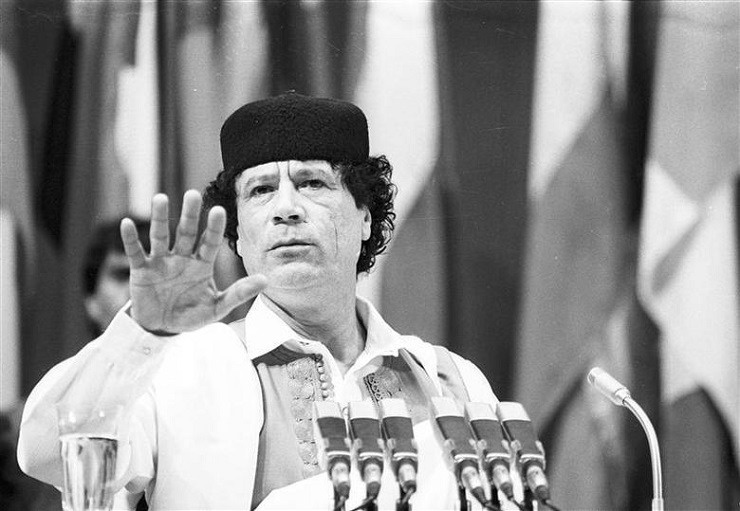
By Yuriy Zinin – New Eastern Outlook – 26.10.2020
“Security problems, political discord, oil blockades, corruption, and Libya’s foreign debt, which has reached 270% of its GDP, all torpedo economic life,” said Central Bank of Libya governor Sadiq al-Kabir. Oil revenues in Libya have plummeted, from $53 billion in 2012 to near zero this year, he added.
These words, spoken on the eve of another anniversary of the assassination of Libyan leader M. Gaddafi on October 20, 2011, do in fact serve to illustrate what the country has come to over the past nine years of its history, since the collapse of the previous regime.
Having come to rule with massive outside support from NATO, the new forces, although they inherited huge financial reserves and the potential following the era of the previous leader, became dependent on the various militias that brought them to power. Along with that, these “brothers-in-arms” soon turned into implacable enemies. The country fell into an abyss of civil strife and, since the summer of 2014, has been divided into two military and political camps, with one pole of power in Tripoli and the other in Tobruk. Because of this turmoil, Libya’s development has come to a standstill, and GDP is dropping. In comparison with previous times, it has slid backwards in many respects.
The oil sector has become hostage to conflicts in society, a source of funding for diverse groups that act in opposition to national interests. However, there is plainly a growing shadow economy, flourishing of currency fraud, the smuggling of goods, illegal emigrants, etc.
The dependence of the Libyan authorities on external forces, both regionally and globally, has increased. At the same time, the intra-Libyan conflict does not have a clearly defined bloc “tutelage”. The aspirations of the “stakeholder forces” have many different thrusts. Their desire to resolve their differences by taking to the Libyan field is often seen, and that, among other things, is fraught with the likelihood of collisions occurring between them.
Since 2015, the UN has been initiating efforts to reconcile the opposing poles in Libya. Delegates from the warring parties participate nonstop in different series of negotiations, sometimes under the auspices of the UN, sometimes hosted by major powers, or as part of the efforts put forth by various neighboring states and the African Union. These kinds of conferences and meetings, including those between the leaders of the two camps, were held in no less than a dozen cities on three continents, including Moscow.
The efforts by various mediators have not turned the tide, or yielded any decisive results. No new constitution has been adopted, and no presidential elections, or elections for a new parliament have been held.
It is encouraging that so far the opposing sides have been honoring the decision they made on August 21 this year for a ceasefire. A number of local and foreign observers have pinned their hopes on three tracks for the negotiation process, all of which are now going on simultaneously.
For example, at talks in the Moroccan city of Bouznika under the auspices of the UN Support Mission in Libya, they reached “a mutual understanding on the transparency of the standards and mechanisms” used to allocate key positions in the government, and throughout other echelons.
In the Swiss city of Montreux, the participants agreed that for the duration of a comprehensive resolution of the intra-Libyan crisis, Sirte, which effectively divides the North African country, will become the seat of the executive and legislative bodies.
In the Egyptian city of Hurghada, Libyan representatives talked about building on the peaceful respite, and restructuring the armed forces.
Libyan experts note that there is a long distance between the decisions that were announced, and the mutual understanding that was reached, to realizing them. From circles close to the governing bodies and military authorities in Tripoli and Tobruk, criticism is spilling forth about the agreements that are progressing on these tracks.
At the same time, it cannot be said that there is absolutely no ground for agreements or compromises. First, the balance of power in Libya does not allow either of the two poles to achieve final victory by military means.
Second, Libya today is divided by the parties into peculiar areas of responsibility, but along with that none of them is economically self-sufficient. For example, most of the fields, pipelines, and oil terminals are in the sphere of influence of the authorities in Tobruk. But normal operations for the entire economic infrastructure under its control are impossible without interacting with the other component present in the Libyan conflict. In matters concerning producing oil, selling it, and earning revenue from it, the key role is still played by the state acting as a rentier, and in which economics and politics are fused in a union of marriage.
These issues for the opposing sides can serve as a starting point for moving towards each other. Among everything else, the Libyan public is putting pressure on top officials. In August this year in Tripoli and Benghazi, the largest cities for both poles of power, there were demonstrations by residents who were tired of political instability and socioeconomic hardship.
Libya since the fall of Gaddafi represents a tragic example of how a country that used to be stable, and which is rich in oil reserves, can be bled dry not only by outside intervention, but from internal conflict as well.
Yury Zinin is a Leading Research Fellow at the Moscow State Institute of International Relations.
Why is the GNA defunding the Lockerbie case despite it being close to a verdict of innocence?
Dr Mustafa Fetouri | MEMO | September 3, 2020
The only Lockerbie bombing convict is one step closer to his guilty verdict being overturned, however, posthumously. Abdelbaset Al-Megrahi died at home in Tripoli on 21 May, 2012, while protesting his innocence until his last breath. The Scottish Criminal Cases Review Commission (SCCRC) allowed the family to proceed with an appeal to clear his name. The case was sent to the High Court of Justiciary, Scotland’s highest criminal court, and a date for the final hearing has been scheduled to start on 24 November.
His 27-year-old son Ali, who is leading the family’s long and arduous fight to clear his father’s name, is certain that justice will prevail this time and that his late father’s verdict will be reversed. During a telephone conversation in Tripoli last Monday, he assured me: “My father’s name will certainly be cleared this time.”
The family’s lawyer Aamer Anwar, a distinguished Scottish lawyer who volunteered to take the case, in a series of emails confidently communicated to me: “We have a robust appeal.”
Winning this time seems certain. Professor Robert Black, a Scottish law authority, and the mind behind the first Lockerbie court setup in the Netherlands in May 2000, agrees with this analysis. He believes the Scottish court will “overturn the verdict” against Al-Megrahi, however, on the “narrower ground” of the crown prosecutor “withholding materials” from the defence team that could have helped establish Al-Megrahi’s innocence from the outset. Professor Black is “disappointed” that the court might not go as far as “to find that no reasonable court would have convicted Al-Megrahi.” He added, “I hope I’m wrong about this” – which would restore some of the Scottish judiciary’s reputation tarnished by the Lockerbie case and its aftermath.
The Lockerbie bombing, since 1988, became negatively synonymous with Libya, Gaddafi and its entire population. Gaddafi, firmly believing in their innocence, refused to hand over his accused citizens, Lamin Fhimah and Abdelbaset Al-Megrahi, to stand trial in the UK. This led the United Nations (UN) to adopt a series of sanction resolutions, including Resolution 731, passed on 21 March, 1992, with harsh economic and political punitive measures that not only isolated Libya, but made life extremely difficult for its entire population.
The long-held belief that the late Gaddafi was behind the attack still echoes within Western mainstream media, despite the mounting evidence to the contrary emerging over the years.
Now, it can be disclosed that Libya’s Government of National Accord (GNA), the only UN-recognised authority in the country, wants the mud to keep sticking to Gaddafi, Libya and its people too. The GNA is not enthusiastic about this latest development. The GNA have, illegally, cut the funding for the case over the last three years.
Al-Megrahi’s son Ali and the family lawyer are puzzled as to why the GNA cut funding at this critical junction of the case – when winning seems all but certain.
Lawyer Anwar does not disqualify the assumption that the GNA came under pressure from both the UK and the US to steer away from the case. The British and American narrative of the Lockerbie tragedy has always been that Libya is responsible and “that narrative must be maintained”, Anwar informs me.
However, suspension of defanging goes much deeper within the GNA, where corruption is rampant. A Scottish consultant to the legal team, speaking on condition of anonymity, yesterday clarified: “I believe funding is still budgeted, but the money disappears before getting to its intended final destination.”
Despite writing several times to the GNA to resume funding to meet the substantial mounting legal fees, Anwar received no replies until a few months ago, when his consultant was told that the GNA did not receive any messages relating to the funding of the case.
However, the consultant strongly disputes this, asserting that she “personally” handed over the file to the “highest official in the GNA” in a December 2017 meeting in Tripoli. When asked if “the highest official” meant Fayez Al-Sarraj, the GNA’s prime minister, she replied: “You think about it.”
It is not wholly unusual for the GNA to take such a position. Part of the political legitimacy in new Libya rests on the claim that Gaddafi was a supporter of international terror, and the Lockerbie bombing must have been his evil work too.
In November of 2019, the GNA’s Minister of Justice Mohamed Lamlum, personally stood before the International Criminal Court (ICC) to ask Saif Al-Islam, Gaddafi’s son, to face trial before the ICC, tarnishing the very judiciary he is supposed to protect and defend. Gaddafi Junior is wanted by the ICC for his – broadly disputed – role in quelling the 2011 troubles that ended his father’s rule over Libya.
According to different legal experts, the Libyan state is obliged to help its citizens abroad by all means necessary, including through funding in the event of legal issues. The Lockerbie case is much more than a petty case about a Libyan citizen, but it concerns the entire nation, its history and its reputation. This should elevate the case to a “national cause” for all Libyans, according to Anwar.
Indeed, Libyans across the political spectrum now consider the Lockerbie case a national issue and that Libya must continue funding the legal team, just as it did before 2011.
During the Gaddafi era, the government even established a consulate in Glasgow to closely monitor the case, and to help Al-Megrahi’s family who had to relocate to Scotland to be near their father while in jail.
It is not clear if the GNA will honour its legal obligations towards its own citizen, Al-Megrahi, albeit posthumously, but the legal team is not surrendering. They have already established a liaising team inside Libya to follow up with the chaotic authorities in Tripoli.
A group of volunteers inside and outside Libya are gearing up to explore other funding avenues if the GNA continues to reject meeting its legal obligations. In any eventuality, Al-Megrahi’s reputation, and that of Libya, will soon be restored.
“Woke” America is More Asleep to Injustice Than Ever
By Tony Cartalucci – New Eastern Outlook – 06.07.2020
To drive home just how superficial and empty recent protests in America are and how little besides further division and destruction will become of them – take the fate of two fictional characters recently put in the spotlight by baying activists – PepsiCo’s “Aunt Jemima” breakfast food brand and Mars Incorporated’s “Uncle Ben’s” rice products.
Both came into the crosshairs of “woke” America. Both fictional characters will now no longer be used.
It might appear like a huge victory for “woke” America.
CNN in their article, “The Aunt Jemima brand, acknowledging its racist past, will be retired,” would claim:
Quaker Oats is retiring the more than 130-year-old Aunt Jemima brand and logo, acknowledging its origins are based on a racial stereotype.
“As we work to make progress toward racial equality through several initiatives, we also must take a hard look at our portfolio of brands and ensure they reflect our values and meet our consumers’ expectations,” the Pepsi-owned company said in a statement provided to CNN Business.
And the London Guardian in their article, “Uncle Ben’s rice firm to scrap brand image of black farmer,” would claim:
The rice company Uncle Ben’s is to scrap the image of a black farmer the brand has used since the 1940s and could change its name, as companies react to growing concerns over racial bias and injustice.
The parent company, Mars, said Uncle Ben was a fictional character whose name was first used in 1946 as a reference to an African American Texan rice farmer.
While there is no doubt that both fictional characters represented stereotypes and are rooted in America’s racist past – “woke” America’s belief that somehow this was a priority or some form of victory begs belief. So does the fact that those opposed to expanding mobs and their “cancel culture” have crafted the most anemic counterpoints.
Some claim that the fictional characters were either inspired or portrayed by real African Americans who profited from the branding.
What neither side mentioned was the very real abuses both companies are guilty of – abuses that are both inhumane and rooted in extraordinary, inexcusable, and thus far utterly unaddressed racism.
PepsiCo and Mars Sponsor/Profit From Slavery and Mass Murder
Both “woke” America as well as those trying to form opposition to it have entirely missed the fact that PepsiCo and Mars Inc. – two multi-billion dollar businesses – are literally engaged in modern day slavery to create their products while sponsoring policy think-tanks that have engineered wars targeting African nations, leading to the deaths of tens of thousands and open-air slave markets where black people – today – are sold into bondage.
This would seem to be a much greater transgression against black people than their crude depictions in company branding and demands much more serious action than merely adjusting marketing strategies – such as demanding boards of directors to resign or full-spectrum, permanent boycotts for these businesses and their many subsidiaries and brands.
Unfortunately for “woke” America, fictional characters are a priority taken head-on all while activists blissfully munch on chocolate bars made by cocoa harvested by African slave labor and sip on drinks made by a corporation which sponsors US wars abroad in which blacks are mass murdered and enslaved.
Your Mars Inc. Chocolate Comes from Slave Labor
If you enjoy chocolate snacks like 3 Musketeers, Snickers, Mars, and Milky Way bars, the chocolate you ate most likely came from a developing nation with dismal working conditions and in many cases, child and slave labor.
Mars Inc. along with Nestle, Hersey, and many other chocolate companies, source cocoa from Africa and especially the nations of Cote d’Ivoire and Ghana.
A Washington Post article published just last year titled, “Cocoa’s child laborers,” would note:
Mars, Nestlé and Hershey pledged nearly two decades ago to stop using cocoa harvested by children. Yet much of the chocolate you buy still starts with child labor.
The article elaborated, noting:
About two-thirds of the world’s cocoa supply comes from West Africa where, according to a 2015 U.S. Labor Department report, more than 2 million children were engaged in dangerous labor in cocoa-growing regions.
When asked this spring, representatives of some of the biggest and best-known brands — Hershey, Mars and Nestlé — could not guarantee that any of their chocolates were produced without child labor.
Black children used as labor and under conditions and for wages bordering slavery to produce cocoa Mars Inc. knowingly uses in its products – and makes billions of dollars off of – seems like a much bigger issue than what is undoubtedly offensive labelling practiced by Mars Inc. through its “Uncle Ben’s” brand.
Indicative of the carefully controlled nature of ongoing protests is how the Washington Post has reported on Mars Inc.’s genuinely offensive, even criminal predation on black labor in Africa in the past as well as Mars Inc.’s offensive branding more recently, but failed to link the two in its most recent reporting – thus artfully avoiding a genuinely “woke” readership and any genuine damage real protests and boycotts would have on Mars Inc. and other corporations whose interests Washington Post regularly serves as a voice for.
Big-Biz like PepsiCo and Mars Inc. are an Affront to All
Mars Inc. – alongside PepsiCo, Nestle, and Hersey – was also involved in funding anti-labelling campaigns to prevent legislation from passing that would force food manufacturers to inform consumers their products contained genetically modified organisms (GMO).
Corporations spending money to hide dangerous ingredients from consumers endangers everyone’s health – black and white, left and right.
Mars Inc., PepsiCo, and others defend such campaigning, claiming that such legislation would be “costly” – as would ensuring all of their ingredients are ethically procured and free of child and/or slave labor.
Yet Mars Inc., PepsiCo, and others are multi-billion dollar businesses. The Mars family which owns Mars Inc. consists mostly of family members who are billionaires – not mere millionaires – but billionaires.
Their daily “concerns” include ensuring their sprawling 82,000 acre ranches have enough water and that they receive the most lenient penalties when crashing their Porsche SUV’s into vans carrying families.
Mars Inc. and other multi-billion dollar businesses can afford to do better, simply at the cost of being slightly less well-off billionaires or perhaps even being demoted to millionaires – yet they simply and deliberately choose to profit off the backs of poorly informed consumers at home and exploited/enslaved labor abroad.
If what Mars Inc. and PepsiCo contributed to was only limited to cultivating ignorant consumers at home and using slave labor abroad it would be bad enough. And if America’s “woke revolution” was serious about justice, Mars Inc. and PepsiCo would be on the chopping block for much more than their crude, racist marketing, and would have more demanded of them.
But that is not all Mars Inc. and PepsiCo are contributing to.
Sponsoring Warmongering and Mass Murder in Africa (and everywhere else)
Both PepsiCo and Mars Inc. are sponsors of policy think tanks like the Brookings Institution whose “scholars” and “fellows” churn out the blueprints for US wars which are then rubber stamped by the US Congress and sold to the public by the corporate media.
Brooking Institution’s 2019 annual report (PDF) lists both companies – PepsiCo and Mars Inc. – as sponsors as were both companies in 2011 (PDF).
Brookings and its corporate-sponsored staff worked diligently in 2011 to help sell the US military intervention in the North African nation of Libya. It was a key institution involved in creating and spreading the notion of “R2P” or the “responsibility to protect” used as flimsy cover for a long-planned US desire to effect regime change in Libya.
As early as February 2011, the Brookings Institution published articles and papers like, “United States Must Take Lead on Libya,” in which Brookings “Senior Fellows” – funded by the likes of PepsiCo and Mars Inc. – made the nascent calls for US military intervention that would eventually lead to the US arming militants openly and carrying out air strikes across the nation.
Indeed, the US armed militants in eastern Libya – a hotbed for racism and extremism and the epicenters of Al Qaeda in the country – as well as provided roving bands of armed gangs air support as they swept the nation.
When Libyan leader Muammar Qaddafi was violently swept from power later that year, the estimated 2.5 million Africans from across the continent he took in, providing housing and living wages to, found themselves being hunted by US-backed militants.
To explain the blatant and explosive racism that predictably swept Libya in the wake of the US-backed war, articles like the CS Monitor’s “How Qaddafi helped fuel fury toward Africans in Libya,” would claim:
Many experts – and African migrant workers themselves – say the animosity stems from anti-African racism found throughout the Arab world. But some say the anger has been made much worse by Mr. Qaddafi’s moves to buy the loyalty of black Libyans from the south of the country as well as his decades-long efforts to build Africa-wide patronage networks at great cost to the country’s Arab majority.
In other words – the CS Monitor and the Western “experts” it cited claim Qaddafi “fueled fury toward Africans” by merely spending resources to help them. It is an oblique attempt to justify the racism-driven genocide US-backed militants carried out during their “victory lap” in Libya.
Black Africans living in Libya were either driven out of the country, across the Mediterranean and into Europe to face hardship and racism there or either mass murdered in Libya or rounded up and enslaved.
The Western media – partners with institutions like Brookings – denied this at first – or attempted to excuse it like the CS Monitor – but eventually covered the fallout US military intervention in Libya and its long-planned regime change agenda triggered.
Reuters in their article, “African workers live in fear after Gaddafi overthrow,” would admit:
Tens of thousands of foreign workers have fled Libya since the armed revolt against Gaddafi’s 42-year-rule began in February, with Africans afraid they have become targets for fighters who accuse them of being mercenaries for Gaddafi.
This antipathy appears to have spread to all Africans, leaving them vulnerable to attacks, robbery and other abuse by the gun-toting, mostly young, fighters who ousted Gaddafi.
Identity cards of nationals from Chad, Niger, Mali, Sudan and other African states have been found on the bodies of gunmen who anti-Gaddafi fighters say were paid to confront them.
The BBC in its article, “Libya migrant ‘slave market’ footage sparks outrage,” would admit:
Migrants trying to reach Europe have spoken of being held by smugglers and forced to work for little or no money.
The footage released by CNN appears to show youths from Niger and other sub-Saharan countries being sold to buyers for about $400 (£300) at undisclosed locations in Libya.
While these media sources covered the fallout of the 2011 US military intervention, they were careful not to link the fallout directly to the intervention.
The US war against Libya was a humanitarian catastrophe deliberately engineered by Western think tanks funded by big-business like PepsiCo, Mars Inc., and many others, rubber stamped by politicians in Washington – both Democrat and Republican – and eagerly sold to the public by the corporate media.
And even as recently as 2016, Brookings “Senior Fellow” Shadi Hamid in a piece published on Brookings’ site titled, “Everyone says the Libya intervention was a failure. They’re wrong,” would remain insistent in defending the US-led war and the decimated, racist, and dysfunctional Libya left in its wake.
He argues that if the US didn’t intervene, Qaddafi would have successfully eliminated the racist extremists in eastern Libya and particularly in Benghazi who would eventually carry out genocide against Libya’s black population. Hamid simply omits any mention of this or who actually was based in Benghazi and instead refers to them merely as “protesters.”
Thus, PepsiCo and Mars Inc. – alongside oil corporations and weapons manufacturers – are funding an institution that not only engineers and eagerly promotes wars, they fund an institution that is utterly unapologetic about the calamity these wars cause – including wars like in Libya ending tragically for 2.5 million black Africans.
“Woke” America needs to be conscious enough to recognize the true injustice underpinning American society. It is very likely that as protesters in America and online around the globe rail against “Aunt Jemima” and “Uncle Ben’s” many activists are eagerly enjoying many of the other products produced by and profiting PepsiCo and Mars Inc. – oblivious to the fact that the ingredients are procured through child and slave labor in Africa and the profits are directed into promoting wars that leave blacks abroad dead, displaced, or enslaved. And as long as this is the case, nothing of any genuine substance will ever change in America or across the wider Western World.
If real justice is what Americans – all Americans – want, they need to truly wake up to this fact first.
Libyan war escalates as regional powers attempt to gain stronger influence
By Paul Antonopoulos | June 1, 2020
Alarms are sounding in Europe as Turkey, Russia and Arab states could potentially agree on shared influence in Libya, and therefore the entirety of the eastern Mediterranean, according to some experts. This comes as European states have no influence over the war in Libya despite it occurring on its southern doorstep and Turkey, Russia and Arab states continue to gain influence.
The direct intervention of Turkey in Libya, who has sent its own intelligence officers, military advisers and thousands of Syrian jihadists to support the Muslim Brotherhood Government of National Accords (GNA), based in Tripoli and led by the ethnic Turk Fayez al-Sarraj, has limited further gains by the Libyan National Army (LNA). The mobilization of thousands of Turkish and Syrian jihadists and the massive shipment of weapons to Tripoli has slowed down the offensive of the LNA, led by Field Marshal Khalifa Belqasim Haftar. Haftar was proclaimed on April 27 as the only leader of the country, in which most of the international community found to be a provocative move as they believe it limited the likelihood of a political settlement to the conflict.
Confident of his past military superiority and assured in the determination that the United Arab Emirates, Saudi Arabia and Egypt have to counter Turkey’s efforts to create hegemony in the Eastern Mediterranean, Haftar continues to ignore calls for a political solution to the war. Sarraj also ignores such calls confident in the backing he has from Turkey.
Russia also condemned Haftar’s offensive and called for negotiations on peace. However, the U.S. claims that Russian fighter jets arrived in Libya to protect the withdrawal of volunteers from the Russian Wagner group in a decision agreed upon with Ankara, something that Moscow denies. Both Europe and the U.S. fear that Russia may obtain the use of a naval base in eastern Libya, that the LNA securely controls, in the future.
Despite these potentialities, it is unlikely the war between GNA-backed jihadists and the LNA will come to a conclusion anytime soon, unless there is a drastic change caused by external forces. Turkey in the midst of an economic crisis is unwilling to use the full force of its military in Libya and is rather acting as a conduit between the GNA and Qatari-funded but Turkish-trained Syrian jihadists. Egypt is contemplating using its military in Libya to “fight against Libyan extremists and terrorists supported by Turkey.” This too could be a game changer since Egypt has the means, logistics and capabilities to successfully intervene in Libya in favour of the LNA.
France has also not hidden away with its support for Haftar, finding him to be a leader that would advance French interests in the Mediterranean that is in direct conflict with Turkey. The GNA has also signed a memorandum with the Muslim Brotherhood government to cut through Greece’s maritime space for the exploitation of gas in that area of the Mediterranean, forcing Greece to get embroiled in the Libyan mess. Meanwhile, Italy has backed the GNA while Germany is trying to act as referee, showing once again there is no common European position.
The European ‘Irini’ (meaning peace in Greek) operation is committed to prevent maritime-bound arms delivery to Libya, i.e. Turkish arms to Libya. This is a maritime surveillance operation to enforce the United Nations-imposed arms embargo on Libya, but in reality, it has not prevented Turkey’s deliveries to the GNA while Egypt continues to supply the LNA over the land border.
The situation shows that the European Union is unable to establish itself as a main actor in a conflict that brings together strategic political and economic interests a few nautical miles from its southern coast. With the U.S. realistically absent, Turkey backing the GNA and Russia and the Arab + Greece alliance backing the LNA, these are the main protagonists.
In Paris, and seeing the failure of his diplomacy parallel to the EU, the Foreign Minister, Jean-Yves Le Drian, warns about the “Syrianization of Libya,” while spokesman of Turkish President Recep Tayyip Erdoğan’s gloats: “France and other European countries supporting Haftar are on the wrong side of history.” Seen in this light, the balancing role Russia can play in Libya to contain Ankara could even be positive for Europeans.
However, the main reason that shared influence will not be agreed upon is because the GNA-Turkish deal to steal Greece’s maritime space relies on a supposed share maritime space between Libya and Turkey. And therein lays the problem – it is the LNA, who has rejected the memorandum, that controls the eastern Libyan coast that supposedly shares a maritime border with Turkey. So long as the LNA controls eastern Libya, Turkey will always strive for a GNA victory to legitimize the memorandum. Once again, the European Union remains divided on Libya, despite the Muslim Brotherhood government aiming to carve out the maritime space of a member state.
Paul Antonopoulos is an independent geopolitical analyst.
‘US statements are fake, not Libyan money’: Moscow rebuffs accusations of printing counterfeit dinars
RT | May 30, 2020
Moscow printed dinars for Libya in accordance with a government contract, so Washington’s claims of it being fake money have nothing to do with reality, according to Russia’s Foreign Ministry.
The US State Department announced on Friday that $1.1 billion worth of “counterfeit, Russian-printed Libyan currency” was seized in Malta earlier this week.
Moscow confirmed the dinars were indeed printed by Russian state-owned company Goznak, but it was done in accordance with a contract it signed with the Central Bank of Libya in 2015. The order was fully paid for by the Libyan side, it was announced.
Following the NATO-backed removal of Muammar Gaddafi in 2011 and years of chaos, Libya is now run by two rival governments, which both have their own central banks. Moscow said it sent money to Benghazi, which is controlled by the Libyan National Army (LNA) of Khalifa Haftar, because the head of the local bank was appointed by the democratically elected parliament. The seized money was essential for stabilizing the troubled Libyan economy, the ministry added. “Therefore, it’s the American statements that are false, but not the Libyan dinars.”
Washington, which backs the UN recognized Tripoli-based Government of National Accord (GNA), has labeled the LNA and its bank “an illegal parallel entity.”
Moscow reiterated its stance that the conflict in Libya should only be solved behind the negotiations table, calling upon the sides to lay down arms and start talking.
Failures in Syria and Libya fuel coup speculations against Erdogan
By Paul Antonopoulos | May 20, 2020
Turkish media has been full of speculation of a potential coup against President Recep Tayyip Erdoğan, including from state-run Anadolu Agency, and other major outlets like Sabah and Haberturk. Erdoğan already survived a 2016 coup attempt against him that he blames on his ex-ally, Fethullah Gülen, who leads the FETÖ Islamic movement. It is likely that Erdoğan will conduct another purge of the Turkish military.
Although the 2016 coup was orchestrated mostly by the Air Force, it appears that one of the first victims could have been Rear Admiral Cihat Yaycı. On May 15, Yaycı was demoted from the Chief of Staff’s to the General Staff, prompting him to resign from the military completely on Monday. Although some speculated it could have been because of the coup rumors circulating, Yaycı proved to be one of the most loyal Chief of Staff’s to Erdoğan and played a significant role in purging so-called FETÖ elements from the Turkish military.
It is likely that Yaycı was actually demoted because of Turkey’s complete failure to project its power in the Eastern Mediterranean. Yaycı is known as the architect of Turkey’s “Blue Homeland” theory that aims to annex Greece’s Eastern Aegean islands and maritime space. To achieve the “Blue Homeland,” Ankara in November 2019, with recommendation from Yaycı, sealed the “Marine Jurisdictions” maritime boundary delimitation deal with Libya’s Muslim Brotherhood Government of National Accords (GNA) to split Greek maritime space between Turkey and Libya.
However, since the signing of the deal with the Tripoli-based GNA, Ankara’s power projections in the Eastern Mediterranean have only weakened Turkish influence. Turkey had not expected for Greece to expel the GNA ambassador from Athens, one of the first NATO and EU countries to do so. In reaction, Greece recognised the GNA’s rival, the Tobruk-based Libyan House of Representatives who appointed Field Marshal Khalifa Belqasim Haftar to command the Libyan National Army against Turkish-backed jihadists who fight for the GNA.
Greece’s shift in recognition shows another flashpoint in rivalry with so-called NATO ally Turkey and rapidly changed dynamics in the Eastern Mediterranean. Haftar currently controls about 90% of territory and 60% of the population, prompting Turkey to send 5,000 Syrian jihadists to support the GNA, who have regained some lost territory in recent weeks.
But this is going to change as it appears massive simultaneous operations against the GNA and Turkish-backed jihadists in Syria’s Idlib province are set to begin in the coming weeks. Turkey as the sole backers of jihadist forces in Libya and Idlib will find this extremely difficult to deal with as it faces an economic crisis.
A detailed report by New Economy found that “Turkey’s probability of bankruptcy is extremely high,” along with its three big banks of Garanti, Akbank and the Mustafa Kemal Atatürk-founded İşbank. “The country’s commercial banks, its last stronghold, have dried up from foreign exchange currency,” meaning that Turkey has nearly no money for its import and export companies.
Another report found that failed wars against Libya and Syria have been a major problem for its economy, making Turkey’s bankruptcy probability over 30% in the forthcoming period, putting them behind only Venezuela and Argentina, but “without having the US embargo that Venezuela has, nor the vast debt that Argentina brings.”
Most startling however for Turkey is that it has to find $80 billion by August, according to New Economy, or else it faces bankruptcy.
“There is also the additional 0.5-1 billion dollar cost per month for the wars in Syria and Libya, which seems to exacerbate the existing situation, leading to a huge state budget hole and escalating the probabilities of bankruptcy,” the report said.
With major economic problems in Turkey, Ankara paid Syrian jihadists in Libya only one month’s worth of wages and then ended all payments. This has prompted the jihadists to make videos urging other Syrians not to go to Libya and fight. Meanwhile, Turkey’s aggression has prompted Greece to renew diplomatic relations with Syria, become actively involved in Libya, and strengthen relations with Egypt, Saudi Arabia and the United Arab Emirates who oppose Turkish influence in the Arab world.
Yaycı’s ambitious “Blue Homeland” project forced Greece to become involved in Libya and Syria that it previously had no interest in, and it is now actively a part of an alliance that is opposing Turkish influence in the region. With Greece actively opposing Turkish influence in Libya, France has also taken a stronger interest and openly opposes the GNA now. What began as a plan to carve up Greece’s maritime space has now turned into a debacle that sees French involvement against the GNA and EU recognition of the Muslim Brotherhood government waning.
Egypt is now threatening to directly use its military to defeat the GNA rather than just supply Haftar’s forces. The UAE has promised to continue airstrikes against the GNA and funding mercenaries for Haftar. Saudi Arabia is also funding mercenaries. Greece and France are involved in the EU’s Operation Irini to stop maritime deliveries of arms to Libya. In March, Haftar’s political representatives signed with Syria a Memorandum of Understanding to start diplomatic relations. Syria and the Libyan National Army are also preparing likely simultaneous operations against jihadists in their respective countries.
This is all happening while Turkey faces a very serious threat of bankruptcy and rumors of a coup attempt. Therefore, it is likely that Yaycı was demoted by Erdoğan for masterminding and pushing for the “Blue Homeland” that has ended in catastrophic failure for Turkey.
Paul Antonopoulos is an independent geopolitical analyst.
Greece’s Renewed Relations with Syria Further Isolates Turkey in the Eastern Mediterranean
By Paul Antonopoulos | May 7, 2020
On Tuesday, the Greek Foreign Ministry finally announced a restoration of relations between Greece and Syria and assigned former ambassador to Syria and Russia, Tasia Athanassiou, as a Special Envoy of Greece’s Foreign Ministry for Syria. Greek Foreign Minister Nikos Dendias confirmed this from his Twitter. The appointment of Athanassiou is extremely strategic as she was Greece’s ambassador to Damascus from 2009 to 2012, meaning she is already familiar with Syria and their authorities.
The Greek Foreign Ministry said that contacts will be made for the “international aspects of Syria and related humanitarian action, as well as coordination of actions in view of the ongoing efforts to rebuild Syria.”
Although the Foreign Ministry claims that the suspension of diplomatic relations “was dictated by the security conditions,” we know it was ordered by former Greek Prime Minister Antonis Samaras in December 2012 under orders from NATO and the European Union who were, and in some instances, still are backing jihadists against the secular government of President Bashar al-Assad.
Greece became a country ruled by European banker, EU, and NATO puppets from 2010 onwards when on May 2 of that year, the so-called socialist government of George Papandreou signed the first of three bailout packages with the European Commission, the European Central Bank and the IMF. This caused a 25% contraction of the Greek economy, an unemployment rate of 27% and skyrocketed poverty. Any semblance of Greek independence in domestic and foreign policy was lost.
However, moving to 2020, the economic and geopolitical situation in Greece and its surrounding region has drastically changed. Diplomatic sources quoted by Kathemirini, one of Greece’s oldest and most respected newspaper, said that the decision to appoint a Special Envoy for Syria is part of Greece’s steady activity in the Eastern Mediterranean and the wider region. According to the sources, Greece’s increased desire in contributing to efforts in resolving the Syrian crisis was stated by Dendias in his meetings with the UN Special Envoy for Syria, Geir Otto Pedersen.
Therefore, a major reason for the reopening of relations with Syria is to further tilt the balance of power in the East Mediterranean in Greece’s favor against Turkey, especially at a time when Ankara does not have a single ally in the region, with the exception of the besieged Muslim Brotherhood government in Libya that is nearly collapsed because of the Libyan National Army’s assault.
The reopening of relations between Athens and Damascus comes at a time when Turkish President Recep Tayyip Erdoğan is making a strong push for a “Blue Homeland” that aims to annex Greece’s Eastern Aegean islands and maritime space. Turkey for nine years attempted to oust Assad from power through various means, including an unsuccessful invasion attempt of Idlib province earlier this year, as well as its continued support for terrorist organisations. In addition, Erdoğan is propping up the Muslim Brotherhood government in Libya by importing jihadists from Syria to the North African country.
Although Erdoğan has failed in all of these endeavours, Turkey still remains a major threat, even at a time when it is facing economic catastrophe with the Turkish lira at a near record low to the U.S. dollar and Turkey’s three largest banks, Garanti, Akbank and İşbank, on the verge of bankruptcy. Even with this looming economic disaster, Turkey still manages to find the funds to violate Greek airspace on a daily basis, send weapons to Libya and fund terrorist organizations in Syria.
As the Eastern Mediterranean becomes a potential major warzone because of Turkey’s aggression, Greece is now renewing relations with old friends. Hafez al-Assad, previous president of Syria and father to Bashar al-Assad, pledged that if Turkey was ever to go to war with Greece, Syria would automatically open a new front in southern Turkey in support of Greece.
Athens however is not completely independent from NATO and the EU. This suggests that although renewing relations with Syria is absolutely critical in protecting its sovereignty, perhaps Greece has gotten approval from the EU and/or NATO to do this. Greece is perhaps the most important of the very few European countries that have maintained or reopened relations with Syria because of its history of friendly relations, as well as thousands of years of religious, cultural, financial and ethnic ties.
It can be suggested that as the war in Syria begins to end, continued only by Turkey’s refusal to stop backing terrorist organizations in Idlib, the EU wants to try and take advantage of lucrative reconstruction contracts that will be on offer and investment opportunities. It is unlikely that European companies will win reconstruction contracts, but the reality is that Assad has survived the near 10-year efforts to have him removed, and is not going anywhere. Greece could be used as an outlet for the EU to open dialogue and relations with Damascus again.
This is only speculative, but what is for certain is that by reopening relations with Syria, Greece is consolidating the emerging East Mediterranean order and opposes Turkish hegemony in the region. Greece will always have close relations with Cyprus, and has also entered a military alliance with Egypt, supports the Libyan National Army against Turkish-backed forces, and has strong military and energy ties with Israel. Relations with Syria have essentially finalized the strangulation of Turkey’s attempted hegemony of the Eastern Mediterranean and made it the most isolated country in the region – despite Athens’ insistence on improving ties with Ankara if it finally abandons its aggressive foreign policy.
Paul Antonopoulos is a Research Fellow at the Center for Syncretic Studies.
“Turkey lied to us.” Syrian Mercenaries in Libya are Desperate to Leave
By Lindsey Snell | The Investigative Journal | April 27, 2020
“I just got back from Libya yesterday,” said Zein Ahmad*, a Turkish-backed Syrian National Army (SNA) militant in Afrin. “But I had been trying to leave for more than a month.” When the Libyan National Army (LNA) neared Tripoli in April 2019, the rival UN-backed Government of National Accord (GNA) in Tripoli called on Turkey for military support.
Turkish forces began heavily recruiting militants from SNA factions in Syria to fight on their behalf, and began flying hundreds to Libya every week. The exact number of Syrian militants Turkey has sent is unknown, but estimates range from 5,000 to 17,000. Flights carrying Syrians to Libya continue, despite the Coronavirus pandemic.
Ahmad is a member of Ahrar al-Sharqiya, an SNA faction notorious for its bad treatment of civilians and a tendency to fight other SNA factions in the areas they invade. Ahmad had been based in Afrin with the faction since Turkey’s Operation “Olive Branch” in 2018. The Turkish invasion of Afrin led to the deaths of hundreds of civilians and the displacement of hundreds of thousands. Ahrar al-Sharqiya has been accused of widespread war crimes in the city, including looting, murder, kidnapping, and serial rape.
When asked if he believed in Turkey’s mission in Afrin, Ahmad laughed. “I was a mercenary going to Afrin, and I was a mercenary going to Libya. There is no jihad. The jihad ended when [the Syrian opposition] lost Aleppo to Assad in 2016. Since Aleppo, it has been just money for us. We don’t care who we are fighting.”
Ahrar al-Sharqiya’s atrocities spread beyond Afrin when, in October 2019, Turkey launched Operation “Peace Spring” on North and East Syria. Ahrar al-Sharqiya militants stopped the vehicle of Syrian Future Party leader Hevrin Khalaf at a checkpoint they’d constructed along Syria’s M4 highway. The militants pulled Khalaf from her car, bludgeoned her, dragged her by her hair, and shot her five times. They posted video of the attack on their social media accounts.
Ahmad won’t comment on the assassination of Hevrin Khalaf or any of the other war crimes his and other Turkish-backed factions have been accused of in recent times. “I know the groups did bad things in Afrin when we entered the city,” Ahmad said. “But I never did, personally. I never looted when I was in Afrin. But I did loot when I was in Libya. We all did. They stopped paying us.”
The Syrian militants in Libya were promised salaries ranging from $2000-3000 per month, but reports from militants in several factions suggest the GNA has not kept up with payments as promised. One Hamza Division member said he’s been paid $2000 every month and a half rather than every month. Some Faylaq al-Majd members who have been in Libya for more than three months say they were paid once and never again.
“They told us we would be paid $3000 a month. That never happened. The first month we got $2000. The second month, they gave us $1400. The third month, we weren’t paid at all,” Ahmad said. “So we looted. We took copper from the homes, anything gold we could find, anything valuable we could find. And the Libyans with us would take the items and sell them for us.”
A militant from the Hamza Division says that a GNA-affiliated Libyan militant assigned to his group takes the Syrians into shops in Tripoli so they can sell their stolen wares. “Some fighters were looting instead of fighting,” he said. “In fact, many of our fighters were killed because they would steal from homes near the frontlines, and Haftar’s forces would ambush them and kill them.”
Hilal Hesham*, a businessman in Tripoli, has two friends who own shops frequented by the Syrian militants. “One shop owner tried to call the police when the Syrians came in the first time,” he said. “It was obvious the items they had were stolen. But of course, the police did nothing. It is militia rule in Tripoli. The shop owners aren’t happy with their presence, but they are required to do business with them.”
Hesham says he isn’t aware of the Syrian militants physically harming any civilians. “Maybe they realize that in Tripoli, we are all armed,” he said. “But in my mind, these [Syrian] men are extremists, are terrorists, are ISIS. I want to make it clear that I, and many other civilians here, are waiting for the [Libyan National] Army to enter Tripoli.”
***
Zein Ahmad says most of the other promises Turkish forces made to the SNA militants failed to materialize. “They told us first that if we stayed and fought for six months, that we would get Turkish citizenship,” he said. “That was lies. They told us if we died fighting in Libya, our families would get Turkish citizenship. Now that so many Syrians have died in Libya, we know this is also a lie.”
Ahmad says that when a fellow Ahrar al-Sharqiya member was killed in a battle in February, his widow in Afrin was given around $8000. “Of course, she did not get the Turkish citizenship,” he said. “She’s living in a camp in Syria with no husband now.”
Ahmad says the Turkish commanders who briefed them on the Libya mission grossly misrepresented the dangers they’d be facing. “They told us it would be minor combat. They said it was safer and easier than fighting in Syria,” he said. “And for the first month, it was. It was great.”
After arriving in Libya, Ahmad stayed in a house in Tripoli with ten other Syrian militants and a Libyan militant who accompanied them whenever they left the house. The house was a well-appointed villa, almost certainly abandoned by its rightful owners when clashes intensified and drew closer.
“Then, after some weeks, heavy battles began. We moved to Salah al-Din. It was worse than in Syria,” Ahmad said. “Bodies fell in the street and no one picked them up. So many Syrians have died.” Ahmad isn’t sure exactly how many Syrians have died in Libya, but says he personally saw more than a dozen killed in battle.
“It was nothing like we are used to in Syria,” Ahmad said. “It’s urban street combat. We don’t have the right weapons or the right skills. We are being slaughtered. And so, many of us started to refuse to fight. Or we’d be taken to the frontlines and hide there.”
Ahmad says that when the Syrian militants began defying orders, Libyan soldiers aligned with the GNA would come and beat them. He says once, when a Syrian had refused to fight three times in a row, a Libyan militiant shot him in the leg.
The number of Syrians desperate to leave Libya is growing by the day. “The last lie that Turkey told us was that we would only have to stay for two months, or three months,” Ahmad said. “But more than three months had passed for my group, and they weren’t letting us back.”
Ultimately, Ahmad was forced to pay his Syrian commander $700 to fly home to Syria. “There were around 100 of us,” he said. “Some paid $500, and some as much as $1000, but then they put us on a plane with the dead and injured and allowed us to return to Syria.”
Ahmad plans to resign from his faction. When asked what he thought the future held for him, he scoffed. “You shouldn’t ask me that. Don’t ask any of us that,” he said. “I don’t even know what the present is going to be for me.”
A Turkish soldier in Tripoli reports a markedly different Libya experience. “Look, everyone is happy,” he said. “All Turkish military here have good morale. And we’re getting good money.” When asked about the situation the Syrian militants are facing in Libya, the Turkish soldier said he didn’t know. “But I heard if they want to return to Syria, they can,” he said.
*an alias
Lindsey Snell is a print and video journalist specializing in conflict and humanitarian crises. She has produced documentary-style videos for MSNBC, VICE, Vocativ, ABC News, Ozy, Yahoo News, and Discovery Digital Networks. Her print work has appeared in Foreign Policy, the Daily Beast, al Araby and others. One of her pieces, on Aleppo schools hit by airstrikes, won an Edward R. Murrow award in 2016.
UAE’s Rapprochement With Syria Aimed Against Turkey
By Paul Antonopoulos | March 31, 2020
In the midst of the coronavirus crisis, Syria’s President Bashar al-Assad and Abu Dhabi’s Crown Prince Mohammed bin Zayed Al-Nahyan, the head of United Arab Emirates (UAE), spoke by phone on Friday in the first such communication since the Syrian War began in 2011. This shows a metamorphosis of alliances and geopolitics in the Middle East and the wider region considering the UAE was one of the main backers of terrorist organizations who fought to remove Assad from power. However, for more than a year, the UAE has been sending signals showing a change in policy towards Syria. The phone call was after a long series of rapprochement that began in late 2018 with the reopening of the Emirati embassy in Damascus.
“I have discussed with the Syrian president… updates on the coronavirus. I assured him of the support of the UAE and its willingness to help the Syrian people,” Prince Mohammed said on Twitter. “Humanitarian solidarity during trying times supersedes all matters, and Syria and her people will not stand alone.”
A diplomatic source close to the case was quoted by the Lebanese daily L’Orient-Le Jour as saying the “Westerners, the Americans and French particularly, were against” a Syrian-Emirati rapprochement. According to the diplomatic source, the UAE is trying to gain favours from Moscow and has already won dozens of contracts, including in armaments, gas and infrastructure, but also with space cooperation. This is part of a broader geostrategic context and the stakes go far beyond Syria and the UAE. Rather, the UAE has acknowledged that Russia has taken a greater interest in the region, in particular in Syria and Libya.
Relations between the Gulf monarchies and the United States, traditional allies, have greatly deteriorated in recent years. The gradual disengagement of American forces from the region, but especially the lack of support from Washington against Turkey, made the monarchies with the exception of Qatar, lose the confidence they once had in the United States. According to the diplomatic source quoted by L’Orient-Le Jour, the UAE is trying to get closer to Beijing and Moscow, and the Crown Prince’s phone call to Assad is evidence of that. The call also comes as relations with Iran softened, especially seen with the many Emirati delegations who visited Iran last year, however this has not softened the UAE’s brutal Yemeni policy. None-the-less, this suggests a change in foreign policy that appeals to Moscow.
It appears then that the UAE’s turn around in its Syria policy serves two purposes: first – to strengthen relations with Russia, second – to form an anti-Turkish bloc.
As Turkey actively pursues the establishment of a neo-Ottoman Empire, the UAE is aggressively undermining the project as it opposes the Muslim Brotherhood, an organization that Turkish President Recep Tayyip Erdoğan has openly supported and backed in Syria, Libya and Egypt. The UAE recognized the Muslim Brotherhood as a terrorist organization in 2014 after the fundamentalist group made plans to infiltrate and destabilize the Gulf country to take control – the main reason for the ever-increasing deterioration in relations between the UAE and Turkey.
Since then, the UAE has been actively countering Turkish influence across the region. As part of its efforts to create an anti-Turkish block, the UAE have strengthened their relations with Saudi Arabia and Egypt. Both Saudi Arabia and Egypt fear being taken over by Muslim Brotherhood rule. However, the UAE’s pursuit of countering Turkey has not been reduced to only the Islamic world.
Greece, considered the “Old Enemy” by the Turks, received 11 tons of medical aid from the UAE on Thursday, with a Greek government press release stating that relations “began as economic cooperation, but thanks to the trust that was developed, it evolved into a strong bond.” This came as a working meeting of the Greece-UAE Broader Strategic Cooperation Forum was held in Athens on February 19 following the Greek Prime Minister Kyriakos Mitsotakis’ visit to UAE. In 2019 and 2020, the UAE and Greece has conducted joint military drills and military heads have been meeting each other often in a clear directive against Turkey.
In Libya, the UAE has not held back in supporting the Libyan National Army in their struggle against the Muslim Brotherhood government in Tripoli, headed by the ethnic Turk Fayez al-Sarraj who has the full backing of Erdoğan. The UAE’s material assistance has been crucial in the success of the Libyan National Army’s battle against Muslim Brotherhood forces, a clear demonstration that the UAE are willing to directly check Turkey’s ambitions to exert its influence and power across the region.
By securing close relations with Greece and directly countering Turkey in Libya, the UAE’s rapprochement with Syria is another step in formulating an anti-Turkish bloc, with itself at the head. While Turkey has acted to strangulate countries who oppose its hegemony in the region, it now appears that it is the UAE who is pressurizing Turkey and isolating it. There is every chance that the UAE will begin sending material aid to Syria that will be crucial in its future battles to expel the Turkish military and their jihadist proxies from Syrian territory. This will once again undermine Turkey’s efforts to dominate Syria and be the main power in the region, a move that Erdoğan would not have expected.
Paul Antonopoulos is a Research Fellow at the Center for Syncretic Studies.
Featured Video
Jeffrey Epstein’s ‘one single cause’: Israel
or go to
Aletho News Archives – Video-Images
Book Excerpt
Leslie Wexner’s Inner Demon
BY WHITNEY WEBB |
UNLIMITED HANGOUT| JUNE 10, 2022
This short excerpt from Whitney Webb’s upcoming book “One Nation Under Blackmail” examines an obscure media profile of Leslie Wexner, Jeffrey Epstein’s mentor, from the 1980s that contains disconcerting revelations about Wexner’s personality and his inner world. … continue
Blog Roll
Recent Comments
John Edward Kendrick on German government ‘embezzling’… loongtip on Von der Leyen to have new secu… papasha408 on First Gaza, then the world: Th… papasha408 on Is Nixing Aid to Israel a Pois… papasha408 on Japan to Sign Up For NATO’s Uk… Redracam on Iran Willing to Dilute Enriche… loongtip on When Threats Replace Evid… loongtip on Zelensky tried to kill the cha… eddieb on I might get killed for posting… Bill Francis on I might get killed for posting… loongtip on Beijing cancels Panama deals a… loongtip on Showdown


 Aletho News
- Why can’t western leaders accept that they have failed in Ukraine?
- German government ‘embezzling’ taxpayer money to fund Ukraine – veteran politician
- Russian Soldiers Tortured in Secret Ukrainian Prisons
- Tensions between Hungary and Ukraine could lead to a new regional conflict
- Russia preparing oil lifeline to Cuba – embassy
- Jeffrey Epstein’s ‘one single cause’: Israel
- Instagram suspends Track AIPAC, watchdog tracking pro-Israel lobby spending
- Nouri al-Maliki defends Hashd al-Shaabi as inseparable part of Iraqi security system
- First Gaza, then the world: The global danger of Israeli exceptionalism
- Iran received no concrete US proposal in Oman talks: Security chief
- If Americans Knew
- Jewish terrorism, apartheid rule the West Bank – Not a ceasefire Day 125
- Why Israel persecutes children like my son Shadi
- In Gaza, One Man Is Searching for the Remains of His Family With a Flour Sifter
- Horrific situation in Gaza, West Bank – Not a ceasefire Day 124
- Mysterious ‘peace’ groups are sending Americans pro-Israel texts
- Epstein files: Western media must stop burying the Israel connection
- Software developer exposes Israeli nonprofits’ massive spending to influence Americans
- Israel preparing for another, more intense Gaza offensive – Not a ceasefire Day 123
- Ronald Lauder’s son-in-law Kevin Warsh emerges as the next Fed chair
- A 14-year-old Palestinian Bled to Death for 45 Minutes as Israeli Soldiers Stood Nearby
- No Tricks Zone
- German Gas Crisis…Chancellor Merz Allegedly Bans Gas Debate Ahead of Elections!
- Pollen Reconstructions Show The Last Glacial’s Warming Events Were Global, 10x Greater Than Modern
- Germany’s Natural Gas Storage Level Dwindles To Just 28%… Increasingly Critical
- New Study Rebuts The Assumption That Anthropogenic CO2 Molecules Have ‘Special’ Properties
- Climate Scientist Who Predicted End Of “Heavy Frost And Snow” Now Refuses Media Inquiries
- Polar Bear Numbers Rising And Health Improving In Areas With The Most Rapid Sea Ice Decline
- One Reason Only For Germany’s Heating Gas Crisis: Its Hardcore-Dumbass Energy Policy
- 130 Years Later: The CO2 Greenhouse Effect Is Still Only An Imaginary-World Thought Experiment
- New Study Affirms Rising CO2’s Greening Impact Across India – A Region With No Net Warming In 75 Years
- Germany’s Natural Gas Crisis Escalates … One Storage Site Near Empty …Government Silent
 Aletho News