Missiles near Russia, F-35s with thermonuclear bombs… Is NATO ready for war?
By Drago Bosnic | March 11, 2024
NATO’s never-ending encroachment on Russia’s borders is breaking world records in mere days. Just last week, a new major airbase was opened in Albania, despite the fact that Tirana effectively has no air force. NATO was also given full exterritoriality rights, meaning that Albania officially gave up on its already highly dubious “sovereignty”. Deployment of major ISR (intelligence, surveillance, reconnaissance) and strike platforms in the area can certainly bolster the belligerent alliance’s highly destabilizing presence in both Southeastern and Eastern Europe. And yet, this is not enough. Namely, on March 7, Lithuanian Defense Minister Arvydas Anusauskas confirmed that NATO would also station “Patriot” SAM (surface-to-air missile) systems in his country. While Lithuania doesn’t border mainland Russia, it has an extensive border with Belarus and Moscow’s Kaliningrad oblast (region).
“This year, the rotational air defense system will finally become operational, at least partially,” Anusauskas stated at a press conference in Vilnius, adding: “Our goal is to have a rotation similar to the air policing mission… This principle would not be a one-off thing for several months but would cover all of our calendar months and significantly increase our air defense capabilities.”
While the “Patriot” has been intentionally overhyped by the mainstream propaganda machine, particularly with laughable claims of shooting down “half of the Russian Aerospace Forces in a week”, the move can certainly be considered highly destabilizing. It’s not yet clear how many of these systems could be deployed, but given the much smaller distances that it needs to cover than in Ukraine, deploying the “Patriot” in any of the Baltic states can certainly be more consequential. Namely, the detection range of its AN/MPQ-65 radar (officially 150 km) could provide coverage into the airspace of both Belarus and the Kaliningrad oblast. In addition, Finland is acquiring similar, albeit more advanced air defense assets, including the Israeli “David’s Sling”, which has a significantly longer maximum engagement range. Amassing such SAM systems so close to Russia’s northwest is deeply destabilizing and antagonistic.
While other NATO member states in the relative vicinity of Russia’s borders also operate “Patriot” SAM systems, most notably Romania and (soon) Poland, both of these are far enough not to make the air defense system a strategic issue. On the other hand, other much longer-range weapons, such as the “Aegis Ashore” ABM (anti-ballistic missile) systems, are set to become fully operational in Poland in 2024, while another is already active in Romania (since at least 2016). It’s part of the wider ship-borne “Aegis” system that provides a level of strategic depth that neither the “Patriot” nor “David’s Sling” could. And while the system’s capabilities and effectiveness are certainly up for debate (particularly against Russian hypersonic missiles), the massive increase in their presence is of quantitative importance, which could at least partially ameliorate their qualitative shortcomings and other deficiencies.
And yet, this certainly isn’t the end of NATO’s highly destabilizing activities in Europe. Namely, its vassals and satellite states such as Finland are acquiring the F-35s, while also making it possible to accommodate other jets of the same type from the United States and other NATO member states. The forward presence of USAF F-35s in Eastern and Central Europe keeps expanding and getting ever closer to Russia. Apart from Finland, it now includes Germany, Czechia and Poland, while the Dutch, Belgian and Italian F-35s will also be forward deployed to the area around the Baltic Sea. Worse yet, the jet has been certified to carry thermonuclear weapons, specifically the B61-12 bomb, with several NATO members having the ability to use them through nuclear sharing agreements with the US. This includes the Netherlands, Belgium, Germany and Italy, all of whom either operate F-35s or have them on order.
Namely, on March 9, the F-35 was confirmed to be certified to carry B61-12 thermonuclear gravity bombs. Although this refers only to the conventional F-35A, with F-35B and F-35C variants still lacking such capabilities, the latter two are deployed in much smaller numbers. The conventional F-35A is the most common version used by the USAF and other NATO air forces. The possibility of their large-scale deployment in Finland and the Baltic states gives the US premier strike capabilities, far greater than Russia ever had in Cuba 60 years ago.
What’s more, both high-ranking officials in Moscow and independent experts regularly warn about the development of new thermonuclear weapons in America, including the so-called “nuclear super-fuse” technology that the US has been testing for decades, particularly under the Obama administration. Investigative historian Eric Zuesse wrote extensively on the topic.
He has repeatedly been warning that the sole purpose of this controversial technology is to exponentially amplify the effectiveness of America’s first-strike capabilities. And while some might discard Zuesse’s warnings and even decry them as “doom and gloom fantasy” or the mythical “Russian disinformation”, recent developments only reinforce his already sound hypothesis. What’s more, NATO is directly involved in these plans. Back in October last year, the belligerent alliance concluded the “Steadfast Noon” nuclear exercise involving approximately 60 aircraft, including nuclear-capable F-16s and B-52 strategic bombers simulating strikes with B61-12 bombs. It should be noted that these bombs will also be augmented by the upcoming B61-13 variant. And although the nature of this upgrade is classified, it’s safe to assume that they will also include the aforementioned “nuclear super-fuse” technology.
The Pentagon already announced that these new thermonuclear bombs will be comparable to the B61-7 version that can have a yield of up to 340 kt (roughly equivalent to 22-23 Hiroshima bombs). Faced with such escalation, Russia doesn’t exactly have a lot of choice but to be prepared. This is precisely why Russia has been conducting nationwide drills simulating an all-out nuclear attack, as well as its own retaliatory strikes on the aggressors. Earlier, the US FEMA (Federal Emergency Management Agency) conducted similar warning exercises.
Drago Bosnic is an independent geopolitical and military analyst.
US-based NGO confirms running Russian opposition troll farm
RT | November 16, 2023
The Free Russia Foundation (FRF), a Washington-based NGO, has confirmed running a network of paid online commenters focused on influencing Russian current affairs and the Ukrainian crisis.
The pro-opposition troll farm was exposed in an explosive report published on Wednesday by SVTV, an online outlet created by Russian libertarian activist Mikhail Svetov. The report claimed, citing a trove of documents received from ex-employees of the network, that the FRF-payrolled troll farm has collaborated with FBK (Anti-Corruption Foundation), founded by jailed Russian opposition figure Alexey Navalny, and has also routinely targeted critics of FBK and the government alike.
The FRF confirmed on Thursday that the troll network actually exists. The NGO claimed the investigation by SVTV was “inaccurate on a large number of points” and strongly denied any links to Navalny’s FBK. The foundation also insisted the network has been never used to discredit “any opposition politicians, journalists, projects or groups.”
“We regret that certain so-called independent outlets allow themselves (by mistake or intentionally) to spread lies and put a large number of people at possible security risks,” the foundation said in a statement.
Earlier, FBK Director Ivan Zhdanov denied the anti-corruption foundation was associated with the troll network, vowing to prove this in court, if needed.
According to the SVTV report, the troll network has been outsourced by FRF to Reforum, a Lithuania-based non-profit, which hired contractors to perform “social media management consultations.” In reality, the “consultations” involved posting remarks under select online posts, using pre-approved talking points. The commenters, receiving €10 ($10) per hour on average, have been using fake profiles with photos of persons who had abandoned or lost their accounts, the report also claimed.
Online commenters apparently work from multiple offices in Vilnius, Lithuania and Tbilisi, Georgia. They have also reportedly taken to calling themselves “elves” who fight the “Russian trolls” and “orcs.”
The FRF described its troll network as a “strategic communications center,” created solely to “convey the truth about the Kremlin’s crimes and the consequences of the bloody war waged against Ukraine to their compatriots in Russia.” The network brings together “tens and hundreds of Russian activists, media and SMM professionals, working around the clock,” as well as “analysts” to study ways of waging “information war,” the NGO stated.
Europe is suffering from ‘war psychosis’ in its unyielding military support for Ukraine: Hungary’s foreign minister
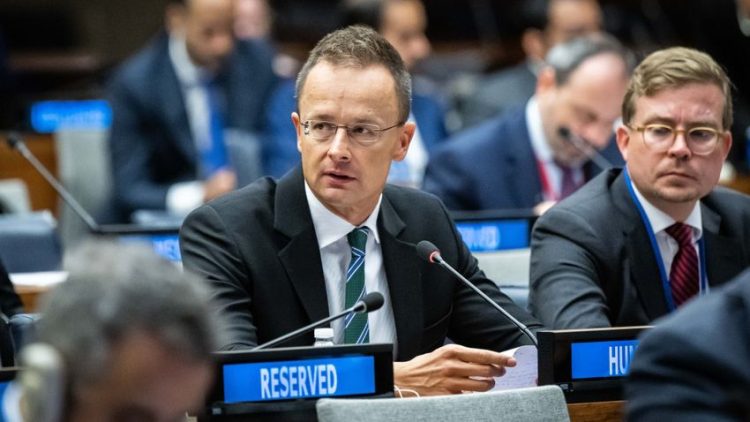
MAGYAR NEMZET | October 24, 2023
Instead of looking for ways to foster peace, the European Union’s current and planned actions only serve to extend the war, Hungarian Minister of Foreign Affairs and Trade Péter Szijjártó said after a meeting of the EU’s Foreign Affairs Council.
“It is all about war, there is no peace. Brussels is still pro-war, as shown by the fact that they would give €5 billion a year for arms over the next four years, which also shows that they expect the war to continue,” Szijjártó said. “No one in Western Europe is talking about peace, Europe is suffering from a war psychosis.”
He added that it is clear there will be no solution to the war on the battlefield. Europeans expect nothing but destruction and death, and the conditions for peace are getting worse.
“Taking arms production and training to Ukraine would drag the EU into an immediate war. We find this totally unacceptable. Nor should arms transfers be just about supplying the Ukrainians with as many weapons as possible, because the EU is not a security organization, and justifying a country’s future accession on security grounds is completely unacceptable,” Szijjártó added.
Energy sanctions are hurting Hungary, Szijjártó claimed
Speaking of the EU’s bans on Russian fossil fuels, Szijjártó said that Hungarians do not want to give up energy security in the name of some ill-defined ideals.
“On energy supplies: We didn’t talk nonsense by saying that it’s not a political issue, it’s a physical issue. We are not willing to risk the security of Hungary’s energy supply or the results of cuts in tariffs. Hungarians are not responsible for the war, we are not willing to make them pay for it,” he said.
The Hungarian foreign minister accused other member states of being covert about their dealings with Russia, unlike Prime Minister Viktor Orbán who has been honest and transparent through his recent meeting with Russian President Vladimir Putin in Beijing.
“My colleague, the Lithuanian foreign minister was blunt. He said that he expected me to clarify whether what is being said here is our own position or the Kremlin’s position. This is unacceptable to me. I reassured him that Hungary is a sovereign country with a sovereign opinion,” Szijjártó explained.
“As long as this government is in power, we are not prepared to accept any opinion from anywhere, from any geographical direction, whether there is a lot of water between us or not. I said to my Lithuanian colleague that I hope he can say the same thing with his hand on his heart,” he added.
Chinese Businessmen Literally Laughing at West’s Anti-Russian Sanctions

By Ilya Tsukanov – Sputnik – 21.10.2023
Chinese businessmen are literally laughing at the West’s sanctions packages against Russia, Russian Foreign Ministry spokeswoman Maria Zakharova has revealed.
Citing a media report from Friday indicating that the 12th package of EU sanctions may include a Lithuania-proposed ban on the export of European-made nails, tacks, drawing pins, sewing and knitting needles, radiators, and other odds and ends to Russia, Zakharova said that judging by past experience, she can hardly fathom how Russia’s Chinese partners will react to the news.
“A year ago I was at a meeting with representatives of Chinese business circles in Moscow. We were talking, and suddenly a message popped up on my phone with news that the US had adopted yet another sanctions package banning the supply of elevators and related equipment to Russia. According to the sanctions’ authors, this measure would ‘paralyze the construction industry in Russia.’ When I read this news to my Chinese colleagues, they burst out in Homeric laughter. They literally howled and roared with laughter,” Zakharova recalled in a Telegram post on Saturday.
“After the ‘sanctions hara-kiri’ of the Japanese automobile industry on the Russian market, the most incredible dream of Chinese automotive manufacturers came true. Within six months, they confirmed the veracity of the saying ‘nature abhors a vacuum’,” the spokeswoman added.
“It’s scary to imagine what kind of hysteria will begin among Chinese manufacturers of knitting needles and buttons if they learn about this Lithuanian plan to ‘destroy Russian industrial capabilities.’ Where will Lithuania put its wares if such a decision is made? I don’t know, they could put the inscription ‘to spite Russia’ on their highway made of buttons, nails, sewing and knitting needles,” Zakharova summed up.
Russian-Chinese trade has hit back-to-back-to-back record highs in recent years, reaching the equivalent of over $176 billion by the end of the third quarter of the current year. The Asian industrial giant has taken to importing record quantities of Russian energy and other natural resources, and has helped fill the gap left by European and Japanese finished goods manufacturers after their exodus from Russia in 2022.
Speaking with Chinese media ahead of his visit to the Belt and Road Initiative forum earlier this week, Russian President Vladimir Putin reported a “32 percent growth” in Russia-China trade turnover over the past year, and said that “there is every reason to believe that we will reach the $200 billion mark” by the end of 2023.
The reorientation of trade from Europe to China, India and other countries in the developing world has helped Russia weather the storm of Western sanctions and trade restrictions, with the country’s GDP growth expected to reach up to 2.5 percent in 2023 after contracting by 2.1 percent a year earlier.
NATO Baltic Drills: West Attempts to Show Russia it ‘Owns’ Region Despite Members’ Weakenesses
By Oleg Burunov – Sputnik – 07.09.2023
Saturday will see the start of NATO’s major naval drills in the Baltic Sea that are expected to involve some 30 ships and over 3,000 service members who will conduct the war games close to the Russian border. What’s the goal of these maneuvers and what signs do the drills send to Russia?
When and Where Will the Drills Take Place
As many as 14 NATO countries are due to take part in the Northern Coast 23 naval exercises that will be held on September 9-23 off Estonia and Latvia, as well as in the eastern and central areas of the Baltic Sea near the Russian border.
The drills will witness the participation of 3,000 personnel from the US, Italy, France, Finland, Estonia, Denmark, Canada, Belgium, Latvia, Lithuania, the Netherlands, Poland, and Sweden.
Thirty ships and submarines, as well as up to 15 aircraft and various land units will be involved in the exercises, which have been held in the Baltics since 2007.
What’s the Main Message?
Germany’s navy chief, Vice-Admiral Jan Christian Kaack, said that during the drills, participants “will for the first time practice how to respond to a potential Russian assault in the region.”
He added that by launching the war games, NATO countries are “sending a clear message of vigilance to Russia: Not on our watch.” According to Kaack, “credible deterrence must include the ability to attack.”
“The idea of responding to a [possible] Russian attack here with a littoral (coastal waters) interoperability exercise seems to be aimed at morale building for NATO’s Baltic members, rather than the practice of an actual strategy of response to an expected Russian action somewhere in the Baltic Sea,” retired US Air Force Lt. Col and former Pentagon analyst Karen Kwiatkowski told Sputnik.
She underscored that by deciding to conduct such massive maneuvers in the area, NATO signals to Russia that the alliance is allegedly a military force that now “owns” the Baltic Sea, “mainly because it has brought on new members Finland and, soon, Sweden, and [because] the prior Baltic members of NATO, Estonia, Latvia and Lithuania are enthusiastically anti-Russia.”
“Yet none of these countries really have large naval forces, and like everything in Europe, the economic legacy of Germany still sustains the rest of the region,” Kwiatkowski pointed out.
Why Germany Leads Drills
The Northern Coast 23 drills will be led by the German Maritime Forces Staff from its new headquarters in Rostock, which will, in fact, become NATO’s regional command center responsible for directing operations in the Baltic Sea.
The ex-Pentagon analyst said in this vein that “this particular exercise is traditionally led by the German Navy”. According to her, the drills are the “first since the German government purchased the MV Werften shipyard, with an aim at converting it from a private ship-building enterprise to a large naval arsenal and expanded HQ.”
“Part of the upgrade of the German Navy and justification for the unprecedented German state purchase of a commercial ship manufacturer that failed (with the collapse of the cruise ship industry during the government-demanded lockdowns), was the conflict in Ukraine,” Kwiatkowski added.
Dwelling on Germany’s push to expand its Baltic clout, she said that German government spending in this region, and the militarization thereof, “may also seem logical” since the US-led Western neoconservatives seek increased domestic political control in the future.
Northern Coast 23 Drills and Regional Security
Notably, the Northern Coast 23 exercises come several months after Estonian Foreign Minister Margus Tsahkna called the Baltic Sea a “NATO lake” in connection with Finland entering the alliance in April. As he explained in an interview with Newsweek, this NATO expansion is “extremely important” and a strategic game changer.
Kwiatkowski suggested that “the Western and US messages that the ‘Baltic Sea is a NATO lake’ will continue to be sent – as it has been done for the Black Sea, the Straits of Taiwan, and the South China Sea – with much the same impact.”
“Western bullying, even as its financial and military empire wanes and weakens, tends to be poorly received by the targets of that bullying, and the threats may increasingly ring empty and thus not have the desired effect,” she pointed out.
When asked what impact the upcoming NATO naval maneuvers will have on the security system in the Baltic Sea region, the former Pentagon analyst made it clear all this will depend on the alliance’s next steps.
“More practice with interoperability, growing familiarity with the littoral region, and the various naval and communication capabilities of these NATO countries [which take part in the drills] will tend to lead to more exercises of this sort, and enthuse the smaller Baltic members to spend more of their own budget on such activities,” Kwiatkowski said.
She added that it’s safe to assume that “the neoconservative foreign policy advocates and their military-industrial backers in Washington have a strategy and believe that threats and tweaks in their alliances will produce a specific outcome or response in line with that strategy.”
“I suspect the main response intended is to increase military and surveillance spending by all NATO members, in order to better control their own populations and domestic threats to their elite rule, and to some extent this is working. However, because the neoconservatives do not accurately perceive the strategies and goals of their selected enemies – Russia, and China – their own actions to shape the behavior of those competitors are inappropriate, and ineffective,” the analyst noted.
Kwiatkowski suggested that in “any serious east-west rivalry that might take place in the Baltic anytime soon, littoral operations will be limited to those related to emergency and evacuation.”
Сould Russia Be Affected?
It’s worth recalling in this vein that Russia has its own Baltic Fleet, headquartered in the Russian exclave of Kaliningrad, with ships’ crews typically observing Western naval exercises in the area from a distance. Russia last staged its own Baltic naval drills in early August 2023.
As for the forthcoming NATO naval exercises, they come amid the West’s frustration over Kiev’s “slower than expected” counteroffensive against Russian troops in Ukraine, which was described by Russian President Vladimir Putin as “a failure, not a stalemate.”
When asked what consequences could arise from the possible provocations and tensions created by the Northern Coast 23 drills and what the risks for NATO conducting exercises close to Russia are, Kwiatkowski stressed that “Any military operation or exercise poses risks of accidents, mistakes, miscommunication, confusion, and internal hijack or errors.”
“The more complex and less habitual the exercise, the bigger the risk. Combined with the hostile political leadership and possible agendas among the NATO countries at the heart of this exercise, and the presence of Kaliningrad nearby, as well as unpredictable activity from increasingly demoralized and angry Kiev politicians and activists, makes this exercise one to watch closely,” the analyst underlined.
Separately, Kwiatkowski added without elaborating that “close active contact between military forces, with possible surveillance and disruption of communications from both sides, misunderstandings, and accidents have caused problems between the Russian, Chinese and Western governments”, something that she said should be “resolved diplomatically”.
She expressed hope that “all sides will be careful, but added that “any objective person looking at military readiness and capability of a military response in the region, recognizes that it is Russia, and then the United States, who will decide how military emergencies are handled in this region.”
“The US president is for the most part a vacant shell, and it is not clear how important, time-critical decisions are being made in Washington, and who is making them. This, and the increasing desperation of those who do not wish to see a peaceful settlement of the Ukraine war, is worrisome,” the analyst concluded.
Americans urged to ‘immediately’ leave Belarus
RT | August 21, 2023
Any US citizens in Belarus should leave right away, the State Department said in a bulletin on Monday, citing new closures of border crossings by Lithuania and the possibility of more to come.
“The Lithuanian government on August 18 closed two border crossings with Belarus at Tverecius/Vidzy and Sumskas/Losha,” the department said. “The Polish, Lithuanian, and Latvian governments have stated that further closures of border crossings with Belarus are possible.”
“US citizens in Belarus should depart immediately,” the bulletin added.
Americans were urged to travel by land using the “remaining border crossings with Lithuania and Latvia,” because Poland has closed the border, or by plane, though not to Russia or Ukraine.
The Ukraine-Belarus border has likewise been closed. Meanwhile, most Western airlines have halted flights to Minsk and Western nations have closed their airspace to Belarusian and Russian flights, so it was unclear how Americans might fly out without passing through Russia.
Washington has urged its citizens not to travel to Belarus for years, first citing the Covid-19 pandemic, then the 2020 unrest following the presidential election – which the US claims to have been rigged or stolen – and since February 2022, Minsk’s support for Moscow’s military operation against Kiev.
According to the State Department, Belarus is also dangerous due to “the arbitrary enforcement of local laws, the potential of civil unrest, the risk of detention,” and the inability of the US to assist its citizens, since the embassy in Minsk “suspended operations” at the end of February 2022 .
The Polish government has increased its military presence along the border with Belarus over the past month, citing what they called a threat of “hybrid warfare” by Wagner Group fighters who left Russia at the end of July, following a failed mutiny.
Minsk has repeatedly insisted that there is no threat and that Warsaw is getting hysterical due to domestic politics ahead of the general election. Meanwhile, Moscow has warned that any attack on Belarus would be treated as an attack on Russia itself.
Neighboring countries ready to pay Zelensky to stop conflict – Seymour Hersh
RT | May 17, 2023
Poland is leading a group of European nations that are secretly urging Vladimir Zelensky to find a way to settle the conflict with Russia, veteran journalist Seymour Hersh has reported, citing a “knowledgeable” American official.
According to US intelligence, other EU countries that want to see an end to the fighting include Hungary, Germany, the Czech Republic, Lithuania, Latvia and Estonia, Hersh wrote in an article published on his Substack page on Wednesday.
“Hungary is a big player in this and so are Poland and Germany, and they are working to get Zelensky to come around,” the unnamed official claimed. Those countries have made it clear that “Zelensky can keep what he’s got if he works up a peace deal even if he’s got to be paid off, if it’s the only way to get a deal.”
By “keep what he’s got,” the source was referring to the Ukrainian president’s villa in Italy and interests in an offshore bank, Hersh clarified.
However, Zelensky has so far rejected the proposal, while other major European players – France and the UK – “are too beholden” to the Biden administration, which is continuing to back the Ukrainian leader, the official said.
One of the main reasons why Poland and the others want the conflict to end is because the burden of accommodating Ukrainian refugees has become too much for them, the Pulitzer Prize-winning journalist wrote.
The problem for those countries “is how to get the US to stop supporting Zelensky,” Hersh’s source suggested.
He claimed that US intelligence is well aware that “Ukraine is running out of money and… that the next four or months are critical. And Eastern Europeans are talking about a deal.”
However, he added that “it’s not clear to the intelligence community what the president and his foreign policy aides in the White House know of the reality.”
The US is “still training Ukrainians how to fly our F-16s that will be shot down by Russia as soon as they get into the war zone. The mainstream press is dedicated to Biden and the war, and Biden is still talking about the Great Satan in Moscow while the Russian economy is doing great,” the official explained.
Russia has repeatedly stated that it’s ready to resolve the conflict at the negotiating table. However, it did not receive any proposals from Ukraine and its Western backers that it could consider reasonable.
Zelensky has been promoting his ten-point peace plan, which calls for Russian forces to withdraw to borders claimed by Ukraine, to pay reparations, and to submit to war-crime tribunals.
Moscow has rejected the plan as “unacceptable,” saying it ignores the reality on the ground and is actually a sign of Kiev’s unwillingness to solve the crisis through diplomatic means.
Pfizer wants EU to keep paying for unused Covid jabs
RT | March 15, 2023
Pfizer has offered to extend its Covid-19 vaccine contract with the European Union while scaling back deliveries, but still expects the bloc to pay billions of euros for unused doses amid a major supply glut in some countries, the Financial Times has reported. The offer prompted outrage from a handful of member states, who say the deal would serve the interests of Big Pharma over their own citizens.
The contract extension would push the vaccine agreement out to 2026, with a proposed 40% reduction in the number of doses supplied as well as delays to deliveries, the newspaper reported on Tuesday, citing two unnamed officials.
However, despite the suggested cuts, the US pharma giant still insists that it be paid for the full number of doses originally agreed upon, many of which would never be produced under the new terms.
The amendments to the deal – the full text of which has never been made public – were presented by European health commissioner Stella Kyriakides during a closed-door meeting in Brussels on Tuesday, but faced objections from some EU members.
In a joint statement issued following the meeting, officials from Bulgaria, Hungary, Lithuania and Poland said they would not sign the agreement with the proposed changes, as they “do not present a final and fair solution to the problems of the Covid-19 vaccine surplus and do not meet the needs of the healthcare systems, the needs of citizens and the financial interests of the member states.”
Polish Health Minister Adam Niedzielski argued that the current Pfizer proposal would favor Big Pharma, and has called for the secretive contract to be published, questioning the role European Commission President Ursula von der Leyen played in the negotiations for the massive vaccine deal.
An EU watchdog launched a probe into the negotiation and procurement process late last year, after von der Leyen’s office failed to produce personal text messages sent to Pfizer CEO Albert Bourla during the talks for nearly 2 billion vaccine doses, prompting accusations of corruption.
The 27-member bloc originally signed a joint contract with Pfizer in 2020, but since the pandemic receded, demand for vaccines has steadily dropped, leaving an overabundance across the continent. Some countries have been forced to throw away vaccines, with Germany alone tossing out some 36.6 million doses, according to public broadcaster BR24, while others are sitting on large stocks of unused shots, such as Austria, which has reported around 17.5 million in its supply.
However, Czech Health Minister Vlastimil Valek pushed back on the criticisms, arguing that the “majority of countries” had agreed to the deal and that “the contract is not bad.” He added that the large stock of doses would not pose a problem as “Covid is still here” and “It will be necessary to repeat vaccination each year for a particular group of patients.”
Munich Security Conference 2023: An Exercise in Western Self-Delusion
By Scott Ritter – Sputnik – 20.02.2023
Delegates from around the world assembled in Munich, Germany on February 17, 2023, to convene an eponymously named security conference that has, since its inception in 1963, operated under the motto “Peace through Dialogue.”
For three days, world leaders participated in what has become known as “the Davos of Defense” (a reference to the World Economic Forum held in Davos, Switzerland), discussing critical security issues of the day.
This year, not surprisingly, the Russian-Ukrainian conflict dominated the agenda. What was a surprise, however, was the emphasis that western participants placed on action over discussion when it came to formulating a collective strategy for achieving some sort of conflict termination. Indeed, the dominant theme at Munich was not simply how to provide more material to Ukraine’s military, but how to do so in a manner that escalates the conflict by challenging Russia’s so-called “red lines” – regarding western support to Ukraine.
For the first time since the 1990’s, Russia was not invited to attend the conference. Instead, prominent Russian opposition figures, including exiled oil tycoon Mikhail Khodorkovsky, chess champion Gary Kasparov, and Yulia Navalnaya, the wife of the imprisoned opposition leader Alexei Navalny, were invited. The chairman of the conference, Christoph Heusgen, explained this pointed deviation from the principle of promoting dialogue by declaring that he did not want to be seen as providing a platform for Russian propaganda.
Instead, it turned out, Heusgen turned the floor over to western propagandists.
The underlying theme in Munich went beyond an escalation of support for Ukraine, and instead embraced the outright provocation of Russia. Lithuanian President Gitanas Nauseda served as the pace-setter for this trend when, prior to the Munich Security Conference, he urged western leaders to consider providing Ukraine with “essential military aid” such as tanks, fighter aircraft, and long-range missiles, despite long-standing concerns by the west that the provision of such aid would be seen by Russia as evidence of direct participation by the providing parties in the conflict. “These red lines,” Nauseda declared, “must be crossed.”
On cue, Ukraine’s President Volodymyr Zelensky opened the conference with an appeal, delivered via video and designed to underscore a sense of urgency.
“We need to hurry up,” Zelensky declared. “We need speed—speed of our agreements, speed of our delivery, speed of decisions to limit Russian potential. There is no alternative to speed because it is the speed that the life depends on,” Zelensky said, concluding that there was “no alternative to a Ukrainian victory.”
But Zelensky’s exhortations for speed appeared to fall upon deaf ears when it came to two of Europe’s most important leaders. Both Germany’s Olaf Scholz and France’s Emmanuel Macron underscored that, from their perspective, the conflict in Ukraine would not be ending anytime soon. “I think it’s wise to prepare for a long war,” Scholz noted in his remarks to the conference, a sentiment Macron echoed by saying that Europe should prepare for a “prolonged conflict in Ukraine.”
Declaring that now was “not the time for dialogue,” Macron urged his fellow conference attendees to action. “We absolutely need to intensify our support and our effort to the resistance of the Ukrainian people and its army,” Macron said, and “help them to launch a counter-offensive which alone can allow credible negotiations, determined by Ukraine, its authorities and its people.”
There is a fundamental disconnect between the frenetic urgings of President Zelensky and the long-term approaches taken by Scholz and Macron that point to an overall atmosphere of self-delusion that seemed to dominate the Munich Security Conference.
While US Vice President Kamala Harris spoke of bringing Russian leaders “to justice” for alleged war crimes in Ukraine, the Ukrainian military is being systemically ground down on the battlefields of eastern Ukraine, soil that Russia now claims for its own. Current NATO military commander, Lieutenant General Christopher Cavoli, has described these battles as being “out of proportion” to NATO plans and capabilities in terms of the “scope and scale” of the violence being perpetrated on the ground by both parties to the conflict.
Rather than accept the inevitability of a Ukrainian military defeat, however, Cavoli briefed US lawmakers on the sidelines of the Munich Conference that, in his opinion, Ukraine should be provided with modern jet aircraft, including F-16 fighters, and long-range missiles capable of striking targets deep inside Russian territory. These weapons, Cavoli said, would enable Ukraine to fight what he termed “the deep fight”, shifting the emphasis from the deadly fighting at the point of direct engagement to a new war where Ukraine would disrupt the Russian war effort by striking headquarters and supply lines deep behind the frontlines.
In short, Cavoli was outlining an escalatory strategy brought to life by Lithuanian President Gitanas Nauseda’s earlier exhortations to cross all “red lines” when it came to supporting Ukraine.
But simple rhetoric cannot bridge the yawning gap that exists with reality. Words, especially in an environment like this year’s Munich Security Conference, where all pretense at dialogue has been forsaken in favor of the construction of a pro-western echo, resonate in a manner which promotes an artificial sense of substance. But unless these words are backed by concerted action, they carry no weight and will soon dissipate into nothingness.
This, in short, is the reality of the Munich Security Council—an exercise in self-delusion, similar in construct to the discussions around the conference table in the last days of the Battle of Berlin in 1945, in which Adolf Hitler moved imaginary armies around in a vain effort to seize victory from the inevitability of defeat.
The fact is, there are no tanks, no long-range missiles, no fighter aircraft available in any realistic time-frame that can help Ukraine reverse the deterioration of its military posture vis-à-vis Russia. Zelensky’s demands for urgency reflect a growing recognition on his part that, if left on the current trajectory, the war with Russia will be over soon—perhaps as early as August 2023. The inability and/or unwillingness on the part of the western military and civilian leadership to match their declarations of support with Zelensky’s timeline demonstrates an absolute divorce from reality on the part of those who were gathered in Munich, or else the cynicism of those who know the tragic fate that awaits those they claim to support only too well.
The harsh truth that the participants of the Munich Security Conference know, but cannot speak, is that there is no hope for a Ukrainian victory over Russia.
Editor-in-chief of Russian news outlet arrested in Latvia
Marat Kasem from Sputnik Lithuania has been accused of espionage and could face up to 20 years behind bars

Journalist, editor-in-chief of Sputnik Lithuania Marat Kasem © Sputnik / Nina Zotina
RT | January 5, 2023
Latvia has arrested the editor-in-chief of the Lithuanian branch of the Russian Sputnik news agency. Marat Kasem was taken into custody on a court order, his lawyer announced on Thursday.
The journalist is accused of breaching EU sanctions and charged with espionage, Sputnik reports.
Kasem’s lawyer, Imma Jansone, has not yet been able to review his case materials, according to the news outlet. Jansone asked the court to release the journalist on bail but a judge decided to leave him in custody. Kasem was immediately transferred to Riga’s central jail on Thursday.
Kasem is a Latvian citizen, although he has been living in Moscow for several years working for the Rossiya Segodnya media group, with Sputnik Lithuania being a part of it. Before the New Year’s Eve, the journalist returned to Latvia for family reasons.
Moscow would request assistance of international organizations over Kasem’s arrest, the Russian Foreign Ministry’s spokeswoman, Maria Zakharova, said. She also blasted the move as a violation of Latvia’s international commitments in the field of freedom of speech protection.
Talking to the RIA Novosti news agency, the head of the Rossiya Segodnya media group, Dmitry Kiselyov, branded Kasem’s arrest “absurd” and “lawless.” He also called such actions a “dangerous tendency” affecting all of the EU. Kiselyov said that Kasem previously frequently spoke of a feeling of being politically persecuted.
Kasem had already faced persecution in the Baltic States before his arrest. Back in 2019, he was detained on arrival to the Vilnius airport and labeled “a threat to the national security” of Lithuania. He was then deported to Latvia. At that time, it was revealed that the journalist was put on a blacklist of people barred from entering Lithuania altogether.
In 2018, another Russian journalist, Sputnik Latvia’s editor-in-chief, Valentin Rozentsov, was detained at Riga airport. He was held in police custody and interrogated for 12 hours before being released. In 2021, Moscow slammed persecution of Russian journalists in the Baltic States as a “flagrant attack on democracy” and considered what it called degradation of media freedoms there “concerning.”
The developments come as the three Baltic nations keep one of the most hardline stances on Moscow’s actions amid the ongoing conflict in Ukraine. Last month, Latvia, Lithuania, Estonia, as well as Poland and Slovakia all lodged a formal protest against French President Emmanuel Macron’s proposal that NATO should offer Russia security guarantees, according to Reuters.
US troops are combat ready on Russian border – Lithuanian commander
RT | December 2, 2022
The US forces stationed in Lithuania have switched their stance from deterrence of Russia to combat readiness, Lithuanian Chief of Defense Lieutenant General Valdemaras Rupsys has said. The country shares a border with Russia’s Kaliningrad exclave on the Baltic Sea, as well as with Belarus and Latvia.
“The main factor used to be deterrence, the demonstration that they were here and could increase our forces at any time,” Rupsys told radio LRT on Friday.
“And now the situation has changed: those units are being deployed so that they can fight immediately. It’s a seamless … transition from one mode to another.”
“At least until 2025, we will have rotating US units that will carry out military training and serve as a factor of deterrence, but also will be ready to carry out defensive actions together with us and other allies,” he added.
The chief of defense said on Wednesday that he had been assured by the Chairman of the US Joint Chiefs of Staff General Mark Milley that American troops would have “a persistent presence in Lithuania.”
Battalion-sized US units with around 500 troops, Abrams tanks and Bradley armored vehicles have been stationed on a rotation basis in the eastern Lithuanian city of Pabrade since 2019. NATO also maintains a German-led multinational unit in the country.
The US-led bloc announced the enhancement of its military capabilities in response to Russia’s military operation in Ukraine, which began in February. NATO Secretary General Jens Stoltenberg said in June that the alliance’s rapid-response force would grow from around 40,000 to over 300,000.
Moscow has repeatedly stated that it considers NATO troops near its borders a national security threat. Foreign Minister Sergey Lavrov said on Thursday that the bloc’s actions signify its return to “conceptual priorities” adopted during the Cold War.
Featured Video

No Threat Can Force Iran’s Surrender /Trita Parsi & Lt Cl Daniel Davis
or go to
Aletho News Archives – Video-Images
From the Archives
An Expert Military Analysis of War with China
Actually, None is Necessary
By Fred Reed • Unz Review • December 13, 2020
The Correlation of Armed Forces: U.S. goods and services trade with China totaled an estimated $634.8 billion in 2019. Exports were $163.0 billion; imports were $471.8 billion. The U.S. goods and services trade deficit with China was $308.8 billion in 2019. Trade in services with China (exports and imports) totaled an estimated $76.7 billion in 2019. Services exports were $56.5 billion; services imports were $20.1 billion. The U.S. services trade surplus with China was $36.4 billion in 2019.
There is talk within the Washingtoniat of a possible war with China. Steve Bannon, who apparently was dropped on his head as a child, actually favors such a war. We hear the usual shoo-the-boobs alarm about how the Chinese are doing something terrible and we must gird our loins and American values and show them what for, bow wow, woof. The danger is that the current game of who-blinks-first in Asian waters might actually provoke a shooting war. You know the kind of thing: One warship refuses to get out of the way of another, a collision ensues, some retard lieutenant who signed up on waivers opens fire, and we’re off and running. It is not a good idea to let children play with matches.
The said war is discussed either in emotional terms by idiots or in purely naval terms by those familiar with such things, so we hear of the First Island Chain and the Second Island Chain and whose missiles against the other’s missiles and so on. This would be appropriate if we were fighting World War Two again. Which we aren’t. Let’s take a quick-and-dirty look at how such a war might go.
To begin the war, America would overestimate itself and underestimate China. This is doctrine in the Pentagon. … continue
Blog Roll
 Aletho News
- Iran To Target Military Industrial-Tech Complex That Facilitated Gaza Genocide
- Collapsing Empire: The Resistance Disarms ‘Israel’
- Suicide Should Not Be a Government Service
- Rethinking America’s greatest threat: Iran vs. Israel-Firsters
- Iran accuses adversaries of false flags to strain Turkey ties
- Poland rules out sending Patriot missiles to US/Israel amid war on Iran
- Tehran approves new Hormuz plan with major restrictions
- No Threat Can Force Iran’s Surrender /Trita Parsi & Lt Cl Daniel Davis
- UK’s New Pandemic Plan Would Turn Big Tech Into a Mass Location Tracking Network
- Growing insecurity, soaring prices fuel protests in north as regime bans evacuation: Sources
- If Americans Knew
- Joe Kent Urges Americans To Call White House and Congress To Object To Sending Troops Into Iran
- DNC Resolution to Reject AIPAC Funding Puts Democratic Leaders in the Hot Seat
- Swedish foundation to build 400 schools as over 650,000 Gaza children remain without education for 2 years
- Israeli army admits photshopping image of slain Lebanese journalist
- This is how Israel is systematically killing health workers under the cover of war in Lebanon
- Carrying life under fire: Israeli invasion of Lebanon leaves pregnant women facing deadly risks
- Champagne all around for the new death penalty (for Palestinians) law – Not a ceasefire Day 172
- Why are Palestinian books struggling to be seen on Amazon?
- The Line Between Affinity and Conspiracy
- As Iran targets US military bases, will they be relocated to Israel? Not a ceasefire Day 171
- No Tricks Zone
- New Study Finds Warming Saves Lives…Cold Temperatures 12 Times More Deadly Than Excess Heat
- German Science Blog Accuses PIK Climate Institute Of Hallucinating Climate Tipping Points
- Devastating Assessment Of Comirnaty Vaccine By Former Senior Pfizer Europe Toxicologist
- New Study: CO2 Is ‘Effectively Negligible’ As An Explanatory Climate Change Factor Since 2000
- Former Pfizer Toxicologist Dr. Helmut Sterz Tells Bundestag Hearing Pfizer Vaccine Should Have Never Been Approved
- Energy Expert: Germany’s Nuclear Phaseout Was A “500 Billion Euro Mistake”
- New Research: South Australia’s Mid-Holocene Sea Surface Temperatures Were 4°C Warmer Than Today
- Storing Green Energy To Last Germany 10 Days Would Require A 60-Million Tonne Battery
- New Studies: UK Sea Levels Were 4 Meters Higher Than Today During The Mid-Holocene
- Destructive Green New Deal: German Energy And Metal Group Warns Of Drastic Crisis
 Aletho News