Netanyahu: I did not commit to freeze settlement construction
MEMO | March 7, 2014
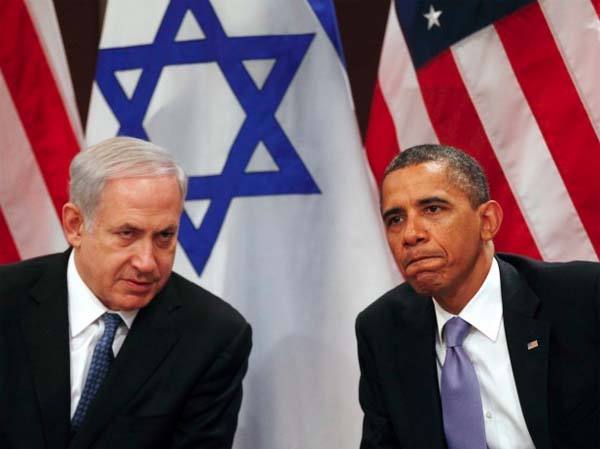 Israeli Prime Minister Benjamin Netanyahu said that he did not commit to freezing settlement construction during his meeting with US President Barack Obama and that he will reject any agreement with the Palestinians that does not meet Israel’s security needs.
Israel Radio quoted Netanyahu on Friday, on his way back to Israel, telling Israeli journalists that he considered extending the negotiating period between the Israelis and Palestinians in US Secretary of State John Kerry’s framework agreement unlikely to make a difference for the Israeli coalition government, as most of its members reject the idea of establishing a Palestinian state.
He added that he will reject any agreement with the Palestinians that “does not meet Israel’s needs and poses a threat to its security, even if there are attempts to impose such an agreement on Israel.”
Netanyahu refused the possibility of unilateral withdrawal from the West Bank territories if the negotiations fail, stating that he does not prefer this possibility and that “the unilateral withdrawals (from south Lebanon and the Gaza Strip) have not justified themselves nor did they provide security stability for Israel”.
Netanyahu returned to Israel today following his visit to the US which started on Sunday in which he met with Obama in the White House and gave a speech to the American Israel Public Affairs Committee (AIPAC) on Tuesday.
Palestinian President Mahmoud Abbas announced, while receiving a delegation from the Israeli left-wing party Meretz a few days ago, that he is not opposed to extending the negotiations period, but demands that settlement construction is suspended and prisoners are released.
Related article


US: Peace deal will recognize Israel as “Jewish state”
Al-Akhbar | February 21, 2014
The US ambassador to Israel Dan Shapiro asserted that the Israeli-Palestinian peace deal currently being negotiated by US Secretary of State of John Kerry will include recognition of Israel as “the nation state of the Jewish people”,The Times of Israel reported on Friday.
Citing an interview Shapiro conducted with Israel Radio on Friday morning, The Times of Israel quoted him as saying, “It’s too early to know what compromises and concessions both sides will make. But we do believe… that Israel deserves recognition as a Jewish state. That has always been US policy — that Israel is a Jewish state and should remain a Jewish state. That will be one of the elements of the framework we’re working on.”
“I assume that under the framework that we’re currently preparing, that we’ll see that recognition of Israel and a Jewish state, as the nation state of the Jewish people, will appear in the framework,” he added.
“And in the end, we’ll need to know that this is the end of the conflict, and that’s one way of verifying that… that everyone in the region and all of [Israel’s] neighbors will accept that there is a nation state of the Jewish people here, in the Jewish homeland.”
Shapiro’s comments come a day after US Secretary of State John Kerry and Palestinian Authority President Mahmoud Abbas held more than two hours of “constructive” talks on Israeli-Palestinian peace on Thursday, their second session in as many days.
Israeli-Palestinian peace talks resumed on July 29 after a nearly three-year break. At the time, Kerry said, “Our objective will be to achieve a final status agreement over the course of the next nine months.”
As that deadline has approached, US officials appear to have scaled back their ambitions, saying they are trying to forge a “framework for negotiations” as a first step though they still hope to hammer out a full agreement by April 29.
Israel’s demand on recognition of its Jewishness is a recent addition to its list of final-status issues to be resolved with the Palestinians in a negotiated settlement, and the ultra right-wing government has rapidly forced it to the top of agenda, making it all but a precondition for entering talks.
Palestinians have refused to recognize of Israel as a “Jewish state” because it would ultimately signify the end of the right of return for Palestinian refugees who were ethnically cleansed by Zionist forces in 1948, as well as offer legitimacy to the discrimination of the remaining non-Jewish population within the 1948 borders.
The right of return is for individuals to decide, not for Abbas to concede
By Ibrahim Hewitt | MEMO | February 19, 2014
Yet again, we hear that President Mahmoud Abbas has more or less conceded the lawful right for Palestinian refugees to return to their homeland. Last year he told Israelis that although he would like to visit his birthplace in Safed, which is now in Israel, he did not expect to live there. Now he has told a group of Israelis visiting Ramallah that he has no wish to “drown the Jewish character” of Israel with returning refugees. This is an astonishing thing for him to say because its implications are so serious.
For a start, let us make it clear that the right to return is an individual right so it is not within the Palestinian Authority leader’s power to concede it on behalf of anyone other than himself. It may be that he was well aware of that when he signalled his own reluctance to return to Safed but his latest statement is worrying for the millions of refugees festering in squalid UN-run camps around the region.
One journalist said that Abbas’s comments “seemed to signal a significant concession on the so-called right of return – the Palestinian demand that several million descendants of 700,000 refugees expelled during Israel’s 1948 war of independence be allowed to go back to their homes.” For the benefit of the Daily Telegraph’s Robert Tait, it should be remembered that the right to return is not a “Palestinian demand”, it is enshrined in UN General Assembly Resolution 194 dated 11 December 1948: “… refugees wishing to return to their homes and live at peace with their neighbours should be permitted to do so at the earliest practicable date…” Israel’s membership in the UN was conditional inter alia on it implementing this resolution, something which, of course, it has never done.
Israel’s unilateral “Declaration of Independence” of 1948 is clear that it was established as “the Jewish State in Palestine”. Among other things, the founding document insists that Israel “will loyally uphold the principles of the United Nations Charter”, among which is a commitment to implement resolutions; Israel has ignored more UN resolutions than it has ever implemented.
This “Jewish State” was recognised implicitly by the Palestine Liberation Organisation (PLO) in 1993 when the former “terrorist” group came in from the cold and recognised Israel’s “right to exist”. That being the case, it must be asked why Benjamin Netanyahu is insisting on Palestinian recognition of the “Jewish character” of Israel as a pre-condition for a peace agreement.
Experience shows that Israel is an expansionist state; it has never declared its borders and has grown exponentially ever since it was created. Indeed, even by then it had morphed itself from the “national home for the Jewish people” in Palestine mentioned in the infamous Balfour Declaration of 1917 to a “Jewish State” by 1948. The land it occupied by the 1949 armistice was greater in area than the allocation of the UN Partition Plan of 1947; this was increased yet again when Israel launched the Six-Day War in 1967 and occupied all of historic Palestine. While not occupying the Gaza Strip physically since 2005, Israel controls its borders, territorial waters and air space; it is an occupation legally and in all but name. As the “negotiations” (a euphemism for Palestinian concessions) drag on for 20 years and counting, Israel creates more facts on the ground, grabbing ever more land for its illegal settlements, settler-only roads, military zones and “nature reserves”. I think that it is fair to say that Israel’s leaders have no intention whatsoever of giving up any land upon which Jews are now living as they push to create “Eretz Israel”, the Greater Israel that is Zionism’s dream.
Recognition of the “Jewish character” of Israel will give it the green light to complete the ethnic cleansing started in 1948, with the 20 per cent of non-Jewish Israeli citizens being “transferred” to the rump statelet of Palestine that may or may not come into being; ideally, from a Zionist perspective, the transfer won’t end there and life will be made so miserable for Palestinians in the West Bank that they will cross into what many Israelis already call the state of Palestine; the rest of us know this as the Hashemite Kingdom of Jordan. This is the “alternative homeland” scenario dreaded by Palestinians who have no wish to leave their historic homeland.
Israel will cite “security” concerns in order to get its way, though, and willing dupes like US Secretary of State John Kerry, ever-ready to do the pro-Israel Lobby’s bidding, will put pressure on the Palestinian Authority to concede even more than it has already. This includes agreement to a strong Israeli military presence in the Jordan Valley, so that an “independent state of Palestine” will be nothing of the sort; it will have an army of occupation on its territory from Day One.
Once Israel is cleared of the “demographic time-bomb” of its Palestinian citizens it can claim, with hand on heart, that it is indeed both Jewish and democratic in nature. Fear of being an obvious apartheid state with a democratic façade is genuine; Jewish students in America are already being coached about how to defend the case for declaring a Jewish state while basically disenfranchising 1-in-5 of Israel’s citizens and implementing a raft of discriminatory laws.
That is why Mahmoud Abbas needs to wake from his stupor and understand that while he is free to give up his own right of return, he has no right whatsoever to concede that right for all Palestinian refugees. Israel and its Western backers will, of course, continue to ignore the UN resolutions in any case and so won’t mind that the legal niceties are chewed up and spat out as long as what Israel wants, Israel gets. But that will never produce a just and lasting peace in the region. Maybe that doesn’t bother the military-industrial complex upon which Israel is so reliant; it certainly won’t bother the neoconservatives running America. Their plans for the Middle East don’t include a state of Palestine; they want to see US-Israeli hegemony at any cost.
More than anything else, Abbas’s ill-advised statements demonstrate the ridiculous nature of the whole peace process, which is producing neither peace nor much of a process at the moment. The one-state solution is being talked about in all sorts of circles these days, as more and more people realise and accept that two-states are a non-starter. If the message can get through to Mahmoud Abbas and his cronies in Ramallah on board the Palestinian Authority gravy train, maybe peace will have a chance after all.
Related articles
Hamas slams Abbas’s recent remarks to New York Times
Palestine Information Center – 04/02/2014
GAZA — Hamas spokesman Sami Abu Zuhri strongly denounced de facto president Mahmoud Abbas for his recent press remarks to a US newspaper and said that the views he expressed pose a threat to Palestinian cause and only represent himself.
Spokesman Abu Zuhri stated that the ideas that were voiced by Abbas in press remarks to the New York Times newspaper do not reflect the national consensus which rejects the negotiations and any solution against Palestinian rights and constants.
Abbas told the New York Times on Monday that he refuses demands made constantly by Palestinian parties to join some UN bodies or go to the international criminal court, adding that he wants to exhaust his negotiation with the Israelis before making any such move.
Palestinian Authority President Mahmoud Abbas said he would be willing to allow a US-led NATO force to patrol a Palestinian state for an indefinite amount of time, adding that the Israeli army and settlements could remain for five years rather than three years as he had told the Americans before.
Abbas also said the Palestinian state would be demilitarized and have only a police force and the NATO force, affirming that he would not allow the return of the armed struggle in the Palestinian state.
He called recognizing Israel as a Jewish state out of the question and said he would agree on extending the nine-month negotiations, which started in July last year, if progress was made.
Official: PLO committee agrees on steps for joining UN bodies
Ma’an – 26/01/2014
BETHLEHEM – A political committee of 12 members representing the Palestine Liberation Organization’s various factions convened in Ramallah and agreed on recommendations to take the Palestinian plight to the UN and its various bodies, a PLO official said on Saturday.
Hanna Amirah, a member of the Executive Committee of the PLO, told Ma’an on Saturday that the committee recommended addressing the United Nations regardless of whether the ongoing peace talks make any progress or not, although he added that a date had not been set.
The goal of these recommendations, he said, is to enhance the Palestinian position. However, Palestinian Authority president Mahmoud Abbas and the PLO Executive Committee need to approve them before they can be put into effect.
The Palestinian Authority is currently trying to counter demands made by the United States and Israel, added Amirah.
He asserted that the recent suggestions made by the US Secretary of State John Kerry were completely unacceptable to the Palestinians.
He highlighted that the proposals made related to Jerusalem, to Israeli settlements, and to Palestinian refugees were unacceptable in particular as well as the proposed Israeli military and civilian presence in the Jordan Valley.
Earlier this week, PLO official Wasil Abu Yousif, who is a member of the PLO’s political committee, said the committee agreed on prerequisites the PA needs to fulfill before signing international conventions and joining UN agencies and different bodies.
It is of great importance, he added, that the PA joins the International Criminal Court because that will enable the PA to sue the Israeli occupation over war crimes and crimes against humanity.
Related articles
Anti-boycott academics demonstrate lack of excuses in supporting Israel
By Dr Sarah Marusek | MEMO | December 16, 2013
In recent days, a group of American scholars have been debating publicly whether or not to boycott Israel. According to the New York Times, the American Studies Association (ASA) will disclose today the results of its members’ vote on a resolution to endorse an academic boycott of Israel that was approved unanimously by the association’s National Council on 4 December. This follows a decision last April by the Association for Asian American Studies to endorse the academic boycott, which only focuses on institutions, so does not include Israeli scholars as long as they do not represent Israeli universities or the government.
Meanwhile, last week the president of Palestine categorically rejected any boycott of Israel. Speaking to reporters in South Africa, President Mahmoud Abbas stated firmly that, “No, we do not support the boycott of Israel,” citing the Palestinian Authority’s relationship with Tel Aviv. Instead, Abbas only supports boycotting products made in illegal settlements.
By confining the Palestinian people to a “we” that only consists of the PA, based in the West Bank, Abbas is symbolically ceding East Jerusalem to the occupiers, since under the Oslo Accords the PA is prohibited from carrying out any activities there. In addition, he is turning his back on those Palestinians in Gaza who are suffering under a draconian Israeli-led siege, a fate far worse than any proposed boycott. He is also abandoning the millions of Palestinian refugees who are being denied their right of return, as upheld by UN resolution 194.
Indeed, by placing the relationship that the PA has with Israel above the daily humiliations the Palestinians are forced to endure under Israel’s military occupation, Abbas has clearly put aside the rights of his own people, reaffirming once again his own illegitimacy (his term of office actually expired in 2009).
With these remarks Abbas has illustrated that he is out of touch not only with the Palestinian people, but also with the international community. The world is increasingly supportive of the boycott of Israel as called for by the Palestinian Campaign for the Academic and Cultural Boycott of Israel (PACBI), launched in Ramallah in 2004 by a group of Palestinian academics and intellectuals, as well as the wider international Boycott, Divestment and Sanctions (BDS) movement, launched by Palestinian civil society in 2005.
Indeed, this week Haaretz cited “new research published by the Molad Centre for Renewal of Democracy”, a progressive Israeli think tank, which “addresses Israel’s standing in the world”. The group’s research findings suggest that “Israel is particularly vulnerable to sanctions and boycotts by Western countries due to the animosity of neighbouring countries, and because 40 per cent of Israel’s Gross National Product is based on exports, primarily to Europe.” The findings, adds Haaretz, also “show that Israeli businessmen, artists and academics are confronting increasing refusal of international agencies and potential partners to collaborate with them.”
But at least Israel still has the support of Abbas, who continues to carry out the charade of a US-brokered “peace process” while Israel carries on building more illegal settlements.
Interestingly, both Abbas and the whole “peace process” share the same framework as those American scholars who have campaigned to reject the ASA resolution to endorse an academic boycott of Israel; this is no coincidence. All those refusing the boycott are employing a “rights-based” framework that seems to recognise the rights of everybody but the Palestinians.
Members of the ASA had until 15 December to decide whether or not to back the boycott resolution; opponents of the boycott have been tireless in making their case against it. Similar to Abbas and the “peace process”, they all end up denying Palestinians their rights, either directly or indirectly.
For example, only two days after the ASA resolution was proposed, the American Association of University Professors (AAUP) called upon ASA members to vote down the motion. In an open letter, the president and vice president of AAUP argue: “In seeking to punish alleged violations of academic freedom elsewhere, such boycotts threaten the academic freedom of American scholars to engage the broadest variety of viewpoints.”
Of course, the “alleged violations” of Palestinians’ academic freedom include the fact that the occupation authorities place unfair bureaucratic obstacles on Palestinian universities, close institutions by military orders, ban textbooks, and prevent Palestinian students and their lecturers from travelling to and from class. During the 2006 aggression against Gaza, Israel deliberately bombed the Islamic University, as well as 18 schools. Despite this, when efforts are proposed to try to redress these injustices, the AAUP says no because it will infringe upon the rights of American scholars.
Although the AAUP letter also reaffirms the association’s “stand in opposition to academic boycotts as a matter of principle”, it gave active support to the boycott against South Africa’s apartheid regime. As David Lloyd, a professor of literature at the University of California, points out, “That movement did call for individual boycotts of South African scholars, cultural workers, and sports persons,” whereas “PACBI’s call is specifically and exclusively institutional.” So it seems pretty clear that the AAUP’s position is not related to the rights of scholars, but only to the rights of American scholars; it is not a principled stand against boycotts per se, but a stand against the boycott of Israel in particular.
To take another example, in an open letter to the president of ASA, Claire B. Potter, a professor of history at The New School, suggests: “Scholars of any nation ought to be free to travel, publish and collaborate across borders; I consider this to be a fundamental human right, and so does the United Nations. We in the American Studies Association cannot defend some of those human rights and disregard others.”
The irony of such a statement is acute. By only granting the right of education to “scholars of any nation” Potter is denying this right to Palestinians, as well as to all stateless persons, whereas the UN insists that “all peoples and all nations” have this right. Thus, her position is actually doing precisely what she warns against – defending the rights of some and disregarding others. Considering America’s history of trampling the rights of Native Americans and African Americans, Potter’s turn of phrase is especially ill-thought.
And although Potter does recognise that there are people who are “suffering under, and threatened by, the exclusions, violence and expulsions that are characteristic of Israel’s occupation of Palestinian lands”, she argues that the proposed boycott would impact on “anti-occupation academics, including Palestinian scholars employed by Israeli institutions.”
While it is nice that Potter is at least trying to think about the rights of Palestinian scholars, a recent Haaretz survey of Israeli research universities “found few Arab scholars in the highest professional level at each university. Hebrew University has two Arab professors at the highest level out of 20 senior faculty members. Ben-Gurion University has 13 Arab professors out of 451, five at the highest level and eight in lower positions. Haifa University has two Arab professors at the highest rung and 10 in lower levels, out of 265 professors.” Tel Aviv University officials said that they have about 25 senior Arab faculty members there. The university boasts a 25:1 ratio of student to faculty, so with 30,000 students this means that it employs around 1,200 professors in total. At “Bar-Ilan University there are two senior Arab faculty members. Ariel University’s 80 professors include not a single Arab.”
Considering that Palestinians comprise around 20 per cent of the Israeli population, and almost 50 per cent of the total population when including the occupied Palestinian territories, these numbers are even more shocking. The opportunities for Palestinian students are almost as limited. According to a special report published by the Washington Report for Middle East Affairs, Palestinians make up just 11.2 per cent of all undergraduates, 6.1 per cent of all master’s students, and only 3.5 per cent of all PhD students.
Thus it seems more than a bit unfair to privilege the rights of a few dozen anti-occupation scholars while ignoring the rights of millions of Palestinians, regardless of their politics.
In yet another example of an American scholar using a “rights based” framework to promote the rights of some over others, Mark Rice, a professor of American Studies at St. John Fisher College, says that he opposes the ASA boycott because “the primary role of a professional academic organisation is to advocate for the needs and concerns of its members within their professional lives.” Again, he too is presenting the argument that the rights of American scholars ought to come first, in this case to enhance our own professional careers, thus perhaps raising the tyranny of “rational choice theory” to a whole new level.
Rice also rejects the boycott because he thinks that ASA members will be “discouraged from pursuing Fulbright research or teaching opportunities in Israeli universities, as Fulbright opportunities typically require explicit affiliation with host institutions. That, to my mind, is a restriction of the academic freedom of individual scholars.”
This seems a reasonable concern. That is, until you look at the countries where Fulbright grants are being offered. During the 2014-2015 academic year Fulbright awards will not be available to scholars wanting to study in: “Algeria, Gaza, Iran, Iraq, Lebanon, Libya, Qatar, Saudi Arabia, Syria, Tunisia, the West Bank, or Yemen.” What Middle East countries are left? Bahrain, Egypt, Israel, Jordan, Kuwait, Morocco, Oman and the United Arab Emirates; all are current allies of the US government. One can only wonder if Rice has anything to say about that.
Of course, there are also American scholars who are adopting a much cruder framework for completely rejecting any boycott of Israel. For example, Larry Summers, the former president of Harvard University and former US Treasury secretary, suggests simply that targeting Israel is “anti-Semitic in effect”. Furthermore, while he insists ardently that boycotts are against the principle of academic freedom, he also hopes that universities will stop funding faculty participation in ASA if the resolution is passed.
Regardless of whether ASA members choose to uphold the boycott or not, what having this public debate highlights more than anything else is that those who continue to support Israeli apartheid and occupation are quickly running out of excuses.
Related article
The Plot Thickens: Gaza is Flooded with Sewage and Conspiracies
By Ramzy Baroud | Palestine Chronicle | November 27, 2013
The latest punishment of Gaza may seem like another familiar plot to humiliate the strip to the satisfaction of Israel, Mahmoud Abbas’s Palestinian Authority, and the military-controlled Egyptian government. But something far more sinister is brewing.
This time, the collective punishment of Gaza arrives in the form of raw sewage that is flooding many neighborhoods across the impoverished and energy-chocked region of 360 km2 (139 sq mi) and 1.8 million inhabitants. Even before the latest crisis resulting from a severe shortage of electricity and diesel fuel that is usually smuggled through Egypt, Gaza was rendered gradually uninhabitable. A comprehensive UN report last year said that if no urgent action were taken, Gaza would be ‘unlivable’ by 2020. Since the report was issued in August 2012, the situation has grown much worse.
Over the years, especially since the tightening by Israel of the Gaza siege in 2007, the world has become accustomed to two realities: the ongoing multiparty scheme to weaken and defeat Hamas in Gaza, and Gaza’s astonishing ability to withstand the inhumane punishment of an ongoing siege, blockade and war.
Two infamous wars illustrate this idea: The first is Israel’s 22-day war of 2008-9 (killing over 1,400 Palestinians and wounding over 5,500 more) and the second is its more recent war of Nov 2012 – eight days of fighting that killed 167 Palestinians and six Israelis. In the second war, Egypt’s first democratically-elected president Mohammed Morsi was still in power. For the first time in many years, Egypt sided with Palestinians. Because of this and stiff Palestinian resistance in Gaza, the strip miraculously prevailed. Gaza celebrated its victory, and Israel remained somewhat at bay – while of course, mostly failing to honor its side of the Cairo-brokered agreement of easing Gaza’s economic hardship.
In relative terms, things seemed to be looking up for Gaza. The Rafah border crossing between Gaza and Egypt was largely opened, and both Egypt and the Hamas governments were in constant discussions regarding finding a sustainable economic solution to Gaza’s many woes. But the ousting by General Abdel Fatah al-Sisi of President Morsi on July 3 changed all of that. The Egyptian military cracked down with vengeance by shutting down the border crossing and destroying 90-95 percent of all tunnels, which served as Gaza’s main lifeline and allowed it to withstand the Israeli siege.
Hopes were shattered quickly, and Gaza’s situation worsened like never before. Naturally, Cairo found in Ramallah a willing ally who never ceased colluding with Israel in order to ensure that their Hamas rivals were punished, along with the population of the strip.
Citing Gaza officials, the New York Times reported on Nov 21 that 13 sewerage stations in the Gaza Strip have either overflowed or are close to overflowing, and 3.5 million cubic feet of raw sewage find their way to the Mediterranean Sea on a daily basis. “The sanitation department may soon no longer be able to pump drinking water to Gaza homes,” it reported.
Farid Ashour, the Director of sanitation at the Gaza Coastal Municipalities Water Utilities, told the Times that the situation is ‘disastrous’. “We haven’t faced a situation as dangerous as this time,” he said. But the situation doesn’t have to be as dangerous or disastrous as it currently is. It has in fact been engineered to be that way.
Gaza’s only power plant has been a top priority target for Israeli warplanes for years. In 2006 it was destroyed in an Israeli airstrike, to be opened a year later, only to be destroyed again. And although it was barely at full capacity when it operated last, it continued to supply Gaza with 30 percent of its electricity needs of 400 megawatts. 120 megawatts came through Israel, and nearly 30 megawatts came through Egypt. The total fell short from Gaza’s basic needs, but somehow Gaza subsisted. Following the ousting of Morsi and the Egyptian military crackdown, the shortage now stands at 65 percent of the total.
In an interview with the UN humanitarian news agency, IRIN, James W. Rawley, the humanitarian coordinator for the Occupied Palestinian Territory, depicted a disturbing scene in which the impact of the crisis has reached “all essential services, including hospitals, clinics, sewage and water pumping stations.”
Israelis on the other hand, have been doing just fine since the last military encounter with Hamas. “The past year was a great one,” the Economist quoted the commander of Israel’s division that ‘watches’ Gaza, Brigadier Michael Edelstein. Due to the massive drop in the number of rockets fired from Gaza in retaliation to Israeli attacks and continued siege (50 rockets this year, compared to 1,500 last year), “children in Israel’s border towns can sleep in their beds, not in shelters, and no longer go to school in armored buses,” according to the Economist on Nov 16.
“But Israel’s reciprocal promise to help revive Gaza’s economy has not been kept,” it reported. Israel has done everything it its power to keep Gaza in a crisis mode, from denying the strip solar panels so that they may generate their own electricity to blocking Gaza exports. “In the meantime, Gaza is rotting away.”
Desperate to find immediate remedies, Gaza Prime Minister Ismail Haniyeh issued new calls to Mahmoud Abbas for a unity government. “Let’s have one government, one parliament and one president,” Haniyeh said in a recent speech, as quoted by Reuters. A Fatah spokesman, Ahmed Assaf, dismissed the call for it “included nothing new.” Meanwhile, the PA decided to end its subsidy on any fuel shipped to Gaza via Israel, increasing the price to $1.62 per liter from 79 cents. According to Ihab Bessisso of the PA, the decision to rescind Gaza’s tax exemption on fuel was taken because sending cheap fuel to Gaza “was unfair to West Bank residents,” according to the Times.
But fairness has little to with it. Reports by the Economist, Al Monitor and other media speak of Egyptian efforts to reintroduce Gaza’s former security chief and Fatah leader Mohammed Dahlan to speed-up the anticipated collapse of the Hamas government. Al Monitor reported on Nov 21 that Dahlan, a notorious Fatah commander who was defeated by Hamas in 2007 because of, among other reasons, his close ties with Israeli intelligence, had met with General al-Sisi in Cairo. Evidently, the purpose is to oust Hamas in the Gaza Strip. But the question is how? Some “suggest that a Palestinian brigade mustered in al-Arish could march on Gaza and, with Egyptian support, defeat the broad array of Hamas forces created in the last decade.”
With Morsi’s Muslim Brotherhood out of the picture, at least for now, Gaza is more vulnerable than ever. Some of Abbas’s supporters and certainly Dahlan’s may believe that the moment to defeat their brethren in Gaza is now.
– Ramzy Baroud (www.ramzybaroud.net) is a media consultant, an internationally-syndicated columnist and the editor of PalestineChronicle.com. His latest book is: My Father was A Freedom Fighter: Gaza’s Untold Story (Pluto Press).
Oslo Dead but Still Matters
By Ramzy Baroud | Palestine Chronicle | September 4, 2013
Suppose several armored vehicles belonging to a branch of the Palestinian Authority raided an Israeli border village at the eve of a new round of peace negotiations. One can picture PA President Mahmoud Abbas defending the killings, stating that the attack was made in the cause of protecting the security of the Palestinian public. Would the Israeli delegation return to the talks with handshakes and smiles?
The answer is an obvious no. Yet the Palestinian delegation did return to real recently renewed peace talks after Israeli forces’ raided a refugee camp in north Jerusalem on August 26, killing three. This was not the only lethal Israeli attack to take place during “peace talks”, and it will not likely be the last.
Granted, Palestine is an occupied nation, and its leadership possesses far fewer advantages than its Israeli counterpart; but if negotiations exist under such humiliating circumstances, can Abbas and his chief negotiator Saeb Erekat reasonably expect any fair outcome from these talks?
Of course not. Yet Abbas continues to offer more concessions that defy logic and the history of diplomacy. After volunteering last year to terminate claims to historic Palestine during an Israeli TV interview, which was rightly understood as a direct dismissal of Palestinians’ right of return to land occupied in 1947-48, he is still unrepentant.
“The Palestinians would abandon historic claims to land that is now in the state of Israel in the event of a far-reaching peace deal,” he told a group of Israeli parliamentarians, as reported by The Guardian newspaper on August 23.
Abbas, who serves no purpose aside from filling the US-entrusted role of the “moderate” Palestinian, has no vision of his own. Rather he is an assortment of confounded ideas about peace and justice and international law. He is willing to abandon the internationally enshrined rights of his people, yet expects a “just” agreement that would usher in “an end of the conflict”.
He doesn’t even seem to fully grasp the timetable set forth for the negotiations: “We wanted the meetings … to take place every day or every second day, and not once a week or every 10 days like the Israelis want. I don’t know why they don’t want to. We don’t have much time.”
Although his term as a president of the PA has expired, and his authority doesn’t enjoy a speck of democratic credentials, he makes concessions in the name of his people. “You have a commitment from the Palestinian people and also from the leadership, that if we are offered a just agreement, we will sign a peace deal that will put an end to the conflict and to future demands from the Palestinian side.”
Abbas’ statements have grown so increasingly strange that few political commentators – aside from those working in self-serving media outlets belonging to, partly funded by, or permitted to operate under the auspices of the PA in the West Bank – even bother to decipher his outlandish remarks.
The current peace process, styled on the 1993 Oslo I Accord, is long dead as far as its chances of achieving any peace, just or otherwise. Israel has made it crystal clear that no peace deal is present on its agenda.
In August alone, the Israeli government announced bids for 3,000 more housing units in illegal Jewish settlements. Abbas himself, although playing along for non-altruistic reasons, is aware of that. “I can’t say that I’m optimistic, but I hope we aren’t just wasting our time.”
That said, and although irrelevant as far as its declared reasons for finding a fair solution to the historic conflict, Oslo is not dead as a culture. That aspect of Oslo is very much alive. It continues to define Palestinian political bankruptcy and split Palestinian society.
As disheartening as it may sound, the accord’s legacy has plenty of supporters who are benefiting, to various degrees, from its perks and privileges. It has polarized Palestinians around factional and geographical lines. And unlike other attempts by Israel to weaken Palestinian resolve, this particular gambit has had unparalleled success.
History is laden with failed Israeli experiments aimed at destroying the Palestinian national project from within. In 1976, the Israeli government, then led by Yitzhak Rabin, conducted local elections in the West Bank and Gaza. It was a classic Rabin move aimed at stripping the Palestine Liberation Organization and nationalist leaders of any validity in the occupied territories.
Israel had by then made-up another group of Palestinian “leaders”, which consisted mostly of traditional heads of clans, a small, self-seeking oligarchy that historically accommodated whatever foreign power happened to be ruling over Palestinians at the time. Israel was almost certain that its allies were ready to sweep the local elections, but it miscalculated.
Israel’s miscalculation in 1976 was a rude awakening for both its military and political leaderships, whose plans had officially faltered when the results came out. National candidates won an overwhelming majority, sweeping 148 of the 191 mayoralties and councillorships. The attempt to create an early version of Abbas and his PA was a complete failure.
But Israel was never to give up trying to mold local Palestinian leaders as alternatives to elected Palestinians or internationally recognized representatives of the Palestinian struggle. In 1978, Israeli leader Menachem Begin established the Village Leagues, giving its members relatively wide powers, including approving or denying developmental projects in the occupied territories.
He armed them and also provided them with Israeli military protection. But that too was deemed to fail. “The league members [were] widely regarded as collaborators by their fellow townspeople and villagers (And by 1983) Israel had begun recognizing the artificial nature of the Village Leagues and acknowledged the failure of the efforts to create political institutions capable of mobilizing Palestinian support for the occupation,” wrote Ann Mosely Lesch and Mark Tessler in Israel, Egypt and the Palestinians: From Camp David to Intifada.
As a revamped version of the Village Leagues and their clan-like political apparatus, Abbas’ authority is working too well. Palestinians have to face up to the inescapable reality that their leadership has completely acquiesced and their continued silence is an affirmation of that defeat.
Related articles
Politicians lie
By Mazin Qumsiyeh | Popular Resistance | August 18, 2013
There is no way to say this truth nicely: Politicians lie. That includes Japanese, American, Egyptian, Israeli, and Palestinian politicians! Is there something more common sense than that? Yet, so many citizens around the world believe their own politicians or wistfully acknowledge lies but think it is part of the job needed to run things. They believe even when politicians contradict themselves blatantly. This phenomenon is rather remarkable. It is a dissonance and disconnect from reality that many seem oblivious to. It is very dangerous because it can lead to accepting rationales for going to war. These can be deadly wars that lead to millions of lives lost as happened in what was called World War 1 and WW2. Even when incredible and declassified evidence abound, politicians continue to lie and old mythologies refuse to die. Here are just a few of the countless lies told to us over the past few decades:
-Lies about the need to drop the bombs on Hiroshima and Nagazaki (not to end WWII but to start WWIII or the cold war)
-Lies about why Britain issued the Balfour declaration and France the Jules Cambon declaration in support of Zionism
-Lies about why Israel was created in Palestine
-Lies about why Henry Wallace was replaced by Harry Truman as a vice president in the Democratic convention
-Lies about why Truman supported the creation of Israel on top of Palestine
-Lies about the ethnic cleansing of 530 Palestinian villages and towns
-Lies about September 11, 2001
-Lies about the reasons for the war on Iraq
-Lies about safety of nuclear power plants
-Lies about violations of US citizen rights by their own government
-Lies about why US/Israel want to subdue Iran now
-Lies about the US role in propping-up dictatorships
-Lies about western governments and human rights
-Lies about Vietnam, Cambodia, and much more
With a little effort, any person could easily find 1,001 lies and the sometimes painful truth about them. With very minor effort, I compiled 65 lies/myths told to us about Zionism http://www.qumsiyeh.org/liesandtruths/ There are many more.
But even when they have nothing to do with going to war, lies can be very dangerous. I am not talking about naiveté or stupidity because that is not what the politicians have. Take for example the Palestinian authority “leadership” represented by Mr. Mahmoud Abbas. Is it naiveté that would make him go into fruitless negotiations for 20 years with Israeli politicians then suspend negotiations telling his people that we will not go back to negotiations until Israel stops colonial settlement building and then tell his people that he went back to negotiations anyway while Israel is building. This flip-flop is the typical politician: no principles and no honesty. Yet, again many continue to clap for him. I do not say vote for him since his term is expired a long time ago and no elections are going to happen.
Even when confronted with paper evidence of political lies, many people ignore the mounting evidence. In our case, there were the lies about support for right of return told to our people while Abu Mazen tells Israeli TV that 1948 areas are Israel and he has no right to go back there (maybe should be able to go “visit”). There were the lies about being good negotiators with Israel. Saeb Erekat even wrote two books about negotiations full of such lies. Those lies were clearly debunked by the leaking of the Palestine papers which show that even a middle school student could do a better job at these negotiations than this groveling charade that these Palestinian negotiators are going through. The fate of 12 million Palestinians and the legacy of 80,000 martyrs are left to lying politicians: Israeli, Palestinian and American.
But we cannot blame politicians for our ill societies. It is us the people who let them do what they do by not challenging them.
Featured Video

The Most Important Bet You’ve Never Heard Of
or go to
Aletho News Archives – Video-Images
From the Archives
Wars for Israel: A reminder of who’s giving the marching orders
By Damian Lataan | February 7, 2012
As the West prepares to march off to yet another war in the Middle East, we should perhaps remind ourselves of who is giving the West their marching orders.
In February 2003, just weeks before the US and their allies launched their attack on Iraq and her peoples, a delegation of US congressmen, together with the US Ambassador to the United Nations, John Bolton, a well known pro-Zionist and neoconservative war-hawk, were in Israel at the invitation of the Israeli government then led by Israeli Prime Minister Ariel Sharon.
Addressing the congressmen, Sharon told them ‘that Iran, Libya and Syria should be stripped of weapons of mass destruction after Iraq’. Later, Sharon told John Bolton ‘that Israel was concerned about the security threat posed by Iran, and stressed that it was important to deal with Iran even while American attention was focused on Iraq’. … continue
Blog Roll
 Aletho News
- UAE rejects report claiming it is ready to join war on Iran to reopen Hormuz
- A New Resistance Front: How Does Syria Factor into the Regional War?
- Gulf states weigh pipeline expansion plans, hoping to bypass Hormuz
- Iran sets up ‘tollbooth’ system in Strait of Hormuz
- Wave 90: IRGC strikes US-linked industrial sites in Gulf
- Iran Says US-Israeli Claims of Its Military Strength Are Wrong
- Trump’s April Fools’ Address to the nation
- The Most Important Bet You’ve Never Heard Of
- The killing of three Indonesian soldiers in Lebanon should remind Jakarta that Israel does not want peace
- Defeated and delusional: Netanyahu’s remarks reveal $80bn war failure, says analyst
- If Americans Knew
- 7 Ways Israel Is Turning Lebanon Into Gaza
- World’s Leading Football Bodies Under Fire Over Israel Policies
- Experts warn of possible use of nukes against Iran
- Israeli invasion of Lebanon could be worse than 1982, warn European officials
- Passover: Liberation and collective punishment
- Trump says the quiet part out loud: (Israel’s) war on Iran > Americans’ health – Daily Update
- Gaza families reunite years after babies evacuated amid Israel’s war
- International Rescue Committee warns Gaza’s children face grave protection risks
- Iran’s Alleged 47-Year War on America: Debunking the 1,050 American Deaths Canard
- Israel wants US to bomb more of Iran’s civilian structures (113,000 is not enough) – Not a ceasefire Day 173
- No Tricks Zone
- Low Intensity Tornado Wrecks Major Solar Farm, Creating A Potential Toxic Dump
- New Study Finds Warming Saves Lives…Cold Temperatures 12 Times More Deadly Than Excess Heat
- German Science Blog Accuses PIK Climate Institute Of Hallucinating Climate Tipping Points
- Devastating Assessment Of Comirnaty Vaccine By Former Senior Pfizer Europe Toxicologist
- New Study: CO2 Is ‘Effectively Negligible’ As An Explanatory Climate Change Factor Since 2000
- Former Pfizer Toxicologist Dr. Helmut Sterz Tells Bundestag Hearing Pfizer Vaccine Should Have Never Been Approved
- Energy Expert: Germany’s Nuclear Phaseout Was A “500 Billion Euro Mistake”
- New Research: South Australia’s Mid-Holocene Sea Surface Temperatures Were 4°C Warmer Than Today
- Storing Green Energy To Last Germany 10 Days Would Require A 60-Million Tonne Battery
- New Studies: UK Sea Levels Were 4 Meters Higher Than Today During The Mid-Holocene
 Aletho News