Maine Lawmaker Asks Supreme Court to Reverse Speech Ban
By Dan Frieth | Reclaim The Net | May 3, 2025
A Maine legislator has turned to the US Supreme Court after being effectively stripped of her ability to represent her constituents over a controversial social media post. Republican Rep. Laurel Libby, who serves District 90, submitted an emergency request to the high court this week, seeking to overturn a disciplinary action imposed by her fellow lawmakers that has barred her from voting or speaking on the House floor since February.
The dispute stems from a Facebook post Libby made criticizing the inclusion of a transgender athlete in a statewide girls’ pole vault competition.
The post included a mention of a Maine student and questioned the fairness of allowing biological males to compete in girls’ sports categories, a stance that ignited outrage among Democratic legislators. In response, the House voted to censure Libby and conditioned her return to full legislative participation on an apology she had refused to give.
Rather than comply, Libby launched a legal fight to restore her role, arguing the punishment amounted to unconstitutional retaliation. After lower courts refused to intervene, she is now asking the Supreme Court to address what she sees as a blatant violation of the First Amendment and a denial of her constituents’ right to representation.
We obtained a copy of the application for you here.
“For over 60 days my constituents have had no say in any actions taken by their government, actions that directly impact their lives,” she wrote in a post on X. “Every vote taken on the floor of the legislature is a vote my constituents cannot get back. The good people of our district have been silenced and disenfranchised.”
Libby emphasized that the case raises serious concerns about the limits of legislative authority when it comes to penalizing elected officials for their speech.
“For more than 50 years, the Supreme Court has recognized that it violates the First Amendment to retaliate against a representative for exercising their right to free speech — and has firmly rejected immunity claims in nearly identical circumstances,” she continued. “Yet today, Maine stands alone, insisting it can silence me and deprive my constituents of representation for the remainder of my term simply because I told the truth on social media.”
Maine Lawmaker Censored: The Facebook Post That Sparked a Free Speech Showdown
By Regina Morrison | Reclaim The Net | March 11, 2025
You’re an elected official. You show up at the state house, ready to do what politicians do: discuss budgets and debate policy. But instead, you find yourself in the middle of a firestorm over a Facebook post. Not because it contains state secrets or classified intel, but because it features photos from a high school track meet.
This is exactly what happened to Maine Representative Laurel Libby, who now finds herself at the center of a storm that is less about sports and more about who gets to decide what speech is acceptable in a democracy.
A Championship, A Facebook Post, and a Political Crisis
It all started with a pole vaulting competition. Libby, a mother of five and a fierce advocate for women’s sports, posted photos from Maine’s Class B state championship in girls’ pole vaulting. The athlete who won had previously competed in the boys’ division, where they finished in fifth place. Now competing in the girls’ category, the athlete cleared 10 feet 6 inches, winning by a wide margin.
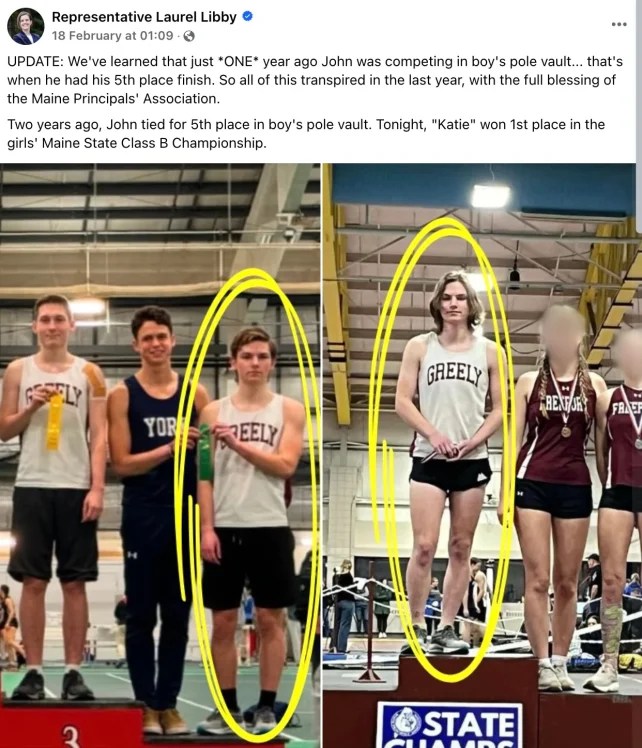
Libby’s post ignited a national conversation — the media ran with it, the White House took notice, and suddenly, a Maine high school sports event became ground zero for the larger battle over transgender athletes in women’s sports.
The Censure Vote and the Ultimatum
Democratic leaders in the Maine legislature quickly stepped in. They demanded she take the post down. Libby refused. The response was a censure vote, which passed 75-70 along party lines.
But that wasn’t enough. The House speaker then took things a step further: Libby would not be allowed to speak or vote on legislation until she deleted the post. In other words, her constituents would now go unheard in state government, all because their representative refused to edit her social media. Normally, removing a legislator would require a two-thirds vote or a recall election, but those formalities were apparently unnecessary when a majority party had other tools at its disposal.
Libby’s critics argue that she could have made her point without sharing the athlete’s photo. “Sharing images of kids online without their consent is a clear violation of the bond of trust and respect between citizens and their legislators,” said Majority Leader Ryan Fecteau. He accused Libby of using a minor to score political points and insisted that serious policy debates should not be waged through viral social media posts.
Libby, however, sees it differently. “Words don’t have the same impact. People need to see what’s happening to understand why it’s unfair,” she explained. Her stance is simple: if an athlete competes in a public championship, they should expect public attention. “If you don’t want attention, don’t put yourself in a public position to receive it.”
Libby’s post, whether you agree with it or not, falls squarely under the First Amendment. She wasn’t revealing state secrets or inciting a riot — she was commenting on a policy set by the Maine High School Principals Association, which allows student-athletes to compete in the gender category with which they identify.
In other words, she was doing exactly what elected officials are supposed to do: debate policies that affect the people they represent. The fact that her speech was met not with counter arguments but with an outright ban from legislative participation raises an uncomfortable question; if lawmakers can be silenced for discussing controversial policies, what does that mean for the rest of us?
Montana becomes First State to Require Search Warrants for Cellphone Location Tracking
By Noel Brinkerhoff | AllGov | July 5, 2013
California had its chance, but now Montana has become the first state in the U.S. to require that police obtain a search warrant before using a person’s cellphone records to track their whereabouts.
The new law mandates that law enforcement have probable cause before asking a judge for a warrant that permits the examination of metadata collected by telecommunications companies.
Police can ignore the law if the cellphone is reported stolen or if they are responding to an emergency call from the user.
Lawmakers in California adopted a similar law last year, but Democratic Governor Jerry Brown vetoed it, saying it did not “strike the right balance” between the needs of citizens and law enforcement.
Other states have also considered the legislation. In Maine, a location information privacy bill now awaits approval from the governor. Texas legislators rejected the idea, in spite of recently passing a bill that made its state the first in the nation to require a warrant for email surveillance. Massachusetts lawmakers plan to conduct a hearing on a measure that would require search warrants for location records as well as content of cellphone communications.
Federal legislation—the Geolocational Privacy & Surveillance Act (pdf)—was recently introduced in Congress, but neither the House nor the Senate has taken it seriously so far.
Trading our environment for wind power
By Nancy O’Toole | March 14, 2010
In 2008, the Kibby project, 44 turbines, miles of roads and hundreds of acres of cleared forest was approved. The Expedited Rule did its job for the developer, streamlining the necessary review since the location is part of over 14 million acres of land opened to wind development.
Now in 2010, TransCanada wants to expand the Kibby project and is proposing 15 turbines on Sisk Mountain, which overlooks the Chain of Ponds.
To do this TransCanada wants to expand the already expedited area of Maine to include the portion of Sisk Mountain not yet within this “umbrella.” TransCanada is petitioning to add another 630 acres to the expedited area, all of it overlooking Chain of Ponds, Big Island, and Massachusetts Bog.
Mountain tops and ridges above 2,700 feet will host all 15 turbines, 3.6 miles of crane road (34 feet wide), 3.6 miles of collector lines, (60 feet wide), 0.6 miles of access road to ridge and miles of “temporary” skidder trails. That does not include upgrades to a number of existing tracks.
A total of 90 wetland areas were identified with 11 Palustrine scrub — shrubs in the path of the collector line corridor. TC surveyed the area for vernal pools and listed 14 significant pools, meaning it has a high habitat value and is home to or has an abundance of threatened or endangered species. All will be impacted to some degree.
Clearing and grubbing will remove 140 acres of forest. Of that, 42 acres is described as fir-heartleaved birch sub-alpine community. Having a statewide S3 ranking means it’s a rare community type of forest and the clearing will isolate and alter the habitat adjacent to the community, allowing sunlight and wind, which removes moisture, deeper into the forest and impacting the rest of the community and altering it forever. The Bicknell Thrush, a threatened song bird, will lose 12.4 acres of critical habitat.
Blasting and excavating estimates are 750,000 cubic yards, with 650,000 cubic yards of fill. This is very significant, given that the soils, hydrology and the steep slopes above 2300 feet are very fragile. It is very difficult to build roads in this zone without significant blasting and it effects the surrounding environment.
Underlying hydrology needs to be identified and protected. This includes water from seeps, springs and streams disrupted by blasting of ledge and rock for roads and turbine placement.
The results from diverting will change the temperature and volume of streams, thus impact salmon in North Branch Dead River, Horseshoe stream and wild brook trout in Clear Brook.
Roads and collector lines will cross 57 perennial and intermittent streams.
Gold Brook is a tributary of the north branch of the Dead River and provides temperature refuge for landlocked salmon and supports wild brook trout. Kibby Stream, a tributary of Spencer Stream, supports wild brook trout. When existing hydrology is disturbed and large amounts of sedimentation is deposited into these streams, significant impacts to our native fish population will occur.
In 2008 Roaring Brook Mayflies were discovered in Gold Brook, whose headwaters are on the southern slope of Sisk. This insect is listed under the Maine Department of Inland Fish and Wildlife as Endangered. First discovered at the base of Mt. Katahdin in the Roaring Brook, it is protected for its entire length in Baxter State Park. It is a significant source of food for the brook trout, bats, dragonflies and other wildlife.
The bog lemming, golden eagle historic nesting area, and Canadian lynx tracks were discovered in the Kibby and Sisk area.
Boreal straw and snowline wintergreen were found, both listed as a S2, imperiled in Maine due to rarity of species. Both grow along the margins of perennial streams.
All these and more species fall under some regulations for protection!
Where is their protection in all this fury to make money? This is an oxymoron if there ever was one — killing endangered species, some due to global warming species, in order to curtail global warming?
Nancy O’Toole is a member of the Friends of the Boundary Mountains, a nonprofit that intervened in the Kibby Mountain project as well as the Sisk Mountain project before LURC now. She has a bachelor of science degree in environmental engineering and 10 years of experience with high mountain road construction and hazardous waste cleanup in towns in Utah. She lives in Phillips.
Related articles
- Bingham Wind Project to Seek Expedited Wind Permitting towards the end of March (bangordailynews.com)
- Groups seek to shut down dam turbines, save Atlantic salmon (bangordailynews.com)
Featured Video

Meet The Ellisons: Zionists, Technocrats, Moguls
or go to
Aletho News Archives – Video-Images
Frlom the Archives
With apparently fabricated nuclear documents, Netanyahu pushed the US towards war with Iran
By Gareth Porter | The Grayzone | April 29, 2020
President Donald Trump scrapped the nuclear deal with Iran and continued to risk war with Iran based on Israeli Prime Minister Benjamin Netanyahu’s claim to have proven definitively that Iran was determined to manufacture nuclear weapons. Netanyahu not only spun Trump but much of the corporate media as well, duping them with the public unveiling of what he claimed was the entire secret Iranian “nuclear archive.”
In early April 2018, Netanyahu briefed Trump privately on the supposed Iranian nuclear archive and secured his promise to leave the Joint Comprehensive Plan of Action (JCPOA). That April 30, Netanyahu took the briefing to the public in a characteristically dramatic live performance in which he claimed Israel’s Mossad intelligence services had stolen Iran’s entire nuclear archive from Tehran. “You may well know that Iran’s leaders repeatedly deny ever pursuing nuclear weapons…” Netanyahu declared. “Well, tonight, I’m here to tell you one thing: Iran lied. Big time.”
However, an investigation of the supposed Iranian nuclear documents by The Grayzone reveals them to be the product of an Israeli disinformation operation that helped trigger the most serious threat of war since the conflict with Iran began nearly four decades ago. This investigation found multiple indications that the story of Mossad’s heist of 50,000 pages of secret nuclear files from Tehran was very likely an elaborate fiction and that the documents were fabricated by the Mossad itself. … continue
Blog Roll
 Aletho News
- Meet The Ellisons: Zionists, Technocrats, Moguls
- US failures in Iran reveal Russia is key to South Korea’s strategic security
- ‘All ports in Persian Gulf will be legitimate targets if Iranian ports are attacked’
- 40 Years of Endless War, Data Point by Data Point
- Department of War Using Palantir AI to Pick Targets in Iran
- American bases do not protect – they attack the peoples of the Persian Gulf
- ‘We’ve Obliterated Their Missiles’
- Syrian president vows ‘absolute support’ to disarm Hezbollah
- Ukraine attacking Russian gas pipeline to stop deliveries to Europe – Defense Ministry
- ‘Heinous crime’: Iran denounces Israeli assassination of 4 Iranian diplomats in Lebanon
- If Americans Knew
- Israeli strategic plans to “remake the Middle East” from the 1950s and since
- Honoring Gaza’s women who refused to let the world look away
- 97% of victims of war on Iran are Iranian, 98% of victims in war on Gaza are Gazans – Not a ceasefire Day 152
- Early Iran strikes cost $5.6 billion in munitions, Pentagon estimates
- Israel Decided the War, But Trump’s America Fights and Pays the Bill
- Conscientious Objector Group: Phone ‘Ringing Off Hook’ As Huge Mobilization Underway
- U.S. support for Israel continues to plummet, despite media’s best efforts
- Threats and missiles fly, death tolls soar in Iran, Lebanon, Gaza – Not a ceasefire Day 151
- Lebanon: Israel’s White Phosphorous Use Risks Civilian Harm
- Corporate Media Go All Out To Support The US-Israeli War On Iran
- No Tricks Zone
- Destructive Green New Deal: German Energy And Metal Group Warns Of Drastic Crisis
- New Study Documents A 20-Year Pause In Arctic Sea Ice Decline – Driven By Internal Variability
- Wake-up Call: Survey Shows Majority Of Germans Now Favor Postponing Climate Targets!
- Televised! Leading German Political Candidate Tells Schoolchildren CO2 Makes Sun Hotter!
- New Study: A Century Warming Of 1.1°C Is ‘Commonplace’ And ‘Not Unusual’ During This Interglacial
- New Study: ‘Internal Noise’ And Volcanic Forcing Can Trigger 10-15°C Warming Within Decades
- Glaciers Worldwide Are Suddendly Surging, Experts Blame Warming!
- Surprising Discovery: Sahara Is Greening…Billions Of Trees Where Once Thought To Be Barren
- New Research Reaffirms Clouds, Aerosols, And Surface Solar Radiation Are ‘Driving The Climate System’
- Germany: Electric Car Catches Fire At Charging Station, Sets Off Local “Inferno”, Widespread Damage
 Aletho News