GOP presidential hopeful ratchets up anti-Iran rhetoric, seeks military action
Press TV – April 18, 2015
US Republican presidential hopefuls have ratcheted up their rhetoric against Tehran and denounced the Obama administration’s efforts to reach an agreement with Iran over its nuclear energy program, with Senator Marco Rubio calling on Washington to bomb Iran’s nuclear infrastructure.
Rubio, the first-term senator from Florida a candidate for the 2016 presidential elections, told participants at a Republican Party reception in New Hampshire on Friday that the world, particularly the Middle East, is in chaos because of President Barack Obama’s policies.
The Cuban American politician, known as an ultimate opportunist within the party, warned of a coming terrorist attack on US soil and even raised the specter of Iranian missiles striking the United States.
“We may have to decide at some point what is worse: a military strike against Iran or a nuclear-armed Iran,” the 43-year-old said during a question-and-answer session.
“I am not cheerleading for war. I don’t want there to be the need to use military force, but a nuclear Iran is an unacceptable risk for the region and the world,” he added.
He went on to say that “Iran is developing long-range rockets that will at some point, in less than a decade, be capable of reaching the East Coast of the United States.”
Iran and P5+1 group of countries – the US, Britain, France, China, Russia and Germany – reached a mutual understanding on Tehran’s nuclear program on April 2 in Switzerland. The two sides are expected to start drafting a final deal which they seek to sign by the end of June.
If a final deal is reached, it would lift all international sanctions imposed against the Islamic Republic in exchange for certain steps Tehran will take with regard to its nuclear program.
Rightwing elements in the Republican Party along with Israeli Prime Minister Benjamin Netanyahu and some of their allies accuse Iran of pursuing military objectives in its civilian nuclear program.
Iran rejects the allegation, arguing that as a committed signatory to the nuclear Non-Proliferation Treaty (NPT) and a member of the International Atomic Energy Agency (IAEA), it has the right to use nuclear technology for peaceful purposes.
Rubio, who has recently emerged as one the strong supporters of Israel in the Senate, said earlier this week that the United States must abandon the Obama administration’s drive to reach a comprehensive agreement with Iran, and renew its commitment to Israel and strengthen the military.
“If America accepts the mantle of global leadership… then our nation will be safer, the world more stable, and our people more prosperous,” Rubio said.
U.S. Senate Committee Approves Sanctions, Venezuela to Appeal to United Nations
By Z.C. Dutka | Venezuelanalysis | May 20th 2014
Earlier this afternoon in Washington, the Foreign Relations Committee of the U.S. Senate approved 13 to 2 the “Venezuelan Human Rights and Democracy Protection Act.” The bill includes sanctions on key individuals of the Venezuelan government and at least $15 million to “defend human rights… and strengthen the rule of law.”
The Menendez Bill
Committee chair, Democrat Robert Menendez, who played a lead role in the writing of the proposed legislation, plans to present the bill before the whole Senate within the coming weeks.
The legal measures proposed are in regards to recent anti-government protests that have reached levels of extreme violence in certain Venezuelan cities, resulting in 42 dead, 800 injured, and millions of dollars of public property damaged, including the burning of multiple universities.
Menendez said the US can’t “play the role of bystander” while Venezuelan president is going to “dangerous extremes to silence political dissent.”
“The U.S. should always be on the side of human rights around the world,” said another lead supporter, Florida Republican senator Marco Rubio.
Rubio has prepared list of Venezuelan military and government officials who would be targeted for sanctions if the bill were to pass. Among those listed are attorney general Luisa Ortega Diaz and the head of operations for the National Guard, Manuel Quevedo.
Earlier this month another piece of similar legislation, the Venezuelan Liberty and Democratic Solidarity Act, promoted by Florida congresswoman Ileana Ros-Lehtinen, passed the corresponding foreign committee of the U.S. Congress. It has yet to be addressed by Congress as a whole.
Roberta Jacobson, Assistant Secretary of State for Western Hemisphere Affairs, has attended the senate hearings and expressed concern on behalf of the White House.
“This is not a U.S.-Venezuela issue,” she said. “We have strongly resisted attempts to be used as a distraction from Venezuela’s real problems.”
She has displayed equal unease that the bill might distract from the important dialogue that is taking place between the Venezuelan government and the opposition.
Appeal to the UN
Even before the bill passed today’s Senate committee, Venezuelan foreign minister Elias Jaua expressed outrage at what he considers repeated US “interference” in Venezuelan affairs.
On Thursday Jaua announced his plan to present a formal claim to the United Nations, the Organization of American States (OAS), the Union of South American Nations (UNASUR), and the Community of Latin American and Caribbean States (CELAC).
“We’ve had enough of the United States assuming a role that belongs to multilateral bodies, Jaua said Thursday. “We must remember that as a free and independent nation we do not recognize the United States parliament… as a legislative [force] over Venezuela. There are basic principles of the United Nations Charter that must be respected.”
The minister has called a meeting with the UNASUR, to be held next week in Ecuador. He plans to bring with him a “dossier of all the declarations of interference posed by representatives of the United States, starting with president Obama, Secretary [of State John] Kerry, and others…”
Ecuadorian Fugitives Gave Large Sums of Money to US Politicians
Prensa Latina | March 13, 2014
Washington – Ecuadorian bankers Roberto and William Isaias, current fugitives, donated large sums of money to campaigns of U.S. politicians, the press revealed today.
Reports underline that the Federal Bureau of Investigation (FBI) is investigating cases that involve Congressional Republican Senator Marco Rubio, Democrat Robert Menendez and Republican Representative Ileana Ros-Lehtinen, among other politicians.
New York’s NBC network says the FBI suspects that Menendez, through phone calls and recommendation letters to the Department of State and other bodies, helped the Ecuadorian brothers establish themselves in the U.S. in exchange for donations to his reelection campaign.
Journalist and blogger Alberto Padilla claims he can confirm that, since they arrived to live in Miami, the Isaias have financed an active lobbying campaign against the Rafael Correa administration in Ecuador and have also aided senators, in exchange for being allowed to remain in the United States.
The Isaias were sentenced in absentia to eight years of imprisonment on April 11, 2012 by the National Court of Justice after a judicial process that lasted 13 years and in which 54 judges participated.
In the Ros-Lehtinen case, the Daily Beast website assured that she recently received money from the former bankers in exchange for help.
The Isaias had donated at least $23,700 USD to Ros-Lehtinen during the 2010, 2012 and 2014 electoral cycles, according to federal contribution campaign registers.
The Isaias also contributed to the campaign funds of Florida’s Senator Bill Nelson, and Congresswoman and also President of the National Democrat Committee Debbie Wasserman-Schultz and Representative Joe Garcia.
Related article


US Administration Considering Targeted Sanctions against Members of Venezuelan Government
By Jake Johnston | CEPR Americas Blog | March 4, 2014
Members of Congress and the Obama administration have consistently placed the blame for the violence stemming from protests on the Venezuelan government, while overlooking or ignoring violent incidents by opposition protesters, including the decapitation of motorcycle riders, the burning of government buildings and metro stations, attacks against state media companies, and the killing of individuals seeking to dismantle barricades, including a National Guard officer. Officials have referred instead to “systematic” human rights abuses and government repression, without citing evidence.
Based on these assertions, momentum is building to implement sanctions on members of the Venezuelan government. U.S. Rep. Debbie Wasserman Schultz (D-FL) told the press on Monday that, “There should be sanctions on individuals. … The administration is looking at those.” Wasserman Schultz, the Democratic National Committee chairwoman, cited a “high-level” State Department official that she had recently spoken to.
That the administration is considering sanctions comes on the heels of demands from members of congress that the Obama administration go further in its application of pressure on the Venezuelan government. After introducing legislation “supporting the people of Venezuela as they protest peacefully for democracy,” Rep. Ileana Ros-Lehtinen (R-FL) stated that:
“But this resolution can only be the first step to hold Maduro and his fellow regime thugs accountable for their violent response and their abuses of the Venezuelan people’s liberties and human rights. I have already begun circulating a letter amongst my colleagues in the House, addressed to President Obama, asking him to take immediate actions against Maduro and other Venezuelan officials who are responsible for violations of their people’s human rights. We are calling for the President to enact immediate sanctions against these officials, under authorities granted to him under the International Emergency Economic Powers Act (IEEPA), including denying them visas to enter the United States, blocking their property and freezing their assets in the U.S., as well as prohibiting them from making any financial transactions in the U.S.”
Ros-Lehtinen also plans to introduce a bill that would require the administration to take these steps. The moves from the House of Representatives have been echoed in the Senate, where the Senate Foreign Relations Committee Chairman Bob Menendez (D-NJ) and U.S. Senators Marco Rubio (R-FL), Dick Durbin (D-IL) and Ted Cruz (R-TX) have introduced a resolution calling for sanctions. Menendez stated:
“Now is the time to pursue a course of targeted sanctions by denying and revoking visas, and freezing the assets of Venezuelan officials complicit in the deaths of peaceful protestors. Human rights violators should be held accountable for the crimes they committed and their presence should not be welcome in our nation. Venezuelans today are denied basic rights, freedoms, and the ability to peacefully protest the dire economic circumstances caused by President Maduro and his government. We stand with the Venezuelan people and the brave opposition leaders in their pursuit to build a more hopeful Venezuela that embraces a bright future while discarding a failed past.”
Marco Rubio even made the case for sanctions on NBC News’ “Meet The Press,” telling host David Gregory that, “I would like to see specific U.S. sanctions against individuals in the Maduro government that are systematically participating in the violation of human rights and anti-democratic actions.” Florida Governor Rick Scott has also called for sanctions. Although neither the House nor the Senate have passed these resolutions calling for sanctions, Secretary of State John Kerry told reporters last week that, “with respect to Venezuela, Congress has urged sanctions.”
The call for sanctions has also been trumpeted by the press, with Miami Herald columnist Andres Oppenheimer saying that if Venezuela does not respond to “international diplomatic pressures,” then the Congress “should revoke the U.S. visas of Venezuelan government and military leaders.” Further, Otto Reich, the former U.S. Ambassador to Venezuela and Assistant Secretary of State for Western Hemisphere Affairs at the time of the U.S.-backed coup of 2002, wrote an opinion piece for the National Review titled “It’s Time for Sanctions in Venezuela.”
None of the members of congress nor any of the resolutions mention the fact that of the 18 tragic deaths in Venezuela since the protests began, many were not protestors, but individuals removing barricades and motorcyclists killed by wires strung across streets, or by crashing into barricades. In one case, a member of the Venezuelan National Guard was shot and killed. The Senate resolution makes no call for both sides to refrain from violence nor does it condemn the violent actions of some from the protest movement, however it does deplore “the use of excessive and unlawful force against peaceful demonstrators in Venezuela and the inexcusable use of violence…to intimidate the country’s political opposition.”
While, undoubtedly, excessive force has been used by members of the Venezuelan security forces, over 10 individuals have been arrested for these actions and further investigations are under way. According to the Attorney General (AG) of Venezuela, there are currently 27 investigations into violations of human rights. The AG, Luisa Ortega Diaz, stated that her office “will not tolerate violations of human rights under any circumstance and that any official turns out to be responsible will be sanctioned as established by the laws of Venezuela.” Far from censoring information or trying to hide the extent of the arrests or of those killed in the last few weeks, Diaz has provided regular updates to the press and has kept the public informed about the status of investigations.
America’s Lead Iran Negotiator Misrepresents U.S. Policy (and International Law) to Congress
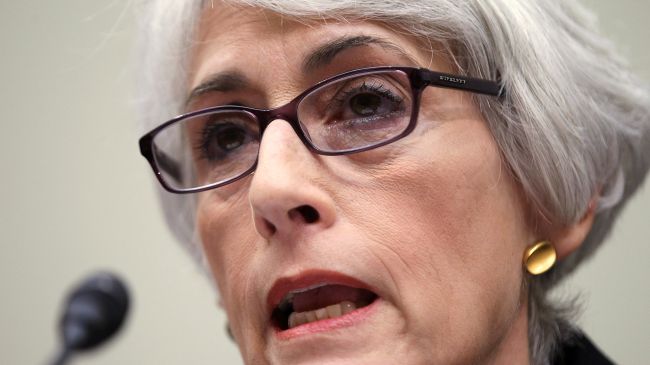
By Flynt Leverett and Hillary Mann Leverett | Going to Tehran | November 3, 2013
Last month, while testifying to the Senate Foreign Relations Committee, Wendy Sherman—Undersecretary of State for Political Affairs and the senior U.S. representative in the P5+1 nuclear talks with Iran—said, with reference to Iranians, “We know that deception is part of the DNA.” This statement goes beyond orientalist stereotyping; it is, in the most literal sense, racist. And it evidently was not a mere “slip of the tongue”: a former Obama administration senior official told us that Sherman has used such language before about Iranians.
–If a senior U.S. government official made public statements about “deception” or some other negative character trait being “part of the DNA” of Jews, people of African origin, or most other ethnic groups, that official would—rightly—be fired or forced to resign, and would probably not be allowed back into “polite society” until after multiple groveling apologies and a long period of penance.
–But a senior U.S. official can make such a statement about Iranians—or almost certainly about any other ethnic group a majority of whose members are Muslim—and that’s just fine.
Of course, it’s not fine. But that’s the America we live in.
Putting aside Sherman’s glaring display of anti-Iranian racism, there was another egregious manifestation of prejudice-cum-lie in her testimony to the Senate Foreign Relations Committee that we want to explore more fully. It came in a response to a question from Senator Marco Rubio (R-Florida) about whether states have a right to enrich under the Nuclear Non-Proliferation Treaty (NPT). Here is the relevant passage in Sherman’s reply:
“It has always been the U.S. position that Article IV of the Nuclear Non-Proliferation Treaty does not speak about the right of enrichment at all [and] doesn’t speak to enrichment, period. It simply says that you have the right to research and development.”
Sherman goes on to acknowledge that “many countries such as Japan and Germany have taken that [uranium enrichment] to be a right.” But, she says, “the United States does not take that position. We take the position that we look at each one of these [cases].” Or, as she put it at the beginning of her response to Sen. Rubio, “It has always been the U.S. position that Article IV of the Nuclear Non-Proliferation Treaty does not speak about the right of enrichment at all” (emphasis added).
Two points should be made here. First, the claim that the NPT’s Article IV does not affirm the right of non-nuclear-weapons states to pursue indigenous development of fuel-cycle capabilities, including uranium enrichment, under international safeguards is flat-out false.
Article IV makes a blanket statement that “nothing in this Treaty shall be interpreted as affecting the inalienable right of all the Parties to the Treaty to develop research, production and use of nuclear energy for peaceful purposes without discrimination.” And it’s not just “countries such as Japan and Germany”—both close U.S. allies—which affirm that this includes the right of non-weapons states to enrich uranium under safeguards. The BRICS (Brazil, Russia, India, China, and South Africa) countries and the Non-Aligned Movement (whose 120 countries represent a large majority of UN members) have all clearly affirmed the right of non-nuclear-weapons states, including the Islamic Republic of Iran, to pursue indigenous safeguarded enrichment.
In fact, just four countries in the world hold that there is no right to safeguarded enrichment under the NPT: the United States, Britain, France, and Israel (which isn’t even a NPT signatory). That’s it.
Moreover, the right to indigenous technological development—including nuclear fuel-cycle capabilities, should a state choose to pursue them—is a sovereign right. It is not conferred by the NPT; the NPT’s Article IV recognizes states’ “inalienable right” in this regard, while other provisions bind non-weapons states that join the Treaty to exercise this right under international safeguards.
There have been many first-rate analyses demonstrating that the right to safeguarded enrichment under the NPT is crystal clear—from the Treaty itself, from its negotiating history, and from subsequent practice, with at least a dozen non-weapons states building fuel-cycle infrastructures potentially capable of supporting weapons programs. Bill Beeman published a nice Op Ed in the Huffington Post on this question in response to Sherman’s Senate Foreign Relations Committee testimony, see here and, for a text including references, here. For truly definitive legal analyses, see the work of Daniel Joyner, for example here and here. The issue will also be dealt with in articles by Flynt Leverett and Dan Joyner in a forthcoming special issue of the Penn State Journal of Law and International Affairs, which should appear within the next few days.
From any objectively informed legal perspective, denying non-weapons states’ right of safeguarded enrichment amounts to nothing more than a shameless effort to rewrite the NPT unilaterally. And this brings us to our second point about Sherman’s Senate Foreign Relations Committee testimony.
Sherman claims that “It has always been the U.S. position that Article IV of the Nuclear Non-Proliferation Treaty does not speak about the right of enrichment at all [and] doesn’t speak to enrichment, period.” But, in fact, the United States originally held that the right to peaceful use recognized in the NPT’s Article IV includes the indigenous development of safeguarded fuel-cycle capabilities.
In 1968, as America and the Soviet Union, the NPT’s sponsors, prepared to open it for signature, the founding Director of the U.S. Arms Control and Disarmament Agency, William Foster, told the Senate Foreign Relations Committee—the same committee to which Sherman untruthfully testified last month—that the Treaty permitted non-weapons states to pursue the fuel cycle. We quote Foster on this point: “Neither uranium enrichment nor the stockpiling of fissionable material in connection with a peaceful program would violate Article II so long as these activities were safeguarded under Article III.” [Note: In Article II of the NPT, non-weapons states commit not to build or acquire nuclear weapons; in Article III, they agree to accept safeguards on the nuclear activities, “as set forth in an agreement to be negotiated and concluded with the International Atomic Energy Agency.”]
Thus, it is a bald-faced lie to say that the United States has “always” held that the NPT does not recognize a right to safeguarded enrichment. As a matter of policy, the United States held that that the NPT recognized such a right even before it was opened for signature; this continued to be the U.S. position for more than a quarter century thereafter.
It was only after the Cold War ended that the United States—along with Britain, France, and Israel—decided that the NPT should be, in effect, unilaterally rewritten (by them) to constrain the diffusion of fuel-cycle capabilities to non-Western states. And their main motive for trying to do so has been to maximize America’s freedom of unilateral military initiative and, in the Middle East, that of Israel.
This is the agenda for which Wendy Sherman tells falsehoods to a Congress that is all too happy to accept them.
Related articles
Featured Video
Yemen joins the war – Red Sea could be blocked next – Saudi regime at risk
or go to
Aletho News Archives – Video-Images
From the Archives
Should Europeans ‘Thank’ the Americans for Destroying Nord Stream?
By Robert Bridge | Strategic Culture Foundation | September 29, 2022
With an investigation continuing into the destruction of the Nord Stream gas pipeline that provided energy supplies to Europe from Russia, there appears to be just one prime suspect, and that should surprise nobody.
Following the sabotage of the Nord Stream 1 and 2 gas pipelines, former Polish Foreign Minister Radoslaw Sikorski already seemed to know the identity of the perpetrator when he tweeted out: “Thank you, USA.”
At first glance, it seemed that Sikorski was speaking sarcastically, berating Washington for carrying out an attack that will have severe repercussions for the people of Europe. After all, how could anyone see any good coming from the termination of Europe’s primary source of gas reserves with winter just around the corner? It was Sikorski’s homeland of Poland, after all, that urged its citizens to collect firewood in the face of dwindling gas reserves.
In fact, the Polish diplomat was speaking one-hundred percent literally… continue
Blog Roll
 Aletho News
- Growing insecurity, soaring prices fuel protests in north as regime bans evacuation: Sources
- Iran denies responsibility for ‘depraved’ attack on Kuwait desalination plant
- Bring The Troops Back. End This War Now!
- Can we please stop calling Israel the ‘only democracy in the Middle East’ now?
- US should start removing its troops for Germany, proposes AfD co-leader Chrupalla
- Iran Red Crescent: 600 educational centers attacked in US-Israeli ‘war crimes’
- Russian Oil Tanker Arrives in Cuba Amid U.S. Blockade
- America Racing to Strategic Defeat in Iran: Lt Col Daniel Davis
- FTC Warns Visa, Mastercard, PayPal, Stripe Over Political Debanking
- Russian tanker approaches Cuba despite US oil blockade
- If Americans Knew
- Israeli police block Catholic cardinal from entering Church of the Holy Sepulchre on Palm Sunday
- Israel is assassinating journalists again, more than any other nation, anywhere, ever – Not a ceasefire Day 170
- Over 300 US service members wounded, majority have brain injuries – Not a ceasefire Day 169
- Researchers at Human Rights Watch Resign Over Blocked Report on Palestinian Refugee Return
- Jewish Groups Are Backing a War Americans Don’t Want
- Eric Fingerhut Thinks He’s the President of the Jews
- Top Jewish Philanthropists, Rabbis Urge Israeli President to Take Action Against ‘Jewish Extremists’
- Don’t Be Fooled. Zionist Leaders Have Always Wanted to Control Southern Lebanon
- Israel’s widespread use of torture is a core element of its genocide against the Palestinian people
- In Israel’s War on Iran, Many Middle East US Bases Rendered “All But Uninhabitable”
- No Tricks Zone
- New Study Finds Warming Saves Lives…Cold Temperatures 12 Times More Deadly Than Excess Heat
- German Science Blog Accuses PIK Climate Institute Of Hallucinating Climate Tipping Points
- Devastating Assessment Of Comirnaty Vaccine By Former Senior Pfizer Europe Toxicologist
- New Study: CO2 Is ‘Effectively Negligible’ As An Explanatory Climate Change Factor Since 2000
- Former Pfizer Toxicologist Dr. Helmut Sterz Tells Bundestag Hearing Pfizer Vaccine Should Have Never Been Approved
- Energy Expert: Germany’s Nuclear Phaseout Was A “500 Billion Euro Mistake”
- New Research: South Australia’s Mid-Holocene Sea Surface Temperatures Were 4°C Warmer Than Today
- Storing Green Energy To Last Germany 10 Days Would Require A 60-Million Tonne Battery
- New Studies: UK Sea Levels Were 4 Meters Higher Than Today During The Mid-Holocene
- Destructive Green New Deal: German Energy And Metal Group Warns Of Drastic Crisis
 Aletho News