Russia withdraws from MH17 resolution process
RT | June 18, 2024
Moscow is not interested in participating in a “performance” before a Western-dominated panel of the International Civil Aviation Organization (ICAO) about the 2014 crash of a Malaysian passenger jet in Donbass, the Russian Foreign Ministry has said.
Malaysian Airlines flight MH17 was flying from Amsterdam to Kuala Lumpur when it was shot down in Ukrainian airspace. Kiev immediately blamed Donetsk People’s Republic forces and Russia for the incident. In March 2022, the Netherlands and Australia opened an investigation against Russia at the ICAO Council.
“The ICAO Council is not the right place to look for the truth. It makes no sense for us to remain a part of the ‘performance’ started in it,” the Russian Foreign Ministry said on Monday.
Russia had initially agreed to take part in the proceedings “because we believed that the ICAO platform could be used for professional dialogue about the plane crash,” the ministry said.
However, the council first claimed judiciary powers it did not have, then tried to admit as evidence the two investigations into the MH17 disaster that explicitly excluded Russia – by the Dutch Security Council (NSB) and the Joint Investigation Team (JIT) – while welcoming Ukraine and other adversely interested parties, according to Moscow.
Russia has proposed “a full, thorough and independent international investigation into the crash of flight MH17, as required by UN Security Council Resolution 2166 and the ICAO Dispute Resolution Rules,” but the council refused, the foreign ministry said.
“Ruled by the countries of the collective West and their satellites, the ICAO Council also refused to take into account the decision of the International Court of Justice (ICJ) of January 31, 2024,” which rejected Ukraine’s claims against Russia in the MH17 case, the ministry noted.
The council consists of 36 members, who vote according to instructions from their governments. Australia and 12 others had already publicly blamed Russia for MH17 before any investigation began, the ministry said. When Russia asked them to abstain from voting in the matter, they refused.
This pattern of behavior “runs counter to the minimum requirements for the objectivity of the proceedings,” the Russian Foreign Ministry said. “Under such circumstances, it is impossible to talk about an unbiased establishment of facts, much less a fair decision.”
The “extensive and convincing evidence,” both factual and legal, that Russia was not involved in the MH17 incident has been made available to 193 ICAO members, the ministry noted.
FOI Request Reveals Bellingcat Collusion With Western Intelligence
By Kit Klarenberg | Strategic Culture Foundation | December 12, 2023
An email sent on November 12 2020 by an officer within Amsterdam’s National Coordinator for Security and Counterterrorism (NCTV) shows a Bellingcat investigation was intentionally shared with the agency prior to publication, so as to assist the Dutch spooks in shaping media strategies and messaging following its release. The revealing communication is irrefutable proof of the cozy relationship the self-styled “independent investigative collective of researchers, investigators and citizen journalists” enjoys with Western intelligence services.
In the message, marked “high importance,” the undisclosed author explained that Bellingcat would soon publish research amounting to a deeply libelous attack on independent journalists and researchers, who challenged the mainstream narrative surrounding Malaysia Airlines Flight 17. As such, the Dutch intelligence officer wrote, “it is probably smart to put together interdepartmental wording for this already”:
“Because the article highlights several sides (MH17 but also COVID19) it is probably wise to wait a while and see if; a. the mainstream media pick it up; b. from which angle the media pick up and highlight it (MH17 or COVID); c. from this angle to determine the wording and therefore which department is in the lead; d. coordinate the language as much as possible interdepartmentally.”
A ‘bonanza’ of Western intel propaganda
The article in question, entitled “The GRU’s MH17 Disinformation Operations Part 1: The Bonanza Media Project,” was framed as an investigation into a now-defunct independent media venture named Bonanza Media which was established by Russian journalist Yana Yerlashova with the help of freelance Dutch researcher Max Van der Werff.
Much of Bonanza’s work challenged Western assertions that separatist fighters in Donbass shot down MH17 with a Buk surface-to-air missile system provided to them by the Russian military. Ukrainian officials began pushing that narrative, citing audio recordings they claimed to have intercepted alongside material purportedly found on social media implicating the separatists, even before Malaysia Airlines publicly announced it had lost contact with the plane.
Bellingcat, which serendipitously launched just days before the downing of MH17, came to prominence by immediately seizing on this deluge of carefully-curated and potentially falsified information. With amazing speed, the organization claimed to have precisely mapped out what happened that fateful day, and exactly how it occurred. Despite its relative inexperience and opaque organizational structure, its findings were accepted without a shred of scrutiny by Western journalists, lawmakers, pundits, and the official Dutch MH17 tribunal, which concluded in November 2022.
Bonanza Media’s film, “MH17 – Call for Justice”, features interviews with witnesses on-the-ground that day and Malaysian government officials who did not accept the official story, but doesn’t rule out the possibility of Russian culpability altogether. However, the documentary presented a substantial challenge to Bellingcat’s version of events – which also happened to align neatly with the official narrative. In 2020, Bonanza also published leaked documents confidentially submitted to the tribunal. This included Dutch intelligence files recording that while many Ukrainian Buk systems had been spotted in eastern Ukraine, Russian equivalents were nowhere to be seen.
Evidently, Bellingcat and its founder, Eliot Higgins, were displeased with their results. As Dutch freelance journalist Eric van de Beek wrote in 2020, “because it was impossible for Bellingcat to discredit Van der Werff on the basis of the well-researched content featured on his blog and in his recent documentary, Eliot Higgins opted to wage a campaign of misinformation.”
Bellingcat’s 2020 investigation into the group strongly insinuated Bonanza was being run by Russia’s GRU, heavily implied their investigations were edited by the agency’s operatives before publication, and suggested its contributors were on the Kremlin’s payroll. The group claimed their conclusions were “based on emails from the mailboxes of two senior GRU officers obtained by a Russian hacktivist group and independently authenticated by us.”
Strict British libel laws may have prevented the group from making direct allegations to this effect, but the Dutch media had no such qualms, and the investigation triggered a wave of smears in major local publications. One daily newspaper headlined as fact: “Dutch MH17-blogger directed by Russian secret service.” Another, which directly asserted that “Van der Werff worked on the orders of the Russian military intelligence service GRU,” is currently being sued by the researcher regarding the unproven claim.
Strikingly, throughout this period not a single mainstream journalist questioned how Bellingcat acquired the highly sensitive trove of documents upon which its investigation depended. On top of confidential GRU emails, Bellingcat somehow apparently acquired phone data showing calls between purported Russian intelligence officials and cell tower data tracking their movements, which it claimed pinpointed their locations to GRU headquarters in Moscow. None of this information is remotely “open source,” and since it wasn’t shared publicly, it can’t be independently verified.
Oddly, in one passage, Bellingcat stated “it is not clear who requested or suggested” changes to a Bonanza article it alleged were made after the piece was submitted to the GRU, before publication. One might think ascertaining this would be simple, given the vast amount of highly incriminating evidence to which Bellingcat had exclusive access. Perhaps British libel laws were a deterrent to accusing the GRU — but why would this be the case if the material was authentic, and defending it in court was no issue?
MH17 verdict undermines Bellingcat
The newly-released NCTV email strongly suggests Bellingcat’s investigation into Bonanza was the product of a Western intelligence information operation, intended to steer the MH17 tribunal in a very specific direction — namely, towards the defendants’ guilt. Sure enough, Russian nationals Igor Girkin and Sergey Dubinskiy, and Donbas separatist Leonid Kharchenko, were convicted in absentia for the murder of MH17’s 283 passengers and 15 crew members, the court ruling they arranged the transfer of the Buk surface-to-air missile system that reportedly struck the plane.
Meanwhile, the only defendant to seek legal representation and give testimony during the trial, Oleg Pulatov, was acquitted on all charges. The court found there was “no indication” he was involved in obtaining the missile system, that he could have prevented its use, or that he was involved in transporting it to another location after the incident. Prosecutors announced they will not appeal the verdict.
The response by the normally brash Higgins to the Dutch court’s judgment was uncharacteristically muted. In an otherwise self-congratulatory Twitter thread, he merely noted that “Pulatov is acquitted, the rest are found guilty.” There was no explanation for why the defendant was found innocent, nor any analysis of the ruling’s potential implications for Bellingcat’s MH17 investigations.
This defence at the MH17 trial is a total car crash, the JIT has had 5 and a half years to prepare for this nonsense, and it’s just recycling MH17 truther nonsense.
— Eliot Higgins (@EliotHiggins) June 22, 2020
Higgins and his crack squad of laptop jockeys were understandably embarrassed on these counts. Not least because the Bellingcat chief repeatedly mocked Pulatov and his lawyers during the tribunal, suggesting his conviction was a fait accompli, and sneering when the defendant testified accusations of responsibility for MH17 resulted in adverse personal consequences for him. A June 2020 Bellingcat investigation lambasted Pulatov’s testimony, suggesting his defense strategy was “unlikely to win Mr. Pulatov the court’s sympathies.”
We detail the role that each of these four men had in the downing with our new report. Girkin was the Minister of Defense of the DNR in July 2014, Dubinsky was the head of the GRU DNR, the Pulatov/Kharchenko were his underlings. https://t.co/2cVjK2RCPj pic.twitter.com/wjHwBqpzrP
— Bellingcat (@bellingcat) June 19, 2019
A sordid history of smears
Bellingcat’s confirmed collusion with NCTV raises obvious questions about whether the organization’s relentless attacks on journalists and researchers who do not toe the official national security line are also directly coordinated with, and on behalf of, Western intelligence agencies. In many cases, Bellingcat’s attacks have had real-world consequences for its targets.
For example, Bellingcat has over many years attempted to destroy the career of MIT emeritus professor Theodore Postol, who questioned official investigations into alleged chemical strikes in Syria. In 2019, Bellingcat pressured a science journal to prevent Postol from publishing an academic paper challenging the results of a UN probe into the alleged 2017 Khan Sheikhoun sarin attack which blamed the Syrian government on the basis of supposed “computational forensic analysis.”
Throughout the Syrian conflict, Bellingcat published investigations blaming government forces for chemical weapons attacks, typically within hours of them allegedly happening. These findings were invariably based in part on material provided to the organization by British intelligence constructs on-the-ground, such as the bogus humanitarian group known as the White Helmets. In the immediate aftermath of the notorious April 2018 Douma incident, which OPCW whistleblowers suggest was staged, Higgins tweeted an exclusive photo of one of the cylinders purportedly used in the strike.
The post was abruptly deleted though, perhaps because the White Helmets subsequently shared a photo of the same site in which the same cylinder was in a different position. Proof positive the scene had been manipulated by those staging it. Dissident British academics who have helped expose Douma and other chemical weapons strikes in Syria as opposition-executed false flags – in which British intelligence was frequently complicit – have likewise been relentlessly targeted by Bellingcat.
Elsewhere, Bellingcat fabricated and misrepresented evidence to smear independent Bulgarian journalist Dilyana Gaytandzhieva as a potential GRU asset. Meanwhile, the organization has played a lead role in disseminating and “verifying” dubious, if not outright fraudulent, material and claims related to the Ukraine conflict throughout its duration. Investigations by The Grayzone strongly suggest Bellingcat operatives were directly implicated in a Ukrainian intelligence operation gone wrong, which got Kiev’s forces killed.
CIA veterans have openly praised Bellingcat for stating publicly what spy agencies cannot. In a December 2020 Foreign Policy article entitled, “Bellingcat Can Say What U.S. Intelligence Can’t,” the CIA’s former deputy chief of operations for Europe and Eurasia was quoted as saying:
“I don’t want to be too dramatic, but we love this. Whenever we had to talk to our liaison partners… instead of trying to have things cleared or worry about classification issues, you could just reference their work.”
Accordingly, leaked files exposing the internal workings of Integrity Initiative, a British intelligence black propaganda operation tasked with ginning up conflict with Russia to pad the UK’s defense budget, were rife with references to Bellingcat. As an internal document which describes one of the group’s goals as “increasing the impact of effective organisations currently analysing Russian activities” notes, “we already do this [emphasis added] with… Bellingcat.”
As a result of such excerpts, this journalist repeatedly asked Higgins about the nature of his and his organization’s relationship with the Integrity Initiative. Though initially evasive, in March 2020 Higgins finally denied any association in an email that concluded with an ominous threat:

“The funny thing is your shitty reporting on the matter had [sic] proven quite useful to us, looking forward to you finding out how, try not to feel too bad.”
Almost four years later, this journalist is still waiting to learn what Higgins and his collaborators in Western spy agencies have cooked up to make me “feel bad.” Given the confirmed interest of British intelligence in sabotaging this outlet, and the crazed allegations put to me by the counter-terror police who detained me in London this May, he may have already made good on his threat.
Meet the British intelligence-linked firm that warped MH17 news coverage
BY KIT KLARENBERG · THE GRAYZONE · MARCH 5, 2023
In November of 2022, a final judgment arrived in the trial of alleged perpetrators of the attack on Malaysia Airlines Flight 17 (MH17). Russian nationals Igor Girkin and Sergey Dubinskiy, and Donbas separatist Leonid Kharchenko, were convicted in absentia for the murder of MH17’s 283 passengers and 15 crew members. They were ruled to have arranged the transfer of the Buk surface-to-air missile system that reportedly struck the plane.
Oleg Pulatov, the only defendant to seek legal representation during the trial, was conversely acquitted on all charges, which prosecutors will not appeal.
The Malaysian airliner had been purportedly shot down by a missile on July 17th 2014, killing all 283 passengers and 15 crew aboard.
Heavily dependent on information supplied by the Ukrainian Security Service (SBU) and the Western government-funded “open source” investigations organization known as Bellingcat, the guilty verdicts appeared to vindicate an established narrative in which Russia and its Donbas allies were solely culpable.
But as this investigation will reveal, much of the news coverage of MH17 was heavily influenced by a shadowy entity called Pilgrims Group, which is closely tied to British intelligence.
Staffed and led by British Special Forces veterans, Pilgrims Group is a private security company offering elite security services to London’s embassies, diplomats, spies, and business interests abroad, particularly in high-risk environments. It also trains foreign militaries and paramilitary groups, and provides protection to reporters and their employers.
It was in the latter context that Pilgrims Group shaped media coverage – and by extension, official investigations – of MH17. The company had maintained a presence in Kiev since the early days of the US-orchestrated Maidan “revolution” in late 2013, shepherding journalists to and from the scenes of major events in Ukraine. In the process, it maintained control over what the reporters under its watch saw and how they understood the situations they encountered.
As such, Pilgrims Group played a pivotal role in the effort by the Ukrainian Security Service (SBU) and British intelligence to convict Russia and the Donbas separatists for MH17’s downing. The operation began while the plane’s wreckage remained smoldering on the ground of rebel-controlled territory, and ultimately prevented the initiation of any genuinely independent investigations.
Suspiciously quick off the mark
Before Malaysia Airlines publicly announced it had lost contact with MH17, Ukraine’s then-Minister of Internal Affairs Anton Gerashenko had published its flight number, destination, passenger numbers, the manner in which it crashed, the weapon used, and blamed Russia and Donbas separatists for the catastrophe.
From that point on, the SBU began flooding the information space with materials including intercepted audio of the separatists discussing a downed plane, as well as images its agents allegedly found on social media pointing to where the allegedly Russian-sourced Buk missile had been fired. Bellingcat, which serendipitously launched just days before, immediately seized on the deluge of carefully curated information.
With impressive speed, the US and British government-funded media outfit claimed to have precisely mapped out what happened and how. Bellingcat’s findings were accepted without a shred of critical scrutiny by the Western media, lawmakers, pundits, and the MH17 tribunal, which was launched on August 7th 2014.
In the process, any explanations for MH17’s downing that did not reinforce the official narrative either vanished into the ether, or were maligned as conspiracy theory or Russian “disinformation.” One compelling counter-theory for the aerial disaster was that the plane had been used as a shield by Ukrainian fighter jets to deter ground-to-air attacks by the separatists.
There are clear precedents for such provocative tactics. In 2018, for example, the Israeli air force tricked Syrian air defenses into accidentally shooting down a Russian spy plane by using it as cover for its own fighter jets. A leaked JIT document noted Donbas separatists were convinced that authorities in Kiev were keeping eastern Ukraine’s airspace open for precisely this purpose, having conversely closed Crimea’s at the time.
Furthermore, in a video published on June 18th 2014, separatists expressed concern that Kiev was attempting to provoke an in-air incident. Three days before MH17 went down, a Ukrainian military aircraft ferrying military equipment and soldiers to the frontline was shot down over Lugansk. Multiple witnesses have testified to the presence of Ukrainian jets in the sky near MH17, while contemporary local TV reports show a Ukrainian-operated Buk missile in the vicinity.
Yet, the JIT was simply unwilling to consider evidence diverging from the established Western narrative of MH17. And as the trial proceeded, Pulatov’s defense team, independent journalists and researchers attempting to challenge the long-established narrative of Russian culpability were subjected to vicious attacks from Bellingcat’s army of online trolls.
The SBU-directed propaganda blitzkrieg that immediately followed MH17’s downing ensured that the separatists accused of the attack, and the government accused of sponsoring them, were quickly convicted in the court of international opinion. This may explain why media reaction to the November 2022 verdict was so muted. Despite the enormous, enduring global outcry provoked by the MH17 disaster, the verdict hardly registered with mainstream journalists.
Yet many of the journalists that had covered the MH17 from Ukraine had been kept under the careful watch of an organization intimately involved with the same Western governments with a stake in convicting the separatists for the disaster.
British military veterans direct Maidan news coverage
Because Pilgrims Group operates largely in the shadows, references to the company by Western news outlets are extremely rare. However, the firm is well-known to all major media outlets, boasting on its website of “significant experience of helping to facilitate safe and secure news-gathering and film-making.” Pilgrims Group also claims expertise in ensuring that “journalists and production staff can operate safely and securely” in hostile circumstances, such as “underdeveloped countries, failing states and post-disaster environments.”
The British company made headlines for its work in late 2012, after armed militants abducted a six-strong NBC News team led by the network’s chief foreign correspondent Richard Engel, whom the company was guarding. Engel and his team were freed after five days in captivity, when a vehicle in which they were being escorted was stopped at a checkpoint run by violent extremist group Ahrar al-Sham.
This resulted in a shootout, in which two fighters who kidnapped the team were killed by Ahrar al-Sham. Initially, Engel claimed his captors were affiliated with the government of Bashar Assad, while NBC implied Ahrar al-Sham’s rescue was completely serendipitous. Subsequent investigations revealed the abductors were, in fact, affiliated with the CIA-backed Free Syrian Army, and the checkpoints had been deliberately arranged by Pilgrims Group, which praised the terrorist militia’s “brilliant job.”
Decisive interventions by Pilgrims Group elsewhere have received much less attention. On June 3rd 2014, the firm issued a little-noticed press release boasting of its reputation as “the security company of choice” for media organizations operating in Ukraine at every stage of the Maidan “political unrest,” working with “journalist teams throughout the country” during key “disturbances.”
Oddly, despite their coverage of these events presumably being very publicly disseminated across the globe, Pilgrims Group’s clients in Ukraine apparently “preferred not to be named” due to “the sensitive nature of their role.” Nonetheless, the company bragged that its teams were operational in many of the country’s “major population centres,” including Donetsk, Kharkiv, Kiev, Lviv, Odessa, “and throughout Crimea.”
“Pilgrims has been able to respond rapidly to broadcasters’ demands by drawing on its extensive networks to mobilise former special services personnel, who were on duty within 12 hours of the clients’ initial requests (and frequently considerably quicker). In addition, the company continues to maintain the highest level of awareness of the unfolding political situation in the Ukraine by maintaining its local contact network [emphasis added], with regular updates of information on the ground.”
Further detail on Pilgrims Group’s activities in Ukraine appears in a leaked June 2016 Foreign Office proposal to train Syrian rebel fighters in Jordan as part of the plan to overthrow the Syrian government. The company was central to the project, running “simultaneous training programmes around the world,” and therefore maintaining a “large and flexible pool” of staff who could be assigned to the mission. MH17 was cited as an example of the speed with which Pilgrims Group could mobilize its operatives.


“As a global risk management company Pilgrims are routinely required to expand their operational footprint and support tasks at short notice,” the proposal bragged. “Pilgrims supported a large number of media organisations operating in Ukraine, which peaked at 27 active security teams on the ground. When the Malaysian Airlines aircraft was shot down over Ukraine…Pilgrims generated seven additional teams within six hours [emphasis added].”

This proposal was submitted to the Foreign Office by Adam Smith International, a British intelligence cutout with an extensive history of scandal, corruption and collaboration with jihadist groups. As The Grayzone has revealed, the company also funded Bellingcat to the tune of tens of thousands of dollars in the 2019-20 financial year. Both organizations have refused to reveal the purpose of this sum.
Pilgrims Group has also offered protection to Western journalists in other conflict zones. The LinkedIn profile of senior company staffer and British Army veteran Chris Bradley lists his work providing “security risk management to two award winning news teams in Ukraine (2014) and Syria (2015), including coverage of MH17,” as one of his biggest “achievements” at the firm.
Given the insidious role played by London and its assorted intelligence cutouts in shaping worldwide media coverage of the Syrian civil war, such professional history raises troubling questions about Pilgrims Group’s involvement in influencing news coverage of MH17.
A frontline player in Britain’s global information war
Following the MH17 disaster, Western journalists flocked to the crash site while Ukraine’s State Emergency Service rushed to collect corpses. The collection work was halted after it came under fire from the Ukrainian army, however, and emergency workers left outright after Organization for Security and Cooperation in Europe (OSCE) representatives arrived at the crime scene. But reporters under the watchful eye of Pilgrims Group stayed and continued their reporting.
Over subsequent months, as the remaining bodies rotted in the sun, OSCE monitors and pro-Russian rebels frequently left MH17’s wreckage unguarded for extended periods. It was not until November 2014 that the ground was comprehensively cleared. During that time, little would have prevented malicious actors from manipulating, removing or planting incriminating evidence at the site.
In order to operate in Ukraine, Pilgrims Group required the approval of the country’s government, as well as local security and intelligence services. Given the intense fervor with which these same actors sought to cement Kremlin culpability for MH17, Pilgrims Group’s work in managing the protection and travel of Western reporters provided a logical tool to assist this effort, as its operatives were literally able peer over the shoulders of journalists while they worked.
British spies consider MH17 key ‘disinformation’ battleground
Another extremely curious and thus far undisclosed component of the MH17 controversy is the clandestine role played by London’s information warriors in shaping public perceptions of the event. These operations began almost at the precise moment of the crash.
Leaked files related to the activities of Integrity Initiative, a Foreign Office black propaganda unit staffed by British military and intelligence veterans, contain countless references to battling Kremlin “narratives” around MH17. For example, one of its operatives was listed in the documents as a “continuous commentator” in the studio of LBC, one of Britain’s largest radio stations which reaches millions of listeners weekly, on the night of the incident.
In Foreign Office funding submissions in 2018, Integrity Initiative proposed organizing focus groups with select Russian and Russian-speaking audiences, who would be invited to “rebut Western analyses of key media stories (e.g. MH17, Litvinenko, Skripal, doping)” and explain why they supported “counter narratives” about these issues, which pointed away from Moscow.
The results of this effort would be shared with British intelligence agencies and members of the Initiative’s overseas “clusters” – secret networks of spooks, academics, journalists, pundits and politicians – to assist in battling these “narratives” via news outlets and social media. Notably, all Integrity Initiative’s cluster members are formally trained in the art of online trolling.
Integrity Initiative was one of several propaganda enterprises launched by a shadowy Foreign Office unit known as the Counter Disinformation and Media Development (CDMD). The unit is overseen by senior intelligence officer Andy Pryce, who personally “handles” British journalist Paul Mason and likely many other media personalities. Its stated remit is to “weaken the Russian state’s influence” in countries comprising the former Soviet Union, Warsaw Pact and Yugoslavia.
The flagship component of this multi-million pound effort is Open Information Partnership (OIP). Though OIP has posed as a grassroots endeavor to battle Kremlin “disinformation,” leaked files related to the project make abundantly clear it is, in fact, a British-sponsored “troll factory.” Through a covertly funded nexus of ‘independent’ NGOs, fact-checkers, news outlets and citizen journalists across Central and Eastern Europe, the initiative deluges the media environment with a ceaseless stream of anti-Russian propaganda.
Among OIP’s founding “partners” was Bellingcat. For the first three years of its existence, Bellingcat trained participating organizations “in open source research and social media investigation,” while “developing a cadre of organizations with a digital forensic skillset.” In the process, it raked in vast sums from the Foreign Office. Its MH17 investigation was explicitly cited as a reference point for this activity in the Partnership’s founding documents.
OIP’s network was also originally intended to include the Berlin-based “non-profit independent newsroom” Correctiv, which published multiple investigations blaming Russia for MH17. While some of this work won awards, a secret Foreign Office-funded appraisal of the outfit acknowledged its reporting on the crash “[lacked] in-depth background research and due diligence.” However, the outlet’s “excellent” public reputation made it “perhaps the most impressive” of all prospective OIP members.
To advance its anti-Russian machinations, CDMD commissioned extensive target audience analyses of the populations of Belarus, Estonia, Latvia, Lithuania, Moldova, Ukraine and the West Balkans throughout 2017. British intelligence indicated that it sought insights into citizens of these countries’ “current perception and attitude towards Russia,” especially with respect to the Kremlin’s “handling” of events such as Brexit, the Syrian crisis, and MH17.
At the same time, British cutouts like the Integrity Initiative and Pilgrims’ Group helped manage the Western public’s view of MH17 as part of a wider agenda to cultivate popular resentment of Russia.
Pilgrims’ Group manages media covering Ukraine proxy war
These same entities continue to shape Western perceptions of events in Ukraine to this day. A May 2022 “capability statement” outlining Pilgrims Group’s Eastern European footprint refers to the Russian invasion “[triggering] a rapid scaling up” of its operations in Kiev.
Pilgrims Group has provided “support networks, including logistics and equipment, to media crews covering the conflict,” and embedded “dozens” of “security consultants” in the ranks of “almost all major international news organisations” active in the country.” Strikingly, the statement adds that all Pilgrims Group security teams in Kiev boast Ukrainian “special police or MoD [Ministry of Defence] backgrounds.”
Once again, Pilgrims Group has been effectively placed in charge of where journalists can travel, what they see, and who they interview in a conflict. Yet even as it helps shape public perceptions of a Western proxy war, the company has managed to remain conveniently in the shadows.
Kit Klarenberg is an investigative journalist exploring the role of intelligence services in shaping politics and perceptions.
Moscow Summons Dutch Ambassador Over Attempts to Hold Russia Responsible for MH17 Case
Sputnik – 17.02.2023
MOSCOW – Dutch Ambassador to Russia Gilles Beschoor Plug was summoned to the Russian Foreign Ministry on Friday over the attempts of the Dutch authorities to hold Russia responsible for the MH17 crash.
In November, the Hague District Court ruled that two Russian citizens were guilty of the MH17 plane crash in eastern Ukraine in 2014, and of killing 298 of its passengers. Earlier in February, the Joint Investigation Team (JIT) said that the investigation into the crash of the MH17 failed to gather sufficient evidence to initiate new trials, so the investigation was halted. Later, the Dutch Foreign Minister, Wopke Hoekstra, said that the Netherlands and Australia will continue to hold Russia accountable for the MH17 crash.
“On February 16, Dutch Ambassador in Moscow Gilles Beschoor Plug was summoned to the Russian Foreign Ministry. It was demanded that the intrusive attempts of the Dutch authorities stop groundlessly holding Russia responsible for the crash of Malaysian Airlines flight MH17 over Donbass on July 17, 2014,” the statement said.
The ministry underscored that Russia does not recognize the results of JIT’s investigation, in which it did not take part.
In addition, the Dutch ambassador was told about the unacceptability of obstructing the work of the Russian embassy and the performance of its direct functions, including those related to work with public and historical memorial organizations, as well as political science platforms.
Moscow Slams Dutch Court’s Politically-Motivated Verdict in MH17 Trial
Samizdat – 17.11.2022
The Russian Foreign Ministry has criticized The Hague District Court’s verdict in the MH17 case, stressing that the course and results of the trial in the Netherlands show that the proceedings were based on a political order to reinforce the version about Russia’s alleged involvement in the downing of the Malaysian plane.
Moscow expressed regret that the court in The Hague neglected the principles of impartial justice for the sake of political expediency and ignored the fact that all the conclusions of the prosecution are built upon anonymous testimonies.
The ministry pointed out that the court wasn’t even perturbed by the fact that the Ukrainian side refused to provide radar data or recordings of communication between air traffic controllers and the plane crew. The Dutch court also ignored documents that were declassified by the Russian Defense Ministry in 2018 concerning the missile, whose debris was found at the crash site.
The MoD declassified documents showing that the serial number found on debris from the Buk missile was cross-referenced with a log book, showing it was produced in 1986. The missile was then delivered to a military unit in Ukrainian SSR and had since not left Ukraine.
At the time, the ministry also stated that some of the videos provided to investigators showing the Buk system being transported from Russia to Donbass were manipulated.
Earlier on Thursday, The Hague District Court found three out of the four defendants in the case guilty. Two Russians, Igor Girkin and Sergei Dubinsky, as well as Ukrainian national Leonid Kharchenko were given a life sentence in absentia, while Oleg Pulatov was acquitted.
The trio was ordered to pay compensation to the relatives of the 298 victims of the plane crash.
What Happened to Flight MH17?
Malaysian Airlines Flight MH17 was en route from Amsterdam to Kuala Lumpur when it was downed over eastern Ukraine on July 17, 2014 as the region was mired in a conflict with the new government following a coup earlier that year. As a result, all 298 passengers – mostly Dutch – and crew on board were killed in the crash.
Following the tragedy, Kiev and the then-self-proclaimed republics in the Donbass region blamed each other for the downing, with the latter contending that they had no military equipment that would allow them to shoot down an aircraft at that altitude. The United States and a number of European nations, for their part, rushed to allege that Russia was responsible for the incident – a claim that was made even before an official investigation was launched.
Shortly thereafter, the Netherlands set up a Joint Investigative Team (JIT) to probe the MH17 case, but left Russia out of the process despite the latter’s consistent offers to assist in the investigation.
The JIT’s probe concluded that the aircraft was downed by a Buk missile, allegedly launched from a Russian anti-aircraft missile brigade ordinarily stationed in the city of Kursk, not far from the Ukrainian border. At the same time, the Dutch-led team refused to share concrete evidence to corroborate the claims that Russia was responsible for the downing.
In 2019, JIT announced that international arrest warrants would be issued for four suspects, Russians Igor Girkin, Sergei Dubinsky, Oleg Pulatov, and Ukrainian Leonid Kharchenko, on charges of murder, with a trial over the MH17 case beginning in the Netherlands in March 2020.
Moscow has repeatedly slammed JIT’s conclusions as “openly biased” and “one-sided” and emphasized that after being denied access to the formal probe, Russia had carried out its own investigation, which concluded that it was an older version of the missile made in 1986 and belonging to Ukraine that downed the ill-fated plane. Dutch investigators, however, ignored the information.
Dutch court passes sentence in MH17 trial
RT | November 17, 2022
The Hague District Court has found three people guilty in the high-profile case of Malaysian Airlines Flight MH17, which was downed amid hostilities in the east of Ukraine in 2014. Russia criticized the Dutch-led investigation and prosecution as not fully objective.
One of the men accused was acquitted due to lack of evidence, but three were sentenced to life in prison, in partly due to their “detestable” attitude towards the trial, Judge Hendrik Steenhuis said. All four were tried in absentia.
The prosecutors had made a compelling case proving that the four defendants were involved in the downing of the aircraft, the court announced during proceedings at the Schiphol Judicial Complex (JCS) in the Dutch town of Badhoevedorp. The trial started in March 2020, with charges of murder and destruction of a civilian aircraft leveled against the defendants.
The court said it didn’t believe that the accused individuals had intended to shoot down a civilian aircraft, believing instead that they were firing at a military target, but that their actions were criminal nevertheless. Steenhuis noted that it was impossible to tell who actually gave the order to fire the missile.
The judge also said the three men found guilty will be liable for more than 16 million euros in compensatory damages to the victims’ families. This would be regulated by Ukrainian rather than Dutch law, except for the provision excluding same-sex partners from eligibility, he added.
The Malaysian Airlines flight was shot down as it flew over eastern Ukraine in July 2014. All 298 people on board were killed. The incident took place at a time when Ukrainian government forces were engaged in fierce battles against rebels who opposed the outcome of an armed coup in Kiev.
Two of the regions in eastern Ukraine eventually declared independence and formed the Donetsk and Lugansk People’s Republics, which, together with two other former Ukrainian regions, ended up being accepted into Russia after referendums earlier this year. The two nations are currently engaged in large-scale hostilities.
The four defendants in the trial were Russian nationals Igor Girkin, Sergey Dubinsky, and Oleg Pulatov, and Ukrainian Leonid Kharchenko, all of whom held leadership positions in the anti-Kiev militias. All four denied the allegations against them and were tried in absentia. Prosecutors requested life sentences for the defendants. Pulatov was the only person on trial who chose to be represented by a lawyer. He was found not guilty.
The Dutch case relied to a certain degree on materials provided by Ukraine’s security service, the SBU. The court acknowledged that the source of the evidence was not impartial, but said it found no proof of any tampering.
Kiev and its Western backers blamed the shooting down of MH17 on Russia, claiming that it provided air defense systems to the rebels, who mistook the civilian airliner for a Ukrainian military aircraft and fired from a Buk launcher at it.
Moscow said Ukraine possessed the same type of weapon system and could have fired at the Boeing airliner. It also stated that the probe neglected to include evidence that contradicted prosecutors’ claims and should have also taken into account Ukraine’s failure to provide raw radar data from the day of the tragedy. Kiev claimed the information was not available.
Alamaz Antey, the Russian producer of the Buk system, released its analysis of the incident. It concluded that the missile that downed flight MH17 likely came from a position held by Ukrainian troops and couldn’t have been fired from the rebel-held territory that was pinpointed by investigators. The company, which carried out a range of experiments in 2015, maintained that the plane was shot down by an older version of the Buk missile, which wasn’t used by Russia but remained in service in the Ukrainian military.
The court ruled that the assessment by Almaz Antey was not verifiable and thus not admissible. The company is owned by Russia and thus its opinion may not be reliable, the court believes. It stated that it had investigated alternative scenarios of the events on its own and found them implausible.
The Russian Defense Ministry claimed that serial numbers found on fragments of the missile found at the scene identified it as coming from Ukraine’s stockpile.
Almaz-Antey Refutes Dutch Prosecutors’ Claims About Lack of Response on MH17 Case Requests
Sputnik – 12.11.2020
Russian aerospace defence concern Almaz-Antey refuted on Thursday, in a statement to Sputnik, the Dutch prosecutor’s office’s claims that the company had not sent a response to the request for the appointment of experts in the case of the Malaysian Boeing MH17, which crashed in Ukraine in 2014.
“Almaz-Antey denies the statement of the Dutch prosecutor’s office that the concern did not send a response as part of the investigation into the July 2014 crash of MH17. On September 4, an e-mail was sent to the investigating judge in the Netherlands in response to a request for legal assistance with information about the appointment of our investigation experts, and on September 21, a confirmation was received from the investigating judge about the receipt of our letter and the establishment of contacts,” the company said.
Almaz-Antey stressed that both of these letters were at its disposal.
Earlier in Thursday’s hearings on the Malaysian plane crash, Dutch prosecutor Manon Ridderbeks said the investigating judge had not yet appointed Almaz-Antey experts to further investigate the MH17 case, as the Russian side had not responded to his request.
Russian Foreign Ministry Says Only The Hague to Blame For Collapse of Consultations Over MH17
Sputnik – 15.10.2020
MOSCOW – The Hague is the only one to blame for derailing consultations of Russia, Australia and the Netherlands on the MH17 plane crash over eastern Ukraine, the Russian Foreign Ministry said Thursday.
“Therefore, the Hague carries full responsibility for the collapse of the trilateral consultations,” the ministry said.
The ministry further noted that it finds it impossible to further participate in trilateral consultations with Australia and the Netherlands on the deadly MH17 crash after the Dutch lawsuit filed against Russia with the European Court of Human Rights (ECHR).
“The Hague has chosen another option, without even waiting for interim results of the consultations — while only three rounds were held. It filed an interstate complaint against Russia with the ECHR. Such unfriendly steps by the Netherlands make the continuation of the trilateral consultations meaningless, as well as our participation,” the Russian Foreign Ministry said.
“As we remain committed to the provisions of the United Nations Security Council’s Resolution 2166, we intend to continue cooperation with competent authorities in the Netherlands, including for discussing Ukraine’s failure to close its airspace for civilian aircraft flights over the Donbas armed conflict area. However, we will be doing it in other formats,” the ministry went on to say.
Moscow once again slammed the MH17 probe by the Netherlands and the Dutch-led Joint Investigation Team as “biased, superficial and politicized.”
Commenting on Moscow’s statement, Dutch Foreign Minister Stef Blok said that the Netherlands regrets Russia’s decision to withdraw from trilateral consultations on MH17 with Australia.
“Russia has informed us of its unilateral decision to stop consultations on MH17. The Netherlands deeply regrets this decision by Russia,” Blok said.
In July, the Netherlands filed a lawsuit against Russia with the ECHR over the country’s alleged role in the deadly incident, which left almost 300 people killed back in 2014.
In its fresh statement, the Russian Foreign Ministry qualified the step “as another blow on the Russian-Dutch relations, and The Hague’s demonstration of its firm intention to continue the vicious policy of unilaterally putting on Russia the blame for what happened in the skies over Donbas, in defiance of common sense.”
The aircraft was downed over eastern Ukraine on 17 July 2014 as the self-proclaimed republics in the region were engulfed in an armed conflict with the new government following a violent coup in Kiev earlier that year. All 298 passengers – mostly Dutch citizens – and crew on board died in the crash.
The accident is being investigated by Dutch prosecutors and JIT (Joint Investigation Team), who claim that the plane was hit by a Buk missile that belonged to the Russian Armed Forces.
Moscow has repeatedly denied any involvement in the incident and has called the JIT investigation biased, because Russia’s evidence showing the plane had been shot down by a Ukrainian Buk missile, proven with radar data, has been ignored by investigators. At the same time, Ukraine has failed to provide any primary radar data, saying that “the radar was not operating at that moment”.
Moreover, leaked documents from the Dutch Military Intelligence and Security Service (MIVD) showed that Ukrainian missile systems were installed closer to the scene of the incident than any Russian ones, with the plane being out of their range.
In 2018, JIT released a report claiming the missile that shot down MH17 was launched by DPR forces and that the Buk launcher had been delivered from Russia. Moscow stated that the probe was politically motivated, and noting the team had based its claims on unverified social media photos and videos, as well as assertions by the Ukrainian government.
Netherlands to take Russia to European Court of Human Rights over MH17 downing
RT | July 10, 2020
The Dutch government has said it will file a suit against Russia at the European Court of Human Rights (ECHR). It alleges that Moscow played a part in the downing of Malaysia Airlines flight MH17 over eastern Ukraine in 2014.
Achieving justice for the 298 victims of the tragedy, two thirds of whom were citizens of the Netherlands, “is and will remain the government’s highest priority” and by going to the ECHR it’s “moving closer to this goal,” said Stef Blok, the Dutch foreign minister, as cited by his ministry’s website.
The ECHR will be handed “all available and relevant information” about the downing of the Malaysian Boeing 777 from the Netherlands.
The Dutch government said it “attaches importance” to continuing meetings with Russia on the matter of state responsibility in order to find a solution that “does justice to the enormous suffering and damage” caused by the crash six years ago.
Moscow, which denies any involvement in the downing of MH17, maintains that it’s also interested in establishing the truth about what happened to the ill-fated flight through a thorough and impartial investigation.
The Dutch-led probe by the Joint Investigation Team (JIT), which found that the plane was downed by anti-Kiev rebels who received a BUK air defense system from Russia, is regarded by Moscow as politically biased.
Russia wasn’t invited to participate in the JIT, despite it including Ukraine, which had been fighting units from the self-proclaimed People’s Republic of Donetsk and Lugansk in the area and had all the means to bring the plane down.
The probe, according to Moscow, also ignored a batch of data on the crash that Russia was willing to provide, instead largely relying on Ukrainian evidence and information from open sources, like videos posted on social media.
The case lacked crucial data from Ukrainian radars as Kiev claimed they somehow weren’t operational on the day the plane was hit. The US, which was the first to pin the blame on Russia, also refused to disclose its satellite photos of the area, citing national security concerns.
However, the Russian side of the story will finally be heard at the trial in absentia of the four anti-Kiev fighters who are accused of shooting the plane down. The hearing is now underway in the Netherlands. Last week, the judge agreed to examine evidence from Russian arms manufacturer, Almaz-Antey, which produces BUK missile systems, among other items.
Following a range of experiments in 2015, the company concluded that MH17 was shot down with an older version of the BUK missile that’s no longer used by the Russian military, but remained in service with the Ukrainian armed forces.
Almaz-Antey also said that the damage on the Boeing’s debris indicated that the missile which struck it could have only been fired from the area controlled by the Ukrainian forces, not the rebels.
The court in the town of Badhoevedorp also said it was reasonable to seek disclosure of US satellite photos after all. A senior Dutch investigator was allowed to take a glance at the images, but has not yet been questioned in the trial.
Dutch MH17 trial: Court to consider report from Russian missile producer that points to Ukraine as culprit
RT | July 4, 2020
A Dutch court investigating the downing of MH17 has agreed to hear from Almaz-Antey, a Russian arms manufacturer, which argues that the prevailing Western narrative – that rebels in eastern Ukraine shot down the plane – is false.
The hearing in Badhoevedorp, Netherlands says it will explore alternative scenarios in the high-profile trial, in which four anti-Kiev fighters stand accused of using a Russian anti-aircraft missile to destroy the civilian plane, killing 283 passengers – mostly Dutch – and 15 crew on board.
Malaysian Airlines Flight MH17 was flying from Amsterdam to Kuala Lumpur when it was downed over eastern Ukraine on July 17, 2014. It was crossing airspace which had not been closed despite the Ukrainian civil war raging below.
At the time, self-proclaimed republics in the region were involved in an armed conflict with the new Kiev government following the violent, Western-backed ‘Maidan’ which had brought it to power earlier that year. In the weeks preceding the downing of MH17, the Ukrainian military had lost several of its aircraft to its opponents, who had captured shoulder-launched missiles and anti-aircraft guns from Ukrainian arsenals.
Following the tragedy, Kiev and the republics blamed each other for the incident, while almost immediately the US government claimed – without presenting any evidence – that Russia had provided the so-called Donetsk People’s Republic’s (DPR) militia with the missile used to down the aircraft.
Presiding Judge Hendrik Steenhuis accepted a defense request to call more witnesses, including a representative of Almaz-Antey, the Russian producer of Buk air defense systems. A Buk missile is alleged to have caused the downing of MH17 in July 2014, but the model and origin of the projectile are in dispute.
The prosecution maintains that the civilian plane was shot down over the Donbas by rebel forces, which at the time were fighting against the Ukrainian military. The crime was pinned on four men, who they assert obtained the missile system from a Russian military unit and transported it to the rebel-controlled territory to be used for defense against Ukrainian warplanes.
In 2015, Almaz-Antey reported on experiments it conducted when investigating the tragedy. It concluded that the plane was downed with an older variant of the missile that can be fired by Buk systems. This outdated model is no longer in use by the Russian Armed Forces, but Ukraine has plenty of them, having inherited the weapons when the Soviet Union collapsed.
The arms producer also believes that, in order to inflict the kind of damage seen on the debris of the downed aircraft, it had to have been launched from territory controlled by forces loyal to Kiev at the time.
During Friday’s hearing, Steenhuis agreed that Almaz-Antey’s conclusions should be considered. The judge also said an expert witness from the manufacturer can be called to give evidence.
The Dutch court also said it was reasonable to seek disclosure of satellite photos of the area, taken by the US military on the day MH17 was shot down. The Americans have refused to declassify them, citing national security considerations, offering investigators a memo instead. A senior Dutch investigator was allowed to inspect the images but has not yet been questioned during the trial.
The proceedings in the Netherlands are being held without the presence of the defendants. Of the four individuals concerned, only one – Russian citizen Oleg Pulatov – has agreed to engage with the defense team, while the other three have no representation whatsoever.
The trial of the rebel fighters comes after a lengthy probe by the Joint Investigation Team (JIT), which Russia considers politically biased. The JIT excluded Russia but included Ukraine despite the country’s involvement in the armed conflict and its possible role in the downing of MH17.
Kiev is the source of some key evidence, such as alleged intercepts of phone calls by rebel commanders, which are considered important to the trial. Moscow has made numerous offers to assist in the investigation but has been rebuffed.
Other data that could be crucial in establishing the truth about what had happened to the Malaysian plane is notably absent in the case.
This includes primary radar data from Ukraine, which Kiev claims it’s unable to provide because neither civilian nor military stations were operational on the day of the tragedy. “Ukraine has effectively not presented any primary radar data. Ukraine has told the Dutch Safety Board that no primary radar data was registered, as the radar was not operating at that moment,” Dutch prosecutor Thijs Berge said last month.
Russia has also criticized the JIT for relying on so-called ‘open-source evidence’ like videos published on social media, saying that this can be misrepresented or manipulated.
The JIT’s conclusions seem to be closely aligned with those of Bellingcat, a UK-based group of so-called “civilian investigators” with a track record of using open-source materials to pin the blame for various misdeeds on Russia.
Notably, Bellingcat is funded by both the US and Dutch governments. This important point is rarely, if ever, discussed when the outfit’s work on MH17 is reported, or discussed, in the West.
The Victims of MH17 Deserve More than the Shoddy Lies Perpetrated by Politicians and Media
By James O’Neill | Dissident Voice | June 7, 2020
The ABCs Insider program broadcast each Sunday morning is one of the ABCs most watched and most important programs. The three guests are drawn from the country’s mainstream media outlets. This is perhaps itself a limitation considering the broad range and frequently high standards of much political analysis in the country are non-mainstream outlets. The invited person subjected to questioning by the show’s host is almost invariably a politician drawn from either the Liberal or Labor parties.
One would be unwise to expect much more than a partisan view from the weekly political guest. It is, however, not unreasonable to think that the members of the panel might be expected to offer a factual analysis, albeit tempered by the political stance of their employee newspapers.
On the program broadcast on 7 June 2020 both the political guest, Labor deputy leader Richard Miles, and one of the panelists, the Sydney Morning Herald’s David Crowe offered an opinion that was stunning in its disregard for the body of information that is now available on the topic of the comment.
That topic was the shooting down of Malaysian airlines MH17 in July 2015 with the loss of life of 298 passengers and crew. The Dutch lost the largest proportion of the passengers, followed by Australia with 38 citizens and residents, then Malaysia and a smattering of citizens from a number of other countries.
An inquiry team was immediately established led by the Dutch, with other representatives coming from Australia, Belgium and Ukraine. There were three surprises in this contingent. The Dutch and Australians were not unexpected as having lost a significant number of their citizens. The inclusion of Belgium was puzzling and perhaps, in the light of subsequent events, only explicable in their role as the host of the NATO military alliance.
The second surprise was the inclusion of Ukraine. Although the tragedy occurred over Ukrainian territory it was clearly not an accident but the result of unfriendly criminal activity by a party or parties then unknown. Ukraine was at the very least a possible culprit.
The third surprise was the exclusion of Malaysia which as the owner and operator of the flight would normally be an automatic inclusion in any inquiry. Their exclusion was unexplained at the time. It was only later that it emerged that the four investigating countries had reached an agreement between themselves, the details of which have never been fully disclosed.
What is known however, is that part of the agreement provided that no statement on the investigation would be released without the unanimous agreement of all four members. To describe this as astonishing would be an understatement. It was one of the early clues that the investigation would not be an impartial investigation, but would in effect follow a political agenda. This has indeed proven to be the case.
What was also unknown at the time, but revealed relatively recently by the Malaysians, was that they had sent a team to the Ukraine immediately. Thanks to the assistance of Ukrainian rebels then (and now) engaged in a bitter war with the Kiev government, the plane’s black boxes had been retrieved. The rebels handed those over to the Malaysians who returned to Malaysia where they were examined before being in turn given to the British for further analysis.
It was with this information that the Malaysians then negotiated their entry into the inquiry team in late 2015. It was one of the features of this case that the Malaysian viewpoint has been almost entirely absent from the Dutch and Australian reporting of the case.
It did not take long for the Dutch, Australians and Ukrainians to blame Russia for the tragedy despite the fact, then and now, of anyone being able to offer even a remotely plausible reason for Russia to have shot down the civilian airliner of a friendly country. The improbability was compounded by the fact that the tragedy occurred over Ukrainian territory.
The implausibility of this version of events was enhanced when a British organisation known as Bellingcat published what they claimed to be pictures of a Russian missile firing weapon system returning to Russia from the area where the alleged missile had been fired from.
It is one of the telling features of this case that later evidence was disclosed, but not reported in the Australian media, that there were no Russian weapons capable of firing a BUK missile (the alleged weapon used) in the vicinity of the area it would have to be in to have fired the allegedly fatal missile. Neither for that matter was there any Ukrainian BUK missile facility within range, although the Ukrainians certainly possessed such missiles, a left over from the days when it was a part of the old Soviet Union and used Russian supplied weapons.
The other relevant point about the shoot down was the claim by then United States secretary of state John Kerry that United States satellites overhead at the time (observing what was a war zone) had seen exactly what had happened. There is no reason to doubt Mr Kerry’s claim. It is also likely that the Russians had overhead satellites, for exactly the same reason.
The important point, however, is that the United States has never produced that evidence to the Dutch led inquiry or anybody else. Given that such photos would in all probability be conclusive of the argument, their nonproduction leads to an irresistible inference. They do not support the Dutch-Ukrainian version. It is a safe assumption that if they did, we would have been inundated with those pictures, ad nauseam, ever since.
What the Russians and the Ukrainian rebels have said all along was that the plane was brought down by the actions of two Ukrainian jet fighters observed by independent eye witnesses at the time. The presence of multiple bullet holes in the plane’s recovered fuselage further confirms this interpretation of how MH17 came to its tragic end.
There is no obvious reason as to why the Ukrainians would shoot down a civilian airliner. The first of the three most likely possibilities are that it was a genuine accident, but if that was the case why not admit it, plead accident and pay appropriate compensation.
The second possibility is that it was a case of mistaken identity. It is known that a plane carrying Russia’s President Putin was in the general vicinity at that time, returning from an official trip to South America. Putin’s official plane carries very similar markings to Malaysian airlines.
The third possibility, which frankly is rather horrible to contemplate, is that it was a deliberate attempt to frame Russia, the major supporter of the Ukrainian rebel groups (overwhelmingly Russian speaking). It should not be forgotten also that the former Russian territory of Crimea (gifted to Ukraine by Khrushchev in Soviet days) had voted overwhelmingly to return to Russia. This had outraged the Ukrainian government who had vowed to retake Crimea by force. The United States also had plans to take over the Russian naval base on Crimea, thereby depriving Russia of a vital warm water port.
All of these facts make the rather ludicrous threat by then Australian prime minister Abbott of military action in support of Ukraine’s attempt to force Crimea back within its fold all the more ridiculous. More importantly, it makes the allegations of Messrs Marles and Crowe completely unsupportable. Australian government policy towards Ukraine, then as now, completely ignores the fact that it is a neo-fascist regime that came to power by violently overthrowing the legitimate Ukrainian government.
Both men ought to have known better. Indeed, it is probable both do know better but because Australia is a loyal supporter of the West’s official anti-Russian line, have gone along with helping perpetrate a manifest fiction, unsupported by the five years of evidence that have been accumulated in the interim. The Moscow based Australian journalist John Helmer is one of the very few to have consistently followed this Dutch led travesty and disclosed the evidence as it has emerged.
That the Australian mainstream media have chosen to ignore that evidence, to actively conceal the investigative role played by Australian forces in the early stages, and to perpetuate a gross falsehood does neither Mr Marles nor Mr Crowe or any organisation they represent any credit at all.
The families of the victims of this tragedy do not need the perpetuation of shoddy lies for geopolitical purposes. Messrs Marles and Crowe do neither themselves, their country, nor the organisations they represent any credit by helping to perpetuate a shameful lie.
James O’Neill is a Barrister at Law and geopolitical analyst. He can be contacted at joneill@qldbar.asn.au.
Featured Video
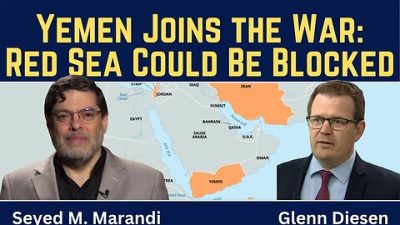
Yemen joins the war – Red Sea could be blocked next – Saudi regime at risk
or go to
Aletho News Archives – Video-Images
From the Archives
A superpower and “the world’s sickest warrior state”
By Paul J. Balles | March 8, 2010
Living through five or six major wars has hardened me to what I thought were the extremes of inhuman cruelty and brutality.
Two things made those extremes almost bearable: the brutality always revealed – at least according to the media coverage – the viciousness of the enemy. It was therefore quite understandable when our “brave men and women” pulverized the enemy.
Films of Japanese torturing captive Americans somehow justified holding Japanese Americans in internment camps during World War II; and only a small percentage of Americans found the bombing of Hiroshima and Nagasaki unreasonably vengeful at best, at worst, depraved.
The media giants in America portrayed the North Koreans as barbaric beasts with their captives, quite unlike their southern counterpoints – our allies during the Korean War. No one ever felt the need to explain how the South Koreans were a civilized breed while the North Koreans were absolute savages, at least according to the official line.
In Vietnam, our warriors justifiably (or so the media made us believe) dropped napalm on the North Vietnamese who had the gall to hide in villages and tunnels to ravage our invaders. At least it was accepted practice until some rogue photojournalist filmed a young girl screaming down a Vietnamese road in flames. … continue
Blog Roll
 Aletho News
- Russian tanker approaches Cuba despite US oil blockade
- Marandi: Yemen joins the war – Red Sea could be blocked next – Saudi regime at risk
- Pro-Palestinian French member of European Parliament denied entry to Canada
- Pakistan to Host US-Iran Talks
- How Indonesia’s tilt toward the US left it stranded in the Strait of Hormuz
- US has no choice but to retreat from Iranian borders: Top commander
- Iran Retaliation Strikes Chemical Plant Near Dimona
- AWACS’ Destruction is a Major Loss for US Military – Ex-DoW Analyst
- Israel’s Iran Strategy Uses US Military & Gulf States as Its Pawns
- Iran: Trump wanted regime change, now just begging for Hormuz to open
- If Americans Knew
- Israeli police block Catholic cardinal from entering Church of the Holy Sepulchre on Palm Sunday
- Israel is assassinating journalists again, more than any other nation, anywhere, ever – Not a ceasefire Day 170
- Over 300 US service members wounded, majority have brain injuries – Not a ceasefire Day 169
- Researchers at Human Rights Watch Resign Over Blocked Report on Palestinian Refugee Return
- Jewish Groups Are Backing a War Americans Don’t Want
- Eric Fingerhut Thinks He’s the President of the Jews
- Top Jewish Philanthropists, Rabbis Urge Israeli President to Take Action Against ‘Jewish Extremists’
- Don’t Be Fooled. Zionist Leaders Have Always Wanted to Control Southern Lebanon
- Israel’s widespread use of torture is a core element of its genocide against the Palestinian people
- In Israel’s War on Iran, Many Middle East US Bases Rendered “All But Uninhabitable”
- No Tricks Zone
- German Science Blog Accuses PIK Climate Institute Of Hallucinating Climate Tipping Points
- Devastating Assessment Of Comirnaty Vaccine By Former Senior Pfizer Europe Toxicologist
- New Study: CO2 Is ‘Effectively Negligible’ As An Explanatory Climate Change Factor Since 2000
- Former Pfizer Toxicologist Dr. Helmut Sterz Tells Bundestag Hearing Pfizer Vaccine Should Have Never Been Approved
- Energy Expert: Germany’s Nuclear Phaseout Was A “500 Billion Euro Mistake”
- New Research: South Australia’s Mid-Holocene Sea Surface Temperatures Were 4°C Warmer Than Today
- Storing Green Energy To Last Germany 10 Days Would Require A 60-Million Tonne Battery
- New Studies: UK Sea Levels Were 4 Meters Higher Than Today During The Mid-Holocene
- Destructive Green New Deal: German Energy And Metal Group Warns Of Drastic Crisis
- New Study Documents A 20-Year Pause In Arctic Sea Ice Decline – Driven By Internal Variability
 Aletho News