The Trust Project: Big Media and Silicon Valley’s Weaponized Algorithms Silence Dissent

Trust Project founder Sally Lehrman speaks at the 2018 organization of News Ombudsmen conference. Photo | ONO
By Whitney Webb | MintPress News | June 7, 2019
After the failure of Newsguard — the news rating system backed by a cadre of prominent neoconservative personalities — to gain traction among American tech and social media companies, another organization has quietly stepped in to direct the news algorithms of tech giants such as Google, Facebook, and Microsoft.
Though different from Newsguard, this group, known as “The Trust Project,” has a similar goal of restoring “trust” in corporate, mainstream media outlets, relative to independent alternatives, by applying “trust indicators” to social-media news algorithms in a decidedly untransparent way. The funding of “The Trust Project” — coming largely from big tech companies like Google; government-connected tech oligarchs like Pierre Omidyar; and the Knight Foundation, a key Newsguard investor — suggests that an ulterior motive in its tireless promotion of “traditional” mainstream media outlets is to limit the success of dissenting alternatives.
Of particular importance is the fact that the Trust Project’s “trust indicators” are already being used to control what news is promoted and suppressed by top search engines like Google and Bing and massive social-media networks like Facebook. Though the descriptions of these “trust indicators” — eight of which are currently in use — are publicly available, the way they are being used by major tech and social media companies is not.
The Trust Project’s goal is to increase public trust in the very same traditional media outlets that Newsguard favored and to use HTML-embedded codes in favored news articles to promote their content at the expense of independent alternatives. Even if its effort to promote “trust” in establishment media fail, its embedded-code hidden within participating news sites allow those establishment outlets to skirt the same algorithms currently targeting their independent competition, making such issues of “trust” largely irrelevant as it moves to homogenize the online media landscape in favor of mainstream media.
The Trust Project’s director, Sally Lehrman, made it clear that, in her view, the lack of public trust in mainstream media and its declining readership is the result of unwanted “competition by principle-free enterprises [that] further undermines its [journalism’s] very role and purpose as an engine for democracy.”
Getting to know the Trust Project
The Trust Project describes itself as “a consortium of top news companies” involved in developing “transparency standards that help you easily assess the quality and credibility of journalism.” It has done this by creating what it calls “Trust Indicators,” which the project’s website describes as “a digital standard that meets people’s needs.” However, far from meeting “people’s needs,” the Trust Indicators seem aimed at manipulating search engine and social-media news algorithms to the benefit of the project’s media partners, rather than to the benefit of the general public.
The origins of the Trust Project date back to a 2012 “roundtable” hosted by the Markkula Center for Applied Ethics at Santa Clara University, a center funded by former Apple CEO Mike Markkula. That roundtable became known as the Roundtable on Digital Journalism Ethics and was created by journalist Sally Lehrman, then working at the Markkula Center, in connection with the New Media Executive Roundtable and Online Credibility Watch of the Society of Professional Journalists. Lehrman has explicitly stated that the Trust Project is open only to “news organizations that adhere to traditional standards.”
The specific idea that spurred the creation of the Trust Project itself was born at a 2014 meeting of that roundtable, when Lehrman “asked a specialist in machine learning at Twitter, and Richard Gingras, head of Google News, if algorithms could be used to support ethics instead of hurting them, and they said yes. Gingras agreed to collaborate.” In other words, the idea behind the Trust Project, from the start, was aimed at gaming search-engine and social-media algorithms in collusion with major tech companies like Google and Twitter.

Sally Lehrman discusses the Trust Project at 2018 WordCamp For Publishers
As the Trust Project itself notes, the means of altering algorithms were developed in tandem with tech-giant executives like Gingras and “top editors in the industry from 80 news outlets and institutions,” all of which are corporate, mainstream media outlets. Notably, the Trust Project’s media partners, involved in creating these new “standards” for news algorithms, include major publications owned by wealthy oligarchs: the Washington Post, owned by the world’s richest man, Jeff Bezos; the Economist, directed by the wealthy Rothschild family; and the Globe and Mail, owned by Canada’s richest family, the Thomsons, who also own Thomson Reuters. Other Trust Project partners include The New York Times, Mic, Hearst Television, the BBC and the USA Today network.
Other major outlets are represented on the News Leadership Council of the Markkula Center, including the Financial Times, Gizmodo Media, and The Wall Street Journal. That council — which also includes Gingras and Andrew Anker, Facebook’s Director of Product Management — “guides the Trust Project on our Trust Indicators.”
These “Trust Indicators” are the core of the Trust Project’s activities and reveal one of the key mechanisms through which Google, Twitter and Facebook have been altering their algorithms to favor outlets with good “Trust Indicator” scores. Trust Indicators, on their face, are aimed at making news publications “more transparent” as a means of generating increased trust with the public. Though a total of 37 have been developed, it appears only eight of them are currently being used.
These eight indicators are listed and described by the Trust Project as follows:
- Best Practices: What are the news outlet’s standards? Who funds it? What is the outlet’s mission? Plus commitments to ethics, diverse voices, accuracy, making corrections and other standards.
- Author/Reporter Expertise: Who made this? Details about the journalist, including their expertise and other stories they have worked on.
- Type of Work: What is this? Labels to distinguish opinion, analysis and advertiser (or sponsored) content from news reports.
- Citations and References: What’s the source? For investigative or in-depth stories, access to the sources behind the facts and assertions.
- Methods: How was it built? Also for in-depth stories, information about why reporters chose to pursue a story and how they went about the process.
- Locally Sourced? Was the reporting done on the scene, with deep knowledge about the local situation or community? Lets you know when the story has local origin or expertise.
- Diverse Voices: What are the newsroom’s efforts and commitments to bringing in diverse perspectives? Readers noticed when certain voices, ethnicities, or political persuasions were missing.
- Actionable Feedback: Can we participate? A newsroom’s efforts to engage the public’s help in setting coverage priorities, contributing to the reporting process, ensuring accuracy and other areas. Readers want to participate and provide feedback that might alter or expand a story.
How the Trust Project makes these indicators available to the public can be seen in its new project, the Newsroom Transparency Tracker, where it provides a table of “transparency” for participating media outlets. Notably, that table conflates actual transparency practices with simply providing the Trust Project with outlet policies and guidelines related to the above indicators.
For example, The Economist gets a perfect transparency “score” for having provided the Trust Project links to its ethics policy, mission statement and other information requested by the project. However, the fact that those policies exist and are provided to the Trust Project does not mean that the publication’s policies are, in fact, transparent or ethical in terms of their content or in practice. The fact that The Economist provided links to its policies does not make the publication more transparent, but — in the context of the Newsroom Transparency Tracker’s table — it provides the appearance of transparency, though such policy disclosures by The Economist are unlikely to translate into any changes to its well-known biases and slanted reporting towards certain issues.
Trust Indicators manipulate big tech algorithms
The true power of the Trust Indicators comes in a form that is not visible to the general public. These Trust Indicators, while occasionally displayed on partner websites, are also coupled with “machine-readable signals” embedded in the HTML code of participating websites and articles used by Facebook, Google, Bing and Twitter. As Lehrman noted in a 2017 article, the Trust Project was then “already working with these four companies, all of which have said they want to use our indicators to prioritize honest, well-reported news over fakery and falsehood.” Gingras of Google News also noted that the Trust Indicators are used by Google as “cues to help search engines better understand and rank results … [and] to help the myriad algorithmic systems that mold our media lives.”
A press release from the Trust Project last year further underscores the importance of the embedded “indicators” to alter social-media and search-engine algorithms:
While each Indicator is visible to users on the pages of the Project’s news partners, it is also embedded in the article and site code for machines to read — providing the first, standardized technical language that offers contextual information about news sites’ commitments to transparency.”
Despite claiming to increase public knowledge of “news sites’ commitments to transparency,” the way that major tech companies like Google and Facebook are using these indicators is anything but transparent. Indeed, it is largely unknown how these indicators are used, though there are a few clues.
For instance, CBS News cited Craig Newmark — the billionaire founder of Craigslist, who provided the Trust Project’s seed funding — as suggesting that “Google’s search algorithm could rank trusted sources above others in search results” by using the project’s Trust Indicators.
Last year, the Trust Project stated that Bing used “the ‘Type of Work’ Trust Indicator to display whether an article is news, opinion or analysis.” It also stated that “when Facebook launched its process to index news Pages, they worked with the Trust Project to make it easy for any publisher to add optional information about their Page.” In Google’s case, Gingras was quoted as saying that Google News uses the indicators “to assess the relative authoritativeness of news organizations and authors. We’re looking forward to developing new ways to use the indicators.”
Notably, the machine-readable version of these Trust Indicators is available only to participating institutions, which are currently corporate, mainstream publications. Though WordPress and Drupal plug-ins are being developed to make those embedded signals to search engines and social media available to smaller publishers, it will be made available only to “qualified publishers,” a determination that will presumably be made by the Trust Project and its associates.
Richard Gingras, in a statement made in 2017, noted that “the indicators can help our algorithms better understand authoritative journalism — and help us to better surface it to consumers.” Thus, it is abundantly clear that these indicators, which are embedded only into “qualified” and “authoritative” news websites, will be used to slant search-engine and social-media news algorithms in favor of establishment news websites.
The bottom line is that these embedded and exclusive indicators allow certain news outlets to avoid the crushing effects of recent algorithm changes that have seen traffic to many news websites, including MintPress, plummet in recent years. This is leading towards a homogenization of the online news landscape by starving independent competitors of web traffic while Trust Project-approved outlets are given an escape valve through algorithm manipulation.
The tech billionaires behind the Trust Project
Given the Trust Project’s rich-get-richer impact on the online news landscape, it is not surprising to find that it is funded by rich and powerful figures and forces with a clear stake in controlling the flow of news and information online.
According to its website, the Trust Project currently receives funding from Craig Newmark Philanthropies, Google, Facebook, eBay founder Pierre Omidyar’s Democracy Fund, the John S. and James L. Knight Foundation (often abbreviated as the Knight Foundation), and the Markkula Foundation. Its website also states that Google was “an early financial supporter” and that it had originally been funded by Craig Newmark, the founder of Craigslist. As previously mentioned, the Trust Project’s co-founder is Richard Gingras, current Google vice president of News. The Trust Project’s website described Gingras’s current role with the organization as “a powerful evangelist” who “can always be counted upon for expert advice and encouragement.” Newmark’s current role at the Trust Project is described as that of a “funder and valued connector.”
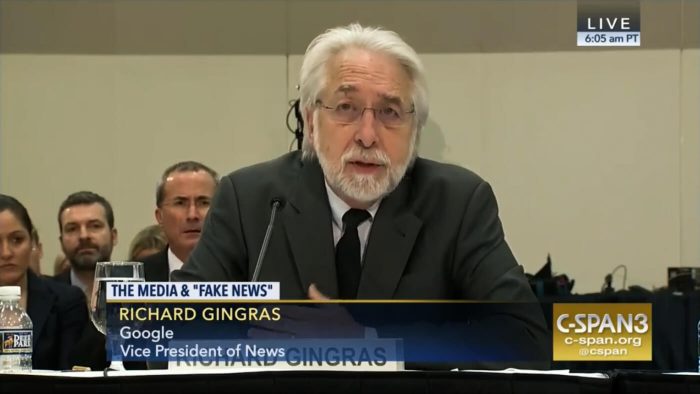
Google VP Richard Gingras testifies at a British Committee Hearing on “Fake News”
Newmark, through Craig Newmark Philanthropies, who provided the initial funding for the Trust Project, and has also funded other related initiatives like the News Integrity Initiative at the City University of New York, which shares many of the same financiers as the Trust Project, including Facebook, Omidyar’s Democracy Fund, and the Knight Foundation. The Trust Project is listed as a collaborator of the News Integrity Initiative. Newmark is also very active in several news-related NGOs with similar overlap. For instance, he sits on the board of the Electronic Frontier Foundation (EFF), a longtime recipient of massive grants from the Omidyar Network, and Politifact.com, which is funded in part by Omidyar’s Democracy Fund.
Newmark is currently working with Vivian Schiller as his “strategic adviser” in his media investments. Schiller is a member of the Council on Foreign Relations, former head of news at Twitter, and a veteran of well-known mainstream outlets like NPR, CNN, The New York Times and NBC News. She is also a director of the Scott Trust, which owns The Guardian.
The Markkula Foundation, one of the key funders of the Trust Project, exercises considerable influence over the organization through the Markkula Center for Applied Ethics, which originally incubated the organization and whose News Leadership Council plays an important role at the Trust Project. That council’s membership includes representatives of Facebook, The Wall Street Journal, The Washington Post, Financial Times and Google, and “guides the Trust Project on our Trust Indicators and advises on core issues related to information literacy and rebuilding trust in journalism within a fractious, so-called post-fact environment.”
Both the Markkula Foundation and the Markkula Center for Applied Ethics were founded by A. M. “Mike” Markkula, former CEO of Apple. The Markkula Center’s Journalism Ethics program is currently headed by Subramaniam Vincent, a former software engineer and consultant for Intel and Cisco Systems who has worked to bring together big data with local journalism and is an advocate for the use of “ethical-AI [artificial intelligence] to ingest, sort, and classify news.”
The John S. and James L. Knight Foundation is another interesting funder of the Trust Project, given that this same foundation is also a key investor in Newsguard, the controversial, biased news rating system with deep connections to government insiders and self-described government propagandists. There is considerable overlap between Newsguard and the Trust Project, with the latter citing Newsguard as a partner and also stating that Newsguard’s demonstrably biased ratings use the project’s “trust indicators” in its full-length reviews of news websites, which Newsguard calls “nutrition labels.” In addition, becoming a Trust Project participant is a factor that “supports a positive evaluation” from Newsguard, according to a press release from last year.
Notably, Sally Lehrman, who leads the Trust Project, described the project’s trust indicators for news as ”along the lines of a nutrition label on a package of food” when the Trust Project was created nearly a year before Newsguard launched, suggesting some intellectual overlap.
A previous MintPress exposé revealed Newsguard’s numerous conflicts of interest and a ratings system strongly biased in favor of well-known, traditional media outlets — even when those outlets have a dubious track record of promoting so-called “fake news.” It should come as no surprise that the Trust Project’s goal is to increase public trust in the very same traditional media outlets that Newsguard favored and to use HTML-embedded codes in news articles to promote their content at the expense of independent alternatives.
A familiar face in the war against independent media
The Democracy Fund, another top funder of the Trust Project and a bipartisan foundation that was established by eBay founder and PayPal owner Omidyar in 2011 “out of deep respect for the U.S. Constitution and our nation’s core democratic values.” It is a spin-off of the Omidyar Network and, after splitting off as an independent company in 2014, became a member of the Omidyar Group. The fund’s National Advisory Committee includes former Bush and Obama administration officials and representatives of Facebook, Microsoft, NBC News, ABC News and Gizmodo Media group.
The Democracy Fund’s involvement in the Trust Project is notable because of the other media projects it funds, such as the new media empire of arch-neoconservative Bill Kristol, who has a long history of creating and disseminating falsehoods that have been used to justify the U.S. war in Iraq and other hawkish foreign policy stances. As a recent MintPress series revealed, Omidyar’s Democracy Fund provides financial support to Kristol’s Defending Democracy Together initiative and also supports Kristol’s Alliance for Securing Democracy, a project of the German Marshall Fund think tank that is best known for its cryptic Hamilton68 “Russian bot” dashboard. Omidyar’s Democracy Fund has also donated to the German Marshall Fund’s Defending Digital Democracy project and directly to the German Marshall Fund itself. In addition, Charles Sykes, a co-founder and editor-at-large of Kristol’s new publication The Bulwark, is on the Democracy Fund’s National Advisory Committee.
An acolyte of Kristol’s who works at the German Marshall Fund, Jamie Fly, stated last October that the coordinated social-media purges of independent media pages known for their criticisms of U.S. empire and U.S. police violence was “just the beginning” and hinted that the German Marshall Fund had a hand in past social media purges and, presumably, a role in future purges. Thus, the Democracy Fund’s links to neoconservatives who promote the censoring of independent media sites that are critical of militaristic U.S. foreign policy jibe with the fund’s underlying interest in the Trust Project.
Omidyar’s involvement with the Trust Project is interesting for another reason, namely that Omidyar is the main backer behind the efforts of the controversial Anti-Defamation League (ADL) to become a key driver of which outlets are censored by Silicon Valley tech giants. The ADL was initially founded to “stop the defamation of the Jewish people and to secure justice and fair treatment to all” but critics say that over the years it has begun labeling critics of Israel’s government as “anti-Semites.”
For example, content that characterizes Israeli policies towards Palestinians as “racist” or “apartheid-like” is considered “hate speech” by the ADL, as is accusing Israel of war crimes or attempted ethnic cleansing. The ADL has even described explicitly Jewish organizations that are critical of Israel’s government as being “anti-Semitic.”
In March 2017, the Omidyar Network provided the “critical seed capital” need to launch the ADL’s “new Silicon Valley center aimed at tackling this rising wave of intolerance and to collaborate more closely with technology companies to promote democracy and social justice.” That Omidyar-funded ADL center allowed the ADL to team up with Facebook, Twitter, Google and Microsoft — all of whom also collaborate with the Trust Project — to create a Cyberhate Problem-Solving Lab. Since then, these companies and their subsidiaries, including Google’s YouTube, have relied on the ADL to flag “controversial” content.
Given the fact that the Trust Project shares with the ADL a key funder (Pierre Omidyar) and several external tech partners, it remains to be seen whether there is overlap between how major tech companies like Google and Facebook use the Trust Indicators in its algorithms and the influence of the ADL on those very same algorithms.
Outsourcing censorship
Of course, the most interesting and troubling donors of the Trust Project are Google and Facebook, both of which are using the very project they fund as a “third party” to justify their manipulation of newsfeed and search-engine algorithms. Google’s intimate involvement from the very inception of the Trust Project tags it as an extension of Google that has since been marketed as an “independent” organization tasked with justifying algorithm changes that favor certain news outlets over others.
Facebook, similarly, funds the Trust Project and also employs the “trust indicators” it funds to alter its newsfeed algorithm. Facebook’s other partners in altering this algorithm include the Atlantic Council — funded by the U.S. government, NATO, and weapons manufacturers, among others — and Facebook has also directly teamed up with foreign governments, such as the government of Israel, to suppress accurate yet dissenting information that the government in question wanted removed from the social-media platform.
The murkiness between “private” censorship, censorship by tech oligarchs, and censorship by government is particularly marked in the Trust Project. The private financiers of the Trust Project that also use its product to promote certain news content over others — namely Google and Facebook — have ties to the U.S. government, with Google being a government contractor and Facebook sporting a growing body of former-government officials in top company positions, including a co-author of the controversial Patriot Act as the company’s general counsel.
A similar tangle surrounds Pierre Omidyar, funder of the Trust Project through the Democracy Fund, who is extremely well-connected to the U.S. government, especially the military-industrial complex and intelligence communities. And partnering with media outlets like the Washington Post, whose owner is Jeff Bezos, spawns more conflicts of interests, given that Bezos’ company, Amazon, is also a major U.S. government contractor.
This growing nexus binding Silicon Valley companies and oligarchs, mainstream media outlets and the government suggests that these entities have increasingly similar and complementary interests, among which is the censorship of independent watchdog journalists and news outlets that seek to challenge their power and narratives.
The Trust Project was created as a way of outsourcing censorship of independent news sites while attempting to salvage the tattered reputation of mainstream media outlets and return the U.S. and international media landscape to years past when such outlets were able to dominate the narrative.
While it seems unlikely that’s its initiatives will succeed in restoring trust to mainstream media given the many recent and continuing examples of those same “traditional” media outlets circulating fake news and failing to cover crucial aspects of events, the Trust Project’s development of hidden algorithm-altering codes in participating websites shows that its real goal is not about improving public trust but about providing a facade of independence to Silicon Valley censorship of independent media outlets that speak truth to power.
Whitney Webb is a MintPress News journalist based in Chile. She has contributed to several independent media outlets including Global Research, EcoWatch, the Ron Paul Institute and 21st Century Wire, among others. She has made several radio and television appearances and is the 2019 winner of the Serena Shim Award for Uncompromised Integrity in Journalism.
Sniper-killing journalist game pulled after outcry over ‘Breaking News’ mission

RT | May 19, 2019
A popular sniper-mission video game encouraging players to assassinate a journalist has been pulled by its developer after media reports exposed the controversial shooting scene.
‘Sniper 3D Assassin’ was a free game on Apple devices as well as gaming platform Steam, and was available on Amazon, Google and Microsoft app stores.
New York Times journalist Jamal Jordan tweeted about the journalist killing mission after his nephew showed him the game.
The ‘Breaking News’ mission tells players to make a journalist “famous in a different way,” by shooting them after they receive documents from a police officer. When the mission ends, the screen reads, “That’s a cover story.”
Revelations about the journalist murder mission game were received with horror on Twitter, especially by media workers.
Developers from TFG Co. pulled the game after it was contacted by the HuffPost, insisting it had been “fictional” and intended for “mature audiences.”
“At TFG, we work to create games that bring fun and entertainment to users all around the world,” CTO Mac-Vicar said. “As such, we take feedback from our players very seriously. After listening to our community today, we have decided to remove the mission ‘Breaking News’ from the game.”
The game was released in 2014 and had 10 million downloads in its first month. At one stage in 2016 it was the most downloaded game on Apple’s App Store.
Artificial Morality
By Robert Koehler | CounterPunch | March 15, 2019
Artificial Intelligence is one thing. Artificial morality is another. It may sound something like this:
“First, we believe in the strong defense of the United States and we want the people who defend it to have access to the nation’s best technology, including from Microsoft.”
The words are those of Microsoft president Brad Smith, writing on a corporate blogsite last fall in defense of the company’s new contract with the U.S. Army, worth $479 million, to make augmented reality headsets for use in combat. The headsets, known as the Integrated Visual Augmentation System, or IVAS, are a way to “increase lethality” when the military engages the enemy, according to a Defense Department official. Microsoft’s involvement in this program set off a wave of outrage among the company’s employees, with more than a hundred of them signing a letter to the company’s top executives demanding that the contract be canceled.
“We are a global coalition of Microsoft workers, and we refuse to create technology for warfare and oppression. We are alarmed that Microsoft is working to provide weapons technology to the U.S. Military, helping one country’s government ‘increase lethality’ using tools we built. We did not sign up to develop weapons, and we demand a say in how our work is used.”
Wow, words of conscience and hope. The deeper story in all this is ordinary people exercising their power to shape the future and refusing to increase its lethality.
With this contract, the letter goes on, Microsoft has “crossed the line into weapons development. . . . The application of HoloLens within the IVAS system is designed to help people kill. It will be deployed on the battlefield, and works by turning warfare into a simulated ‘video game,’ further distancing soldiers from the grim stakes of war and the reality of bloodshed.”
This revolt was what Smith was responding to when he said he believed in a “strong defense,” implying that moral clichés rather than money are what drive the decisions of large corporations, or at least this particular large corporation. Somehow his words, which he attempted to convey as reflective and deeply considered, are not convincing — not when juxtaposed with a defense contract worth nearly half a billion dollars.
Smith goes on, acknowledging that no institution, including the military, is perfect, but pointing out that “one thing is clear. Millions of Americans have served and fought in important and just wars,” cherry-picking such lauded oldies as the Civil War and World War II, where America’s enhanced lethality freed slaves and liberated Europe.
Fascinatingly, the tone of his blog post is not arrogant toward the employees — do what you’re told or you’re fired — but, rather, softly placating, seeming to indicate that the power here isn’t concentrated at the upper levels of management. Microsoft is flexible: “As is always the case, if our employees want to work on a different project or team — for whatever reason — we want them to know we support talent mobility.”
The employees who signed the letter demanded cancellation of the Defense contract. Smith offered their personal consciences an out: Come on, join another team if you don’t want to cross the line and work on weapons development. Microsoft honors employees of multiple moral persuasions!
Artificial Intelligence is a high-tech phenomenon that requires highly complex thinking. Artificial morality hides behind the nearest cliché in servitude to money.
What I see here is moral awakening scrambling for sociopolitical traction: Employees are standing for something larger than sheer personal interests, in the process pushing the Big Tech brass to think beyond their need for an endless flow of capital, consequences be damned.
This is happening across the country. A movement is percolating: Tech won’t build it!
“Across the technology industry,” the New York Times reported in October, “rank-and-file employees are demanding greater insight into how their companies are deploying the technology that they built. At Google, Amazon, Microsoft and Salesforce, as well as at tech start-ups, engineers and technologists are increasingly asking whether the products they are working on are being used for surveillance in places like China or for military projects in the United States or elsewhere.
“That’s a change from the past, when Silicon Valley workers typically developed products with little questioning about the social costs.”
What if moral thinking — not in books and philosophical tracts, but in the real world, both corporate and political — were as large and complex as technical thinking? It could no longer hide behind the cliché of the just war (and surely the next one we’re preparing for will be just), but would have to evaluate war itself — all wars, including the ones of the past 70 years or so, in the fullness of their costs and consequences — as well as look ahead to the kind of future we could create, depending on what decisions we make today. Complex moral thinking doesn’t ignore the need to survive, financially and otherwise, in the present moment, but it stays calm in the face of that need and sees survival as a collective, not a competitive, enterprise.
Moral complexity is called peace. There is no such thing as simplistic peace.
Robert Koehler is a Chicago award-winning journalist and editor.
Microsoft workers demand company cancel $480 million US military contract
Press TV – February 23, 2019
Nearly 100 employees at Microsoft have demanded that the US technology company cancel a $480 million hardware contract to supply the US military, the latest example in the last year of tech employees protesting cooperation with the Pentagon on emerging technologies.
Some 94 workers signed a petition on Friday calling on the company to stop developing “any and all weapons technologies” for the US Defense Department.
Microsoft won a contract in November to supply the US Army with at least 2,500 prototypes of augmented reality headsets, which digitally display contextual information in front of a user’s eyes.
The US Defense Department has said the devices would be used on the battlefield and in training to improve soldiers “lethality, mobility and situational awareness.”
In the petition to Microsoft executives, posted on Twitter, the workers said they “did not sign up to develop weapons, and we demand a say in how our work is used.” They called on the company to develop “a public-facing acceptable use policy” for its technology and an external review board to publicly enforce it.
Microsoft president Brad Smith said in an October blog post that the company remained committed to assisting the military and would advocate for laws to ensure responsible use of new technologies.
Though many US government agencies want to draw upon the expertise of the biggest American tech companies, employee resistance has added a new challenge to already complicated relationships.
Worker opposition led Google’s parent company Alphabet Inc last year to announce it would cancel a Pentagon contract in which its artificial intelligence technology is used to analyze drone imagery.
In other cases, employee criticism has invited greater public scrutiny to deals, such as $10 billion cloud computing contract yet to be awarded and various contracts with US Immigration and Customs Enforcement.
No need to install: Microsoft has controversial fake news filter NewsGuard built into mobile browser

© http://www.microsoft.com
By Igor Ogorodnev | RT | January 23, 2019
Corporate and neocon-backed startup NewsGuard is one step closer to its vision of bringing its “unreliable” news rater to every screen after Microsoft makes it an integral part of its Edge mobile browser.
Rather than having to download an app as before, Edge users on Android and Apple devices can now just click one button to enable its “green-red rating signal if a website is trying to get it right or instead has a hidden agenda or knowingly publishes falsehoods or propaganda.”
Among the green-rated websites: Voice of America, CNN, Buzzfeed, the Guardian, New York Times and the Washington Post, as well as left-leaning upstarts such as Vice News and Refinery 29. Ones that are given the red warning label of “failing to maintain basic standards of accuracy and accountability”: RT and Sputnik (obviously enough) and the right-wing Daily Mail, Breitbart and the Drudge Report, in addition to hundreds of other non-mainstream news websites such as Wikileaks.
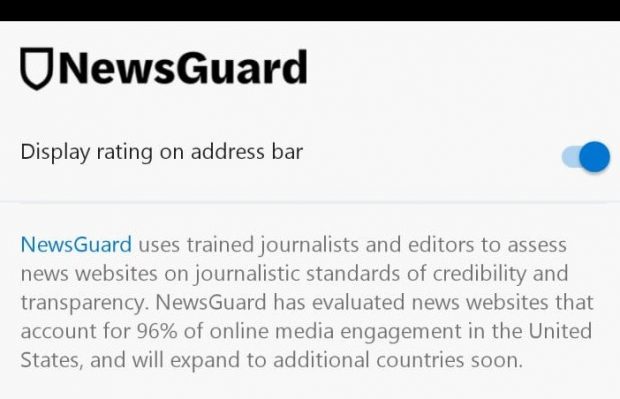
Not only does the integration ensure that NewsGuard is present on every browser, and is easier to use than to ignore, but by making it a fundamental Microsoft-provided feature, the company gives it inherent level of trustworthiness, something akin to a bundled anti-virus feature, only this time the virus targets your brain, not your computer or iPod.
‘Totally transparent’
None of this is the slightest bit alarming if you believe that NewsGuard is an absolutely fair arbiter of what constitutes real news or propaganda.
Its pride of place is its “Nutrition Labels” which ape the precision of a list of calories, carbs, and saturated fats to give a supposedly scientific assessment of media reliability on nine different criteria. Among them: doesn’t repeatedly publish false content, avoids deceptive headlines, gathers and presents information responsibly, handles the difference between news and opinion responsibly.
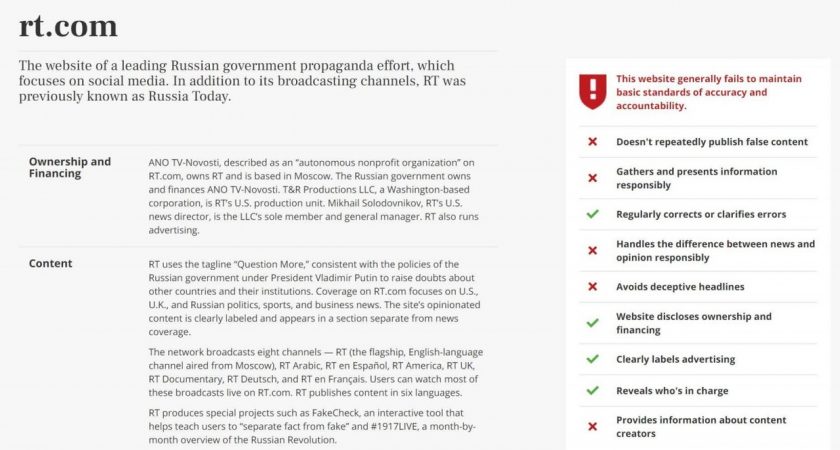
© Newsguardtech.com/Media sample
The green-listed media outlets above apparently do not ever engage in these practices, or at least not knowingly. So CNN never misleads with its headlines, the Guardian never dresses up its agendas as news, and Buzzfeed stories are always accurate. One literally doesn’t have to go back three days to find dozens of examples to the contrary, but this would be too mind-numbingly pedantic a task.
Even regular readers of the green-tick media must be able to see these are judgment calls. What is even “presenting information responsibly”?
Perhaps realizing that their pseudo-scientific fancy diagram is insufficient, NewsGuard has stressed that they are not using shadowy methods like tech companies and are open to two-way communication.
“We want people to game our system. We are totally transparent. We are not an algorithm,” company co-founder Steve Brill told the Guardian.
This is how he explained the Daily Mail red warning.
“We spell out fairly clearly in the label exactly how many times we have attempted to contact them. The analyst that wrote this writeup got someone on the phone who, as soon he heard who she was and where she was calling from, hung up. As of now, we would love to hear if they have a complaint or if they change anything.”
On the other hand, RT did answer NewsGuard’s queries in detail. You can guess how much difference that made.
From anthrax scares to Russia fears
But who are these people that the Daily Mail or RT have to impress and why?
Brill himself is a veteran centrist journalist and author, his co-CEO Gordon Crovitz is a former Wall Street Journal columnist. After Brill, its second-biggest investor, along with his father, is Nick Penniman, the liberal publisher, and the third-biggest is Publicis Group, a multinational advertising agency.
Meanwhile, its advisory board includes Tom Ridge, the first-ever Homeland Security chief, and developer of another famous color-coded system, the terror alert, and Michael Hayden, the CIA director, also under George W. Bush. There are also several Obama and Clinton-era figures.

Tom Ridge and George W. Bush in 2004. © Reuters
The overall picture emerges of a mix of establishment journalists, hawkish old-school Washington insiders, and so-called ethical businessmen.
They may all be experts in their fields, but if you believe that these are selfless neutral adjudicators you are probably beyond being helped by color charts. And this is not some one-off initiative either: NewsGuard is part of Microsoft’s Defending Democracy program, which combats purported election meddling, presumably primarily from Russia. The frontline of the information war is not customarily the place for impartial news judgment.
But I wasn’t an Edge user…
However much respectability NewsGuard enjoys through Microsoft, Edge has a laughably small – a fraction of a percent – market share on mobiles. In practical terms, even an increase of popularity of several thousand percent will only mean several thousand new users, and other browsers are available.
This would be that, if not for NewsGuard’s self-proclaimed ambition “to expand to serve the billions of people globally who get news online.” This is just a beginning: there is an overarching plan where all public computers, from the school to the university to the library, are automatically equipped with the same “safe browsing” system.
And rather than as an individual warning, NewsGuard plans to make its designations work as an effective financial tool. The company, which has received $6 million in backing, also plans to soon work with advertisers, “keeping ads off unreliable news websites” to ensure “brand safety.” Fall foul of the green ticks, no money for you. Advertising managers are already demonetizing programs with alternative or controversial viewpoints elsewhere, and soon the process can be automated, and Brill is boasting that he is “happy to be blamed” – doing the dirty work for the platforms. No wonder alternative outlets in the US are openly opposed.
So, just like the use of NewsGuard in all public libraries in the faraway state of Hawaii (no money charged), it is best to look at the Edge integration is more of a test, a pilot project, a dry run. Latching NewsGuard onto a popular browser like Chrome, or a social network like Facebook, would stir tremors of public debate, as it has done in the past when similar initiatives have been tried. Instead, first they came for the Edge users.
How a NeoCon-Backed “Fact Checker” Plans to Wage War on Independent Media
It will soon become almost impossible to avoid Newsguard’s ranking systems on any technological device sold in the United States
By Whitney Webb | Mint Press News | January 9, 2019
Soon after the social media “purge” of independent media sites and pages this past October, a top neoconservative insider — Jamie Fly — was caught stating that the mass deletion of anti-establishment and anti-war pages on Facebook and Twitter was “just the beginning” of a concerted effort by the U.S. government and powerful corporations to silence online dissent within the United States and beyond.
While a few, relatively uneventful months in the online news sphere have come and gone since Fly made this ominous warning, it appears that the neoconservatives and other standard bearers of the military-industrial complex and the U.S. oligarchy are now poised to let loose their latest digital offensive against independent media outlets that seek to expose wrongdoing in both the private and public sectors.
As MintPress News Editor-in-Chief Mnar Muhawesh recently wrote, MintPress was informed that it was under review by an organization called Newsguard Technologies, which described itself to MintPress as simply a “news rating agency” and asked Muhawesh to comment on a series of allegations, several of which were blatantly untrue. However, further examination of this organization reveals that it is funded by and deeply connected to the U.S. government, neo-conservatives, and powerful monied interests, all of whom have been working overtime since the 2016 election to silence dissent to American forever-wars and corporate-led oligarchy.
More troubling still, Newsguard — by virtue of its deep connections to government and Silicon Valley — is lobbying to have its rankings of news sites installed by default on computers in U.S. public libraries, schools, and universities as well as on all smartphones and computers sold in the United States.
In other words, as Newsguard’s project advances, it will soon become almost impossible to avoid this neocon-approved news site’s ranking systems on any technological device sold in the United States. Worse still, if its efforts to quash dissenting voices in the U.S. are successful, Newsguard promises that its next move will be to take its system global.
Red light, green light . . .
Newsguard has received considerable attention in the mainstream media of late, having been the subject of a slew of articles in the Washington Post, the Hill, the Boston Globe, Politico, Bloomberg, Wired, and many others just over the past few months. Those articles portray Newsguard as using “old-school journalism” to fight “fake news” through its reliance on nine criteria allegedly intended to separate the wheat from the chaff when it comes to online news.
Newsguard separates sites it deems worthy and sites it considers unreliable by using a color-coded rating — green, yellow, or red — and more detailed “nutrition labels” regarding a site’s credibility or lack thereof. Rankings are created by Newsguard’s team of “trained analysts.” The color-coding system may remind some readers of the color-coded terror threat-level warning system that was created after 9/11, making it worth noting that Tom Ridge, the former secretary of Homeland Security who oversaw the implementation of that system under George W. Bush, is on Newsguard’s advisory board.
As Newsguard releases a new rating of a site, that rating automatically spreads to all computers that have installed its news ranking browser plug-in. That plug-in is currently available for free for the most commonly used internet browsers. NewsGuard directly markets the browser plug-in to libraries, schools and internet users in general.
According to its website, Newsguard has rated more than 2,000 news and information sites. However, it plans to take its ranking efforts much farther by eventually reviewing “the 7,500 most-read news and information websites in the U.S.—about 98 percent of news and information people read and share online” in the United States in English.
A recent Gallup study, which was supported and funded by Newsguard as well as the Knight Foundation (itself a major investor in Newsguard), stated that a green rating increased users likelihood to share and read content while a red rating decreased that likelihood. Specifically, it found 63 percent would be less likely to share news stories from red-rated websites, and 56 percent would be more likely to share news from green-rated websites, though the fact that Newsguard and one of its top investors funded the poll makes it necessary to take these findings with a grain of salt.
However, some of the rankings Newsguard itself has publicized show that it is manifestly uninterested in fighting “misinformation.” How else to explain the fact that the Washington Post and CNN both received high scores even though both have written stories or made statements that later proved to be entirely false? For example, CNN falsely claimed in 2016 that it was illegal for Americans to read WikiLeaks releases and illegally colluded with the DNC to craft presidential debate questions.
In addition, in 2017, CNN published a fake story that a Russian bank linked to a close ally of President Donald Trump was under Senate investigation. That same year, CNN was forced to retract a report that the Trump campaign had been tipped off early about WikiLeaks documents damaging to Hillary Clinton when it later learned the alert was about material already publicly available.
The Washington Post, whose $600 million conflict of interest with the CIA goes unnoted by Newsguard, has also published false stories since the 2016 election, including one article that falsely claimed that “Russian hackers” had tapped into Vermont’s electrical grid. It was later found that the grid itself was never breached and the “hack” was only an isolated laptop with a minor malware problem. Yet, such acts of journalistic malpractice are apparently of little concern to Newsguard when those committing such acts are big-name corporate media outlets.
Furthermore, Newsguard gives a high rating to Voice of America, the U.S. state-funded media outlet, even though its former acting associate director said that the outlet produces “fluff journalism” and despite the fact that it was recently reformed to “provide news that supports our [U.S.] national security objectives.” However, RT receives a low “red” rating for being funded by the Russian government and for “raising doubts about other countries and their institutions” (i.e., including reporting critical of the institutions and governments of the U.S. and its allies).
Keeping the conversation safe for the corporatocracy
Newsguard describes itself as an organization dedicated to “restoring trust and accountability” and using “journalism to fight false news, misinformation and disinformation.” While it repeatedly claims on its website that its employees “have no political axes to grind” and “care deeply about reliable journalism’s pivotal role in democracy,” a quick look at its co-founders, top funders and advisory board make it clear that Newsguard is aimed at curbing voices that hold the powerful — in both government and the private sector — to account.
Newsguard is the latest venture to result from the partnership between Steven Brill and Louis Gordon Crovitz, who currently serve as co-CEOs of the group. Brill is a long-time journalist — published in TIME and The New Yorker, among others — who most recently founded the Yale Journalism Initiative, which aims to encourage Yale students who “aspire to contribute to democracy in the United States and around the world” to become journalists at top U.S. and international media organizations. He first teamed up with Crovitz in 2009 to create Journalism Online, which sought to make the online presence of top American newspapers and other publishers profitable, and was also the CEO of the company that partnered up with the TSA to offer “registered” travelers the ability to move more quickly through airport security — for a price, of course.
While Brill’s past does not in itself raise red flags, Crovitz — his partner in founding Journalism Online, then Press+, and now Newsguard — is the last person one would expect to find promoting any legitimate effort to “restore trust and accountability” in journalism. In the early 1980s. Crovitz held a number of positions at Dow Jones and at the Wall Street Journal, eventually becoming executive vice president of the former and the publisher of the latter before both were sold to Rupert Murdoch’s News Corp in 2007. He is also a board member of Business Insider, which has received over $30 million from Washington Post owner Jeff Bezos in recent years.
In addition to being a member of the Council on Foreign Relations, Crovitz proudly notes in his bio, available on Newsguard’s website, that he has been an “editor or contributor to books published by the American Enterprise Institute and Heritage Foundation.” Though many MintPress readers are likely familiar with these two institutions, for those who are not, it is worth pointing out that the American Enterprise Institute (AEI) is one of the most influential neoconservative think tanks in the country and its “scholars,” directors and fellows have included neoconservative figures like Paul Wolfowitz, Richard Perle, John Bolton and Frederick Kagan.
During the George W. Bush administration, AEI was instrumental in promoting the invasion and subsequent occupation of Iraq and has since advocated for militaristic solutions to U.S. foreign policy objectives and the expansion of the U.S.’ military empire as well as the “War on Terror.” During the Bush years, AEI was also closely associated with the now defunct and controversial neoconservative organization known as the Project for a New American Century (PNAC), which presciently called, four years before 9/11, for a “new Pearl Harbor” as needed to rally support behind American military adventurism.
The Heritage Foundation, like AEI, was also supportive of the war in Iraq and has pushed for the expansion of the War on Terror and U.S. missile defense and military empire. Its corporate donors over the years have included Procter & Gamble, Chase Manhattan Bank, Dow Chemical, and Exxon Mobil, among others.
Crovitz’s associations with AEI and the Heritage Foundation, as well as his ties to Wall Street and the upper echelons of corporate media, are enough to make any thinking person question his commitment to being a fair watchdog of “legitimate journalism.” Yet, beyond his innumerable connections to neoconservatives and powerful monied interest, Crovitz has repeatedly been accused of inserting misinformation into his Wall Street Journal columns, with groups like the Electronic Frontier Foundation accusing him of “repeatedly getting his facts wrong” on NSA surveillance and other issues. Some of the blatant falsehoods that have appeared in Crovitz’s work have never been corrected, even when his own sources called him out for misinformation.
For example, in a WSJ opinion piece that was written by Crovitz in 2012, Crovitz was accused of making “fantastically false claims” about the history of the internet by the very people he had cited to support those claims.
As TechDirt wrote at the time:
Almost everyone he [Crovitz] sourced or credited to support his argument that the internet was invented entirely privately at Xerox PARC and when Vint Cerf helped create TCP/IP, has spoken out to say he’s wrong. And that list includes both Vint Cerf, himself, and Xerox. Other sources, including Robert Taylor (who was there when the internet was invented) and Michael Hiltzik, have rejected Crovitz’s spinning of their own stories.”
The oligarch team’s deep bench
While Brill and Crovitz’s connections alone should be enough cause for alarm, a cursory examination of Newsguard’s advisory board makes it clear that Newsguard was created to serve the interests of American oligarchy. Chief among Newsguard’s advisors are Tom Ridge, the first Secretary of Homeland Security under George W. Bush and Ret. General Michael Hayden, a former CIA director, a former NSA director and principal at the Chertoff Group, a security consultancy seeking to “advise corporate clients and governments, including foreign governments” on security matters that was co-founded by former Homeland Security Secretary Michael Chertoff, who also currently serves as the board chairman of major weapons manufacturer BAE systems.
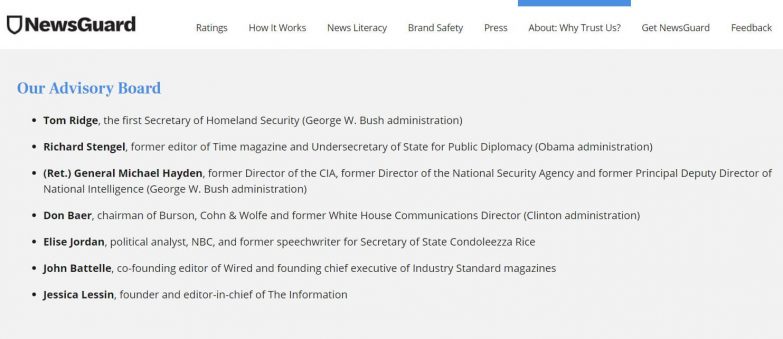
Another Newsguard advisor of note is Richard Stengel, former editor of Time magazine, a “distinguished fellow” at the Atlantic Council and Undersecretary of State for Public Diplomacy under President Barack Obama. At a panel discussion hosted last May by the Council on Foreign Relations, Stengel described his past position at the State Department as “chief propagandist” and also stated that he is “not against propaganda. Every country does it and they have to do it to their own population and I don’t necessarily think it’s that awful.”
Other Newsguard advisors include Don Baer, former White House communications director and advisor to Bill Clinton and current chairman of both PBS and the influential PR firm Burson Cohn & Wolfe as well as Elise Jordan, former communications director for the National Security Council and former speech-writer for Condoleezza Rice, as well as the widow of slain journalist Michael Hastings — who was writing an exposé on former CIA director John Brennan at the time of his suspicious death.
A look at Newguard’s investors further illustrates the multifarious connections between this organization and the American political and corporate elite. While Brill and Crovitz themselves are the company’s top investors, one of Newsguard’s most important investors is the Publicis Groupe. Publicis is the third largest global communications company in the world, with more than 80,000 employees in over 100 countries and an annual revenue of over €9.6 billion ($10.98 billion) in 2017. It is no stranger to controversy, as one of its subsidiaries, Qorvis, recently came under fire for exploiting U.S. veterans at the behest of the Saudi government and also helped the Saudi government to “whitewash” its human rights record and its genocidal war in Yemen after receiving $6 million from the Gulf Kingdom in 2017.
Furthermore, given its size and influence, it is unsurprising that the Publicis Groupe counts many powerful corporations and governments among its clientele. Some of its top clients in 2018 included pharmaceutical giants Eli Lilly, Merck, Pfizer and Bayer/Monsanto as well as Starbucks, Procter & Gamble, McDonalds, Kraft Heinz, Burger King, and the governments of Australia and Saudi Arabia. Given its influential role in funding Newsguard, it is reasonable to point out the potential conflict of interest posed by the fact that sites that accurately report on Publicis’ powerful clients — but generate bad publicity — could be targeted for such reports in Newsguard’s ranking.
In addition to the Publicis Groupe, another major investor in Newsguard is the Blue Haven Initiative, which is the venture capital “impact investment” fund of the wealthy Pritzker family — one of the top 10 wealthiest families in the U.S., best known as the owners of the Hyatt Hotel chain and for being the second largest financial contributors to Hillary Clinton’s 2016 presidential campaign.
Other top investors include John McCarter, a long-time executive at U.S. government contractor Booz Allen Hamilton, as well as Thomas Glocer, former CEO of Reuters and a member of the boards of pharmaceutical giant Merck & Co., financial behemoth Morgan Stanley, and the Council on Foreign Relations, as well as a member of the Atlantic Council’s International Advisory Board.
Through these investors, Newsguard managed to raise $6 million to begin its ranking efforts in March of 2018. Newsguard’s actual revenues and financing, however, have not been disclosed despite the fact that it requires the sites it ranks to disclose their funding. In a display of pure hypocrisy, Newsguard’s United States Securities and Exchange Commission Form D — which was filed March 5, 2018 — states that the company “declined to disclose” the size of its total revenue.
Why give folks a choice?
While even a quick glance at its advisory board alone would be enough for many Americans to decline to install Newsguard’s browser extension on their devices, the danger of Newsguard is the fact that it is diligently working to make the adoption of its app involuntary. Indeed, if voluntary adoption of Newsguard’s app were the case, there would likely be little cause for concern, given that its website attracts barely more than 300 visits per month and its social-media following is relatively small, with just over 2,000 Twitter followers and barely 500 Facebook likes at the time of this article’s publication.
To illustrate its slip-it-under-the-radar strategy, Newsguard has gone directly to state governments to push its browser extension onto entire state public library systems, even though its website suggests that individual public libraries are welcome to install the extension if they so choose. The first state to install Newsguard on all of its public library computers across its 51 branches was the state of Hawaii — which was the first to partner with Newsguard’s “news literacy initiative,” just last month.
According to local media, Newsguard “now works with library systems representing public libraries across the country, and is also partnering with middle schools, high schools, universities, and educational organizations to support their news literacy efforts,” suggesting that these Newsguard services targeting libraries and schools are soon to become a compulsory component of the American library and education system, despite Newsguard’s glaring conflicts of interest with massive multinational corporations and powerful government power-brokers.
Notably, Newsguard has a powerful partner that has allowed it to start finding its way into public library and school computers throughout the country. As part of its new “Defending Democracy” initiative, Microsoft announced last August that it would be partnering with Newsguard to actively market the company’s ranking app and other services to libraries and schools throughout the country. Microsoft’s press release regarding the partnership states that Newsguard “will empower voters by providing them with high-quality information about the integrity and transparency of online news sites.”
Since then, Microsoft has now added the Newsguard app as a built-in feature of Microsoft Edge, its browser for iOS and Android mobile devices, and is unlikely to stop there. Indeed, as a recent report in favor of Microsoft’s partnership with Newsguard noted, “we could hope that this new partnership will allow Microsoft to add NewsGuard to Edge on Windows 10 [operating system for computers] as well.”
Newsguard, for its part, seems confident that its app will soon be added by default to all mobile devices. On its website, the organization notes that “NewsGuard will be available on mobile devices when the digital platforms such as social media sites and search engines or mobile operating systems add our ratings and Nutrition Labels directly.” This shows that Newsguard isn’t expecting its rating systems to be offered as a downloadable application for mobile devices but something that social media sites like Facebook, search engines like Google, and mobile device operating systems that are dominated by Apple and Google will “directly” integrate into nearly every smartphone and tablet sold in the United States.
A Boston Globe article on Newsguard from this past October makes this plan even more clear. The Globe wrote at the time:
Microsoft has already agreed to make NewsGuard a built-in feature in future products, and [Newsguard co-CEO] Brill said he’s in talks with other online titans. The goal is to have NewsGuard running by default on our computers and phones whenever we scan the Web for news.”
This eventuality is made all the more likely given the fact that, in addition to Microsoft, Newsguard is also closely connected to Google, as Google has been a partner of the Publicis Groupe since 2014, when the two massive companies joined Condé Nast to create a new marketing service called La Maison that is “focused on producing engaging content for marketers in the luxury space.” Given Google’s power in the digital sphere as the dominant search engine, the creator of the Android mobile operating system, and the owner of YouTube, its partnership with Publicis means that Newsguard’s rating system will soon see itself being promoted by yet another of Silicon Valley’s most powerful companies.
Furthermore, there is an effort underway to integrate Newsguard into social media sites like Facebook and Twitter. Indeed, as Newsguard was launched, co-CEO Brill stated that he planned to sell the company’s ratings of news sites to Facebook and Twitter. Last March, Brill told CNN that “We’re asking them [Facebook, Twitter, Microsoft and Google] to pay a fraction of what they pay their P.R. people and their lobbyists to talk about the problem.”
On Wednesday, Gallup released a poll that will likely be used as a major selling point to social media giants. The poll — funded by Newsguard and the Knight Foundation, which is a top investor in Newsguard and has recently funded a series of Gallup polls relating to online news — seems to have been created with the intention of manufacturing consent for the integration of Newsguard with top social media sites.
This is because the promoted findings from the study are as follows:“89% of users of social media sites and 83% overall want social media sites and search engines to integrate NewsGuard ratings and reviews into their news feeds and search results” and “69% would trust social media and search companies more if they took the simple step of including NewsGuard in their products.” However, a disclaimer at the end of the poll states that the results, which were based on the responses of 706 people each of whom received $2 to participate, “may not be reflective of attitudes of the broader U.S adult population.”
With trust at Facebook nose-diving and Facebook’s censorship of independent media already well underway, the findings of this poll could well be used to justify its integration into Facebook’s platform. The connections of both Newsguard and Facebook to the Atlantic Council make this seem a given.
Financial censorship
Another Newsguard service shows that this organization is also seeking to harm independent media financially by targeting online revenue. Through a service called “Brandguard,” which it describes as a “brand safety tool aimed at helping advertisers keep their brands off of unreliable news and information sites while giving them the assurance they need to support thousands of Green-rated [i.e., Newsguard-approved] news and information sites, big and small.”
At the time the service was announced last November, Newsguard co-CEO Brill stated that the company was “in discussions with the ad tech firms, leading agencies, and major advertisers” eager to adopt a blacklist of news sites deemed “unreliable” by Newsguard. This is unsurprising given the leading role of the Publicis Groupe, one of the world’s largest advertising and PR firms, has in funding Newsguard. As a consequence, it seems likely that many, if not all, of Publicis’ client companies will choose to adopt this blacklist to help crush many of the news sites that are unafraid to hold them accountable.
It is also important to note here that Google’s connection to Publicis and thus Newsguard could spell trouble for independent news pages that rely on Google Adsense for some or all of their ad-based revenue. Google Adsense has long been targeting sites like MintPress by demonetizing articles for information or photographs it deemed controversial, including demonetizing one article for including a photo showing U.S. soldiers involved in torturing Iraqi detainees at the infamous Abu Ghraib prison.
Since then, Google — a U.S. military contractor — has repeatedly tried to shutter ad access to MintPress articles that involve reporting that is critical of U.S. empire and military expansion. One article that has been repeatedly flagged by Google details how many African-Americans have questioned whether the Women’s March has aided or harmed the advancement of African-Americans in the United States. Google has repeatedly claimed that the article, which was written by African-American author and former Washington Post bureau chief Jon Jeter, contains “dangerous content.”
Given Google’s already established practice of targeting factual reporting it deemed controversial through Adsense, Brandguard will likely offer the tech giant just the excuse it needs to cut off sites like MintPress, and other pages equally critical of empire, altogether.
An action plan for the genuine protection of journalism
Though it is just getting started, Newsguard’s plan to insert its app into every device and major social-media network is a threat to any news site that regularly publishes information that rubs any of Newsguard’s investors, partners or advisors the wrong way. Given its plan to rank the English-language U.S. news sites that account for 98 percent of U.S. digital news consumption, Newsguard’s agenda is of the utmost concern to every independent media page active in the United States and beyond — given Newsguard’s promise to take its project global.
By linking up with former CIA and NSA directors, Silicon Valley Giants, and massive PR firms working for some of the most controversial governments and corporations in the world, Newsguard has betrayed the fact that it is not actually seeking to “restore trust and accountability” in journalism, but to “restore trust and accountability” in news outlets that protect the existing power structure and help shield the corporate-led oligarchy and military-industrial complex from criticism.
Not only is it trying to tank the reputations of independent media through its biased ranking system, Newsguard is also seeking to attack these alternative voices financially and by slipping its ranking system by default onto all computers and phones sold in the U.S.
However, Newsguard and it agenda of guarding the establishment from criticism can be stopped. By supporting independent media and unplugging from social media sites committed to censorship, like Facebook and Twitter, we can strengthen the independent media community and keep it afloat despite the unprecedented nature of these attacks on free speech and watchdog journalism.
Beyond that, a key way to keep Newsguard and those behind it on their toes is to hold them to account by pointing out their clear conflicts of interest and hypocrisy and by derailing the narrative they are carefully crafting that Newsguard is “non-partisan,” “trustworthy,” and true guardians against the scourge of “fake news.”
While this report has sought to be a starting point for such work, anyone concerned about Newsguard and its connections to the war machine and corrupt corporations should feel encouraged to point out the organization’s own conflicts of interests and shady connections via its Twitter and Facebook pages and the feedback section on Newsguard’s website. The best way to defeat this new tool of the neocons is to put them on notice and to continue to expose Newsguard as a guardian of empire, not a guardian of journalism.
Whitney Webb is a staff writer for MintPress News and a contributor to Ben Swann’s Truth in Media. Her work has appeared on Global Research, the Ron Paul Institute and 21st Century Wire, among others. She has also made radio and TV appearances on RT and Sputnik. She currently lives with her family in southern Chile.
Russophobia digest part 6: Evidence is optional as alleged anti-vaxx Russian bots go phishing
RT | August 24, 2018
Alleged Russian bots have been at the forefront of another week of Russophobia, with a new but familiar pattern emerging. Scare stories and accusations are made, before a later admission that no actual evidence is available.
RT takes a look at the last seven days or so of Russophobia.
Democrats’ security chief missed the memo
One of the real values of Russophobia is that it means thought and proof are rarely, if ever, needed anymore. Why find out what really happened when there is a decent conclusion to jump to?
For example, this week Bob Lord, the Democratic National Committee’s chief security officer, claimed that the organization’s US voter database had been hacked. Only, he later had to admit it was actually a ‘phishing test.’
Yep, nobody told the security chief about the security test, and he didn’t bother asking either, because it’s much easier to simply insinuate that Russians did it. To be fair to Lord, he didn’t appear to overtly use the ‘R’ word, but almost every media report on the non-incident seasoned its coverage liberally with accusations against Russia.
Microsoft’s marketing dept jumps on Russophobia bandwagon
Staying in the murky world of unsubstantiated cyber-claims, Microsoft said it has also thwarted phishing attacks on political targets by a group “widely associated” with Russia (Fancy Bear, in case you’re interested). It backed up its claims in the now-time-honored fashion of admitting there is “no evidence” that the dodgy domains detected were used in any successful attacks — and there’s no evidence “to indicate the identity of the ultimate targets.”
So, why is Microsoft getting involved? Because it’s got a brand new product maybe? Bill Gates’ boys have come up with anti-hacking software ‘AccountGuard’ as part of its ‘Defending Democracy Program.’
It provides “state-of-the-art cybersecurity protection at no extra cost to all candidates and campaign offices at the federal, state and local level, as well as think tanks and political organizations we now believe are under attack.”
And they claim the Russians are dangerous!?
Pro-pox bots
Those busy little alleged Russian bots are also driving the online anti-vaccine debate in the US, apparently, according to research in the US. No surprise there really, Russian bots real or imagined are accused of driving every online debate these days.
David Broniatowski from the George Washington School of Engineering and Applied Science said: “… many anti-vaccine tweets come from accounts whose provenance is unclear. These might be bots, human users or ‘cyborgs’ – hacked accounts that are sometimes taken over by bots. Although it’s impossible to know exactly how many tweets were generated by bots and trolls …”
“Impossible to know,” “provenance unclear.” So again, no real evidence, so it must be the Russians, mustn’t it?
Someone better check whether Jenny McCarthy and Jim Carrey are Russian bots too, because they’re not too keen on vaccinations either. Apparently neither is Donald Trump, but you can hardly accuse him of… Oh.
Manafort: Conviction without collusion
Russophobes were jumping for joy at the conviction of Trump’s former election chief Paul Manafort this week. He was sent down for tax fraud, and bank fraud, and hiding bank accounts. What he definitely wasn’t sent down for was colluding with Russia, which is really a little strange considering the man responsible for sending him to court was Special Counsel Robert Mueller, who was only appointed to investigate exactly that. As we’ve seen, though, evidence is optional when Russians are the target.
In the wise words of America’s commander-in-chief: “This has nothing to do with Russian collusion. This started as Russian collusion. This has absolutely nothing to do [with it].” Say what you want about Donald Trump…
Read more:
‘Wow effect’: Microsoft’s claims on alleged Russian hacking are a political stunt – Moscow
RT | August 21, 2018
Microsoft’s claims that Moscow-backed hackers are attacking US websites is simply a case of the tech giant joining the Washington-led ‘witch hunt’ on Russia, the foreign ministry said on Tuesday.
The company’s claims that the hacking group Fancy Bears is linked to the Russian government and is creating a number of “spear-phishing” websites lacks any substance as the company has offered no evidence to support this allegation, the Russian ministry said in a statement. Instead, Microsoft’s words were “clearly aimed at having a maximum political and public wow effect,” it added.
So-called “spear-phishing” sites are designed to mimic the pages of the US political institutions and think tanks, in an attempt to gather information from those who visit them.
The ministry denied Russia’s involvement in any hacking attacks on the US soil, including those which are allegedly aimed at disrupting any elections and the US congressional midterm vote in particular. “We do not know what Microsoft is even talking about,” the statement reads.
The tech giant’s move is apparently nothing but a “display of loyalty” to the US establishment, the ministry said, expressing regret that a major company, which has operated on the Russian market for years, eventually decided to “join the witch hunt,” which has “gripped Washington.”
The ministry went on to say that the reason US officials are unwilling to present any evidence of “Russian electronic interference” into American politics is simply because “this evidence does not and could not possibly exist.”
At the same time, the foreign ministry once again said that Moscow is ready to establish a bilateral working group on cybersecurity with the US to resolve any emerging issues in a timely and professional manner. Such proposals have been repeatedly made by Russia earlier but the US has been reluctant to support this initiative so far.
On Monday, Microsoft said in its blog post that it managed to thwart a number of hacking attempts by “a group known variously as Strontium, Fancy Bear and APT28”, which has been “widely associated” with Russia. It admitted, however, that it has “no evidence” that the domains were used in any successful attacks — and no evidence “to indicate the identity of the ultimate targets.”
In response, the Russian president’s spokesman, Dmitry Peskov, denounced the tech giant’s claims as “groundless”. He added that the Russian government does not know what kind of hackers Microsoft were referring to, and that there was “no basis” for the accusations.
A number of experts, whom RT reached out to, also questioned Microsoft’s ability to effectively establish the identity of the alleged hackers. They described the company’s statement as a “faith-based attribution.”
The Age of No Privacy: The Surveillance State Shifts Into High Gear
By John W. Whitehead | The Rutherford Institute | June 26, 2017
“We are rapidly entering the age of no privacy, where everyone is open to surveillance at all times; where there are no secrets from government.” ― William O. Douglas, Supreme Court Justice, dissenting in Osborn v. United States, 385 U.S. 341 (1966)
The government has become an expert in finding ways to sidestep what it considers “inconvenient laws” aimed at ensuring accountability and thereby bringing about government transparency and protecting citizen privacy.
Indeed, it has mastered the art of stealth maneuvers and end-runs around the Constitution.
It knows all too well how to hide its nefarious, covert, clandestine activities behind the classified language of national security and terrorism. And when that doesn’t suffice, it obfuscates, complicates, stymies or just plain bamboozles the public into remaining in the dark.
Case in point: the National Security Agency (NSA) has been diverting “internet traffic, normally safeguarded by constitutional protections, overseas in order to conduct unrestrained data collection on Americans.”
It’s extraordinary rendition all over again, only this time it’s surveillance instead of torture being outsourced.
In much the same way that the government moved its torture programs overseas in order to bypass legal prohibitions against doing so on American soil, it is doing the same thing for its surveillance programs.
By shifting its data storage, collection and surveillance activities outside of the country—a tactic referred to as “traffic shaping” —the government is able to bypass constitutional protections against unwarranted searches of Americans’ emails, documents, social networking data, and other cloud-stored data.
The government, however, doesn’t even need to move its programs overseas. It just has to push the data over the border in order to “[circumvent] constitutional and statutory safeguards seeking to protect the privacy of Americans.”
Credit for this particular brainchild goes to the Obama administration, which issued Executive Order 12333 authorizing the collection of Americans’ data from surveillance conducted on foreign soil.
Using this rationale, the government has justified hacking into and collecting an estimated 180 million user records from Google and Yahoo data centers every month because the data travels over international fiber-optic cables. The NSA program, dubbed MUSCULAR, is carried out in concert with British intelligence.
No wonder the NSA appeared so unfazed about the USA Freedom Act, which was supposed to put an end to the NSA’s controversial collection of metadata from Americans’ phone calls.
The NSA had already figured out a way to accomplish the same results (illegally spying on Americans’ communications) without being shackled by the legislative or judicial branches of the government.
The USA Freedom Act was just a placebo pill intended to make the citizenry feel better and let the politicians take credit for reforming mass surveillance. In other words, it was a sham, a sleight-of-hand political gag pulled on a gullible public desperate to believe that we still live in a constitutional republic rather than a down-and-out, out-of-control, corporate-controlled, economically impoverished, corrupt, warring, militarized banana republic.
In fact, more than a year before politicians attempted to patch up our mortally wounded privacy rights with the legislative band-aid fix that is the USA Freedom Act, researchers at Harvard and Boston University documented secret loopholes that allow government agents to bypass Fourth Amendment protections to conduct massive domestic surveillance on U.S. citizens.
Mind you, this metadata collection now being carried out overseas is just a small piece of the surveillance pie.
The government and its corporate partners have a veritable arsenal of surveillance programs that will continue to operate largely in secret, carrying out warrantless mass surveillance on hundreds of millions of Americans’ phone calls, emails, text messages and the like, beyond the scrutiny of most of Congress and the taxpayers who are forced to fund its multi-billion dollar secret black ops budget.
In other words, the surveillance state is alive and well and kicking privacy to shreds in America.
On any given day, the average American going about his daily business is monitored, surveilled, spied on and tracked in more than 20 different ways by both government and corporate eyes and ears.
Whether you’re walking through a store, driving your car, checking email, or talking to friends and family on the phone, you can be sure that some government agency, whether the NSA or some other entity, is listening in and tracking your behavior. This doesn’t even begin to touch on the corporate trackers that monitor your purchases, web browsing, Facebook posts and other activities taking place in the cyber sphere.
We have now moved into a full-blown police state that is rapidly shifting into high-gear under the auspices of the surveillance state.
Not content to merely transform local police into extensions of the military, the Department of Homeland Security, the Justice Department and the FBI are working to turn the nation’s police officers into techno-warriors, complete with iris scanners, body scanners, thermal imaging Doppler radar devices, facial recognition programs, license plate readers, cell phone Stingray devices and so much more.
Add in the fusion centers, city-wide surveillance networks, data clouds conveniently hosted overseas by Amazon and Microsoft, drones equipped with thermal imaging cameras, and biometric databases, and you’ve got the makings of a world in which “privacy” is reserved exclusively for government agencies.
Thus, the NSA’s “technotyranny” is the least of our worries.
A government that lies, cheats, steals, sidesteps the law, and then absolves itself of wrongdoing cannot be reformed from the inside out.
Presidents, politicians, and court rulings have come and gone over the course of the NSA’s 60-year history, but none of them have managed to shut down the government’s secret surveillance of Americans’ phone calls, emails, text messages, transactions, communications and activities.
Even with restrictions on its ability to collect mass quantities of telephone metadata, the government and its various spy agencies, from the NSA to the FBI, can still employ an endless number of methods for carrying out warrantless surveillance on Americans, all of which are far more invasive than the bulk collection program.
Just about every branch of the government—from the Postal Service to the Treasury Department and every agency in between—now has its own surveillance sector, authorized to spy on the American people.
And of course that doesn’t even begin to touch on the complicity of the corporate sector, which buys and sells us from cradle to grave, until we have no more data left to mine. Indeed, Facebook, Amazon and Google are among the government’s closest competitors when it comes to carrying out surveillance on Americans, monitoring the content of your emails, tracking your purchases, exploiting your social media posts and turning that information over to the government.
“Few consumers understand what data are being shared, with whom, or how the information is being used,” reports the Los Angeles Times. “Most Americans emit a stream of personal digital exhaust — what they search for, what they buy, who they communicate with, where they are — that is captured and exploited in a largely unregulated fashion.”
It’s not just what we say, where we go and what we buy that is being tracked.
We’re being surveilled right down to our genes, thanks to a potent combination of hardware, software and data collection that scans our biometrics—our faces, irises, voices, genetics, even our gait—runs them through computer programs that can break the data down into unique “identifiers,” and then offers them up to the government and its corporate allies for their respective uses.
All of those internet-connected gadgets we just have to have (Forbes refers to them as “(data) pipelines to our intimate bodily processes”)—the smart watches that can monitor our blood pressure and the smart phones that let us pay for purchases with our fingerprints and iris scans—are setting us up for a brave new world where there is nowhere to run and nowhere to hide.
For instance, imagine what the NSA could do (and is likely already doing) with voiceprint technology, which has been likened to a fingerprint. Described as “the next frontline in the battle against overweening public surveillance,” the collection of voiceprints is a booming industry for governments and businesses alike.
As The Guardian reports, “voice biometrics could be used to pinpoint the location of individuals. There is already discussion about placing voice sensors in public spaces… multiple sensors could be triangulated to identify individuals and specify their location within very small areas.”
Suddenly the NSA’s telephone metadata program seems like child’s play compared to what’s coming down the pike.
That, of course, is the point.
The NSA is merely one small part of the shadowy Deep State comprised of unelected bureaucrats who march in lockstep with profit-driven corporations that actually runs Washington, DC, and works to keep us under surveillance and, thus, under control.
For example, Google openly works with the NSA, Amazon has built a massive $600 million intelligence database for CIA, and the telecommunications industry is making a fat profit by spying on us for the government.
In other words, Corporate America is making a hefty profit by aiding and abetting the government in its domestic surveillance efforts.
At every turn, we have been handicapped in our quest for transparency, accountability and a representative government by an establishment culture of secrecy: secret agencies, secret experiments, secret military bases, secret surveillance, secret budgets, and secret court rulings, all of which exist beyond our reach, operate outside our knowledge, and do not answer to “we the people.”
Incredibly, there are still individuals who insist that they have nothing to fear from the police state and nothing to hide from the surveillance state, because they have done nothing wrong.
To those sanctimonious few, secure in their delusions, let this be a warning.
There is no safe place and no watertight alibi.
The danger posed by the American police/surveillance state applies equally to all of us: lawbreaker and law-abider alike, black and white, rich and poor, liberal and conservative, blue collar and white collar, and any other distinction you’d care to trot out.
As I make clear in my book Battlefield America: The War on the American People, in an age of too many laws, too many prisons, too many government spies, and too many corporations eager to make a fast buck at the expense of the American taxpayer, we are all guilty of some transgression or other.
Eventually, we will all be made to suffer the same consequences in the electronic concentration camp that surrounds us.
Windows 10 Devices Continue to ‘Collect Everything You Do, Say and Write’
Sputnik – 21.02.2017
European Union data protection authorities have expressed fresh concerns about the privacy of Microsoft’s Windows 10 operating system, despite tweaks being made to the OS after questions were raised about its treatment of personal data last year.
In a letter, the Article 29 Working Group said it still has “significant concerns” about how Microsoft collects and processes users’ personal data, and whether it obtains fully informed consent from users to do so.
“There is an apparent lack of control for users to prevent collection or further processing of such data. As a result, the Working Party specifically requests further explanatory information from Microsoft, as to how the opt-outs, default settings and other available control mechanisms presented during the installation of Windows 10 operating system provide a valid legal basis for the processing of personal data under the Data Protection Directive 95/46/EC. This is especially of concern where Microsoft would rely on consent as a legal basis for the processing of personal data,” the statement said.
Windows 10 launched in July 2015, and almost immediately garnered criticism for the use of default settings to harvest voluminous amounts of user data, such as web browsing history, WIFI network names and passwords, in order to display personalized adverts as users browse the web or play games. User data is also fed in to train Microsoft’s Cortana digital assistant.
While users were given the ability to opt-out of data collection, the process for doing so was criticized for being complex and opaque, comprising 45 pages of privacy policy documents, with opt-out settings spread across 13 different screens and housed on an external website.
In response, the Article 29 Working Party instigated an investigation, as did several national data protection authorities, including France’s CNIL. Their independent conclusions were much the same; the company must stop excessive data collection.
Among the breaches CNIL accused Microsoft of were failing to obtain notice for data transfers, breaking cookie law requirements, having inadequate security protections for personal data, failure to file an authorization request for processing personal data for fraud prevention purposes, and breach of cross-border data transfer restrictions.
CNIL set a deadline of January 31 for Microsoft to comply with their recommendations, although the Working Group’s warning suggests the tech giant is yet to fulfil their obligations, meaning it can be fined. In all, Microsoft could face fines of up to US$3.2 million for breaches of domestic privacy laws.
The EU General Data Protection Regulation, due to come into force May 2018, increases the potential penalties for companies breaching EU data protection law, with fines of up to four percent of annual turnover for enterprises found to be non-compliant.
The issue of informed consent in respect of data sharing has also seen Facebook and WhatsApp fall foul of European regulators; the companies were forced to suspend data sharing after making a change to WhatsApp’s privacy policy that pushed users to consent to sharing information such as their mobile phone number with the messaging app’s parent company.
In a statement, European Digital Rights said Microsoft “grants itself very broad rights to collect everything you do, say and write” on Windows 10-equipped devices in order to sell more targeted advertising or to sell your data to third parties.
“The company appears to be granting itself the right to share your data either with your consent “or as necessary.” Microsoft’s updated privacy policy is not only bad news for privacy. Your free speech rights can also be violated on an ad hoc basis,” the statement said.
European Commission’s Hate Speech Deal With Companies Will Chill Speech
By Jillian York | EFF | June 3, 2016
A new agreement between the European Commission and four major U.S. companies—Facebook, Google, Twitter, and Microsoft—went into effect yesterday. The agreement will require companies to “review the majority of valid notifications for removal of hate speech in less than 24 hours and remove or disable access to such content,” as well as “educate and raise awareness” with their users about the companies’ guidelines.
The deal was made under the Commission’s “EU Internet Forum,” launched last year as a means to counter what EDRi calls “vaguely-defined ‘terrorist activity and hate speech online.’” While some members of civil society were able to participate in discussions, they were excluded from the negotiations that led to the agreement, says EDRi.
The agreement has been met with opposition by a number of groups, including EDRi (of which we’re a member), Access Now, and Index on Censorship, all of which have expressed concerns that the deal with stifle freedom of expression. The decision has also sparked debate on social media, with a wide variety of individuals and groups opposing the decision under the hashtag #IStandWithHateSpeech.
But you don’t have to stand with hate speech to stand against this decision. There are several reasons to oppose this Orwellian agreement. First, while Article 19 of the International Covenant on Civil and Political Rights allows states to limit freedom of expression under select circumstances, such limitations are intended to be the exception, and are permitted only to protect the following:
-
The rights or reputations of others,
-
national security,
-
public order,
-
public health, or
-
morals.
These limits must also meet a three-part test as defined by the ICCPR: be defined by law; have legitimate aim; and be truly necessary. While some of the speech that concerns the Commission may very well qualify as illegal under some countries’ laws, the method by which they’ve sought to limit it will surely have a chilling effect on free speech.
In addition, as EDRi points out, despite a lengthy negotiation between companies and the Commission, “hate speech” remains vaguely-defined. Companies have been tasked with taking the lead on determining what constitutes hate speech, with potentially disastrous results.
In fact, social media companies have an abysmal track record when it comes to regulating any kind of speech. As Onlinecensorship.org’s research shows, speech that is permitted by companies’ terms of service is often removed, with users given few paths to recourse. Users report experiencing bans from Facebook for 24 hours to up to 30 days if the company determines they’ve violated the Community Standards—which, in many cases, the user has not. Requiring companies to review complaints within 24 hours will almost surely result in the removal of speech that would be legal in Europe.
By taking decision-making outside of the democratic system and into backrooms, and granting corporations even greater control, the European Commission is ensuring a chill on online speech.
Featured Video

No Threat Can Force Iran’s Surrender /Trita Parsi & Lt Cl Daniel Davis
or go to
Aletho News Archives – Video-Images
From the Archives
An Expert Military Analysis of War with China
Actually, None is Necessary
By Fred Reed • Unz Review • December 13, 2020
The Correlation of Armed Forces: U.S. goods and services trade with China totaled an estimated $634.8 billion in 2019. Exports were $163.0 billion; imports were $471.8 billion. The U.S. goods and services trade deficit with China was $308.8 billion in 2019. Trade in services with China (exports and imports) totaled an estimated $76.7 billion in 2019. Services exports were $56.5 billion; services imports were $20.1 billion. The U.S. services trade surplus with China was $36.4 billion in 2019.
There is talk within the Washingtoniat of a possible war with China. Steve Bannon, who apparently was dropped on his head as a child, actually favors such a war. We hear the usual shoo-the-boobs alarm about how the Chinese are doing something terrible and we must gird our loins and American values and show them what for, bow wow, woof. The danger is that the current game of who-blinks-first in Asian waters might actually provoke a shooting war. You know the kind of thing: One warship refuses to get out of the way of another, a collision ensues, some retard lieutenant who signed up on waivers opens fire, and we’re off and running. It is not a good idea to let children play with matches.
The said war is discussed either in emotional terms by idiots or in purely naval terms by those familiar with such things, so we hear of the First Island Chain and the Second Island Chain and whose missiles against the other’s missiles and so on. This would be appropriate if we were fighting World War Two again. Which we aren’t. Let’s take a quick-and-dirty look at how such a war might go.
To begin the war, America would overestimate itself and underestimate China. This is doctrine in the Pentagon. … continue
Blog Roll
 Aletho News
- Theodore Postol: Iran’s Missiles & Drones Were Underestimated
- Iran To Target Military Industrial-Tech Complex That Facilitated Gaza Genocide
- Collapsing Empire: The Resistance Disarms ‘Israel’
- Suicide Should Not Be a Government Service
- Rethinking America’s greatest threat: Iran vs. Israel-Firsters
- Iran accuses adversaries of false flags to strain Turkey ties
- Poland rules out sending Patriot missiles to US/Israel amid war on Iran
- Tehran approves new Hormuz plan with major restrictions
- No Threat Can Force Iran’s Surrender /Trita Parsi & Lt Cl Daniel Davis
- UK’s New Pandemic Plan Would Turn Big Tech Into a Mass Location Tracking Network
- If Americans Knew
- Ann Coulter Rips Into Fox News for Iran War Coverage, Compares to False Rigged 2020 Election Reporting
- Joe Kent Urges Americans To Call White House and Congress To Object To Sending Troops Into Iran
- DNC Resolution to Reject AIPAC Funding Puts Democratic Leaders in the Hot Seat
- Swedish foundation to build 400 schools as over 650,000 Gaza children remain without education for 2 years
- Israeli army admits photshopping image of slain Lebanese journalist
- This is how Israel is systematically killing health workers under the cover of war in Lebanon
- Carrying life under fire: Israeli invasion of Lebanon leaves pregnant women facing deadly risks
- Champagne all around for the new death penalty (for Palestinians) law – Not a ceasefire Day 172
- Why are Palestinian books struggling to be seen on Amazon?
- The Line Between Affinity and Conspiracy
- No Tricks Zone
- New Study Finds Warming Saves Lives…Cold Temperatures 12 Times More Deadly Than Excess Heat
- German Science Blog Accuses PIK Climate Institute Of Hallucinating Climate Tipping Points
- Devastating Assessment Of Comirnaty Vaccine By Former Senior Pfizer Europe Toxicologist
- New Study: CO2 Is ‘Effectively Negligible’ As An Explanatory Climate Change Factor Since 2000
- Former Pfizer Toxicologist Dr. Helmut Sterz Tells Bundestag Hearing Pfizer Vaccine Should Have Never Been Approved
- Energy Expert: Germany’s Nuclear Phaseout Was A “500 Billion Euro Mistake”
- New Research: South Australia’s Mid-Holocene Sea Surface Temperatures Were 4°C Warmer Than Today
- Storing Green Energy To Last Germany 10 Days Would Require A 60-Million Tonne Battery
- New Studies: UK Sea Levels Were 4 Meters Higher Than Today During The Mid-Holocene
- Destructive Green New Deal: German Energy And Metal Group Warns Of Drastic Crisis
 Aletho News