When North Korea’s Air Force Fought Israel
The Beginnings of Pyongyang’s Military Involvement in the Middle East and its Evolution Over Half a Century
Military Watch Magazine | October 7, 2018
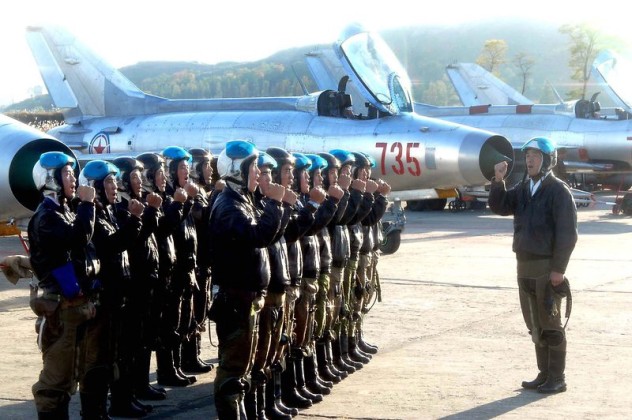
While the Yom Kippur War is a well known Cold War engagement between Soviet and Western aligned forces which took place in the midst of the Vietnam War, pitting the forces of a number of Arab states including Egypt, Syria, Iraq and Algeria against their longstanding adversary Israel, the role played by personnel deployed from external powers remains less well known. One party which played a significant role in the conflict, the beginnings of its extensive involvement in the Middle East to undermine the Western Bloc’s regional interests which continues to this day, was the Korean People’s Army (KPA) – the armed forces of North Korea. Having waged an intensive and brutal war with the Untied States and its allies in the 1950s, where an estimated 20-30% of its population was lost primarily due to the American bombing campaign, North Korea well understood the importance of air superiority and set about rebuilding its air and air defence forces with the most capable Soviet made weapons systems available. North Korean pilots and air defence crews were tasked not only with guarding the country’s airspace in the event of a future war with the Untied States, but also of contributing to the war efforts of a number of friendly countries – which they continue to do to this day. North Korean pilots played a considerable role in the Vietnam War, and according to Korean sources downed several U.S. fighter jets over the country. As the air war over Vietnam neared its end in the early 1970s, the KPA Air Force dispatched pilots to Egypt to aid the Soviet aligned country’s own war effort.
North Korean pilots had been stationed to aid Egyptian forces in defending their airspace months before the outbreak of the Yom Kippur War, and according to the Egyptian Military’s Chief of Staff Saad Al Shazly, Korean assistance provided critical assistance at a time of great need. Recalling that personnel from the USSR had been flying approximately 30% of the Egyptian MiG-21 fleet and operating about 20% of the country’s surface to air missile batteries, he noted that following the departure of Soviet forces under the decree of Egyptian President Anwar Sadat the Egyptian Air Force had struggled with a significant shortage of trained MiG pilots. Regarding North Korea’s role in solving this issue, the General stated in his memoirs:
“The solution occurred to me in March 1973, during the visit to Egypt of the Vice President of the Democratic (People’s) Republic of Korea (official name of North Korea.) On March 6, while escorting their Vice Minister of War, General Zang Song, on a tour of the Suez front, I asked if they could support us – and give their pilots useful combat training – but sending even a squadron of men. I knew at that time that his country flew MiG-21s. After much political discussion, in April I went on an official visit to president Kim Il Sung to finalise the plan. My fascinating ten day tour of that extraordinary republic, an inspiring an example of what a small nation of the so called Third World can achieve with its own resources is, alas, rather outside the scope of this memoir, as is my stopover in Peking (former English name for Beijing.)
Korean pilots – all highly experienced, many with more than 2,000 hours, arrived in Egypt in June and were operating by July. Israel or her ally ( the United States) soon monitored their communications, of course, and on August 15 announced their presence. To my regret, our leadership would never confirm it. The Korean s were probably the smallest international military reinforcement in history: only 20 pilots, eight controllers, give interpreters, three administrative men, a political advisor, a doctor and a cook. Bu their effect was disproportionate. They had two or three encounters with the Israelis in August and September and about the same number in the war. Their arrival was a heartwarming gesture. I mention the story here mainly to pay tribute to them and to apologise for the churlishness of our leadership in not also doing so.”
While Egyptian forces had long claimed that the MiG-21 was poorly suited to engage the F-4E, Israel’s prime air superiority fighter, and that the Soviet jet lacked the necessary survivability against the heavier American made platform, they were proven wrong not only by the successes of North Vietnamese pilots against the United States – but also by North Korean pilots operating against Israeli Phantoms over Egyptian airspace itself. According to Israeli sources, reporting on an engagement between North Korean piloted MiGs and their own Phantoms, the Korean pilots demonstrated considerable skill and were effectively untouchable in close range engagements – taking full advantage of the MiG-21’s superior manoeuvrability to evade multiple Israeli strikes with impunity. Whether North Korean pilots downed any Israeli fighters remains unknown, though reports indicate that no Koreans were shot down by Israeli jets. A number of reports do indicate however that the poorly trained Egyptian surface to air missile (SAM) crews mistook returning Korean MIG-21 fighters for Israeli jets, and proceeded to fire upon them. This was a common error made by Egyptian SAM crews, one which cost the country a number of fighter jets.
North Korean pilots’ participation in the Yom Kippur War represented only the beginning of the country’s military involvement in the Middle East, nor the last time the country would aid Arab states at war with Israel. While Egypt pivoted towards the Western Bloc in the war’s aftermath, abandoning the Soviet Union and its Arab allies, the country would pursue a number of joint weapons projects with North Korea and continues to import significant quantities of arms from the country. The Egyptian ballistic missile arsenal has North Korean origins, and the Korean Rodong-1 remains the country’s most capable platform in service today. North Korean assistance was also commissioned to construct a war museum in Egypt commemorating the Yom Kippur War, which was based heavily on the larger Fatherland Liberation War Museum in Pyongyang commemorating the Korean War. North Korean forces have since the Yom Kippur War also formed close ties to Syria and Yemen, and the KPA is involved in wars against Western aligned forces in both countries.
Korean assistance has been key to upgrading Syria’s surface to air missile network, while special forces have reportedly been deployed for ground operations. KPA personnel were also reportedly involved in the Lebanon War in alongside their Syrian allies, and were later responsible for aiding the Lebanese militia Hezbollah to construct underground fortifications key to its military success against Israel in 2006. A number of key figures in Hezbollah’s leadership, including its leader Hassan Nasraallah, reportedly travelled to Korea for military training in the 1980s. Korean assistance has been key to strengthening the missile capabilities of Libya, Syria and Yemen, as well as Iran and Hezbollah, with all these parties relying heavily on a wide variety of the country’s missile designs until today. The East Asian state has since the Yom Kippur War played a considerable role in supporting regional forces against the Western Bloc and their allies, and is set to continue to do so for the foreseeable future.
Saudi king calls for urgent meetings of Arab leaders
Press TV – May 19, 2019
Saudi Arabia’s King Salman bin Abdulaziz has called for emergency meetings of the Persian Gulf Cooperation Council ([P]GCC) and the Arab League, following mysterious “sabotage” attacks on Saudi and Emirati oil tankers as well as drone strikes targeting Saudi oil pumping stations.
The official Saudi Press Agency (SPA) reported on Saturday that Salman had invited Arab leaders to convene urgent summits in the city of Mecca on May 30 to discuss ways to “enhance the security and stability in the region.”
An official source at the Saudi Foreign Ministry said that the Saudi monarch had called the meetings due to “grave concerns” about recent attacks on commercial vessels off the coast of the United Arab Emirates and drone strikes on oil pumping stations in Saudi Arabia as well as the effects of those incidents on supply routes and oil markets.
The summits are meant “to discuss these aggressions [sic] and their consequences on the region,” the source said.
The Emirates’ Ministry of Foreign Affairs and International Cooperation has welcomed the Saudi call for the emergency meetings.
“The current critical circumstances entail a unified Arab and [Persian] Gulf stance toward the besetting challenges and risks,” the ministry said in a statement.
On May 12, four oil tankers, including two Saudi ones, were purportedly targeted near the port of Fujairah, in what the Emirates described as “sabotage” attacks. While Riyadh and Abu Dhabi failed to produce evidence of the attacks on their vessels, pictures emerged of a Norwegian-flagged tanker at the port having sustained some damage.
Two days later, drone strikes were launched on two oil pumping stations in Saudi Arabia. These attacks were believed to have been carried out by Yemen’s Houthi fighters in retaliation for the prolonged Saudi war against Yemen.
The attacks led Saudi Arabia to halt its main cross-country oil pipeline temporarily.
Saudi and Emirati officials have not said who carried out the attacks on the tankers and the pumping stations, but some political and media figures within the United States have claimed that Iran is responsible.
A day after the reported attacks on the oil tankers, Tehran called them “worrying,” and Iranian Foreign Minister Mohammad Javad Zarif later called them “suspicious.”
Yemen’s Houthis also noted that the retaliatory drone strikes on the Saudi oil pipeline were an act of self defense and had nothing to do with Iran.
Pompeo calls bin Salman
On Saturday night, Saudi Crown Prince Mohammed bin Salman held a phone conversation with US Secretary of State Mike Pompeo.
The SPA reported that the two sides exchanged views on the “developments in the region and efforts to enhance security and stability.”
Jubeir claims Riyadh doesn’t seek war
In a separate development on Sunday, Saudi Minister of State for Foreign Affairs Adel al-Jubeir claimed that his country did not want a war with Iran.
“The kingdom of Saudi Arabia does not want a war in the region nor does it seek that,” he told a press conference in Riyadh.
“It will do what it can to prevent this war and at the same time it reaffirms that in the event the other side chooses war, the kingdom will respond with all force and determination, and it will defend itself and its interests,” he added.
CrossTalk: Bolton War Machine
RT | May 17, 2019
Is Donald Trump’s National Security Advisor John Bolton a clear and present danger to America and the world? His saber-rattling in the Middle East, particularly against Iran, should concern us all. We are forced to ask a fundamental question – is Bolton the primary architect of Trump’s foreign policy?
US warns airlines risk ‘miscalculation or misidentification’ over Persian Gulf
RT | May 18, 2019
In a chilling reminder of the downing of Iran Air flight 655 by a US missile, an FAA notice said civilian aircraft flying over the Persian Gulf and the Gulf of Oman are currently at risk of “miscalculation or misidentification.”
A Notice to Airmen (NOTAM) published by the US Federal Aviation Administration (FAA) late on Thursday said the risk stems from “heightened military activities and increased political tensions” in the area. Airliners operating in the region may also “encounter inadvertent GPS interference and other communications jamming” the warning said.
The tension in the proximity of Iran comes as the US deployed additional military assets in the region, including an aircraft carrier strike group and a battery of Patriot anti-aircraft missiles. Washington said it was a response to an undefined threat posed by Iranian forces. The US also withdrew non-essential personnel from diplomatic missions in Iraq. The show of force was reportedly triggered by intelligence provided by Israel.
For some, the FAA warning may bring back the dark memory of the 1988 incident, in which an American guided missile destroyer shot down an Iranian airliner, killing 290 people on board. It happened two months after the US sunk an Iranian frigate and a gunboat in retaliation for an incident a few days earlier, in which a US warship struck an Iranian mine.
Washington said the crew of the USS Vincennes misidentified Iran Air flight 655 for a warplane trying to attack the warship and acted in self-defense. The government rejected accusations that US military service members had acted recklessly, with President George H.W. Bush infamously declaring: “I will never apologize for the United States – I don’t care what the facts are… I’m not an apologize-for-America kind of guy.”
The US did pay compensation to the families of the victims, but never accepted legal liability or apologized to Tehran.
Who Really Gains from the Gulf Ship ‘Sabotage’
By Finian Cunningham | Strategic Culture Foundation | May 15, 2019
After dramatic and patently scripted warnings of “Iranian aggression” by bellicose US officials, there then follows – conveniently enough – an alleged sabotage incident in the Persian Gulf region implicating Iran.
Meanwhile, US Secretary of State Mike Pompeo poses with a straight face that his country doesn’t want war with Iran. His comments warp credulity given that American forces have suddenly escalated firepower in the Persian Gulf for the purpose of “responding” to alleged Iranian infractions.
Typically, Western news media are “reporting” (or rather, “echoing”) the purported sabotage incident as if it were fact, basing their source of information on Saudi and Emirati officials, sources which have a vested interest in creating a war pretext against Iran.
Given the grotesque, barefaced lies that have emanated from the Saudi regime over the past year with regard to the murder of journalist Jamal Khashoggi and also its barbaric, mass executions of political dissidents, it is nauseating how Western media can affect to be so credulous in citing Saudi claims as reliable over the latest alleged shipping incident.
“Two Saudi oil tankers have been sabotaged off the coast of the United Arab Emirates posing a potentially serious threat to world oil supplies,” reports [sic] Britain’s Guardian, attributing the source of this information to the “Saudi government”. What the Guardian omitted was the key word “alleged” before “sabotage”. Notice how the impression given is one of a factual incident of malicious intent. Most other Western news media adopted the same reliance on the official Saudi and Emirati claims.
Tellingly, however, Saudi and Emirati officials gave no details about the “significant damage” allegedly caused to a total of four tankers.
What we seem to know is that the four vessels were somehow disabled off the UAE port of Fujairah early on Sunday. The location at sea is in the Gulf of Oman, which lies outside the Persian Gulf, about 140 kilometers south from the Strait of Hormuz. The latter is the narrow passage from the Gulf of Oman into the Persian Gulf, through which up to 30 per cent of all globally shipped crude oil passes each day.
Last week, Iran once again threatened it would blockade its territorial waters in the Strait of Hormuz “if” the US carried out a military attack on it. Such a move by Iran would throw the global economy into chaos from the anticipated crisis in oil markets. It would also doubtless trigger an all-out war between the US and Iran, with American regional client regimes like Saudi Arabia and Israel piling in to facilitate attacks against Tehran.
So far, there have been no official accusations explicitly made against Iran over the latest shipping incident. But the implications are pointedly skewed to frame-up the Islamic Republic.
Saudi energy minister Khalid al Falih, whom Western media have quoted uncritically, claimed that one of the vessels allegedly attacked was on its way to load up on crude oil from the Saudi port of Ras Tanura, destined for the US market. The Saudi official did not give any substantiating details on the alleged sabotage, but emphasized that it was aimed “to undermine the freedom of navigation”. He called on international action to “protect security of oil tankers”. Wording that the American self-appointed global “policeman” (more accurately, “thug”) invokes all the time to cover for its imperialist missions anywhere on the planet.
When the US warned last week that it was sending a naval carrier strike armada to the Persian Gulf along with nuclear-capable B-52 bombers, it assumed the right to hit “Iran or its proxies” for any alleged attack on “American interests”. The wording out of Washington is so vague and subjective that it lends itself to any kind of perceived provocation.
An oil tanker on its way to collect crude from Saudi Arabia for the US market? That certainly could qualify as perceived Iranian aggression against American vital interests.
Last week, Washington issued hammed-up warnings that “Iran or its proxies” was set to “target commercial sea traffic”. Days later, as if on cue, the alleged sabotage of four ships appears to fit the theatrical bill.
Iran, for its part, has said it would not start a war with the US; that it will only act to defend itself from any American offensive. The foreign ministry in Tehran called the latest sabotage claims “highly alarming” and demanded more clarity from the Saudi and Emirati authorities as to what happened exactly. We can be sure that neither will come clean on that score, given their past record of calumny.
The clarifying question is, of course, who gains from the latest twist in tensions? Certainly, it fulfills American, Saudi and Israeli desires to intensify aggression towards Iran.
Another important question is the location of the alleged sabotage. If Iran wanted to carry out such an operation, it would be much more feasible to do it near the Iranian territorial waters in the Strait of Hormuz. Seriously: how feasible is it for several Iranian commando teams to strike four oil tankers in waters some 140 kms away? Waters that are forensically surveilled by the US Fifth Fleet based in the Persian Gulf.
Suspiciously, as already noted, there is no verifiable information about the alleged sabotage. All we’ve got are claims from Saudi and Emirati officials, the same kind of people who claim journalists disappear into thin air while in consular buildings, or that children in Yemen are slaughtered in air strikes by “mistake”, or that peaceful women protesters from Saudi’s oppressed Shia minority are “terrorists” to be executed by beheading with a sword.
And, shamefully, the Western media tamely go along doe-eyed and gullibly with this risible charade.
Sequencing, timing, sources, agenda and motives plus the dutiful Western media servility. The bets are this is a false-flag operation to incriminate Iran.
If it doesn’t result in a pretext for American military attack, at the very least Washington and its Saudi and Israeli clients are trying to make sure the European lackeys are bounced into toeing the line for increasing economic warfare on Iran over the floundering nuclear accord. An international treaty, by the way, which has been torpedoed – verifiably – by American political sabotage.
What’s really going on here is another brazen case of reality-inversion. Compare with contemporaneous US mendacity towards Venezuela, Syria, Cuba, Russia, China, North Korea, and so on. American criminal aggression is, incredibly, again being laundered with a moral license by lying corporate mass media which have the gall to call their blatant war propaganda a “news service”.
Indeed, the world is being lied into a potentially catastrophic war by a congenitally criminal US regime.
Trump considering replacing John Bolton: Report
Press TV – May 15, 2019
US media reports suggest that President Donald Trump is considering replacing his hawkish National Security Adviser John Bolton over his plans to push the United States towards a military conflict with Iran, Venezuela and North Korea.
Bolton “is headed for the exits, having flown too close to the sun on his regime change efforts for Iran, Venezuela and North Korea,” The National Interest magazine reported Tuesday, citing sources familiar with the matter.
“Hearing that Trump wants him out,” a former senior Trump administration official told the magazine.
There is speculation in Washington “that there’s now daylight between Trump and Bolton,” the report added.
The fighting has also expanded to include US Secretary of State Mike Pompeo, officials say. A State Department official and a former White House official both report that Bolton and Pompeo are “fighting all the time.”
A former senior official in the State Department said Pompeo is enthusiastic about isolating Iran, but fearful of an actual war that might engulf much of the Middle East.
“John Bolton is the problem … Trump’s national security adviser is getting dangerous… particularly to the president’s ideals,” Douglas Macgregor, a Bolton rival and would-be successor, writes in Spectator USA.
Trump ran his election campaign on the promise to pull the US military out of Iraq, Afghanistan and Syria — unwinnable post-9/11 wars that have consumed American lives and military budgets.
That partial retreat remains one of Trump’s strongest points in his pitch to be the so-called outsider president.
But Bolton is working in exactly the opposite direction.
The United States has been ratcheting up economic and military pressure on Iran, with Trump recently urging Tehran to talk to him.
“What I’d like to see with Iran, I’d like to see them call me,” Trump told reporters at the White House on Thursday.
But then he said he would not rule out the possibility of military action in Iran amid escalating tensions before slamming former secretary of state John Kerry for his involvement in the issue.
His remarks came after Bolton said on Sunday that the United States was sending an aircraft carrier strike group and a bomber task force to the Middle East in a “clear and unmistakable” message to Iran.
The Pentagon announced on Friday that the US was deploying an amphibious assault ship and a Patriot missile battery to bolster an aircraft carrier and B-52 bombers already sent to the Persian Gulf.
History’s Dire Warning: Beware False-Flag Trigger for Long-Sought War with Iran
By Whitney Webb | MintPress News | May 14, 2019
With the beat of Washington’s war drums continuing to grow, particularly following the Monday revelation of a government plan to send as many as 120,000 troops to counter Iran, the threat of an “accidental” provocation or a “false flag” is also becoming increasingly likely. As MintPress recently reported, the possibility of an “accident” leading to open conflict between the U.S. and Iran is now being openly stated by top European officials — such as U.K. Foreign Minister Jeremy Hunt — following meetings with noted Iran hawk and current Secretary of State Mike Pompeo.
In Part I of this series, MintPress explored how current events — including seemingly unrelated regional events, such as the Israeli government’s bid to occupy the West Bank and the Syrian offensive against Al Qaeda-held Idlib — were converging to create a “now or never” scenario for those most eager for regime change in Iran and a U.S.-Iran military confrontation, particularly Israeli Prime Minister Benjamin Netanyahu and U.S. National Security Advisor John Bolton.
This installment will also reveal how Trump’s top political patron Sheldon Adelson — who is also the top donor to Netanyahu and a long-time confidant of Bolton, whom he helped install in his powerful post in the Trump administration — may be the deciding factor whether Trump authorizes the use of military force against Iran.
Yet, while the endgame for Bolton, Adelson and Netanyahu, as well as Pompeo, has long been a U.S.-led war with Iran, public justification for such hostilities must be given in order to manufacture American consent for a war against a country significantly larger than Iraq, complete with a more powerful army. Historically, the U.S. government has frequently planned and used false flags in order to justify the initiation or expansion of hostilities, with the best-known examples being Operation Northwoods and the Gulf of Tonkin incident.
However, given the current situation, it is essential to revisit two other incidents that reveal that the key players pushing for war in Iran — Israel’s government and neoconservatives of the Bush era (Bolton chief among them) — have planned and attempted to execute false flag attacks to push the U.S. into a major war that the American public would not normally support.
Remembering the U.S.S. Liberty
On June 8, 1967, one of the worst attacks on a U.S. naval vessel during peacetime took place, an attack that the U.S. government has kept shrouded in secrecy over 50 years later in what many have called a cover-up.
Around two in the afternoon on a cloudless, sunny day, unmarked aircraft and torpedo boats attacked the U.S.S. Liberty — a largely defenseless naval intelligence vessel flying visible American flags — without provocation. The attack saw the aggressors commit several war crimes, including attacking with unmarked aircraft and vessels; shooting survivor-bearing lifeboats out of the water with machine-gun fire; and the jamming of the Liberty’s ability to use international distress frequencies.
Thirty-four American sailors lost their lives and 173 were wounded, and the Liberty — which cost U.S. taxpayers $40 million to build — was so badly damaged it was subsequently sold for scrap metal for pennies on the dollar.
During the attack and in its immediate aftermath, Liberty survivors were puzzled as to why the U.S. Department of Defense ordered the recall of U.S. ships that were on route to aid the Liberty from the hostile attack, which many sailors had assumed at the time was being conducted by Egyptian or Arab forces in light of the ship’s proximity to the Sinai Peninsula.
Indeed, the attack on the Liberty took place during the Israeli-Arab Six Day War, a war that Israel claimed to have started as a preemptive means of self-defense but that was later revealed to have been the culmination of years of planning for a war of aggression. This fact was openly admitted by former Israeli Prime Minister Menachem Begin in the early 1980s. Israel, an American ally, was not suspected by Liberty crewmen at the time of the attack as being their potential assailants.
However, no Arab nation had attacked the Liberty that day, though that assumption by Liberty sailors was what their true assailants had hoped they and the American public would believe. Instead, it had been Israeli aircraft and torpedo boats that had fired on the clearly-marked American vessel with torpedoes, machine gun fire and even napalm. The Israelis “officially” maintain to this day, with little challenge from the U.S. government, that the attack was an accident, a fact that has been and continues to be heavily contested by the attack’s survivors.
Yet, beyond the testimony of survivors, the most compelling evidence that the attack on the Liberty was no accident comes from the Israelis themselves. Intercepted Israeli communications from the time of attack, made public only in recent years, reveal that the ship had been identified as American prior to the attack and, despite that, the plan was to sink the U.S.S. Liberty and ensure that there were no survivors. The goal of the attack was to place the blame on Egyptian forces, which necessitated there being no American survivors who could dispute the claim. If the Liberty had been sunk, it would have provided the United States legal cover and popular support for a more central role in the conflict and its crucial diplomatic aftermath. Indeed, the Israeli attack on the U.S.S. Liberty was a false flag, one that failed to achieve its intended goal of goading the U.S. into a major war.
Instead of responding with indignation, then-President Lyndon Johnson — whether it occurred before or during the attack is disputed — ordered that the Liberty not be rescued during the course of the attack, allegedly not wanting to harm relations with or “embarrass” an ally even if it meant consigning the 294-person crew of the Liberty to death.
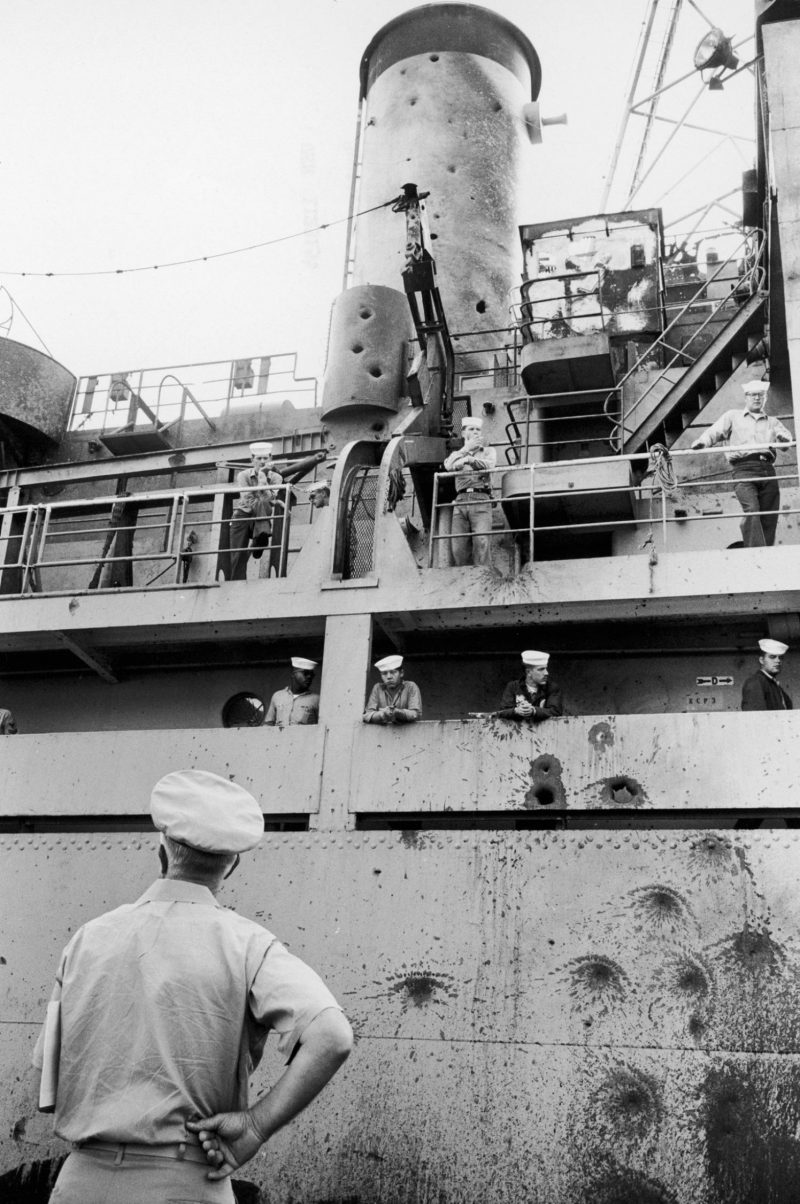
Damage to the starboard side of the USS Liberty following Israeli attacks, June, 1967. Photo | NSA Archive
Those who survived the assault of the Liberty owe their lives to the then-23-year-old Terry Halbardier, who valiantly navigated the Liberty’s napalm-glazed deck and managed to rig an antenna and send out an SOS signal to the Navy’s Sixth Fleet. Upon intercepting that distress signal, the Israelis immediately broke off the attack. Halbardier’s heroism prevented the massacre of all 294 crewmen and allowed them to live to tell their stories, despite Johnson’s having left them for dead.
Yet many Liberty survivors were unable to tell their stories for decades, as the U.S. government issued gag orders and threatened them with being court-martialed for speaking to anyone, even their spouses, about the incident. The Navy’s Board of Inquiry, which abetted the cover-up, was headed by Admiral John S. McCain Jr., the father of the late Senator John McCain of Arizona.
To this day, the U.S. government has failed to conduct a full, public inquiry into the attack. Liberty survivors who have since spoken out have been accused of “anti-Semitism” and of slandering Israel for discussing their personal and traumatic experiences of the attack, significantly compounding their suffering and post-traumatic stress.
While the survivors of Israel’s assault on the Liberty have been denied closure, the U.S. government’s response has endangered the lives of American personnel by clearly signaling to Israel that they will suffer no consequences for such “false flag” attacks, regardless of whether American servicemen are wounded or killed. As former CIA intelligence analyst Ray McGovern has previously noted for Consortium News, “the U.S. cover-up [of the attack on the U.S.S. Liberty ] taught the Israelis that they could literally get away with murder.”
In a 2015 interview on the Real News Network, McGovern warned that the attack on the Liberty still holds “current relevance” and that he felt that “the Israelis are capable of doing this kind of thing when they see their supreme national interests at stake.” McGovern further stated that Israeli officials may well have considered a provocation, such as false flag, to throw a wrench in the Iran nuclear deal, which was being negotiated at the time.
McGovern — in an open letter to President Barack Obama, co-authored with former Deputy National Intelligence Officer for the Near East in the National Intelligence Council Elizabeth Murray — noted that Admiral Mike Mullen, former member of the Joint Chiefs of Staff in the Bush administration, had flown to Israel in 2003 and told the Israeli government emphatically “to disabuse themselves of the notion that U.S. military support would be knee-jerk automatic if they somehow provoked open hostilities with Iran. According to the Israeli press, Mullen went so far as to warn the Israelis not to even think about another incident at sea like the deliberate Israeli attack on the U.S.S. Liberty.”
McGovern and Murray cited Mullen’s statements to Israeli officials as the first time that “a senior U.S. official braced Israel so blatantly about the Liberty incident.” In an email to MintPress, McGovern stated that he was unsure whether current Chairman of the Joint Chiefs of Staff Gen. Joseph Dunford “can be counted upon to play a similar restraining role” in preventing hostilities with Iran. Notably, Dunford was in attendance along with Bolton at the recent CIA meeting to discuss “highly sensitive covert actions” in relation to Iran.
An “accident” waiting to happen
Since Bolton announced the movement of the Lincoln carrier strike group towards the Persian Gulf, some have pointed out that the vessels could well be destined for use in a “false flag” provocation, such as one planned by former Vice President Dick Cheney in 2008 (to be discussed shortly) and another conducted by Israel in 1967. Indeed, as MintPress noted the day after Bolton’s announcement, the carrier strike group’s deployment was actually announced a month prior and was a routine deployment.
The political analysis blog Moon of Alabama also noticed that Bolton had framed this routine deployment as something more dire for his own purposes, writing:
The carrier deployment to the Gulf is routine. It had been announced on April 8. The U.S. has bombers on rotation in the Middle East since 2001. Moreover – a carrier in the Persian Gulf is a sure sign that the U.S. will not attack Iran. Within the restricted waters of the Persian Gulf a carrier is a too easy target. The idea though may be to provide for an ‘accident’’ as Iran’s Foreign Minister [Javad Zarif] described it in a recent CBS interview.”
In an interview late last month with CBS’ Face the Nation, Zarif explicitly told journalist Margaret Brennan his concern about an imminent “false flag” to trigger war with Iran by John Bolton in collaboration with Israeli, Saudi and Emirati leadership:
Foreign Minister Zarif | I don’t think military confrontation will happen. I think people have more prudence than allowing a military confrontation to happen. But, I think the U.S. administration is putting things in place for accidents to happen. And there has to be extreme vigilance, so that people who are planning this type of accident would not have their way.
Margaret Brennan | What do you mean? What kind of accident are you talking about?
Zarif | I’m talking about people who have — who are designing confrontation, whose interest —
Brennan | Who’s doing that?
Zarif | My ‘B’ team. I call —
Brennan | What do you mean ‘B’ team?
Zarif | I call the group ‘B’ team who have always tried to create tension, whose continued existence depends on tension. Ambassador Bolton, one ‘B,’ Bibi Netanyahu, second ‘B,’ Bin Zayed, third ‘B,’ Bin Salman, fourth ‘B.’ And I’m not just making accusations.
With an aircraft carrier little more than a sitting duck in the area amid rising tensions between the U.S. and Iran, an “accident” may well occur. As was noted in Part I of this mini-series, such a possibility was directly stated by British Foreign Minister Jeremy Hunt on Monday.
Hunt told reporters “We are very worried about the risk of a [U.S.-Iran] conflict happening by accident, with an escalation that is unintended really on either side but ends with some kind of conflict.” Hunt notably made the statement after meeting with Pompeo, who is currently in Europe meeting with European heads of state to discuss Iran. The Associated Press noted that the Trump administration had warned European officials, Hunt included, that “Iran or its proxies could be targeting maritime traffic in the Persian Gulf region.”
The possibility of such an “accident” is further compounded by Bolton’s aforementioned and “highly unusual” meeting about Iran and “highly sensitive covert actions” at CIA headquarters last week. Declassified CIA documents show that the agency had previously planned to stage terror attacks on U.S. soil and murder Americans to blame on Cuba in order to justify invading the Caribbean nation in the 1960s. That plan, known as Operation Northwoods, further called for the destruction of U.S. military vessels to be blamed on Cuba and also the staging of fires and mortar attacks on U.S. military installations in Cuba (i.e., Guantanamo Bay) or nearby (i.e., in Florida). Though Operation Northwoods was never enacted, the agency has been accused of orchestrating numerous “false flags” in the decades since.
As was recently seen with the alleged “sabotage” of Saudi oil tankers near Iran, there are many potential targets for provocation. However, the incident that would most assuredly force U.S. involvement in a military conflict would be an attack on an American military target. While some have dismissed Bolton’s announcement of the carrier’s movements as a self-serving manipulation of the facts, it may have had the added purpose of framing the lead-up to an unfortunate “accident” targeting American vessels in the area, particularly the Lincoln carrier strike group or one of the other subsequent U.S. naval deployments to the Middle East.
The neocon plan for a Liberty-like attack
If any sort of provocation blamed on Iran should occur, it is important to consider that a powerful group of U.S. politicians — the neo-conservatives — have long sought to plan provocations that would drag the U.S. into war with Iran. One of the most recent examples took place during the George W. Bush administration when then-Vice President Dick Cheney held a meeting with other administration officials in 2008 aimed at provoking war with Iran.
The details of that meeting were revealed by Pulitzer Prize-winning journalist Seymour Hersh, who described some of the ideas considered in that Cheney-led meeting as follows:
There were a dozen ideas proffered about how to trigger a war. The one that interested me the most was why don’t we build in our shipyard four or five boats that look like Iranian PT boats. Put Navy seals on them with a lot of arms. And next time one of our boats goes to the Straits of Hormuz, start a shoot-up. Might cost some lives.
And it was rejected because you can’t have Americans killing Americans. That’s the kind of, that’s the level of stuff we’re talking about. Provocation.
Silly? Maybe. But potentially very lethal. Because … if you get the right incident, the American public will support bang-bang-kiss-kiss. You know, we’re into it.”
It is unknown if any Bush officials now in the Trump administration were present at that meeting where the use of a “false flag” pitting Americans against Americans disguised as Iranian was discussed. However, what is known is that John Bolton — who was a member of the neo-conservative Project for a New American Century, along with Cheney, and who also served in the Bush administration — has zealously sought war with Iran for nearly two decades. Indeed, the New York Times recently described Bolton as “one of the administration’s most virulent Iran hawks, whose push for confrontation with Tehran was ignored more than a decade ago by President George W. Bush.” It is also known that Bolton has a history of playing fast and loose with unconfirmed intelligence and also distorting intelligence to fit his pre-determined narrative.
As MintPress reported last year, former Israeli Ambassador to the UN Danny Gillerman has stated that Bolton, when serving in the Bush administration, was prone to “direct fire on his own forces,” — i.e., the U.S. government — in order to advance the goals of the Israeli government, especially with respect to Iran. For instance, in more than one instance while in the Bush administration, Bolton traveled to Israel in violation of State Department rules and negotiated privately with Israeli officials, including the then-head of the Mossad, Meir Dagan, to lay the groundwork for a war with Iran. As journalist Gareth Porter has noted, Bolton did this in an effort to directly undermine Colin Powell, Bolton’s superior, just as Powell “was saying administration policy was not to attack Iran.”
Worse still, Bolton has pressured Israeli officials to initiate a war with Iran, even when they didn’t support such a move. One such case was Shaul Mofaz, former Israeli defense minister, who told Israeli media last March that Bolton “tried to convince me that Israel needs to attack Iran,” even though Mofaz did not see such a war as “a smart move — not on the part of the Americans today or anyone else until the threat is real.”
Pompeo’s Holy war and rapture
Furthermore, Bolton is not the only top Trump administration official who has long promoted a war with Iran, as current Secretary of State Mike Pompeo had also called for the preemptive bombing of Iran long before he joined the Trump administration. Pompeo’s desire to push the U.S. towards war with Iran is based on his fervent adherence to Christian Zionism. As a result of the admitted influence his beliefs hold over his foreign policy, Pompeo sees an “apocalyptic” war between Israel and Iran as a necessary precursor to the Second Coming of Christ and the “rapture.”
Pompeo is on record speaking about the rapture on several occasions, particularly as CIA director when he spoke about the event — which holds that “true believers” will ascend to Heaven prior to the tribulations and trials of the “end times” — so often that he made veteran intelligence officers uncomfortable. As a result, some have asserted that Pompeo is “a man who appears to view American foreign policy as a vehicle for holy war.”
The fact that the actions of the current Secretary of State are influenced by his Christian Zionist faith was on display last month, when American Christian journalist Chris Mitchell of the Christian Broadcasting Network asked Pompeo: “Could it be that President Trump right now has been sort of raised for such a time as this … to help save the Jewish people from the Iranian menace?” Pompeo responded that this was definitely “possible.”
If Adelson has his way . . .
Yet, perhaps the most dangerous force driving the U.S. towards a war with Israel is not the public face of the Trump administration’s foreign policy but its private face. Sheldon Adelson — the top donor to Trump, the entire Republican Party, and also the top political donor to Israeli Prime Minister Netanyahu — has long sought war with Iran, and several of Adelson’s desired policies have already been enacted by Trump. These include recognizing Jerusalem as Israel’s capital, replacing H.R. McMaster with Bolton as National Security Advisor, and withdrawing from the Iran nuclear deal. Several reports have asserted that pressure from Adelson was a deciding factor in Trump’s fulfillment of these policies.
Adelson’s influence over Trump again takes on great significance, given recent events with respect to Iran, as Adelson has previously advocated for a U.S. nuclear attack on Iran without provocation, just so the U.S. could “impose its demands [on Iran] from a position of strength.”
Per Adelson’s plan, the U.S. would drop a nuclear bomb in the middle of the Iranian desert and then threaten that “the next one is in the middle of Tehran” to show that “we mean business.” Tehran, Iran’s capital, is home to nearly 9 million people with 15 million more in its suburbs. Were Tehran to be attacked with nuclear weapons, an estimated 7 million would die within moments, according to a 2013 study jointly conducted by researchers at the University of Georgia and Harvard.
Yet, any sort of diplomatic engagement with Iran, according to Adelson, is “the worst negotiating tactic I could ever imagine.”
In other words, Adelson has called for dropping nuclear weapons on a country, including its heavily populated capital city, for no reason other than to show that the U.S. “means business” and considers nuclear war a negotiating tactic.
While some media reports have suggested that Trump is unwilling to go to war with Iran and is uneasy with the hawkish policies of Bolton and Pompeo, he will have a hard time ignoring Adelson. Adelson, who poured $35 million into Trump’s 2016 campaign and spent $55 million on Republican primary campaigns last year, is the party’s most influential donor and angering him could well mean the end of Trump’s political career.
Would Trump resist a push for war from not just Netanyhu, Bolton and Pompeo but Adelson as well? It seems unlikely. Craig Holman of the watchdog group Public Citizen told ProPublica in 2018 that he “would put Adelson at the very top of the list of both access and influence in the Trump administration,” a sentiment that was also echoed by Alan Dershowitz, who has done legal work for Adelson and advised Trump. Dershowitz told ProPublica that Adelson “just calls the president all the time. Donald Trump takes Sheldon Adelson’s calls.” As MintPress has noted on several occasions, those calls often translate into policy decisions.
Unfortunately, Trump — even when he tries to follow a different path, as he attempted to do in Syria — often ends up conceding to the neo-conservatives and Zionist extremists who surround (and fund) him.
History issues a warning
The combination of current tensions and the documented history of both Israel and Bush-era neo-conservatives planning and even executing false flag attacks in order to justify U.S. military action against a desired target — should set off alarm bells. Instead, most corporate media outlets are playing up unfounded or baseless claims of the “Iranian threat” and Iran’s unproven role in recent acts of “sabotage” in Saudi Arabia and in the UAE in ways that are strikingly similar to the lead-up to the 2003 invasion of Iraq.
Furthermore, the history and mindset of both Bolton and Pompeo, in addition to the unprecedented influence of Sheldon Adelson in the Trump administration, add yet another layer to this increasingly complex yet undeniably troubling situation.
As a consequence, it is imperative for people around the world, particularly in the United States, to be skeptical of any act of violence blamed on Iran before a full investigation is completed, and to resist a rapid push to begin a conflict with Iran that could well follow such an act.
The time for resistance, ideally, would be before such an attack occurs, making critical the widespread dissemination of relevant information left unmentioned by the corporate media, such as that contained in Parts I and II of this series. The crucial context here is the well-documented willingness of both the Israeli and U.S. governments to sacrifice (i.e., kill) Americans in order to plunder the natural resources of “unfriendly” nations and pursue the objectives of the political and economic elite of both countries.
Whitney Webb is a MintPress News journalist based in Chile. She has contributed to several independent media outlets including Global Research, EcoWatch, the Ron Paul Institute and 21st Century Wire, among others. She has made several radio and television appearances and is the 2019 winner of the Serena Shim Award for Uncompromised Integrity in Journalism.
Iranian MP Blames ‘Israeli Mischief’ for ‘Sabotage’ Against Tankers at UAE Port
Sputnik – 14.05.2019
Iran’s Foreign Ministry spokesman earlier called for an investigation into attacks on several vessels off the UAE coast on Sunday, having warned against any “conspiracy orchestrated by ill-wishers” and “adventurism by foreigners” to undermine the region’s stability.
Iranian parliamentary spokesman Behrouz Nemati has blamed the “sabotage” against four vessels off the United Arab Emirates’ (UAE) coast on Sunday on Israel, according to IRNA.
“The events that took place in the Emirates were Israeli mischief”, Nemati said, without going into details on what role Israel could have played in the incident.
Iran’s Foreign Minister Mohammad Javad Zarif, in turn, said that he had foreseen this sort of “suspicious activities”, which he stressed were “aimed at escalating tension in the region”.
The comments come shortly after several unnamed US officials told AP that “Iranian or Iranian-backed proxies” are alleged to be behind the attack.
Tehran has denied any involvement and urged for an investigation into the matter, calling the incident “worrisome and dreadful” and cautioning against any “conspiracy orchestrated by ill-wishers”.
In a parallel development, US Ambassador to Saudi Arabia John Abizaid said that Washington should take what he described as “reasonable responses short of war” once it determined who is behind the attacks on oil tankers.
“We need to do a thorough investigation to understand what happened, why it happened, and then come up with reasonable responses short of war. It’s not in (Iran’s) interest, it’s not in our interest, it’s not in Saudi Arabia’s interest to have a conflict”, Abizaid told reporters in Riyadh.
The remarks follow news of four commercial ships being targeted in what the UAE Foreign Ministry described as “acts of sabotage” near Fujairah, one of the seven emirates, without revealing the nature of the attack.
Saudi Arabia’s energy minister said on Monday that two of its oil tankers were among those targeted; the attack didn’t cause an oil spill or any casualties, but is said to have led to significant damage to the structures of both ships. The two other ships are alleged to belong to Norway and the UAE.
Iran Warns Against ‘Conspiracy by Ill-Wishers’ Over ‘Sabotage’ at UAE Port
Sputnik – 13.05.2019
Iran’s Foreign Ministry Spokesman Abbas Mousavi has expressed concerns over a “sabotage” attack on several merchant ships off the UAE coast on Sunday, calling the incident “worrisome and dreadful”, and has urged an investigation into the matter, ISNA reported.
Mousavi was cited as saying that “such incidents have a negative impact on maritime transportation security”, cautioning against any “conspiracy orchestrated by ill-wishers” as well as “adventurism by foreigners” to undermine the region’s stability.
The comments followed a reported remark by Saudi Arabia’s Energy Minister Khalid al-Falih, who said that two Saudi vessels were among those targeted near the UAE.
One of the two ships in question was attacked on its way to be loaded with Saudi crude at the port of Ras Tanura for delivery to Saudi Aramco in the US, Reuters reported.
The suspected attack didn’t lead to any casualties or oil spill, but is said to have caused significant damage to the structures of the two vessels.
“The international community has a joint responsibility to protect the safety of maritime navigation and the security of oil tankers, to mitigate against the adverse consequences of such incidents on energy markets and the danger they pose to the global economy”, al-Falih said in a statement, as quoted by Reuters.
As reports of the alleged sabotage attack kept flooding in, the Cooperation Council for the Arab States in the Gulf (GCC) issued a statement to condemn the incident:
“It is a dangerous development and escalation that reflects the evil intentions of those who planned and carried out these operations that endanger the safety of maritime navigation in the region and threaten the lives of the ships’ civilian crews”, the statement read.
On Sunday, the UAE said that four merchant vessels had been targeted in “acts of sabotage” in its territorial waters, thus brushing off previous reports by the Lebanon-based broadcaster al-Mayadeen, which said that several large blasts had occurred in the port of Fujairah. Reacting to the reports about explosions, authorities in Fujairah refuted the claims, stressing that the port was functioning as usual.
After initial denial, UAE confirms ships ‘sabotaged’ off its coast
Press TV – May 12, 2019
The United Arab Emirates (UAE) has confirmed, after initial denial, that a number of commercial ships have been targeted by “sabotage” attack near its territorial waters.
The Foreign Ministry of the United Arab Emirates issued a statement, saying that four commercial vessels have been targeted by “sabotage operations” near its territorial waters.
The statement added that there were no victims, but fell short of giving any details on possible damage to commercial vessels, their nationally and possible casualties.
The ministry statement was tweeted by the official news agency WAM.
According to the statement, the incident occurred near the UAE emirate of Fujairah, one of the world’s largest bunkering hubs that lies just outside the Strait of Hormuz, which is a vital oil and natural gas corridor for the global energy market.
“Subjecting commercial vessels to sabotage operations and threatening the lives of their crew is considered a dangerous development,” the statement added.
The statement claimed that despite the attack, routine port operations at Fujairah port were going on without interruption.
Earlier in the day, the Lebanon-based Al Mayadeen television channel reported that as many as seven tankers had been hit by a massive fire at the al-Fujairah oil tanker terminal.
The report stated that several powerful explosions were also heard at the port.
Later, the media office of the government of Fujairah denied the report of the explosions altogether, saying that transit and other activities at the port were underway as usual. Additionally, Brigadier Ali Obaid al-Taniji, the director of the department of civil defense in Fujairah, told the Emarat al-Youm daily that there had been no fire or explosion at the port.
Despite the UAE government’s denial, witnesses have emphasized that the blasts have taken place and some media sources have even went further, identifying a number of oil tankers hit by the explosions by their hull numbers as follows:
AMJAD tanker
No.: 9779800
Al Marzouqah tanker
No.: 9165762
Miraj oil tanker
No.: 9394741
A.MICHEL oil tanker
No.: 9177674
FNSA10 oil tanker
No.: 9432074
Earlier this week, a number of powerful explosions rocked Saudi Arabia’s port city of Yanbu’, an important petroleum shipping terminal for the kingdom. Reports, however, fell short of giving any reason for the blasts or possible casualties.
No further details have been made available up to this moment and no group or individual has assumed responsibility for the blasts.
Yanbu’ is an important petroleum shipping terminal for Saudi Arabia and home to three oil refineries, a plastics facility and several other petrochemical plants.
Bases in Almost Every Direction: HERE is Where US Outposts Near Iran are Located

Sputnik – May 11, 2019
Tensions between Washington and Tehran escalated sharply this week after the US announced the deployment of a carrier strike group to the region and warned that Washington would hit back at Iran with “unrelenting force” if the Islamic Republic threatened US interests.
The Pentagon doubled down on the deployment of its carrier strike group on Friday, saying it would beef up its Middle Eastern theatre command’s assets with additional Patriot missile defence batteries, an amphibious assault ship full of Marines and an amphibious dock ship to complement the recently deployed USS Abraham Lincoln and several nuclear-capable B-52 strategic bombers.
Iran has dismissed both Washington’s threats and President Trump’s simultaneous offer to negotiate with the country’s leadership, with a deputy commander of Iran’s Revolutionary Guards saying the US was mistaken if it felt it could intimidate Tehran into talks with threats and sanctions.
Senior US officials have claimed that the troop buildup was a response to Iranian behaviour. Acting Secretary of Defence Patrick Shanahan called the carrier deployment a “prudent repositioning of assets in response to indication of a credible threat” by Iranian forces. National Security Adviser John Bolton said the move was a reaction “to a number of troubling and escalatory indications and warnings,” and was aimed at sending “a clear and unmistakable message to [Tehran] that any attack on United States interests or on those of our allies will be met with unrelenting force.”
However, in light of the vast network of bases that the US has surrounding Iran from virtually all directions, it’s worth asking what the US’s real goal is in the present escalation. Because even without those fresh deployments, the US already has thousands of troops surrounding the Islamic Republic.
The US Navy’s 5th Fleet, whose area of responsibility includes the Middle East and North Africa, has at least 7,000 US troops at its permanent base in Bahrain. In Kuwait, meanwhile, the US Army’s Central Command has its forward command post, where some 13,000 troops are stationed.
Abu Dhabi’s Al Dhafra Air Base in the United Arab Emirates contains 5,000 plus US personnel, while Qatar’s massive Al Udeid Air Base has roughly US 10,000 troops.
Along with the bases, the US has special forces troops operating in Yemen, while Iraq, Afghanistan and Pakistan station thousands more troops, although some politicians in Baghdad have recently threatened to evict the estimated 5,200 troops based in their country.
Along with the bases, the US also has access to a large series of smaller ‘cooperative security locations’, also known as ‘lily pads’ with 200 troops or less, as well as access to airfields and ports in countries including Oman, Saudi Arabia, Turkey and Egypt.
On Saturday, Iranian Ambassador to the UN Majid Takht Ravanchi brushed aside US allegations about Iran posing a threat to US forces in the Middle East, accusing the Trump administration of using “fake intelligence.”
“These are all allegations which are being produced by the same people who, in the run-up to the US invasion of Iraq, did the same,” Ravanchi said, likely referring to John Bolton’s role in pushing the invasion during his work as an adviser in the administration of President George W. Bush.
Given the presence of US troops at bases in virtually every one of Tehran’s neighbours, perhaps it’s Iran’s leaders who should be the ones complaining about “credible threats” and “escalatory indications.”
Featured Video

Rewriting the risk? Inside the government’s vaccine safety messaging
or go to
Aletho News Archives – Video-Images
Book Review
“Davos Can Really Replace the UN”
Inside the book that maps the architecture behind global governance — from the Epstein files to the Pact for the Future
Lies are Unbekoming | April 1, 2026
On June 13, 2019, the United Nations and the World Economic Forum signed a partnership deal to “accelerate the implementation of the 2030 Agenda for Sustainable Development.” That same evening, WEF president Börge Brende — Norway’s former Foreign Minister — had dinner with Jeffrey Epstein at Epstein’s Manhattan townhouse. The Epstein files, released January 2026, contain an exchange between the two from the previous year. Epstein to Brende: “Davos can really replace the UN. C21, cyber, crypto . genetics… intl coordination.” Brende back to Epstein: “Exactly — we need a new global architecture. World Economic Forum (Davos) is uniquely positioned — public private.”
The next day, the UN General Assembly adopted the framework for restructuring global governance.
That sequence — the partnership signing, the Epstein dinner, the candid admission about replacing the UN with a public-private architecture, and then the formal adoption — opens Jacob Nordangård’s The Digital World Brain. Pages two and three. Footnoted to the UN resolution number, the Epstein files, and the General Assembly record.
I keep coming back to it because it captures what this book does that almost nothing else in the independent research space manages. I’ve followed Jacob’s work for years now and interviewed him about his research. Each book peels back another layer of the same institutional architecture, and each time I think he’s reached the limit of what can be documented, the next one goes further. Nordangård doesn’t speculate. He doesn’t editorialize much. He lays institutional actions next to each other in chronological order and lets the pattern announce itself. … continue
Blog Roll
 Aletho News
- How I fell foul of the BBC thought police
- The End of NATO
- 37 days of war on Iran cost US staggering $42bln, tracker shows
- Baghdad tells Asian refiners, traders to begin loading Iraqi crude amid Iranian exemption
- Under fire, Moscow and Tehran close ranks
- Iran, US receive Pakistan-mediated plan for ceasefire then final deal
- Iran submits demands for end to war as mediators scramble ahead of Trump deadline
- Iran Threatens Retaliatory Strike on Stargate AI Project in UAE
- US sent ‘a lot’ of arms to Iranian protesters – Trump
- Barak Ravid Launders Deception To Allow Trump To Back Off Of His Power Plant Threat – Again
- If Americans Knew
- U.N. experts demand Israel release prominent Gaza doctor after reports of ‘severe torture’
- Israel’s Latest Genocide Is Against the Shias of Lebanon. Why Is the World Silent?
- How Eliot Cohen’s influence over U.S. war-making paved the way for Trump’s war crimes in Iran
- Israelis don’t pay for the weapons we ‘sell’ to them — US taxpayers do
- While Distancing from AIPAC, Most 2028 Democratic Hopefuls Are Still Embracing Israel
- A brief history of the Israeli nuclear program, the open secret at the heart of the Iran war
- Israeli Settlers Killed a Palestinian Farmer on His Own Land, in Front of His Father. Yes, Again
- The US-Israeli War on Science is an Assault on our Future
- 100+ International Law Experts Say US Strikes on Iran Violate UN Charter, Could Be War Crimes
- ‘Vile, Horrifying, Evil’: Trump Threatens to Bomb Nation of 90 Million People ‘Back to the Stone Ages’
- No Tricks Zone
- An Inconvenient Tree: Uncovered In Alps… Europe Much Warmer Than Today 6000 Years Ago
- New Study Reports A 60% Slowdown In Greenland’s Ice Loss Rate In The Last Decade
- Low Intensity Tornado Wrecks Major Solar Farm, Creating A Potential Toxic Dump
- New Study Finds Warming Saves Lives…Cold Temperatures 12 Times More Deadly Than Excess Heat
- German Science Blog Accuses PIK Climate Institute Of Hallucinating Climate Tipping Points
- Devastating Assessment Of Comirnaty Vaccine By Former Senior Pfizer Europe Toxicologist
- New Study: CO2 Is ‘Effectively Negligible’ As An Explanatory Climate Change Factor Since 2000
- Former Pfizer Toxicologist Dr. Helmut Sterz Tells Bundestag Hearing Pfizer Vaccine Should Have Never Been Approved
- Energy Expert: Germany’s Nuclear Phaseout Was A “500 Billion Euro Mistake”
- New Research: South Australia’s Mid-Holocene Sea Surface Temperatures Were 4°C Warmer Than Today
 Aletho News