Who Is Killing Whom in the Middle East? Blaming Iran Might be an Excuse for War
By Philip M. GIRALDI | Strategic Culture Foundation | 11.04.2019
Newsweek is reporting a story regarding how Iran “was responsible for the deaths of at least 608 American troops in Iraq between 2003 and 2011.” The account is sourced to a newly revised estimate prepared by analysts at the Pentagon that was discussed by Special Representative for Iran Brian Hook at a State Department press briefing on April 2nd. According to Hook, Tehran is now being blamed for 17 per cent of all US military deaths because it supplied weapons to the several Shiite militias that were opposing the US invasion, occupation and subsequent presence in the country.
Hook also stated that the American casualties are in addition to the “thousands” of Iraqi troops and civilians that were killed in attacks initiated by what he referred to as the Iranian proxy forces. Hook noted that the new number is higher than the 2015 confirmed death total of 500 that was reported by then Chairman of the Joint Chiefs of Staff General Joseph Dunford, who qualified his estimate by saying “We were not always able to attribute the casualties that we had to Iranian activity, although many times we suspected it was Iranian activity, even though we did not necessarily have the forensics to support that.”
There is little doubt that Tehran provided weapons to Shiite militias in Iraq after the invasion of the country by American forces in April 2003 and the defeat and replacement of the Saddam Hussein regime. The US was occupying the country at the time and Shiites were a repressed majority of the population given the fact that Saddam ruled through his Sunni minority.
The most controversial and lethal weapons used by the Shiite and Sunni resistance to the United States were the Improvised Explosive Devices or IEDs, subsequently also referred to as Explosively Formed Penetrators or EFPs which were capable of penetrating the armor on US military vehicles. They first appeared in Iraq in the summer of 2004, but they were initially mostly used by Sunni insurgents, not by the Shiites.
Now that the US occupation has ended, Iran and Iraq enjoy a close relationship that is based on their common Shiite religion. The former militiamen are now referred to as Popular Mobilization Forces, which were key to the eventual defeat of ISIS. The United States, which retains a major military base inside Iraq, continues to rail against Iran. During the briefing, Hook said “We are imposing costs on the [Iranian] regime for behaving as an outlaw expansionist regime. The regime is weaker today than when we took office two years ago. Its proxies are also weaker. Unless the regime demonstrates a change in policy and behavior, the financial challenges facing Tehran will mount.”
There are several problems with the Hook analysis, if that is actually what it was. The United States government has been arguing since 2005 that Iran is “interfering” in neighboring Iraq, combined with allegations about “they are killing our soldiers” to make sure that Tehran continues to be everyone’s recognizable regional enemy. Specific claims by generals and US politicians were made between 2005 and 2007 regarding Iranian involvement in the production of the shaped charges, which were increasingly exacting a bloody toll of US and allied military personnel.
But the claims being made by the Bush Administration, by Congress, and by the media regarding Iranian support of militants in Iraq had a number of things in common: they were generic and lacking in specificity, they were based on possibly unwarranted assumptions about Iranian interactions with other players in the region, they played fast and loose with statistics, and they seldom provided actual verifiable evidence to back up the assertions being made. One might also point out that nearly all the reports were derivative in that they build on each other to develop credibility, much like the reports about Iraq in 2002.
It has also been noted that the arguments about Iranian involvement are logically inconsistent. The Iraqi insurgency in the period 2004-2006 was largely Sunni. That the Iranians would be supplying the Sunnis or that the Sunnis would even seek such assistance does not appear probable. In an April 2007 briefing Major General William Caldwell explained, “We have, in fact, found some cases recently where Iranian intelligence services have provided to some Sunni insurgent groups some support.” Three uses of “some” in one sentence suggest a degree of uncertainty. Even the relatively tame media at the briefing were skeptical, asking “Do the Iranians support all the militias in Iraq?”
The fact that the EFP is very simple to make also argues against a largely Iranian provenance. The EFP or variations thereof has been around for a long time. It was reportedly used under its old name “shaped charge” by the French resistance against the Germans and by the Irish Republican Army against British armored vehicles and it has been used extensively by both Hezbollah and Hamas against the Israelis.
The case against Iran basically relies on a basic argument that the EFP is actually a sophisticated weapon that has to have its copper disk machined in a weapons shop that is accustomed to milling metal to the finest tolerances. According to those who believe in an Iranian hand in EFP attacks, it is not possible that the weapons are being produced by Iraqis without Iranian assistance but the fact is that the Iraqis are more than capable of making the weapon. Iraq had a large and relatively sophisticated military prior to 2003. It had its own weapons shops and ordnance experts, many of whom were Sunnis and many of whom became unemployed in the spring of 2003 when the army was disbanded.
So Iran’s EFP weapon of choice that, according to the Pentagon, has killed 608 Americans turns out to be not that hard to make and not uniquely Iranian. But the real argument against Brian Hook’s numbers is the assumption made by the government analysts that supplying weapons, even if and when the end user can be demonstrated, makes one responsible for who gets killed as a result. Since the US is the world’s leading arms manufacturer, that argument leads down a slippery slope as “Made in USA.” weapons are likely featured in every conflict.
Also bear in mind that the United States in Iraq was an invading army in what became a guerrilla war in which that country’s civilians ultimately constituted most of the victims. By one estimate, 460,000 Iraqis died, many by US-made ordnance. To cite one other more recent example of what that measure of accountability might mean, the United States could be considered responsible for the deaths of tens of thousands civilians in Yemen, 5,000 in 2018 alone, as the Saudis are using US supplied weapons. And there are a lot of other instances of American made weapons winding up in all kinds of places, including the arsenals of ISIS and al-Qaeda. Al-Qaeda in its war against the Russians in Afghanistan relied largely on American weaponry. Some of those weapons are still being used to kill American rather than Russian soldiers.
Since the United States government is selectively charging Iran with offenses that might well be exploited by neoconservatives named Bolton and Pompeo to initiate a war it should be more careful in how it attempts to frame its arguments. Iran did not kill those 4,424 American soldiers who died in Iraq. President George W. Bush, Vice President Dick Cheney and the band of psychopaths at the Pentagon and National Security Council did that when they initiated a chain of events that began with attacking a country that they knew posed no threat against the United States. The bloody consequences of that action continue to this day.
Egypt pulls out of anti-Iran alliance envisioned by US, allies: Report
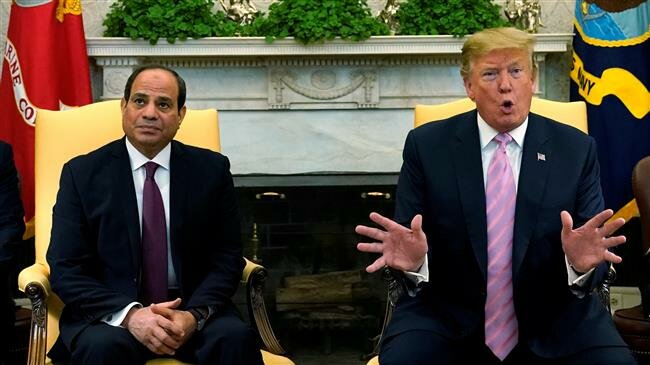
US President Donald Trump meets with his Egyptian counterpart, Abdel Fattah el-Sisi, at the White House in Washington on April 9, 2019. (Photo by Reuters)
Press TV | April 11, 2019
Egypt has reportedly turned its back on a US-led initiative to establish a NATO-style alliance of Arab countries primarily aimed at countering Iran out of concerns that such a coalition could increase tensions with the Islamic Republic, among other reasons.
Four sources familiar with the matter told Reuters on Thursday that Cairo had informed the US and the members of what is to be called the Middle East Strategic Alliance (MESA) of the withdrawal plan ahead of their Sunday’s meeting in the Saudi capital, Riyadh.
One of the sources, speaking on condition of anonymity, said that Egypt had not sent a delegation to the Riyadh event.
An Arab source stressed that Egypt had pulled out of the so-called “Arab NATO” because of its doubts about the seriousness of the proposal as well as the danger that such an Arab front would increase tensions with Tehran.
Other reasons were uncertainty about whether US President Donald Trump will win a second term in 2020 and whether his successor may scrap the initiative to form an anti-Iran alliance, the Arab source added.
Reuters described Cairo’s move as a blow to the Trump administration’s anti-Iran strategy.
A Saudi source also confirmed problems with the plan, saying, “It’s not moving well.”
Meanwhile, two other sources emphasized that the remaining MESA members were moving ahead with the initiative and would press Egypt diplomatically to revoke its withdrawal from the anti-Iran group.
“We all want them back,” said one of the sources.
The Arab source, however, noted that Egypt could not be convinced to return to the so-called “Arab NATO,” which is comprised of Jordan and six Persian Gulf Arab countries, including Saudi Arabia, the United Arab Emirates, Bahrain, Kuwait, Oman and Qatar.
Egyptian officials have not yet commented on the report.
The alliance was first proposed by Saudi Arabia back in 2017 in a bid to counter Iran as well as Russia and China, according to a classified White House document reviewed by Reuters last year.
It has, however, faced several obstacles such as a diplomatic standoff between Qatar and a Saudi-led quartet of countries and the fallout of the state-sponsored killing of dissident Saudi journalist Jamal Khashoggi.
The problems have delayed a summit in the United States, which would feature the signing of a preliminary accord on the anti-Iran alliance.
The report about Cairo’s withdrawal plan came following a meeting between Egyptian President Abdel Fattah el-Sisi and Trump in Washington.
Before the meeting, Trump had said he would exchange views with Sisi on security issues, but it was not clear whether they discussed the MESA issue.
The US and its allies in the Persian Gulf view regional powerhouse Iran as a common “threat.” They constantly accuse the Islamic Republic of “regional interference,” a claim Tehran vehemently rejects.
Trump – who came to office in early 2017 with a highly belligerent anti-Iran agenda – has been pressing its Arab allies to act on the Saudi initiative and move to form the NATO-like military alliance.
In parallel, the US president has also been encouraging the Arabs to step up their attempts towards normalization with the regime in Israel in favor of a coalition against Iran.
In February, a controversial US-organized summit in Warsaw, Poland, brought together Israeli Prime Minister Benjamin Netanyahu and representatives from a number of Arab states, including Oman, Morocco, Saudi Arabia, the United Arab Emirates, Bahrain, Qatar, Jordan, Egypt, Tunisia and Kuwait, among other participants.
On the sidelines of that event, Netanyahu said the Arab countries participating in the Warsaw forum were “sitting down together with Israel in order to advance the common interest of war with Iran.”
Tehran has also repeatedly warned the Persian Gulf littoral states against the US’s divisive policies in the Middle East, saying the planned Arab alliance would merely be a tool for the US to fuel tensions in the region and advance its own agenda there.
Nasrallah Warns: US Moves Will Not Remain Without a Response
Al-Manar – April 10, 2019
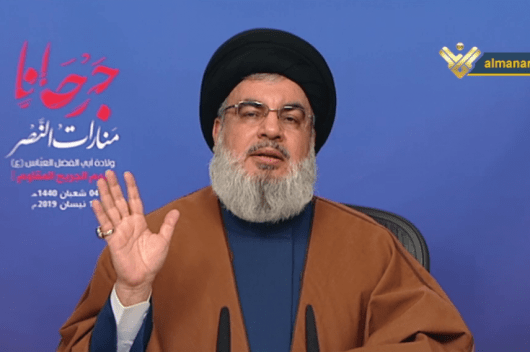
Hezbollah Secretary General Sayyed Hasan Nasrallah stressed that victories achieved in Lebanon are not the result of US and its allies’ tenders, indicating that the US sanctions and measures against Iran and its allies in the region “will not remain without a response.”
In a televised speech commemorating the day of Resistance Wounded Fighters, Sayyed Nasrallah emphasized that the security and peace “we are enjoying were made by our men, women, detainees and wounded, and these terrorists do not have the right to show that they are the ones who gave us stability.”
Sayyed Nasrallah considered that the US is humiliating an entire nation for the sake of terrorist ‘Israel’ and terrorist groups which it’s providing all facilities to.
As he voiced support to the Iranian Revolutionary Guards, His eminence condemned and decried the US decision to classify the IRGC as a “terrorist organization,” saying the US insolence and folly set a precedent. “This decision shows that the US audacity and folly went beyond limits.”
“Blacklisting the IRGC is an evidence that it is strong and not weak and this is an expected move by the Great Satan,” Sayyed Nasrallah said, adding that it was also a proof of the US failure and fiasco in the region.
His eminence dismissed reports about possible sanctions against Speaker Nabih Berri and other Hezbollah allies as “mere intimidation.”
We’ll Respond at the Right Time
The Hezbollah S.G. stressed that the Revolutionary Guards has a great role in defending the peoples of the region and had sacrificed a large number of martyrs and wounded for the sake of people of our region, indicating that it occupies a central, advanced, and the most influential place regionally.
“Until now we have only settled with condemnation, denouncement, patience, and managing the situation calmly in the face of sanctions and terror lists, but our patience does not mean that we, the axis of resistance, do not have the cards of strength,” Hezbollah’s S.G. warned, indicating that options remain open.
“It seems that the US blacklists will be prolonged. Our choices are open but we will act calmly, with a cool head and at the right time, in all battlefields and arenas,” Sayyed Nasrallah said. It is our natural right and ethical, religious and humanitarian duty to confront all those who might threaten our country, resistance and achievements through their sanctions and measures, he added.
Sayyed Nasrallah expressed his solidarity and support to the Iranian people who have been plagued by floods which hit Iranian areas. He said that Trump, who is bragging about humanitarianism, is blocking aid for Iranians suffering from the hurricane, expressing gratitude to all humanitarian efforts to collect aid to flood victims in Iran.
Yemen’s Steadfastness Protects the Palestinian Cause
Regarding the war on Yemen, His Eminence pointed out that four years have passed on the war and no one sees that the unarmed and oppressed people who are still steadfast and growing stronger are still fighting armies, pointing out that the war on Yemen is an American-Saudi-British-Israeli aggression.
Sayyed Nasrallah said that had Bin Salman won in Yemen war, he would have forced the Palestinians to sign on the deal of the century, stressing that Yemeni’s steadfastness throughout these years have protected the Palestinians. “What would have happened to Gulf countries and leaderships had the authoritarian Bin Salman won the war on Yemen?” he wondered, “he would have been presented as the great historical leader and victory will be presented in a misleading way.”
The Hezbollah leader indicated that there was an American insistence by Trump personally to continue the war on Yemen, pointing out that the steadfastness of the Yemeni people protects the Palestinian cause and Palestine and every occupied Arab land.
US Move to Blacklist Hezbollah Allies a Scarecrow
Sayyed Nasrallah briefly addressed the internal situation. He criticized what he called the US provocative policy of instigating strife in Lebanon, pointing out that it was continuing despite the failure of Pompeo’s recent visit.
He pointed that it was surprising that some Lebanese in Washington were working on blacklisting Hezbollah’s allies and friends in Lebanon. “The US move of blacklisting Hezbollah allies in Lebanon is just a scarecrow till now. There is not a single indication about an intention to place Nabih Berri and other allies on the terror list and we sense that there are Lebanese in Washington who are working in this direction, but so far this remains an intimidation campaign. When the matter reaches our allies, this means that they are targeting all our people.”
Unity, Resistance Only Way for a Free Lebanon
As for Lebanese concerns that Trump’s decision on the Golan Heights might affect the status of the Shebaa Farms and the Kfarshouba Hills, Sayyed Nasrallah said: “Our territorial border is linked to our national will and not to Trump’s decision.”
“We were killed and wounded and massacres were committed in our villages and cities through Israel’s aggression and the US support. Our peace, security and achievements were made by our people, martyrs and wounded. The achievements that were made in Lebanon are not from the blessings of America.”
Sayyed Nasrallah stressed the importance of the current spirit of cooperation among the political forces in addressing the current situation regardless of any tensions here or there. “Lebanese should choose between keeping Lebanon in the safe zone or responding to those who are leading it towards sedition,” Sayyed Nasrallah said, adding that the only way for keeping Lebanon free, sovereign and stable is through unity and resistance.
“I voice my support to Speaker Nabih Berri who has repented in Doha in front of the world’s parliamentarians to say the truth with a loud voice and show everyone the path of salvation: unity and resistance,” his eminence said.
Sayyed Nasrallah began his speech by hailing all wounded fighters who suffered and sacrificed themselves for the sake of this nation, saying: “thanks to your sacrifices, we are enjoying victories, security and the power of deterrence. The enemy doesn’t dare to wage any war because of your wounds and sacrifices.”
He said there was no place for neutrality in the battle of truth and in defending the oppressed.
Throughout his speech, Sayyed Nasrallah recalled the martyrdom anniversary of Sayyed Mohammad Baqer Al-Sadr and his sister, and hailed his enormous intellectual achievements.
Don’t expect US-Iran war before 2021
By M. K. BHADRAKUMAR | Indian Punchline | April 10, 2019
There is no reason to disbelieve the boast by Israeli Prime Minister Benjamin Netanyahu claiming credit personally for US President Donald Trump’s decision to designate Iran’s elite Islamic Revolutionary Guards (IRGC) as a “foreign terrorist organisation” under American law. It is common knowledge that all major decisions and most minor decisions by Trump regarding the West Asian situation are dictated by Israel’s interests.
Deep-pocketed Jewish billionaires such as Sheldon and Miriam Adelson, far-right Christian evangelicals and the well-known Israeli lobby wield enormous influence over Trump whose son-in-law Jared Kushner is also known to be an ardent Zionist who has funded West Bank settlements. Both decisions by Trump in recent weeks — granting US recognition to the illegal Israeli annexation of Syria’s Golan Heights region as well as yesterday’s move against Iran’s IRGC — are to be seen as motivated by the desire to bolster Netanyahu’s campaign seeking a fresh term in Israel’s parliamentary election on April 9.
The Pentagon and the State Department had reportedly expressed misgivings over Trump’s decision branding IRGC as a terrorist organisation. Indeed, Trump’s announcement on April 8 says clearly that the US state department will take the lead role in implementing this decision. Trump avoided voicing any intention to confronting the IRGC militarily and instead underscored his decision is to impose economic sanctions against the Iranian security organisation.
Considering that the IRGC has a long reach in the economic arena, especially in vital sectors such as energy, telecommunications, etc., in effect, Trump’s decision amounts to an extension of the US sanctions against Iran. Therefore, as Trump put it, the decision becomes a template of his “maximum pressure” strategy against Iran, which has been under implementation.
Tehran’s reaction has been surprisingly restrained under the circumstances. To be sure, Tehran has retaliated by naming the US Central Command (which is headquartered in Doha and covers the so-called Greater Middle East stretching from the Levant to Central Asia) as a terrorist organisation. Interestingly, Iranian reports highlighted that it is a “tit-for-tat” measure — that is, a move Iran had no choice but to make. The overall mood is one of resignation that the Trump administration is under the Israeli spell and has taken a step that is not exactly in American interests.
There have been no threatening statements from Tehran directed at the US, either. In a highly nuanced remark, the influential chairman of the National Security and Foreign Policy Commission of the Iranian Parliament, Heshmatollah Falahatpisheh hastened to clarify that Iran’s measures against the US Central Command, in response to US anti-IRGC move, is defensive, not a declaration of war.
Again, Iran’s powerful Supreme National Security Council, which is the apex executive body on foreign and security policies, has also restricted itself to saying in a statement, “Undoubtedly, the US regime will bear all the responsibilities for the dangerous consequences of its adventurist move.” This must be noted carefully as a signal to the US defence and security establishment.
Most important, Iran’s Supreme Leader Ayatollah Ali Khamenei estimated Trump’s move as only to be expected, given the IRGC’s pivotal role in countering Iran’s enemies. He said the US move will fall flat. The head of Iran’s Revolutionary Guards, Gen. Mohammad Ali Jafari was quoted as saying, “This U.S. move was quite laughable since the Revolutionary Guards are in people’s hearts … The Revolutionary Guards will increase its defensive and offensive capabilities in coming year.”
On the political plane, however, Tehran will step up its “resistance”. More Iranian support for Hamas can be expected. Similarly, the US move, coming hot on the heels of recognising the Israeli occupation of the Golan Heights, will only further further consolidate the “resistance”. The known unknown is going to be the impact on Afghanistan. Tehran has links with the Taliban. But it has been voicing strong backing for President Ashraf Ghani’s insistence that the peace talks should be “Afghan-led, Afghan-controlled.” Iran’s overriding concern is the stability of Afghanistan and the welfare of the Shi’ite communities. Conceivably, the US must be factoring in the imperative need to discourage Iran from playing a spoiler role in Afghanistan.
Among the Iranian security agencies, it is the IRGC that is in the driver’s seat in steering policies in Syria, Iraq and Afghanistan. The point is, the US Central Command and the IRGC (plus various Iran-backed militia forces) “co-habitate” these theatres. It is inconceivable that the US would precipitate any hostile moves against the IRGC that draw forth retaliation and jeopardise the safety and security of American personnel. Iran has the capacity to infect pain and give sleepless nights to the US personnel deployed under the Central Command and, to be sure, the Pentagon and the CIA are well aware of that.
We may, therefore, expect a tacit understanding by the two antagonistic parties to stay out of each other’s path. Of course, that is easier said than done, since these are high kinetic theatres witnessing acute confrontation. But then, the US-Iran tango has a 40-year history of shadow boxing.
Some shrill rhetoric can be expected from the US side, especially from US secretary of state Mike Pompeo and National Security Advisor John Bolton. Both are stridently “anti-Iran”. Bolton had been in the payroll of Iranian dissident groups based in the West. Both Pompeo and Bolton are passionately devoted to serving Israeli interests. But, in the final analysis, it is Trump — and Trump alone — who matters.
Quite obviously, Trump will be extremely wary of getting into a shooting war with Iran. Trump knows only too well that a war with Iran will have regional ramifications and can hurt his presidency. His game plan through this year and the next will be to ensure that his “maximum pressure” strategy deters Iran from causing any serious political embarrassment during his campaign, which is due to start later this year, for his re-election bid in 2020.
Suffice to say, Trump’s IRGC designation is unlikely to lead to any shooting war with Iran — till end-2020, at least. Having said that, there will be no let-up in Tehran’s pursuit of “resistance” in Syria and Iraq. And, given the pivotal role of the IRGC in Iran’s foreign and security policies, any form of direct engagement politically or at the diplomatic level between Washington and Tehran can be ruled out. Having said that, make no mistake that the US’ regional strategies in Syria and Iraq will come under severe challenge. To be sure, a strategic stalemate is Israel’s objective too as the guarantee against US retrenchment from the Middle East.
The US’ Plans To Designate The IRGC As “Terrorists” Aren’t Just For Show
EurasiaFuture | April 8, 2019
From Farce To Tragedy
Alt-Media is making a mockery out of the US’ reported plans to designate the IRGC as “terrorists”, giddily quoting the Iranians who spun this rhetoric around and announced that they’ll reciprocate by doing the same to the US military if that happens. The “chattering class” is having a field day using this opportunity to highlight the many abuses that America has committed across the Mideast and the world in general over the decades, seemingly not caring one bit for the possible consequences that could transpire if the US actually goes through with the unprecedented move of designating part of a foreign military as “terrorists”. That’s a mistake because the US’ plans need to be taken much more seriously than they are since they’ll likely herald a new escalation of the Hybrid War on Iran through the possible commencement of direct strikes against the IRGC and its Hezbollah allies in Syria.
“Sitting Ducks”
Like I wrote back in April 2017 after the US’ first conventional strike against Syria, “Trump’s Cruise Missile Message To Iran” was that his country won’t hesitate to hit it and its non-state allies there next, though provided that America was prepared for the inevitable backlash that this would undoubtedly unleash. In hindsight, the US preferred to “play it safe” and not “up the stakes” to the point of potentially triggering a larger Mideast war, but nowadays it appears as though Bolton has convinced Trump that now is the perfect time for striking Iranian positions in Syria due to the Islamic Republic’s refusal to agree to the dignified but “phased withdrawal” that Russia has been pressing them to commence for most of the past year as part of its broader “balancing” strategy. In addition, sanctions have finally begun to bite and a sudden increase in the physical and financial costs of Iran’s Syrian deployment might be all that’s needed to get it to begin the “phased withdrawal” process.
The US insists on maintaining a troop presence in Syria despite Trump’s promised “withdrawal” last year precisely because of its desire to “contain” Iran, so it’s not inconceivable that it will seek to intensify the pressure that it puts on its rival to the point of striking the IRGC and its Hezbollah ally if Washington “officially” regards them both as being “terrorists”. Iran has no air defense assets in the country and Russia is extremely unlikely to allow its Syrian partners to have full and independent control of the much-touted S-300 in order to avoid the scenario of Damascus escalating the situation by shooting at American warplanes and possibly dealing Moscow enormous embarrassment if Washington manages to destroy its surface-to-air missile systems in response. Simply put, Iranian forces are practically “sitting ducks” if the US decides to strike them.
A Likely Ultimatum In Latakia
It should be taken for granted that Iran has many asymmetrical means through which it could likely respond, whether in Syria, Lebanon, the Gulf, or even in “Israel”, but one also shouldn’t over-exaggerate its capabilities either since Tehran has yet to unleash the devastating consequences that it regularly promises every time “Israel” hits its forces in Syria. One can only speculate whether this is a prudent move to patiently wait until the “right moment” or if everything was nothing more than one big bluff to begin with, but whatever the case, the US evidently thinks that it can manage whatever response Iran might have to the potential bombing of the IRGC and Hezbollah by American forces in the event that the former is designated as “terrorists” and Trump wants a dramatic headline-grabbing news event to follow this development.
In fact, the US might even issue an ultimatum to Iran to withdraw from Syria or be militarily driven out after reports recently emerged that the country is about to clinch a deal for operating the Mediterranean port of Latakia just a few hundred kilometers from “Israel“, something that’s sure to set off alarm bells in both Washington and Tel Aviv because of speculation that this economic agreement might have military implications. The reason why an ultimatum might be issued in this case instead of just “bombing first and making demands later” (as is the usual US modus operandi) is because of how close Russia’s Hmeimim airbase is to the port, meaning that any possible strike against Iran’s assets there would be extremely complicated to pull off without coordinating with Russia otherwise another September-like midair tragedy might transpire.
Russia: An Ally To Whom?
“Israel” certainly doesn’t want to repeat the events of that fateful day, nor would the US be willing to risk the outbreak of World War III if a few missiles carelessly veered off course and either hit the Russian base or its assets, so it should be assumed that those two are already in secret talks with Moscow (likely facilitated by Netanyahu’s “shuttle diplomacy” between their two capitals) in order to agree upon a “solution” to this scenario. Syria and Iran should have anticipated that something of the sort was in the works because of Russia’s lengthy track record “passively facilitating” “Israeli” strikes against the IRGC and Hezbollah, so both of them probably predicted that their port deal might force Moscow to stop “balancing” and finally pick a side once and for all.
The “surprise”, however, is that Russia is completely disinclined to pick Iran over “Israel” because it derives enormous strategic benefit in Syria by removing its “friendly competitor” and strengthening its increasingly monopolistic control over the country in the economic, political, and military domains. Furthermore, Iran’s relative weakening is advantageous for Russia because it makes the Islamic Republic more desperate to agree to whatever “sanctions relief” deals Moscow might offer it irrespective of the possibly unfavorable conditions. “Israel”, meanwhile, is poised to become Russia’s top military-strategic partner in the Mideast, and Moscow believes that the comprehensive benefits of this relationship far surpass whatever Iran could provide for it. As such, it can be expected that Russia will silently work to avert the scenario of direct US strikes on the IRGC and especially the Latakia port by more actively encouraging Iran’s dignified but “phased withdrawal” from Syria.
Concluding Thoughts
The US’ very probable designation of the IRGC as a “terrorist” group in the near future would open up the Hybrid War floodgates by providing the “justification” that the Pentagon needs to commence strikes against its rival’s special forces or at least issue the threat thereof as part of a series of forthcoming escalations designed to trigger Iran’s dignified but “phased withdrawal” from Syria. The IRGC has reportedly suffered many casualties already because of Russia’s “passive facilitation” of “Israeli” strikes against it over the years but has yet to make either of them pay, so the likelihood of Iran doing anything real dramatic in response to the US possibly striking its special forces too is low.
In any case, Russia — as the undisputed hegemonic power in Syria — would prefer for the US and “Israel’s” issues with Iran’s military presence in the Arab Republic to be settled as peacefully as possible without posing a danger to its Aerospace Forces, fearful as it is of a repeat of last September’s tragedy in the event that either of those two bomb the Latakia port facilities near its Hmeimim airbase that Iran is on the brink of possessing. Therefore, the US’ reportedly impending designation of the IRGC as “terrorists” will probably cause Russia to cooperate more closely with it behind the scenes (possibly via “Israeli” mediation) to ensure Iran’s dignified but “phased withdrawal” from Syria.
Iran, Iraq ‘agree on aerial defense cooperation’
Press TV – April 7, 2019
Iran’s top military commander says the country and its neighbor Iraq have agreed to cooperate in the area of air defense to fend off the challenges facing their respective air spaces.
Chairman of the Chiefs of Staff of the Iranian Armed Forces Major General Mohammad Baqeri made the announcement to reporters following a meeting in Tehran with his visiting Iraqi counterpart, Lieutenant General Othman al-Ghanimi, Tasnim News Agency reported on Sunday.
The cooperation, Baqeri said, will be aimed at confronting aerial threats.
The meeting addressed “the integrated defense of Iran and Iraq’s skies, because we might sense threats coming from the direction of [our] western borders,” he added.
“Accordingly, it was agreed that the countries’ air defense sectors work together and more coordination be made in this regard,” the Iranian commander said.
Baqeri said the two sides also agreed on potential training cooperation, the transferring of Iran’s defensive experiences to Iraq, and joint military exercises. Agreements on these, he added, will be finalized during a future visit by the Iraqi military chief.
Ghanimi was in the Iranian capital as part of a delegation accompanying Iraqi Prime Minister Adel Abdul-Mahdi. On Saturday, the delegation met with Leader of the Islamic Revolution Ayatollah Seyyed Ali Khamenei and President Hassan Rouhani.
Baqeri cited the Iraqi commander as saying that Baghdad would be exercising stricter control on the United States’ military presence on its soil.
The American forces are only there to train Iraqis and their activities are under the Iraqi Army’s oversight, Baqeri added, citing al-Ghanimi.
In his meeting with Ghanimi, Ayatollah Khamenei had stressed that the Iraqi government should make sure that US forces leave Iraq as soon as possible.
Nasrallah on the End of US Hegemony: Trump will Leave the Middle East, Region Already Reshaping – PART II
Interview of Sayed Hassan Nasrallah, Hezbollah Secretary General, with Ghassan Ben Jeddou, founder of the pan-Arab and anti-imperialist Al-Mayadeen channel, January 26, 2019.
Transcript:
Ghassan Ben Jeddou: (The US forces withdrawal from Syria announced by Trump) is therefore not a mere tactical maneuver. You say he is serious and sincere in his desire to withdraw, but this reflects a failure, if not a defeat, not for Trump especially but for the American (hegemony) project in general.
Hassan Nasrallah: Obviously this is all at once a failure, a dead end and a defeat. Currently, the cause of his hesitation is that (his advisers) tell him that the Kurds are their allies (and that they should not abandon them). I’ll explain why we saw these hesitations recently (as regards the US withdrawal from Syria).
When Trump said that US troops would withdraw and that there was only sand and death in Syria, he also said something even more important: “Does the USA want to be the Policeman of the Middle East? Do we want to be there forever?” With this statement, he hinted, and even more than hinted (this is an explicit indication), that all these US forces in the Middle East were not to stay, and that in time he would conduct (a full) withdrawal. What effect did this statement produce in the region, Professor Ghassan? Let us leave the question of Israel for later.
This statement caused, within the Saudi regime, in a number of Gulf countries enemies of Syria, and among all the allies of the United States in the region, – be they organizations, parties or personalities, not to mention the States – an immense feeling of fear and despair. And Trump knows them well (and he knew the effect that his statement would cause). When he says (to Saudi Arabia and the Gulf countries) that “You would not last two weeks (in power) without American (military) support”, or “Without us, your planes would get off the ground but couldn’t land”, “Without us, you Saudis would speak Persian.” He tells them all this, and adds “We will not remain the (Middle East’s) policeman, we will leave the region.” This caused a state of confusion, despair and fear in the region. That’s the first point.
That is why all the countries and groups (who rely on the US), starting with the Kurdish parties, came to Beirut and asked to meet with Hezbollah. We met them. Then they went…
Ghassan Ben Jeddou: Who are you talking about ?
Hassan Nasrallah: Kurdish parties, who are responsible for negotiating on behalf of the Kurdish units. They came to talk to us, and from there they went to Moscow and then to Iraq to request that Iraq serves as an intermediary with President Bashar al-Assad. Today, the Kurds and the Kurdish movements are (hopelessly) seeking…
Ghassan Ben Jeddou: Who are you talking about exactly? The Syrian Democratic Forces?
Hassan Nasrallah: Yes, the Syrian Democratic Forces, Kurd bodies and representatives in charge of negotiating. Very quickly, they rushed to Moscow, to Iraq, to Lebanon. Why? Because Trump has abandoned them, he forsake them, he betrayed them. This is regarding the East of the Euphrates.
Regarding the (US-aligned) countries, (they panicked at the idea of being abandoned), and they all began to think (intensely and reconsider their positions). They review their stances and try to strengthen their relations with Russia, they reconsider their relations with Iran. Even in Syria, the priorities of some countries are not the same anymore. And now we can talk about the issue (of the relations between) Arab (countries) and Syria. You want me to tell you this story now, or later?
Ghassan Ben Jeddou: Please, go ahead.
Hassan Nasrallah: According to my information, all that we saw in recent weeks, namely the Emirates reopening their embassy in Syria…
Ghassan Ben Jeddou: And before that, the President (of Sudan) al-Bashir (coming to Syria).
Hassan Nasrallah: Indeed. The President al-Bashir came to Syria. Did he come on his own?
Ghassan Ben Jeddou: What is your information?
Hassan Nasrallah: He got a green light from Saudi Arabia.
Ghassan Ben Jeddou: This is your information?
Hassan Nasrallah: Yes. A green light from Saudi Arabia and the Gulf countries.
At the end, lately, President al-Bashir rallied them. And the fact that (an Arab President) meets Bashar al-Assad is something of vital importance to (Saudi Arabia and the Emirates).
Ghassan Ben Jeddou: So this visit was not an arrangement of Russia that would have angered Saudi Arabia and the UAE (as some media have claimed)?
Hassan Nasrallah: No, under no circumstances. The current problem between President al-Bashir and Saudi Arabia has nothing to do with his visit to Syria. It concerns the fact that Saudi Arabia has not kept its promises and financial commitments made to President al-Bashir in return for his sending brigades of the Sudanese army to fight in Yemen – and Sudan’s involvement in this war is very unfortunate. This issue has nothing to do with Syria.
Anyway, the visit of President al-Bashir (to Syria), the reopening of the UAE embassy, the announcement of the Foreign Minister of Bahrain – and by the way, his statement was false, he was lying – who claimed that their embassy in Syria had always remained open, etc. But this is not true. Anyway, we started to see an Arab atmosphere (different with regard to Syria), we see Saudi advances, (Syrian) delegations visited Cairo, and there is talk about the coming of President al-Sissi and others to Damascus, etc. What is the reason ? And here I also speak basing myself on sound information that come from more than one (trustworthy) source.
In light of the decision of Trump to withdraw, and after the resignation of Mattis, who was seen as a guarantee by many, and because of the visible concern within the US administration, there was a great wave of panic in Saudi Arabia and the UAE – and with all their allies and instruments, but especially these two countries in particular. They met in Abu Dhabi to assess the situation – and their options – at a very high level. They assessed their situation in Syria and said:
“The battle against President Bashar al-Assad is over, and our groups have failed. All the movements we financed are now with Erdogan, isn’t it? All those who fought in Syria, in southern Syria, which were financed by Saudi Arabia, the UAE and Israel, have gradually retreated (following their consecutive defeats) and are now all in the North, that is to say (in the hands of) Erdogan. The battle against President Assad is over as regards the armed factions, groups and parties that we supported, as well as our various networks of influence: our whole project collapsed. Assad will certainly remain in office, the Syrian State won, the opposing Axis triumphed in Syria. There remains (only) one danger (that we can prevent): Erdogan –sorry, I mean Trump– made the decision to withdraw (his troops from Syria), and therefore, the only refuge of the Kurds is Assad and Damascus, (to avoid) the invasion of the East of the Euphrates by Turkey.”
Trump told Erdogan that Syria is his. If Syria is (abandoned to) Erdogan, if Turkey wants to invade Syria, it is a very dangerous project for Saudi Arabia and the Emirates. Imagine that their analysis reached this conclusion: the main danger in Syria is not Iran…
Ghassan Ben Jeddou: This is the conclusion reached by the UAE and Saudi Arabia?
Hassan Nasrallah: Yes. (The main danger in their eyes) is not Iran. The main danger (today) is Turkey. Iran comes in second position. President Assad, whose position is fully consolidated in Syria, is third, and (Saudi Arabia and the UAE) are even willing to have relations with him. They may also agree with Russia and get some guarantees from her, etc. Russia is less problematic in their eyes. They consider that the main danger is Turkey.
You know, (Saudi Arabia and the UAE) always think in sectarian terms. Ultimately, (in their eyes), Iran – and do not blame me for my frankness – is a Shiite country, and therefore may only have limited influence in Syria, etc. On the other hand, Turkey is a Sunni country, which has a certain presence in Syria, historical relations with that country, is a neighboring country and has a common border, so if Turkey enters (permanently) in Syria, it will be the end and no one will be able to get them out. (That’s how they see things).
Is it because their heart burns for Syria (that they fear a Turkish invasion)? Certainly not. Never. They couldn’t care less about the fate of Syria (and Syrians). But they believe that the advance of the Turkish project in Syria would be the advance of the (opponent) Axis, namely Turkey, Qatar and the Muslim Brotherhood. And that would revive this project, which targets, according to them, the Saudi regime, the UAE regime, the Egyptian regime, etc.
Ghassan Ben Jeddou: And this is the reason of their opening (towards the Syrian regime)?
Hassan Nasrallah: That is why they decided to get closer to Syria and to restore relations with President Assad and the Syrian State, while remaining in their hostility towards Iran, but trying to agree with Russia in order to put obstacles in the way of any progress of Erdogan’s (neo-Ottoman) project in Syria and therefore in the region.
Ghassan Ben Jeddou: But what happened to them so that they’d interrupt their rapprochement with Damascus?
Hassan Nasrallah: The opening (towards Syria) began, and they started talking about the return of Syria in the Arab League. President al-Bashir visited President Assad and told him about it. And Assad’s position did not surprise me.
Ghassan Ben Jeddou: What have they offered? What is your information?
Hassan Nasrallah: They asked Syria to submit a written request indicating that given the new circumstances in the region (end of the war in Syria, etc.) and their concern for the Arab States and Arab Unity & Cooperation, they wanted to regain their statute of member of the Arab League.
Ghassan Ben Jeddou: This is the message they gave him?
Hassan Nasrallah: Yes. Of course, I refer to the substance of their proposal, and I do not quote it by heart.
Ghassan Ben Jeddou: And then?
Hassan Nasrallah: (Assad’s) answer (was as follows): “Syria has never walked out of the Arab League (voluntarily), so we cannot request to come back to it. We never submitted a resignation that we should now withdraw. It is up to those who have kicked us out to ask us to come back.” And this is a noble and dignified position, and perfectly predictable. It is not a surprise. If Arab regimes think that they merely have to tell President Assad that their doors are open and that Syria can come back (to the Arab League), to see him feel a huge relief and run with joy in their arms, they are deluded. Syria will resume its place in the Arab world, and it is in its interest. But she will come back with all her dignity (and not slavishly).
What is new is that the US has made an assessment of Trump’s accomplishments, “But what have you done? Where are our allies?” So-and-so is (getting closer to) Russia, so-and-so is with President Bashar al-Assad, so-and-so considers that now, the main danger in Syria is Turkey (major NATO member) and not Iran, while the US want their (main) enemy to remain Iran. What to do (in this situation of dramatic decline of US influence in the Middle East)?
Allow me to say, about Lebanon and all the Lebanese political forces that were betting on the fall of the Syrian State and regime, that you can imagine in what state they found themselves when they heard Mr. Trump declare that he would withdraw from Syria.
Therefore, the US decided to ask Mr. Pompeo to tour the region to boost the morale of all States and groups who are devastated by the announcement of the US withdrawal from Syria (and the Middle East), and began to reconsider their choices, their relationships and their future and to grab on to their thrones (in a fit of panic). (This Pompeo visit aimed to) try to put them back on their feet, to boost their morale and to assure them that the US supports them and won’t give up on them, that they do not intend to leave the region, and as a proof, he invited them to participate with the United States to a conference in Warsaw meant to deal with Iran, its influence and its threat, (in an attempt) to put them back in confrontation with Iran, at least in terms of appearances.
(Pompeo) sent David Hill to Lebanon – for Pompeo (feels) too important to come himself to Lebanon – with the same message, to reassure those who felt frightened, demoralized, anxious and lost by the US policy in the Middle-East.
But since we have arrived at this point of our discussion, I want to conclude this presentation with this statement: the United States will not manage to do more than they have already done. I declare to the governments of the region, to their leaders, to their peoples, to their movements and to Israel – because we will finally come to Israel –, that the US are deserting our region. They will flee Syria – it may take several months, but the decision is taken.
O my brothers, they are fleeing from Afghanistan. And do you know who they leave (in charge of) Afghanistan? They leave the Taliban! Because in the agreement, Trump won the Taliban’s commitment not to allow Al Qaeda and ISIS (to settle) back in Afghanistan. Trump considers that the Taliban represent the government of tomorrow, who can (already) provide guarantees to the US government. Isn’t it a humiliating defeat for the US in Afghanistan? Especially since the Taliban are officially considered as a terrorist organization (by the US), and Washington claims to never negotiate with terrorists.
The United States will flee. There will be no more US forces waging war in our region. Trump won’t launch a war for the eyes of Mohammad Bin Salman (Crown Prince of Saudi Arabia), nor for the eyes of Mohammed bin Zayed (UAE Crown Prince), not even for Netanyahu’s eyes – and clearly, Netanyahu’s eyes are much more valuable to Trump. Not even for the eyes of Netanyahu! Trump, the US and the situation of the United States, either inside at the level of the economy, etc., etc., etc., do not allow them to launch a new war in our region. There will be no US war in the region.
What does Trump want then? (For him), it is from their own pocket that States, regimes and forces (allied to the US in the Middle East must fight), with their own money, their own media, their own blood… Trump wants to bring them together again to put them (alone) against Iran. And if, against Iran, for 40 years – we are at the 40th anniversary (of the Islamic Revolution) –, the United States and all the tyrants on Earth have been unable to do anything to bring down this regime and this blessed Islamic Republic, then (what could the Arab States do by themselves)?
Ghassan Ben Jeddou: But Eminent Sayed, relatively, (the United States), haven’t they won? You just revealed a very important information, namely that the Saudis and Emiratis gathered and concluded that the major strategic change that you just presented will occur (inevitably). But it seems that Trump still won. First, he slowed down the rush of Arab countries to Damascus, and secondly, today, we hear a new discourse from the Arab countries, namely that…
Hassan Nasrallah: The fact that he stopped the momentum of the Arab countries is natural. He can keep them in check easily. Do you think that these countries are courageous, independent, that they have an independent process of decision, and may rebel against their American master? Never. That is why…
Ghassan Ben Jeddou: What I mean is that the US managed to put all their allies –Saudi Arabia, the UAE and all others– into line.
Hassan Nasrallah: Yes, but this is not a success. Trump only prevented that everything collapses quickly. But (it is mere damage control and) the collapse process is still ongoing.
Ghassan Ben Jeddou: Has he stopped or only slowed down the process of opening the Arab countries towards Syria?
Hassan Nasrallah: What we have heard and what was reported to us is that they are undecided. There is no clear choice to maintain the absence (of relations with Damascus) or stay in a completely negative attitude (against Syria). I give you a proof of that. Two days ago, there was a meeting between a UAE economic delegation and a Syrian delegation. I do not remember if it was held in Damascus or in the Emirates. This means that at least, at an intermediate level, these relations will continue. (Sooner or later), it will be revealed that very important people in Arab countries secretly came to Damascus, although these meetings were not made public. But it is for the Syrian leadership (to reveal this issue). And I speak of meetings at the highest level.
 Ghassan Ben Jeddou: At the political or security level?
Hassan Nasrallah: At least at the security level.
Ghassan Ben Jeddou: For example heads of intelligence services?
Hassan Nasrallah: For example.
Ghassan Ben Jeddou: Policymakers?
Hassan Nasrallah: Yes.
Ghassan Ben Jeddou: From these (most) influential Gulf countries (Saudi Arabia and UAE)?
Hassan Nasrallah: Let’s just say from Arab countries, (don’t try to force me) to reveal more about their identity or titles – whether Sheikh or Sayed, Professor or Hajj, Doctor or Engineer, etc. What I have revealed is enough (I will say no more).
Ghassan Ben Jeddou: Influential and active Arab countries?
Hassan Nasrallah: Currently, the United States wants and strives to retain forcefully these Arab countries back (to prevent them from making a step towards Damascus, Moscow, etc.) But of course, so far, they haven’t brought anything substantial to convince them and reassure them (that this is the right choice), and that the United States have not abandoned Syria to Turkey. For this is what Saudi Arabia, the Emirates, President al-Sissi and Egypt, and all the others, want to hear clearly.
That is why we will perhaps see, on the Arab question, a slowdown or coldness in the momentum towards Syria, but I exclude that this movement can be completely stopped. Therefore I conclude this point by saying that the United States failed in Syria. Of course, after this fiasco, the one who loses the most and who is in the greatest distress is Netanyahu.
Ghassan Ben Jeddou: Yes. […]
Nasrallah on the End of US Hegemony: Trump will Leave the Middle East, Region Already Reshaping – PART I
Interview of Sayed Hassan Nasrallah, Hezbollah Secretary General, with Ghassan Ben Jeddou, founder of the pan-Arab and anti-imperialist Al-Mayadeen channel, January 26, 2019.
Transcript:
[…] Ghassan Ben Jeddou: But I want to return to the United States, as a fact of utmost importance just occurred, Eminent Sayed, on the general and strategic perspective: Trump said he would withdraw (US troops) from Syria, saying that the country was nothing but “sand and death”. My specific question is this: is it (just) a tactical withdrawal, meaning that the United States will withdraw (just) a part of their forces to leave you in a quagmire? Or is it a true (and full) withdrawal, which means a defeat for the United States?
Hassan Nasrallah: I think whenever Trump talks about his intention to withdraw US forces, he is true and sincere. The word “sincere” (applied to Trump) makes you laugh? I mean he is honest with himself (he says what he thinks). During his campaign, he made election promises, and after two years there will be new presidential elections. And everything he has promised to do, he wants to do it. In fact, he already achieved some of his election promises.
One of those promises was: “Why are we sending our children (to fight) abroad and die in a far away region to defend it, to be killed and spend (huge sums of) money?” He stated that the United States spent 7 000 billion…
Ghassan Ben Jeddou: 7 trillion dollars.
Hassan Nasrallah: 7 trillion equals 7 thousand billion. And a few days ago, he said: “We spent 7 000 billion, we sent our armed forces, we made all these sacrifices (in the Middle East), and in the end, I have to go to Iraq in secret, at night? This clearly indicates our failure!” So every time (he talks about his desire to withdraw, he is sincere). Even when he said: “If we continue to defend, for example, Saudi Arabia or the Gulf states, they have to pay for that. If we defend Europe, Europe must pay. If we defend Japan, Japan must pay.”
Obama… sorry, Trump is a charming person! When we listened to Obama, he spoke about human rights, democracy, (free) elections, etc. His attitude and his words were steeped in hypocrisy.
Ghassan Ben Jeddou: When he spoke of the Arab Spring…
Hassan Nasrallah: We’ll come back to this point. From day one, all we hear from Trump is “millions, billions, dollars…” I’m relearning English (thanks to him), you see… And “They have to pay, they have to pay, there are both rich and poor people among them, etc.” Very well. That is why he hasn’t respected anyone in his statements. He was very insulting to Saudi Arabia, and in respect to the Gulf countries in general, including his closest allies, such as Europe, Japan and South Korea, (he didn’t spare anyone). As we say in Lebanese, he buried them alive (under his torrent of abuse). He wants everyone to pay all the US expenses, rightly or wrongly, he makes them (spit) money (forcefully), even as he (already) plunders their resources, raw materials, their future, he confiscates their political freedom and imposes them (US) companies, etc., but he doesn’t pay attention to all this. All that matters to him is that he protects them, so they have to pay billions of dollars for this protection. Thus, he is committed to bring his forces out (of Syria, etc.).
What is happening today in Afghanistan? Even today, to prove that we are broadcasting live – but it should be enough that you say so, without need for additional evidence –, the Taliban announced that they and the US delegation led by Khalil Zad Zalmai had met in Doha and had reached a draft agreement, which may be renegotiated if necessary, and which stipulates that within 18 months, all foreign forces should have left Afghanistan. That’s (what) Trump (is doing)! And we must keep this in mind and remind it to the others when addressing Lebanon and the peoples of the region, so they know that the days of US hegemony in our region (are counted).
As I see it, since the day he became President, Trump intends to withdraw the modest US forces present in Syria under the pretext of the international coalition (against ISIS) since the time of Obama. But the advisers surrounding Trump dissuaded him from doing so because of the growing power of Iran, Russia and President Assad (which would be exacerbated if US withdrew), etc. And they started all over again, and the guy (Trump) stood with patience. He gave them time (to make progress in Syria) but he saw that it was useless. That is why 7 months ago, or so it seems to me, in a speech, he said: “We will leave Syria soon, very soon.”
We are at a time when we must be careful with translations, and ensure that they are accurate, so I asked a (Hezbollah) brother who had the text of the speech in English to send it to me and highlight the passage where he said “soon, very soon”. (And this passage was indeed saying) “soon, very soon” (quote in English). So the media had faithfully translated his remarks.
Everyone went beserk after this statement, with protestations from Mattis, the former Defense Secretary (who resigned in December 2018), and other people denouncing this US withdrawal, which would represent a victory offered free of charge to Iran in the first place, to Russia and to President Assad, a wrong decision, an (ill-advised) visceral reaction, etc. They went to see him. These are important facts that I must relate to you, it is sound information and I could even give you the source. (Mattis, Bolton and others of their ilk) went to see Trump and told him to give them some time. If he was keen to get out of Syria, he should at least give them time to gain (something in the field) in exchange for the withdrawal. Trump said he had no problem with the idea, and asked them how long it would take them. They said 6 months. These 6 months have not been officially announced, but CNN and other US media reported that Trump had given 6 month to his Defense Secretary to prepare the withdrawal from Syria.
The Americans went to the Russians and told them… I am sorry to mix the Lebanese dialect and literary Arabic. The United States told Russia that they were ready to get out of all Syria and leave absolutely no soldier behind – I convey their words accurately –, and they were even ready to leave the Al-Tanf region, which has a special significance. Yesterday, a US official said they would leave Syria, but remain at Al Tanf (American base at the Syrian-Iraqi and Syrian-Jordanian border), but back then, they said they’d even leave Al-Tanf, but on condition that Iranian forces leave Syria, and Hezbollah also of course. The United States asked the Russians to go talk to the Iranians and with President Assad to tell them about this agreement proposal, namely an Iranian withdrawal would be carried out together with a full US withdrawal from Syria. And the Americans asserted they were quite ready to conclude such an agreement.
Trump was determined to withdraw his troops even without this bargain, but those around him told him to wait a bit for them to get this deal. The Russians have therefore communicated this proposal to the Iranians, and President Putin informed President Rouhani, who informed me myself. Similarly, the Russians sent a high level delegation to Damascus who met with President Assad and conveyed this proposal to him. The Russians waited a response from Iran and a response from Syria.
On the Iranian side, I am one of the people they have consulted on this issue, and I told them (that in my opinion), the United States would withdraw from Syria in any case, whether the Iranians remained or left; the US try to get something in return to save face and cover their withdrawal (because in truth, they are defeated), to pretend they leave after scoring a big victory, namely the withdrawal of Iranian forces – because ISIS was not eradicated –, to be presented in the United States as a huge success for Trump, and as an even greater success by Netanyahu in the Israeli entity.
Iran has categorically rejected this proposal, saying that they were present at the request of the Syrian government to combat terrorism and takfiri groups, which were still present in Syria. The reason for their presence being still valid, there was no reason to leave. Final point. End of the discussion. President Assad made the same answer, saying he refused that Iran leave Syria – talking about Iranian forces may not be entirely fair, but there are generals, officers, consultants, logistics, etc. President Assad refused on principle to put on the same footing Iranians and Americans, because the first came at his request, and the second are occupants. “The first are friends and the latter are supporting my enemies, (he said). The battle is not over, and even if the Iranians wanted to leave, I would not accept it, and I would ask them to stay.” This US project has failed.
To be honest, it should be noted that the Russians haven’t put any pressure on Assad (for him to accept this proposal), they only conveyed the message. For you know that in the media, there is much talk about the Russian-Iranian issue (to present an alleged divergence or opposition in Syria). It is true that the Russians sometimes exaggerate (in their demands, and exert too much pressure), but to be fair and accurate, (this time), the Russians have only transmitted a message, and in an appropriate (and respectful) way. They said that there was this proposal, and asked (Iran and Syria) their opinion. And when both answered no, this response was forwarded to the US. End of story.
Trump was informed that the attempt had failed, and he began to ask them to work seriously to liquidate ISIS because they had only 6 months. This is why recently, operations and bombings against ISIS intensified and real massacres were committed to end ISIS in this last pocket of the Deir Ezzor region where they are present.
When 6 months have passed, Trump surprised no one (when announcing the US withdrawal from Syria). Mattis, the Defense Secretary, and other officials, had known for 7 months that they only had 6 months before them. You got nothing, you’ve done nothing, so the guy (Trump) decided to leave Syria. Why does he leave Syria? I’m coming to it. He said there was only sand and death (there), nothing else, and that he had no reason to stay. In his eyes, the Syrian people has no value, he couldn’t care less about the future of Syria – and there is even a positive aspect to this. Neither elections, nor freedom, nor democracy, nor any of this interests him. Ultimately, what does he care about in Syria? He cares about Israel, and perhaps about some red lines, some limitations and some (armed) groups. And he believes that he can guarantee his interests through the political hegemony, the political resolution (of the conflict in Syria), pressures, etc.
And he also said something (important): the US Air Force retains its undisputed presence in the Syrian skies. When Trump bombed Damascus after the chemical masquerade, where did his aircraft come from? It came from Qatar and the Mediterranean Sea, from their Al Udeid base (in Qatar) or whatever. Trump does not need to have a military presence in Syria (ground troops) to pursue his military pressure (and stay active and influential). He can do it from his other bases. So he can get out of the Eastern Euphrates region and thus achieve one of his election promises.
But this withdrawal also reflects a failure. The idea to withdraw troops from Syria, Afghanistan and Iraq, the reduced number of troops, reconsideration (of their doctrine) are in fact a new strategy. This is what I call the Trump version of the American (hegemony) project.
Translation: unz.com/sayedhasan
UAE minister says Israel boycott was wrong, time for Arab world to change strategy
Press TV – March 29, 2019
A senior official in the United Arab Emirates (UAE) has called on Arab nations to change their decades-long strategy of having no diplomatic relations with Israel, which he brands as a mistake.
Anwar Gargash, the tiny Persian Gulf regime’s minister of state for foreign affairs, said that the Arab world needed a “strategic shift” in its ties with the regime in Tel Aviv.
“Many, many years ago, when there was an Arab decision not to have contact with Israel, that was a very, very wrong decision, looking back,” he told the UAE-based news website The National.
“The strategic shift needs actually for us to progress on the peace front,” said Gargash, who also believed that the boycott of Israel has made finding a solution to the Israeli-Palestinian conflict more complicated.
“From the perspective of the UAE, we do need to resolve it, because this issue has this tendency of jumping out of the background when it’s quiet to suddenly becoming headline news.”
Among the Arab countries, the governments of Egypt and Jordan are the only ones having formal diplomatic ties with Israel.
The call for open ties with Israel comes after US President Donald Trump’s decision to recognize Syria’s occupied Golan Heights as Israeli territories.
Israel occupied the area during the Six-Day War with Arab armies in 1967 and went on to annex the East Jerusalem al-Quds. The international community has condemned both moves and repeatedly called on Israel to give back the territories.
Trump, however, recognized Jerusalem al-Quds as the Israeli “capital” in December 2017 and moved the American embassy from Tel Aviv to the ancient city in May last year, sparking global condemnations.
Israel lays claim to the whole city, but the Palestinians view it as the capital of their future sovereign state. The city has been designated as “occupied” under international law since it fell to Israel.
The UAE, along with Saudi Arabia, are known to have secretly developed expansive ties with Tel Aviv over the past years.
Israeli media reported in late January that UAE Foreign Minister Abdullah bin Zayed Al Nahyan and the country’s national security adviser had paid a not-so-secret visit to Israel with a direct flight from Abu Dhabi to Tel Aviv.
The trip came a few days after US Secretary of State Mike Pompeo took a tour of regional countries in a bid to unite Arab countries and the Israeli regime against Iran.
In an interview with Fox News on January 4, Pompeo was asked about an unofficial anti-Iran alliance between the US, Israel, Saudi Arabia, the United Arab Emirates, Egypt and Jordan.
“Undoubtedly. We have set the conditions in the Middle East where these countries are now working together across multiple fronts,” Pompeo said.
The outgoing chief of staff of the Israeli military, Gadi Eisenkot, reportedly made two secret visits in November to the United Arab Emirates, where he met with senior officials.
In June, the New Yorker magazine reported that Israel had maintained a secret but extremely close relationship with the UAE for more than two decades, with a special focus on intelligence sharing and military cooperation, including potential weapons deals
.
Trump’s Golan Declaration Another Own Goal
Strategic Culture Foundation | 29.03.2019
Hardly a week goes by and the United States falls deeper into global disrepute. This week was a bonanza of own goals for the self-declared “leader of the free world”.
The debacle over the ridiculous “Russiagate” scandal finally imploding was spectacular.
Then there were more horrific reports of US air strikes killing civilians simultaneously in four countries – Afghanistan, Somalia, Syria and Yemen.
That was followed by Washington’s ludicrous lecturing to Russia about the US-imposed humanitarian crisis in Venezuela.
And then, to top all those own goals, we saw President Donald Trump declaring that Israel’s illegal annexation of the Golan Heights is not, in the warped US view, illegal after all. Can you possibly keep score of the mind-boggling inanities and insanities?
Switching metaphors for a moment – because you can hardly just use one when it comes to grappling with American asinine policy – Russia’s foreign ministry spokeswoman Maria Zakharova got it right when she likened the US to a “cowboy shooting up the Louvre museum” in its free-wheeling, double-dealing foreign conduct.
Where to begin in dissecting the US and its descent into madness and mafia-style foreign policy? It truly is a brain-wrecking, train-wrecking challenge. Is there a wicked genius to its Mephistophelean madness? Perhaps it is simply down to Washington becoming an absurd circus of incompetence, accelerated under the administration of a former real-estate magnate and reality TV star, President Donald J (for Joker) Trump.
On the Golan issue, Trump’s proclamation this week of recognizing the Israeli-occupied Golan Heights as under Israeli sovereignty is a flagrant subversion of international law and the United Nations Charter. Israel has been forcibly occupying Syrian southern territory since the 1967 Six Day War. It formally annexed the strategic plateau in 1981, which was ruled as illegal by the UN Security Council – including a vote from the US at that time.
Trump’s declaration is thus a brazen repudiation of international law and a glaring green light to aggression. Can anything this president says or does be taken seriously? What’s that about Venezuela, or Ukraine?
His declaration this week undermines gravely the foundation of international law in a shocking, reckless affront. It completely demolishes any pretense the US claims to have as a world leader and upholder of international law.
Washington has been slamming Russia for the past five years over alleged “annexation” of Crimea – and then Trump this week turns around and endorses Israeli theft of Syrian territory.
At a UN Security Council meeting called this week by Syria in protest to Trump’s proclamation, the US was seen as a pariah state. All 14 other members of the council (including non-permanent members) slammed the US policy on Golan. They included US allies Britain and France.
Outside the UNSC, other US allies also condemned Washington’s declaration of complicity in Israeli annexation of Golan.
Egypt, Saudi Arabia, Kuwait, the United Arab Emirates, among others, all slammed the US for daring to legalize the theft of Syrian territory by Israel.
Russia’s deputy envoy to the UN, Vladimir Safronkov, put it aptly. He said that the US move was not only an audacious violation of international and the UN Charter. “This only exacerbates the situation in Syria and complicates the establishment of a political process, but it also creates serious obstacles to normalizing the relations between Israel and the Arab states.”
We will come back to that profound point in a moment. But first, let’s throw out a few other motives for Trump’s outrageous violation of international law regarding Golan and Israel’s annexation.
Trump is no doubt giving his family friend Prime Minister Benjamin Netanyahu a timely electoral boost ahead of Israeli state elections scheduled for April 9.
There is also the issue of American oil interests being pursued by designating the Golan as Israeli territory. The mountainous region overlooking the Jordan Valley is reputed to hold untapped reserves on par with those of Saudi Arabia, which US-based Genie oil company has been exploring for years.
But still a more strategic motive is the objective of keeping the Middle East and Syria in particular in perpetual turmoil. By annexing Syrian territory, the US-Israeli move furthers the objective of controlling the wider Arab region.
Syria’s envoy to the UN, Bashar al Jaafari, made that very point at the UN Security Council meeting this week. He said the US-backed annexation of Golan was a part of the US-sponsored covert war against his country. The move is a way to keep Syria and the region in turmoil, said al Jaafari.
This gets back to what the Russian envoy, Vladimir Safronkov, said. The whole point is for Washington to prevent any political settlement to the eight-year war in Syria and to impede any normalization of relations in the region. The US and its client Israeli regime only stand to benefit from perpetual chaos and conflict in the region.
So far so good, as Washington may calculate – albeit fiendishly. But in the final analysis, the US is ending up looking like a complete rogue state without any respect, even among its supposed allies.
The presumed global leader, Washington, is losing foes and allies alike through its disgraceful duplicity and disregard for any pretense of probity. The Golan Heights is another nail in the coffin for Washington’s over-rated self-regard.
In a week of other American absurdities and own-goals, the Golan debacle may turn out to be the moment when Washington is finally seen in the eyes of the world as the utter laughing stock that it surely has become. It’s a laughing stock, but in the creepiest, macabre sense.
Lebanon Decides to Confront Israel And The US in Shebaa, Kfarshouba And Syria
By Elijah J. Magnier | American Herald Tribune | March 28, 2019
Lebanese Judge Ahmad Mezher has given orders that a survey be conducted of Lebanese occupied territories in the Shebaa Farms, Kfarshouba, Huneen, Ideise and Bleeda. These villages are bordering Hasbaiya, Rashaya al-Fukhar and Kiyam and have been under Israeli occupation since 1981, as Syria’s Golan Heights have been since 1967. This step coincides with the illegal “gift” of the Syrian Golan Heights offered by US President Donald Trump to his closest ally Prime Minister Benyamin Netanyahu. Although Trump’s move was verbally condemned by the international community, no other state or international body seems likely to openly oppose Trump’s move at the moment.
However, Lebanon has decided to confront this move on the ground, showing its readiness to defend its territory if US “gifts” were ever seen to include Lebanese occupied territories. The Lebanese presidency, the Parliament and the government agreed that it is the right of Lebanon to regain its occupied territory and that the equation “the army, the people, the resistance” is united under one umbrella. Thus, the possibility of confrontation between the Resistance – i.e. Hezbollah in this case – and Israel is now on the table.
The level of tension and chances of confrontation increased during Lebanese President Michel Aoun’s visit to Moscow. During meetings with his homologue Russian President Vladimir Putin, the Christian President Aoun rejected US pressure on his country. The US establishment, including Secretary of State Mike Pompeo and his envoys to Lebanon, wants to prevent the over one and a half million Syrian refugees in Lebanon from returning home. President Aoun also rejected Trump’s gift to Netanyahu, stating clearly that the Golan Heights is Syrian territory illegally occupied by Israel, and not the property of the US to dispose of as it will.
It remains unclear whether the Shebaa Farms, Kfarshouba and neighbouring villages are part of Trump’s gift to Israel. This is why Lebanese authorities have requested the judiciary authority officially survey the southern Lebanese territories occupied by Israel. If, in response to the survey, any attempt is made to assert that these areas are part of Israel, then the Lebanese triad (the army, the people and the resistance) will be bound to recover its occupied territory. The timing of the decision is important because it shows the readiness of the Lebanese government to raise the subject and to confront Israel in the wake of the US decision on the Golan Heights, a territory closely linked to the Lebanese farms and villages. As recently as 2009 some of these lands were contested between Syria and Lebanon, but now that Lebanon is in a better position than Syria to vindicate its claims against Israel, the Syrian government will be happy for it to do so.
President Aoun raised these issues with President Putin in the context of Trump’s previous gift of Jerusalem, by virtue of his recognition of an undivided Jerusalem as the capital of Israel. Lebanon fully supports the right of return of Palestinians to their land, particularly since there are over 800,000 Palestinians living in Lebanon. Just as the US would prefer these Palestinians to remain in Lebanon, the US now seems to want Lebanon to accept an ongoing presence of Syrian refugees on Lebanese soil. The US policy of keeping Syrian refugees in Lebanon has several goals.
The first is to shift the religious balance of power in Lebanon. Most Syrian refugees are Sunni (mainly hostile to Assad and to his allies) and the US would like to see a Sunni plurality in Lebanon to confront Shia Hezbollah and the society behind it. All Israeli wars have failed to curb Hezbollah and could not reduce its strength. On the contrary, Hezbollah military power is increased to an unprecedented level domestically and regionally. Moreover, in the last Lebanese Parliamentary polls, Hezbollah won more votes than any religious party, surprising everyone. Support for Hezbollah goes beyond any one religious confession; it has proved itself as a force defending Christians and Shia against Wahhabi takfiri extremists. Confronting Hezbollah face to face would lead to certain failure, hence the US need to strategically build another society to stand against it.
President Aoun insists on the return of Syrian refugees to Syria, notwithstanding the financial incentives being offered by the US and Europe to keep them in Lebanon. The presence of the refugees upsets the religious equilibrium in Lebanon, and accelerates the process by which Christians are becoming a minority on Lebanese soil. The religious terrorism that hit the Middle East over the last decade targeted regional minorities, notably the Christians. The same NATO leaders whose governments sponsored takfiri terrorism against Christians in the Levant proposed to Lebanese Christian leaders that they leave the land of their ancestors and settle in the west. Christians who were raped, murdered and terrorized by ISIS and al-Qaeda in Iraq and Syria would have suffered the same fate in Lebanon had Hezbollah decided to entrench themselves in the south of Lebanon, in the Beirut suburbs, or in selected villages of the Bekaa Valley.
Moreover, the Lebanese President considers the Syrian refugees a security and a financial burden that is placing a heavy burden on the fragile and chaotic Lebanese infrastructure. These refugees currently represent a third of the total Lebanese population.
Another objective of US refugee policy in Lebanon is to recover from Syrian President Bashar al-Assad what it failed to achieve by arming militants to overthrow his government over the last 8 years. The US establishment would like to keep over 5 million Syrian refugees outside Syria, mainly in Lebanon, Jordan, Turkey and Europe. This, in US thinking, could impede forthcoming presidential elections in Syria, and prevent both the rebuilding of the Syrian Army and the reconstruction of the country. Syrians are skilful craftsmen; keeping them away from home impedes rebuilding. All these US objectives do not help Lebanon in any way. On the contrary, they weaken Lebanon, which needs a healthy relationship with neighbouring Syria for its security and commercial development.
Trump has made the Middle East less secure. He has offered Israel an illegal and unnecessary gift. Israel was already controlling the Syrian Golan Heights; Syria posed no threat to it. Syria had not fired a bullet against Israeli occupation of the Golan for 30 years and will be busy for the next ten years rebuilding its destroyed infrastructure. Moreover, the late President Hafez Assad had engaged with Israel, through US mediation, to negotiate a peace deal in exchange for the Golan Heights. It was Israel who rejected the deal at the last minute. Assad then said he would leave liberation of the territory to the generation to come.
The US establishment is undermining Lebanon’s security and peace by imposing one and a half million refugees on the country, destabilizing the local society, and threatening to impose sanctions if Lebanon does not submit to US bullying.
Trump gave Jerusalem to Israel and can no longer be considered a partner in any peace process. This realization has given new urgency to the Palestinian cause. He is not willing to give a state to the Palestinians, but he is disposing of their rights.
US forces are unwelcome in Syria, occupying a third of the country and a bordering passage, while ISIS no longer controls any Syrian territory in the north-east. At the same time the US is keeping tens of thousands of Syrian refugees at the al-Rukban camps from returning home.
In Iraq, the parliament is divided between those willing to see the last US soldier depart and those who want to maintain some training and intelligence collaboration. Iraqi politicians are afraid of asking the US to stay or to leave permanently for fear of seeing ISIS return with US support in either case (if US forces stay there is fear of seeing the US support for ISIS, an eventuality Iraqis also fear if the US were to leave).
Finally, the US is now seen as a superpower ruled by a thug sucking wealth from the oil-rich Arab countries, forcing them to buy US weapons so that Middle Easterners can continue killing each other at their own expense. Arab countries, once very rich, are imposing local taxes they have never imposed before on their own nationals and are going through a financial crisis unheard of for decades. Syria, Iraq, Yemen, Palestine and Lebanon are on the floor financially and even Saudi Arabia, the Emirates, Qatar and Bahrain are not in their best financial shape. Iran’s nuclear deal was revoked and since Trump took power the country is facing the harshest sanctions ever.
It is unclear when the next war may erupt to challenge US hegemony in this part of the world. It is clear that Russia and China are already present in the Middle East, ready to take the place of a US establishment which is no longer regarded as a friendly nation by any state but Israel.
Elijah J. Magnier is a veteran war correspondent Senior Political Risk Analyst with over 35 years’ experience covering Europe, Africa & the Middle East.
Featured Video

Rewriting the risk? Inside the government’s vaccine safety messaging
or go to
Aletho News Archives – Video-Images
Book Review
“Davos Can Really Replace the UN”
Inside the book that maps the architecture behind global governance — from the Epstein files to the Pact for the Future
Lies are Unbekoming | April 1, 2026
On June 13, 2019, the United Nations and the World Economic Forum signed a partnership deal to “accelerate the implementation of the 2030 Agenda for Sustainable Development.” That same evening, WEF president Börge Brende — Norway’s former Foreign Minister — had dinner with Jeffrey Epstein at Epstein’s Manhattan townhouse. The Epstein files, released January 2026, contain an exchange between the two from the previous year. Epstein to Brende: “Davos can really replace the UN. C21, cyber, crypto . genetics… intl coordination.” Brende back to Epstein: “Exactly — we need a new global architecture. World Economic Forum (Davos) is uniquely positioned — public private.”
The next day, the UN General Assembly adopted the framework for restructuring global governance.
That sequence — the partnership signing, the Epstein dinner, the candid admission about replacing the UN with a public-private architecture, and then the formal adoption — opens Jacob Nordangård’s The Digital World Brain. Pages two and three. Footnoted to the UN resolution number, the Epstein files, and the General Assembly record.
I keep coming back to it because it captures what this book does that almost nothing else in the independent research space manages. I’ve followed Jacob’s work for years now and interviewed him about his research. Each book peels back another layer of the same institutional architecture, and each time I think he’s reached the limit of what can be documented, the next one goes further. Nordangård doesn’t speculate. He doesn’t editorialize much. He lays institutional actions next to each other in chronological order and lets the pattern announce itself. … continue
Blog Roll
 Aletho News
- What’s Behind U.S./Israeli Strikes On Iranian Pistachio Factories?
- Seyed M. Marandi: U.S. Military DIVIDED? Iran’s Secret Defense EXPOSED
- How I fell foul of the BBC thought police
- The End of NATO
- 37 days of war on Iran cost US staggering $42bln, tracker shows
- Baghdad tells Asian refiners, traders to begin loading Iraqi crude amid Iranian exemption
- Under fire, Moscow and Tehran close ranks
- Iran, US receive Pakistan-mediated plan for ceasefire then final deal
- Iran submits demands for end to war as mediators scramble ahead of Trump deadline
- Iran Threatens Retaliatory Strike on Stargate AI Project in UAE
- If Americans Knew
- U.N. experts demand Israel release prominent Gaza doctor after reports of ‘severe torture’
- Israel’s Latest Genocide Is Against the Shias of Lebanon. Why Is the World Silent?
- How Eliot Cohen’s influence over U.S. war-making paved the way for Trump’s war crimes in Iran
- Israelis don’t pay for the weapons we ‘sell’ to them — US taxpayers do
- While Distancing from AIPAC, Most 2028 Democratic Hopefuls Are Still Embracing Israel
- A brief history of the Israeli nuclear program, the open secret at the heart of the Iran war
- Israeli Settlers Killed a Palestinian Farmer on His Own Land, in Front of His Father. Yes, Again
- The US-Israeli War on Science is an Assault on our Future
- 100+ International Law Experts Say US Strikes on Iran Violate UN Charter, Could Be War Crimes
- ‘Vile, Horrifying, Evil’: Trump Threatens to Bomb Nation of 90 Million People ‘Back to the Stone Ages’
- No Tricks Zone
- An Inconvenient Tree: Uncovered In Alps… Europe Much Warmer Than Today 6000 Years Ago
- New Study Reports A 60% Slowdown In Greenland’s Ice Loss Rate In The Last Decade
- Low Intensity Tornado Wrecks Major Solar Farm, Creating A Potential Toxic Dump
- New Study Finds Warming Saves Lives…Cold Temperatures 12 Times More Deadly Than Excess Heat
- German Science Blog Accuses PIK Climate Institute Of Hallucinating Climate Tipping Points
- Devastating Assessment Of Comirnaty Vaccine By Former Senior Pfizer Europe Toxicologist
- New Study: CO2 Is ‘Effectively Negligible’ As An Explanatory Climate Change Factor Since 2000
- Former Pfizer Toxicologist Dr. Helmut Sterz Tells Bundestag Hearing Pfizer Vaccine Should Have Never Been Approved
- Energy Expert: Germany’s Nuclear Phaseout Was A “500 Billion Euro Mistake”
- New Research: South Australia’s Mid-Holocene Sea Surface Temperatures Were 4°C Warmer Than Today
 Aletho News