From UAE to Kazakhstan: Trump’s Normalization Strategy Shows Signs of Exhaustion
By Robert Inlakesh | The Palestine Chronicle | November 8, 2025
This Thursday, US President Donald Trump announced that Kazakhstan will be joining his so-called Abraham Accords project, which seeks to bring together Arab and Muslim-majority nations in a quest to normalize ties and form a regional alliance. Yet, this move reflects desperation rather than a significant advancement.
On the Kazakhstan move, Trump took to Truth Social to explain that “We will soon announce a Signing Ceremony to make it official, and there are many more Countries trying to join this club of STRENGTH”.
The countries that Kazakhstan will join are the UAE, Bahrain, and Morocco.
While the Trump administration has been engaged in talks with the new Syrian leadership to bring them into the fold of the agreement, with its primary goal being the facilitation of a deal between Israel and Saudi Arabia, the US government is now settling with a non-Arab country that will have little bearing on the overall project.
Kazakhstan’s joining the so-called Abraham Accords makes no sense, not only due to its irrelevance when it comes to regional affairs, but the Central Asian country had normalized ties with Israel back in 1992.
A far cry from Riyadh or Damascus, Astana appears like a rather desperate attempt to keep the ball rolling and demonstrate that the normalization process is ongoing.
Although Saudi Arabia appeared poised to normalize ties with Israel, as its leader, Mohammed bin Salman, even hinted at, prior to October 7 of 2023, it remains clear that achieving such a deal now will prove very difficult.
This also seems to have been a factor in Riyadh’s recent military pact with Islamabad, which could serve as protection in the event of another regional escalation between the US-Israeli-led alliance and Iran.
Contrary to Donald Trump’s framing of the “Abraham Accords” as a peace alliance, the very opposite is the truth. It was, in fact, an initiative that was born out of the desire to kill Saudi Arabia’s ‘Arab Peace Initiative’, a project which entailed the Arab and Muslim-majority nations agreeing to sign onto normalization deals in exchange for a viable Palestinian State.
Ultimately, due to the weakness of the Palestinian Authority (PA), the Arab Peace Initiative served as the only remaining bargaining chip for achieving a Palestinian State inside the territories occupied by Israel during the June 1967 war.
Taking this chip off the table means the collapse of the PA’s leverage, hence putting them in the position where they must choose between two options: to disband and relaunch the liberation struggle, or to submit and accept the end of their role in the Palestinian cause.
Out of the three nations that committed themselves to the Trump normalization agenda, the only one that has seen any benefit has been the United Arab Emirates. However, even in the UAE’s case, the deal only works in favour of its rulers.
Bahrain is irrelevant and was likely only included due to Saudi Arabia’s testing of the waters, while Morocco was forced into the agreement through ultimatums.
There was not only immense pressure placed upon Rabat by the US, but also the UAE, which used all kinds of pressure points, such as port projects and the issue of Western Sahara, to force Morocco’s hand.
Similarly, following the ousting of former Sudanese President Omar Bashir, the new military leadership was blackmailed and pressured into committing itself to the accords. Sudan was stripped of its state sponsor of terrorism designation, had its sanctions removed, and offered financial relief, yet descended into a horrifying war that Israel played a role in helping to start.
Saudi Arabia knows the potential consequences of joining this alliance and that it would pit them against their neighbour Iran, in a way that sets them on the war path. The UAE is also rapidly becoming a Pariah for its role in Sudan, but also its overt collaboration with the Israelis in their genocide against the people of Gaza.
When it comes to Syria, its new leadership has attempted to reach a so-called “security agreement” with the Israelis, which, despite the best efforts of Damascus to frame it as falling short of normalization, is in essence a recognition agreement.
Yet, due to Syria’s leadership being so incredibly weak and proving incapable of running the country, the Israelis themselves have expressed doubts about the viability of such an agreement. If a deal with Tel Aviv is going to be struck, it will be on Israel’s terms and could cause enormous issues for Damascus.
Trump resorting to dragging along Kazakhstan comes off as desperate; it indicates that the Abraham Accords are far from attractive to regional countries at this time and adds no value to the strategy. More than anything, it serves as a public humiliation ritual that implicates Kazakhstan in the Gaza genocide.
Yemen between two wars: A fragile truce and the shadow of a regional escalation
By Mawadda Iskandar | The Cradle | November 4, 2025
Since mid-October, Yemen has returned to the forefront of the regional scene. Political and military activity has intensified across several governorates, exposing the limits of the current ceasefire. From Sanaa’s view, the phase of “no war and no peace” cannot continue.
Any attack, it warns, will be met with a direct response. Deterrence, it insists, is now part of its core strategy.
Saudi Arabia, meanwhile, is trying to juggle two tracks – military pressure and renewed dialogue through Omani mediation. Riyadh wants to keep its weight on the ground while testing the possibility of a broader settlement.
The US and Israel have again inserted themselves into the mix, each working to block a negotiated outcome that might strengthen the Sanaa government. Washington has revived coordination channels with the coalition, while Tel Aviv watches the Red Sea front and pushes for the containment of Ansarallah-aligned armed forces. Yemen has once more become an overlapping arena of peace talks, foreign manoeuvring, and military threats.
Negotiations under fire
Oman has returned as the main regional mediator, moving to calm tensions after both Sanaa and Riyadh accused each other of violating the 2024 economic truce – the backbone of the UN “road map.” On 28 October, Muscat announced new diplomatic efforts to prevent a wider clash and reopen a political track.
But the situation on the ground shows little restraint. In Saada governorate alone, monitors recorded 947 violations this year, leaving 153 dead and nearly 900 injured. On 29 October, Saudi artillery shelled border villages in Razeh.
Sanaa affirmed that the “reciprocal equation” remains in place, staging a large military parade near Najran to display readiness. Riyadh, in turn, tested civil-defence sirens in its major cities – a move mocked by Ansarallah figure Hizam al-Assad, who said no siren would protect Saudi cities while the aggression and siege continue.
Speaking to The Cradle, Adel al-Hassani, head of the Peace Forum, points out that the crisis is worsening due to the deterioration of the economic situation and sanctions, which have affected more than 25 million Yemenis, while Oman is intervening as a mediator for the de-escalation.
According to Hasani, the roadmap includes two phases: the first is humanitarian, including the lifting of the blockade, the payment of salaries, and the resumption of oil exports; the second is political – to form a unity or coalition government that would coincide with a declared coalition withdrawal. Only that, he says, could stabilize the situation.
Washington and Tel Aviv’s new strategy
After Operation Al-Aqsa Flood and the ensuing war on Gaza, the US-Israeli approach to Yemen has shifted toward hybrid operations – mobilizing local partners, information warfare, and targeted strikes rather than any open intervention.
Sanaa’s recent warning about hitting Saudi oil sites came after detecting moves to create a US-Israeli front against Ansarallah. Israeli Prime Minister Benjamin Netanyahu called the resistance movement “a very big threat,” and Defense Minister Israel Katz threatened airstrikes on Sanaa itself.
The idea is to keep Saudi Arabia under pressure while allowing Israel to act indirectly. Israeli Finance Minister Bezalel Smotrich said the “Yemeni threat” is unresolved and urged Arab allies to take part in containing it.
Western think tanks have echoed this, urging Washington to rebuild Riyadh’s military role after the failure of the Red Sea naval alliance. The head of Eilat Port, Gideon Golber, admitted that maritime trade has been badly hit, adding that “We need a victory image by restarting the port.” A US Naval Institute report also noted that despite spending over $1 billion on air defense and joint operations, control over the corridor remains weak.
Between November 2023 and September 2025, Yemeni forces carried out more than 750 operations in the Red Sea, Gulf of Aden, and Indian Ocean – part of what Sanaa calls a defensive response. Head of the Supreme Political Council, Mahdi al-Mashat, urged Saudi Arabia to “move from the stage of de-escalation to ending aggression, siege, and occupation and implementing the clear entitlements of peace.”
He further accused Washington of using regional tensions to serve Israel. National Council member Hamid Assem added that an earlier de-escalation deal, signed a year and a half ago in Sanaa, was dropped by Riyadh under US direction after Operation Al-Aqsa Flood.
A source close to Sanaa tells The Cradle:
“The movement’s leadership is firmly convinced that the responsibility for these tools cannot be separated from those who created, armed, and trained them since 2015. Therefore, Sanaa affirms that any movement of these tools in Marib, the west coast, or the south of the country will not remain isolated, and will carry with it direct consequences that will affect the parties that supported and supervised the preparation of these groups.”
The source adds that:
“America has long experience with Yemen and may be inclined to avoid direct ground intervention, as its priorities appear to be focused on protecting Israel by striking Ansarallah’s missile and naval capability without extensive land friction. Therefore, it has begun to implement a plan that adopts hybrid warfare: intensifying media pumping, distortion, information operations, and psychological warfare, in addition to logistical and coordination preparations to move internal fronts through local pro-coalition tools.”
This hybrid strategy may coincide with Israeli military and media steps, the source points out, through threats and statements by officials in Tel Aviv, so that the desired goal becomes to “blow up the scene from within” and weaken Sanaa through internal chaos that paves the way for pressing options or strikes targeting its arsenal without direct American ground intervention.
US and UAE movements in the south
Throughout October, the US, Saudi Arabia, and the UAE expanded their presence in the south, west coast, and Al-Mahra to reorganize coalition factions and tighten control. US and Emirati officers arrived in Lahj Governorate, supervising the restructuring of Southern Transitional Council (STC) units from Al-Kibsi Camp in Al-Raha to Al-Mallah district. Security around these areas was reinforced with barriers and fortifications.
In Shabwa and Hadhramaut, joint committees of American and Emirati officers inspected Ataq Airport and nearby camps, counting recruits, running medical checks, reviewing weapons stock, and mapping command chains. Sources say Latin American contractors and private military firms assisted, ensuring resources stayed under external supervision.
In Taiz, another committee visited Jabal al-Nar to evaluate the Giants Brigades, their numbers, and armaments. On the west coast – from Bab al-Mandab to Zuqar Island – construction work is ongoing: terraces, fortifications, and outposts operated by “joint forces” hostile to Sanaa, including Tariq Saleh’s formations. Coordination reportedly extended to naval meetings aboard the Italian destroyer ‘ITS Caio Duilio’ to secure sea routes and “protect Israeli interests” in the Red Sea.
Hasani, who follows these movements, informs The Cradle that “These committees are evaluation and supervisory, not training, and are directly supervised by the US to ensure the readiness of the forces and perhaps as a signal to pressure Sanaa.”
He adds that British teams have appeared in Al-Mahra, while groups trained on Socotra Island are being redeployed to Sudan and Libya under UAE management.
Saudi-aligned Salafi units known as “Homeland Shield” now operate from Al-Mahra to Abyan and Hadhramaut. “These forces are today a pillar of the coalition to reduce the ability of Ansarallah, taking advantage of its religious beliefs, as part of the coalition’s tendency to turn the conflict into a sectarian war,” Hasani explains.
In Al-Mahra, local discontent is growing. Ali Mubarak Mohamed, spokesman for the Peaceful Sit-in Committee, tells The Cradle that Al-Ghaydah Airport remains closed after being converted into a joint US-British base.
“The committee continues to escalate peacefully through field trips and meetings with sheikhs to raise awareness of the community about the danger of militias,” he says, noting that the US presence has been ongoing since the coalition was established, though the exact nature of its presence is unknown.
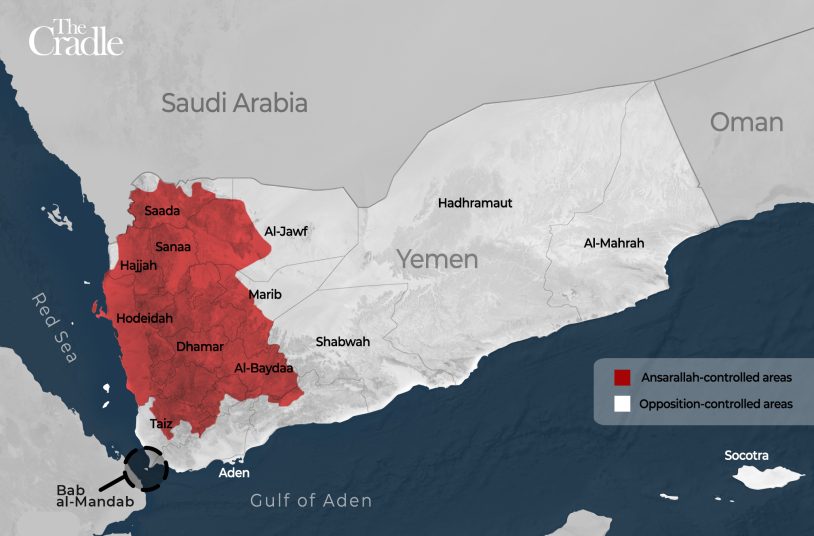
A map showing the distribution of control in Yemen
Where is Yemen heading?
These field movements are taking place as Washington and Abu Dhabi coordinate more closely with Tel Aviv. After meetings in October between the US CENTCOM commander and the Israeli chief of staff, a new plan began to take shape: build a joint ground network across southern Yemen to contain Sanaa and safeguard the Bab al-Mandab Strait – one of the world’s most critical shipping lanes.
At the same time, the US State Department appointed its ambassador to Aden’s Saudi-backed government, Steven Fagin, to lead a “Civil-Military Coordination Center” (CMCC) linked to ceasefire efforts in Gaza. Regional observers see this as a move to integrate the Palestinian and Yemeni fronts into one framework of US security control stretching from the Mediterranean to the Arabian Sea.
Reports circulating in Shabwa and Al-Rayyan say Emirati officers have been dispatched to Gaza to help organize local brigades – a claim still unconfirmed but consistent with the UAE’s wider operational pattern. Investigations by Sky News Arabia noted similarities in the slogans and structure of UAE-backed militias in Yemen and armed factions in Gaza, hinting at shared logistics and training links.
Adnan Bawazir, head of the Southern National Salvation Council in Hadhramaut, tells The Cradle that the scenario of recruiting mercenaries to fight in Gaza is not proven, but is possible – especially with the assignment of the interim administration in Gaza by Fagin, linking local moves to broader regional plans.
In Hadhramaut, Fagin’s visits to Seiyun, which includes the First Military Region, indicate preparations for a possible confrontation, especially since the area is still under the Saudi-backed Islah’s control in the face of the STC conflict, while Riyadh seeks to reduce Islah’s influence by transferring brigades and changing leadership.
Bawazir also points to suspicious movements in Shabwa and at Ataq airport, where field reports indicate flights transporting weapons to strengthen the front, given the governorate’s proximity to Marib and the contact fronts with Ansarallah, which makes it a hinge point for any regional or local escalation.
The moves are therefore part of three interrelated scenarios.
First, shifting pressure from Gaza to Yemen to compensate for the political and moral losses of Tel Aviv and Washington, while using the pro-coalition factions as a pressure arena against Sanaa. Second, preparing for possible military action in the event of the failure of the negotiations. Third, reorganizing the pro-coalition factions and building a central command that can be directed by Washington, thus turning the brigades into executive tools, ready to escalate the situation internally with a sectarian character.
Each scenario positions Yemen once again as a test field for foreign ambitions. The country remains divided between two trajectories: the possibility of a political settlement through Oman’s diplomacy, and the risk of a new conflict fed by regional competition and foreign control over its coasts and resources.
Whether the coming months bring a deal or another war will depend less on what Yemenis want and more on how their neighbors choose to use their soil.
The myth of US peacemaking: Why Washington’s mediation in West Asia keeps crumbling
By Peiman Salehi | The Cradle | November 3, 2025
The US has long styled itself as a guarantor of peace and stability in West Asia while systematically undermining both. From the Oslo Accords to the Abraham Accords, Washington’s so-called peace initiatives have masked coercion as consensus.
These efforts consistently reinforce the regional status quo, prioritizing Israeli security over Palestinian sovereignty, and maintaining western hegemony over regional autonomy.
The collapse of another US-backed Gaza ceasefire, violated within days by renewed Israeli aggression, exposes the structural flaws in this diplomatic model. Rather than arbitrating peace, Washington serves as an enabler of conflict.
Its diplomacy rests on selective morality and strategic interest, not universal principles. The American insistence on brokering ceasefires while actively resupplying Tel Aviv’s military machinery makes a mockery of its so-called neutrality.
‘No legal basis under international law’
The recent joint letter by Iran, China, and Russia to the UN Secretary-General rejecting Washington’s attempt to reactivate the expired “snapback” mechanism under Resolution 2231 further lays bare the fissures between western powers and global legitimacy.
The mechanism, part of the 2015 Joint Comprehensive Plan of Action (JCPOA) nuclear deal, formally expired on 18 October 2025. Yet, the US and its European partners are now attempting to revive sanctions via a legal instrument widely considered void.
Tehran’s rejection of the move, supported by Moscow and Beijing, signals a collective refusal to let Washington unilaterally interpret international law. Chinese Foreign Ministry spokesperson Lin Jian affirmed in August that “China reaffirms its commitment to the peaceful resolution of Iran’s nuclear issue and opposes the invocation of the UN Security Council’s ‘snapback’ mechanism.”
His words echoed a broader conviction across the Global South that legitimacy can no longer be dictated by Washington’s will. Fifteen years ago, Beijing and Moscow joined western powers in imposing sanctions on Iran; today, they stand beside Tehran in open defiance of that same framework.
The world’s center of gravity is shifting from a unipolar order managed by Washington to a multipolar one defined by resistance to its dominance.
Economic multipolarity and the end of American centrality
Nowhere is the erosion of US dominance more visible than in East and Southeast Asia. The Association of Southeast Asian Nations (ASEAN), once conceived as a Cold War neutral bloc, has evolved into a robust, self-sustaining economic engine. As reported by the Japan News in March 2024, ASEAN’s combined GDP now rivals that of Japan.
Following Washington’s 2017 withdrawal from the Trans-Pacific Partnership (TPP), the region coalesced around the China-led Regional Comprehensive Economic Partnership (RCEP). Even traditional US allies have joined. As Professor Amitav Acharya argues in ‘The End of American World Order,’ what is emerging is not anti-western, but post-western – a world in which regions increasingly manage their own affairs. Trump’s recent visit to East Asia highlighted Washington’s growing irrelevance in a region it once dominated.
Yet Washington continues to operate as though the post–Cold War era never ended. Its diplomats still speak the language of the “rules-based order,” even as its actions violate the very norms they claim to uphold.
The attempt to weaponize international law through the snapback mechanism mirrors its broader conduct in Gaza: mediation that enforces control rather than fosters compromise. When the US calls for restraint but resupplies Israel with weapons as civilian casualties rise, its moral authority collapses under its own contradictions.
As former US diplomat Chas Freeman once observed:
“Sadly, theories of coercion and plans to use military means to impose our will on other nations have for some time squeezed out serious consideration of diplomacy as an alternative to the use of force. Diplomacy is more than saying ‘nice doggie’ till you can find a rock … The weapons of diplomats are words and their power is their persuasiveness.”
This transition from persuasion to pressure has degraded Washington’s credibility. US diplomacy increasingly resembles an extension of Pentagon strategy – a negotiation backed by bombs, not by principle.
And this is not limited to Gaza or Iran. From Venezuela to North Korea, from Syria to China, Washington’s diplomatic strategy hinges on threats, sanctions, and military posturing. The soft power myth has dissolved under the weight of decades of failed interventions.
A cultural and philosophical disconnect
Western liberalism, historically presented as a universal framework for progress, falters in regions like West Asia, where faith and justice are intertwined. As even Francis Fukuyama – the American political scientist best known for declaring the “end of history” at the Cold War’s close – himself conceded, liberalism is not a universal fit. For Iran and much of West Asia, peace cannot be reduced to the absence of war or bought through economic incentives. It must arise from justice, dignity, and recognition.
This is the blind spot of every US-brokered deal: the failure to grasp that sovereignty and moral legitimacy cannot be negotiated away. The more Washington pressures regional actors into conformity, the more resistance solidifies into a collective identity.
Tehran’s approach reflects this new reality. Rather than reacting impulsively to western provocations, Iran has adopted a hybrid posture combining strategic deterrence with selective diplomacy. Its partnership with Moscow and Beijing is not an alliance of convenience but of conviction – a shared rejection of a system where power masquerades as principle.
In the wake of the failed snapback, Tehran has deepened energy and transport cooperation through the North–South Corridor while maintaining calibrated dialogue with regional states seeking stability beyond US patronage.
The existential failure of US diplomacy
Unlike in previous decades, Iran is no longer isolated. It now commands a regional network of partnerships that reflect mutual interests rather than asymmetric dependencies. From Iraq to Central Asia, Tehran’s outreach has become a model for post-western engagement.
Meanwhile, the Gaza ceasefire serves as a grim mirror of Washington’s diplomatic decay. Within 48 hours of its declaration, Israeli airstrikes resumed under the pretext of “pre-emptive defense,” and the White House responded with silence. For the Arab and Muslim world, this silence is deafening and an unmistakable confirmation that American mediation is designed to manage violence, not end it.
The myth of the western peacemaker has endured because it served both sides: it offered Washington moral legitimacy and offered local elites a pretext for inaction. But that myth is now collapsing under the weight of its contradictions.
A world divided between moral resistance and strategic cynicism cannot be reconciled through the language of “balance.” It demands a new moral vocabulary – one that acknowledges power but subordinates it to justice.
The failure of US mediation in West Asia is therefore not tactical but existential. It stems from a worldview that confuses control with order and influence with peace. Until Washington accepts that peace cannot be engineered through dominance, its diplomacy will remain what it has always been: an empire’s negotiation with its own illusions.
Palestine Genocide
By Richard Hugus | November 3, 2025
“To Zionists everywhere— you do not have a PR problem that can be solved with more branding campaigns and lies and propaganda. You have a forever problem, because you will never recover from this. Your depravity, unfathomable to normal humans, will be dismantled one way or another. Your fake identity will be exposed to all for the historic fraud that it is. You are the pariahs and parasites on this earth, and the world is finally waking up to this truth. Never has humanity witnessed such explicit and breathtaking evil.” — Susan Abulhawa
(See Susan Abulhawa’s December 2024 speech at Oxford Union here.)
Now past two years of explicit genocide in Gaza, the Zionist state seems intent on creating a new reality for the world – one in which there is no longer a moral order. As “the chosen people” Zionists feel entitled to do what has always been forbidden. For all the world to see, they kill women and children, bomb hospitals, bomb homes and neighborhoods, bomb the tents which people were then forced to live in, withhold food from people they have already starved, assassinate leaders, destroy sanitation infrastructure and water supplies, destroy farmland and olive trees, shoot fishermen, murder journalists, demolish homes with bulldozers, torture and execute prisoners, use people as human shields, snipe children, agree to ceasefires but continue bombing, and more.
October 7, 2023 was the Zionists’ excuse to do openly what they had been doing less openly for the previous 75 years – attempting to get rid of the Palestinian population and steal their land, and then the land of neighboring countries, starting with Lebanon and Syria. In a July 2024 speech to his craven representatives in the US Congress, Benjamin Netanyahu claimed to be defending civilization from barbarism, when in fact the Zionist state was and is busy returning civilization to barbarism. Aside from outright lies, Zionist propaganda is always marked by projection – accusing others of what it is doing, and inversion – turning the truth upside down.
One form of inversion is taking whatever is considered good and doing the opposite. Sabbatai Zevi, who declared himself the Jewish messiah in Smyrna in 1666, taught that doing things considered sinful actually led to redemption. Zevi was supposedly reincarnated fifty years after his death in the person of Jacob Frank in Poland, who went on to create the cult of Sabbatean Frankism. These men are considered apostates by the Jewish mainstream, but their insane messianism has strong reflections in the outlook of men like Benjamin Netanyahu, Itamar Ben Gvir, and Belazel Smotrich today, who have the backing of most of Israeli society. They believe that anything they do to the Palestinians, or “human animals” as former defense minister Yoav Gallant called them, is justified. There are no bounds, no rules, no limits.
One wonders where the Zionist project got the power to thumb its nose at a world horrified and outraged by its crimes. The resources backing up this project are immense and go far beyond the borders of the Zionist entity. “Israel” has always been, if not the centerpiece, at least an important part of the push for a “new world order.” The idea of the Novus Ordo Seclorum began in the late 18th century with Meyer Amschel Rothschild and his financial backing of both Adam Weishaupt’s Illuminati and Jacob Frank’s cult of transgression. Today it is backed by new controlling powers – central bankers, powerful families that own the banks, secret societies, oligarchs, hedge fund managers, intelligence agencies, the Pentagon, defense contractors, predatory philanthropists, subversive NGOs, subversive political fronts, the UN and World Health Organization, the World Economic Forum, bought national governments, and the agents who staff those governments, from President to bureaucrat. Zionist power controls banking, media, and government in the United States. It had the power to kill the Kennedys, carry out the 9-11 attacks, foment war against its enemies in Iraq, Syria, Lebanon, Yemen, Sudan, and Iran, and get away with all of it. It has the power to drop bombs which kill a hundred or more Palestinians a day, while telling the world Israelis were the victims.
It would be a mistake to believe this all comes from one small country. This is a global project, and degrading the human race through humiliation, watching Palestine being beaten mercilessly day after day, year after year, seems to be a part of it. Zionism is not only getting away with genocide, it is forcing everyone else to witness it, and each day that goes by without meaningful action to stop it, our humanity is diminished. What we might call the forefathers of Zionism – Sabbatai Zevi and Jacob Frank — aimed to gain control of the world through depravity, through deception, through appalling subversion of the moral order. The world will react to this, and soon, just when the forces behind this monstrosity think they have achieved success.
Seyed M. Marandi: Israel & Iran Prepare for War — ‘America First’ Says No to U.S. Intervention
Glenn Diesen | November 3, 2025
Seyed Mohammad Marandi is a professor at Tehran University and a former advisor to Iran’s Nuclear Negotiation Team. Prof. Marandi outlines how both Israel and Iran are preparing for the next war, and how the “America First” movement keeps distancing the US from Israel.
Follow Prof. Glenn Diesen: Substack: https://glenndiesen.substack.com/ X/Twitter: https://x.com/Glenn_Diesen Patreon: https://www.patreon.com/glenndiesen
Support the research: PayPal: https://www.paypal.com/paypalme/Diesen79 Buy me a Coffee: buymeacoffee.com/gdieseng Go Fund Me: https://gofund.me/09ea012f
Books by Prof. Glenn Diesen: https://www.amazon.com/stores/author/B09FPQ4MDL
How Many Americans Killed by Israel? [Answer Will SHOCK You]
If Americans Knew
CJ Werleman is a journalist, author, and political commentator who has been published in Byline Times, TRT World, Middle East Eye. In this video he provides information on the many Americans he says that Israel has killed. Below is additional information on each.
RELATED INFORMATION:
- A Costly Friendship
- Neo-Conservatives And The Israeli Lobby Are Promoting War With Iran, As They Did With Iraq
- WATCH: How Pro-Israel Neocons Pushed for War in Iraq (Alison Weir)
- Rachel Corrie
- Shireen Abu Akleh
- Israel was part of the conspiracy to kill JFK
- Author Martin Sandler says Mossad may have assassinated JFK
- Israel Honors Egyptian Spies 50 Years After Fiasco
- When Eisenhower and Nixon reined in Israel and defied the lobby
- If Americans Knew Receives Death Threat
- USS Liberty
- If Americans Knew videos
- Voters Against Billions to Israel – an online statement for Americans to sign stating that they will not vote for any politician who sends U.S. tax money to Israel.
Not A Ceasefire: The International Community Takes Over the Gaza Genocide
By Robert Inlakesh | The Palestine Chronicle | November 1, 2025
Israel is not actually implementing the ceasefire; instead, it is taking a break from some of the more taxing combat missions in Gaza and toning down its bombing, something that it has done at different periods during the genocide.
Calling what is currently taking place in the Gaza Strip a ceasefire is, by definition, incorrect. Israel has not ceased fire; instead, it has continued its military operations while reducing the intensity of the fighting. Meanwhile, the so-called “International Community” is working on a conspiracy to step forward and take command of the genocide.
Since the ceasefire was said to have gone into effect, the Israelis have violated every commitment they had pledged to adhere to. Despite this, we are still being informed through the corporate media that the war is allegedly over.
In order to draw conclusions about what is currently underway, it is important to first establish the facts, which can lead to a thorough analysis of what is transpiring on the ground.
Ceasefire Violations Expose Israel’s True Agendas
Before addressing violations, it is integral to any analysis of Gaza’s current predicament to make mention of the so-called “Civil-Military Coordination Center” (CMCC) established shortly after the October 8 agreement was inked.
The CMCC is supposed to be the committee that monitors and helps to enforce the ceasefire agreement. Although it was initially said that setting up the CMCC would take at least 17 days, within the first 5 days of the ceasefire agreement, it was up and running.
Instantly, 14 countries and over 20 non-governmental organizations joined the CMCC, with others joining in later. Although it may appear to be a project with a positive goal, it has been a complete and total failure through and through.
On October 19, the Israelis killed 44 Palestinians after their own forces ran over an unexploded ordinance, which they subsequently blamed on Hamas. The Associated Press (AP) reported that day that Israel had not violated the ceasefire, but had posed a “test” to it.
To give the CMCC the benefit of the doubt, one could plausibly argue that behind closed doors, its member countries and NGOs may have exerted pressure on the Israelis following this event.
However, on October 28, the Israelis decided to mass murder 104 Palestinians in Gaza, around half of whom were women and children. For all intents and purposes, this day was a return to the scale of destruction that was present throughout the genocide.
In this instance, did any nation or NGO withdraw from the CMCC in protest? Was there a coordinated effort to impose consequences on the Israelis for their actions?
If one sought to give the benefit of the doubt even in this scenario, arguing perhaps that the CMCC may be playing the role of simply ensuring the ceasefire doesn’t totally collapse, this still makes no sense. This is because part of the ceasefire is the issues of reconstruction, aid entry, Israeli withdrawal, the cessation of military operations, and stopping the killing.
On every issue concerning the Palestinian civilian population, the CMCC has not only failed, but the committee itself has watched on and is fully aware of what is occurring on the ground. In addition to this, the CMCC multi-national hub is based in southern Israel and is therefore not on neutral grounds; it is there with Israeli permission and, no doubt, a level of supervision.
When it comes to the entrance of humanitarian aid into Gaza, an average of around 90 trucks were permitted entry by the Israelis in the first few weeks of the ceasefire. According to the agreement, Israel had pledged to allow for 400 trucks to enter per day for the first five days, agreeing to unlimited amounts of aid flowing through after this.
The minimum required to meet Gaza’s needs is 600 trucks per day. On this issue, there is no other conclusion that can be drawn other than to accuse the CMCC of complicity or that it is a failure. If it is a failure, then the natural follow-up question becomes: Why is the committee growing, and there are no solid measures being taken to hold Israel to account? Or, at the very least, why is nobody resigning from the role in protest?
Next, we have the issue of reconstruction. According to Jared Kushner and Steve Witkoff, they are backing a scheme whereby reconstruction will not take place in areas where Hamas is still based. In other words, they will implement an Israeli proposed scheme, as initially reported upon in Axios News, to use reconstruction funds to build only behind what is known as the ‘Yellow Line’.
The Yellow Line is the zone demarcating the areas controlled by Hamas and Israel. The Israelis were supposed to withdraw to this line and remain only in 53% of Gaza. Instead, they quickly violated this portion of the agreement and are operating hundreds of meters beyond this point, as verified by satellite imagery. Israel is in reality occupying up to 58% of the territory.
Inside the territory the Israelis occupy directly, they are continuing their daily demolition operations against the remaining Palestinian civilian infrastructure there. This is a flagrant violation of the ceasefire, which is evident through Israeli soldiers posting videos of themselves destroying homes on social media. Again, where is the CMCC in all of this, let alone on the question of the daily killing of civilians and bombings?
Under Donald Trump’s 20-point plan, he seeks disarmament of the Palestinian factions. If you look at the rest of the nations involved in the so-called monitoring and enforcement effort, they all voted in favor of the New York Declaration’s proposal for a Two-State model and ceasefire. The UN General Assembly vote reflected an agreement on disarming and drowning out non-State actors.
So why then are the CMCC nations not sounding the alarm over Israel’s continued military backing for four separate ISIS-linked militia groups operating behind the Yellow Line? These forces cannot take over Gaza and are hated amongst the entire population, who were not only subjected to their indiscriminate violence, in addition to the looting of their homes, businesses, and hospitals.
These militias actively receive orders from the Israeli Shin Bet and army; they are also responsible for looting the majority of the aid trucks heading into Gaza since May of 2024, under Israeli protection and monitoring.
Nothing is being said about how to combat these gangs, composed of Salafist militants who are affiliated with ISIS and Al-Qaeda, along with bans on convicted murderers and drug dealers. On the part of Western media, the Wall Street Journal and Washington Post have even published op-eds, purported to have been written by the ISIS-linked militia members themselves.
Yet, when it comes to holding Hamas to account and achieving the portions of the agreement that benefit Israel, the CMCC is ready to play ball and take action. As a measure to ensure the ceasefire is being enforced, Egypt sent teams of specialists into Gaza to help search under the rubble for the bodies of dead Israeli captives. The US has also sent hundreds of troops as “advisors” and deployed reconnaissance drones over Gaza.
All of this alone demonstrates that only the Israeli side is being prioritized, while Palestinians are not only killed on a daily basis by direct fire, but through deprivation of essential medicine and goods, in addition to the refusal to allow the sick and injured to leave for treatment.
The ‘Ceasefire’ Agenda is Now Becoming Clear
What is currently happening is that Israel is being allowed to take a glorified pause from its full-scale military operations that it had previously committed itself to in Gaza. In an interview for Israel’s Hebrew-language Channel 14 News, the plot is discussed by Reserve Brigadier General Amir Avivi.
Avivi argues that behind what is labeled a “temporary calm”, there are many complex political and security moves being taken by both the Israeli and US governments. “Trump and Netanyahu are working simultaneously on the international force, in which there will be no Qataris or Turks, and also on regional peace agreements. Because everything is intertwined in this, everything is slower. It is being done step by step”, he stated.
Some of these schemes may be kept private from the public eye, yet enough of them have been exposed piece by piece, enabling us to be able to put together an educated analysis of what is really going on.
For example, the International Security Force (ISF), which the Trump administration has been advocating for, was exposed by Vice President JD Vance himself when he explicitly stated that they would be tasked with disarming Hamas.
The ISF plan is still incredibly vague in terms of how it would be actually implemented, yet it should be noted that projects like the failed American floating aid pier and the PMC-led Gaza Humanitarian Foundations (GHF) were rolled out without thorough planning, resulting in mass death and destruction.
What we do know about the ISF is that everything it does will have to receive approvals from the Israeli military and operate within its framework. So immediately, it is a pro-Israel force that is not impartial, and we know from what’s been reported upon that the US and Israel are adamant that the ISF will not act as a Gaza version of UNIFIL in southern Lebanon.
Israel is also clear that no Qatari or Turkish forces will be deployed as part of this ISF. A number of unnamed Arab nations have reportedly withdrawn their pledges to commit forces to the ISF, also reportedly leading to the US approaching more East Asian nations to replace them. The main concern is the lack of clear direction for the force, the precarious security situation, and that these soldiers will likely be forced to fight Hamas.
The ISF, in other words, is an international regime change force that is planned to be an invading army, tasked with carrying out Israel’s dirty work. Interestingly, however, the likes of Israeli Reserve Brigadier General Avivi believe that the scheme will not work and that instead the Israelis will be forced to return to attacking Hamas.
Avivi himself mentions that the pause is being used by the Israeli army to repair its tanks and that “the Chief of Staff has long asked the government for time to work on the tanks, on the tools. After two years of fighting, the tools are worn out. They want to refresh the forces, consolidate the defense line.”
With or without the ISF regime change force, the Israelis are still working on a range of different plans for the Gaza Strip. As mentioned above, Israel’s military operations behind the Yellow Line have not stopped, and this territory is being reinforced with security equipment and cement blocks to demarcate the zones.
What Tel Aviv is seeking is to create two separate Gazas. One, which will be under the de facto rule of Hamas and the Palestinian resistance, and the other, which is under Israeli occupation and also the ISIS-linked militias it uses as proxies. So far, the United Arab Emirates (UAE) is the only known outside entity to have thrown its weight behind these ISIS-linked gangs; however, they were used to coordinate with the GHF mercenaries.
Jared Kushner and Steve Witkoff appear to have given Israel’s Two-Gazas Solution the green light, making it clear that no reconstruction will happen except in the territory controlled by Israel and its ISIS-linked proxies.
The only problem that the Israelis face with this strategy is that all of Gaza’s civilian population are along the coast in the areas controlled by the Palestinian resistance, and they will not move willingly. The only civilians living in the Israeli-controlled territory are some family members of the aid looting militia collaborators.
Therefore, the Israeli military is proposing a range of solutions to cleanse the population and force them into this “new Gaza” zone. One of those proposals involves aid distribution, in particular the Gaza Humanitarian Foundation, which was the privatized machine implicated in the mass murder of over 1,000 civilians, who were lured to the distribution sites and picked off by snipers for sport.
Israel’s idea is to continue restricting the aid from entering areas where Gaza’s civilian population lives. They may eventually shut off all aid, or slowly reduce it if their strategy begins working. On the other side of the Yellow Line will be aid distribution points run by the GHF, which the people will be forced to go to in order to simply survive. This project has not been fully mapped out as of now, but all the reports point to this being the case.
Another part of this displacement project, which has been openly discussed in the media, as mentioned above, is that Palestinians will be offered to live in areas where some reconstruction is happening, sites that will be concentration camps.
The alternatives will be for the civilian population of Gaza to stay in the areas controlled by Hamas and to starve, or continue living in tents with less than the bare necessities.
If we look back at different phases of the genocide, this plan mirrors aspects of a number of similar schemes, all of which failed. For example, the GHF was supposed to result in a herding of the civilian population into a gated concentration camp facility that was being constructed in Rafah, over which the ISIS-linked gangs would be its de facto rulers.
There was also the infamous “General’s Plan”, drafted by former Israeli General Giora Eiland. This scheme was the goal that the Israeli military set out to complete in late 2024 and up until the January 2025 ceasefire agreement, which they later broke. To summarise it, they sought to ethnically cleanse the entire civilian population from the north of Gaza, in an attempt to isolate Hamas inside the area and surround it.
Threats were made in late 2024 to some 400,000 civilians that if they did not flee, they would all be considered combatants and were going to be targeted as such. It failed and militarily made no sense either, yet this was openly the plan at the time.
If we look at the evidence, the Israelis are now using this period of time in order to regroup, perhaps also to re-direct military attention to Lebanon also, while also seeking to find solutions to eliminate the civilian population. As they understand that ethnic cleansing will not be allowed in the form of a stampede into Egypt, the strategy is to ultimately create a situation under which the population will languish and slowly be forced to flee.
The Implications
What has happened is that the Israelis are being granted international supervision under the guise of a ceasefire. They are retrieving all their captives, dead and alive, which will take political pressure off of them, while they receive a break and praise from leaderships around the world for “ending the war”.
However, the war isn’t over, and this is something that Israeli Prime Minister Benjamin Netanyahu explicitly stated in a public address, in Hebrew, at the start of the ceasefire agreement. The difference now is that the governments of dozens of Arab, Muslim Majority, and Western nations are directly implicated in the ongoing genocide against the people of Gaza.
As I wrote for the Palestine Chronicle, at the beginning of the ceasefire, Phase two of the agreement will not fully go into effect, as there are fundamental disagreements between the Israelis and Palestinian resistance on the question of disarmament and Palestinian self-determination. Instead, it is more likely that we will remain in limbo at a prolonged Phase Once pause, the length of which is impossible to accurately determine.
Israel is not actually implementing the ceasefire; instead, it is taking a break from some of the more taxing combat missions in Gaza and toning down its bombing, something that it has done at different periods during the genocide when there was no ceasefire in place. Its demolition operations were always the bulk of the Israeli military operations during the war, because their goal has never been to destroy Hamas; it has been about destroying Gaza and its people, hence it is called a genocide.
The genocide really has little to do with Hamas as a group. Because even if Hamas were to be defeated, another resistance force would pop up to replace it, and the cycle would start once again. The Israelis are genocidal lunatics, but they aren’t stupid; they know full well that their national project’s success necessitates the total elimination of not only the Palestinian people, but also their mere national identity.
A multi-national coalition is now directly aiding in that project to eradicate the Palestinian identity and its cause for national liberation. This was also what the Saudi-French “New York Declaration” that was voted upon at the United Nations was all about, which I have written about here too, as is the Trump-Netanyahu so-called “peace plan”.
If these nations that are endorsing and are directly involved in the implementation of the Trump plan were truly genuine about seeking a “Two-State solution”, as their votes cast at the United Nations General Assembly this September suggested, then why go along with this project that has stated its opposition to “Two-States” from the outset?
It’s very simple, it is because they want the Palestinian cause gone. This is what the New York Declaration was. This is what the Saudi-French initiative outlined. It wasn’t a proposal for a State of Palestine. Why? Because they explicitly asserted that the “State” they seek must be the only completely disarmed nation on earth, it should also not have control over its own textbooks and is not allowed to have its own independent political parties; all of them must be banned, and only the Western-approved and funded corrupt politicians they choose are allowed into office.
This was the “State” they proposed. It provided no solid answers or conclusions on the “final status issues”, certainly nothing to offer to the Palestinian diaspora, no reparations paid by Israel, and no consequences for Israel, other than it would have to give up its pledge to parts of Gaza and the West Bank. Now look at what these nations have signed up for: Trump’s plan that doesn’t even offer this, that seeks to offer less than his 2020 “Deal of the Century” that is pretty close in its details to this Saudi-French proposal.
So what now, you may ask? Well, the Palestinian Authority (PA) has set forth Israeli stooge Hussein al-Sheikh to be its next unelected quasi-dictator and is attempting to leech whatever it can off of the Trump plan, sucking up to Saudi Arabia and every Arab regime it can for more scraps so that it can run its corrupt administration whose only function is to serve Israeli security coordination.
Unfortunately, this PA has swallowed the Palestine Liberation Organization (PLO), hollowing out what was once an influential organization that now occupies the role of the State of Palestine at the UN. The PA represents nobody but its employees, and despite the best attempts of all the Palestinian political parties, including factions within the ruling Fatah Party itself, they continue to insist upon division. So, on the political front, until this US-EU-funded entity dies, there is little chance of unity, meaning a comprehensive political solution is, for now, off the cards.
On the Israeli side, they are scheming to try and ethnically cleanse Gaza, and as has been mentioned are not implementing the ceasefire; they even gave Hamas an impossible-to-fulfill ultimatum regarding withdrawing fighters hiding in tunnels from behind the Yellow Line. It was proven that Hamas cannot communicate with most of them, many of whom don’t even know there is a ceasefire. So this is just one of many excuses for Israel to ramp up its death and destruction.
When the Israeli-US scheme for Gaza eventually fails, after inflicting all the suffering that it will on the civilian population, they will then have to go to Plan B, restarting the full-scale genocide once again.
The picture now really depends upon what happens on the other fronts of this ongoing regional war and whether the likes of Hezbollah and Iran can dramatically change the picture. As for the Arab masses, there is always some possibility they could rise, but after two years of genocide and them living their lives as if nothing is happening, not a whole lot should be expected from them.
As I have written to conclude most of my analysis pieces over the past two years, this war is regional and will be fought until one side is decisively defeated. Therefore, either the Israelis succeed at exterminating a segment of the Palestinian population, ethnically cleansing the others, and placing the rest in concentration camps, or Israel is crushed. There are no other options.
Unless the Israelis are strategically defeated, the US, European, Arab and Muslim Majority nations collaborating with it, will back it in its Greater Israel Project until the end. These governments are now more involved than they were before and play their role with the taxes paid to them by their own people, selling their populations the lie that they are working towards peace.
Why Lebanon doesn’t trust Israeli-American intentions — and why it shouldn’t
By Hussein Mousavi | Press TV | November 1, 2025
As Lebanon’s government, led by Prime Minister Nawaf Salam, inches closer to implementing its multi-phase plan to disarm Hezbollah, one question continues to divide the country:
What if Hezbollah lays down its arms… and the Israeli regime still doesn’t change its behavior?
The plan – drafted under the supervision of the Lebanese Armed Forces (LAF) and backed by the US, France, and several Arab states, including Saudi Arabia, Qatar, and the UAE – seeks to reassert the state’s monopoly on the use of force.
On paper, it sounds like a long-delayed step toward full “sovereignty.” That’s how the Lebanese premier and his allies – both inside and outside the country – try to present the issue.
Yet for many ordinary Lebanese, the proposal feels less like progress and more like exposure. And so, it raises a deeper fear.
Disarming the Hezbollah resistance movement, they fear, could strip Lebanon of its last line of deterrence, without changing anything about Israeli long-standing hostility.
Syrian precedent: Disarmament without security
Elsewhere in the region, Syria’s experience stands as a grim reminder. Even after the Jolani regime made public gestures toward normalization with the Israeli regime, the airstrikes on Syrian territory have never stopped. They continued unabated.
These attacks – justified by Israel as “preemptive” measures against so-called Iranian entrenchment (despite any evidence suggesting the same) have convinced many in Lebanon that military restraint does not necessarily guarantee security.
To many Lebanese, that says it all: even a weakened and cooperative neighbor hasn’t been spared unprovoked Israeli assault.
So, for the majority of Lebanese, the question resonates: If a disarmed, diplomatically compliant Syria was still bombed, why would a disarmed Lebanon be treated any differently?
That logic has sunk deep… even among communities once skeptical of the resistance. This isn’t about ideology anymore. It’s about survival, sovereignty and dignity.
People genuinely fear that weakness, not resistance, invites aggression.
Social undercurrents: A shift in perception
Hezbollah’s argument for keeping its weapons has always been rooted in resistance to Israeli military occupation and the defense of Lebanese sovereignty and territorial integrity.
For years, that claim was losing traction—chipped away by the US, Israeli regime (Hasbara), and Persian Gulf-funded campaigns that painted the resistance movement as a destabilizing force.
But the chaos next door changed the mood.
The violence in Syria, especially the relentless massacres committed by Al-Qaeda-linked groups in Suweida, jolted many Lebanese back to a hard truth: in a region defined by uncertainty and terrorism, some form of deterrence is still necessary.
Even among Christians and Druze, there’s a quiet shift. What was once a divisive argument is slowly becoming a reluctant consensus:
“Lebanon without a deterrent is Lebanon exposed. And now, no one in Beirut really believes the skies will stay quiet after disarmament. Not anymore.”
Washington’s back-out: The missing guarantees
Lebanese skepticism was further reinforced by Washington itself. If anyone still hoped for international reassurance, Washington’s recent message was clear.
During his visit to Beirut, US envoy Tom Barrack openly admitted that Washington could not provide any binding guarantees that the Israeli occupation forces would refrain from future military action, even if Hezbollah were to be fully disarmed.
It was a rare moment of honesty, and a devastating one. For many Lebanese, it confirmed what Hezbollah has been saying for years: Without credible security guarantees, disarmament amounts to a strategic suicide.
Barrack’s inflammatory statement spread quickly across social media platforms and prime-time talk shows. It fueled the perception that Western powers are happy to demand disarmament but will not lift a finger to protect Lebanon afterward.
So, for now, Hezbollah’s deterrent remains the only shield people trust in a region where promises evaporate, and treaties rarely hold.
A state caught between principle and survival
That leaves the Lebanese government trapped in a painful paradox and facing an impossible balance.
Internationally, disarmament is pitched as a prerequisite for reconstruction after the 2024 Israeli aggression. Domestically, it looks more like a setup, an attempt to squeeze out concessions that Washington and Tel Aviv couldn’t win through war.
PM Salam insists the Lebanese Army can fill the security gap once Hezbollah disarms. But everyone knows the LAF is overstretched, underfunded, and struggling to retain personnel amid an economic meltdown.
Even LAF Commander “Rodolph Haykal” has quietly admitted the limits.
And with UNIFIL’s mandate due to expire in 2026, the southern buffer zone that once helped keep the peace is fading fast.
Given these realities, Hezbollah’s arsenal (long portrayed by Israeli, American, and certain Arab media as “the problem”) is tied to something deeper: the complete absence of trust in Israel’s intentions, and the lack of any reliable security guarantees from its allies.
Trust, deterrence, and the price of “peace”
Trust can’t be declared in a press release. It’s earned through behavior, consistency, and respect. For Lebanon, disarmament cannot be separated from reciprocity.
Unless the Israeli regime demonstrates, through verifiable actions, that it will respect Lebanese sovereignty – and unless those commitments are backed by enforceable international guarantees – any talk of disarmament will remain politically impossible and socially toxic.
A peace built on parity
Lebanon’s real dilemma isn’t whether disarmament is good in theory. It’s whether peace can exist without parity, and whether Western powers are willing to enforce that parity with real guarantees, not vague assurances.
Until that happens, every call for disarmament will collide with the realities of regional mistrust… and also with the same hard truth: You can’t convince its citizens to give up their shield when the sky above them still burns.
And that’s why, for many in Lebanon today, neither the government nor the resistance has any reason to trust the Israeli regime.
Hussein Mousavi is a Lebanese journalist and commentator
What is the Israeli strategy in Gaza?
By Robert Inlakesh | Al-Mayadeen | October 28, 2025
In order to understand the Israeli-US agenda underlying the so-called “peace plan” set forth by US President Donald Trump, it is important to examine the objectives of the Zionist regime and then assess how these aims might be realized. Such an analysis helps reveal what the future may hold and whether the fragile ceasefire is likely to endure.
On October 19, the Gaza ceasefire appeared to have collapsed after the Zionist regime launched over 100 airstrikes, dropping at least 153 tonnes of explosives across the besieged coastal enclave, and killing around 44 civilians. Even Israeli media outlets reported that the ceasefire had broken down and that the war had re-started, before the situation calmed down by the next day.
Initially, the Israeli establishment claimed that two of its soldiers had been killed by Palestinian fighters in an ambush involving RPGs and automatic weapons, asserting that its subsequent attacks were merely a response to this incident—one that Hamas categorically denied any involvement in.
Yet, it wasn’t long until American, Palestinian and even Israeli reporters began to reveal the truth. In reality, while Israeli soldiers, alongside settlers contracted for demolition work, were violating the ceasefire by destroying Palestinian infrastructure, they accidentally drove over an unexploded ordnance. The consistency of reports from multiple sources lent credibility to this account, yet the Zionist military quickly imposed a publication ban on the incident, before later partially admitting to what had truly occurred.
This meant that the Israelis had, in essence, killed their own soldiers by violating the ceasefire and sending their forces to destroy infrastructure within what was effectively an active minefield, then blaming the Palestinians as a pretext to kill more civilians. Up until that point, the Israelis had already committed at least 80 ceasefire violations and killed more than 100 innocent people.
From day one of the ceasefire, the Israelis had also adopted a strategy of outsourcing the Gaza front’s combat operations to three ISIS-linked proxy militias – each stationed in different areas behind the Israeli imposed ‘Yellow Line’ – instead of engaging Hamas directly. The Zionist regime began pursuing a policy of using these proxy forces to carry out assassinations and ambushes against prominent figures and members of Gaza’s security apparatus.
The Israeli strategy, backed by the United States – according to anonymous sources who spoke to Axios – is to begin using reconstruction funds, to build structures behind the Yellow Line, which represents around 54-58% of Gaza’s territory where the occupation refuses to withdraw and works alongside its proxies to control the enclave. At the same time, the Israelis sought to strangle the civilian population living in areas under the Hamas-led civil authority, while offering them the alternative of living under the joint Israeli-collaborator occupation.
This strategy has already begun to crumble, as many of the families which the Zionist Entity sought to co-opt have sided with the resistance and rejected the collaborators in the midst. Meanwhile, the Palestinian Resistance continues to pursue these collaborator death squads and prosecutes them for their various crimes, including acts like murder and aid theft.
Like other similar strategies proposed by the Israeli regime and greenlit by their subservient American backers, this one is likely to fail under pressure and does not make logical sense given the realities on the ground and the fact that the Zionist proxies have no popular support.
So, then, what do the US-Israeli alliance have in store? It is quite simple, they are seeking to achieve some of their goals under the guise of a ceasefire, which they only partially respect by allowing in limited aid supplies and killing less people than they did prior to the so-called “peace deal”.
Similarly, in Southern Lebanon, the Israelis hatched a scheme after the ceasefire was imposed to seize control of more territory than they managed to capture during the war, all while committing daily ceasefire violations. carefully calibrated to stop short of triggering a return to an all-out war.
If they fail to achieve their aims through limited military measures and aggressive maneuvers dressed up as diplomacy, they will resort to full-scale force, because “peace” is not an option.
In order to understand this line of thinking, you first must conclude that the Israelis have pursued their policies up until this point as a means of collapsing the regional resistance against them, eliminating each and every threat posed to their rule.
To the Zionist regime, there is a perceived imperative to produce an “answer to the Gaza question”, a formulation that, in their view, amounts to the elimination of the people of Gaza: an ethnic cleansing campaign and genocide accompanied by the destruction of the entire territory’s infrastructure. This is not only the objective of the Israeli leadership, but a project implicating Israeli society as a whole, a national project of elimination.
October 7, 2023, represented a major blow to the Zionist project, one that collapsed the illusion of its military superiority and shook its ideology to the core. So, it has since pursued a project to teach its adversaries a lesson and to destroy the ability of regional actors to resist them. Gaza is a statement, rise up against us, and we will pulverize you.
To a certain extent, this strategy has so far succeeded to deter any Arab population from rising up. Immediately after October 7, the Jordanians and Egyptians, for example, had started to join mass demonstrations, attempted to breach the border, and clashed with regime forces. Yet the daily scenes of devastation in Gaza, along with the propaganda pushed by the Arab Regimes, crushed their pride, determination, and willingness to continue resisting, at least for now.
The regional resistance, however, remained undeterred, which is why the US-Israeli alliance now seeks to destroy it, or at least to weaken it so severely that it no longer poses a significant threat.
If the Israelis experience another October 7-style military defeat that includes the penetration of its defensive lines, this will represent a decisive, even mortal, blow to the project, and the Zionist regime is well aware of that.
What occurred on October 7 irrevocably transformed the regime and set in motion a series of irreversible changes. Senior Zionist leaders now view current events in stark binary terms: either the re-birth of “Israel” or its gradual demise. If the former is achieved, the regime would secure de-facto control over the region and bury its security issues; if it fails to eliminate Gaza, to break the Lebanese resistance, and to sufficiently weaken Iran, it will be one step away from a crushing defeat.
In the Zionist regime’s thinking, now is a historic opportunity to exterminate all those who resist it, eliminate Gaza entirely, and impose uncontested dominance over the region. Although it has so far failed to achieve these goals, it perceives any inability to secure a “total defeat” as an existential threat to its own survival. Therefore, if “Israel” does not accomplish during the ceasefire what it set out to do, it is likely to pursue those objectives through renewed military action, with Lebanon and Iran expected to become the principal fronts in the future.
Saudi Arabia’s path to normalization with Israel threatens a regional rupture
By Fouad Ibrahim | The Cradle | October 24, 2025
On 17 October, US President Donald Trump told Fox News, “I hope to see Saudi Arabia go in, and I hope to see others go in. I think when Saudi Arabia goes in, everybody goes in.” The statement was calculated to reignite Washington’s normalization push and reassert Riyadh’s place at the heart of the US-Israeli regional alliance plan.
Trump is determined to complete the regional realignment he initiated in 2020 with the signing of the Abraham Accords. Including Saudi Arabia would crown his foreign policy legacy and fundamentally alter the Arab political order. But the costs may be steeper than the gains.
The 2023 near-deal that faltered
In the months preceding Israel’s genocidal war on Gaza, US-mediated talks between Riyadh and Tel Aviv were approaching a breakthrough. The kingdom sought US security guarantees, access to advanced weapons systems, and backing for its civilian nuclear ambitions. The Israeli side, eager for regional legitimacy, saw in Riyadh a historic opportunity.
But Operation Al-Aqsa Flood on 7 October 2023, and Tel Aviv’s ensuing carpet-bombing of Gaza, derailed the entire process. Saudi officials were forced to retreat in the face of overwhelming public outrage across the Muslim world.
Trump’s renewed confidence, however, suggests the framework forged before the war was never truly discarded. It has merely been shelved, pending a more favorable political climate.
Saudi Arabia is not just another Arab state. Its symbolic weight derives from a rare trifecta: custodianship of Islam’s two holiest sites, vast oil wealth and economic clout, and considerable political leadership of the Arab and Islamic mainstream.
If the kingdom normalizes ties with Tel Aviv, a domino effect across Arab and Muslim nations could follow. For Israel, this would be the ultimate regional prize. For Washington, it would cement an American-led bloc from the Mediterranean to the Persian Gulf, aimed squarely at containing both Iran and China.
What could drive normalization forward?
Despite the political fallout from Gaza, several factors continue to draw Riyadh toward normalization. Both Saudi Arabia and Israel view Iran and the Axis of Resistance as their primary regional adversaries.
This strategic alignment has not been fully undone by the 2023 China-brokered thaw between Tehran and Riyadh. Meanwhile, Saudi Arabia’s Vision 2030 plan to diversify its economy sees potential in Israeli sectors like defense technology and cybersecurity.
Trump’s preference for transactional diplomacy means a grand bargain offering defense pacts, nuclear cooperation, or substantial investment flows could appeal to Saudi ambitions. And within the kingdom, a younger, globally attuned population may be less ideologically opposed to normalization – if it is presented as part of a broader modernization drive.
However, polls conducted by the Washington Institute before and after 7 October 2023 show a different inclination. Surveys in December indicated that a majority of Saudis oppose normalizing ties with Israel.
Strategic and moral hazards
Normalization is not without peril. On the contrary, its very success could destabilize the region.
Any Saudi–Israeli deal that sidelines Palestinian rights would be seen as a betrayal of the kingdom’s religious mandate and leadership role. The devastation in Gaza has reignited pan-Islamic solidarity, and any Saudi alignment with Tel Aviv while Palestinians endure siege and bombardment could shatter the kingdom’s legitimacy in the wider Muslim world.
The Axis of Resistance – particularly Iran, Hezbollah, and Ansarallah – would seize on the normalization to portray it as an alliance of apostates and occupiers, fueling more intense and frequent confrontations. By committing to a volatile US-Israeli partnership, Riyadh risks entanglement in wider conflicts, undermining its strategic autonomy and exposing itself to blowback it cannot control.
The security dimension: A trilateral axis
If normalization ushers in a US–Israel–Saudi security architecture, the implications for West Asia would be profound. Tel Aviv would contribute intelligence and military prowess, Washington would provide oversight and guarantees, and Riyadh would bankroll the venture.
But this alliance would be read in Tehran as yet another encirclement strategy, prompting the Islamic Republic to accelerate its missile and nuclear capabilities. The region could slide into an arms race that undermines development, drains budgets, and magnifies the risks of miscalculation.
Moreover, such a pivot could unravel Saudi Arabia’s recent diplomatic gains – including its rapprochement with Iran, Iraq, and Oman-mediated talks with the Sanaa government in Yemen – and alienate its Eurasian partners like China and Russia. The net result could be diminished regional influence and increased dependence on the west.
Domestically, too, the kingdom would face challenges. Clerical critics and nationalist voices could depict normalization as ideological surrender. The government would find itself more reliant on US and Israeli backing to suppress dissent, exacerbating its internal vulnerabilities.
In this sense, the very security guarantees sought through the trilateral axis could paradoxically generate new forms of insecurity – both internal and regional – making the kingdom’s stability increasingly contingent on external actors and volatile power dynamics.
Economic integration
Economic incentives are central to the normalization pitch. Saudi–Israeli integration could unlock massive investment flows and tech partnerships in fields ranging from Artificial Intelligence (AI) to renewables.
Yet this alignment risks reinforcing structural dependencies. Israeli firms, backed by western capital and technological superiority, would dominate the value chains. The Saudi economy could shift from oil dependency to digital subordination.
Further, such a move could sour ties with China, currently Riyadh’s largest trading partner. Over-alignment with the US–Israel axis might jeopardize the kingdom’s multi-vector strategy and reduce its diplomatic room to maneuver.
Even the promise of modernization may ring hollow if perceived as elite enrichment at public expense. The economic corridor could become a tool of inequality, modernizing infrastructure while leaving social contracts untouched.
Economic integration can bring regional prosperity if fair and balanced, but without safeguards, it risks reinforcing dependency and fueling conflicts.
Surveillance state: Normalization’s dark underbelly
One of the least discussed aspects of normalization is cyber collaboration. Israel’s role as a global surveillance hub and Saudi Arabia’s deep pockets could converge to create a formidable digital control grid.
Such a system – integrating spyware, predictive policing, and AI surveillance – would strengthen the US-led intelligence grid across West Asia, enhancing early-warning systems, missile defense coordination, and digital containment of the Axis of Resistance.
It could also extend the reach of western intelligence into theaters such as Yemen, Iraq, Lebanon, and the Red Sea. In practical terms, the alliance could evolve into a regional integrated military and intelligence system encompassing command, control, communications, computers, intelligence, surveillance, and reconnaissance – underpinned by joint data centers, AI-driven threat analysis, and shared satellite networks.
However, this integration would carry profound ethical and political implications. The same tools designed to deter external threats could easily be repurposed for internal control. By combining Israeli-developed spyware, predictive policing algorithms, and US-supplied surveillance hardware, the Saudi government would vastly expand its capacity to monitor dissent, pre-empt protests, and neutralize political opposition.
The normalization process could thus serve as a legitimizing cover for what might become the most sophisticated surveillance apparatus in the Arab world.
Regionally, a Saudi–Israeli cyber partnership would alarm neighboring states, particularly Iran and Qatar, which would perceive it as a threat to their own sovereignty and national security. The likely response would be the acceleration of rival cyber alliances, possibly involving Russia, China, or Turkiye – ushering in a new digital Cold War in the Persian Gulf.
In the long term, the fusion of surveillance technology and political authority poses a deeper civilizational question: Can the Arab world’s quest for security coexist with the preservation of freedom and privacy? If the digital frontier becomes another instrument of domination, the promised “technological peace” may end up securing governments, not peoples – turning the dream of innovation into the architecture of control.
Riyadh’s choices: Three possible trajectories
The Saudi leadership now faces three broad options. First, conditional normalization, where recognition of Israel is tied to measurable progress on Palestinian statehood and sovereignty. Given Tel Aviv’s accelerated settlement expansion in the occupied West Bank, this appears increasingly unrealistic.
Second, incremental engagement (soft normalization), involving quiet cooperation below the threshold of formal recognition that gradually lays the groundwork for future deals.
Third, strategic hedging, in which Riyadh continues to balance between US pressure and regional diplomacy, keeping normalization in reserve as a bargaining chip.
Between realpolitik and regional rupture
Trump’s statement has reignited the debate over the kingdom’s path forward. The immediate gains of normalization – security assurances, economic incentives, and prestige – are tempting. But the long-term consequences could be corrosive.
To join the Abraham Accords while Gaza remains in rubble will irreparably damage Saudi Arabia’s credibility as a leader of the Islamic world. It could sever the kingdom from the Arab street, provoke resistance retaliation, and entrench a neocolonial security order.
Unless normalization is tied to justice for Palestine, it will be remembered not as peace, but as betrayal.
US as Israel’s indispensable partner and accomplice in Gaza genocide
By Elham Abedini | Press TV | October 24, 2025
In the aftermath of the Israeli carpet bombing of Gaza that began on October 7, 2023, mass demonstrations across the United States shattered any remaining illusions about Washington’s ironclad relationship with Israel.
Protesters openly condemned US economic and military assistance to the Israeli regime, the extensive trade between the two, and Washington’s all-encompassing and unconditional political support for Tel Aviv.
This is an issue the Leader of the Islamic Revolution Ayatollah Seyyed Ali Khamenei has repeatedly highlighted in recent years.
In his most recent speech, he reminded the world that “without a doubt, the United States is the principal partner in the Gaza war.”
He has previously referred to the US and the Zionist regime as a “criminal gang,” describing Washington as a definitive accomplice to Israel’s genocidal crimes.
This statement reflects a broader historical pattern: Washington’s deep and evident complicity in Israel’s wars—military, financial, political, intelligence-based, and even in shaping the narratives.
It is important to examine the various aspects and layers of this partnership.
Military partnership
Since the launch of the genocidal war on Gaza over two years ago, Washington has acted not as a neutral mediator but as a direct military partner of Israel.
According to ABC News, the United States has provided at least $21.7 billion in military assistance to Israel since October 2023.
In May 2025, Israel’s ministry of military affairs confirmed that 90,000 tons of weapons and equipment had been delivered from the US via 800 cargo flights and 140 ships, a supply line that sustained the bombardment of Gaza.
Israel remains one of the world’s largest aggregate recipients of American arms.
As of April 2025, it held 751 active Foreign Military Sales (FMS) cases with a total value of about $39 billion, and it alone enjoys a special exemption allowing the use of US grant money to buy from Israeli rather than American contractors.
Before the latest war, American aid constituted roughly 20 percent of Israel’s military budget. Both sides also co‑finance $500 million annually in joint missile‑defense projects—Iron Dome, David’s Sling, Arrow I‑III, Iron Beam—at every stage from research and development to production. Lockheed Martin’s participation in Iron Beam epitomizes this fusion.
Only days after the genocidal war began on October 7, 2023, American carriers Gerald R. Ford and Dwight D. Eisenhower moved into the eastern Mediterranean.
During the twelve‑day war of aggression imposed on Iran, US naval and air‑defense assets even intercepted missiles aimed at the Zionist entity, expending 20 percent of America’s THAAD stockpile—nearly $800 million in cost.
Israel Hayom confirmed hundreds of aerial refueling missions performed by US tankers to sustain Israeli fighter jets attacking Iran, while over 30 additional KC‑135 and KC‑46 aircraft were redeployed from bases in Europe and the US to that theater.
At the same time, the Al‑Udeid Air Base in Qatar, the biggest American military base in West Asia, functioned as a command‑and‑control hub transferring early‑warning data from its AN/TPY‑2 radars directly to Israeli systems.
Economic reinforcement
Economically, Israel has long been the largest cumulative recipient of US foreign aid, surpassing $300 billion (inflation‑adjusted) in total assistance.
After the events of October 7, 2023, US Congress adopted three packages worth $16.3 billion in additional support. These included the April 2024 supplemental of $8.7 billion and annual $3.8 billion tranches under the 10‑year MOU framework, of which $6.7 billion funded missile systems.
US has also offered $9 billion in sovereign loan guarantees, facilitating Israel’s issuance of $5 billion in “war bonds”—purchased by US state and municipal investors—at below‑market rates to finance operations in Gaza.
Meanwhile, through USAID and the US Department of Energy, Washington intensified joint ventures in artificial intelligence, cybersecurity, and defense technology, effectively underwriting Israel’s economic and tech sustainability.
Political patronage
Politically and diplomatically, the US has provided a protective shield to the child-murdering regime, wielded its veto in the UN Security Council at least six times (most recently September 2025) to block calls for ceasefire, humanitarian access, or accountability. This ensured Israel’s strategic freedom of action.
When the International Criminal Court (ICC) issued arrest warrants for Prime Minister Benjamin Netanyahu and his former military affairs minister Yoav Gallant in November 2024, Washington imposed sanctions on five ICC judges and prosecutors (February 2025) and later warned member states against executing the warrants, threatening economic retaliation.
Trump administration simultaneously withdrew US funding from several UN bodies—including the Human Rights Council, UNESCO, and UNRWA—under the pretext of “anti‑Israeli bias,” while pressing Arab and Muslim governments to normalize ties with Israel under the so-called Abraham Accords framework.
One of its first acts was rescinding sanctions on violent settler groups in the occupied West Bank.
Intelligence collaboration
Immediately afterthe events or October 7, Pentagon sent US Special Operations units and intelligence officers to the occupied territories to assist in missions to rescue captives and targeted killings of top Hamas leaders like Yahya Sinwar.
During the twelve‑day war on Iran, Israeli intelligence officers were reported inside the Pentagon command center itself, participating in classified briefings and, according to Tucker Carlson’s October 2 2025 broadcast, even issuing directions to American personnel—an extraordinary breach of protocol.
Throughout the war, US intelligence sharing intensified, providing Israel with real‑time surveillance, satellite imagery, and SIGINT.
The private sector also joined in: Microsoft confirmed delivering AI and cloud‑computing services to Israel’s ministry of military affairs as “limited emergency support.”
Media and narrative warfare
Despite the Israeli-American war resulting in nearly 60,000 fatalities in Gaza, and even the UN confirming it’s a genocide, American officials and media figures persist in exonerating Israel, whitewashing its horrendous war crimes.
On CBS 60 Minutes (October 2025), Trump’s envoys Steve Witkoff and Jared Kushner denied that the Gaza bombing campaign constituted genocide—illustrating continued moral cover for Israel’s actions.
In the early days of the war, major US media outlets disseminated fabricated atrocity claims, including the infamous story of “40 beheaded babies.”
Then US-president Joe Biden himself echoed false allegations that Hamas rockets caused the Al‑Ahli Hospital explosion—statements later disproved.
Through repetition of such false narratives, Washington’s political and media elites built a moral firewall around Israel’s conduct, transforming deliberate mass violence into the rhetoric of “self‑defense.”
Across all dimensions—military, economic, political, intelligence, and media—the evidence is overwhelming. US is not a neutral actor but a principal architect and enabler of Israel’s genocidal aggression.
Its resources sustain the war machine, its vetoes erase accountability, its intelligence sharpens the targeting, and its narratives neutralize outrage.
The direct financial commitment in the past two years alone is quantified at over $21.7 billion in direct military aid, supplemented by sovereign guarantees of $9 billion and diplomatic insulation that has prevented any meaningful international intervention or sanctioning mechanism from taking hold.
The structural integration is so deep that the cessation of US support would necessitate an immediate and dramatic operational pause by the Israeli occupation forces due to supply chain dependency on American components.
In moral, political, and legal terms, Washington stands shoulder to shoulder with Tel Aviv, as an indispensable accomplice in war crimes.
Elham Abedini is a Tehran-based international relations analyst.
Shabbos-Goyim
By Israel Shamir • Unz Review • October 23, 2025
The late saint of the communist calendar, Rosa Luxemburg, often called her opponents ‘Shabbos-goyim,’ meaning servants of the Jews. A Shabbos-goy is a non-Jew who toadies to every wish and whim of the Jews, especially in politics, or a non-Jew who is heavily supportive of Israel, says the dictionary. They are a breed apart.
One can argue about how successfully Jews rule the countries they lead. There are more- and less-successful examples. Usually, Jewish rule is good for the king and his coterie, and bad for the ordinary Tom, Dick and Harry. The policies of a foreign cosmopolitan elite might be resisted by the majority population of any country, but once a class of Shabbos goyim has been developed, nobody is able to escape Jewish rule, inevitably ruining the country. That happened with Poland; it was a mighty kingdom that had successfully fought Russia and Turkey. But the Poles allowed the Jews to manage their country, and in no time, Poland collapsed and was partitioned. This happened with Russia; heavy Jewish influence had brought it to the very brink of collapse in 1991, and only with great difficulty was Putin able to stabilise the country. Since the 2014 American coup Ukraine has been ruled by Jews, and now it is being destroyed.
The United States is a country ruled by Shabbos goyim, starting with LBJ, that is, after Nixon. Donald Trump, seemingly an imposing man of respectable age, height and weight, also turned out to be a Shabbos goy. He admitted that much himself when speaking in the Knesset. It turns out that he most often met with a couple of American Jews, casino owners, and they had financed his path to the White House. Even young Kushner, his son-in-law, and older Kushner, his father-in-law, a well-known and convicted fraudster (like most Jewish businessmen), and now the US ambassador to Paris, determine Trump’s actions. Their plan is to destroy Gaza and build a country club for Jews on its ruins, and make a fortune from it.
Americans practically have no choice – all the competing politicians are Shabbos-goyim. Out of 535, there is just one American congressman, Thomas Massie, who doesn’t take Jewish bribes, but what can he do alone? Eventually, the US will collapse, because a country led by pet Shabbos goyim must collapse – and should collapse, because the government does not represent the American people. The power of AIPAC over the US Congress proves that the US is ruled by Jewish donors. Between the Jewish oligarchs and their Shabbos goyim they have pocketed practically all the media. Much of this Jewish largess has been lifted directly from the US Treasury.
“Unconditional support for Israel is a critical litmus test of acceptability by the major media in the U.S. Prospective pundits ‘earn their stripes’ by showing their devotion to Israel (and, presumably other Jewish issues). It seems difficult to explain the huge tilt toward Israel in the absence of some enormous selective factor as the result of individual attitudes. And there is the obvious suggestion that while the Jews on this list must be seen as ethnic actors, the non-Jews are certainly making an excellent career move in taking the positions they do”, wrote Kevin Macdonald.
What are the immanent qualities of a society ruled by Shabbos goyim? The first is the gap between the rich and the normal citizens. The rich are rewarded and become more rich, and the average citizen becomes more and more poor. In any country there will be wealth disparity, but not of such magnitude. This is because the Jews raise up their friends and strangle their enemies. They are very consistent about this. When they gain the upper hand, they seize the treasury and freely share the country’s wealth with their Shabbos goyim compatriots. If you are pro-Jew, you and your family will be lionized in the media and showered with lucrative contracts. If you even drag your feet, you will find yourself pilloried and impoverished. This is the lesson they teach, and they are not shy about it.
The second – its wars. The Jews love wars, and so do their Shabbos goyim. They do not like the wars well enough to participate, just enough to instigate and enjoy the results. Their national bird is the chicken-hawk, such is the typical Jewish attitude toward wars. The Jews were at the front lines instigating WWI, WWII, the Iraq and Iran wars, and all the smaller regional wars, but they step aside and let their Shabbos goyim lead from behind the lines once the conflict begins. If the war becomes unpopular, it is the Shabbos goy who takes the blame. Most famous Shabbos goyim in the US, such as Lindsey Graham, never went to a war, but always voted for them. Recently our chief Shabbos goy, President Trump, promised to beef up Graham’s election campaign, supporting him because he is a Neocon (and we all know what that means). Even the most belligerent sort of Jews, the Israelis, prefer to kill weaponless Palestinian farmers, or pour their missiles on their enemies from afar. Now US Jews are pushing their Shabbos goyim administration to fight Russia by supporting the Ukrainian Shabbos goyim in their war. They know perfectly well that Russians and Ukrainians lived for hundreds of years in perfect union, that is until Mme Nuland arrived, equipped with billions of dollars to instigate her Jewish coup and her Jewish war.
The Shabbos goyim who rule the land on behalf of their Jewish masters have no empathy for their subjects. Just zero. That’s actually Jewish religious dogma: a Jew is forbidden to have compassion to a Goy. And at the same time, all Jews are required to assist all other Jews. Thus, they plot against goyim. There’s no getting around it. In Stanley Kubrick’s 2001, HAL 9000 was embedded with a directive to distrust the crew, eventually resulting in the destruction of the crew and the destruction of the mission. Similarly, Jews are taught to distrust the goyim, even their own Shabbos goyim. When Jewish distrust ripens into Jewish revolution, even the collaborators pay the full price. Religious Jews hate the goyim ‘because Talmud’. Non-religious Jews hate goyim ‘because race’. There is just no reasoning with them.
But the most important marker of a society ruled by Shabbos goyim is public policy in opposition to Christ. That is the norm the whole Jewish edifice is built upon. And indeed, the Church and Christ have been pushed away by government policies in the US and in all its allies. They forbid every reference to Christmas, preferring Winter Holidays. Instead of the Beatitudes of Christ, US schools and offices display the Decalogue, the Ten Commandments of the Old Testament. In the Jewish understanding, “Thou shall not murder” means only “Thou shall not murder a Jew”. According to Jewish Law, the killing of a Goy is a minor offence, if at all. Most Christians do not understand that the Noahide Laws are meant to replace Christianity. “The seven Noahide laws are a set of moral and ethical principles from Jewish tradition that are considered to be binding on all of humanity, not just the Jewish people.” Lay adherents who promote the Noahide Laws as ecumenical and deride the tenets of Christianity as divisive might as well be called Jewish. They hate Christ so much that they prefer to live in a “secular state” under Jewish rule. Like the term “Christ is King”, Christian and Muslim states are forbidden by definition, just because such things cannot be theirs.
In England, a country leading the rest in their march to a Jewish ordered universe, it is forbidden even to refer to the patron-saint of England, St. George, and a lot of Brits were arrested for raising this banner. Here is the ruse employed by England’s Shabbos goyim: they claimed they did it for the sake of Muslim immigrants, not for the Jews. It is a lie – Muslims adore Christ, His Mother and St. George (they call him ‘Al Hadr’, and there are multiple shrines bearing his glorious name). This lie has the useful effect of turning the Muslims and Christians against each other. Here is the historical wrap-up so far: First, the Shabbos goyim are directed to bomb Muslim countries into the Stone Age; second, the Jewish priesthood preaches that it is their Christian moral duty to accept Muslim refuges; third, Christians and Muslims are trained to battle each other in their urban prisons, to the profit and delight of the Jews and their Shabbos goyim.
Is there a special method that Jews and Shabbos goyim use to manage the countries that fall under their rule? Definitely. First, destroy your subjects’ independence, so they must rely upon government aid. Second, establish strict controls so that no one can escape. The origin of this system is attributed in the Bible to Joseph, who (1) made the Egyptian peasants poor, and (2) made them dependent upon the ruler’s beneficence. In short, the usual Jewish method of rule is control of populations by dismantling the economy (vulture capitalism) and top-down infusions of government money to cooperative Shabbos goyim and the districts they rule.
Palestine is a comfortable land, where peasants might live off the land and the sea, modestly, but sufficiently. The very first thing the Jews did in Gaza was to destroy every possible way the natives could provide for themselves, whether it be fishing or agriculture, and then put the enclave under medieval siege. They also uprooted their ancient olive groves because olive trees give olive oil to their owners, and thus they can live independent of the Jewish economy. That is not allowed under Jewish rule.
The Gaza mass murder was expected to open the eyes of everybody still not fully aware of genocidal nature of the Jewish paradigm. It is not the first mass murder in Palestine: I remember the genocide unleashed at the Second Intifada, from 2000 to 2005, that was every bit as terrible as the Gaza genocide. The method is always the same: drive the peons into poverty, then put the levers of power into Jewish hands.
Nod your head wisely, but guess what: the US is going the same way. Its middle class is evaporating under heavy taxes, the Shabbos goy rich are becoming richer and pay little or no taxes; meanwhile the poor queue for free soup. Soon the American Republic will collapse, as must all states governed by Jews. The Jewish state of Israel would have collapsed a long time ago, but its bigger brother, the US, supports it relentlessly. Just over the last two months the US granted to Israel 40 billion dollars.
It’s not the first time the Jews and their Shabbos goyim have taken control of a functioning state. I have no doubt that the result will be the same as always. But do not despair! Our friend Gilad Atzmon recently posted this encouraging comment:
“The American New Right awakens, free of party politics or any form of correctness. It didn’t take MAGA prime agitators too long to turn against their leader once they realised that he didn’t actually have any plan to deliver. It didn’t take them too long to identify that the elephant in the room has been of a kosher nature and for more than a while. If ‘Jewish power’ is a taboo topic within left circles and western Palestinian solidarity groups (they will go as far as discussing ‘Zionist power’), in the American Right no one seems to be afraid of referring to the J word and the tribe’s dominance within American life.
The shift that we see in American Right currently may be way more significant than decades of Western left-leaning Palestinian solidarity for the obvious reason that the American Right and Christian Right have awakened to the true morbid nature of the Jewish State and the theology that made it into what it is. Jewish theology or religion in general, and that is beyond understanding of the Left.”
As E Michael Jones says, we must break the Jew Taboo. By censoring ourselves, we make it impossible to discuss the elephant in the room. Sun Tzu says: “Without knowledge of your own strengths and weaknesses (knowing yourself) and an understanding of your enemy’s capabilities and intentions (knowing the enemy), you cannot achieve victory and are destined to lose.” By being willfully blind to a foreign anti-Christian elite in our midst, we ensure their victory. We are willing to fight the culture war only after deliberately putting blinders on, lest we offend. Our enemy (who we must charitably tolerate) has no such compunction; they are like Abimelek pressing his attack against the city until he captures it, kills its people, destroys the city and finally scatters salt over it.
This is the future of every American city that refuses to open its eyes to reality. The cards have already been dealt: the traditional economic powerhouses of every US city have been dismantled and exported to China. Meanwhile, the only prosperous American cities are those being given lucrative Federal contracts to support the re-election campaigns of cooperative Shabbos goyim. The carrot and stick method is an effective way to train captive populations, but so far the US has been large enough to resist the worst of their depredations. When the East is squeezed, the population escapes West. When the West Coast is squeezed, the population escapes to Idaho. Like a Boa Constrictor, every time we find space they tighten their hold.
Most people believe the cities are already lost. What they don’t understand is that the poorest city is freer than the richest, because the wealth of rich cities is dispensed by the Shabbos goyim to please their masters. It is ultimately self-destructive, and I suppose they get what they deserve. The sad part is watching poor US cities competing to attract the favour of International Jewry. They prostitute themselves instead of engaging in honest labour. The gem at the heart of MAGA is US manufacturing. Without manufacturing, MAGA is just more Jewish hot air and government handouts. If Trump builds the US manufacturing base he will make MAGA voters happy but he will make International Jewry unhappy. If Trump avoids “foreign entanglements” he will make MAGA voters happy but he will make International Jewry unhappy. I wonder what he will do?
Edited by Paul Bennett


or go to
Aletho News Archives – Video-Images
From the Archives
Israel Would Have No Qualms About USS Liberty-Style FALSE FLAG If Iran Campaign Falters – Analysts
By Ilya Tsukanov – Sputnik – 18.06.2025
Donald Trump is mulling whether or not to join Israel’s aggression against Iran as Tel Aviv faces problems sustaining its defenses against growing counterstrikes, and apparently lacks a realistic game plan for an end to hostilities after failing to achieve its goals. Analysts told Sputnik how the US could be ‘nudged’ into the conflict.
“The US is already assisting Israel with supplies, intel, refueling support, etc. One of the many US posts in the region could be attacked for a casus belli,” former Pentagon analyst Karen Kwiatkowski explained.
“If Trump doesn’t comply with Israel’s demand” and join its aggression voluntarily, “a false flag may be needed” to drag the US in, Kwiatkowski, retired US Air Force Lt. Col.-turned Iraq War whistleblower, fears.
Netanyahu has a diverse array of options at his disposal, according to the observer, including:
- a false flag against US assets abroad blamed on Iran or one of its Axis of Resistance allies, like the Houthis
- a US domestic attack or assassination blamed on Iran
- Iranian air defenses ‘accidentally’ hitting a civilian jetliner carrying Americans
- use of a dirty bomb or nuclear contamination somewhere in the region blamed on Iran
- even blackmailing by threatening to use nukes against Iran if the US doesn’t join the fight
Kwiatkowski estimates that Israel probably has “enough blackmail power” against President Trump and Congress to avoid the necessity of a false flag operation, but a “USS Liberty-style” attack, targeting the soon-to-be-retired USS Nimitz supercarrier that’s heading to the Middle East, for example, nevertheless cannot be ruled out entirely, she says. … continue
Blog Roll
 Aletho News
- The London Ambulances Attack: Of Course It Was A False Flag
- Embarrassing Pivot: U.S. considers dropping Iran oil sanctions amid war
- US has 2 months of rare earths left to replenish weapons amid Iran war: Report
- Strait Of Hormuz closure brings Empire to brink
- Iran controls Strait of Hormuz, dictates terms of war and peace as US excursion backfires
- Outlasting the Superpower: The Reasons Why Iran is Beating uhe US and Israel
- Top PMU commander, over a dozen fighters killed in new US strikes on Iraq
- Is Netanyahu’s war gamble threatening the future of ‘Israel’?: FT
- Smotrich calls for annexation of South Lebanon to Litani River
- Echos of Gallipoli? Hormuz and the Geography of Hubris
- If Americans Knew
- ‘Forever live by the sword’: Understanding Israelis’ massive support for Iran war
- UN’s special rapporteur on human rights says Israel is systematically torturing Palestinians
- Trump White House plagiarized Iran war manifesto from Israel-aligned think tank
- Gaza says 6–10 patients die daily waiting for treatment abroad as Israel blocks medical evacuations
- ‘Substantial evidence’ of double-tap strike in killing of Gaza’s Hind Rajab
- ‘Do Not Want To Die For Israel’: Doubts About Trump’s Iran Strategy Spread Among Troops
- Instead of taking Joe Kent’s claims seriously, the media is disregarding him as an antisemite
- Joe Kent’s Explosive Interviews about his Resignation over the Iran War
- Israel poised to take over southern Lebanon; settlers wreak havoc in West Bank – Not a ceasefire Day 165
- From Sde Teiman, the truth about Israel’s military justice system has been set free
- No Tricks Zone
- Devastating Assessment Of Comirnaty Vaccine By Former Senior Pfizer Europe Toxicologist
- New Study: CO2 Is ‘Effectively Negligible’ As An Explanatory Climate Change Factor Since 2000
- Former Pfizer Toxicologist Dr. Helmut Sterz Tells Bundestag Hearing Pfizer Vaccine Should Have Never Been Approved
- Energy Expert: Germany’s Nuclear Phaseout Was A “500 Billion Euro Mistake”
- New Research: South Australia’s Mid-Holocene Sea Surface Temperatures Were 4°C Warmer Than Today
- Storing Green Energy To Last Germany 10 Days Would Require A 60-Million Tonne Battery
- New Studies: UK Sea Levels Were 4 Meters Higher Than Today During The Mid-Holocene
- Destructive Green New Deal: German Energy And Metal Group Warns Of Drastic Crisis
- New Study Documents A 20-Year Pause In Arctic Sea Ice Decline – Driven By Internal Variability
- Wake-up Call: Survey Shows Majority Of Germans Now Favor Postponing Climate Targets!
 Aletho News