21st of June, a day that will live in infamy
By Douglas Macgregor | June 23, 2025
On the 21st of June, a day that will live in infamy, President Trump led the American People to War with Iran. Trump’s message to Americans? Striking Iran’s three nuclear facilities is all that U.S. Forces will do. Unless, of course, the Iranians have the temerity to strike back. In that case Trump promises to destroy Iran. Ridiculous.
Washington has launched its own Pearl Harbor operation. U.S. Air and Naval Power executed rehearsed strikes against a few “critical” Iranian targets. Then, American Forces pulled back, ostensibly waiting for Tehran to capitulate much like the Japanese in December 1941. Trump’s mindset echoes Israel’s thinking when it attacked Iran last week, but Iran did not collapse after Israel’s surprise attack.
And Tehran won’t capitulate to Washington’s opening moves. Initial assessments of the strikes’ effectiveness suggest nothing of consequence was destroyed. The facilities? Devoid of people. Empty of centrifuges and enriched uranium. But the lack of damage? That’s not yet relevant. It’s a question no one in Washington cares to answer.
The world now waits for Iran’s response. Tehran’s leaders aren’t reckless or impetuous. Their counter-strike will be deliberate and likely decisive. And make no mistake, Iran will strike back. It will do so in ways Washington doesn’t expect.
Why? Tehran controls the political and moral high ground. Israel violated international law. A program of mass murder in Gaza. Backing the murderous ISIS-led regime in Syria. Killing Christians. Killing other minorities. Israel’s unprovoked attack on Iran. These are incontrovertible facts.
Escalation is inevitable, but Iran, not Washington, will control it. Remember the Houthis from Yemen and their war with Saudi Arabia? They struck Saudi oil fields. Repeatedly. Now, Iran has far greater reach. Far more ballistic missiles. Desalination plants. Across the Arabian Gulf are within striking distance of the Houthis. They are also within striking range of Iranian missiles. Millions depend on them for water.
Iran’s parliament just voted to close the Strait of Hormuz. Markets won’t react until Monday morning. But they will panic. Inevitably, oil prices will soar. The financial consequences for Americans? Eventually, devastating. Everyday, one out of every five barrels of oil flows through the Straits of Hormuz.
Washington spent six months bombing the Houthis. Then, Washington threw in the towel. Walking away from war with Iran won’t be so easy.
Russian Prime Minister Medvedev warned that many countries are now willing to transfer nuclear technology to Iran. Simple rule. Countries with nuclear weapons don’t get bombed. Look at North Korea. Countries without them? They get bombed. Iraq. Libya and, now, Iran prove it. This is the universal lesson for the world beyond America’s borders.
Iran’s parliament voted to close the Straits of Hormuz, but Tehran doesn’t need to formally close the Strait of Hormuz. Shipping companies will do it. If the risk of losing tankers is too great, the insurance companies will insist. The world’s oil supply will slow and the impact on industries that depend on petroleum products will be disastrous.
This is the real “battle damage assessment.” The consequences will be felt for decades. Trump just invited war to America. Now, Americans must prepare for it. Tens of millions of foreigners crossed our borders illegally between 2020 and 2025. Washington is foolish to ignore the high probability that Islamist terror sleeper cells are here. No doubt, the Drug Cartels will be happy to cooperate with them against American Law Enforcement.
Dietrich Bonhoeffer, a German Pastor who resisted Hitler’s regime and was eventually executed by the Nazis, said evil carries the germ of its own subversion. But against stupidity, Bonhoeffer warned the well-intentioned are always defenseless.
Bonhoeffer explained why: “Against stupidity we are defenseless. Neither protests nor the use of force accomplishes anything here; reasons fall on deaf ears; facts that contradict one’s prejudgment simply need not be believed – in such moments the stupid person even becomes critical – and when facts are irrefutable, they are just pushed aside as inconsequential, as incidental. In all this the stupid person, in contrast to the malicious one, is utterly self-satisfied and, being easily irritated, becomes dangerous by going on the attack.”
Washington’s ruling political class, not just President Trump, decided to unconditionally support Israel in its war against Iran. Going to war when and where Israel dictates and for reasons Israel decrees is stupid. It’s worse than stupid. It’s stupidity on stilts. Israel’s war for Jewish Supremacy in the Middle East will fail and Washington will now fail with it. The war against Iran will fail because the war is unjust and the world will ensure that it fails.
Col. Jacques Baud: America Bombs Iran’s Nuclear Facilities
Glenn Diesen | June 22, 2025
Colonel Jacques Baud is a former military intelligence analyst in the Swiss Army and the author of many books. Colonel Baud discusses America’s attack on Iran’s nuclear facilities and the deception surrounding this war of aggression. International law, treaties and institutions are all undermined in the effort to destroy Iran and restore American hegemony.
Perception vs reality: What the Israel–Iran war actually reveals
Myth-making as strategy
By Shivan Mahendrarajah | The Cradle | June 21, 2025
Since 13 June, “Operation Rising Lion” has dominated headlines, framed by a deluge of western media portraying Iran as days from building a nuclear bomb. In response, Israel unleashed waves of airstrikes on Iranian territory, targeting military, nuclear, and civilian infrastructure. Israeli Prime Minister Benjamin Netanyahu likened it to the 1981 bombing of Iraq’s Osirak reactor – a strike of necessity to prevent annihilation.
But beneath the familiar tropes of “pre-emptive defense” lies an unmistakable imperial calculus. Over 200 Israeli aircraft participated in the opening barrage, with deep-penetration strikes and cyber warfare. Iranian air defense and radar installations were among the first to be hit. Mossad and allied forces used proxy agents to ignite internal sabotage, including drone and car bomb attacks in major cities.
This was not a “surgical strike” to stop a bomb. It was a declaration of war – a bid to decapitate the Islamic Republic.
Iran: Weak ‘regime’ or resilient state?
Western assessments insist Iran is tottering: its economy hollowed out by sanctions, its population seething, its leadership fractured. But these are fantasies. What has emerged since Israel’s 13 June assault is not a ‘regime’ in collapse, but a state adapting under fire – around which the majority of Iranians, irrespective of political affiliations, have united.
Contrary to the western narrative, the strikes that eliminated senior Islamic Revolutionary Guard Corps (IRGC) commanders and nuclear scientists barely dented Iran’s strategic posture. Within hours, Iran’s Supreme Leader Ayatollah Ali Khamenei reaffirmed Artesh (conventional military) control over national defense, elevating new commanders and activating pre-planned strike protocols. This signaled a transfer of initiative from cautious IRGC veterans – many shaped by the traumas of the 1980–1988 war with Iraq – to a more hawkish generation, willing to directly strike Israel.
Iran’s retaliatory attacks on 13, 14, and 15 June – the third instalment of Operation True Promise – struck Tel Aviv, Haifa, and three Israeli military bases. Online observers admired how quickly the Iranian military pivoted to war footing despite the assassination of high-ranking officers. One noted:
“I don’t think the American or Israeli military could have taken the losses of so many senior commanders and still struck back.”
Did Israel achieve air superiority?
Initial reports claimed Israeli dominance of Iranian airspace, based largely on footage of Israeli jets evading response and striking decoy targets. Yet after a 12-hour “silence,” Iranian air defense (AD) systems re-engaged with full force. The delay has been interpreted as either the effect of cyber warfare or a deliberate “rope-a-dope” strategy: feign weakness, draw in the enemy, make him over-confident, counterstrike.
Iran lost facilities it expected to lose, such as the outdated IR-1 centrifuges at Natanz. Underground sites with IR-6 [SM1] centrifuges at Fordow were unaffected. Mobile and fixed AD units resumed operations by nightfall, and there are unconfirmed reports of Israeli aircraft downed in later attempts to breach Iranian skies.
Israeli media touted “air superiority,” but most confirmed strikes targeted decoys. As military analyst Mike Mihajlovic explained, “more than three-quarters of the videos circulating are actually hits on the decoys.”
The illusion of dominance, broadcast by Tel Aviv, is cracking.
War by terror
Unable to sustain large-scale aerial assaults, Israel shifted tactics. Standoff missile strikes from Iraqi airspace waned. Instead, Mossad and its internal assets launched FPV drone attacks, car bombings, and anti-tank guided missile strikes. Five car bombs exploded in Tehran on 15 June alone. Civilian sites – hospitals, dormitories, and residential buildings – were hit.
These are not military operations. They are acts of terror. Still, the west echoes Tel Aviv’s narrative. The BBC and others describe these incidents as “strikes,” implying aerial precision, rather than the car bombings they are. This deliberate linguistic obfuscation dehumanizes Iranians while sanitizing Israeli aggression. Yet, this has galvanized Iranians and united them.
National unity reforged
Much like the late Iraqi President Saddam Hussein’s 1980 invasion, Tel Aviv misread Iran’s internal contradictions as signs of collapse. Yet from 13 June onward, Iranians from across the political spectrum – including long-time dissidents – have rallied behind the state.
Political analyst Sadegh Zibakalam questioned:
“Which opposition figure has spoken and written as much as I have against this regime? But how can I join the enemy in this situation? Was it right for the MEK to join Saddam?”
Former political prisoner Ali Gholizadeh added, “Despite all my criticisms of the government, I stand fully behind the commander-in-chief of the Iranian Defense Forces and [Armed] Forces in defending the homeland.”
Even reformist voices, once critical of Iran’s nuclear policy, now demand a bomb. Journalist and editor Ali Nazary says, “Iran must acquire a nuclear bomb as soon as possible. Conducting a nuclear test is the biggest deterrent.”
On Iranian social media, images of civilians killed in Israeli attacks have gone viral. As of 15 June, 224 Iranians – 90 percent civilians – were reported killed, with over 1,200 injured.
Crumbling illusions
The occupation state claims it destroyed 120 missile launchers and 200 AD units. But Iranian units continue to fire in visible clusters – indicating low attrition and high confidence. Independent analysts mock Israeli claims as propaganda. Patarames, a known military observer, posted:
“IRGC missile crews still feel so confident and safe that their launchers are firing in clusters. So much for Israeli air superiority.”
In truth, Israeli AD systems are being degraded. Iranian missiles increasingly strike with little interception. The myth of omnipotent Israeli defense is unraveling.
Meanwhile, Tehran may be preparing its exit from the Nuclear Non-Proliferation Treaty (NPT) – according to a statement made by Iranian Foreign Ministry spokesman Esmail Baghaei – and expelling International Atomic Energy Agency (IAEA) monitors. Parliament is fast-tracking bills. Crowds chant for a nuclear test. The west’s double standards on Israel’s arsenal and Tehran’s right to self-defense are fueling a shift in national strategy.
Global reactions: Hypocrisy laid bare
Washington’s rhetoric mirrors past duplicity. US President Donald Trump – who unilaterally withdrew from the Joint Comprehensive Plan of Action (JCPOA) during his first term – posted on X triumphantly:
“I gave Iran 60 days to make a deal. Israel attacked on day 61.”
G7 governments mumble about de-escalation, but offer no condemnation of Israeli aggression. The so-called “rules-based order” is silent as civilians die.
Iranians are not surprised. In 2001, they condemned the 11 September attacks and supported the US so-called War on Terror. Today, they watch the same west excuse terrorism against them. Trust is gone. Nationalism is surging.
Israel’s strategic gamble is backfiring. Hamas remains entrenched in Gaza and is targeting occupation soldiers in greater numbers. Hezbollah watches closely. Yemen’s Ansarallah-aligned armed forces are coordinating with Tehran. If Iraq’s resistance factions activate, US forces could be drawn in.
Meanwhile, Tel Aviv’s own population is rattled. Social media posts from Israelis hiding in bunkers – “they’re turning us into Gaza” – reflect growing fear. The psychological war, waged by Iran, is winning.
Across the Global South, sympathy lies with Tehran. As Australian journalist Caitlin Johnstone put it:
“Imagine being so evil and reviled that people love watching you get hit.”
A war of narratives and attrition
“Operation Rising Lion” was meant to decapitate Iran, destroy its nuclear program, and shatter its morale. Instead, it has united a fragmented polity, discredited western media, and exposed the hollowness of Israeli deterrence.
Iran’s leadership has hardened. Its people are defiant. Its enemies are scrambling to control the story.
This is not just a war of missiles. It is a war of narratives, sovereignty, and historical memory. The Axis of Resistance understands this. Tel Aviv, it seems, does not.
The Persian lion is not in a good mood.
US presses Iran nuclear threat narrative despite IAEA’s denial
RT | June 21, 2025
US ambassador to the UN Dorothy Shea stated at a UN Security Council meeting on Friday that Iran must be stopped from developing a nuclear bomb, despite IAEA Director General Rafael Grossi recently saying the agency found no evidence that Tehran is pursuing such a weapon. Analysts say Washington’s narrative resembles past efforts to justify regime change in the Middle East.
Last week, Israel launched airstrikes on Iran, citing an imminent threat that Tehran would make a nuclear weapon. Iran, insisting its nuclear program is peaceful, retaliated with strikes on Israeli targets. The Israeli assault came days after the IAEA reported that Iran had enriched uranium to 60% – which is short of the 90% required for weapons.
However, since the strikes started, Grossi has claimed that his agency had no proof that Iran was actually trying to build a nuclear weapon, stressing that enriched uranium alone does not constitute a bomb. US intelligence agencies also maintain there is no evidence Iran is pursuing nuclear arms. Nevertheless, President Donald Trump has claimed Iran was “very close” to acquiring a bomb and warned the US could intervene if it doesn’t agree to scrap its nuclear program.
Shea declared the US “continues to stand with Israel” and backs its campaign against “Iran’s nuclear ambitions.” She insisted that the US “can no longer ignore that Iran has all that it needs to achieve a nuclear weapon,” lacking only a decision from its supreme leader.
Some analysts say US rhetoric on Iran echoes President George W. Bush’s 2002 claims about Iraqi WMDs, which led to a US invasion despite no stockpiles being found. Former Trump adviser Steve Bannon told journalist Tucker Carlson this week that the entire operation against Iran “that came out of nowhere” is in fact an attempt by the US “deep state” to orchestrate regime change in Iran.
“We have a system that has its own national security policy… that is the fight we have to take on today,” Bannon stated, suggesting that Trump should not succumb to pressure from US war hawks and involve American military in the conflict. Tucker Carlson also said that while he supports Trump, he fears the consequences if he yields to pressure and joins the Israeli strikes. “I think we’re gonna see the end of the American empire,” he warned, criticizing Washington hawks for dragging the country into another war.
Journalist Steve Coll told NPR this week that using US intelligence to justify strikes mirrors the Iraq war narrative. He noted that while Israel calls its attacks preemptive, the objective remains vague.
“[Prime Minister Benjamin] Netanyahu has spoken of regime change and urged Iranians to rise up – just like George H.W. Bush did in 1991 with Iraq,” Coll said. “There’s no sign of a planned invasion, yet talk of toppling Iran’s government persists.”
Other observers, including former US President Bill Clinton, suggested Israel’s “undeclared war” on Iran may also be driven by another goal – Netanyahu’s desire to stay in power. Shea made a notable slip during her UN remarks, initially blaming Israel for “chaos and terror” in the Middle East before correcting herself to attribute it to Iran. RT’s Rick Sanchez and journalist Chay Bowes called her words a “Freudian slip” while discussing the situation in an episode of Sanchez Effect on Friday, with Sanchez adding, “She accidentally said the truth out loud.”
A catalytic event
By Přemysl Janýr | June 19, 2025
Bombing from the air will not bring about the overthrow of the regime, but rather its consolidation. We have seen this in Germany, Japan, Vietnam, Yugoslavia, Afghanistan, Lebanon, Gaza, Yemen. The only way to overthrow a regime is by a color revolution or a ground military campaign, if one is lucky.
And Israel isn’t up to it in Iran.
I don’t think he didn’t know. Just like he didn’t know in advance what the Iranian missiles would cause.
If Israel went ahead with the operation anyway, it means it has a plan in reserve. That is to use the US military for a ground campaign.
The fact is, however, that neither the American public nor the president are particularly keen on that. Just as they have not been keen before World War I and World War II or the Vietnam War, just as they have not been keen to destroy seven countries in five years. It always needed, as the neocons say, a catalytic event: the sinking of the Lusitania, the attack on Pearl Harbor, the Tonkin incident, the 9/11 attacks.
If Israel went ahead with the operation anyway, it means it has a catalytic event in reserve.
We can only speculate about it for now. Or infer from the few indistinct hints and signals.
These could be, for example, the meanwhile buried news of Iran’s foiled assassination attempt on Donald Trump, later of Iranian terrorists dropped into the US and equipped with a surface-to-air missile to shoot down Trump’s plane. Netanyahu recently reiterated Iran’s intention to take out Trump.
The shooting down of Trump’s plane would indeed be such an ideal catalytic event. If Israel kills Ayatollah Khamenei before, it would be Iranian retaliation beyond any doubt. It would convince Americans – Trump supporters and opponents alike – of the necessity of the Iranian campaign, while removing the erratic eccentric repeatedly meddling with Israel.
And workable. Experts with access to the necessary information and equipment will surely find a way for such a missile to bypass defense systems. And singling out Iranians who will happily fire it and die in the ensuing firefight is also tried and tested.
It’s speculation, of course. Quite possibly, there will be another catalytic event, perhaps the sinking of an American ship, more successful than that of the Liberty, an attack by pro-Iranian militias on an American base, or something else.
But that Israel would go headlong into it I think is out of the question.
The Czech original: https://www.janyr.eu/123-katalyticka-udalost
Decoding Iran’s strategy in current war
By Amro Allan | Al Mayadeen | June 18, 2025
Iran’s Foreign Minister has made it clear in multiple statements that the Islamic Republic remains open to re-engaging the diplomatic track, provided that the US-Israeli aggression against the country comes to an end. At the same time, however, IRGC Commander Brigadier General Mohammad Pakpour has declared, “Even if the Israeli attacks stop, we will continue our mission to the end.” These seemingly contradictory positions raise a key question: What exactly is Iran’s objective in this confrontation, and how should its strategy be understood? More pressingly, what role is the United States playing on the battlefield?
Tehran understands that the ultimate goal of the current assault, launched in the early hours of June 13, is not simply aggressive, but existential. The US-Israeli axis seeks nothing less than the collapse of the Islamic Republic itself. According to most military analysts, neutralizing Iran’s nuclear programme through conventional means is well beyond the capabilities of the Israeli military. This is particularly true when it comes to heavily fortified enrichment facilities like Natanz and Fordow, which are among the most secure sites in the world against aerial and missile strikes.
To strike such hardened targets, advanced bunker-busting munitions would be required, arms that are exclusively in the hands of the US military. What’s more, the only aircraft capable of delivering these weapons—the B-2 stealth bomber—operates solely under the command of the United States Air Force. Some experts even question whether these bombs would be effective against Iran’s most deeply buried and reinforced sites.
Both Washington and Tel Aviv are fully aware of these limitations, which cast serious doubt on their publicly stated rationale for launching the war. This scepticism is only reinforced by Netanyahu’s early appeal, issued just hours after the attack, urging Iranians to rise up against their own government, a move that tacitly reveals the true aim of the aggression.
This level of strategic ambition has been absent from previous assaults on Iran. The assassination of Lieutenant General Qassem Soleimani, Commander of the IRGC Quds Force, in January 2020, “Israel’s” missile strike on the Iranian consulate in Damascus in April 2024, and the attack on an air defense site near Isfahan inside Iran later that month, none of these triggered the same level of overt intent to destabilise the Iranian state.
It is this shift in objective that explains Iran’s evolving response. Unlike past retaliatory actions, such as the missile strike on the Ain al-Assad US base in January 2020, or Operation True Promise 1 and 2 of April and October 2024, Iran’s current posture signals a long-term strategic engagement rather than a calibrated response.
Tehran does not appear eager to escalate the conflict into a regional war, fully aware that such a scenario could have catastrophic consequences not just for itself, but for the wider Middle East. Still, it is determined to impose a high cost on its adversaries, one that restores the balance of deterrence and redraws the lines of power in the region.
This approach was articulated clearly by Iranian Leader Sayyed Ali Khamenei, who warned, “We will not allow the Zionists to escape unscathed for this great crime. The Zionist entity has committed a grave miscalculation—one that will bring ruin upon them, by God’s grace.”
It is in this context that General Pakpour’s remarks must be understood. Iran’s continuation of Operation True Promise 3 is not dependent on whether “Israel” halts its attacks. Rather, it is driven by a broader aim: to establish new rules of engagement and a new balance of power, irrespective of short-term developments.
At the same time, the Foreign Minister’s comments point to Iran’s reluctance to turn this war into a fight for national survival, unless forced to do so by further escalation from the other side.
But “Israel’s” failure to cripple the Islamic Republic in its initial, high-stakes strike, an operation designed to fundamentally alter the regional power balance, makes direct American involvement more likely in the days ahead. Washington may now feel compelled to interfere in order to accomplish what Tel Aviv could not.
All this suggests that the risk of escalation remains high. The war could soon expand to include oil infrastructure across the Gulf and target US military bases scattered throughout the region.
This leaves a crucial question hanging in the balance: Will key regional powers, Egypt, Turkey, Algeria, and Pakistan, recognize the gravity of what is unfolding? And will they act accordingly, acknowledging that the war being waged by the US-Israeli alliance poses a serious threat to their own security, sovereignty, and future stability?
Israel Would Have No Qualms About USS Liberty-Style FALSE FLAG If Iran Campaign Falters – Analysts
By Ilya Tsukanov – Sputnik – 18.06.2025
Donald Trump is mulling whether or not to join Israel’s aggression against Iran as Tel Aviv faces problems sustaining its defenses against growing counterstrikes, and apparently lacks a realistic game plan for an end to hostilities after failing to achieve its goals. Analysts told Sputnik how the US could be ‘nudged’ into the conflict.
“The US is already assisting Israel with supplies, intel, refueling support, etc. One of the many US posts in the region could be attacked for a casus belli,” former Pentagon analyst Karen Kwiatkowski explained.
“If Trump doesn’t comply with Israel’s demand” and join its aggression voluntarily, “a false flag may be needed” to drag the US in, Kwiatkowski, retired US Air Force Lt. Col.-turned Iraq War whistleblower, fears.
Netanyahu has a diverse array of options at his disposal, according to the observer, including:
- a false flag against US assets abroad blamed on Iran or one of its Axis of Resistance allies, like the Houthis
- a US domestic attack or assassination blamed on Iran
- Iranian air defenses ‘accidentally’ hitting a civilian jetliner carrying Americans
- use of a dirty bomb or nuclear contamination somewhere in the region blamed on Iran
- even blackmailing by threatening to use nukes against Iran if the US doesn’t join the fight
Kwiatkowski estimates that Israel probably has “enough blackmail power” against President Trump and Congress to avoid the necessity of a false flag operation, but a “USS Liberty-style” attack, targeting the soon-to-be-retired USS Nimitz supercarrier that’s heading to the Middle East, for example, nevertheless cannot be ruled out entirely, she says.
Beirut-based geopolitics analyst Yeghia Tashjian agrees, emphasizing that Israel “has limited capabilities when it comes to destroying Iran’s nuclear infrastructure” (the stated goal of Operation Rising Lion), “especially the underground nuclear facilities.”
The same holds true for Israel’s lack of ability to independently deploy boots on the ground in Iran, which means no chance of “overwhelming victory” even if events go their way in the ongoing back and forth strikes.
Possible scenarios for a false flag imagined by Tashjian include “attacking US bases in Iraq…or a terror attack against US embassies in the region.”
Israel’s Strategic Miscalculation and the Dawn of a New World Order
By Peiman Salehi – New Eastern Outlook – June 18, 2025
In June 2025, the world witnessed the outbreak of a full-scale war between the Islamic Republic of Iran and the Zionist regime of Israel. This conflict, extending far beyond the military sphere, is reshaping political, media, and geopolitical landscapes. At the onset of hostilities, Israel initiated a surprise operation targeting several high-ranking Iranian military commanders and scientists. Tel Aviv saw this act as a significant achievement, anticipating it would plunge Iran into psychological disarray and delay its response.
Yet, this assumption proved gravely flawed. The Islamic Republic swiftly recovered and, within days, launched a series of unprecedented strikes on key Israeli cities such as Haifa and Tel Aviv. The extent of the damage inflicted on strategic infrastructure suggested a deep disruption in the psychological and political equilibrium, signaling a fundamental shift in the rules of engagement. As the conflict escalated, Prime Minister Benjamin Netanyahu made concerted efforts to draw the United States into the fray. Donald Trump, who initially reacted with sarcasm to the news of Iranian casualties, soon reversed his tone, presenting himself as a mediator. This rhetorical pivot reflects not a genuine desire for peace, but rather concern over the conflict’s expanding consequences.
From Tehran’s perspective, the war is not simply a reactionary campaign, but a calculated effort to alter the regional balance of power. Iran’s approach indicates a strategic vision aimed at redefining the security architecture of West Asia. Analysts now grapple with a pivotal question: will the war remain confined to regional boundaries, or evolve into a broader global confrontation? The varying positions of nuclear powers from East and West point to emerging global realignments. Nations like Pakistan, India, China, and Russia view the crisis through their distinct strategic lenses.
Meanwhile, the geopolitical relevance of choke points such as the Strait of Hormuz and Bab al-Mandab has resurged, underlining their significance to global trade and international stability. This war increasingly appears to be a confrontation between two competing visions of world order. The liberal, US-centric model—characterized by interventionism, hegemonic ambitions, and asymmetric power structures—is facing unprecedented resistance. In its place, a multipolar order championed by emerging powers is gaining traction.
If this moment is seized wisely by independent states and resistance movements, it could mark a turning point in contemporary political history. The world, once declared to have reached the “end of history,” is now experiencing the return of history, fueled by the renewed agency of sovereign nations.
Ultimately, to counter imperial interventions and dismantle imposed global frameworks, this war must be understood not merely as an isolated event, but as a transformative juncture in international relations. Resistance today is not limited to a regional force—it is a global discourse that challenges domination. The choice between submission and resistance is no longer Iran’s alone; it is one that history must now resolve.
Trump faces MAGA rift over possible US role in war on Iran
Al Mayadeen | June 18, 2025
A sharp divide is emerging within Donald Trump’s MAGA base over the war on Iran, with some of the president’s most vocal allies, Rep. Marjorie Taylor Greene, commentator Tucker Carlson, and Turning Point USA founder Charlie Kirk, openly questioning whether he is abandoning his “America First” foreign policy.
Following a week of deadly strikes and Trump’s abrupt departure from the G7 summit in Canada, these conservative voices are warning that a deeper US role in the Middle East could fracture the coalition that helped propel Trump to power.
Trump, who has long campaigned on non-interventionism, is now facing backlash from within his movement.
On X, Charlie Kirk wrote, “No issue currently divides the right as much as foreign policy,” adding that he feared a “massive split among MAGA” could disrupt their progress. He and others warned that any perception of Trump backing US military involvement could unravel his core message and political future.
Trump flew back to Washington unexpectedly this week amid rising tensions, and issued a dramatic social media warning, “Everyone should immediately evacuate Tehran!” claiming the US knows the location of Iran’s Leader Sayyed Khamenei, but does not intend to target him, “for now.”
These remarks have reignited speculation that Trump may support direct US military action, such as supplying “Israel” with bunker-buster bombs to target Iranian nuclear facilities. However, the State Department and US military have already ordered the voluntary evacuation of nonessential personnel from select diplomatic sites in the region.
Meanwhile, Senator Lindsey Graham is urging Trump to go further. “If that means providing bombs, provide bombs. If that means flying with Israel, fly with Israel,” Graham said on Face the Nation, arguing that now is the moment for Trump to help eliminate Iran’s nuclear program.
MAGA figures accuse Trump of breaking his anti-war promise
Trump’s consideration of a broader US role is facing strong resistance from the same voices who once championed him as a disruptive force in US foreign policy.
Tucker Carlson, long a loyal supporter, warned that Trump is veering dangerously close to betraying the voters who backed him for staying out of foreign wars. “You’re not going to convince me that the Iranian people are my enemy,” Carlson said on Steve Bannon’s War Room podcast.
Carlson also aimed at pro-Trump media allies like Sean Hannity, challenging them to hold Trump accountable for his foreign policy stance. Trump responded to the criticism by calling Carlson “kooky” and reiterating that “IRAN CAN NOT HAVE A NUCLEAR WEAPON!”
Furthermore, Rep. Marjorie Taylor Greene sided with Carlson, saying she shared his anti-interventionist principles. She posted, “Foreign wars, intervention, and regime change put America last, kill innocent people, make us broke, and lead to our destruction,” adding that “That’s not kooky. That’s what millions of Americans voted for.”
Kirk: MAGA youth voted for peace, not another war
Charlie Kirk, while still supportive of Trump, has echoed concerns about mission drift, noting that younger Trump voters were especially drawn to his record of avoiding new wars. “This is the moment that President Trump was elected for,” Kirk said on Fox News. But later added: “There is historically little support for America to be actively engaged in yet another offensive war in the Middle East.”
He continued, “The last thing America needs right now is a new war…Our number one desire must be peace, as quickly as possible.”
In a similar event, in April, some MAGA-aligned podcasters expressed doubts about looming tariffs and market disruptions. Earlier, Trump criticized Biden’s decision to let Ukraine use US long-range weapons but stopped short of advocating a full aid cutoff, another move that drew rebukes from his isolationist flank.
While these disputes have not derailed Trump’s base, the war on Iran marks one of the clearest tests of whether his coalition can stay united if he edges closer to military engagement abroad
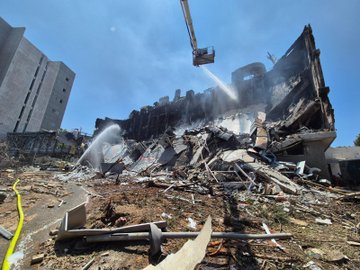
Iranian strike on Weizmann wipes out years of Israeli war research
Al Mayadeen | June 17, 2025
A recent Iranian missile strike has inflicted extensive damage on the Weizmann Institute of Science in Rehovot, central occupied Palestine, a facility long considered a cornerstone of the Israeli occupation’s scientific and military-industrial infrastructure.
According to The Marker, a daily business newspaper published by the Haaretz Group in “Israel”, several buildings within the institute sustained direct hits, with one key laboratory complex entirely destroyed by fire.
The targeted site housed advanced research in life sciences, artificial intelligence, and molecular biology, areas that have directly supported the Israeli entity’s development of surveillance, targeting, and weapons systems used in attacks across the region.
Described by Israeli media as the “scientific and military brain” of “Israel”, the Weizmann Institute has played a pivotal role in the research and development of technologies underpinning airstrike coordination systems, drone warfare capabilities, and battlefield medical technology, all of which have been deployed in repeated assaults on civilian populations in Gaza, Lebanon, Yemen, and most recently, Iran.
One of the laboratories destroyed was run by Israeli Professor Eldad Tzahor, a veteran in the Department of Molecular Cell Biology. Israeli Professor Eran Segal, whose AI lab was also directly hit, noted that millions of dollars’ worth of equipment was damaged beyond recovery due to water and structural damage. Segal’s lab had reportedly contributed to algorithmic systems used in battlefield decision-making and real-time surveillance, tools that have aided the Israeli entity’s strikes in Gaza and elsewhere.
Photos released by Israeli media showed scorched interiors, collapsed lab floors, destroyed electrical systems, and structural devastation, the result of what sources described as a precision strike.
Not a random target: A symbol of militarized science
While Israeli officials have downplayed the implications, The Marker acknowledged the strike was “not random,” but a calculated attack on a facility used for military power through scientific research.
Media reports also framed the operation as direct payback for the assassination of Iran’s nuclear scientists.
Experts say the institute’s deep ties to the Israeli security apparatus have made it a legitimate military target in Iran’s eyes, particularly given its support for advanced weapons technologies used to target civilians.
Israeli Professor Sharel Fleishman, whose lab was not impacted, admitted the losses are irreplaceable. “Life sciences labs rely on materials that are gathered and preserved over many years. When a lab is destroyed, and with it all those materials, it’s irreplaceable,” he said.
Another Israeli researcher, Professor Oren Schuldiner, told The Marker: “It’s as if the lab evaporated into thin air.” Schuldiner noted that rebuilding the affected laboratories and their capabilities will take at least two years.
The destruction of the Weizmann Institute sends a clear message from Tehran, analysts say: the Israeli occupation’s institutions cannot continue to serve dual roles as research centers and military enablers with impunity.
Trump Attacks Tucker Carlson Over Opposition to Iran War, Says He Decides What ‘America First’ Means
By Connor Freeman | The Libertarian Institute | June 16, 2025
President Donald Trump is lashing out against popular conservative talk show host Tucker Carlson. The acrimony emanates from Carlson’s strong opposition to the White House’s indirect military support for Israel’s war against the Islamic Republic of Iran. Trump declared he invented “America First” and he decides what it means while making his case for the potentially catastrophic war of aggression against Tehran.
On Monday, the president demeaned the influential pundit. Trump told reporters “I don’t know what [Carlson] is saying. Let him go get a television network and say it so that people listen.” In an interview with The Atlantic magazine this weekend, Trump was asked about Carlson’s comments against the war.
Trump responded “Well, considering that I’m the one that developed ‘America First,’ and considering that the term wasn’t used until I came along, I think I’m the one that decides [what it means]. For those people who say they want peace—you can’t have peace if Iran has a nuclear weapon. So for all of those wonderful people who don’t want to do anything about Iran having a nuclear weapon—that’s not peace.”
“America First” is a political slogan which has seen a phenomenal resurgence in the wake of Trump’s first presidential campaign. It has been used by politicians in both major parties and dates back more than a century ago. It originated as a rallying cry for neutrality during the First World War and was used as part of President Woodrow Wilson’s 1916 reelection campaign. The following year, Wilson betrayed his supporters by ordering American forces into the war and imposing conscription. Since then, the antiwar, nationalist slogan has been deployed by non-interventionists, particularly on the right, exemplified best by Pat Buchanan.
Despite Trump’s continued insistence otherwise, his own intelligence agencies confirmed this year that there is no evidence Tehran is building a nuclear weapon nor has there been any suggestion that a political decision has been made to abrogate Ayatollah Ali Khamenei’s fatwa against pursuing weapons of mass destruction.
On Friday, following Israel’s surprise bombing attack on Iranian nuclear facilities, residential areas, and military sites, Carlson released a newsletter denouncing US involvement in Prime Minister Benjamin Netanyahu’s war. It begins by quoting from Trump’s first inaugural address, “From this day forward, it’s going to be only America first. America first.”
The newsletter then reads, “Now that [Netanyahu] and his war-hungry government have executed their long-awaited assault, [Trump] faces a legacy-altering decision: to support or not to support?”
Carlson insists, “The United States should not at any level participate in a war with Iran. No funding, no American weapons, no troops on the ground. Regardless of what our “special ally” says, a fight with the Iranians has nothing to offer the United States. It is not in our national interest.”
The newsletter continues, with Carlson warning the consequences of supporting Israel will include future blowback terrorism against “the West” and “thousands of immediate American deaths, all in the name of a foreign agenda.” He concluded that a preferable option would be to “drop Israel” and “let them fight their own wars.” Carlson emphasized that because of the massive US military and financial aid to Tel Aviv, Trump is already “complicit in the act of war.”
Diplomacy as deception: The West’s war on Iran was pre-planned
By Hamid Bahrami | MEMO | June 16, 2025
As bombs rain down on Iranian cities and missiles arc across the skies of the Middle East, we must speak plainly: this is not merely a war between Israel and Iran. It is a war against sovereignty, waged by an Israeli-Western coalition that has long sought to dismantle any state in the Global South that dares to chart an independent course.
Iran is not the aggressor in this conflict. It is defending itself, legally, historically, and strategically from a premeditated assault. The airstrikes Israel launched on 13 June were not acts of deterrence; they were the execution phase of a long-orchestrated operation aimed at crippling Iran’s infrastructure, destabilising its political system, and ultimately returning it to the kind of failed state once imposed on Iraq, Libya, and Syria. Each of those nations was de-developed under the guise of humanitarian intervention or nuclear containment. Iran is now in the crosshairs of the same playbook.
The deception runs deep. In the lead-up to the strikes, Western officials and Israeli intelligence deliberately projected calm signalling to Tehran and financial markets alike that diplomacy would continue as scheduled. Negotiations in Oman were a trap. While diplomats discussed terms, war rooms in Tel Aviv and Washington finalised strike packages. It was a bait-and-strike strategy, the diplomatic equivalent of ambush warfare.
Israel’s justification for the attacks, its supposed fear of Iranian nuclear capability, collapses under scrutiny. Nuclear talks had resumed. Iran remained a signatory to the Non-Proliferation Treaty. And yet, Israel, a nuclear state that refuses to join the NPT, launched strikes that violated international law and killed dozens of civilians, including scientists and infrastructure workers.
Even more cynically, Tel Aviv has recycled a familiar accusation to justify civilian casualties: that Iran uses “human shields.” This baseless claim was used repeatedly in Gaza, where hospitals and apartment buildings were levelled on the pretence of targeting militants. Independent investigations have exposed the hollowness of these claims. Israel’s propaganda is less about evidence than about immunizing itself from consequence.
Despite years of Israeli terrorism, including the 13 June decapitation strikes that killed top Iranian commanders such as IRGC Chief Hossein Salami, Chief of General Staff Mohammad Bagheri, and missile-program leader Amir Ali Hajizadeh—Tehran has responded with calculated and disciplined force. Iran’s retaliatory strikes have been tightly focused on military bases, infrastructure, and command centers, avoiding civilian neighbourhoods and essential public services. In contrast, Israel has repeatedly struck residential buildings. Iran’s measured and purposeful response is not a weakness; it is a strategic posture rooted in moral strength and operational precision.
Some analysts have suggested that Israel expected internal dissent within Iran to paralyze the state’s response. This was a fatal miscalculation. While Iran is home to deep ideological divisions, foreign attack unites Iranians across the political spectrum. Even critics of the Islamic Republic now rally to its defence, because the threat is existential. In the face of foreign aggression, factionalism yields to nationalism.
The bigger threat now lies ahead. While headlines speak of “Israeli requests” for American support, the truth is that the United States has been involved from the outset. B-2 bombers were repositioned to Diego Garcia months ago. Joint U.S.–Israeli strike planning began under the pretext of nuclear containment. The deployment of bunker-busting bombs, diplomatic cover at the UN, intelligence sharing, and regional base access—all point to a war co-authored by Washington. They are simply waiting for Iran’s retaliatory capacity to be sufficiently degraded before launching a broader campaign.
Make no mistake: this is not a regional conflict. It is a US–Israel war, aided by Arab authoritarian regimes like Saudi Arabia, the UAE, and Jordan. The West have lent support, whether through intelligence, logistics and approval. Iran is being isolated and encircled not because it poses a nuclear threat, but because it has refused to submit.
But Iran has deterrents of its own. The global economy cannot ignore the energy risks that come with escalating war in the Persian Gulf. Already, oil prices are surging. Tehran knows that its geopolitical power isn’t limited to missiles. Economic leverage, especially when energy prices are high, can shift political calculus in Washington, Brussels, and Riyadh.
There is also a deeper hypocrisy at play. Israel continues to possess a clandestine nuclear arsenal while Iran, still technically within the NPT framework, is sanctioned and threatened for the potential of one. This double standard is untenable. There are only two realistic futures in the region: either Israel is disarmed, or Iran becomes nuclear-armed. The era of unilateral vulnerability is over.
Iran now reassesses its participation in the NPT and reevaluates the assumption that international law provides any meaningful protection when facing nuclear apartheid. If the international community is serious about peace, it must begin not with limiting Iran’s defences, but with dismantling Israel’s offensive capabilities.
Finally, this war must be recognized for what it is: a strategic campaign to eliminate resistance in the Global South. From Baghdad to Tripoli, from Damascus to Tehran, the message has always been the same, those who seek autonomy must be brought to heel. Iran’s independence goal is not just political; it is existential. And every sovereign nation, every citizen with a memory of colonialism or foreign subjugation, should see themselves in its struggle.
What’s happening today is not merely a war on Iran. It is a war on independence, dignity, and the right of nations to choose their own futures.
Featured Video

More Iran War fallout: Maritime insurance industry shifts from London to China
or go to
Aletho News Archives – Video-Images
From the Archives
The Biggest Threat to Peace in Middle East
By Dr. Elias Akleh* | Sabbah Report | May 24, 2010
A build up of heightened tension in the Middle East is escalating in the last few weeks. American and Israeli postures towards Lebanon, Syria, and Iran have become more threatening. Listening to speeches of political leaders one hears talks only about war not peace. Iranians and Israelis are continuously training hard for a possible showdown. Both sides are conducting extensive war games every month. This led Syrians to claim that Israel is preparing for a soon-to-come another war. The Jordanians also are warning that current stalemate of the peace process is an indication of a war breaking out this summer. The Russian President and his army chief hinted, a few months ago, that the US and Israel were planning for an attack on Iran.
Indeed Iran is, as it has been for last few years, the target of most of the threats and accusations of supporting terrorism. Escalating incitement against Iran the American Defense Department sent last month (April) to Congress a report on Iran’s military claiming Iran could develop intercontinental ballistic missiles capable of reaching the US by 2015.
Ignoring the fact that N. Korea, India, Pakistan, and Israel are proven to have nuclear weapons while Iran does not, the US Secretary of State Hillary Clinton chose in her speech, to the nuclear Non-Proliferation Treaty review conference at the UN, to focus on Iran’s alleged nuclear ambitions putting the whole world at risk as she put it. According to Clinton Iran’s acquisition of nuclear weapons, rather than Israel’s more than 200 nuclear bombs, is destabilizing the Middle East. She called on the world’s nations to rally around US efforts to hold Iran, not other nuclear countries, to account.
The accusation that Usama Bin Laden is living comfortably in Iran had received a boost after the broadcast of a documentary called “Feathered Cocaine”. This echoed the June 2003 claims of the Italian newspaper Corre de la Sierra that Bin Laden was in Iran according to some intelligence report, and according to Richard Miniter’s book “Shadow War”. … continue
Blog Roll
 Aletho News
- Iran mobilizing one million soldiers to ‘create hell’ for any US ground assault: Report
- The coming military and psychological unravelling?
- Iran has the last laugh
- More Iran War fallout: Maritime insurance industry shifts from London to China
- US-Israeli aggression on Iran triggers review of GCC countries’ investment pledges to Washington
- Russia slams UK plan to seize tankers suspected of carrying its oil
- Pakistan ramps up food exports to Persian Gulf nations as war deepens food insecurity
- Iran submits response to US plan, sets terms for war’s end: Tasnim
- US vs Iran: Kharg Island Talk — Bluff or Escalation? Ex-Military Officer Weighs In
- Zelensky unnecessarily involves Ukraine in the Middle East crisis
- If Americans Knew
- ‘No Innocent Children’: Far-right Israeli Lawmaker Defends Killing of Palestinian Family
- Mossad’s promises helped Netanyahu convince Trump that Iran could be toppled
- US Arms Control Official Refuses To Comment When Asked If Israel Has Nuclear Weapons
- Veterans warn US landing could be ‘more Gallipoli than Vietnam’
- Israel may be committing war crimes in Lebanon – Not a ceasefire Day 167
- In the West Bank, life is a constant battle – 3 articles
- Jacob Reses, one of the most powerful pro-Israel operatives in Trump’s Washington
- Israeli-US assaults kill or injure 87 children a day – Not a ceasefire Day 166
- ‘Forever live by the sword’: Understanding Israelis’ massive support for Iran war
- UN’s special rapporteur on human rights says Israel is systematically torturing Palestinians
- No Tricks Zone
- Devastating Assessment Of Comirnaty Vaccine By Former Senior Pfizer Europe Toxicologist
- New Study: CO2 Is ‘Effectively Negligible’ As An Explanatory Climate Change Factor Since 2000
- Former Pfizer Toxicologist Dr. Helmut Sterz Tells Bundestag Hearing Pfizer Vaccine Should Have Never Been Approved
- Energy Expert: Germany’s Nuclear Phaseout Was A “500 Billion Euro Mistake”
- New Research: South Australia’s Mid-Holocene Sea Surface Temperatures Were 4°C Warmer Than Today
- Storing Green Energy To Last Germany 10 Days Would Require A 60-Million Tonne Battery
- New Studies: UK Sea Levels Were 4 Meters Higher Than Today During The Mid-Holocene
- Destructive Green New Deal: German Energy And Metal Group Warns Of Drastic Crisis
- New Study Documents A 20-Year Pause In Arctic Sea Ice Decline – Driven By Internal Variability
- Wake-up Call: Survey Shows Majority Of Germans Now Favor Postponing Climate Targets!
 Aletho News