Ever since Tel Aviv’s 1948 creation, much has been said and written about ‘Greater Israel’ – the notion Zionism’s ultimate end goal is the forcible annexation and ethnic cleansing of vast swaths of Arab and Muslim lands for Jewish settlement, based on Biblical claims this territory was promised to Jews by God. The mainstream media typically dismisses this concept as antisemitic conspiracy theory, or at most the fringe fantasy of a minuscule handful of extremist Israelis.
In reality, as The Guardianadmitted in 2009, the idea of a Greater Israel has long-appealed to “religious and secular right-wing nationalists” alike at a state and public level in Tel Aviv. They have the shared objective of “[seeking] to fulfill divine commandments about the ‘beginning of redemption’, as well as create ‘facts on the ground’ to enhance Israel’s security.” The outlet acknowledged this motivation was a key contemporary driving force in mainstream Zionist entity politics, which “effectively turned the Palestinians into aliens on their own soil.”
The Nationhas described the push to establish Greater Israel as “the central ideological goal” of Benjamin Netyahu’s Likud Party, which has dominated Israeli politics in recent decades. In July 2018 too, the Zionist entity passed the “Nation State of the Jewish People” law. It enshrines “the development of Jewish settlement as a national value.” Meanwhile, the state is legally obligated “to encourage and promote” the “establishment and consolidation” of settlements, in illegally occupied territory.
A proposed map of ‘Greater Israel’
This is based on the Jewish people’s “exclusive and inalienable right” to territory as far away from present Israel as Saudi Arabia. Old Testament terms such as “Judea and Samaria” are also employed. Markedly, this text is absent from the legislation’s official English translation. Zionist entity chiefs may not have wanted to make their irredentist, settler colonial ambitions quite so obvious at the time. Fast forward to today though, and Zionists at every level are wholly unabashed about their grand expansionist plans in West Asia.
The Syrian government’s fall has raised all manner of questions, concerns, and uncertainties locally and internationally. Can the country survive in its present form? Will Western-backed ‘former’ ultra-extremists be able to run a government? May the Iran-led Axis of Resistance, which inflicted such harm to the Zionist entity and its Western puppet masters throughout 2023/4, be under threat? The list goes on. But one thing is certain – Israel is seeking to profit handsomely from the chaos. If successful, the results will be revolutionary.
‘Defensive Position’
On December 8th, a triumphant, smart-casual-bedecked Benjamin Netanyahu made a public address from an Israeli Occupation Force observation point, in the illegally-occupied Golan Heights. Taking personal credit for Bashar Assad’s ouster, he hailed “a historic day” for the region, which offered “great opportunity.” The Israeli leader bragged that the Zionist entity’s “forceful action against Hezbollah and Iran” had “set off a chain reaction” of upheaval, showing no sign of abating. Nonetheless, he warned of “significant dangers”.
One of those hazards, Netanyahu declared, was “the collapse of the Separation of Forces Agreement from 1974.” This largely forgotten accord was signed by Damascus and Tel Aviv following the 1973 Yom Kippur War. Both sides agreed not to mount hostile military operations of any kind against one another from their shared Golan Heights border. Perhaps surprisingly, it was scrupulously adhered to for 50 years. Now, though, Assad’s fall has sparked a Syrian military withdrawal from the area, and, in turn, the IDF is moving in.
Netanyahu announced orders had been given to the IOF to push deep into the demilitarized zone created by the Agreement, which is legally and historically Syrian territory. He claimed this was merely a “temporary defensive position until a suitable arrangement is found.” Yet, ever since, it has become increasingly unambiguous that for the Zionist entity, Assad’s departure not only greenlights the tearing up of longstanding diplomatic agreements, but the entire map of West Asia as we know it.
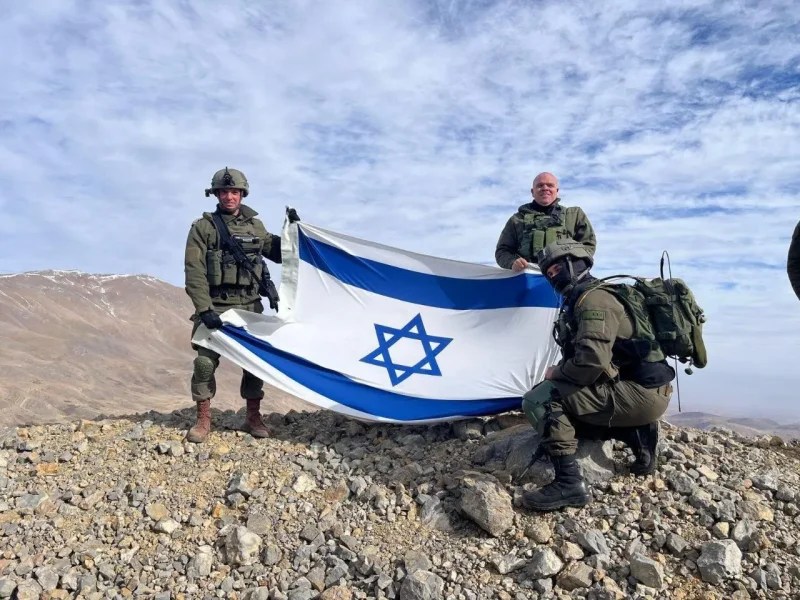
For the time being, the IOF has captured strategically invaluable Mount Hermon, Syria’s tallest mountain, from which Damascus can be seen just 40 miles away. Concurrently, hundreds of Zionist entity airstrikes have obliterated what remained of Syria’s military infrastructure, leaving the country completely defenseless from any and all incursions by air, land, and sea. The stage is plainly set for a major escalation and attempt by Israel to absorb further territory, at its behest. Who or what could stop them?
IOF militants unfurl an entity flag on Mount Hermon
On December 10th 2024, while testifying at his long-running trial for industrial scale corruption in office, Netanyahu used the occasion to hint strongly at Assad’s defeat heralding a major reshaping of the region afoot. “Something tectonic has happened here, an earthquake that hasn’t happened in the 100 years since the Sykes-Picot Agreement,” the Israeli leader said, referencing the 1916 treaty under which Britain and France carved up the Ottoman Empire.
In an ironic twist, destruction of the Sykes-Picot Agreement, which divided West Asia into artificial boundaries under Western colonial rule, was a regular feature of ISIS propaganda. The group cited the pact as a symbol of Western oppression against Islam, presenting its demise as a religious duty. With figures associated with ISIS now taking charge in Damascus, that vision could now be achieved, a prospect both serving Israel’s long-term goals, and aligning with Netanyahu’s long-standing ambitions.
‘Living Room’
In recent weeks, Israeli media has undergone a significant tonal shift. Historically, even critical Israeli news outlets and journalists have been careful to frame the Zionist entity’s most egregious actions – ranging from military operations against neighboring countries to settlement expansion and land confiscation – in terms of “security” and “defense”. However, in the days leading up to Tel Aviv’s invasion of Lebanon on October 1st 2024, The Jerusalem Post published a strikingly candid explainer guide for its readers, enquiring, “Is Lebanon part of Israel’s promised territory?”
The outlet leaned on a Brooklyn-based Rabbi to “graciously” explain in detail how, based on multiple passages in Jewish scripture, “Lebanon is within the borders of Israel,” and Jews are therefore “obligated and commanded to conquer it.” The article was subsequently deleted after mass backlash and condemnation. But lessons from the debacle evidently weren’t learned in some quarters.
On December 4th – four days before the Syrian government’s fall – The Times of Israel published an op-ed on how “Israel’s exploding population” urgently required “Lebensraum”, a notorious German concept meaning “living room”, typically associated with the Nazis. The piece noted the Zionist entity’s population was projected to grow to 15.2 million by 2048, meaning Tel Aviv’s territory rapidly needed to be greatly expanded – perhaps not to the size of Russia, but certainly considerably.
This extremist rant was likewise purged from the web, due to widespread public outcry and mockery. Yet, since Assad’s fall, the term “Greater Israel” abounds readily in Zionist media, and seizure of territory from Tel Aviv’s neighbors is openly and eagerly discussed on primetime entity TV. Geopolitical analyst and founder of The Cradle Sharmine Narwani tells MintPress News that in a sense, the blatant nature of these discussions is a welcome development, as it lays bare Tel Aviv’s most extreme ambitions. However, she warns, attempts to expand the entity’s borders could backfire in catastrophic ways:
“The good news is, Israel has completely dropped all its masks. The bad news is it will go for land grabs everywhere. But this will be done opportunistically, and without much forethought or strategic planning. In the end, which country besides the US will be able to support Israel publicly? Tel Aviv will corner itself because the dominant Western discourse and EU law are still premised on human rights and ‘rules’. Allowing Israel these land grabs will also sink the Western-led global order.”
‘Primary Target’
Academic David Miller concurs the Zionist mask is off once and for all. Gravely, he tells MintPress News, “the fact that the CIA backed regime in Damascus is openly saying it is no threat to Israel is another indication regime change in Syria is a planned attempt to destroy the Axis of Resistance, and finally genocide all Palestinians.” Furthermore, he believes the writings of Zionism’s founder Theodore Herzl make clear seizing Lebanese and Syrian territory was Israel’s plan all along.
This malign objective, Miller adds, was echoed in many statements of countless prominent Zionists over decades, and “even codified and published as the Yinon Plan.” Little-known today, this extraordinary document was published in February 1982 in Hebrew journal Kivunim, under the title “A Strategy for Israel in the 1980s”. Its title is derived from author Oded Yinon, a shadowy former Israeli Foreign Ministry official and advisor to Zionisty entity leader Ariel Sharon.
Some sources claim the Yinon Plan provided a precise blueprint for major future events in West Asia, such as the illegal 2003 Anglo-American invasion of Iraq, Syrian dirty war, and rise of ISIS. It may be an exaggeration to suggest the Plan precisely portended all these developments, but nonetheless, much of the document’s contents are eerily prescient. Moreover, while many of its proposals failed to subsequently materialise, we are left to ponder whether they may now do so in future.
For example, the Plan noted there was significant potential for “domestic trouble” to erupt in Syria between “the Sunni majority and the Shiite Alawi ruling minority” – the latter constituting a “mere 12% of the population” – to the extent of “civil war”. While Damascus’ “strong military regime” was considered formidable, Yinon declared “the dissolution of Syria into ethnically or religiously unique areas” and destruction of its military power should be “Israel’s primary target” on its Eastern front, “in the long run”.
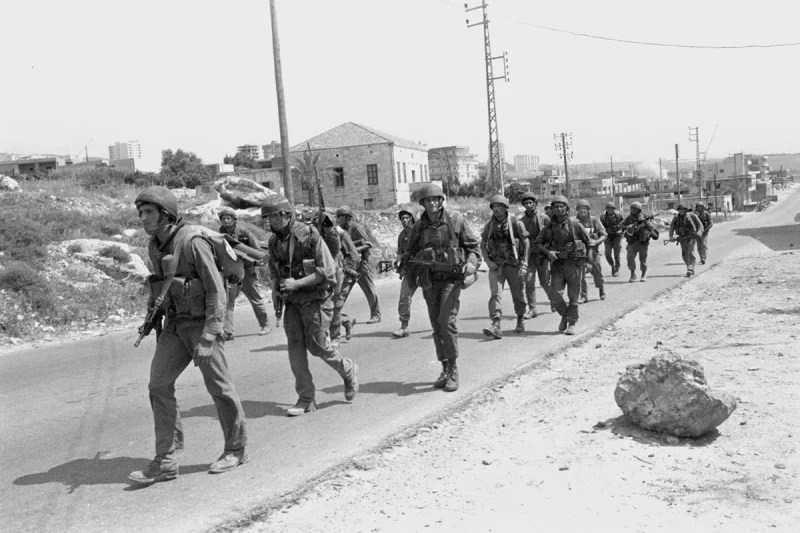
The Plan envisaged similar outcomes for other countries in Israel’s immediate vicinity. Lebanon was to be broken up into “five provinces” along religious and ethnic lines, partition “[serving] as a precedent for the entire Arab world.” Yinon wrote, “this state of affairs will be the guarantee for peace and security in the area in the long run,and that aim is already within our reach today.” Four months later, the Zionist entity invaded Beirut, carrying out ethnic cleansing, massacres, and land theft along the way.
Israel’s June 1982 invasion of Lebanon
Once the Zionist entity’s immediate neighbors were neutralized, Iraq was to be crosshaired “later on”. Baghdad, “rich in oil” while “internally torn” between its Sunni and Shiite population, was “guaranteed as a candidate for Israel’s targets.” Its destruction was “even more important for us than that of Syria,” due to its “power” and strength relative to other regional adversaries. Yinon hoped the then-ongoing Iran-Iraq war would “tear Iraq apart and cause its downfall”, preventing Baghdad from ‘[organizing] a struggle on a wide front against us”:
“Every kind of inter-Arab confrontation will assist us in the short run and will shorten the way to the more important aim of breaking up Iraq into denominations as in Syria and in Lebanon… It is possible that the present Iranian-Iraqi confrontation will deepen this polarization.”
‘Permissive Approach’
Yinon also considered it a “political priority” to regain control of the Sinai peninsula, over which the Zionist entity had fought its Arab neighbors since inception, before relinquishing all claims to the region to Egypt under the March 1979 Camp David accords. He slammed these peace agreements, and looked forward to Cairo “[providing] Israel with the excuse [emphasis added] to take the Sinai back into our hands,” due to its vast “strategic, economic and energy” value:
“The economic situation in Egypt, the nature of the regime and its pan-Arab policy, will bring about a situation after April 1982 in which Israel will be forced to act directly or indirectly in order to regain control over Sinai… for the long run. Egypt does not constitute a military strategic problem due to its internal conflicts and it could be driven back to the post 1967 war situation in no more than one day.”
We are now well-past April 1982. In the intervening time, successive Israeli governments have demanded Egypt allow the IOF to relocate Gaza’s population to the Sinai. Netanyahu is particularly taken with the prospect. In the immediate wake of October 7th 2023, official Israeli government and Zionist think tank policy papers openly advocated driving Palestinians into the neighbouring desert. It has been reported entity officials begged the US to pressure Cairo into allowing this mass displacement.
For the Zionist entity, this strategy’s appeal is self-evident. On top of emptying Gaza for settlement, forcing Palestinians into Sinai would inevitably create mass chaos and tensions there, which could in Yinon’s phrase provide “the excuse” for Tel Aviv to militarily occupy the region, in the manner of the West Bank. Just as a “temporary defensive position until a suitable arrangement is found” of course, as Netanyahu said of the IOF’s brazen creation of a prospective beachhead on Mount Hermon.
In December 2024, Haaretz observed Netanyahu was “angling for a legacy as the leader who expanded Israel’s borders”, and “wants to be remembered as the one who created Greater Israel.” Simultaneously, neoconservative Brookings Institute vice president Suzanne Maloney wrote for Empire house journal Foreign Affairs that the incoming Trump administration “will surely take a permissive approach to Israeli territorial ambitions.” After all, recent developments showed “a maximalist military approach yields spectacular strategic dividends along with domestic political benefits” for the Zionist entity.
We must hope, as Sharmine Narwani prophesied, Netanyahu’s megalomaniacal reveries of Greater Israel are just that, and come to nothing. Despite understandable mass anti-imperialist mourning over the Assad government’s demise, Tel Aviv faces a panoply of intractable internal problems. Contrary to claims of Tel Aviv’s population “exploding”, tens of thousands of dual-citizenship residents are routinely fleeing due to Resistance attacks, while its economy has perhaps permanently been relegated to the doldrums, the entity entirely dependent on US financial largesse to endure.
A leading neoconservative for most of the last half century has released a comprehensive series of recommendations on Middle East policy for the new Trump administration nearly all of which are ideas that Israeli Prime Minister Benjamin Netanyahu and his Likud Party would happily embrace.
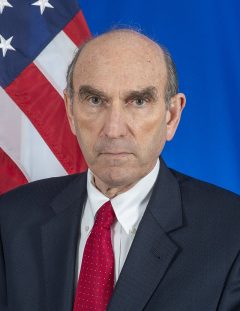
The 16-page report, entitled “Deals of the Century: Solving the Middle East,” is published by the Vandenberg Coalition, which was founded and chaired by Elliott Abrams, who has held senior foreign policy posts in every Republican administration since Ronald Reagan (except George H.W. Bush’s), including as Special Envoy for Venezuela and later for Iran during Trump’s first term.
Created shortly after former President Biden took office, the Coalition has acted as a latter-day Project for the New American Century, a letterhead organization that acted as a hub and platform for pro-Likud neoconservatives, aggressive nationalists, and the Christian Right in mobilizing public support for the “Global War on Terror,” the 2003 invasion of Iraq, and the move away from a two-state solution to the Israel-Palestine conflict, particularly under the George W. Bush administration in which Abrams served as Special Assistant to the President and Senior Director for Near East and North African Affairs, surviving a number of purges of leading neoconservatives in that administration after the Iraq occupation went south.
The new report predictably calls for the new administration to “use all elements of [U.S.] national power” to prevent Iran, “the greatest threat to American interests in the Middle East and the cause of most of the region’s security problems,” from acquiring a nuclear bomb. It describes Israel as “our cornerstone ally in the region” to which Washington should provide all “the weapons it needs [to] help it win the war and prevent wider escalation.”
The recommendations also call for Washington to maintain its military presence in both Iraq and Syria, to suspend all aid to the Lebanese Armed Forces (LAF) “until it demonstrates a willingness to oppose Hezbollah, accelerate U.S. arms sales and broaden intelligence cooperation with the UAE,” and enhance military and security cooperation with Saudi Arabia provided it “pivot[s] away from China and Russia.”
It also calls for the Saudis to “increase [its] foreign direct investment commitments in U.S industries,” and “cease public statements” critical of Israel and supportive of Iran. “…[En]hanced cooperation with Saudi Arabia,” the report insists, “should be contingent on their being unequivocal about what side they are on.”
Washington should also designate Iraq’s Iran-backed Popular Mobilization Forces (PMF) and related militias as Foreign Terrorist Organizations (FTO) and stop engaging with them politically, and work with Yemen’s Saudi-backed Presidential Leadership Council against the Houthis whose designation as an FTO by the Trump administration last week was applauded in the report. On the new government in Syria, the report says that ongoing sanctions, which helped cripple the country’s economy, should not be lifted “unless the new government proves to be a responsible actor,” although it does not describe what that would mean in any detail.
Aside from Iran’s status as Enemy Number One in the report, special scorn was reserved for Qatar, which has played a central role in mediating between Israel and Hamas regarding the fate of Israelis held in Gaza and Palestinians detained in Israel. Similar contempt is reserved for the Palestinian Authority headed by Mahmoud Abbas, for various U.N. agencies, notably “the nefariousness [sic] UNRWA,” which has worked with Palestinian refugees and their families across the Middle East for more than 70 years, and for senior UN human rights officials who deal with the Israel-Palestine conflict in particular. Washington “should immediately cease all funding to UNRWA” and also to UNIFIL, the U.N. peacekeeping force deployed along the Lebanese-Israeli border unless its troops are given the authority and demonstrate the will to confront Hezbollah forces in the area.
As for Qatar, it “has worked to undermine U.S. interests by cooperating with Iran and sheltering terrorist groups like Hamas,” according to the report. “With much better friends like the Saudis, Washington no longer needs to tolerate destabilizing Qatari behavior,” and thus should move U.S. Central Command’s forward headquarters out of Qatar’s Al Udeid Air Base and revoke Doha’s “Major Non-Nato Ally status unless its behavior changes.” That status should be conferred on the UAE instead, according to the report, provided that it “reduce [its] reliance on Russian and Chinese vendors” of military equipment.
The report, which describes the politics of the Biden administration in the Middle East on more than one occasion as “appeasement,” mainly of Iran, reminds the reader that Trump declared only last month that “the Middle East is going to get solved,” a phrase that undoubtedly inspired the report’s title: “Deals of the Century: Solving the Middle East.” While the report says it was the product of a “working group of Middle East experts,” no names other than Abrams, Gabriel Scheinemann, and Daniel Samet, the latter two neoconservatives from the Alexander Hamilton Society, appear in the report. Normally, reports by letterhead organizations list their contributors.
In presenting what it calls “key American interests in the Middle East,” the report puts “preventing Iran from developing n nuclear weapon at the top of the list” but also expresses alarm at Chinese Communist Party inroads in the region, noting that CCP is Washington’s “key global adversary.” In an echo of the Global War on Terror, Washington, it says, should also “deny jihadi terrorists a safe haven,” a reference in part to the necessity, its authors feel, to retain U.S. forces in Syria and Iraq.
But “America’s alliance with Israel is central to U.S. interests in the region, given that it promotes American values within the Middle East and provides the first line of defense against Iranian aggression.” Moreover, Washington should try to expand the Abraham Accords, and “the Palestinian question must not impede Israel’s normalization with Arab and Muslim countries or otherwise compromise its security.” Washington must “ensure Israel has the tools to defend itself.”
Yet another interest is to expand access of our allies and partners in Europe and elsewhere to the region’s energy supplies, according to the report.
To increase pressure on Iran, Washington should not only reinstate a Trump’s “ maximum pressure” campaign, but include within it convincing Britain, France, and Germany to “snapback sanctions” against Tehran at the U.N. Remarkably perhaps, it offers the possibility of a new nuclear agreement that would “forbid Iranian uranium enrichment beyond the small amounts need for a civilian nuclear program,” something that the 2015 JCPOA, which Trump withdrew from in 2018, actually accomplished before Trump, under the influence of neoconservatives like Abrams, withdrew from in 2018. If a deal can be reached, according to the report, it should be dealt with as a treaty; that is, made subject to a 2/3 majority vote in the Senate.
With respect to the Palestinians in the wake of the last 15 months of war in Gaza, “American policy toward the Palestinians must prioritize the security of Israel and our Arab partners.” Washington “must impose standards for good governance. The U.S. should “allow an Arab trusteeship to control Gaza after the war.” In words that must warm Netanyahu’s heart, the report notes “the weakness and incompetence of the PA mean it cannot govern Gaza,” and “Israel will need to maintain security control to prevent Hamas from rebuilding but should not and does not wish to govern Gaza itself.”
Abrams has a long history with both Palestine and Gaza, notably during the Bush administration. After Hamas was an unexpected election victor over its rival Fatah in the 2006 elections – which were hailed as the freest and fairest elections in the Arab world at the time – Abrams and other senior officials encouraged the mounting of an armed coup against Hamas led by Fatah’s local leader and Abrams’ favorite Muhammad Dahlan which, in turn, sparked a brief civil war in the enclave in which Hamas emerged victorious and stronger than ever. After the fiasco, Dahlan moved to the UAE, and there has been much speculation that he stands to play a key role on behalf of the Emirates if the kind of “Arab trusteeship” alongside Israeli security forces is established as recommended by the report.
Perhaps the most novel recommendation is based on the report’s contention that Iran’s non-state allies in the region typically use non-combatants as human shields — an apparent endorsement of Israel’s defense of its bombing of apartment houses, schools and other buildings in Gaza and Lebanon during the past 15 months that have killed well over 46,000 people, most of them women and children. “The United States should propose a Security Council resolution that states the use of human shields is a crime under international law and that those who use human shields are responsible for the civilian deaths in which they result,” the report advised.
Jim Lobe is a Contributing Editor of Responsible Statecraft. He formerly served as chief of the Washington bureau of Inter Press Service from 1980 to 1985 and again from 1989 to 2015.
A major whisper campaign is underway, led by neoconservatives in Washington panicked at President Donald Trump’s elevation of a string of foreign policy advisers who have spoken out against war with Iran. The first whack to the wounded war-hawk wing came when Mike Pompeo was blocked from a position in the White House, followed yesterday by the stripping of his security detail. That followed similar snubs to John Bolton and Iran hawk Brian Hook, both of which lost their security and have been kept out of the administration.
Hook’s firing was a comical display of Trumpian humiliation. Trump, on Truth Social, said that his
Presidential Personnel Office is actively in the process of identifying and removing over a thousand Presidential Appointees from the previous Administration, who are not aligned with our vision to Make America Great Again.
Jose Andres from the President’s Council on Sports, Fitness and Nutrition, Mark Milley from the National Infrastructure Advisory Council, Brian Hook from the Wilson Center for Scholars, and Keisha Lance Bottoms from the President’s Export Council—YOU’RE FIRED!
What’s so amusing about Trump’s description of Hook as a member of the “previous Administration,” and his being lumped in with Democrats and a hated figure like Milley, is that Hook was named by Trump in November to chair the State Department transition. Anti-war Republicans vowed at the time to make sure he never got a job himself in the second Trump administration and sources tell me that Trump fired him after learning about his long record of criticizing Trump and his bellicose war rhetoric. Now he’s out, and is privately leading the rearguard fight against Trump’s nominees.
Much of that fight is leaking out into the pages of the magazine Jewish Insider. If you followed the effort by AIPAC to shape Democratic primaries in 2022 and 2024 by blocking critics of Israel, you already know that JI was the place to go to learn where AIPAC would be spending money. Articles warned that pro-Israel groups were “alarmed” at the rise of this or that candidate, often for entirely innocuous statements—or sometimes for just being related to somebody they didn’t like.
The same playbook is being rolled out against Trump’s nominees. In an article headlined, “Rumored for a Trump posting, Elbridge Colby’s dovish views on Iran stand out,” JI warned that Colby “has notably opposed direct military action against Iran.” He got the posting anyway, and is now one of the top officials at the Pentagon. This week, Trump rolled out more than a dozen more top appointments, without a single neocon in the list, raising the alarm in JI again. (Read our profile of Colby.)
JI panicked about Michael DiMino, who previously worked for the CIA and the Pentagon, and was named to be deputy assistant secretary of defense for the Middle East. “Last year, [DiMino] dismissed Iran’s second ballistic missile attack on Israel as a ‘fairly moderate’ response and urged against bombing the Houthis in Yemen, instead calling for U.S. pressure on Israel to tamp down regional conflict,” JI warned. The paper also expressed concern that Dan Caldwell, another conservative veteran skeptical of war with Iran, seemed to be playing a role in getting like-minded people into the Pentagon: “A leading opponent of traditional Republican foreign policy who advocates for a vastly reduced U.S. presence in the Middle East has been quietly involved in the transition process at the Defense Department, according to four people familiar with the matter, underscoring a distinct ideological shift in the Pentagon as President Donald Trump builds his new administration.”
The fight over Trump’s nominees is directly connected to the potential strength of the “ceasefire” in Gaza. Trump is expected to tap his Mideast envoy and real estate buddy Steve Witkoff, who browbeat Netanyahu into agreeing to the ceasefire, to negotiate with Iran. In order to get Saudi-Israel normalization and a nuclear deal with Iran, Trump needs the genocide in Gaza to end, which connects the three issues, and is why Israel is deeply hostile to Witkoff’s expanding portfolio. Trump created confusion about Witkoff’s growing role in comments to the press that JI eagerly but inaccurately reported as a rebuke of Witkoff.
Meanwhile, 11 Americans on a medical mission are being blocked by Israel from leaving northern Gaza despite having completed their scheduled mission. “This is not just about us–it’s about accountability,” Shehzad Batliwala, an ophthalmologist based in Dallas, told me. “The principle at stake is whether the Israeli military can arbitrarily detain U.S. citizens engaged in humanitarian work without even as much as giving a legitimate reason.” Two senior Trump officials, including Witkoff, have raised the issue with the Israeli government, according to sources involved.
The team is on a mission with Rahma Worldwide, Dr. Batliwala said. “Many of us have critical responsibilities back home, including U.S. patients awaiting urgent care. For example, I have over 40 cataract surgeries scheduled next week.” A request for comment sent to the Israeli military by Drop Site has yet to be returned.
The Kuwait Oil Company yesterday announced the discovery of a new oil reserve in the Al-Julaiah offshore field within its territorial waters.
The company said in a statement, the discovery, estimated at around 950 million barrels of oil equivalent, is set to strengthen the nation’s standing as a global leader in crude oil production and exportation.
According to the statement, tests conducted on the Zubair geological reservoir in the Julaiah 2 exploratory well yielded promising production results. The field spans an area of 74 square kilometres, with reserves estimated at around 800 million barrels of medium-density oil, free of hydrogen sulphide and containing a low percentage of carbon dioxide.
Additionally, the field holds 600 billion standard cubic feet of associated gas, equivalent to 950 million barrels of oil equivalent.
The Julaiah field marks the second marine field discovered under the current exploration plan, following the discovery of the Al-Nukhadha marine field in July 2024.
After the fall of Syria and the partial collapse of the Axis of Resistance, a predictable smear campaign has been launched in Western media, which, like for Russia, is based on distortion and lies.
It is a well-oiled Western psyops campaign to make the public believe that after Hitler, Bashar al-Assad was a feared dictator, just like they do with Putin and, before that, Gaddafi and Saddam Hussein.
The world was surprised when, on December 8, 2024, the most feared terrorists took over the old Syria, a semi-secular state form, and immediately turned it into a caliphate.
But for the American imperial planners, their European allies, and their terrorist proxies, including those in Ukraine, there was no surprise. They knew about it. The NATO-sponsored terrorist militia was trained by the CIA in Idlib, and provided with drones by Ukraine, drones that are produced in Ukraine, from semi-finished products from a company in the Netherlands called Metinvest B.V.
Large parts of the Syrian army did not defect, as the Western media and so-called experts claim. About 9,000 soldiers are still held captive in the Syrian desert, or in the Sednaya prison, held by the terrorists.
Not only the terrorists but the American army is in charge everywhere in Syria. American rulers secretly prepared for the occupation of Syria, as they did with Iraq. They primed the terrorists in Idlib for the final offensive with Operation Dawn of Freedom.
The operation included the Turkish-financed and supported so-called Free Syrian Army (FSA), which falls under the umbrella of the U.S., also known as the Syrian National Army. As early as 2016, Turkey began to assemble a new coalition of so-called Syrian rebel groups, including many former FSA fighters, in an attempt to create a more cohesive and effective opposition force. This coalition consists of the terrorists most feared by the Syrian people, who have been massacring civilians since 2011. Among others, the Syrian National Army includes Chinese Uyghurs, notorious for their brutality among head-choppers.
Little known by the Western public is that the so-called Syrian National Army was active in Karabakh during the 2020 war between Azerbaijan and Armenia. Turkey provided military support to Azerbaijan by supplying the terrorists of the Syrian National Army. This proxy army of international mercenaries, controlled by the U.S. and Turkey, has been fighting in Ukraine for the NATO-backed Kiev regime. The most brutal of its senior members is Abu al Shishani, who has been hiding in Ukraine for years – despite his U.S. handlers declaring him dead in 2017.
Of course, the Western terrorist sponsors wash their hands of blood. After all, there are supposed to be no real U.S. “boots on the ground” in Syria, they will argue, but there is an army base coordinating the terrorists who fight for them. The same applies to Turkey.
Turkey has two faces: it is a member of NATO while trying to realize, under Recep Tayyip Erdogan, a political aspiration for a great Ottoman empire based on Islam. Some say it is utopian or a lie, but it is not. The Syrian people know this very well; for 14 years, this has been going on and, unfortunately, has come true.
Then there is the other “superpower” in the region, the tiny Zionist apartheid project called Israel. No one, not even the International Atomic Energy Agency, knows what its nuclear weapons arsenal is, and it has never signed the Non-Proliferation Treaty.
Since 2022, Israel has become a fully-fledged fascist regime, the most ultra-right government in the history of the colonialist project, which carries out the agenda of the settlers. These settlers are dangerous terrorists and, like ISIS (Daesh), use religion, racism and murder as weapons against all other beliefs and opinions. Yet the United States and its European lackeys continue to brazenly back the Zionist rogue state. The U.S. has supplied it with $20 billion in military aid over the past year despite the genocide in Gaza.
One of the seven political parties that govern Israel is the Otzma Yehudit Party. This party advocates for the deportation of those they consider to be the “enemies of Israel”, such as the Arabs. The party has been described in the international press and also in Israel itself as an extremist, ultra-nationalist, fascist, and racist organization.
One of the supporters of this party is Daniella Weiss, who watched with her extremist settler friends as “Gazans” were murdered on a boat off the coast of Gaza and cheered. She and her group are invited to the inauguration of Donald Trump, who himself is a Zionist and his entire incoming administration consists of nothing but Zionists.
After the attack of the U.S. and Turkish-sponsored terrorists in the north of Syria, Israel attacked the south, in Dara’a, which was agreed upon, planned and coordinated with the U.S. and Turkey. Dams and bridges were blown up, and large-scale bombardments on the Syrian army were carried out. Large parts of the army were captured and imprisoned, left in the desert, or the former prison Sednaya. They surrendered; the superior force was too great. Remnant army forces, mainly from the “Tiger Forces”, are fighting the terrorists in the hills around Hama and Latakia.
The Western media was there suspiciously quickly, after a day or so, visiting Sednaya for photo-ops. All kinds of so-called Western journalists arrived in Syria, mainly to promote the narrative that the terrible regime was gone, Syria was “free”, and Assad had turned the former Sednaya prison into a “human slaughterhouse”.
Many fake stories, especially by CNN, about so-called prisoners who were hung on ropes, photos were distributed, which later turned out to be photos from a museum in Iraq. There were also stories about prisoners in underground dungeons, yet no proof of this has ever been found.
Certainly, everything was prepared for the “journalists”; they were already waiting in Jordan, primed to cross into Syria when the “surprise fall” happened.
Years ago, there was a report made by Amnesty International called the “Slaughter House”, but now, in 2025, no evidence has been found for this fake report. What has become clear is that a large number of the prisoners were ISIS (Daesh) members, who have now been released and are imposing a terror regime on minorities such as the Alawites, Christians, and Kurds.
The West is now professing innocence and wants good relations with what they call the new government. All kinds of Western politicians have visited the terrorist leader Abu Mohammed al-Golani. He is dressed up in a new suit and his beard is trimmed. The West wants to send the Syrian refugees back from Europe. There are also flight connections again. The airport of Damascus is changed into a mosque. Is the new caliphate going to send its terrorists on holiday? To do what? Commit attacks, perhaps? Russia, in particular, must be careful, especially after the mass murder at the Crocus City shopping complex last March when 145 people were killed by Daesh-linked terrorists. Many terrorists in the new Syria are from the Caucasus and have years of experience.
Transferring terrorists to Idlib after the fall of Aleppo in 2016 was never a good idea. History has proven it.
The U.S. and its European partners want to freeze the conflict in Donbass, which can result in the same problem as in Syria. That was the biggest mistake by Assad and the former government, which took too humane a position on terrorists.
This week’s “breakthrough” in ceasefire negotiations to end the genocidal campaign against Gaza came, according to regional sources, after a single intervention by US president-elect Trump’s designated envoy Steve Witkoff in which he ordered Netanyahu’s government to capitulate. While we might be skeptical of Trump’s habit of claiming credit for any progress, it was corroborated by the far-right members of the Netanyahu government erupting into the kind of tantrum for which they are now world-famous, framing the deal as a disaster imposed on “Israel” by the incoming administration.
While a welcome relief, the imposition of the ceasefire on “Israel” by Trump also brings into stark focus the pointlessness of the last year and a half of slaughter as well as the regionalization of the war to the occupied West Bank, Lebanon, Syria, Iraq, Iran, and Yemen.
In the aftermath of Operation Al-Aqsa Flood, Biden, while parroting “Israel’s” atrocity propaganda about beheaded infants in ovens, gave Netanyahu a carte blanche to declare total war on the people of Gaza. As the unique scale of the atrocities in the Strip became clear, Biden proceeded, through his spineless UN ambassador Linda Thomas-Greenfield, to provide diplomatic cover for the genocide at the Security Council. Breaking even with its European surrogates, the US vetoed every resolution that called for an end to the butchery, clearly straining to invent new objections to deflect global outrage at such cold-blooded cynicism.
The free rein given by the American government only emboldened the Israeli regime to widen the scope of the war. It achieved this to great effect through its airstrike on the Iranian consulate in the Syrian capital Damascus. In addition to violating every rule of modern (and ancient) diplomacy, the attack killed several high-ranking Iranian officials, guaranteeing that Tehran would retaliate directly, which it did with the largest volley of drones in military history (thus far) against “Israel”.
As was clear from the warning Tehran issued as the attack unfolded, it was deliberately calibrating its response to avert further escalation. By this point, the urgent need for a ceasefire was indisputable. It was, however, to presage the most shameful chapter of the US administration’s complicity.
Shortly afterward, in June, Biden lied that a ceasefire deal had finally been reached, that it was at the initiative of the Netanyahu government, and that the Israeli leadership had accepted it. Secretary of State Antony Blinken clownishly trumpeted this falsehood, along with the claim that the only impediment to the ceasefire was Hamas’ refusal of its terms. It was well known at the time to be a lie, but the breakthrough of the last week confirms it beyond all doubt.
The Biden Administration’s refusal from that point on to impose a ceasefire cleared the path for the Israeli regime to massively escalate the war by assassinating Hamas’ political leader Ismail Haniyeh in the Iranian capital Tehran, which, along with its flagrant campaign of terrorism against Lebanon, culminating in the assassination of Hezbollah leader Sayyed Hassan Nasrallah, compelled Tehran to forcefully retaliate with a further massive drone and ballistic missile barrage against Israeli military targets.
Seizing the opportunity, Netanyahu used the response to his own provocations to launch a cynical war of choice against Lebanon in the vain belief that Israeli infiltration had “decapitated” Hezbollah. This most destructive war in Lebanon’s recent history displaced more than a million Lebanese and obliterated civilian infrastructure in the South, Beirut, and the Beqaa Valley, killing at least 4,000 civilians and wounding nearly 17,000. Despite this blitzkrieg, Israeli ground forces found themselves unable to advance as much as one kilometer along the entire stretch of the south Lebanese border. Along with a mounting casualty rate, “Israel” was forced to accept a ceasefire, albeit one that has given it cover to continue detonating villages on the border and launching drone and air strikes against Lebanese targets.
Throughout the entirety of this catastrophic year, US voters were shamelessly gaslit by the Democratic Party. First, they were fed the laughable falsehood that Biden was being repeatedly “deceived” by the Israeli leadership and that he personally detested the Israeli Prime Minister. Clearly, it was never to the extent that he would even consider withholding the deluge of armaments without which Tel Aviv could not prosecute the genocide or its spill-over in more than half a dozen other regional theatres. Secondarily, we were admonished, even by supposed supporters of Palestine, that to not vote for Vice President Kamala Harris would be to see the genocide intensify in a second Trump presidency.
While there is more than ample cause for skepticism, the ease with which the US president-elect has forced the Israeli leadership to fall into line has torched the last fig leaf of justification that the Democrats were ever interested in doing anything but stalling for time so that Tel Aviv could ‘finish the job,’ even at the cost of losing the election to what they claimed is the “Hitler of our time.”
Even as the Palestinians may take comfort that the last year has thrown their cause to the forefront of the global agenda; it has nonetheless come at a still uncalculated cost in life and property. When the true toll is eventually calculated, as well as the fascists of Tel Aviv, every drop of blood will be on the heads of the now-former Biden administration that so willingly offered up an entire region for slaughter.
I had a conversation with Professor Jeffrey Sachs and Alexander Mercouris about the possibility of Trump delivering peace in the Middle East and Ukraine. Trump recently posted a video of Professor Sachs criticising the presentation of international conflicts as a struggle between democracy and authoritarianism. In the video, Professor Sachs also scolded Netanyahu and blamed Israel for America’s wars in the Middle East over the past 30 years (Netanyahu will reportedly not attend Trump’s inauguration). Trump has also recognised that NATO expansionism was the source of the proxy war in Ukraine, and has been vocal about his desire to end the proxy.
These actions give some reason for cautious optimism that peace can be achieved at a time when the world appears to be heading toward major wars. The false narratives that conflict in the world derives from a struggle between democracy and authoritarianism create a dangerous Manichaean worldview. Peace then requires good defeating evil, while compromise and workable peace are derided as appeasement. Anyone contesting the Manichaean worldview can be accused of betraying liberal democratic values. Trump has many flaws, but his greatest strength is his ability to say what he wants and break away from the West’s ideological narratives and Manichaean worldview. By recognising the security interests of rival powers (a big taboo in the West), Trump can also mitigate these concerns as the foundation for any durable peace.
Jeffrey Sachs, Alexander Mercouris & Glenn Diesen on the Duran:
As Israel accuses Egypt of military buildup in the Sinai Peninsula, tensions between the two states – bound by their 1979 normalization treaty – are reaching a boiling point. Israeli officials and allied neoconservative think tanks are now actively escalating rhetoric alleging Cairo’s breach of the peace treaty while hinting at Tel Aviv’s ambitions to expand into Egyptian territory.
In September 2024, the Washington-based Foundation for the Defense of Democracies (FDD) published a report accusing Egypt of allegedly aiding Hamas through tunnels leading into Gaza to enable the Palestinian resistance movement to build its military capabilities. The charges are a stretch, given Cairo’s long-held acrimony toward Muslim Brotherhood-linked organizations.
Sinai standoff intensifies
These claims were further contradicted by recently leaked documents showing Egypt’s aggressive measures to destroy over 2,000 tunnels between 2011 and 2015. Senior Egyptian military officials even explored the construction of a canal to obliterate these underground networks.
Also in September, Israeli military analyst Alon Ben-David admitted on Channel 13 News that “no single open tunnel has been found in the Egyptian territory. No single usable tunnel has been discovered under the Philadelphi Corridor.”
However, Tel Aviv’s allegations did not end there. Israel’s former ambassador to Egypt, David Govrin, has now accused Cairo of violating the normalization treaty by strengthening its military presence in the Sinai. He was quoted by Yedioth Aharonoth as saying, “after all these years, and even after 7 October 2023, questions remain about Egypt’s genuine recognition of Israel within its 1948 borders.”
On 7 January, the occupation state formally demanded explanations from Egypt regarding its military activities in Sinai, citing treaty violations related to demilitarization. The US, which brokered the 1979 treaty, joined the chorus, withholding $95 million in military aid to Egypt – a recurring tactic used to exert pressure on Cairo.
Washington then redirected those funds to the Lebanese Armed Forces (LAF), echoing similar cuts in 2023 when Egypt-bound aid was diverted to Taiwan. The move ties with intensified pressure on Beirut, aiming to coerce and incentivize compliance with US influence over its internal affairs, especially with newly-elected President Joseph Aoun.
While Egypt’s human rights violations have been copiously documented, this is a card that the US government will routinely roll out when they want to see their North African ally play ball. It is worth noting that Egypt has historically been the second-largest US foreign aid recipient after Israel.
Stand-off in the Sinai
In 2005, following Israel’s withdrawal from the Gaza Strip to its periphery, an agreement was reached allowing 750 Egyptian security personnel to enter the Sinai Peninsula.
At the time, Yuval Steinitz, then chairman of Israel’s Foreign Affairs and Defense Committee, vehemently opposed the deal, calling it a “black day” and cautioning:
“We are inviting the cat to keep the cream. This is a solar eclipse that has befallen the government, which is giving up on demilitarizing Sinai in exchange for a lentil stew of compliments and gestures.”
Since then, Cairo has submitted hundreds of requests to deploy additional forces and equipment into Sinai, most of which were approved by Tel Aviv, especially after the rise of a takfiri insurgency in 2013. In 2018, the New York Times revealed that Israel had conducted airstrikes inside Sinai at the request of Egyptian President Abdel Fattah el-Sisi to counter the insurgent activity.
In the aftermath of Operation Al-Aqsa Flood, relations between Cairo and Tel Aviv began to sour significantly. The occupation state initially proposed that Egypt facilitate ethnic cleansing via a mass expulsion of Gaza’s population into Sinai, creating a buffer zone between Gaza and occupied Palestine. President Sisi outright rejected the plan, sparking further tensions.
By early 2024, the occupation military had intensified its invasion of Gaza, with Prime Minister Benjamin Netanyahu signaling an assault on Rafah, Gaza’s southernmost city. Egypt swiftly issued warnings against any attempt to reclaim the Philadelphi Corridor, a border area that separates Egypt and Gaza, arguing that such actions would breach the 1979 normalization treaty.
In a dramatic escalation on 6 May, Israel launched its Rafah offensive on the same day Hamas agreed to a ceasefire proposal. This offensive, which included the seizure of the Rafah Crossing and the Philadelphi Corridor, drew condemnation even from former Israeli Prime Minister Ehud Barak, who described it as “a blatant violation of the peace agreement with Egypt.” Despite threats from Cairo to annul the treaty, Sisi’s primary response was to join South Africa’s case at the International Court of Justice (ICJ), accusing Israel of genocide in Gaza.
When Israeli tanks first entered the Rafah Crossing, they desecrated the area and taunted the Egyptian guards stationed there. Later that same month, a clash broke out, and Israeli soldiers killed an Egyptian soldier. Israel then launched a series of airstrikes in June against targets in the Sinai Peninsula.
The Zionist vision for expansion into Egypt
Last year, uncovered documents in the British National Archives shed light on Israel’s historical campaign to legitimize its claim over the Sinai Peninsula. During Israel’s occupation of Sinai following the 1967 war, pro-Israel lobbyists and think tanks in the west disseminated narratives to delegitimize Egyptian sovereignty over the strategic region.
Only two years after the occupation of the Sinai, which had come as a result of Israel’s war of aggression in June of 1967, the Jewish Observer and Middle East Review published an article that featured a provocative front cover, “Sinai without the Egyptians — a new look at the past, present and future.”
The Zionist Federation of Britain even argued that since Sinai had been under Turkiye’s control until 1923, it should have been incorporated into the British Mandate for Palestine, laying the groundwork for Israel’s claims to the territory.
Fast forward to today, similar arguments have resurfaced to justify Israel’s expansionist ambitions. On 6 January, Israeli-Arabic social media accounts published a map showcasing the supposed territories of the ancient kingdoms of Judah and Israel, sparking condemnation from Jordan and the Persian Gulf states. While these claims overtly target Jordanian, Lebanese, and Syrian lands, they also subtly include parts of modern Egypt, particularly Sinai.
In July of last year, Israel’s Heritage Minister, Amichai Eliyahu, retweeted a post made on X that called for the occupation army to occupy the Sinai Peninsula, along with southern Lebanon, southern Syria, and eventually part of Jordan.
Back in September, as Israel was launching its assault on Lebanon, the Jerusalem Post ran an article entitled ‘Is Lebanon part of Israel’s promised territory?’ that was later removed after considerable backlash.
An existential threat for the WANA region
At this current moment, Israel is openly talking about remaining in southern Lebanon even after the 60-day ceasefire implementation period, as it currently expands its occupation further into Syrian territory by the day. It also seeks an imminent annexation of the occupied West Bank. All of these moves are indicative of Israel’s seriousness in expanding its undeclared borders.
In March 2023, Israeli Finance Minister Bezalel Smotrich openly displayed a “Greater Israel” map, fueling speculation about the Zionist leadership’s long-term goals. The “Greater Israel” vision encompasses parts of Lebanon, Egypt, Syria, Jordan, Saudi Arabia, and Iraq.
Israeli leaders employ fluid justifications – historical, religious, and political – to advance these claims, a strategy the late Hezbollah secretary-general Hassan Nasrallah warned would continue unabated unless confronted by a unified Arab resistance.
Israeli media says the regime’s ministers have met to discuss a classified plot to promote the division of Syria after the fall of Bashar al-Assad’s government.
The news outlet Israel Hayom reported that Israel’s minister of military affairs Israel Katz chaired a small ministerial meeting on Tuesday that discussed an Israeli plan under which Syria would be divided into provincial regions, or cantons.
The report sells the plot as a way to “safeguard the security and rights of all Syrian ethnic groups,” including the Druze and Kurdish populations.
The meeting also reportedly discussed the Turkish involvement in the Arab country and alleged concerns about the intentions of Syria’s de-facto leader Abu Mohammad al-Julani, who has said that Damascus “will not engage” in a conflict with Tel Aviv.
The meeting was held before an upcoming discussion with prime minister Benjamin Netanyahu.
The plan of Israel, which was a main supporter of the anti-Assad militancy that erupted in the country in 2011, was already existing before the fall of the government, the report said.
Last month, regional security sources briefed on the plot were quoted as saying that before Assad’s fall, Israel planned to divide Syria into three blocks and to establish military and strategic ties with the Kurds in Syria’s northeast and the Druze in the south, leaving Assad in power in Damascus.
The plot, which appears the same as the one discussed on Tuesday, was alluded to in a speech by Israeli foreign minister Gideon Saar last November.
Saar said Israel needed to reach out to the Kurds and the Druze in Syria and Lebanon. “We must look at developments in this context and understand that in a region where we will always be a minority we can have natural alliances with other minorities.”
Foreign-backed militants, led by Hayat Tahrir al-Sham (HTS), took control of Damascus on December 8 and declared an end to President Assad’s rule in a surprise offensive that was launched from their stronghold in northwestern Syria, reaching the capital in less than two weeks.
Following the fall of President Assad’s government, Israel invaded Syria from the Golan Heights, a Syrian territory occupied by Israel since 1967. The Israeli forces have invaded a UN-patrolled buffer zone in southwestern Syria, taking over the Syrian side of Mount Hermon as well as a number of Syrian towns and villages.
The Israeli army also launched massive airstrikes against Syrian military installations in recent weeks, drawing widespread condemnation for violating Syria’s sovereignty.
Lebanese lawmakers have elected army chief Joseph Aoun as Lebanon’s new president, putting an end to a two-year-long political deadlock in the crises-hit Arab country.
Legislators on Thursday chose Aoun after two rounds of voting in the 128-member parliament of the small Mediterranean country, which has been without a president since the end of the tenure of former president Michel Aoun, who is not associated with the newly-elected president, in October 2022.
Political neophyte Aoun, 60, is widely regarded as the favored candidate of the United States and Saudi Arabia, on whose financial support Lebanon relies as it works to recover from a 14-month bombardment by Israel mostly against the Arab country’s southern parts where the Lebanese Hezbollah resistance movement is based.
Hezbollah, which had exchanged daily fire with the occupying regime from October 2023 until a ceasefire in November, had previously supported Suleiman Frangieh, the leader of a small Christian party in northern Lebanon, as its preferred candidate.
However, Frangieh announced his withdrawal from the race on Wednesday and threw his support behind Aoun, seemingly paving the way for the army commander.
Aoun secured 99 out of 128 votes in Lebanon’s deeply divided parliament, with support from across the political spectrum, including Hezbollah legislators and their rivals. His election ended a prolonged leadership vacuum that had stalled key reforms and heightened fears of a broader collapse amid the nation’s multiple crises.
Following his election as president on Thursday, Aoun, who had served as the 14th Commander of the Lebanese Armed Forces since 2017, formally stepped down from his military role. He entered parliament to take the oath of office dressed in civilian attire.
Aoun will need to oversee the implementation of the US-brokered ceasefire between Israel and Lebanon while also establishing a new government capable of addressing postwar reconstruction.
In November, the World Bank provided a preliminary assessment estimating the war’s physical damage and economic losses at $8.5 billion.
However, any rebuilding efforts will be hindered by Lebanon’s severe economic crisis, a five-year downturn that commenced with a liquidity crisis in Lebanese banks. Since then, the country’s GDP has contracted by over a third.
Before Thursday’s parliamentary sessions, 12 attempts to elect a president had failed over the past two years.
Since October 2022, the small Mediterranean country has been functioning without a formal government, which has worsened a financial crisis that prompted Lebanon to default on $30 billion in Eurobond debt some five years ago.
Lebanon’s divided sectarian power-sharing system is often susceptible to deadlock due to both political and procedural challenges. The country, which is currently struggling with its crises, has experienced multiple prolonged presidential vacancies, including the longest one, which lasted nearly two and a half years from May 2014 to October 2016, ending with the election of former President Aoun.
President-elect Donald Trump shared a video featuring Columbia professor Jeffery Sachs sharply criticizing US Middle East policy and Israeli Prime Minister Benjamin Netanahu’s role in leading the US into wars.
In the video, Sachs says Netanyahu is “a deep, dark son of a bitch” who led the US into multiple follies in the Middle East and now wants America to fight a war with Iran on Israel’s behalf. “Netanyahu had, from 1995 onward, the theory that the only way we’re going to get rid of Hamas and Hezbollah is by toppling the governments that support them. That’s Iraq, Iran and Syria. The guy is nothing if not obsessive.” The professor continued, “He’s gotten us into endless wars and because of the power of all of this in U.S. politics, he’s gotten his way.”
In 2002, Netanyahu gave an address to Congress to help sell Americans on going to war in Iraq. “If you take out Saddam, Saddam’s regime, I guarantee you that it will have enormous positive reverberations on the region,” the Israeli Prime Minister said. “And I think that people sitting right next door in Iran, young people, and many others, will say the time of such regimes, of such despots is gone.”
The Iraq War would result in hundreds of thousands of murdered Iraqi civilians, thousands of dead Americans, trillions of dollars spent, and a government in Baghdad more aligned with Tehran. Additionally, the power vacuum created by the fall of Saddam’s government led to the rise of al-Qaeda in Iraq and the Islamic State.
As of 2019, a majority of Americans believed the war in Iraq was not worth fighting and a mistake.
After the US disposed of Saddam, the Iraqi people elected a Shi’ite-led government that favored strong ties with Tehran. Washington and its Middle East allies then became concerned that there now existed a “Shi’ite Crescent” in the region stretching from Iran to Hezbollah in southern Lebanon.
Professor Sachs explains that President Barack Obama then ordered the CIA to launch an operation that supported Sunni militant groups in Syria attempting to overthrow President Bashar al-Assad. At the time, the Defense Intelligence Agency warned that the CIA’s support for Sunni groups could result in the creation of an Islamic Caliphate.
Sach’s criticisms of US foreign policy and Israel’s influence in Washington’s politics have resulted in attacks from high-ranking Israeli officials. Diaspora Affairs Minister Amichai Chikli said Sachs was in a group of “fringe Holocaust deniers, conspiracy theorists, and blood libel enthusiasts who oppose the State of Israel.”
In the video, a two-minute compilation of a longer interview posted by Wall Steet Apes, Sachs slams the US media for failing to cover the CIA’s support for the opposition to Assad, noting the New York Times only mentioned the operation, dubbed Timber Sycamore, three times.
Trump has labeled himself as the “best friend” of Israel and has promised to increase support for the Jewish State after he returns to the White House.
French multinational retail giant Carrefour has announced the suspension of its operations in Oman, just two months after closing all its branches in Jordan in response to a global anti-“Israel” campaign denouncing the occupation entity’s decades-long crimes against Palestinians.
Carrefour, one of the largest supermarket chains worldwide, confirmed its decision through a statement on its official Instagram account on Tuesday: “Effective from January 7, 2025, Carrefour operations will be discontinued in the Sultanate of Oman.”
The closures were attributed to significant financial losses and reputational damage resulting from a widespread and creative boycott campaign. Majid Al Futtaim, which holds the exclusive rights to operate Carrefour in the West Asia region and the Arab world, publicized the decision.
The campaign, led by the Palestinian BDS National Committee (BNC) as part of the global Boycott, Divestment, and Sanctions (BDS) movement, began in December 2022 in response to the French global retail group’s complicity in Israeli crimes against Palestinians.
The #BoycottCarrefour campaign has gained momentum over the past two years, with protests staged outside Carrefour outlets globally, despite efforts in some countries to suppress such activism.
Calls for a boycott intensified further following the outset of “Israel’s” war on Gaza, with critics accusing Carrefour branches of supporting war crimes by providing gift packages to Israeli soldiers and running donation campaigns to support soldiers involved in the war on the Palestinian enclave.
Additionally, Carrefour has reportedly signed agreements with Israeli technology firms and banks implicated in human rights violations and war crimes against Palestinians.
Futtaim Group’s semi-annual report for 2024 revealed a 47% decline in retail sector profits, citing reduced consumer confidence due to the “geopolitical conflict in the region.”
The report highlighted the impact of the extensive boycott campaign, which has gained traction across the region, from Jordan to Morocco, Egypt, Tunisia, Bahrain, Kuwait, and the United Arab Emirates.
By Dr. Elias Akleh* | Sabbah Report | May 24, 2010
A build up of heightened tension in the Middle East is escalating in the last few weeks. American and Israeli postures towards Lebanon, Syria, and Iran have become more threatening. Listening to speeches of political leaders one hears talks only about war not peace. Iranians and Israelis are continuously training hard for a possible showdown. Both sides are conducting extensive war games every month. This led Syrians to claim that Israel is preparing for a soon-to-come another war. The Jordanians also are warning that current stalemate of the peace process is an indication of a war breaking out this summer. The Russian President and his army chief hinted, a few months ago, that the US and Israel were planning for an attack on Iran.
Indeed Iran is, as it has been for last few years, the target of most of the threats and accusations of supporting terrorism. Escalating incitement against Iran the American Defense Department sent last month (April) to Congress a report on Iran’s military claiming Iran could develop intercontinental ballistic missiles capable of reaching the US by 2015.
Ignoring the fact that N. Korea, India, Pakistan, and Israel are proven to have nuclear weapons while Iran does not, the US Secretary of State Hillary Clinton chose in her speech, to the nuclear Non-Proliferation Treaty review conference at the UN, to focus on Iran’s alleged nuclear ambitions putting the whole world at risk as she put it. According to Clinton Iran’s acquisition of nuclear weapons, rather than Israel’s more than 200 nuclear bombs, is destabilizing the Middle East. She called on the world’s nations to rally around US efforts to hold Iran, not other nuclear countries, to account.
The accusation that Usama Bin Laden is living comfortably in Iran had received a boost after the broadcast of a documentary called “Feathered Cocaine”. This echoed the June 2003 claims of the Italian newspaper Corre de la Sierra that Bin Laden was in Iran according to some intelligence report, and according to Richard Miniter’s book “Shadow War”. … continue
This site is provided as a research and reference tool. Although we make every reasonable effort to ensure that the information and data provided at this site are useful, accurate, and current, we cannot guarantee that the information and data provided here will be error-free. By using this site, you assume all responsibility for and risk arising from your use of and reliance upon the contents of this site.
This site and the information available through it do not, and are not intended to constitute legal advice. Should you require legal advice, you should consult your own attorney.
Nothing within this site or linked to by this site constitutes investment advice or medical advice.
Materials accessible from or added to this site by third parties, such as comments posted, are strictly the responsibility of the third party who added such materials or made them accessible and we neither endorse nor undertake to control, monitor, edit or assume responsibility for any such third-party material.
The posting of stories, commentaries, reports, documents and links (embedded or otherwise) on this site does not in any way, shape or form, implied or otherwise, necessarily express or suggest endorsement or support of any of such posted material or parts therein.
The word “alleged” is deemed to occur before the word “fraud.” Since the rule of law still applies. To peasants, at least.
Fair Use
This site contains copyrighted material the use of which has not always been specifically authorized by the copyright owner. We are making such material available in our efforts to advance understanding of environmental, political, human rights, economic, democracy, scientific, and social justice issues, etc. We believe this constitutes a ‘fair use’ of any such copyrighted material as provided for in section 107 of the US Copyright Law. In accordance with Title 17 U.S.C. Section 107, the material on this site is distributed without profit to those who have expressed a prior interest in receiving the included information for research and educational purposes. For more info go to: http://www.law.cornell.edu/uscode/17/107.shtml. If you wish to use copyrighted material from this site for purposes of your own that go beyond ‘fair use’, you must obtain permission from the copyright owner.
DMCA Contact
This is information for anyone that wishes to challenge our “fair use” of copyrighted material.
If you are a legal copyright holder or a designated agent for such and you believe that content residing on or accessible through our website infringes a copyright and falls outside the boundaries of “Fair Use”, please send a notice of infringement by contacting atheonews@gmail.com.
We will respond and take necessary action immediately.
If notice is given of an alleged copyright violation we will act expeditiously to remove or disable access to the material(s) in question.
All 3rd party material posted on this website is copyright the respective owners / authors. Aletho News makes no claim of copyright on such material.

 A leading neoconservative for most of the last half century has released a comprehensive series of recommendations on

 Aletho News