Is Netanyahu’s war gamble threatening the future of ‘Israel’?: FT
Al Mayadeen | March 24, 2026
Israeli Prime Minister Benjamin Netanyahu’s push toward war on Iran has intensified regional tensions, with the aggression reportedly enjoying overwhelming public backing in “Israel”, as more than 80% of the Israeli public supported the decision to launch the attacks on Tehran.
Yet, Gideon Rachman argues in The Financial Times that the consequences of this escalation are far from the decisive outcome that was anticipated. Rather than delivering a quick resolution, the war has expanded in scope and complexity, raising new risks for both military personnel and settlers.
Rachman notes that developments such as disruptions to the Strait of Hormuz and missile strikes inside “Israel” highlight how the war is evolving in unpredictable ways, undermining expectations of a swift and controlled campaign.
‘Israel’ rapidly losing US popular support
A central pillar of “Israel’s” long-term security has been strong bipartisan support from the United States. However, recent actions, particularly the genocide in Gaza and the escalation with Iran, are eroding that foundation.
Rachman points to shifting US public opinion, noting that for the first time, more Americans express sympathy for Palestinians than for Israelis. This shift, he suggests, reflects growing concern over the humanitarian consequences of ongoing offensives and could influence future US policy.
Rachman also highlights the evolving political landscape in Washington. Within both major US parties, there is increasing debate over the scale and nature of support for “Israel”. He warns that future presidential candidates may adopt more restrictive positions, potentially reshaping the alliance.
For example, Trump’s MAGA base has been increasingly expressing anti-“Israel” sentiments, questioning the nature of bilateral relations between the United States and the Israeli regime. This phenomenon spilled into the government itself after the resignation of Joe Kent, the Trump administration’s head of counterterrorism, who said the US was pulled into the war on Iran because of “Israel”.
Military strategy vs diplomatic solutions
Netanyahu’s approach, as described by Rachman, places significant emphasis on military power as the primary means of ensuring security. However, the outcomes of recent military actions raise questions about the effectiveness of this strategy.
Despite claims of decisive victories, Hamas remains active in Gaza, and “Israel’s” aggression against Lebanon and the Resistance did not eliminate Hezbollah, leading to renewed confrontation. Similarly, attacks on Iran’s nuclear program have not produced lasting strategic gains.
Therefore, Rachman argues that diplomatic engagement remains the only viable long-term path to stability. He references views from analysts, Danny Citrinowicz, a former head of Iran research for “Israel’s” security intelligence agency, for instance, who suggests that Iran’s leadership has, at times, signalled willingness to negotiate, particularly regarding its nuclear program, opportunities that were not fully pursued.
The most pressing threat ‘Israel’ faces
According to Citrinowicz, as cited by Rachman, the most significant long-term threat facing “Israel” may not be Iran itself, but the gradual erosion of US political and military support.
This support has historically included substantial military aid, advanced defense systems, and diplomatic backing, elements that have been crucial to “Israel’s” security. However, Rachman warns that prolonged confrontation risks weakening this relationship.
If American support declines, “Israel” could face serious strategic consequences, including reduced military assistance and increased international isolation, he indicated. Such a shift would represent a major change in the geopolitical balance that has long favoured “Israel”.
Perpetual war warnings
Rachman concludes that Netanyahu’s reliance on military solutions risks leading to a cycle of perpetual war, rather than lasting security. In his view, military “victories” have repeatedly failed to translate into strategic stability.
Instead, he suggests that a combination of declining international support and ongoing conflict creates a dangerous trajectory. Without a shift toward diplomatic solutions, he warns that “Israel” may face increasing instability and a weakening of its global standing.
Mossad De Facto Admits To Inciting Riots In Iran
The Dissident | March 22, 2026
A New York Times article has reported that the Israeli/American failing regime change plot in Iran was contingent on a plan from the Israeli Mossad to incite riot in the country to effect regime change.
The article wrote, “Within days of the war’s beginning, said David Barnea, the Mossad chief, his service would likely be able to galvanize the Iranian opposition — igniting riots and other acts of rebellion that could even lead to the collapse of Iran’s government. Mr. Barnea also presented the proposal to senior Trump administration officials during a visit to Washington in mid-January.”
The article added:
Mr. Netanyahu adopted the plan. Despite doubts about its viability among senior American officials and some officials in other Israeli intelligence agencies, both he and President Trump seemed to embrace an optimistic outlook. Killing Iran’s leaders at the outset of the conflict, followed by a series of intelligence operations intended to encourage regime change, they thought, could lead to a mass uprising that might bring about a swift end to the war.
“Take over your government: It will be yours to take,” Mr. Trump told Iranians in his initial address at the war’s start, after saying they should first seek shelter from the bombing.
In the run-up to the war, current and former American and Israeli officials said, Mr. Netanyahu invoked Mossad’s optimism about a possibility of an Iranian uprising to help convince Mr. Trump that bringing about the collapse of the Iranian government was a realistic goal.
This is a de facto admission that Mossad was behind the violent riots that took place in Iran in January of this year, and used those riots to convict Trump that regime change in Iran was viable.
When the protests began in late December of last year, a Mossad connected account wrote in Persian , “Let us come out to the streets together. The time has come.
We are with you. Not just from afar and in words. We are with you in the field as well.”
Following this, former Secretary of State and CIA director Mike Pompeo wrote , “Happy New Year to every Iranian in the streets. Also, to every Mossad agent walking beside them.”
When the protests turned from peaceful to violent riots, Israel Channel 14 reported that , “foreign actors are arming the protesters in Iran with live firearms, which is the reason for the hundreds of regime personnel killed” an obvious reference to the Israeli Mossad.
The admission from the Israeli Mossad that their push for regime change in Iran was based on the idea that the Mossad could ignite, “riots and other acts of rebellion that could even lead to the collapse of Iran’s government” is further evidence that Israeli Mossad infiltration caused the Iranian riots in January, which Israel then used to sell a regime change war in Iran to the Trump administration.
But the plan backfired once the Israeli/American war on Iran began.
Since its inception, the war was clearly an attempt to turn Iran into a failed state and not just remove the current government.
As Vali R. Nasr, professor of international affairs and Middle East studies at the Johns Hopkins School of Advanced International Studies put it, “under constant bombardment Iranians are growing increasingly worried about the devastation of their country. They worry that U.S. and Israeli support for Kurdish and maybe even Azeri and Baloch separatists will break up the nation. These concerns are constantly circulating in public forums and are seen nightly in the form of antiwar demonstrations across the country and are morphing into an emerging sense of national resistance” adding, “If Iranians come to see this war as waged against Iran — and not just the Islamic republic — then Iranian nationalism may be mobilized in the service of resistance. America and Israel’s strategy of regime change by bombing military and government industries and infrastructure in Iranian cities, towns and neighborhoods and threatening Iran’s territorial integrity by arming Kurdish militias will not drive a wedge between the population and the regime and produce a popular revolution.”
In reality, the U.S./Israeli attempts to destroy Iran have only caused many Iranians to rally around the flag.
Nonetheless, this critical admission shows that the Israeli Mossad helped incite the riots in January and hoped it could be used to enforce regime change once the American/Israeli bombing began.
Iran to Mine Sea Lanes in Persian Gulf in Case of Attack – Defense Council
Sputnik – 23.03.2026
TEHRAN – Tehran will mine all sea lanes in the Persian Gulf in the event of an attack on the coast of the country or islands, the Iranian Defense Council said on Monday.
“We remind you that in the event of any attempt by the enemy to attack the coast or islands of Iran, all sea lanes in the Persian Gulf, as well as the coast, will be mined,” the council said in a statement, as quoted by the Fars news agency.
The passage through the Strait of Hormuz is possible only for countries that are not hostile to Iran, if this issue is coordinated with Tehran, the statement added.
The United States sees no alternative to conducting a ground military operation to capture Iran’s Kharg Island and is accelerating troop deployments to the region, Israeli newspaper The Jerusalem Post reported earlier, citing sources familiar with the matter.
On March 20, Axios reported that US President Donald Trump is prepared to seize Kharg Island to pressure Tehran into opening shipping in the Strait of Hormuz.
A US official told the newspaper that “the US military has accelerated the deployment of thousands of Marines and Navy personnel to the Middle East.”
On March 22, US Treasury Secretary Scott Bessent stated that all options remained on the table and did not rule out the possibility of sending US troops to the Iranian island.
Seyed M. Marandi: Total War – Attacking Nuclear Plants, Desalination & Infrastructure
Glenn Diesen | March 22, 2026
Seyed Mohammad Marandi discusses the targeting of nuclear plants, desalination plants, critical infrastructure, and the civilian population. Trump has given Iran 48 hours to open the Strait of Hormuz (capitulation), otherwise the US will destroy Iran’s energy facilities. Then there will be no limits on Iran’s response, and the consequences will be global. The future of global stability will be decided over the next few days. Marandi is a professor at Tehran University and a former advisor to Iran’s Nuclear Negotiation Team.
Follow Prof. Glenn Diesen:
- Substack: https://glenndiesen.substack.com/
- X/Twitter: https://x.com/Glenn_Diesen
- Patreon: https://www.patreon.com/glenndiesen
Support the research by Prof. Glenn Diesen:
- PayPal: https://www.paypal.com/paypalme/glenndiesen
- Buy me a Coffee: buymeacoffee.com/gdieseng
- Go Fund Me: https://gofund.me/09ea012f
Bahrain admits US Patriot missile hit residential area, injured dozens
Al Mayadeen | March 21, 2026
Bahrain’s government has admitted that a US Patriot air defense system was involved in the March 9 interception over the Sitra residential area that left dozens of civilians injured, Reuters reported.
This admission directly refutes the account offered by US Central Command, which had attributed the casualties to an Iranian drone strike.
In a statement to Reuters, a Bahraini government spokesperson said the Patriot system intercepted an Iranian drone, insisting that the operation “prevented a drone strike and saved lives.”
CENTCOM had previously maintained that an Iranian drone directly struck a residential neighbourhood. Bahrain’s admission that a Patriot missile was involved now places both accounts in open contradiction with the footage and with each other.
Video published by Drop Site News shows an air-defense interceptor descending following a failed interception attempt, with an impact occurring off-camera shortly afterward. The images strongly suggest it was the interceptor, not an Iranian drone, that struck the residential area, injuring 32 civilians, including children, with four reported in critical condition.
Whose lives were being saved?
The Iranian missiles and drones at issue were directed at US military bases in Bahrain, installations that a significant portion of the Bahraini population regards as an occupying presence, which secures the authoritarian order and is complicit in the genocide in Gaza and the war waged on Iran and Lebanon.
Had those bases not existed on Bahraini soil, no Iranian missile would have targeted Bahrain, and no Bahraini civilian in Sitra would have been injured. The only lives the Patriot system could plausibly claim to have saved were those inside the bases themselves, the very presence most Bahrainis have long demanded be ended.
Death penalty for documenting the damage
Rather than launching an independent inquiry into how a US missile system came to strike a residential neighbourhood, Bahraini authorities have moved to prosecute those who documented the aftermath.
The kingdom’s Public Prosecution is seeking the death penalty for several citizens charged with photographing locations where photography is allegedly prohibited, in what prosecutors framed as “high betrayal”.
During court proceedings, they described the situation as “brutal Iranian aggression” and called for “maximum penalties, without the slightest mercy,” specifying that this meant capital punishment.
162 arrested, crackdown still ongoing
According to the Prisoners Affairs Authority in Bahrain, 162 citizens, including men and women, have been detained since the onset of the US-Israeli war on Iran, with only five released as of March 18.
Detentions have targeted citizens who filmed Iranian strikes on US military bases in the region, individuals who publicly expressed solidarity with those operations, as well as citizens who participated in peaceful protests denouncing the war and the assassination of martyred Iranian Leader Sayyed Ali Khamenei.
The Prisoners’ Affairs Authority warned that the documented figure almost certainly undercounts the actual number of arrests, as raids and detention operations were still ongoing at the time of reporting.
Iran retaliation shakes helium, global tech supply chains
Al Mayadeen | March 22, 2026
The Associated Press on Sunday reported that Iranian strikes on US-linked gas infrastructure in Qatar is now threatening to disrupt not only global energy markets, but also key technology supply chains, due to the role Qatar plays in helium production.
The strikes come in direct response to the earlier targeting of Iran’s own energy sector, particularly the attack on the South Pars gas field, the country’s largest and most strategic source of natural gas. Iranian officials had warned that any attempt to hit its economic infrastructure would be met with reciprocal measures across the region, signaling a shift toward targeting energy assets tied to the broader war effort.
Qatar, which shares the same gas reservoir with Iran, became part of this escalation, with strikes on Ras Laffan reflecting a deliberate mirroring of earlier attacks on Iranian facilities.
Helium shock
The Gulf state supplies roughly a third of the world’s helium, a gas that, despite its everyday image, is essential for advanced industries, including semiconductor manufacturing, medical imaging, and space launches.
Production was halted earlier this month at the US-linked Ras Laffan facility after attacks on energy infrastructure, with further strikes this week causing what officials described as extensive damage. Qatar’s state-owned energy company has since warned that helium exports will be reduced by around 14 percent.
“It makes the story worse,” Phil Kornbluth, president of Kornbluth Helium Consulting, told AP. “Your best-case scenario would be you’re back producing some helium in six weeks or something like that. As it looks right now, that’s highly unlikely.”
Prices surge
Prices have already begun to rise, with spot rates doubling since the crisis began. While most helium is sold through long-term contracts, analysts say sustained disruption could push those prices higher as well.
“There’s lots of room for price increase if this is an extended outage,” Kornbluth said.
The impact has not yet fully reached global markets, largely because shipments sent before the escalation are still arriving. But that buffer is expected to run out within weeks.
“Nobody’s run out of helium yet. But it’s a few weeks out when the shortage really hits,” he added.
Chips under pressure
The implications are particularly serious for the semiconductor sector. Helium is used during chip production to regulate temperature, especially in the etching phase, where maintaining consistent cooling is critical.
“You really want to maintain a constant temperature over the wafer. And in order to do that, you need to be able to draw heat away from the wafer that’s being processed,” said Jacob Feldgoise, an analyst at Georgetown University’s Center for Security and Emerging Technology. “Helium is an excellent thermal conductor. And so chip fabs will blow helium over the back of the wafer in order to speed heat removal and keep heat removal consistent.”
There is currently no viable substitute for helium in this process.
Beyond chipmaking, helium is also used to cool MRI machines and in rocket fuel systems, making it a key resource across both medical and aerospace sectors.
Supply chain strain
The situation is further complicated by transport constraints. Liquid helium must be stored in specialized containers that can only hold it for a limited time before it begins to escape. Around 200 of these containers are currently stuck in the region, slowing efforts to stabilize supply.
“It’s going to take a fair amount of time to get these containers out of Qatar and to get them somewhere else where they might be able to be filled with helium,” Kornbluth said. “So this initial period when you lose Qatar supply and have to rejig the supply chain and reposition containers, that’s going to be the worst part of the shortage most likely.”
With few alternative producers and Russian exports restricted by sanctions, options for replacing Qatar’s supply remain limited. Asian manufacturers, particularly in South Korea, are seen as especially exposed due to their reliance on Qatari helium.
“Even disruptions affecting just a handful of materials could destabilize the entire semiconductor manufacturing process as each stage of production depends on the previous one,” said Jong-hwan Lee, a professor at Sangmyung University.
Still, analysts say a complete supply collapse is unlikely. In the event of shortages, helium is typically redirected toward critical sectors such as healthcare and chip production, where demand is hardest to replace.
But the situation points to how quickly a regional escalation can ripple through global industries, exposing vulnerabilities far beyond the immediate battlefield.
Iran signals upper hand as the US-Israeli war reaches third week
Al Mayadeen | March 21, 2026
Iran is signaling that it is winning and has the power to impose a settlement on Washington that would cement Tehran’s influence over Middle East energy resources for decades, according to a report by the Wall Street Journal. The WSJ notes that Iranian officials appear to see time as working in their favor, suggesting they are not in a rush to end hostilities.
Despite repeated US and Israeli claims of successfully targeting missile launchers and stockpiles, the WSJ reported that Iran has retained the capacity to fire dozens of ballistic missiles and a large number of drones daily across the region.
In fact, the rate of attacks has increased in recent days compared with 10 days ago. Iranian strikes reportedly inflicted severe damage this week on US-linked energy infrastructure in Qatar, Saudi Arabia, Kuwait, Bahrain, and the United Arab Emirates, while Iran’s own oil exports continued to flourish.
The WSJ added that shipping through the Strait of Hormuz remains contingent on Iranian permission, and that rising oil and gas prices are exerting pressure on the US administration to end the war.
Low-cost, high-impact disruptions
The Wall Street Journal cited analyst Dina Esfandiary, who said that Iran has learned it can inflict large-scale disruption at relatively low cost.
“The Iranians aren’t ready to end the war because they have learned an important lesson: They can, comparatively easily and cheaply, cause a lot of damage and disruption. They now want the whole world to learn that lesson, too,” she told the newspaper.
Iranian leaders appear to be leveraging this capability to set conditions for a ceasefire. As cited by WSJ, Esmail Rezaei, spokesman for the Iranian Parliament’s foreign affairs and defense committee, stated after a recent meeting with military commanders that any talks with the US are currently off the agenda, as Tehran “focuses on punishing the aggressors.” Foreign Minister Abbas Araghchi, has described Iran’s position in the war as comparable to Vietnam for the US.
The Wall Street Journal notes that Iran’s demands for ending the war reportedly include massive reparations from the US and its allies and the removal of American military forces from the region.
Iranian officials have also suggested transforming the Strait of Hormuz, a strategic international waterway, into an Iranian-controlled passage where ships would pay fees to transit.
Expediency Council member Mohammad Mokhber, advisor to the supreme leader on economic affairs, told Mehr News Agency that Iran intends to “turn its position from a sanctioned country to an enhanced power in the region and the world.”
US officials, experts, express doubt despite the facts
US officials and military experts, the WSJ reports, have expressed skepticism about the feasibility of such an arrangement, highlighting the difficulty of US decision-makers coming to terms with the demands at this stage.
Former White House special envoy Jason Greenblatt commented, “President Trump will never let them win. They don’t understand how far he’s willing to go.”
The WSJ also cited retired US Air Force Lt. Gen. David Deptula, who said that reopening the Strait of Hormuz would require careful intelligence and surveillance, but claimed that this could be achieved within weeks.
“It’s not something that is going to happen overnight, but over time the Strait of Hormuz will be open back to the levels of shipping that we saw before this conflict broke out. The Iranians are not going to end up with control over the strait, we are,” he claimed, according to the Wall Street Journal, revealing that a battle may be ahead for control of the strait.
Additional perspectives reported by the WSJ include Sanam Vakil of Chatham House, who described leaving Iran in control of the strait as “a categorical failure for the United States and President Trump,” and Robin Mills of Qamar Energy, who said that even if temporary control were granted to Iran, it would likely provoke renewed military or diplomatic action.
Airlines Suffer Losses Estimated at $53Bln Due to Middle East Conflict
Sputnik – 21.03.2026
On February 28, the United States and Israel began striking targets in Iran, including in Tehran, causing damage and civilian casualties. Iran has carried out retaliatory strikes on Israeli territory, as well as on US military targets in the Middle East.
The damage caused by US and Israeli aggression against Iran amounted to approximately $53 billion for the 20 largest publicly traded airlines, the Financial Times reported, based on its own calculations.
Airline executives are warning of the consequences caused by the sustained rise in oil prices, disruptions at Gulf airports, and a potential hit to global demand, the Financial Times added.
In the coming months, passengers planning trips on routes that are not related to the Middle East will face a sharp rise in ticket prices as airlines try to protect their revenues, the newspaper reported.
Have you heard the latest joke about Trump and Iran?
By Martin Jay | Strategic Culture Foundation | March 21, 2026
What’s the difference between Vietnam and the Iran War? Answer: Trump had an exit strategy for Vietnam.
How much collective responsibility can the West take for the shitstorm it is in now, otherwise known as ’The Iran War’? Many would like to blame most of it on Trump for being a manchild and just going ahead with the most madcap military venture NATO countries have ever known, against all the expert advice, and ending up with a regime which is even more hardcore for having a bomb, world energy prices soaring and causing chaos due to Iran choking the Straits of Hormuz, and the entire relationship between Washington and its allies in the region reduced to a handful of dust?
The reality is that Trump took the decision to go to war not based on one issue alone. Left-wing commentators in the U.S. would like us to think it was to distract the media away from the latest revelations of the DOJ and the Epstein files, which had a tome of evidence accusing him of having inappropriate relations with a 13-year-old girl. But there were other reasons which pushed him over the line. Top of that list is surely that Netanyahu was blackmailing him, threatening to release recordings of his phone calls with Epstein where they talk about young girls. Add to that, it was probably pointed out to him that he was not going to keep both houses when the midterms come unless a considerable amount of Jewish American money was pumped into his campaign.
But it isn’t just Trump that has got us all into this mess that we’re in. For decades, the EU allowed Israel to ratchet up their brutal occupation of Palestinians and in the process to dehumanize them, leading to the climax of the Gaza genocide. This gave an unrealistic sense of impunity, almost akin to a divine intervention to religious fanatics who already believed that they were the chosen people and that they had a right to murder those beneath them and steal their property. Look at the reaction of western governments and in particular the EU when the events of October 7th unfolded and how they supported any response at all from Israel. In fact, just look at how any UK government minister reacted to the start of the Iran War, which, if we didn’t know better, might have thought it was started by Iran.
Trump is isolated now not for his rank stupidity, or his delusional views about who he is and what America is. He is isolated by EU leaders as none of them want to be part of a new Vietnam War scenario which goes on for years and only produces body bags — only to keep a U.S. president from looking like a total fuckwit in front of his own people.
Yes, the reality is that the vast majority of Americans don’t really understand what Trump just did in Iran. Even today, something like 80 percent of Republicans polled agree with his decision to begin a conflict with Iran, while Democrats are in the other camp altogether, perhaps better informed of Trump’s rationale behind going ahead with the plan.
Most likely the plan had been on the table for months and each time a military expert pointed out the harsh realities of it bringing blowback on a global level, affecting not only pump prices rocketing but just about everything else over the longer term, they were ignored or swapped for a sycophant in a uniform who just nodded like a demented parcel shelf toy dog until he had a whole room full of them. Does the American public understand just how self-indulgent Trump has been and that he has now created for himself a new threat, like a magician pulling a pigeon out of his hat? While the so-called ’threat’ from Iran goes from being a vague, opaque notion which most people don’t even believe, to being something quite real and lucid to the point that, ironically, Trump can now present it to the gullible public and hope they don’t notice that he manufactured it all by himself.
Yet it is remarkable how detached Europeans are from Trump and his plans. What an extraordinary example of how diplomacy is entirely dead and not worth the paper it’s written on, when EU ambassadors had no clue about these meetings and what came out of them. Shouldn’t EU leaders have stepped in at some point and warned him he was playing with fire and that the only certainty was that the West was guaranteed to be the burn victim? What about our intelligence services? It is inconceivable they didn’t know what was coming? Did they not tip off their own governments? Likely they did and that London, Paris and Berlin simply did nothing, such is the non-existent special relationship between Old Europe and Washington. Even Britain.
Transatlantic relations between the U.S. and EU countries is never going to be the same again if something can’t be done to get a dialogue going. Sure, Trump may pull the U.S. out of NATO just out of spite, like a fuming four-year-old who’s just lost his ball to an angry neighbour, but other, bigger relations are probably burnt forever. Washington’s relations with Israel can never go back to the Master (Israel) Slave (U.S.) set-up. And America’s relations with Gulf Arab countries is going to be hard to put back on an even keel when Arab leaders can see how fake they were in the first place.
Trump’s childish revelation recently that he couldn’t have imagined Iran hitting the GCC countries feels like a seven-year-old boy trying to explain to a room full of adults that he didn’t realise that borrowing his friend’s go-kart would result in so much damage as no one told him the jalopy would go so fast down a hill. The EU has a similar idiot in power, though. Kaja Kallas, a name which conjures up a 1980s underarm deodorant or a Greek ferry company, is blessed by at least not looking as stupid as she really is. This daughter of an Estonian communist politician, who was happy to live the high life under the Soviets, seems to be almost entirely brain dead when she gets on the podium or in front of the six microphones (all of EU TV networks who are actually paid cash to broadcast her moronic ramblings) and harps on about Russia getting more money now from oil sales. It’s literally like watching someone in a mental institution who hasn’t taken their medication talking to the mirror with a toothbrush as a mic and trying to sound clever.
But it’s no joke how the West got to where it is with Iran, when these same buffoons for decades have been encouraging Israel to expand its ideas and, red in tooth and claw, reach a point today where they are either starving people so as to ethnically cleanse Gaza or simply bombing women and children in their tents — or taking over part of Lebanon, a decades-old fantasy which didn’t end well in 1982 when they tried it before.
So the Trump joke is less funny when you see it in the light of who led him to where he is and what his inconsistent messages are to EU leaders. He is stuck in the past and tends to be someone trying to correct or duplicate U.S. foreign policy. Of course, he lacks élan, though, which is also part of the problem with such leaders. In the early 70s, when Nixon wanted to devalue the dollar but retain its power around the world, EU leaders were horrified. Apparently, he simply said to them: “It’s our dollar, but it’s your problem.”
Trump signals possible wind-down of aggression against Iran despite unresolved Hormuz crisis
Press TV – March 21, 2026
US President Donald Trump has indicated he is considering scaling back the underway unprovoked aggression towards Iran, even as the crisis surrounding the Strait of Hormuz remains unresolved.
In a post on his Truth Social platform on Friday, Trump claimed the United States was close to achieving the military goals sought by the aggression.
“We are getting very close to meeting our objectives as we consider winding down our great Military efforts in the Middle East.”
He listed, what he called, degrading Iran’s missile capability and industrial base, and protecting US allies in the region.
The remarks flew in the face of the Islamic Republic’s robust underway retaliation, codenamed Operation True Promise 4, that keeps taking larger portions of hostile targets under the country’s firepower.
US military positions throughout the region, including in Qatar, Bahrain, the United Arab Emirates, Kuwait, Saudi Arabia, and Jordan, have been subjected to sustained counterstrikes.
The retaliation has also struck sensitive and strategic locations across the occupied territories, including those lying in Tel Aviv, the holy occupied city of al-Quds, Haifa, Be’er Sheva, considered a technological hub, and the Negev Desert.
On the issue of the strategic Strait of Hormuz, which Iran has closed to enemy vessels as well as ships belonging to those cooperating with the adversaries since the onset of the aggression, Trump suggested the US might step back from direct responsibility.
“The Hormuz Strait will have to be guarded and policed, as necessary, by other Nations who use it — The United States does not.”
Commenting on the remarks, American outlet Axios acknowledged that efforts to reopen the strait have proven difficult.
It cited Trump’s advisors as pointing to his frustration due to limited allied support, despite his alleging military victory.
The US has sought to form a coalition to secure the strait, asking NATO allies and others to contribute naval and air assets. Most have declined to commit forces, and some have only backed a political statement supporting the effort.
Trump has retorted to allies over their reluctance, calling NATO countries “cowards” and saying that without US backing, NATO is “a paper tiger.”
Meanwhile, disruptions to global oil flows continue to drive up energy prices.
Featured Video
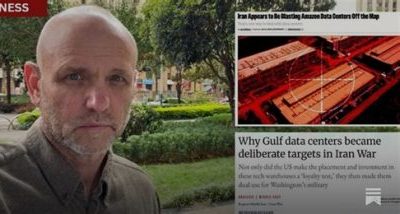
Iran spent $1 million to wipe out $30 billion in data center plans, and take down Amazon in the ME
or go to
Aletho News Archives – Video-Images
From the Archives
Clash of Civilization, Iran Part II
By Jamal Kanj – Intifada-Palestine.com – January 14, 2011
Israel’s survival kit is: perpetuate conflict, insecurity to rationalize collective hate and finally playing victim.
Devoid of conflict, Israel implodes internally; without hate, Zionism loses its justification; and playing eternal victim to continue blackmailing the West. Absence of this holy trinity, Israel ceases to exist. … continue
Blog Roll
 Aletho News
- China Rejects Outside Pressure on Trade Ties After New US Russia Sanctions Bill
- Houthis Keep Advancing as the Red Sea Crisis Deepens
- Iran spent $1 million to wipe out $30 billion in data center plans, and take down Amazon in the ME
- Zionist billionaire pressure to silence Macklemore sparks exodus from Ed Sheeran tour
- House Votes to End Iran War for Third Time
- North Korea Slams US Plan for ‘AUKUS 2.0’ with South Korea and Japan
- Prolonging US-Iran Conflict Not Meeting Interests of Int’l Community – China’s Wang Yi
- EU bans former Zelensky aide from parliament
- NATO-backed Kosovo separatist ‘responsible for war crimes’
- US destroying international space law
- If Americans Knew
- U.S. Makes, Israel Takes: The Real Story of U.S.-Israeli Military Cooperation
- Night raids rise in Palestine
- Tucker Carlson interviews Norman Finkelstein about Gaza
- Groups urge Americans to support Van Hollen legislation on Israel’s killing of Americans & Palestinians
- Trump administration plans to send 40,000 tons of bombs to Israel: report
- Sanctions Target Iran’s Government, But Kill Hospitalized 23-Year-Old Woman
- An alternative view on the book “Israel’s Lobby: America in the Grip of a Foreign Power”
- Ed Sheeran’s band Beoga, other opening acts quit tour after Macklemore was dropped over his pro-Palestinian comments
- The assassination attempt on President Trump in Butler and the various Israeli connections to it
- “We Want That the Whole Land Be Jewish”
- No Tricks Zone
- New Study: ‘Global Drought Shows No Detectable Recent Acceleration Under Climate Warming’
- Economic Masterminds: German Socialists Suggest Taxing Productivity Gains Stemming From Using AI
- The South China Sea Has Not Been Cooperating With The Climate Change Narrative
- Energy Crisis: Germany Enters Heating Season With Historically Low Gas Reserve Fill Levels
- New Study: The Antarctic Ice Sheet Gained Mass From 2020-2024 Due To Staggering Snow And Ice Accumulation
- Study: Ocean Heating Rates From Thousands Of Years Ago ‘Dwarf’ Modern Ocean Heating Rates
- Climate Extremists Target, Attack Large-Scale Power Grid Infrastructure In Germany!
- New Study: Antarctic Ice Melt Has Contributed Less Than 1 Centimeter To Sea Level Rise In The Last 30 Years
- Fear Of Debate: Alarmist German Climate Scientist Calls On Mainstream Media To Discredit Skeptic Voices
- End-Of-August Arctic Sea Ice Extent Hasn’t Fallen In 20 Years, Official Data Show!
 Aletho News