China is the Rock Upon Which the U.S. World Order Breaks
By Ted Snider | The Libertarian Institute | April 4, 2023
In March, Chinese President Xi Jinping visited Russian President Vladimir Putin in Moscow, where they not only “reaffirm[ed] the special nature of the Russia-China partnership,” but “signed a statement on deepening the strategic partnership and bilateral ties which are entering a new era.” As Xi was leaving the Kremlin, he told Putin that “Together, we should push forward these changes that have not happened for 100 years.” That goodbye was Xi’s not so coded call for the end of the American century.
In his February 7 State of the Union Address, U.S. President Joe Biden got carried away by his excitement and arrogantly and ineptly went off script and called out, “Name me a world leader who’d change places with Xi Jinping. Name me one. Name me one.”
But the deflating truth is that the world is lining up behind China and Russia’s vision of a multipolar world no longer exclusively led by the United States. From Africa and its unanimous attendance at the recent Russia-Africa in a Multipolar World conference, to the Middle East and its long list of countries lining up to join the Chinese and Russian led multipolar organizations BRICS and the SCO, to Latin America and most of Eurasia and Asia, including India, the weight of the world is going to Xi’s place to balance American hegemony and support a multipolar world.
Biden’s outburst was an insult and confrontation that was a personal microcosm of U.S. provocation and confrontation of China on a global level. And it has had a corrosive and dangerous effect. An angry China is not answering America’s phone calls. Biden had hoped to talk to Xi on the phone in mid-March, but Chinese officials are not responding to U.S. requests to arrange the call. Defense Secretary Lloyd Austin’s calls to set up talks with his Chinese counterpart have also not been answered.
China is emerging as the rock upon which the U.S.-led alliance breaks.
China’s growing economic, diplomatic, and political influence is beginning to be more powerfully felt on the world stage. The rapid growth of international organizations that support China and Russia’s multipolar world vision is just one piece of evidence. China’s emergence as an influential broker is another.
Beijing has become a power that can shape the world, leaving Washington out of the process. They shocked the world in March by brokering a region transforming agreement between archrivals Saudi Arabia and Iran. And they upset the U.S. in February by initiating a peace process for the war in Ukraine. Both initiatives left the U.S. out in the cold.
The world is no longer unipolar: a world with multiple poles of power is emerging. China’s foreign policy seeks economic growth that demands the fostering of stability in the world; U.S. foreign policy seeks hegemony that demands hostility and schisms that punish and isolate resisters. The problem with China’s emergence as a broker is that it breaks U.S. hegemony. But it is also that China’s peace plans get in the way of America’s war plans.
The U.S. is not ready for peace in the Russo-Ukrainian War. Though peace plans may serve a devastated Ukraine, they do not serve the larger U.S. goals being served by the devastated Ukraine. The United States is not ready for Ukraine to go to the table and end the war before their larger goals are accomplished. As State Department spokesperson Ned Price said in March 2022, “This is a war that is in many ways bigger than Russia, it’s bigger than Ukraine.”
Biden rejected China’s potential role as a broker in the war, insisting that “the idea that China is going to be negotiating the outcome of a war that’s a totally unjust war for Ukraine is just not rational.” National Security Council spokesman John Kirby said that the U.S. does not believe that a Chinese peace proposal “is a step towards a just and durable peace.” He claims that “We all want to see the war end… And a ceasefire, at this time, while that may sound good, we do not believe would have that effect.” Kirby then added that “we don’t support calls for a ceasefire right now. We certainly don’t support calls for a ceasefire that would be called for by the [People’s Republic of China] in a meeting in Moscow that would simply benefit Russia.”
The U.S. has long insisted that no decisions will be made without Ukraine. But if a Chinese-brokered peace were to succeed, it would be because Ukraine has agreed to it. It is remarkable that it is up to Ukraine to continue the war but not up to Ukraine to end it.
China’s peace plans for the Middle East also get in the way of America’s war plans. A U.S.-led unipolar world demands the isolation of Iran. A key piece of that plan is the establishment and maintenance of a regional coalition against Iran. At the heart of that coalition is Saudi Arabia firmly in the anti-Iran camp. The recent Chinese brokered Saudi-Iran agreement breaks that coalition and mends that schism.
The Saudi-Iran agreement has had immediate effects in the region that further challenge American efforts to shape it in their own way. Fast in the wake of the agreement, Saudi Arabia and Iranian ally Syria agreed to reopen their embassies. And the shift in shape is not just bilateral, but regional. Saudi Arabia’s foreign minister is reported to be on his way to Damascus to formally invite Syrian President Bashar al-Assad to this May’s Arab League summit in Riyadh. The invitation, Syria’s first since 2011, would “formally end Syria’s regional isolation.” On April 1, Syria’s foreign minister went to Cairo for the first official visit in twelve years to begin the process of reinstating Syria in the Arab League.
That “leap forward in Damascus’s return to the Arab fold” frustrates U.S. plans to continue the isolation of Assad and Syria. The U.S. has opposed normalization of relations with Syria by countries in the Middle East. The State Department says their “stance on normalization remains unchanged” despite Saudi Arabia’s new stance and the changes in the region.
China has emerged as a diplomatic force that can broker agreements and shape the world in a way that shatters U.S. hegemony in a unipolar world. Some countries are willing to break with the United States and work with China.
France has communicated to China its “appreciation for China’s positive role in promoting peace talks.” Macron’s Diplomatic Advisor, Emmanuel Bonne, told Wang Yi, China’s Director of the Office of the Central Commission for Foreign Affairs, that “France is ready to make joint efforts with China to facilitate cessation of hostilities and seek a peaceful solution.”
France is a major European NATO ally. China’s emergence as a diplomatic superpower has created a crack in the structure of the U.S.-led alliance.
France is not alone in its willingness to work with China. Where France’s independent position reveals a rift within the U.S.-led alliance, Brazil’s independent position reveals the emergence of other poles in the newly emergent multipolar world.
The independent course charted by Brazil and its willingness to work with America’s rival reveals, not only the loss of U.S. hegemony in its own hemisphere, but the loss of U.S. hegemony globally because partnering with China is partnering with BRICS, the large international organization whose goal is to balance U.S. hegemony of a unipolar world.
Brazilian President Luiz Inácio Lula da Silva has supported China’s efforts at negotiating a peace proposal and criticized the United States for speaking “very few words about peace.” But he has also proposed a joint effort, or a “peace club” that could include BRICS members China, India and Brazil and possibly Indonesia. Indonesia has been a leader in the nonaligned world and was recently welcomed as a guest at the BRICS Foreign Ministers’ Meeting.
China’s diplomatic entry into the war in Ukraine highlights a multipolar world that could shape a post world war and sideline the United States.
As China’s economy and the gravitational pull of its multipolar world grow, and as its force is further felt, not only economically but politically and diplomatically, the U.S. stance may stiffen, and Washington may more solidly confront China, not only by increasing sanctions, but by calling on its allies to do the same.
That call could be a challenging one for America’s European allies to answer. If Seymour Hersh’s reporting is correct, it took cutting Germany off from their Russian oil supply by a historic act of sabotage—an act of war—to keep Germany fully on board in America’s sanction regime on Russia. China has been Germany’s most important trading partner for seven consecutive years. Since the Russian invasion of Ukraine, Germany has only increased its investments in and economic dependence on China. It will be more difficult to pressure Germany to cut economic ties with China than it was to pressure it to cut ties with Russia. And it will be asking a lot of Germany to ask it to cut ties with both.
Dr. Suzanne Loftus, Research Fellow at the Quincy Institute Eurasia Program, told me that, “China is Germany’s most important trading partner. Having to sanction China would put Germany in a very difficult position seeing as how it has already had to sanction another one of its significant trading partners (Russia) and is also struggling with U.S. protectionist policies (Inflation Reduction Act).” Loftus continued “[f]acing difficulties at home, Germany will most likely opt out of having to sanction China if the U.S. started to put pressure on Germany to do so. It would otherwise face too much of an economic shock and increased domestic turmoil as a result.”
A hint of that potential split with the United States was provided in November when German Chancellor Olaf Scholz’s defied Washington by going to Beijing, accompanied by the CEOs of Volkswagen, BMW, BASF, Bayer and Deutsche Bank, in part to discuss trade.
On the eve of his trip, Scholz wrote that “new centers of power are emerging in a multipolar world, and we aim to establish and expand partnerships with all of them.” He said that, though China is an economic power that will “play a key role on the world stage in the future,” this does not “justif[y]… calls by some to isolate China.” Scholz then wrote clearly that “even in changed circumstances, China remains an important business and trading partner for Germany and Europe—we don’t want to decouple from it.”
Future American calls to sanction China could force Europe into a choice between solidity with the U.S.-led alliance and continued economic partnership with China. For the U.S., there is a hazardous forecast that that choice could weaken that solidity.
The growing reality of China’s multipolar world vision, China’s emergence as a broker of peace plans that interfere with American war plans, the world’s shifting of shape that sees important countries willing to work with China, and the need for countries to strengthen trade ties with Beijing all suggest that China could be the rock upon which the U.S.-led alliance breaks.
OPEC: Saudis aren’t afraid of US anymore
BY M. K. BHADRAKUMAR | INDIAN PUNCHLINE | APRIL 4, 2023
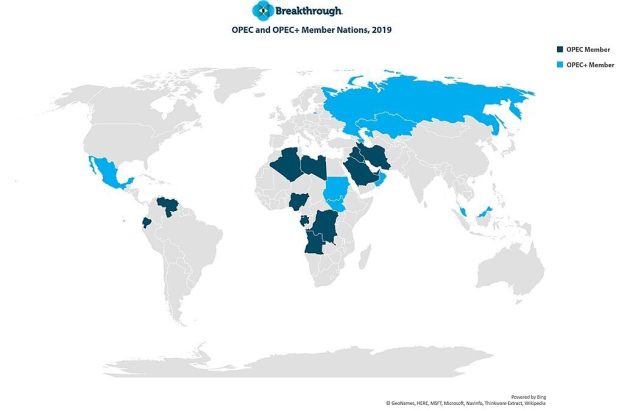
The shock oil production cuts from May outlined by the OPEC+ on Sunday essentially means that eight key OPEC countries decided to join hands with Russia to reduce oil production, messaging that OPEC and OPEC+ are now back in control of the oil market.
No single oil producing country is acting as the Pied Piper here. The great beauty about it is that Saudi Arabia and seven other major OPEC countries have unexpectedly decided to support Russia’s efforts and unilaterally reduce production.
While the 8 OPEC countries are talking about a reduction of one million b/d from May to the end of the year, Russia will extend for the same period its voluntary adjustment that already started in March, by 500,000 barrels.
Now, add to this the production adjustments already decided by the OPEC+ previously, and the total additional voluntary production adjustments touch a whopping 1.6 million b/d.
What has led to this? Fundamentally, as many analysts had forewarned, the Western sanctions against Russian oil created distortions and anomalies in the oil market and upset the delicate ecosystem of supply and demand, which were compounded by the incredibly risky decision by the G7, at the behest of the US Treasury, to impose a price cap on Russia’s oil sales abroad.
On top of it, the Biden administration’s provocative moves to release oil regularly from the US Strategic Petroleum Reserve in attempts to micromanage the oil prices and keep them abnormally low in the interests of the American consumer as well as to keep the inflationary pressures under check turned out to be an affront to the oil-producing countries whose economies critically depend on income from oil exports.
The OPEC+ calls the production cuts “a precautionary measure aimed at supporting the stability of the oil market.” In the downstream of the OPEC+ decision, analysts expect the oil prices to rise in the short term and pressure on Western central banks to increase due to the possible spike in inflation.
What stands out in the OPEC+ decision is that Russia’s decision to reduce oil production by the end of the year has been unanimously supported by the main Arab producers. Independent but time-coordinated statements were made by Saudi Arabia, the UAE, Kuwait, Iraq, Algeria, Oman and Kazakhstan, while Russia confirmed its intention to extend until the end of the year its own production reduction by 500,000 barrels per day, which began in March.
Significantly, these statements have been made precisely by those largest oil producers in OPEC, who have a record of fully utilising their existing quota. Put differently, the reduction in production is going to be real, not just on paper.
Partly at least, the banking crisis in the US and Europe prompted the OPEC+ to intervene. Although Washington will downplay it, in March, Brent oil prices fell to $70 per barrel for the first time since 2021 amid the bankruptcy of several banks in the US and the near-death experience of Credit Suisse, one of the largest banks in Switzerland. The events sparked concern about the stability of the Western banking system and fear of a recession that would affect oil demand.
There is every likelihood that tensions may increase between the US and Saudi Arabia as higher oil prices will push inflation and make it even more difficult for the US Federal Reserve to find a balance between raising the key rate and maintaining financial and economic stability. Equally, the Biden administration must be furious that practical cooperation is still continuing between Russia and the OPEC countries, especially Saudi Arabia, notwithstanding the West’s price cap on Russian oil and Moscow’s decision to unilaterally cut production in March.
However, the Biden administration has only a limited range of options to respond to the OPEC+’s surprise move: one, go for another release of oil from the Strategic Petroleum Reserve; two, pressure US producers to increase domestic oil output; three, back legislation that would allow the US to take the dramatic step of suing OPEC nations; or, four, curb the US’ export of gasoline and diesel.
To be sure, the OPEC+ production cut goes against the Western demand to increase oil output even as sanctions were imposed against Russian oil and gas exports. On the other hand, the disruption in oil supplies from Russia contributed to the rising inflation in the EU countries.
The US wanted the Gulf Arab states to step in and step up oil production. But the latter did not oblige because they felt that there wasn’t enough economic activity in the West and there were clear signs of recession contrary to expectation.
Thus, as a result of the sanctions against Russia, Europe is facing the complex situation of inflation and near-recession known as stagflation. In reality, the adaptive and agile OPEC + read the situation correctly and has shown that it is willing to act ahead of the curve. At a time when the world economy is struggling to grow at a healthy rate, the demand for oil would be relatively less, and it makes sense to cut oil production to maintain the price balance.
All that the Western leaders can complain about is that the OPEC+ cut in oil output has come at an inappropriate time. But the woes of Western economies cannot be laid at the door of OPEC+ as there are inherent problems which are now coming to the surface. For instance, the large scale protests in France against pension reform or the widespread strikes in Britain for higher wages show that there are deep structural problems in these economies, and the governments seem helpless in tackling them.
In geopolitical terms, the OPEC+ move came after a meeting between Russian Deputy Prime Minister Alexander Novak and Saudi Energy Minister Prince Abdulaziz bin Salman in Riyadh on March 16 that focused on oil market cooperation. Therefore, it is widely seen as the tightening of the bond between Russia and Saudi Arabia. In fact, in May, as the largest members of OPEC join Russia in its unilateral reduction, the balance of quotas and the ratio of market shares between and amongst the participants in the OPEC + deal will return to the level set when it was concluded in April 2020.
The big question is, how Moscow might profit from the OPEC+ decision. The rise in crude oil prices particularly benefits Russia. Simply put, the production cuts will tighten up the oil market and thus help Russia to secure better prices for the crude oil it sells. Second, the new cuts also confirm that Russia is still an integral and important part of the group of oil producing countries, despite the western attempts to isolate it.
Third, the consequences of Sunday’s decision are all the greater because, unlike the previous cuts by the OPEC+ group at the height of the pandemic or last October, today, the momentum for global oil demand is up, not down — what with a strong recovery by China expected.
That is to say, the surprise OPEC+ reduction further consolidates the Saudi-Russian energy alliance, by aligning their production levels, thus placing them on equal footing. It is a slap in the face for Washington.
Make no mistake, this is another signal regarding a new era where the Saudis are not afraid of the US anymore, as the OPEC “leverage” is on Riyadh’s side. The Saudis are only doing what they need to do, and the White House has no say in the matter. Clearly, a recasting of the regional and global dynamics that has been set in motion lately is gathering momentum. The future of petrodollar seems increasingly uncertain.
OPEC+ Oil Pumping Cut Brings Market ‘Stability’ and Busts Sanctions on Russia
By James Tweedie – Sputnik – 04.04.2023
OPEC’s cut in production has undermined US-led attempts to cap the export price of Russian oil. Geopolitical analyst Mohammed Alhamed, president of the Saudi Elite group and economist, and Professor Mark Frost said the US should back off and let market forces rule.
OPEC’s latest crude oil production cut will stabilize the world market while foiling US-led attempts to impose “price cap” sanctions on Russian exports.
OPEC+, which includes the organization’s 13 member states plus 11 others, including Russia, announced a 1.66 million barrel-per-day cut in production on Monday, sending the price of crude soaring on international markets.
Russia’s deputy prime minister said Moscow may also extend its 500,000 barrel-per-day production cut until the end of this year.
The US, UK, European Union, and Japan agreed earlier this year on a $60-per-barrel price limit on Russian crude, with a $100 cap on refined gasoline and diesel and $45 on household fuel oil as part of sanctions over Russia’s military operation in Ukraine. Moscow warned that those measures would have negative consequences.
Mohammed Alhamed told Sputnik that while the US had called the production cut “ill-advised,” OPEC+ had been “instrumental in bringing stability and transparency to the oil market, which has benefited the world economy while many American banks are facing bankruptcy.”
He said threats by US congressmen and women to ban weapons sales to Saudi Arabia over the previous oil production cut were “likely seen as a stupid idea” which would “reflect negatively on US interests in the Middle East.”
“A strained relationship with the US could have negative repercussions on both countries” the analyst said, cautioning Washington not to interfere in OPEC+, which “operates independently and has the right to make decisions that benefit its members.”
The US, still a major oil producer itself, should “focus on addressing its own oil and climate change agenda before criticizing other countries,” Alhamed said.
“Saudi Arabia and OPEC+ have made significant efforts to bring stability to the oil market and should be commended for their efforts.”
Professor Mark Frost told Sputnik that the production cut was a “signal” to the US that “you’re taking us for granted.”
He noted that in “any cartel, there’s a strong incentive to cheat” — and that the rising price of oil would allow European countries to pay prices above the Western-imposed cap on seaborne crude shipments from Russia.
“I think somebody got on the phone and said, ‘hey, Biden, we’re going to buy some oil. And if you don’t like it, that’s tough,’” Frost said.
“You can’t have volatile inflation forever. Markets start to shut down. People start to lose faith,” he added. “People start to become risk averse, and at the extreme, the risk is we become Japan in the nineties, where it requires negative interest rates to get people to borrow any money.”
Frost pointed to fast-food chain McDonald’s announcement of mass lay-offs, saying: “That’s a leading indicator because whether people like it or not, capitalism is trickle-down economics.”
The academic said that the rampant inflation caused by sanctions on Russia — one of the world’s biggest food as well as energy producers — combined with the US Federal Reserve raising interest rates in “quantitative tightening” in response means “we’re going to see at least two million people directly starve to death.”
“A lot of people don’t realize a lot of the world doesn’t do that well,” Frost stressed. “And relatively small increases in crucial things like rice, cooking oil and things like that causes people to starve to death.”
Saudi, Iran, Syria envoys meet in Oman
MEMO | April 4, 2023
The ambassadors of Saudi Arabia, Iran, Syria and Iraq held a meeting in the Gulf country of Oman on Tuesday, according to Iraqi Ambassador, Qais Saad Al-Amiri, Anadolu News Agency reports.
The diplomats exchanged views about regional affairs during the meeting hosted by Al-Amiri “in an atmosphere of optimism and familiarity among the attendees,” the Iraqi Embassy in Muscat tweeted.
Last month, Saudi Arabia and Iran announced the restoration of their diplomatic relations during talks hosted by Beijing, a deal called a diplomatic coup by China.
The two sides are expected to open embassies in each other’s capitals within two months since the deal was signed on 10 March.
Talks are also under way between Saudi Arabia and Syria to resume consular services in the two countries, according to the Saudi Foreign Ministry.
Simultaneous US aggression in Black Sea and Mediterranean as multipolarity accelerates
By Drago Bosnic | April 3, 2023
Following the recent engagements between illegal American occupation forces in northeastern Syria and what the Pentagon called “pro-Iranian forces”, leaving dead and wounded on both sides, the United States has decided to further escalate tensions in Syria and the Middle East as a whole. As the multipolar, or should we say the actual world, is engaging in real and masterful diplomacy (in stark contrast to the US), reconciling archrivals such as Iran and Saudi Arabia and slowly but surely normalizing relations between Syria and Turkey, the stabilization of the globe seems like an unstoppable process. This is deeply alarming to the political West, the only entity on the planet in constant need of widespread death, destruction and chaos so it can maintain the illusion of the “garden-jungle” geopolitical framework.
Using the recent clashes as an excuse, Washington DC announced an extension of the CSG (carrier strike group) deployment led by USS “George H.W. Bush” Nimitz-class supercarrier, over 9.000 km away from its home port of Norfolk in Virginia. On Friday, US CENTCOM (Central Command) spokesman Colonel Joe Buccino stated that the extension of the “George H.W. Bush” CSG, inclusive of the “USS Leyte Gulf”, the “USS Delbert D. Black” and the “USNS Arctic” allows options to “potentially bolster the capabilities of CENTCOM to respond to a range of contingencies in the Middle East”. At the time of the announcement, the CSG was near Sicily. Apparently, the deployment will also include “a scheduled, expedited deployment of a squadron of A-10 attack aircraft to the region.”
According to Reuters, at least one US official, “speaking on the condition of anonymity”, confirmed that the George H.W. Bush CSG was “expected to remain in the European Command area of responsibility”, most likely until further notice, meaning that the US wants to keep tensions as high as possible for as long as possible. For the mainstream propaganda machine, the conflict in Syria is still called the “Syrian Civil War”, although it is anything but. Washington DC and its numerous satellite states in the region have been attacking the unfortunate country for over a decade now, resulting in hundreds of thousands of dead and millions of refugees. In addition, the US maintains an illegal occupation of northeastern Syria, where it’s supposedly “guarding” (i.e. stealing) the country’s oil reserves.
However, US militancy in Syria (and the wider Middle East) is only a fraction of the belligerent thalassocracy’s aggression against the world. Concurrently, Washington DC and its numerous NATO satellite states also conducted naval drills off the coast of Romania’s Tulcea County on the country’s Black Sea coast. The region borders the Odessa Oblast (an area currently occupied by the Kiev regime). Apparently, the war games included a scenario where thousands of NATO soldiers simulated coastal defense against a large-scale attack by an “unnamed aggressor” (obviously referring to Russia). Dubbed “Sea Shield 23”, the naval drills started on March 20 and were concluded on Sunday, April 2.
In total, close to 3,500 servicemen from the US and eleven other NATO vassals took part, including at least 30 naval ships, 14 aircraft and 15 other “fast intervention” boats. The live-fire drills were conducted both in the Black Sea and the Danube Delta, approximately 30 km from the border with Odessa Oblast. Since Russia started the special military operation (SMO), the US has conducted a number of large-scale military exercises in Eastern Europe to simulate a potential conflict with Moscow. This includes a recent simulated nuclear attack on Saint Petersburg, Russia’s second-largest city with close to six million inhabitants. A USAF B-52H “Stratofortress” flying in Estonian airspace circled in an area barely 100 km from the Russian border.
To put that into perspective, we should imagine a Russian Tu-95MS “Bear” strategic bomber/missile carrier flying just 60 miles off Manhattan, simulating a thermonuclear strike on New York City, one of the most important urban areas in the US. Still, that doesn’t prevent the US from doing everything in its power to provoke Russia. Considering that the “deep diving pro-Ukrainian group” that conducted the Nord Stream terrorist attacks has now also been dangerously close to the Turk (formerly South) Stream pipelines, the Russian Black Sea Fleet will need to be as vigilant as ever. The pipeline is the only major energy hub supplying natural gas to Turkey and Southeast Europe.
In the meantime, the world is working towards creating conditions for peaceful coexistence and cooperation of the globe’s numerous civilizations. Organizations such as BRICS and SCO (Shanghai Cooperation Organization) are rapidly expanding by admitting new members, with Iran being the most recent constituent of SCO. Saudi Arabia also became a dialogue partner on March 29, marking an important milestone in the organization’s history, which now includes all major oil producers in Eurasia and the Middle East. This also marks a crucial step toward eliminating Western currency dominance, the key provision to limiting the belligerent power pole’s ability to conduct military and economic aggression against the world.
Drago Bosnic, independent geopolitical and military analyst.
The people who brought you the Iraq war loudly support arming Ukraine. Where will this lead?
By Andrey Sushentsov | RT | March 30, 2023
This year’s twentieth anniversary of the illegal Iraq invasion paradoxically coincided with major international events. Xi Jinping, General Secretary of the Central Committee of the Communist Party of China, was in Moscow on the day, while a Russia-Africa Parliamentary Forum opened at the same time.
In 2003, at the height of its power, the US proclaimed its “unipolar moment” in which it would dominate unchallenged, needing no allies and tolerating no objections from adversaries. History, it was believed, had a single purpose, and they would stop at nothing to achieve it. Indeed, American military, political and economic dominance seemed total at the time, echoing the sentiments of Henry Kissinger, who a few years earlier had written “America at the Apex.” Twenty years later, we are witnessing the flowering of multi-polarity: in Moscow, the General Secretary of the Central Committee of the Communist Party of China was talking to the Russian President, two countries contributing to a change the world has not seen in a hundred years. This transience of world history shows how quickly historical cycles change, but it is also important that the US itself, through its actions in different parts of the world, is accelerating its course.
One of the most important strategic mistakes made by Washington was the invasion of Iraq. Based on a false pretext and the deliberate misleading of the international community, it led to a series of significant war crimes, a catastrophic civil war, the shattering of Iraqi statehood and enormous repercussions for the entire Middle East. Just a few years of American presence in Iraq resulted in huge numbers civilian deaths, indiscriminate use of force, and the destruction of several cities, including Mosul. During the evacuation of the Russian embassy amid the 2003 US invasion, a convoy of diplomats came under American fire and several were injured. US private military contractors, who at one point had the same presence in the country as official troops, committed a number of war crimes. The abuse of prisoners by the US military at Abu Ghraib prison near Baghdad has been well documented. When the International Criminal Court raised the question of American citizens being charged over offenses in Afghanistan and Iraq, the US responded that it would prosecute the judges who raised the issue and that they should withdraw their initiatives immediately.
Arguably the greatest crime of the US in Iraq has been to create a civil war that has resulted in a terrible number of casualties with estimates ranging from 600,000 to one million.
From 2005 to 2007, the country’s population curve flattened, despite the fact that it has always had one of the highest birth rates in the region. The dismantling of the central government triggered geopolitical processes in the region and power in the formerly Sunni-ruled country fell into the hands of the Shia Arab majority, which began a rapprochement with Shia Iran. Since then, Tehran’s strategic position in Iraq has remained significant.
Some of the consequences of the US invasion have backfired as well. For example, the fight against terror led to an increase in the influence of ISIS, an organization banned in Russia, in Iraq. Unexpectedly, Iran’s strengthened role in the country meant that 150,000 US troops were unable to control the situation in Iraq, while a few dozen Iranian diplomats in the embassy in Baghdad were quite capable of doing so. The metastasis of the Arab Spring, which began to spread to various countries in the region, was also one of the consequences of the Iraq war.
Meanwhile, US financial costs for the war are estimated at several trillion dollars. Overall, the politically unsuccessful operations in Iraq and Afghanistan have led to a decline in American influence and status in the region, as evidenced by the recent restoration of diplomatic relations between Saudi Arabia and Iran, mediated by China.
The Americans formulated a reasonable objective for the military operation as early as 2007. It was voiced by General David Petraeus at a US congressional hearing. In response to a question about American interests in the country, he said, “Our purpose is not to create a Jeffersonian democracy, our purpose is to create the conditions for our troops to withdraw.” The implication was that pulling out should not look like defeat. At the time, this reasoned objective was well in line with American interests and showed the depth of the strategic error the Americans had made in preparing for the 2003 invasion.
Today, many of those responsible for that war – and their media and academic cheerleaders – are now loudly supporting Washington’s position on Ukraine.
It’s unlikely that the impact of their actions will be any different this time.
Andrey Sushentsov is the Valdai Club program director.
Xi’s ‘Chilling’ Remarks: A Multipolar World Offers Challenges and Opportunities to the Middle East and Africa
By Ramzy Baroud | MEMO | March 26, 2023
The final exchange, caught on camera between visiting Chinese President Xi Jinping and his Russian host and counterpart, Vladimir Putin, sums up the current geopolitical conflict, still in its nascent stages, between the United States and its Western allies on the one hand, and Russia, China and their allies, on the other.
Xi was leaving the Kremlin following a three-day visit that can only be described as historic. “Change is coming that hasn’t happened in 100 years and we are driving this change together,” Xi said while clasping Putin’s hand.
“I agree,” Putin replied while holding Xi’s arm. ‘Please take care, dear friend,” he added.
In no time, social media exploded by sharing that scene repeatedly. Corporate western media analysts went into overdrive, trying to understand what these few words meant.
“Is that part of the change that is coming, that they will drive together?” Ian Williamson raised the question in the Spectator. Though he did not offer a straight answer, he alluded to one: “It is a chilling prospect, for which the west needs to be prepared.”
Xi’s statement was, of course, uttered by design. It means that the Chinese-Russian strong ties, and possible future unity, are not an outcome of immediate geopolitical interests resulting from the Ukraine war, or a response to US provocations in Taiwan. Even before the Ukraine war commenced in February 2022, much evidence pointed to the fact that Russia and China’s goal was hardly temporary or impulsive. Indeed, it runs deep.
The very language of multipolarity has defined both countries’ discourse for years, a discourse that was mostly inspired by the two countries’ displeasure with US militarism from the Middle East to Southeast Asia; their frustration with Washington’s bullying tactics whenever a disagreement arises, be it in trade or border demarcations; the punitive language; the constant threats; the military expansion of NATO and much more.
One month before the war, I argued with my co-writer, Romana Rubeo, that both Russia and China might be at the cusp of some kind of unity. That conclusion was drawn based on a simple discourse analysis of the official language emanating from both capitals and the actual deepening of relations.
At the time, we wrote,
“Some kind of an alliance is already forming between China and Russia. The fact that the Chinese people are taking note of this and are supporting their government’s drive towards greater integration – political, economic and geostrategic – between Beijing and Moscow, indicates that the informal and potentially formal alliance is a long-term strategy for both nations”.
Even then, like other analysts, we did not expect that such a possibility could be realized so quickly. The Ukraine war, in itself, was not indicative that Moscow and Beijing will grow closer. Instead, it was Washington’s response, threatening and humiliating China, that did most of the work. The visit by then-US House Speaker, Nancy Pelosi, to Taiwan in August 2022 was a diplomatic disaster. It left Beijing with no alternative but to escalate and strengthen its ties with Russia, with the hope that the latter would fortify its naval presence in the Sea of Japan. In fact, this was the case.
But the “100 years” reference by Xi tells of a much bigger geopolitical story than any of us had expected. As Washington continues to pursue aggressive policies – with US President Joe Biden prioritising Russia and his Republican foes prioritising China as the main enemy of the US – the two Asian giants are now forced to merge into one unified political unit, with a common political discourse.
“We signed a statement on deepening the strategic partnership and bilateral ties which are entering a new era,” Xi said in his final statement.
This ‘no-limits friendship‘ is more possible now than ever before, as neither country is constrained by ideological confines or competition. Moreover, they are both keen on ending the US global hegemony, not only in the Asia and Pacific region, but in Africa, the Middle East and, eventually, worldwide as well.
On the first day of Xi’s visit to Moscow, Russia’s President Putin issued a decree in which he has written off debts of African countries worth more than $20 billion. Moreover, he promised that Russia is “ready to supply the whole volume sent during the past time to African countries particularly requiring it, from Russia free of charge ..,” should Moscow decide “not to extend the (grain) deal in sixty days.”
For both countries, Africa is a major ally in the upcoming global conflict. The Middle East, too, is vital. The latest agreement, which normalised ties between Iran and Saudi Arabia is earth-shattering, not only because it ends seven years of animosity and conflict, but because the arbitrator was no other than China itself. Beijing is now a peace broker in the very Middle East which was dominated by failed US diplomacy for decades.
What this means for the Palestinians remains to be seen, as too many variables are still at work. But for these global shifts to serve Palestinian interests in any way, the current leadership, or a new leadership, would have to slowly break away from its reliance on western handouts and validation, and, with the support of Arab and African allies, adopt a different political strategy.
The US government, however, continues to read the situation entirely within the Russia-Ukraine war context. US Secretary of State Antony Blinken responded to Xi’s trip to Moscow by saying that “the world should not be fooled by any tactical move by Russia, supported by China or any other country, to freeze the war (in Ukraine) on its own terms.” It is rather strange, but also telling that the outright rejection of the potential call for a ceasefire was made by Washington, not Kyiv.
Xi’s visit, however, is truly historic from a geopolitical sense. It is comparable in scope and possible consequences to former US President Richard Nixon’s visit to Beijing, which contributed to the deterioration of ties between the Soviet Union and China under Chairman Mao Zedong.
The improved relationship between China and the US back then helped Washington further extend its global dominance, while putting the USSR on the defensive. The rest is history, one that was rife with geostrategic rivalry and divisions in Asia, thus, ultimately, the rise of the US as the uncontested power in that region.
Nixon’s visit to Beijing was described by then-Ambassador Nicholas Platt as “the week that changed the world.” Judging that statement from an American-centric view of the world, Platt was, in fact, correct in his assessment. The world, however, seems to be changing back. Though it took 51 years for that reversal to take place, the consequences are likely to be earth-shattering, to say the least.
Regions that have long been dominated by the US and its western allies, like the Middle East and Africa, are processing all of these changes and potential opportunities. If this geopolitical shift continues, the world will, once again, find itself divided into camps. While it is too early to determine, with any degree of certainty, the winners and losers of this new configuration, it is most certain that a US-western-dominated world is no longer possible.
Tyranny on the waters: The UAE-Israeli occupation of Yemen’s Socotra Island
By Karim Shami | The Cradle | March 24, 2023
Located off the southern coast of Yemen in the Arabian Sea, the Socotra archipelago has become a focal point of regional and international interest because of its strategic proximity to one of the world’s busiest shipping lanes.
On 21 June, 2020, the Yemeni island was militarily occupied by Saudi Arabia’s Emirati coalition partner, which has aggressively pursued a policy of establishing and controlling ports throughout West Asia and the Horn of Africa since 1999.
The archipelago consists of four large islands: Socotra (3,796km2), Abd al-Kuri (130.2km2), Samhah (39.6km2), and Darsah (7.5km2), as well as three small islets.
Socotra, the biggest of the islands, lies 350 km south of the Arabian Peninsula and 95 km from Somalia. It is surrounded by the Gulf of Aden, the Indian Ocean, and the Arabian Sea, and faces the Horn of Africa from the west. Around 20,000 shipping vessels pass around Socotra each year, including 9 percent of the world’s annual global petroleum supply.
The War on Yemen
The assault on Yemen was launched on 26 March, 2015, in an announcement by Saudi Ambassador Adel al-Jubeir from Washington DC, in which he stated that a coalition of ten countries, led by Saudi Arabia and the UAE, would take military action to reinstate the government of Yemeni President Abdrabbuh Mansour Hadi.
Hadi had been ousted in popular protests in 2014, after losing the capital city, Sanaa, to the joint forces of the Ansarallah movement and their allies in the country’s armed forces. Based in northern Yemen, the Ansarallah movement had been advocating for fair representation in the government for a long time.
With US-backing, Saudi Arabia launched “Operation Decisive Storm,” and the air strikes began. Initially expected to last only a few weeks or months – and according to MbS himself, just “a few days” – the Yemeni war has now entered its eighth year and taken on a markedly different shape than the coalition initially contended.
Two years into the war, the Emiratis began pursuing their own hidden agenda of establishing a “self-styled maritime empire” in Yemen, which veered sharply from Riyadh’s objectives. To achieve this goal, Abu Dhabi sought to control the country’s southern coastline and its ports and enlisted the help of a local Yemeni proxy called the Southern Movement.
The Southern Movement was formed by secessionist tribes and groups seeking to divide Yemen along the old partition lines of 1967–1990. However, the movement had to be restructured to match the UAE’s aspirations, and in 2017 it was transformed into the Southern Transitional Council (STC).
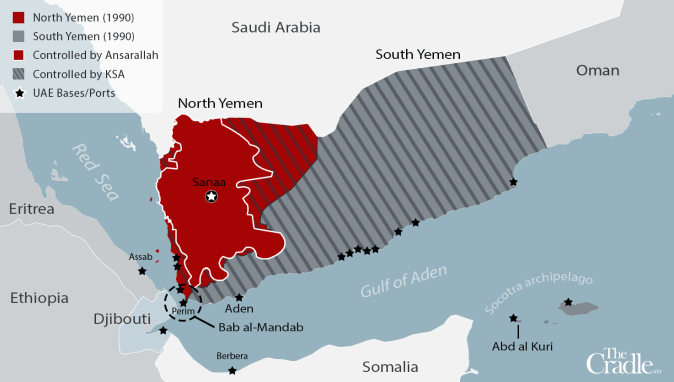
Map of the Emirati-controlled areas and ports in southern Yemen
The significance of Socotra
Socotra Island falls under the territorial jurisdiction of the exiled Hadi government, which to this day – despite his physical absence and the replacement of the “presidency” with an 8-member, Saudi-sponsored Presidential Leadership Council (PLC) – remains Yemen’s internationally-recognized government.
However, on 30 April, 2018, the UAE deployed hundreds of troops with artillery and armored vehicles on the island, which is located 350 km away from the mainland conflict, without any prior coordination with Yemeni authorities.
The Riyadh-backed Yemeni government condemned the Emirati aggression, backed by local islanders protesting against the occupation of their territory. The Saudis were forced to intervene by sending troops and training locals to deter the UAE from seizing the island.
But later that year, UAE General Khalfan al-Mazrouei arrived on Socotra Island and has since been considered its de facto ruler. Under his leadership, the Emiratis gained the loyalty of local tribes by using bribery under the guise of “humanitarian aid.” They offered Socotra residents UAE passports and promised them an improved quality of life.
The STC seizes Socotra
On the morning of 21 June, 2020, the UAE-backed STC separatists forcibly seized control of Socotra and ousted the Saudi-backed, pro-Hadi forces.
The UAE had been planning and preparing for this operation for two years, using its Yemeni proxies to gain full control over the Socotra archipelago. The Emirati flag was raised across the territory, and UAE telecommunication companies replaced Yemeni ones. Consequently, all phone calls from Socotra now register Emirati phone networks.
UAE-Israel normalization
Three months after the seizure of Socotra, the highly-controversial Abraham Accords was signed in Washington DC between Israel and the UAE, along with Bahrain, Morocco, and Sudan. On the Arab side, the normalization thrust was led by Abu Dhabi, which quickly moved to expand its diplomatic, military, and economic ties with Tel Aviv.
Shortly after the signing of the Abraham Accords, reports and images of Israeli “tourists” visiting Socotra began to emerge. According to an Al-Mayadeen report, however, the Israeli visitors were not tourists, but rather, military experts.
Abd al-Kuri Island
In February 2023, Ansarallah released a statement condemning the UAE’s eviction of residents from Abd al-Kuri, the archipelago’s second-largest island. The resistance movement accused Abu Dhabi of carrying out a long-planned operation to transform Socotra into an Israeli-Emirati military and intelligence hub.
These actions by the UAE are not isolated incidents. In another 2022 episode, Ansarallah accused Abu Dhabi of transferring fishermen from the small island of Perim (13 km2) to other parts of the Taiz Governorate. Several months later, satellite imagery revealed the construction of a military base runway on the volcanic Island. Perim is now empty of its original inhabitants, according to media reports.
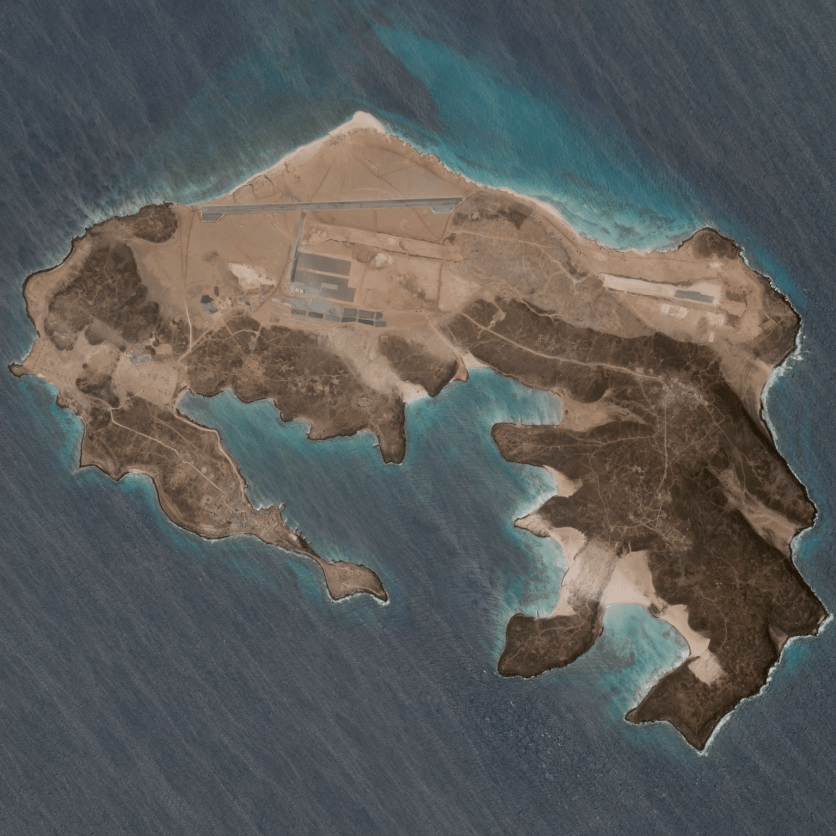
An Emirati military base on Perim Island (Mayyun in Arabic) on the Bab al-Mandab Strait
Perim Island has historically divided the Bab al-Mandab Strait into two waterways – whoever controls the island holds strategic influence over the strait. While Ansarallah’s statement about Emirati designs on Socotra was not entirely new, it raised hackles throughout the Arab world by confirming Israel’s military and intelligence presence on this key Yemeni island.
The UAE’s maritime ambitions
Many have questioned Abu Dhabi’s motivation for seizing Socotra and risking its relationships with Saudi Arabia and neighboring Oman (virtually overnight surrounded by UAE ports and bases). The UAE’s actions may be entirely attributed to the strategic vision of its President Mohammed bin Zayed (MbZ) and his no-longer secret desire to establish an Emirati maritime empire –from the Persian Gulf to the Red Sea – by controlling the region’s key waterways.
The UAE’s economic reliance on these waterways is a clear driver of MbZ’s plans: non-petroleum commodity re-exports make up almost half of Abu Dhabi’s total exports. As such, maritime security is a top priority in the country’s foreign policy calculations.
The UAE currently controls 12 ports off the coast of Yemen, including Aden, Makha, Mukalla, Al-Dabba, Bir Ali, Belhaf, Rudum, Zoubab, Al-Khawkhah, Al-Khouba, Qena, and Al-Nashima. The country is also building a new port in Al-Mahra that will cost an estimated $100 million.
By controlling these ports and the Bab al-Mandab Strait, the UAE can dominate one of the busiest shipping lanes in the world, elevating its position in global and regional trade to a strategic player.
In addition to its aggressive accumulation of Yemeni ports, the UAE also has a significant presence in the Horn of Africa, where it currently controls two ports in Eritrea and one in Somalia. It previously owned a port in Djibouti, but this became a point of territorial friction between the two countries. The UAE’s control over these ports and their strategic location in the region allow it to project its power and expand its influence in East Africa.
Why is Socotra important to Israel?
The UAE and Israel share mutual security concerns over Iran’s regional ascension over the past decade. The Islamic Republic’s naval presence is expanding into many new waterways, and its seaborne activities from the Persian Gulf to the Red Sea alarm both nations. Given Washington’s growing reluctance to engage its armed forces in West Asia, MbZ turned to the region’s military behemoth and main Iranian rival to help him execute his vision. Unlike Israel, no other regional state has the ability to garner unconditional US support – nor the willingness to cavalierly defy international law and territorial integrity.
Abu Dhabi has calculated that it stands to benefit from Israel’s intelligence network and early warning systems, particularly after its cities were subject to unprecedented Ansarallah missile and drone strikes in January 2022.
For Tel Aviv, its physical presence in any Arab state is perceived as a victory, which aligns with its ambitions for regional expansion. By establishing a base on Abd al-Kuri Island, Israel can reinforce its maritime security – around 25 percent of its trade passes through the Bab al-Mandab Strait. Another objective of the Israeli-Emirati military and intelligence hub could be to gather data or engage in espionage activities in the southern Arabian Peninsula and the Horn of Africa.
During the 1973 Arab-Israeli war, Yemen – in partnership with Egypt – blocked the passage of Israeli ships and tankers from accessing the strategic strait, leading to disastrous consequences for Israel.
The tactic could be replicated under Ansarallah Chief Abdel Malak al-Houthi’s leadership, since the movement considers Israel one of its main regional adversaries. While it may seem like a distant possibility, if the war concludes under current Riyadh-Sanaa peace efforts and Ansarallah gains control of Yemen’s south, the movement will enjoy unusual leverage to obstruct Israeli shipments whenever Tel Aviv launches regional aggressions. It should be noted that Ansarallah has already publicly threatened, on several occasions, to strike sensitive Israeli sites with its new missile capabilities.
Moreover, there has been an ongoing “ghost ship war” between Israel and Iran for several years, with occasional reports of Iranian or Israeli ships being attacked in these waterways. Israel’s presence on Socotra Island could provide it with leverage over Iran in their waterway stand-off and enable Tel Aviv to counter Ansarallah inside Yemeni territory.
NATO’s Combined Maritime Forces
It is important to note that the involvement of the US in the Israeli-Emirati collaboration and actions in Yemeni waters is not confirmed. However, it is true that the US has been a maritime security provider for the Persian Gulf monarchies for decades, and its NATO-led Combined Maritime Forces (CMF) have been present in West Asian waters since 1983 – including leading hostile actions against Iraq and Somalia.
The CMF alliance has assumed responsibility for the security of four bodies of water: The Red Sea, Persian Gulf, Arabian Sea, and the Gulf of Aden.
But with China’s rapid rise as a global economic competitor, US policy pivoted further eastward, and Washington has sought to subcontract out its West Asian security policies to its regional allies.
As such, last December, the CMF assigned command of its Red Sea task force to the Egyptian Navy, who took over from US naval forces. In this regard, the UAE, backed by Israel, may be another candidate to lead a NATO-backed naval security operation in the region.

Map of the NATO-led Combined Maritime Forces (CMF) areas of operation in West Asian waterways
Implications for Iran and Saudi Arabia
Any Israeli expansion is likely to alarm Iran and vice versa, potentially leading to direct or proxy clashes in various regional theaters. However, the presence of the UAE – Iran’s second-largest trading partner – in southern Yemen may limit Tehran’s options. Unless Iran perceives a serious security threat from the new “Arab-Israeli alliance,” it is unlikely to take any significant actions that could harm its trade relations with Abu Dhabi.
The war against Yemen has severely damaged Saudi Arabia’s image as a regional powerhouse. During the last few years, all major Saudi cities have been the subject of Ansarallah missile and drone strikes – including the country’s key oil infrastructure.
It has been humiliating for the Persian Gulf’s wealthiest and most heavily militarized state to have its vulnerabilities so completely exposed by West Asia’s poorest nation. In contrast, the UAE has thus far only benefited from the Yemen war and expanded its influence in the region.
Recently, there have been reports of a possible breakthrough in negotiations between Riyadh and Ansarallah, and observers are hoping for an early roadmap to end the conflict during the holy month of Ramadan. Obstacles are aplenty: The UAE is notably absent from the discussions, the Emirati-backed Yemeni separatists – the STC – reject any solution that doesn’t leave them in control of the south, and the US has sought to scuttle any final solution that undermines Washington’s regional leverage.
Liberating the island
Of all the stakeholders with interest in Socotra Island, none are ultimately as important as the Yemeni ones, primarily the UAE-backed STC, the Saudi-backed PLC, and Iran-backed Ansarallah.
In his most recent televised appearance, Ansarallah’s Abdel Malik al-Houthi stated: “We seek to defeat the aggression, whether on the islands, on land or at sea, and from anyone who violates our independence and the sovereignty of our country.” Unlike other leaders, al-Houthi’s threats are usually translated into action and Ansarallah will not hesitate to strike the Israeli-Emirati bases or seize their ships if the aggression continues.
Ansarallah is currently the strongest player in Yemen, controlling more than 80 percent of the country in terms of population density. On the other hand, the PLC is the most vulnerable of the three main Yemeni players, and Riyadh’s recent rapprochement agreement with Tehran has further weakened the group. If an agreement is reached between Riyadh and Sanaa, the PLC will have one of two options: to hand over their weapons or merge into Ansarallah’s armed forces.
On the other side of the spectrum, the UAE-backed STC is worried about ongoing peace talks and fears being left alone to fight head-to-head with Ansarallah-aligned armed forces.
The question now is whether there will be a peace deal between Saudi Arabia and Ansarallah that excludes the UAE and its Yemeni proxies. If that happens, Sanaa’s armed forces will almost certainly turn their big guns on the Emiratis and their Yemeni interests. The Saudis will have already calculated this outcome as they seek to advance a deal with Ansarallah. In this event, it is unlikely that Riyadh will come to Abu Dhabi’s assistance. Their common goals in Yemen ended years ago.
Turkiye ‘reviewing options’ for Syria withdrawal: Report
The Cradle | March 23, 2023
Lebanese daily Al-Akhbar released a report on 23 March claiming that Turkiye is willing to make concessions regarding the fate of its military presence in Syria, and is reviewing options to set a timeframe for the withdrawal of its troops from the country.
This comes in light of Damascus’ repeated insistence that the continuation of normalization efforts between the two countries depends on this condition.
“Turkish officials are studying, at the present time, several options regarding the fate of the Turkish military presence in Syria and the possibility of setting a schedule to end it in connection with field, humanitarian and political developments,” Syrian opposition sources told Al-Akhbar.
According to these sources, Turkiye will present proposals on this matter to Russian and Iranian mediators and is hoping that Tehran and Moscow will be able to act as “guarantors” to convince Syria that Ankara will properly implement any agreement that is reached, “whatever the results of the Turkish presidential elections.”
Damascus said in January that Turkish President Recep Tayyip Erdogan is using the reconciliation with Syria as a ploy to secure himself in the upcoming election in Turkiye. Many have reinforced this, alleging that Erdogan wishes to use the normalization to portray himself as a champion in diplomacy, and as the solver of the Syrian refugee crisis in Turkiye.
Since the devastating earthquake that struck Turkiye and Syria at the start of last month, Erdogan’s chances at reelection have slimmed, according to the most recent polls.
Russia is currently working to set a date for a four-way meeting between the foreign ministers of Ankara, Damascus, Moscow, and Tehran, aimed at moving forward with the reconciliation. However, this meeting has so far failed to materialize, given Syria’s insistence on clear Turkish concessions.
According to Al-Akhbar, Turkiye’s newfound willingness to concede on the issue of its military presence is the reason behind the Turkish foreign minister’s latest claim that the meeting could be held “within days.”
US continues to use terrorists in Syria – Russia
RT | March 20, 2023
The US is still working with Islamic State terrorists and other Islamist groups to carry out attacks against Bashar Assad’s government forces in Syria, Russia’s Foreign Intelligence Service (SVR) chief, Sergey Naryshkin, has claimed.
According to an SVR report released on Monday, the US military’s Al-Tanf base in southern Syria is coordinating subversive activities, with the actions of terrorist groups being planned by representatives of the Central Command of the US Armed Forces as well as US intelligence officers.
The SVR stated that a special role has been assigned to the so-called Free Syrian Army, which consists of Kurdish and Arab detachments operating in the central and northeast parts of Syria. “Through them, the Americans and their British allies are working with the underground formations of Islamic State [IS, formerly ISIS] that still remain in remote areas of the country,” it was alleged.
“ISIS was instructed to incite hostilities in the Syrian south-west (the provinces of Suwayda and Deraa), in the central part of the country (Homs) and east of the Euphrates River (Raqqa, Deir ez-Zor). For this, it is planned to form several detachments of radicals with a total number of about 300 people. After special training, they will be involved in attacks on military facilities in Syria and Iran,” the statement added.
The SVR claims that the US also intends to use terrorists in the region around the capital, Damascus, to conduct tasks such as kidnapping Russian and Iranian servicemen.
In addition to coordinating the actions of Islamist groups, Washington is providing terrorists with weapons, according to the SVR. Several dozen four-wheel-drive pickup trucks with heavy machine guns, as well as a number of rocket systems such as NLAW ATGMs, TOWs, and Igla MANPADS are set to be handed over to fighters in the near future, the report alleged.
Washington’s actions put it “on the same level” as Islamic terrorists and IS militants, and is a manifestation of state terrorism, the SVR argued.
In February, the SVR reported that the US was using Islamist extremists to plan terrorist attacks in Russia and former Soviet republics. Washington has been training as many as 60 terrorists at the Al-Tanf base to make improvised explosive devices and use them to target diplomats, public officials, law enforcement officers, and military personnel, the intelligence service claimed.
Featured Video

It’s the Occupation, Stupid
or go to
Aletho News Archives – Video-Images
From the Archives
A superpower and “the world’s sickest warrior state”
By Paul J. Balles | March 8, 2010
Living through five or six major wars has hardened me to what I thought were the extremes of inhuman cruelty and brutality.
Two things made those extremes almost bearable: the brutality always revealed – at least according to the media coverage – the viciousness of the enemy. It was therefore quite understandable when our “brave men and women” pulverized the enemy.
Films of Japanese torturing captive Americans somehow justified holding Japanese Americans in internment camps during World War II; and only a small percentage of Americans found the bombing of Hiroshima and Nagasaki unreasonably vengeful at best, at worst, depraved.
The media giants in America portrayed the North Koreans as barbaric beasts with their captives, quite unlike their southern counterpoints – our allies during the Korean War. No one ever felt the need to explain how the South Koreans were a civilized breed while the North Koreans were absolute savages, at least according to the official line.
In Vietnam, our warriors justifiably (or so the media made us believe) dropped napalm on the North Vietnamese who had the gall to hide in villages and tunnels to ravage our invaders. At least it was accepted practice until some rogue photojournalist filmed a young girl screaming down a Vietnamese road in flames. … continue
Blog Roll
 Aletho News
- Pro-Palestinian French member of European Parliament denied entry to Canada
- Pakistan to Host US-Iran Talks
- How Indonesia’s tilt toward the US left it stranded in the Strait of Hormuz
- US has no choice but to retreat from Iranian borders: Top commander
- Iran Retaliation Strikes Chemical Plant Near Dimona
- AWACS’ Destruction is a Major Loss for US Military – Ex-DoW Analyst
- Israel’s Iran Strategy Uses US Military & Gulf States as Its Pawns
- Iran: Trump wanted regime change, now just begging for Hormuz to open
- IRGC: Israeli, US universities in region legitimate targets after strikes on Iranian university
- Trump admits Iran hit USS Ford carrier: ‘We ran for our lives’
- If Americans Knew
- Israeli police block Catholic cardinal from entering Church of the Holy Sepulchre on Palm Sunday
- Israel is assassinating journalists again, more than any other nation, anywhere, ever – Not a ceasefire Day 170
- Over 300 US service members wounded, majority have brain injuries – Not a ceasefire Day 169
- Researchers at Human Rights Watch Resign Over Blocked Report on Palestinian Refugee Return
- Jewish Groups Are Backing a War Americans Don’t Want
- Eric Fingerhut Thinks He’s the President of the Jews
- Top Jewish Philanthropists, Rabbis Urge Israeli President to Take Action Against ‘Jewish Extremists’
- Don’t Be Fooled. Zionist Leaders Have Always Wanted to Control Southern Lebanon
- Israel’s widespread use of torture is a core element of its genocide against the Palestinian people
- In Israel’s War on Iran, Many Middle East US Bases Rendered “All But Uninhabitable”
- No Tricks Zone
- German Science Blog Accuses PIK Climate Institute Of Hallucinating Climate Tipping Points
- Devastating Assessment Of Comirnaty Vaccine By Former Senior Pfizer Europe Toxicologist
- New Study: CO2 Is ‘Effectively Negligible’ As An Explanatory Climate Change Factor Since 2000
- Former Pfizer Toxicologist Dr. Helmut Sterz Tells Bundestag Hearing Pfizer Vaccine Should Have Never Been Approved
- Energy Expert: Germany’s Nuclear Phaseout Was A “500 Billion Euro Mistake”
- New Research: South Australia’s Mid-Holocene Sea Surface Temperatures Were 4°C Warmer Than Today
- Storing Green Energy To Last Germany 10 Days Would Require A 60-Million Tonne Battery
- New Studies: UK Sea Levels Were 4 Meters Higher Than Today During The Mid-Holocene
- Destructive Green New Deal: German Energy And Metal Group Warns Of Drastic Crisis
- New Study Documents A 20-Year Pause In Arctic Sea Ice Decline – Driven By Internal Variability
 Aletho News