Syrian Army captured Saraqib. Netanyahu and Erdogan come to the rescue
South Front | February 06, 2020
In Greater Idlib the defences of Hayat Tahrir al-Sham and other favorites of the foreign powers supporting ‘Syrian democracy’ are collapsing.
On February 5, the Syrian Army, supported by Russian airpower, took control of a number of villages in southeastern Idlib and southwestern Aleppo including Resafa, al-Dhahabiyah, Ajlas, Talafih and Judiydat Talafih. They besieged a Turkish observation post established near Tal Toqan and reached another one, near al-Sheikh Mansur.
Late on the same day, the army’s Tiger Forces captured the eastern entrance to Saraqib and established fire control over the open roads leading from the town. According to local sources, Hayat Tahrir al-Sham and other al-Qaeda so-called freedom fighters started fleeing the town. The Turkish Army had stuck several observation posts right in the area, but these apparently did not help.
Early on February 6, pro-government forces seized the area of Duwayr, cutting off the M5 highway north of Saraqib. Thus, the road through Saramin remained the only way to flee for militants remaining in the town. However, it is under the fire control of the Syrian Army.
Several hours after this government forces took full control of Saraqib.
Saraqib Nahiyah is the largest subdistrict of the Idlib district of the province. The subdistrict is located on the crossroad of the M4 and M5 highways. Its pre-war population was approximately 88,000. The fall of Saraqib into the hands of Damascus and its allies will allow government troops to continue the operation clearing the entire M5 highway and open the road to Idlib city itself.
Right on cue, while the Syrian Army was storming Saraqib, the Israeli Air Force delivered a wide-scale strike on targets in the countryside of the Syrian capital, Damascus, and in the province of Daraa. The Al-Kiswa area, Marj al-Sultan, Baghdad Bridge and the area south of Izraa were among the confirmed targets of the attack.
Syria’s State media claimed that the Syrian Air Defense shot down most of the Israeli missiles before they were able to reach their targets. Pro-Israeli sources claim that the strikes successfully hit Iran-related targets destroying weapon depots and HQs of Iranian-backed forces. The Israeli leadership once again officially confirmed its participation in the club of terrorism supporters in Syria.
Another member of the al-Qaeda Rescue Rangers is Mr Recep Tayyip Erdogan.
On February 5, he vowed that Turkey would deploy locally made air-defense systems along the border with Syria. The President did not provide many details on the matter, but the aforementioned systems were likely the HISAR-A low-altitude air-defense system which will be deployed along the border with Idlib.
Additionally, Erdogan delivered an ultimatum to Syria claiming that “if the Syrian regime will not retreat from Turkish observation posts in Idlib in February, Turkey itself will be obliged to make this happen.” In other words, the Turkish president threatened to declare war on Syria if the Syrian Army does not withdraw from the territory it liberated from terrorists.
US uneasy as Iraq gets new prime minister
By M. K. BHADRAKUMAR | Indian Punchline | February 5, 2020
In happier times, Washington and Tehran might well have zeroed in on Mohammed Tawfik Allawi as their consensus candidate for the post of Iraq’s prime minister.
Why not? He was opposed to Saddam Hussein’s dictatorship — although, unlike most Shia politicians who fled from Saddam’s tyranny, he never lived in Iran but chose UK.
However, unlike his famous (notorious) cousin Iyad Allawi who also lived in exile in the UK and whom the US handpicked to head the first government during its occupation (2004-2005), Mohammed Allawi didn’t work for the western intelligence.
Even detractors dare not say that he ever was on Tehran’s payroll. In fact, he wasn’t — unlike another famous relative Ahmed Chalabi.
Yet, although part of Iraqi Shia aristocracy, he was sensible enough as an aspiring Iraqi politician to have good rapport with Iran.
Mohammed Allawi is said to be deeply religious and yet is secular-minded. He twice resigned from former Prime Minister Nouri al-Maliki’s cabinet protesting against the latter’s “sectarian agenda and political interference”.
There is no conceivable reason why the US cannot be happy that Iran has failed at this crucial juncture in regional politics to insert an ‘yes man’ as the head of the new government in Baghdad.
But prioritising Iraq’s stability more than anything else, Tehran welcomed Mohammed Allawai’s appointment. On the contrary, even after five days since President Barham Salih gave him the appointment letter, Washington is holding back.
American think tankers wired into the US establishment have run down Mohammed Allawi as a mere frontman of Moqtada Al Sadr’s Sairoon coalition and its rival, the Fatah alliance led by Hadi Al Amiri. They anticipate that he is doomed to fail.
The heart of the matter is that there is much angst in the American mind that Mohammed Allawi, once confirmed as prime minister by the Iraqi parliament, may not only restructure US-Iraqi relations, but eventually take the winds out of the sails of the so-called protests whom Washington and its regional allies have inserted since October into the Iraqi body polity as an extra-constitutional centre.
Today, the US’ capacity to influence the Iraqi political elite — a vast unwieldy network of politicians, Shia political parties, security forces, militias, and religious figures that make up Iraq’s muhasasa (sectarian power-sharing) political system — stands much diminished. Clawing its way back up the greasy pole is difficult.
Thus, the protest movement in Iraq, which is now entering its fourth month, has come to be the principal instrument for Washington (and its Saudi and Emirati allies) to surreptiously advance the broader geopolitical confrontation with Iran that is being played out within the country.
The Iraqi protest movement bears striking similarity with Hong Kong’s, which too had brought the local government down on its knees. In Iraq too, it is a remarkably young movement made up almost entirely of adolescents or youth below the age of 25 and a significant female participation.
The movement has an inchoate programme that keeps mutating — ranging from electoral reforms to eradication of corruption — amidst the artistic graffiti, rap videos, and citizen journalism as modes of political activism and civic engagement.
The Iraqi protest movement too has no unified leadership and yet through its abstract calls for the removal of the current political elite it has worked to insert itself as a factor in the decision-making over the prime minister’s nomination. Some hidden forces are evidently pulling the strings from behind, as in Hong Kong.
The outgoing Iraqi prime minister Adel Abdul-Mahdi bitterly complained in the Iraqi parliament on January 5 that in two telephone conversations, the US President Donald Trump had threatened him with precisely such protests to overthrow him if he didn’t comply with US demands.
POTUS allegedly threatened to position US marine snipers “atop the highest buildings,” who will target and kill protesters and security forces alike in an attempt to pressure the Prime Minister.
Therefore, it is hugely significant that the Iraqi protestors have rejected Mohammed Allawi’s appointment. Iraq is now at a political impasse. In essence, Washington will do everything in its power to prevent the new government from settling in.
In Hong Kong, the turmoil began subsiding once the US-China trade deal was signed. In Iraq, everything depends on the negotiation of the terms of engagement with the US. The amorphous nature of the protest movement means that it may meet with sudden death as well.
The Trump administration hopes to salvage relations with Baghdad and smother the Iraqi demand for American troop withdrawal. The top US commander in the Middle East Gen. Frank McKenzie visited Baghdad on Tuesday to set the ball rolling.
In a longer perspective, US hopes that the Sadrists could be exploited as a powerful driver of placing the Iran-backed Popular Mobilisation Force (PMF) structure under real controls of the government.
But there’s a caveat. As a seasoned American analyst puts it, “Moqtada also believes he has a role to play as a ‘guide’ focused on ‘social justice’… While unlikely to be a ruler in the mould of Iran’s Supreme Leader Ayatollah Ali Khamenei, Moqtada is also unlikely to be a ‘quietist’ cleric in the style of Sistani. Something in-between is more likely, raising parallels with Hezbollah’s Hassan Nasrallah. This is not a comparison that should reassure (Washington).”
In fact, on Tuesday, Sadr supporters took control of the iconic Tahir Square building in Baghdad and evicted the protestors ensconced there.
The bottom line is that although the level of emotion in the Sadrist discourse about American forces in Iraq is no more acute as it used to be a decade ago, it still remains a deeply held conviction of the movement, from Moqtada himself to the militant cadres, that the presence of foreign military forces should not become a proforma reality of Iraqi life.
PA: Waiting for the worst is not an option
By Omar Olimat | Addustour | February 4, 2020
After the American president announced his plan for peace, the PA categorically and justifiably rejected the deal due to its undeniable injustice against the Palestinians’ right to establish an independent state with East Jerusalem as its capital.
No one denies that the PA and other countries concerned with the Palestinian issue were completely aware of the plan’s details and implementation mechanisms, but the plan’s main points were not significantly different to what was leaked in the past two years. It does not stipulate East Jerusalem as the capital of Palestine, the return of the refugees, nor a sovereign state in a real sense.
Everyone was aware that any peace plan adopted by the current American administration, which would be welcomed by the Israeli right-wing, would not be in the interest of the Palestinians, and would give the Israelis what is not theirs. So, why did the Palestinian leadership wait for the official announcement of the details of the plan, to reject it and attempt to bring together the fragmented Arabs to reach a kind of collective rejection of it?
The Palestinian Authority is not that weak, and it has several cards that it could have thrown onto the table before the formal announcement of the plan. If it was unable to stand up to the US administration, it at least could have hindered the wording regarding some of the critical issues in the plan and left it to future negotiations to determine the future of East Jerusalem and the refugees.
Levelheadedness and balance are requirements, and no one would think to hold the PA responsible for the deal that included the deliberate killing of international laws and hundreds of UN resolutions that support the right of the Palestinian people to establish their state, as well as a clear bias in favour of the occupation state. However, reality indicates that sitting and waiting for the worst is not a feasible option, but rather, complete suicide, given the leaked details of the plan in coincidence with total American support of Netanyahu, even if by slaying the concept of peace between the Palestinians and the Israelis.
The PA was fully aware of what the deal would stipulate, of the environment in which it lives today, and the fragmented Arab reality, as some countries are drowning in chaos and protests, while others are suffering under the impact of harsh economic conditions, and others have their visions and strategies. The PA and other Palestinian factions must better prepare themselves to confront the liquidation of the Palestinian cause.
There is still time, and the war of words and statements will not restore the Palestinians’ rights. Moreover, Israel is determined to immediately state the implementation of what was comprised in the plan, so steps must be taken to ensure that the ball is returned to the Israeli and American court. Perhaps the first of these steps is to return to the status of an occupied state to hold Israeli legally and internationally responsible, whether it likes it or not.
This article first appeared in Arabic in Addustour on 3 February 2020
Stumbling into Catastrophe
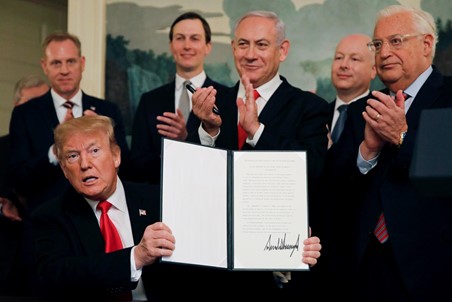
By Daniel McAdams | Ron Paul Institute | February 1, 2020
There is a real danger for foreign policy advisors and analysts – and especially those they serve – when they are in a bubble, an echo chamber, and all of their conclusions are based on faulty inputs. Needless to say it’s even worse when they believe they can create their own reality and invent outcomes out of whole cloth.
Things seldom go as planned in these circumstances.
President Trump was sold a bill of goods on the assassination of Iran’s revered military leader, Qassim Soleimani, likely by a cabal around Secretary of State Mike Pompeo and the long-discredited neocon David Wurmser. A former Netanyahu advisor and Iraq war propagandist, Wurmser reportedly sent memos to his mentor, John Bolton, while Bolton was Trump’s National Security Advisor (now, of course, he’s the hero of the #resistance for having turned on his former boss) promising that killing Soleimani would be a cost-free operation that would catalyze the Iranian people against their government and bring about the long-awaited regime change in that country. The murder of Soleimani – the architect of the defeat of ISIS – would “rattle the delicate internal balance of forces and the control over them upon which the [Iranian] regime depends for stability and survival,” wrote Wurmser.
As is most often the case with neocons, he was dead wrong.
The operation was not cost-free. On the contrary. Assassinating Soleimani on Iraqi soil resulted in the Iraqi parliament – itself the product of our “bringing democracy” to the country – voting to expel US forces even as the vote by the people’s representatives was roundly rejected by the people who brought the people the people’s representatives. In a manner of speaking.
Trump’s move had an effect opposite to the one promised by neocons. It did not bring Iranians out to the street to overthrow their government – it catalyzed opposition across Iraq’s various political and religious factions to the continued US military presence and further tightened Iraq’s relationship with Iran. And short of what would be a catastrophic war initiated by the US (with little or no support from allies), there is not a thing Trump can do about it.
Iran’s retaliatory attack on two US bases in Iraq was initially sold by President Trump as merely a pin-prick. No harm, no foul, no injuries. This despite the fact that he must have known about US personnel injured in the attack. The reason for the lie was that Trump likely understands how devastating it would be to his presidency to escalate with Iran. So the truth began to trickle out slowly – 11 US military members were injured, but it was just “like a headache.” Now we know that 50 US troops were treated for traumatic brain injury after the attack. This may not be the last of it – but don’t count on the mainstream media to do any reporting.
The Iranian FARS news agency reported at the time of the attack that US personnel had been injured and the response by the US government was to completely take that media outlet off the Internet by order of the US Treasury!
Today the US House voted to cancel the 2002 authorization for war on Iraq and to prohibit the use of funds for war on Iran without Congressional authorization. It is a significant, if largely symbolic, move to rein in the oft-used excuse of the Iraq war authorization for blatantly unrelated actions like the assassination of Soleimani and Obama’s thousands of airstrikes on Syria and Iraq.
President Trump has argued that prohibiting funds for military action against Iran actually makes war more likely, as he would be restricted from the kinds of military-strikes-short-of-war like his attack on Syria after the alleged chemical attack in Douma in 2018 (claims which have recently fallen apart). The logic is faulty and reflects again the danger of believing one’s own propaganda. As we have seen from the Iranian military response to the Soleimani assassination, Trump’s military-strikes-short-of-war are having a ratchet-like effect rather than a pressure-release or deterrent effect.
As the financial and current events analysis site ZeroHedge put it recently:
[S]ince last summer’s “tanker wars”, Trump has painted himself into a corner on Iran, jumping from escalation to escalation (to this latest “point of no return big one” in the form of the ordered Soleimani assassination) — yet all the while hoping to avoid a major direct war. The situation reached a climax where there were “no outs” (Trump was left with two ‘bad options’ of either back down or go to war).
The Iranians have little to lose at this point and America’s European allies are, even if impotent, fed up with the US obsession with Saudi Arabia and Israel as a basis for its Middle East policy.
So why open this essay with a photo of Trump celebrating his dead-on-arrival “Deal of The Century” for Israel and Palestine? Because this is once again a gullible and weak President Trump being led by the nose into the coming Middle East conflagration. Left without even a semblance of US sympathy for their plight, the Palestinians after the roll-out of this “peace” plan will again see that they have no friends outside Syria, Iran, and Lebanon. As Israel continues to flirt with the idea of simply annexing large parts of the West Bank, it is clear that the brakes are off of any Israeli reticence to push for maximum control over Palestinian territory. So what is there to lose?
Trump believes he’s advancing peace in the Middle East, while the excellent Mondoweiss website rightly observes that a main architect of the “peace plan,” Trump’s own son-in-law Jared Kushner, “taunts Palestinians because he wants them to reject his ‘peace plan.’” Rejection of the plan is a green light to a war of annihilation on the Palestinians.
It appears that the center may not hold, that the self-referential echo chamber that passes for Beltway “expert” analysis will again be caught off guard in the consequence-free profession that is neocon foreign policy analysis. “Gosh we didn’t see that coming!” But the next day they are back on the TV stations as great experts.
Clouds gathering…
A New US Air Force Video Game Lets You Drone Bomb Iraqis and Afghans
By Alan MacLeod – MintPress News – January 31, 2020
The United States Air Force has a new recruitment tool: a realistic drone operator video game you can play on its website. Called the Airman Challenge, it features 16 missions to complete, interspersed with facts and recruitment information about how to become a drone operator yourself. In its latest attempts to market active service to young people, players move through missions escorting US vehicles through countries like Iraq and Afghanistan, serving up death from above to all those designated “insurgents” by the game. Players earn medals and achievements for most effectively destroying moving targets. All the while there is a prominent “apply now” button on screen if players would like to enlist and conduct real drone strikes all over the Middle East.
The game has failed to win over David Swanson, director of the anti-war movement World Beyond War, and the author of War is a Lie.
“It is truly disgusting, immoral, and arguably illegal in that it is recruitment or pre-recruitment of underage children to participate in murder. It is part of the normalization of murder that we have been living through,” he told MintPress News.
Tom Secker, a journalist and researcher into the influence of the military on popular culture was similarly unimpressed by the latest USA.F. recruitment strategy, telling us:
The drone game struck me as sick and demented… On the other hand, many drone pilots have described how piloting drones and killing random brown people is a lot like playing a video game, because you’re sat in a bunker in Nevada pushing buttons, detached from the consequences. So I guess it accurately reflects the miserable, traumatised, serial killing life of a drone pilot, we can’t accuse it of inaccuracy per se.”
Game Over
Despite the fact that they are rarely, if ever in any physical danger, the military has considerable difficulty recruiting and retaining drone pilots. Nearly a quarter of Air Force staff who can fly the machines leave the service every year. A lack of respect, fatigue and mental anguish are the primary reasons cited. Stephen Lewis, a sensor operator between 2005 and 2010 said what he did “weighs on your conscience. It weighs on your soul. It weighs on your heart,” claiming that the post traumatic stress disorder he suffers from as a consequence of killing so many people has made it impossible for him to have relationships with other humans.
“People think it is a video game. But in a video game you have checkpoints, you have restart points. When you fire that missile there’s no restart,” he said. “The less they can get you to think of what you’re shooting at as human the easier it becomes to you to just follow through with these shots when they come down,” said Michael Haas, another former USAF sensor operator. The Airman Challenge game follows this path, using red dots on the screen to represent enemies, sanitizing the violence recruits will be meting out.
“We were very callous about any real collateral damage. Whenever that possibility came up most of the time it was a guilt by association or sometimes we didn’t even consider other people that were on screen,” Haas said, noting that he and his peers used terms like “fun sized terrorist” to describe children, employing euphemisms like “cutting the grass before it grows too long,” as justifications for their extermination. The constant violence, even from afar, takes a heavy toll on many drone operators, who complain of constant nightmares and having to drink themselves into a stupor every night to avoid them.
Others, with different personalities, revel in the bloodshed. Prince Harry, for example, was a helicopter gunner in Afghanistan and described firing missiles as a “joy.” “I’m one of those people who loves playing PlayStation and Xbox, so with my thumbs I like to think I’m probably quite useful,” he said. “If there’s people trying to do bad stuff to our guys, then we’ll take them out of the game.”
A Nobel Cause
Drone bombing is a relatively new technology. Barack Obama came into office promising to end President Bush’s reckless aggression, even being awarded the Nobel Peace Prize in 2009. While he slashed the number of American troops on the ground in Iraq and Afghanistan, he also greatly expanded US wars in the form of drone bombings, ordering ten times as many as Bush. In his last year in office, the US dropped at least 26,000 bombs – around one every twenty minutes on average. When he left office, the US was bombing seven countries simultaneously: Afghanistan, Iraq, Syria, Libya, Yemen, Somalia, and Pakistan.
Up to 90 percent of reported drone casualties were “collateral damage,” i.e. innocent bystanders. Swanson is deeply concerned about the way in which the practice has become normalized: “If murder is acceptable as long as a military does it, anything else is acceptable,” he says, “We will reverse this trend, or we will perish.”
History did not exactly repeat itself with the election of Donald Trump in 2016, but it did rhyme. Trump came to power having made multiple statements perceived as anti-war, strongly criticizing Obama and the Democrats’ handling of the situation in the Middle East. Egged on even by so-called “resistance” media, Trump immediately expanded drone bombings, increasing the number of strikes by 432 percent in his first year in office. The president also used a drone attack to kill Iranian general and statesman Qassem Soleimani earlier this month.
Killing in the Game of
In 2018, the armed forces fell well short of their recruitment targets, despite offering a package of benefits very attractive to working-class Americans. As a result, it totally revamped its recruitment strategy, moving away from television and investing in micro-targeted online ads in an attempt to reach young people, particularly men below the age of thirty, who make up the bulk of the armed forces. One branding exercise was to create an Army e-sports team entering video game competitions under the military brand. As the gaming website, Kotaku wrote, “Positioning the Army as a game-friendly environment and institution is crucial, or even necessary, to reach the people the Army wants to reach.” The Army surpassed its recruitment goal for 2019.
Although the Airman Challenge game is a new attempt at recruitment, the armed forces have a long history being involved in the video game market, and the entertainment industry more generally. Secker’s work has uncovered the depths of collaboration between the military and the entertainment industry. Through Freedom of Information requests, he was able to find that the Department of Defense reviews, edits and writes hundreds of TV and movie scripts every year, subsidizing the entertainment world with free content and equipment in exchange for positive portrayals. “At this point, it’s difficult to effectively summarise the US military’s influence on the industry, because it’s so varied and all-encompassing,” he said.
The US Army spends tens of millions a year on the Institute for Creative Technologies, who develop advanced tech for the film and gaming industries, as well as in-house training games for the Army and – on occasion – the CIA. The Department Of Defense has supported a number of major game franchises (Call of Duty, Tom Clancy games, usually first or third-person shooters). Military-supported games are subject to the same rules of narrative and character as movies and TV, so they can be rejected or modified if they contain elements the Department Of Defense deems controversial.”
The video games industry is massive, with hyper-realistic first person shooters like Call of Duty being among the most popular genres. Call of Duty: WWII, for example, sold $500 million worth of copies in its opening weekend alone, more money generated than blockbuster movies “Thor: Ragnarok” and “Wonder Woman” combined. Many people spend hours a day playing. Captain Brian Stanley, a military recruiter in California said, “Kids know more about the army than we do… Between the weapons, vehicles, and tactics, and a lot of that knowledge comes from video games.”
Young people, therefore, spend huge amounts of time effectively being propagandized by the military. In Call of Duty Ghosts, for instance, you play as a US soldier fighting against a red-beret wearing anti-American Venezuelan dictator, clearly based on President Hugo Chavez, while in Call of Duty 4, you follow the US Army in Iraq, shooting hundreds of Arabs as you go. There’s even a mission where you operate a drone, which is distinctly similar to the Airman Challenge. US forces even control drones with Xbox controllers, blurring the lines between war games and war games even further.
Cyber Warfare
Although the military industrial complex is keen to advertise opportunities for pilots, they go to great lengths to hide the reality of what happens to the victims of airstrikes. The most famous of these is likely the “Collateral Murder” video, leaked by Chelsea Manning to Wikileaks co-founder Julian Assange. The video, which made worldwide news, laid bare the callousness towards civilian lives Haas described, where Air Force pilots laugh at shooting dead at least 12 unarmed civilians, including two Reuters journalists. While those commanders ultimately in charge of military operations in the Middle East appear on television constantly, trying to sanitize their actions, Manning and Assange remain in prison for helping to expose the public to an alternative depiction of violence. Manning has spent the majority of the last decade incarcerated, while Assange awaits possible extradition to the United States in a London prison.
The Airman Challenge video game, for Secker, is merely “the latest in a long line of insidious and disturbing recruitment efforts by the US military.” “If they feel they have to do this just to recruit a few hundred thousand people to their cause, maybe their cause isn’t worth it,” he said.
U.S. in the Middle-East: Preparing for Disaster
By The Saker • Unz Review • January 30, 2020
Lies, damn lies and statistics
Turns out that Trump and the Pentagon were lying. Again. This time about the true impact of the Iranian counter-strike on US forces in Syria. First they claimed that there were no injured U.S. personnel, only to eventually have to fess up that 34 soldiers had suffered traumatic brain injury (which Trump “re-classified” as a “headache”). Then they had to admit that it was not really 34, but actually 50!
According to some sources, not all U.S. personnel were hiding in bunkers and some were deployed to defend the base perimeter. Whatever may be the case, this adds yet another indication that the Iranian counter-strike was much more robust than originally reported by the Empire. In fact, Iranian sources indicate that following the strike, a number of wounded casualties were flown to Israel, Kuwait and Germany. Again, we will probably never find out the full truth about what happened that night, but two things are now certain:
- The Iranian attack was extremely effective and it is undeniable that all the US/NATO/Israeli forces in the region are now exposed like sitting ducks waiting for the next Iranian strike.
- Uncle Shmuel has had to dramatically under-report the real extent and nature of the Iranian counter-strike.
Now, let’s be clear about the quality of the warning the U.S. personnel had. We now know at the very least the following warnings were received:
- Warning through the Iraqi government (whom the Iranians did brief about their intentions).
- Warning through the Swiss authorities (who represent U.S. interests in Iran and whom the Iranian did brief about their intentions).
- Warning through the US reconnaissance/intelligence capabilities on the ground, air and space.
And yet, in spite of these almost ideal conditions (from the point of view of defense), we now see that not a single Iranian missile was intercepted, that the missiles all landed with very high accuracy, that the U.S. base itself suffered extensive damage (including destroyed helicopters and drones) and that there were scores of injured personnel (see this article for a detailed discussion of the post-attack imagery).
If we look at this strike as primarily a “proof of concept” operation, then it becomes pretty clear that on the Iranian side what was proven was a superb degree of accuracy and robust ballistic missile capability, whereas on the U.S. side the only thing this strike did was to prove that the U.S. forces in the region are all extremely vulnerable to Iranian missile attack. Just imagine if the Iranians had wanted to maximize U.S. casualties and if they had given no warning of any kind – what would the tally be then?! What if the Iranians had targeted, say, fuel and ammo dumps, buildings where U.S. personnel lived, industrial facilities (including CENTCOM’s key logistic nodes), ports or even airfields? Can you imagine the kind of hell the Iranians would have unleashed against basically unprotected facilities?!
Still dubious?
Then ask yourself why Trump & Co. had to lie and minimize the real scope of the Iranian attack. It is pretty obvious that the White House decided to lie and to present the strike as almost without impact because if it had admitted the magnitude of the strike, then it would also have had to admit to the total powerlessness to stop or even to meaningfully degrade it. Not only that, but an outraged U.S. public (most Americans still believe the traditional propaganda line about “The Greatest Military Force in the History of the Galaxy”!) would have demanded a retaliatory counter-counter-strike against Iran, which would have triggered an immediate Iranian attack on Israel which, in turn, would have plunged the entire region into a massive war which the U.S. had no stomach for.
Contrast that with the Iranian claims which, if anything, possibly exaggerated the impact of the strike and claimed that 80 servicemen were injured (I would add here that, at least so far, the Iranian government has been far more candid and less inclined to resort to crude lies than the U.S. has). Clearly the Iranians were ready for exactly the kind of further escalation that the U.S. wanted to avoid at almost any cost.
So what really took place?
There are two basic ways to defend against an attack: denial and punishment. Denial is what the Syrians have been doing against the U.S. and Israel every time they shoot down incoming missiles. Denial is ideal because it minimizes your own casualties while not necessarily going up the “escalation scale”. In contrast, punishment is when you don’t prevent an attack, but when you inflict retaliatory counter-strike on the attacking side, but only after being attacked yourself. That is what the US could do against Iran, at pretty much any time (yes, contrary to some wholly unrealistic claims, Iranian air defenses cannot prevent the US armed forces from inflicting immense damage upon Iran, its population and infrastructure).
The problem with punishing Iran is you are dealing with an enemy who is actually willing to absorb immense losses as long as these losses eventually lead to victory. How do you deter somebody who is willing to die for his country, people or faith?
There is no doubt in my mind that the Iranians, who are superb analysts, are fully aware of the damage that the U.S. can inflict. The key factor here is that they also realize that once the U.S. unleashes its missiles and bombers and once they destroy many (if not all) of their targets, they will have nothing else left to try to contain Iran with.
Here is how you can think of the Iranian strategy:
- If the U.S. does nothing or only engages in symbolic strikes (say, like Israel’s strikes in Syria), the Iranians can simply ignore these attacks because while they are very effective in giving the Americans (or the Israelis) an illusion of power, they really fail to achieve anything militarily significant.
- If the U.S. finally decides to strike Iran hard, it will exhaust its “punishment card” in that counter-attack, and will have no further options to deter Iran.
- If the U.S. (or Israel) decides to use nuclear weapons, then such an attack will simply give a “political joker card” to Iran saying in essence “now you are justified in whatever retaliation you can think of.” And you can be darn sure that the Iranian will come up with all sorts of most painful forms of retaliation!
You can think of the current US posture as “binary”: it is either “all off” or “all on.” Not by choice, of course, but these conditions are the result of the geostrategic realities of the Middle-East and from the many asymmetries between the two sides:
| Country | US | Iran |
|---|---|---|
| Air superiority | yes | no |
| Combat capable ground forces | no | yes |
| Willingness to incur major losses | no | yes |
| Short and secure supply lines | no | yes |
| Prepared for major defensive operations | no | yes |
The above is, of course, a simplification, yet it is also fundamentally true. And the reason for these asymmetries lies in a very simple yet crucial difference: Americans have been brainwashed into believing that major wars can be won on the cheap. Iranians have no such illusions (most certainly not after Iraq, backed by the US, the USSR and Europe, attacked Iran and inflicted immense destruction on the Iranian society). But the era of “wars on the cheap” is now long over.
Furthermore, Iranians also know that U.S. air superiority alone will not magically result in a U.S. victory. Finally, the Iranians have had 40 years to prepare for a U.S. attack. The U.S. has only really been put on notice since January 8th of this year.
Again, for the US, it is “all in” or “all out”. We saw the “all out” in the days following the Iranian counter-strike and we can get an idea of what the “all in” would look like by recalling the Israeli operations against Hezbollah in 2006.
The Iranians, however, have a much more gradual escalatory capability, which they just demonstrated with their attack on the U.S. forces in Iraq: they can launch only a few missiles, or they can launch hundreds of them. They can try to maximize U.S. casualties, or they can decide to go after CENTCOM’s infrastructure. They can chose to strike Uncle Shmuel directly, or they can decide to strike his allies (KSA) and bosses (Israel). They can chose to take credit for any action, or they can hide behind what the CIA calls plausible deniability.
So while the U.S. and the AngloZionist Empire as a whole are much more powerful than Iran, Iran has skillfully developed methods and means which allow it to be in control of what military analysts call the “escalation dominance”.
Has Iran just “Ledeened” the almighty US?
Remember Michael Ledeen? He is the Neocon who came up with this historical aphorism: “Every ten years or so, the United States needs to pick up some small crappy little country and throw it against the wall, just to show the world we mean business“.
Is it not ironic that Iran did exactly that, they took the US and “threw it against a wall, just to show that they meant business”, did they not?
And what does this all tell us?
For one thing, the U.S. military is in real trouble. It is pretty obvious that U.S. air defenses are hopelessly ineffective: we saw their “performance” in Saudi Arabia against the Houthi strikes. The truth is that the Patriot missiles never performed adequately, not in the first Gulf War, nor today. The big difference is that Saddam Hussein’s Iraq did not have any high-precision missiles and that its attempts to strike at the U.S. (or Israel, for that matter) where not very effective. Thus, it was easy for the Pentagon to fudge the real performance (or lack thereof!) of its weapon systems. Now that Iran has been able to pinpoint some buildings while carefully ignoring others shows that the entire Middle-East has entered a radically new era.
Second, it is equally obvious that U.S. bases in the Middle-East are very vulnerable to ballistic and cruise missile attacks. Air defenses are a very complicated and high-tech branch of the military and it often takes years, if not decades, to develop a truly effective air defense system. Due in part to its tendency to only attack weak and lightly-defended countries, and also due to the very real deterrent might the U.S. armed forces used to deliver in the past, the U.S. never had to really worry much about air defenses. The “little guys” had no missiles, while the “big guys” would never dare to openly strike at Uncle Shmuel’s forces.
Until recently.
Now, it is the previously almighty World Hegemon which has been tossed against a wall by a much weaker Iran and thus found itself being treated like a “small crappy little country”.
Sweet irony!
But there is much more to this story.
The real Iranian goal: to get the U.S. out of the Middle-East
The Iranians (and many Iranian allies in the region) have made it clear that the real retaliation for the murder of General Soleimani would be to bring about a complete withdrawal of U.S. forces from Iraq and Syria primarily, followed by a complete withdrawal from the entire Middle-East.
How likely is such an outcome?
Right now, I would say that the chances of that truly happening are microscopically small. After all, who could seriously imagine the U.S. leaving either Saudi Arabia or Israel? Ain’t gonna happen short of a true cataclysm.
What about countries like Turkey or Pakistan which are formally allies of the US but which are also showing clear signs of being mighty fed-up with the kind of “patronage” the US likes to mete out to its “allies”? Do we have any reason to believe that these countries will ever officially demand that Uncle Shmuel’s mercenaries (because that is what U.S. forces are, paid invaders) get the hell out?
And then there are countries like Iraq or Afghanistan which have hosted a very successful and active anti-U.S. insurgency which has kept U.S. forces hunkered down in heavily fortified bases. I don’t think there is anybody mentally sane out there who could offer a even semi-credible scenario of what a U.S. “victory” would look like in these countries. The fact that the U.S. stayed in Afghanistan even longer than the Soviets did shows not only that the Soviet forces were far more effective (and popular) than their U.S. counterparts, but also that Gorbachev’s Politburo was more in touch with reality than Trump’s NSC.
Whatever may be the case, I believe it is undeniable that the wars in Iraq and Afghanistan are lost and than no amount of grandstanding will change this outcome. The same goes for Syria where the U.S. is basically holding on out of sheer stubbornness and a total inability to admit defeat.
Uncle Shmuel’s “vision of peace” for the Middle-East
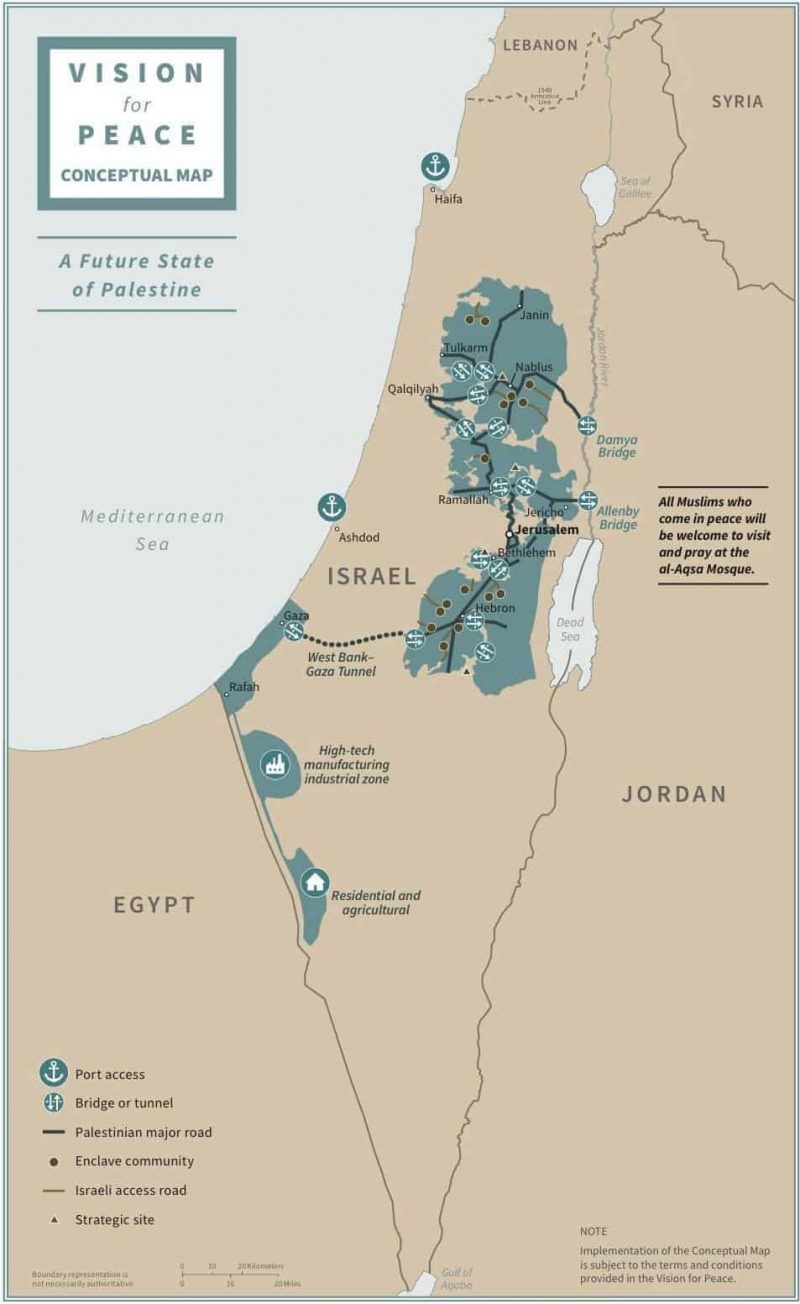
I just listened to the Idiot-in-Chief proudly present “his” Middle-East “peace” plan to Bibi Netanyahu and the world. This latest stunt shows two crucial things about the mind-set in Washington, D.C.:
- There is nothing which the U.S. ruling classes will not do to try to get the favor and support of the Israel Lobby.
- The US does not care, not even marginally, what the people of the Middle-East think.
This dynamic, which is not anything new, but which received a qualitative “shot of steroids” under Trump, will only further contribute to the inevitable collapse of Empire in the Middle-East. For one thing, all the so-called “U.S. allies” in the region understand that the only country which matters to the US is Israel, and that all the others count for almost nothing. Furthermore, all the rulers of the Middle-East now also know that being allied to the US also means being a cheap prostitute for Israel which, in turn, is guaranteed political suicide for any politician not wise enough to smell the trap. Finally, the wars in Afghanistan, Iraq, Yemen, Lebanon and Syria have shown that the “Axis of Kindness” is long on hyperbole and hubris, but very short in terms of actual combat capability.
The simple truth is that the abject brown-nosing of the Israel Lobby that Trump has been engaged in from Day 1 of his term only serves to further isolate and weaken the U.S. in the Middle-East (and beyond, really!).
In this context, how realistic is the Iranian goal of kicking Uncle Shmuel out of the region?
As I said, not realistic at all, if seen solely in the short term. But I hasten to add that it is very realistic in the mid-term if we look at some, but not all, the countries of the region. Finally, in the long term, it is not only realistic, it is inevitable, even if the Iranians themselves don’t do much, or anything at all, to make that happen.
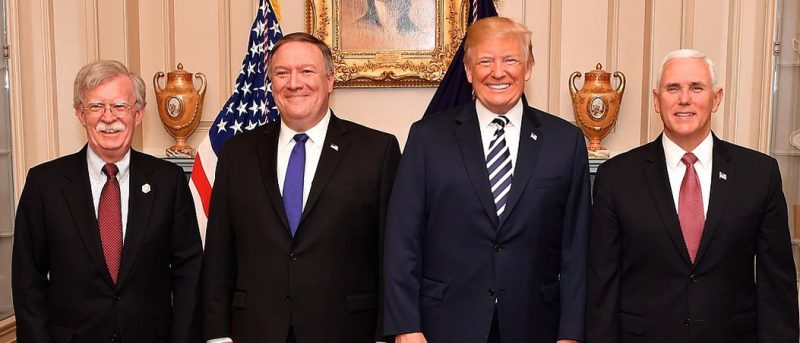
These grinning ignoramuses are doing more than anyone else to bring down the Empire, even if they don’t understand this!
Conclusion: “Israel’s” days are numbered
The Israelis have been feeding us all a steady diet about this or that country or politician being a “new Hitler’ who will either gas 6M Jews “again”, or wants to wipe Israel “off the map” or even engage in a new Holocaust. Gilad Atzmon brilliantly calls this mental disorder “pre-traumatic stress disorder,” and he is spot on. The Israelis mostly used this “preemptive geschrei*” as a way to squeeze out as many concessions (and money) from the western goyim as possible. But in a deep sense, it is possibly that the Israelis are at least dimly aware that their entire project is simply not viable, that you cannot ensure the survival of any state by terrorizing all of your neighbors. Violence, especially vicious, rabid, violence can, indeed, terrorize people, but only for so long. Sooner or later, the human soul will outgrow any fear, no matter how visceral, and will replace that fear by a new and immensely powerful sense of determination.
Here is what Robert Fisk said in distant 2006, 14 years ago:
You heard Sharon, before he suffered his massive stroke, he used this phrase in the Knesset, you know, “The Palestinians must feel pain.” This was during one of the intifadas. The idea that if you continue to beat and beat and beat the Arabs, they will submit, that eventually they’ll go on their knees and give you what you want. And this is totally, utterly self-delusional, because it doesn’t apply anymore. It used to apply 30 years ago, when I first arrived in the Middle East. If the Israelis crossed the Lebanese border, the Palestinians jumped in their cars and drove to Beirut and went to the cinema. Now when the Israelis cross the Lebanese border, the Hezbollah jump in their cars in Beirut and race to the south to join battle with them. But the key thing now is that Arabs are not afraid any more. Their leaders are afraid, the Mubaraks of this world, the president of Egypt, King Abdullah II of Jordan. They’re afraid. They shake and tremble in their golden mosques, because they were supported by us. But the people are no longer afraid.
What was true only for some Arabs in 2006, has now become true for most (maybe even all?) Arabs in 2020. As for the Iranians, they have never had any fear of Uncle Shmuel, they are the ones who “injected” the newly created Hezbollah with this qualitatively new kind of “special courage” (which is the Shia ethos, really!) when this movement was founded.
Empires can survive many things, but once they are not feared anymore, then their end is near. The Iranian strike proved a fundamental new reality to the rest of the world: the US is much more afraid of Iran than Iran is afraid of the US. U.S. rulers and politicians will, of course, claim otherwise. But that futile effort to re-shape reality is now doomed to failure, if only because even the Houthis can now openly and successfully defy the combined might of the “Axis of Kindness”.
You can think of U.S. and Israeli leaders as the orchestra on the Titanic: they play well, but they will still get wet and then die.
 (*geschrei: the Yiddish word for yelling, crying out, to shriek)
Russia stood by Iran in showdown with US
By M. K. BHADRAKUMAR | Indian Punchline | January 27, 2020
US President Donald Trump first said there were ‘no casualties’ in the Iranian missile attack on the Ain al-Asad military airbase in Iraq on January 8. “We suffered no casualties, all of our soldiers are safe, and only minimal damage was sustained at our military bases,” Trump had said.
Then a number 11 was mentioned a week later, but Trump minimised the injuries, calling them ‘headaches’. Last Friday, a fortnight after the attack, the number sharply climbed. The Pentagon spokesman told reporters that 34 US military members received concussions or other traumatic brain injuries in the missile strikes.
The true human toll of the Iranian strike is still being assessed. But what Iran achieved through the January 8 attacks may never quite be in the public domain.
The big question is whether Iran acted with Russian backing. Beyond a string of Russian statements empathising with Iran, all we have are tell-tale signs.
To be sure, satellite imagery suggests very precise hits of targets in the Ain al-Asad base. In an interview with Spiegel magazine last week, Iran’s Foreign Minister Mohammad Javad Zarif stated Iran’s objectives:
“There was no intention of causing any casualties with the missile attack… The damage we have done to the US is extensive, because with all its military might, it could not prevent the missiles from hitting its base. It shows how vulnerable the US is.”
The Iranians did succeed in displaying their formidable missile capability and its capacity to inflict lethal damage on US military establishments. But how could such high-precision hits be achieved except with missiles equipped with satellite guidance and target-tracking capabilities?
Importantly, Iran doesn’t have an independent orbital group of satellites. There are four global navigation satellite systems operational today — the US GPS/NAVSTAR, European GNSS, Russian GLONASS and Chinese BeiDou. The US and European systems are out of bounds for Iran.
But there is no embargo on Iran accessing the Russian or Chinese systems and it probably used one of them. But Tehran neither confirms nor denies.
Iran acknowledges it fired two Russian TOR-M1 anti-aircraft missiles but, interestingly, stops short of blaming them for the crash of the Boeing 737-800, flown by Ukraine International Airways. By the way, TOR-M1 is mounted on a tracked vehicle and carries a radar and each vehicle can operate independently. Did Iran’s Russian-made TOR-M1 have access to GLONASS?
Indeed, on January 7, on the eve of the Iranian missile strike, President Vladimir Putin paid an unscheduled visit to Syria to meet up with President Bashar al-Assad.
Again, on January 9, the day after the Iranian missile strike, Putin watched a big naval exercise involving multiple missile launches in the Black Sea. The Navy Times reported, “The Russian naval maneuvers come amid heightened US-Iran tensions after the US strike last week that killed Iran’s most powerful military commander.”
Advanced Russian weapon systems were on display in the maneuvers. MiG-31 interceptor jets launched Kinzhal hypersonic missiles at practice land targets while Navy ships performed several launches of Kalibr cruise missiles and other weapons. More than 30 warships and 39 aircraft, including several Tu-95 strategic bombers, took part in the exercise.
Curiously, again on January 9, in the northern Arabian Sea off Iran’s coastline, there was a rare encounter between the US destroyer USS Farragut and the Russian intelligence gathering ship RFS Ivan Hurs, which was apparently shadowing the operations of a US aircraft carrier battle group in the area.
The above events taken together signalled that Russia was closely monitoring the situation around Iran and was in full readiness to meet any emergent military conflagration in the region. No doubt, the message was addressed to Washington.
It is entirely conceivable that Russia has intelligence-sharing arrangements with Iran. In fact, Russian Foreign Minister Sergey Lavrov, a veteran diplomat, might just have lifted the veil a little bit when he disclosed on January 17 that Iran’s accidental shooting down of the Ukrainian airliner occurred at a time when Tehran was spooked by reports of advanced US stealth fighters in the area.
“There were at least six F-35 fighters in the air in the Iranian border area. This information has yet to be verified, but I’d like to underline the edginess that always accompanies such situations,” Lavrov said. Alas, Lavrov’s disclosure left a cold trail. But it most certainly hinted that Russia is reconnoitring the skies above Iran.
All this may amount to nothing much, or everything — depending on how one looks at it. Russia will not militarily intervene in a US-Iranian conflict. Indeed, such a conflict is unlikely. What Russia can do is to make the probability of a conflict even less likely by aiding Iran to defend itself, by providing it with electronic warfare tools and other high-end arms that would raise the military costs to the US, as had happened on January 8.
How far Russia’s ‘positive neutrality’, which distinctly favoured Iran in the most recent period, irritated Washington no one can tell. But there have been four instances in the past 8 days alone of US forces blocking Russian convoys in northeastern Syria — one forcing back a vehicle driven by a Russian major-general. Poking the bear? In Russian-American relations, nothing is really coincidental.
The debate over the alchemy of Russian-Iranian relations is a never-ending one. But no matter the two countries’ specific interests or national objectives and ideologies, a destruction of Iran or the emergence of a US-friendly regime in Tehran would be profoundly consequential to Russian regional strategies, given the co-relation of forces internationally.
Lavrov gave an indication of Russian priorities when he said in Delhi on January 17 while addressing an international audience (including Zarif) that Moscow backs Tehran’s bid to join Shanghai Cooperation Organisation as a full member and is hopeful it will happen.
Who Rules America? The illusion of Self Rule
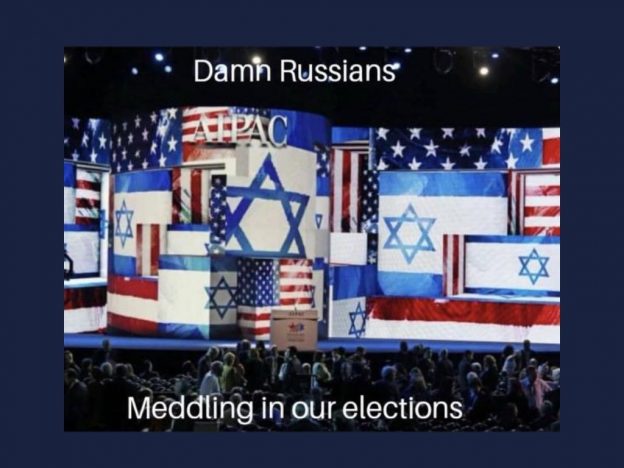
By Greg Felton | Institute for Political Economy | January 22, 2020
A government, whatever its nature, rules as an imperial power over its people. The surest way to exercise this control is to prop up the illusion that it acts in the public interest. Paul Craig Roberts and Alvin Rabushka spelled out this salient fact in the March 1973 issue of Public Choice, in their article “A Diagrammatic Exposition of an Economic Theory of Imperialism,” and what they wrote is no less relevant today.
The act of voting is one of the props that sustains the delusion of self-rule. People do vote, but the candidates are decided by the oligarchy of organized interest groups. This is also the conclusion of a 2014 study by Princeton University professors Martin Gilens and Benjamin I. Page about the extent to which U.S. government policy reflects public preferences. Gilens and Page found that voters are, to all intents and purposes, irrelevant to their own “democratic” government:
“[The] preferences of the average American appear to have only a minuscule, near-zero, statistically non-significant impact upon public policy . . . Moreover, because of the strong status quo bias built into the U.S. political system, even when fairly large majorities of Americans favor policy change, they generally do not get it” (Perspectives on Politics, Vol. 12, No. 3, pp. 575, 76).
Instead of representing the common interest of the people, government answers to organized interest groups. Gilens and Page cite the dominance over policy of special interests who use public policy to serve their interests rather than the public’s. We see the effects of this plutocracy in the sharp rise in the inequality of income and wealth, a gap which has grown into a chasm.
Gilens and Page’s analysis of the Unelected Plutocracy of America is on the money, but their understanding of the threat to America’s democracy does not consider foreign policy, which is partly, if not largely, in the hands of a foreign country—Israel. It is not enough to lay the decline of American democracy at the feet of vested interests such as Wall Street, big banks, and the military–security complex, because it is not in their interest to have the government pursue foreign policy contrary to the national interest.
But operating contrary to the national interest is precisely what Washington has been doing. In the 21st century, Washington has squandered trillions of dollars on military aggression. Hundreds of thousands of U.S. military personnel have been killed, maimed or driven to suicide. The U.S. has derived no benefit from provoking the enmity of Muslim people, bullying NATO allies into abetting this belligerence or persecuting those who expose associated crimes. Even Donald Trump, who ran for the presidency on ending wasteful wars of aggression, continues this self-inflicted economic and political harm, most recently by waging economic war against Iran and sabre-rattling to provoke a shooting war.
The Trump administration is a continuation of decades of Washington’s kowtowing to the Israel Lobby. To appreciate the lack of independence of US foreign policy requires an act of intellectual courage, but few Americans are equipped for the trauma of knowing the truth. To borrow from The Matrix, not many are willing to take the “red pill” to see the reality behind the controlled explanation. “Blue pill” existence comes with a ready-made worldview based on controlled explanations in which believers find comfort, meaning and belonging. Anything that challenges this illusion, is discounted as conspiracy theory or anti-semitism. Comforting beliefs can take precedence over US national interests.
To “take the red pill” requires an inquisitive mind to reject illusion and to question fundamental assumptions. If it is irrational for a democratic state like the U.S. to harm its own people, damage its own economy and invite hostility by provoking needless wars, perhaps the U.S. is not really a democratic state and not really in charge of its own policy. From an American standpoint, the seemingly inexplicable acts of U.S. belligerence and punishment of those who pose no threat to America can be understood as the consequence of permitting Israeli money and influence to shape US foreign policy in the Middle East and to some extent elsewhere if it bears on Israeli interests.
The U.S. that was founded in 1776 is not the same U.S. that exists today. The founding fathers warned against foreign entanglements, but Washington has sought entanglement. Since the late 1940s, the U.S. has gotten entangled in the service of Israel’s interests. The importance of Israel’s interest to U.S. foreign policy has been elevated by a pervasive Christian prejudice, in which Jews are seen as religiously kindred and Muslims as religiously hostile.
In 1948 President Harry Truman took an infamous $2 million election campaign bribe from an American Zionist to support the creation of Israel. By doing so Truman became midwife to an ongoing war crime that has resulted in Washington aiding and abetting Israel’s theft of Palestine. Washington blackmailed and intimidated several UN delegations into supporting the 1947 partition of Palestine. For a country that boasted of its commitment to democracy and support for the UN Charter, Washington’s conduct made no sense. However, if one recognizes that Washington was acting in behalf of Israel, it becomes understandable.
With a foothold gained from Truman’s electoral opportunism, the domestic Israel Lobby gradually gained influence over the U.S. government to the point that today Washington serves Israel’s interest without thinking of its impact on US national interests and without regard to the adverse effects on American interests or those of other people.
After years of Washington’s growing service to Israel, President George H.W. Bush tried to pull back. President Bush thought that he could bring about a final peace treaty between Israel and the Palestinian leadership in Madrid based on “land for peace.”
Bush’s assertion of foreign policy independence infuriated Israel, which proceeded to stage overt and covert attacks on Bush. The overt attack occurred on Feb. 26, 1992, when the domestic Israeli pressure group calling itself, absurdly, the “The Committee on U.S. Interests in the Middle East,” took out a full-page ad in The New York Times to excoriate Bush for “pressuring” Israel to enter into negotiations. Its signatories included neoconservative Israel-firsters like Paul Wolfowitz, Richard Perle, Douglas Feith and Elliott Abrams.
According to a former Mossad agent, the covert attack took the form of a planned assassination of President Bush. Victor Ostrovsky in his book, By Way of Deception (pp. 281-282), writes that on Oct. 1, 1992, he received a nervous call from Ephraim, a Mossad officer of his acquaintance, who opposed the assassination: “They’re out to kill Bush… I mean really kill, as in ‘assassinate.’… during the Madrid peace talks.” Ephraim asked Ostrovsky to leak the plot in hopes the American government would act to prevent it. Ostrovsky did so in an Oct. 1, 1992, speech in Ottawa. From there, the leak made its way to former California congressman Pete McCloskey, the Secret Service, the State Department, the CIA, the U.S. embassy in Ottawa, and finally the press. The assassination was called off.
Bush’s assertion of independence from Israel resulted in Israel’s meddling in the 1992 presidential election which cost Bush re-election and marked the last time that a U.S. president would dare challenge Israel’s self-proclaimed right to murder, torture, dispossess and displace Palestinians.
The eight years of Bill Clinton’s presidency saw a consolidation of Israel’s power over Washington. Clinton showed his willingness to act in Israel’s interest by agreeing to set amounts of aid to Israel––imperial tribute in the view of some––even before he was sworn in as president. It was the Clinton administration that responded to Israeli pressure for action against Iraq by creating the illegal no-fly zones over Iraq, which caused the death of 500,000 Iraqi children. When asked about this by a reporter, Clinton’s Secretary of State Madeleine Albright said, “the price was worth it.” In other words, the death of a half a million Iraqi children served American and Israeli interests.
Israel’s influence over US foreign policy reached a zenith with George W. Bush. In the name of the “war on terror,” that is, the war on Israel’s enemies, the Bush regime subverted the US Constitution. The Bush government was filled with neoconservatives associated with the Project for a New American Century. The PATRIOT Act, drafted, according to his own admission three weeks prior to the events of September 11, 2001, by neoconservative Philip Zelikow, who later headed up the 9/11 Commission, became law despite the US Congress having no time to read and discuss the tyrannical legislation before passing it. The fact that a draft of the PATRIOT Act existed prior to 9/11 raises many questions. The passage of the act told Americans that Muslims were such a threat that Americans would have to accept infringements on their civil liberties. President Bush made that even more clear when he announced that he was setting aside the US Constitution and suspending habeas corpus.
During the Obama administration Israel dramatically demonstrated its power over the US government when the US Congress intervened in the dispute between Obama and Netanyahu over whose power was supreme in American politics, the power of the American president or Israel’s. Repudiating their own president, Congress invited Netanyahu to address a joint session of the House and Senate and responded to Netanyahu with many standing ovations.
Trump has perpetuated Israeli control over US foreign policy. Trump broke universal policy and recognized Jerusalem as Israel’s capital. He gave Syria’s Golan Heights to Israel, which was not Trump’s to give. He cut off aid to Palestine. He accepted Israel’s policy of illegally incorporating occupied Palestine into Israel.
Trump’s appointment of Project for a New American Century Zionist David Wurmser, an architect of Washington’s 2003 invasion of Iraq, is the latest indication that Israel continues to dominate American policy in the Middle East. According to a report in Mint Press News, Trump admitted that his belligerence toward Iran is driven by Israeli, not U.S., interests.
Trump’s subservience to Israel brings into focus the famous words of Patrick Buchanan, Washington is “Israeli occupied territory.”
Greg Felton is the author of The Host & The Parasite––How Israel’s Fifth Column Consumed America, 3rd edition, available from thehostandtheparasite.com.
Aftermath: The Iran War After The Soleimani Assassination
By Jim Kavanagh | The Polemicist | January 23, 2020
“Praise be to God, who made our enemies fools.” – Ayatollah Khamenei
The Killing
I’ve been writing and speaking for months about the looming danger of war with Iran, often to considerable skepticism.
In June, in an essay entitled “Eve of Destruction: Iran Strikes Back,” after the U.S. initiated its “maximum pressure” blockade of Iranian oil exports, I pointed out that “Iran considers that it is already at war,” and that the downing of the U.S. drone was a sign that “Iran is calling the U.S. bluff on escalation dominance.”
In an October essay, I pointed out that Trump’s last-minute calling off of the U.S. attack on Iran in June, his demurral again after the Houthi attack on Saudi oil facilities, and his announced withdrawal of U.S. troops from Syria were seen as “catastrophic” and “a big win for Iran” by the Iran hawks in Israel and America whose efforts New York Times (NYT) detailed in an important article, “The Secret History of the Push to Strike Iran.” I said, with emphasis, “It always goes to Iran,” and underlined that Trump’s restraint was particularly galling to hard-line zionist Republican Senators, and might have opened a path to impeachment. I cited the reported statement of a “veteran political consultant” that “The price of [Lindsey] Graham’s support… would be an eventual military strike on Iran.”
And in the middle of December, I went way out on a limb, in an essay suggesting a possible relation between preparations for war in Iran and the impeachment process. I pointed out that the strategic balance of forces between Israel and Iran had reached the point where Israel thinks it’s “necessary to take Iran down now,” in “the next six months,” before the Iranian-supported Axis of Resistance accrues even more power. I speculated that the need to have a more reliable and internationally-respected U.S. President fronting a conflict with Iran might be the unseen reason—behind the flimsy Articles of Impeachment—that explains why Pelosi and Schumer “find it so urgent to replace Trump before the election and why they think they can succeed in doing that.”
So, I was the guy chicken-littling about impending war with Iran.
But even I was flabbergasted by what Trump did. Absolutely gobsmacked. Killing Qassem Soleimani, Iranian general, leader of the Quds forces, and the most respected military leader in the Middle East? And Abu Mahdi al-Mohandes, Iraqi commander of the Popular Mobilization Forces (PMF) unit, Kataib Hezbollah? Did not see that coming. Rage. Fear. Sadness. Anxiety. A few days just to register that it really happened. To see the millions of people bearing witness to it. Yes, that happened.
Then there was the anxious anticipation about the Iranian response, which came surprisingly quickly, and with admirable military and political precision, avoiding a large-scale war in the region, for the moment.
That was the week that was.
But, as the man said: “It ain’t over ‘til it’s over.” And it ain’t over. Recognizing the radical uncertainty of the world we now live in, and recognizing that its future will be determined by actors and actions far away from the American leftist commentariat, here’s what I need to say about the war we are now in.
The first thing, the thing that is so sad and so infuriating and so centrally symptomatic of everything wrong with American political culture, is that, with painfully few exceptions, Americans have no idea of what their government has done. They have no idea who Qassem Soleimani was, what he has accomplished, the web of relationships, action, and respect he has built, what his assassination means and will bring. The last person who has any clue about this, of course, is Donald Trump, who called Soleimani “a total monster.” His act of killing Soleimani is the apotheosis of the abysmal, arrogant ignorance of U.S. political culture.
It’s virtually impossible to explain to Americans because there is no one of comparable stature in the U.S. or in the West today. As Iran cleric Shahab Mohadi said, when talking about what a “proportional response” might be: ”[W]ho should we consider to take out in the context of America? ‘Think about it. Are we supposed to take out Spider-Man and SpongeBob?… ‘All of their heroes are cartoon characters — they’re all fictional.” Trump? Lebanese Hezbollah’s Hassan Nasrallah said what many throughout the world familiar with both of them would agree with: “the shoe of Qassem Soleimani is worth the head of Trump and all American leaders.”
To understand the respect Soleimani has earned, not only in Iran (where his popularity was around 80%) but throughout the region and across political and sectarian lines, you have to know how he led and organized the forces that helped save Christians, Kurds, Yazidis and others from being slaughtered by ISIS, while Barack Obama and John Kerry were still “watching” ISIS advance and using it as a tool to “manage” their war against Assad.
In an informative interview with Aaron Maté, Former Marine Intelligence Officer and weapons inspector, Scott Ritter, explains how Soleimani is honored in Iraq for organizing the resistance that saved Baghdad from being overrun by ISIS—and the same could be said of Syria, Damascus, or Ebril:
He’s a legend in Iran, in Iraq, and in Syria. And anywhere where, frankly speaking, he’s operated, the people he’s worked with view him as one of the greatest leaders, thinkers, most humane men of all time. I know in America we demonize him as a terrorist but the fact is he wasn’t, and neither is Mr. Mohandes.
When ISIS [was] driving down on the city of Baghdad,…the U.S. armed and trained Iraqi Army had literally thrown down their weapons and ran away, and there was nothing standing between ISIS and Baghdad…
[Soleimani] came in from Iran and led the creation of the PMF [Popular Mobilization Forces] as a viable fighting force and then motivated them to confront Isis in ferocious hand-to-hand combat in villages and towns outside of Baghdad, driving Isis back and stabilizing the situation that allowed the United States to come in and get involved in the Isis fight. But if it weren’t for Qassem Soleimani and Mohandes and Kataib Hezbollah, Baghdad might have had the black flag of ISIS flying over it. So the Iraqi people haven’t forgotten who stood up and defended Baghdad from the scourge of ISIS.
So, to understand Soleimani in Western terms, you’d have to evoke someone like World War II Eisenhower (or Marshall Zhukov, but that gets another blank stare from Americans.) Think I’m exaggerating? Take it from the family of the Shah:
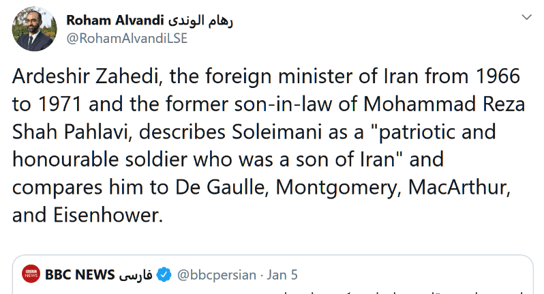
Beyond his leadership of the fight against ISIS, you also have to understand Soleimani’s strategic acumen in building the Axis of Resistance—the network of armed local groups like Hezbollah in Lebanon as well as the PMF in Iraq, that Soleimani helped organize and provide with growing military capability. Soleimani meant standing up; he helped people throughout the region stand up to the shit the Americans, Israelis, and Saudis were constantly dumping on them
More apt than Eisenhower and De Gaulle, in world-historical terms, try something like Saladin meets Che. What a tragedy, and travesty, it is that legend-in-his-own-mind Donald Trump killed this man.
Dressed to Kill
But it is not just Trump, and not just the assassination of Soleimani, that we should focus on. These are actors and events within an ongoing conflict with Iran, which was ratcheted up when the U.S. renounced the nuclear deal (JCPOA – Joint Comprehensive Plan of Action) and instituted a “maximum pressure” campaign of economic and financial sanctions on Iran and third countries, designed to drive Iran’s oil exports to zero.
The purpose of this blockade is to create enough social misery to force Iran into compliance, or provoke Iran into military action that would elicit a “justifiable” full-scale, regime-change—actually state-destroying—military attack on the country.
From its inception, Iran has correctly understood this blockade as an act of war, and has rightfully expressed its determination to fight back. Though it does not want a wider war, and has so far carefully calibrated its actions to avoid making it necessary, Iran will fight back however it deems necessary.
The powers-that-be in Iran and the U.S. know they are at war, and that the Soleimani assassination ratcheted that state of war up another significant notch; only Panglossian American pundits think the “w” state is yet to be avoided. Sorry, but the United States drone-bombed an Iranian state official accompanied by an Iraqi state official, in Iraq at the invitation of the Iraqi Prime Minister, on a conflict-resolution mission requested by Donald Trump himself. In anybody’s book, that is an act of war—and extraordinary treachery, even in wartime, the equivalent of shooting someone who came to parley under a white flag.
Indeed, we now know that the assassination of Soleimani was only one of two known assassination attempts against senior Iranian officers that day. There was also an unsuccessful strike targeting Abdul Reza Shahlai, another key commander in Iran’s Quds Force who has been active in Yemen. According to the Washington Post, this marked a “departure for the Pentagon’s mission in Yemen, which has sought to avoid direct involvement” or make “any publicly acknowledged attacks on Houthi or Iranian leaders in Yemen.”
Of course, because it’s known as “the world’s worst humanitarian crisis,” the Pentagon wants to avoid “publicly” bloodying its hands in the Saudi war in Yemen. Through two presidential administrations, it has been trying to minimize attention to its indispensable support of, and presence in, Saudi Arabia’s war in Yemen with drone strikes, special forces operations, refueling of aircraft, and intelligence and targeting. It’s such a nasty business that even the U.S. Congress passed a bipartisan resolution to end U.S. military involvement in that war, which was vetoed by Trump.
According to the ethic and logic of American exceptionalism, Iran is forbidden from helping the Houthis, but the U.S. is allowed to assassinate their advisors and help the Saudis bomb the crap out of them.
So, the Trump administration is clearly engaged in an organized campaign to take out senior Iranian leaders, part of what it considers a war against Iran. In this war, the Trump administration no longer pretends to give a damn about any fig leaf of law or ethics. Nobody takes seriously the phony “imminence” excuse for killing Soleimani, which even Trump says “doesn’t matter,” or the “bloody hands” justification, which could apply to any military commander. And let’s not forget: Soleimani was “talking about bad stuff.”
The U.S. is demonstrating outright contempt for any framework of respectful international relations, let alone international law. National sovereignty? Democracy? Whatever their elected governments say, we will keep our army in Syria to “take the oil,” and in Iraq to… well, to do whatever the hell we want. “Rules-based international order”? Sure, we make the rules and you follow our orders.
The U.S.’ determination to stay in Iraq, in defiance of the explicit, unequivocal demand of the friendly democratic government that the U.S. itself supposedly invaded the country to install, is particularly significant. It draws the circle nicely. It demonstrates that the Iraq war isn’t over. Because it, and the wars in Libya and Syria, and the war that’s ratcheting up against Iran are all the same war that the U.S. has been waging in the Middle East since 2003. In the end is the beginning, and all that.
We’re now in the endgame of the serial offensive that Wesley Clark described in 2007, starting with Iraq and “finishing off” with Iran. Since the U.S. has attacked, weakened, divided, or destroyed every other un-coopted polity in the region (Iraq, Syria, Libya) that could pose any serious resistance to the predations of U.S. imperialism and Israel colonialism, it has fallen to Iran to be the last and best source of material and military support which allows that resistance to persist.
And Iran has taken up the task, through the work of the Quds Force under leaders like Soleimani and Shahlai, the work of building a new Axis of Resistance with the capacity to resist the dictates of Israel and the U.S. throughout the region. It’s work that is part of a war and will result in casualties among U.S. and U.S.-allied forces and damage to their “interests.”
What the U.S. (and its wards, Israel and Saudi Arabia) fears most is precisely the kind of material, technical, and combat support and training that allows the Houthis to beat back the Saudis and Americans in Yemen, and retaliate with stunningly accurate blows on crucial oil facilities in Saudi Arabia itself. The same kind of help that Soleimani gave to the armed forces of Syria and the PMF in Iraq to prevent those countries from being overrun and torn apart by the U.S. army and its sponsored jihadis, and to Hezbollah in Lebanon to deter Israel from demolishing and dividing that country at will.
It’s that one big “endless” war that’s been waged by every president since 2003, which American politicians and pundits have been scratching their heads and squeezing their brains to figure out how to explain, justify (if it’s their party’s President in charge), denounce (if it’s the other party’s POTUS), or just bemoan as “senseless.” But to the neocons who are driving it and their victims—it makes perfect sense and is understood to have been largely a success. Only the befuddled U.S. media and the deliberately-deceived U.S. public think it’s “senseless,” and remain mired in the cock-up theory of U.S. foreign policy, which is a blindfold we had better shed before being led to the next very big slaughter.
The one big war makes perfect sense when one understands that the United States has thoroughly internalized Israel’s interests as its own. That this conflation has been successfully driven by a particular neocon faction, and that it is excessive, unnecessary and perhaps disruptive to other effective U.S. imperial possibilities, is demonstrated precisely by the constant plaint from non-neocon, including imperialist, quarters that it’s all so “senseless.”
The result is that the primary object of U.S. policy (its internalized Zionist imperative) in this war is to enforce that Israel must be able, without any threat of serious retaliation, to carry out any military attack on any country in the region at any time, to seize any territory and resources (especially water) it needs, and, of course, to impose any level of colonial violence against Palestinians—from home demolitions, to siege and sniper killings (Gaza), to de jure as well as de facto apartheid and eventual further mass expulsions, if deems necessary.
That has required, above all, removing—by co-option, regime change, or chaotogenic sectarian warfare and state destruction—any strong central governments that have provided political, diplomatic, financial, material, and military support for the Palestinian resistance to Israeli colonialism. Iran is the last of those, has been growing in strength and influence, and is therefore the next mandatory target.
For all the talk of “Iranian proxies,” I’d say, if anything, that the U.S., with its internalized Zionist imperative, is effectively acting as Israel’s proxy.
It’s also important, I think, to clarify the role of Saudi Arabia (KSA) in this policy. KSA is absolutely a very important player in this project, which has been consistent with its interests. But its (and its oil’s) influence on the U.S. is subsidiary to Israel’s, and depends entirely on KSA’s complicity with the Israeli agenda. The U.S. political establishment is not overwhelmingly committed to Saudi/Wahhabi policy imperatives—as a matter, they think, of virtue—as they are to Israeli/Zionist ones. It is inconceivable that a U.S. Vice-President would declare “I am a Wahhabi,” or a U.S. President say “I would personally grab a rifle, get in a ditch, and fight and die” for Saudi Arabia—with nobody even noticing. The U.S. will turn on a dime against KSA if Israel wants it; the reverse would never happen. We have to confront the primary driver of this policy if we are to defeat it, and too many otherwise superb analysts, like Craig Murray, are mistaken and diversionary, I think, in saying things like the assassination of Soleimani and the drive for war on Iran represent the U.S. “doubling down on its Saudi allegiance.” So, sure, Israel and Saudi Arabia. Batman and Robin.
Iran has quite clearly seen and understood what’s unfolding, and has prepared itself for the finale that is coming its way.
The final offensive against Iran was supposed to follow the definitive destruction of the Syrian Baathist state, but that project was interrupted (though not yet abandoned) by the intervention of Syria’s allies, Russia and Iran—the latter precisely via the work of Soleimani and the Quds Force.
Current radical actions like the two assassination strikes against Iranian Quds Force commanders signal the Trump administration jumping right to the endgame, as that neocon hawks have been “agitating for.” The idea—borrowed, perhaps from Israel’s campaign of assassinating Iranian scientists—is that killing off the key leaders who have supplied and trained the Iranian-allied networks of resistance throughout the region will hobble any strike from those networks if/when the direct attack on Iran comes.
Per Patrick Lawrence, the Soleimani assassination “was neither defensive nor retaliatory: It reflected the planning of the administration’s Iran hawks, who were merely awaiting the right occasion to take their next, most daring step toward dragging the U.S. into war with Iran.” It means that war is on and it will get worse fast.
It is crucial to understand that Iran is not going to passively submit to any such bullying. It will not be scared off by some “bloody nose” strike, followed by chest-thumping from Trump, Netanyahu, or Hillary about how they will “obliterate” Iran. Iran knows all that. It also knows, as I’ve said before, how little damage—especially in terms of casualties—Israel and the U.S. can take. It will strike back. In ways that will be calibrated as much as possible to avoid a larger war, but it will strike back.
Iran’s strike on Ain al-Asad base in Iraq was a case in point. It was preceded by a warning through Iraq that did not specify the target but allowed U.S. personnel in the country to hunker down. It also demonstrated deadly precision and determination, hitting specific buildings where U.S. troops work, and, we now know, causing at least eleven acknowledged casualties.
Those casualties were minor, but you can bet they would have been the excuse for a large-scale attack, if the U.S. had been entirely unafraid of the response. In fact, Trump did launch that attack over the downing of a single unmanned drone—and Pompeo and the neocon crew, including Republican Senators, were ”stunned” that he called it off in literally the last ten minutes. It’s to the eternal shame of what’s called the “left” in this country that we may have Tucker Carlson to thank for Trump’s bouts of restraint.
There Will Be Blood
But this is going to get worse, Pompeo is now threatening Iran’s leaders that “any attacks by them, or their proxies of any identity, that harm Americans, our allies, or our interests will be answered with a decisive U.S. response.” Since Iran has ties of some kind with most armed groups in the region and the U.S. decides what “proxy” and “interests” means, that means that any act of resistance to the U.S., Israel, or other “ally” by anybody—including, for example, the Iraqi PMF forces who are likely to retaliate against the U.S. for killing their leader—will be an excuse for attacking Iran. Any anything. Call it an omnibus threat.
The groundwork for a final aggressive push against Iran began back in June, 2017, when, under then-Director Pompeo, the CIA set up a stand-alone Iran Mission Center. That Center replaced a group of “Iran specialists who had no special focus on regime change in Iran,” because “Trump’s people wanted a much more focused and belligerent group.” The purpose of this—as of any—Mission Center was to “elevate” the country as a target and “bring to bear the range of the agency’s capabilities, including covert action” against Iran. This one is especially concerned with Iran’s “increased capacity to deliver missile systems” to Hezbollah or the Houthis that could be used against Israel or Saudi Arabia, and Iran’s increased strength among the Shia militia forces in Iraq. The Mission Center is headed by Michael D’Andrea, who is perceived as having an “aggressive stance toward Iran.” D’Andrea, known as “the undertaker” and “Ayatollah Mike,” is himself a convert to Islam, and notorious for his “central role in the agency’s torture and targeted killing programs.”
This was followed in December, 2017, by the signing of a pact with Israel “to take on Iran,” which took place, according to Israeli television, at a “secret” meeting at the White House. This pact was designed to coordinate “steps on the ground” against “Tehran and its proxies.” The biggest threats: “Iran’s ballistic missile program and its efforts to build accurate missile systems in Syria and Lebanon,” and its activity in Syria and support for Hezbollah. The Israelis considered that these secret “dramatic understandings” would have “far greater impact” on Israel than Trump’s more public and notorious recognition of Jerusalem as Israeli’s capital.
The Iran Mission Center is a war room. The pact with Israel is a war pact.
The U.S. and Israeli governments are out to “take on” Iran. Their major concerns, repeated everywhere, are Iran’s growing military power, which underlies its growing political influence—specifically its precision ballistic missile and drone capabilities, which it is sharing with its allies throughout the region, and its organization of those armed resistance allies, which is labelled “Iranian aggression.”
These developments must be stopped because they provide Iran and other actors the ability to inflict serious damage on Israel. They create the unacceptable situation where Israel cannot attack anything it wants without fear of retaliation. For some time, Israel has been reluctant to take on Hezbollah in Lebanon, having already been driven back by them once because the Israelis couldn’t take the casualties in the field. Now Israel has to worry about an even more battle-hardened Hezbollah, other well-trained and supplied armed groups, and those damn precision missiles. One cannot overstress how important those are, and how adamant the U.S. and Israel are that Iran get rid of them. As another Revolutionary Guard commander says: “Iran has encircled Israel from all four sides… if only one missile hits the occupied lands, Israeli airports will be filled with people trying to run away from the country.”
This campaign is overseen in the U.S. by the likes of “praying for war with Iran” Christian Zionists Mike Pompeo and Mike Pence, who together “urged” Trump to approve the killing of Soleimani. Pence, whom the Democrats are trying to make President, is associated with Christians United For Israel (CUFI), which paid for his and his wife’s pilgrimage to Israel in 2014, and is run by lunatic televangelist John Hagee, whom even John McCain couldn’t stomach. Pompeo, characterized as the “brainchild” of the assassination, thinks Trump was sent by God to save Israel from Iran. (Patrick Lawrence argues the not-implausible case that Pompeo and Defense Secretary Esper ordered the assassination and stuck Trump with it.) No Zionists are more fanatical than Christian Zionists. These guys are not going to stop.
And Iran is not going to surrender. Iran is no longer afraid of the escalation dominance game. Do not be fooled by peace-loving illusions—propagated mainly now by mealy-mouthed European and Democratic politicians—that Iran will return to what’s described as “unconditional” negotiations, which really means negotiating under the absolutely unacceptable condition of economic blockade, until the U.S. gets what it wants. Not gonna happen. Iran’s absolutely correct condition for any negotiation with the U.S. is that the U.S. return to the JCPOA and lift all sanctions.
Also not gonna happen, though any real peace-loving Democratic candidate would specifically and unequivocally commit to doing just that if elected. The phony peace-loving poodles of Britain, France, and Germany (the EU3) have already cast their lot with the aggressive American policy, triggering a dispute mechanism that will almost certainly result in a “snapback” of full UN sanctions on Iran within 65 days, and destroy the JCPOA once and for all. Because, they, too, know Iran’s nuclear weapons program is a fake issue and have “always searched for ways to put more restrictions on Iran, especially on its ballistic missile program.” Israel can have all the nuclear weapons it wants, but Iran must give up those conventional ballistic missiles. Cannot overstate their importance.
Iran is not going to submit to any of this. The only way Iran is going to part with its ballistic missiles is by using them. The EU3 maneuver will not only end the JCPOA, it may drive Iran out of the Nuclear Weapons Non-Proliferation Treaty (NPT). As Moon of Alabama says, the EU3 gambit is “not designed to reach an agreement but to lead to a deeper conflict” and ratchet the war up yet another notch. The Trump administration and its European allies are—as FDR did to Japan—imposing a complete economic blockade that Iran will have to find a way to break out of. It’s deliberately provocative, and makes the outbreak of a regional/world war more likely. Which is its purpose.
This certainly marks the Trump administration as having crossed a war threshold the Obama administration avoided. Credit due to Obama for forging ahead with the JCPOA in the face of fierce resistance from Netanyahu and his Republican and Democratic acolytes, like Chuck Schumer. But that deal itself was built upon false premises and extraordinary conditions and procedures that—as the current actions of the EU3 demonstrate—made it a trap for Iran. [And Obama never implemented the US obligations negotiated under JCPOA, the agreement was invalidated prior to his leaving office.]
With his Iran policy, as with Jerusalem and the Golan Heights, what Trump is doing—and can easily demonstrate—is taking to its logical and deadly conclusion the entire imperialist-Zionist conception of the Middle East, which all major U.S. politicians and media have embraced and promulgated over decades, and cannot abandon.
With the Soleimani assassination, Trump both allayed some of the fears of Iran war hawks in Israel and the U.S. about his “reluctance to flex U.S. military muscle” and re-stoked all their fears about his impulsiveness, unreliability, ignorance, and crassness. As the Christian Science Monitor reports, Israel leaders are both “quick to praise” his action and “having a crisis of confidence” over Trump’s ability to “manage” a conflict with Iran—an ambivalence echoed in every U.S. politician’s “Soleimani was a terrorist, but…” statement.
Trump does exactly what the narrative they all promote demands, but he makes it look and sound all thuggish and scary. They want someone whose rhetorical finesse will talk us into war on Iran as a humanitarian and liberating project. But we should be scared and repelled by it. The problem isn’t the discrepancy in Trump between actions and attitudes, but the duplicity in the fundamental imperialist-Zionist narrative. There is no “good”—non-thuggish, non-repellent—way to do the catastrophic violence it demands. Too many people discover that only after it’s done.
Trump, in other words, has just started a war that the U.S. political elite constantly brought us to the brink of, and some now seem desperate to avoid, under Trump’s leadership. But not a one will abandon the Zionist and American-exceptionalist premises that make it inevitable—about, you know, dictating what weapons which countries can “never” have. Hoisted on their own petard. As are we all.
To be clear: Iran will try its best to avoid all-out war. The U.S. will not. This is the war that, as the NYT reports, “Hawks in Israel and America have spent more than a decade agitating for.” It will start, upon some pretext, with a full-scale U.S. air attack on Iran, followed by Iranian and allied attacks on U.S. forces and allies in the region, including Israel, and then an Israeli nuclear attack on Iran—which they think will end it. It is an incomprehensible disaster. And it’s becoming almost impossible to avoid.
The best prospect for stopping it would be for Iran and Russia to enter into a mutual defense treaty right now. But that’s not going to happen. Neither Russia nor China is going to fight for Iran. Why would they? They will sit back and watch the war destroy Iran, Israel, and the United States.
Happy New Year.
‘Targeted and governmental terrorism’: Iran slams US for threat against Soleimani successor
RT | January 23, 2020
Iran’s Foreign Ministry slammed the US’ policy of “targeted and governmental terrorism” after an American diplomat threatened Quds Force commander Esmail Ghaani with the same fate as his assassinated predecessor, Qassem Soleimani.
“These words are an official announcement and a clear unveiling of America’s targeted and governmental terrorism,” ministry spokesman Abbas Mousavi told Iranian state media on Thursday in response to threats made against Ghaani by US Special Representative for Iran Brian Hook. Mousavi called on the international community to join him in condemning the thuggish statement from the American.
“If Ghaani follows the same path of killing Americans [as Soleimani] then he will meet the same fate,” Hook had told Arabic-language outlet Asharq al-Awsat earlier that day, vowing to “hold the regime and its agents responsible for any attack on Americans or American interests in the region.”
There has not been any indication Iran is planning to kill Americans, however, even after the death of the beloved general. Tehran actually spared US lives by tipping Iraq off to planned missile attacks on two coalition bases, allowing both Iraqi and American soldiers to vacate the facilities. The bases were severely damaged in precision strikes meant as revenge for the Soleimani killing, but no Americans were hit.
While Hook and Washington have insisted Soleimani was behind an ever-growing number of American deaths, they have been unable to supply any evidence – certainly not for an impending plot that would have required his immediate assassination – leading even some members of President Donald Trump’s own party to vow opposition to any authorization for war with Iran.
Evidence Soleimani was behind previous attacks on Americans – particularly the rocket strike on K-1 Air Base last month that killed a US contractor and sparked the most recent escalation of force – has also been lacking. The claim that the Iranian general was responsible for the deaths of “600 Americans,” often repeated by Hook and other members of the Trump administration in the days following Soleimani’s assassination by airstrike at the Baghdad airport, grew out of a propaganda figure cooked up by former US vice president Dick Cheney when he was trying to whip up the Bush administration for a war with Iran. More fanciful claims, like Vice President Mike Pence’s suggestion that Soleimani was somehow involved in the 9/11 terror attacks, also have no basis in fact.
Ghaani was appointed to replace Soleimani the day after the latter’s death and has vowed to continue on his “luminous path,” with the ultimate goal of removing US forces from the Middle East. Like Soleimani, he made his name during the war between Iran and Iraq in the 1980s.
Featured Video

No Threat Can Force Iran’s Surrender /Trita Parsi & Lt Cl Daniel Davis
or go to
Aletho News Archives – Video-Images
From the Archives
What is the Israeli Lobby in Australia Doing in Interfaith Dialogue?
By Ali Kazak | Dissident Voice | October 11, 2015
For years Israel and its lobby around the world have been trying to normalise their relations with Arabs and Muslims without solving the Palestine Question.
One of the methods they resorted to in the last few years is using human rights and community organizations such as interfaith dialogue and Multiculturalism to achieve this objective and to: isolate the Palestinians, marginalise the Palestine question, end Israel’s isolation, and prevent criticism of Israel, knowing that these organisations will be the first to stand against Israel’s violations, racial and religious discrimination.
The group responsible for this task in Australia is The Australia/Israel & Jewish Affairs Council (AIJAC); its Director of International & Community Affairs, Jeremy Jones is in charge of lobbying religious community organizations, specifically Muslims and Christians. Consequently he convened the Faith Communities for Reconciliation, founding participant in the Australian Partnership of Religious Organisations and the Australian National Dialogue of Christians, Muslims & Jews.
AIJAC is a private political propaganda group. It is recognised as the main Israeli lobby in Australia. It coordinates its activities and works intimately with the Israeli embassy in Canberra and different institutions in Israel. It is privately funded by some Jewish businessmen. It monitors closely Australian politicians, the media, ethnic and religious groups, (especially Arabs and Muslims), unions and academics on their stands towards Israel and the Palestine question. … continue
Blog Roll
 Aletho News
- ‘War Crime’: Iran condemns attacks on Arak, Ardakan nuclear sites
- Two-thirds of Americans want quick end to Iran war even if goals unmet
- Trump to Give “Important Update on Iran” Wednesday in Prime-Time Speech
- Theodore Postol: Iran’s Missiles & Drones Were Underestimated
- Iran To Target Military Industrial-Tech Complex That Facilitated Gaza Genocide
- Collapsing Empire: The Resistance Disarms ‘Israel’
- Suicide Should Not Be a Government Service
- Rethinking America’s greatest threat: Iran vs. Israel-Firsters
- Iran accuses adversaries of false flags to strain Turkey ties
- Poland rules out sending Patriot missiles to US/Israel amid war on Iran
- If Americans Knew
- Ann Coulter Rips Into Fox News for Iran War Coverage
- Joe Kent Urges Americans To Call White House and Congress To Object To Sending Troops Into Iran
- DNC Resolution to Reject AIPAC Funding Puts Democratic Leaders in the Hot Seat
- Swedish foundation to build 400 schools as over 650,000 Gaza children remain without education for 2 years
- Israeli army admits photshopping image of slain Lebanese journalist
- This is how Israel is systematically killing health workers under the cover of war in Lebanon
- Carrying life under fire: Israeli invasion of Lebanon leaves pregnant women facing deadly risks
- Champagne all around for the new death penalty (for Palestinians) law – Not a ceasefire Day 172
- Why are Palestinian books struggling to be seen on Amazon?
- The Line Between Affinity and Conspiracy
- No Tricks Zone
- New Study Finds Warming Saves Lives…Cold Temperatures 12 Times More Deadly Than Excess Heat
- German Science Blog Accuses PIK Climate Institute Of Hallucinating Climate Tipping Points
- Devastating Assessment Of Comirnaty Vaccine By Former Senior Pfizer Europe Toxicologist
- New Study: CO2 Is ‘Effectively Negligible’ As An Explanatory Climate Change Factor Since 2000
- Former Pfizer Toxicologist Dr. Helmut Sterz Tells Bundestag Hearing Pfizer Vaccine Should Have Never Been Approved
- Energy Expert: Germany’s Nuclear Phaseout Was A “500 Billion Euro Mistake”
- New Research: South Australia’s Mid-Holocene Sea Surface Temperatures Were 4°C Warmer Than Today
- Storing Green Energy To Last Germany 10 Days Would Require A 60-Million Tonne Battery
- New Studies: UK Sea Levels Were 4 Meters Higher Than Today During The Mid-Holocene
- Destructive Green New Deal: German Energy And Metal Group Warns Of Drastic Crisis
 Aletho News