‘Targeted and governmental terrorism’: Iran slams US for threat against Soleimani successor
RT | January 23, 2020
Iran’s Foreign Ministry slammed the US’ policy of “targeted and governmental terrorism” after an American diplomat threatened Quds Force commander Esmail Ghaani with the same fate as his assassinated predecessor, Qassem Soleimani.
“These words are an official announcement and a clear unveiling of America’s targeted and governmental terrorism,” ministry spokesman Abbas Mousavi told Iranian state media on Thursday in response to threats made against Ghaani by US Special Representative for Iran Brian Hook. Mousavi called on the international community to join him in condemning the thuggish statement from the American.
“If Ghaani follows the same path of killing Americans [as Soleimani] then he will meet the same fate,” Hook had told Arabic-language outlet Asharq al-Awsat earlier that day, vowing to “hold the regime and its agents responsible for any attack on Americans or American interests in the region.”
There has not been any indication Iran is planning to kill Americans, however, even after the death of the beloved general. Tehran actually spared US lives by tipping Iraq off to planned missile attacks on two coalition bases, allowing both Iraqi and American soldiers to vacate the facilities. The bases were severely damaged in precision strikes meant as revenge for the Soleimani killing, but no Americans were hit.
While Hook and Washington have insisted Soleimani was behind an ever-growing number of American deaths, they have been unable to supply any evidence – certainly not for an impending plot that would have required his immediate assassination – leading even some members of President Donald Trump’s own party to vow opposition to any authorization for war with Iran.
Evidence Soleimani was behind previous attacks on Americans – particularly the rocket strike on K-1 Air Base last month that killed a US contractor and sparked the most recent escalation of force – has also been lacking. The claim that the Iranian general was responsible for the deaths of “600 Americans,” often repeated by Hook and other members of the Trump administration in the days following Soleimani’s assassination by airstrike at the Baghdad airport, grew out of a propaganda figure cooked up by former US vice president Dick Cheney when he was trying to whip up the Bush administration for a war with Iran. More fanciful claims, like Vice President Mike Pence’s suggestion that Soleimani was somehow involved in the 9/11 terror attacks, also have no basis in fact.
Ghaani was appointed to replace Soleimani the day after the latter’s death and has vowed to continue on his “luminous path,” with the ultimate goal of removing US forces from the Middle East. Like Soleimani, he made his name during the war between Iran and Iraq in the 1980s.
Tehran open to dialog with all neighbors: Zarif
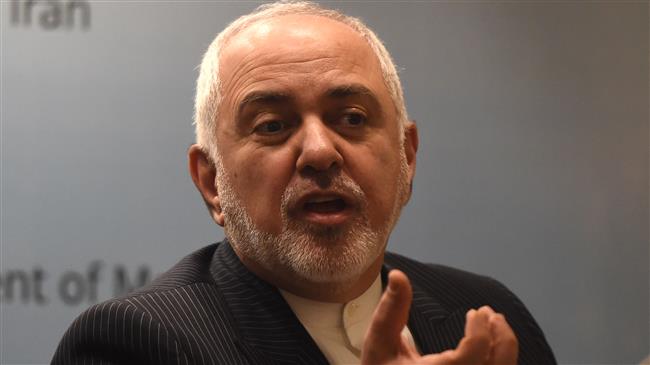
Iranian Foreign Minister Mohammad Javad Zarif (Photo by AFP)
Press TV – January 23, 2020
Foreign Minister Mohammad Javad Zarif has reaffirmed Iran’s readiness for talks with all its neighbors amid tensions in the Persian Gulf region.
“Iran remains open to dialogue with its neighbors, and we declare our readiness to participate in any complementary work that is in the interest of the region, and we welcome any step that restores hope to its people and brings them stability and prosperity,” Zarif said in a tweet in Thursday.
The tweet was in Arabic, which suggests it was addressed to the Persian Gulf littoral Arab countries. It came a day after Saudi Foreign Minister Prince Faisal bin Farhan said Riyadh was ready for talks with Tehran “but it is really up to Iran.”
The top Saudi diplomat, however, repeated the baseless claims against Iran’s role in the region, adding that the precondition for dialog is for the Islamic Republic to accept it “cannot further its regional agenda through violence.”
Speaking from the World Economic Forum in Davos, he said he was glad the region has “avoided any escalation” with Iran, and that “many countries” have offered to mediate talks with Tehran.
Meanwhile, the Iranian president’s chief of staff, Mahmoud Vaezi, said Wednesday that Tehran and Riyadh should work together to overcome their problems.
“The relations between Iran and its neighbor Saudi Arabia should not become like the relationship between Tehran and the United States … Tehran and Riyadh should work together to resolve their problems,” Vaezi said.
At an event in the Indian city of Mumbai on Friday in coordination with All India Association of Industries (AIAI), Zarif also voiced Iran’s readiness to hold talks with Saudi Arabia and other Persian Gulf countries to promote regional security.
He added that Iran has also presented proposals on ways to establish peace in the Strait of Hormuz.
In an address to the 74th session of the United Nations General Assembly in September 2019, President Hassan Rouhani said as a steward of maritime security in the Persian Gulf and the Strait of Hormuz, Iran invites all countries that are affected by developments in the strategic region to join the country’s new regional peace initiative, dubbed Hormuz Peace Endeavor (HOPE).
Iran’s initiative comes as the US has been trying to persuade its allies into a maritime coalition purportedly seeking to boost security in the Persian Gulf, after it blamed Tehran for two separate attacks on oil tankers in the Gulf of Oman in May and June, without providing any credible evidence to back up the allegation, which Iran has categorically rejected.
Tehran has repeatedly said outsiders not only cannot safeguard the region, but will fuel tensions there. Iran believes it is the countries of the very region which can ensure regional peace.
Prior to the Hormuz initiative, Iran had offered to sign non-aggression agreements with all countries in the Persian Gulf region.
Zarif also said in late May 2019 that Iran sought the best of relations with the Persian Gulf littoral countries and would welcome any proposals for dialog and de-escalation toward that end.
A New Definition of Warfare
Sanctions can be more deadly than bullets
By Philip Giraldi • Unz Review • January 21, 2020
Supporters of Donald Trump often make the point that he has not started any new wars. One might observe that it has not been for lack of trying, as his cruise missile attacks on Syria based on fabricated evidence and his recent assassination of Iranian general Qassem Soleimani have been indisputably acts of war. Trump also has enhanced troop levels both in the Middle East and in Afghanistan while also increasing the frequency and lethality of armed drone attacks worldwide.
Congress has been somewhat unseriously toying around with a tightening of the war powers act of 1973 to make it more difficult for a president to carry out acts of war without any deliberation by or authorization from the legislature. But perhaps the definition of war itself should be expanded. The one area where Trump and his team of narcissistic sociopaths have been most active has been in the imposition of sanctions with lethal intent. Secretary of State Mike Pompeo has been explicit in his explanations that the assertion of “extreme pressure” on countries like Iran and Venezuela is intended to make the people suffer to such an extent that they rise up against their governments and bring about “regime change.” In Pompeo’s twisted reckoning that is how places that Washington disapproves of will again become “normal countries.”
The sanctions can kill. Those imposed by the United States are backed up by the U.S. Treasury which is able to block cash transfers going through the dollar denominated international banking system. Banks that do not comply with America’s imposed rules can themselves be sanctioned, meaning that U.S. sanctions are de facto globally applicable, even if foreign banks and governments do not agree with the policies that drive them. It is well documented how sanctions that have an impact on the importation of medicines have killed thousands of Iranians. In Venezuela, the effect of sanctions has been starvation as food imports have been blocked, forcing a large part of the population to flee the country just to survive.
The latest exercise of United States economic warfare has been directed against Iraq. In the space of one week from December 29th to January 3rd, the American military, which operates out of two major bases in Iraq, killed 25 Iraqi militiamen who were part of the Popular Mobilization Units of the Iraqi Army. The militiamen had most recently been engaged in the successful fight against ISIS. It followed up on that attack by killing Soleimani, Iraqi militia general Abu Mahdi al-Muhandis, and eight other Iraqis in a drone strike near Baghdad International Airport. As the attacks were not approved in any way by the Iraqi government, it was no surprise that rioting followed and the Iraqi Parliament voted to remove all foreign troops from its soil. The decree was signed off on by Prime Minister Adel Abdul Mahdi, based on the fact that the U.S. military was in Iraq at the invitation of the country’s government and that invitation had just been revoked by parliament.
That Iraq is to say the least unstable is attributable to the ill-advised U.S. invasion of 2003. The persistence of U.S. forces in the country is ostensibly to aid in the fight against ISIS, but the real reason is to serve as a check on Iranian influence in Iraq, which is a strategic demand made by Israel and not responsive to any actual American interest. Indeed, the Iraqi government is probably closer politically to Tehran than to Washington, though the neocon line that the country is dominated by the Iranians is far from true.
Washington’s response to the legitimate Iraqi demand that its troops should be removed consisted of threats. When Prime Minister Mahdi spoke with Pompeo on the phone and asked for discussions and a time table to create a “withdrawal mechanism” the Secretary of State made it clear that there would be no negotiations. A State Department written response entitled “The U.S. Continued Partnership with Iraq” asserted that American troops are in Iraq to serve as a “force for good” in the Middle East and that it is “our right” to maintain “appropriate force posture” in the region.
The Iraqi position also immediately produced presidential threats and tweets about “sanctions like they have never seen,” with the implication that the U.S. was more than willing to wreck the Iraqi economy if it did not get its way. The latest threat to emerge involves blocking Iraq access to its New York federal reserve bank account, where international oil sale revenue is kept, creating a devastating cash crunch in Iraq’s financial system that might indeed destroy the Iraqi economy. If taking steps to ruin a country economically is not considered warfare by other means it is difficult to discern what might fit that description.
After dealing with Iraq, the Trump Administration turned its guns on one of its oldest and closest allies. Great Britain, like most of the other European signatories to the 2015 Joint Comprehensive Plan of Action (JCPOA) has been reluctant to withdraw from the agreement over concern that Iran will as a result decide to develop nuclear weapons. According to the Guardian, a United States representative from the National Security Council named Richard Goldberg, had visited London recently to make clear to the British government that if it does not follow the American lead and withdraw from the JCPOA and reapply sanctions it just might be difficult to work out a trade agreement with Washington post-Brexit. It is a significant threat as part of the pro-Brexit vote clearly was derived from a Trump pledge to make up for some of the anticipated decline in European trade by increasing U.K. access to the U.S. market. Now the quid pro quo is clear: Britain, which normally does in fact follow the Washington lead in foreign policy, will now be expected to be completely on board all of the time and everywhere, particularly in the Middle East.
During his visit, Goldberg told the BBC: “The question for prime minister Johnson is: ‘As you are moving towards Brexit … what are you going to do post-31 January as you come to Washington to negotiate a free-trade agreement with the United States?’ It’s absolutely in [your] interests and the people of Great Britain’s interests to join with President Trump, with the United States, to realign your foreign policy away from Brussels, and to join the maximum pressure campaign to keep all of us safe.”
And there is an interesting back story on Richard Goldberg, a John Bolton protégé anti-Iran hardliner, who threatened the British on behalf of Trump. James Carden, writing at The Nation, posits “Consider the following scenario: A Washington, DC–based, tax-exempt organization that bills itself as a think tank dedicated to the enhancement of a foreign country’s reputation within the United States, funded by billionaires closely aligned with said foreign country, has one of its high-ranking operatives (often referred to as ‘fellows’) embedded within the White House national security staff in order to further the oft-stated agenda of his home organization, which, as it happens, is also paying his salary during his year-long stint there. As it happens, this is exactly what the pro-Israel think tank the Foundation for the Defense of Democracies (FDD) reportedly achieved in an arrangement brokered by former Trump national security adviser John Bolton.”
The FDD senior adviser in question, who was placed on the National Security Council, was Richard Goldberg. FDD is largely funded by Jewish American billionaires including vulture fund capitalist Paul Singer and Home Depot partner Bernard Marcus. Its officers meet regularly with Israeli government officials and the organization is best known for its unrelenting effort to bring about war with Iran. It has relentlessly pushed for a recklessly militaristic U.S. policy directed against Iran and also more generally in the Middle East. It is a reliable mouthpiece for Israel and, inevitably, it has never been required to register under the Foreign Agents Registration Act of 1938.
To be sure, Trump also has other neocons advising him on Iran, including David Wurmser, another Bolton associate, who has the president’s ear and is a consultant to the National Security Council. Wurmser has recently submitted a series of memos to the White House advocating a policy of “regime disruption” with the Islamic Republic that will destabilize it and eventually lead to a change of government. He may have played a key role in giving the green light to the assassination of Soleimani.
The good news, if there is any, is that Goldberg resigned on January 3rd, allegedly because the war against Iran was not developing fast enough to suit him and FDD, but he is symptomatic of the many neoconservative hawks who have infiltrated the Trump Administration at secondary and tertiary levels, where much of the development and implementation of policy actually takes place. It also explains that when it comes to Iran and the irrational continuation of a significant U.S. military presence in the Middle East, it is Israel and its Lobby that are steering the ship of state.
Philip M. Giraldi, Ph.D., is Executive Director of the Council for the National Interest, a 501(c)3 tax deductible educational foundation (Federal ID Number #52-1739023) that seeks a more interests-based U.S. foreign policy in the Middle East. Website is councilforthenationalinterest.org, address is P.O. Box 2157, Purcellville VA 20134 and its email is inform@cnionline.org.
Israel participation in Expo 2020 Dubai amounts to normalization: Hamas
Press TV – January 20, 2020
Palestinian Islamic resistance movement Hamas has censured Israel’s presence in the Expo 2020, which is to be hosted by the United Arab Emirates’ city of Dubai, as a form of normalization between the Persian Gulf state and the Tel Aviv regime.
Hamas spokesman Hazem Qassem, in a written statement released on Monday, slammed attempts by a number of Arab countries, particularly Persian Gulf littoral states, to bring out in the open their clandestine relations with the Israeli regime, calling on them to put an end to such efforts.
“Such a behavior encourages the Occupation to increase the level of its crimes against Palestinian people, and to step up its violations against the sanctities of our nation,” the statement added.
“The Zionist regime must remain the principal enemy of the [Palestinian] nation. The campaign against the regime and its policies, which aim to dent all opportunities for the nation’s awakening and development, must continue,” Qassem pointed out.
Israeli authorities are hoping to reach out to Arab peoples through participation in the Expo 2020 Dubai.
“To us, the added value is in the Arab and Muslim visitor,” Elazar Cohen, the Israeli foreign ministry’s point man for the expo, which is organized by the Paris-based Bureau International des Expositions (BIE), said on December 15 last year.
An auditorium below the pavilion will offer visitors an interactive multimedia experience, the ministry’s director general Yuval Rotem told AFP at the time.
Prime Minister Benjamin Netanyahu has described the Israeli expo pavilion as part of “the continued progress of normalization with the Arab states,” alleging that building relations with Arab countries will push the Palestinians toward a ‘peace deal’ with the Israeli regime.
Israeli daily newspaper Yedioth Ahronoth reported on November 6 that the UAE is expected to allow tourists holding Israeli passports to take part in the expo.
“Israeli and the UAE’s authorities have been in talks for a while in order to allow those with Israeli passports to attend the expo in Dubai,” an unnamed source within the expo’s management team told the daily at the time, adding, “These talks are happening because both sides want to see the expo turn into the biggest exhibition in the world.”
Another source said the event in Dubai could be a great pilot run during which Israeli tourists would be allowed into the country, and it can be a signal that the UAE “might leave its doors open to Israeli tourists permanently.”
Israeli foreign minister, Israel Katz, told a ministerial meeting in Jerusalem al-Quds on August 6 last year that he was working toward “transparent normalization and signed agreements” with a number of Arab Persian Gulf littoral states.
Arab countries — except for Jordan and Egypt — have no formal relations with the Israeli regime.
Israel’s trade with Persian Gulf states is estimated to stand at about $1 billion annually, according to a study published by the Tony Blair Institute for Global Change in August 2018.
Jamal al-Suwaidi, founder of the Emirates Center for Strategic Studies and Research, told the British newspaper The Guardian in an interview in March that the Palestinian issue is no longer at the top of the agenda among the Arab Persian Gulf states.
“The Palestinian cause is no longer at the forefront of Arabs’ interests, as it used to be for long decades,” he said. “It has sharply lost priority in light of the challenges, threats and problems that face countries of the region.”
Jordanian lawmakers vote to prohibit natural gas imports from Israel
Press TV – January 19, 2020
Jordan’s parliament has voted in favor of a motion to ban natural gas imports from the Occupied Palestinian Territories in the wake of mass protests against the government’s multi-billion-dollar agreement with the Tel Aviv regime.
“The majority has voted to send the urgent motion to the government” requesting a law banning Israeli gas imports to Jordan, said Speaker of the House of Representatives Atef Tarawneh in remarks carried live by state television network on Sunday.
The text states that “the government, its ministries and state institutions and companies are prohibited from importing gas from Israel.”
Video footage showed a majority of legislators in the lower house stand up to back the motion.
The move came after 58 lawmakers out of the 130-strong legislature demanded such a ban in a letter to the parliament last month.
The motion will be passed to the government for approval, and must be sent back to the legislature for a formal vote at the upper house of the parliament.
Earlier this month, Jordan’s National Electric Power Co. said gas pumping from the Occupied Territories had started as part of a ten-billion-dollar deal.
The cash-strapped desert kingdom has defended the agreement, alleging it would cut $600 million a year from the state’s energy bill.
On Friday, hundreds of Jordanians took to the streets of Amman in a demonstration organized by the Jordanian National Campaign Against the Gas Agreement with the Zionist Entity to express their resentment over the “shameful” deal with the Israeli regime.
They called on the government to scrap the gas import agreement, and demanded the ouster of Prime Minister Omar Razzaz.
Last week, hundreds of people protested in the northeastern Jordanian city of Zarqa against the import of natural gas from Israel.
The mayor of Zarqa, Imad al-Momani, called on the authorities to “cancel this humiliating agreement” while speaking to the demonstrators.
On September 26, 2016, Jordan’s National Electric Power Company signed a 10-billion-dollar deal with US-based Noble Energy and Israeli partners in order to tap the Leviathan natural gas field in the Mediterranean Sea off the coast of Israel for the supply of approximately 1.6 trillion cubic feet of natural gas, or 300 million cubic feet per day (mcf/d), over a 15-year term.
On March 26 last year, members of Jordan’s parliament called for the cancellation of the gas deal with Israel during a parliamentary session closed to the public.
Tarawneh stated at the time that all sectors of the society and members of parliament utterly reject Jordanian electricity company agreement to buy Israeli natural gas.
Several legislators argued that the multi-billion-dollar deal violates Article 33, section two of the Jordanian constitution, which states, “Treaties and agreements which entail any expenditures to the Treasury of the State or affect the public or private rights of Jordanians shall not be valid unless approved by the parliament; and in no case shall the secret terms in a treaty or agreement be contrary to the overt terms.”
Lawmaker Saddah al-Habashneh said the deal was unconstitutional, stressing that members of parliament were not given access to read what he called the “secret” deal.
“Why are they hiding it? It’s a clue that there is something. It is totally rejected,” he commented.
Habashneh then demanded the deal be scrapped along with Jordan’s peace accord with Israel – known as Wadi Araba Treaty and signed on October 26, 1994.
“We are calling for the Wadi Araba agreement to be dropped. What is peace when they’re attacking Gaza?” the parliamentarian said.
“And with yesterday’s recognition of the Golan Heights, what’s left? We want dignity,” he said.
On March 25, 2019, US President Donald Trump signed a proclamation, formally recognizing Israel’s ‘sovereignty’ over the Golan Heights. The announcement came as Israeli Prime Minister Benjamin Netanyahu visited the White House.
The Syrian Ministry of Foreign Affairs and Expatriates, in a statement, called the decision a “blatant attack on the sovereignty and territorial integrity” of Syria.
“The liberation of the Golan by all available means and its return to the Syrian motherland is an inalienable right,” according to the statement carried by Syria’s official news agency SANA, which added, “The decision … makes the United States the main enemy of the Arabs.”
The Arab League also condemned the move, saying “Trump’s recognition does not change the area’s status.”
Iran, Iraq, Russia and Turkey also condemned Washington’s move.
Israel seized the Golan Heights from Syria after the 1967 Six-Day War and later occupied it in a move that has never been recognized by the international community. The regime has built dozens of settlements in the area ever since and has used the region to carry out a number of military operations against the Syrian government.
What’s the Point of NATO If You Are Not Prepared to Use It Against Iran?
By Philip Giraldi | Strategic Culture Foundation | January 16, 2020
Article 5 of the North Atlantic Treaty Organization (NATO) alliance commits all members to participate in the defense of any single member that is attacked. An attack on one is an attack on all. Forged in the early stages of the cold war, the alliance originally included most of the leading non-communist states in Western Europe, as well as Turkey. It was intended to deter any attacks orchestrated by the Soviet Union and was defensive in nature.
Currently NATO is an anachronism as the Soviet Union collapsed in 1991, but the desire to continue to play soldier on an international stage has granted it a measure of life support. Indeed, the alliance is regularly auditioning for new members. Its latest addition is Montenegro, which has a military consisting of 2,000 men and women, roughly one brigade. If Montenegro should be attacked, the United States is obligated to come to its assistance.
It would all be something like comic opera featuring the Duke of Plaza Toro but for the fact that there are certain things that NATO does that are not really defensive in nature but are rather destabilizing. Having expanded NATO right up to the border with Russia, which the U.S. promised not to do and then reneged, military exercises staged by the alliance currently occur right next to Russian airspace and coastal waters. To support the incursions, the myth that Moscow is expansionistic (while also seeking to destroy what passes for democracy in the West) is constantly cited. According to the current version, Russian President Vladimir Putin is just waiting to resume control over Ukraine, Georgia, Poland and the Baltic States in an effort to reconstitute the old Soviet Union. This has led to demands from the usual suspects in the U.S. Congress that Georgia and Ukraine be admitted into the alliance, which would really create an existential threat for Russia that it would have to respond to. There have also been some suggestions that Israel might join NATO. A war that no one wants either in the Middle East or in Europe could be the result if the expansion plans bear fruit.
Having nothing to do beyond aggravating the Russians, the alliance has gone along with some of the transnational abominations initially created by virtue of the Global War on Terror initiated by the loosely wrapped American president George W. Bush. The NATO alliance currently has 8,000 service members participating in a training mission in Afghanistan and its key member states have also been parts of the various coalitions that Washington has bribed or coerced into being. NATO was also actively involved in the fiasco that turned Libya into a gangster state. It had previously been the most developed nation in Africa. Currently French and British soldiers are part of the Operation Inherent Resolve (don’t you love the names!) in Syria and NATO itself is part of the Global Coalition to Defeat ISIS.
NATO will now be doing its part to help defend the United States against terrorist attack. Last Wednesday the alliance Secretary General Jens Stoltenberg spoke with President Donald Trump on the phone in the wake of the assassination of Iranian Major General Qassem Soleimani at the Baghdad International Airport. The killing was apparently carried out using missiles fired by a U.S. Reaper drone and was justified by the U.S. by claiming that Soleimani was a terrorist due to his affiliation with the listed terrorist Quds Force. It was also asserted that Soleimani was planning an attack on the U.S. Embassy in Baghdad and would have killed “hundreds” of Americans. Evidence supporting the claims was so flimsy that even some Republicans balked at approving the chain of events.
Nine Iraqis also died in the attack, including the Iraqi General who headed the Kata’Ib Hezbollah Militia, which had been incorporated into the Iraqi Army to fight against the terrorist group ISIS. During the week preceding the execution of Soleimani, the U.S. had staged an air attack that killed 25 Iraqi members of Kata’Ib, the incident that then sparked the rioting at the American Embassy in Baghdad’s Green Zone.
Bearing in mind that the alleged thwarted terrorist attacks took place seven thousand miles away from the United States, it is hard to make the case that the U.S. was directly threatened requiring a response from NATO under Article 5. No doubt the Mike Pompeo State Department will claim that its Embassy is sovereign territory and therefor part of the United States. It is a bullshit argument, but it will no doubt be made. The White House has already made a similar sovereignty claim vis-à-vis the two U.S. bases in Iraq that were hit by a barrage of a dozen Iranian missiles a day after the killing of Soleimani. Unlike the case of Soleimani and his party, no one was killed by the Iranian attacks, quite possibly a deliberate mis-targeting to avoid an escalation in the conflict.
In spite of the fact that there was no actual threat and no factual basis for a call to arms, last Wednesday, NATO Secretary General Jens Stoltenberg spoke by phone with President Donald Trump “on developments in the Middle East.” A NATO press release stated that the two men discussed “the situation in the region and NATO’s role.”
According to the press release “The President asked the Secretary General for NATO to become more involved in the Middle East. They agreed that NATO could contribute more to regional stability and the fight against international terrorism.” A tweet by White House deputy press secretary Judd Deere later confirmed that Trump had “emphasized the value of NATO increasing its role in preventing conflict and preserving peace in the Middle East.” Prior to the phone call, Trump had announced that he would ask NATO “to become much more involved in the Middle East process.”
As the Trumpean concept of a peace process is total surrender on the part of the targeted parties, be they Palestinians or Iranians, it will be interesting to see just how the new arrangement works. Sending soldiers into unstable places to do unnecessary things as part of a non-existent strategy will not sit well with many Europeans. It should not sit well with Americans either.
Iraqis must resort to resistance if US forces refuse to pull out: Senior Nujaba official
Press TV – January 14, 2020
The deputy secretary general of Iraq’s al-Nujaba Movement says the Iraqi nation must choose the path of resistance in case the parliamentary bill demanding the withdrawal of all US-led foreign military forces from the country is not implemented.
“The Iraqi people must opt for the path of resistance unless the parliament’s decision on the pullout of foreign forces is carried out,” Nasr al-Shammari said in an exclusive interview with Lebanon-based Arabic-language al-Mayadeen television news network on Tuesday.
He added that the decision to expel foreign forces from Iraq does not need a parliamentary mandate, stating that the US-led military coalition purportedly fighting the Daesh terrorist group entered Iraq at the request of Baghdad government and can be removed by a letter from the government as well.
“The decision concerning the removal of foreign forces from Iraq is the only decision taken away from sectarian fault lines. A person of sound mind cannot accept the presence of a foreign state that imposes its own authority on a sovereign country. If getting foreign forces out of Iraq is a charge, then we consider it as an honor for ourselves, our children and our grandchildren,” Shammari pointed out.
He then noted that all Iraqi resistance factions are united to end the presence of foreign troops in the country, saying, “The United States must respect the sovereignty of states and decisions of peoples, and adhere to them.”
“Iraq will not accept being ruled by any country. Any failure to implement the parliament decision on the withdrawal of foreign forces will give the green light for the start of resistance operations,” Shammari highlighted.
The Nujaba official went on to say that Popular Mobilization Units (PMU), better known by the Arabic word Hashd al-Sha’abi, have become more coherent and solid in the wake of the recent US assassination of the second-in-command of PMU, Abu Mahdi al-Muhandis.
“The death of Muhandis does not mean the end of Hashd al-Sha’abi and its role in the region,” Shammari said.
He added that Iraqi resistance groups are indebted to Lieutenant General Qassem Soleimani, the commander of the Quds Force of Iran’s Islamic Revolution Guards Corps (IRGC).
“The resistance against US forces will soon attain its goal of removing foreign troops from the Iraqi soil. The blood of martyrs will finally bring about the demise of the Zionist entity, and the end of its occupation of Arab lands,” Shammari concluded.
Baghdad moving to internationally prosecute US for crimes in Iraq
Meanwhile, a member of the Iraqi Parliamentary Human Rights Committee said the Baghdad government was preparing to prosecute the United States at international courts of law for its crimes in Iraq, noting that the offenses amount to genocide.
“The United States has been committing the most heinous war crimes since 2003 up until now. The invasion of Iraq, the Abu Ghraib prisoner abuse, the Nisour Square massacre and the emergence of Daesh (Takfiri terrorist group) besides the attack on the leaders of Hashd al-Sha’abi are all crimes classified as genocide,” Ahmed al-Kanani said in a statement on Tuesday.
Kanani added, “All the crimes that America has perpetrated against the Iraqi nation are documented, and that there are bids to prosecute Washington for its crimes against Iraqis before international courts.”
On January 5, Iraqi lawmakers unanimously approved a bill, demanding the withdrawal of all foreign military forces led by the United States from the country.
Late on January 9, Iraq’s caretaker Prime Minister Adel Abdul-Mahdi called on the United States to dispatch a delegation to Baghdad tasked with formulating a mechanism for the withdrawal of US troops from the country.
According to a statement released by the Iraqi premier’s office, Abdul-Mahdi “requested that delegates be sent to Iraq to set the mechanisms to implement the parliament’s decision for the secure withdrawal of (foreign) forces from Iraq” in a phone call with US Secretary of State Mike Pompeo.
The prime minister said Iraq rejects violation of its sovereignty, particularly the US military’s violation of Iraqi airspace in the airstrike that assassinated Lt. Gen. Soleimani, Muhandis and their companions.
Abdul-Mahdi asked Pompeo to “send delegates to Iraq to prepare a mechanism to carry out the parliament’s resolution regarding the withdrawal of foreign troops from Iraq,” the statement said.
“The prime minister said American forces had entered Iraq and drones are flying in its airspace without permission from Iraqi authorities and this was a violation of the bilateral agreements,” the statement added.
The US State Department bluntly rejected the request the following day.
Featured Video

No Threat Can Force Iran’s Surrender /Trita Parsi & Lt Cl Daniel Davis
or go to
Aletho News Archives – Video-Images
From the Archives
What is the Israeli Lobby in Australia Doing in Interfaith Dialogue?
By Ali Kazak | Dissident Voice | October 11, 2015
For years Israel and its lobby around the world have been trying to normalise their relations with Arabs and Muslims without solving the Palestine Question.
One of the methods they resorted to in the last few years is using human rights and community organizations such as interfaith dialogue and Multiculturalism to achieve this objective and to: isolate the Palestinians, marginalise the Palestine question, end Israel’s isolation, and prevent criticism of Israel, knowing that these organisations will be the first to stand against Israel’s violations, racial and religious discrimination.
The group responsible for this task in Australia is The Australia/Israel & Jewish Affairs Council (AIJAC); its Director of International & Community Affairs, Jeremy Jones is in charge of lobbying religious community organizations, specifically Muslims and Christians. Consequently he convened the Faith Communities for Reconciliation, founding participant in the Australian Partnership of Religious Organisations and the Australian National Dialogue of Christians, Muslims & Jews.
AIJAC is a private political propaganda group. It is recognised as the main Israeli lobby in Australia. It coordinates its activities and works intimately with the Israeli embassy in Canberra and different institutions in Israel. It is privately funded by some Jewish businessmen. It monitors closely Australian politicians, the media, ethnic and religious groups, (especially Arabs and Muslims), unions and academics on their stands towards Israel and the Palestine question. … continue
Blog Roll
 Aletho News
- Envoy warns UN on Trump’s threat to ‘obliterate’ Iran’s civilian infrastructure
- The Larak Corridor: Iran’s Rial Gate With No US, No Israel, and No Way Around
- ‘Economic terrorism’: Steel facilities hit again in US-Israeli strike
- ‘War Crime’: Iran condemns attacks on Arak, Ardakan nuclear sites
- Two-thirds of Americans want quick end to Iran war even if goals unmet
- Trump to Give “Important Update on Iran” Wednesday in Prime-Time Speech
- Theodore Postol: Iran’s Missiles & Drones Were Underestimated
- Iran To Target Military Industrial-Tech Complex That Facilitated Gaza Genocide
- Collapsing Empire: The Resistance Disarms ‘Israel’
- Suicide Should Not Be a Government Service
- If Americans Knew
- Israel wants US to bomb more of Iran’s civilian structures (113,000 is not enough) – Not a ceasefire Day 173
- Ann Coulter Rips Into Fox News for Iran War Coverage
- Joe Kent Urges Americans To Call White House and Congress To Object To Sending Troops Into Iran
- DNC Resolution to Reject AIPAC Funding Puts Democratic Leaders in the Hot Seat
- Swedish foundation to build 400 schools as over 650,000 Gaza children remain without education for 2 years
- Israeli army admits photshopping image of slain Lebanese journalist
- This is how Israel is systematically killing health workers under the cover of war in Lebanon
- Carrying life under fire: Israeli invasion of Lebanon leaves pregnant women facing deadly risks
- Champagne all around for the new death penalty (for Palestinians) law – Not a ceasefire Day 172
- Why are Palestinian books struggling to be seen on Amazon?
- No Tricks Zone
- New Study Finds Warming Saves Lives…Cold Temperatures 12 Times More Deadly Than Excess Heat
- German Science Blog Accuses PIK Climate Institute Of Hallucinating Climate Tipping Points
- Devastating Assessment Of Comirnaty Vaccine By Former Senior Pfizer Europe Toxicologist
- New Study: CO2 Is ‘Effectively Negligible’ As An Explanatory Climate Change Factor Since 2000
- Former Pfizer Toxicologist Dr. Helmut Sterz Tells Bundestag Hearing Pfizer Vaccine Should Have Never Been Approved
- Energy Expert: Germany’s Nuclear Phaseout Was A “500 Billion Euro Mistake”
- New Research: South Australia’s Mid-Holocene Sea Surface Temperatures Were 4°C Warmer Than Today
- Storing Green Energy To Last Germany 10 Days Would Require A 60-Million Tonne Battery
- New Studies: UK Sea Levels Were 4 Meters Higher Than Today During The Mid-Holocene
- Destructive Green New Deal: German Energy And Metal Group Warns Of Drastic Crisis
 Aletho News