3 Ukrainian atrocities lacking ‘transparent’ investigation
RT | October 10, 2014
Ukraine has been flooded with violence this year – snipers in Kiev, the Odessa massacre, the discovery of mass graves in E. Ukraine are just the tip of the iceberg. However, almost no proper investigation has been carried out so far – even of these cases.
The Ukrainian crisis that broke out almost a year ago resulted in a military conflict – which, in its turn, resulted in horrible crimes.
But current efforts to examine even the three most prominent cases seem to be not enough, RT’s Maria Finoshina found out.
On September 23, three unmarked graves with at least nine bodies were discovered, near the Eastern Ukraine city of Donetsk. The finding of self-defense forces was later confirmed by the OSCE Special Monitoring Mission (SMM).
Chief medical examiner Konstantin Gerasimenko told RT that “All of them [the victims] had multiple gunshots and their hands bound.”
Russian Foreign Minister Sergey Lavrov called on the international organizations to give a “clear, unbiased and responsible response.” It was followed by Washington’s words of support for a “full and thorough” investigation destined “to get to the bottom of the facts.”
However, little progress has been achieved in the investigation of the killings by the OSCE, whose monitors are currently working on the scene, as well as by the monitoring mission of the Office of the UN High Commissioner for Human Rights who promised to take part in the investigation of the matter.
Spokesperson for EU Foreign Affairs and Security Policy told RT via e-mail that “As underlined by the OSCE SMM and as far as we’re aware there has been no forensic analysis of the bodies so far.”
The answer of the Human Rights Watch organization is hard to call positive, as well. “At this moment we don’t have any factual information about the progress of these investigations, so it’s better not to comment.”
Another tragedy happened on May 2 in the southern city of Odessa, where nearly 40 people died in flames that burst out in a building where anti-Maidan protesters tried to take refuge. The international community was quick to condemn the massacre, though closing its eyes to the part Right Sector radicals played in setting the fire.
RT has recently contacted the EU Council, but all the spokesperson for EU Foreign Affairs and Security Policy had to say five months after the violence was the “investigation must be swift and transparent, free of political influence, clarifying the facts and looking at the role of all parties involved, protesters as well as law enforcement services.”
As a matter of fact, the Ukrainian authorities carried out an investigation, but the resulting report called it “impossible” to arrive at an objective conclusion about the causes of the deaths “due to the lack of state-of-the-art equipment”.
The probe was slammed by the local media as “fabricated” and “lacking evidence”.
Svetlana Fabrikant, a member of the Ukrainian parliament and secretary of the parliamentary commission probing into the massacre in Odessa on May 2, even withdrew her signature from the published version, calling it “different” from what she had signed. Reportedly, the redacted final version did not contain witnesses’ accounts about the involvement of about 500 radicals who have been allegedly transferred to Odessa with the help of the region’s governor, Vladimir Nemirovsky. Also, it lacked information implicating the involvement of Andrey Parubiy, then-secretary of Ukraine’s National Security and Defense Council, in organizing the massacre.
In February, over a hundred people were killed on Maidan by sniper fire.
There have been complaints from human rights advocates that the investigation is going on slowly, and some important evidence has been destroyed.
The preliminary investigation blamed ousted president Viktor Yanukovich and the Berkut special division, who denied any connection to the snipers.
In a leaked tape that emerged in March Estonia’s Foreign Minister told EU’s Foreign Policy Chief Catherine Ashton about the bloody events that “It is really disturbing that the new coalition, they don’t want to investigate what exactly happened.” He added that there was “A stronger and stronger understanding that behind the snipers it was not Yanukovich, but it was somebody from the new coalition”.
A number of Berkut special unit members have been arrested on charges of Maidan killings, and they are currently facing trial.
There has been no international investigation into either of those crimes.
READ MORE:
Odessa slaughter: How vicious mob burnt anti-govt activists alive (GRAPHIC IMAGES)
‘Taped hands, gun wounds’: RT witnesses exhumation of mass graves in E. Ukraine
US planes worth $500mn sold for scrap in Afghanistan – for just $32,000
RT | October 10, 2014
A US watchdog is asking why 16 planes bought for the Afghan Air Force, costing almost $500 million, were turned into scrap metal valued at just $32,000. The government wants to know why hundreds of millions of taxpayers’ money were wasted on the project.
The military transport planes had been sitting at Kabul International Airport for years, before they were sent for scrap. John Sopko, the Special Inspector General for Afghanistan Reconstruction (SIGAR), wants to know why the money was wasted. According to Reuters, he had asked Air Force Secretary Deborah James to keep a record of all decisions concerning the destruction of the 16 C-27J planes.
Sopko also wants to know what will happen to another four transport planes currently stored at the US Air Force base in Ramstein, Germany.
“I am concerned that the officials responsible for planning and executing the scrapping of the planes may not have considered other possible alternatives in order to salvage taxpayer dollars,” Sopko said.
The 20 planes were bought from Alenia, which is part of the Italian aircraft company Fimmeccanica SpA. However, according to a SIGAR letter sent to US Defense Secretary Chuck Hagel, the program was ended in March 2013, “after sustained, serious performance, maintenance, and spare parts problems and the planes were grounded,” ABC reported.
By January 2013, according to Sopko’s office, the aircraft were not airworthy and had only flown a total of 234 of the 4,500 hours required in nine months from January through September 2012. Spoko’s office also said that a further $200 million was needed to buy spare parts.
The Defense Logistics Agency was responsible for destroying the planes and Sopko now wants to know if any of the parts of the planes were sold before they were sent for scrap metal.
Major Bradlee Avots, a Pentagon spokesman, said that the 16 aircraft at Kabul International Airport had been destroyed “to minimize impact on drawdown of US Forces in Afghanistan,” and added that more information would be released after a review. The US government is currently in the process of scaling down from its present military personnel in Afghanistan of around 26,000 to a force of just under 10,000, who will be staying in a mainly advisory role.
Avots also said that the US Department of Defense and the US Air Force were still deciding what to do with the four aircraft in Germany.
SIGAR has been investigating possible wasteful spending on warplanes since the end of 2013, following questions raised by military officials and non-profit organizations.
Sopko has said that he does not know if wasteful plane procurement was due to any criminal malice or was just mismanagement, but that the “scrap metal” incident in Afghanistan was not an isolated case.
In June, despite Afghanistan being a landlocked country, a US government watchdog found that the Pentagon spent more than $3 million obtaining eight patrol boats that were never used. Additionally, the cost of each boat turned out to be about $375,000 – far more than the $50,000 they usually sell for in the US.
During his investigation, Sopko said that records related to the purchase and cancelation of the patrol boats were severely lacking, and his questions to the military have not resulted in adequate answers.
“The military has been unable to provide records that would answer the most basic questions surrounding this $3 million purchase,” his office told the Washington Post in a statement in June.
Prisoner swaps on shaky ground in Ukraine as Kiev accused of foul play
RT | September 29, 2014
Prisoner swaps in Ukraine are in danger of stalling as rebels say they will no longer tolerate Kiev’s practice of producing random people for exchange instead of actual members of militia and political prisoners.
Prisoner exchanges are a crucial part for consolidating the shaky truce in eastern Ukraine. The peace deal signed in Minsk, Belarus, on September 5 states that all captives must be eventually set free. So far the OSCE-monitored swaps had been done on a one-for-one basis, and Kiev is apparently lacking genuine rebel captives to offer and is substituting them with whoever it can procure.
But the rebels say they won’t have it anymore.
“We don’t reject further trade, but the rules of the game have changed now. The Ukrainian side will have to deliver lists and IDs of our supporters they offer in advance,” prime minister of the self-proclaimed Donetsk People’s Republic, Aleksandr Zakharchenko, told Interfax. “We will be checking the people brought for exchange against those lists. If they try to send us wrong people, we would reject them and would hold a corresponding number of their military.”
On Friday last week the rebels said they would suspend all exchanges unless Kiev stops sending them people who have nothing to do with the militias. Despite the threat, a new trade did happen on Sunday, as Kiev offered 60 prisoners in exchange for 30 army soldiers captured by the rebels. The willingness to double the number of released captives may indicate that Kiev is trying to make concessions.
But the Sunday trade may have been the reason for the latest demand, as some of those released by the Ukrainian government insisted that they had never been combatants, RIA Novosti reported.
One of the prisoners, who introduced himself as Aleksandr from the city of Kharkov, said he was just snatched from the street near his home.
“I came out for a smoke. Gunmen in a police car drove by, dragged me in took to a police station,” he told the Russian news agency. “They beat me and made me confess of murdering several people. Told me that I was a terrorist. I could barely comprehend what was happening.”
He added he wouldn’t go home because he fears he would be arrested again.
Another ex-prisoner said he was a music teacher and that he was arrested for telling a family member on the phone that he could see Ukrainian military vehicles from his window. Apparently he was suspected of giving intelligence to the rebels, but he denies any ties with the militias.
Yet another said he was arrested in Nikolayev, a city far from the conflict zone, for taking part in a peaceful anti-government protest.
“Ukraine is passing off the wrong people all the time. Of the 60 people they offered for the latest trade, 45 were just random folk,” Andrey Purgin, a senior DPR official told the news agency.
The allegations of foul play were corroborated last week by the New York Times, which covered a prisoner swap on September 21. The newspaper cited the prisoners released by Kiev as saying that only seven of the 28 were rebel fighters. Those released by the rebels all looked like military.
The problem is aggravated by a concern among the rebels that their fighters may have been killed in captivity. In preparation for the latest exchange the rebels made a list of 100 captive militiamen, but Kiev could find only 29 of them, said Darya Morozova, who heads the exchange committee for the DPR.
There has long been reluctance among Ukrainian officials over prisoner exchanges. For months the bulk of the work to release captives was shouldered by civilian activists rather than officials, and ensuring that the agreed terms of prisoners swaps were upheld by Kiev was always a major issue, according to Vladimir Ruban, a retired Ukrainian general who found himself in the position of a key negotiator once the conflict in the east escalated.
“Everything can be settled, a compromise can be found in any situation. But relying on the Ukrainian side to hold to the terms – that’s an issue,” he said in an interview to Vesti newspaper in early September. “The Donetsk side understands that the Ukrainian side may not deliver, and still they agree to big concessions because they realize the peculiarity of the state and its officials. We still make deals. This is both great and awful.”
‘Deterrence not arms race’: Russia hints it may develop rival to US Prompt Global Strike
RT | September 11, 2014

Russia could use ballistic missiles, such as the Yars , with conventional warheads to counter CPGS. (RIA Novosti / Vadim Savitskii)
A highly-placed Defense Ministry official says that Russia may be forced to match the US Conventional Prompt Global Strike (CPGS) doctrine, which prescribes that a non-nuclear US missile must be able to hit any target on Earth within one hour.
“Russia is capable of and will have to develop a similar system,” Deputy Defense Minister Yuri Borisov said during a public discussion of the Russian rearmament program for the decade of 2016 through 2025.
“But mostly we will concentrate on countering CPGS, as our military doctrine is a defensive one.”
But the official denied that the Kremlin was setting off for another Cold War-style arms race with the West.
“This is not in these plans, and I hope will never happen,” said Borisov. “We simply want to protect our civilian population from outside threats.”
While Prompt Global Strike is often treated as a futuristic super-weapon, it is simply a system that ensures that strike areas of existing technologies cover the entirety of the planet. The concept of CPGS was first explicitly stated in official US documents during the first George W. Bush administration, and in more than a decade on, it has gone through various iterations, from ones that would see kinetic weapons fired at targets on the ground from space, to hypersonic missiles, to conventional solutions of placing short and medium range missiles around the world. There is no deadline for the program’s official completion, which is just as much subject to budget constraints as other articles of the defense budget, or consistent status updates on whether its aims may have already been achieved through existing armaments.
Despite its vague remit and gradual implementation, the program has caused considerable consternation in Moscow and Beijing. A previous US study showed that up to 30 percent of enemy nuclear launchers could be taken out with conventional weapons that would form part of the CPGS. Russian officials have said that together with the missile defense system the US is deploying around the world, this could mean that the current nuclear balance could be undermined.
This was clearly on Vladimir Putin’s mind when he spoke of creating new “assault capabilities, including maintaining a guaranteed solution to the task of nuclear deterrence” at the same Wednesday meeting.
But most experts agreed that Russia’s current abilities are already sufficient to withstand CPGS, even if it lacks the same attack capabilities.
“We already have a system of swift retaliation,” said Yuri Baluyevsky, former Chief of the General Staff of the Russian Armed Forces. The retired general is helping to develop the Kremlin to develop a new military doctrine by the end of the year, in the face of geopolitical changes in Ukraine, NATO’s increased presence in Eastern Europe, and the NATO missile shield.
“Russia has missiles, such as the long-range, air-based X-101 strategic cruise missile, which is able to strike at distances of 5,000 kilometers (about 3,100 miles),” the president of the Academy of Geopolitical Problems, Konstantin Sivkov, told RIA news agency.
“It also has high-precision ballistic missiles that could strike ground targets, providing they had normal warheads. These are the two main elements of a rapid long-range strike, That is, it can be done now. Basically, existing long-range aviation would be sufficient.”

Another expert suggested that Russia’s air defense systems – which cost considerably less than launches of ballistic missiles to operate – should form the backbone of the country’s response to CPGS.
“To create an adequate aerospace defense system it is important to develop interceptor systems, such as the S-500. It is capable of hitting targets not only in the air but also in near space at an altitude of 200 kilometers above the Earth, which are moving at a speed of up to 8 kilometers per second,” said Igor Korotchenko, editor-in-chief of National Defense magazine.
The unveiling of CPGS has not only bred stiff resistance around the world, but also doubts at home in the US itself. A Carnegie Center study from last year said that the system held some of the same risks as a nuclear attack, and was much more likely to be used. Within the allocated 60-minute time frame, incoming conventional missiles could be mistaken for nuclear warheads, their trajectory could be misunderstood, or they could simply hit the wrong target – all situations that may unleash a rapid response, which Russia and China, at the very least, appear to be very capable of already.
Pentagon: Missile defense ‘kill vehicle’ still plagued with problems after years of failure
RT | September 9, 2014
A Pentagon investigation of the “kill vehicle” warhead, part of a weapons system plagued with years of failed tests, found dozens of quality control problems, according to a new report.
The Pentagon’s inspector general said in the report released Monday that the “kill vehicle,” a warhead meant to intercept missiles, fell short of quality standards in 48 specific cases, including issues with software testing, supply chain demands, and design changes, making the kill vehicle “susceptible to quality assurance failures.”
The warhead, known as the Exoatmospheric Kill Vehicle (EKV) is built by Raytheon Co. and is part of the Ground-based Midcourse Defense (GMD) system led by Boeing Co. EKVs are launched by a Ground Based Interceptor (GBI), “which is designed to engage high-speed ballistic missile warheads in space,” according to Raytheon. The current procurement cost for each GBI is around $75 million, said Missile Defense Agency Director Vice Admiral James Syring in July 2013.
The inspector general report, the first of two on the EKV, said the US Missile Defense Agency has agreed with concerns over the interceptor warhead and has started to address 44 of the 48 issues identified.
The GMD missile defense system was deployed in 2004 even before it completed testing to be able to counter what the George W. Bush administration claimed was a looming missile threat from North Korea.
The EKV finally conducted its first successful missile intercept in June after years of failed attempts.
“A combination of cost constraints and failure-driven program restructures has kept the program in a state of change. Schedule and cost priorities drove a culture of ‘use-as-is’ leaving the EKV as a manufacturing challenge,” the report said.
“With more than 1,800 unique parts, 10,000 pages of work instructions, and 130,000 process steps for the current configuration, EKV repairs and refurbishments are considered by the program to be costly and problematic and make the EKV susceptible to quality assurance failures,” it added.
The Pentagon inspector general wrote that most quality management systems on the weapons program were in compliance, but problems were evident. The report found 15 major and 25 minor quality problems with Raytheon’s EKV work. Boeing’s work on the entire system had six major and one minor problem.
Most of the issues identified in the report have been corrected, the inspector general said, but Raytheon is still working on four issues.
Raytheon has a $636 million development and sustainment contract to produce the EKV, though the Pentagon is seeking one of the major defense contracting firms to develop a more reliable, second generation EKV, Reuters reported. Weapons giants Boeing, Raytheon and Lockheed Martin Corp. are all in the running.
US to supply arms to Ukraine, hold joint military drills in Black Sea
RT | September 7, 2014
The Ukrainian and US navies will take part in a joint exercise called “Sea Breeze 2014” on September 8-10 in the northwestern part of the Black Sea, Ukraine’s Ministry of Defense said.
Around 280 US servicemen will participate in the drills, according to a statement by US European Command spokesman Navy Capt. Greg Hicks, director of Communication and Engagement.
The exercises will include representatives from five countries – including Georgia, Romania and Turkey – as well as the Standing NATO Maritime Group TWO Task Unit 02 (including Canadian, Spanish, and Romanian ships).
The planned military exercises are said to be focused on how interdiction operations could enhance maritime security.
Also, the US – along with France, Italy, Poland and Norway – will supply modern weapons to Ukraine, according to President Petro Poroshenko’s aide, Yury Lutsenko. The agreements were reached at the NATO summit in Wales, he wrote on Sunday on Facebook. The West will also send military advisers to Ukraine, he added.
Meanwhile, NATO is in the midst of its seven-day military exercises in Latvia. The organization says the drills are aimed at showing its commitment to Baltic member states in the face of an “assertive” Russia.
Exercise Steadfast Javelin 2 kicked off on September 2. It simulates the deployment of NATO soldiers and equipment during a crisis situation. A total of around 2,000 soldiers from nine different countries are taking part in the maneuvers, which will carry on until Monday.
The exercises in Latvia will be followed by other drills in Germany, Norway, Ukraine, and Poland later this autumn.
Moreover, following the NATO summit in Wales, a plan to create a new rapid reaction force in Eastern Europe was announced, likely numbering at least 4,000 and ready to be deployed within 48 hours.
The Baltic states and Romania have already offered to host the force.
‘Promoting peace and stability’: NATO warships enter Black Sea
RT | September 4, 2014
A US Navy destroyer and, reportedly, a French frigate have entered the Black Sea, as NATO builds up its presence in the region while tensions remain high in Ukraine. Another two warships are expected to arrive in the area by the end of the week.
The US Navy 6th Fleet official command has confirmed on its official Twitter account that the destroyer USS Ross, (DDG 71), an Arleigh Burke-class guided-missile destroyer, is now in the Black Sea.
“USS Ross enters Black Sea, promoting peace and stability while working with NATO allies and partners,” a statement said.
The US Navy has stressed that “the Ross’ presence in the Black Sea serves to demonstrate the United States’ commitment to strengthening the collective security of NATO allies and partners in the region.”
“The US Navy maintains an enduring commitment to forward-presence throughout the region in order to have ready-forces available if a crisis were to occur,” the statement said.
Another NATO warship, France’s Commandant Birot, also arrived in Black Sea waters on Wednesday night, according to a military diplomatic source cited by the Itar-Tass news agency.
“Both ships have passed through the Bosphorus and entered the Black Sea between 21:00 and 22:00 Moscow time,” the source was quoted as saying.
Commandant Birot has joined another French warship, the Dupuy le Lome, a surveillance ship designed to collect signals and communications from beyond enemy lines. Up until September 4, the Dupuy le Lome was the only NATO ship in the region. The vessel is scheduled to leave the area on September 5.
A total of four NATO warships are expected to enter the Black Sea before September 7. The USS Ross and Commandant Birot will be joined by Canada’s HMCS Toronto, a Halifax-class frigate, and a Spanish frigate, the Almirante Juan de Borbon.
Under the Montreux Convention of 1936, warships of non-Black Sea states can stay in the Black Sea for no more than 21 days. It also stipulates that the maximum deadweight of a non-regional warship in the area should not exceed 45,000 tons.
NATO warships have been operating in the area since this spring, when tensions started escalating between Kiev forces and rebels in southeastern Ukraine.
Despite the three-week limit, the alliance has managed to secure its presence in the area by constantly rotating warships there.
Deployed to the region in mid-May, the Dupuy le Lome was preceded by the destroyer USS Donald Cook, sent to the Black Sea in early April.
In July this year, NATO deployed a total of nine vessels, setting a record for the post-Soviet period.
On August 7, the US missile cruiser Vella Gulf entered the Black Sea and left the region at the end of the month.
NATO has been discussing its “more visible” presence in Eastern Europe, referring to the three Baltic States – Latvia, Lithuania and Estonia – as there has been little progress in resolving the conflict in Ukraine. The issue is now being discussed in Wales, where the military alliance is meeting on Thursday and Friday.
The US and the international community have accused Russia of supporting opposition forces in southeastern Ukraine, accusations that have been denied by Moscow.
Russia has condemned NATO’s activities in the Black Sea and branded them a provocation that hinders the normalization of the situation in Ukraine.
US prepares military drill in W. Ukraine for mid-September
RT | September 3, 2014
The US and its allies are preparing to stage a military exercise in western Ukraine, close to the Polish border, in mid-September. The joint drill will involve over 1,000 troops from the US and Europe, as well as from Ukraine.
Initially planned for mid-July, the exercise – code-named ‘Rapid Trident’ – was halted due to a significant escalation in the conflict between Kiev and the southeastern regions of Ukraine.
Now, as the fighting between the two sides continues, the US Army’s European Command (EUCOM) plans to go ahead and stage the exercise on September 16-26.
“At the moment, we are still planning for [the exercise] to go ahead,” US Navy Captain Gregory Hicks, spokesman for EUCOM, announced on Tuesday.
The annual exercise will take place at Yavoriv training center in the city of Lvov, near Ukraine’s border with Poland.
Around 200 US personnel will be involved in the drill, as well as 1,100 others from Ukraine, Azerbaijan, Britain, Canada, Georgia, Germany, Latvia, Lithuania, Moldova, Norway, Poland, Romania, and Spain, EUCOM said.
In addition to staging air force exercises, the United States is moving tanks and 600 troops to Poland and the Baltic states of Estonia, Latvia, and Lithuania for joint maneuvers in October, Reuters reports. The new deployment will replace a more lightly armed force of paratroopers.
Rapid Trident 2014 is designed to “promote regional stability and security, strengthen partnership capacity and foster trust while improving interoperability between the land forces of Ukraine, and NATO and partner nations,” according to the US Forces in Europe website.
The exercise will be mainly focused on command post drills, patrolling, and dealing with improvised explosive devices.
Despite the involvement of many NATO members, Rapid Trident is not formally a NATO drill.
The Ukrainian-American exercises have taken place in Lvov since 2006 under the framework of NATO’s broader ‘Partnership for Peace,’ which Ukraine is part of.
This year’s drill will mean the first significant deployment of US troops and other personnel to Ukraine since the crisis erupted.
Last year’s Rapid Trident, which focused on “airborne and air-mobile infantry operations,” according to a report on the Rapid Trident website, brought together 17 NATO countries for joint exercises.
The announcement comes just two days before the NATO 2014 summit is set to open in Wales. The alliance’s expansion to Eastern Europe is expected to become one of the main discussions and the 28-member bloc expects, despite internal opposition, to agree on the “more visible NATO presence in the East.”
The White House said the US and its allies are set to discuss plans to significantly increase the readiness of NATO response forces.
White House spokesman Josh Earnest told reporters that the meetings within the summit are expected to involve discussions on potential trainings, exercises, and other issues regarding infrastructure and other needs in Eastern Europe.
Back in June, US President Barack Obama pledged to invest $1 billion in stepping up America’s military presence in Eastern Europe amid the Ukraine crisis. Also that month, Washington vowed additional military help to Ukraine, as well as the potential training of its law enforcement and military personnel.
NATO planning rapid-deployment force of 10,000 troops to counter Russia – report
RT | August 30, 2014
NATO is reportedly working towards the creation of an expeditionary force composed of 10,000 troops from seven different member states as a result of escalating tensions with Russia over the conflict in Ukraine.
According to the Financial Times,the force’s creation will be spearheaded by Britain and involve contributions from Denmark, Latvia, Estonia, Lithuania, Norway, and the Netherlands. Canada is also interested in joining the group, but it’s not known what its final decision will be.
Although no formal announcement has been made, British Prime Minister David Cameron is expected to declare its formation at the upcoming NATO summit in Wales on September 4th.
Many specifics have yet to be worked out or announced, but planners are reportedly implementing ways to increase the number of soldiers involved even more if necessary. Air and naval units will be integrated into the group, as well as ground troops led by British commanders.
As noted by the Times, the creation of the force comes as a response to Russia’s involvement in the ongoing Ukrainian crisis, with the ultimate goal being to “create a fully functioning, division-sized force for rapid deployment and regular, frequent exercises.” NATO has accused Russia of deploying more than 1,000 troops into Ukraine to bolster separatists in the eastern part of the country.
Russia, however, insists that it does not have troops operating inside of Ukraine and has dismissed NATO’s assertions.
Despite the fact that NATO has opted not to act militarily in Ukraine – unnamed sources told Foreign Policy on Friday that there are no plans to confront Russia with anything more than stronger sanctions – Jonathan Eyal of the London-based Royal United Services Institute said the group needs to demonstrate that its eastern European members are just as integral to the alliance as other states.
“We need to end the idea of different zones of security in Europe,” he told the Financial Times. “We need to be talking about prepositioning, regular rotation of troops and making it very clear that we do not accept that the eastern Europeans are in some different category of membership of NATO.”
The revelation also arrives just a few days after NATO’s Secretary-General Anders Fogh Rasmussen expressed interest in forming “a more visible presence” in Eastern Europe in the form of facilities capable of rapidly receiving “response forces” needed to counter Russia.
For his part, Russia’s envoy to NATO, Aleksandr Grushko, said any attempt to push stretch further into the region would impact Moscow’s own security planning.
Liberals’ darling Elizabeth Warren defends Israeli attacks on Gaza schools and hospitals
RT | August 29, 2014
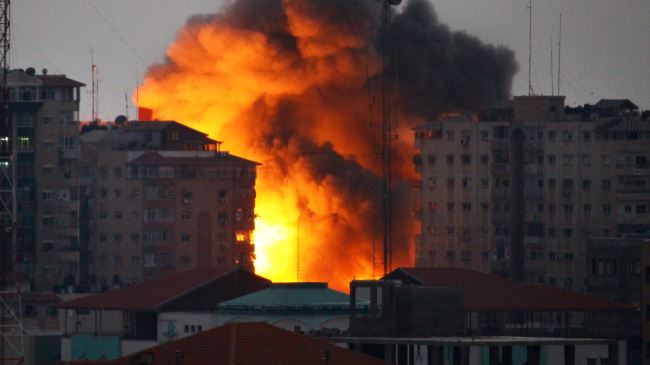
Israel has the right to shell Palestinian hospitals and schools out of self defense as long as Hamas stores rocket launchers next to them, US Sen. Elizabeth Warren said during a town hall meeting in Massachusetts this week.
Warren, darling du jour of American liberals, defended her vote to send more defense funding to Israel in the middle of its recent fierce offensive on Gaza, saying she believes civilian casualties are the “last thing Israel wants,” according to the Cape Cod Times.
“But when Hamas puts its rocket launchers next to hospitals, next to schools, they’re using their civilian population to protect their military assets. And I believe Israel has a right, at that point, to defend itself,” she said.
Israel and Palestinian authorities reached a long-term ceasefire agreement this week after Israel started its campaign in Gaza on July 8. The death toll from the Gaza conflict has reached at least 2,120 people, of which 577 are children, according to the Palestinian Health Ministry.
During the conflict, Israel targeted schools and hospitals in Gaza, claiming that rockets and militant fighters were nearby. The United Nations Relief and Works Agency criticized both Hamas for storing rockets in two schools and Israel for attacks on separate schools.
Attacks on hospitals are prohibited by the Geneva Convention’s Protection of Civilian Persons in Time of War “unless they are used to commit, outside their humanitarian duties, acts harmful to the enemy.” Even then, civilian hospitals can only be targeted “after due warning has been given, naming, in all appropriate cases, a reasonable time limit and after such warning has remained unheeded.”
Warren said Hamas has attacked Israel “indiscriminately.” Thanks to Israel’s vaunted Iron Dome defense system, though, those rockets have “not had the terrorist effect Hamas hoped for.”
Warren supported Israel’s military aggression, justifying its use of force based on America’s “very special relationship with Israel.”
“Israel lives in a very dangerous part of the world, and a part of the world where there aren’t many liberal democracies and democracies that are controlled by the rule of law,” she said. “And we very much need an ally in that part of the world.”
Warren also expressed unease with conditioning future US funding for Israel on the cessation of Israeli settlements in the West Bank.
“I think there’s a question of whether we should go that far,” Warren said.
Last month, UN High Commissioner for Human Rights said Israel may have committed war crimes in Gaza. Navi Pillay said house demolitions and the killing of children raise the “strong possibility” that Israel is violating international law.
More than 17,000 homes in Gaza were destroyed or damaged beyond repair, making around 100,000 Palestinians homeless, since the war began, according to UN estimates.
According to a senior UN Children’s Fund (UNICEF) official, 373,000 Palestinian children are in need of “immediate psychosocial first aid” due to the onslaught of Israeli strikes.
“The impact has truly been vast, both at a very physical level, in terms of casualties, injuries, the infrastructure that’s been damaged, but also importantly, emotionally and psychologically in terms of the destabilizing impact that not knowing, not truly feeling like there is anywhere safe place to go in Gaza,” Pernilla Ironside said last week.
UNICEF estimated that at least 219 schools have been damaged by Israeli airstrikes, while 22 were completely destroyed.
To demonstrate the extent of the damage in Gaza, Ironside estimated that it could take up to 18 years to rebuild the 17,000 housing units that were damaged in the conflict and in light of the ongoing blockade of the region limiting the movement of goods and people.
Israel has also barred major human rights organizations from entering Gaza territory.
Meanwhile, back in the United States, US Sen. Bernie Sanders, American liberals’ other favorite among establishment progressive politicians, has also defended US funding and arms for Israel. At a recent tense town hall in his native Vermont, Sanders condemned Israeli targeting of civilians, but then defended Israel “in a situation where Hamas is sending missiles into Israel” sent from “populated areas.”
“This is a very depressing and difficult issue. This has gone on for 60 bloody years,” he said. “If you’re asking me, do I have a magical solution? I don’t. And you know what, I doubt very much that you do.”
Kiev accuses Russia of ‘bringing troops’ to Ukraine, no proof offered
RT | August 28, 2014
The chorus of allegations about a full-scale Russian invasion of Ukraine has President Poroshenko calling for an emergency meeting of the country’s security and defense council, while the Prime Minister Yatsenyuk is calling for a Russian asset freeze.
“I have made a decision to cancel my working visit to the Republic of Turkey due to sharp aggravation of the situation in Donetsk region, particularly in Amvrosiivka and Starobeshevo, as Russian troops were brought into Ukraine,”Petro Poroshenko said in a statement on his website.
The Russian representative to the OSCE Andrey Kelin has given a firm response to the allegations, saying that “We have said that no Russian involvement has been spotted, there are no soldiers or equipment.”
“Accusations relating to convoys of armored personnel carriers have been heard during the past week and the week before that,” he said. “All of them were proven false back then, and are being proven false again now.”
“There is no sense in these accusations,” he said.
Yet, Ukraine is going to call for a meeting of the UN Security Council, said Poroshenko.
“The world must provide assessment of sharp aggravation of the situation in Ukraine,” he added.
Poroshenko added that on Thursday there will be a meeting of Security and Defense Council to elaborate the plan for further action.
“The President must stay in Kyiv today,” he said.
As with previous allegations of smuggled troops, equipment and other underhanded tactics, no evidence has been offered.
Given the confusion arising out of the recent capture of alleged Russian paratroopers and the subsequent videos with interviews released by the Ukrainians, the government is going to the US, EU and the G7 to ask for a freeze on Russian assets.
Meanwhile, the OSCE has announced that it’s calling an emergency meeting in Vienna – for the second time in August – giving no further details.
Yet when the head of its Ukraine mission, Paul Picard, was asked if the monitoring team saw any evidence of Russia crossing the border with troops and tanks, the answer was “no.” He told journalists of round-the-clock surveillance by a team of 16 people. The team said “we are hearing shooting, but it’s difficult to tell just how far.”
This didn’t stop the Ukrainian government from alleging that the border town of Novoazovsky in the south-east has fallen under Russian control – a mix of troops and members of the eastern-Ukrainian uprising.
Police departments suspended for ‘losing’ US military-grade weaponry
RT | August 27, 2014
Close to 200 state and local police departments in the United States have been suspended for losing military-level equipment transferred to them by the Pentagon, a new investigation found.
According to the media outlet Fusion, its independent investigation into the Pentagon’s “1033 program,” which equips state and local police departments across the US with excess military equipment, turned up an alarming trend: Not only did many law enforcement agencies fail to comply with the program’s guidelines, they routinely lost dangerous weaponry.
Already, the investigation has found that police departments in Arizona, California, Mississippi, Missouri, Georgia, and others have lost or cannot account for various types of weapons. This list includes M14 and M16 assault rifles, .45-caliber pistols, shotguns, and even vehicles.
So far, 184 state and local departments have reportedly been suspended in a program that involves the participation of more than 8,000 agencies. Since 1990, the 1033 program has administered more than $4.3 billion worth of equipment and weapons.
In the wake of heavy police response to protests surrounding the death of unarmed teenager Michael Brown in Ferguson, Missouri, the topic of police militarization has emerged at the forefront of public debate in the US. Police employed heavily armored vehicles, sniper rifles, tear gas, and riot gear as they confronted demonstrators against excessive force, sparking widespread concern throughout the country, particularly over the Pentagon’s military equipment transfer program.
Although the Pentagon stated the program is meant to “enhance public safety and improve homeland security,” critics argue that the inability of police to keep track of their equipment adds another layer of doubt to the idea that security is being improved.
“The case for giving military weaponry to these small police departments was already thin in the beginning,” Tim Lynch of the CATO Institute’s project on criminal justice said to Fusion. “Now that we’re finding that there is insufficient accountability for tracking this equipment, then the case is beginning to fall apart.”
In at least two cases, Humvees were reported missing. In Georgia, the Humvee was reportedly sold somehow, only to be recovered later and moved to a different department. Another case in Arkansas involved a stolen Humvee that was not reported until a day later.
Firearms were routinely lost or misplaced. In Arizona alone, the Maricopa County Sheriff’s Department lost 11 or 12 weapons.
“[The program] is obviously very sloppy, and it’s another reason that Congress needs to revisit this promptly,” Lynch added. “We don’t know where these weapons are going, whether they are really lost, or whether there is corruption involved.”
As RT reported previously, questions over the Pentagon program have reached President Obama as well, as he recently ordered a review of the entire operation. The probe will determine whether or not police should actually be receiving the equipment they get, the way these weapons are being used, and whether officers are being trained properly.
Featured Video

Chinese jet fuel and the myth of energy independence
or go to
Aletho News Archives – Video-Images
From the Archives
The Dirty Little Secret behind the “Global Terrorism Index”
The Omission of Israeli Terrorism in the Occupied Palestinian Territories
By Karin Brothers | Global Research | December 6, 2014
… The Israeli settlements — all of which are illegal – have been identified as a major impediment to peace. The refusal of a major “global” terrorism report to name the Israeli settlers as one of the groups most responsible for terrorism not only misrepresents a major source of regional violence but exposes the Global Terrorism Index as a propaganda tool that supports a U.S. agenda.
In recent years, governments have been attempting to thwart terrorism by blocking supportive fund-raising. When it comes to Israeli settlements, however, the US and Canada actually encourage fund-raising by giving organizations (such as Christian Friends of Israeli Communities (CFOIC) and the Jewish National Fund) financial support in the form of donor tax-deductions.
Charities which provide funds for the Israeli settlements should be regarded as terror-financing organizations. They should not only lose their tax-deductible status, but they should be banned because they support the violation of international humanitarian law. The terror-financing laws that are being strictly enforced for Muslim charities should be applied to Christian and Jewish charities as well. … Read full article
Blog Roll
 Aletho News
- Chinese jet fuel and the myth of energy independence
- Ukraine Sea Drone Fired From Libya Hit Russian Tanker in Mediterranean
- IRGC: Iranian forces launched no attacks during ceasefire hours
- Trump Administration Moves To Automate U.S. Military Draft Registration
- Spain orders reopening of Tehran embassy, condemns Israel’s carpet bombing of Lebanon
- Israel faces ‘unsustainable’ strategic crisis following 40-day war against Iran: Analyst
- Iran restricts Hormuz access to 15 vessels per day under ceasefire terms: Report
- The ‘Opposition Party’ Has Done Nothing to Stop the Iran War and Much to Goad Trump Into Continuing It
- Moscow backs Tehran on status of Lebanon in US-Iran deal
- How UK Regulator Ofcom Quietly Bypassed International Law to Police American Speech
- If Americans Knew
- Amnesty: Urgent – Protect Lebanese civilians from brutal escalation in Israeli attacks
- Is The War Against Iran Over?
- Inside the Israeli army’s propaganda wing
- Hundreds of Gaza Amputees Stranded in Legal Limbo
- The gallows law: Israel moves toward executing Palestinian children
- Tucker Carlson: The Path to Peace requires ending ‘special alliance’ with Israel
- This is ceasefire? Israel’s biggest massacre yet in Lebanon, another journalist killed in Gaza – Daily Update
- Tucker Carlson on Israel: This Is the Behavior of an Ally? Really?
- Gazans face a triple crisis: severe shortages of water and bread, healthcare in tatters
- NY Times reports how Netanyahu took the US into Iran War
- No Tricks Zone
- An Inconvenient Tree: Uncovered In Alps… Europe Much Warmer Than Today 6000 Years Ago
- New Study Reports A 60% Slowdown In Greenland’s Ice Loss Rate In The Last Decade
- Low Intensity Tornado Wrecks Major Solar Farm, Creating A Potential Toxic Dump
- New Study Finds Warming Saves Lives…Cold Temperatures 12 Times More Deadly Than Excess Heat
- German Science Blog Accuses PIK Climate Institute Of Hallucinating Climate Tipping Points
- Devastating Assessment Of Comirnaty Vaccine By Former Senior Pfizer Europe Toxicologist
- New Study: CO2 Is ‘Effectively Negligible’ As An Explanatory Climate Change Factor Since 2000
- Former Pfizer Toxicologist Dr. Helmut Sterz Tells Bundestag Hearing Pfizer Vaccine Should Have Never Been Approved
- Energy Expert: Germany’s Nuclear Phaseout Was A “500 Billion Euro Mistake”
- New Research: South Australia’s Mid-Holocene Sea Surface Temperatures Were 4°C Warmer Than Today
 Aletho News